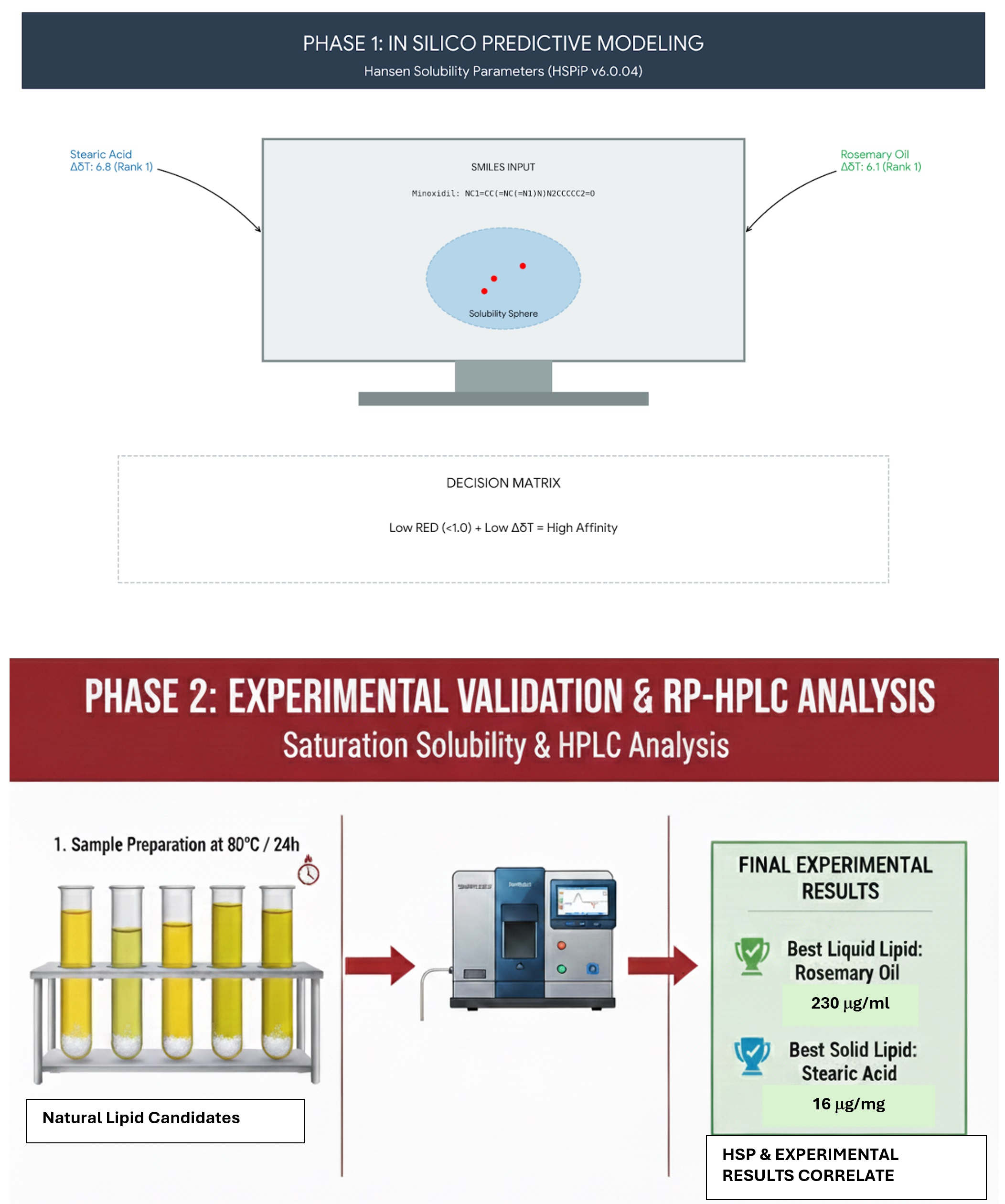
Solubility Preformulation Screening of Minoxidil in Different Natural Oils Using Experimental and Computational Approaches



Abstract
1. Introduction

2. Materials and Methods
2.1. Materials
2.2. Solubility Studies
2.2.1. Solubility Parameter Calculations
2.2.2. Experimental Solubility Studies
Selection of Solid Lipids
Selection of Liquid Lipids
Statistical Analysis of Lipid Solubility Data
3. Results and Discussion
4. Conclusions
Author Contributions
Funding
Data Availability Statement
Conflicts of Interest
Abbreviations
| HSP | Hansen Solubility Parameter |
| BCS | Biopharmaceutical classification system |
| API | Active pharmaceutical ingredient |
| Log (Kow) | Octanol-water partition coefficient |
| NLCs | Nanostructured lipid carriers |
| RED | Relative Energy Difference |
| HSPiP | Hansen Solubility Parameters in Practice |
| SLNs | Solid lipid nanocarriers |
| SMILES | Simplified Molecular Input Line Entry System |
| HPLC | High-performance liquid chromatography |
References
- Rambwawasvika, H. Alopecia Types, Current and Future Treatment. J. Dermatol. Cosmetol. 2021, 5, 93–99. [Google Scholar] [CrossRef]
- Kidangazhiathmana, A.; Santhosh, P. Pathogenesis of Androgenetic Alopecia. Clin. Dermatol. Rev. 2022, 6, 69–74. [Google Scholar] [CrossRef]
- Sawant, N.; Chikhalkar, S.; Mehta, V.; Ravi, M.; Madke, B.; Khopkar, U. Androgenetic Alopecia: Quality-of-Life and Associated Lifestyle Patterns. Int. J. Trichology 2010, 2, 81–85. [Google Scholar] [CrossRef]
- Müller Ramos, P.; Melo, D.F.; Radwanski, H.; de Almeida, R.F.C.; Miot, H.A. Female-Pattern Hair Loss: Therapeutic Update. An. Bras. Dermatol. 2023, 98, 506–519. [Google Scholar] [CrossRef]
- Chen, S.; Xie, X.; Zhang, G.; Zhang, Y. Comorbidities in Androgenetic Alopecia: A Comprehensive Review. Dermatol. Ther. 2022, 12, 2233–2247. [Google Scholar] [CrossRef]
- Pirhayati, F.H.; Mirzaeei, S.; Rahimpour, E.; Mohammadi, G.; Martinez, F.; Taghe, S.; Jouyban, A. Experimental and Computational Approaches for Measuring Minoxidil Solubility in Propylene Glycol + Water Mixtures at Different Temperatures. J. Mol. Liq. 2019, 280, 334–340. [Google Scholar] [CrossRef]
- Pereira, M.N.; Schulte, H.L.; Duarte, N.; Lima, E.M.; Sá-Barreto, L.L.; Gratieri, T.; Gelfuso, G.M.; Cunha-Filho, M.S.S. Solid Effervescent Formulations as New Approach for Topical Minoxidil Delivery. Eur. J. Pharm. Sci. 2017, 96, 411–419. [Google Scholar] [CrossRef] [PubMed]
- Suchonwanit, P.; Thammarucha, S.; Leerunyakul, K. Minoxidil and Its Use in Hair Disorders: A Review. Drug Des. Dev. Ther. 2019, 13, 2777–2786. [Google Scholar] [CrossRef]
- Nagai, N.; Iwai, Y.; Sakamoto, A.; Otake, H.; Oaku, Y.; Abe, A.; Nagahama, T. Drug Delivery System Based on Minoxidil Nanoparticles Promotes Hair Growth In C57BL/6 Mice. Int. J. Nanomed. 2019, 14, 7921–7931. [Google Scholar] [CrossRef]
- Zhao, Z.; Wang, Y.; Xing, H.; Wang, Y.; Lv, K.; Pan, X.; Chen, T.; Hu, Y.; Li, G.; Ma, D. Optimizing Efficacy: Hyaluronic Acid Liposomes Encapsulating Minoxidil for Enhanced Transdermal Delivery and Treatment of Androgenetic Alopecia. Colloids Surf. B Biointerfaces 2025, 255, 114956. [Google Scholar] [CrossRef]
- Naeini, A.H.; Mahdavipour, K.; Rastegari, A.; Aghsami, M.; Montazeri, H.; Faghihi, H.; Mohammadi, Z. Chitosan and Its Amphiphilic Derivative Nanoparticles Loaded with Minoxidil for Induction of Hair Growth: In Vitro and In Vivo Evaluation. Int. J. Biol. Macromol. 2024, 259, 129122. [Google Scholar] [CrossRef]
- Jeong, W.Y.; Kim, S.; Lee, S.Y.; Lee, H.; Han, D.W.; Yang, S.Y.; Kim, K.S. Transdermal Delivery of Minoxidil Using HA-PLGA Nanoparticles for the Treatment in Alopecia. Biomater. Res. 2019, 23, 16. [Google Scholar] [CrossRef] [PubMed]
- Liao, Y.; Liu, C.; Guo, L.; Wang, L.; Xu, S.; Zhou, G.; Zhou, S.; Yuan, M. Temperature-Responsive Detachable Microneedles Integrated with Minoxidil Nanoparticle for Effectively Promoting Hair Regrowth. Chem. Eng. J. 2024, 495, 153666. [Google Scholar] [CrossRef]
- Hamed, R.; Alhadidi, H.F.I. Minoxidil Nanosuspension-Loaded Dissolved Microneedles for Hair Regrowth. AAPS PharmSciTech 2024, 25, 75. [Google Scholar] [CrossRef] [PubMed]
- Markovic, M.; Zur, M.; Garsiani, S.; Porat, D.; Cvijić, S.; Amidon, G.L.; Dahan, A. The Role of Paracellular Transport in the Intestinal Absorption and Biopharmaceutical Characterization of Minoxidil. Pharmaceutics 2022, 14, 1360. [Google Scholar] [CrossRef]
- Mi, J.; Zheng, K.; Jiang, L.; Pang, X.; Wang, J.; Wang, Q.; Sun, Z.; Li, B.; Cui, Y.; Jiao, S.; et al. Minoxidil/Salicylic Acid Hydrogel Formulated for Alopecia Treatment: Supramolecular Interactions Modulate Physicochemical Properties and Biological Activities Revealed by Experimental and Theoretical Studies. J. Mol. Struct. 2024, 1306, 137847. [Google Scholar] [CrossRef]
- Makoni, P.A. Lipid Nanocarriers: A Novel Approach to Delivering Ophthalmic Clarithromycin. Ph.D. Thesis, Rhodes University, Makhanda, South Africa, 2020. [Google Scholar]
- Souto, E.B.; Muller, R.H. Solid Lipid Nanoparticles and Nanostructured Lipid Carriers-Lipid Nanoparticles for Medicals and Pharmaceuticals. Encycl. Nanosci. Nanotechnol. 2011, 23, 313–328. [Google Scholar]
- Makoni, P.A.; Wa Kasongo, K.; Walker, R.B. Preformulation Studies of Efavirenz with Lipid Excipients Using Thermal and Spectroscopic Techniques. Pharmazie 2020, 75, 417–423. [Google Scholar] [CrossRef] [PubMed]
- Hussain, A.; Ramzan, M.; Altamimi, M.A.; Khuroo, T.; Mohd Siddique, M.U.; Alnemer, O.A. HSPiP, Computational Modeling, and QbD-Assisted Optimized Method Validation of 5-Fluorouracil for Transdermal Products. ACS Omega 2024, 9, 903–916. [Google Scholar] [CrossRef]
- Vijayalakshmi, S.; Subramanian, S.; Malathi, S. Hansen Solubility Parameter Approach in the Screening of Lipid Excipients for the Development of Lipid Nano Carriers. Indian J. Pharm. Educ. Res. 2025, 59, s71–s80. [Google Scholar] [CrossRef]
- Abd-algaleel, S.A.; Abdel-Bar, H.M.; Metwally, A.A.; Hathout, R.M. Evolution of the Computational Pharmaceutics Approaches in the Modeling and Prediction of Drug Payload in Lipid and Polymeric Nanocarriers. Pharmaceuticals 2021, 14, 645. [Google Scholar] [CrossRef] [PubMed]
- Sun, J.; Wei, Q.; Shen, N.; Tang, Z.; Chen, X. Predicting the Loading Capability of MPEG-PDLLA to Hydrophobic Drugs Using Solubility Parameters. Chin. J. Chem. 2020, 38, 690–696. [Google Scholar] [CrossRef]
- Doktorovova, S.; Souto, E.B.; Silva, A.M. Hansen Solubility Parameters (HSP) for Prescreening Formulation of Solid Lipid Nanoparticles (SLN): In Vitro Testing of Curcumin-Loaded SLN in MCF-7 and BT-474 Cell Lines. Pharm. Dev. Technol. 2018, 23, 96–105. [Google Scholar] [CrossRef]
- Makoni, P.A.; Ranchhod, J.; WaKasongo, K.; Khamanga, S.M.; Walker, R.B. The Use of Quantitative Analysis and Hansen Solubility Parameter Predictions for the Selection of Excipients for Lipid Nanocarriers to Be Loaded with Water Soluble and Insoluble Compounds. Saudi Pharm. J. 2020, 28, 308–315. [Google Scholar] [CrossRef]
- Sui, X.; Xie, T. Combination of Chinese and Western Medicine to Prevent and Reverse Resistance of Cancer Cells to Anticancer Drugs. Chin. J. Integr. Med. 2020, 26, 251–255. [Google Scholar] [CrossRef]
- Fu, R.; Li, J.; Yu, H.; Zhang, Y.; Xu, Z.; Martin, C. The Yin and Yang of Traditional Chinese and Western Medicine. Med. Res. Rev. 2021, 41, 3182–3200. [Google Scholar] [CrossRef]
- Reihani, N.; Ghourchian, H. Synergy of Keratin Peptides and Natural Oils Embedded in Nanostructured Lipid Carriers to Protect and Restore Human Hair Structure. J. Mol. Liq. 2025, 422, 126957. [Google Scholar] [CrossRef]
- Leite Junior, A.C.; Bastos, C.d.C.B. Essential Oils for Hair Health: A Critical Mini-Review of the Current Evidence and Future Directions. Braz. J. Health Aromather. Essent. Oil 2024, 1, bjhae3. [Google Scholar] [CrossRef]
- Abbott, S.; Hansen, C.M.; Yamamoto, H. Hansen Solubility Parameters in Practice, 6th ed. 2024. Available online: https://hansen-solubility.com/ (accessed on 26 October 2025).
- Wojeicchowski, J.P.; Ferreira, A.M.; Okura, T.; Pinheiro Rolemberg, M.; Mafra, M.R.; Coutinho, J.A.P. Using COSMO-RS to Predict Hansen Solubility Parameters. Ind. Eng. Chem. Res. 2022, 61, 15631–15638. [Google Scholar] [CrossRef]
- He, Z.; Liu, Z.; Zhang, Y.; Guo, T.; Feng, N. Modulating Metal-Organic Frameworks by Surface Engineering of Stearic Acid Modification for Follicular Drug Delivery and Enhanced Hair Growth Promotion. J. Nanobiotechnol. 2025, 23, 118. [Google Scholar] [CrossRef] [PubMed]
- Noor, N.M.; Sheikh, K.; Somavarapu, S.; Taylor, K.M.G. Preparation and Characterization of Dutasteride-Loaded Nanostructured Lipid Carriers Coated with Stearic Acid-Chitosan Oligomer for Topical Delivery. Eur. J. Pharm. Biopharm. 2017, 117, 372–384. [Google Scholar] [CrossRef] [PubMed]
- De La Peña-Gil, A.; Toro-Vazquez, J.F.; Rogers, M.A. Simplifying Hansen Solubility Parameters for Complex Edible Fats and Oils. Food Biophys. 2016, 11, 283–291. [Google Scholar] [CrossRef]
- Barroso, L.; Viegas, C.; Vieira, J.; Ferreira-Pêgo, C.; Costa, J.; Fonte, P. Lipid-Based Carriers for Food Ingredients Delivery. J. Food Eng. 2021, 295, 110451. [Google Scholar] [CrossRef]
- International Conference on Harmonization. ICH Q2(R2) Guideline on Validation of Analytical Procedures; Committee for Medicinal Products for Human Use: Amsterdam, The Netherlands, 2023. [Google Scholar]
- Shatalebi, M.A.; Rafiei, Y. Preparation and Evaluation of Minoxidil Foamable Emu Oil Emulsion. Res. Pharm. Sci. 2014, 9, 123–133. [Google Scholar]
- Abdel-Razek, A.G.; Abo-Elwafa, G.A.; Al-Amrousi, E.F.; Badr, A.N.; Hassanein, M.M.M.; Qian, Y.; Siger, A.; Grygier, A.; Radziejewska-Kubzdela, E.; Rudzińska, M. Effect of Refining and Fractionation Processes on Minor Components, Fatty Acids, Antioxidant and Antimicrobial Activities of Shea Butter. Foods 2023, 12, 1626. [Google Scholar] [CrossRef]
- Ghazani, S.M.; Zou, L.; Rakitsky, W.G.; Marangoni, A.G. Algal Butter, a Novel Cocoa Butter Equivalent: Chemical Composition, Physical Properties, and Functionality in Chocolate. JAOCS J. Am. Oil Chem. Soc. 2018, 95, 1239–1251. [Google Scholar] [CrossRef]
- Deen, A.; Visvanathan, R.; Wickramarachchi, D.; Marikkar, N.; Nammi, S.; Jayawardana, B.C.; Liyanage, R. Chemical Composition and Health Benefits of Coconut Oil: An Overview. J. Sci. Food Agric. 2021, 101, 2182–2193. [Google Scholar] [CrossRef]
- Al-Madhagy, S.; Ashmawy, N.S.; Mamdouh, A.; Eldahshan, O.A.; Farag, M.A. A Comprehensive Review of the Health Benefits of Flaxseed Oil in Relation to Its Chemical Composition and Comparison with Other Omega-3-Rich Oils. Eur. J. Med. Res. 2023, 28, 240. [Google Scholar] [CrossRef]
- Šamec, D.; Loizzo, M.R.; Gortzi, O.; Çankaya, İ.T.; Tundis, R.; Suntar, İ.; Shirooie, S.; Zengin, G.; Devkota, H.P.; Reboredo-Rodríguez, P.; et al. The Potential of Pumpkin Seed Oil as a Functional Food-A Comprehensive Review of Chemical Composition, Health Benefits, and Safety. Compr. Rev. Food Sci. Food Saf. 2022, 21, 4422–4446. [Google Scholar] [CrossRef]
- Guo, Z.; Jia, X.; Zheng, Z.; Lu, X.; Zheng, Y.; Zheng, B.; Xiao, J. Chemical Composition and Nutritional Function of Olive (Olea europaea L.): A Review. Phytochem. Rev. 2018, 17, 1091–1110. [Google Scholar] [CrossRef]
- Medic, J.; Atkinson, C.; Hurburgh, C.R. Current Knowledge in Soybean Composition. J. Am. Oil Chem. Soc. 2014, 91, 363–384. [Google Scholar] [CrossRef]
- Micić, D.; Đurović, S.; Riabov, P.; Tomić, A.; Šovljanski, O.; Filip, S.; Tosti, T.; Dojčinović, B.; Božović, R.; Jovanović, D.; et al. Rosemary Essential Oils as a Promising Source of Bioactive Compounds: Chemical Composition, Thermal Properties, Biological Activity, and Gastronomical Perspectives. Foods 2021, 10, 2734. [Google Scholar] [CrossRef] [PubMed]
- Thermo Scientific. Calculate Reagent Log P Values to Determine Solubility Characteristics; Thermo Scientific: Rockford, IL, USA, 2007; Volume TR0056.1. [Google Scholar]
- Novaes, F.J.M.; de Faria, D.C.; Ferraz, F.Z.; de Aquino Neto, F.R. Hansen Solubility Parameters Applied to the Extraction of Phytochemicals. Plants 2023, 12, 3008. [Google Scholar] [CrossRef] [PubMed]



| API-Lipid System | δD (MPa½) | δP (MPa½) | δH (MPa½) | δT (MPa½) | ΔδT (MPa½) |
|---|---|---|---|---|---|
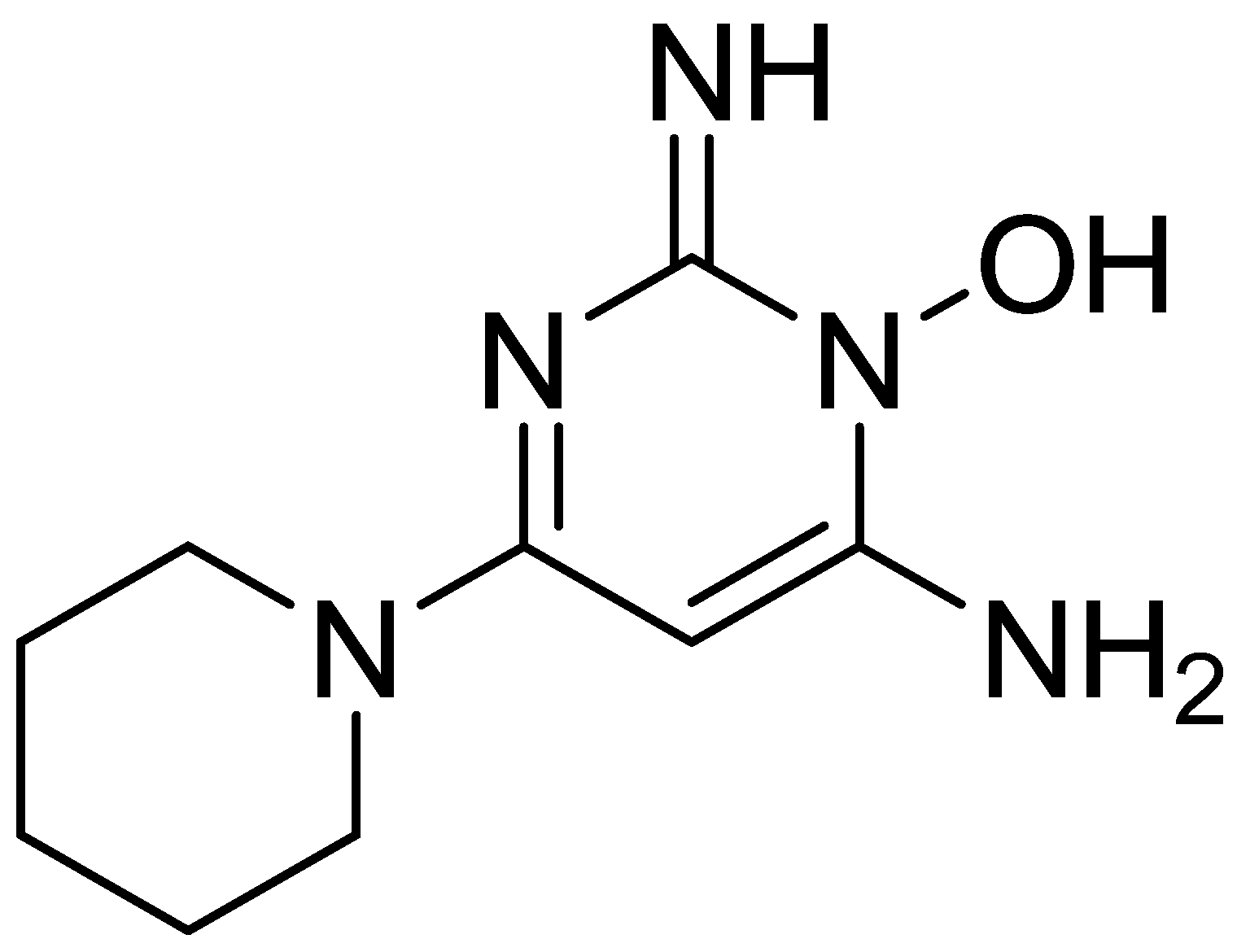
| Minoxidil | 18.7 | 7.8 | 13.2 | 24.2 | |
| Solid lipids | |||||
| Cocoa butter | 16.5 | 1.2 | 2.1 | 16.6 | 7.6 |
| Shea butter (refined) | 16.5 | 1.2 | 2.1 | 16.6 | 7.6 |
| Stearic acid | 16.2 | 2.9 | 5.7 | 17.4 | 6.8 * |
| Coconut oil | 16.4 | 2.4 | 4.1 | 17.0 | 7.2 |
| Liquid lipids | |||||
| Flaxseed oil | 16.5 | 1.7 | 2.7 | 16.8 | 7.4 |
| Olive oil | 16.5 | 1.4 | 2.3 | 16.7 | 7.5 |
| Pumpkin seed oil | 16.5 | 1.7 | 2.7 | 16.8 | 7.4 |
| Rosemary essential oil | 17.8 | 2.8 | 1.5 | 18.1 | 6.1 * |
| Soybean oil | 16.6 | 1.4 | 2.3 | 16.8 | 7.4 |
| Compound or IUPAC Name | Chemical Structure | Log Kow |
|---|---|---|
| Palmitic acid |  | 6.8 |
| Stearic acid |  | 7.9 |
| Oleic acid |  | 7.7 |
| Linoleic acid |  | 7.2 |
| Palmitoleic acid |  | 6.6 |
| Linolenic acid |  | 6.5 |
| Lauric acid |  | 4.8 |
| Myristic acid |  | 5.8 |
| Arachidic acid |  | 8.8 |
| Pinene |  | 4.3 |
| Eucalyptol |  | 3.1 |
| Camphor |  | 2.3 |
| Drug | δD (MPa½) | δP (MPa½) | δH (MPa½) | RED |
|---|---|---|---|---|
| Minoxidil | 18.7 | 7.8 | 13.2 | 0.00 |
| Solid Lipids | ||||
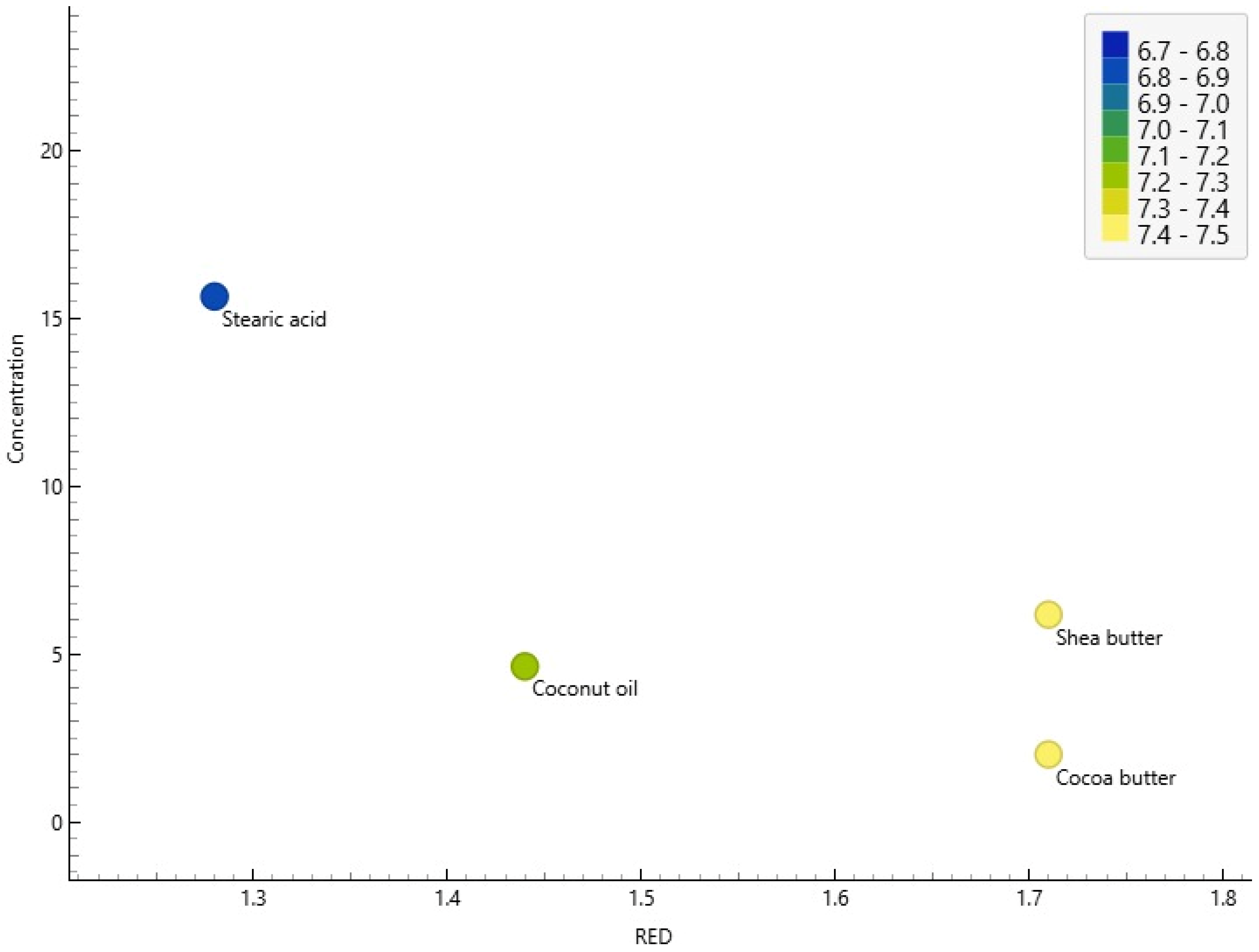
| Stearic acid | 16.2 | 2.9 | 5.7 | 1.28 * |
| Cocoa butter | 16.5 | 1.2 | 2.1 | 1.71 |
| Shea butter (refined) | 16.5 | 1,2 | 2.1 | 1.71 |
| Coconut oil | 16.4 | 2.4 | 4.1 | 1.44 |
| Liquid Lipids | ||||
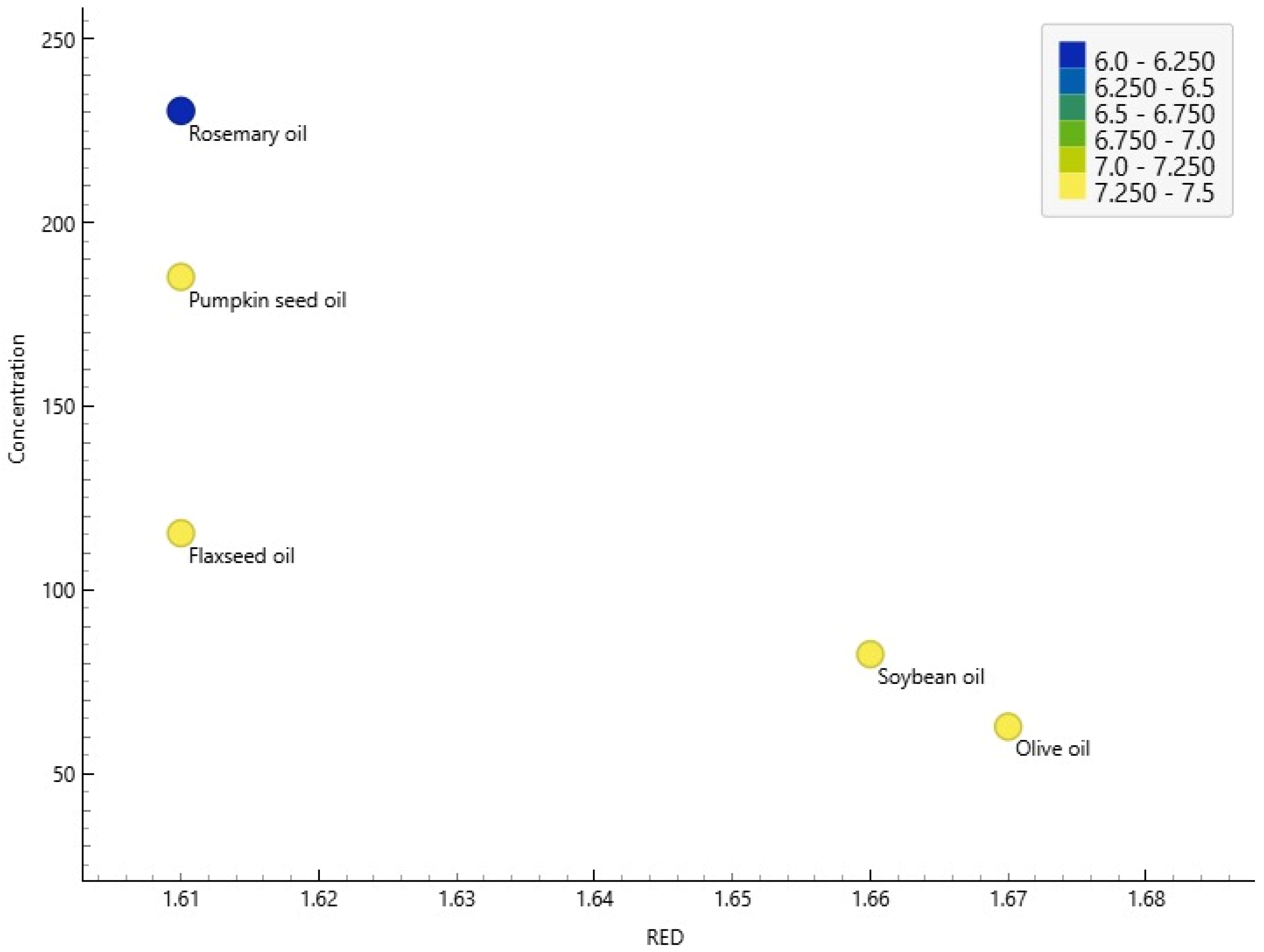
| Pumpkin seed oil | 16.5 | 1.7 | 2.7 | 1.61 * |
| Rosemary essential oil | 17.8 | 2.8 | 1.5 | 1.61 * |
| Flaxseed oil | 16.5 | 1.7 | 2.7 | 1.61 * |
| Soybean oil | 16.6 | 1.4 | 2.3 | 1.66 |
| Olive oil | 16.5 | 1.4 | 2.3 | 1.67 |
Disclaimer/Publisher’s Note: The statements, opinions and data contained in all publications are solely those of the individual author(s) and contributor(s) and not of MDPI and/or the editor(s). MDPI and/or the editor(s) disclaim responsibility for any injury to people or property resulting from any ideas, methods, instructions or products referred to in the content. |
© 2025 by the authors. Licensee MDPI, Basel, Switzerland. This article is an open access article distributed under the terms and conditions of the Creative Commons Attribution (CC BY) license (https://creativecommons.org/licenses/by/4.0/).
Share and Cite
Motloung, K.M.A.; Witika, B.A.; Makoni, P.A. Solubility Preformulation Screening of Minoxidil in Different Natural Oils Using Experimental and Computational Approaches. Processes 2025, 13, 4027. https://doi.org/10.3390/pr13124027
Motloung KMA, Witika BA, Makoni PA. Solubility Preformulation Screening of Minoxidil in Different Natural Oils Using Experimental and Computational Approaches. Processes. 2025; 13(12):4027. https://doi.org/10.3390/pr13124027
Chicago/Turabian StyleMotloung, Khothatso Mapule Annah, Bwalya Angel Witika, and Pedzisai Anotida Makoni. 2025. "Solubility Preformulation Screening of Minoxidil in Different Natural Oils Using Experimental and Computational Approaches" Processes 13, no. 12: 4027. https://doi.org/10.3390/pr13124027
APA StyleMotloung, K. M. A., Witika, B. A., & Makoni, P. A. (2025). Solubility Preformulation Screening of Minoxidil in Different Natural Oils Using Experimental and Computational Approaches. Processes, 13(12), 4027. https://doi.org/10.3390/pr13124027