Article

SpyCatcher-Multiplicity Tunes Nanoscaffold Hydrogels for Enhanced Catalysis of Regulated Enzymes


1
Guangxi Key Laboratory of Green Processing of Sugar Resources, Guangxi University of Science and Technology, Liuzhou 545006, China
2
Angel Yeast Co., Ltd., Yichang 443003, China
*
Author to whom correspondence should be addressed.
Processes 2025, 13(12), 4009; https://doi.org/10.3390/pr13124009
Submission received: 18 November 2025 / Revised: 1 December 2025 / Accepted: 8 December 2025 / Published: 11 December 2025
(This article belongs to the Section Materials Processes)

Abstract

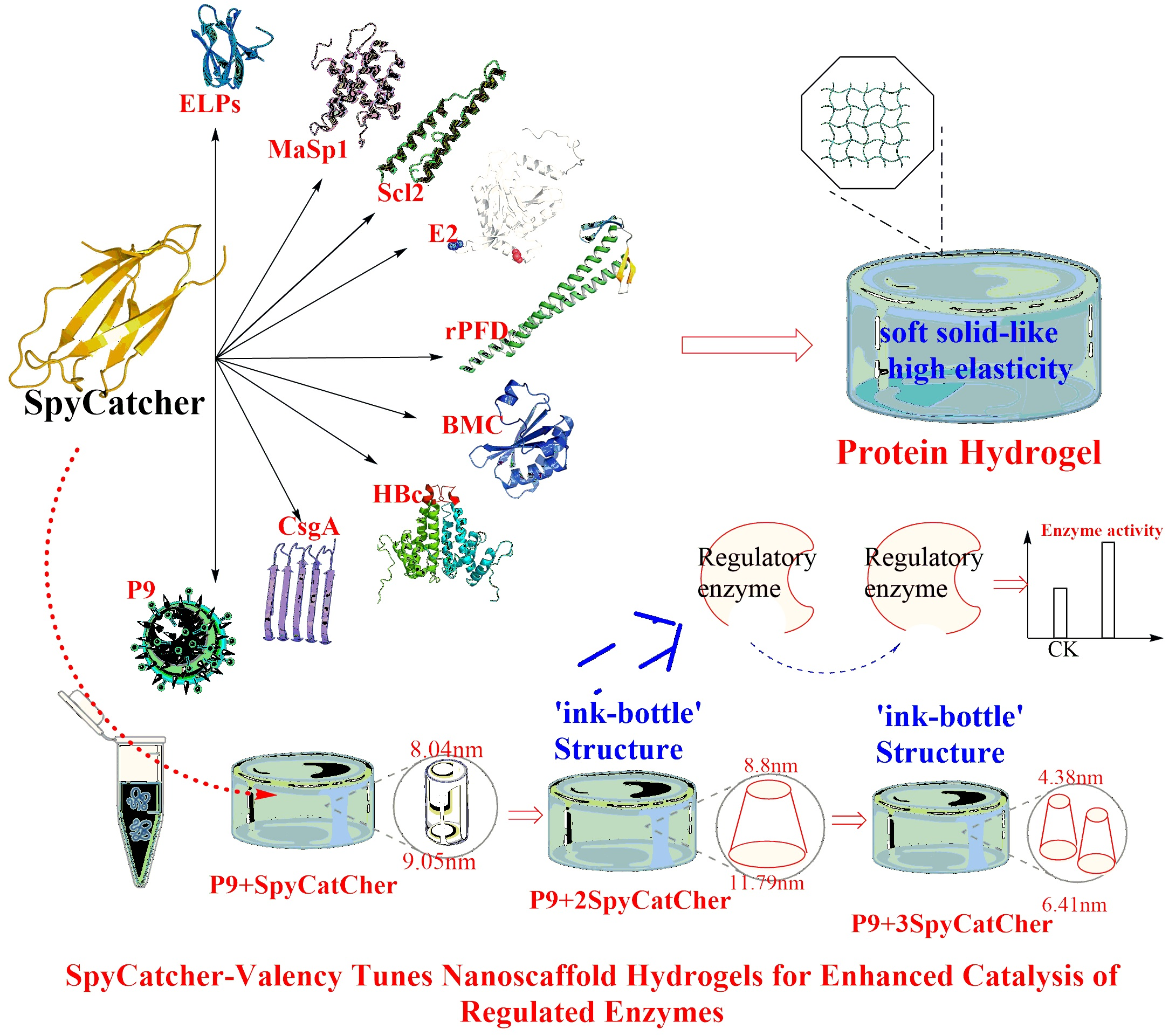
This study presents a strategy for enhancing hydrogel formation through SpyCatcher-mediated conjugation of nanoscale scaffold proteins. We demonstrate that SpyCatcher can facilitate hydrogel assembly with various nano-scaffolds of diverse structural configurations. By conjugating one, two, or three SpyCatcher units to the P9 protein nanoscaffold, hydrogel yield was substantially increased, allowing for the simultaneous co-immobilization of a larger number of enzymes. Characterization using cell-free biosynthesis, electron microscopy, and rheological analysis revealed that the resulting SpyCatcher-mediated nanoscaffold hydrogels exhibit soft solid-like behavior, high elasticity, and an “ink-bottle” pore morphology, which collectively promote and regulate enzymatic activity. Notably, hydrogels crosslinked via the P9 scaffold with two SpyCatcher units showed the most balanced properties, leading to a 149% increase in pyruvic acid production. These findings not only advance the efficient design of hydrogels for enzyme co-immobilization but also provide a foundation for developing more sophisticated models and expanding the scope of biocatalytic systems.

1. Introduction

Protein- and peptide-based nanostructured hydrogels have emerged as promising biomaterials in biosynthesis and biomedical applications due to their genetically programmable nature and customizable functionalities, which significantly expand their potential utility [1]. These three-dimensional polymeric networks demonstrate remarkable versatility in biomedical applications, ranging from controlled drug delivery systems to biosensing platforms and tissue engineering scaffolds [2,3,4]. In biosynthesis, their porous architecture enables effective enzyme immobilization for enhanced catalytic processes [5], such as the biological synthesis of certain chemicals and food flavorings, etc. Conventional hydrogel formation typically relies on physical entanglement, electrostatic interactions, or covalent crosslinking of hydrophilic polymer chains in aqueous environments [6]. However, chemically synthesized hydrogels often lack biological activity, driving current research toward developing protein-based hydrogels with tunable mechanical properties and biofunctionality through rational design strategies.
Natural proteins such as elastin, laminin, and silk fibroin have been extensively investigated for hydrogel fabrication. Nevertheless, practical implementation faces significant challenges, including high production costs of pure proteins and inadequate mechanical strength of the resulting hydrogels [2,7]. Conventional physical or chemical crosslinking methods frequently require specialized conditions and may compromise protein integrity, thereby limiting scalability and application potential [8]. These limitations underscore the critical need for developing facile and biocompatible hydrogel preparation strategies to advance practical implementation.
In our previous research [8], hydrogel formation was observed after connecting γ-profoldin (γPFD) nanoscaffolds from Methanocaldococcus jannaschii (M. jannaschii) with SpyCatcher from Streptococcus pyogenes (S. pyogenes), showing great potential for enzyme co-immobilization, particularly in promoting the regulation of enzyme activity. However, the ability of γPFD to form hydrogels mediated by SpyCatcher may be attributed to its unique linear β-chain repetitive structure [9]. Whether SpyCatcher can promote the formation of hydrogels in combination with other structural types of nanoscaffold proteins, whether increasing the gene copy number of SpyCatcher further promotes the formation of hydrogels, and why SpyCatcher-mediated hydrogels can enhance the activity of regulatory enzymes have not yet been explored and reported. The current study systematically evaluates the hydrogel-forming capacity of representative nanoscaffold proteins with distinct structural configurations. We investigate the dose-dependent effects of SpyCatcher on hydrogel formation. Furthermore, we establish a modular platform for enzyme co-immobilization by incorporating SpyTag-modified enzymes, using a pyruvate-producing cell-free biosynthesis system (CFBS) as a model. Through comprehensive characterization of enzymatic activity and hydrogel performance, this work provides fundamental insights into developing multifunctional protein hydrogels with tailored biocatalytic properties.

2. Materials and Methods

2.1. Strains and Plasmids

The bacterial strains and plasmids used in this study are listed in Table 1. E. coli BL21(DE3) served as the host strain for recombinant protein expression. All gene sequences (Supplementary Table S1) were codon-optimized for E. coli expression systems.

2.2. Plasmid Construction

Codon-optimized genes encoding BMC (cyanophycin synthetase from Cyanophyceae), CsgAB (curli amyloid protein from E. coli), E2 (dihydrolipoamide acetyltransferase from Bacillus stearothermophilus), ELPs (elastin-like polypeptides from Procambarus clarkii), Scl2 (collagen-like protein from Streptococcus), HBcAg (icosahedral virus-like particles hepatitis B core antigen protein), P9 (phage capsid protein from Pseudomonas phage), MaSp1 (spidroin from Rhodovulum sulfidophilum), and SpyCatcher (spontaneous isopeptide bond-forming module from S. pyogenes) were commercially synthesized by ANSHENGDA (Suzhou, China). These genes were cloned into the pET32a vector (Novagen) via NcoI and HindIII restriction sites to generate recombinant plasmids: pET32a-BMC, pET32a-BMC-SpyCatcher, pET32a-CsgAB, pET32a-CsgAB-SpyCatcher, pET32a-E2, pET32a-E2-SpyCatcher, pET32a-ELPs, pET32a-ELPs-SpyCatcher, pET32a-Scl2, pET32a-Scl2-SpyCatcher, pET32a-HBcAg, pET32a-HBcAg-SpyCatcher, pET32a-P9, pET32a-P9-SpyCatcher, pET32a-P9-2SpyCatcher, and pET32a-P9-3SpyCatcher.

2.3. Cell Culture and Lysate Preparation

Single colonies were inoculated into 5 mL of LB medium (5% yeast extract, 10% peptone, 10% NaCl) and grown overnight at 37 °C with shaking (200 rpm). Seed cultures were diluted to an initial OD600 of 0.1 in 50 mL fresh LB medium and incubated under identical conditions until reaching an OD600 ≈ 0.8. For pZACBP-derived constructs, cultures were maintained at 25 °C without IPTG (Isopropyl β-D-1-thiogalactopyranoside) induction. For pET32a-derived constructs, protein expression was induced with 1 mM IPTG followed by 20 h of incubation at 25 °C (200 rpm). Cells were harvested by centrifugation (10,000× g, 4 °C, 2 min), washed with phosphate buffer (0.1 M, pH 7.0), and lysed using a high-pressure homogenizer (ANTUOSI AH-Basic, Suzhou, China) at 1500 bar. Total protein concentration was determined by Bradford assay (Bio-Rad, Hercules, CA, USA) using bovine serum albumin (BSA) as the standard.

2.4. Protein Purification

Cell lysates were centrifuged (8000× g, 30 min, 4 °C), and supernatants were loaded onto Ni-NTA affinity columns (2 mL bed volume). Proteins were eluted using an imidazole gradient (20–500 mM) according to the manufacturer’s protocol (HisTrap™ FF, Cytiva, Marlborough, MA, USA). For SpyCatcher purification, lysates were incubated with 4 M ammonium sulfate on ice for 4 h, followed by centrifugation (8000× g, 5 min, 4 °C) to collect hydrogel-embedded proteins. The precipitate was then washed twice with five volumes of pre-cooled sterile water.

2.5. Validation of Isopeptide Bonds and Grayscale Analysis

Covalent conjugation between P9-SpyCatcher and SpyTag-fused enzymes was verified by 12.5% SDS-PAGE under denaturing conditions. Grayscale analysis was performed using ImageJ software (v1.53, NIH), with quantification parameters including band area, minimum/maximum gray values, integrated density, and mean gray value.

2.6. Transmission Electron Microscopy (TEM)

Protein samples (30 µL) were adsorbed onto 200-mesh copper grids for 10 min, negatively stained with 1% uranyl acetate (2 min), and air-dried. Imaging was performed using a Hitachi HT7800 microscope (Gurugram, India) at magnifications of 10,000×, 30,000×, and 70,000×.

2.7. Enzyme Immobilization Assay

SpyCatcher can stably bind to enzymes labeled with SpyTag under various pH and temperature conditions. By centrifugation and washing, the unbound proteins can be removed [8]. P9-SpyCatcher, P9-2SpyCatcher and P9-3SpyCatcher were individually incubated with mCherry-SpyTag (29.6 kDa) at molar ratios of up to 1:7 (total volume: 80 µL) at 37 °C for 1 h. After centrifugation (8000× g, 1 min), unbound mCherry-SpyTag in the supernatant was quantified fluorometrically (excitation: 485 nm, emission: 528 nm; Synergy Neo2, BioTek, Winooski, VT, USA). Free mCherry-SpyTag served as the negative control.

2.8. Cell-Free Biosynthesis System (CFBS)

CFBS reactions were carried out in a volume of 30 µL at 37 °C in 1.5 mL Eppendorf tubes for 6 h. The standard reaction mixture, as described in our previous studies [8,10] contained the following components: acetate salts (8 mM magnesium acetate, 10 mM potassium phosphate (K2HPO4, pH 7.2), 4 mM ammonium acetate, and 134 mM potassium acetate), 2 mM NAD+, 20 mM NADPH, 1.5 mM CoA, 1.5 mM ATP, and 200 mM glucose.
E. coli BL21(DE3) lysates were used for protein expression in cell-free synthesis. Cultured cells were centrifuged at 8000× g for 5 min and washed twice with pre-cooled S30 buffer (14 mM magnesium acetate, 2 mM dithiothreitol, 10 mM Tris-acetate, 60 mM potassium acetate, pH 8.2), and resuspended in 0.5 mL of S30 buffer per gram of wet cell pellet. The crude lysates (10 mg/mL protein concentration) were used directly in CFBS reactions, while other purified enzymes co-immobilized by hydrogel were applied at 2 mg/mL. The crude CFBS reaction mixture served as the base system, with purified enzymes supplemented for subsequent reactions. After 6 h of reaction, the solution was centrifuged at 8000× g for 5 min, and the supernatant was collected for analysis.

2.9. Pore Size Determination with BET

The BET test was conducted by KEYANGOU Technology Co., Ltd. (Beijing, China), and for each sample, three parallel tests were conducted, and the average value was calculated afterwards. Freeze-dried protein powder samples (FreeZone®; Labconco, Kansas City, MO, USA) were subjected to BET surface area and porosity analysis (ASAP 2020; Micromeritics, Norcross, GA, USA). Prior to measurement, samples were degassed at <40 °C under vacuum (<10−3 mbar) for 12 h. Nitrogen adsorption isotherms were collected at 77 K across relative pressures (P/P0) of 0.05–0.30, with ≥30 s equilibration time per data point. Pore size distributions were calculated using the Barrett-Joyner-Halenda (BJH) method.

2.10. Rheology Measurements

The frequency-, shear stress-, and time-dependent viscoelastic moduli (G′ and G″) were measured using a TA Instruments (Waters Corporation., New Castle, DE, USA) Discovery Hybrid Rheometer equipped with a 4 mm flat plate. The mechanical properties of P9-SpyCatcher, P9-2SpyCatcher, and P9-3SpyCatcher were measured in frequency and time modes at 25 °C with a strain of 2% and a test frequency of 10 rad/s. The frequency-dependent sweep ranged from 0.1 to 100 Hz. The shear stress-dependent sweep ranged from 0.1% to 100%.

2.11. Assay

Culture turbidity was monitored at 600 nm, pyruvate was analyzed by HPLC using an HC-C18 column (5 µm, 4.6 × 250 mm, Agilent, Santa Clara, CA, USA). The mobile phase consisted of 0.03 mol/L KH2PO4 and methanol (6:4, v/v) delivered at 1.0 mL/min, with the column oven maintained at 30 °C. Pyruvate was monitored at 225 nm using an ultraviolet detector, with retention times ranging from 3.0 to 3.5 min.

2.12. Statistical Analysis

All experiments were performed in triplicate. Data are presented as mean ± standard deviation. Statistical significance (p < 0.05) was determined by one-way ANOVA with Tukey’s post hoc test using OriginPro 9.1 (OriginLab, Northampton, MA, USA).

3. Results and Discussion

3.1. Design and In Vitro Characterization of Protein Nanoscaffolds Mediated by SpyCatcher

Our previous work established that SpyCatcher enables spontaneous hydrogel formation through γ-profoldin (γPFD) assembly [8]. Given that γPFD exhibits a linear β-chain architecture [9], we sought to investigate whether this phenomenon extends to nanoscaffolds with distinct structural geometries. Thus, eight proteins with different nanostructures were selected from our laboratory’s existing nanoscaffold component library (Table 2): icosahedral bacterial microcompartments (BMCs) [11], amyloid-like CsgA fibrils [12], E2 nanocages [13], elastin-like polypeptides (ELPs) [14], hepatitis B core antigen (HBcAg) icosahedrons [15], collagen-like Scl2 lollipop structures [16], spherical phage P9 membranes [17], and spider silk MaSp1 fibrils [18].
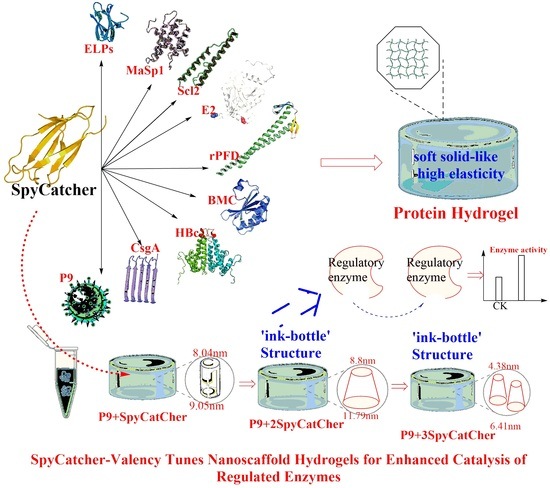
All nanoscaffold proteins remained soluble when expressed in E. coli BL21(DE3). Remarkably, SpyCatcher fusion induced hydrogel formation across all nanoscaffold types within 4 h at 4 °C (accelerated to 30 min with 100 mM ammonium sulfate) (Figure 1). Subsequently, we quantified the swelling rates of the SpyCatcher-based protein hydrogels (Supplementary Figure S2). The expansion rates of these samples were relatively low (approximately 300–400%), indicating their strong potential as fixation matrices. While conventional strategies preferentially employ SpyTag (~1.5 KDa) for protein fusion due to its smaller molecular weight [20], this study innovatively leveraged SpyCatcher (~9.5 KDa) as the conjugation module to establish a rapid hydrogel formation platform. This approach offers two advantages: (1) precise co-immobilization of SpyTag-fused target enzymes via specific molecular recognition, and (2) simultaneous enzyme purification through SpyCatcher-mediated phase separation, effectively bypassing the need for traditional chromatographic methods.
Although nanoscaffold protein hydrogels integrated with Spy systems have been reported—exemplified by SpyTag-fused spider silk proteins [21] such constructs inherently possess gelation capabilities. For scaffold proteins lacking intrinsic hydrogel-forming properties, SpyCatcher conjugation offers an efficient alternative. This geometry-sensitive yet universal gelation mechanism fundamentally differs from conventional strategies requiring external crosslinkers. For instance, Zhang et al. [22] employed dual physical-chemical crosslinking for ELP hydrogels, while Lim et al. [23] and Cosgriff-Hernandez et al. [24] relied on synthetic polymer conjugation. Our SpyCatcher-mediated approach eliminates such requirements, enabling intrinsic biofunctionalization through SpyTag-fusion partners.
Alternatively, SpyCatcher/SpyTag systems can mediate self-assembly of identical proteins to enable structural superposition, enhancing hydrogel crosslinking density while facilitating autonomous organization. For instance, Gao et al. [25] constructed GB1-SpyCatcher and GB1-SpyTag conjugates for hydrogel formation. However, such systems primarily enable post-assembly immobilization of enzymes or small molecules within preformed matrices. In contrast, our strategy leverages SpyCatcher’s intrinsic phase-separation capability while preserving SpyTag’s functionality for directed small-molecule conjugation, achieving superior molecular stability. Although it remains uncertain whether SpyCatcher can facilitate hydrogel formation with all types of nanoproteins, SpyCatcher-mediated hydrogel formation provides a novel approach for subsequent research. Nevertheless, SpyCatcher-mediated hydrogel synthesis exhibits limitations: significant residual monomeric proteins persist post-assembly, with SDS-PAGE analysis revealing scaffold-dependent efficiency variations evidenced by differential supernatant protein levels (Supplementary Figure S1).

3.2. SpyCatcher Multivalency Enhances P9 Hydrogel Formation

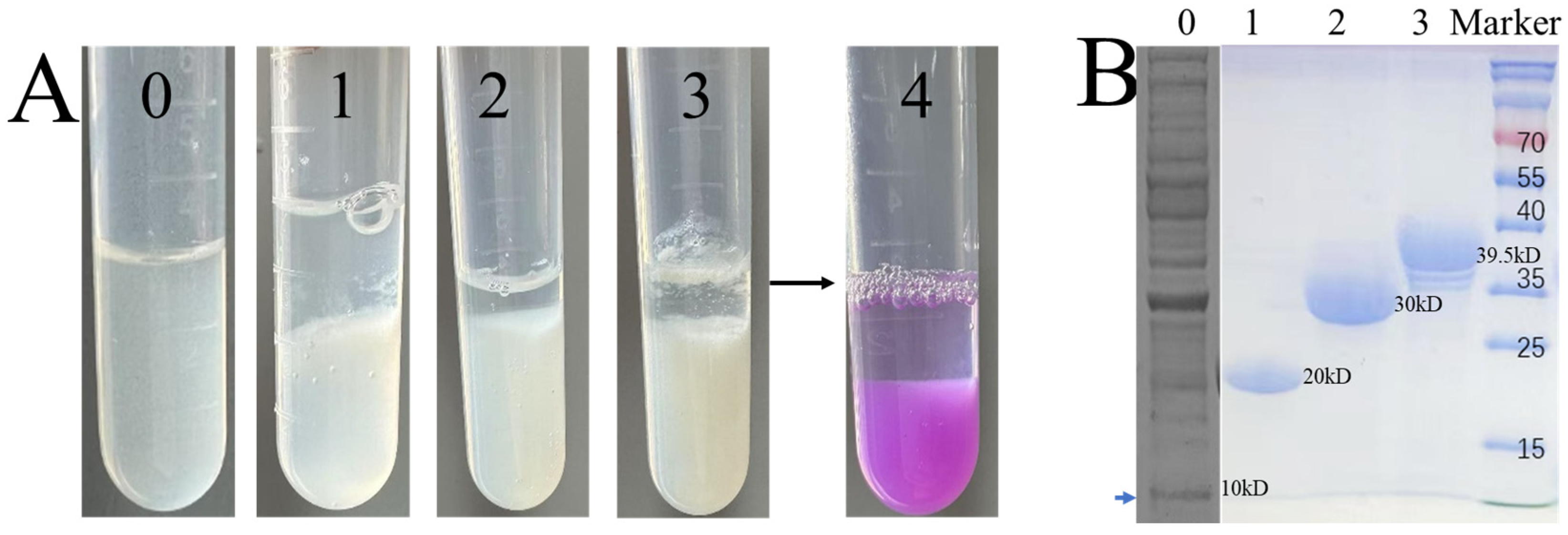
Since SpyCatcher conjugation does not ensure complete hydrogel precipitation of scaffold proteins, multivalent SpyCatcher conjugation requires further investigation. To probe the relationship between SpyCatcher valency and hydrogel properties, we engineered P9 phage membrane proteins with increasing SpyCatcher units (1–3 copies). While native P9 remained soluble (Figure 2(A0)), SpyCatcher fusion induced concentration-dependent hydrogel formation (Figure 2(A1–A3)). Under the condition of maintaining the consistency of total protein, grayscale analysis of protein bands performed using ImageJ software (v1.53, NIH) revealed a 2.5:2:1 hydrogel mass ratio corresponding to the 3:2:1 SpyCatcher variants (Figure 2B). Intriguingly, P9-3SpyCatcher exhibited anomalous SDS-PAGE migration despite confirmed sequence integrity (Sequencing identification), likely due to insoluble aggregate formation altering electrophoretic mobility [26]. Of course, this conclusion is merely a preliminary observation. More direct research will be conducted in the future to further address this gelation issue.

3.3. SpyCatcher-Dependent Enzyme Immobilization Capacity

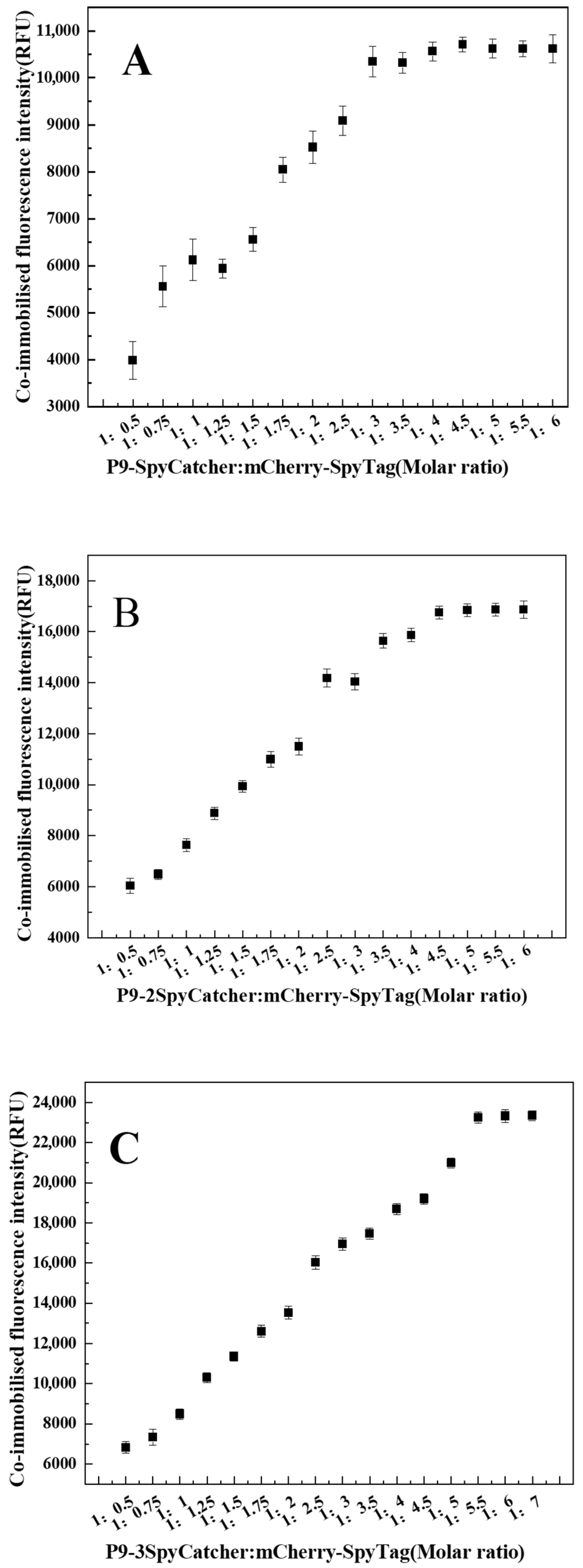
Building upon the established correlation between SpyCatcher valency and hydrogel yield, we investigated the molecular loading capacity of P9-based hydrogels through SpyTag-mediated enzyme conjugation. Quantitative fluorescence analysis revealed a valency-dependent immobilization profile where the amount of fluorescent protein is positively correlated with fluorescence intensity: P9-SpyCatcher, P9-2SpyCatcher, and P9-3SpyCatcher carried 3.0, 4.5, and 5.5 moles of cargo protein per mole of hydrogel, respectively (Figure 3). This linear relationship between SpyCatcher multiplicity and loading efficiency underscores the system’s programmability for controlled enzyme integration.

3.4. Nanostructural Evolution Mediated by SpyCatcher Valency

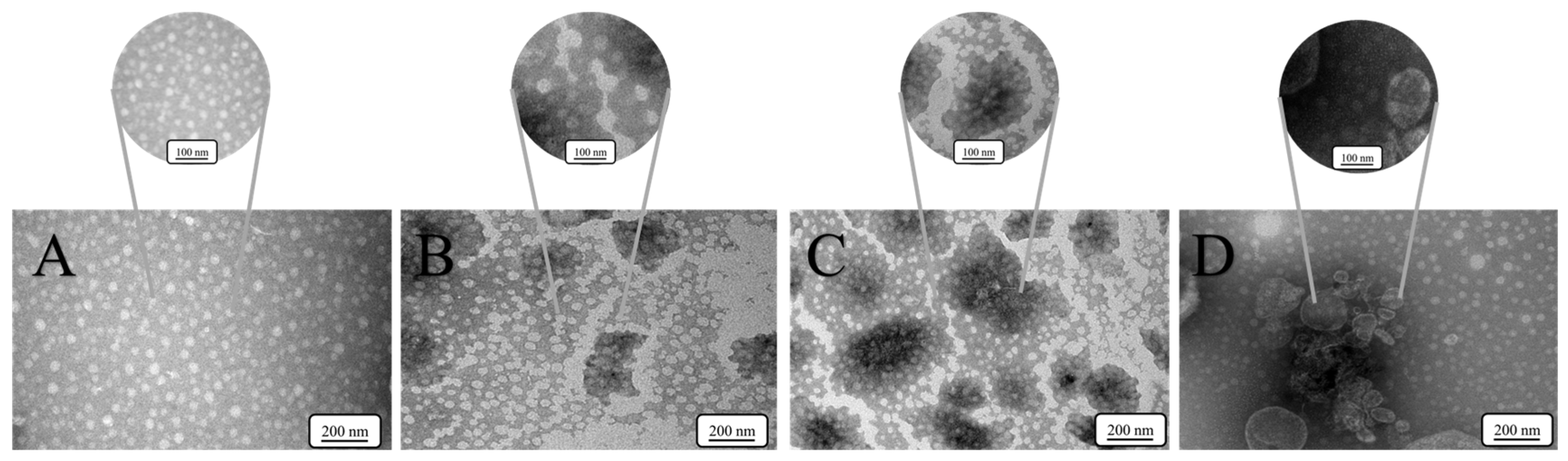
To elucidate the structural basis of valency-dependent hydrogel properties, we conducted negative-stain TEM analysis across P9 variants (Figure 4). Native P9 maintained spherical vesicles, consistent with previous reports [17,27] (Figure 4A). SpyCatcher conjugation induced distinct assembly patterns:
  • P9-SpyCatcher: Linear chain-like aggregates via pairwise interactions (Figure 4B).
  • P9-2SpyCatcher: Networked clusters exhibiting significantly increased crosslinking density, as measured by the total length of interconnected P9 monomers (approximately 68.4% increase) (Figure 4C).
  • P9-3SpyCatcher: Dense microdomains exhibiting reduced interparticle spacing (Figure 4D).
Upon closer inspection, a significant structural transformation was observed following the connection of three SpyCatcher units. Concurrently, the population of free P9 proteins in the surrounding environment exhibited a marked reduction. Notably, the SpyCatcher-linked P9 molecules underwent molecular fusion, ultimately self-organizing into dense and irregular aggregates (Figure 4D). This structural progression mirrors γPFD’s “regionalized” assembly pattern [8], suggesting a universal SpyCatcher-mediated crosslinking mechanism. The transition from discrete nanoparticles to continuous hydrogel networks explains both enhanced enzyme loading and eventual decline in catalytic efficiency in P9-3SpyCatcher systems (Figure 5).

3.5. CFBS-Driven Rational Engineering for Pyruvate Production

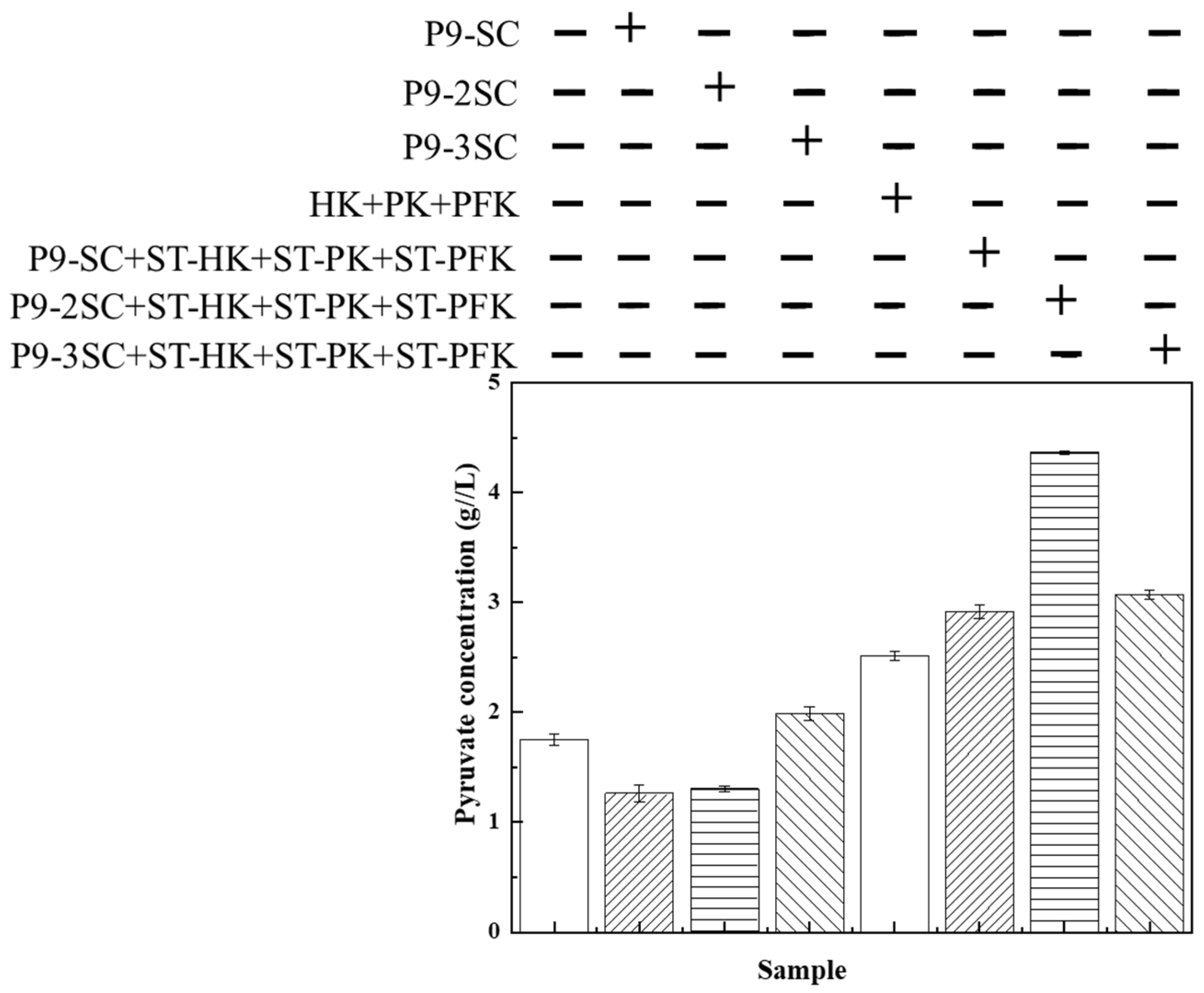
The CFBS serves as a powerful biomanufacturing platform, particularly when utilizing crude cell extracts for rapid enzyme production [28]. However, conventional CFBS approaches face challenges, including excessive impurities and low target protein yields [10]. To address these limitations, we developed a SpyCatcher-mediated protein hydrogel system that enables rapid purification and precise enzyme immobilization. Building upon our previous demonstration of γPFD-SpyCatcher hydrogels for enhanced biocatalysis [8], we implemented a CFBS platform for pyruvate synthesis using three glycolytic enzymes: hexokinase (HK), phosphofructokinase (PFK), and pyruvate kinase (PK). Pyruvate is the final product of the glycolysis synthesis pathway. The metabolic pathway involves the participation of regulatory enzymes; this design allowed systematic evaluation of SpyCatcher valency effects in P9-based hydrogels (Figure 5).
Fluorometric quantification demonstrated SpyCatcher-dependent mCherry-SpyTag immobilization capacities: 3.0, 4.5, and 5.5 (mol) enzyme/(mol) scaffold for 1-3 SpyCatcher variants, respectively (Figure 3A). However, cell-free biosynthesis (CFBS) of pyruvate revealed non-linear catalytic enhancement (Figure 5). As shown in Figure 5, P9-2SpyCatcher increased pyruvate production by 49% compared to crude extract at equivalent protein loading, whereas P9-3SpyCatcher yielded only a 31% increase. Comparative analysis with prior γPFD-SpyCatcher hydrogel systems [8] further revealed scaffold-dependent variations in enzymatic activity. Although P9-3SpyCatcher achieves maximal enzyme immobilization capacity, it proves suboptimal for regulating multi-enzyme cascades. We attribute this limitation to substrate diffusion constraints caused by enzyme overcrowding in denser hydrogels, as evidenced by pore structure alterations (Figure 4D). Of course, it could also be due to the excessive density of enzyme immobilization, resulting in increased spatial steric hindrance, reduced substrate accessibility, and the crowding effect among enzyme molecules. Further experiments are needed to confirm this.

3.6. Rheological Properties of SpyCatcher-Mediated Protein Hydrogels

To investigate the potential relationship between mechanical properties and enzyme activity enhancement, we performed rheological characterization on the protein hydrogels. All measurements were conducted with triplicate independent samples (n = 3), and the linear viscoelastic region (LVR) was determined through amplitude sweep experiments prior to frequency scans. The storage modulus (G′) and loss modulus (G″) were monitored within the confirmed LVR. As shown in Supplementary Figure S3 and Table 3, all hydrogel variants exhibited G′ values consistently greater than G″ across the measured frequency range, confirming the formation of solid-like networks with elastic behavior dominant over viscous properties. The P9-2SpyCatcher hydrogel demonstrated an intermediate stiffness with balanced structural integrity, while P9-SpyCatcher formed a relatively denser network. In contrast, P9-3SpyCatcher showed the lowest mechanical strength among the three variants, consistent with its potentially more porous architecture.
It is noteworthy that all hydrogels displayed some frequency dependence in their moduli, with G′ and G″ both increasing slightly with frequency. This behavior is characteristic of many physically crosslinked biopolymer hydrogels and reflects their soft, dynamic nature rather than ideal elastic networks. Such frequency dependence does not preclude their classification as hydrogels, as the consistent G′ > G″ relationship confirms their solid-like character, which is widely accepted in biomaterials science for similar soft networks. The observed “shear-thinning” behavior, where viscosity decreased with increasing shear rate, further supports the dynamic nature of these networks and suggests potential applicability in injectable delivery systems.
Based on these rheological properties, we hypothesize that the soft, elastic nature of SpyCatcher-mediated hydrogels contributes significantly to enhancing enzymatic activity. The P9-2SpyCatcher variant, with its intermediate crosslinking density, appears to offer an optimal balance between preventing enzyme leakage and permitting sufficient substrate diffusion, explaining its superior performance in the CFBS system.

3.7. Structural Characteristics of SpyCatcher-Mediated Protein Hydrogels

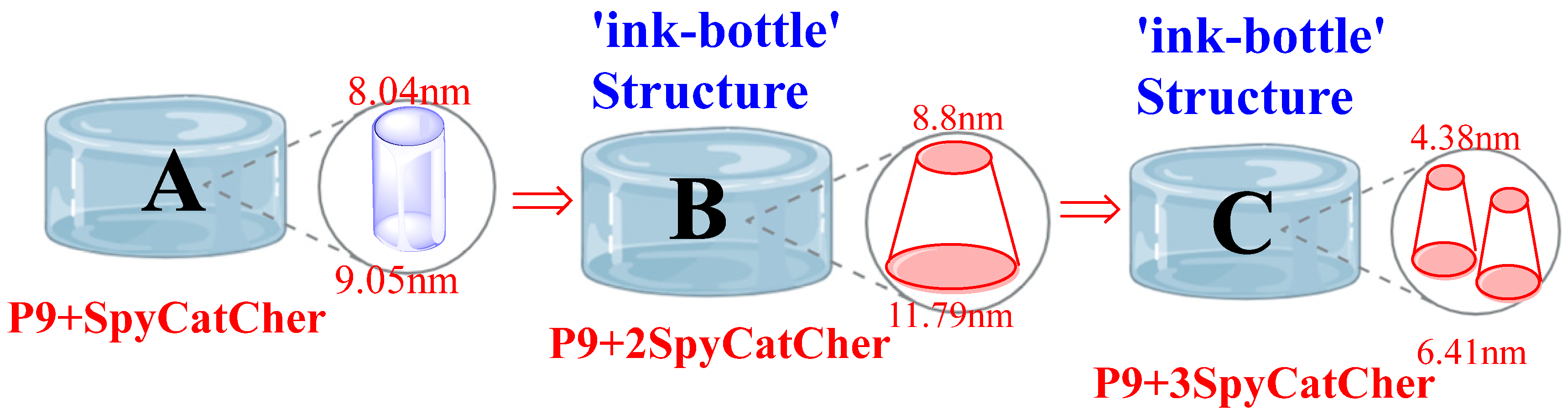
The structural characteristics of hydrogels may significantly impact their functions. Therefore, we next quantified the pore architectures of P9-SpyCatcher variants using BET surface area analysis. Increasing the SpyCatcher content enhanced hydrogel formation and proportionally increased the specific surface area (P9-3SpyCatcher > P9-2SpyCatcher > P9-SpyCatcher), as expected (larger surface area allows more enzymes to be immobilized). The pore size distributions of the P9-SpyCatcher, P9-2SpyCatcher, and P9-3SpyCatcher hydrogels are presented in Table 4. Based on these results, we performed a comparative analysis, and a schematic illustrating this mechanism is provided in Figure 6:
  • P9-SpyCatcher: The adsorption (9.50 nm) and desorption (8.04 nm) pore diameters are similar (difference = 1.46 nm), indicating uniform pore channels. This uniformity allows enzyme molecules to fully enter and freely orient within the pores, enhancing catalytic performance.
  • P9-2SpyCatcher: The significant difference between adsorption (11.8 nm) and desorption (8.81 nm) pore diameters (Δ = 2.99 nm) is characteristic of an “ink-bottle pore” structure (wide cavity + narrow pore neck). In the field of biomaterials, ‘ink-bottle type materials’ exhibit adsorption hysteresis due to pore blocking caused by the necessity to pass through narrow openings [29]. However, if pore blocking is absent in the ink-bottle geometry, its significance in other contexts warrants re-evaluation [30], such as in enzyme immobilization of P9-2SpyCatcher. The large cavity size (11.8 nm) may accommodate more enzyme molecules, potentially contributing to its greater efficacy in regulating enzyme activity compared to P9-SpyCatcher.
  • P9-3SpyCatcher: The significantly higher BJH adsorption pore diameter (6.41 nm) relative to the BET value (3.31 nm) (ratio = 1.94) indicates a hierarchical micro-mesoporous structure. This structure combines abundant micropores (sensitive to BET analysis) with mesopores (BJH adsorption = 6.41 nm), rendering it suitable for small molecule adsorption/catalysis. However, the smaller pore dimensions make it prone to clogging following enzyme immobilization.
The larger the surface area of the hydrogel, the more enzymes it can carry. However, the ink-bottle effect does exhibit an important correlation with the analysis of specific surface area and pore size distribution, though this correlation is not necessarily mathematical. Generally, when the pore size is smaller than the dimensions of the enzyme or substrate molecules, it restricts their access to the hydrogel cavities. Conversely, excessively large pores reduce the collision frequency between enzymes and substrates, thereby diminishing catalytic efficiency. Moreover, compared to regularly shaped gels, the ink-bottle structure achieves superior molecular concentration within the cavity and facilitates slow release. Therefore, we infer that the enhanced catalysis of regulatory enzymes promoted by SpyCatcher may also be closely related to the “ink-bottle” structure. Based on this, we boldly hypothesize that in the process of immobilizing regulatory enzymes using the embedding method and conducting catalytic research, constructing a similar “ink-bottle” structure model is more conducive to catalytic activity than the conventional uniform model. Therefore, cylindrical and cylindrical–trapezoidal columns prepared based on PAGE gel (Same surface area, same enzyme quantity) were used for the embedding and catalytic experiments of glutamate dehydrogenase, and it was concluded that the embedding of a similar “ink-bottle” structure model is 5% more efficient than the conventional uniform model (Supplement Figure S3). Although the experimental model was relatively crude, it also provides new ideas for research on enzyme immobilization.
Based on the analysis of the ink-bottle structure, it can be inferred that P9-2SpyCatcher has a pore size (larger aperture) that may be more suitable compared to other hydrogel materials, effectively controlling (balancing) the diffusion rate of the product. Additionally, its ‘shear-thinning’ type enables the timely removal of the product from the enzyme active site, while also enhancing the mass transfer rate between the substrate and the product to accelerate the reaction. This might explain why SpyCatcher-mediated protein hydrogels enhance the activity of regulatory enzymes, and why the conjugation with two SpyCatchers is most effective. Of course, it has not been reported whether the “ink-bottle pore” structure changes due to external factors such as cofactors, thereby affecting the catalytic efficiency of the enzyme. Moreover, whether the residual monomers after SpyCatcher-mediated hydrogel formation affect the swelling ratio, pore size, and co-immobilized enzymes of the hydrogel has also not been reported, and the protein hydrogel materials discovered may also have great potential in the field of biomedicine. Thus, further measurements are needed.

4. Conclusions

This study establishes SpyCatcher as a universal mediator for protein hydrogel formation across structurally diverse nanoscaffolds. Through systematic valency engineering, we demonstrate that multivalent SpyCatcher fusion enables precise control over hydrogel mass and enzyme loading capacity. The CFBS results further emphasize the importance of optimizing molecular architecture to maximize biocatalytic efficiency and indicate that the structural characteristics of soft solid nature, high elasticity and “ink-bottle pore” significantly promote the catalytic activity of regulatory enzymes. These findings advance our ability to design functionally tailored protein hydrogels for synthetic biology and biomanufacturing applications. However, it is important to note that the current validation is primarily based on a single model enzyme system for pyruvate biosynthesis. The broader applicability of this platform to other enzymes or multi-step pathways may be influenced by several factors, including enzyme size, charge, cofactor requirements, and the diffusion of substrates and intermediates, especially in complex biocatalytic cascades. Future work will focus on exploring these variables to fully define the scope and potential of this modular hydrogel platform.

Supplementary Materials

The following supporting information can be downloaded at: https://www.mdpi.com/article/10.3390/pr13124009/s1. Supporting Information Table S1: Nano-scaffold proteins used in this study; Figure S1: SDS-PAGE analysis of SpyCatcher-fused nanoscaffold proteins; Figure S2: Swelling rate of SpyCatcher (SC)-mediated protein-based hydrogels.; Figure S3: SpyCatcher-mediated protein hydrogel viscoelastic properties; Figure S4: Immobilization and catalytic activity of Corynebacterium glutamicum under different models.

Author Contributions

Conceptualization, F.-X.N.; Validation, B.L. and H.L.; Investigation, X.Y., M.-Y.H. and F.-X.N.; Writing—original draft, M.-Y.H.; Writing—review and editing, F.-X.N.; Visualization, X.Y., H.L. and F.-X.N.; Supervision, B.L.; Project administration, F.-X.N. All authors have read and agreed to the published version of the manuscript.

Funding

This work was funded by the National Natural Science Foundation of China (Grant No. 32260246), the doctoral fund of Guangxi university of science and technology (No. 21Z50) and the central government guides the special fund for local science and technology development (No. ZY22096007).

Data Availability Statement

The original contributions presented in this study are included in the article/Supplementary Material. Further inquiries can be directed to the corresponding author.

Conflicts of Interest

Authors Bei Liao and Hui Li were employed by Angel Yeast Co., Ltd. The remaining authors declare that the research was conducted in the absence of any commercial or financial relationships that could be construed as a potential conflict of interest.

References

  1. Gaspar-Morales, E.A.; Waterston, A.; Sadqi, M.; Diaz-Parga, P.; Smith, A.M.; Gopinath, A.; Andresen Eguiluz, R.C.; de Alba, E. Natural and engineered isoforms of the inflammasome adaptor ASC form noncovalent, pH-responsive hydrogels. Biomacromolecules 2023, 24, 5563–5577. [Google Scholar] [CrossRef]
  2. Lee, K.Z.; Jeon, J.; Jiang, B.; Subramani, S.V.; Li, J.; Zhang, F. Protein-based hydrogels and their biomedical applications. Molecules 2023, 28, 4988. [Google Scholar] [CrossRef]
  3. Bordbar-Khiabani, A.; Gasik, M. Smart hydrogels for advanced drug delivery systems. Int. J. Mol. Sci. 2022, 23, 3665. [Google Scholar] [CrossRef]
  4. Lin, Y.; Wu, A.; Zhang, Y.; Duan, H.; Zhu, P.; Mao, Y. Recent progress of nanomaterials-based composite hydrogel sensors for human–machine interactions. Discov. Nano 2025, 20, 60. [Google Scholar] [CrossRef]
  5. Meyer, J.; Meyer, L.E.; Kara, S. Enzyme immobilization in hydrogels: A perfect liaison for efficient and sustainable biocatalysis. Eng. Life Sci. 2022, 22, 165–177. [Google Scholar] [CrossRef]
  6. Zhang, Y.S.; Khademhosseini, A. Advances in engineering hydrogels. Science 2017, 356, eaaf3627. [Google Scholar] [CrossRef]
  7. Huerta-López, C.; Alegre-Cebollada, J. Protein Hydrogels: The swiss army knife for enhanced mechanical and bioactive properties of biomaterials. Nanomaterials 2021, 11, 1656. [Google Scholar] [CrossRef] [PubMed]
  8. Wang, B.P.; Yin, X.; Huang, M.Y.; Li, T.Y.; Long, X.F.; Li, Y.; Niu, F.X. A self-assembling γPFD-SpyCatcher hydrogel scaffold for the coimmobilization of SpyTag-enzymes to facilitate the catalysis of regulated enzymes. J. Agric. Food Chem. 2024, 72, 19940–19947. [Google Scholar] [CrossRef] [PubMed]
  9. Glover, D.J.; Clark, D.S. Oligomeric assembly is required for chaperone activity of the filamentous γ-prefoldin. FEBS J. 2015, 282, 2985–2997. [Google Scholar] [CrossRef]
  10. Niu, F.X.; Yan, Z.B.; Huang, Y.B.; Liu, J.Z. Cell-free biosynthesis of chlorogenic acid using a mixture of chassis cell extracts and purified spy-cyclized enzymes. J. Agric. Food Chem. 2021, 69, 7938–7947. [Google Scholar] [CrossRef]
  11. Cameron, J.C.; Wilson, S.C.; Bernstein, S.L.; Kerfeld, C.A. Biogenesis of a bacterial organelle: The carboxysome assembly pathway. Cell 2013, 155, 1131–1140. [Google Scholar] [CrossRef]
  12. Bu, F.; Dee, D.R.; Liu, B. Structural insight into Escherichia coli csgA amyloid fibril assembly. mBio 2024, 15, e00419–e00424. [Google Scholar] [CrossRef] [PubMed]
  13. Milne, J.L.S.; Wu, X.; Borgnia, M.J.; Lengyel, J.S.; Brooks, B.R.; Shi, D.; Perham, R.N.; Subramaniam, S. Molecular structure of a 9-MDa icosahedral pyruvate dehydrogenase subcomplex containing the E2 and E3 enzymes using cryoelectron microscopy. J. Biol. Chem. 2006, 281, 4364–4370. [Google Scholar] [CrossRef]
  14. Liu, Z.; Cao, S.; Liu, M.; Kang, W.; Xia, J. Self-assembled multienzyme nanostructures on synthetic protein scaffolds. ACS Nano 2019, 13, 11343–11352. [Google Scholar] [CrossRef] [PubMed]
  15. Fatema, K.; Snowden, J.S.; Watson, A.; Sherry, L.; Ranson, N.A.; Stonehouse, N.J.; Rowlands, D.J. A VLP vaccine platform comprising the core protein of hepatitis B virus with N-terminal antigen capture. Int. J. Biol. 2025, 305, 141152. [Google Scholar] [CrossRef] [PubMed]
  16. Xu, Y.; Keene, D.R.; Bujnicki, J.M.; Höök, M.; Lukomski, S. Streptococcal scl1 and scl2 proteins form collagen-like triple helices. J. Biol. Chem. 2002, 277, 27312–27318. [Google Scholar] [CrossRef] [PubMed]
  17. Lyytinen, O.L.; Starkova, D.; Poranen, M.M. Microbial production of lipid-protein vesicles using enveloped bacteriophage phi6. Microb. Cell Fact. 2019, 18, 29. [Google Scholar] [CrossRef]
  18. Foong, C.P.; Higuchi-Takeuchi, M.; Malay, A.D.; Oktaviani, N.A.; Thagun, C.; Numata, K. A marine photosynthetic microbial cell factory as a platform for spider silk production. Commun. Biol. 2020, 3, 357. [Google Scholar] [CrossRef]
  19. Berckman, E.A.; Chen, W. Self-assembling protein nanocages for modular enzyme assembly by orthogonal bioconjugation. Biotechnol. Prog. 2021, 37, e3190. [Google Scholar] [CrossRef]
  20. Li, L.; Fierer, J.O.; Rapoport, T.A.; Howarth, M. Structural analysis and optimization of the covalent association between SpyCatcher and a Peptide Tag. J. Mol. Biol. 2014, 426, 309–317. [Google Scholar] [CrossRef] [PubMed]
  21. Li, Y.; Yang, C.; Fang, S.; Zhou, Y.; Li, M.; Liu, Z.; Zhang, X.; Duan, L.; Liu, K.; Sun, F. Clickable, Thermally responsive hydrogels enabled by recombinant spider silk protein and spy chemistry for sustained neurotrophin delivery. Adv. Mater. 2025, 37, e2413957. [Google Scholar] [CrossRef] [PubMed]
  22. Zhang, Y.; Desai, M.S.; Wang, T.; Lee, S.W. Elastin-based thermoresponsive shape-memory hydrogels. Biomacromolecules 2020, 21, 1149–1156. [Google Scholar] [CrossRef] [PubMed]
  23. Lim, S.; Ahn, G.; Jung, R.; Muckom, R.J.; Glover, D.J.; Clark, D.S. Engineering bioorthogonal protein-polymer hybrid hydrogel as a functional protein immobilization platform. Chem. Commun. 2018, 54, 11467–11470. [Google Scholar] [CrossRef]
  24. Cosgriff-Hernandez, E.; Hahn, M.S.; Russell, B.; Wilems, T.; Munoz-Pinto, D.; Browning, M.B.; Rivera, J.; Höök, M. Bioactive hydrogels based on designer collagens. Acta Biomater. 2010, 6, 3969–3977. [Google Scholar] [CrossRef]
  25. Gao, X.; Fang, J.; Xue, B.; Fu, L.; Li, H. Engineering protein hydrogels using SpyCatcher-SpyTag chemistry. Biomacromolecules 2016, 17, 2812–2819. [Google Scholar] [CrossRef] [PubMed]
  26. Westermeier, R. Electrophoresis in Practice: A Guide to Methods and Applications of DNA and Protein Separations; Wiley-VCH: Weinheim, Germany, 1997. [Google Scholar]
  27. Jung, Y.; Jung, H.; Lim, D. Bacteriophage membrane protein P9 as a fusion partner for the efficient expression of membrane proteins in Escherichia coli. Protein Expr. Purif. 2015, 108, 12–18. [Google Scholar] [CrossRef]
  28. Huang, M.; Wang, W.; Guo, T.; Long, X.; Niu, F. Cell-free Escherichia coli synthesis system based on crude cell extracts: Acquisition of crude extracts and energy regeneration. Processes 2022, 10, 1122. [Google Scholar] [CrossRef]
  29. Kozak, E.; Chmiel, G.; Patrykiejew, A.; Sokołtowski, S. Pore closure effect on adsorption hysteresis in slit-like pores. Phys. Lett. A 1994, 189, 94–98. [Google Scholar] [CrossRef]
  30. Sarkisov, L.; Monson, P.A. Modeling of adsorption and desorption in pores of simple geometry using molecular dynamics. Langmuir 2001, 17, 7600–7604. [Google Scholar] [CrossRef]

Figure 1. Hydrogel formation mediated by conjugation of nanoscaffold proteins with SpyCatcher (SC).
Processes 13 04009 g001
Figure 2. P9-based protein hydrogel and SDS-PAGE diagram. (A) P9-based protein hydrogel. L0: P9 protein. L1:P9-SpyCatcher protein hydrogel. L2: P9-2SpyCatcher protein hydrogel. L3: P9-3SpyCatcher protein hydrogel. L4: P9-3SpyCatcher-SpyTag-mCherry. (B) P9-based protein SDS-PAGE diagram. L0: Crude cell extract of P9 protein (indicated by arrow). L1: P9-SpyCatcher protein hydrogel. L2: P9-2SpyCatcher protein hydrogel. L3: P9-3SpyCatcher protein hydrogel.
Processes 13 04009 g002
Figure 3. Ability of P9-SpyCatcher, P9-2SpyCatcher and P9-3SpyCatcher to co-immobilize mCherry-SpyTag. (A) Ability of P9-SpyCatcher to co-immobilize mCherry-SpyTag. (B) Ability of P9-2SpyCatcher to co-immobilize mCherry-SpyTag. (C) Ability of P9-3SpyCatcher to co-immobilize mCherry-SpyTag. All reactions were individually incubated with mCherry-SpyTag (29.6 kDa) at molar ratios of up to 1:7 (total volume: 80 µL) and incubated at 37 °C for 1 h. RFU: Relative Fluorescence Units. The data represent the means of three replicates and error bars represent standard deviations.
Processes 13 04009 g003
Figure 4. Transmission electron microscopy (TEM) of P9, P9-SpyCatcher, P9-2SpyCatcher and P9-3SpyCatcher. (A) TEM of P9. (B) TEM of P9-SpyCatcher. (C) TEM of P9-2SpyCatcher. (D) TEM of P9-3SpyCatcher. Scale bar is 100 nm and 200 nm.
Processes 13 04009 g004
Figure 5. Cell-free synthesis of pyruvate using purified P9-based protein hydrogel co-immobilized enzymes through SpyCatcher (SC) and SpyTag (ST). (HK) hexokinase, (PFK) phosphofructokinase, (PK) pyruvate kinase. Crude lysates (protein concentration: 10 mg/mL) were used in cell-free biosynthesis (CFBS) reactions. (+) Addition of 2 mg/mL purified enzyme via P9-SC, P9-2SC, or P9-3SC hydrogels. (−) No enzyme addition. The data represent the means of three replicates and error bars represent standard deviations. The different bars in the figure represent different batches of samples. (Processes 13 04009 i001) No scaffolds; (Processes 13 04009 i002) P9-SC scaffold; (Processes 13 04009 i003) P9-2SC scaffold; (Processes 13 04009 i004) P9-3SC scaffold.
Processes 13 04009 g005
Figure 6. Schematic illustration of enzymatic catalysis within P9-based hydrogels functionalized with different amounts of SpyCatcher. (A) P9-SpyCatcher hydrogel. (B) P9-2SpyCatcher hydrogel. (C) P9-3SpyCatcher hydrogel.
Processes 13 04009 g006
Table 1. Strains and plasmids used in this study.
NameDescriptionSource
E. coli BL21(DE3)F- ompT gal dcm lon hsdSB (rB-mB-) λ (DE3 lacI lacUV5-T7 gene 1 ind1 sam7 nin5) Invitrogen (Waltham, MA, USA)
pET32aCol El ori, lacl, T7 promoter, AmprNovagen (Vadodara, India)
pET32a-BMCFusion protein of BMC from Cyanophyceae to generate: BMC, T7 promoter, AmprThis study
pET32a-BMC-SpyCatcherFusion protein of BMC from Cyanophyceae to a SpyCatcher domain via a (GSG)2 linker to generate: BMC-(GSG)2-SpyCatcher, T7 promoter, AmprThis study
pET32a-CsgABFusion protein of CsgAB from E. coli to generate: BMC, T7 promoter, AmprThis study
pET32a-CsgAB-SpyCatcherFusion protein of CsgAB from E. coli to a SpyCatcher domain via a (GSG)2 linker to generate: CsgAB-(GSG)2-SpyCatcher, T7 promoter, AmprThis study
pET32a-E2Fusion protein of E2 from Bacillus stearothermophilus (B. stearothermophilus) to generate: E2, T7 promoter, AmprThis study
pET32a-E2-SpyCatcherFusion protein of E2 (B. stearothermophilus) to a SpyCatcher domain via a (GSG)2 linker to generate: E2-(GSG)2-SpyCatcher, T7 promoter, AmprThis study
pET32a-ELPsFusion protein of ELPs from Procambarus clarkii (P. clarkii) to generate: ELPs, T7 promoter, AmprThis study
pET32a-ELPs-SpyCatcherFusion protein of ELPs (P. clarkii) to a SpyCatcher domain via a (GSG)2 linker to generate: ELPs-(GSG)2-SpyCatcher, T7 promoter, AmprThis study
pET32a-HBcAgFusion protein of HBcAg (virus-like particles hepatitis B) to generate: HBcAg, T7 promoter, AmprThis study
pET32a-HBcAg-SpyCatcherFusion protein of HBcAg (virus-like particles hepatitis B) to a SpyCatcher domain via a (GSG)2 linker to generate: HBcAg-(GSG)2-SpyCatcher, T7 promoter, AmprThis study
pET32a-γPFDFusion protein of γPFD from Methanococcus jannaschii (M. jannaschii) to generate: γPFD, T7 promoter, Ampr[8]
pET32a-γPFD-SpyCatcherFusion protein of γPFD (M. jannaschii) to a SpyCatcher domain via a (GSG)2 linker to generate: γPFD-(GSG)2-SpyCatcher, T7 promoter, Ampr[8]
pET32a-Scl2Fusion protein of Scl2 from Streptococcus to generate: Scl2, T7 promoter, AmprThis study
pET32a-Scl2-SpyCatcherFusion protein of Scl2 from Streptococcus to a SpyCatcher domain via a (GSG)2 linker to generate: Scl2-(GSG)2-SpyCatcher, T7 promoter, AmprThis study
pET32a-MaSp1Fusion protein of MaSp1 from Rhodovulum sulfidophilum (R. sulfidophilum) to generate: MaSp1, T7 promoter, AmprThis study
pET32a-MaSp1-SpyCatcherFusion protein of MaSp1 (R. sulfidophilum) to a SpyCatcher domain via a (GSG)2 linker to generate: MaSp1-(GSG)2-SpyCatcher, T7 promoter, AmprThis study
pET32a-P9Fusion protein of P9 from Pseudomonas phage to generate: P9, T7 promoter, AmprThis study
pET32a-P9-SpyCatcherFusion protein of P9 from Pseudomonas phage to a SpyCatcher domain via a (GSG)2 linker to generate: P9-(GSG)2-SpyCatcher, T7 promoter, AmprThis study
pET32a-P9-2SpyCatcherFusion protein of P9 from Pseudomonas phage with two SpyCatcher domains via (GSG)2 linker to generate: P9-(GSG)2-SpyCatcher-(GSG)2-SpyCatcher, T7 promoter, AmprThis study
pET32a-P9-3SpyCatcherFusion protein of P9 from Pseudomonas phage with three SpyCatcher domains via (GSG)2 linker to generate: P9-(GSG)2-SpyCatcher-(GSG)2-SpyCatcher-(GSG)2-SpyCatcher, AmprThis study
pZACBPConstitute expression vector, p15A ori, P37 promoter, Cmr[10]
pZAC-mCherry-SpyTagFusion protein of mCherry (Discosoma sp.) to a SpyTag domain via a (GSG)2 linker to generate: mCherry-(GSG)2-SpyTag-His, P37 promoter, Cmr[8]
pZAC-PK-SpyTagFusion protein of pyruvate kinase (E. coli str. K-12 substr. MG1655) to a SpyTag domain via a (GSG)2 linker to generate: PK-(GSG)2-SpyTag-His, P37 promoter, Cmr[8]
pZAC-HK-SpyTagFusion protein of hexokinase (E. coli str. K-12 substr. MG1655) to a SpyTag domain via a (GSG)2 linker to generate: HK-(GSG)2-SpyTag-His, P37 promoter, Cmr[8]
pZAC-PFK-SpyTagFusion protein of 6-phosphofructokinase (E. coli str. K-12 substr. MG1655) to a SpyTag domain via a (GSG)2 linker to generate: PFK-(GSG)2-SpyTag, P37 promoter, Cmr[8]
Table 2. Nano-scaffold proteins used in this study.
ProteinNCBI Reference SequenceDescriptionRef.
BMCWP_010872077.1Bacterial microcompartment protein demonstrating structural mimicry of icosahedral viral capsids in Cyanophyceae[11]
CsgABWP_119912935.1Self-assembling amyloid fibril protein (E. coli)[12]
E21B5S_AThermostable nano-cage protein from B. stearothermophilus pyruvate dehydrogenase complex [19]
ELPsUWL85471.1Elastin-mimetic polypeptide derived from P. clarkii[14]
HBcAgUXP87744.1Icosahedral VLP-forming hepatitis B core antigen[15]
γPFDWP_015732617.1Linear oligomeric architecture from M. jannaschii[9]
Scl2WP_165363174.1Streptococcus-derived collagen-like domain protein[16]
P9NP_620342.1Phage-encoded membrane protein forming spherical vesicles in Pseudomonas[17]
MaSp1AAS67615.1Bioengineered dragline silk protein from R. sulfidophilum[18]
Table 3. SpyCatcher-mediated protein hydrogel rheological properties.
SampleP9-SpyCatcherP9-2SpyCatcherP9-3SpyCatcher
Character
Structural Strength (G’)High (~11 Pa)Moderate (~1.42 Pa)Low (~0.32 Pa)
Viscous/Elastic Ratio (tan δ)Low (~0.36)Moderate (~0.38)High (~0.38–0.48)
Zero-shear Viscosity (η0)HighModerateLow
Structural StabilityVery StableStableRelatively Stable
Yield StressHighModerateLow
Shear-thinning BehaviorObservedObservedObserved
Table 4. Pore Size Parameters of Nanomaterials Calculated by 4V/A Model.
ParameterP9-SpyCatcherP9-2SpyCatcherP9-3SpyCatcher
BET Average Pore Width (4V/A a)/nm7.32 ± 0.13 nm12.14 ± 0.11 nm3.31 ± 0.12 nm
BJH Avg. Pore Diameter (4V/A a, Ads b)/nm9.50 ± 0.13 nm11.79 ± 0.11 nm6.41 ± 0.12 nm
BJH Avg. Pore Diameter (4V/A a, Des c)/nm8.04 ± 0.13 nm8.80 ± 0.11 nm4.38 ± 0.12 nm
BJH Ads-Des Difference/nm1.46 nm2.99 nm2.03 nm
a where pore diameter = 4V/A (V: total pore volume, A: BET surface area). b Adsorption branch. c Desorption branch.
Disclaimer/Publisher’s Note: The statements, opinions and data contained in all publications are solely those of the individual author(s) and contributor(s) and not of MDPI and/or the editor(s). MDPI and/or the editor(s) disclaim responsibility for any injury to people or property resulting from any ideas, methods, instructions or products referred to in the content.