Article

Femtosecond Laser Filament-Induced Discharge at Gas–Liquid Interface and Online Measurement of Its Spectrum


by
Zheng Lu
1,
Bo Li
1,
Xiaofeng Li
2,
Zhifeng Zhu
2,
Tengfei Wu
2,
Lei Zhang
2,
Hujun Jiao
3 and
Qiang Gao
1,*
1
State Key Laboratory of Engines, Tianjin University, Tianjin 300072, China
2
National Key Laboratory of Metrology and Calibration, Beijing Changcheng Institute of Metrology & Measurement, Beijing 100095, China
3
School of Physics and Electronics Engineering, Shanxi University, Taiyuan 030006, China
*
Author to whom correspondence should be addressed.
Processes 2025, 13(12), 4003; https://doi.org/10.3390/pr13124003
Submission received: 11 November 2025 / Revised: 1 December 2025 / Accepted: 8 December 2025 / Published: 11 December 2025
(This article belongs to the Special Issue Thermodynamics and Fluid Mechanics in Energy Systems)

Abstract

Gas–liquid discharge shows great promise for enhancing the efficiency of diverse energy conversion systems; however, its inherent stochasticity and instability hinder precise process control. Here, we use femtosecond laser-induced discharge combined with space–time resolution spectroscopy to achieve stable and tunable plasma generation at the gas–liquid interface. Experimental results show that the interface reduces the breakdown electric-field threshold by about 25%, shortens the breakdown delay by about 80 ns, and markedly suppresses timing jitter compared with air and the formation of high-density, low-temperature plasma, indicating that liquid-derived species participate in and reshape the ionization pathways. This work provides a controllable platform for the study of gas–liquid discharge and new insights for the design of efficient plasma auxiliary systems for multiphase flow energy conversion.

1. Introduction

Gas–liquid two-phase plasma discharge technology enables the generation of non-equilibrium plasma rich in reactive species (e.g., OH, O, H2O2, O3) [1,2,3]. This approach has not only demonstrated significant effectiveness in areas such as water treatment [4] and liquid-phase material synthesis [5] but also exhibited considerable potential for enhancing thermodynamic processes [6] and controlling fluid dynamic behavior [7] in energy systems. Through mechanisms involving reactive species participation, localized energy deposition, and coupling between electric and flow fields, it offers a novel strategy for regulating energy conversion processes and optimizing multiphase flow systems [8,9,10]. However, this field has long been constrained by a fundamental technical bottleneck: the strong randomness and instability inherent in conventional gas–liquid discharge configurations [11,12]. The unpredictable spatiotemporal occurrence of discharges at the interface leads to erratic discharge pathways, significant fluctuations in energy deposition, and considerable variability in the yield of active species. Such inherent unpredictability impedes accurate quantitative analysis and effective control of key physicochemical processes, such as the initial breakdown mechanism, the kinetics of active species generation, and energy transfer efficiency in the interfacial region [13,14]. These limitations not only hinder a deeper understanding of the fundamental scientific principles governing gas–liquid plasma systems but also obstruct the development of high-performance, high-stability plasma-enhanced energy utilization systems.
To overcome this limitation, researchers have begun exploring novel approaches capable of precisely controlling the discharge path with high spatiotemporal resolution. Among these, femtosecond laser-induced discharge technology has attracted considerable attention due to its exceptional controllability [15,16,17,18]. This technique utilizes high-intensity femtosecond laser pulses to generate extended plasma filaments [19], which act as predetermined conductive channels between the electrodes. By confining the high-voltage discharge strictly within these filaments, the technique significantly reduces discharge randomness [20,21]. This characteristic makes it an ideal platform for ultra-high-time-resolution online diagnosis and the study of discharge plasma characteristics [22,23,24]. The preliminary work of our research group fully demonstrates the remarkable advantages of this technology in online spectral measurements [25], quantitative measurements of components [26], plasma regulation [27], and research on physical discharge characteristics [28] in complex flow fields, thus laying a solid technical foundation for realizing gas–liquid interface discharge control.
In order to systematically reveal the characteristics of femtosecond laser-induced discharge at the gas–liquid interface, femtosecond laser-induced discharge technology is extended from a homogeneous gas environment to gas–liquid interface with more complex physical and chemical characteristics. Compared with femtosecond laser-induced discharge characteristics in air, it is proved that gas–liquid interface induced discharge has higher discharge controllability. Space–time resolution spectroscopy is used to detect plasma evolution process online, and the intensity of key spectral lines, electron density, and electron temperature are accurately analyzed. This method is expected to clarify the formation mechanism and dynamic behavior of plasma in gas–liquid environment and further reveal the unique modulation effect of liquid phase in discharge process, which not only helps deepen our understanding of the physical discharge process in multiphase medium but also provides new possibilities for innovative applications of plasma in liquid surface treatment, interface catalysis, and biomedicine.

2. Experimental

The femtosecond laser-induced discharge setup at gas–liquid interface is shown in Figure 1. A femtosecond Ti: sapphire laser system (Spitfire Ace, Spectra-Physics, Milpitas, CA, USA) served as the light source, with a central wavelength of 800 nm. The laser delivered pulses with an energy of 4.5 mJ/pulse and a duration of approximately 45 fs, at a maximum repetition rate of 1 kHz. To match the discharge system requirements, the repetition rate was set to 10 Hz in the experiment. The laser beam was reflected by a highly reflective mirror and focused using a spherical lens (f = 750 mm) to form visible femtosecond laser filaments at the gas–liquid interface. Two tapered electrodes were connected to the positive and ground terminals of a high-voltage power supply (HVP-20, Xi’an Lingfengyuan Electronic Technology Co., Ltd., Xi’an, China), which generated DC square-wave pulses with voltages ranging from 0 to 20 kV. The pulse frequency was set to 10 Hz, with a pulse width of 1 μs and rise/fall times of 50 ns. A current-limiting resistor of 1 kΩ was incorporated into the circuit, and each laser pulse triggered a single discharge event.
The signal acquisition system consisted of a spectrometer (Acton SP-2300i, Princeton Instruments, Trenton, NJ, USA) coupled with an intensified charge-coupled device (ICCD) camera (PI-MAX3, Princeton Instruments). Plasma emission from the laser-induced discharge was collected and directed into the spectrometer through a condensing lens (f = 100 mm). The spectrometer slit was aligned parallel to the laser propagation direction, enabling spatially resolved spectral acquisition along this axis. The slit width was set to 150 μm, and the plasma emission was dispersed by the grating (300 g/mm, 1200 g/mm) before being recorded by the ICCD camera. Precise timing control between the femtosecond laser and the discharge pulse was achieved using a digital pulse generator (DG645). A voltage probe (P6015A) and a current probe (TCP2020) were installed across the electrode gap and connected to an oscilloscope (WaveRunner 606zi) to monitor the voltage and current waveforms. Simultaneously, the laser pulse timing was monitored using a photodiode (DET10A/M) connected to the same oscilloscope.
The discharge was generated at the gas–liquid interface inside a quartz cell with internal dimensions of 1200 × 50 × 50 mm filled with pure water. The electrode tips were positioned approximately 0.2 mm above the liquid surface, and the inter-electrode spacing was adjustable through a translation stage.

3. Results and Discussion

3.1. Study of Discharge Control

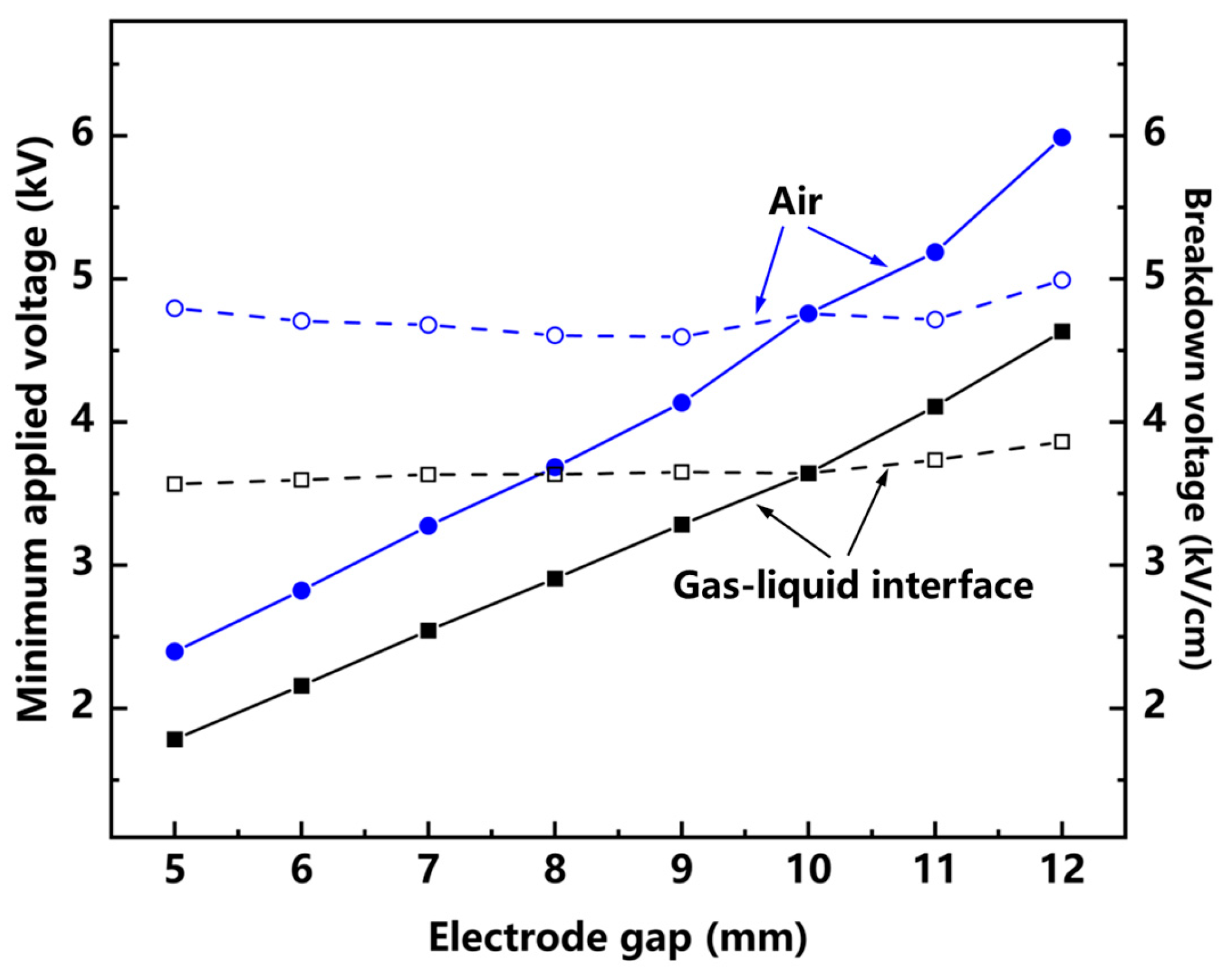
The minimum applied voltage of femtosecond laser-induced discharge in air and at the gas–liquid interface at different electrode gaps was measured, and the breakdown threshold was calculated. The minimum applied voltage refers to the lowest external voltage (in kV) required to initiate breakdown across the electrode gap under each condition. In contrast, the breakdown threshold represents the minimum applied voltage per unit of electrode spacing (unit: kV/cm), calculated by dividing the minimum applied voltage by the electrode spacing. This representation allows for comparisons of insulation breakdown behavior independent of specific gap distances. The results are shown in Figure 2. The solid lines indicate the minimum applied voltage; the dashed lines indicate the breakdown threshold. The minimum applied voltage increases linearly with the increase in the electrode gap. The breakdown threshold of induced discharge in air is about 4.8 kV/cm, and that of induced discharge at gas–liquid interface is about 3.6 kV/cm. The breakdown field strength of femtosecond laser-induced discharge at the gas–liquid interface is about 25% lower than that in pure air. This phenomenon reveals that the gas–liquid interface can significantly reduce the breakdown threshold through cooperation with discharge plasma, thus showing unique advantages in energy efficiency.
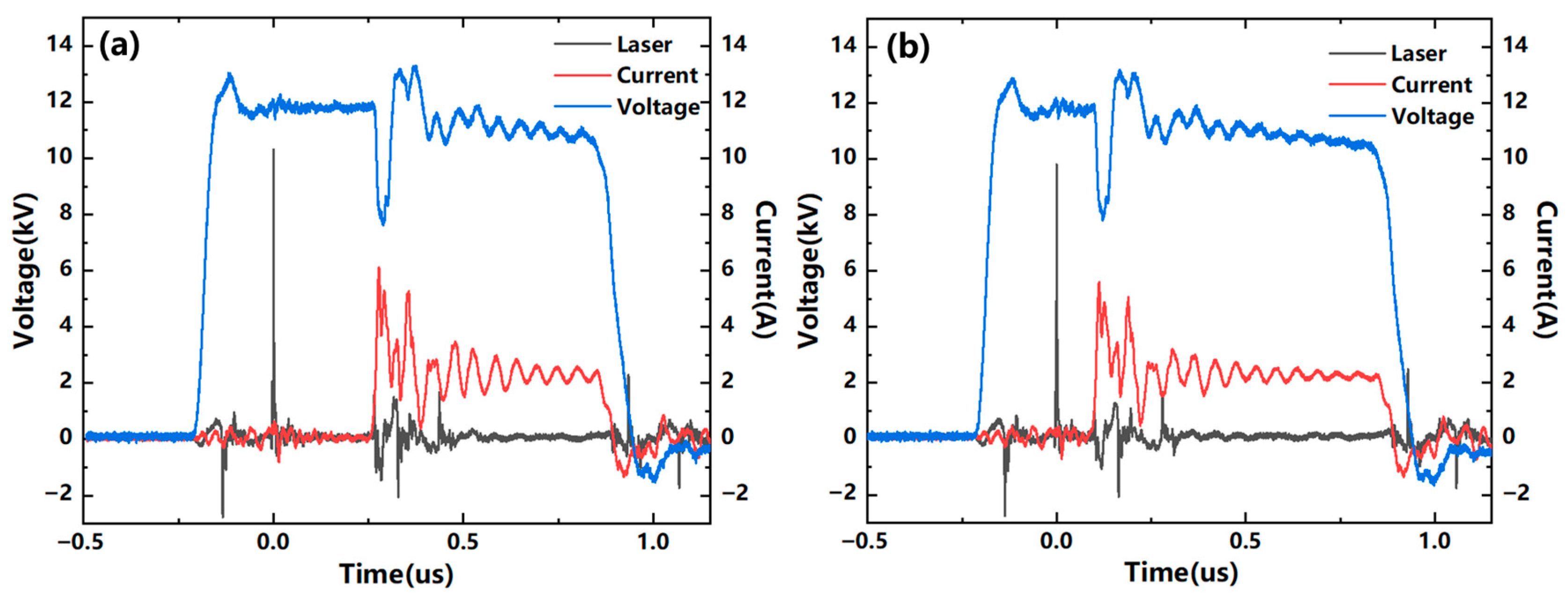
To investigate the dynamic breakdown process of femtosecond laser-induced discharge at the gas–liquid interface, we recorded and compared the temporal waveforms of the laser pulse, voltage, and current under a fixed applied voltage of 12 kV in both ambient air and at the gas–liquid interface. The results are presented in Figure 3. Figure 3a shows the timing diagram of femtosecond laser-induced discharge in air; Figure 3b shows the timing diagram of femtosecond laser-induced discharge at the gas–liquid interface. The moment of laser arrival was defined as t = 0, and the instant at which the voltage dropped abruptly accompanied by a sharp current rise was identified as the breakdown moment. It was observed that the breakdown did not occur immediately after the laser trigger. During the initial phase, the system voltage remained steadily high while the current signal was weak, corresponding to the formation and development of the laser-preionized channel. The breakdown occurred only after a certain delay. A key finding is that the breakdown delay of the femtosecond laser-induced discharge was approximately 240 ns in pure air, but was significantly shortened to about 160 ns at the gas–liquid interface. This indicates that, under the same electrical conditions, the presence of the gas–liquid interface advanced the discharge establishment time by about 80 ns.
The decrease in the breakdown time delay and the decrease in the breakdown threshold confirm each other in physical essence and reveal that the gas–liquid interface has a remarkable synergistic enhancement effect on the discharge initialization process. The presence of the liquid surface likely accelerates the avalanche process through several mechanisms, such as supplying additional initial electrons (e.g., via laser-induced photoemission from the water surface), modifying the local electric field distribution near the interface, or influencing the decay dynamics of the plasma channel [29,30]. These findings not only dynamically corroborate the high efficiency of discharge initiation at the gas–liquid interface but also provide experimental support for its potential use in pulsed power applications that demand rapid and precise discharge control.
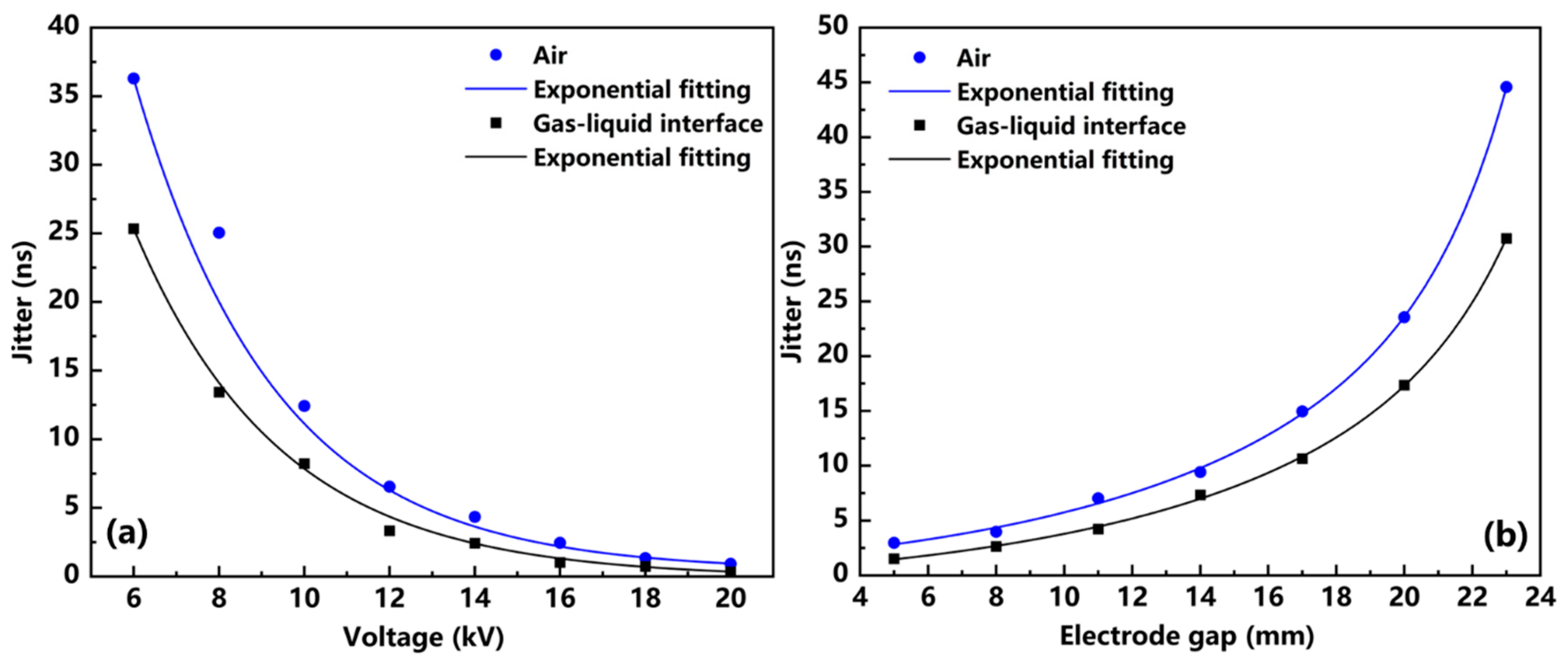
Discharge jitter was measured at different voltages and electrode gaps. In this study, the standard deviation of five measurements at the breakdown time was defined as discharge jitter. As shown in Figure 4a, the discharge jitter value decreased exponentially with the increase in discharge voltage. As shown in Figure 4b, the discharge jitter value increased exponentially with the increase in the discharge gap. In Figure 4a, all electrode spacings were set constant at 10 mm; in Figure 4b, all voltages were set constant at 12 kV. It is worth noting that the jitter of femtosecond laser-induced discharge at the gas–liquid interface is smaller than that of femtosecond laser-induced discharge in air at any parameter setting. This proves that femtosecond laser can realize more stable induced discharge at the gas–liquid interface.

3.2. Study of Spectral Properties

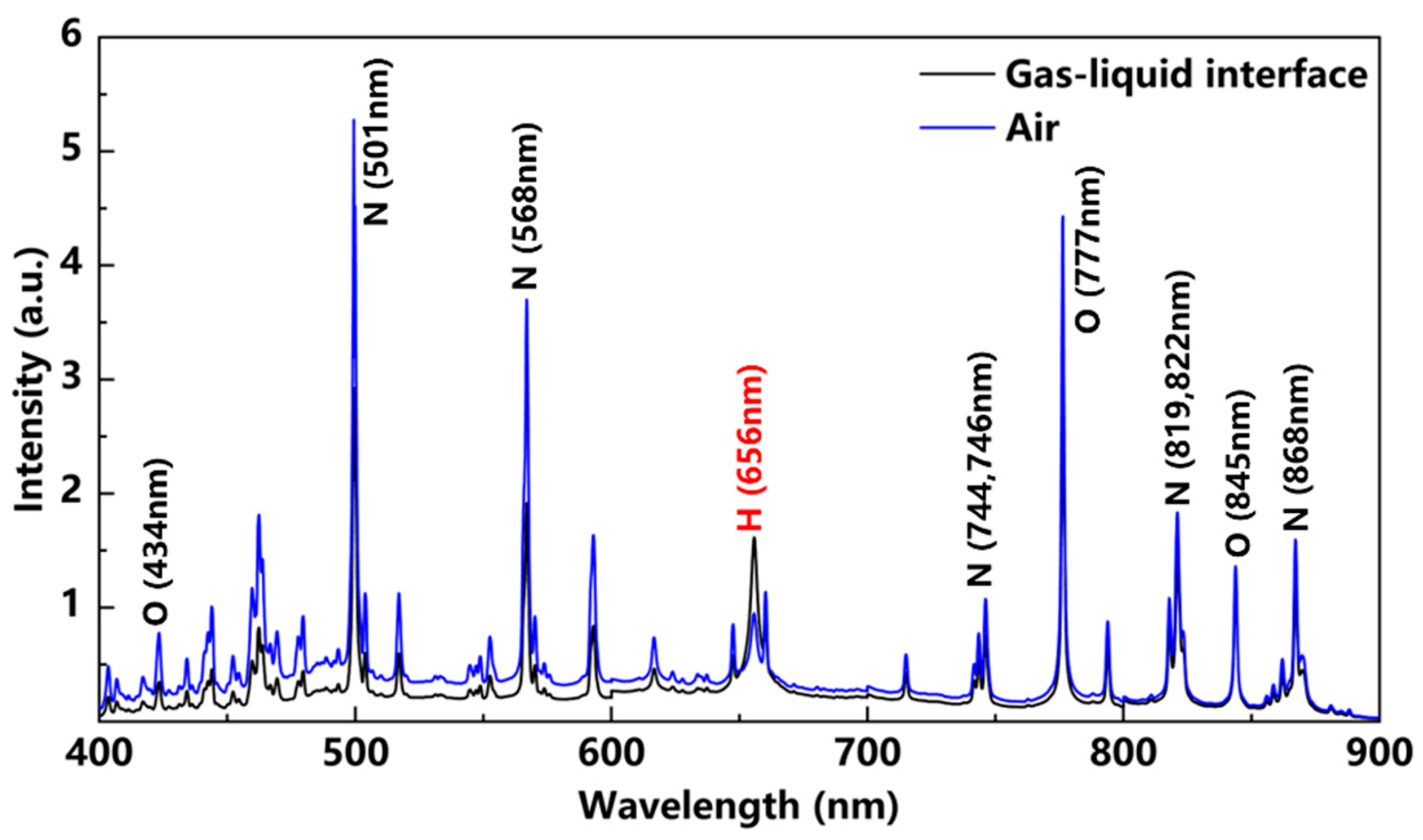
The ICCD camera’s delay was set to 300 ns to prevent interference from scattered light signals at the gas–liquid interface. The gate width was set to 1 μs, matching the discharge pulse width of 1 microsecond. This configuration enabled the complete capture of the entire discharge emission spectrum in a single acquisition. To reduce the relative error in spectral intensity, each spectrum was accumulated over 100 pulses and repeated for 10 independent measurements. Figure 5 presents a comparison of the emission spectra from femtosecond laser-induced discharge in air and at the gas–liquid interface. It can be observed that the intensity of nitrogen atom lines in the 800–900 nm range was significantly higher in air than at the gas–liquid interface. These nitrogen emissions originate primarily from the dissociation of nitrogen molecules in the breakdown region. Notably, the Hα emission line at 656 nm was markedly enhanced under the gas–liquid interface condition, which is attributed to the radiative emission of hydrogen atoms produced through the femtosecond laser breakdown of water molecules. In addition, a strong oxygen atom emission peak was detected near 777 nm, resulting from the 3 p 5 P 3 s 5 S transition. This emission is associated with the dissociation of both water molecules and ambient oxygen during laser-induced breakdown [31].
Compared with the spectral characteristics of femtosecond laser-induced discharge in air, the enhancement of the Hα (656 nm) signal in the gas–liquid interface environment reflects the significant influence of liquid composition on plasma composition and reaction path. This phenomenon indicates that water molecules participate in and change the species and distribution of particles in plasma during discharge at the gas–liquid interface [32,33], thus modulating spectral emission behavior.
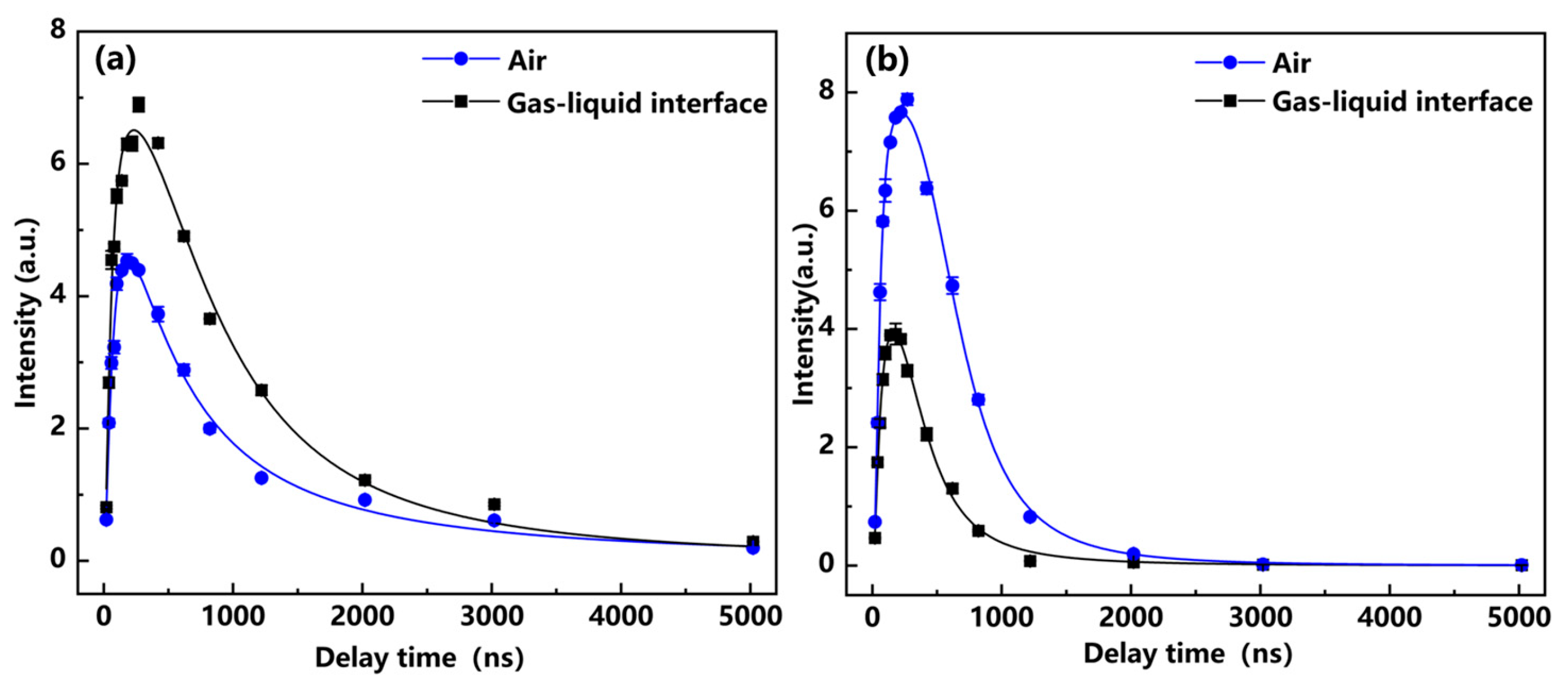
Based on the spectral differences revealed in Figure 5, we further compared the temporal evolution of the N atom (501 nm) and Hα (656 nm) emission lines in two environments: femtosecond laser-induced discharge in air and at the gas–liquid interface. The results are shown in Figure 6. As illustrated in Figure 6a, the error bars in the figure represent the measurement errors in the emission spectral intensity of N atoms (3.1–5.5% in air, 2.0–3.8% at the gas–liquid interface). The N atom (501 nm) emission in air reached its peak intensity at approximately 230 ns, whereas under gas–liquid interface conditions, the peak occurred earlier, at around 180 ns. Moreover, the N atom line intensity in air consistently exceeded that at the gas–liquid interface throughout the entire observation period, and its emission lifetime was longer. Figure 6b shows the temporal evolution of the Hα (656 nm) line. The error bars in the figure represent the measurement errors in the emission spectral intensity of Hα (3.4–5.8% in air, 1.9–3.4% at the gas–liquid interface). In air, its intensity peaked at about 180 ns, while at the gas–liquid interface, the peak was delayed to approximately 240 ns, with the latter also exhibiting a longer emission duration.
The emission from excited species in plasma originates primarily from electron impact ionization and excitation processes; thus, the temporal behavior of spectral lines is closely related to the discharge current waveform. The differing peak times of spectral lines in different environments reflect variations in the dominant reaction pathways within the plasma after its formation. The enhanced and prolonged Hα signal at the gas–liquid interface suggests that species originating from the liquid phase participate in and alter the plasma reaction dynamics. Time-resolved emission spectroscopy effectively reveals the temporal characteristics of ionization, particle interactions, and charge transfer in the plasma, providing valuable insight into the dynamic evolution of discharge plasma properties.
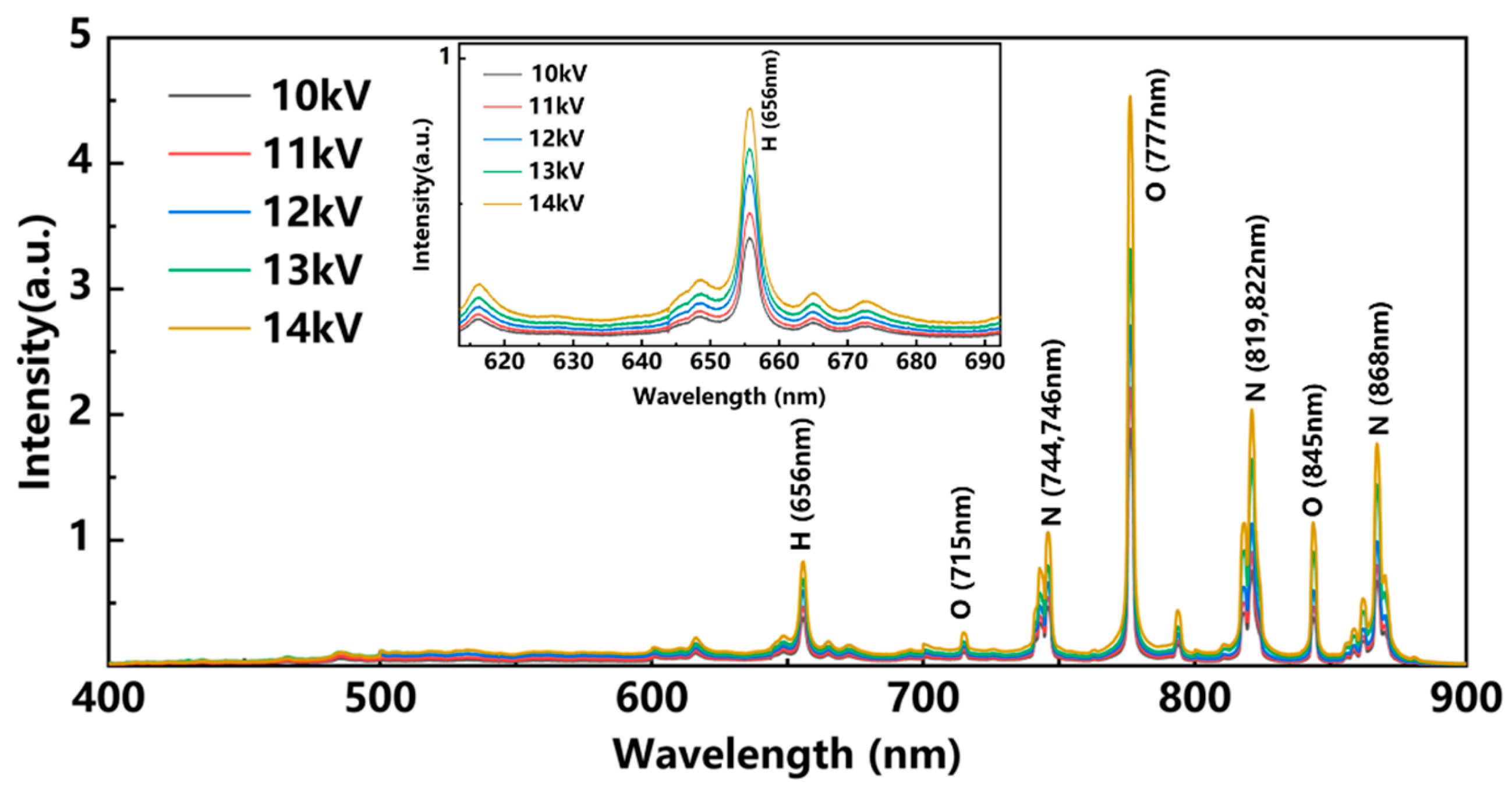
Figure 7 shows the emission spectra of femtosecond laser-induced discharge at the gas–liquid interface under applied voltages ranging from 10 kV to 14 kV. The spectral profiles under these different voltages were generally consistent, indicating no significant change in the types of active species generated during discharge. The inset shows a magnified view near the Hα line at 656 nm. It can be clearly observed that the intensities of the Hα line and other atomic/ionic lines systematically increased with increasing applied voltage. This trend suggests that higher voltages enhance energy injection into the electric field, leading to elevated electron temperature and density in the plasma, which in turn promotes the excitation and ionization of atoms and ions.
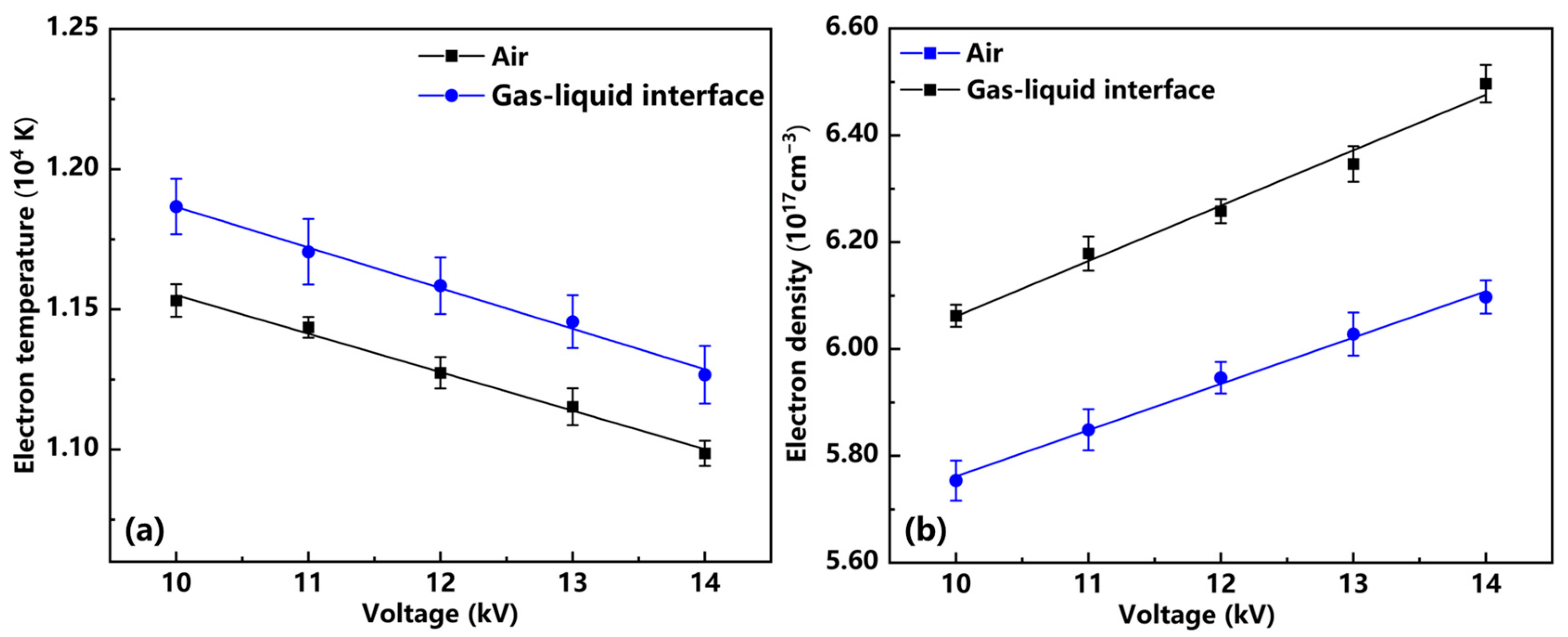
The plasma electron density was quantitatively analyzed using the O atom emission line at 777 nm, which exhibited the optimal signal-to-background ratio. The electron collision parameter ω = 0.00443 nm was determined through Lorentzian line fitting [34,35], and the corresponding electron density was derived based on Stark broadening theory [36]. As shown in Figure 8a, the electron density increased linearly with applied voltage in both air and gas–liquid interface environments, with similar slopes of increase. Error bars represent the computational error in the electron temperature (3.3–5.0% in air, 2.1–3.9% at the gas–liquid interface).
The electron temperature was calculated using the Boltzmann plot method based on three O atom emission lines at 715.6 nm, 777 nm, and 844 nm [37,38]. Figure 8b illustrates the variation in electron temperature as a function of discharge voltage. Error bars represent computational errors in electron density (3.7–5.8% in air, 2.4–4.5% at gas–liquid interfaces). The results indicate that the electron temperature decreased linearly with increasing voltage in both environments, with closely comparable slopes. Notably, the electron temperature at the gas–liquid interface was consistently lower than that in air at the same voltage, suggesting that the liquid environment significantly modulates the energy distribution within the plasma. This effect may be attributed to the cooling of high-energy electrons by liquid-phase species or an increased collision frequency at the interface.

4. Conclusions

In this paper, stable control and spectral diagnostics of femtosecond laser-induced discharge were achieved at the gas–liquid interface. By extending femtosecond laser-induced discharge technology to the gas–liquid interface, the plasma evolution process was monitored in real time using spatiotemporally resolved spectroscopy, providing an effective approach for investigating discharge physics in gas–liquid two-phase environments. The gas–liquid interface was found to significantly enhance discharge efficiency and stability. Experimental results show that the breakdown electric field strength at the interface decreased by approximately 25%, the breakdown delay was shortened by about 80 ns, and the discharge timing jitter was markedly reduced compared to that in ambient air. These findings indicate a synergistic interaction between the liquid environment and the discharge plasma, which facilitates discharge channel formation and improves both energy injection efficiency and discharge stability. Spectral analysis revealed a prolonged emission lifetime of the Hα line (656 nm) and a reduction in both intensity and the lifetime of nitrogen lines in the interface environment, suggesting that species originating from the liquid phase actively participate in and alter plasma reaction pathways, thereby promoting the generation and persistence of hydrogen-containing active species. Compared with air, femtosecond laser-induced discharge at the gas–liquid interface has higher electron density and lower electron temperature. These phenomena indicate that gas–liquid interface changes plasma reaction path by participating in the ionization process and promotes the formation of high-density and low-temperature plasma.
This study demonstrates that the presence of the liquid phase enhances ionization efficiency and underscores the unique regulatory role of the gas–liquid interface in femtosecond laser-induced discharges. The results not only advance the understanding of the physical mechanisms of interface plasma but also provide an experimental basis and methodological support for the precise application of liquid-phase plasma technology in environmental, energy, and biomedical fields.

Author Contributions

Conceptualization, Z.L.; methodology, Q.G. and B.L.; validation, X.L. and Z.Z.; formal analysis, Q.G. and H.J.; investigation, T.W. and L.Z.; data curation, H.J.; resources, Q.G. and T.W.; writing—original draft preparation, Z.L. and B.L.; writing—review and editing, B.L. and X.L.; supervision, Q.G.; project administration, Q.G. and B.L.; funding acquisition, Q.G. and B.L. All authors have read and agreed to the published version of the manuscript.

Funding

This research was funded by the National 14th Five-Year Plan Metrology Technology Foundation (JSJL2022205XXXX).

Data Availability Statement

No new data were created or analyzed in this study.

Conflicts of Interest

The authors declare no conflicts of interest.

References

  1. Gao, Y.T.; Zhou, R.W.; Hong, L.F.; Chen, B.H.; Sun, J.; Zhou, R.S.; Liu, Z.J. Efficient synthesis of CO and H2O2 via nanosecond pulsed CO2 bubble discharge. J. Phys. D Appl. Phys. 2024, 57, 375204. [Google Scholar] [CrossRef]
  2. Matsumoto, M.; Wada, Y.; Xu, K.J.; Onoe, K.; Hiaki, T. Enhanced generation of active oxygen species induced by O3 fine bubble formation and its application to organic compound degradation. Environ. Technol. 2022, 43, 3661–3669. [Google Scholar] [CrossRef] [PubMed]
  3. Yan, J.H.; Dai, S.L.; Li, X.D.; Tu, X.; Liu, Y.N.; Cen, K.F. Emission spectroscopy diagnosis of the radicals generated in gas-liquid phases gliding arc discharge. Spectrosc. Spect. Anal. 2008, 28, 1851–1855. [Google Scholar]
  4. Shen, J.; Sun, Q.; Zhang, Z.L.; Cheng, C.; Lan, Y.; Zhang, H.; Xu, Z.M.; Zhao, Y.; Xia, W.D.; Chu, P.K. Characteristics of DC gas-liquid phase atmospheric-pressure plasma and bacteria inactivation mechanism. Plasma Process. Polym. 2015, 12, 252–259. [Google Scholar] [CrossRef]
  5. Burakov, V.S.; Kiris, V.V.; Nevar, A.A.; Nedelko, M.I.; Tarasenko, N.V. Combined gas-liquid plasma source for nanoparticle synthesis. J. Appl. Spectrosc. 2016, 83, 643–649. [Google Scholar] [CrossRef]
  6. Xu, H.; Wei, Z.P.; Quan, L.; Hu, Y.W.; Qiao, M.T.; Shao, M.X.; Xie, K. Controlled plasma-droplet interactions: Two-phase flow millifluidic system. Phys. Plasmas 2025, 32, 012001. [Google Scholar] [CrossRef]
  7. Zheng, Z.; Chang, D.L.; Liang, J.P.; Lu, K.; Cui, X.; Li, Y.; Yang, D.Z. Ammonia nitrogen removal by gas-liquid discharge plasma: Investigating the voltage effect and plasma action mechanisms. Water 2023, 15, 3827. [Google Scholar] [CrossRef]
  8. Bruggeman, P.J.; Frontiera, R.R.; Kortshagen, U.; Kushner, M.J.; Linic, S.; Schatz, G.C.; Andaraarachchi, H.; Chaudhuri, S.; Chen, H.T.; Clay, C.D.; et al. Advances in plasma-driven solution electrochemistry. J. Chem. Phys. 2025, 162, 070901. [Google Scholar] [CrossRef]
  9. Zhu, L.; He, Z.H.; Gao, Z.W.; Tan, F.L.; Yue, X.G.; Chang, J.S. Research on the influence of conductivity to pulsed arc electrohydraulic discharge in water. J. Electrostat. 2014, 72, 53–58. [Google Scholar] [CrossRef]
  10. Stelmashuk, V.; Prukner, V.; Kolacek, K.; Tuholukov, A.; Hoffer, P.; Straus, J.; Frolov, O.; Jirasek, V. Optical emission spectroscopy of underwater spark generated by pulse high-voltage discharge with gas bubble assistant. Processes 2022, 10, 1474. [Google Scholar] [CrossRef]
  11. Babaeva, N.Y.; Berry, R.S.; Naidis, G.V.; Smirnov, B.M.; Son, E.E.; Tereshonok, D.V. Kinetic and electrical phenomena in gas-liquid systems. High Temp. 2016, 54, 745–766. [Google Scholar] [CrossRef]
  12. Dorval, A.; Stafford, L.; Hamdan, A. Spark discharges at the interface of water and heptane: Emulsification and effect on discharge probability. J. Phys. D Appl. Phys. 2024, 57, 015203. [Google Scholar] [CrossRef]
  13. Song, W.Z.; Zhang, Y.; Yu, J.W.; Gao, Y.X.; Naitoc, T.; Oinumac, G.; Inanagac, Y.; Yang, M. Rapid removal of polyacrylamide from wastewater by plasma in the gas-liquid interface. J. Environ. Sci. 2019, 83, 1–7. [Google Scholar] [CrossRef] [PubMed]
  14. Xin, Q.; Zhang, Y.; Wu, K.B. Degradation of microcystin-LR by gas-liquid interfacial discharge plasma. Plasma Sci. Technol. 2013, 15, 1221–1225. [Google Scholar] [CrossRef]
  15. Arantchouk, L.; Honnorat, B.; Thouin, E.; Point, G.; Mysyrowicz, A.; Houard, A. Prolongation of the lifetime of guided discharges triggered in atmospheric air by femtosecond laser filaments up to 130 μs. Appl. Phys. Lett. 2016, 108, 171103. [Google Scholar] [CrossRef]
  16. Henriksson, M.; Daigle, J.F.; Théberge, F.; Châteauneuf, M.; Dubois, J. Laser guiding of Tesla coil high voltage discharges. Opt. Express 2012, 20, 12721–12728. [Google Scholar] [CrossRef]
  17. Zhang, Z.; Lu, X.; Hao, Z.Q.; Zhang, S.C.; Zhang, D.D.; Wang, Z.H.; Ma, Y.Y.; Yan, P.; Zhang, J. Laboratory simulation of femtosecond laser guided lightning discharge. Acta Phys. Sin. 2007, 56, 5293–5297. [Google Scholar] [CrossRef]
  18. Zhang, Z.; Lu, X.; Liang, W.X.; Hao, Z.Q.; Zhou, M.L.; Wang, Z.H.; Zhang, J. Triggering and guiding of high voltage discharge by using femtosecond laser filaments with different parameters. Chin. Phys. B 2009, 18, 1136–1140. [Google Scholar] [CrossRef]
  19. Li, M.; Gu, J.P.; Zhang, D.Y.; Gao, Q.; Li, B. Equivalence ratio measurements in CH4/Air gases based on the spatial distribution of the emission intensity of femtosecond laser-induced filament. Processes 2021, 9, 2022. [Google Scholar] [CrossRef]
  20. Bergé, L.; Skupin, S.; Nuter, R.; Kasparian, J.; Wolf, J.P. Ultrashort filaments of light in weakly ionized, optically transparent media. Rep. Prog. Phys. 2007, 70, 1633–1713. [Google Scholar] [CrossRef]
  21. Burger, M.; Skrodzki, P.J.; Nees, J.; Jovanovic, I. Electrical conductance of near-infrared femtosecond air filaments in the multi-filament regime. Opt. Lett. 2018, 43, 5520–5523. [Google Scholar] [CrossRef] [PubMed]
  22. Ionin, A.A.; Seleznev, L.V.; Sunchugasheva, E.S. Formation of plasma channels in air under filamentation of focused ultrashort laser pulses. Laser Phys. 2015, 25, 035301. [Google Scholar] [CrossRef]
  23. Kosareva, O.G.; Mokrousova, D.V.; Panov, N.A.; Nikolaeva, I.A.; Shipilo, D.E.; Mitina, E.V.; Koribut, A.V.; Rizaev, G.E.; Couairon, A.; Houard, A.; et al. Remote triggering of air-gap discharge by a femtosecond laser filament and postfilament at distances up to 80 m. Appl. Phys. Lett. 2021, 119, 041101. [Google Scholar] [CrossRef]
  24. Leonov, S.B.; Firsov, A.A.; Shurupov, M.A.; Michael, J.B.; Shneider, M.N.; Miles, R.B.; Popov, N.A. Femtosecond laser guiding of a high-voltage discharge and the restoration of dielectric strength in air and nitrogen. Phys. Plasmas 2012, 19, 123505. [Google Scholar] [CrossRef]
  25. Gao, Q.; Zhu, Z.F.; Li, B.; Han, L.; Li, Z.S. Spatiotemporally resolved spectra of gaseous discharge between electrodes triggered by femtosecond laser filamentation. Appl. Phys. B Lasers Opt. 2022, 128, 196. [Google Scholar] [CrossRef]
  26. Lu, Z.; Li, B.; Feng, Z.Y.; Gao, Q. One-dimensional measurement of metal elements in aerosols based on femtosecond laser-extended electrode discharge spectroscopy (FEEDS) technique. Plasma Sci. Technol. 2025, 27, 085501. [Google Scholar] [CrossRef]
  27. Zhu, Z.F.; Li, B.; Gao, Q.; Zhu, J.J.; Li, Z.S. Spatiotemporal control of femtosecond laser filament-triggered discharge and its application in diagnosing gas flow fields. Plasma Sci. Technol. 2022, 24, 025401. [Google Scholar] [CrossRef]
  28. Feng, Z.Y.; Han, L.; Gao, Q.; Liu, Z.H.; Li, B. One-dimensional temperature measurement of gases based on femtosecond laser-extended electrode discharge spectroscopy (FEEDS). Opt. Laser Eng. 2024, 178, 108209. [Google Scholar] [CrossRef]
  29. Cahoon, E.M.; Almirall, J.R. Quantitative analysis of liquids from aerosols and microdrops using laser induced breakdown spectroscopy. Anal. Chem. 2012, 84, 2239–2244. [Google Scholar] [CrossRef]
  30. Zhang, C.; Tang, M.; Zhang, H.C.; Lu, J. Optical breakdown during femtosecond laser propagation in water cloud. Opt. Express 2019, 27, 8456–8475. [Google Scholar] [CrossRef]
  31. Yang, X.Y.; Guo, L.B.; Li, J.M.; Yi, R.X.; Hao, Z.Q.; Shen, M.; Zhou, R.; Li, K.H.; Li, X.Y.; Lu, Y.F.; et al. Laser-induced breakdown spectroscopy of liquid solutions: A comparative study on the forms of liquid surface and liquid aerosol. Appl. Opt. 2016, 55, 7406–7411. [Google Scholar] [CrossRef] [PubMed]
  32. Liu, F.; Wang, W.C.; Wang, S.; Ren, C.S.; Wang, Y.N. The study of active atoms in high-voltage pulsed coronal discharge by optical diagnostics. Plasma Sci. Technol. 2005, 7, 2851–2855. [Google Scholar] [CrossRef]
  33. Tatarova, E.; Dias, F.M.; Ferreira, C.M. Hot hydrogen atoms in a water-vapor microwave plasma source. Int. J. Hydrogen Energy 2009, 34, 9585–9590. [Google Scholar] [CrossRef]
  34. Aguilera, J.A.; Bengoechea, J.; Aragón, C. Curves of growth of spectral lines emitted by a laser-induced plasma: Influence of the temporal evolution and spatial inhomogeneity of the plasma. Spectrochim. Acta Part B At. Spectrosc. 2003, 58, 221–237. [Google Scholar] [CrossRef]
  35. Rao, A.; Gragston, M.; Patnaik, A.K.; Hsu, P.S.; Shattan, M.B. Measurement of electron density and temperature from laser-induced nitrogen plasma at elevated pressure (1–6 bar). Opt. Express 2019, 27, 33780–33789. [Google Scholar] [CrossRef]
  36. Ferioli, F.; Buckley, S.G. Measurements of hydrocarbons using laser-induced breakdown spectroscopy. Combust. Flame 2006, 144, 435–447. [Google Scholar] [CrossRef]
  37. Knox, R.S. Excited-state equilibration and the fluorescence-absorption ratio. Acta Phys. Pol. 1999, 95, 85–103. [Google Scholar] [CrossRef]
  38. Liu, W.; Bernhardt, J.; Theberge, F.; Châteauneuf, M.; Dubois, J. Spectroscopic characterization of femtosecond laser filament in argon gas. J. Appl. Phys. 2007, 102, 033111. [Google Scholar] [CrossRef]
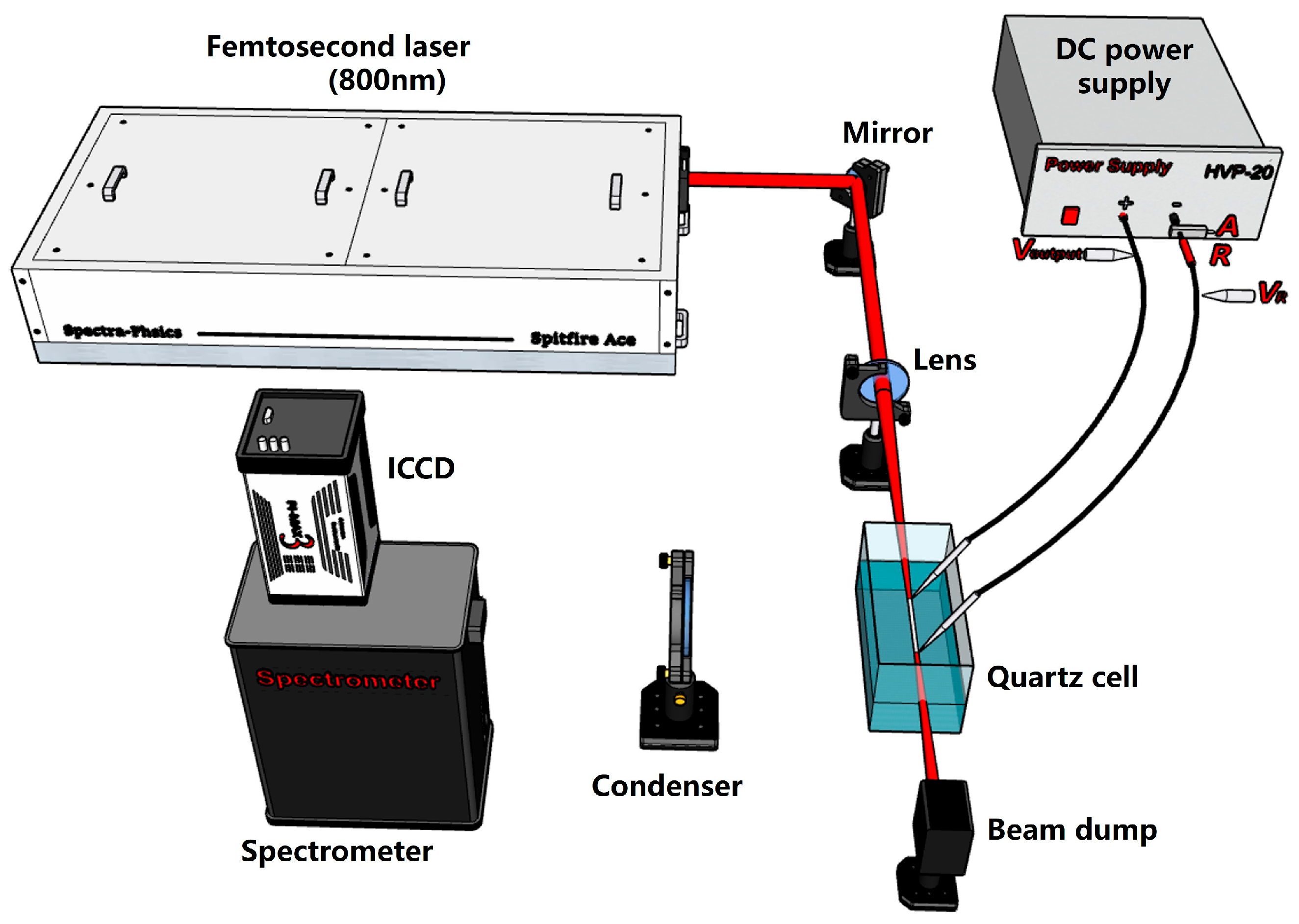
Figure 1. Experimental setup for femtosecond laser filament-induced discharge at gas–liquid interface.
Processes 13 04003 g001
Figure 2. Minimum voltage and discharge breakdown threshold at different electrode gaps.
Processes 13 04003 g002
Figure 3. Timing diagram of femtosecond laser filament-induced discharge: (a) timing diagram of laser filament-induced discharge in air; (b) timing diagram of laser filament-induced discharge at gas–liquid interface.
Processes 13 04003 g003
Figure 4. Discharge jitter: (a) comparison of discharge jitter at different voltages; (b) comparison of discharge jitter at different electrode gaps.
Processes 13 04003 g004
Figure 5. Spectrum of femtosecond laser-induced discharge at gas–liquid interface and in air.
Processes 13 04003 g005
Figure 6. Temporal evolution of spectral line intensity of discharge plasma: (a) temporal evolution of the spectral intensity of Hα (656 nm); (b) temporal evolution of the spectral intensity of N (501 nm).
Processes 13 04003 g006
Figure 7. Spectra of femtosecond laser-induced discharge at gas–liquid interface under different voltages.
Processes 13 04003 g007
Figure 8. Variation in electron temperature and electron density in 10–14 kV: (a) variation in electron density with voltage; (b) variation in electron temperature with voltage.
Processes 13 04003 g008
Disclaimer/Publisher’s Note: The statements, opinions and data contained in all publications are solely those of the individual author(s) and contributor(s) and not of MDPI and/or the editor(s). MDPI and/or the editor(s) disclaim responsibility for any injury to people or property resulting from any ideas, methods, instructions or products referred to in the content.