Article

An Experimental Study of Bubble Growth and Detachment Characteristics at an Orifice for an Electronic Atomizer

1
CHN Energy Jiangxi Engineering Technology Co., Ltd., Jiujiang 330499, China
2
School of Advanced Manufacturing, Nanchang University, Nanchang 330031, China
3
Jiangxi Xintian Auto Products Co., Ltd., Yichun 336000, China
*
Author to whom correspondence should be addressed.
Processes 2025, 13(11), 3516; https://doi.org/10.3390/pr13113516
Submission received: 11 October 2025 / Revised: 29 October 2025 / Accepted: 30 October 2025 / Published: 2 November 2025
(This article belongs to the Special Issue Thermodynamics and Fluid Mechanics in Energy Systems)

Abstract

The formation of bubbles at an orifice is a key problem in gas–liquid two-phase flow. In the electronic atomizer, the bubble size and generation frequency formed at the gas exchange port are important factors affecting the heat and mass transfer efficiency and two-phase flow in the atomization process. Therefore, it is of great theoretical and practical significance to study the process of bubble growth and detachment at the orifice. In this work, the dynamic change in bubble volume during the periodic growth of the orifice is analyzed by visual experiments. The effects of outlet liquid flow rate, orifice parameter, and liquid properties on bubble detachment volume and detachment frequency are discussed. It is found that under different orifice diameters and outlet liquid flow rates, the bubble generation period can be divided into three forms: single-, double-, and triple-bubble periodicities based on the number of bubbles in the period. The detachment frequency and detachment volume of bubbles increase with the increase the in outlet flow rate. The change in liquid properties also affects the bubble growth and detachment characteristics. This work provides a theoretical basis for the design of an air exchange structure in an electronic atomizer.

1. Introduction

Gas–liquid two-phase flow, such as bubbles in water, is a common phenomenon in both nature and industrial production, involving many fields such as biology, medicine, energy, and industrial production [1]. For example, in the chemical industry, bubbles can promote material mixing, heat transfer, and chemical reaction processes in reaction devices, and only by understanding the formation principle and motion characteristics of bubbles can these chemical processes be effectively controlled. In the nuclear industry, the study of bubble dynamics is of great significance for exploring the mechanism of liquid nucleate boiling heat transfer. Therefore, mastering the motion characteristics of bubbles in liquid is the key to solving these problems.
Theoretical analysis is an important way to understand the bubble formation process. Yang and Yeh [2] studied the formation process of bubbles in incompressible viscous fluid. The relationship between bubble growth rate, bubble volume, liquid pressure, energy dissipation rate, and time was obtained. It was proven that the theory is suitable for both Newtonian fluid and non-Newtonian fluid. Ramakrishnan et al. [3] proposed a two-stage model to describe the bubble formation process, that is, the expansion process and the detachment stage. In the expansion stage, the bubble is still on the surface of the orifice, and the necking is not formed; in the detachment stage, the bubble leaves the surface of the orifice but is connected by the neck and the orifice. As the bubble grows, the neck gradually elongates. Gaddis and Vogelpohl [4] deduced a multi-stage mathematical model of bubble formation at a constant gas flow rate through the force balance of bubbles, assuming that the bubble shape is spherical. Anagbo et al. [5] proposed an ellipsoid model, established a formula for calculating the volume of bubble formation, and found that the diameter of the immersion hole, gas flow rate, gas–liquid density, viscosity, surface tension, and other parameters all affect the bubble volume. Li et al. [6] proposed a theoretical model to predict the bubble diameter based on bubble force equilibrium at the bubble detachment moment, and the effects of pore structures, operating conditions, and liquid properties are included.
The mechanisms of the bubble growth and movement process are difficult to be fully revealed by theoretical analysis. The most intuitive and effective method to study bubble behavior is still the experimental method. Leibson et al. [7] studied the bubble formation mechanism of single-immersed orifice plates with different pore sizes at different flow rates through experiments and found that the formation condition of the bubble zone is that the Reynolds number of the orifice gas is less than 2100. Gutwald and Mersmann [8] proposed that when the Weber number is equal to 2, the transition from the bubbling zone to the jet zone appears. Mohseni et al. [9] experimentally studied the dynamics of bubble formation from micro-pores. It was found that the formation mechanism of submillimeter orifice bubbles was greatly affected by capillary pressure and gas kinetic energy. In addition, the bubble area diagram was drawn using the Bond number (Bo), Weber number (We), and Eotworth number (Eo). Mirsandi et al. [10] experimentally and numerically studied the influence of wetting conditions on the bubble formation kinetics of submerged orifices. Bubble growth is divided into four stages: hemispherical expansion, cylindrical expansion, critical growth, and necking. Yamasaki et al. [11] investigated the bubbles detached from a single hole in a magnetic fluid. It was found that the diameter of the bubbles decreased with the applied magnetic field, and the key factor determining the bubble characteristics was the surface tension of the magnetic fluid. The surface tension increases with the increase in the applied magnetic field. Mohseni et al. [12] developed a method to estimate the bubble size of submillimeter holes under variable gas flow conditions and investigated the effect of gas reservoir volume upstream of the orifice plate on gas reservoir pressure. As the gas reservoir volume increases, the change in gas reservoir pressure decreases. Hanafizadeh et al. [13] studied the influence of the orifice shape on the formation mechanism of bubbles in gas–liquid two-phase flow. The effects of circular, square, and triangular orifices with the same cross-sectional area on the contact angle, equivalent diameter, frequency, height, and necking time of bubbles were studied. Under the same cross-sectional area, the bubbles generated by the square and triangular orifices are larger than those generated by the circular orifice, but the bubble detachment frequency under the circular orifice is faster. Liu et al. [14] investigated the gas leakage dynamics from non-circular orifices and showed that the equivalent bubble diameter increases with an increasing orifice aspect ratio. Crha et al. [15] demonstrated the bubble size, deformation, and velocity in aqueous glycerol solutions and found that viscosity has little effect on the bubble behavior. Tang et al. [16] reported a new bubbling regime named unstable bubbling when investigating the bubble formation and detachment from a submerged capillary nozzle. In this new regime, early and normal bubble detachments coexist. Yao et al. [17] investigated bubble formation from submerged microcapillary nozzles in Novec 649 and found that the drag and liquid inertia forces play a larger role for bubble detachment in Novec 649 than in water.
With the continuous development of the phase interface tracking method, numerical simulation has become one of the important means of bubble dynamics research. Islam et al. [18] used the VOF method to study the influence of inlet gas velocity and Reynolds number on the formation characteristics of bubbles in viscous liquid in a rectangular domain. It was found that the high inlet gas velocity accelerates the decrease in the bubble contact angle from an obtuse angle to an acute angle. The increase in the Reynolds number leads to an increase in the bubble breakup speed and a smaller neck height due to the stronger vortex ring around the neck of the bubble. Chen et al. [19] applied the dynamic contact angle model to a series of bubble formation processes from the single-period region to the double-period region through VOF numerical simulation. The static contact angle at a high gas velocity has a large relative error compared with the dynamic contact angle model in terms of bubble detachment time and bubble shape. Cao et al. [20] used the CLSVOF method to numerically study the effect of the orifice diameter on bubble formation in yield stress fluids and compared the results with those in Newtonian fluids. Among different types of fluids, the formation time and detachment volume of bubbles in shear-thinning fluids are the smallest, followed by Newtonian fluids, and finally the yield stress fluids. Boubendir et al. [21] studied the growth and shedding of bubbles in co-flow two-phase flow in cylindrical microtubules with the OpenFOAM code and showed that in the bubble growth stage, the surface tension plays an adhesion role on the nozzle before the neck is formed; then, the capillary effect tends to reduce the neck diameter. Vaishnavi et al. [22] numerically studied the influence of surface tension and orifice properties on bubble formation dynamics and found that the detachment time is inversely proportional to gas velocity. Jia and Pang [23] investigated the effects of wettability and surface tension on the characteristics of bubble formation, especially the motion of the contact line, using the volume of the fluid method. Li et al. [24] used the Coupled Level-Set/Volume-of-Fluid method to investigate the bubble growth and formation process under different orifice parameters, fluid properties, and operating conditions.
As mentioned above, bubble characteristics play an important role in the safety and efficiency of equipment operation in various industrial applications and daily life, and the characteristics of bubble growth and detachment have been widely investigated by a lot of researchers using theoretical, experimental, and numerical simulation methods for gas–liquid two-phase flow. However, there are few studies on the effect of bubble characteristics on maintaining gas–liquid equilibrium in a container. In this work, the process of bubble formation and detachment in the gas exchange port of the electronic atomizer is studied experimentally. The influence of operating conditions and liquid characteristics on the bubble growth and detachment process is discussed. It provides a theoretical basis for the mass transfer of gas–liquid two-phase flow in the electronic atomizer and has certain guiding significance for the design of the ventilation structure.

2. Experimental Setup

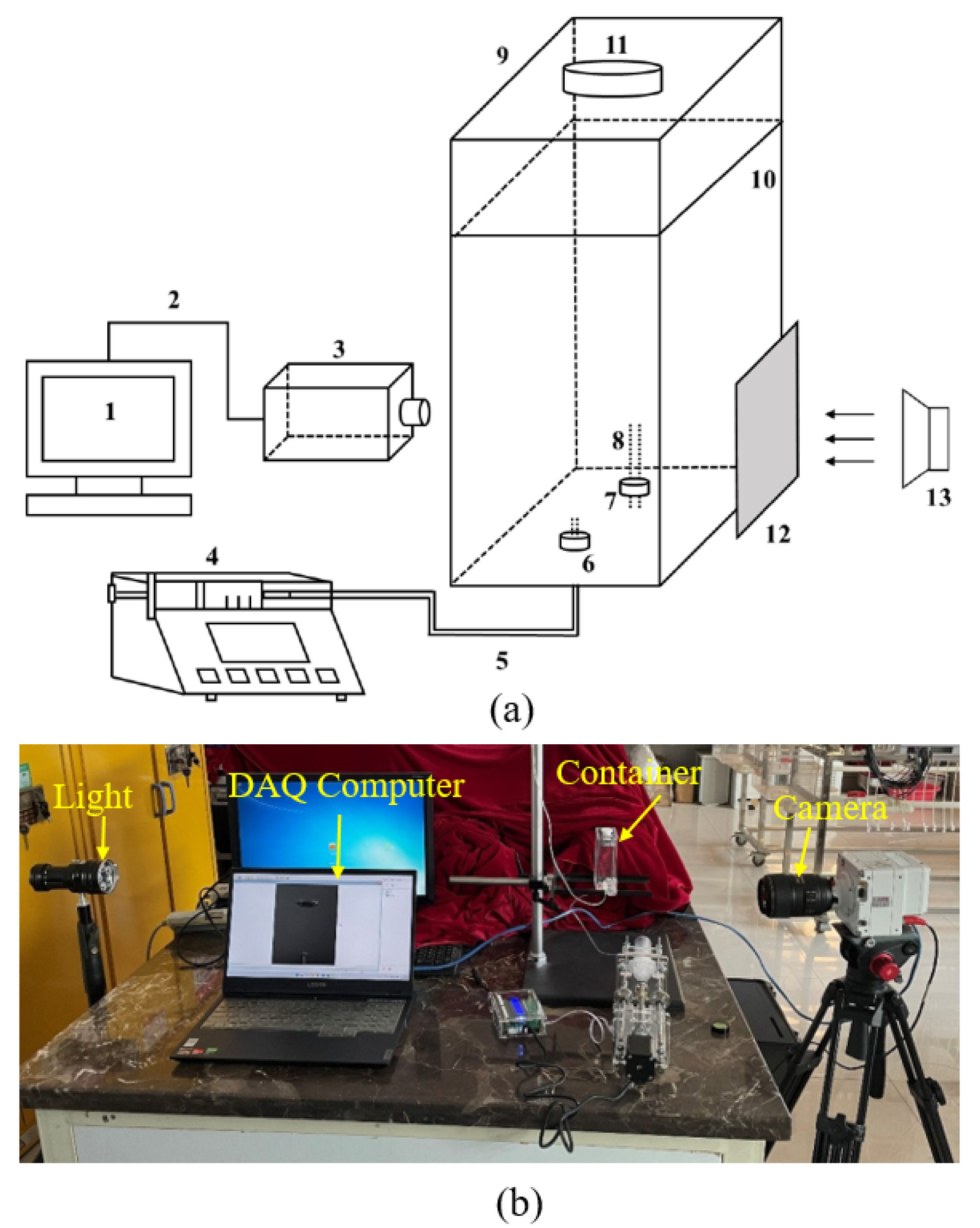
To explore the influencing factors of the bubble growth and detachment process in the gas–liquid exchange process in an electronic atomizer, an experimental system was designed, as shown in Figure 1. The experimental platform is mainly composed of a bubble generation device, an image acquisition and processing device, and a lighting device. The bubble generation device consists of a liquid container, an injection pump, a PU hose, a rubber stopper, and a steel pipe. The liquid tank made of acrylic material has a size of 70 mm × 30 mm × 105 mm. A liquid injection hole with a diameter of 15 mm is opened at the top, and there are two small holes at the bottom, one of which is inserted with a steel pipe through a rubber stopper and used as the gas inlet (the orifice). The inner diameter of the steel pipe ( d p ) can be varied, but the thickness of the pipe wall is kept at 0.2 mm. The other hole is the liquid outlet, and it is connected to an injection pump (ZS1T-V5, Guanjie Electronics, Zibo, China, precision accuracy of 0.01 mL/min), with a PU hose and a rubber stopper. The injection pump is used to quantitatively extract the liquid in the container. In the process of liquid discharge, the air will enter the container in the form of bubbles from the steel pipe port to maintain the gas–liquid balance inside the container. Hot-melt adhesive is wrapped around the rubber stopper to ensure good sealing. The image acquisition and processing device includes a computer and a high-speed camera (Phantom VEO 710L, Wayne NJ USA) with a resolution of 640 × 800 and a frame rate of 8000 fps. The lighting device is placed at the back of the liquid tank, which is in a straight line with the liquid tank and the high-speed camera.
The liquid fluid used in this experiment includes deionized water, a glycerol–water solution with a ratio of 3: 7 (30% glycerol aqueous solution), and a glycerol–water solution with a ratio of 5: 5 (50% glycerol aqueous solution), whose physical properties are listed in Table 1. The physical properties of the glycerol–water solution come from the linear interpolation values of Takamura et al. [25].

3. Image Processing

3.1. Preprocessing

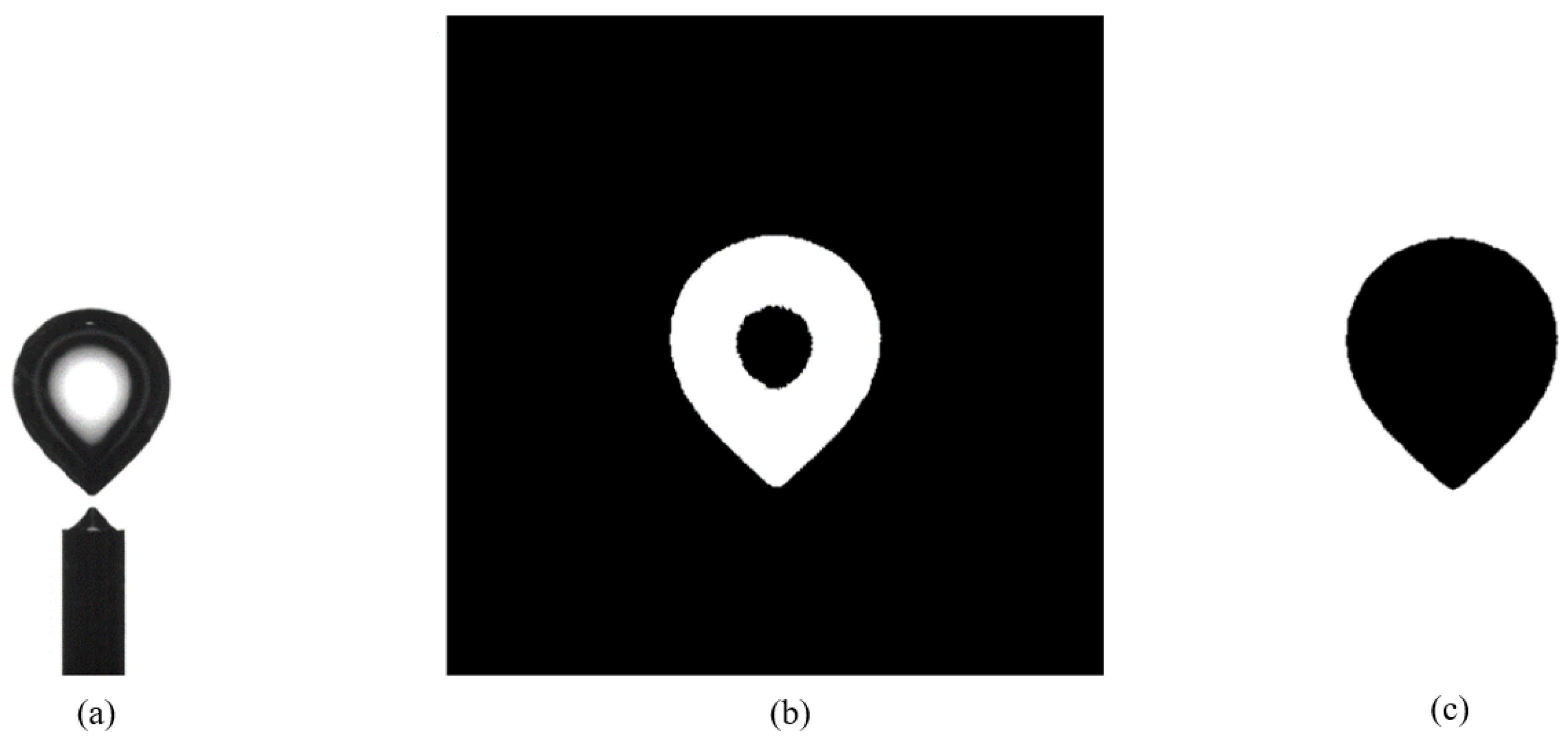
Although the experimental shooting process has been carefully designed, there are still some quality problems in the captured images due to the influence of the experimental environment and other uncontrollable factors, such as image noise, background imbalance, and inconsistent brightness of the gas bubble. Therefore, before extracting the feature parameters, the image needs to be preprocessed to enhance the visual effect and the identifiability of the feature parameters of the target image. Preprocessing mainly includes image binarization, background removal, and image filtering. Binarization processing refers to converting an image into an image with a pixel value of only 0 or 1 by selecting an appropriate threshold based on the difference in gray characteristics between the target and the background in the image. The difference image method is used to subtract the target image from the background image without bubbles. The processed image only has pixel values at the target bubble position, and the steel pipe can be removed from the image. The last process of preprocessing is image filtering, which can preserve the details of the target bubble and reduce the interference of noise in the image. The original image taken by the experiment and the preprocessed image are compared in Figure 2a,b.

3.2. Hole Filling and Edge Detection

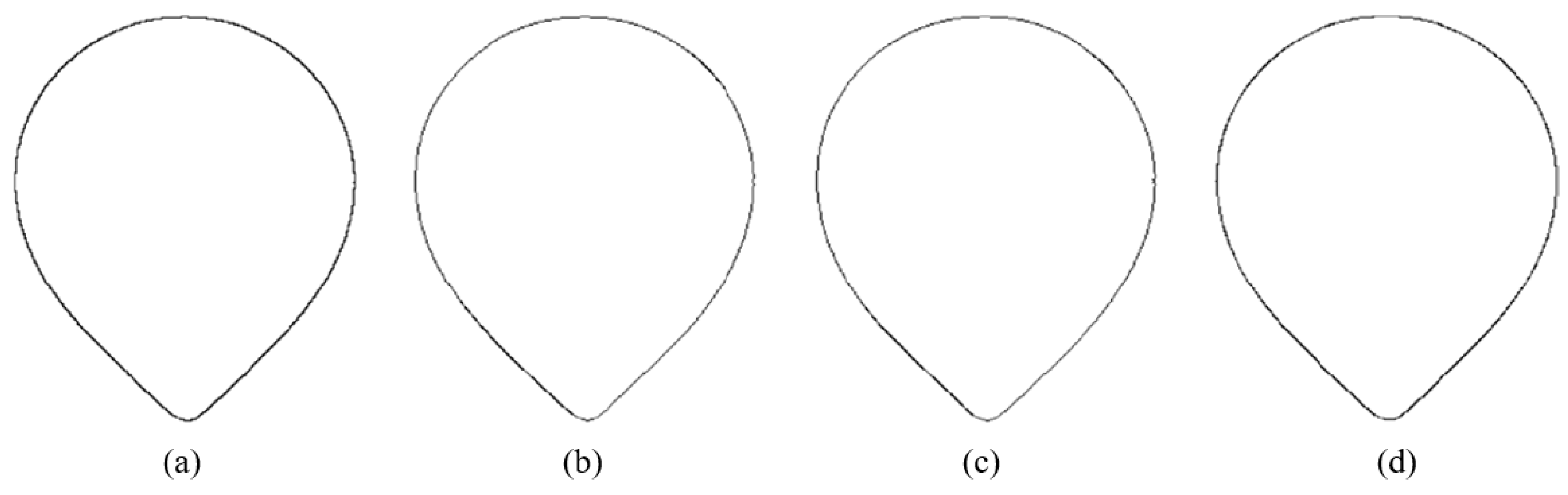
In the process of removing the background of the image, the discrimination of the gray value of the bubble part is reduced, and the uneven illumination intensity during the shooting produces a white reflective area. Therefore, the preprocessed bubble image center will produce “holes”, and there will be missing edges. In order to better identify the bubble characteristics, the obtained bubble image needs to be filled with holes, as shown in Figure 2c. Then, in order to extract the bubble characteristic parameters, it is necessary to use the edge operator to extract the edge coordinates of the bubble after filling the holes in the bubble. According to the jump characteristics of gray value, the image edge can be divided into step type, ridge type, and pulse type [26]. The step-type edge refers to the large difference in the gray value of the adjacent area in the image. In this experiment, the bubble image is a binary image after preprocessing and hole filling. The gray difference between the bubble and the background is obvious, so the bubble edge in this experiment belongs to the step edge. There are four operators to perform the edge detection, i.e., the Roberts, Sobel, Prewitt, and Canny operators [27,28,29]. The bubble results processed by the four edge detection operators are shown in Figure 3; negligible differences are found among the four operators, and the Canny operator is finally selected.

3.3. Bubble Parameter Characterization

From the previous image processing, some bubble parameters can be extracted; they include the geometric parameters (the area, equivalent diameter, equivalent volume, centroid, and shape parameters of the bubble) and the motion parameters (bubble detachment period and velocity).
The bubble area S can be described by the sum of the pixels in the bubble-connected region in the binarized image filled with holes. I ( i , j ) is the filled bubble image, Ω is the set of bubble pixels, and the bubble area is defined as follows:
S = i , j Ω I ( i , j )
The bubble departure diameter is actually the equivalent diameter calculated by the area of the bubble, that is, the diameter of the circle with the same area size as the bubble. The calculation formula is as follows:
d b = 4 S π
The bubble detachment volume is the equivalent volume calculated according to the detachment diameter:
V b = π d b 3 6
In the binary image of the bubble, the geometric center of the bubble is the centroid of the bubble. The average value can be obtained by summing the coordinates of all the pixels of the bubble in the image. The abscissa and ordinate of the pixels in the bubble area are represented by i and j, respectively. The sum of the pixels in the bubble area is represented by N, and the calculation formula of the centroid coordinates ( x c , y c ) is
x c = i , j Ω i N y c = i , j Ω j N
To characterize the deformation effect of the bubbles, a roundness R can be defined as
R = L 2 S
where L is the perimeter of the bubble. The roundness R can describe the complexity of the bubble. The larger the roundness R, the smoother the shape of the bubble. On the contrary, the smaller the roundness R, the less the shape of the bubble is close to a circle.
The time interval from the last bubble departure from the orifice to the end of the next bubble departure from the orifice is defined as a bubble departure cycle. The detachment period includes the waiting time ( T w , the time interval from the time of the last bubble detachment to the time when the top of the next bubble emerges from the orifice) and the formation time ( T f , the time interval from the time when the bubble emerges from the nozzle to the complete detachment from the nozzle):
T = T w + T f

4. Results and Discussion

4.1. Regime Map of the Bubble Periodicity

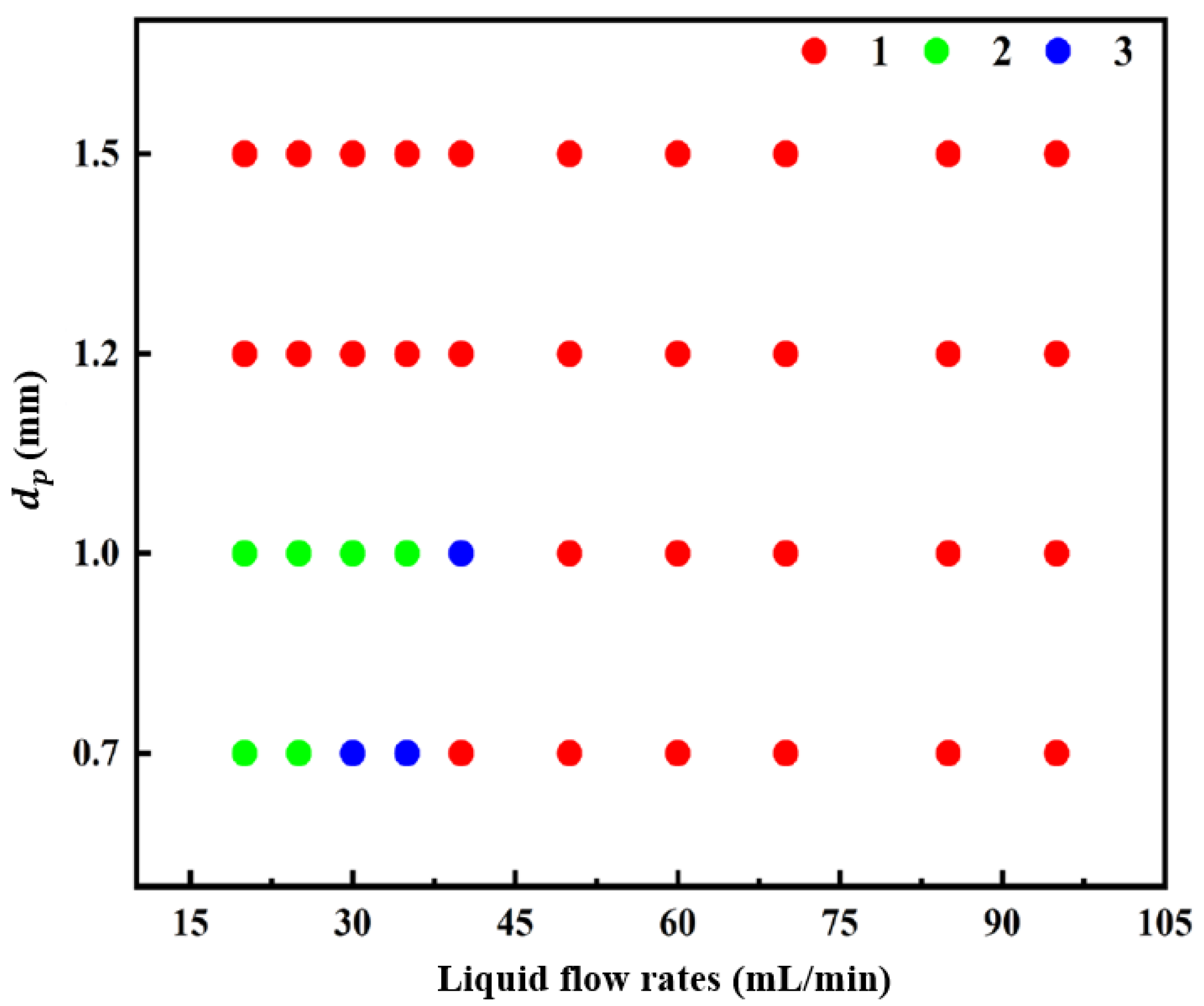
Depending on the inner diameter of the steel tube and the outlet liquid flow rate, the generated bubble may experience three different periodicities: single-bubble periodicity, double-bubble periodicity, and triple-bubble periodicity, which have one, two, and three separated bubbles, respectively, without any bubble aggregation and fragmentation in one single-bubble-generation cycle. Figure 4 shows the regime map of the bubble periodicity under different liquid flow rates (25 mL/min–95 mL/min) and orifice inner diameters ( d p = 0.7 mm, 1.0 mm, 1.2 mm, and 1.5 mm) when using deionized water as the liquid. It can be seen that when the inner diameter of the orifice d p is 1.2 mm and 1.5 mm, the change in the outlet liquid flow rate has no effect on the periodicity of the bubble, which is a single-bubble periodicity. When d p is 0.7 mm and 1.0 mm, as the liquid flow rate of the outlet increases, the bubble at the orifice first appears with the double-bubble periodicity, then presents triple-bubble periodicity, and finally grows and detaches in the form of single-bubble periodicity. The corresponding reason may be related to the effects of buoyancy, momentum force, pressure, resistance, surface tension, and inertial force that the bubble experiences. When the flow rate is relatively low, the detached diameter of the bubble is small, and it becomes easier to detach, resulting in either two or three detached bubbles within one cycle. As the flow rate increases, the bubble grows bigger, and it detaches more slowly, so it becomes a single periodicity. Similarly, as the orifice inner diameter d p increases, the bubble becomes more difficult to detach, and it grows bigger, so it becomes a single periodicity. The three periodic bubble generation mechanisms are discussed in detail below.

4.1.1. Single-Bubble Periodicity

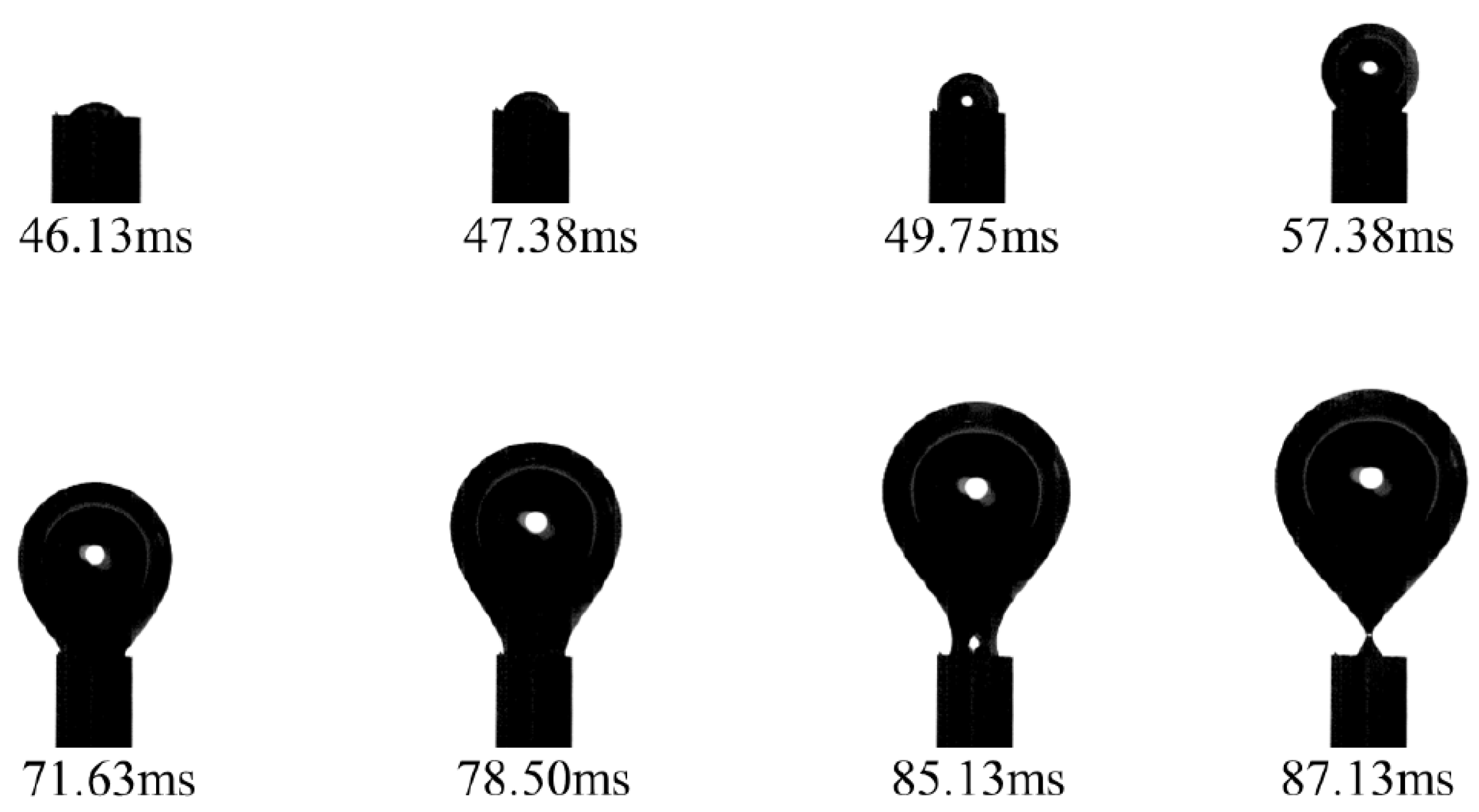
Figure 5 shows a bubble growth process when the liquid flow rate is 25 mL/min and d p = 1.5 mm. It falls within the single-bubble periodicity regime. The whole bubble growth process can be divided into four stages. Initially, the gas–liquid interface at the orifice moves upward to form a bubble bulge. The bulge gradually becomes hemispherical (49.75 ms). This is the bubble nucleation stage. In this stage, the buoyancy can be ignored; the main resistance of the growing bubble is the surface tension and the hydrostatic pressure. When the three-phase contact line of the bubble grows longitudinally away from the axis of the orifice, the bubble continues to expand, and the gas–liquid interface is disturbed due to the large radial expansion rate of the interface (57.38 ms). This is the subcritical bubble growth stage. At this stage, the upward resultant force becomes larger, and the bubble forms a more complete spherical shape under the combined action of various forces. In the critical bubble growth stage, the bubble continues to elongate and expand during upward movement. Due to the significant increase in the bubble volume, the buoyancy has a significant effect on the bubble, and the longitudinal elongation rate is faster. In the final necking stage (85.13 ms–87.13 ms), the bottom of the bubble shrinks inward to form a neck. At this time, the radial expansion and rising height of the bubble are not obvious. The necking process leads to a rapid change in the contact angle and the surface tension, thereby accelerating the neck contraction. Finally, the bubble detaches from the orifice and leaves a bubble cone at the bottom, attaching to the orifice for the next cycle. These bubble growth stages are consistent with those observed in Gnyloskurenko et al. [30].
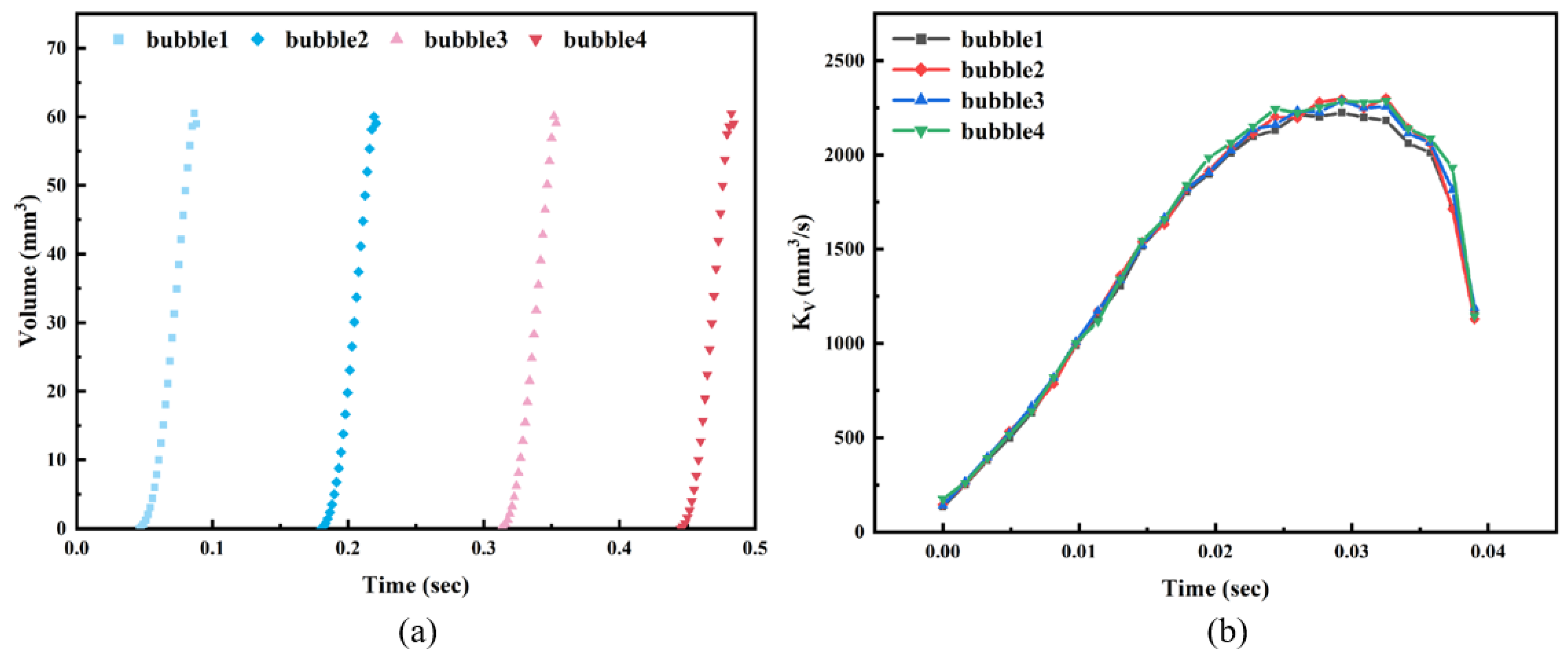
Figure 6 shows the time variations in bubble volume and bubble volume expansion rate K V for four consecutive cycles with d p = 1.5 mm and liquid flow rate = 25 mL/min at the single-bubble periodicity regime. The bubble volume expansion rate is defined as K V = V 2 V 1 t 2 t 1 , where V 1 and V 2 represent the instantaneous bubble volumes at time instants of t 1 and t 2 , respectively. It is clear that the volumes of the four bubbles show the same variation trend. As shown in Figure 6a, each bubble has a waiting time ( T w ) before the bubble overcomes the surface tension force and hydrostatic pressure to nucleate and have a non-zero volume, while from the bubble nucleation to the final detachment, it is the growth time ( T g ). As the bubble grows, the volume expansion rate of the bubble gradually increases. When the bubble enters the subcritical growth state, the buoyancy of the bubble increases, and the volume expansion rate of the bubble increases at a higher speed. At this time, the bubble also grows steadily around and gradually becomes a more complete sphere. After the volume expansion rate reaches a certain constant value, it fluctuates around this value. At this time, it is a critical growth state. The longitudinal growth rate is faster, and the lateral growth rate is slower. In the late stage of bubble growth, that is, the necking stage, the resultant force of the bubble is upward, the neck continues to contract, the bubble volume increases slowly, and the volume expansion rate shows a decreasing trend.

4.1.2. Double-Bubble Periodicity

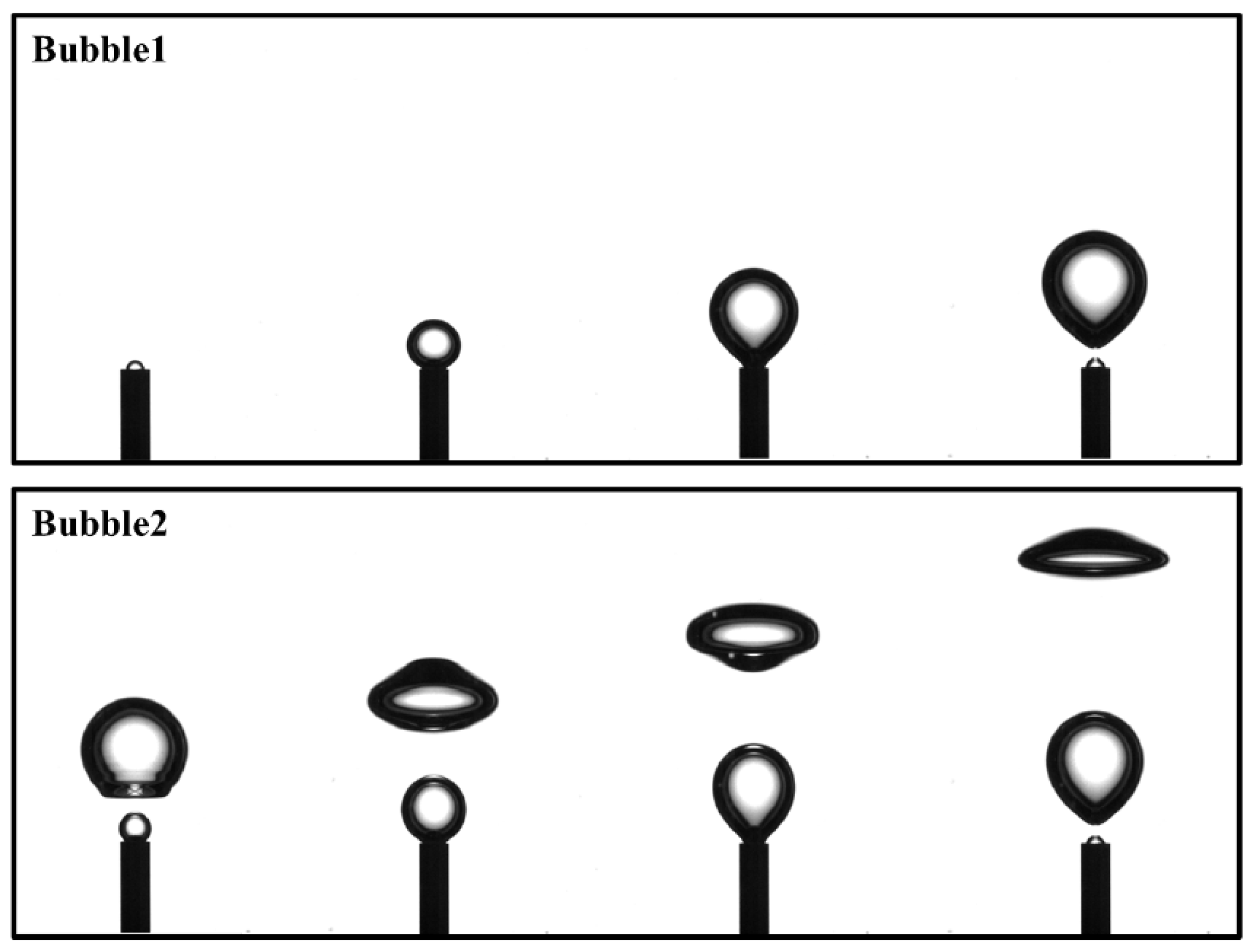
In the double-bubble periodicity regime, there are two bubbles in each bubble cycle, as shown in Figure 7. The first bubble is called the leading bubble, and the second is called the trailing bubble. The formation of the leading bubble is not affected by the trailing bubble of the previous cycle. In the same cycle, when the leading bubble breaks away, the trailing bubble immediately begins to form. The two bubbles do not coalesce or collide, but the detachment of the subsequent bubble will be affected by the leading bubble. There is a waiting time between the double-bubble cycles.
In order to clearly show the periodic changes in bubbles in the double-bubble periodicity regime, the volume changes in three consecutive double-bubble cycles are demonstrated in Figure 8. The growth process of the leading bubble is similar to that in the single-bubble periodicity regime. There is a waiting time in the early stage of bubble growth, while the trailing bubble begins to grow from the neck of the orifice during the departure of the leading bubble, and there is no waiting time. The departure of the leading bubble disturbs the surrounding liquid and promotes the detachment of the trailing bubble. This is why the departure volume of the leading bubble Vb1 is 20.56% larger than that of the trailing bubble Vb2. As shown in Figure 8b, the volume expansion rate of the leading bubble is almost zero at the initial stage of growth. Once the nucleation bulge begins to grow into a spherical bubble, the volume expansion rate begins to increase significantly, and the bubble accelerates expansion. In the necking stage, the volume expansion rate gradually decreases until the bubble is detached. The trailing bubble begins to grow due to the direct departure of the leading bubble from the residual neck. The disturbance caused by the upward movement of the leading bubble leads to the initial oscillation and unstable shape of the trailing bubble, and the volume expansion rate fluctuates up and down. As the influence of the rising of the leading bubble on the growth of the bubble is weakened, the volume expansion rate shows an increasing trend, but the peak value of the volume expansion rate is lower than that of the leading bubble.

4.1.3. Triple-Bubble Periodicity

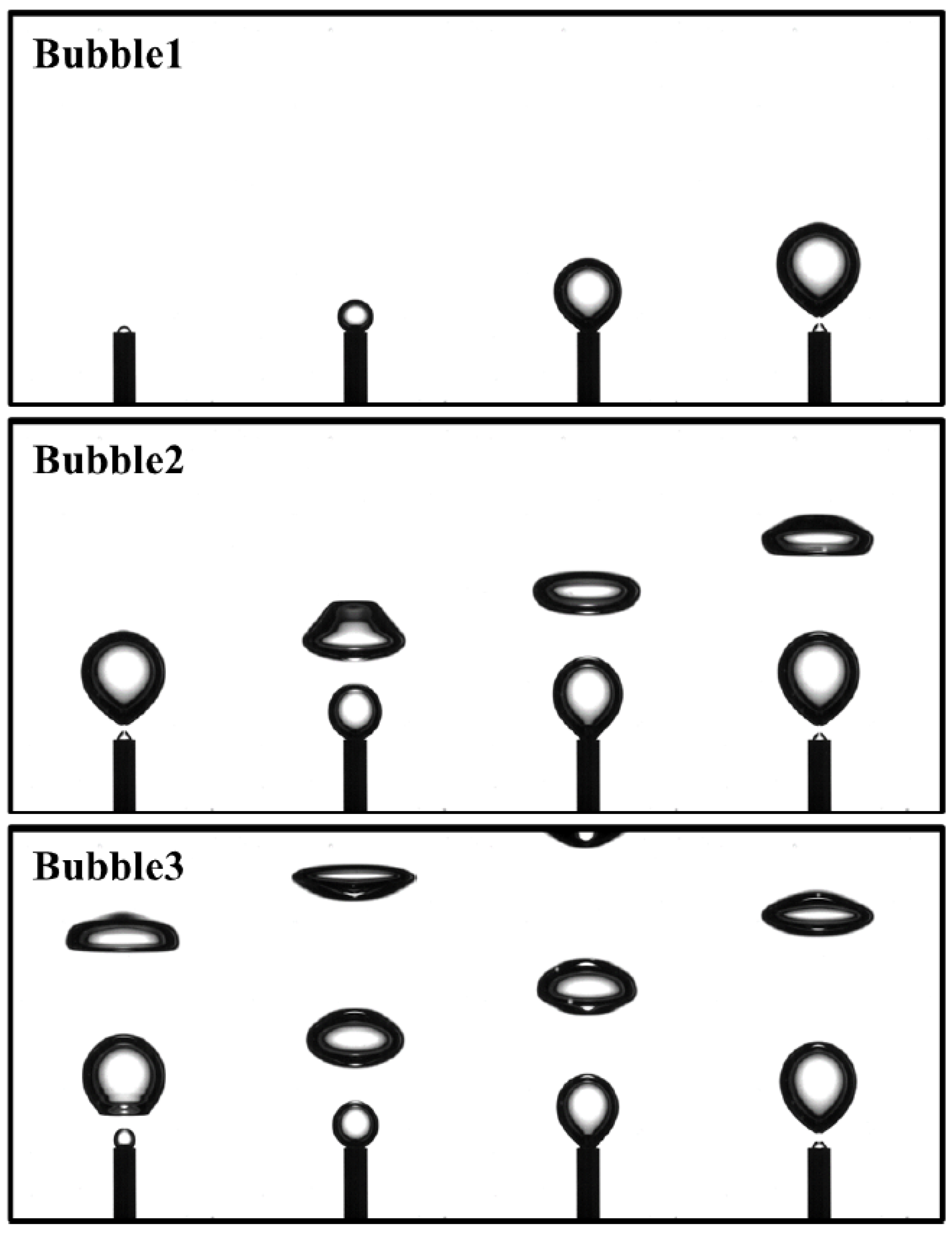
When the inner diameter of the orifice is 0.7 mm and the outlet liquid flow rate increases from 25 mL/min to 35 mL/min, the bubble formation changes from the double-bubble periodicity regime to the triple-bubble periodicity regime, as shown in Figure 9. There are three small cycles of bubble detachment in each large cycle. The three bubbles are recorded as bubble 1, bubble 2, and bubble 3, respectively. In the same cycle, the interaction between the three bubbles is strong, which makes the shape and dynamic behavior of the bubble formation process slightly different from those in the single- and double-bubble periodicity regimes. The detachment of the leading bubble affects the subsequent bubbles. The detachment period of bubble 1 comprises a waiting time and a growth time, and it is the longest, while bubble 2 and bubble 3 only contain a growth time without a waiting time, and the detachment period of bubble 2 is the shortest. The average detachment volumes of bubble 1, bubble 2, and bubble 3 are 37.24 mm3, 35.15 mm3, and 30.96 mm3, respectively.
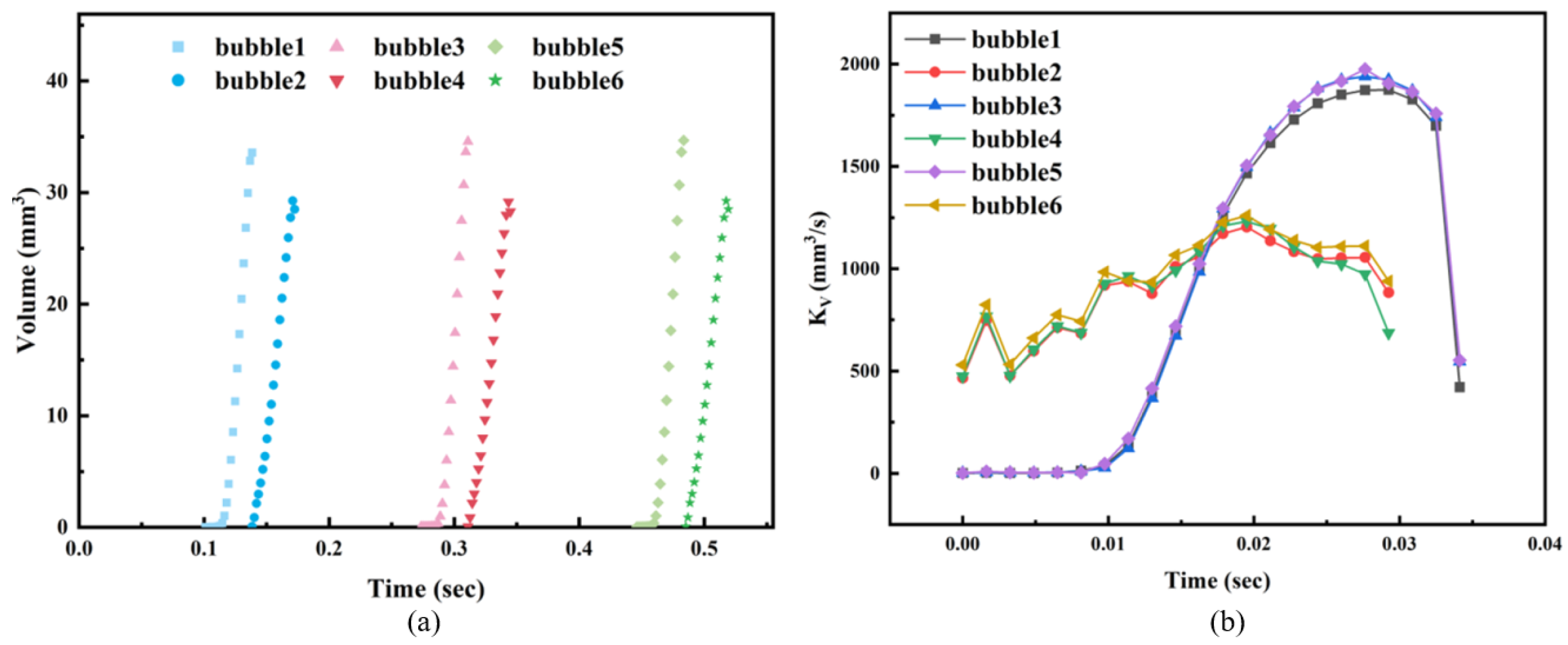
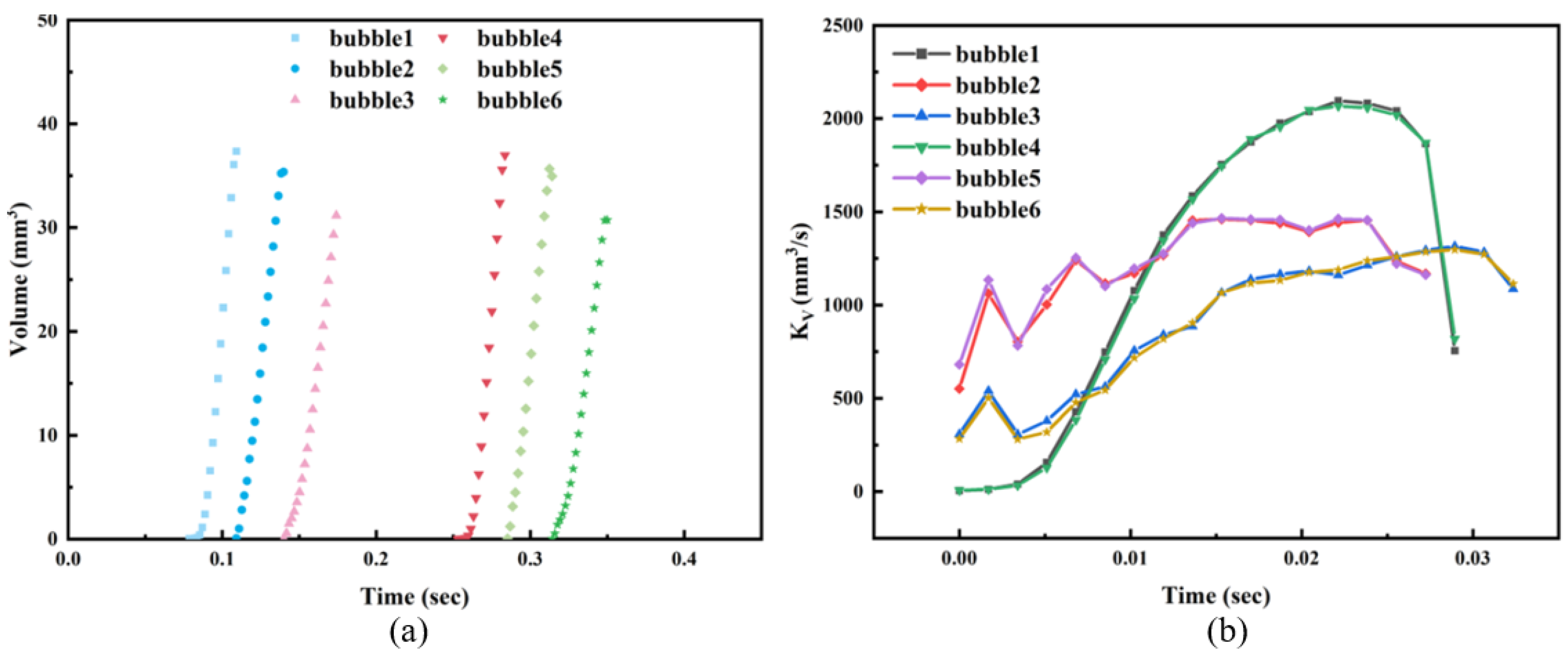
Figure 10 shows the time variations in bubble volume and bubble volume expansion rate K V for two consecutive cycles with d p = 0.7 mm and a liquid flow rate = 35 mL/min at the triple-bubble periodicity regime. The leading bubble has the largest volume, and the subsequent bubbles decrease their volume successively. The volume expansion rate of the leading bubble also follows the nucleation, subcritical, critical, and necking stages, while the subsequent bubbles show an oscillation trend of the volume expansion rate due to the influence of the previous bubbles.

4.2. The Effect of the Outlet Flow Rate in the Single-Bubble Periodicity Regime

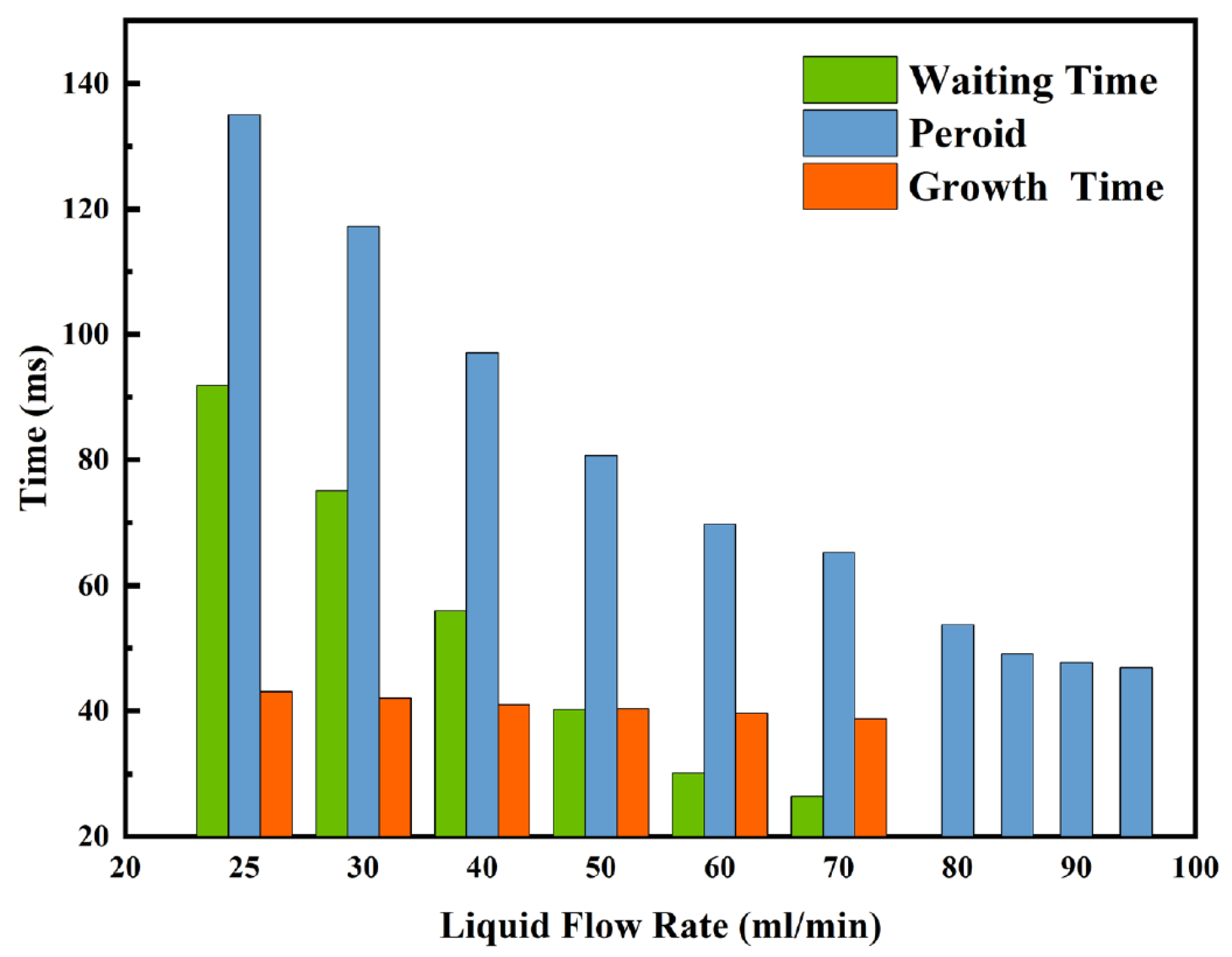
Figure 11 shows the variations in the bubble generation period at different outlet flow rates when d p = 1.5 mm. When the flow rate is in the range of 25 mL/min to 70 mL/min, the bubble period is determined by the waiting time and the growth time. The waiting time of bubbles decreases with the increase in the liquid flow rate. This is because the larger the liquid outlet flow rate, the faster the gas enters the container from the steel pipe, and the shorter the time required for the steel pipe orifice to gather pressure. The bubble growth time decreases slightly with the decrease in the liquid flow rate. When the flow rate is increased to more than 80 mL/min, the bubble waiting time is so short that it can hardly be measured, as shown in the figure, the bubble growth cycle is only determined by the growth time. The growth time decreases with the increase in the flow rate of the liquid outflow. It can clearly be seen from the figure that the bubble growth period decreases with the increase in flow rate, but the decreasing rate becomes less sensitive as the outlet flow rate increases.
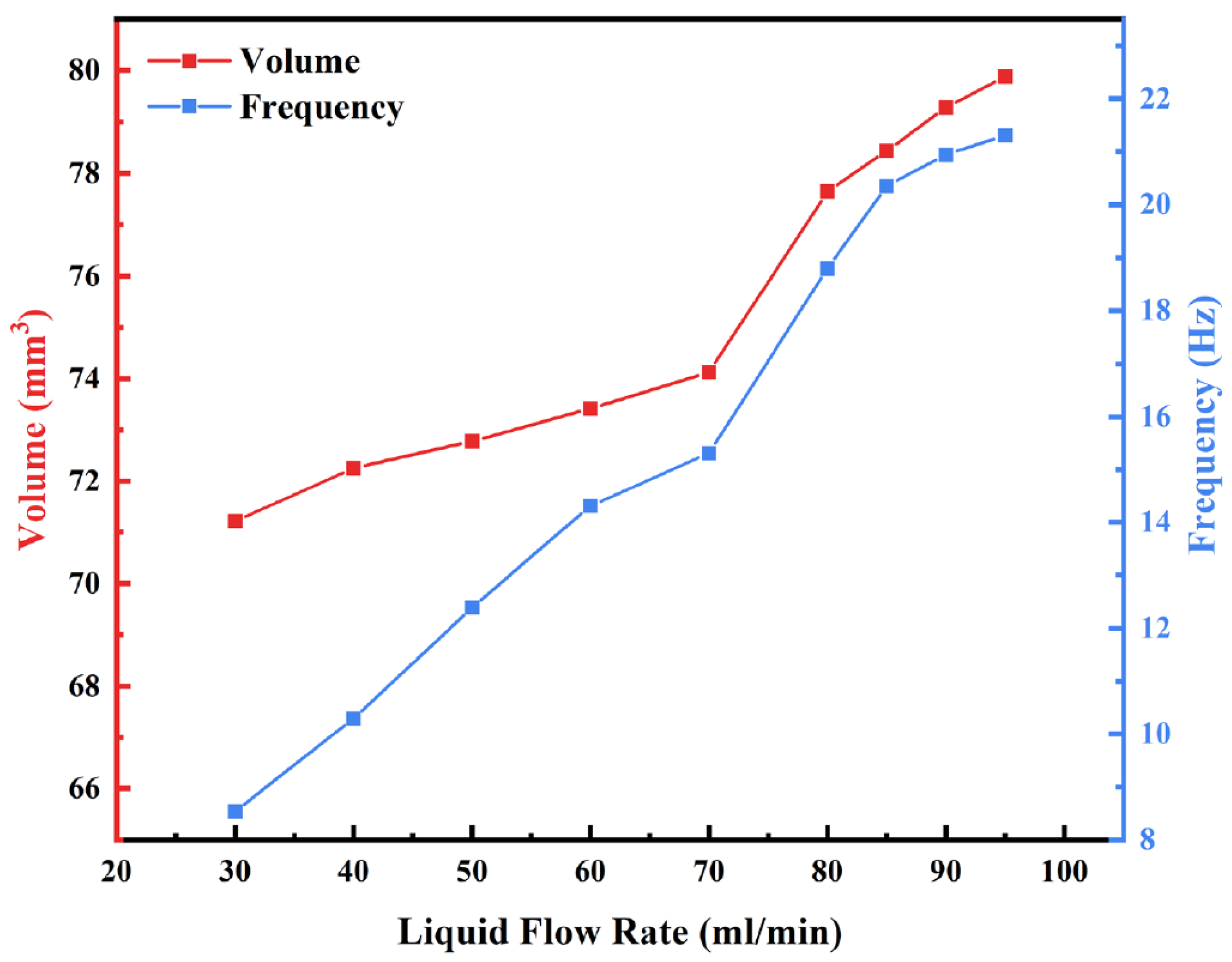
Figure 12 shows the variations in bubble volume and bubble frequency with the outlet liquid flow rate when d p = 1.5 mm. The bubble frequency increases with the increase in the liquid outflow rate, and it can be regarded as linear growth between 30 mL/min and 60 mL/min. With the increase in the outlet liquid flow rate, the volume of bubble detachment also increases. This is because the velocity of gas at the steel pipe orifice increases with the increase in the liquid flow rate, and the inertial force acting on the gas–liquid interface also increases. As the inertial force acts uniformly on the gas–liquid interface, the bubble is in the trend of continuous expansion and growth, so the detachment volume of the bubble increases. On the other hand, the increase in the bubble buoyancy caused by the increased bubble volume and the increase in the inertial force caused by the increase in the gas velocity at the orifice together make the bubble detachment frequency faster.
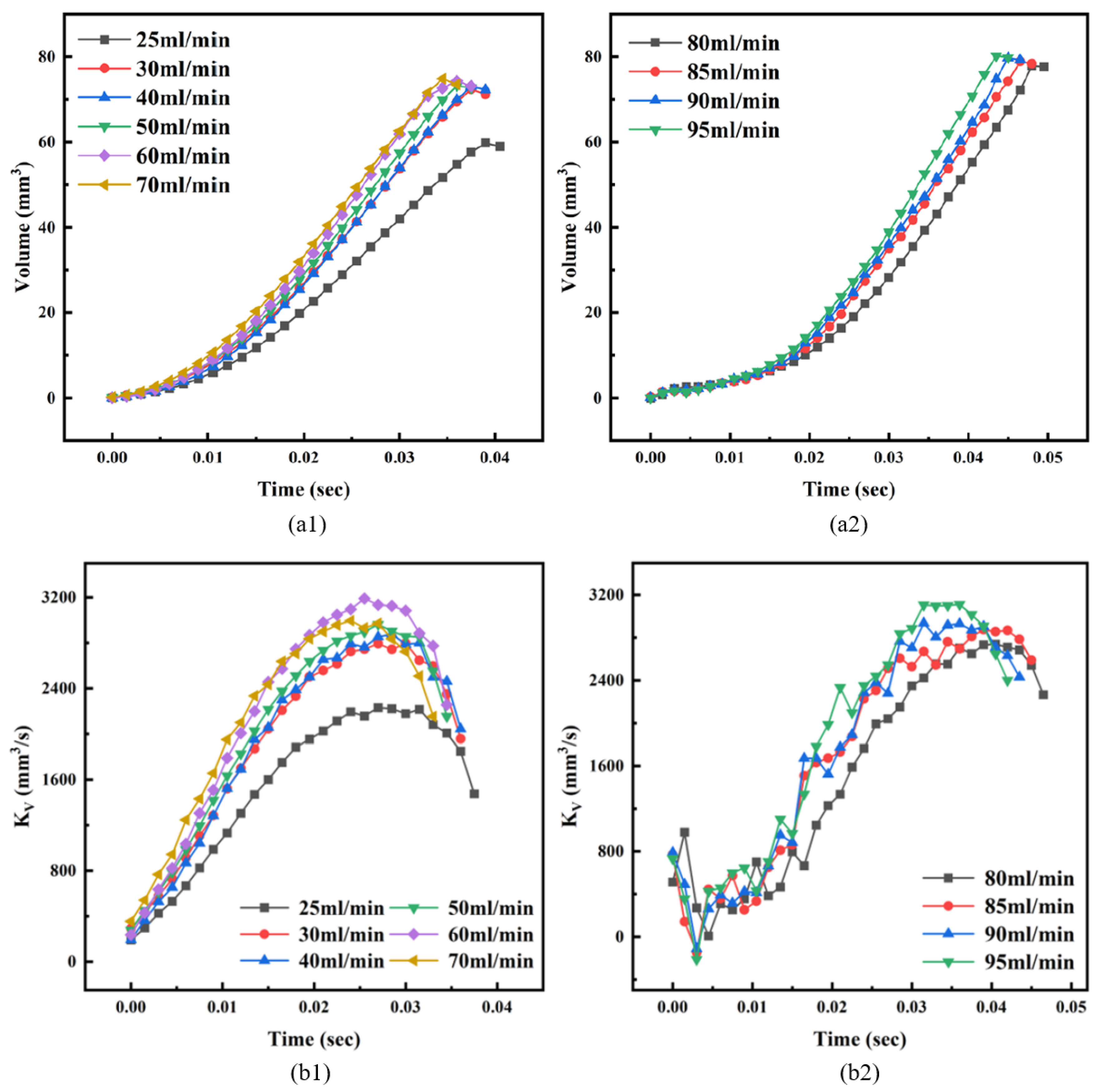
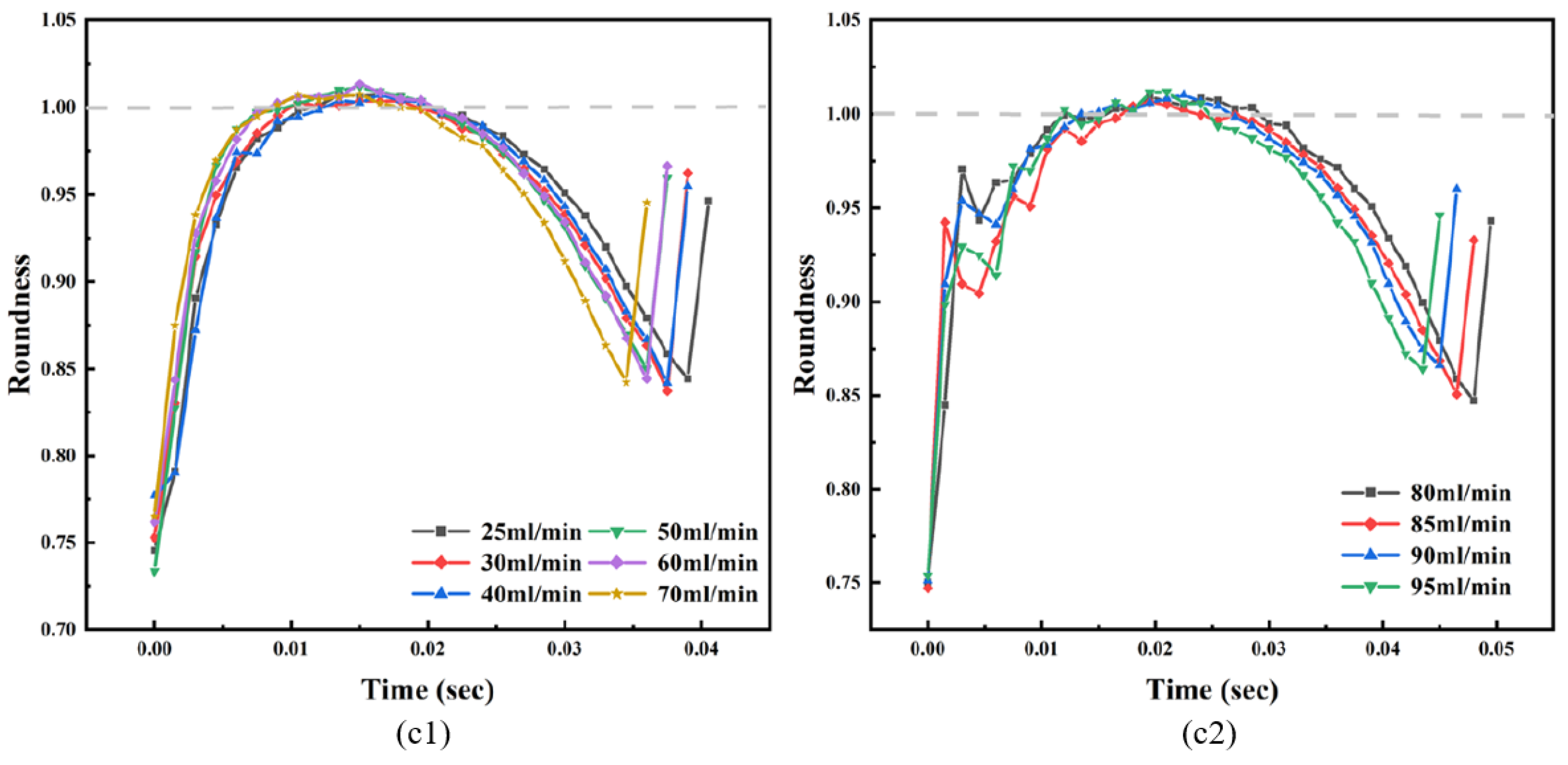
Figure 13 compares the time variations in bubble volume, bubble volume expansion rate, and roundness at different outlet flow rates when d p = 1.5 mm. It can be seen that there is no difference in the growth trend of bubbles under different outlet liquid flow rates. When the liquid flow rate 70 mL/min, the bubble volume first experiences an accelerated growth trend and then a linear growth trend. Reflected in the curve of the volume expansion rate, the volume expansion rate increases rapidly at the beginning, then reaches a plateau for a short period of time, and then begins to decline at the necking moment. The bubble roundness curve shows that the bubble shape quickly approaches the spherical shape. After the neck appears, it begins to decline and is no longer close to a spherical shape. Finally, the neck is broken when the bubble is detached, and the roundness of the bubble is again improved. When the liquid flow rate 80 mL/min (no waiting time), the bubble volume expansion rate has a negative value and fluctuates up and down in the initial stage, which is closely related to the disturbance of the flow field after the previous bubble is detached. The bubble roundness fluctuates in the initial stage, quite different from that when the flow rate is low ( 70 mL/min). The roundness accelerates and decreases during the necking process until the neck breaks at the time of detachment.

4.3. The Effect of Liquid Properties in the Single-Bubble Periodicity Regime

Since the research background includes the study of gas–liquid equilibrium in the electronic atomizer, and the liquid properties of the atomized liquid in the electronic atomizer are different from those of water, the change in liquid properties in the container will also affect the formation and detachment process of bubbles. It is necessary to study the formation and detachment process of bubbles in glycerol aqueous solution and compare the experimental results of bubble formation in glycerol aqueous solution with the experimental results of bubble formation in water.
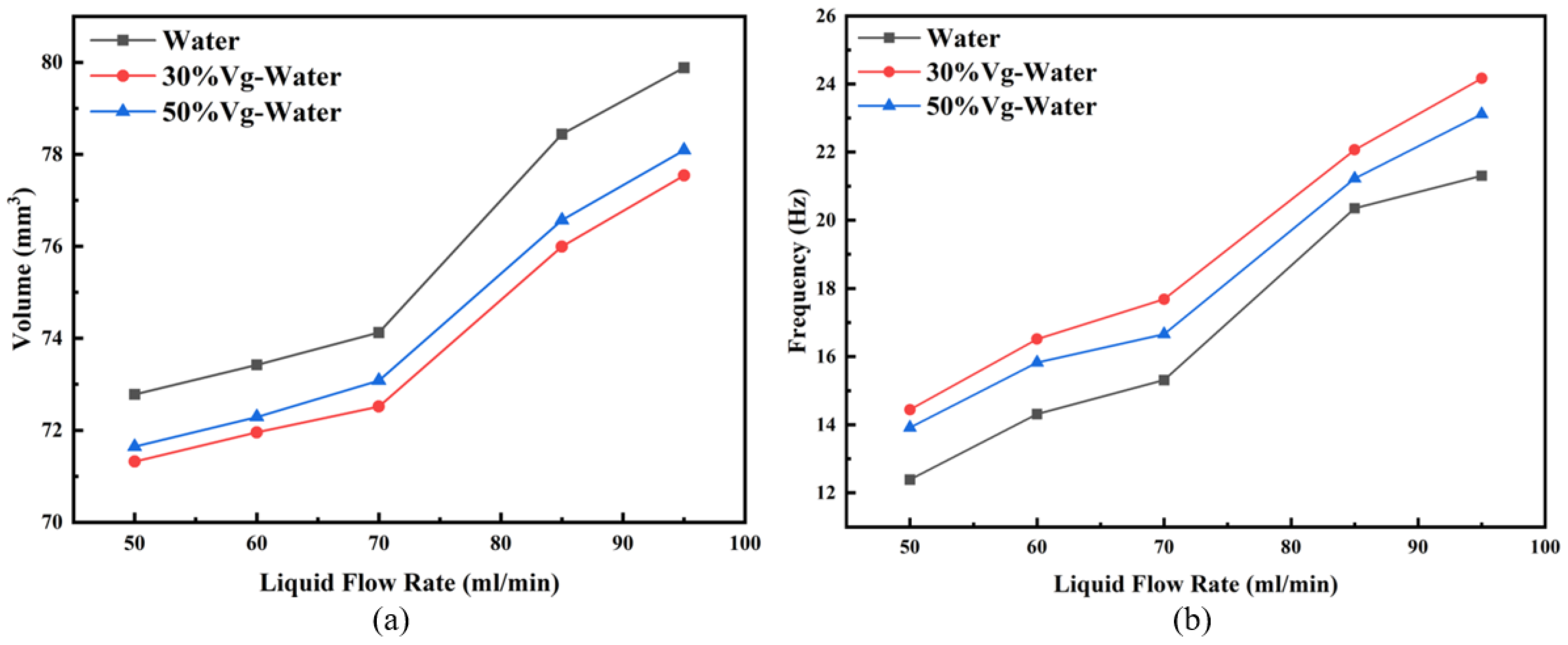
Figure 14 compares the bubble volume and bubble frequency at different outlet flow rates for the three liquids (water, 30% glycerol aqueous solution, and 50% glycerol aqueous solution). The bubble detachment frequency in deionized water is smaller than that in glycerol aqueous solution, and the detachment volume is larger than that in glycerol aqueous solution. Compared with deionized water, the glycerol aqueous solutions have a larger viscosity and a smaller surface tension. The increase in viscosity will increase the viscous drag of the liquid to the bubble and hinder the detachment of the bubble. The decrease in surface tension reduces the buoyancy required for bubble detachment and accelerates the detachment of bubbles. Therefore, the difference between the detachment volume of bubbles in glycerol aqueous solution and that in deionized water depends on the relative effect of surface tension and viscous force. It can be observed that the surface tension plays a leading role in this experiment, resulting in the detachment volume of bubbles in deionized water being larger than that in glycerol aqueous solution, and the detachment frequency of bubbles is less than that in glycerol aqueous solution. In addition, the higher the concentration of glycerol aqueous solution, the greater the surface tension and viscosity, but the increase in viscosity is much larger than the increase in surface tension. This means that in a high concentration of glycerol aqueous solution, the bubble rise is more resistant, the bubble growth time is longer, and the amount of gas entering the bubble is more. Therefore, in a high concentration of glycerol aqueous solution, the volume of bubble detachment is larger and the frequency of detachment is smaller.

5. Conclusions

The current work explores the growth and detachment process of bubbles through visual experiments. Based on the periodic growth law of bubbles, the volume dynamic changes during the growth of single-bubble periodicity and multi-bubble periodicities are analyzed. The effects of the outlet liquid flow rate and the liquid properties on the bubble detachment volume and detachment frequency are also discussed. The following conclusions are obtained:
(1) The bubble formation period can be divided into single-bubble periodicity, double-bubble periodicity and triple-bubble periodicity under different orifice sizes and outlet liquid flow rates. In all these periodicities, bubbles are formed in a single form, and there is no collision or coalescence behavior.
(2) The growth process of single bubbles can be divided into four stages according to the shape change—nucleation stage, quasi-critical stage, critical stage, and necking stage—which is similar to the division rules in the literature.
(3) The growth period and waiting time of the bubble decrease with the increase in the outlet liquid flow rate, and the growth time of the bubble decreases slightly with the flow rate. When there is no waiting time, the continuous bubble growth time decreases with the increase in the outlet flow rate. The detachment frequency and detachment volume of bubbles increase with the increase in the outlet flow rate.
(4) The change in liquid properties also affects the bubble growth and detachment characteristics. The detachment volume of bubbles in glycerol aqueous solution is larger than that in deionized water, and the detachment frequency is less than that in deionized water. The larger the concentration of the glycerol aqueous solution, the larger the bubble detachment volume and the smaller the detachment frequency.

Author Contributions

D.S.: Validation, Methodology, Investigation. J.Z.: Formal Analysis, Data Curation, Conceptualization, Writing—Original Draft. H.L.: Writing—Review and Editing, Visualization, Data Curation. Y.Z.: Writing—Review and Editing, Supervision. Z.K.: Writing—Review and Editing, Supervision, Formal Analysis. All authors have read and agreed to the published version of the manuscript.

Funding

This research was funded by Jiangxi Provincial Natural Science Foundation (No. 20232BAB204057 and No. 20242BAB26072).

Data Availability Statement

The data that support the findings of this study are available from the corresponding author upon reasonable request.

Conflicts of Interest

Author Deji Sun was employed by the company CHN Energy Jiangxi Engineering Technology Co., Ltd. Author Huiwu Liu was employed by the company Jiangxi Xintian Auto Products Co., Ltd. The remaining authors declare that the research was conducted in the absence of any commercial or financial relationships that could be construed as a potential conflict of interest.

References

  1. Lau, R.; Mo, R.; Sim, W.S.B. Bubble characteristics in shallow bubble column reactors. Chem. Eng. Res. Des. 2010, 88, 197–203. [Google Scholar] [CrossRef]
  2. Yang, W.-J.; Yeh, H.-C. Theoretical study of bubble dynamics in purely viscous fluids. AIChE J. 1965, 12, 927–931. [Google Scholar] [CrossRef]
  3. Ramakrishnan, S.; Kumar, R.; Kuloor, N.R. Studies in bubble formation—I bubble formation under constant flow conditions. Chem. Eng. Sci. 1969, 24, 731–747. [Google Scholar] [CrossRef]
  4. Gaddis, E.S.; Vogelpohl, A. Bubble formation in quiescent liquids under constant flow conditions. Chem. Eng. Sci. 1986, 41, 97–105. [Google Scholar] [CrossRef]
  5. Anagbo, P.E.; Brimacombe, J.K.; Wraith, A.E. Formation of ellipsoidal bubbles at a free-standing nozzle. Chem. Eng. Sci. 1991, 46, 781–788. [Google Scholar] [CrossRef]
  6. Li, S.K.; Xiao, H.; Wang, Z.Z.; Zhang, H.D.; Chen, A.Q.; Huang, Q.S.; Yang, C. Theoretical model for predicting bubble formation from submerged orifices. Chem. Eng. J. 2024, 496, 153893. [Google Scholar] [CrossRef]
  7. Leibson, I.; Holcomb, E.G.; Cacoso, A.G.; Jacmic, J.J. Rate of flow and mechanics of bubble formation from single submerged orifices. I. Rate of flow studies. AIChE J. 1956, 2, 296–300. [Google Scholar] [CrossRef]
  8. Gutwald, S.; Mersmann, A. Bubble growth in secondary foams. Chem. Eng. Technol. 1997, 20, 293–296. [Google Scholar] [CrossRef]
  9. Mohseni, E.; Kalayathine, J.J.; Reinecke, S.F.; Hampel, U. Dynamics of bubble formation at micro-orifices under constant gas flow conditions. Int. J. Multiph. Flow 2020, 132, 103407. [Google Scholar] [CrossRef]
  10. Mirsandi, H.; Smit, W.J.; Kong, G.; Baltussen, M.W.; Peters, E.A.J.F.; Kuipers, J.A.M. Influence of wetting conditions on bubble formation from a submerged orifice. Exp. Fluids 2020, 61, 83. [Google Scholar] [CrossRef]
  11. Yamasaki, H.; Kishimoto, T.; Tazawa, T.; Yamaguchi, H. Dynamic behavior of gas bubble detached from single orifice in magnetic fluid. J. Magn. Magn. Mater. 2020, 501, 166446. [Google Scholar] [CrossRef]
  12. Mohseni, E.; Reinecke, S.F.; Hampel, U.; Chiamulera, M.E. Bubble formation from sub-millimeter orifices: Experimental analysis and modeling. Chem. Eng. Process.-Process Intensif. 2022, 173, 108809. [Google Scholar] [CrossRef]
  13. Hanafizadeh, P.; Sattari, A.; Hosseini-Doost, S.E.; Nouri, A.G.; Ashjaee, M. Effect of orifice shape on bubble formation mechanism. Meccanica 2018, 53, 2461–2483. [Google Scholar] [CrossRef]
  14. Liu, J.; Qi, H.; Song, Y.; Chen, S.; Wu, D. Dynamics of bubbles detached from non-circular orifices: Confinement effect of orifice boundary. Chem. Eng. J. 2023, 471, 144777. [Google Scholar] [CrossRef]
  15. Crha, J.; Orvalho, S.; Ruzicka, M.C.; Shirokov, V.; Jerhotova, K.; Pokorny, P.; Basarova, P. Bubble formation and swarm dynamics: Effect of increased viscosity. Chem. Eng. Sci. 2024, 288, 119831. [Google Scholar] [CrossRef]
  16. Tang, J.; Hu, R.; Xu, L.; Liu, H.; Luo, J. Shape Oscillation-Induced Early Detachment of Bubble from a Submerged Microcapillary Nozzle. Langmuir 2023, 39, 16596–16605. [Google Scholar] [CrossRef]
  17. Yao, H.C.; Luo, J.; Xu, Y.; Liu, H.T.; Tang, J.G. Bubble Formation from a Submerged Microcapillary Nozzle in Novec 649. Ind. Eng. Chem. Res. 2024, 63, 22166–22176. [Google Scholar] [CrossRef]
  18. Islam, T.; Ganesan, P.; Sahu, J.N.; Hamad, F. Numerical study to invistigate the effect of inlet gas velocity and Reynolds number on bubble formation in a viscous liquid. Therm. Sci. 2015, 19, 2127–2138. [Google Scholar] [CrossRef][Green Version]
  19. Chen, N.; Chen, X.; Delgado, A. Numerical Study of Formation of a Series of Bubbles from an Orifice by Applying Dynamic Contact Angle Model. Adv. Mater. Sci. Eng. 2020, 2020, 5213234. [Google Scholar] [CrossRef]
  20. Cao, B.; Bai, L.; Hu, Z.; Li, S. Bubble Formation in Yield-Stress Fluids Using a Coupled Level-Set and Volume-of-Fluid Method. ACS Omega 2020, 5, 24011–24017. [Google Scholar] [CrossRef] [PubMed]
  21. Boubendir, L.; Chikh, S.; Tadrist, L. On the surface tension role in bubble growth and detachment in a micro-tube. Int. J. Multiph. Flow 2020, 124, 103196. [Google Scholar] [CrossRef]
  22. Vaishnavi, G.N.V.S.; Ramarajan, J.; Jayavel, S. Numerical studies of bubble formation dynamics in gas-liquid interaction using Volume of Fluid (VOF) method. Therm. Sci. Eng. Prog. 2023, 39, 101718. [Google Scholar] [CrossRef]
  23. Jia, M.; Pang, M.J. Influence of wettability and surface tension on bubble formation from a needle. Asia-Pac. J. Chem. Eng. 2025, 20, e3169. [Google Scholar] [CrossRef]
  24. Li, S.K.; Zhang, H.D.; Xiao, H.; Chen, A.Q.; Huang, Q.S. Numerical investigation of bubble growth and formation under quasi-static conditions. Int. J. Chem. React. Eng. 2025, 23, 647–663. [Google Scholar] [CrossRef]
  25. Takamura, K.; Fischer, H.; Morrow, N.R. Physical properties of aqueous glycerol solutions. J. Pet. Sci. Eng. 2012, 98–99, 50–60. [Google Scholar] [CrossRef]
  26. Pan, Z.; Zhao, L.; Zhang, B.; Tang, Z.; Xu, C. Multi-scale bubble size distribution measurement by digital imaging technique. Chin. J. Sci. Instrum. 2019, 40, 129–137. [Google Scholar] [CrossRef]
  27. Zhang, S.; Huang, W.; Shi, Y. Improved Bernsen binary algorithm for spot detection of plant disease leaves. Guangdong Agric. Sci. 2016, 43. [Google Scholar] [CrossRef]
  28. Ma, H.; Zhang, J. Classical document recognition algorithm based on threshold optimization technology. J. MUC (Nat. Sci. Ed.) 2022, 31, 76–80. [Google Scholar]
  29. Xu, M. Research on White Blood Cell Image Segmentation Based on Threshold and Watershed Algorithm. Master’s Thesis, Harbin University of Science and Technology, Harbin, China, 2021. [Google Scholar] [CrossRef]
  30. Gnyloskurenko, S.V.; Byakova, A.V.; Raychenko, O.I.; Nakamura, T. Influence of wetting conditions on bubble formation at orifice in an inviscid liquid. Transformation of bubble shape and size. Colloids Surf. A Physicochem. Eng. Asp. 2003, 218, 73–87. [Google Scholar] [CrossRef]
Figure 1. The experimental system for visualization of the bubble detachment characteristics at the orifice. (a) A schematic diagram (1. DAQ computer. 2. Data cable. 3. High-speed camera. 4. Injection pump. 5. PU hose. 6. Perforated rubber stopper. 7. Rubber stopper. 8. Stainless steel pipe. 9. Liquid container. 10. Liquid fluid. 11. Rubber stopper. 12. Uniform light plate. 13. LED light source); (b) a physical photograph.
Processes 13 03516 g001
Figure 2. (a) The original experimental image. (b) The preprocessed image. (c) Image after hole filling.
Processes 13 03516 g002
Figure 3. The detection results of the four operators: (a) Roberts, (b) Sobel, (c) Prewitt, and (d) Canny.
Processes 13 03516 g003
Figure 4. Regime map of the bubble periodicity under different liquid flow rates and orifice inner diameters when using deionized water as the liquid (—single-bubble periodicity, —double-bubble periodicity, and —triple-bubble periodicity).
Processes 13 03516 g004
Figure 5. The bubble growth process when d p = 1.5 mm and liquid flow rate = 25 mL/min at the single-bubble periodicity regime.
Processes 13 03516 g005
Figure 6. Time variations in (a) bubble volume and (b) bubble volume expansion rate K V . ( d p = 1.5 mm, liquid flow rate = 25 mL/min, single-bubble periodicity regime).
Processes 13 03516 g006
Figure 7. The bubble growth process when d p = 0.7 mm and liquid flow rate = 25 mL/min at the double-bubble periodicity regime.
Processes 13 03516 g007
Figure 8. Time variations in (a) bubble volume and (b) bubble volume expansion rate K V . ( d p = 0.7 mm, liquid flow rate = 25 mL/min, double-bubble periodicity regime).
Processes 13 03516 g008
Figure 9. Bubble growth process when d p = 0.7 mm and liquid flow rate = 35 mL/min at the triple-bubble periodicity regime.
Processes 13 03516 g009
Figure 10. Time variations in (a) bubble volume and (b) bubble volume expansion rate K V . ( d p = 0.7 mm, liquid flow rate = 35 mL/min, triple-bubble periodicity regime).
Processes 13 03516 g010
Figure 11. Bubble period variation at different outlet flow rates when d p = 1.5 mm.
Processes 13 03516 g011
Figure 12. Variations in bubble volume and bubble frequency with outlet liquid flow rate when d p = 1.5 mm.
Processes 13 03516 g012
Figure 13. Time variations in (a1,a2) bubble volume, (b1,b2) bubble volume expansion rate K V , and (c1,c2) roundness at different outlet flow rates when d p = 1.5 mm.
Processes 13 03516 g013aProcesses 13 03516 g013b
Figure 14. Variations in (a) bubble volume and (b) bubble frequency with outlet liquid flow rate for different liquids.
Processes 13 03516 g014
Table 1. Physical properties of liquids.
LiquidDynamic Viscosity (Pa·s)Density (kg/m3)Surface Tension Coefficient (N/m)
Deionized water0.001003998.20.0719
30% glycerol aqueous solution [25]0.0027351073.50.07085
50% glycerol aqueous solution [25]0.0076511280.06925
Disclaimer/Publisher’s Note: The statements, opinions and data contained in all publications are solely those of the individual author(s) and contributor(s) and not of MDPI and/or the editor(s). MDPI and/or the editor(s) disclaim responsibility for any injury to people or property resulting from any ideas, methods, instructions or products referred to in the content.