1. Introduction
The contamination of aquatic environments by a wide array of Contaminants of Emerging Concern (CECs) represents one of the most significant environmental challenges of the 21st century [
1,
2]. This diverse group of micropollutants includes substances from various sources, such as pharmaceuticals (e.g., antibiotics and hormones), personal care products (e.g., UV filters and synthetic fragrances), and numerous industrial and agricultural chemicals. Among the most problematic are Persistent Organic Pollutants (POPs), a subclass that includes synthetic pesticides and per- and polyfluoroalkyl substances (PFAS), widely known as “forever chemicals” due to their extreme resistance to degradation [
3,
4].
The continuous introduction and persistence of these compounds in water bodies are a growing threat to ecological balance and human health. These compounds are introduced into water sources through various pathways, including industrial effluents, agricultural runoff, and the disposal of consumer products such as medicines, personal care products, non-stick cookware, firefighting foams, and stain-resistant textiles. Their chemical stability, which makes them effective in commercial applications, also leads to their presence and accumulation in ecosystems and human tissues [
1,
2].
A critical health concern associated with many of these pollutants is their ability to act as endocrine-disrupting chemicals (EDCs). By mimicking or antagonizing natural hormones, EDCs can interfere with the body’s endocrine system, potentially leading to developmental defects, reproductive issues, immune system dysfunction, and an increased risk of certain cancers. The presence of such compounds in drinking water, even at trace concentrations, poses a substantial threat to public health, making their removal essential for ensuring water safety and security [
5].
The global reliance on synthetic agrochemicals is a primary driver of water contamination. The intensification of agricultural practices is reflected in a steady, significant increase in pesticide use worldwide. According to recent data from the Food and Agriculture Organization (FAO), the total quantity of pesticides used has doubled since 1990 [
6]. This upward trajectory has been maintained, showing a 13% increase over the last decade. More recently, in 2022, pesticide use increased by 4% compared to the previous year [
6]. The continuous and intensifying application of agrochemicals raises great concerns from both environmental and public health standpoints, as it increases the loading of these persistent compounds into soil and aquatic ecosystems, ultimately threatening the safety of drinking water resources.
The recalcitrant nature of many CECs, including pesticides, renders conventional water treatment processes, such as coagulation, sedimentation, and filtration, ineffective for their removal. This technological gap highlights the need for more robust and efficient purification strategies. In response to this environmental and health threat, research on the development of Advanced Oxidation Processes (AOPs), which utilize highly reactive species such as hydroxyl radicals (•OH) to degrade complex and stable organic molecules into less harmful substances, is increasing [
7,
8,
9].
Among these AOPs, ultrasound (sonolysis) and cold plasma have emerged as promising and innovative solutions [
7,
10,
11]. Both technologies offer several distinct advantages, such as operating efficiently at ambient temperature and pressure, and not requiring the addition of external chemical reagents, which minimizes the risk of forming secondary toxic byproducts. The energy needed to conduct these processes can be supplied by renewable sources, thereby enhancing the treatment’s sustainability. Furthermore, these methods are characterized by short processing times and satisfactory degradation efficiency when compared to other techniques, making them suitable alternatives for water purification [
7,
12].
Numerous studies have reported the effectiveness of ultrasound as a standalone or hybrid Advanced Oxidation Process (AOP) for degrading a wide range of pesticides in aqueous solutions. Ultrasound generates hydroxyl radicals (•OH) via acoustic cavitation, thereby degrading pesticides. Research has shown that the herbicide atrazine can be degraded entirely in under 20 min when ultrasound is combined with Fenton’s reagent (sono-Fenton process) [
13]. In another study focusing on the organophosphate insecticide chlorpyrifos, sonolysis alone achieved over 90% degradation after 120 min of treatment [
14]. Recalcitrant organochlorines, such as lindane, have been treated, attaining 88% removal after 100 min of sonication [
15]. These examples highlight ultrasound’s ability to break down diverse, complex pesticide molecules, reinforcing its potential as a water-treatment and remediation technology.
Several studies have also shown that cold plasma is a potential technology for removing pesticides from water. Its effectiveness comes from generating a mix of reactive species, such as hydroxyl radicals (•OH), ozone, singlet oxygen, molecular hydrogen, UV radiation, and other ions and free radicals, that attack and break down pollutant molecules [
16]. Research has shown that the organophosphate insecticide malathion degrades when exposed to cold plasma, achieving over 70% removal from water in 8 min [
16]. The technology is also effective against more persistent compounds, such as the herbicide atrazine, which has demonstrated 99% degradation within a 40-min treatment period using a dielectric barrier discharge plasma system [
17]. Furthermore, cold plasma has been used to treat the insecticide diazinon, reporting a degradation of 9.4 mg/L within 30 min [
18]. These examples demonstrate the potential of cold plasma to treat diverse and structurally complex pesticides.
Despite the proven efficacy of Advanced Oxidation Processes for various agrochemicals, there is a scarcity of literature reporting the decomposition of Aldrin and Dieldrin using cold plasma technologies. Specifically, the application and comparative efficacy of glow discharge, dielectric barrier discharge (DBD), and corona discharge plasmas for the remediation of these specific organochlorine pesticides have not been extensively investigated. This lack of data highlights the need to evaluate these non-thermal technologies as viable alternatives to conventional treatments.
This study targets Aldrin and Dieldrin, synthetic organochlorine insecticides known for their historical agricultural use and severe environmental impacts. Although Aldrin was extensively applied for soil pest control against termites and corn rootworms, it rapidly oxidizes in biological and ecological systems to form its more stable and toxic epoxide, Dieldrin. Consequently, Dieldrin represents the primary toxicological concern, persisting in ecosystems long after the release of the parent compound [
19].
The primary environmental issue with these pesticides is their extreme persistence. They are highly resistant to degradation, with literature data indicating that the half-life of Aldrin in the environment is approximately 3.1 months. Its epoxidation leads to the formation of Dieldrin, which is significantly more recalcitrant, exhibiting a half-life of about 29.7 months, underscoring the long-term threat these compounds pose to soil and water ecosystems [
20]. Due to their lipophilic nature, they are prone to bioaccumulation in organisms’ fatty tissues and subsequent biomagnification as they move up the food chain [
21]. This has had a serious impact on wildlife, particularly top predators such as fish and birds of prey.
Contamination of water bodies is a significant threat associated with Aldrin and Dieldrin. Their primary route into aquatic ecosystems is through agricultural runoff and soil erosion, which carry the pesticides into rivers, lakes, and groundwater [
19]. Although they have low water solubility, their persistence allows them to remain in water and bind to sediments for long periods, thereby acting as a long-term source of contamination. This poses a direct risk to drinking water safety. Their chemical stability makes them resistant to conventional water treatment methods, necessitating the use of advanced technologies to protect public health. Due to these profound risks, the use of Aldrin and Dieldrin has been banned or severely restricted globally under the Stockholm Convention on Persistent Organic Pollutants. Nonetheless, the threat posed by these chemicals is not merely historical. Despite the international agreement, their use persists in some parts of the world. This lack of control in certain regions means that Aldrin and Dieldrin persist as active sources of pollution, representing an ongoing danger to water sources and public health.
The concentrations of Aldrin and Dieldrin in the environment range from several nanograms per liter (ng/L) to low micrograms per liter (μg/L), reflecting the varied history of their use and environmental conditions worldwide. These levels are highly dependent on factors like proximity to historical agricultural areas, soil characteristics, and rainfall events that trigger runoff. For instance, in regions with extensive historical use but long-standing bans, legacy contamination is still evident. Monitoring in the Great Lakes of North America has detected dieldrin in surface waters, with typical background concentrations in the low nanogram per liter range (0.1 to 2 ng/L) [
22].
Studies in more intensively agricultural basins, particularly those with soils that retain high contaminant loads, reveal more concerning levels. Research conducted in the Paraná River basin in Brazil and Argentina has reported Dieldrin concentrations ranging from 15 to 50 ng/L, with peaks often occurring after rainfall [
23]. These levels are at or above the drinking water guideline set by the World Health Organization (30 ng/L). At “hotspots” or regions with less stringent regulation, concentrations approach the microgram-per-liter scale. For example, studies in contaminated river systems in parts of Asia have reported Dieldrin levels exceeding 100 ng/L (0.1 µg/L) [
24]. In Brazil, monitoring data from the SISAGUA system (2018–2022) indicated that these pesticides are frequently detected in public water supply systems, with concentrations reaching up to 5 mg/L in certain regions [
25]. These examples demonstrate that the persistence of Aldrin and Dieldrin continues to cause significant and geographically widespread pollution of water resources.
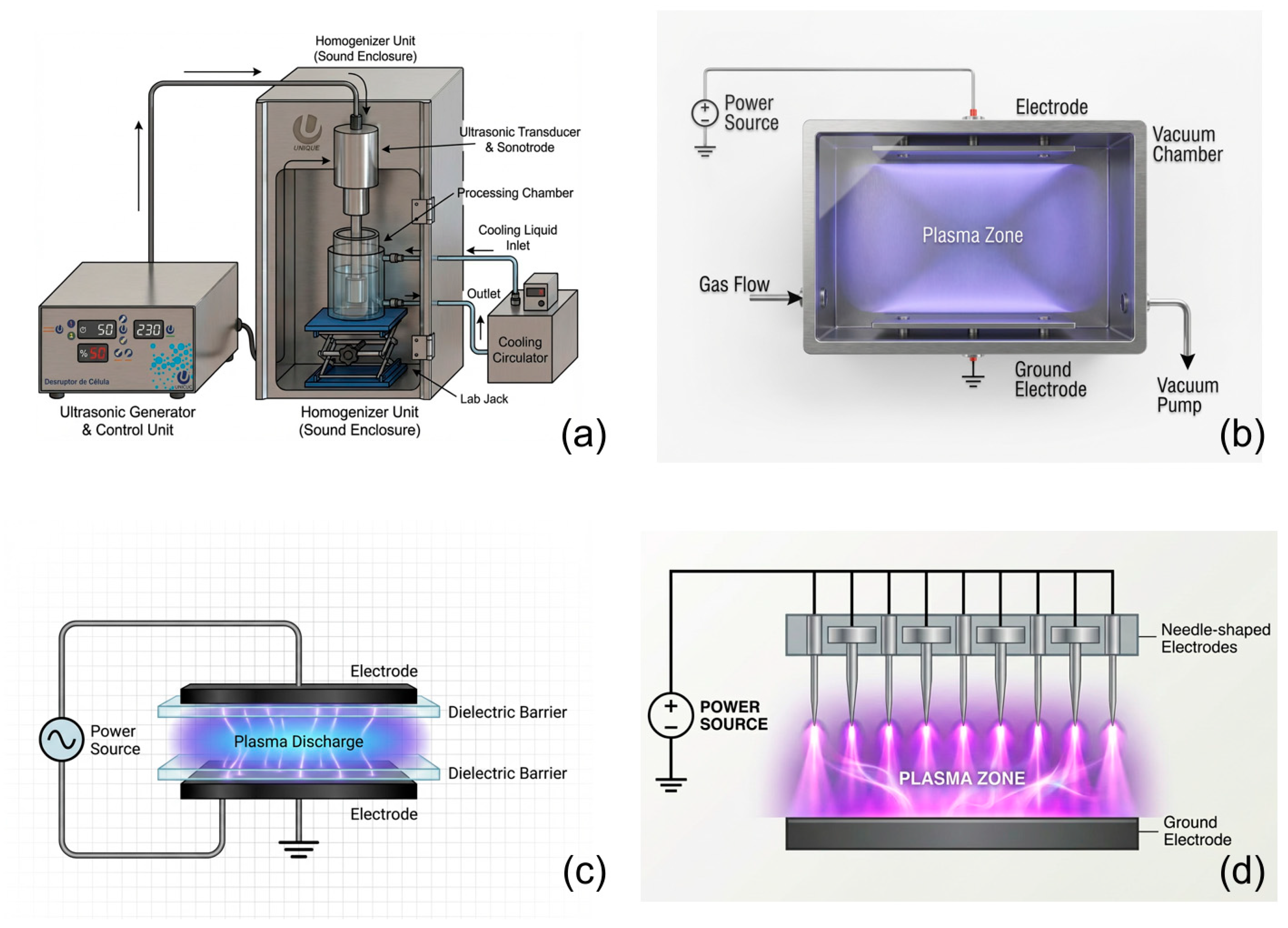
In this context, the present study aims to investigate and compare the efficacy of four non-thermal advanced oxidation processes (ultrasound, dielectric barrier discharge (DBD) plasma, glow discharge plasma, and corona discharge plasma) for the degradation of the persistent organochlorine pesticides Aldrin and Dieldrin in an aqueous solution. While both ultrasound and cold plasma are non-thermal AOPs, they operate through fundamentally different mechanisms. Ultrasound relies on acoustic cavitation to generate localized hotspots and hydroxyl radicals [
15]. In contrast, cold plasma utilizes high-voltage electrical discharges to produce a broader cocktail of reactive species, including ozone, UV radiation, and high-energy electrons [
16]. A comparative analysis of these distinct energy sources (mechanical versus electrical) is essential to determine which degradation pathway is most effective for overcoming the chemical stability of these pesticides.
This research evaluates the degradation efficiency of each technology under various operational parameters, including power, frequency, and treatment time, to determine the optimal conditions for their removal. One of the main objectives is to determine which of these technologies is more efficient in treating water contaminated with these pollutants, with a focus on achieving residual concentrations that comply with established drinking water quality standards [
6].
3. Results
The experimental results for the degradation of Aldrin and Dieldrin obtained under the various operational conditions are summarized in
Table 1. Data quantified by GC-MS using the Solid-Phase Microextraction (SPME) technique allowed us to calculate the degradation of these pesticides as percentages.
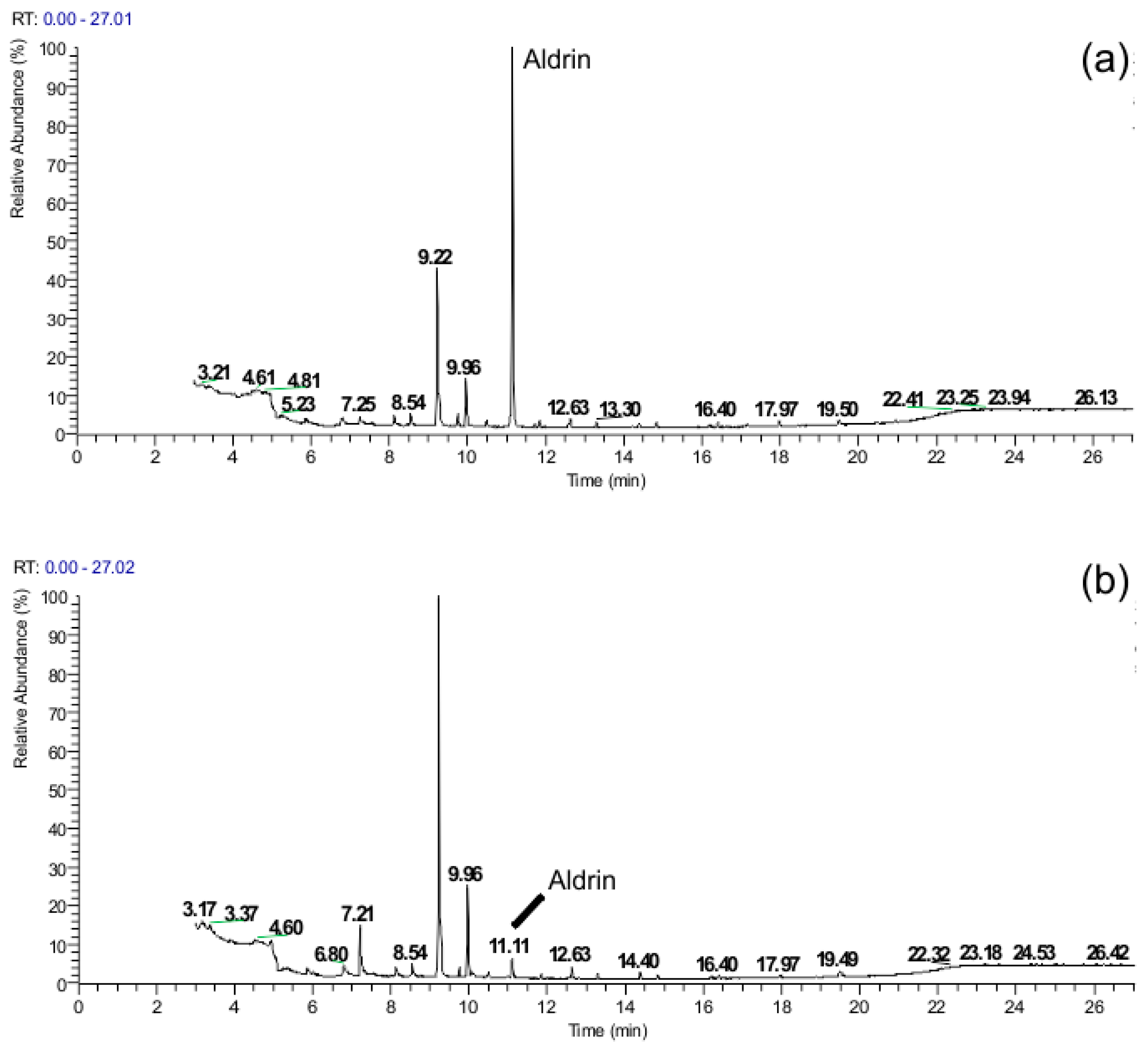
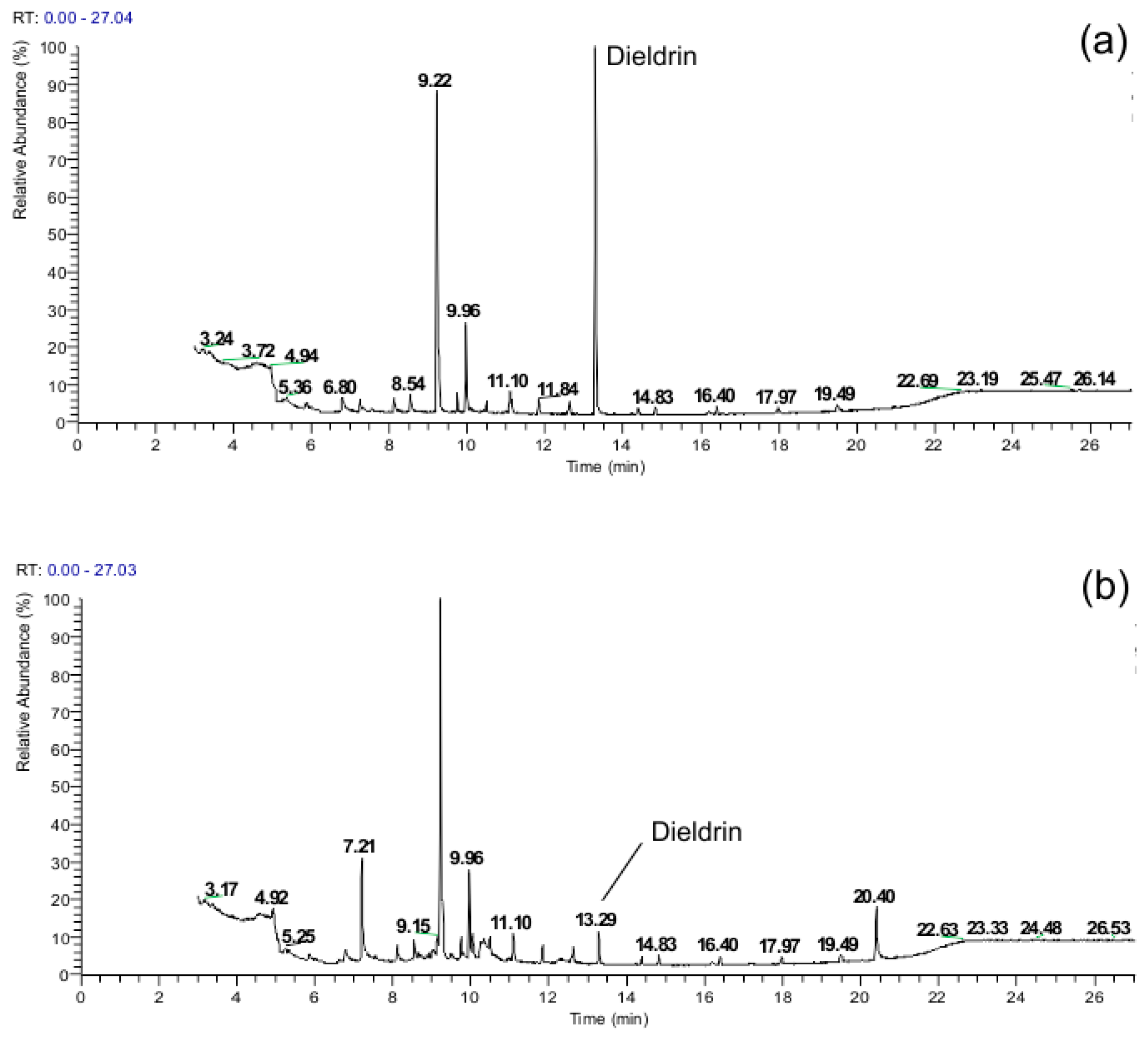
To visualize the efficiency of the degradation process, the gas chromatograms of the samples were analyzed before and after treatment.
Figure 2 and
Figure 3 present the chromatographic profiles of Aldrin and Dieldrin, respectively, obtained after DBD plasma-treatment at 50 Hz for 15 min. The chromatograms reveal significant degradation of the characteristic peaks of the parent compounds after the treatment time, confirming the high degradation efficiency quantified in
Table 1. These profiles are representative of the results obtained across the other studied systems (ultrasound, glow discharge, and corona discharge), which exhibited similar patterns of peak elimination.
The degradation of both Aldrin and Dieldrin by ultrasound was efficient. Dieldrin removal was consistently high, maintaining efficiencies above 98.6% across all tested power densities and time settings, while Aldrin achieved degradation ranging from 80.8 to 99.4%. The highest performance for both pesticides, 99.2% for Dieldrin and 98.9% for Aldrin, was observed under the mildest operational conditions tested (3 min at 3125 W/L ultrasonic power density). This operational characteristic is relevant for practical application, as it suggests that the acoustic cavitation mechanism effectively produces the necessary reactive species at low energy inputs, demonstrating that high degradation efficiency can be achieved without the economic burden of maximizing power or exposure time.
Table 2 presents the normalized concentrations of hydroxyl radicals, superoxide anions, * and hydrogen peroxide produced by ultrasound and various plasma systems. The results reveal distinct oxidative profiles for each technology.
The corona discharge system demonstrated the highest capacity to generate hydroxyl radicals and hydrogen peroxide, achieving the highest hydroxyl radical concentration across all tested frequencies. Hydrogen peroxide generation was also dominant in this system, reaching a maximum normalized value of 1.0 at 5000 Hz. However, it exhibited a decreasing trend as the frequency increased to 15,000 Hz. The production of superoxide anions was the lowest in this system. In contrast to the corona plasma, both glow discharge and ultrasound favored the production of superoxide anions. The glow discharge plasma produced the highest levels of superoxide anions among all systems, peaking at 10 mL/min. The generation of hydroxyl radicals and hydrogen peroxide remained low compared to the amount produced by the corona plasma. Similar to glow discharge, ultrasound showed significant superoxide anion generation. However, it produced slightly higher hydroxyl radical levels compared to glow discharge and DBD plasmas, particularly at higher power densities. The DBD plasma system produced the least overall of the measured reactive species in the liquid phase. This suggests that, under these specific experimental conditions, the DBD system may generate other species not quantified here (such as ozone or gaseous species), or that the transfer of these radicals to the liquid phase was less efficient than in the corona and glow discharge plasmas.
The observed difference in degradation rates can be attributed to both chemical and physical factors. Chemically, the epoxide group in Dieldrin is more resistant to oxidation than the double bond present in Aldrin. Physically, ultrasonic degradation efficiency is also influenced by the pollutant’s hydrophobicity, which dictates its proximity to the cavitation bubble interface. Aldrin, being more hydrophobic (log Kow ≈ 6.5), accumulates more readily at the bubble surface compared to the slightly more polar Dieldrin (log Kow ≈ 5.4), thereby maximizing its exposure to the localized high temperatures and hydroxyl radical attack.
The use of Dielectric Barrier Discharge (DBD) plasma provided another effective method for degrading both Aldrin and Dieldrin, yielding higher Aldrin degradation efficiency. Degradation of Aldrin consistently exceeded 99.5% across the entire tested operational range (50 Hz to 1000 Hz), confirming the technique’s robustness regardless of frequency variation. For Dieldrin, removal rates were also very high, peaking at 95.7% at the lowest processing time and frequency (50 Hz, 5 min). Both Aldrin and Dieldrin showed high degradation (>95%), indicating that the generation of plasma reactive species, mainly hydroxyl radicals, within the plasma zone is sufficiently potent at low-to-moderate energy levels to degrade these stable cyclic compounds [
16].
The treatment of Aldrin and Dieldrin using glow discharge plasma demonstrated consistently high and stable degradation efficiency, positioning it as a reliable technique for water treatment. For both Aldrin and Dieldrin, removal rates remained high, ranging from 95.8% to 99.7% for Aldrin and 96.7% to 97.8% for Dieldrin. This narrow distribution of degradation values, regardless of variations in gas flow (10 to 30 mL/min) or exposure time (5 to 15 min), highlights the plasma’s robust ability to generate the necessary degrading species, primarily through photolysis, UV-induced homolysis of water, and formation of plasma reactive species such as molecular oxygen and hydrogen as previously reported by our group for these systems [
29]. Aldrin reached its maximum degradation (99.7%) in this system under moderate conditions (30 mL/min flow for 15 min), confirming that the plasma atmosphere can transfer energy effectively to the aqueous solution to break down these two persistent molecules.
The corona discharge plasma was also found to be an effective method for decomposing the persistent pollutants Aldrin and Dieldrin in water. This technique achieved the highest degradation efficiency in the study, resulting in the total removal (100%) of Aldrin. Dieldrin was also removed with consistently high rates, peaking at 98.2%. A clear operational trend was observed for both pesticides. Increasing the exposure time to plasma improved the degradation rate, with the best results found at the maximum tested duration of 15 min. This performance highlights the ability of the high-energy electric field generated by corona discharge to directly produce potent oxidizing species at the water surface, efficiently overcoming the chemical stability of these molecules.
It is also important to note that, while air plasma can theoretically lower solution pH by forming nitrogen species, preliminary analysis did not detect significant nitrite or nitrate formation in this study. Moreover, since Aldrin and Dieldrin are resistant to acid hydrolysis, the observed degradation is attributed to oxidative radical attack rather than pH-mediated effects.
The four non-thermal methods exhibited distinct operational profiles despite all achieving high degradation of the persistent organochlorine pesticides, Aldrin and Dieldrin. The main differences lie in their sensitivity to energy input and exposure time. Ultrasound stood out for its economic advantage, consistently delivering removal rates near 99% for both compounds at the lowest tested power and shortest times (3–5 min), with excess energy reducing overall efficiency. The electrical plasma techniques, especially corona discharge, achieved the highest efficiency (100% for Aldrin) but generally required long exposure times (15 min) to reach peak performance for both compounds. The dielectric barrier discharge (DBD) plasma exhibited frequency-dependent performance, with optimal Dieldrin removal at the lowest frequency studied (50 Hz). Glow discharge plasma provided the most consistent stability, achieving high removal rates (>95%) across all flow rates and times tested, and demonstrating the least operational sensitivity to parameter variation among the four systems.
The comparison between the degradation profiles of Aldrin and Dieldrin across the four non-thermal techniques reveals some differences. Dieldrin contains an epoxide group in its structure, which renders it slightly more stable and less reactive than Aldrin. Aldrin demonstrated maximal degradation across the electrical plasma methods, achieving a 100% removal via corona discharge. In contrast, Dieldrin showed lower removal rates in the plasma systems (95.7% for the discharge barrier and 98.2% for corona discharge). However, its degradation subjected to ultrasound was slightly higher than that of Aldrin under equivalent operating conditions. Aldrin showed greater degradation in more aggressive plasma environments, such as those generated by DBD and corona plasmas, meeting the strict 0.03 μg/L regulatory limit more readily (
Table 3). Dieldrin, while still highly degradable under ultrasound and plasma, was slightly more constrained by the operational conditions, suggesting that the epoxide ring may require prolonged exposure to the generated hydroxyl radicals (•OH) and other plasma reactive species for complete cleavage.
The required optimal treatment conditions vary significantly depending on the contamination level of Aldrin and Dieldrin relative to the regulatory limit (0.03 μg/L). For heavily contaminated waters, such as those with a concentration of 5 μg/L, which require a degradation of 99.4%, a more high-performing method is essential. For these heavily contaminated waters, corona discharge plasma at 15 kHz for 15 min, which delivered up to 99.98% removal of Aldrin, would be the most efficient method. For “normal” levels of Aldrin and Dieldrin contaminated waters (<0.1 μg/L), the required degradation to meet the 0.03 μg/L limit drops significantly to only 70%. In this scenario, the operational choice shifts to the more economically advantageous ultrasound technique, employing the mildest possible operating condition (3125 W/L ultrasonic power density for 3 min), as this condition already achieves 98% removal, surpassing the 70% target with minimal energy expenditure.
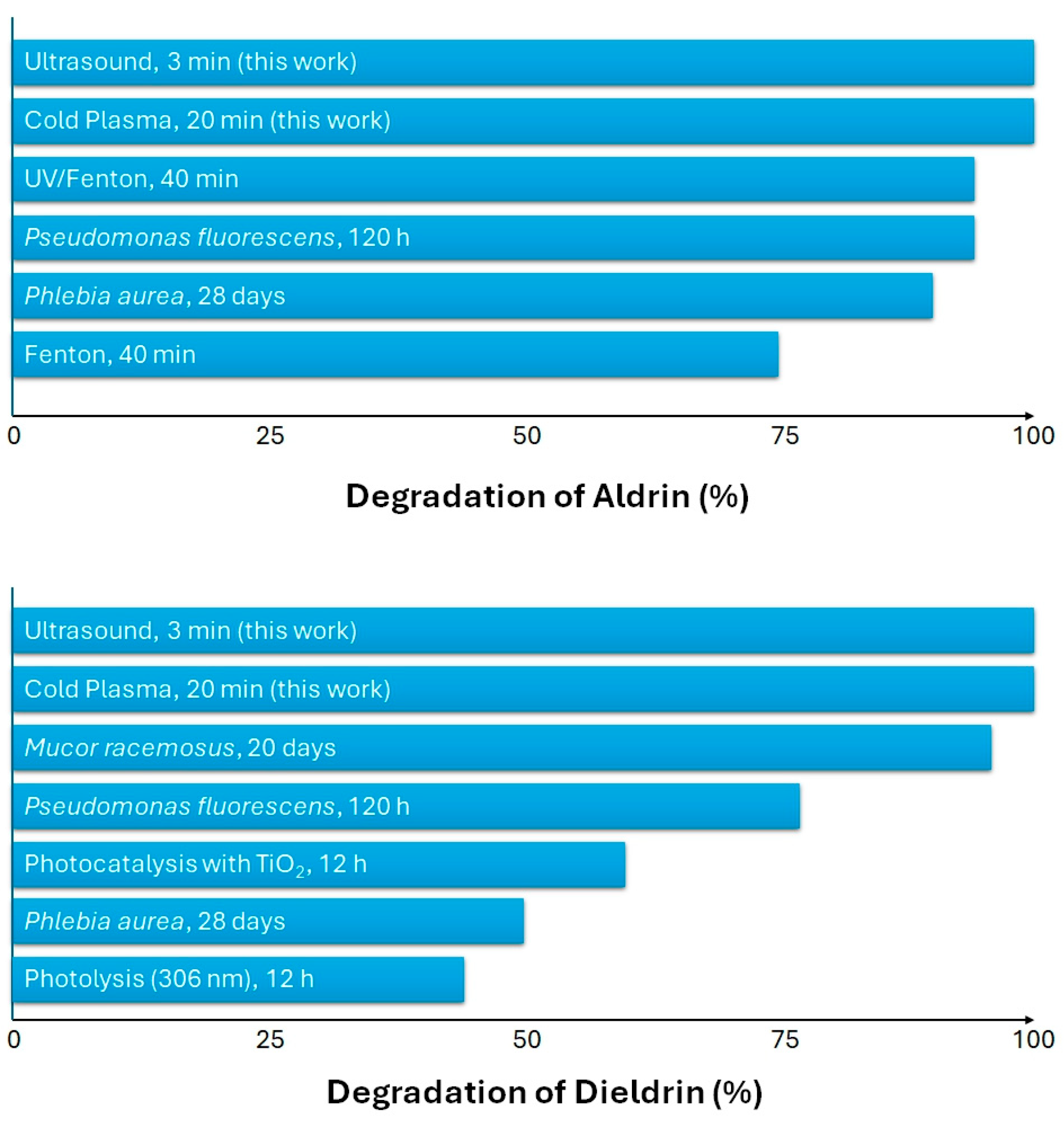
To contextualize the efficiencies achieved by non-thermal AOPs in this study, the degradation rates of Aldrin and Dieldrin were compared with those of various conventional, photocatalytic, and biological processes reported in the literature (
Figure 4). This comparison highlights the advantages of highly reactive species generated by ultrasound and cold plasma.
The degradation of Aldrin demonstrated that the efficacy of the non-thermal methods studied herein is comparable to that of other processes in terms of total degradation rate. The optimal ultrasound condition tested in this work and the corona discharge plasma condition both achieved degradation efficiencies higher than 99%. In contrast, classical methods showed slightly inferior performance and required much longer treatment times. The Fenton and UV/Fenton processes, while oxidative, achieved satisfactory efficacy despite requiring a longer exposure time of 40 min. Biological treatments are effective against Aldrin, with
Pseudomonas fluorescens reaching approximately 95% removal after 120 h (5 days) [
30], and
Phlebia aurea achieves about 90% removal after 28 days [
33].
A similar, though less pronounced, trend was observed for the degradation of Dieldrin, reflecting its enhanced chemical stability due to the epoxide ring structure. The non-thermal techniques studied herein demonstrated high efficacy at optimal conditions, achieving degradations of 99% for ultrasound and 97% for corona discharge and glow discharge plasma. In comparison, the degradation of Dieldrin by photocatalysis with TiO
2 reached about 60% removal after 12 h, while photolysis alone achieved approximately 44% removal over the same 12-h period [
31,
32]. Biological and microbial treatments showed to be efficient but slow, with
Mucor racemosus and
Pseudomonas fluorescens achieving satisfactory degradation rates (>77%), but requiring long treatment times (between 5 and 20 days) [
34,
35].
This comparison shows that the generation of hydroxyl radicals (•OH) by non-thermal methods leads to faster degradation kinetics than those observed in other chemical or biological systems. As such, non-thermal ultrasound and cold plasma processes represent a rapid and effective solution for treating water contaminated with persistent organochlorine pesticides like Aldrin and Dieldrin, outperforming some traditional chemical, photocatalytic, and biological remediation technologies.
3.1. Energy Efficiency Analysis
The economic viability of Advanced Oxidation Processes (AOPs) is intrinsically linked to their energy consumption.
Table 4 presents the electrical parameters (current, power, and total energy consumption) monitored for the ultrasound and plasma systems under varying operational conditions.
The ultrasonic treatment exhibited a high energy demand, driven by the power density requirements to sustain acoustic cavitation. The power consumption ranged from 144.1 W to 266.0 W. Consequently, the total energy consumption for a 10-min treatment reached up to 0.047 kWh at the highest power density (6250 W/L). While effective, the high power input suggests that ultrasonic systems require optimization of the treatment volume-to-power ratio to become cost-competitive.
The DBD system demonstrated the highest energy efficiency among all tested configurations. Operating at very low power levels, ranging from 28.2 W (at 50 Hz) to 49.3 W (at 1000 Hz), the DBD reactor consumed between 0.002 kWh and 0.012 kWh. Increasing the excitation frequency from 50 to 500 Hz increased power from 28 W to 40 W, likely due to the higher voltage required to maintain discharge. Despite this, DBD was the most energy-efficient option, consuming approximately one-tenth the power required by the glow discharge system.
In contrast to the DBD, the glow discharge system was the most energy-intensive plasma technology evaluated. Power consumption peaked at 343.3 W at 10 mL/min, resulting in an energy consumption of 0.087 kWh after 15 min. An inverse relationship between frequency and power was observed: increasing the gas flow rate from 10 mL/min to 30 mL/min reduced power consumption from 343.3 W to 273.5 W. This behavior suggests a change in the discharge regime or in impedance-matching efficiency at higher flow rates. However, because its power demand is comparable to or exceeds that of the ultrasound system, glow discharge operation incurs the highest operational cost (OPEX).
The corona discharge system offered a balanced profile between energy input and oxidative performance. Power consumption ranged from 70.7 W (5000 Hz) to 84.7 W (15,000 Hz), with energy values falling between 0.006 and 0.021 kWh. Although it consumes roughly twice as much energy as the DBD system, it remains significantly more efficient than the glow-discharge and ultrasound setups.
Table 5 summarizes the energy efficiency (EE), expressed in kWh per microgram (mg) of pesticide removed, for the optimal conditions of each technology. A lower value indicates a more energy-efficient process.
The DBD system proved to be the most energy-efficient technology among those evaluated. Operating at 50 Hz for 5 min, it required the lowest energy input to degrade the pollutants, with an EE of 0.016 kWh/mg for Aldrin and 0.017 kWh/mg for Dieldrin. This high efficiency is attributed to the system’s ability to maintain a stable discharge at very low power consumption (approx. 28 W) while maintaining high degradation rates.
Ultrasound (3125 W/L) ranked second in efficiency, with an EE of 0.028 kWh/µg for both pesticides. Although ultrasonic systems generally have high power requirements, the rapid degradation kinetics (3 min) compensated for the energy demand, making it a viable intermediate option.
The other two plasma configurations showed significantly higher energy costs per unit of pollutant removed. The corona discharge required approximately 3 times more energy than the DBD system, with values of 0.048–0.050 kWh/μg. While this system achieved complete degradation (100%), the higher power input (approx. 70–85 W) reduced its overall energy efficiency ratio compared to the DBD. The glow discharge (GD) was the least efficient of the methods evaluated. With an EE of 0.096 kWh/mg (Aldrin) and 0.099 kWh/mg (Dieldrin), it consumed nearly 6 times more energy than the DBD system to achieve comparable removal mass. This high cost suggests that, despite its effectiveness, glow discharge is less economically attractive for this specific application, mainly because it requires low operating pressures.
3.2. Degradation Mechanism
Following the degradation efficiency tests, a critical step in this kind of study is identifying potential by-products formed during the process. Samples collected after processing were subjected to GC-MS analysis in Full Scan mode, which operates by analyzing a broad range of mass-to-charge ratios (m/z) (specifically 40−500 m/z), a configuration designed to identify multiple and often unknown components in a sample.
The resulting chromatograms did not yield conclusive evidence of degradation intermediates or final products. While the disappearance of the characteristic pesticide peaks (peaks at TR 11.15 min for Aldrin and TR 13.28 min for Dieldrin) confirmed the high degree of conversion, no significant new peaks related to organic breakdown products were identified and matched against the NIST spectral library.
Prior studies on the degradation of Aldrin and Dieldrin have reported that Aldrin is transformed through oxidation, reduction, and hydroxylation pathways, with Dieldrin being the principal metabolite. At the same time, Dieldrin is further converted by oxidation, reduction, hydroxylation, and hydrolysis to give 9-hydroxydieldrin and dihydroxydieldrin. Ozone and photocatalytic systems degrade Aldrin via •OH and other strong oxidants. These studies have identified the intermediates in an ozonated visible-light photocatalytic system as 9-hydroxyaldrin, chlorinated cyclohexadiene intermediates, and small carboxylic acids (oxalic and fumaric), consistent with progressive dechlorination and ring-opening before mineralization [
34,
35].
The outcome observed in our study suggested two main possibilities. The first is that the plasma reactive species generated during the processes (such as the hydroxyl radical, superoxide anion, ozone, singlet oxygen, molecular hydrogen, and others) achieved complete mineralization of the pesticides, converting the initial organic molecules entirely into simple, stable inorganic species like water, carbon dioxide, and inorganic chlorides. The second possibility is the formation of degradation products that were either non-volatile and therefore captured by the SPME fiber and detected by GC-MS, or present in concentrations below the detection limits of the GC-MS system under the employed analytical conditions. Future investigations would require alternative analytical techniques, such as High-Performance Liquid Chromatography coupled with Mass Spectrometry (HPLC-MS/MS), which is better suited to polar and less volatile compounds, to definitively rule out the formation of potentially toxic intermediates.
3.3. Scale-Up Considerations
It is important to note that while the probe-type ultrasound system demonstrated high efficiency in this bench-scale study, scaling up this technology presents engineering challenges related to cavitation uniformity. In larger batch volumes, the acoustic intensity attenuates rapidly from the probe tip. Consequently, industrial applications would likely require continuous-flow-through reactors or multi-transducer arrays to ensure a homogeneous cavitation field throughout the treated volume.
Similarly, the scale-up of plasma technologies must address the discharge’s surface-limited nature. Since the degradation mechanism relies on the diffusion of reactive species from the gas–liquid interface into the bulk, traditional deep-tank reactors are inefficient for large volumes. Future industrial applications would likely require reactor designs that maximize interfacial area, such as falling-film reactors or spray towers. These configurations generate thin liquid layers or droplets, significantly enhancing the contact area between the pollutant-laden water and the plasma discharge, thereby maintaining high degradation efficiency at larger scales.
The implementation of these technologies at pilot or full-scale industrial levels is envisioned primarily as a tertiary polishing step. Given the energy costs associated with AOPs, they are best suited for treating water and effluents that have already undergone primary and biological treatment, targeting only the residual recalcitrant loads (such as POPs). Feasibility at this scale relies on the adoption of continuous-mode reactors, previously commented on, such as multi-transducer ultrasonic flow cells or plasma falling-film units, which are already commercially available or in advanced development stages for other industrial applications.
While the precise optimal values identified are specific to the bench-scale geometry employed, the observed operational trends, specifically the high efficiency of moderate ultrasonic power and the trade-off between speed and absolute removal in plasma systems, provide generalizable design principles for the implementation of these technologies at larger scales.
Finally, it is crucial to contextualize the study’s achievements within its experimental scope. Analytically, GC-MS analysis successfully confirmed the rapid elimination of the toxic parent compounds and the absence of stable organic intermediates; however, the lack of complementary analysis means that a complete mass balance to prove complete mineralization remains to be verified. Environmentally, the use of distilled water provided a necessary baseline for determining intrinsic degradation kinetics without interference; however, future applications must account for the radical scavenging effects typical of complex wastewater matrices. Operationally, while the batch reactors demonstrated high removal efficiencies (>99%), industrial implementation will require transitioning to continuous-flow configurations to address mass-transfer limitations. In this work, a proof-of-concept was established, paving the way for scale-up studies. Energetically, the study found that while plasma technologies offer superior absolute removal, their higher energy costs position them best as tertiary polishing steps for the final elimination of recalcitrant micropollutants.