Article

Diagnosing Multistage Fracture Treatments of Horizontal Tight Oil Wells with Distributed Acoustic Sensing


1
China National Logging Company, Xi’an 710077, China
2
School of Mine Safety, North China Institute of Science and Technology, Sanhe 065201, China
3
School of Ocean and Earth Science, Tongji University, Shanghai 200092, China
4
School of Geosciences and Info-Physics, Central South University, Changsha 410083, China
*
Author to whom correspondence should be addressed.
Processes 2025, 13(12), 3925; https://doi.org/10.3390/pr13123925 (registering DOI)
Submission received: 27 October 2025 / Revised: 26 November 2025 / Accepted: 1 December 2025 / Published: 4 December 2025

Abstract

Distributed acoustic sensing (DAS) technology is gaining popularity for real-time monitoring during the hydraulic fracturing of unconventional reservoirs. By transforming a standard optical fiber into a dense array of acoustic sensors, DAS provides continuous spatiotemporal measurements along the entire wellbore. Although accurate DAS-based real-time diagnosis of multistage hydraulic fracturing is critical for optimizing the efficiency of stimulation operations and mitigating operational risks in horizontal tight oil wells, existing methods often fail to provide integrated qualitative and quantitative insights. To address this gap, we present an original diagnostic workflow that synergistically combines frequency band energy (FBE), low-frequency DAS (LF-DAS), and surface injection data for simultaneous fluid/proppant allocation and key downhole anomaly identification. Field application of the proposed framework in a 47-stage well demonstrates that FBE (50–200 Hz) enables robust cluster-level volume estimation, while LF-DAS (<0.5 Hz) reveals fiber strain signatures indicative of mechanical integrity threats. The workflow can successfully diagnose sand screenout, diversion, out-of-zone flow, and early fiber failure—events often missed by conventional monitoring. By linking distinct acoustic fingerprints to specific physical processes, our approach transforms raw DAS data into actionable operational intelligence. This study provides a reproducible, field-validated framework that enhances understanding in the context of fracture treatment, supports real-time decision making, and paves the way for automated DAS interpretation in complex completions.

1. Introduction

Multistage fracture treatment in long horizontal wells is one of the key technologies facilitating the development of unconventional tight oil reservoirs [1]. Plug-and-perf (PnP) completion, which involves isolated perforation clusters and fracturing of the reservoir stage by stage, has become the most widely adopted completion technology in horizontal wells among several existing well completion strategies [2]. To ensure optimized perforation cluster efficiency and a uniform distribution of fractures along the entire wellbore, continuous high-resolution monitoring is required to improve the efficiency of stimulation operations and ensure operational safety during multistage fracturing [3].
Distributed acoustic sensing (DAS) has emerged as a powerful tool in this context. By transforming a standard optical fiber into a dense array of acoustic sensors which continuously record the flow-induced sound at perforation clusters during hydraulic fracture treatment, DAS enables real-time measurements along the entire wellbore without additional downhole intervention [4,5,6,7,8]. When the fiber-optic cable is installed in a treating wellbore, its capability to capture the spatiotemporal evolution of acoustic energy facilitates a variety of applications, including both qualitative and quantitative evaluations. Qualitative evaluations include those evaluating the effectiveness of perforation operations [9,10,11], monitoring perforation cluster activation [12], detecting diversion [13,14,15,16], and identifying downhole anomalies such as sand screenout [17], out-of-zone flow [18,19] and fiber failure [20]. Quantitative evaluations mainly include fluid and sand volume estimation approaches [21,22], as well as those for perforation cluster efficiency estimation [23].
When hydraulic fracturing fluid and proppant are injected into perforation clusters at a high speed, the DAS fiber cable in the borehole records high-amplitude acoustic signals throughout its whole length; as a result, the injection depth interval usually cannot be identified from the raw DAS waterfall plot. To carry out the qualitative and quantitative evaluations mentioned above, raw DAS acoustic measurements usually need to be transformed into the frequency band energy (FBE), which is an energy attribute distribution for all depth locations and time frames. Industrial practices have demonstrated that FBE performs well under stable and well-calibrated conditions [24,25,26,27]. Besides FBE, the low-frequency components (<0.5 Hz) of DAS (LF-DAS) data have been widely used to constrain the position and time of fracture hits occurring near a fiber-optic cable deployed in an offsetting well [28,29]. LF-DAS, when applied to the DAS data acquired from the treatment well, is able to indicate the effects of compression and relaxation along the fiber and, thus, can serve as an indicator of fiber breakage [30].
Despite these advances, significant challenges remain regarding the comprehensive interpretation of DAS data for multistage fracture diagnostics. While FBE and LF-DAS have proven useful for identifying specific downhole events and estimating fluid and proppant allocation, their combined diagnostic potential has not yet been systematically leveraged within a unified framework. Moreover, the acoustic signatures associated with complex, concurrent downhole phenomena, such as simultaneous sand screenout, diverter activation, and out-of-zone flow, are often overlapping or ambiguous in raw or conventionally processed DAS data. This ambiguity can lead to misinterpretation, delayed operational decisions, or suboptimal stimulation designs. Furthermore, although several studies have proposed methods to quantify the perforation cluster efficiency using DAS-derived fluid allocation, few have explicitly linked these quantitative metrics with qualitative diagnostic indicators—such as the timing and spatial evolution of diverter effectiveness or the onset of fiber-optic cable strain anomalies—in order to provide a holistic view of treatment performance. The lack of an integrated diagnostic workflow that simultaneously addresses both qualitative event detection and quantitative performance evaluation limits the full value proposition of DAS in real-time fracture optimization.
To address these limitations, this study presents a novel, integrated diagnostic workflow that synergistically combines FBE, LF-DAS, and surface injection data to enable both qualitative identification and quantitative assessment of multistage fracture treatments in horizontal tight oil wells. We demonstrate the workflow’s performance using field data acquired from a 47-stage horizontal well completed with a behind-casing permanent fiber-optic installation. In particular, four representative and operationally critical phenomena—including sand screenout, diverter-induced stage re-entry, out-of-zone fluid migration, and fiber-optic cable mechanical failure—are systematically diagnosed and interpreted using spatiotemporal patterns in FBE and LF-DAS attributes.
Our results show the following:
(1)
FBE, when extracted within frequency bands optimized for injection sensitivity, can robustly delineate active perforation clusters and quantify the relative allocation of fluid and proppant;
(2)
LF-DAS provides critical low-frequency strain signatures that reveal mechanical deformation events, including fiber strain anomalies indicative of cable damage or wellbore compression;
(3)
The integration of FBE, LF-DAS, and surface injection data enables unambiguous discrimination between overlapping acoustic events (e.g., distinguishing sand screenout buildup from diverter-induced flow redistribution);
(4)
The perforation cluster efficiency can be reliably calculated and correlated with real-time diagnostic flags to guide on-the-fly completion adjustments.
This work contributes to the field by (1) establishing a comprehensive, physics-informed diagnostic framework for multistage fracturing using DAS; (2) characterizing previously under-documented acoustic signatures of key downhole events; and (3) demonstrating, through field-scale validation, how DAS-derived diagnostics can directly inform completion optimization and risk mitigation in tight oil developments.

2. Methods and Workflow

2.1. Overview of the DAS-Based Diagnosis Workflow

This study presents a comprehensive workflow for qualitative and quantitative diagnosis of multistage hydraulic fracturing in horizontal wells by integrating distributed acoustic sensing (DAS) data with injection data. The proposed method leverages the high-resolution spatiotemporal capabilities of DAS to monitor fracture dynamics during stimulation operations, enabling the accurate identification of key events and estimation of critical operational parameters.
The workflow, which is illustrated in Figure 1, begins with the acquisition of raw DAS data along the fiber-optic cable installed in the wellbore. Two parallel signal processing pathways are applied to extract distinct physical information from the raw data:
(1)
A one-dimensional (1D) Fast Fourier Transform (FFT) is performed on the raw DAS data to decompose the signal into frequency components, yielding the frequency band energy (FBE) data. Multi-band FBE datasets are generated, and the optimal FBE dataset that is most sensitive to acoustic emissions associated with fluid flow, perforation activation, and proppant transport is used for qualitative diagnoses and quantitative evaluations of fluid volume, sand volume, and cluster efficiency.
(2)
Low-pass filtering is applied to the raw DAS data to extract the low-frequency component of DAS (LF-DAS) data, which represents the low-frequency strain response related to fiber tension and compression, as well as long-term deformation of the wellbore and surrounding formation. LF-DAS data are particularly sensitive to fiber breakage during hydraulic fracturing.
The resulting FBE and LF-DAS datasets serve as inputs for post-processing and subsequent evaluation. In the qualitative evaluation phase, five diagnostic tasks are conducted:
(i)
Perforation identification, where sudden increases in FBE signals indicate the activation of perforations at each stage;
(ii)
Active cluster identification, allowing for determination of which clusters exhibit significant acoustic activity in FBE signals and thus contribute effectively to fracture propagation;
(iii)
Diversion identification, which involves detecting the deployment and impact of diverting agents through abrupt shifts in flow patterns observed in the FBE data;
(iv)
Sand screenout identification to recognize regions where proppant accumulation leads to reduced or ceased flow, which are identified via sustained FBE intensity anomalies;
(v)
Out-of-zone flow identification, in which unintended fluid migration beyond the intended treatment interval is detected via spatially inconsistent FBE signal patterns;
(vi)
Fiber failure identification, which involves assessing the optical fiber’s integrity via discontinuities or signal extension stripe features in both the FBE and LF-DAS data.
In parallel, the qualitative insights are translated into quantitative evaluations using calibrated models and signal integration techniques:
(i)
Fluid volume estimation, which is derived by correlating the amplitude and duration of FBE signals with injection rates and known perforation cluster properties;
(ii)
Sand volume estimation, which is performed by applying the fraction of proppant concentration to slurry rate to the fluid volume derived above;
(iii)
Cluster efficiency, which is calculated as the ratio of the number of stimulated clusters to the total number of clusters, in which a stimulated cluster is defined as one that has received more than 50% of the ideal volume of the even fluid distribution for the individual stage.
For both qualitative and quantitative evaluations, the injection data—including the injection pressure, slurry rate, and proppant concentration—are integrated throughout the workflow to validate the DAS-derived interpretations, calibrate signal responses, and enhance the accuracy of both qualitative and quantitative assessments. By combining advanced signal processing techniques with physical hydraulic fracturing mechanics, this integrated approach enables real-time, high-resolution monitoring of multistage fracturing operations, supporting optimized well design, enhanced reservoir connectivity, and improved production outcomes.

2.2. FBE Extraction

DAS data inherently capture broadband acoustic signals spanning from millihertz to kilohertz frequencies, reflecting a superposition of diverse physical processes including fluid flow, fracture propagation, mechanical deformation, and thermal transients. To isolate and interpret specific subsurface dynamics—such as fluid flow, proppant transport, fracture tip growth, or inter-well communication—it is essential to decompose the full-band signal into targeted frequency bands. Each band serves as a spectral fingerprint: low frequencies (<1 Hz) often correlate with quasi-static strain or thermal effects and are helpful in identifying fluid interfaces and different flow regimes; mid-frequencies (1–50 Hz) can indicate fluid-driven fracture activity and work well to identify flow from the inflow control valves (ICV); and high frequencies (>50 Hz) typically represent turbulent flow or microseismic events [31]. Thus, FBE extraction should be performed to enable physically meaningful characterization of distinct flow and deformation mechanisms during hydraulic fracturing operations.
FBE was originally defined as the sum of squared raw measurements in each DAS channel location over a fixed period of time [32], and has been used as a proxy for the energy induced by fluid and proppant movement. However, this type of FBE contains the full frequency band energy, and thus may not capture the energies relating to certain injection intervals due to the chaotic features of the full borehole resulting from high-flow-rate injections. To overcome this issue, FBE was defined as the sum of the power spectral density (PSD) of raw measurements in each DAS channel location over a fixed period of time [33]. This transformation converts the inherently qualitative DAS waveform into physically interpretable, quantifiable attributes which facilitate automated fracture diagnoses. However, for the quantitative estimation of fluid and proppant volumes, FBEs, in which the negative and positive values of PSD are summed, are used in the system of equations, which generally yields incorrect summation values. To address this issue, we develop a new FBE extraction method, in which the Root Mean Squared (RMS) normalized values of FFT data are leveraged.
The raw DAS signal is fundamentally a two-dimensional (2D) spatiotemporal array D ( t , z i ) , where t denotes discrete time samples and z indexes the spatial channels along the fiber. The first step in our FBE computation involves temporal segmentation: for each spatial channel z i , the continuous time-series D ( t , z i ) is partitioned into non-overlapping (or optionally overlapping) analysis windows of fixed length N, corresponding to a user-defined downsampling interval. Each resulting 1D segment, denoted s i , k [ n ] , where k indexes the k-th temporal window at channel z i and n = 0, 1, …, N − 1, constitutes a discrete time signal which is suitable for spectral analysis.
A FFT is then applied to each windowed segment:
S i , k [ f ]   =   F F T ( s i , k [ n ] ) ,   f 0 , f s N , 2 f s N , . . . , f s 2
where f s is the sampling frequency and S i , k [ f ] represents the complex Fourier coefficients over the positive frequency axis up to the Nyquist limit. The magnitude spectrum ∣ S i , k [ f ] ∣ is computed to yield an amplitude–frequency representation for each segment.
For targeted spectral monitoring, one or more frequency bands [ f l o w ( b ) , f h i g h ( b ) ] are defined based on their physical relevance. Two distinct formulations of FBE are employed depending on the analytical objective:
The energy-sum FBE, which emphasizes the total spectral power within band b, is defined as:
F B E s u m , i , k ( b ) = f = f l o w ( b ) f h i g h ( b ) | S i , k [ f ] | 2
while the RMS-normalized FBE, which facilitates amplitude comparison across channels by accounting for bandwidth, is calculated using the following equation:
F B E R M S , i , k ( b ) = 1 M b f = f l o w ( b ) f h i g h ( b ) | S i , k [ f ] | 2
where M b denotes the number of discrete frequency bins falling within the b-th band.
The new RMS-normalized FBE defined in Equation (3) provides a normalized metric suitable for statistical comparison; the key advantage of this type of FBE is that it allows for the extraction of FBEs in certain frequency bands—such as those that are most sensitive to fluid injection activities—and is able to highlight the higher energies in the injected cluster intervals while suppressing energies in the non-injection borehole intervals. Thus, it is more suitable for quantitative estimation of fluid and proppant volumes.
Notably, the frequency band of 50 to 200 Hz was selected as the optimal band to extract the FBE data throughout this work. The selection of this frequency band for FBE extraction was determined through a systematic sensitivity analysis, aimed at identifying the band most responsive to injection-related acoustic emissions while minimizing background noise. As demonstrated in our prior work [34], this band consistently yields the strongest correlation with fluid and proppant injection dynamics in multistage fracturing treatments, clearly resolving high-energy zones corresponding to active perforation clusters—features that are often obscured in other frequency ranges. In that study, comparative evaluation across multiple bands confirmed that the band ranging from 50 to 200 Hz provides optimal sensitivity for quantitative allocation estimates, with validation against simulated injection profiles showing errors within 6%. Given the similarity in reservoir characteristics, well configuration, completion design, and fracturing parameters between the current and prior field cases, we adopt this same band as the optimal FBE dataset for the present analysis.

2.3. LF-DAS Extraction

The application of Low-Frequency Distributed Acoustic Sensing (LF-DAS) in the oil and gas industry has become popular in recent years, with a large number of studies demonstrating its practical implementation. LF-DAS data (<0.05 Hz) were initially acquired via fiber-optic cables deployed in offset monitoring wells during the hydraulic fracturing of the treatment well, in order to characterize hydraulic fracture’s length, density, and aperture. To extract LF-DAS data, the raw phase-rate data are first low-pass filtered (<0.5 Hz) and downsampled to 1 Hz to suppress aliasing, then further band-limited to <0.05 Hz to isolate low-frequency geomechanical responses. A channel-invariant DC drift (~0.1 rad/s), attributed to instrumental noise, is estimated from quiescent well sections and subtracted to preserve signal polarity—this step is critical for distinguishing compressional versus extensional strain. Median filtering removes transient spikes while retaining coherent strain trends. It was observed that, during the stimulation of a specific stage in a horizontal well, distinct LF-DAS strain signals were detectable in the adjacent monitoring well. At locations aligned with the actively stimulated stage, the fiber registered tensile strain due to local rock dilation induced by fracture initiation and propagation. Conversely, adjacent intervals exhibited compressive strain resulting from stress-shadow effects. Upon pump shutdown, the previously dilated fracture zone gradually closed, manifesting as compressive strain recovery, while surrounding formations and fiber segments experienced stress relaxation, reflected as tensile strain. Subsequently, LF-DAS systems have been employed to detect strain signals at millihertz frequencies [35]; to derive S-wave velocity profiles [36]; and integrated with Distributed Temperature Sensing (DTS) to locate annular fluid levels, identify leak points, estimate leakage rates, and infer leakage pathways in oil and gas wells [37]. In production logging contexts, LF-DAS fundamentally responds to thermally induced strain driven by variations in fluid temperature.
In hydraulic fracture monitoring scenarios, when inter-well communication is established between the treatment well and the fiber-instrumented monitor well, the physical origin of the LF-DAS signal depends on the presence of fracture fluid. In the absence of injected fluid within the fracture, LF-DAS primarily captures the static strain induced by fracture tip deformation. When the fracture is filled with cooler stimulation fluid, the recorded LF-DAS response represents a composite signal comprising both the static mechanical strain due to fracture propagation and thermal strain due to fluid-induced temperature perturbations. Recent studies integrating concurrent LF-DAS and DTS measurements have demonstrated that, over short temporal intervals, low-frequency strain signals from LF-DAS remain unaffected by observable thermal transients, suggesting the dominance of mechanical strain under certain operational conditions [38]. Based on this observation, the extension stripe feature of LF-DAS has been shown to reflect fiber slippage via numerical modeling [39] and laboratory experiments using a testbed [40], where the extent of broadening of the extension zone in the strain rate waterfall plot can indicate the slippage length along the fiber. These findings have built a solid foundation for leveraging LF-DAS features to study fiber slippage and eventual fiber breakage during hydraulic fracture treatment.

2.4. Quantitative Estimation of Fluid and Proppant Volumes

Unlike qualitative analyses—which primarily rely on pattern recognition—quantitative evaluation requires the establishment of a physically meaningful and empirically calibrated relationship between acoustic signal intensity and key injection parameters such as slurry rate and proppant concentration.
A widely adopted empirical model, originally proposed by Pakhotina et al. [23], describes a logarithmic correlation between the cube of the instantaneous flow rate at each perforation cluster and its normalized FBE response:
l o g ( q i 3 ( t ) ) = A E I ( t ) + B
where q i 3 ( t ) is the instantaneous flow rate allocated to perforation cluster i at time t, E I ( t ) is the normalized FBE signal from cluster i at time t, and A and B are empirical calibration constants determined through controlled laboratory experiments. Notably, the parameter B is not an independent fitting parameter but is implicitly determined by the physical scaling of the acoustic energy-to-flow rate relationship and, in practice, can be expressed as a function of the proportionality constant A. Meanwhile, A is the correlation parameter, which is close to a constant regardless of the fluid and fracture properties, generally ranging from 0.08 to 0.1 [24]. In our work, we applied these same constants without re-calibration and assigned a constant value of 0.083 for A, as our well configuration (horizontal well, plug-and-perf completion), fiber deployment (cemented behind casing), and acquisition setup closely resemble those in Pakhotina et al.’s work [23]. However, the parameter A in the equation exerts a strong nonlinear influence on estimated flow rates and, hence, on the fluid volumes. A brief sensitivity analysis over the range A ∈ [0.08, 0.1] indicated that each increment of 0.01 in A approximately doubles the estimated flow rate at 90 dB, and the flow rate estimations can vary by up to 300%. Therefore, for field applications, site-specific calibration of A should be performed (e.g., using flowmeter logs or tracer data) and uncertainty bounds should be propagated through volume estimation workflows to avoid significant over- or under-predictions of fluid allocation.
The nonlinear power-law relationship in Equation (4) is physically motivated by experimental observations that acoustic emissions generated via fluid flow through perforations increase super-linearly with the flow rate due to enhanced turbulence in the perforation tunnel and near-wellbore region. This logarithmic formulation accounts for the observed nonlinear scaling between acoustic energy and flow rate, which arises from complex physical phenomena such as turbulence, near-wellbore friction, and variable fiber-optic coupling conditions.
To ensure consistency with the total measured injection rate, a material balance constraint is applied:
i = 1 n N i × q i ( t ) = q T ( t )
where N i is the number of perforations in cluster i, q T ( t ) is the total injection rate at time t, and n is the total number of clusters in the stage.
By solving this constrained system of equations, individual cluster flow rates q i ( t ) can be estimated. These are then time-integrated to compute the cumulative fluid volume delivered to each cluster:
V i = t = t 0 t f i n N i × q i ( t ) × t
where Δt is the time increment between continuous data points.
If proppant concentration c p ( t ) is known from the injection data, the cumulative proppant mass injected into cluster i is obtained via integration:
W i = t = t 0 t f i n N i × c p ( t ) × q i ( t ) × t
This approach enables detailed quantification of the fluid and proppant distributions across perforation clusters, providing critical insights into the efficiency of the stimulation operation and treatment uniformity. The details of all parameters used in Equations (4)–(7) are listed in Table 1 for clarity.

2.5. Quantitative Calculation of Perforation Cluster Efficiency

A perforation cluster is typically defined as a group of perforations drilled into the casing and repeated across multiple stages, which collectively form the fracture stage intended for stimulation. A single fracture stage may contain 1 to 15 or more perforation clusters. The design of fracture stages and the number of perforation clusters are determined by various operational and geological parameters. The perforation cluster efficiency (PCE) is a key metric in horizontal well stimulation, typically defined in two ways: cluster completion efficiency and cluster production efficiency. Cluster completion efficiency is the percentage of perforation clusters that receive effective hydraulic stimulation fluid during fracturing operations over a given interval, while cluster production efficiency is the percentage of clusters that effectively contribute to overall hydrocarbon production from the well [41]. We adopt the cluster completion efficiency as the perforation cluster efficiency metric in this study. The efficiency of a perforation cluster depends on whether the inflow perforations within the cluster can receive sufficient fluid and achieve a sufficiently high injection rate to create effective fractures. DAS monitoring offers a means to improve current completion practices, enabling real-time evaluation and optimization of perforation cluster efficiency.
The final distributions of fluid and proppant volumes delivered to individual perforation clusters at the end of the fracturing treatment serve as an indicator of cluster efficiency. Based on this principle, the concept of an “effective perforation cluster” is introduced. The reference fluid volume is defined as:
V r e f   =   V T 2 N T  
where V T represents the total fluid volume injected into the fracture stage and N T is the total number of perforation clusters in that stage. Under ideal conditions, assuming a uniform fluid distribution among all clusters, a perforation cluster is considered effective if it receives a fluid volume exceeding 50% of the reference volume V r e f . Using this criterion, one can identify which clusters in the studied stage were effectively stimulated. The perforation cluster efficiency E is then defined as:
E   =   N e N T
where N T is the total number of perforation clusters in the stage and N e is the number of effective perforation clusters [23].
The 50% threshold relative to the reference volume V r e f is widely adopted, both industrially and in field-based diagnostic studies, in order to distinguish meaningfully stimulated clusters from underperforming ones. Typical perforation cluster completion efficiencies in horizontal wells range from 60% to 70%, implying that a significant fraction of clusters receive less than half of their ideal share and contribute minimally to the overall fracture network. Clusters exceeding 50% of V r e f are therefore considered “effective” because they represent a practical lower bound for meaningful fluid and proppant entry, consistent with DAS-validated interpretations in prior work [42]. Sensitivity analyses further confirm that, while the exact count of effective clusters varies slightly with threshold choice (e.g., 40% vs. 60%), the qualitative assessment of stage-level non-uniformity remains robust. In summary, this metric enables a quantitative assessment of stimulation uniformity and allows for performance evaluation of completion designs, supporting data-driven optimization of future hydraulic fracturing operations.

3. Field Dataset

3.1. Well Completion

The monitored well, referred to as Well JL-1H, is located in the Junggar Basin and was completed as a horizontal tight oil producer. The target formation exhibits low permeability and low porosity, requiring multistage hydraulic fracturing for effective stimulation. The reservoir mainly consists of fine-grained lithology with interbedded sandy laminae and exhibits variable natural fracture development along the lateral section. These heterogeneous rock properties and natural fracture networks are expected to influence fracture initiation, propagation, and fluid distribution during stimulation operations.
The well was plug-and-perf stimulated for 47 stages along the horizontal section, with each stage containing multiple perforation clusters. The operational objective was to maximize fracture complexity and cluster efficiency while ensuring balanced fluid and proppant placement. A slickwater-based fracturing fluid was used in the early pad stages, followed by crosslinked gel and proppant-laden slurry for fracture extension and conductivity enhancement. DAS monitoring was leveraged in real-time throughout the treatment to identify phenomena such as perforation blast, cluster activation, fracture diversion, sand screenout, out-of-zone flow distribution, and fiber breakage; to estimate fluid and proppant allocations; and to calculate cluster efficiency.

3.2. DAS Acquisition

The well was equipped with a permanent behind-casing fiber-optic cable to enable DAS monitoring along the entire lateral section. The fiber was cemented in place during installation of the casing, ensuring continuous coverage of all perforation clusters. This configuration enabled acquisition of high-resolution strain rate data during fracturing, providing real-time insights into fluid entry and fracture dynamics.
The DAS interrogator unit (IU) employs a pulse-compression optical reflectometry technique based on chirped probing pulse matched filtering—which is essentially a variant of Time-gated Digital Optical Frequency-Domain Reflectometry (TGD-OFDR) technology [43]—to address the signal-to-noise ratio (SNR) degradation caused by the trade-off between sensing range and spatial resolution. The spatial resolution of TGD-OFDR depends solely on the sweep bandwidth of the chirped probing pulse. Consequently, increasing the pulse duration to enhance SNR simultaneously achieves higher spatial resolution [44]. Additionally, a Rotational Vector Summation (RVS) algorithm is utilized to mitigate the signal fading induced by polarization and coherent fading [45,46]. Consequently, this demodulation system achieves good values in key performance metrics, with relatively high SNR DAS data collected at a 0.1 m spatial sampling interval with 1.0 m gauge length.
In our case, the DAS IU acquired raw acoustic data with a spatial sampling interval of 0.2 m, a gauge length of 2.0 m, and a sampling rate of 10 kHz, enabling continuous acquisition of high-fidelity, high-SNR, and high-resolution acoustic data along the entire wellbore. The IU was connected to a GPS antenna for accurate time records throughout the acquisition survey.
The raw DAS data were processed in real-time by a high-performance workstation in the field. Physically meaningful and actionable aspects of the DAS data that are needed to characterize the well and the reservoir were extracted using the method and workflow proposed in this work, enabling real-time diagnosis of multistage fracture treatments in the considered horizontal tight oil well using the DAS data.
For FBE and LF-DAS computation, we used the same gauge length as employed during data acquisition—namely, 2.0 m. We acknowledge that, when raw optical phase data are recorded, post-processing can be performed with a different gauge length than the acquisition setting, and advanced techniques such as Variable Gauge Length (VGL)—where different gauge lengths are applied at different fiber depths—are also available [47]. However, in this study, raw optical data were not acquired; consequently, the FBE and LF-DAS signals were extracted directly from the pre-processed DAS data using the original 2.0 m gauge length. Therefore, VGL processing was not applied.
In addition, poor cement bonding can indeed attenuate DAS/FBE signals independently of the actual flow rate, potentially introducing uncertainty in quantitative interpretation. In this study, however, cement bond logging (CBL) was performed immediately after fiber deployment and cementing, and the results confirmed uniform cement integrity across all perforated stages involved in the fracturing treatment. This high-quality zonal isolation ensured consistent mechanical coupling between the casing, cement sheath, and fiber-optic cable along the monitored interval. Consequently, we conclude that the FBE amplitude variations observed during the treatment were primarily driven by downhole flow dynamics, rather than artifacts derived from variable fiber coupling.

4. Results and Discussion

4.1. Normal Fracture Treatment

The hydraulic fracturing operation in horizontal wells using bridge plugs and perforating guns follows a sequential, multistage process. DAS technology enables real-time monitoring of such operations through the detection and analysis of acoustic signals propagated along an optical fiber deployed in the wellbore. In the context of perforating operations, DAS serves multiple critical functions. First, it provides continuous, real-time confirmation of key operational milestones—such as the lowering of the perforating gun, bridge plug seating, and sequential firing of charges—without reliance on conventional mechanical or electrical sensors. This allows for precise identification of toolstring position and event timing, enhancing operational accuracy and safety. Second, the distinct acoustic signatures associated with each shot enable verification of charge detonation and assessment of perforation effectiveness, offering insights into potential misfires or incomplete discharges. Third, DAS data capture subtle vibrations during tripping operations, facilitating monitoring of toolstring integrity and minimizing risks such as stuck pipes or premature activation.
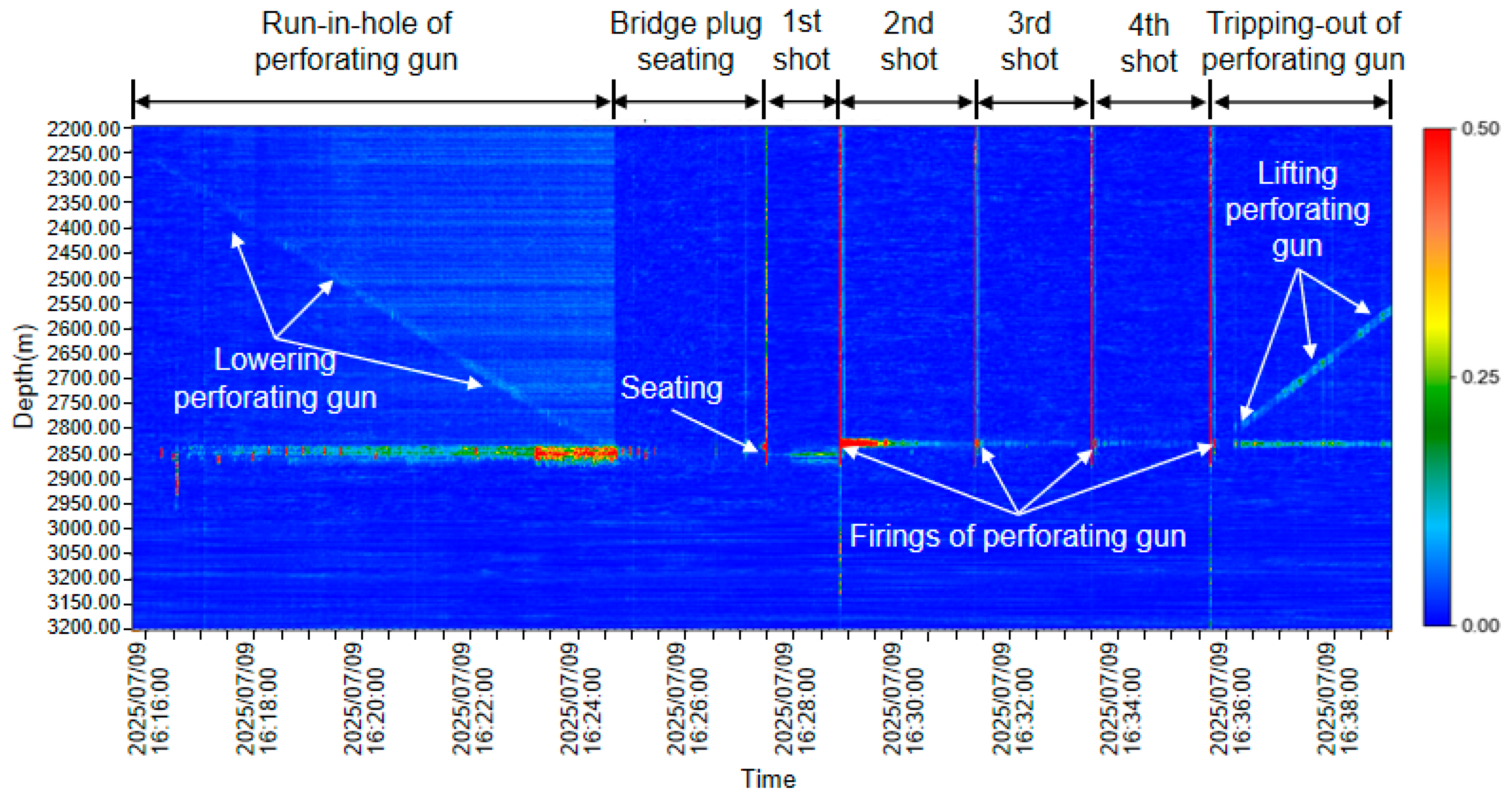
Figure 2 presents a comprehensive view of the perforating operation of Stage 43 recorded via DAS, illustrating the sequential operational phases of a horizontal well perforating and bridge plug setting procedure, capturing the dynamic acoustic response throughout the intervention. Initially, the perforating gun was run into the wellbore on a toolstring to the target interval. The top-left to bottom-right trending linear high-energy streak indicates that the perforating gun had been lowering into the treatment depth interval at a constant speed. The high-energy streak was induced by the relatively strong vibrations associated with the mechanical interaction between the perforating gun toolstring and the wellbore. After the successful run-in-hole of the perforating gun, a bridge plug was seated at the desired depth to isolate the previously stimulated stage of the well. This bridge plug seating event is clearly delineated by a distinct high-energy spike in the FBE waterfall plot at approximately 2863 m depth, indicating successful deployment and engagement of the plug. Following this, four discrete perforation shots were executed in succession, each manifesting as sharp, high-amplitude transient events that propagate vertically across the depth axis, reflecting the explosive energy released from the perforating charges. These firing signatures exhibit consistent timing intervals and spatial localization, confirming the controlled and sequential detonation sequence. Finally, the tripping-out phase of the perforating gun is captured by the bottom-left to top-right trending linear high-energy streak, indicative of the upward movement of the toolstring and cessation of downhole activity. The temporal and spatial coherence of the recorded events underscores the reliability of DAS monitoring for real-time surveillance of complex completion operations in horizontal wells, enabling precise control over treatment intervals, ensuring effective zonal isolation, and guaranteeing the valid firing of charges.
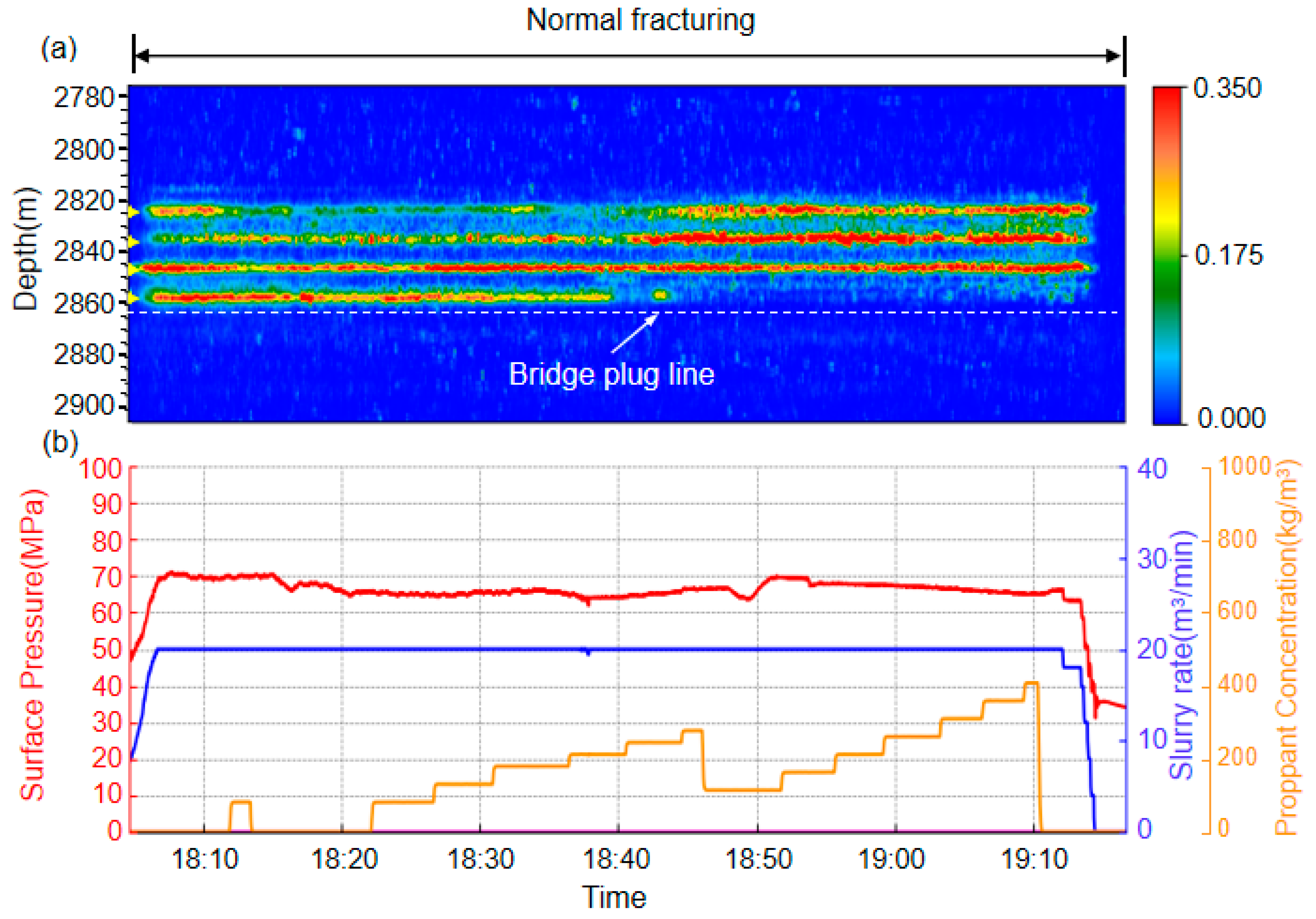
Following the successful perforating operation, high-pressure fracturing fluid was pumped through the perforations to propagate fractures, with proppant carried into the formation to maintain fracture conductivity. Figure 3a presents the DAS FBE waterfall plot in the frequency band of 50–200 Hz, capturing the spatiotemporal evolution of acoustic signals during Stage 43, while Figure 3b illustrates the corresponding surface treatment parameters—including the tubing pressure, slurry rate, and proppant concentration—over time. The fracturing treatment duration was 1 h and 15 min, with a total injected fluid volume of 1414 m3 and proppant volume of 120 m3. The FBE waterfall plot reveals distinct horizontal bands of high-amplitude acoustic activity at depths ranging from approximately 2820 to 2860 m, which align precisely with the expected perforation intervals above the bridge plug line marked at ~2863 m. These coherent high-energy signals, characterized by their periodicity and depth localization, are indicative of fracture initiation and propagation within the target formation. Notably, the onset of intense acoustic emissions coincides temporally with the initial rise in tubing pressure and the commencement of slurry injection, as shown in Figure 3b, suggesting a strong correlation between fluid entry into the formation and the generation of high-energy vibration events. As the slurry rate increases in stepwise increments, the amplitude and spatial extent of the DAS FBE signals intensify progressively, reflecting enhanced fracture complexity and extension. The final decline in both pressure and slurry rate corresponds to a rapid attenuation of acoustic activity, confirming the termination of fracture growth. This remarkable temporal and spatial congruence between the DAS-derived subsurface response and the surface pumping schedule underscores the capability of DAS monitoring to provide real-time, high-resolution insights into fracture dynamics, thereby enabling accurate interpretation of the effectiveness of treatments and optimization of stimulation strategies for complex unconventional reservoirs.
Based on the aforementioned method for quantitative estimation of fluid and proppant volumes [23], the distribution bar charts of fluid (Figure 4a) and proppant (Figure 4b) intake for the four perforation clusters in this stage were obtained. The fluid volumes received at Clusters 43-1, 43-2, 43-3, and 43-4, from bottom to top, can be seen to increase and then decrease. The proppant volumes received at the four clusters were consistent with the fluid volumes. As there were a total of four perforation clusters, the reference fluid volume V r e f , according to Equation (8), was 12.5%. All of these four clusters had an intake fluid volume greater than the reference fluid volume ( V r e f = 12.5%), which indicates that the number of effective perforation clusters N e is 4. As all four clusters were effectively stimulated, the perforation cluster efficiency E of Stage 43 was 100%. This cluster efficiency is consistent with the relatively uniform distribution of FBE energies across the four clusters on the FBE waterfall plot.
The fluid and proppant allocation estimates presented here were derived from DAS-based FBE analysis using Equations (4)–(7) from Liu et al.’s work [34]. In that study, validation against post-frac numerical simulations shows that estimated fluid and proppant allocations agree within a 6% error, confirming the method’s quantitative reliability—significantly better than conventional approximations, which often exceed 20% error. The utilized methodology accounts for key sources of uncertainty, including FBE band selection, cluster boundary delineation, and energy-to-flow calibration. Given the similarity in well design, completion strategy, and fracturing conditions between the current case and the validated field example, we adopted the same workflow and uncertainty framework in this study, providing confidence in the quantitative results while acknowledging the inherent limitations of DAS-based allocation.
However, a key limitation of the empirical correlation in Equations (4)–(7) is its assumption of a fixed relationship between flow rate and acoustic signal strength, ignoring dynamic changes in perforation geometry during stimulation. In practice, proppant-laden fluids can erode perforations, increasing their diameter over time [48,49]. This reduces friction and turbulence, lowering the energy and frequency content of the acoustic signal—a “fading” effect visible in FBE waterfall plots even at constant injection rates. Thus, sound pressure level (SPL) depends not only on flow rate but also on time-varying perforation size. When erosion occurs, the assumed proportionality between SPL and flow rate breaks down, causing the fixed coefficients A and B to underestimate flow rates in later stages. While the correlation works well under short-term or controlled conditions, its accuracy diminishes in long-duration or high-proppant treatments unless perforation evolution and signal decay are explicitly modeled. Advanced approaches that jointly estimate flow and perforation changes have been proposed [50], but they require additional calibration and are often noise-sensitive in field applications. In this study, we did not observe significant signal attenuation or frequency shifting indicative of perforation erosion in the DAS-based FBE waterfall plots in Figure 3a. Specifically, the acoustic energies from all of four clusters remained consistently high throughout the treatment stage, persisting until the sand concentration dropped to zero, which suggests minimal degradation of flow-induced noise due to changing perforation size. Given the absence of observable signal decay in our dataset, we consider that the use of the time-invariant empirical correlations, which are defined in Equations (4)–(7), is sufficient for flow estimation in this specific context.
In summary, DAS not only enhances the reliability and efficiency of perforating operations but also contributes valuable diagnostic information for optimizing well completion strategies in complex horizontal and multistage interventions. In this study, the integration of DAS monitoring with surface injection data enabled precise characterization of the effectiveness of perforation operations and fracture behaviors during multistage hydraulic fracturing, demonstrating high cluster efficiency and uniform treatment distribution in Stage 43. This real-time, high-resolution surveillance approach provides critical insights for optimizing stimulation operations and enhancing reservoir performance in horizontal wells.

4.2. Diversion Diagnosis

Diversion is a widely applied technique in multistage hydraulic fracturing to improve the uniformity of stimulation and enhance perforation cluster efficiency [51]. In multi-cluster perforation designs, fluid entry is often dominated by a few clusters due to geological heterogeneity, stress anisotropy, and variations in perforation entry friction. This uneven fluid allocation reduces the effectiveness of stimulation operations by leaving some clusters under-stimulated. The principle of diversion is to introduce degradable (particulate or fibrous) materials into the fracture network to temporarily restrict intake at dominant clusters. These materials increase local near-wellbore friction, forcing fluid into clusters with lower stimulation. Once pumping is complete, the diverter materials degrade or are flushed out, restoring full production capacity. The diversion process generally follows three stages: initial obstruction of flow paths at dominant clusters; pressure redistribution that elevates the near-wellbore pressure in blocked intervals and redirects fluid into under-stimulated clusters; and progressive equalization through repeated placement that gradually improves stimulation uniformity [52].
The DAS FBE dataset facilitates effective monitoring of real-time diversion effects. Diagnostic indicators of successful diversion include attenuation of acoustic amplitude at dominant clusters, enhancement of signals at previously underperforming clusters, and a concurrent rise in surface pressure during diverter pumping, consistent with increased near-wellbore restriction. Comparison of fluid and proppant allocations before and after diverter placement also provides a quantitative measure of the effectiveness of diversion processes.
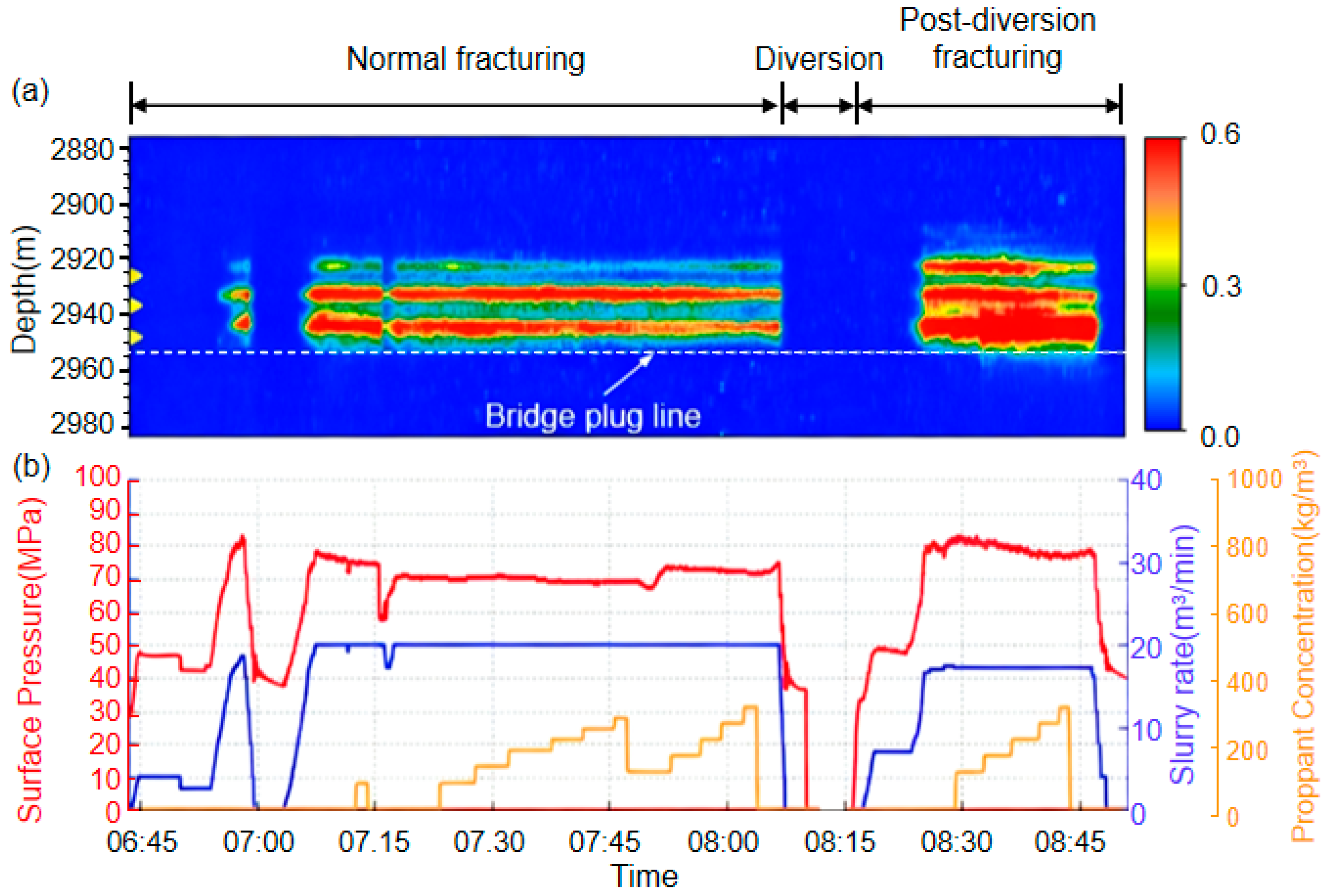
Taking the three-cluster Stage 41 as an example (Figure 5), the DAS FBE [50–200 Hz] waterfall plot revealed that Clusters 41-1 and 41-2 dominated fluid intake in the early stage, with Cluster 41-3 showing lower fluid and proppant allocation, with relatively low FBE compared to the two dominant clusters. Dissolvable diverter pods (a degradable polymer-based material) were injected into the wellbore around 8:10 and re-stimulation resumed at 8:15, aiming to break the uneven fluid and proppant distribution across the three clusters. The post-diversion FBE of Cluster 41-3 increased significantly and the treatment pressure also increased dramatically, demonstrating that the diversion was successful.
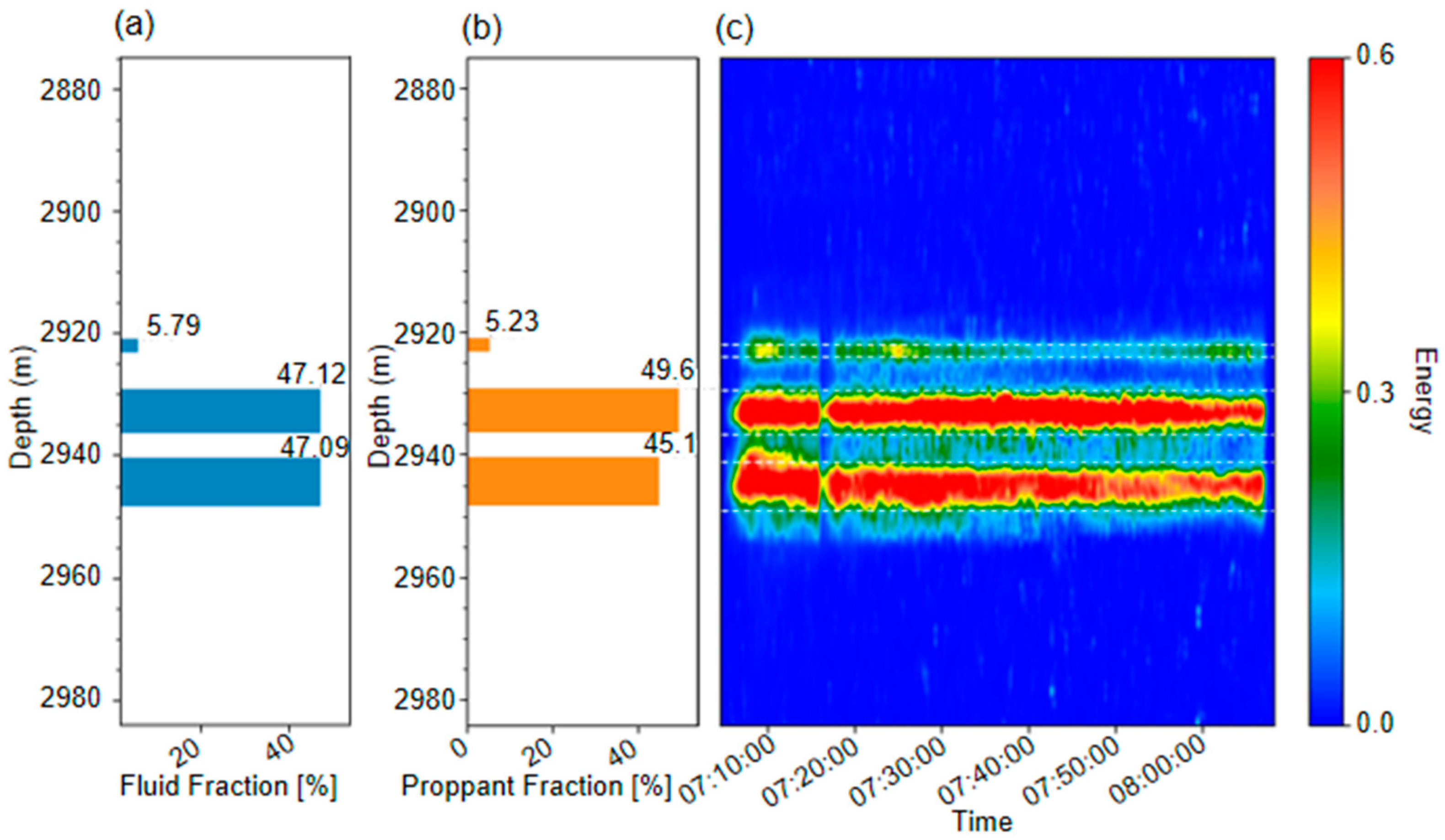
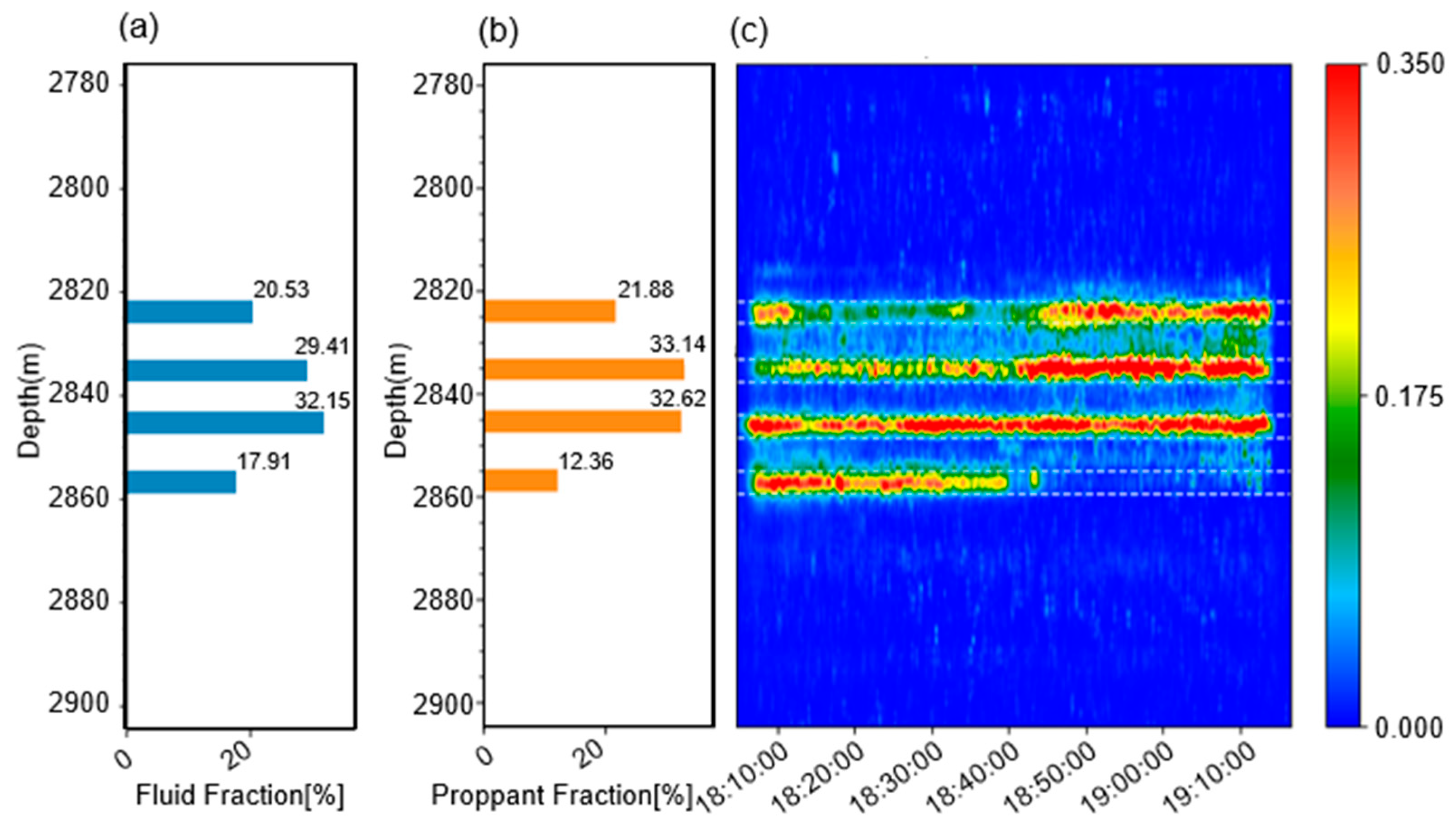
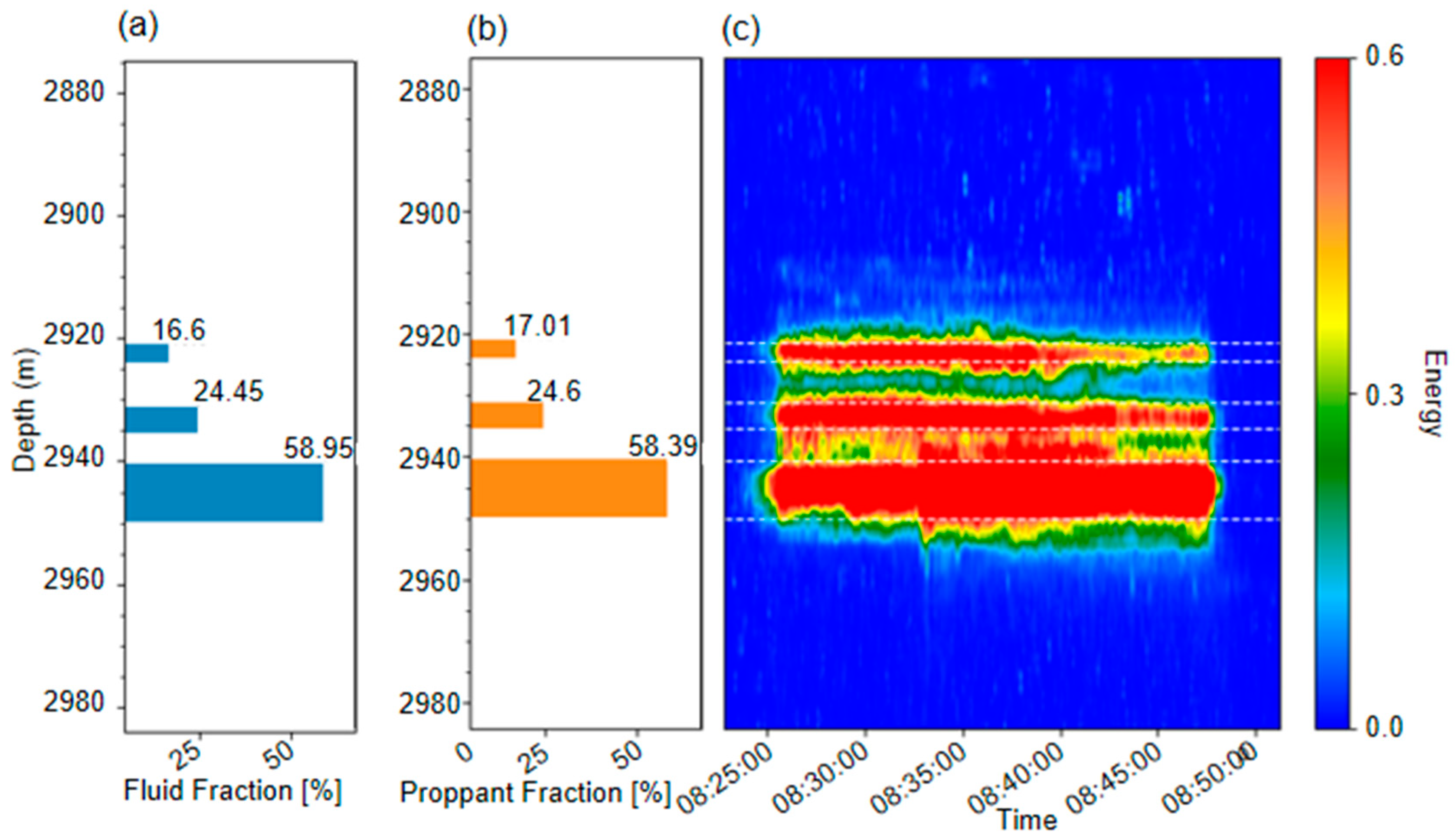
Quantitative estimation of the pre- and post-diversion fluid and proppant distributions across the three perforation clusters further demonstrated the effectiveness of the diversion process. Figure 6 and Figure 7 present the distribution bar charts of fluid intake (Figure 6a and Figure 7a), the distribution bar charts of proppant intake (Figure 6b and Figure 7b), and the FBE [50–200 Hz] waterfall plots (Figure 6c and Figure 7c) before and after diversion placement. The fluid and proppant allocations in Cluster 41-3 increased from 5.79% to 16.6% and from 5.23% to 17.01%, respectively. Defining a perforation cluster that receives a fluid volume greater than V r e f = 12.5% as an effective perforation cluster, the Cluster 41-3 was ineffective before diverter placement and transformed into an effective cluster after diversion.
The ideal effect of diversion is to increase the fluid and proppant intake in Cluster 41-3 while reducing those of Clusters 41-1 and 41-2. Nevertheless, the fluid and proppant allocation in Cluster 41-3 still remained the lowest among the three clusters. The limited effectiveness of diversion was diagnosed through joint analysis of the real-time pressure and FBE dynamics data. Following diverter injection, the surface pressure exhibited a modest (~4.5 MPa) but unstable increase, characterized by a “sawtooth” fluctuation pattern (i.e., repeated cycles of pressure rise followed by abrupt drops). Concurrently, the FBE responses from Clusters 41-1 and 41-2 never fully diminished; instead, they displayed persistent, oscillatory energy levels, indicating that these clusters remained in a “semi-open” state throughout the treatment. This coupled behavior rules out perforation erosion—which would produce a monotonic, irreversible increase in cluster conductivity and a steady pressure decline—and instead points to diverter degradation as the dominant mechanism. Specifically, the pod diverter likely lacked sufficient mechanical strength or thermal stability under downhole conditions. As pressure built up, the diverter temporarily sealed the dominant clusters, causing pressure to rise; however, once the local pressure exceeded the material’s critical threshold, the seal was compromised (“pierced”), leading to sudden pressure release and renewed flow into Clusters 41-1 and 41-2. Such transient sealing-and-failure behavior has been documented in laboratory and field studies of degradable diverters, where insufficient mechanical integrity leads to cyclic pressure responses during fracturing [16,53]. Subsequent re-accumulation of diverter particles then re-established partial blockage, initiating the next cycle. The resulting feedback loop between temporary sealing and failure explains both the sawtooth pressure signature and the sustained, fluctuating FBE activity—confirming that inadequate diverter integrity—and not perforation damage—caused the poor outcome of the diversion process.
Optimization requires careful selection of diverter type, size distribution, and concentration, as well as appropriate timing of placement informed by real-time DAS monitoring. Although field engineers are not typically able to carry out in-depth investigations and optimization, DAS-based diagnostics can enable timely evaluation of diversion efficiency and guide operational adjustments, such as placing the diverter in an earlier stage of the hydraulic fracture treatment.

4.3. Sand Screenout Diagnosis

Sand screenout is a condition that occurs when the solids carried in a treatment fluid—such as proppant in a fracture fluid—create a bridge across the perforations or similar restricted flow areas. This creates a sudden and significant restriction to fluid flow that causes pump pressure levels to unexpectedly rise rapidly, potentially in excess of the safe-operating parameters of the wellbore or wellhead equipment. Sand screenout is a critical challenge in hydraulic fracturing, affecting both the construction process and operational safety [54]. A screenout can put many of the field crew on stand-by status and delays the placement of subsequent stages, resulting in cost overruns due to stand-by charges, wellbore cleanout operations, and lost production days. Real-time sand screenout detection during fracturing is critical to prevent catastrophic wellbore blockage and ensure optimal proppant placement for reservoir productivity. Immediate sand screenout identification allows for prompt intervention through fluid rate adjustments, diversion techniques, or flowback and flushing-based wellbore cleanout, thus minimizing treatment failure risks [55].
DAS monitoring is helpful for real-time sand screenout identification. When sand screenout occurs during horizontal well fracturing, distinct features manifest on both the treatment curves and the DAS FBE waterfall plot. Sand screenout usually leads to the redistribution of fluid intake across perforation clusters. If only partial clusters experience sand screenout, the affected clusters demonstrate rapid fluid intake reduction or cessation, while the unaffected clusters show increased fluid intake, accompanied by significant DAS FBE response enhancement.
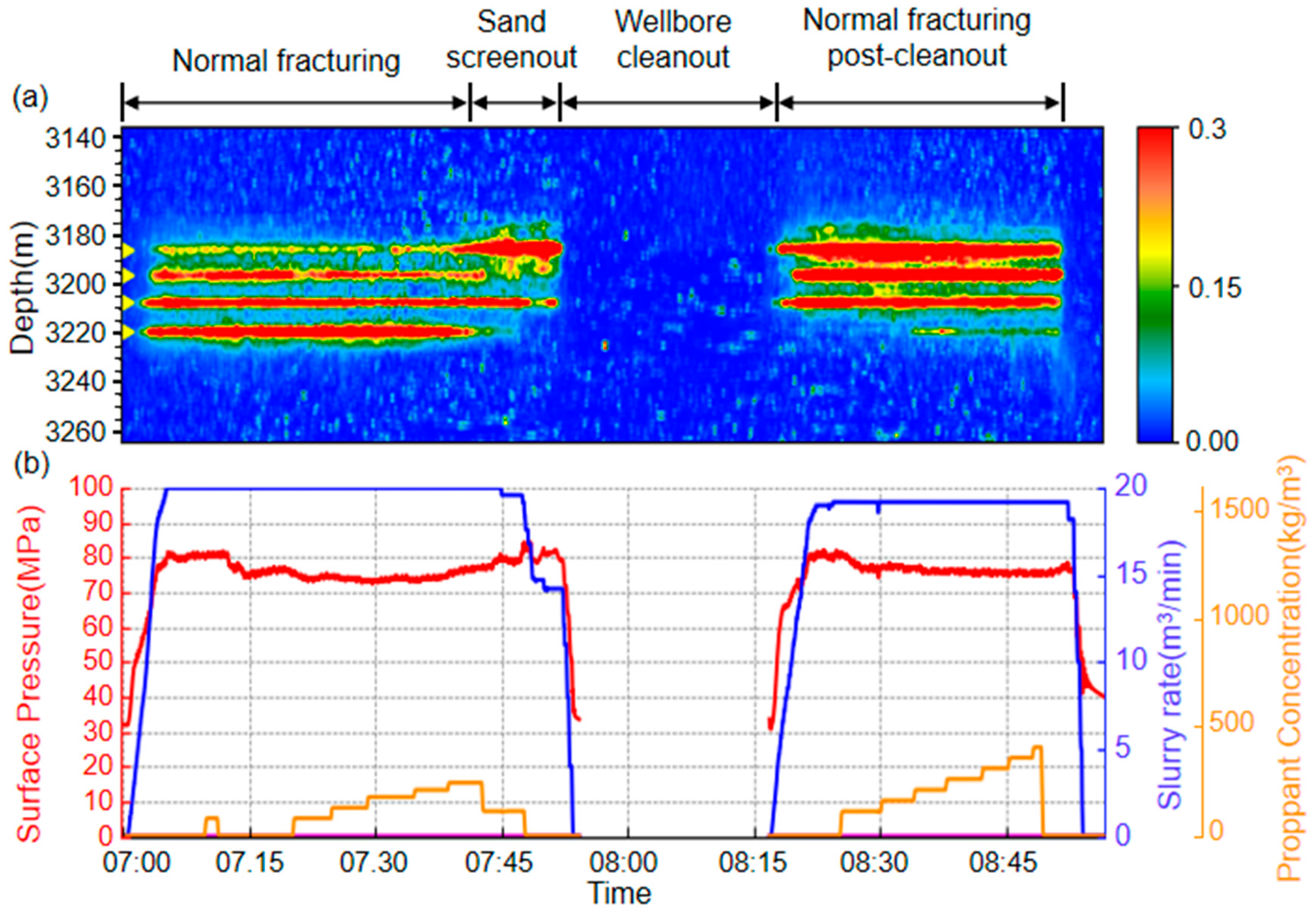
We take the sand screenout in Stage 35 as an example; the total fracturing time was 1 h 57 min, with a total injected fluid volume of 1706 m3 and a proppant mass of 120 m3. Early in the stage, the DAS FBE [50–200 Hz] energy distribution indicated that Clusters 35-1 and 35-2 (upwards) received disproportionately higher fluid volumes compared with the other clusters (yellow triangles in Figure 8a). However, this four-cluster fracturing stage encountered sand screenout after about 40 min, with Clusters 35-1 and 35-3 exhibiting a sharp decline in FBE intensity and Cluster 35-4 exhibiting a sharp increase in FBE intensity. Meanwhile, the pressure curve exhibited a sustained upward trend exceeding the safety threshold, with significant fluctuations and abnormal pressure gradient increase. The slurry rate curve shows a steep decline, failing to maintain the designed injection rate. The proppant concentration curve displays violent fluctuations in the proppant concentration, with stepwise growth interruption (Figure 8b). Further analyses indicated that only Clusters 35-1 and 35-3 experienced sand screenout. The fluid intake reduction in Clusters 35-1 and 35-3 was compensated to Cluster 35-4, which showed a significant increase in FBE intensity.

4.4. Out-of-Zone Flow Diagnosis

Out-of-zone flow (or cross-flow) refers to unintended fluid migration between different stages during hydraulic fracturing, which can reduce perforation cluster efficiency, distortion of the fracture geometry, and compromised fracture containment. Out-of-zone flow primarily stems from four factors: Poor cementing quality, bridge plug seal failure, radially propagating hydraulic fractures along the horizontal well trajectory, and naturally developed fractures near the wellbore [18]. Among these, inadequate cementing and bridge plug malfunction constitute the two most prevalent causes [19].
DAS provides an effective diagnostic tool for identifying out-of-zone flow. For normal fracturing, strong acoustic responses in the FBE waterfall plot are usually confined to the treatment zone, while out-of-zone flow usually exhibits strong vibrational responses in the FBE waterfall plot within non-fractured stages. By combining these FBE characteristics with surface injection data, out-of-zone flow paths can be localized and their significance assessed. The ability of DAS to diagnose out-of-zone flow in real-time serves as a valuable basis for operational decision making and post-treatment evaluation.
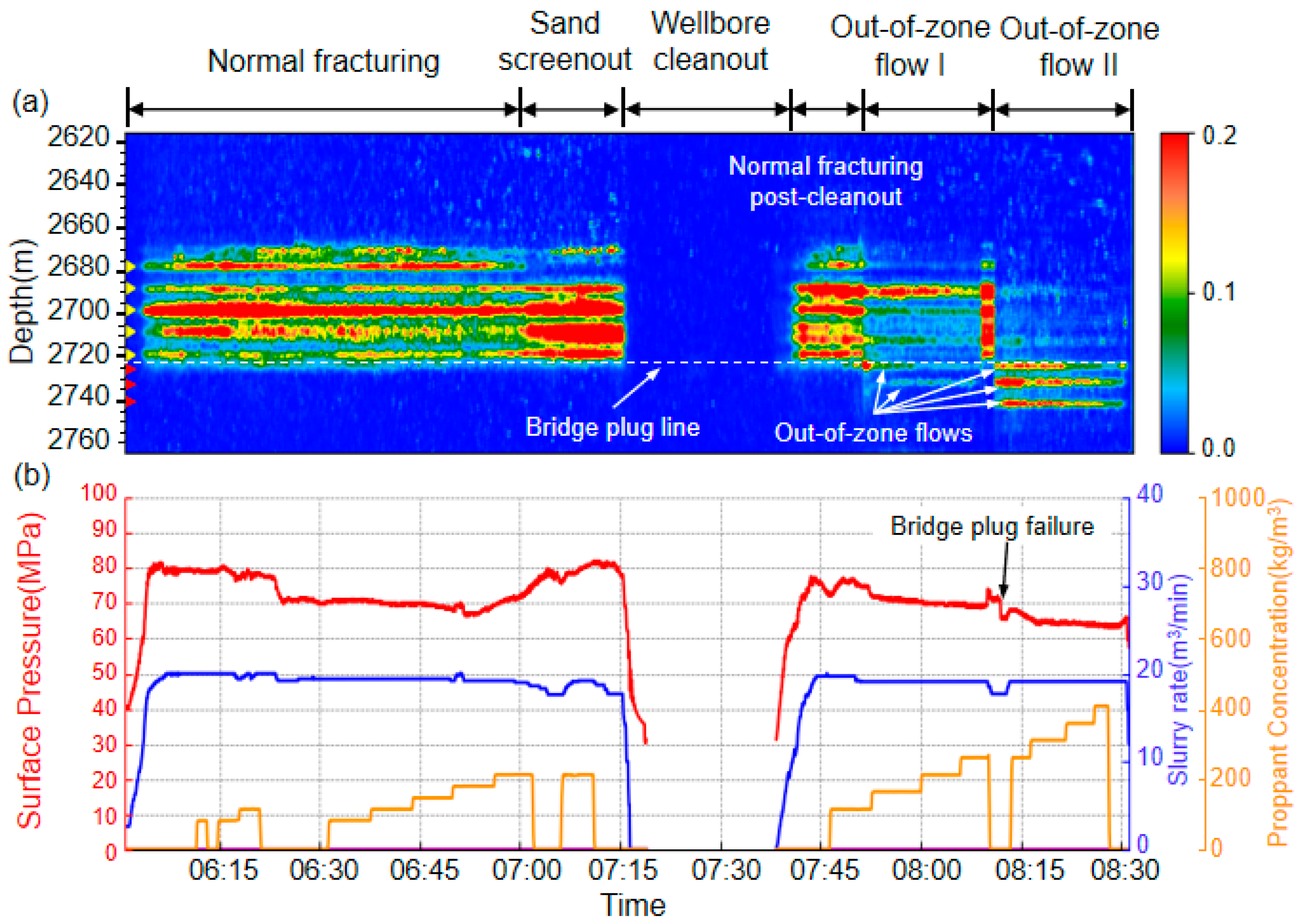
During the fracture treatment of Stage 46 with five perforation clusters, minor and severe out-of-zone flows occurred in the previous stage. Figure 9 shows the FBE [50–200 Hz] waterfall plot and the injection curves, with yellow and red triangles representing the perforation cluster centers of Stages 46 and 45, respectively. The white dashed line delineates the bridge plug depth position between Stage 46 and Stage 45. The total treatment time of Stage 46 was 2 h 38 min, with an injected fluid volume of 2311 m3 and a total proppant mass of 180 m3. The FBE waterfall plot in Figure 9a indicates that the stage endured five phases, including normal fracturing in the early phase, sand screenout and wellbore cleanout in the middle time period, post-cleanout normal fracturing, and two out-of-zone flows. The FBE waterfall plot revealed the first out-of-zone flow as a minor fluid leakage into the previous stage, evidenced by lower pressure drawdown in the injection pressure curve on Figure 9b. The field engineers diagnosed this first out-of-zone flow as imposing a negligible influence on overall stimulation and continued the stimulation job. However, when the field engineers spotted stronger FBE energies on all clusters with quick injection pressure build-up, they immediately lowered the slurry rate, resulting in injection pressure drawdown. During this time period, the bridge plug between Stages 46 and 45 failed to seal the two stages around 6:10, resulting in more severe fluid losses into Stage 45, which was evidenced by the stronger FBE zone located within the depth intervals of Stage 45. Weak FBE features within the cluster zone of Stage 46 indicated that almost all the fluids and proppants went into Stage 45, with this out-of-zone flow compromising the cluster efficiency of Stage 46. Notably, even when the slurry rate recovered to a normal level and the proppant concentration increased, the injection pressure still decreased rapidly.
Further in-depth analysis of the distinct FBE features of the out-of-zone flows confirm that the out-of-zone flows were caused by bridge plug failure. The continuous high-energy zone along the FBE waterfall plot is the hallmark of casing-annulus communication, which can be caused by poor cementing quality, radially propagating hydraulic fractures along the horizontal well trajectory, and naturally developed fractures near the wellbore. Under high-pressure injection, these leakage paths allow the fracturing fluid to bypass intended perforation clusters via behind-casing flow paths and migrate vertically to adjacent intervals. However, in this case, the out-of-zone flows during the fracture treatment of Stage 46 were featured with alternating high- and low-energy zones at perforation cluster intervals and inter-cluster FBE remaining relatively lower, indicating that they were internal communications due to inter-stage bridge plug failure. This means that improper setting, erosion, or debris obstruction had created communication between perforated intervals inside the casing within Stage 46 and 45.
Critically, this pattern differs fundamentally from what would be expected in the event of cement sheath failure or annular leakage. If fracturing fluid had bypassed the casing through a compromised cement barrier, the resulting flow path would lack discrete entry points and instead produce a continuous, unstructured high-energy zone along the affected interval—without the distinct spatial periodicity matching the perforation cluster geometry [11,19]. The observed cluster-aligned, alternating FBE signature strongly suggests that fluid entered the formation through the intact perforations of Stage 45, not via annular channels. This interpretation is further supported by the absence of sustained high-energy signals in non-perforated sections between stages, which would be characteristic of cement-related microannuli or channeling.
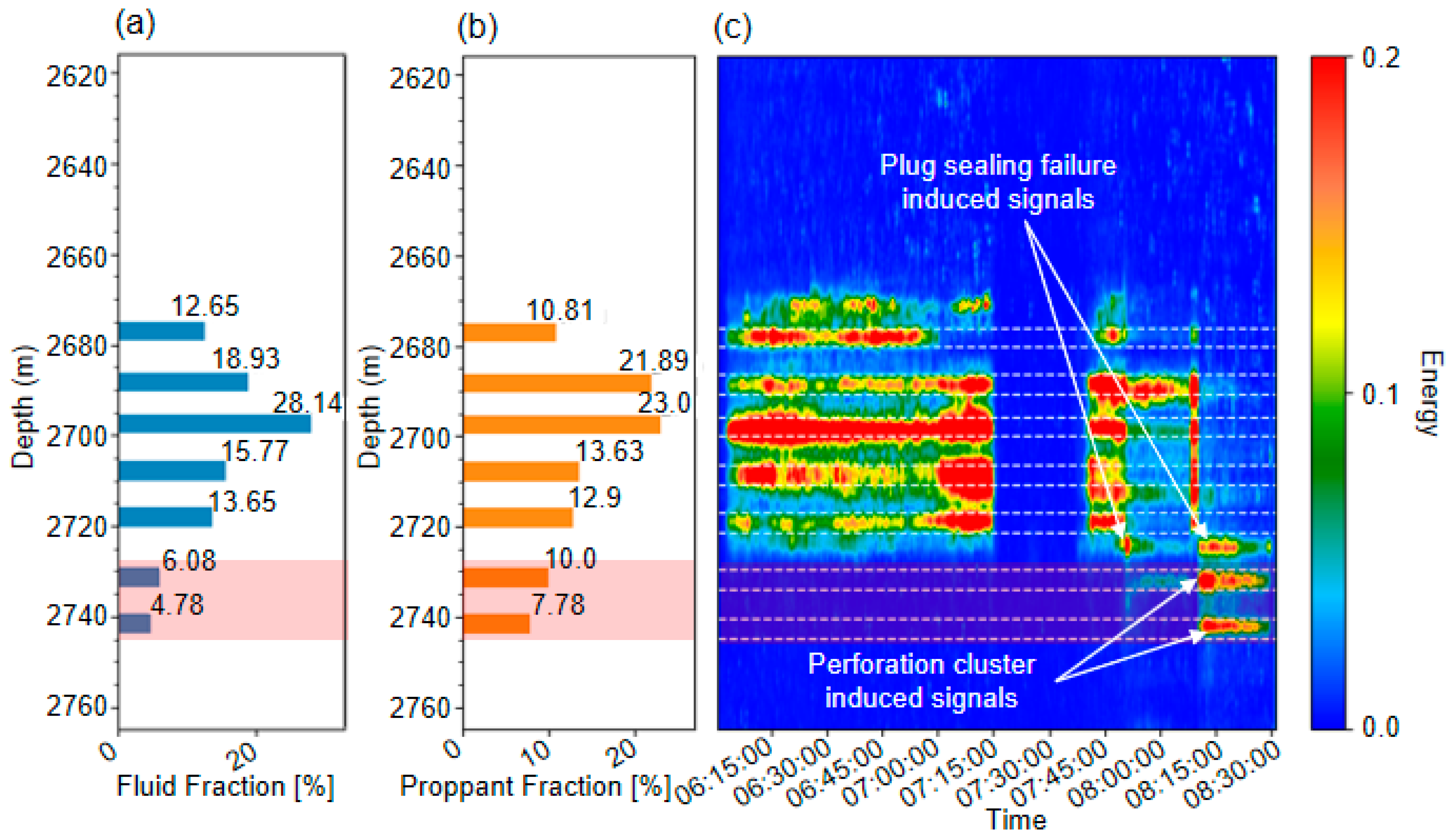
Based on the quantitative method for estimation of fluid and proppant volumes, the distribution bar charts of fluid (Figure 10a) and proppant (Figure 10b) intake across the five perforation clusters and out-of-zone flow intervals were derived from the FBE data (Figure 10c). Fluid and proppant flowing into openings, whether created by plug sealing failure or perforations, yield high energy responses in FBE data; however, as the fluid and proppant entering into the hole created by failed plug sealing do not eventually flow into the reservoir formation, they do not contribute to the stimulated reservoir volume and the corresponding FBE signals cannot be utilized for quantitative estimation of fluid and proppant intake. Therefore, only the out-of-zone flow resulting from perforation clusters of the previously stimulated Stage 45—which are located within the out-of-zone flow intervals and highlighted by red shaded rectangles—should be considered in the quantitative estimation of fluid and proppant allocation. This distinction underscores the importance of integrating DAS data with quantitative volumetric analysis to differentiate between true fracture initiation and non-productive near-wellbore flow events, thereby ensuring accurate assessment of cluster effectiveness and treatment performance.
The fluid fractions received at the five clusters, from bottom to top (Cluster 46-1 to 46-5), show a non-uniform trend, with Cluster 46-3 receiving the highest fluid volume (28.14%) and Cluster 46-5 the lowest (12.65%). A similar pattern was observed in the proppant fraction distribution, indicating consistent flow behavior between fluid and proppant delivery. Notably, although out-of-zone flow in the upper two perforation clusters of the adjacent Stage 45 took some fluid and proppant allocations, all five clusters received fluid volumes exceeding the reference threshold V r e f = 12.5%, defined according to Equation (8), confirming that each cluster still contributed effectively to the fracturing process. Therefore, the number of effective perforation clusters N e was five, resulting in a perforation cluster efficiency E of 100% for Stage 46.

4.5. Fiber Failure Diagnosis

Fiber failure or fiber breakage during in-well DAS monitoring of hydraulic fracture treatment occurs when mechanical, thermal, or chemical stresses exceed the structural tolerance of the optical cable. In hydraulic fracturing operations, several mechanisms may contribute to this failure. Mechanical stress induced by casing deformation under high-pressure injection operations can impose axial compression or bending on the cable; debonding or failure of the cement sheath exposes the fiber to direct casing contact, increasing localized strain accumulation; abrasion and microbending caused by sand-laden flow or debris impact can progressively weaken the fiber cladding; and vibration fatigue from repeated high-amplitude strain cycles accelerates damage.
Prior to catastrophic failure, DAS measurements often reveal distinctive pre-breakage signatures. A previous quantitative evaluation of the pre-breakage signature has revealed that the standard deviation of the cable vibration exceeded 2000 με/s before the fiber breakage [20]. Although quantitative evaluation provides a more accurate indicator of fiber failure, it is not feasible during real-time monitoring without prior knowledge due to the complexity of its placement and the various possible parameter configurations (e.g., different fiber cable types and DAS Ius). Therefore, qualitative indicators are more suitable for real-time diagnosis of fiber failure risk during hydraulic fracturing. These qualitative indicators include sustained high-amplitude strain rate fluctuations beyond baseline levels, alternating tensile and compressive strain spikes indicative of buckling or microbending, and phase wrapping events when displacement rates exceed the DAS demodulation limit.
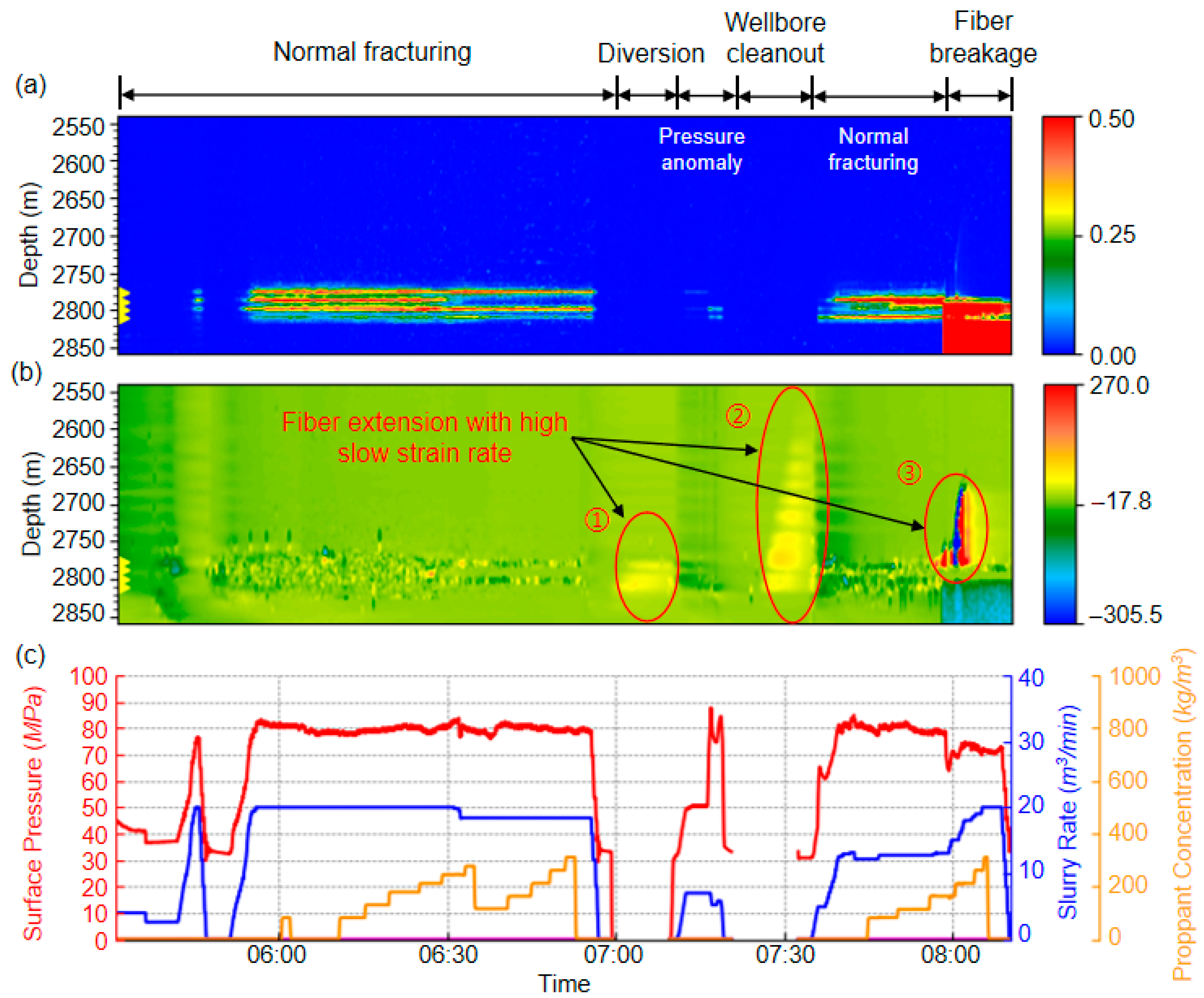
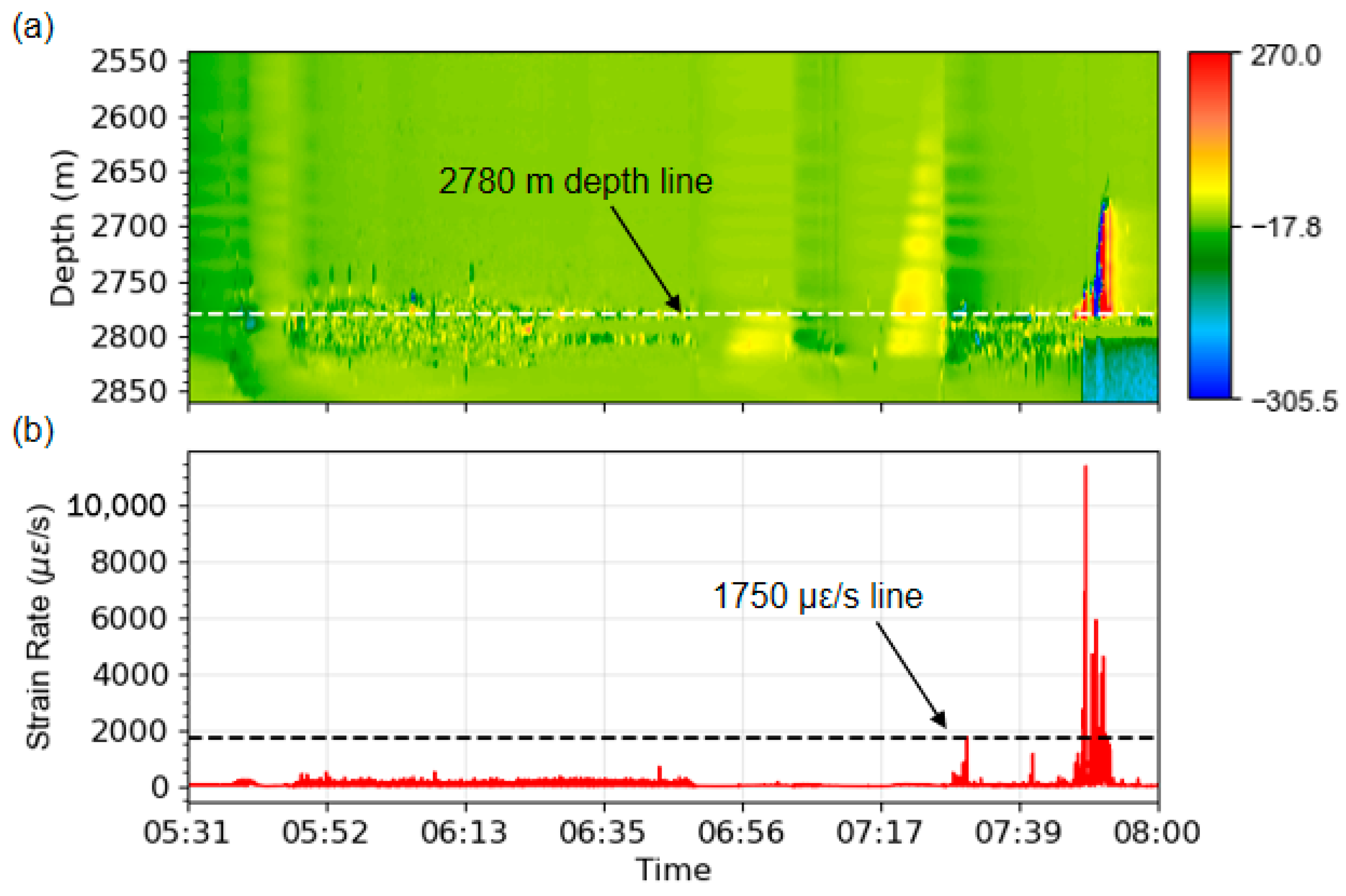
We take Stage 44—in which fiber breakage took place—as an example, where the total treatment time was 2 h 45 min, with an injected fluid volume of 1768 m3 and a proppant mass of 120 m3. Figure 11a–c present the FBE [50–200 Hz] waterfall plot, the LF-DAS [0–0.5 Hz] waterfall plot, and the corresponding treatment parameters, respectively, with yellow triangles pinpointing the centers of perforation clusters. The FBE waterfall plot reveals distinct phases: Normal fracturing, diversion, pressure anomaly, wellbore cleanout, normal fracturing, and fiber breakage. During the early stage (from pumping beginning until 06:55), operations proceeded relatively normally. Clusters 44-2 and 44-4 exhibited higher FBE amplitudes, indicating relatively greater fluid and proppant intake. In contrast, Cluster 44-1 showed the weakest FBE, suggesting minimal fluid and proppant entry. Notably, at approximately 06:32, the FBE of Cluster 44-3 diminished to near zero, implying cessation of fluid injection into this cluster. These observations indicate significant inter-cluster flow heterogeneity and low perforation cluster efficiency. Consequently, the field engineers decided to deploy diverters, which were pumped at 07:00, and fracturing resumed at 07:10. However, elevated pumping pressures were observed despite reduced slurry rates, prompting a flowback operation at 07:20 to relieve near-wellbore blockages. Fracturing was reinitiated at 07:35. The FBE waterfall plot reveals that Clusters 44-1 and 44-3 subsequently exhibited stronger energy than Clusters 44-2 and 44-4, confirming effective diversion. Nevertheless, operations continued under suboptimal conditions—namely, low injection rate coupled with high pressure—increasing the difficulty of fluid entry. At 07:58, a sudden pressure drop coincided with increased slurry rate. Simultaneously, FBE signals below the depth of Cluster 44-3 (~2780 m) became anomalous, exhibiting phase-wrapping artifacts in the FBE data—a diagnostic signature indicating optical fiber cable breakage. After fiber breakage, both FBE and LF-DAS signals abruptly terminate at ~2780 m, confirming optical continuity failure. The loss of signal continuity in both datasets confirmed the occurrence of fiber failure, while the absence of post-breakage strain or acoustic activity validated the irreversibility of the damage.
In fact, two anomalies—delineated by red ellipses in Figure 11b—were observed in the LF-DAS waterfall plot and could serve as precursors to fiber damage, as the LF-DAS data captures the long-term strain evolution along the fiber. Before fiber breakage, two fiber extensions with high strain rate were observed around the treatment depth intervals, including ① a region of sustained high strain rate contained within the top and bottom depths of the four clusters, indicative of limited gradual extensive deformation of the fiber; and ② a more pronounced zone of high strain accumulation spreading from cluster depths ~2820 m to the non-treatment zone up to ~2550 m, with a height about 270 m. These two extension events were likely a proxy for debonding of the cement sheath, allowing direct fiber–casing contact. It is considered that the diversion process resulted in the first extension event, while the flushing-based wellbore cleanout operation caused the second, more significant extension event. The fiber-optic cable from ~2820 m to ~2550 m had undergone mechanical stress and stretched extensively. The 270 m extension zone reflects the spatial extent over which strain was transmitted along the fiber due to localized tensile loading at the eventual break point. As fiber-optic cables are highly sensitive to micro-strain, even minor deformations can propagate elastically over hundreds of meters, resulting in a broad but low-amplitude strain signature. Critically, the strain rate magnitudes across this 270 m interval remained below 200 με/s, as indicated by the color scale in Figure 11b; this level is consistent with the background operational strain during fracturing and is well below the empirically identified precursor threshold of 1750 με/s (shown in Figure 12b) that directly preceded fiber rupture. Therefore, the 270 m zone represents a regional stress influence area, and not a zone of critical damage. The actual failure was driven by extreme localized strain (>1750 με/s) at a single point, while the surrounding 270 m merely exhibited elastic response within safe mechanical limits—far below the cable’s rated tensile strength (≥55 kN). These two fiber extension events were then followed by ③ cyclic sharp compressive and tensile strain stripes immediately after fiber rupture, with blue and red colors representing compression and extension responses, respectively. The previous two extension events exposed the fiber-optic cable to direct fluid and proppant movement, and abrasion by the high-speed fluid and proppant had exacerbated local strain concentration, ultimately leading to fiber breakage.
To quantify the mechanical precursor of fiber failure, we extracted the absolute strain rate from the LF-DAS (<0.5 Hz) data at the eventual break depth of 2780 m. As shown in Figure 12, a distinct high-strain-rate extension zone emerged approximately 20 min before complete signal loss. The peak absolute strain rate reached 1750 με/s—marked by the black dashed line in Figure 12b—which we identify as the critical precursor threshold for imminent fiber failure in this case. This value significantly exceeds the typical background strain rates (<200 με/s) observed during normal fracturing operations. Given that the armored fiber-optic cable used in this well has a rated tensile strength of ≥55 kN (equivalent to a strain tolerance on the order of several thousand microstrain under standard installation conditions), the sustained strain rate of 1750 με/s indicates severe localized mechanical loading, likely induced by excessive casing deformation or point-load stress during high-pressure pumping. Consequently, we propose that a real-time LF-DAS strain rate exceeding 1750 με/s can serve as an empirical early warning indicator for fiber integrity risk in similar completions.
It should be noted that the 1750 με/s threshold is specific to this well and reflects the combined influence of cable type, cement bonding quality, casing configuration, and fracturing intensity [56]. One existing case study shows that the standard deviation of the permanent fiber optic cable vibration exceeded 1500 με/s before the fiber breakage [20]. As the reported horizontal well is located in the DJ Basin in Northern Colorado and fiber optic cable has different mechanical properties from the cable in our case, discrepancy exists between these two precursor strain rate values. Therefore, the 1750 με/s threshold value only serves as a case-specific reference and should not be universally applied to other wells, reservoirs, or completion designs without site-specific calibration.
In summary, these LF-DAS signatures demonstrate that fiber extension under high strain rates precedes catastrophic failure, providing a critical early warning signal for potential fiber breakage. Notably, the strain rate remained elevated over extended periods before the abrupt discontinuity, underscoring the importance of monitoring cumulative strain in real-time. Monitoring these precursory signatures provides a practical basis for early warning systems to mitigate the risk of fiber failure.

5. Conclusions

This study established an original, field-validated diagnostic framework that uniquely integrates FBE and LF-DAS data to simultaneously resolve quantitative allocation and qualitative anomalies during multistage fracturing in horizontal tight oil wells. Our key findings demonstrate the following:
(1)
Quantitative accuracy—Fluid and proppant allocations derived from the 50–200 Hz FBE band showed strong agreement with expected stage-level volumes.
(2)
Anomaly fingerprinting—Distinct DAS signatures were identified for five critical events: (i) sand screenout manifests as abrupt, localized FBE spikes, coinciding with pressure surges; (ii) effective diversion produces sequential, migrating energy fronts across clusters; (iii) out-of-zone flow appears as coherent acoustic activity outside perforated intervals; (iv) normal treatments exhibit spatially uniform FBE envelopes aligned with the cluster geometry; and (v) incipient fiber failure generates persistent high-strain-rate stripe patterns in LF-DAS (<0.5 Hz), which were detectable minutes before signal loss, and a strain rate of 1750 με/s was found to serve as a case-specific empirical early warning threshold for fiber failure risk.
(3)
Methodological synergy—Neither raw DAS nor FBE alone suffices; LF-DAS provides complementary mechanical context, while FBE isolates flow-induced acoustics, jointly enabling robust interpretation even in the presence of overlapping noise sources.
Nevertheless, the proposed workflow’s reliability depends on a sufficient signal-to-noise ratio (challenged by poor fiber coupling or high ambient noise), moderate computational overhead for real-time FBE/LF-DAS processing, and the need for empirical calibration of the energy–flow relationship, which may require adjustment across well designs.
Looking forward, this diagnostic framework is ideally suited for integration with machine learning-based pattern recognition systems for automated anomaly classification (e.g., CNNs for FBE image features or LSTMs for temporal sequences). Coupling such models with real-time optimization engines—where DAS-derived insights are utilized to dynamically adjust injection rates, proppant schedules, or diverter deployment—could enable closed-loop, adaptive fracturing. Future efforts should focus on building transferable event libraries, reducing latency via edge computing, and validating calibration protocols across diverse reservoirs to enhance scalability and operational efficiency.

Author Contributions

Conceptualization, Z.Z. and H.Z.; methodology, Z.Z., H.Z., L.L., W.L. and J.T.; software, L.L., B.L. and W.L.; validation, Z.Z., J.T., W.L. and B.L.; formal analysis, W.L. and B.L.; investigation, Z.Z., L.L. and J.T.; resources, H.Z. and W.L.; data curation, Z.Z. and B.L.; writing—original draft preparation, H.Z. and W.L.; writing—review and editing, Z.Z., J.T. and L.L.; visualization, Z.Z., H.Z., J.T. and L.L.; supervision, Z.Z., L.L. and J.T.; project administration, H.Z. and B.L.; funding acquisition, W.L. and B.L. All authors have read and agreed to the published version of the manuscript.

Funding

This research was funded by the Scientific Research and Technology Development Project of China National Petroleum Corporation (Grant No. 2021DJ3803), the Key R&D Program of Shaanxi Province (Grant No. 2023-ZDLSF-64), and the Fundamental Research Funds for the Central Universities (Grant No. 3142024017).

Data Availability Statement

The original contributions presented in this study are included in the article. Further inquiries can be directed to the corresponding author.

Conflicts of Interest

The authors Hanbin Zhu, Wenqiang Liu, and Bobo Li were employed by the China National Logging Company. The remaining authors declare that the research was conducted in the absence of any commercial or financial relationships that could be construed as potential conflicts of interest.

Abbreviations

The following abbreviations are used in this manuscript:
CNNConvolutional Neural Network
DASDistributed Acoustic Sensing
DTSDistributed Temperature Sensing
FBEFrequency Band Energy
FFTFast Fourier Transform
ICVInflow Control Valve
IUInterrogator Unit
LF-DASLow-Frequency Components of DAS
LSTMLong Short-Term Memory
PCEPerforation Cluster Efficiency
PnPPlug-and-Perf
PSDPower Spectral Density
RMSRoot Mean Squared
SNRSignal to Noise Ratio
TGD-OFDRTime-gated Digital Optical Frequency-Domain Reflectometry
VGLVariable Gauge Length

References

  1. Zhang, Z.; Tang, J.; Zhang, J.; Meng, S.; Li, J. Modeling of Scale-Dependent Perforation Geometrical Fracture Growth in Naturally Layered Media. Eng. Geol. 2024, 336, 107499. [Google Scholar] [CrossRef]
  2. Weijers, L.; Wright, C.; Mayerhofer, M.; Pearson, M.; Griffin, L.; Weddle, P. Trends in the North American frac industry: Invention through the shale revolution. In Proceedings of the SPE Hydraulic Fracturing Technology Conference and Exhibition, The Woodlands, TX, USA, 5–7 February 2019; p. D011S001R001. [Google Scholar] [CrossRef]
  3. Cipolla, C.; Singh, A.; McClure, M.; McKimmy, M.; Lassek, J. The perfect frac stage—What’s the value? In Proceedings of the Unconventional Resources Technology Conference, Houston, TX, USA, 17–19 June 2024; pp. 923–942. [Google Scholar] [CrossRef]
  4. Molenaar, M.; Hill, D.; Webster, P.; Fidan, E.; Birch, B. First downhole application of distributed acoustic sensing for hydraulic-fracturing monitoring and diagnostics. SPE Drill. Complet. 2012, 27, 32–38. [Google Scholar] [CrossRef]
  5. Ugueto, G.; Ehiwario, M.; Grae, A.; Molenaar, M.; McCoy, K.; Huckabee, P.; Barree, B. Application of integrated advanced diagnostics and modeling to improve hydraulic fracture stimulation analysis and optimization. In Proceedings of the SPE Hydraulic Fracturing Technology Conference and Exhibition, The Woodlands, TX, USA, 4–6 February 2014; p. SPE-168603. [Google Scholar] [CrossRef]
  6. Molenaar, M.; Fidan, E.; Hill, D. Real-time downhole monitoring of hydraulic fracturing treatments using fibre optic distributed temperature and acoustic sensing. In Proceedings of the SPE/EAGE European Unconventional Resources Conference and Exhibition, Vienna, Austria, 20–22 March 2012; p. SPE-152981. [Google Scholar] [CrossRef]
  7. Molenaar, M.; Cox, B. Field cases of hydraulic fracture stimulation diagnostics using fiber optic distributed acoustic sensing (DAS) measurements and Analyses. In Proceedings of the SPE Middle East Unconventional Resources Conference and Exhibition, Muscat, Oman, 24 January 2013; p. SPE-164030. [Google Scholar] [CrossRef]
  8. Saw, J.; Zhu, X.; Luo, L.; Correa, J.; Soga, K.; Ajo-Franklin, J. Distributed Fiber Optic Sensing for in-well hydraulic fracture monitoring. Geoenergy Sci. Eng. 2025, 250, 213792. [Google Scholar] [CrossRef]
  9. Boone, K.; Crickmore, R.; Werdeg, Z.; Laing, C.; Molenaar, M. Monitoring hydraulic fracturing operations using fiber-optic distributed acoustic sensing. In Proceedings of the SPE/AAPG/SEG Unconventional Resources Technology Conference, San Antonio, TX, USA, 20–22 July 2015; p. URTEC-2158449. [Google Scholar] [CrossRef]
  10. Cramer, D.; Friehauf, K.; Roberts, G.; Whittaker, J. Integrating distributed acoustic sensing, treatment-pressure analysis, and video-based perforation imaging to evaluate limited-entry-treatment effectiveness. SPE Prod. Oper. 2020, 35, 730–755. [Google Scholar] [CrossRef]
  11. Zhang, S.; Tang, H.; Hurt, R.; Jayaram, V.; Wagner, J. Joint interpretation of fiber optics and downhole gauge data for near wellbore region characterization. In Proceedings of the SPE Hydraulic Fracturing Technology Conference and Exhibition, The Woodlands, TX, USA, 4–5 February 2020; p. D021S004R002. [Google Scholar]
  12. Lorwongngam, A.; McKimmy, M.; Oughton, E.; Cipolla, C. One shot wonder XLE design: A continuous improvement case study of developing XLE design in the Bakken. In Proceedings of the SPE Hydraulic Fracturing Technology Conference and Exhibition, The Woodlands, TX, USA, 31 January–2 February 2023; p. D021S006R002. [Google Scholar]
  13. Ramurthy, M.; Richardson, J.; Brown, M.; Sahdev, N.; Wiener, J.; Garcia, M. Fiber-optics results from an intra-stage diversion design completions study in the Niobrara formation of DJ basin. In Proceedings of the SPE Hydraulic Fracturing Technology Conference and Exhibition, The Woodlands, TX, USA, 9–16 February 2016; p. D021S006R005. [Google Scholar] [CrossRef]
  14. Trumble, M.; Sinkey, M.; Meehleib, J. Got diversion? Real time analysis to identify success or failure. In Proceedings of the SPE Hydraulic Fracturing Technology Conference and Exhibition, The Woodlands, TX, USA, 5–7 February 2019; p. D021S005R002. [Google Scholar] [CrossRef]
  15. Ugueto, C.; Gustavo, A.; Huckabee, P.; Molenaar, M. Challenging assumptions about fracture stimulation placement effectiveness using fiber optic distributed sensing diagnostics: Diversion, stage isolation and overflushing. In Proceedings of the SPE Hydraulic Fracturing Technology Conference and Exhibition, The Woodlands, TX, USA, 4–6 February 2015; p. D011S002R001. [Google Scholar] [CrossRef]
  16. Ugueto, G.; Huckabee, P.; Nguyen, A.; Daredia, T.; Chavarria, J.; Wojtaszek, M.; Nasse, D.; Reynolds, A. A cost-effective evaluation of pods diversion effectiveness using fiber optics DAS and DTS. In Proceedings of the SPE Hydraulic Fracturing Technology Conference and Exhibition, The Woodlands, TX, USA, 4–5 February 2020; p. D011S002R001. [Google Scholar] [CrossRef]
  17. Thiruvenkatanathan, P.; Langnes, T.; Beaumont, P.; White, D.; Webster, M. Downhole sand ingress detection using fibre-optic distributed acoustic sensors. In Proceedings of the Abu Dhabi International Petroleum Exhibition and Conference, Abu Dhabi, United Arab Emirates, 7–10 November 2016; p. D031S061R002. [Google Scholar] [CrossRef]
  18. Hull, R.; Woerpel, C.; Trujillo, K.; Bohn, R.; Wygal, B.; Carney, B.; Carr, T. Hydraulic fracture characterization using fiber optic DAS and DTS data. In Proceedings of the SEG International Exposition and Annual Meeting, Online, 11–16 October 2020; p. D041S096R007. [Google Scholar] [CrossRef]
  19. Bohn, R.; Hull, R.; Trujillo, K.; Wygal, B.; Parsegov, S.; Carr, T.; Carney, B. Learnings from the Marcellus Shale Energy and Environmental Lab (MSEEL) using fiber optic tools and Geomechanical modeling. In Proceedings of the Unconventional Resources Technology Conference, Austin, TX, USA, 20–22 July 2020; pp. 1833–1851. [Google Scholar] [CrossRef]
  20. James-Ravenell, M.; Jin, G. Characterizing in-well DAS signal before fiber breakage. In Proceedings of the Fourth International Meeting for Applied Geoscience & Energy, Houston, TX, USA, 26–29 August 2024; pp. 538–541. [Google Scholar] [CrossRef]
  21. Pakhotina, I. Using Distributed Acoustic Sensing for Multiple-Stage Fractured Well Diagnosis. Ph.D. Thesis, Texas A&M University, College Station, TX, USA, 2020. [Google Scholar]
  22. Hamanaka, Y.; Zhu, D.; Hill, A. Investigation of the Reduction in Distributed Acoustic Sensing Signal Due to Perforation Erosion by Using CFD Acoustic Simulation and Lighthill’s Acoustic Power Law. Sensors 2024, 24, 5996. [Google Scholar] [CrossRef]
  23. Pakhotina, I.; Sakaida, S.; Zhu, D.; Hill, A. Diagnosing multistage fracture treatments with distributed fiber-optic sensors. SPE Prod. Oper. 2020, 35, 0852–0864. [Google Scholar] [CrossRef]
  24. Chen, K.; Zhu, D.; Hill, A. Acoustic Signature of Flow From a Fractured Wellbore. In Proceedings of the SPE Annual Technical Conference and Exhibition, Houston, TX, USA, 28–30 September 2015. [Google Scholar] [CrossRef]
  25. Shen, Y.; Holley, E.; Jaaskelainen, M. Quantitative real-time DAS analysis for plug-and-perf completion operation. In Proceedings of the SPE/AAPG/SEG Unconventional Resources Technology Conference, Austin, TX, USA, 20 January 2017. [Google Scholar] [CrossRef]
  26. Santos, R. Experimental Study of the Effect of Permeability on the Generation of Noise. Ph.D. Thesis, Texas A&M University, College Station, TX, USA, 2018. [Google Scholar]
  27. Li, Z.; Wu, Y.; Yang, Y.; Li, M.; Sheng, L.; Guo, H.; Jiao, J.; Li, Z.; Sui, W. A Sensitive Frequency Band Study for Distributed Acoustical Sensing Monitoring Based on the Coupled Simulation of Gas–Liquid Two-Phase Flow and Acoustic Processes. Photonics 2024, 11, 1049. [Google Scholar] [CrossRef]
  28. Ichikawa, M.; Kurosawa, I.; Uchida, S.; Kato, A.; Ito, Y.; Takagi, S.; de Groot, M.; Hara, S. Case study of hydraulic fracture monitoring using low-frequency components of DAS data. In Proceedings of the SEG Technical Program Expanded Abstracts, San Antonio, TX, USA, 15–20 September 2019; pp. 948–952. [Google Scholar] [CrossRef]
  29. Ugueto, G.; Todea, F.; Daredia, T.; Wojtaszek, M.; Huckabee, P.; Reynolds, A.; Laing, C.; Chavarria, J.A. Can you feel the strain? DAS strain fronts for fracture geometry in the BC Montney, Groundbirch. In Proceedings of the SPE Annual Technical Conference and Exhibition, Calgary, AL, Canada, 30 September–2 October 2019; p. D021S029R005. [Google Scholar] [CrossRef]
  30. Jin, G.; Roy, B. Hydraulic-fracture geometry characterization using low-frequency DAS signal. Lead. Edge. 2017, 36, 975–980. [Google Scholar] [CrossRef]
  31. In’t Panhuis, P.; den Boer, H.; Van Der Horst, J.; Paleja, R.; Randell, D.; Joinson, D.; Bartlett, R. Flow Monitoring and Production Profiling Using DAS. In Proceedings of the SPE Annual Technical Conference and Exhibition, Amsterdam, The Netherlands, 27–29 October 2014; p. SPE-170917. [Google Scholar] [CrossRef]
  32. Kavousi, P.; Carr, T.; Wilson, T.; Amini, S.; Wilson, C.; Thomas, M.; MacPhail, K.; Crandall, D.; Carney, B.; Costello, I.; et al. Correlating distributed acoustic sensing (DAS) to natural fracture intensity for the Marcellus Shale. In Proceedings of the SEG Technical Program Expanded Abstracts, Houston, TX, USA, 24–29 September 2017; pp. 5386–5390. [Google Scholar] [CrossRef]
  33. Zhao, Z.; Wu, X.; Qiao, Y.; Zhang, Y.; Tang, J.; Tian, Y.; Fu, Z.; Wang, C. Uncertainty analysis of quantitative hydraulic fracturing fluid and sand volumes calculated from DAS data. In Proceedings of the SEG Workshop on Fiber Optics Sensing for Energy Applications, Xi’an, China, 21–23 July 2024; pp. 35–38. [Google Scholar] [CrossRef]
  34. Liu, W.; Li, B.; Zhao, Z.; Wen, R.; Bai, Y.; Guo, H.; Tang, J.; Wang, C. An Enhanced Workflow for Quantitative Evaluation of Fluid and Proppant Distribution in Multistage Fracture Treatment with Distributed Acoustic Sensing. Processes 2025, 13, 3738. [Google Scholar] [CrossRef]
  35. Becker, M.; Ciervo, C.; Cole, M.; Coleman, T.; Mondanos, M. Fracture hydromechanical response measured by fiber optic distributed acoustic sensing at milliHertz frequencies. Geophys. Res. Lett. 2017, 44, 7295–7302. [Google Scholar] [CrossRef]
  36. Shragge, J.; Yang, J.; Issa, N.; Roelens, M.; Dentith, M.; Schediwy, S. Low-frequency ambient Distributed Acoustic Sensing (DAS): Useful for subsurface investigation? In Proceedings of the SEG International Exposition and Annual Meeting, San Antonio, TX, USA, 15–20 September 2019; p. D023S007R005. [Google Scholar] [CrossRef]
  37. Haavik, K. Annuli liquid-level surveillance using distributed fiber-optic sensing data. SPE J. 2024, 29, 1195–1209. [Google Scholar] [CrossRef]
  38. Karrenbach, M.; Ridge, A.; Cole, S.; Boone, K.; Kahn, D.; Rich, J.; Silver, K.; Langton, D. DAS microseismic monitoring and integration with strain measurements in hydraulic fracture profiling. In Proceedings of the Unconventional Resources Technology Conference, Austin, TX, USA, 24–26 July 2017; pp. 1316–1330. [Google Scholar] [CrossRef]
  39. Song, X.; Jin, G.; Wu, K.; Wan, X. A Numerical Model for Analyzing Mechanical Slippage Effect on Crosswell Distributed Fiber-Optic Strain Measurements During Fracturing. SPE J. 2024, 29, 4724–4736. [Google Scholar] [CrossRef]
  40. Weber, G.; Scolimoski, E.; Gomes, D.; Brusamarello, B.; Dureck, E.; Pipa, D. Low-Frequency Strain Testbed for DAS Performance Characterization. IEEE Sens. Lett. 2025, 9, 1–4. [Google Scholar] [CrossRef]
  41. Ingram, S.R.; Lahman, M.; Persac, S. Methods improve stimulation efficiency of perforation clusters in completions. J. Pet. Technol. 2014, 66, 32–36. [Google Scholar] [CrossRef]
  42. Ugueto, C.G.A.; Huckabee, P.T.; Molenaar, M.M.; Wyker, B.; Somanchi, K. Perforation Cluster Efficiency of Cemented Plug and Perf Limited Entry Completions; Insights from Fiber Optics Diagnostics. In Proceedings of the SPE Hydraulic Fracturing Technology Conference, The Woodlands, TX, USA, 9–11 February 2016. [Google Scholar] [CrossRef]
  43. Wang, S.; Fan, X.; Liu, Q.; He, Z. Distributed fiber-optic vibration sensing based on phase extraction from time-gated digital OFDR. Opt. Express 2015, 23, 33301–33309. [Google Scholar] [CrossRef]
  44. Chen, J.; Liu, Q.; He, Z. Time-domain multiplexed high resolution fiber optics strain sensor system based on temporal response of fiber Fabry-Perot interferometers. Opt. Express 2017, 25, 21914–21925. [Google Scholar] [CrossRef] [PubMed]
  45. Li, H.; Liu, T.; Fan, C.; Yan, B.; Chen, J.; Huang, T.; Yan, Z.; Sun, Q. Fading suppression for distributed acoustic sensing assisted with dual-laser system and differential-vector-sum algorithm. IEEE Sens. J. 2022, 22, 9417–9425. [Google Scholar] [CrossRef]
  46. Cuny, T.; Bettinelli, P.; Le Calvez, J. Variable gauge length: Processing theory and applications to distributed acoustic sensing. Geophys. Prospect. 2025, 73, 160–187. [Google Scholar] [CrossRef]
  47. Wu, Y.; Wei, Z.; Li, T.; Chen, S.; Liu, Z.; Sui, Q.; Li, Z. Three-layer structure multiplexing fading elimination method in long-haul Φ-OTDR. J. Light. Technol. 2024, 42, 5017–5024. [Google Scholar] [CrossRef]
  48. Lakirouhani, A.; Jolfaei, S. Assessment of hydraulic fracture initiation pressure using fracture mechanics criterion and coupled criterion with emphasis on the size effect. Arab. J. Sci. Eng. 2024, 49, 5897–5908. [Google Scholar] [CrossRef]
  49. Cramer, D.D.; Zhang, J. Pressure-Based Diagnostics for Evaluating Treatment Confinement. SPE Prod. Oper. 2021, 36, 530–552. [Google Scholar] [CrossRef]
  50. Oshikata, D.; Zhu, D.; Hill, A.D. Evaluating Fluid Distribution by Distributed Acoustic Sensing (DAS) with Perforation Erosion Effect. Sensors 2025, 25, 7037. [Google Scholar] [CrossRef] [PubMed]
  51. Yan, Y.; Wang, Y.; Li, H.; Wang, Q.; Wang, B. Fracture Competitive Propagation and Fluid Dynamic Diversion During Horizontal Well Staged Hydraulic Fracturing. Processes 2025, 13, 2252. [Google Scholar] [CrossRef]
  52. Van Domelen, M. A practical guide to modern diversion technology. In Proceedings of the SPE Oil and Gas Symposium/Production and Operations Symposium, Oklahoma City, OK, USA, 27–31 March 2017; p. D031S007R002. [Google Scholar] [CrossRef]
  53. Garza, M.; Baumbach, J.; Prosser, J.; Pettigrew, S.; Elvig, K. An Eagle Ford case study: Improving an infill well completion through optimized refracturing treatment of the offset parent wells. In Proceedings of the SPE Hydraulic Fracturing Technology Conference and Exhibition, The Woodlands, TX, USA, 5–7 February 2019; p. D011S001R005. [Google Scholar] [CrossRef]
  54. Sun, Y.; Liu, Q.; Zhu, F.; Zhang, L. Sand Screenout Early Warning Models Based on Combinatorial Neural Network and Physical Models. Processes 2025, 13, 1018. [Google Scholar] [CrossRef]
  55. Hou, L.; Elsworth, D.; Gong, P.; Bian, X.; Zhang, L. Integration of real-time monitoring and data analytics to mitigate sand screenouts during fracturing operations. SPE J. 2024, 29, 3449–3458. [Google Scholar] [CrossRef]
  56. Kianoush, P.; Gomar, M.; Khah, N.K.F.; Hosseini, S.; Kadkhodaie, A.; Varkouhi, S. Designing multi-function rapid right angle set slurry compositions for a high pressure-high temperature well. Results Earth Sci. 2025, 3, 100069. [Google Scholar] [CrossRef]
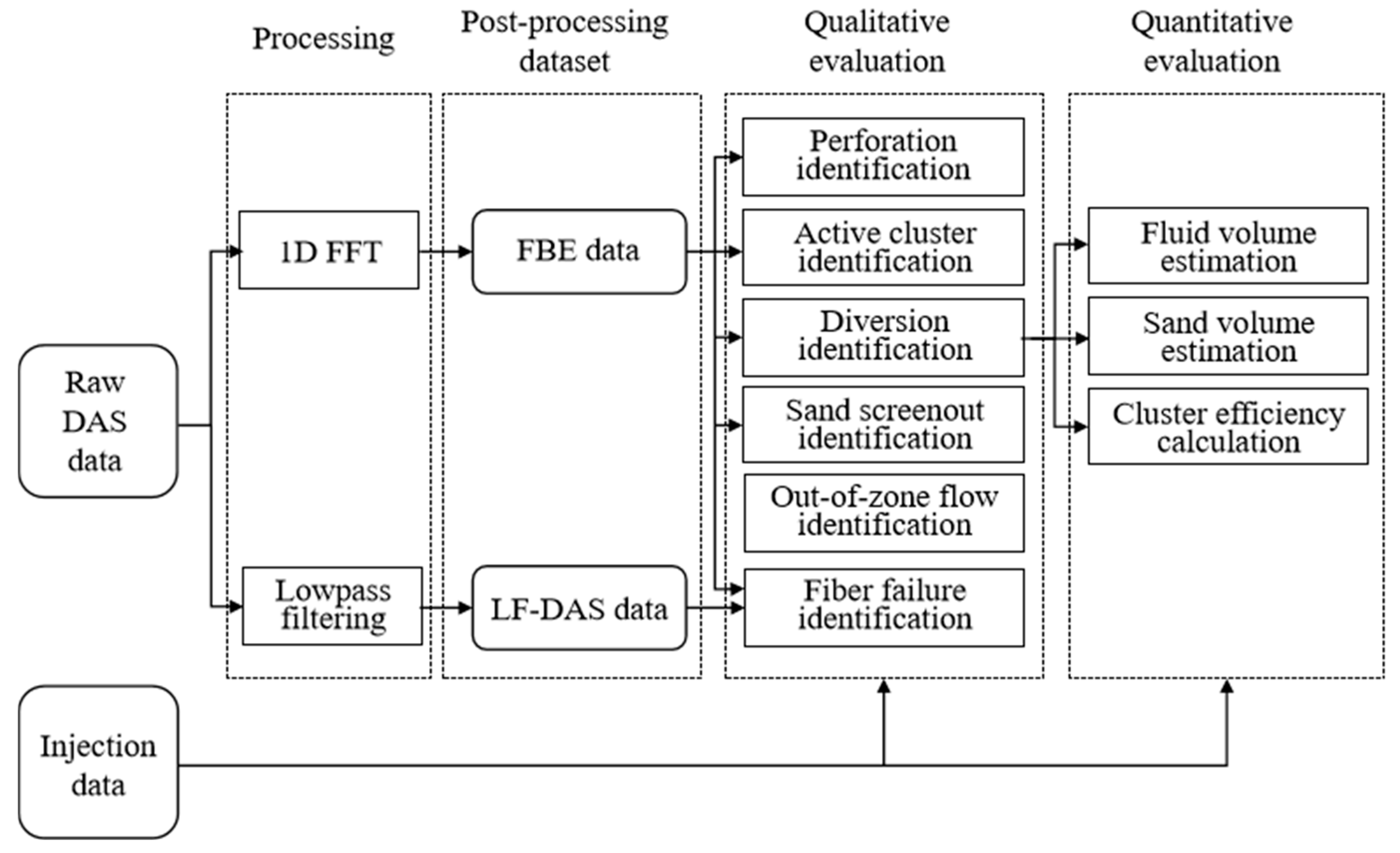
Figure 1. Workflow for diagnosing multistage fracture treatments of horizontal well with DAS.
Processes 13 03925 g001
Figure 2. DAS FBE [50–200 Hz] waterfall plot of the perforating job for Stage 43.
Processes 13 03925 g002
Figure 3. DAS FBE [50–200 Hz] waterfall plot (a) and injection data plot (b) for Stage 43.
Processes 13 03925 g003
Figure 4. Fluid and proppant distribution for Stage 43, with four clusters. (a) Bar chart of fluid distribution. (b) Bar chart of proppant distribution. (c) Waterfall plot of FBE [50–200 Hz].
Processes 13 03925 g004
Figure 5. DAS FBE [50–200 Hz] waterfall plot (a) and injection data plot (b) for Stage 41.
Processes 13 03925 g005
Figure 6. Pre-diversion fluid and proppant distribution for Stage 41 with three clusters. (a) Bar chart of fluid distribution. (b) Bar chart of proppant distribution. (c) Waterfall plot of FBE [50–200 Hz].
Processes 13 03925 g006
Figure 7. Post-diversion fluid and proppant distribution for Stage 41 with three clusters. (a) Bar chart of fluid distribution. (b) Bar chart of proppant distribution. (c) Waterfall plot of FBE [50–200 Hz].
Processes 13 03925 g007
Figure 8. DAS FBE [50–200 Hz] waterfall plot (a) and injection data plot (b) for Stage 35.
Processes 13 03925 g008
Figure 9. DAS FBE [50–200 Hz] waterfall plot (a) and injection data plot (b) for Stage 46.
Processes 13 03925 g009
Figure 10. Fluid and proppant distribution for Stage 46 with out-of-zone flows. (a) Bar chart of fluid distribution. (b) Bar chart of proppant distribution. (c) Waterfall plot of FBE [50–200 Hz].
Processes 13 03925 g010
Figure 11. DAS FBE [50–200 Hz] waterfall plot (a), LF-DAS [0–0.5 Hz] waterfall plot (b), and injection data plot (c) for Stage 44. Red ellipses highlight tensile strain rate anomalies.
Processes 13 03925 g011
Figure 12. Quantitative identification of fiber failure precursor using LF-DAS: (a) LF-DAS waterfall plot showing anomalous extension stripe at 2780 m (white dashed line); (b) time-series of absolute strain rate extracted at 2780 m—with the peak precursor value of 1750 με/s marked by the black dashed line, occurring ~20 min before total signal loss.
Processes 13 03925 g012
Table 1. Definitions of parameters used in Equations (4)–(7).
SymbolDefinitionParameter TypeSource
q Instantaneous flow rateVariableRepresented by the slurry rate per second of injection curve
q T Total flow rateVariableRepresented by the slurry rate during a given time duration
t TimeVariableRepresented by the time-series of injection curve
ΔtDelta timeConstantRepresented by the sampling time interval of injection curve
EFBE valueVariableDerived from the raw DAS data
ACorrelation parameterConstantEmpirically available
BCorrelation parameterConstantEmpirically available and can be replaced as a function of A
NNumber of perforation clusters per stageVariableDepends on well completion
cProppant concentrationVariableRepresented by the proppant concentration per second of injection curve
VCumulative fluid volumeVariableTo be calculated
WCumulative proppant volumeVariableTo be calculated
Disclaimer/Publisher’s Note: The statements, opinions and data contained in all publications are solely those of the individual author(s) and contributor(s) and not of MDPI and/or the editor(s). MDPI and/or the editor(s) disclaim responsibility for any injury to people or property resulting from any ideas, methods, instructions or products referred to in the content.