


Abstract
This study aims to reveal the influence mechanisms of particles to provide a basis for screening high-efficiency foam stabilizers of nanoparticle (NP) and surfactant (SF). Molecular simulation was used, including Stretching Molecular Dynamics (SMD) for liquid film rupture, Mean Squared Displacement (MSD)/Radial Distribution Function (RDF) for water molecule behavior, NP interface tendency analysis, and interface traction force analysis. The system used silica (SiO2) NPs (silane-modified to adjust hydrophilicity–hydrophobicity), three SFs [DTAB, CHSB, BS12; single/mixed systems], water (liquid phase), and nitrogen (gas phase). NPs need balanced hydrophilicity (to adsorb water) and hydrophobicity (to stay at the gas–liquid interface); 10% silane-modified NPs performed best, with 44% higher critical traction force for film rupture than unmodified NPs, effective water adsorption (molecules within 0.3–0.4 nm), and 12% interface presence probability. SFs (especially mixed systems like DTAB + BS12) attracted NPs to form stable composites, binding more tightly than single SFs and reducing SF mobility. The NP-SF system showed superior stability: DTAB + BS12 + NPs had the highest critical traction force (816.11 kJ·mol−1·nm−1) and longest rupture time (1.61 ns); the traction work required to pull NPs in the composite (2443.87 kJ·mol−1) was much higher than that required for pure NPs (991.63 kJ·mol−1). Finally, an experiment was conducted to measure the initial foam volume and drainage half-life of different systems to verify the simulation results.
1. Introduction
Foam is a two-phase system composed of liquid and gas, where gas exists in the form of bubbles as the dispersed phase and liquid serves as the continuous phase. In the chemical industry, the rational utilization and precise regulation of foam are crucial for process efficiency, product quality, and resource utilization [1,2,3]. In polymer engineering, foam structure is the intermediate medium of key material production. For example, polyurethane forms a porous structure using the bubbles generated by foaming agents during polymerization, which is lightweight and can be used for thermal insulation and cushioning [4]. In the detergent and daily chemical industry, foam can encapsulate oil-polluted particles to enhance their decontamination ability while improving the user experience [5]. In food chemical engineering, foam is used in the production of ice cream and fermented foods to impart a porous texture [6]. In the petroleum chemical industry, foam flooding technology can improve the fluidity of flooding agents, expand the sweep range of oil reservoirs, and increase oil recovery by 10–20% [7]. In wastewater treatment, the air flotation method uses foam to adsorb pollutants [8].
The stability of foam liquid films is a key factor determining foam performance [9]. Foam instability refers to foam collapse, i.e., bubble coalescence or liquid film rupture [10,11]. Foam is a thermodynamically metastable system. At the long-time scale, foam collapse is irreversible because the space occupied by foam liquid films tends to decrease to minimize the surface free energy of the entire system [12]. Specifically, the liquid film between bubbles is driven by external forces, causing the liquid inside the film to drain, leading to film thinning and even rupture. The stability of foam deteriorates further in complex chemical environments, for a few main reasons. First, bubbles of different sizes in foam have different chemical potentials in the gas phase. Gas in smaller bubbles tends to cross the liquid film and transfer to larger bubbles—a phenomenon known as “Ostwald ripening” [13,14]. Second, after chemical organic solvents come into contact with foam, SF molecules may preferentially partition into the oil phase due to their lipophilicity. Organic substances are emulsified into small oil droplets that enter the foam structure, destroying the integrity of the liquid film [15]. Third, high-temperature and high-pressure environments can accelerate the drainage of liquid in the liquid film [16,17].
A common approach to improve the stability of foam liquid film is to add components that can stabilize foam liquid films to the liquid phase [18]. Initially, surfactants (SFs) were used as both foaming agents and foam stabilizers [19,20]. In such cases, a large amount of SF is required, and the foam-stabilizing effect is only moderate. Later, polymers were used to replace part of the SF as foam stabilizers (i.e., a mixture of SF and polymer was used, where SF mainly acts as a foaming agent and polymer mainly acts as a foam stabilizer) to improve the stability of foam liquid films [21,22,23,24]. It has been shown that the complexes formed by SF and polymer adsorbed on the liquid film near bubbles could effectively prevent foam coalescence and collapse. However, under high-temperature and high-pressure conditions, these complexes were prone to decomposition, losing their foam-stabilizing effect and leading to foam collapse. Nanoparticles (NPs) are a new type of foam stabilizer that can be used in combination with SFs to improve the stability of foam liquid films. For example, adding 0.5 wt% NPs to foam flooding fluid can significantly slow down the drainage of foam liquid films, thereby effectively increasing the foam drainage half-life and foaming volume [25,26,27,28]. However, the mechanism by which NPs improve the stability of foam liquid films remains unclear. Understanding the foam-stabilizing mechanism of NPs at the molecular scale will facilitate the screening or design of high-efficiency NPs.
Existing studies have made progress in exploring foam stabilization via composite systems, but gaps remain in clarifying the molecular-scale synergistic mechanism between NPs and SFs. For instance, Wang et al. employed a molecular dynamics (MD) simulation to investigate the synergistic effect of alkali/surfactant/polymer (ASP) systems on water-based foam formation and stabilization, focusing on macro-system interactions but not delving into how NP surface properties (e.g., hydrophilic–hydrophobic balance) regulate synergistic stability [29]. Yang et al. studied the oil-bearing stability of salt-resistant foam and attributed its performance to macroscopic viscoelasticity, yet they did not analyze the molecular binding between NPs and SFs at the gas–liquid interface [30]. Nie et al. explored temperature effects on SF foam stability via experiments and MD simulation, but their work excluded NPs and thus failed to address NP-SF synergism under thermal perturbation [31]. Zhou et al. and Wu et al. further expanded foam stability research to heat transfer modes (for extinguishing agents) and the interfacial deformation of protein–polysaccharide composite particles, respectively, but these studies either ignored NPs or focused on non-inorganic NPs (e.g., gliadin-based particles), lacking relevance to silica NPs and their silane modification [32,33]. Collectively, the current research rarely systematically links NP surface modification (a key factor for interface tendency and water adsorption) to SF synergism, nor does it fully reveal how mixed SFs optimize NP adsorption at the gas–liquid interface—limiting the targeted design of high-efficiency NP-SF foam stabilizers, especially for complex environments like high-temperature oil reservoirs.
To address this, the present study adopts molecular simulation technology as the core approach, conducting simulations of Stretching Molecular Dynamics (SMD) for liquid film rupture, Mean Squared Displacement (MSD), and Radial Distribution Function (RDF) to analyze water molecule behavior near NPs, track NP interface tendencies, and measure interface traction force. From a molecular-scale perspective, the research focuses on two core aspects: (1) clarifying how silica (SiO2) NPs (with hydrophilic–hydrophobic properties regulated via silane modification) interact with water molecules and gas–liquid interfaces to delay liquid film rupture; (2) exploring the synergistic mechanism between these NPs and different SFs (single systems: DTAB, CHSB, BS12; mixed systems: DTAB + BS12, DTAB + CHSB) in stabilizing liquid films. This work aims to reveal the intrinsic molecular mechanisms underlying NP-SF composite-induced foam stabilization, thereby providing direct theoretical guidance for the rational selection and optimization of NPs and SFs in foam-stabilizing technologies (e.g., petroleum foam flooding).
2. Simulation and Experiment Descriptions
2.1. System Composition
The selected NPs were silica (SiO2), and the SFs included dodecyltrimethylammonium bromide (DTAB), cetylhydroxysulfobetaine (CHSB), and dodecyldimethylbetaine (BS12). The liquid phase was water, and the gas phase was nitrogen (N2).
Part of the silanol groups on the NPs was replaced by the doped silane group to modify the hydrophilic properties of NPs. The particle size of the NP model was 1.75 nm, which was close to the particle size of SiO2 particles commonly used in experiments and meets the requirements of the molecular simulation scale. Silane groups were randomly doped on the NP surface.
The rationale for modifying the NPs with silane groups was to systematically tune their wettability, a critical factor governing their foam-stabilizing performance. Pristine silica NPs are inherently hydrophilic due to the abundance of surface silanol groups, which causes them to reside predominantly in the aqueous phase of the foam film and prevents effective adsorption at the gas–liquid interface—the primary site for stabilization. To overcome this limitation and render the NPs active, we deliberately replaced a portion of the hydrophilic silanol groups with hydrophobic silane groups via a doping strategy. This surface engineering approach allowed us to create a series of NP models with a controlled range of hydrophilic–hydrophobic properties, enabling a direct investigation into how the balance of these competing interactions dictates the stability of the foam liquid film.
For the experiment, the NPs with different wettability rates, including Aerosil 200 (hydrophilic, contact angle < 40°), Aerosil R805 (contact angle between 105 and 120°), and Aerosil R972 (hydrophobic, contact angle between 140 and 150°) were purchased from Evonik Industries (Shanghai, China). The SFs, including DTAB, CHSB, AND BS12 were provided by Shanghai Aladdin Biochemical Technology Co., Ltd. (Shanghai, China). The N2 was made by Fujian Jiuce Gas Co., Ltd. (Fuzhou, China).
The rationale for the selection of surfactants is twofold. First, DTAB (cationic), CHSB (zwitterionic), and BS12 (zwitterionic) are indeed representative and commonly studied surfactants in enhanced oil recovery (EOR) and foam stabilization research [30,31]. Their properties are well-characterized, making them ideal benchmarks for molecular simulation studies. Second, the specific choice of cationic and zwitterionic surfactants was strategic. The silica nanoparticle (SiO2) surface is inherently negatively charged at a neutral pH. Cationic surfactants (like DTAB) exhibit strong electrostatic attraction to the NP surface, facilitating the formation of NP-SF complexes. Zwitterionic surfactants (like CHSB and BS12) are known for their high salinity tolerance and excellent compatibility with other surfactant types. This allows us to investigate the synergistic effects in mixed systems (e.g., cationic–zwitterionic) without the complication of precipitation or unfavorable electrostatic repulsion that can occur with anionic surfactants in high-salinity environments. While anionic surfactants are also widely used, their electrostatic repulsion from the similarly charged silica surface would result in a different adsorption mechanism, which was outside the scope of this initial investigation, focused on understanding the fundamentals of attractive NP-SF interactions.
2.2. Simulation Methods
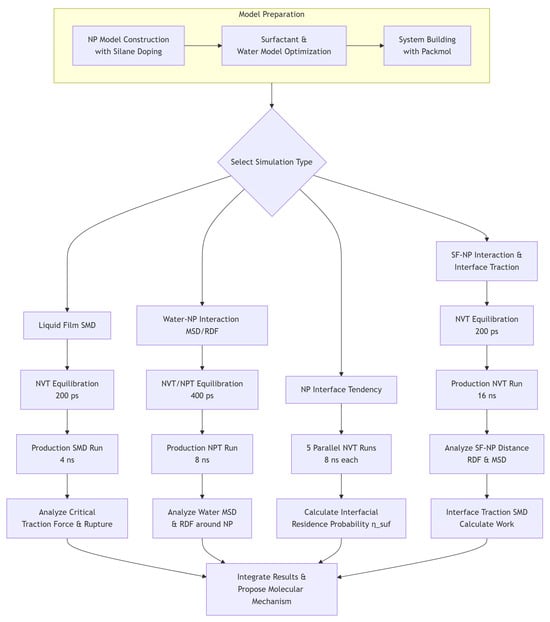
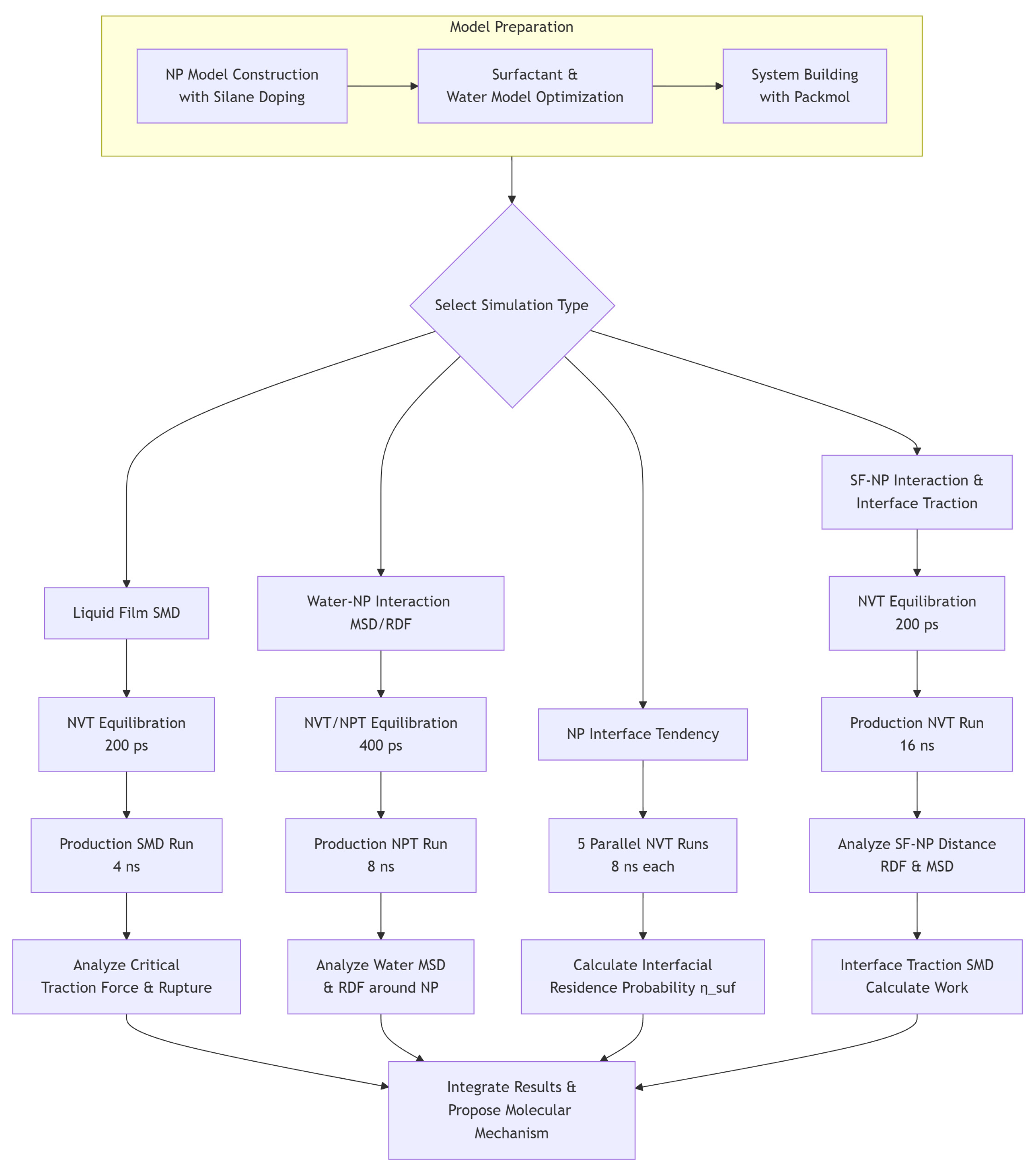
The simulation was conducted using the Gaussian 16 quantum chemical calculation software (Cloud Scientific, Shanghai, China). Since several methods were used in the simulation, a schematic summarizing the simulation process is provided in Figure 1 to aid clarity.
Figure 1.
Schematic flowchart of the simulation process.
The methods are described in detail below [34,35,36].
2.2.1. Stretching Molecular Dynamics (SMD) of Liquid Films
The Packmol tool (Version 20.0.0) was used to construct the simulation system. A water layer of 16 × 3 × 9 nm3 was built in a 20 × 3 × 25 nm3 simulation box, containing approximately 4000 water molecules, and 5 NP molecules were added to the water layer. Depending on simulation needs, 115 SF molecules were added to each side of the liquid film. At 300 K, a 200 ps NVT ensemble pre-equilibration was first performed. After the system reached initial equilibrium, a 4 ns long-time NVT ensemble molecular dynamics simulation was conducted to obtain the final equilibrium structure. The equilibrated structure was used for SMD simulation, using an umbrella sampling algorithm model. Two traction groups and two sets of traction forces were set, directed to both sides of the liquid film in the horizontal direction to simulate the effect of interfacial tension during liquid film rupture. The moving speed of the traction point was set to 0.01 nm/ps, and the force constant was set to 300 kJ/mol/nm2.
2.2.2. Mean Squared Displacement (MSD) and Radial Distribution Function (RDF) Analysis of Water Molecules
One NP was added to a 5 × 5 × 5 nm3 simulation box filled with water. The OPLS-AA force field was used to describe the NP; to more accurately describe the interaction between NPs and water molecules, the description of the electrostatic interactions of NPs in the OPLS-AA force field was customized and improved based on first-principles. The wave function information of NPs was calculated at the B3LYP/6-31G* level of theory, and the restrained electrostatic potential (RESP) method was further used to calculate the fitted electrostatic potential of NPs. This approach enabled a more accurate description of the electrostatic interactions of NPs, which played an important role in the simulation. The molecular force field of water molecules was constructed based on the SPC/E model under the OPLS-AA force field framework. Simulations were performed at 300 K and 1 atm; a 200 ps NVT ensemble and a 200 ps NPT ensemble pre-equilibration were conducted sequentially. After the system reached equilibrium, an 8 ns long-time NPT ensemble molecular dynamics simulation was performed for data collection.
2.2.3. NP Interface Tendency Analysis
A 10 × 10 × 4 nm3 water film structure was constructed, with 5 NPs randomly placed in the liquid film. Then, 8 nm vacuum layers were added to both sides of the liquid film, and five parallel 8 ns molecular dynamics simulations were performed for each system to observe the probability of NPs appearing at the interface.
2.2.4. Interaction Analysis Between SFs and NPs
Gauss View was used to construct molecular models, and the Gaussian 16 software package was used to perform structure optimization and electronic structure calculation at the B3LYP/6-31G* theoretical level to ensure the accuracy and rationality of the initial molecular structure used for simulation. The RESP method was used to calculate the molecular charge distribution, and the LigParGen tool (Version 2.1) was combined to construct reasonable OPLS-AA force field parameters. Combined with charge distribution information, molecular force field parameters were accurately constructed. For model construction, the Packmol tool (Version 20.0.0) was used to build the simulation system: 26,752 water molecules, 20 N2 molecules, 120 SF molecules, and 1 NP molecule were added to a 10 × 10 × 19 nm3 simulation box. This molecular number corresponds to a 10 × 10 × 8 nm3 pure water simulation box and a 10 × 10 × 11 nm3 gas simulation box at 1 atm and the simulation temperature, and the area per molecule (APM) of SFs was consistent with the experimental value. Simulations were performed at 300 K; a 200 ps NVT ensemble pre-equilibration was first conducted, and after the system reached equilibrium, a 16 ns long-time NVT ensemble molecular dynamics simulation was performed for data collection.
2.2.5. Interface Traction Force Analysis
In a 5 × 5 × 16 nm3 simulation box, approximately 2000 N2 molecules were added to the upper half to simulate a pressure of 40 MPa, and approximately 6700 water molecules were added to the lower half to simulate the liquid film. Then, NPs and SFs were added at the gas–liquid interface, and three different systems were constructed for simulation. In the SF system, 60 SF molecules were added at the gas–liquid interface to simulate pure SF foam; in the NP system, 1 NP was added at the gas–liquid interface to simulate the NP foam interface; in the SF + NP system, 1 NP and 36 composite SF molecules were added at the gas–liquid interface to simulate the foam interface of the NP-SF self-assembly system.
A 200 ps NVT ensemble pre-equilibration was performed for each of the three systems; after the system reached equilibrium, a 4 ns long-time NVT ensemble molecular dynamics simulation was conducted at 300 K. After these two simulation steps, the system reached equilibrium at this temperature, and the NP-SF self-assembly system was formed and remained stable, meeting the requirements for subsequent simulations.
2.2.6. Assumptions in Molecular Dynamic Simulations
The molecular dynamics simulations in this work were conducted based on the following critical assumptions:
- (1)
- Force Field Accuracy: The OPLS-AA force field, with custom RESP charges for nanoparticles (NPs), provides a sufficiently accurate description of the interatomic interactions. This includes van der Waals, bonded terms, and electrostatic interactions for the complex NP–surfactant systems.
- (2)
- Fixed Bond Constraints: The use of algorithms like SHAKE to constrain bonds involving hydrogen atoms assumes that high-frequency bond vibrations do not significantly influence the slower dynamical processes under investigation (e.g., foam drainage and rupture).
- (3)
- Classical Nuclei: The simulations treat all atoms classically, neglecting quantum mechanical effects such as proton tunneling or zero-point energy, which is a standard and valid approach for the studied systems at room temperature.
- (4)
- Water Model: The SPC/E water model adequately captures the structure and dynamics of bulk water and aqueous interfaces. Its fixed-point charges and rigid geometry are assumed to be sufficient for modeling the hydrophobic and hydrophilic interactions central to this study.
- (5)
- NP Model: The modeled silica NP with randomly doped silane groups is a valid representation of experimentally synthesized particles. The NP is treated as a rigid or semi-flexible body with a fixed atomic structure, neglecting any potential chemical degradation or dissolution on the simulation timescale.
- (6)
- Equilibration Criterion: The systems are considered equilibrated based on the stability of potential energy and temperature over a predefined simulation time (e.g., 200 ps). It is assumed that this is sufficient to sample the relevant configurational space before production runs.
- (7)
- Non-equilibrium Process: The Stretching Molecular Dynamics (SMD) simulations, which use a constant pulling velocity, provide meaningful insights into the equilibrium property of “resistance to rupture,” even though the process itself is non-equilibrium.
2.2.7. Computer Server
All molecular dynamics simulations were performed using the Gaussian 16 and GROMACS (Version 2021.6) software packages on a high-performance computing cluster. The primary computations were conducted on nodes equipped with Intel Xeon Gold 6248R (Intel Corporation, Shanghai, China) processors (with CPU clock speeds of 3.0 GHz) and NVIDIA Tesla V100 GPUs (NVIDIA Corporation, Shanghai, China). A typical simulation box containing approximately 50,000 atoms (e.g., the system for NP-SF interaction analysis) required about 24 to 36 h of wall-clock time to complete a 1 ns simulation using a single GPU node. The total computational cost for this study, including all equilibration and production runs for the various systems, amounted to approximately 150,000 CPU–core hours and 25,000 GPU–hours.
2.3. Experimental Methods
The experiment employs the Waring Blender method to evaluate foam performance. Selectively add surfactants and nanoparticles to water to prepare the solution. Precisely measure 200.0 mL of the test solution into the blender cup and blend at a fixed speed (e.g., 12,000 rpm) for 60 s. Record the total initial foam volume at the moment of stopping the stirring. The difference between this volume and the initial liquid volume (200 mL) represents the foam volume, indicating foaming ability. Subsequently, continuously measure and record the volume of liquid drained from the foam over time until the foam largely collapses. The time required for the drained liquid volume to reach half of the total initial liquid volume (i.e., 100 mL) is defined as the drainage half-life, which directly characterizes foam stability. All experiments must be conducted under constant-temperature conditions, and each sample should be tested in at least triplicate to ensure the reproducibility of results. This method effectively compares the foam-stabilizing performance of different nanoparticle–surfactant composite systems or their pure substances.
3. Results and Discussion
3.1. NP Systems
3.1.1. Effect of Silane Modification Rate on Liquid Film Rupture
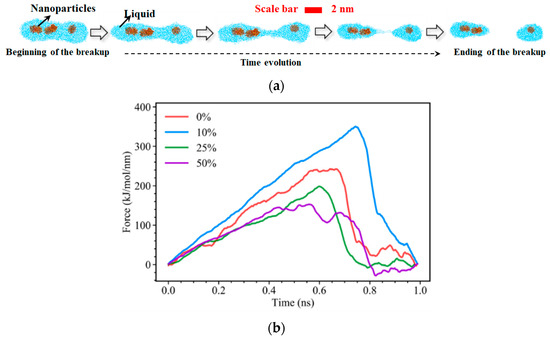
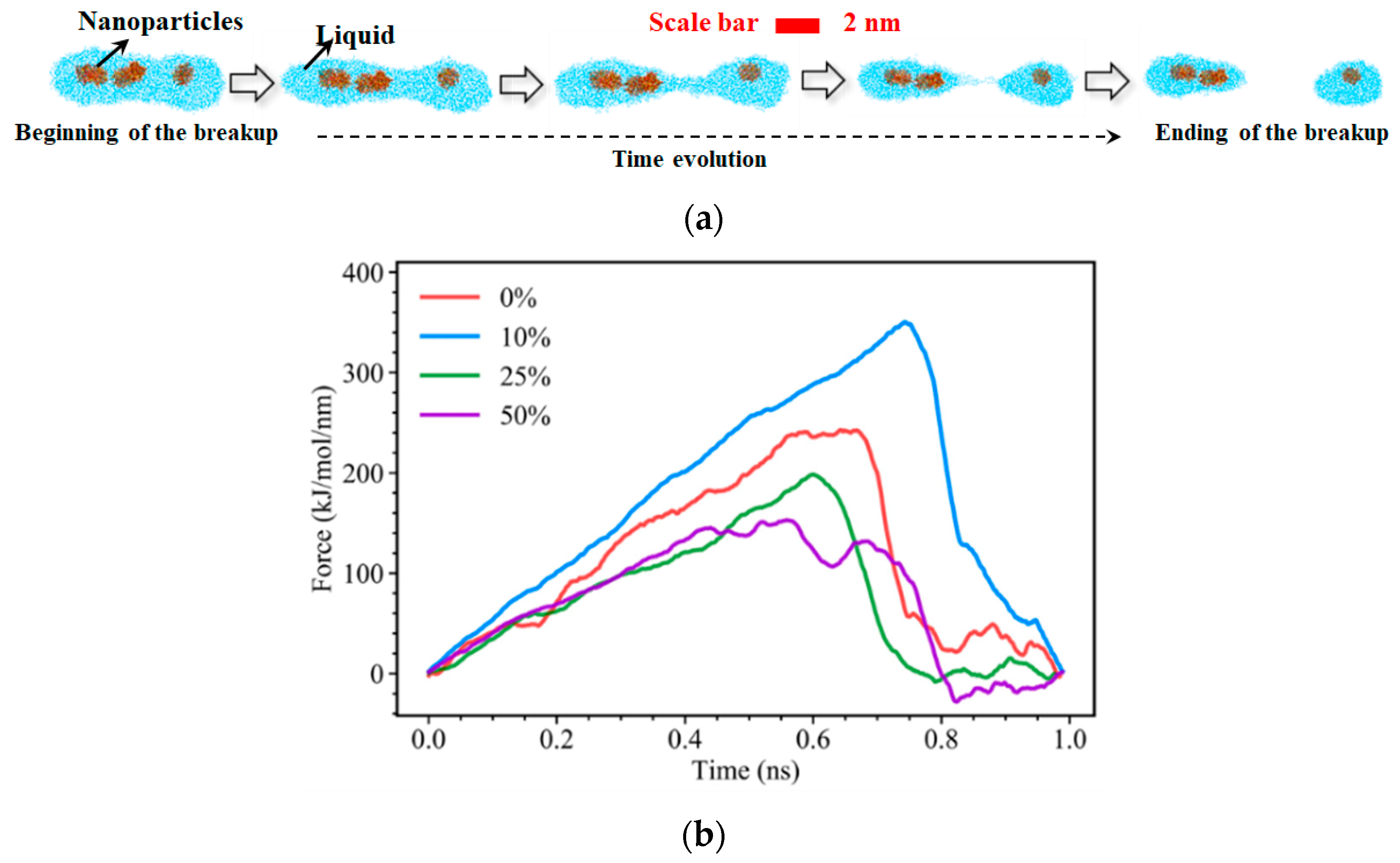
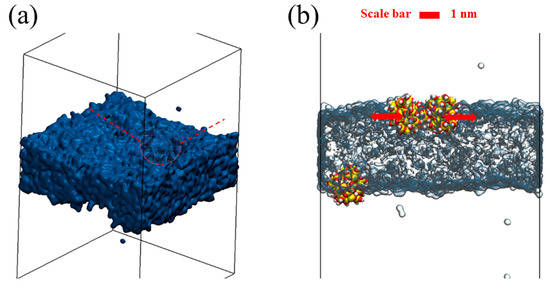
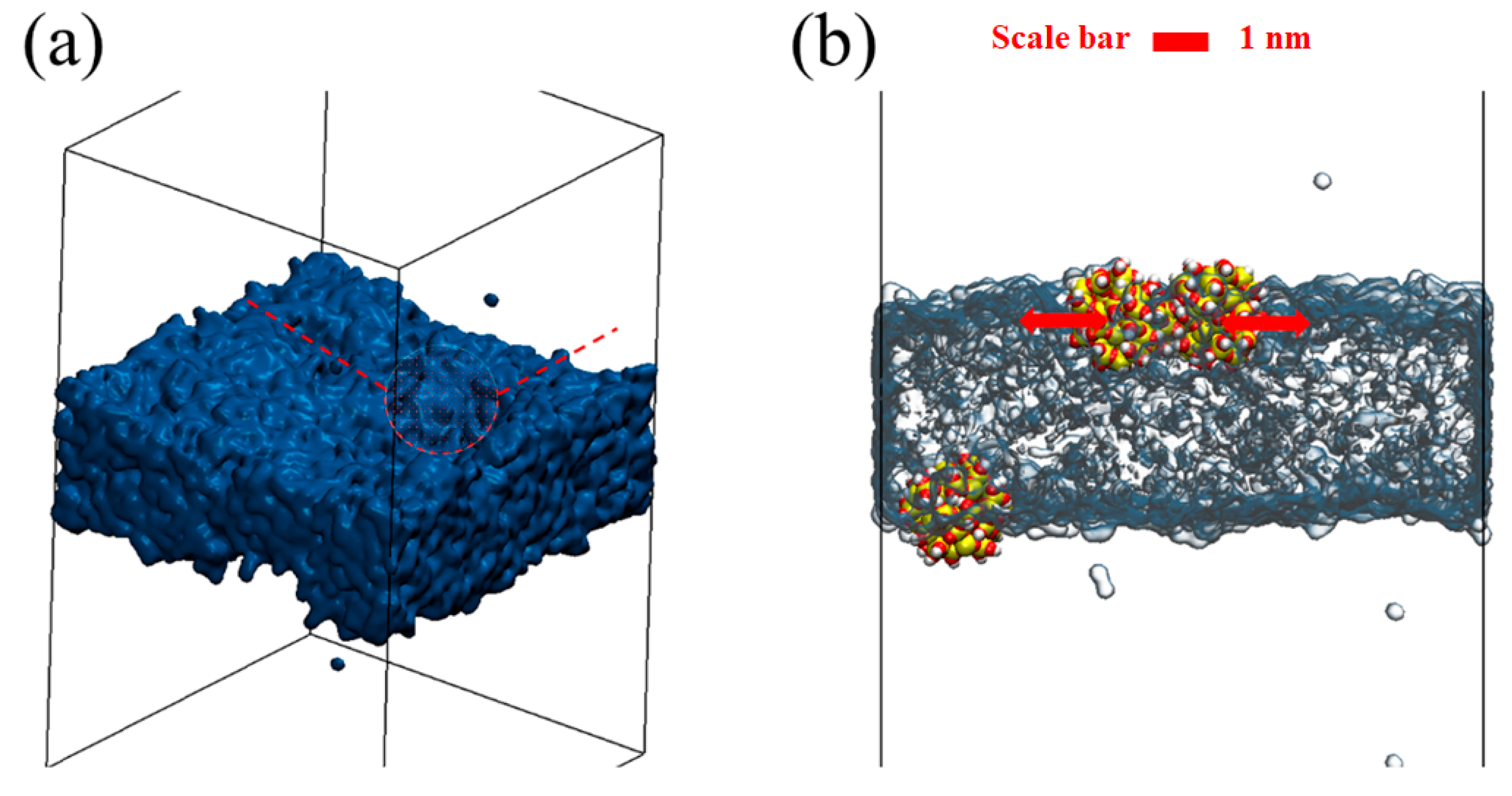
To explore how NPs hinder the liquid film rupture, an SMD simulation of the liquid film rupture process was performed, and the results are shown in Figure 2. Figure 2a shows the typical rupture of the liquid film under traction force. It can be seen from the figure that the liquid film ruptures at the position where NPs are sparsely distributed, indicating that NPs affect the interfacial properties of the liquid film to a certain extent. Figure 2b shows the variation in traction force with time during liquid film rupture. As shown in Figure 2b, the traction force at both ends of the liquid film increases continuously as the rupture progresses. When the traction force reaches the maximum value, the liquid film ruptures. This maximum traction force is defined as the critical traction force for liquid film rupture. This traction force reflects the dynamic stability of the system: a larger critical traction force means a larger tension is required for foam rupture at the same thickness, the interface structure is more resistant to the liquid film rupture process, and liquid film stability is better. When the traction force reaches the maximum value, the liquid film ruptures. As a result, the resistance to the movement of water molecules under traction force is significantly reduced, and the traction force on both sides decreases accordingly.
Figure 2.
Simulation of SMD with liquid film containing nanoparticles. (a) Typical liquid film rupture process; (b) variation in traction force with time in nanoparticle systems with different modification rates.
Table 1 compares the critical traction force and rupture time of NP systems with different silane modification rates. The liquid film with NPs modified with 10% silane groups has the largest critical traction force and the longest rupture time. Compared with the NP system without silane modification, its critical traction force is 44% higher, indicating that the NP system modified with silane groups significantly improves liquid film stability and makes the liquid film more resistant to rupture. However, an excessively high silane modification rate has the opposite effect. As shown in Table 1, when the modification ratio increases from 10% to 25% and 50%, both the critical traction force and rupture time decrease significantly. Therefore, the silane modification rate should be reasonably regulated to optimize the liquid film-stabilizing ability of NPs.
Table 1.
Critical traction force and rupture time of liquid film in nanoparticle systems.
3.1.2. Analysis of Water Molecule Restraint Ability and Interface Tendency
This section analyzes why there is an optimal silane modification ratio for NPs to achieve the strongest liquid film-stabilizing ability from two NP perspectives: the water molecule restraint ability and the interface tendency.
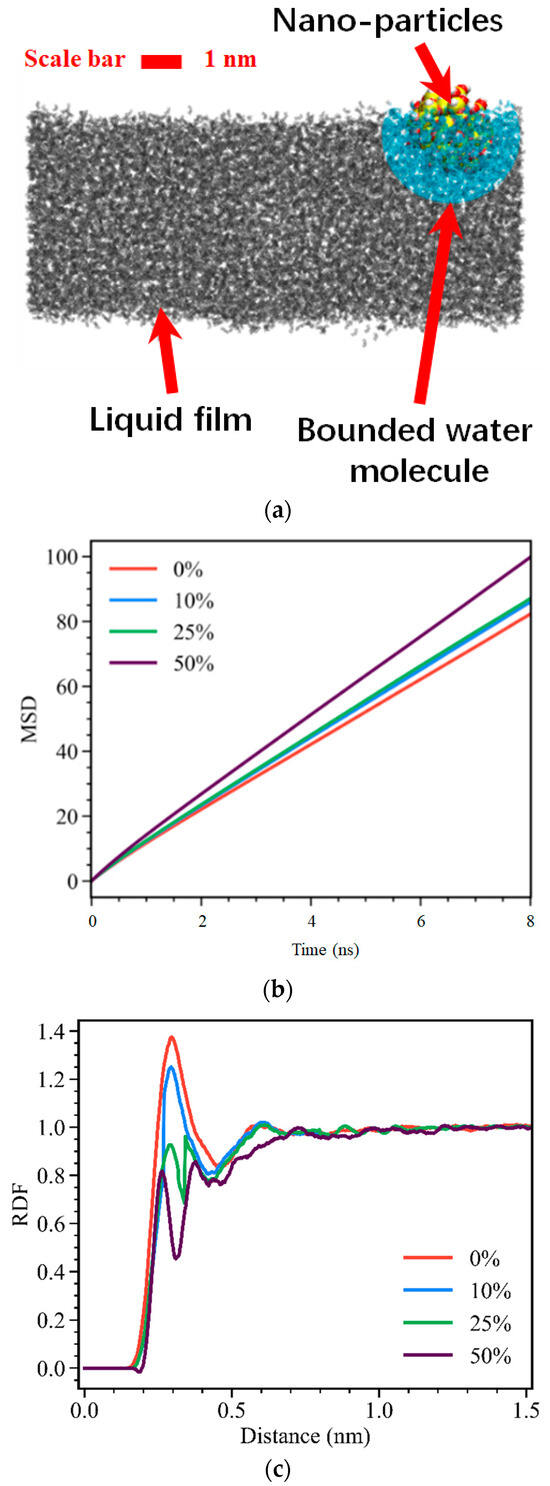
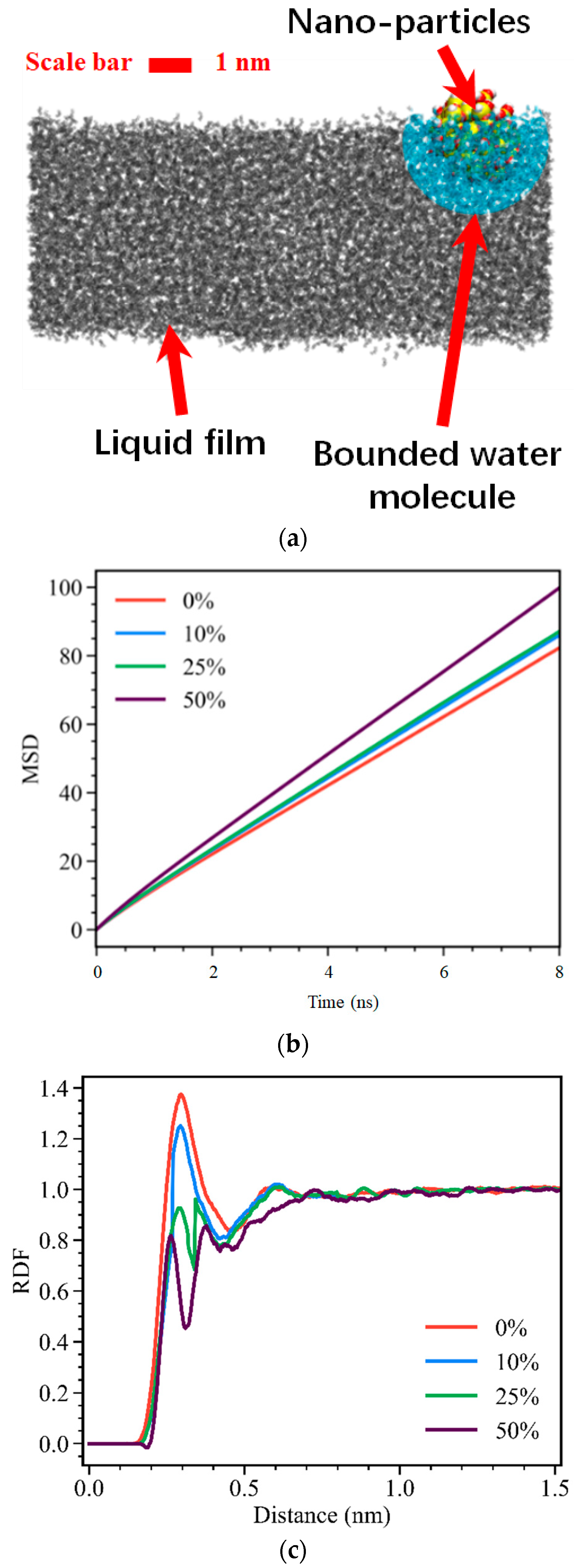
To investigate the water molecule restraint ability of NPs, the MSD and RDF of water molecules near NPs were simulated and calculated sequentially, and the results are shown in Figure 3. Figure 3a shows the positional relationship among NPs, constrained water molecules, and the liquid film. The MSD of water molecules is an important parameter characterizing the mobility of water molecules [37]. Figure 3b compares the MSD variation in water molecules near NPs with different silane modification rates. As shown in the figure, as the silane modification ratio increases from 0% to 50%, the MSD of water molecules in the system increases by 17%. This is because the hydrophobicity of NPs enhances with the increase in the silane doping ratio, weakening their ability to restrain water molecules and thereby significantly increasing the mobility of water molecules near NPs. The RDF of water molecules is a key parameter characterizing the tightness of the bond between NPs and water molecules [38]. Figure 3c shows the RDF for water molecules near the NPs with different silane modification ratios. As shown in the figure, NPs with 0% and 10% silane modification bond more tightly with water molecules, i.e., they have a higher RDF peak near 0.3–0.4 nm, which means more water molecules are constrained in the hydrophilic shell layer 0.3–0.4 nm from the NPs. In contrast, NPs modified with the 25% and 50% silane groups have a lower distribution of water molecules in the same region compared to the normal state (RDF = 1), indicating that NPs with high silane modification rates exhibit hydrophobic properties, and hydrophobicity increases with the increase in silane modification rate.
Figure 3.
Binding of water molecules in liquid films by nanoparticles. (a) Positional relationship among liquid film, constrained water molecules, and nanoparticles; (b) MSD variation in water molecules near nanoparticles; (c) radial distribution of water molecules near nanoparticles.
Analysis of MSD and RDF shows that as the silane modification ratio of NPs increases, the hydrophobicity of NPs enhances while hydrophilicity weakens, i.e., the ability to restrain water molecules decreases. A lower ability to restrain water molecules means poorer liquid film stability. Therefore, from the perspective of water molecule restraint ability, a lower silane modification rate for NPs is more beneficial to improving liquid film stability.
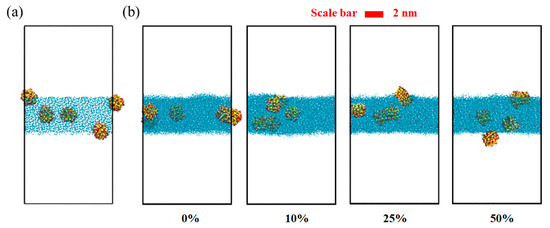
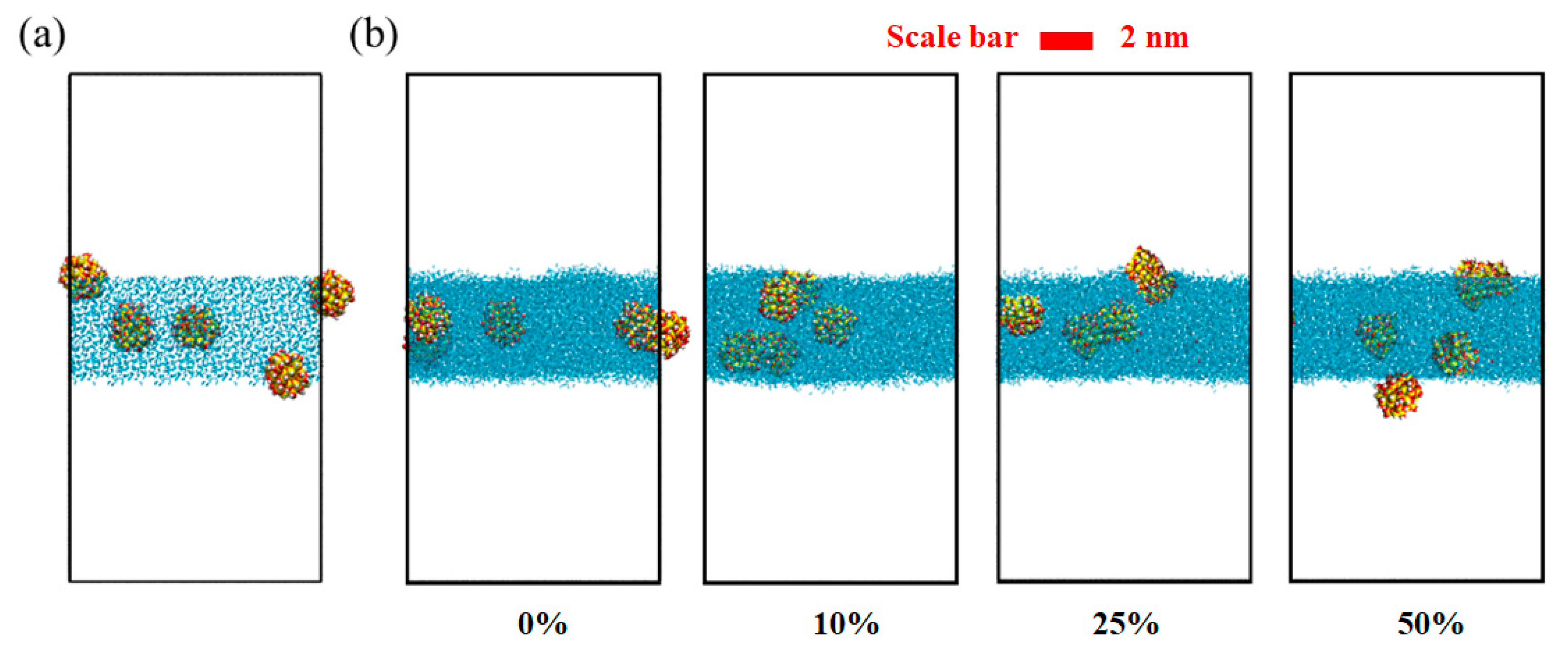
The silane modification ratio (or hydrophilic/hydrophobic property) of NPs not only affects their ability to restrain water molecules but also their interface tendency. Generally, more hydrophilic substances tend to exist inside the liquid phase, while more hydrophobic substances tend to exist at the gas–liquid interface [39]. Five parallel simulations were conducted on NPs with different modification structures, and different NPs showed different interface tendencies. Figure 4 shows the distribution of NPs in different interface regions after an 8 ns molecular dynamics simulation. As shown in the figure, the probability of NPs appearing at the interface increases with the increase in the silane modification rate of NPs. To quantitatively describe the interface tendency behavior of NPs, the number of NPs appearing on the surface and the probability (ηsuf) of their appearing at the end of the simulation were counted, as shown in Table 2. Sampling was performed within the last 100 ps of the simulation, and only the number of NPs that stably existed at the interface was counted. As shown in the table, the tendency of NPs to appear at the interface increases with the increase in silane modification rate. NPs with 0% and 10% modification rates have strong hydrophilicity and show a low interface tendency, while NPs with 25% and 50% modification rates have weak hydrophilicity and show a high interface tendency; among them, NPs with a 50% modification rate have a 72% probability of existing at the interface. Therefore, NPs with a higher hydrophobic modification ratio have a higher probability of appearing at the interface.
Figure 4.
Distribution of nanoparticles with different surface modification rates at the liquid film interface. (a) At the beginning of the simulation; (b) at the end of the simulation.
Table 2.
Number and probability of nanoparticles appearing at the interface.
The observed trend in critical traction force with varying silane modification rates can be attributed to the competing effects of nanoparticle hydrophilicity and interfacial activity. The superior performance of the 10%-modified NPs stems from an optimal balance: sufficient hydrophobicity to ensure a non-zero interfacial propensity (ηsuf ≈ 12%, as shown in Table 2), thereby positioning them at the critical gas–liquid interface where rupture initiates, coupled with retained strong hydrophilicity to tightly bind water molecules within the film’s lamella, as evidenced by the high RDF peak in Figure 3c. In contrast, unmodified NPs (0%), despite their excellent water-binding capability, largely reside in the bulk liquid phase and fail to reinforce the vulnerable interface. Conversely, highly modified NPs (25% and 50%) exhibit high interfacial propensity but diminished hydration shells. Their weakened interaction with water molecules, reflected by their increased MSD and lowered RDF, renders the interface more susceptible to fluctuations and drainage, ultimately leading to a lower mechanical resistance to rupture. This non-monotonic dependence conclusively demonstrates that effective stabilization requires NPs to function as robust interfacial “anchors” with a strong “hold” on the surrounding water.
3.1.3. Analysis of Water Molecule Restraint Ability and Interface Tendency
To better explain the function of NPs in delaying the liquid film rupture, the microscopic process of liquid film rupture without NPs was simulated first, as shown in Figure 5a. The liquid film rupture starts from the liquid film interface. Water molecule cavities caused by unbalanced forces appear on both the upper and lower interfaces of the liquid film. These cavities further deteriorate until they penetrate the liquid film, accelerating foam collapse. Rupture starts at the interface because the attractive force between water molecules on the interface is weak (there is no attractive force between water molecules on the gas-phase side). Therefore, to improve liquid film stability, it is necessary to protect the molecules on the interface.
Figure 5.
Mechanism of liquid film breakup: (a) without nanoparticles; (b) with nanoparticles. Red arrows indicate the interaction between nanoparticles and water molecules.
The addition of appropriate NPs can protect water molecules on the interface. NPs with strong hydrophilicity can better adsorb water molecules themselves, as verified in Section 3.1.2 (as shown in Figure 3). The attractive force between NPs and water is stronger than that between water molecules, thus better preventing water molecules from being separated (i.e., liquid film rupture). However, this enhancement effect is of little significance if it only occurs inside the liquid film. Because liquid film rupture starts from the interface, when the rupture propagates to the inside of the liquid film, it will bypass the NPs and continue to rupture at the liquid film far from the NPs, as shown in Figure 2. The prerequisite for NPs to truly play a role is that they can stably stay at the liquid film interface, which requires NPs to have a certain interface tendency (i.e., hydrophobicity). NPs staying at the liquid film interface strongly adsorb water molecules on the interface to their surface, effectively preventing the separation of water molecules at the interface (i.e., liquid film rupture), and thereby improving liquid film stability, as shown in Figure 5b.
Therefore, for NPs to stabilize the liquid film, they need to have both hydrophilicity and hydrophobicity. These two requirements are contradictory, meaning that NPs need to have an optimal hydrophilic–hydrophobic range to maximize liquid film stability. NPs with a silane modification ratio of approximately 10% have both excellent hydrophilic ability and interfacial properties, and thus have greater advantages in improving liquid film stability.
3.2. NP-SF Composite Systems
3.2.1. Interaction Between SFs and NPs
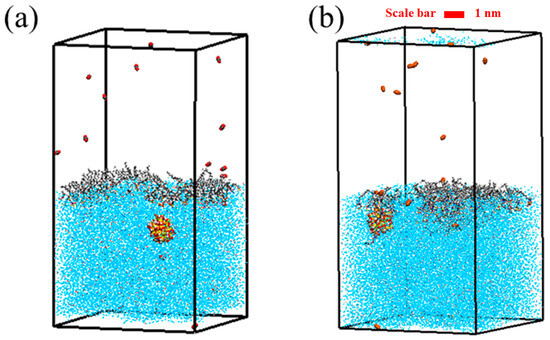
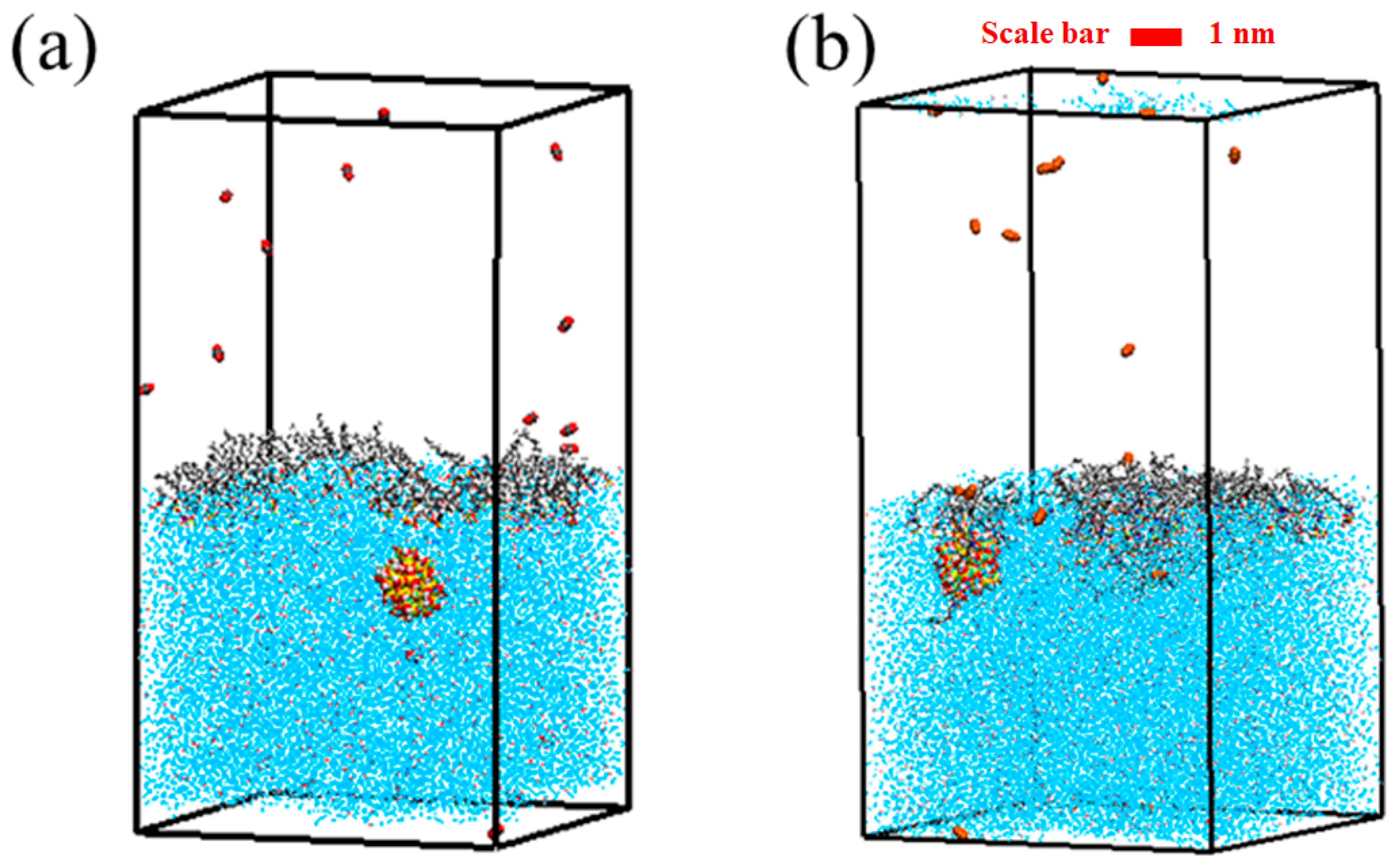
To comprehensively explore the interaction between SFs and NPs, simulations were conducted based on single SFs and mixed SFs, respectively. Figure 6a,b show the simulation results for these two cases. As shown in the figures, in both cases, SFs aggregate at the gas–liquid interface to form an SF layer. The difference lies in the position of NPs. In the single SF system (taking DTAB as an example), NPs are not tightly adsorbed at the gas–liquid interface where SFs are located, as shown in Figure 6a. In the mixed SF system (taking DTAB + BS12 as an example), NPs and SFs are tightly bound to form a stable SF + NP composite layer, as shown in Figure 6b.
Figure 6.
Interaction between surfactants and nanoparticles: (a) single surfactant (DTAB); (b) mixed surfactants (DTAB + BS12).
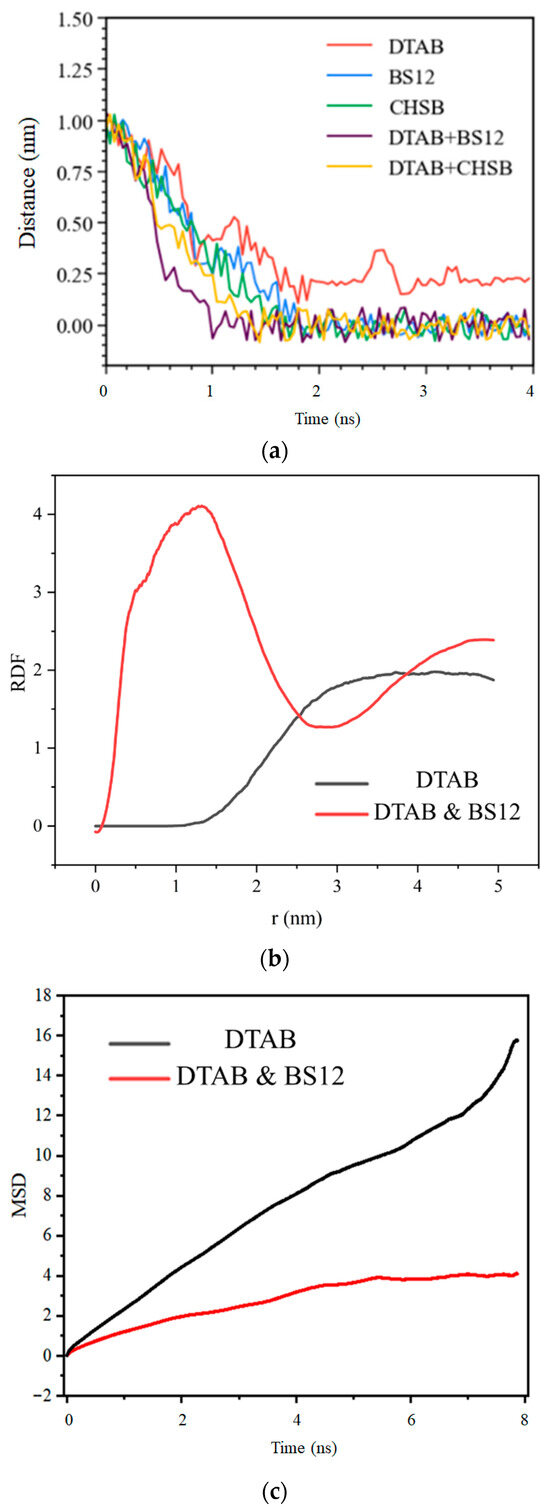
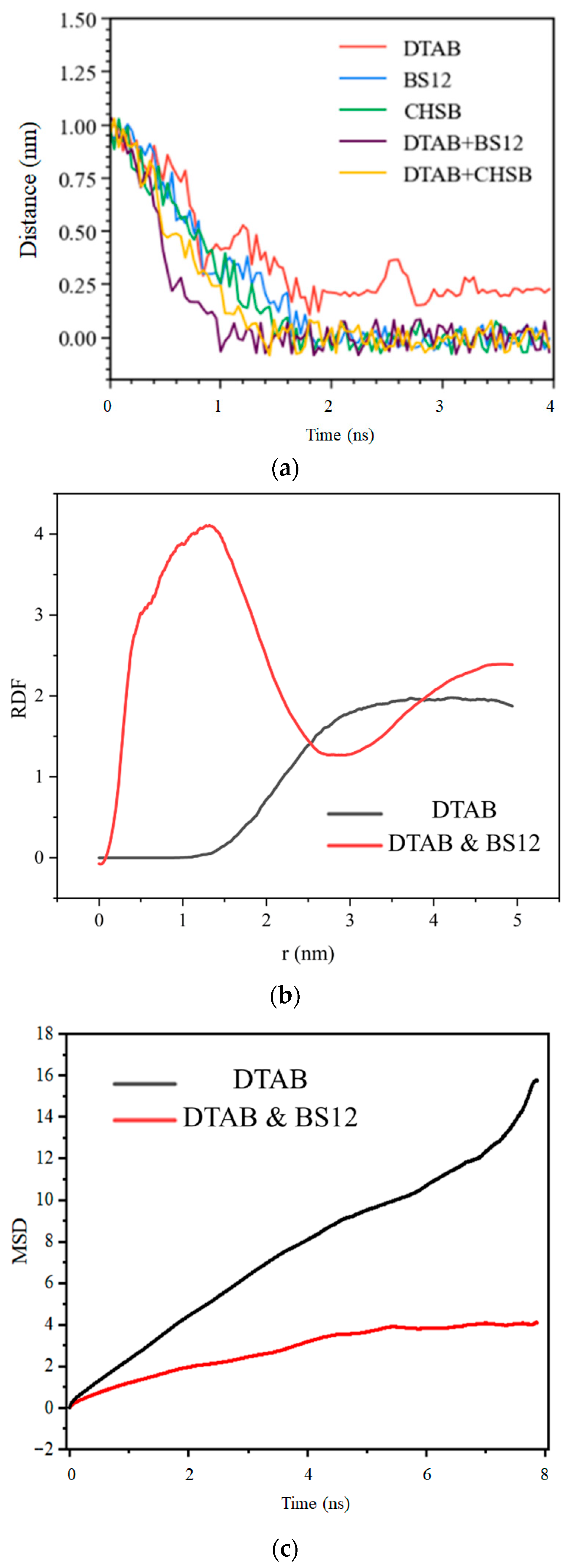
To further demonstrate the interaction between NPs and SFs, the distance between NPs and the gas–liquid interface, the RDF of SFs near NPs, and the MSD of SFs were investigated sequentially, as shown in Figure 7. Figure 7a shows the variation in the average distance between NPs and the SF molecular layer with time. As shown in the figure, the interaction between mixed SFs (especially the DTAB + CHSB combination) and NPs is more obvious, and NPs can be adsorbed to the SF layer at the gas–liquid interface more quickly. Figure 7b shows the radial distribution of SFs. In the case of single SF (DTAB), DTAB is mainly distributed in the range of 3.0–5.0 nm from the NP center. In the case of mixed SFs (DTAB + BS12), DTAB and BS12 show a strong adsorption tendency at the NP interface. Specifically, in the range of 1.3–1.5 nm, the radial distribution of DTAB + BS12 SFs shows a significantly high peak, indicating that mixed SFs bind more tightly to NPs. Figure 7c shows the variation in MSD of SFs with time. Compared with the DTAB system, the MSD value in the DTAB + BS12 mixed SF system is lower, indicating that the binding between NPs and mixed SFs is stronger in this system, and the formed aggregates are more stable.
Figure 7.
Interaction between nanoparticles and surfactants. (a) Variation in average distance between nanoparticles and surfactants with time; (b) radial distribution of surfactants with nanoparticles as the center; (c) MSD of surfactants.
The distinct behaviors of single- and mixed-surfactant systems when interacting with NPs, as shown in Figure 6 and Figure 7, can be mechanistically explained by the nature of the formed complexes. In single-surfactant systems (e.g., DTAB alone), the electrostatic repulsion between similarly charged headgroups likely creates a loosely packed layer around the NP, resulting in a larger average distance and higher surfactant mobility (MSD). Conversely, in mixed-surfactant systems (e.g., DTAB + BS12), the cationic (DTAB) and zwitterionic (BS12) molecules can co-adsorb on the NP surface through synergistic electrostatic and hydrophobic interactions. This combination facilitates a denser, more tightly bound composite shell, as indicated by the sharp RDF peak at 1.3–1.5 nm. This dense shell not only reduces the MSD of the surfactants but also significantly enhances the effective hydrophobicity and interfacial activity of the entire NP-SF complex, “dragging” it more efficiently and firmly to the gas–liquid interface. This mechanistic insight underscores that surfactant mixtures can be engineered to optimize the interfacial assembly and packing of nanoparticles.
Combining the simulation results in Figure 6 and Figure 7, two conclusions can be drawn: First, NPs interact with SFs adsorbed at the gas–liquid interface, and therefore are more likely to remain at the phase interface. This is of great significance for improving the stability of foam liquid films. Second, compared with single SFs, mixed SFs bind to NPs more quickly and tightly. It must be emphasized that not all mixed SFs are more effective than their pure forms. How to optimize SF combinations to achieve the best effect requires more systematic research in the future. The following section will conduct further research on the composites formed by the combination of SFs and NPs.
3.2.2. Interface Traction Force Analysis
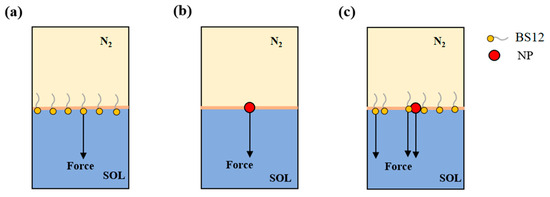
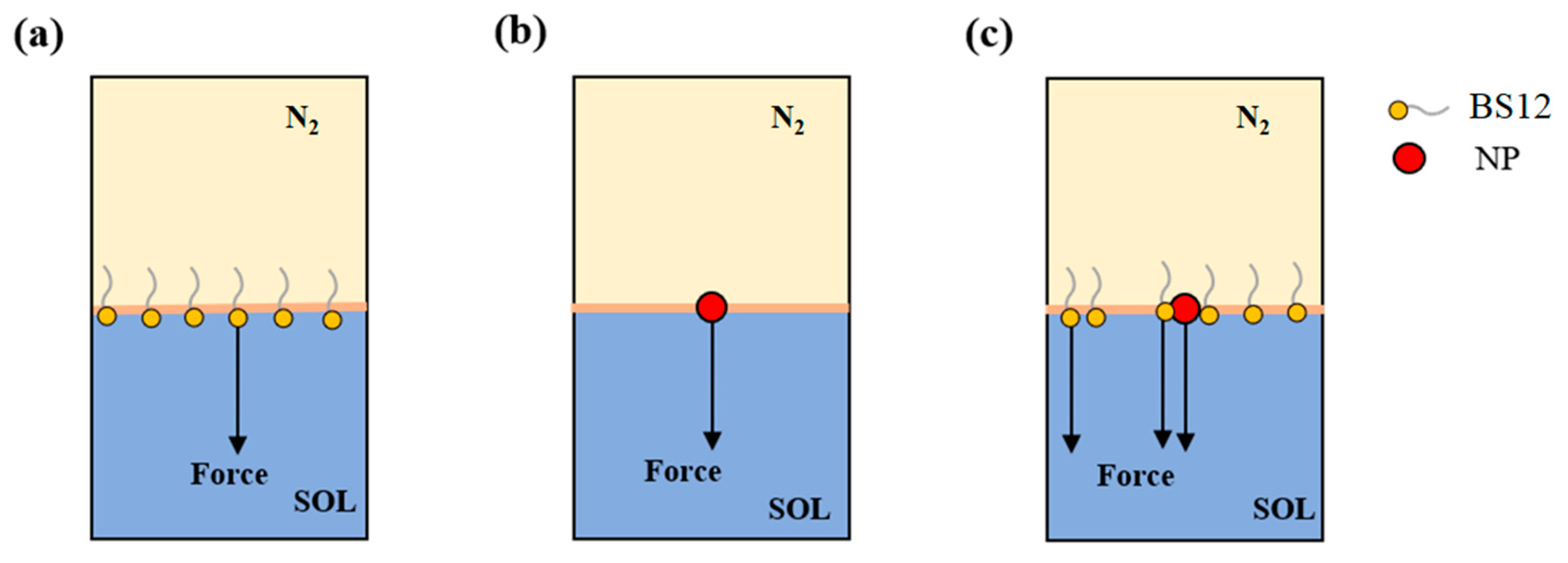
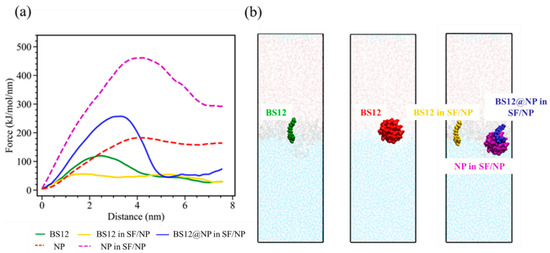
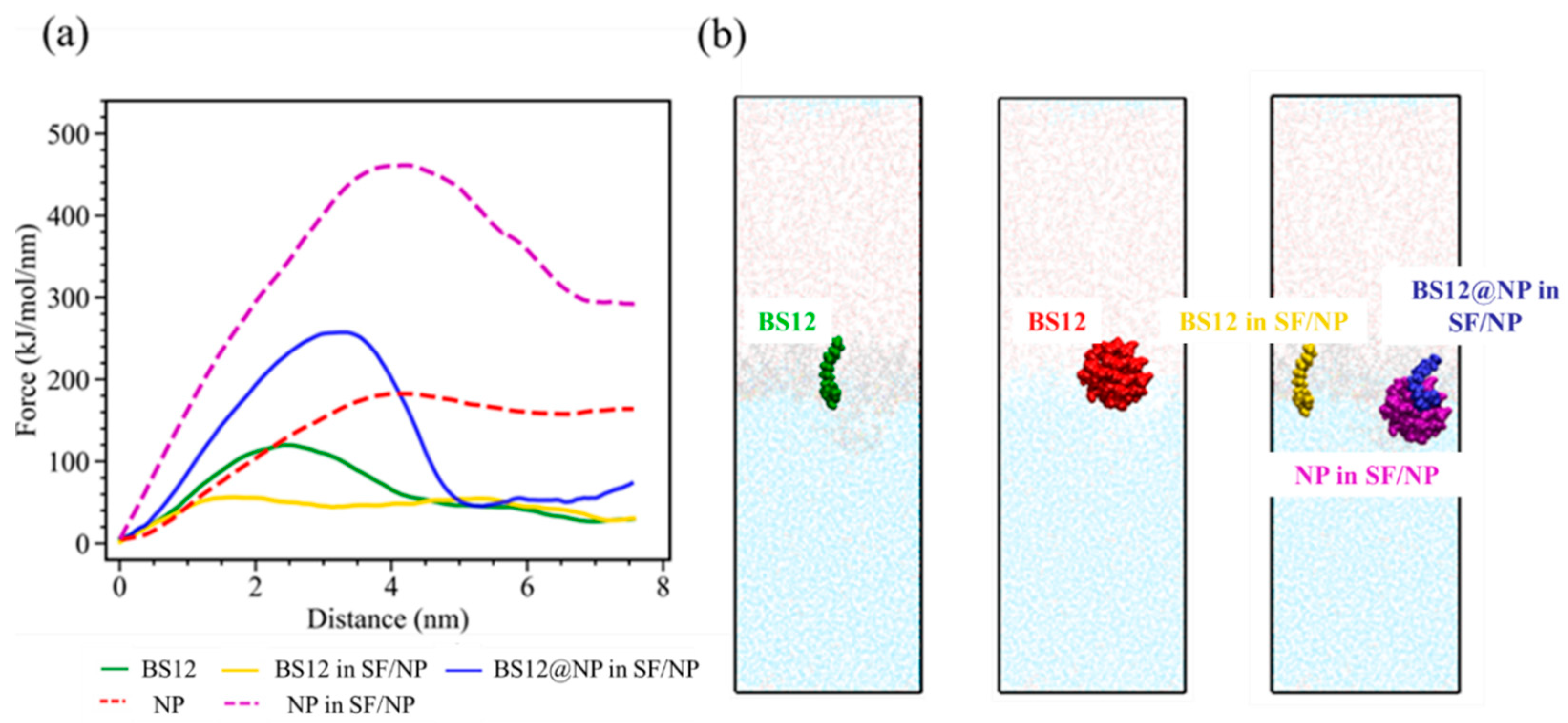
To demonstrate the stability of the SF-NP composite at the gas–liquid interface, SMD simulations were conducted on multiple systems. Using the last frame structure of the molecular simulation as the initial structure, umbrella sampling was used for traction. The traction direction was from the gas–liquid interface to the aqueous phase, the force constant was set to 100 kJ/mol/(nm)2, the traction speed was 0.01 nm/ps, and the simulation was conducted at 300 K for 1 ns. Three systems were studied, as shown in Figure 8. For the SF system, traction was applied to SF molecules at the gas–liquid interface (SF). For the NP system, traction was applied to NPs (NP). For the SF + NP system, traction was applied to NPs (NP), a certain SF molecule adsorbed near NPs (BS12@NP in SF/NP), and a certain SF molecule far from NPs (BS12 in SF/NP), respectively.
Figure 8.
Schematic diagram of the SMD simulation system. (a) SF system; (b) NP system; (c) SF + NP system.
The variation in the traction force on the pulled object with the moving distance is shown in Figure 9a. A larger traction force indicates a larger movement resistance that the pulled object needs to overcome at that time, reflecting the pulled object’s difficulty detaching from that position. Figure 9b shows the pulled objects in different systems. Three results can be obtained from Figure 9a. First, the force required to pull the SF + NP composite is greater than that required to pull a single NP. This is mainly because NPs and SF molecules form an assembly and there is an adsorption effect between them, which further increases their adsorption capacity at the gas–liquid interface, thus increasing the resistance that needs to be overcome to pull them. Second, the force required to pull the SF molecule far from NPs (BS12 in SF/NP) is less than that required to pull the SF molecule adsorbed near NPs (BS12@NP in SF/NP), and even less than that required to pull pure SF molecules (BS12). This is mainly because NPs adsorb nearby SF molecules, resulting in a sparse distribution of SF molecules far away and thereby weakening the interaction between distant SF molecules and reducing the force required to pull the molecules. Third, in the pure SF and pure NP systems, the force required to pull SFs is greater than that required to pull NPs. This indicates that at the gas–liquid interface, the stability of SFs is stronger than that of NPs, because the hydrophilicity of NPs is stronger than that of SFs.
Figure 9.
Graph showing the variation in SMD-simulated tensile force with distance. (a) Variation in force on BS12 and NPs with distance; (b) schematic diagram of the SMD simulation system structure.
Each curve in Figure 9a was integrated to calculate the work of the traction force, as shown in Table 3. The amount of work required to pull NPs in the SF + NP system is the largest, while that needed to pull SF molecules not adsorbed on NPs in the SF + NP system was the smallest. Interface stability analysis shows that the composite formed by NPs and SFs has a stronger interface adsorption capacity, is more difficult to detach from the equilibrium position, and is more stable.
Table 3.
Statistics on the work of the traction force.
3.2.3. Foam-Stabilizing Mechanism of NP + SF Composites
Figure 8b shows the influence mechanism of NPs on liquid film stability. Based on this, combined with the molecular simulation results of the interaction between NPs and SFs in Section 2.2.1 and Section 2.2.2, the influence mechanism of the NP-SF composite system on liquid film stability is elaborated below.
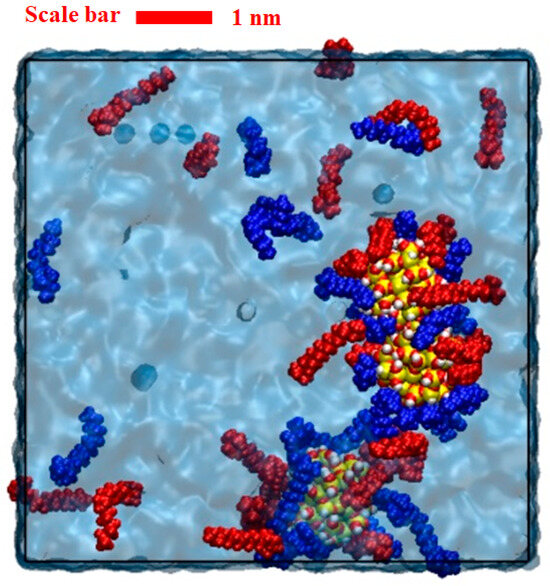
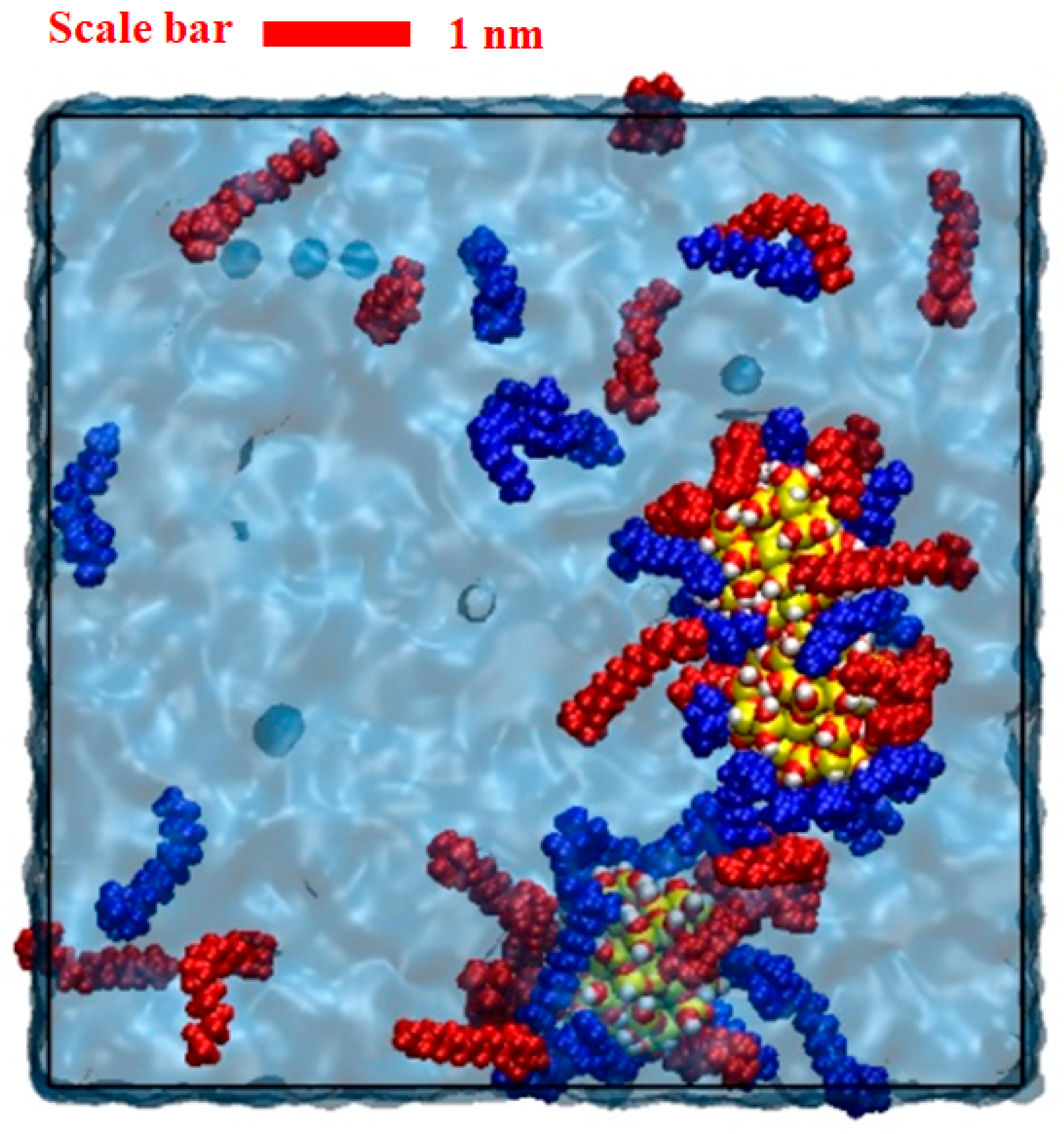
SFs have both hydrophilic and hydrophobic groups, so they can be better adsorbed at the liquid film interface, instead of remaining free inside the liquid film. The molecular simulation results in Section 2.2.1 and Section 2.2.2 proved that SFs and NPs can be adsorbed together well. Figure 10 shows that in the composite system, NPs are attracted to the gas–liquid interface by SFs and self-assemble with SFs to form an SF/NP aggregate. On the one hand, these aggregate forms a large-scale hydrophilic–hydrophobic interaction region, resulting in an ordered structure of water molecules at the interface; on the other hand, this increases the interface entropy of the gas–liquid interface and reduces the interface tension. In summary, the interface self-assembly formed by NPs under the action of SFs further enhances their interface stability compared with pure SF or pure NP systems.
Figure 10.
Self-assembly of the composite system of surfactants and nanoparticles at the interface. Red: DTAB, blue: BS12.
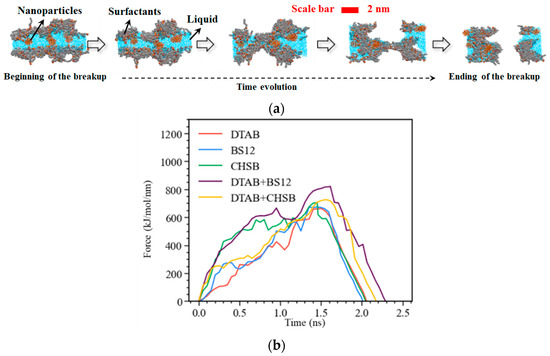
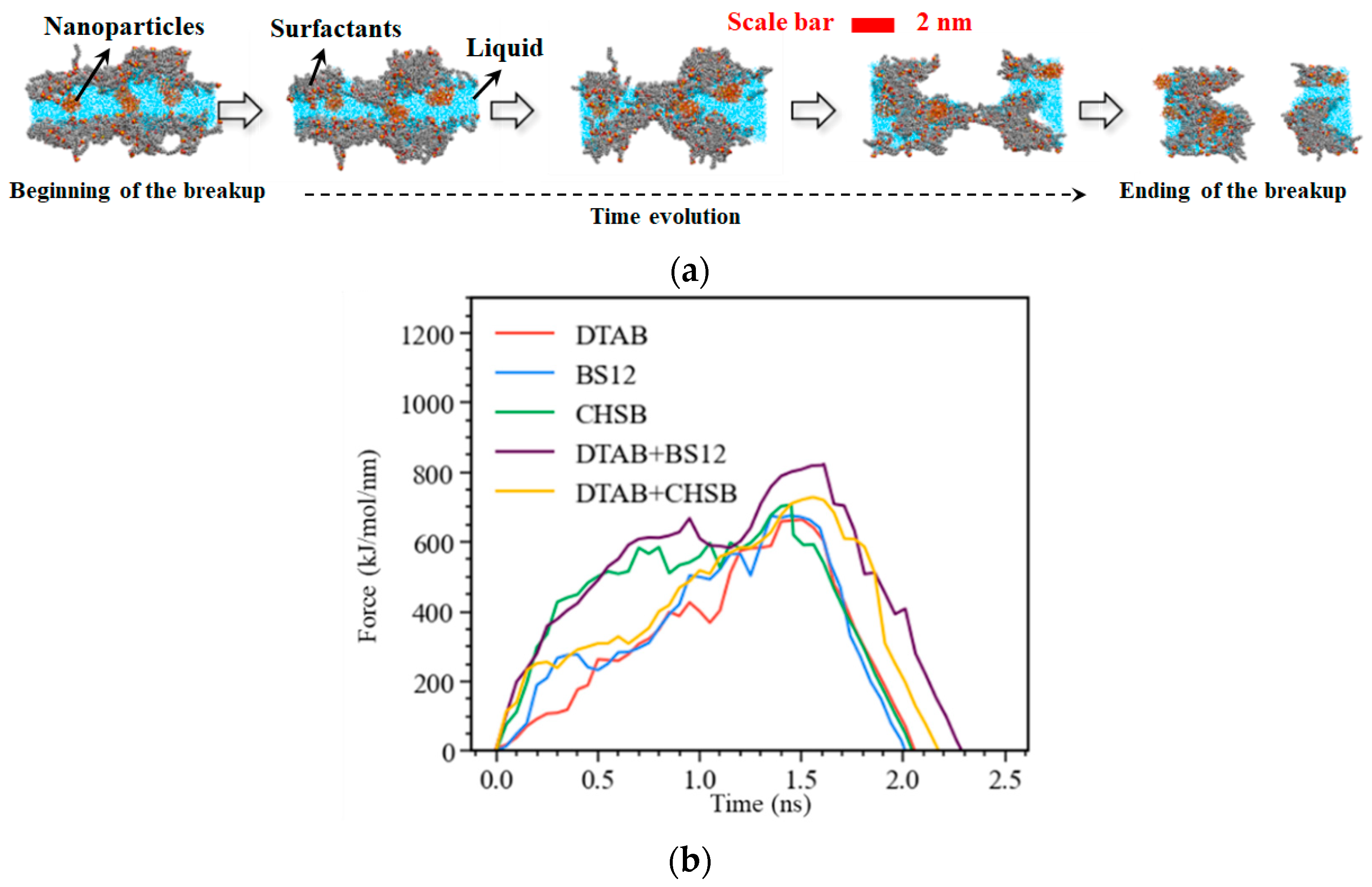
To further demonstrate the difference between NPs and SF + NP composites in terms of their influence on liquid film rupture, the process of rupture among liquid films containing SF + NP composites was simulated, and the variation in traction force was analyzed, as shown in Figure 11. Figure 11a shows the typical rupture process of a liquid film under traction force in the composite system. Comparing Figure 2a and Figure 11a, a common feature of the two systems is that the liquid film always ruptures at the position where NPs are sparsely distributed; however, in the composite system, SF molecules are more likely to be adsorbed on the liquid film surface near NPs, thereby forming a thicker liquid film.
Figure 11.
Simulation of SMD with SF + NP composite liquid membrane. (a) Typical liquid film rupture process; (b) influence of different types of surfactants on traction force.
Table 4 shows the effect of SF type in the SF + NP system on the critical traction force and rupture time of the liquid film. Comparing Table 1 and Table 4, the critical traction force of the NP + SF system is significantly greater than that of the NP system; among the NP + SF systems, the critical traction force is the highest when CHSB molecules are present, and the rupture time is the longest when DTAB molecules are present. However, after the SF system is compounded, both the critical traction force and rupture time are further enhanced, and the system stability is significantly improved. The most excellent performance was shown by the foam liquid film formed by the combination of the DTAB + BS12 composite SF system and NPs, which obtained the highest critical traction force and the longest rupture time among all systems. This indicates that for NP-stabilized foam, the presence of SFs—especially the combination of cationic–amphoteric SFs—can significantly improve the stability of foam liquid films.
Table 4.
Critical traction force and rupture time of the liquid film in the SF + NP system.
3.3. Experimental Comparison
To verify the simulation results of this study, the initial foaming volume and the drainage half-life were measured for different systems, as listed in Table 5. The macroscopic foam experimental data aligns well with the molecular simulation results, collectively revealing the synergistic foam-stabilizing mechanism between nanoparticles and surfactants. Experiments demonstrated that Aerosil R805 (Evonik Industries, Shanghai, China), with moderate wettability, exhibited the optimal foam-stabilizing performance (half-life of 150 min), validating the “hydrophilic–lipophilic balance” identified in simulations as the key factor for nanoparticle-mediated foam stability: requiring both a strong water molecule binding capacity (hydrophilicity) and high interfacial tendency (hydrophobicity). Furthermore, the composite systems of surfactants and nanoparticles showed significantly enhanced performance. Specifically, the ternary system formed by mixed surfactants (e.g., DTAB + BS12) and R805 achieved the best performance (foam volume of 480 mL, half-life of 325 min), directly corroborating the phenomenon observed in simulations: surfactants effectively draw nanoparticles to the interface and form a dense, stable composite adsorption layer with them. This work successfully establishes a complete correlation from molecular-scale mechanisms to macroscopic performance, providing a solid foundation for the rational design of high-performance foam systems.
Table 5.
Initial foam volume and drainage half-life.
4. Conclusions
In this study, molecular simulation methods were used to reveal the mechanism by which nanoparticles (NPs) enhance the stability of foam liquid films and their synergistic mechanism with surfactants (SFs) at the molecular scale. The following main findings and implications were obtained.
Main Findings:
- (1)
- Core conditions for NPs to stabilize foam liquid films are as follows: NPs must balance two contradictory properties—strong hydrophilicity (to adsorb water molecules) and moderate hydrophobicity (to stay at the gas–liquid interface). Silica (SiO2) NPs with a 10% silane modification rate achieve the optimal balance: compared with unmodified NPs, their critical traction force for liquid film rupture is 44% higher (420.42 kJ·mol−1·nm−1 vs. 291.14 kJ·mol−1·nm−1); most water molecules are constrained within 0.3–0.4 nm of the NPs (verified by RDF) and their probability of existing at the gas–liquid interface reaches ~12% (verified by interface tendency analysis). Excessively high silane modification rates (25% or 50%) reduce both water adsorption capacity and liquid film stability.
- (2)
- Synergistic mechanism between NPs and SFs: Surfactants (SFs) effectively attract NPs to form stable NP-SF composite layers at the gas–liquid interface. Mixed SF systems (e.g., DTAB + BS12) outperform single SFs (e.g., DTAB alone): mixed SFs bind to NPs more tightly (RDF shows a significant high peak at 1.3–1.5 nm from NP centers), reduce SF mobility (lower MSD values), and further enhance interface stability. The DTAB + BS12 + NPs composite system exhibits the best performance among all systems, with a critical traction force of 816.11 kJ·mol−1·nm−1 and a rupture time of 1.61 ns—far higher than single-NP or single-SF systems.
- (3)
- Molecular-scale stabilization mechanism: NPs stabilize liquid films by enhancing the interaction force between water molecules at the gas–liquid interface, preventing the formation and expansion of water molecule cavities (the initial cause of liquid film rupture). SFs further reinforce this effect via their amphiphilicity: SF molecules adsorb at the gas–liquid interface first, then “anchor” NPs to the interface, forming a large-scale hydrophilic–hydrophobic interaction region that orders interfacial water molecules and reduces interfacial tension.
- (4)
- Quantitative evidence of enhanced stability: Interface traction force analysis confirms that the NP-SF composite has a stronger interface adsorption capacity. The work required to pull NPs in the SF + NP system away from the gas–liquid interface is 2443.87 kJ·mol−1—much higher than that for pure NPs (991.63 kJ·mol−1), indicating that the composite is harder to detach from the interface.
Implications:
- (1)
- Guidance for NP modification: For foam-stabilizing applications, silica NPs should be modified to a ~10% silane content to balance hydrophilicity and hydrophobicity, avoiding over-modification, which impairs water adsorption.
- (2)
- Guidance for SF selection: In NP-based foam systems, prioritizing mixed cationic-amphoteric SF combinations (e.g., DTAB + BS12) instead of single SFs can maximize the synergistic effect with NPs, especially for scenarios requiring high stability (e.g., petroleum foam flooding).
- (3)
- Theoretical support for industrial applications: This study clarifies the molecular-scale mechanism of NP-SF composite-induced foam stabilization, providing a direct theoretical basis for optimizing foam stabilizers in fields such as petroleum foam flooding (to improve oil recovery) and wastewater treatment (to enhance air flotation efficiency).
Author Contributions
Conceptualization, W.L.; Methodology, H.Z. and D.Z.; Validation, C.Z. and Y.L.; Formal analysis, W.L., C.Z. and Z.L.; Investigation, W.L. and C.Z.; Resources, W.L., Z.L. and Y.L.; Data curation, H.Z., D.Z. and Z.L.; Writing—original draft, W.L. and D.Z.; Writing—review and editing, H.Z. and Y.L.; Supervision, H.Z. All authors have read and agreed to the published version of the manuscript.
Funding
This research was funded by the National Science and Technology Major Project (No. 2024ZD1406600).
Data Availability Statement
The original contributions presented in this study are included in the article. Further inquiries can be directed to the corresponding authors.
Conflicts of Interest
Authors Weitao Li, Dong Zhang, Chuanbao Zhang, Zongyang Li and Youquan Li were employed by Research Institute Exploration and Development, Shengli Oilfield Company, Sinopec. The remaining author declares that the research was conducted in the absence of any commercial or financial relationships that could be construed as a potential conflict of interest.
Nomenclature
| BS12 | Dodecyldimethylbetaine |
| CHSB | Cetylhydroxysulfobetaine |
| DTAB | Dodecyltrimethylammonium bromide |
| MSD | Mean Squared Displacement |
| NP | Nanoparticle |
| RDF | Radial Distribution Function |
| SF | Surfactant |
| SMD | Stretching Molecular Dynamics |
References
- Hu, X.; Yan, A.; Chen, Z.; Xie, J.; Zhang, H.; Yang, K.; Liu, H.; Shafieezadeh, M.M. Investigating Enhanced Oil Recovery Techniques in Ultratight Reservoirs Through Coreflooding Experiments. Int. J. Energy Res. 2025, 2025, 6618774. [Google Scholar] [CrossRef] [Scilit]
- Nagy, R.; Hartyányi, M.; Bejczi, R.; Bartha, L.; Puskás, S. Recent aspects of chemical enhanced oil recovery. Chem. Pap. 2025, 79, 2695–2716. [Google Scholar] [CrossRef] [Scilit]
- Ozowe, W.; Daramola, G.O.; Ekemezie, I.O. Innovative approaches in enhanced oil recovery: A focus on gas injection synergies with other EOR methods. Magna Sci. Adv. Res. Rev. 2024, 11, 311–324. [Google Scholar] [CrossRef] [Scilit]
- Yuan, S.; Han, H.; Wang, H.; Luo, J.; Wang, Q.; Lei, Z.; Xi, C.; Li, J. Research progress and potential of new enhanced oil recovery methods in oilfield development. Pet. Explor. Dev. 2024, 51, 963–980. [Google Scholar] [CrossRef] [Scilit]
- Janssen, M.T.G.; Mutawa, A.S.; Pilus, R.M.; Zitha, P.L.J. Foam-Assisted Chemical Flooding for Enhanced Oil Recovery: Effects of Slug Salinity and Drive Foam Strength. Energy Fuels 2019, 33, 4951–4963. [Google Scholar] [CrossRef] [Scilit]
- Issakhov, M.; Shakeel, M.; Pourafshary, P.; Aidarova, S.; Sharipova, A. Hybrid surfactant-nanoparticles assisted CO2 foam flooding for improved foam stability: A review of principles and applications. Pet. Res. 2022, 7, 186–203. [Google Scholar] [CrossRef] [Scilit]
- Chen, H.; Wei, B.; Zhou, X.; Zhu, J.; Xu, Z.; Fan, Y. Theory and technology of enhanced oil recovery by gas andfoam injection in complex reservoirs. Adv. Geo-Energy Res. 2024, 15, 181–184. [Google Scholar] [CrossRef] [Scilit]
- Zhu, D.; Li, B.; Chen, L.; Zhang, C.; Zheng, L.; Chen, W.; Li, Z. Experimental investigation of CO2 foam flooding-enhanced oil recovery in fractured low-permeability reservoirs: Core-scale to pore-scale. Fuel 2024, 362, 130792. [Google Scholar] [CrossRef] [Scilit]
- Wang, Z.; Li, S.; Xu, Z.; Aryana, S.A.; Cai, J. Advances and challenges in foam stability: Applications, mechanisms, and future directions. Capillarity 2025, 15, 58–73. [Google Scholar] [CrossRef] [Scilit]
- Langevin, D. Recent Advances on Emulsion and Foam Stability. Langmuir 2023, 39, 3821–3828. [Google Scholar] [CrossRef] [Scilit] [PubMed]
- Dehghani, R.; Bayat, A.E.; Sarvestani, M.T.; Behnood, M. A comprehensive review on key mechanisms and parameters affecting foam stability. J. Mol. Liq. 2024, 416, 126477. [Google Scholar] [CrossRef] [Scilit]
- Dehdari, B.; Parsaei, R.; Riazi, M.; Niakousari, M. Dimensionless analysis of foam stability for application in enhanced oil recovery. Sci. Rep. 2024, 14, 1–16. [Google Scholar] [CrossRef] [Scilit]
- Yu, W.; Kanj, M.Y. Review of foam stability in porous media: The effect of coarsening. J. Pet. Sci. Eng. 2022, 208, 109698. [Google Scholar] [CrossRef] [Scilit]
- Tcholakova, S.; Mitrinova, Z.; Golemanov, K.; Denkov, N.D.; Vethamuthu, M.; Ananthapadmanabhan, K.P. Control of Ostwald Ripening by Using Surfactants with High Surface Modulus. Langmuir 2011, 27, 14807–14819. [Google Scholar] [CrossRef] [Scilit]
- Emami, H.; Tanha, A.A.; Manshad, A.K.; Mohammadi, A.H. Experimental Investigation of Foam Flooding Using Anionic and Nonionic Surfactants: A Screening Scenario to Assess the Effects of Salinity and pH on Foam Stability and Foam Height. ACS Omega 2022, 7, 14832–14847. [Google Scholar] [CrossRef] [Scilit]
- Zhang, P.; Ren, S.; Shan, Y.; Zhang, L.; Liu, Y.; Huang, L.; Pei, S. Enhanced stability and high temperature-tolerance of CO2 foam based on a long-chain viscoelastic surfactant for CO2 foam flooding. RSC Adv. 2019, 9, 8672–8683. [Google Scholar] [CrossRef] [Scilit]
- Wang, L.; Ma, C. Experimental Study on CO2 Foam Flooding System in High Temperature and Low-Permeability Reservoirs. ACS Omega 2025, 10, 34801–34810. [Google Scholar] [CrossRef] [Scilit]
- Majeed, T.; Kamal, M.S.; Zhou, X.; Solling, T. A Review on Foam Stabilizers for Enhanced Oil Recovery. Energy Fuels 2021, 35, 5594–5612. [Google Scholar] [CrossRef] [Scilit]
- Nascimento, J.V.C.D.; Lima, E.R.A.; Preisig, N.; Stubenrauch, C. Properties of liquid foams stabilized by sugar-based surfactants and prepared under different conditions. J. Surfactants Deterg. 2024, 28, 321–331. [Google Scholar] [CrossRef] [Scilit]
- Vavra, E.; Puerto, M.; Biswal, S.L.; Hirasaki, G.J. A systematic approach to alkaline-surfactant-foam flooding of heavy oil: Microfluidic assessment with a novel phase-behavior viscosity map. Sci. Rep. 2020, 10, 1–12. [Google Scholar] [CrossRef] [Scilit]
- Seright, R.; Wang, D. Polymer flooding: Current status and future directions. Pet. Sci. 2023, 20, 910–921. [Google Scholar] [CrossRef] [Scilit]
- Sun, C.; Hou, J.; Pan, G.; Xia, Z. Optimized polymer enhanced foam flooding for ordinary heavy oil reservoir after cross-linked polymer flooding. J. Pet. Explor. Prod. Technol. 2016, 6, 777–785. [Google Scholar] [CrossRef] [Scilit]
- Zhou, W.; Xin, C.; Chen, S.; Yu, Q.; Wang, K. Polymer-Enhanced Foam Flooding for Improving Heavy Oil Recovery in Thin Reservoirs. Energy Fuels 2020, 34, 4116–4128. [Google Scholar] [CrossRef] [Scilit]
- Chen, Q.; Ye, M.; Wang, D.; Wang, Y.; Wang, Z.; Pu, W.; Wei, B. Active polymer flooding for strongly heterogeneous reservoir associate with foam combination technology. Geoenergy Sci. Eng. 2024, 242, 213288. [Google Scholar] [CrossRef] [Scilit]
- Zhang, J.; Zhang, M.; Huang, X.; Hu, P.; Xue, J.; Wang, W. Visualization Experiments of Nanoparticle-Surfactant-Stabilized Foam Flooding in Cores with Different Permeabilities by NMR. ACS Omega 2024, 9, 46454–46460. [Google Scholar] [CrossRef] [Scilit]
- Jangir, K.; Kumar, U.; Suniya, N.K.; Singh, N.; Parihar, K. Enhancing the Aqueous foam Stability Using Nanoparticles: A Review. World J. Chem. Educ. 2022, 10, 84–90. [Google Scholar] [CrossRef] [Scilit]
- AlYousef, Z.; Almobarky, M.; Schechter, D. Enhancing the Stability of Foam by the Use of Nanoparticles. Energy Fuels 2017, 31, 10620–10627. [Google Scholar] [CrossRef] [Scilit]
- Tang, X.-C.; Li, Y.-Q.; Liu, Z.-Y.; Zhang, N. Nanoparticle-reinforced foam system for enhanced oil recovery (EOR): Mechanistic review and perspective. Pet. Sci. 2023, 20, 2282–2304. [Google Scholar] [CrossRef] [Scilit]
- Wang, Y.; Le, X.; Wang, X.; Liu, W.; Wang, Z. Molecular Dynamics Simulation of the Synergistic Effect of Alkali/Surfactant/Polymer on the Formation and Stabilization of Water-Based Foam Systems. Polymers 2023, 15, 584. [Google Scholar] [CrossRef] [Scilit] [PubMed]
- Yang, C.; Yu, Z. A Study on the Oil-Bearing Stability of Salt-Resistant Foam and an Explanation of the Viscoelastic Phenomenon. Processes 2023, 11, 2598. [Google Scholar] [CrossRef] [Scilit]
- Nie, X.; Liu, S.; Dong, Z.; Dong, K.; Zhang, Y.; Wang, J. Experimental Study and Molecular Simulation of the Effect of Temperature on the Stability of Surfactant Foam. Processes 2023, 11, 801. [Google Scholar] [CrossRef] [Scilit]
- Zhou, X.; An, Z.; Liu, Z.; Ha, H.; Li, Y.; Pan, R. The Influence of the Heat Transfer Mode on the Stability of Foam Extinguishing Agents. Fire 2024, 7, 137. [Google Scholar] [CrossRef] [Scilit]
- Wu, P.; Shang, W.; Shao, J.; Deng, Q.; Zhou, J.; Xiang, X.; Peng, D.; Jin, W. Tuning the Interfacial Deformation of Gliadin-Flaxseed Gum Complex Particles for Improving the Foam Stability. Gels 2024, 10, 677. [Google Scholar] [CrossRef] [Scilit]
- Azmi, N.S.M.; Abu Bakar, N.F.; Mohd, T.A.T.; Azizi, A. Molecular dynamics simulation on CO2 foam system with addition of SiO2 nanoparticles at various sodium dodecyl sulfate (SDS) concentrations and elevated temperatures for enhanced oil recovery (EOR) application. Comput. Mater. Sci. 2020, 184, 109937. [Google Scholar] [CrossRef] [Scilit]
- Zhang, Z.; Qiao, M.; Zhao, H.; Ran, Q.; Yuan, S. Effect of mixed surfactants on foam stabilization: A molecular dynamics simulation. J. Mol. Liq. 2022, 365, 120096. [Google Scholar] [CrossRef] [Scilit]
- Wang, Z.; Li, S.; Li, S.; Zhu, J.; Yang, H. Molecular dynamics simulation of the synergistic effect of a compound surfactant on the stability of CO2 oil-based foam. AIChE J. 2023, 69, e18150. [Google Scholar] [CrossRef] [Scilit]
- Quan, X.; Xiong, J.; Tong, T.; Jiao, J.; Zou, J.-P.; Wei, Y. Molecular dynamics simulation of synergistic behavior at the air–water interface: Mixed cationic–anionic fluorocarbon–hydrocarbon surfactants. Phys. Chem. Chem. Phys. 2025, 27, 6043–6055. [Google Scholar] [CrossRef] [Scilit] [PubMed]
- Ma, J.; Song, X.; Luo, J.; Zhao, T.; Yu, H.; Peng, B.; Zhao, S. Molecular Dynamics Simulation Insight into Interfacial Stability and Fluidity Properties of Microemulsions. Langmuir 2019, 35, 13636–13645. [Google Scholar] [CrossRef] [Scilit] [PubMed]
- Willard, A.P.; Chandler, D. The molecular structure of the interface between water and a hydrophobic substrate is liquid-vapor like. J. Chem. Phys. 2014, 141, 18C519. [Google Scholar] [CrossRef] [Scilit]

Disclaimer/Publisher’s Note: The statements, opinions and data contained in all publications are solely those of the individual author(s) and contributor(s) and not of MDPI and/or the editor(s). MDPI and/or the editor(s) disclaim responsibility for any injury to people or property resulting from any ideas, methods, instructions or products referred to in the content. |
© 2025 by the authors. Licensee MDPI, Basel, Switzerland. This article is an open access article distributed under the terms and conditions of the Creative Commons Attribution (CC BY) license (https://creativecommons.org/licenses/by/4.0/).