

Abstract
Mathematical models and numerical simulations are necessary to understand the dynamical behaviors of complex systems. The aim of this work is to investigate closed-form solutions for the ball–plate problem considering a system derived from an optimal control problem for ball–plate dynamics. The nonlinear properties of ball and plate control system are presented in this work. To semi-analytically solve this system, we explored a second-order nonlinear differential equation. Consequently, we obtained the approximate closed-form solutions by the Optimal Parametric Iteration Method (OPIM) using only one iteration. A comparison between the analytical and corresponding numerical procedures reflects the advantages of the first one. The accordance between the obtained results and the numerical ones highlights that the procedure used is accurate, effective, and good to implement in applications such as sliding mode control to the ball-and-plate problem.
1. Introduction
Chaotic dynamic systems have an application in various sectors, including medicine, mechatronics and secure communication. Therefore, the study of chaotic dynamic systems has real and strong motivation. Jurdjevic [1] has introduced the ball–plate problem as an optimal control problem on the Lie group . Challenges related to the control and fast dynamic response requiring fast and short sensing and the immediate correction of the selected controller represent the recent development of ball–plate system applications. A mechatronic learning platform of a ball–plate system constitutes a successful tool for training in robotics, automation control methods and applications due to importance of controlling fast and unstable systems [2].
Refs. [3,4,5,6,7] introduce many iteration methods for solving different nonlinear problems. El-Amrani et al. [8] presented an iterative scheme for the numerical analysis modeling of flow and heat transfer in porous media, taking into account the nonlinear viscosity and diffusion coefficient depending on the temperature. Li [9] studied the nonlinear Schrodinger equation with a highly oscillatory potential by means of Picard’s iterative schemes. Hernandez-Veron et al. [10] developed an accurate iterative scheme for solving Wiener–Hopf problems. Hernandez-Veron et al. [11] used Newton-type iterative schemes to analyze the existence of solutions and approximate solutions of Chandrasekhar H-equations. Sharma et al. [12] proposed a new three-step iteration scheme with applications to different problems. Liu et al. [13] applied three novel fifth-order iterative schemes in practical applications. Cordero et al. [14] proposed an iterative scheme to obtain multiple solutions simultaneously. Kapoor et al. [15] obtained series solutions to fractional telegraph equations using an iterative scheme based on Yang’s transform. Ghosh et al. [16] analytically solved some arbitrary-order nonlinear Volterra integro-differential equations involving delay using an iterative scheme. Botchev et al. [17] solved some nonlinear heat-conduction problems by means of an adaptive iterative explicit scheme. Mastryukov [18] presented a different scheme for wave equations using the Laguerre transform. Praks et al. [19] solved the implicit Colebrook equation for flow friction using an iterative scheme, namely the optimal multi-point iterative method.
Other analytical methods, such as the Optimal Parametric Iteration Method (OPIM) [20], the Optimal Homotopy Asymptotic Method (OHAM) [21,22,23], the Optimal Homotopy Perturbation Method (OHPM) [24,25,26] and the modified Optimal Parametric Iteration Method [27], approach nonlinear differential equations. Based on these methods, we performed an analytical study of the ball–plate problem using the OPIM technique. This analytical technique does not depend on the existence of small parameters in equations or initial/boundary conditions.
The dynamic properties of chaotic systems for which the exact solution can no longer be controlled are studied using specific mathematical methods, such as bifurcation diagrams, bifurcation routes, Hopf bifurcation, the existence of heteroclinic orbits or homoclinic orbits, topological horseshoes, Poincare maps, Lyapunov exponent spectra, phase portraits, frequency spectra, equilibria, a dissipative system, and amplitude modulations.
The introduction, challenges, and directions are presented in Section 1, while the ball–plate problem and closed-form solutions are given and discussed in Section 2. Section 3 describes the Optimal Parametric Iteration Method (OPIM) and semi-analytical solutions. Section 4 contains the numerical results. Finally, Section 5 is devoted to some conclusions and future directions.
2. Preliminaries
2.1. The Ball–Plate Problem
The ball–plate problem is modeled by a mechanical system, and it is written as [28]
The mechanical system (1) has a Hamilton–Poisson structure characterized by the constants of motion given by
with the Hamiltonian and the Casimir of the system.
2.2. Closed-Form Solutions
Three cases can be distinguished:
(a) F irstly, the physical parameters verify , .
By transformation,
with , the closed-form solutions of the Equations (1) and (4) are obtained using the Hamilton–Poisson structure from Equation (2).
From the nonlinear initial value problem,
is obtained the unknown smooth function w, from Equation (5).
The set of the semi-analytical solutions of the Equation (6) will be denoted by
The substitution of into Equation (5) leads to semi-analytical closed-form solutions , , of the Equations (1) and (4).
The set of the semi-analytical closed-form solutions of the Equations (1) and (4) will be denoted by
(b) In the second case the physical parameters satisfy , .
The closed-form solutions of the Equations (1) and (4) could be obtained using the following transformation:
The unknown smooth function w from Equation (7) is solution of the nonlinear initial value problem:
obtained from the third Equation (1).
The set of the semi-analytical solutions of the Equation (8) will be denoted by
The semi-analytical closed-form solutions , , of the Equations (1) and (4) are obtained by substitution of the into Equation (7).
The set of the semi-analytical closed-form solutions of the Equations (1) and (4) will be denoted by
(c) The last case corresponds to the physical parameters , .
By means of the transformation:
the closed-form solutions of the Equations (1) and (4) are built. The unknown smooth function w from Equation (9) is solution of the nonlinear initial value problem:
obtained from the third Equation (1).
The set of the semi-analytical solutions of the Equation (10) will be denoted by
If , then by substitution of into Equation (9) are obtained the semi-analytical closed-form solutions , , of the Equations (1) and (4).
3. The Optimal Parametric Iteration Method
3.1. Preliminary
Let be the following second-order nonlinear differential equation:
subject to the initial conditions
with a linear operator, a nonlinear operator, a boundary operator, g a known function, u an unknown smooth function depending on the independent variable t and .
If an analytic function F is expanded in Taylor series it is obtained:
where denotes the partial derivative of the function F with respect to u, for , , real values. Instead of solving the nonlinear differential Equation (11), one can solve another equation, using Equation (40) and Optimal Parametric Iteration Method (OPIM), developed by Marinca et al. [20]:
where , , and are auxiliary continuous functions; , , (obtained from Taylor series expansion of the nonlinear operator ); is the (n + 1)-th-order approximate solution of Equations (11) and (12), denoted by or and is the initial approximation, a solution of the linear differential problem:
The unknown convergence-control parameters , , and that appears in Equation (14) will be optimally computed.
The -order approximate solution of Equations (11) and (12) is well determined if the convergence-control parameters are known.
In OPIM, the linear operator is arbitrarily chosen, not the physical parameters. There are situations when the choice of physical parameters give rise to chaotic behavior of the dynamic system. This happened in the case of choosing higher values of damping factor or for exceeding the optimal resonance conditions. Likewise in the case of the arbitrary choice of the initial conditions.
Let be an initial approximation of Equation (15). The nonlinear operators , , and that appear in Equation (14) have the form
where is a positive integer, and and are known functions that depend on .
For an -order approximate solution of Equations (11) and (12), the validation of this procedure is highlighted by computing the residual function given by
such that , for all .
Some mathematical notions as: OPIM sequence of the Equation (11), OPIM functions of Equation (11), -approximate OPIM solutions of Equation (11), weak -approximate OPIM solutions of Equation (11) on the real interval are defined in [29]. The existence of weak -approximate OPIM solutions is built by the theorem presented in [29].
Remark 1.
The integration of the Equation (14) produces secular terms of the form: , , , , , , and so on. For the nonlinear oscillator the secular terms that appear through integration generate the resonance phenomenon. Consequently, the secular terms have to be avoided.
3.2. Semi-Analytical Solutions via OPIM Technique
The applicability of the OPIM scheme for the Equation (6) using only one iteration is presented in details below.
By means of the linear operator given by Equation (18), the initial approximation , solution of Equation (15) is
with , , unknown parameters at this moment.
Using Equation (18), a simple computation yields the following expressions:
For the Equation (14), there are more possibilities to choose the following auxiliary functions:
or , , , and so on.
By means of the Equations (19), (20) and (21) respectively, the following expression which appears in Equation (14) becomes:
This expression contains some terms depending on the elementary functions and . By integration of the Equation (17), for , the first-order approximate solution will contain secular terms of the form and which have to go to zero. Therefore, avoiding these secular terms in the Equation (22) involves:
For , for example
Thus, the expression contains a linear combination of the elementary functions of the functions set
In this way, by integration of the Equation (17), for , the first-order approximate solution has the following form:
where the unknown control-convergence parameters , , , depend on the , , , and will be optimally computed.
In the case when the expression becomes:
Thus, the expression contains a linear combination of the elementary functions of the functions set
As in the previous case, the first-order approximate solution is a linear combination of the elementary functions of the functions set
and so on.
Generally, for , a fixed number the first approximation is a linear combination of the functions set
where the unknown control-convergence parameters , , depend on the , , and will be optimally computed.
Thus, by using only one iteration, the OPIM solution is well determined as by Equation (27).
Furthermore, using two iterations, the OPIM solution is computed as by Equation (27), and so on.
For the first-order approximate solution given by Equation (27) imposing the initial data from Equation (6) yields:
In the second case of the Equation (8) by the same manner, the OPIM procedure is applied using only one iteration.
The linear and nonlinear operators, respectively, are:
Taking into consideration the linear operator given by Equation (29), the initial approximation , solution of Equation (15) is
with , , unknown parameters at this moment.
From Equation (29), by a trivial computation, results the expressions:
Returning to Equation (14), there are a lot of possibilities to choose the following auxiliary functions:
or , , , and so on.
By means of the Equations (30), (31) and (32) respectively, the following expression from Equation (14) becomes:
This expression contains some terms depending on the elementary functions and . By integration of the Equation (17), for , the first-order approximate solution will contain secular terms of the form and which have to go to zero. Therefore, avoiding these terms in the Equation (33) involves:
For
Thus, the expression contain a linear combination of the elementary functions of the functions set
In this way, by integration of the Equation (17), for , the first-order approximate solution has the following form:
with unknown control-convergence parameters , depending on the , , , and will be optimally computed.
In the case when the expression become:
Thus, the expression contain a linear combination of the elementary functions of the functions set
As in the previous case, the first-order approximate solution is a linear combination of the elementary functions of the functions set
and so on.
Generally, for , a fixed number, the first approximation is a linear combination of the functions set
where the unknown control-convergence parameters , , , depend on the , , , , and will be optimally computed.
Thus, by using only one iteration, the OPIM solution is well determined as by Equation (38).
Furthermore, using two iterations, the OPIM solution is computed as by Equation (38), and so on.
Let be a first-order approximate solution given by Equation (38). Imposing the initial data from Equation (8) yields:
The applicability of the OPIM procedure for the nonlinear differential problem given by Equation (10) using only one iteration is presented in details below.
For the third case , the following well-known series expansions are used:
The linear and nonlinear operators could be chosen as:
Taking into consideration the linear operator given by Equation (41), the initial approximation , solution of Equation (15) is
with , , unknown parameters at this moment.
Using Equation (41), a simple computation yields the following expressions:
In this case the following auxiliary functions are proposed:
or , , , and so on.
A semi-analytical solution of the Equation (10) can be obtain by OPIM procedure choosing an arbitrary value of the index in the Equation (40).
Thus, for , using Equations (40) and (43), the expression has the form:
where
Imposing the conditions and (by avoiding the secular terms in and ) involves:
Therefore, the expression becomes a linear combination of the functions set
Consequently, the first-order approximate solution , solution of the Equation (14) becomes a linear combination of the functions set
Analogously, for the first-order approximate solution , solution of the Equation (14) becomes a linear combination of the functions set
and so on.
For a fixed arbitrary number the first-order approximate solution , solution of the Equation (14) has the form
where the unknown control-convergence parameters , , , depend on the , , and will be optimally computed.
4. Numerical versus OPIM Results
In this section are presented in details the numerical versus OPIM solutions for the ball–plate problem. The studied problem admits periodic solutions independently of initial conditions as it was proved in [28].
In the considered cases the numerical solutions are obtained via the 4th-order Runge-Kutta method.
4.1. Case 1: ,
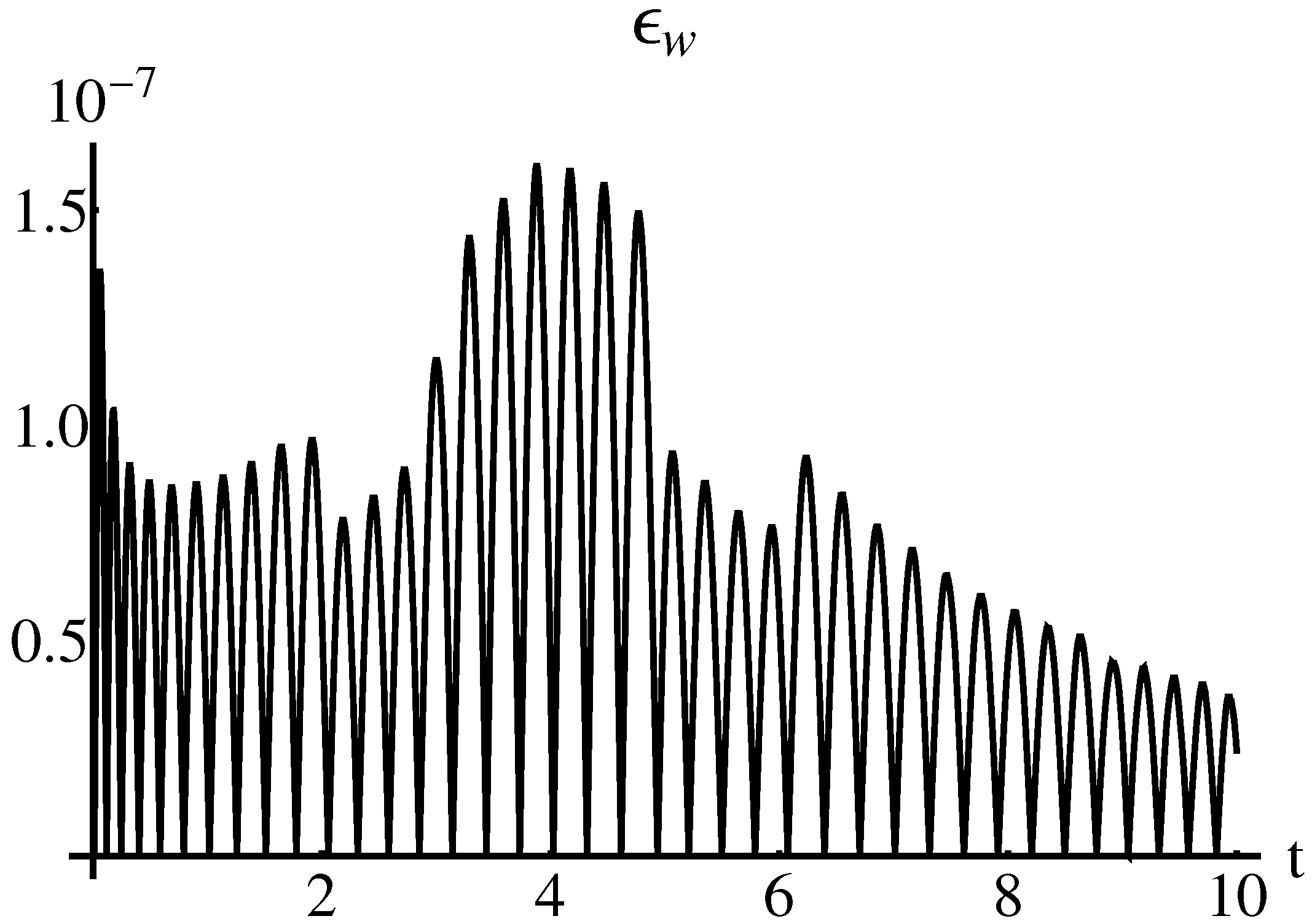
To highlight the accuracy of the obtained analytical solutions in Table 1 and Figure 1 are examined the difference for different values of the index.
From the Table 1 it results that with the increasing of index, the magnitude of the difference decreases to . The optimal value for index towards to .
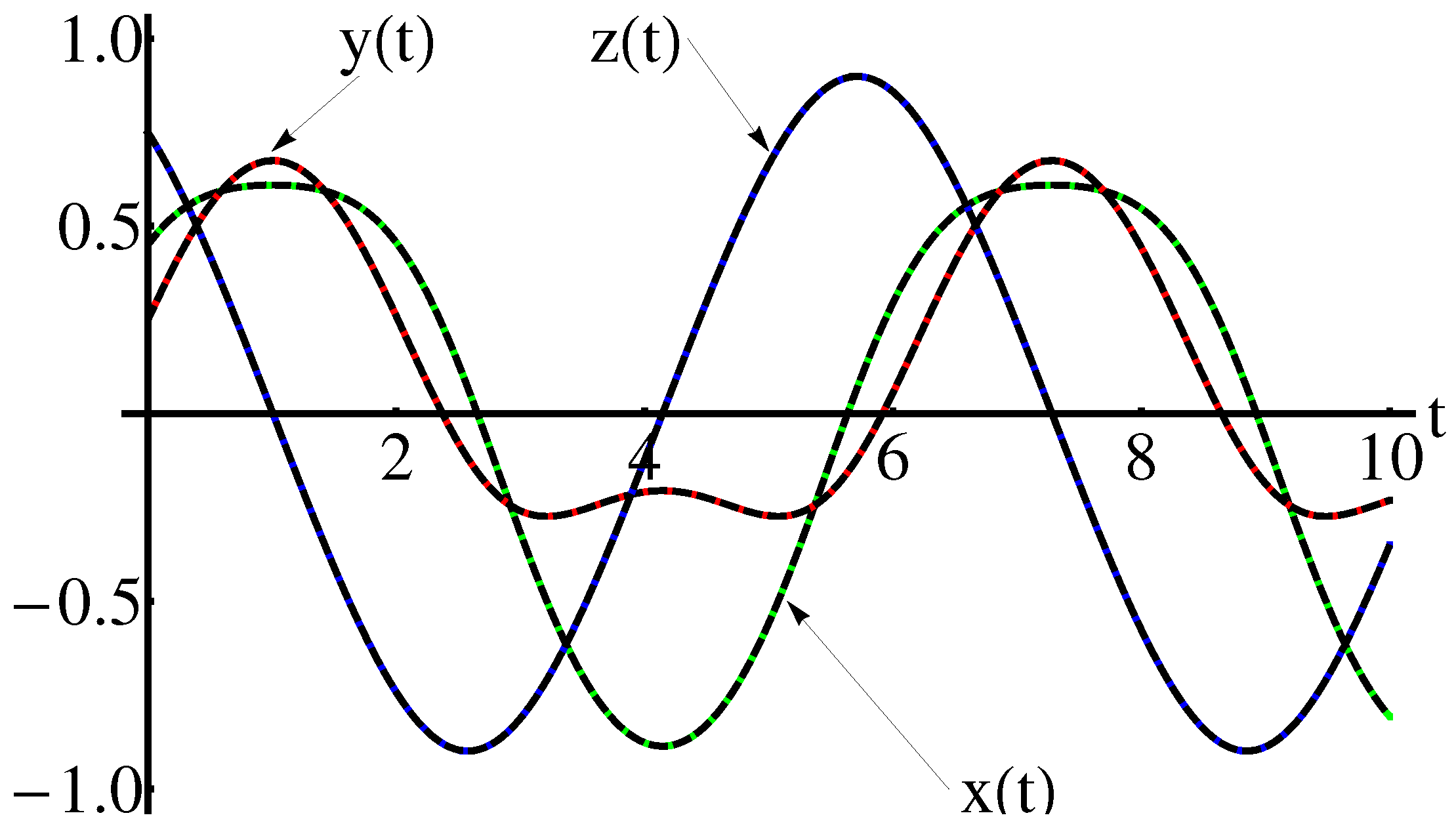
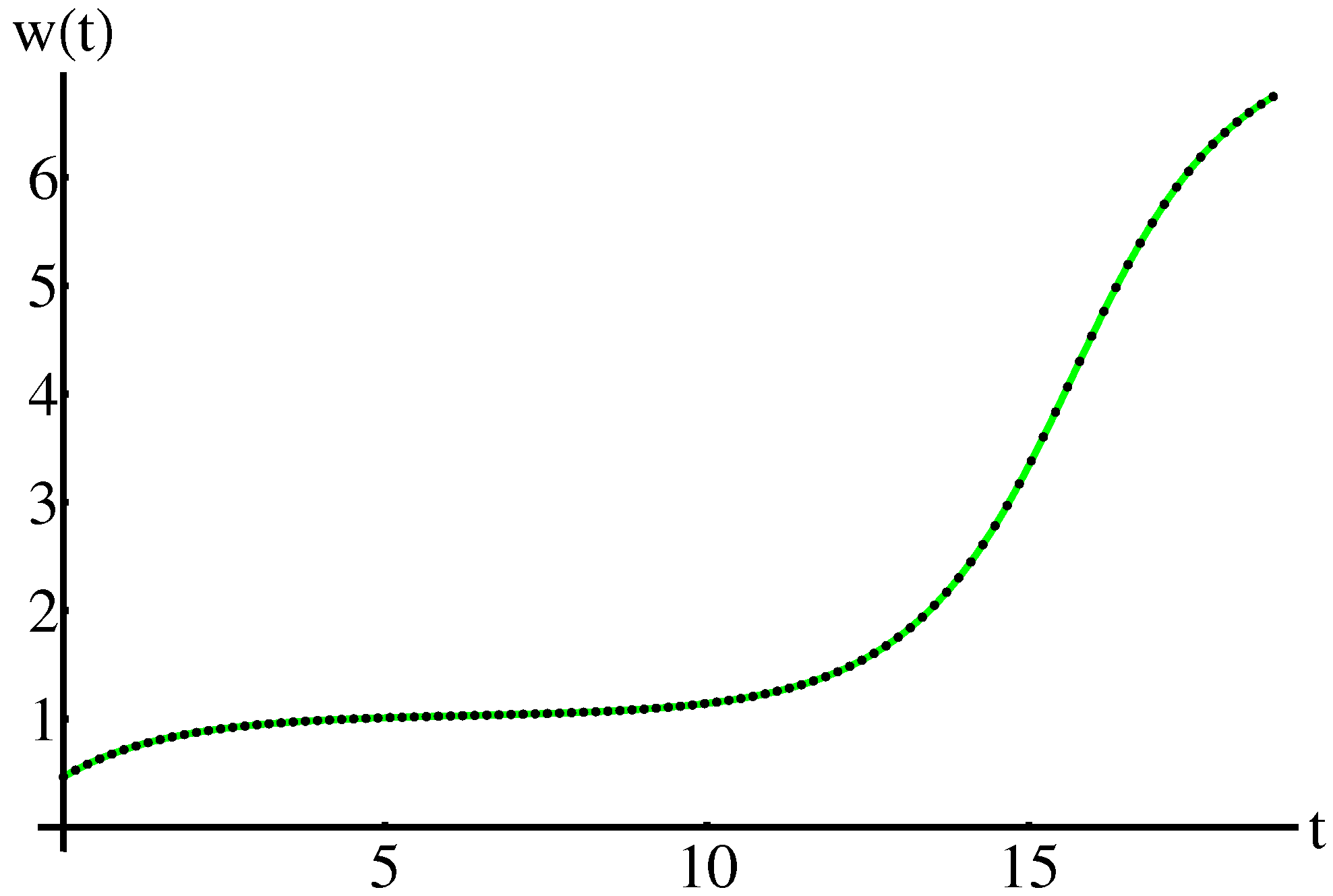
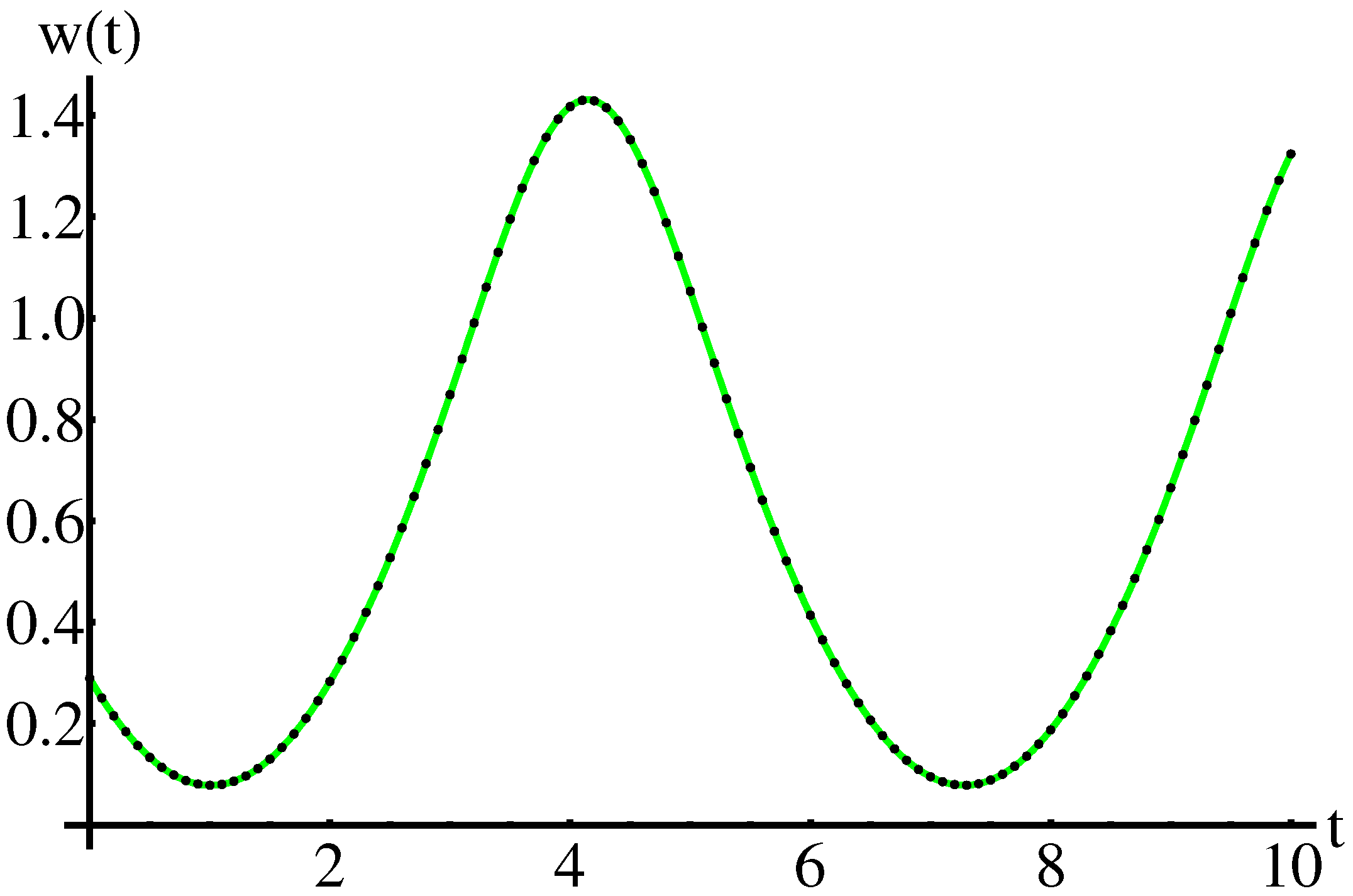
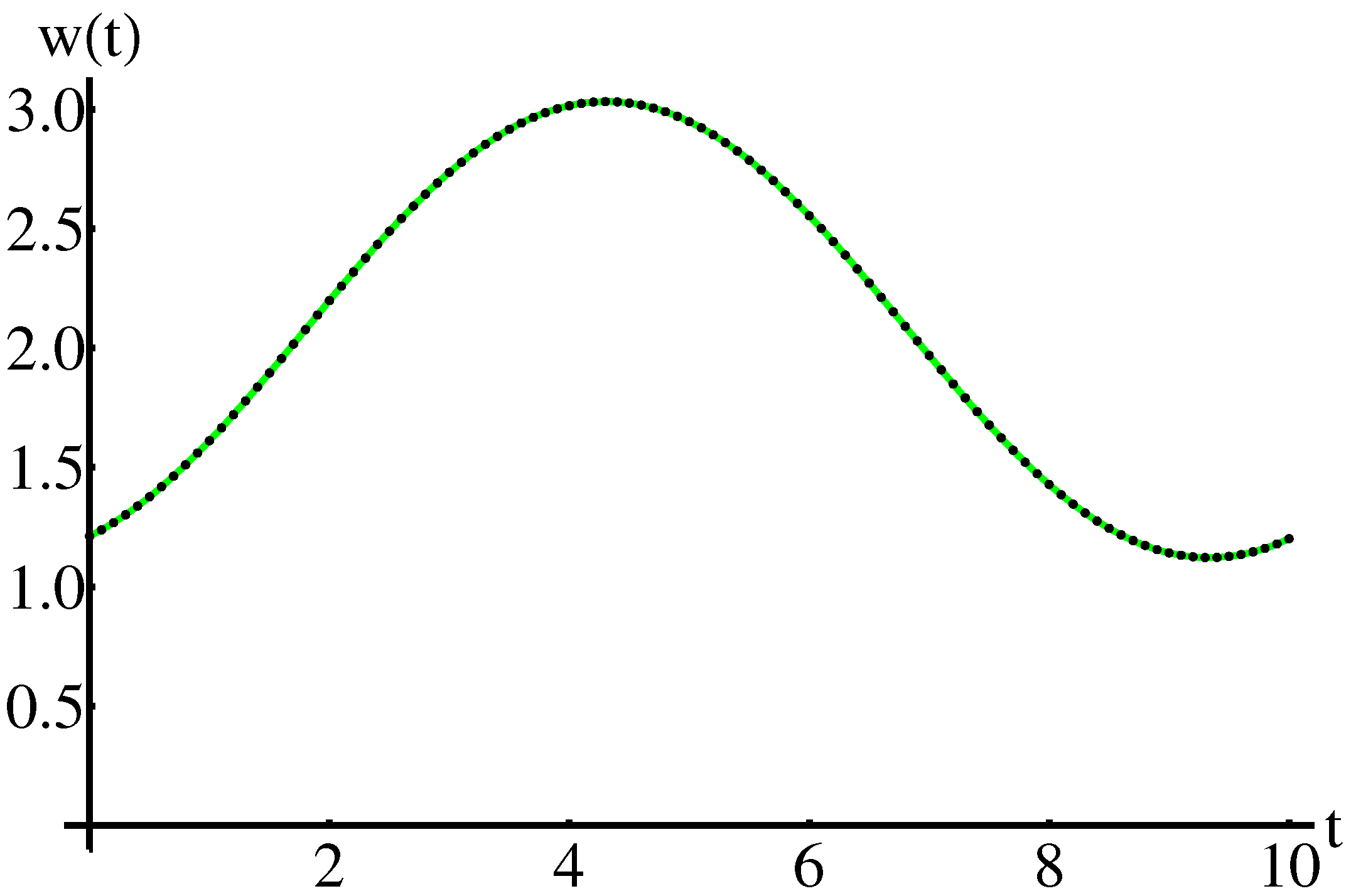
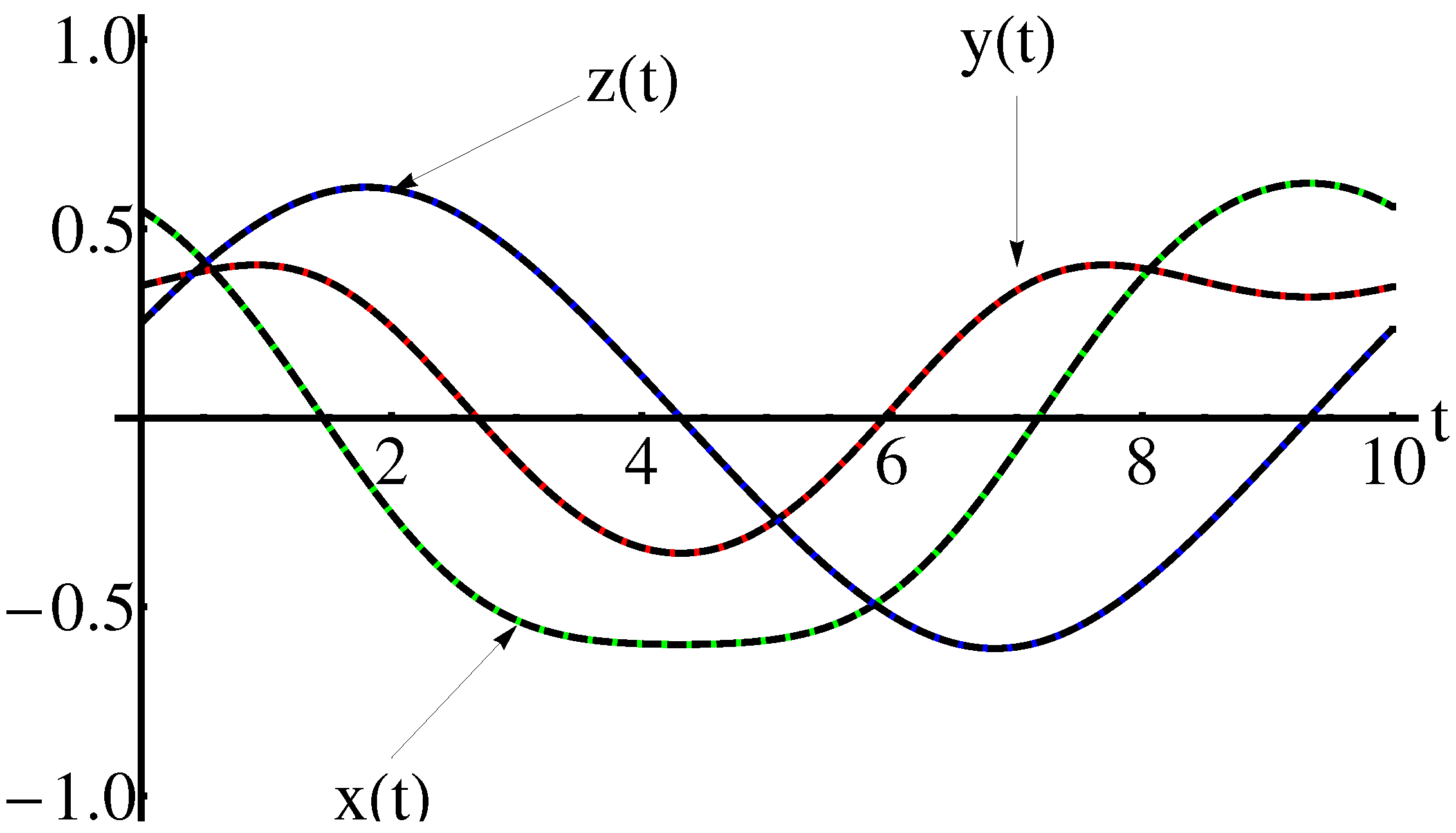
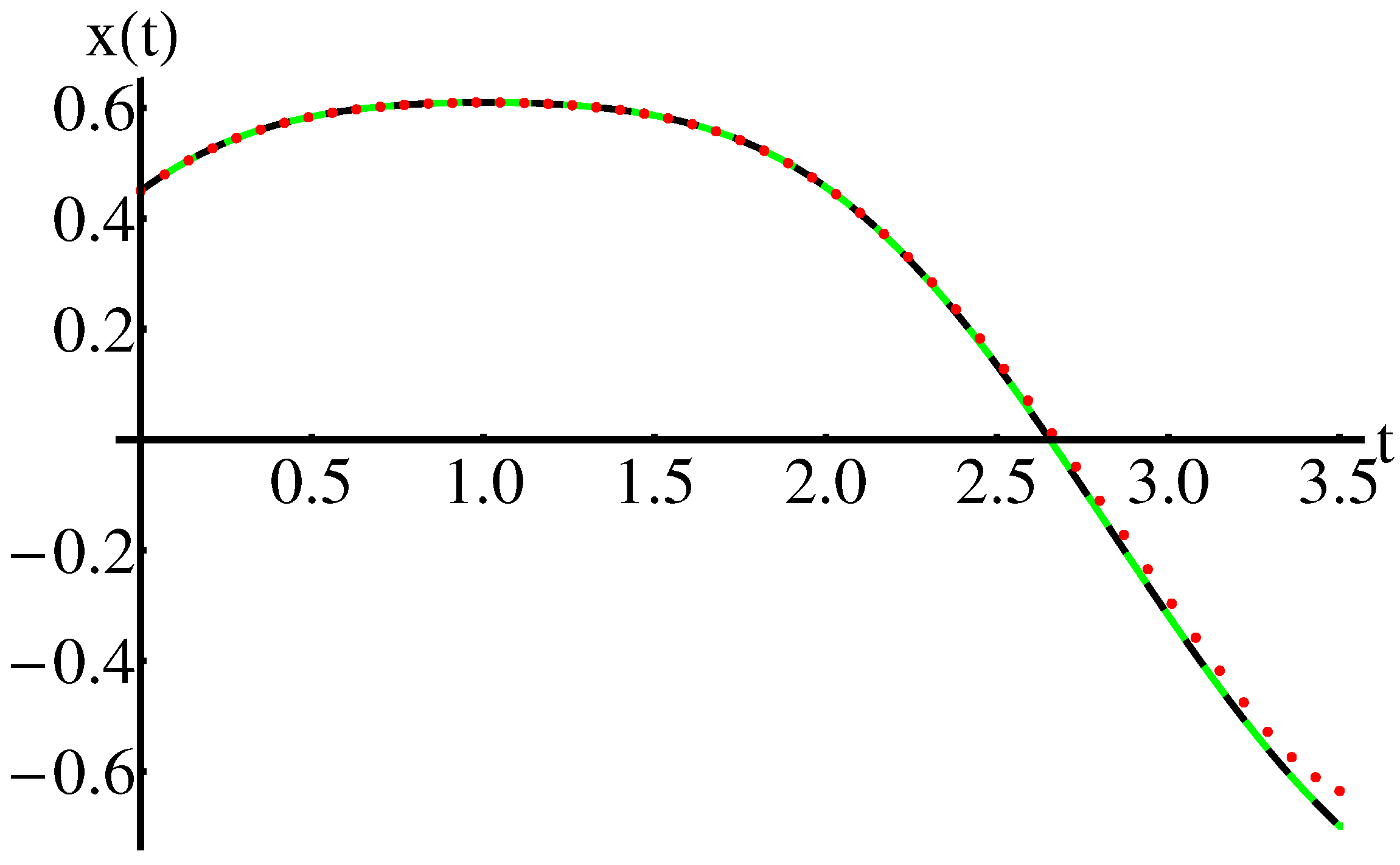
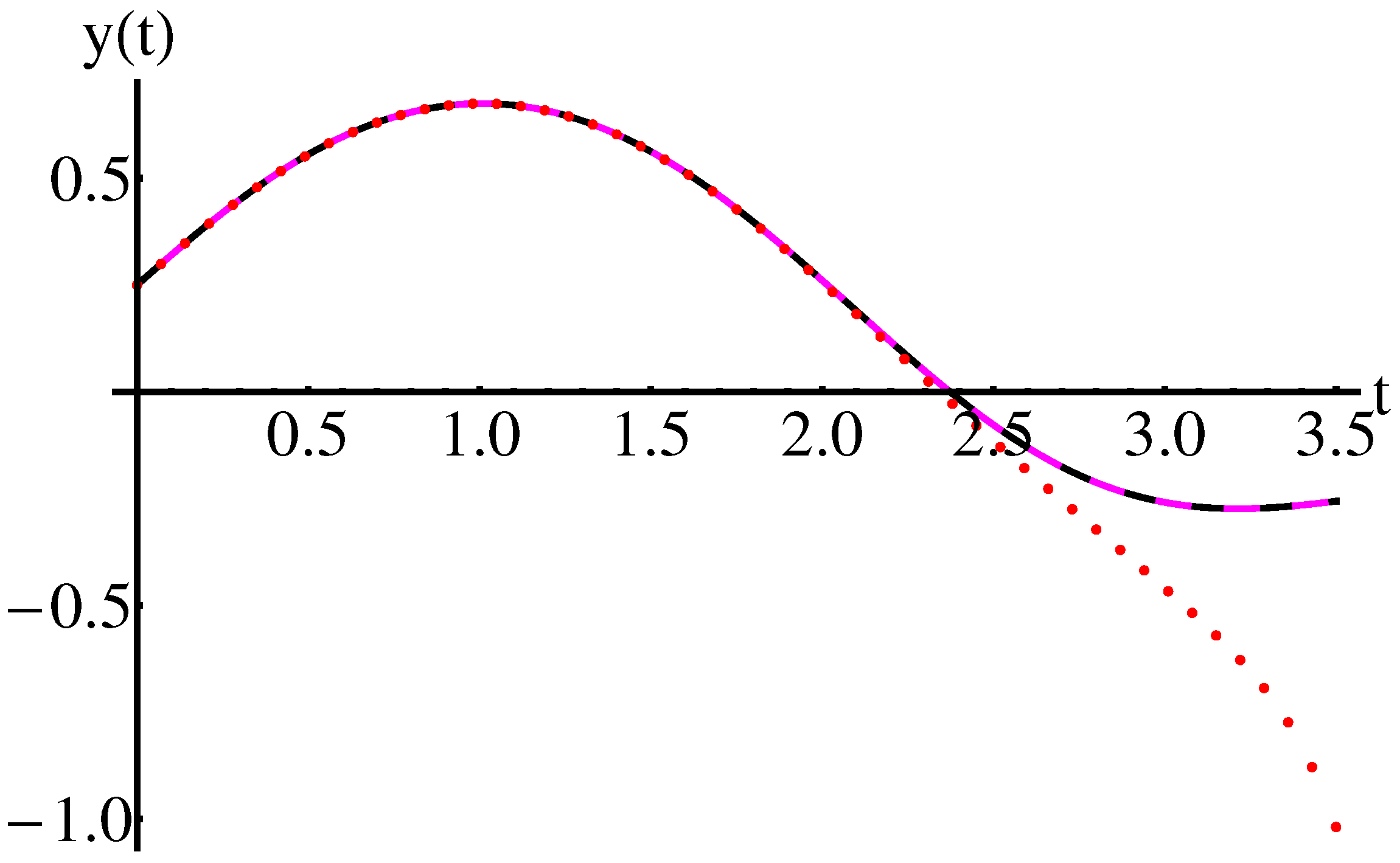
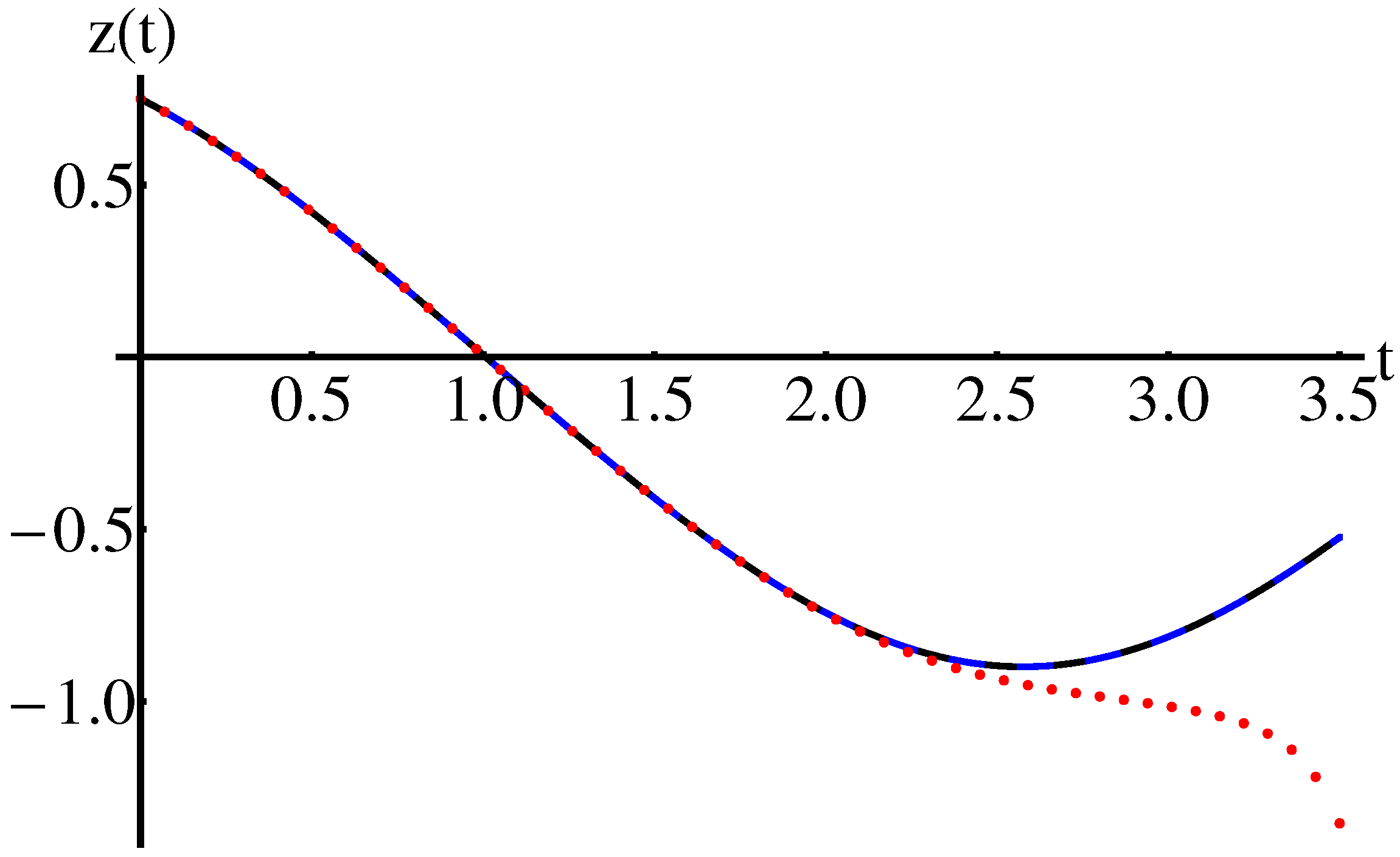
The OPIM scheme is validated in the first case for the initial conditions: , , . The profiles of the functions , are depicted in the Figure 2 and Figure 3.
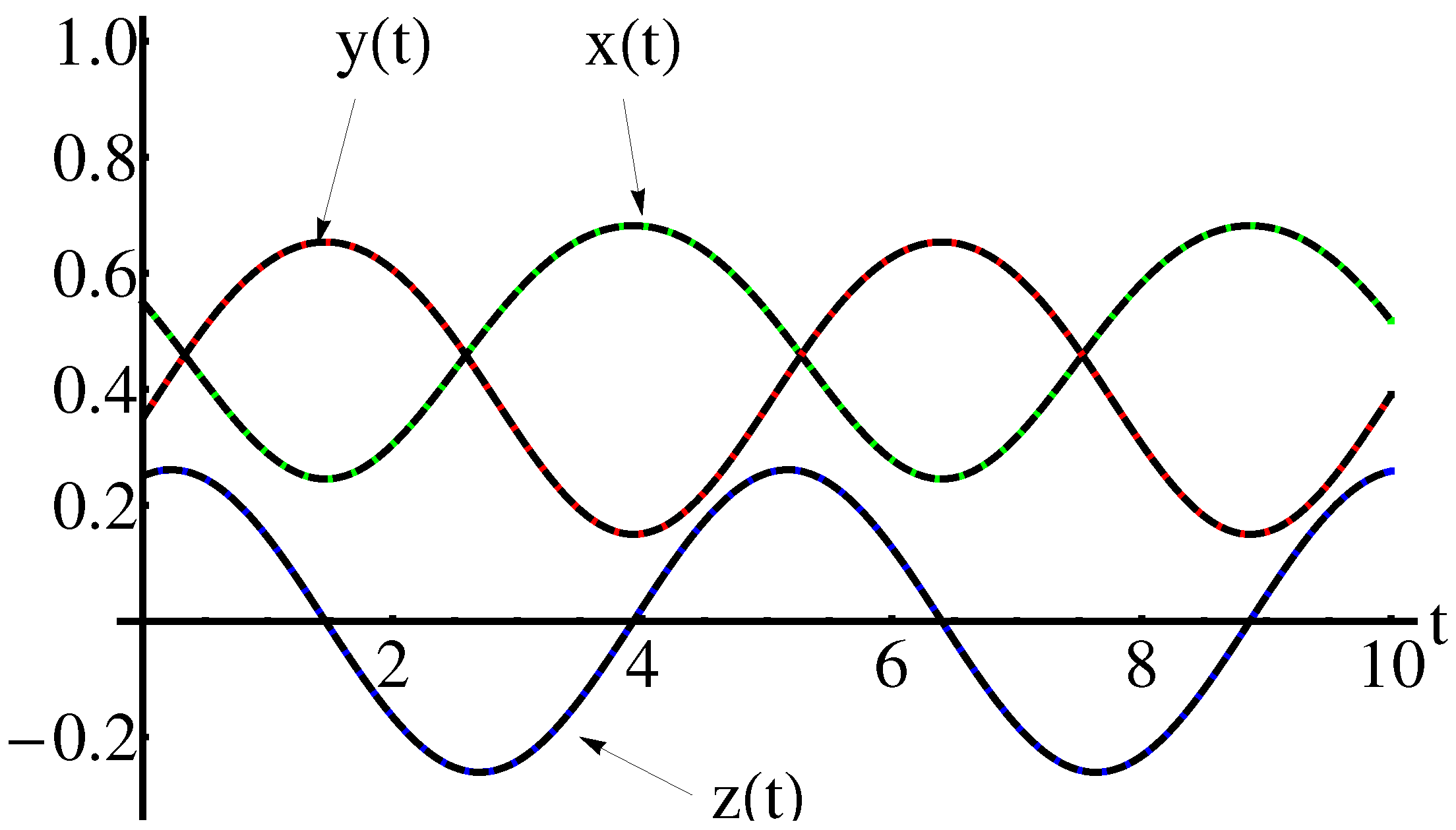
Figure 3.
The functions using Equation (A3) for initial data: , , , physical parameters: , and index : OPIM solution (dashing black line) and numerical results (solid color line: green line for , red line for , blue line for ), respectively.
4.2. Case 2: ,
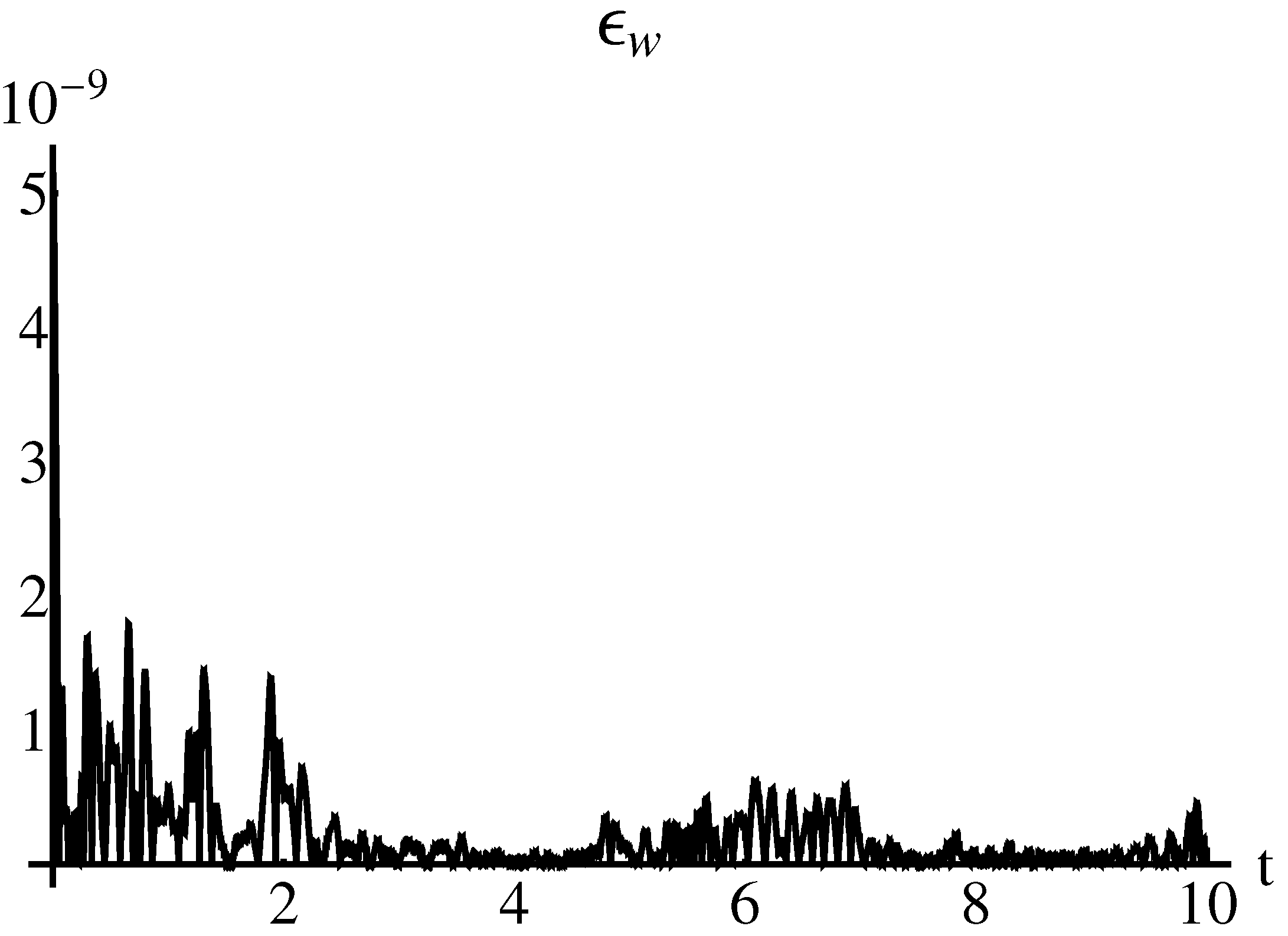
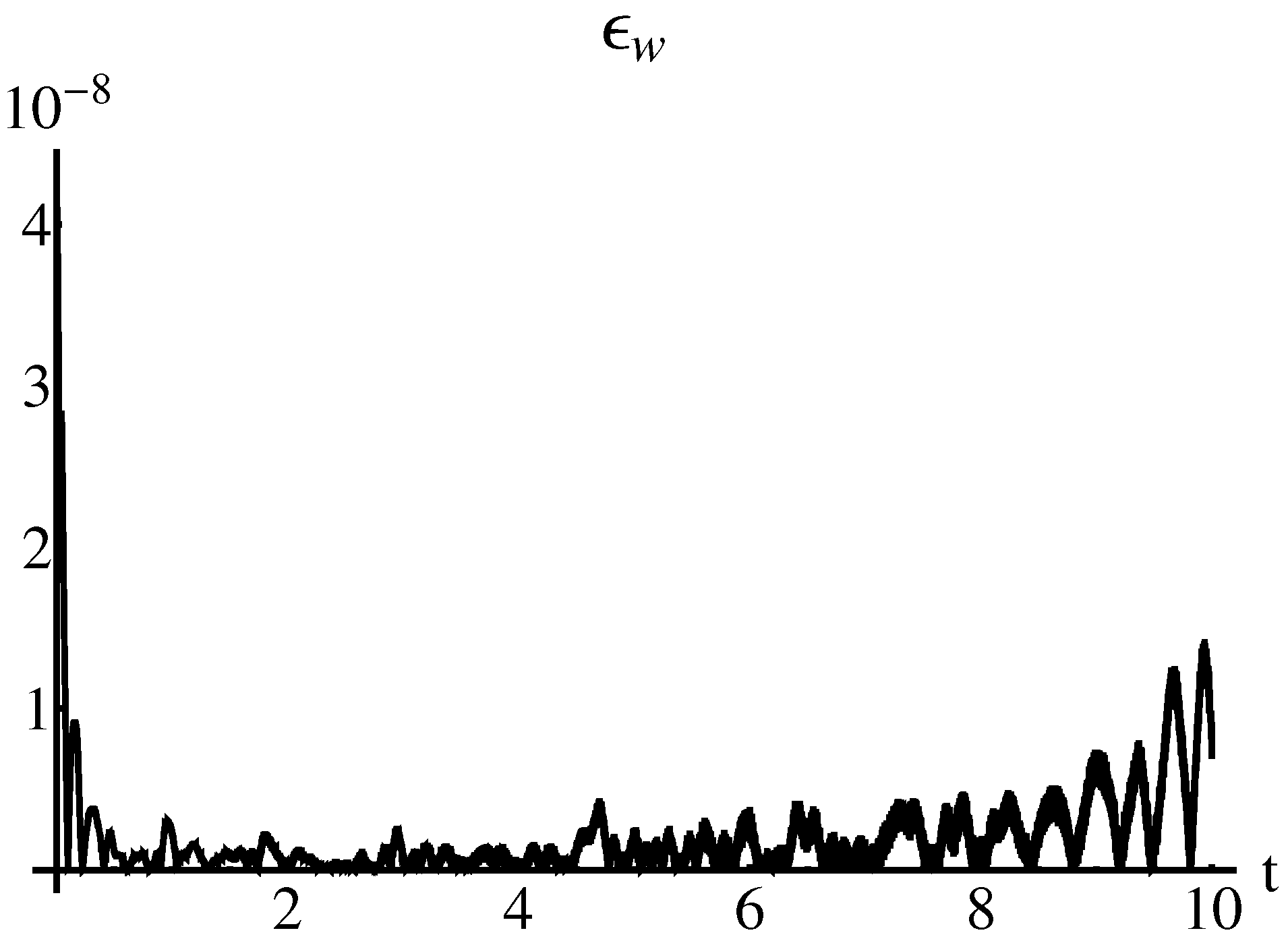
Figure 4 shows the variation of the difference in the second case for initial data , , , physical parameters , and index .
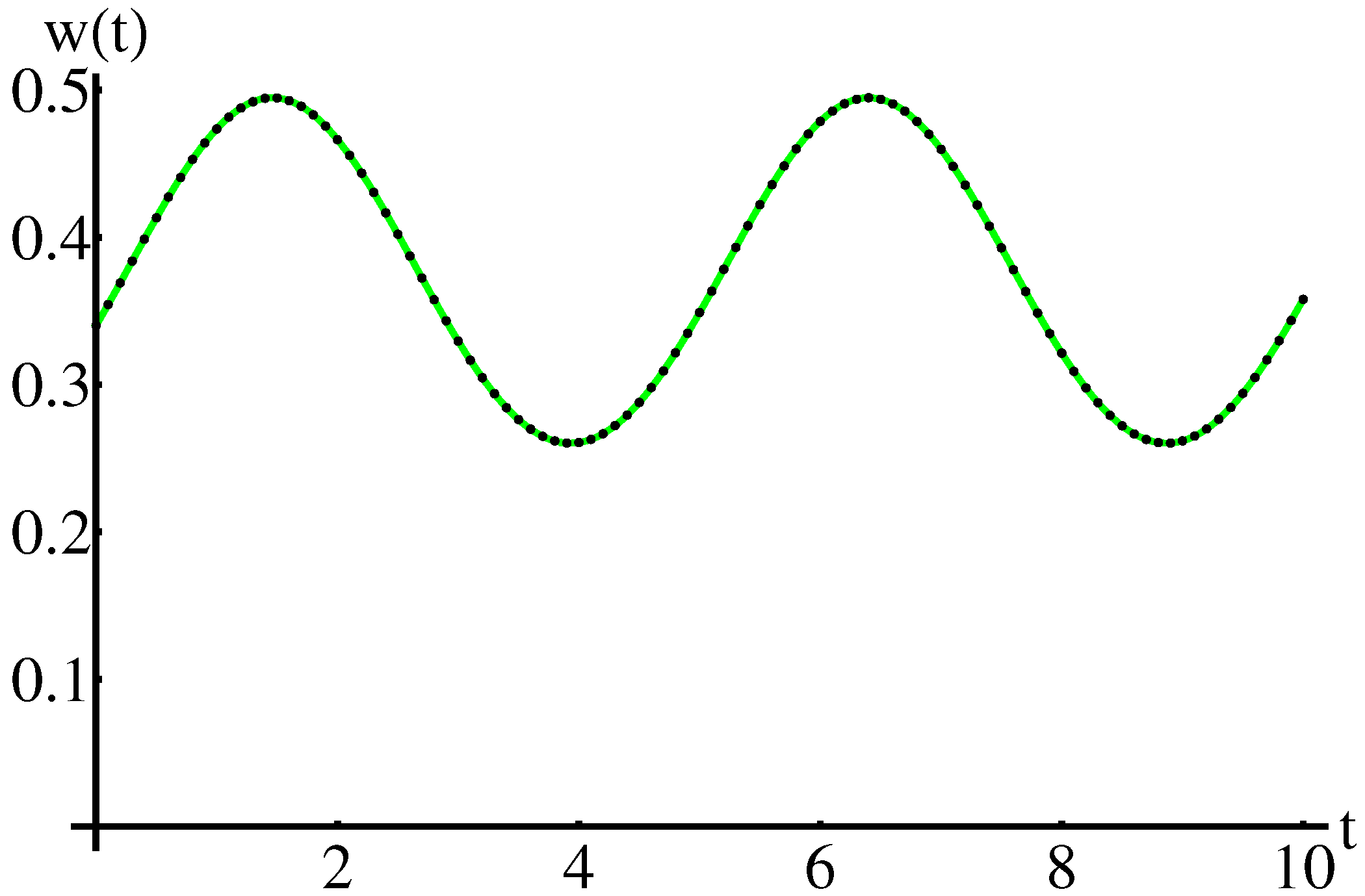
Also, in this case the accuracy of the applied method is highlighted by comparison between the functions: , respectively and corresponding numerical ones in Table 3 and Figure 5, respectively Figure 6.
Figure 6.
The functions using Equation (A4) for initial data: , , , physical parameters: , and index : OPIM solution (dashing black line) and numerical results (solid color line: green line for , red line for , blue line for ), respectively.
4.3. Case 3: ,
In Figure 7 is presented the variation of the difference in the last case for initial data , , , physical parameters , and index .
A comparison between the functions: , and corresponding numerical ones, respectively, is emphasized in Table 4 and Figure 8, respectively Figure 9.
Figure 9.
The functions using Equation (A5) for initial data: , , , physical parameters: , and index : OPIM solution (dashing black line) and numerical results (solid color line: green line for , red line for , blue line for ), respectively.
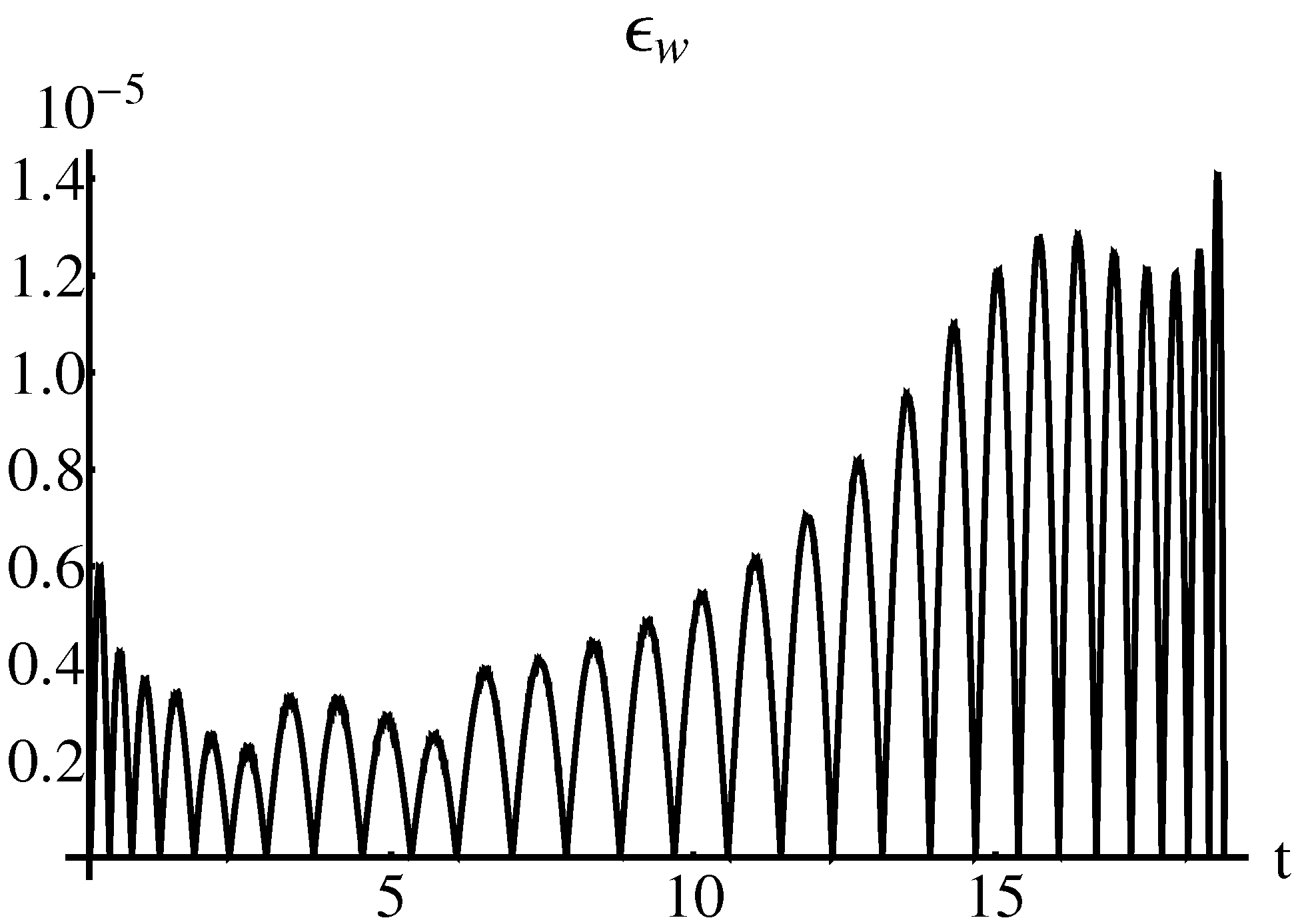
The variation of the difference for initial data , , , physical parameters , and index is graphically plotted in Figure 10.
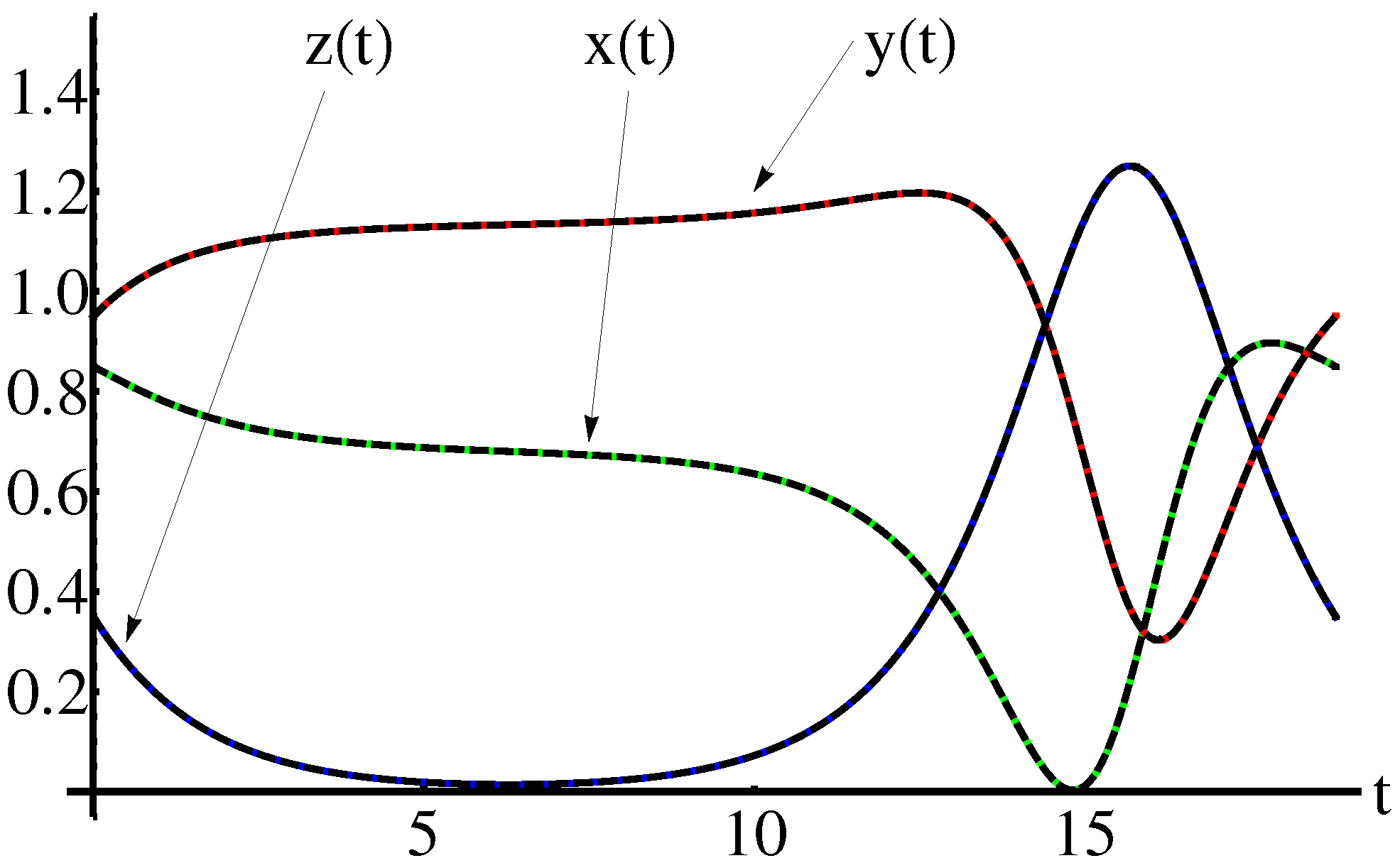
From the last couple of table and figures (Table 5 and Figure 11, respectively Figure 12) is found a good agreement between the OPIM solutions: , respectively , , and corresponding numerical ones.
The numerical values of the convergence-control parameters for for four values of the index are presented in details in Appendix A.
4.4. OPIM Solutions versus Iterative Solutions
This subsection is dedicated for a comparison between the obtained results by OPIM scheme (using one iteration) and corresponding results with the iterative method described in [30] (using seven iterations). In the Table 6 and Figure 13, Figure 14 and Figure 15, respectively, can be seen the precision and efficiency of the OPIM method.
The steps of the iterative method [30] are presented below.
If the system (1) is integrated over the interval , it results:
The iterative algorithm leads to:
The solutions of the Equations (1), using the iterative algorithm, can be written as:
The iterative solutions , after seven iterations and considering the initial conditions: , , (presented in the Table 5), taking into account the algorithm (50), become:
A comparison between the OPIM solutions , , , the corresponding iterative solutions given in Equation (51) and the corresponding numerical ones are represented in Figure 13, Figure 14 and Figure 15 and in Table 5. The accuracy of the OPIM approach is highlighted by this analysis. This comparative analysis highlights the efficiency and the accuracy of the OPIM method using only one iteration.
5. Conclusions
This work proposed an analytical approach: OPIM to solve the second-order nonlinear differential equations using just one iteration. It was chosen as a nonlinear dynamical system to obtain the analytical approximate solutions, the ball–plate problem, that possess a Hamilton–Poisson structure. By comparison, the analytical results with the corresponding numerical ones yields a good agreement between them. The comparison proves the accuracy of the applied method, the obtained solutions are approaching the exact solution. The advantages of the OPIM method comparative with other analytical methods is synthesized by: the writing of the solutions in an effective form, the efficiency, the convergence control (in the sense that the residual functions is smaller than 1) and the non-existence of small parameters.
The achievement of these results encouraged the study of dynamical systems with similar properties. The selection of various control algorithms could be one of the directions for future study.
Author Contributions
Conceptualization, R.-D.E. and N.P.; methodology, N.P.; software, R.-D.E. and N.P.; validation, R.-D.E. and N.P.; formal analysis, R.-D.E. and N.P.; investigation, R.-D.E. and N.P.; writing—original draft preparation, R.-D.E. and N.P.; writing—review and editing, R.-D.E. and N.P.; visualization, R.-D.E. and N.P.; supervision, N.P. All authors have read and agreed to the published version of the manuscript.
Funding
This research received no external funding.
Data Availability Statement
The data presented in this study are available on request from the corresponding author.
Conflicts of Interest
The authors declare no conflict of interest.
Appendix A
Initial conditions , , and physical parameters , .
References
- Jurdjevic, V. The geometry of the plate-ball problem. Arch. Rational Mech. Anal. 1993, 124, 305–328. [Google Scholar] [CrossRef]
- Tudic, V.; Kralj, D.; Hoster, J.; Tropcic, T. Design and Implementation of a Ball–plate Control System and Python Script for Educational Purposes in STEM Technologies. Sensors 2022, 22, 1875. [Google Scholar] [CrossRef] [PubMed]
- Mickens, R.E. Iteration procedure for determining approximate solutions to nonlinear oscillation equations. J. Sound Vib. 1987, 116, 185–188. [Google Scholar] [CrossRef]
- Mickens, R.E. A generalized iteration procedure for calculating approximations to periodic solutions of “truly nonlinear oscillators”. J. Sound Vib. 2005, 287, 1045–1051. [Google Scholar] [CrossRef]
- Lim, C.W.; Wu, B.S. A modified procedure for certain non-linear oscillators. J. Sound Vib. 2002, 257, 202–206. [Google Scholar] [CrossRef]
- Hu, H. Solutions of a quadratic nonlinear oscillator: Iteration procedure. J. Sound Vib. 2006, 298, 1159–1165. [Google Scholar] [CrossRef]
- Chen, Y.M.; Liu, J.K. A modified Mickens iteration procedure for nonlinear oscillators. J. Sound Vib. 2008, 314, 465–473. [Google Scholar] [CrossRef]
- El-Amrania, M.; Salhi, L.; Seaid, M.; Yakoubi, D. An iterative scheme for solving acoupled Darcy–convection–diffusion model. J. Math. Anal. Appl. 2023, 517, 126603. [Google Scholar] [CrossRef]
- Li, J. Uniformly accurate nested Picard iterative schemes for nonlinear Schrödinger equation with highly oscillatory potential. Appl. Numer. Math. 2023, 192, 132–151. [Google Scholar] [CrossRef]
- Hernandez-Veron, M.A.; Romero, N. Solving Wiener–Hopf problems via an efficient iterative scheme. J. Comput. Appl. Math. 2022, 405, 113083. [Google Scholar] [CrossRef]
- Hernandez–Veron, M.A.; Martinez, E. Iterative schemes for solving the Chandrasekhar H-equation using the Bernstein polynomials. J. Comput. Appl. Math. 2022, 404, 113391. [Google Scholar] [CrossRef]
- Sharma, P.; Ramos, H.; Behl, R.; Kanwar, V. A new three-step fixed point iteration scheme with strong convergence and applications. J. Comput. Appl. Math. 2023, 430, 115242. [Google Scholar] [CrossRef]
- Liu, C.-S.; El-Zahar, E.R.; Chang, C.-W. Three novel fifth-order iterative schemes for solving nonlinear equations. Math. Comput. Simul. 2021, 187, 282–293. [Google Scholar] [CrossRef]
- Cordero, A.; Garrido, N.; Torregrosa, J.R.; Triguero-Navarro, P. An iterative scheme to obtain multiple solutions simultaneously. Appl. Math. Lett. 2023, 145, 108738. [Google Scholar] [CrossRef]
- Kapoor, M.; Khosla, S. Series Solution to Fractional Telegraph Equations Using an Iterative Scheme Based on Yang Transform. Differ. Equ. Dyn. Syst. 2024, 1–27. [Google Scholar] [CrossRef]
- Ghosh, B.; Mohapatra, J. An Iterative Scheme for Solving Arbitrary-Order Nonlinear Volterra Integro-Differential Equations Involving Delay. Iran. J. Sci. 2023, 47, 851–861. [Google Scholar] [CrossRef]
- Botchev, M.A.; Zhukov, V.T. Adaptive Iterative Explicit Time Integration for Nonlinear Heat Conduction Problems. Lobachevskii J. Math. 2024, 45, 12–20. [Google Scholar] [CrossRef]
- Mastryukov, A.F. A Difference Scheme for Wave Equation. Numer. Anal. Appl. 2024, 17, 58–66. [Google Scholar] [CrossRef]
- Praks, P.; Brkić, D. Choosing the Optimal Multi-Point Iterative Method for the Colebrook Flow Friction Equation. Processes 2018, 6, 130. [Google Scholar] [CrossRef]
- Marinca, V.; Herisanu, N. Nonlinear Dynamical Systems in Engineering; Springer: Berlin/Heidelberg, Germany, 2011. [Google Scholar]
- Herisanu, N.; Marinca, V. Accurate analytical solutions to oscillators with discontinuities and fractional-power restoring force by means of the optimal homotopy asymptotic method. Comput. Math. Appl. 2010, 60, 1607–1615. [Google Scholar] [CrossRef]
- Marinca, V.; Herisanu, N. The Optimal Homotopy Asymptotic Method—Engineering Applications; Springer: Berlin/Heidelberg, Germany, 2015. [Google Scholar]
- Marinca, V.; Herisanu, N. An application of the optimal homotopy asymptotic method to Blasius problem. Rom. J. Tech. Sci. Appl. Mech. 2015, 60, 206–215. [Google Scholar]
- Marinca, V.; Herisanu, N. Nonlinear dynamic analysis of an electrical machine rotor-bearing system by the optimal homotopy perturbation method. Comp. Math. Appl. 2011, 61, 2019–2024. [Google Scholar] [CrossRef]
- Marinca, V.; Ene, R.D.; Marinca, B. Optimal Homotopy Perturbation Method for nonlinear problems with applications. Appl. Comp. Math. 2022, 21, 123–136. [Google Scholar]
- Ene, R.D.; Pop, N. Semi-Analytical Closed-Form Solutions for the Rikitake-Type System through the Optimal Homotopy Perturbation Method. Mathematics 2023, 11, 3078. [Google Scholar] [CrossRef]
- Ene, R.D.; Pop, N. Approximate Closed-Form Solutions for a Class of Dynamical Systems involving a Hamilton–Poisson Part. Mathematics 2023, 11, 4811. [Google Scholar] [CrossRef]
- Lazureanu, C.; Binzar, T. Symmetries and properties of the Energy-Casimr mapping in the ball–plate problem. Adv. Math. Phys. 2017, 2017, 5164602. [Google Scholar] [CrossRef]
- Ene, R.D.; Pop, N. Semi-Analytical Closed-Form Solutions for Dynamical Rössler-Type System. Mathematics 2024, 12, 1308. [Google Scholar] [CrossRef]
- Daftardar-Gejji, V.; Jafari, H. An iterative method for solving nonlinear functional equations. J. Math. Anal. Appl. 2006, 316, 753–763. [Google Scholar] [CrossRef]
Disclaimer/Publisher’s Note: The statements, opinions and data contained in all publications are solely those of the individual author(s) and contributor(s) and not of MDPI and/or the editor(s). MDPI and/or the editor(s) disclaim responsibility for any injury to people or property resulting from any ideas, methods, instructions or products referred to in the content. |
© 2024 by the authors. Licensee MDPI, Basel, Switzerland. This article is an open access article distributed under the terms and conditions of the Creative Commons Attribution (CC BY) license (https://creativecommons.org/licenses/by/4.0/).