Article

A Model-Driven Approach to Extract Multi-Source Fault Features of a Screw Pump

1
School of Mechanical, Electronic and Control Engineering, Beijing Jiaotong University, Beijing 100044, China
2
Branch of Industry, Beijing Petroleum Machinery Co., Ltd., Beijing 102206, China
*
Author to whom correspondence should be addressed.
Processes 2024, 12(11), 2571; https://doi.org/10.3390/pr12112571
Submission received: 24 September 2024 / Revised: 5 November 2024 / Accepted: 15 November 2024 / Published: 17 November 2024
(This article belongs to the Section Process Control, Modeling and Optimization)

Abstract

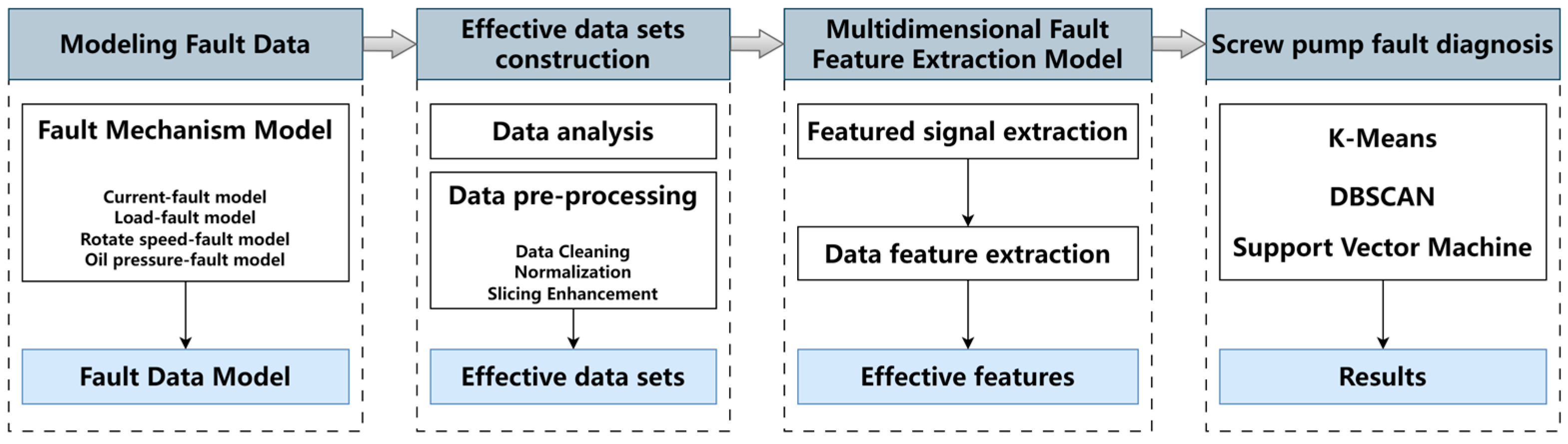
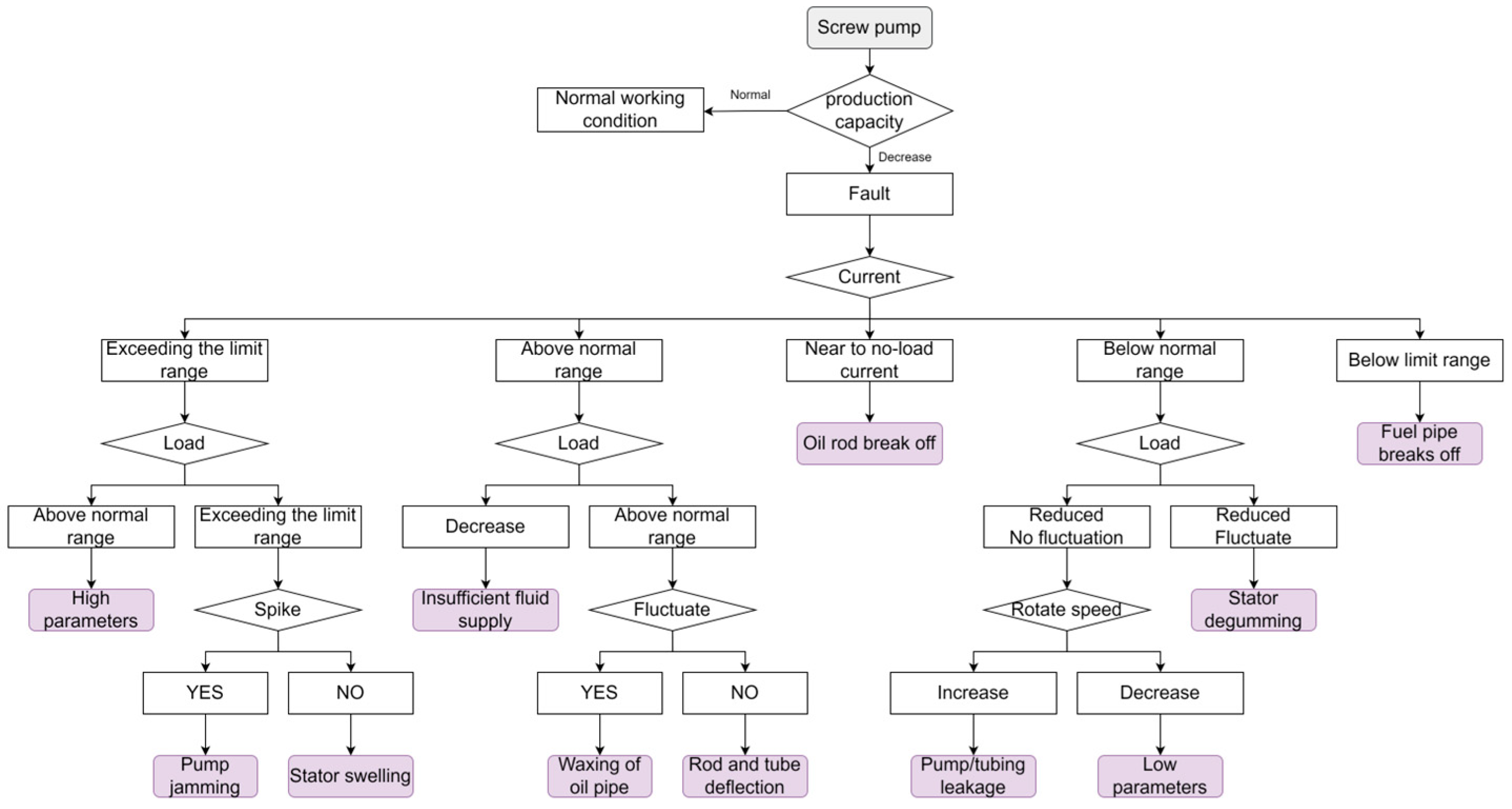
Screw pumps’ faulty working conditions affect the stability of oil production. At project sites, different sensors are used simultaneously to collect multi-dimensional signals; the data fault labels and location are not clear, and how to comprehensively use multi-source information in effective fault feature extraction has become an urgent issue. Existing diagnostic methods use a single signal or part of a signal and do not fully utilize the acquired signal, which makes it difficult to achieve the required accuracy of diagnostic results. This paper focuses on the model-driven approach to extract multi-source fault features of screw pumps. Firstly, it constructs a fault data model (FDM) by analyzing the fault mechanism of the screw pump. Secondly, it uses the FDM to select an effective data set. Thirdly, it constructs a multi-dimensional fault feature extraction model (MDFEM) to extract featured signal features and data features, for which we also comprehensively used multi-source signals in effective fault feature extraction, while other traditional methods only use one or two signals. Finally, after feature selection, unsupervised fault diagnosis was achieved by using the k-means method. After experimental verification, the method can comprehensively use multi-source information to construct an effective data set and extract multi-dimensional, effective fault features for screw pump fault diagnosis.
Keywords: feature extraction; model-driven; multi-source information; screw pump; fault diagnosis feature extraction; model-driven; multi-source information; screw pump; fault diagnosis