
Abstract
In this paper, we consider an iterative learning control problem for a class of unknown discrete-time nonlinear systems with iteration-varying initial error, iteration-varying system parameters, iteration-varying external disturbance, iteration-varying desired output, and iteration-varying control direction. These iteration-varying uncertainties are not required to take any particular structure such as the high-order internal model and only need to satisfy certain boundedness conditions. We propose an iterative learning control law with an adaptive iteration-varying fuzzy system to overcome all the uncertainties and achieve the learning control objective. Furthermore, we present a sufficient condition for designing adaptive gains and prove the convergence of the learning error to a small value as the trial number is large enough. Finally, we use two simulation examples to demonstrate all the theoretical results.
1. Introduction
For controlling a system with a given repetitive task over a finite time interval, we often considered using the iterative learning control (ILC) [1,2] in the past three decades. Being an interesting and attractive learning strategy, ILC has achieved plenty of research works in the literature. Several important theoretical results [3,4,5] and practical applications [6,7,8,9,10,11] can still be found in recent years. Basically, the ILC laws use the previous input and output data stored in the memory to construct a current control input for the system to track the desired output perfectly as the number of learning trials is large enough. A basic requirement of the control system when designing the ILC laws is that all the environmental conditions, such as the system parameters or external disturbances, are invariant from trial to trial. This requirement seems reasonable but is generally restrictive as most conditions may vary in the real physical world.
There are some possible iteration-varying uncertain sources existing in the iterative learning control systems. The most important ones include: (a) iteration-varying initial error, (b) iteration-varying external disturbance, (c) iteration-varying desired output, (d) iteration-varying system parameters, and (e) iteration-varying control direction (sign of control gain). To solve the design of ILC laws under the consideration of iteration-varying uncertainties is in general difficult. Some research works have been proposed in the area of ILC. For example, the ILC laws were studied under the uncertainty (a) in [12,13], under uncertainty (c) in [14], under uncertainties (a), (c) in [15,16], under uncertainties (a), (b), (c) in [17,18], under uncertainties (c), (d) in [19], under uncertainties (a), (c), (e) in [20], under uncertainties (a), (c), (d), (e) in [21], under uncertainties (a),(b), (c), (d) in [22,23,24], and under uncertainty (e) in [25,26]. However, to the best of the authors’ knowledge, no research works have been published to deal with the design and analysis of ILC laws under all the uncertainties of (a), (b), (c), (d), (e) at the same time.
The motivation of this paper is to find a realizable iterative learning control law for a class of discrete-time nonlinear systems under the five iteration-varying uncertainties mentioned above. Furthermore, this paper still has some more new contributions when compared with the existing ILC laws when dealing with iteration-varying uncertainties. Firstly, the uncertainties do not have to take any particular forms, such as the strict high-order internal model (HOIM) structure. Secondly, the uncertainties are not required to converge to certain iteration-invariant ones along the iteration domain in order to guarantee a satisfying learning performance. Thirdly, the upper bounds of these uncertainties can be unknown and not necessarily small.
To achieve this paper’s iterative learning control objective, we first apply a fuzzy system with iteration-varying consequent parameters as an approximator to approximate the unknown nonlinear function with iteration-varying parameters. Based on this iteration-varying fuzzy system, an adaptive strategy is adopted to design the ILC law to solve the ILC problem with all the existing iteration-varying uncertainties. The control structure is simple and easy to implement. We first reformulate the error dynamics into an iteration-invariant nominal part and an iteration-varying uncertain part, respectively. After a further derivation, the error dynamics becomes a parameterized linear combination of fuzzy basis function vector and control input as well as a lumped iteration-varying uncertainty. An iteration-varying dead-zone-like auxiliary error is proposed to deal with the lumped iteration-varying uncertainty. Then a set of adaptive laws is presented using the auxiliary error to update the fuzzy and control parameters from trial to trial in this ILC law. A rigorous technical proof is given to guarantee the boundedness of the learning system for each iteration and discrete-time instant. Furthermore, we show that the norm of output error can asymptotically converge along the iteration axis to a value that depends on the width of the dead zone. The main contributions can be summarized as follows.
- (1)
- This is the first work that considers the design and analysis of iterative learning control law for nonlinear unknown systems with all the five kinds of iteration-varying uncertainties.
- (2)
- The mentioned iteration-varying uncertainties are allowed to be unknown and without any special structure.
- (3)
- The upper bounds of the iteration-varying uncertainties can be unknown and not necessarily small.
- (4)
- A new concept of using a fuzzy system with iteration-varying consequent parameters as an approximator is proposed.
This paper is organized as follows. Section 2 gives a problem formulation and definition of the iteration-varying uncertainties for this work. The iterative learning control law and the parameter adaptive laws are proposed in Section 3. Based on the derived error dynamics, we analyzed the closed-loop stability and learning performance in Section 4. In Section 5, two simulation examples are then given to show the effectiveness of the iterative learning control law. Finally, we made a conclusion in Section 6.
2. Problem Formulation
In this paper, we consider a class of repetitive nonlinear discrete-time systems as follows,
where is the index of discrete time, is the index of learning control iteration, is the state vector, is an unknown nonlinear function of and . is the output, is the input and without loss of generality, we let . The iteration-varying uncertainties appeared in this system are defined as follows: (1) the initial output is iteration-varying, (2) the system parameters and are unknown and iteration-varying, (3) the disturbance is unknown and iteration-varying, (4) the desired output is iteration-varying, (5) the sign of control gain is unknown and iteration-varying. The control objective is to design an iterative learning control law such that will track as close as possible, , even all the above-mentioned uncertainties exist. Several assumptions are required for the controller design as follows.
- (A1)
- The iteration-varying initial output error is bounded .
- (A2)
- The iteration-varying system parameters , are bounded and .
- (A3)
- The iteration-varying disturbance is bounded with where is an unknown positive constant for all and .
- (A4)
- The iteration-varying desired output is bounded with where is an unknown positive constant for all and .
- (A5)
- The unknown nonlinear function is smooth and bounded if and are bounded.
Remark 1.
Note that all the iteration-varying uncertainties are required to be bounded. This is reasonable in a real control environment. But the upper bounds of the uncertainties are not required to be small enough so as to guarantee a satisfied performance. Furthermore, these upper bounds are allowed to be unknown. We will design suitable adaptive laws to overcome these unknown bounds. Compared with all the related works in the area of ILC dealing with similar problems, this paper can handle the more general class of iteration-varying uncertainties and needs less knowledge on them.
3. Design of the Iterative Learning Control Law
To overcome the unknown smooth nonlinear function , we proposed a fuzzy system to approximate as most of the design approaches used in the past two decades in the literature. However, we are going to present a different concept to the fuzzy system for an optimal function approximation since the system parameter vector is iteration-varying. We suggest that there exists an optimal iteration-varying fuzzy system for approximation of , where is the iteration-varying fuzzy consequent parameter vector, and is the fuzzy basis function vector. This iteration-varying fuzzy system will in general gives a better approximation to the iteration-varying nonlinear function , and the approximation error over a compact set will be smaller or the compact set for a reasonable approximation will be larger than those traditional designs using fixed consequent parameter fuzzy systems. More precisely, the approximation behavior between the optimal fuzzy system and the nonlinear function will satisfy
where on a compact set with being an unknown positive constant.
We now separate the iteration-varying parameters and into the iteration-invariant nominal parts , , and the iteration-varying uncertain parts , , respectively. That is, and .
Remark 2.
It is reasonable that, , and , are all bounded according to assumption (A2). Furthermore, we assumeandfor some positive unknown constants and .
Based on (3), we derive the output error as follows,
The iterative learning control law is designed as
where is a small positive constant, and are adaptive control parameters which will be updated along the iteration domain in order to ensure the learning error convergence and closed-loop stability. Define the control parameter errors as , and substitute the iterative learning control law (5) into the output error (4). Then we have
where
It is easily shown that
so that the term in (7) will satisfy the bounding condition as follows,
where is a suitably defined unknown positive constant and . To overcome all the unknown caused by iteration-varying uncertainties, a dead-zone like auxiliary error is firstly introduced:
for . It is noted that is not defined since it will not be utilized in the later design. The notation sat in (10) is a saturation function defined as
can be considered as a width of dead zone which is iteration-time varying and it is defined as
where is another control parameter. According to the definition, it is easy to prove that .
In this iterative learning controller, in (5) and in (11) are used to compensate for the unknown iteration-invariant parameters , and , respectively. As the uncertainties are unknown, a direct strategy is to construct certain adaptive laws to automatically search for the optimal parameters. The adaptive laws are designed to ensure the closed-loop stability and improve the learning performance as the number of iterations is large enough. The parameter adaptive laws for , and at ()th iteration are proposed in the following:
for , where are the adaptive gains. In the first trial, we will set , to be any constant vector, and to be a small number. According to (14), we have and . If we define the parameter errors as and subtract , and on both sides of (12)–(14) respectively, then it will yield
4. The Main Results for Stability and Convergence
This section will study the system convergent performance and the boundedness of all the internal signals. The main results are summarized in the following theorem.
Theorem 1.
Consider the class of discrete-time nonlinear systems (1) which satisfies the assumptions (A1)–(A5) and design iterative learning control law as in (5), (10) and (12)–(14). If satisfies
then we can get the following results.
- (t1)
- The adaptive parameters , , are bounded .
- (t2)
- The dead-zone-like auxiliary error , output error and control input are bounded . Furthermore,
Proof.
(t1) To show the boundedness of adaptive parameters, we define a positive function as follows,
According to (6), we can find that
This implies that
Substituting (10) into (22) and using the fact that in (9), we can derive that
where . If we choose such that , then we have
for . Note that for the first iteration, , and are bounded since the initial settings of and are bounded. This implies is bounded , and hence , , and are bounded according to the result of (24). This proves (t1) of the theorem.
Because is bounded and is nonnegative, we can conclude that
.
To prove that will be bounded and converge to zero, we firstly note that the fuzzy basis function vector is bounded, and given in (5) as well as are bounded according to (t1). We can guarantee are bounded . Hence, (25) implies that
and . When , the output error satisfies
. This concludes the result of (t2) in the theorem. □
Remark 3.
In this theorem, we show that the output error will converge to a residual set which is bounded by . Therefore, we require that is as small as possible for all . This is the reason for us to set the initial value of to be a small number and the adaptive gain in (14) as a small one such that and hence, will remain in a reasonable small value for all . Of course it is no problem to choose as small as possible due to the requirement of convergent condition in (18).
5. Simulation Examples
Example 1.
In this example, we use a simple parameterized nonlinear system with iteration-varying uncertainties to study the learning performance of the iterative learning control system. The nonlinear system considered is given as
where
here s denotes the sign of control gain , rand is a uniform distribution on the interval and is known for simplicity. We use the following reference model to generate the desired output,
The iterative learning control objective in this example is to force the system output to track the desired output for all as close as possible. The proposed iterative learning control law (5), (10) and (12)–(14) are chosen with , , so that . The control parameter values at first iteration are given as for all .
Case 1: (unknown positive control gain)
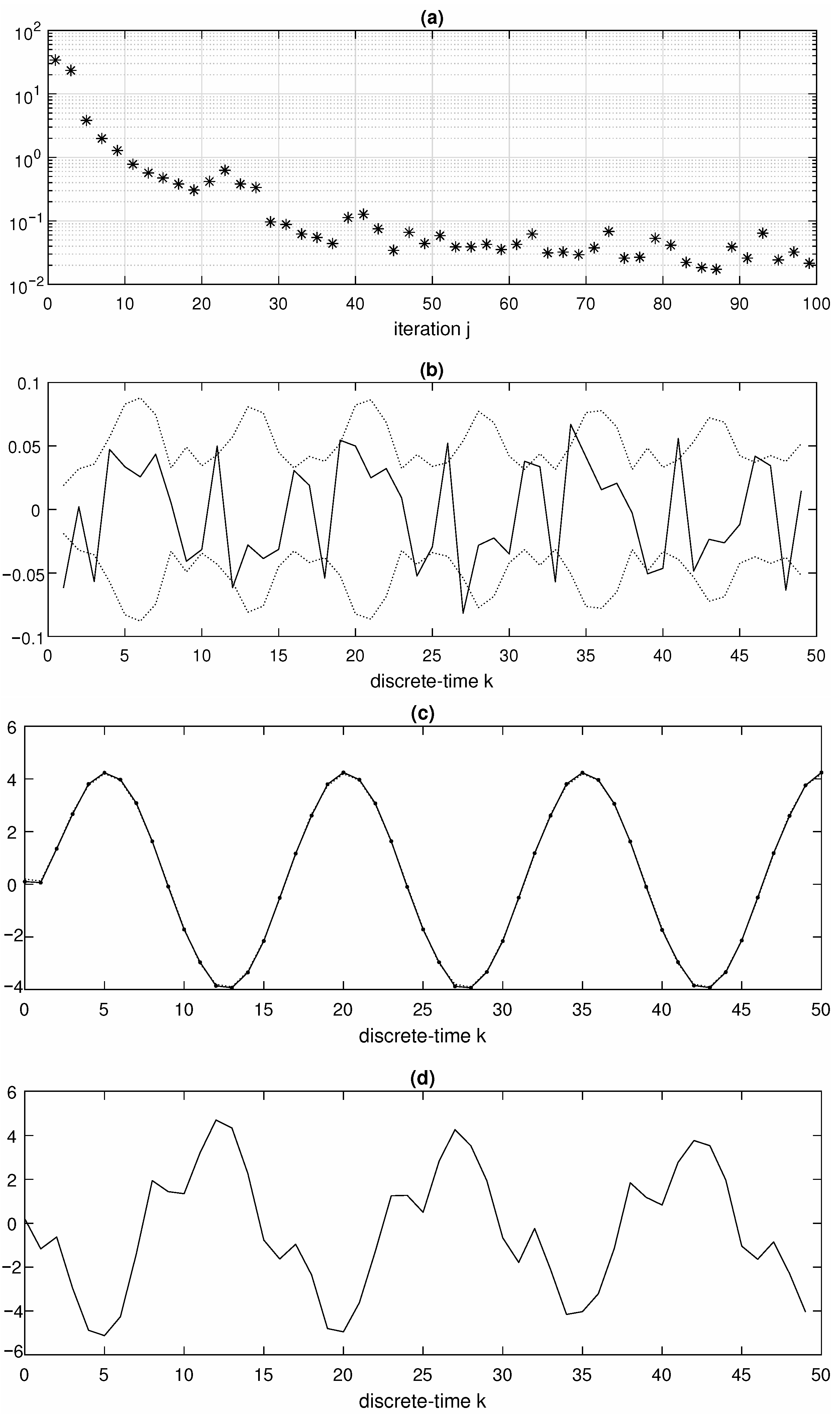
Figure 1a shows versus iteration . The simulation result proves that (t2) of the theorem is correct. Figure 1b shows the output error , width of iteration-varying dead zone and at the 100th trial. The profile of roughly lies between and , for . The system output and desired output at the 100th iteration are shown in Figure 1c. Finally, the bounded control input at the 100th iteration is given in Figure 1d.
Figure 1.
(a) (∗) versus iteration j. (b) (solid line) and (dotted lines) versus time k. (c) (solid line) and (dotted line) versus discrete-time k. (d) versus discrete-time k.
Case 2: (unknown negative control gain)
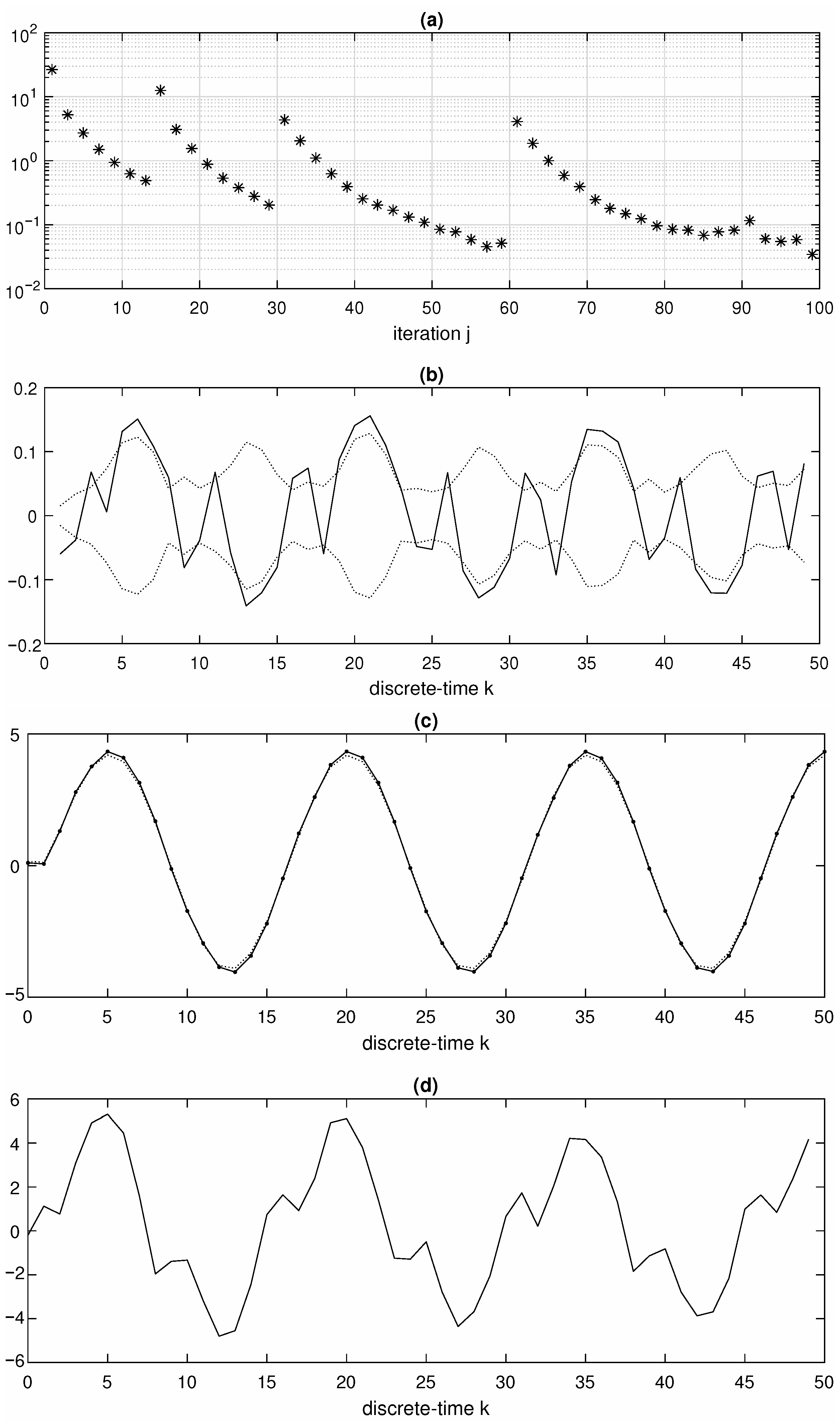
In order to check if the learning performance still remains when the sign of the control gain changes, we let s of in (31) be replaced by and make a simulation again without changing any parameters in the proposed iterative learning control law in case 1. It is clear from Figure 2 that the learning performances are almost the same as those in case 1. But the control input in Figure 2d is reversed when compared with that in Figure 1d. This proves that the proposed iterative learning control law can work without the knowledge of the control gain sign.
Figure 2.
(a) (∗) versus iteration j. (b) (solid line) and (dotted lines) versus discrete-time k. (c) (solid line) and (dotted line) versus discrete-time k. (d) versus discrete-time k.
Case 3: at the 15th, 30th, 60th iterations and for the others (iteration-varying control gain)
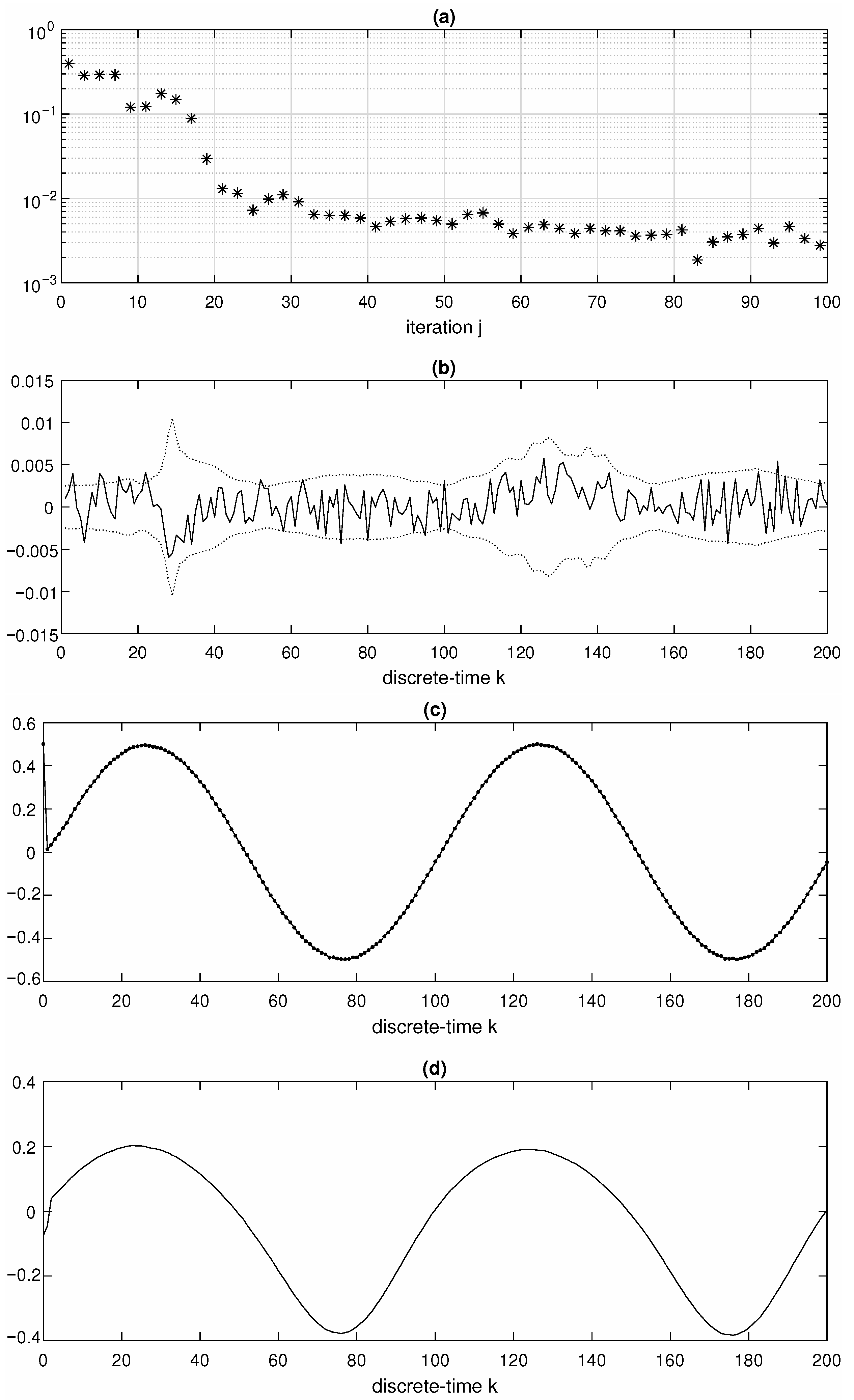
In this case, we study the learning effect when the sign of control gain is iteration-varying. We let for most of the iterations except at the 15th, 30th, and 60th iterations. The simulation results are now shown in Figure 3. It is interesting to find that the learning system has to re-learn when the sign of control gain suddenly changes. However, it can overcome the variation quickly after several trials and capture the control direction again.
Figure 3.
(a) (∗) versus iteration j. (b) (solid line) and (dotted lines) versus discrete-time k. (c) (solid line) and (dotted line) versus discrete-time k. (d) versus discrete-time k.
Example 2.
In this example, we use the proposed fuzzy iterative learning control law to control a non-BIBO nonlinear unknown system similar to but more complex than that in [27]. The difference equation of the nonlinear system with iteration-varying uncertainties is given as
where is the system output, is the control input and is a non-repeatable random disturbance. Here the reference model is chosen as
where is an iteration-varying bounded reference input. We choose in (5) and the initial value of control parameters at the first iteration as , and , respectively. The adaptive gains are chosen as . Five fuzzy rules are chosen to construct the fuzzy basis function vector . The detailed fuzzy membership functions are given as follows,
Hence, the fuzzy basis functions are given as
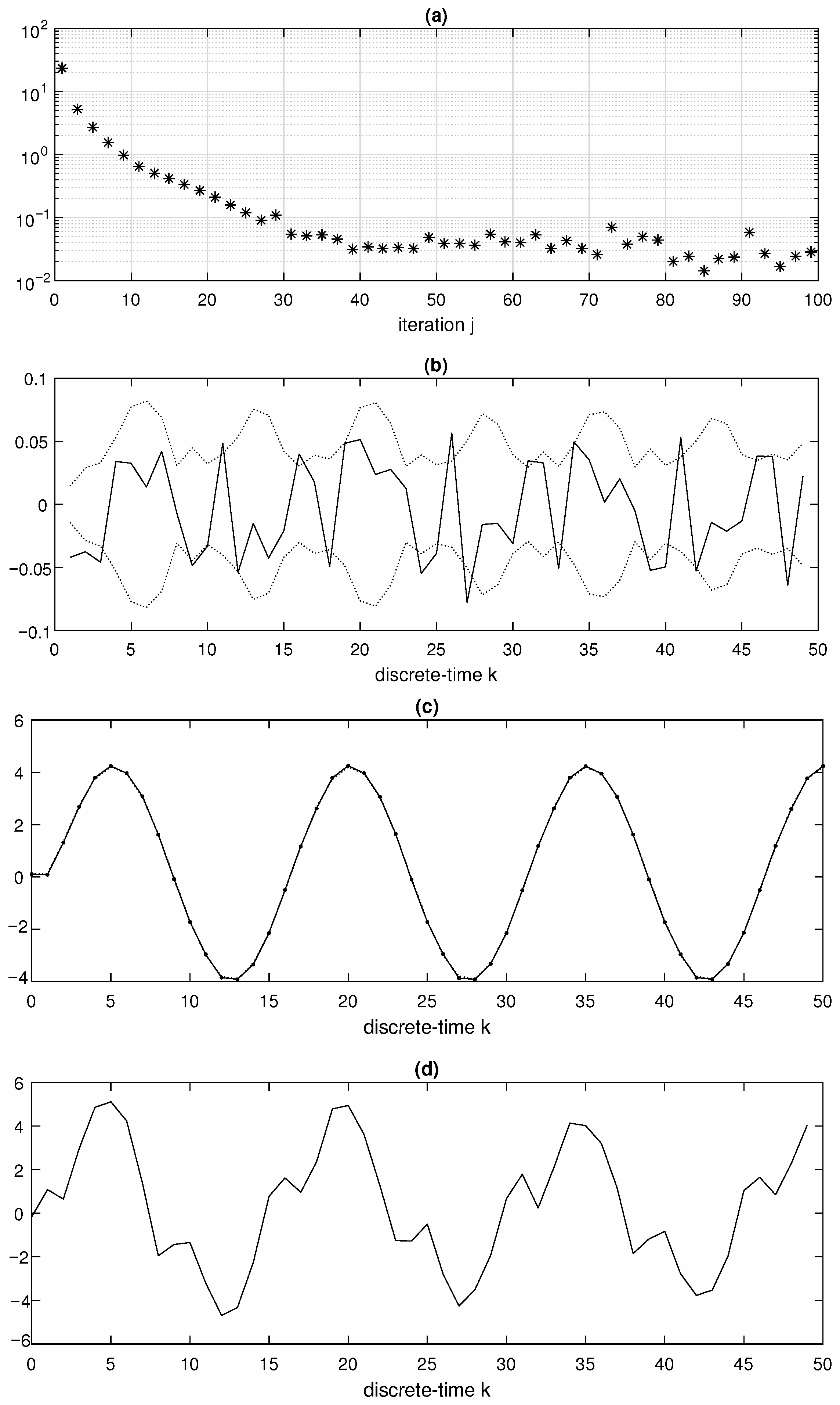
. In Figure 4a, we show the evolution of with respective to iteration j. After 100 iterations, the converged learning error is shown in Figure 4b. Same as example 1, the trajectory of roughly lies between and , for . After the 100th trial, a satisfied output tracking performance is achieved. We then show the relation between and in Figure 4c for . Finally, Figure 4d shows the control input which is clearly bounded.
Figure 4.
(a) (∗) versus iteration j. (b) (solid line) and (dotted lines) versus discrete-time k. (c) (solid line) and (dotted line) versus discrete-time k. (d) versus discrete-time k.
6. Conclusions
A robustness problem caused by iteration-varying uncertainties in studying iterative learning control is always a practical but difficult challenge. This paper aims to design an iterative learning control law for a class of unknown discrete-time nonlinear systems with five kinds of iteration-varying uncertainties. These uncertainties include iteration-varying initial error, iteration-varying external disturbance, iteration-varying desired output, iteration-varying system parameters, and iteration-varying control direction. This paper is the first ILC work that can deal with these uncertainties at the same time. In addition to this main contribution, the five kinds of iteration-varying uncertainties can take a general structure. They don’t have to satisfy the assumption of the high-order internal model or any other special formulation. We not only show that all the internal signals are bounded for each iteration and discrete-time instant but also guarantee that the output error asymptotically converges to a small value. Two simulation results are studied with several scenarios to show that the fuzzy iterative learning control law is practical and feasible.
Author Contributions
Conceptualization, C.-J.C., Y.-C.W.; methodology, C.-J.C.; software, Y.-C.W.; validation, C.-J.C., Y.-C.W.; formal analysis, C.-J.C.; writing–original draft preparation, C.-J.C.; writing–review and editing, C.-J.C. All authors have read and agreed to the published version of the manuscript.
Funding
This work is supported by Ministry of Science and Technology, Taiwan, under Grants MOST110-2221-E-211-002.
Institutional Review Board Statement
Not applicable.
Informed Consent Statement
Not applicable.
Data Availability Statement
Not applicable.
Conflicts of Interest
The authors declare no conflict of interest.
References
- Bristow, D.A.; Tharayil, M.; Allyne, A.G. A survey of iterative learning. IEEE Control Syst. Mag. 2006, 26, 96–114. [Google Scholar]
- Ahn, H.S.; Chen, Y.; Moore, K.L. Iterative learning control: Brief survey and categorization. IEEE Trans. Syst. Man Cybern. Part C Rev. 2007, 37, 1099–1121. [Google Scholar] [CrossRef]
- Xiong, W.; Xu, L.; Ho, D.W.C.; Cao, J.; Huang, T. Synchronous and asynchronous iterative learning strategies of T-S fuzzy systems with measurable and unmeasurable state information. IEEE Trans. Fuzzy Syst. 2018, 26, 3042–3053. [Google Scholar] [CrossRef]
- Bu, X.; Hou, Z.; Yu, Q.; Yang, Y. Quantized data driven iterative learning control for a class of nonlinear systems with sensor saturation. IEEE Trans. Syst. Man Cybern. Syst. 2020, 50, 5119–5129. [Google Scholar] [CrossRef]
- Chen, Q.; Shi, H.; Sun, M. Echo state network-based backstepping adaptive iterative learning control for strict-feedback systems: An error-tracking approach. IEEE Trans. Cybern. 2020, 50, 3009–3022. [Google Scholar] [CrossRef]
- Li, X.; Liu, Y.H.; Yu, H.Y. Iterative learning impedance control for rehabilitation robots driven by series elastic actuators. Automatica 2018, 90, 1–7. [Google Scholar] [CrossRef]
- Jian, Y.; Huang, D.; Liu, J.; Min, D. High-precision tracking of piezoelectric actuator using iterative learning control and direct inverse compensation of hysteresis. IEEE Trans. Ind. Electron. 2019, 66, 368–377. [Google Scholar] [CrossRef]
- Cobb, M.K.; Barton, K.; Fathy, H.; Vermillion, C. Iterative learning-based path optimization for repetitive path planning, with application to 3-D crosswind flight of airborne wind energy systems. IEEE Trans. Control Syst. Technol. 2020, 28, 1447–1459. [Google Scholar] [CrossRef]
- Huang, D.; Min, D.; Jian, Y.; Li, Y. Current-cycle iterative learning control for high-precision position tracking of piezoelectric actuator system via active disturbance rejection control for hysteresis compensation. IEEE Trans. Ind. Electron. 2020, 67, 8680–8690. [Google Scholar] [CrossRef]
- Liu, G.; Hou, Z. Adaptive iterative learning control for subway trains using multiple-point-mass dynamic model under speed constraint. IEEE Trans. Intell. Transp. Syst. 2021, 22, 1388–1400. [Google Scholar] [CrossRef]
- Wang, L.; Yu, J.; Zhang, R.; Li, P.; Gao, F. Iterative learning control for multiphase batch processes with asynchronous switching. IEEE Trans. Syst. Man Cybern. Syst. 2021, 51, 2536–2549. [Google Scholar] [CrossRef]
- Sun, M.; Wang, D. Iterative learning control with initial rectifying action. Automatica 2002, 38, 1177–1182. [Google Scholar] [CrossRef]
- Xu, J.-X.; Yan, R. On initial conditions in iterative learning control. IEEE Trans. Autom. Control 2005, 50, 1349–1354. [Google Scholar]
- Xu, J.-X.; Xu, J. On iterative learning from different tracking tasks in the presence of time-varying uncertainties. IEEE Trans. Syst. Man Cybern. Part B Cybern. 2004, 34, 589–597. [Google Scholar] [CrossRef] [PubMed]
- Chi, R.; Hou, Z.; Xu, J.-X. Adaptive ILC for a class of discrete-time systems with iteration-varying trajectory and random initial condition. Automatica 2008, 44, 2207–2213. [Google Scholar] [CrossRef]
- Yu, M.; Huang, D.; He, W. Robust adaptive iterative learning control for discrete-time nonlinear systems with both parametric and nonparametric uncertainties. Int. J. Adapt. Control Signal Process. 2016, 30, 972–985. [Google Scholar] [CrossRef]
- Chien, C.-J. A combined adaptive law for fuzzy iterative learning control of nonlinear systems with varying control tasks. IEEE Trans. Fuzzy Syst. 2008, 16, 40–51. [Google Scholar] [CrossRef]
- Chi, R.; Hou, Z.; Jin, S.; Wang, D. Discrete-time adaptive ILC for non-parametric uncertain nonlinear systems with iteration-varying trajectory and random initial condition. Asian J. Control 2013, 15, 562–570. [Google Scholar] [CrossRef]
- Yin, C.; Xu, J.-X.; Hou, Z. A high-order internal model based iterative learning control scheme for nonlinear systems with time-iteration-varying parameters. IEEE Trans. Autom. Control 2010, 55, 2665–2670. [Google Scholar] [CrossRef]
- Yu, M.; Wang, J.; Qi, D. Discrete-time adaptive iterative learning control for high-order nonlinear systems with unknown control directions. Int. J. Control. 2013, 86, 299–308. [Google Scholar] [CrossRef]
- Zhao, D.; Yang, Y. An iterative learning control design method for nonlinear discrete-time systems with unknown iteration-varying parameters and control direction. Math. Probl. Eng. 2016, 7, 8971407. [Google Scholar] [CrossRef] [Green Version]
- Yin, C.; Xu, J.-X.; Hou, Z. An ILC scheme for a class of nonlinear continuous-time systems with time-iteration-varying parameters subjected to second-order internal model. Asian J. Control 2011, 13, 126–135. [Google Scholar] [CrossRef]
- Meng, D.; Moore, K.L. Robust iterative learning control for nonrepetitive uncertain systems. IEEE Trans. Autom. Control 2017, 62, 907–913. [Google Scholar] [CrossRef]
- Yu, M.; Li, C. Robust adaptive iterative learning control for discrete-time nonlinear systems with time-iteration-varying parameters. IEEE Trans. Syst. Man Cybern. Syst. 2017, 47, 1737–1745. [Google Scholar] [CrossRef]
- Yan, W.; Sun, M. Adaptive iterative learning control of discrete-time varying systems with unknown control direction. Int. J. Adapt. Control Signal Process. 2013, 27, 340–348. [Google Scholar] [CrossRef]
- Xu, Q.-Y.; Li, X.-D. Adaptive fuzzy ILC of nonlinear discrete-time systems with unknown dead zones and control directions. Int. J. Syst. Sci. 2018, 49, 1878–1894. [Google Scholar] [CrossRef]
- Wang, Y.C.; Chien, C.J. Design and analysis of fuzzy-neural discrete adaptive iterative learning control for nonlinear plant. Int. J. Fuzzy Syst. 2013, 15, 149–158. [Google Scholar]
Publisher’s Note: MDPI stays neutral with regard to jurisdictional claims in published maps and institutional affiliations. |
© 2022 by the authors. Licensee MDPI, Basel, Switzerland. This article is an open access article distributed under the terms and conditions of the Creative Commons Attribution (CC BY) license (https://creativecommons.org/licenses/by/4.0/).