Article

Prediction of Wastewater Quality at a Wastewater Treatment Plant Inlet Using a System Based on Machine Learning Methods

1
Faculty of Law and Social Sciences, Jan Kochanowski University, Uniwersytecka 15 St., 25-405 Kielce, Poland
2
Faculty of Civil and Environmental Engineering, Gdansk University of Technology, Narutowicza 11/12, 80-233 Gdansk, Poland
3
Faculty of Environmental, Geomatic and Energy Engineering, Kielce University of Technology, Tysiąclecia Państwa Polskiego 7, 25-314 Kielce, Poland
4
Faculty of Technology Fundamentals, Lublin University of Technology, Nadbystrzycka 38, 20-618 Lublin, Poland
*
Author to whom correspondence should be addressed.
Processes 2022, 10(1), 85; https://doi.org/10.3390/pr10010085
Submission received: 22 November 2021 / Revised: 29 December 2021 / Accepted: 29 December 2021 / Published: 1 January 2022
(This article belongs to the Section Environmental and Green Processes)

Abstract

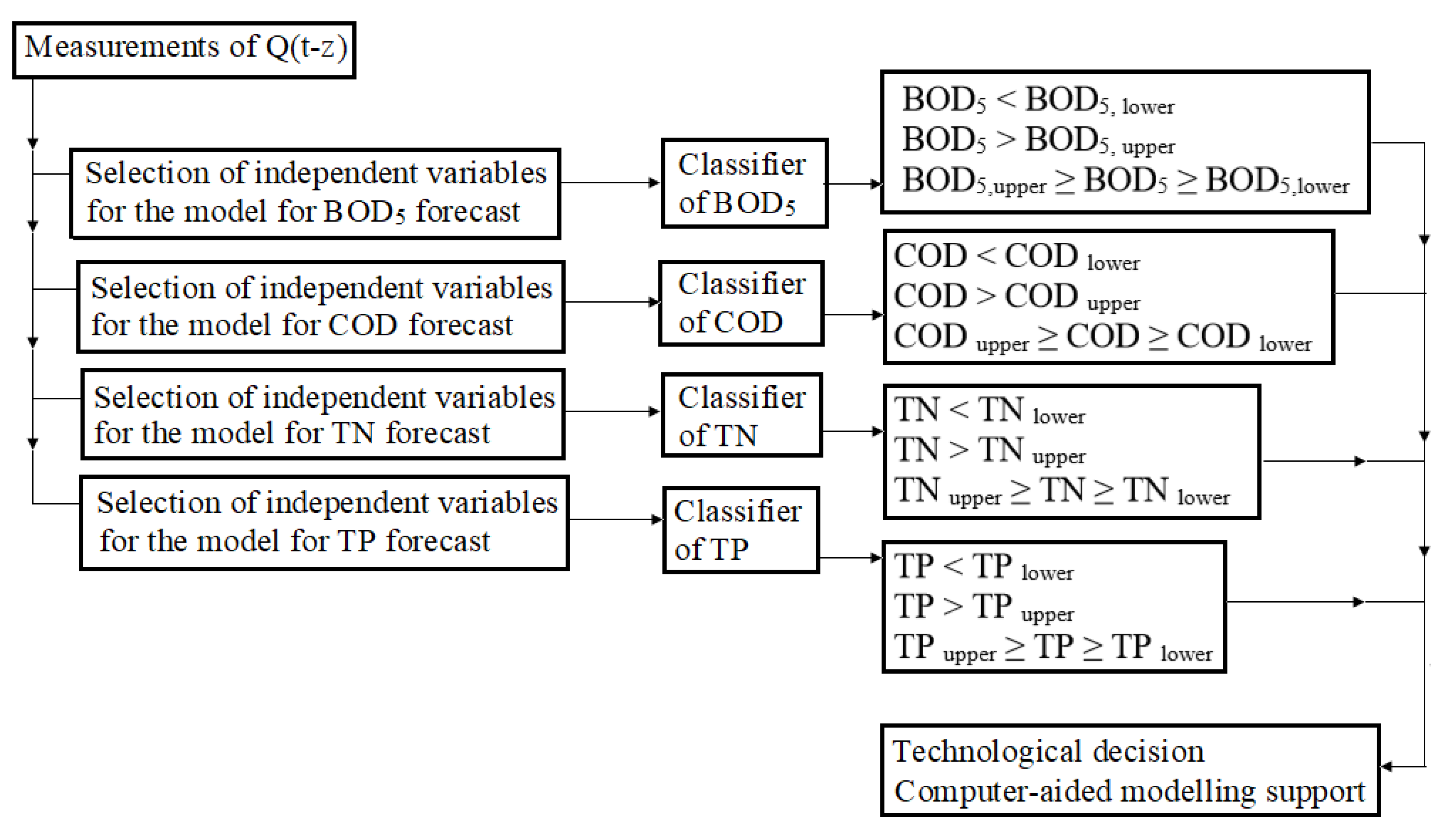
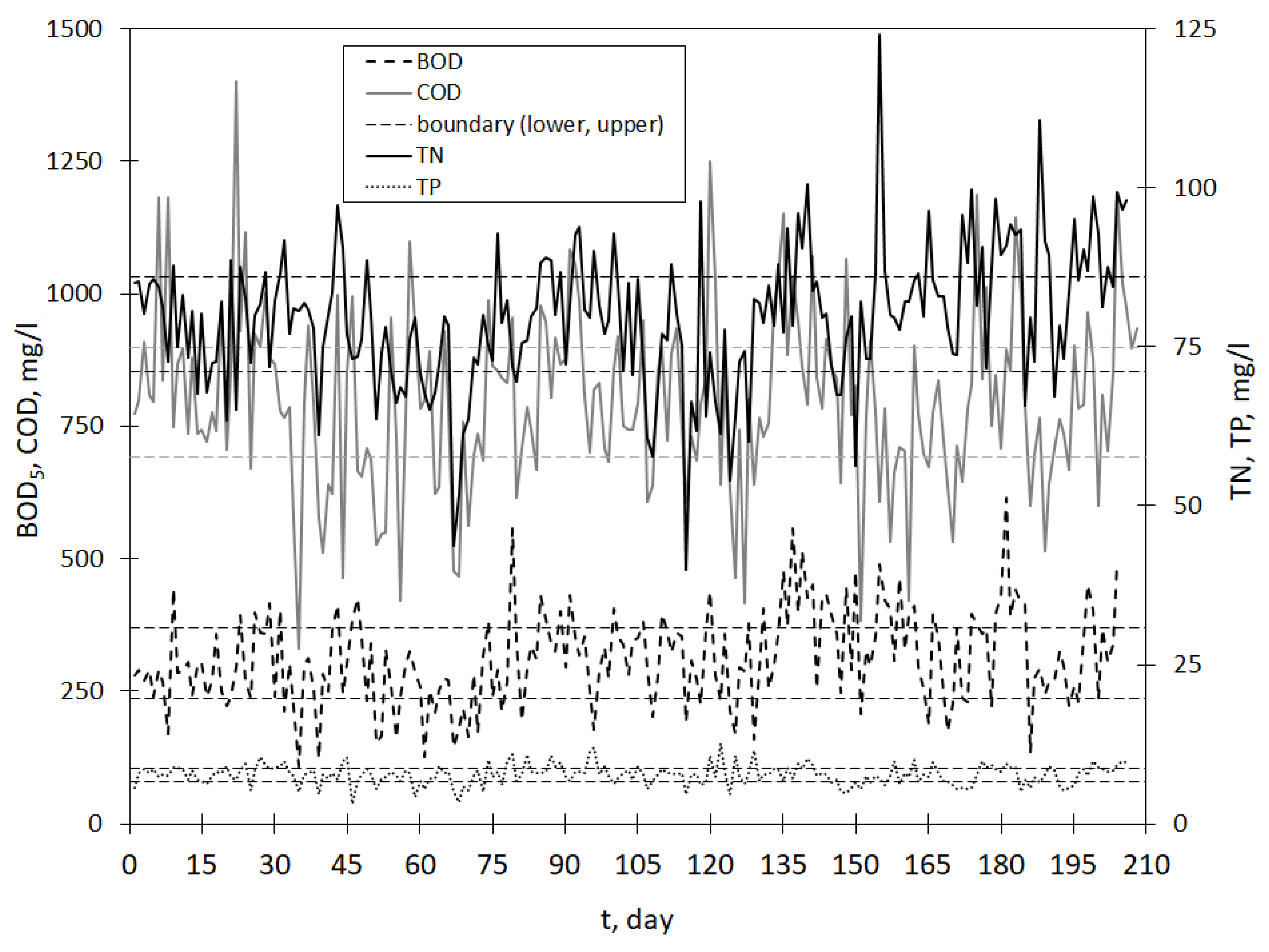
One of the important factors determining the biochemical processes in bioreactors is the quality of the wastewater inflow to the wastewater treatment plant (WWTP). Information on the quality of wastewater, sufficiently in advance, makes it possible to properly select bioreactor settings to obtain optimal process conditions. This paper presents the use of classification models to predict the variability of wastewater quality at the inflow to wastewater treatment plants, the values of which depend only on the amount of inflowing wastewater. The methodology of an expert system to predict selected indicators of wastewater quality at the inflow to the treatment plant (biochemical oxygen demand, chemical oxygen demand, total suspended solids, and ammonium nitrogen) on the example of a selected WWTP—Sitkówka Nowiny, was presented. In the considered system concept, a division of the values of measured wastewater quality indices into lower (reduced values of indicators in relation to average), average (typical and most common values), and upper (increased values) were adopted. On the basis of the calculations performed, it was found that the values of the selected wastewater quality indicators can be identified with sufficient accuracy by means of the determined statistical models based on the support vector machines and boosted trees methods.
Keywords: wastewater treatment plant; classification; wastewater quality; support vector machines; boosted trees wastewater treatment plant; classification; wastewater quality; support vector machines; boosted trees