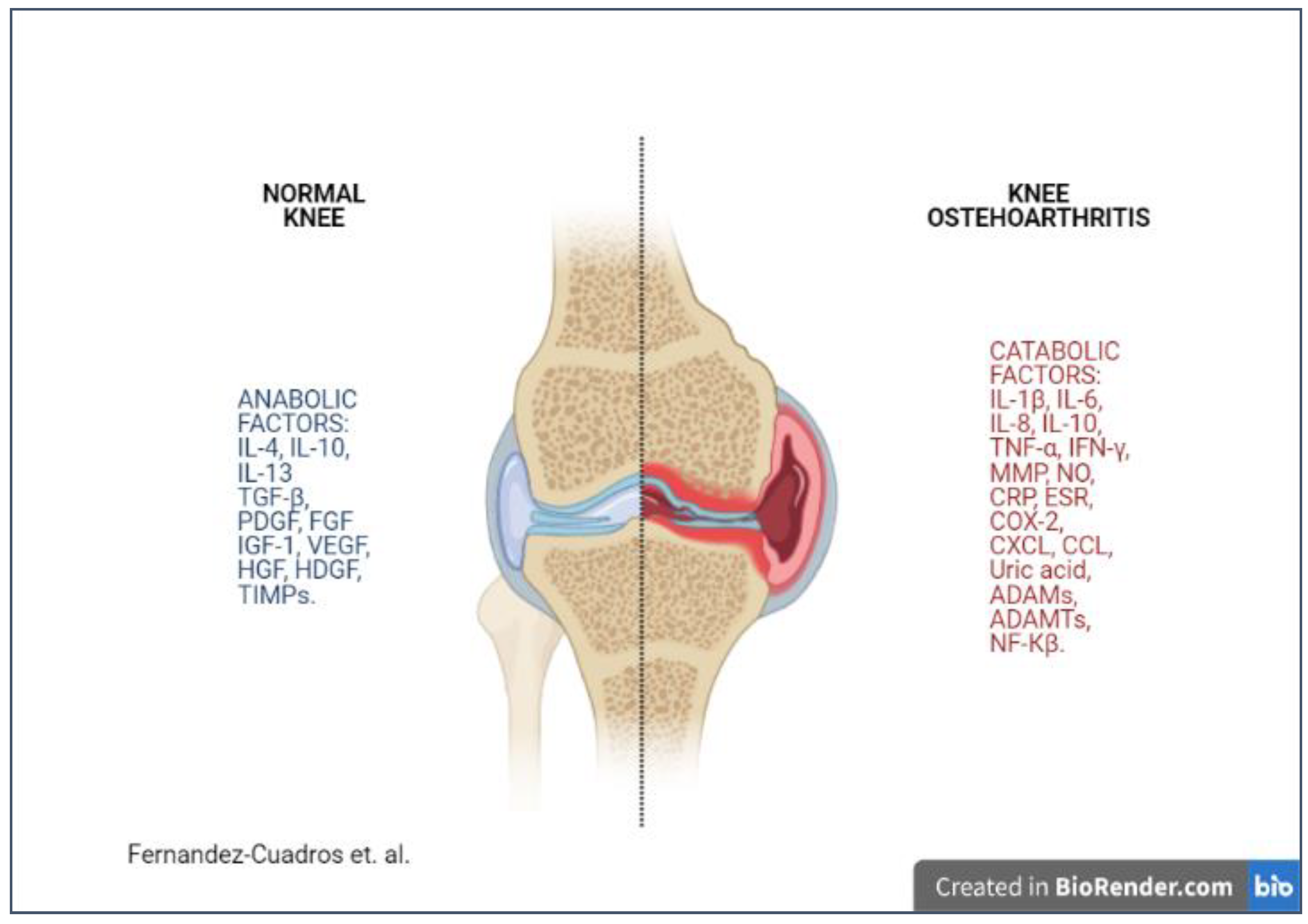
Intra Articular Ozone Modulates Inflammation and Has Anabolic Effect on Knee Osteoarthritis: IL-6 and IGF-1 as Pro-Inflammatory and Anabolic Biomarkers

 ,
, 
Abstract
1. Introduction
2. Material and Methods
3. Results
4. Discussion
5. Conclusions
Author Contributions
Funding
Institutional Review Board Statement
Informed Consent Statement
Data Availability Statement
Acknowledgments
Conflicts of Interest
Ethics Approval
References
- Fernández-Cuadros, M.E. Ozone Fundamentals and Effectiveness on Knee Pain: Chondromalacia and Knee Osteoarthritis; LAP LAMBERT Academic Publishing: Saarbrücken, Germany, 2016. [Google Scholar]
- Richards, M.M.; Maxwell, J.S.; Weng, L.; Angelos, M.G.; Golzarian, J. Intra-articular treatment of knee osteoarthritis: From anti-inflammatories to products of regenerative medicine. Phys. Sportsmed. 2016, 44, 101–108. [Google Scholar] [CrossRef]
- Fernandez-Cuadros, M.E.; Perez-Moro, O.S.; Mirón-Canelo, J.A. Could ozone be used as a feasible future treatment in osteoarthritis of the knee. Divers. Equal Health Care 2016, 13, 232–239. [Google Scholar] [CrossRef]
- Rankothgedera, S.; Atukorala, I.; Fernando, C.; Munidasa, D.; Wijayaratne, L.; Udagama, P. A potential diagnostic serum immunological marker panel to differentiate between primary and secondary knee osteoarthritis. PLoS ONE 2021, 16, e0257507. [Google Scholar] [CrossRef] [PubMed]
- Fernández-Cuadros, M.E.; Pérez-Moro, O.S.; Albaladejo-Florín, M.J.; Álava-Rabasa, S.; Tobar-Izquierdo, M.; Rodriguez-de-Cía, J. A new paradigm for the management of knee osteoarthritis: The role of hyaluronic acid, platelet-rich plasma (PRP) and ozone in the modulation of inflammation: A review. JSR 2020, 1–8. [Google Scholar] [CrossRef]
- Oliviero, A.; Giordano, L.; Maffulli, N. The temporal effect of intra-articular ozone injections on pain in knee osteoarthritis. Br. Med. Bull. 2019, 132, 33–44. [Google Scholar] [CrossRef] [PubMed]
- Higashi, Y.; Sukhanov, S.; Anwar, A.; Shai, S.Y.; Delafontaine, P. Aging, atherosclerosis, and IGF-1. J. Gerontol. Ser. A Biomed. Sci. Med. Sci. 2012, 67, 626–639. [Google Scholar] [CrossRef]
- Fernández-Cuadros, M.E.; Albaladejo-Florín, M.J.; Peña-Lora, D.; Álava-Rabasa, S.; Pérez-Moro, O.S. Ozone (O3) and SARS-CoV-2: Physiological bases and their therapeutic possibilities according to COVID-19 evolutionary stage. SN Compr. Clin. Med. 2020, 2, 1094–1102. [Google Scholar] [CrossRef]
- Fernández-Cuadros, M.E.; Pérez-Moro, O.; Albaladejo-Florin, M.J.; Álava-Rabasa, S. Intra-articular ozone modulates inflammation, ameliorates pain and rigidity, improves function and has anabolic effect on knee osteoarthritis: A prospective quasi-experimental before-and-after study, 115 patients. Rev. Soc. Esp. Dolor 2020, 27, 78–88. [Google Scholar]
- Fernandez-Cuadros, M.E.; Perez-Moro, O.S.; Albaladejo-Florin, M.J.; Algarra-Lopez, R. Ozone decreases biomarkers of inflamation (C-reactive protein and erytrocyte sedimentation rate) and improves pain, function and quality of life in knee osteoarthrtitis patients: A before-and-after study and review of the literature. Middle East J. Rehabil. Health 2018, 5, e64507. [Google Scholar] [CrossRef]
- Fernandez-Cuadros, M.E.; Perez-Moro, O.S.; Albaladejo-Florin, M.J.; Algarra-Lopez, R. Intra articular ozone reduces serum uric acid and improves pain, function and quality of life in knee osteoarthritis patients: A before-and-after study. Middle East J. Rehabil. Health 2018, 5, e68599. [Google Scholar] [CrossRef]
- Fernandez-Cuadros, M.E.; Susana Perez-Moro, O.; Jesus Albaladejo-Florin, M. Knee osteoarthritis: Condroprotector action and symptomatic effect of ozone on pain, function, quality of life, minimal joint space and knee arthroplasty delay. Middle East J. Rehabil. Health 2017, 4, e43200. [Google Scholar] [CrossRef]
- Fernández-Cuadros, M.E.; Pérez-Moro, O.S.; Albaladejo-Florín, M.J.; Álava-Rabasa, S. Symptomatic (Pain and Inflammation) and Disease-Modifying Effect (Minimal Joint Space) of Intra-articular Ozone (O2-O3) in Osteoarthritis of the Knee: A Clinical Case. SN Compr. Clin. Med. 2019, 1, 817–821. [Google Scholar] [CrossRef]
- Pan, F.; Tian, J.; Cicuttini, F.; Jones, G. Prospective Association Between Inflammatory Markers and Knee Cartilage Volume Loss and Pain Trajectory. Pain Ther. 2021, 1–13. [Google Scholar] [CrossRef]
- Livshits, G.; Zhai, G.; Hart, D.J.; Kato, B.S.; Wang, H.; Williams, F.M.; Spector, T.D. Interleukin-6 is a significant predictor of radiographic knee osteoarthritis: The Chingford study. Arthritis Rheum. 2009, 60, 2037–2045. [Google Scholar] [CrossRef] [PubMed]
- Pelletier, J.P.; Raynauld, J.P.; Caron, J.; Mineau, F.; Abram, F.; Dorais, M.; Haraoui, B.; Choquette, D.; Martel-Pelletier, J. Decrease in serum level of matrix metalloproteinases is predictive of the disease-modifying effect of osteoarthritis drugs assessed by quantitative MRI in patients with knee osteoarthritis. Ann. Rheum. Dis. 2010, 69, 2095–2101. [Google Scholar] [CrossRef] [PubMed]
- Richette, P.; Latourte, A.; Sellam, J.; Wendling, D.; Piperno, M.; Goupille, P.; Pers, Y.-M.; Eymard, F.; Ottaviani, S.; Ornetti, P.; et al. Efficacy of tocilizumab in patients with hand osteoarthritis: Double blind, randomised, placebo-controlled, multicentre trial. Ann. Rheum. Dis. 2021, 80, 349–355. [Google Scholar] [CrossRef] [PubMed]
- Manoto, S.L.; Maepa, M.J.; Motaung, S.K. Medical ozone therapy as a potential treatment modality for regeneration of damaged articular cartilage in osteoarthritis. Saudi J. Biol. Sci. 2018, 25, 672–679. [Google Scholar] [CrossRef] [PubMed]
- Mobasheri, A.; Rayman, M.P.; Gualillo, O.; Sellam, J.; Van Der Kraan, P.; Fearon, U. The role of metabolism in the pathogenesis of osteoarthritis. Nat. Rev. Rheumatol. 2017, 13, 302–311. [Google Scholar] [CrossRef]
- Xu, W.; Zhao, X.; Sun, P.; Zhang, C.; Fu, Z.; Zhou, D. The effect of medical ozone treatment on cartilage chondrocyte autophagy in a rat model of osteoarthritis. Am. J. Transl. Res. 2020, 12, 5967. [Google Scholar]
- Guo, R.; Zhang, G.; Zhang, L.; Liu, N.; Ren, L.; Fan, J.; Hou, J. The effect of intra-articular ozone injection on the cytokines of collagen-induced arthritis. Chin. J. Rheumatol. 2017, 21, 247–251. [Google Scholar]
- Vaillant, J.D.; Fraga, A.; Díaz, M.T.; Mallok, A.; Viebahn-Hänsler, R.; Fahmy, Z.; Barbera, A.; Delgado, L.; Menendez, S.; Fernández, O.S.L. Ozone oxidative postconditioning ameliorates joint damage and decreases pro-inflammatory cytokine levels and oxidative stress in PG/PS-induced arthritis in rats. Eur. J. Pharmacol. 2013, 714, 318–324. [Google Scholar] [CrossRef]
- Fernández, O.S.L.; Viebahn-Haensler, R.; Cabreja, G.L.; Espinosa, I.S.; Matos, Y.H.; Roche, L.D.; Santos, B.T.; Our, G.T.; Vega, J.C.P. Medical ozone increases methotrexate clinical response and improves cellular redox balance in patients with rheumatoid arthritis. Eur. J. Pharmacol. 2016, 789, 313–318. [Google Scholar] [CrossRef]
- Chang, J.D.; Lu, H.S.; Chang, Y.F.; Wang, D. Ameliorative effect of ozone on cytokine production in mice injected with human rheumatoid arthritis synovial fibroblast cells. Rheumatol. Int. 2005, 26, 142–151. [Google Scholar] [CrossRef] [PubMed]
- Zhang, W.; Wang, F.; Zhang, L.; Sun, T.; Fu, Z. Intrathecal injection of ozone alleviates CCI-induced neuropathic pain via the GluR6-NF-κB/p65 signalling pathway in rats. Mol. Med. Rep. 2021, 23, 231. [Google Scholar] [CrossRef] [PubMed]
- Gultekin, F.A.; Cakmak, G.K.; Turkcu, U.O.; Yurdakan, G.; Demir, F.E.O.; Comert, M. Effects of ozone oxidative preconditioning on liver regeneration after partial hepatectomy in rats. J. Investig. Surg. 2013, 26, 242–252. [Google Scholar] [CrossRef]
- Yıldız, A.; Şehitoğlu, M.H.; Karaboğa, İ.; Arıkan, S. Ozone treatment for high-dose systemic Steroid-Induced retinal injury. Cutan. Ocul. Toxicol. 2020, 39, 274–280. [Google Scholar] [CrossRef]
- Calunga, J.L.; Zamora, Z.B.; Borrego, A.; Río, S.D.; Barber, E.; Menéndez, S.; Taboada, D. Ozone therapy on rats submitted to subtotal nephrectomy: Role of antioxidant system. Mediat. Inflamm. 2005, 2005, 221–227. [Google Scholar] [CrossRef] [PubMed]
- Souza, Y.M.D.; Fontes, B.; Martins, J.O.; Sannomiya, P.; Brito, G.S.; Younes, R.N.; Rasslan, S. Evaluation of the effects of ozone therapy in the treatment of intra-abdominal infection in rats. Clinics 2010, 65, 195–202. [Google Scholar] [CrossRef] [PubMed][Green Version]
- Gürkan, G.; Sayin, M.; Kizmazoglu, C.; Erdogan, M.A.; Yigitturk, G.; Yilmaz, H.E.; Uzunoglu, I.; Kaya, I.; Yuceer, N. Evaluation of the neuroprotective effects of ozone in an experimental spine injury model. J. Neurosurg. 2020, 33, 406–414. [Google Scholar] [CrossRef]
- Zamora, Z.B.; Menéndez, S.; Bette, M.; Mutters, R.; Hoffmann, S.; Schulz, S. Ozone Prophylactic Effect and Antibiotics as a Modulator of Inflamatory Septic process in Rats. In Proceedings of the 16th International Ozone Association World Congress, Las Vegas, NV, USA, 31 August–5 September 2003; p. 123. [Google Scholar]
- Ersoz, N.; Ozler, M.; Topal, T.; Uysal, B.; Poyrazoglu, Y.; Simsek, K.; Gocgeldi, E.; Korkmaz, A. The effect of ozone treatment on experimental colon anastomosis in rats. Eur. Surg. 2016, 48, 122–128. [Google Scholar] [CrossRef]
- Merhi, Z.; Garg, B.; Moseley-LaRue, R.; Moseley, A.R.; Smith, A.H.; Zhang, J. Ozone therapy: A potential therapeutic adjunct for improving female reproductive health. Med. Gas Res. 2019, 9, 101. [Google Scholar] [CrossRef]
- Yu, G.; Liu, X.; Chen, Z.; Chen, H.; Wang, L.; Wang, Z.; Qiu, T.; Weng, X. Ozone therapy could attenuate tubulointerstitial injury in adenine-induced CKD rats by mediating Nrf2 and NF-κB. Iran. J. Basic Med. Sci. 2016, 19, 1136. [Google Scholar]
- Chen, Z.; Liu, X.; Yu, G.; Chen, H.; Wang, L.; Wang, Z.; Qiu, T.; Weng, X. Ozone therapy ameliorates tubulointerstitial inflammation by regulating TLR4 in adenine-induced CKD rats. Ren. Fail. 2016, 38, 822–830. [Google Scholar] [CrossRef] [PubMed]
- Isik, A.; Peker, K.; Gursul, C.; Sayar, I.; Firat, D.; Yilmaz, I.; Demiryilmaz, I. The effect of ozone and naringin on intestinal ischemia/reperfusion injury in an experimental model. Int. J. Surg. 2015, 21, 38–44. [Google Scholar] [CrossRef]
- Vitale, G.; Pellegrino, G.; Vollery, M.; Hofland, L.J. ROLE of IGF-1 system in the modulation of longevity: Controversies and new insights from a centenarians’ perspective. Front. Endocrinol. 2019, 10, 27. [Google Scholar] [CrossRef] [PubMed]
- Bailes, J.; Soloviev, M. Insulin-Like Growth Factor-1 (IGF-1) and Its Monitoring in Medical Diagnostic and in Sports. Biomolecules 2021, 11, 217. [Google Scholar] [CrossRef] [PubMed]
- Kuang, J.; Zhang, L.; Xu, Y.; Xue, J.; Liang, S. Association between insulin-like growth factor 1 and insulin resistance in obese prepubertal boys: A cross-sectional study. Res. Sq. 2020, 1–10. [Google Scholar] [CrossRef]
- Muench, L.N.; Tamburini, L.; Kriscenski, D.; Landry, A.; Berthold, D.P.; Kia, C.; Cote, M.P.; McCarthy, M.B.; Mazzocca, A.D. The Effect of Insulin and Insulin-like Growth Factor 1 (IGF-1) on Cellular Proliferation and Migration of Human Subacromial Bursa Tissue. Arthrosc. Sports Med. Rehabil. 2021; in press. [Google Scholar] [CrossRef] [PubMed]
- Roubenoff, R.; Parise, H.; Payette, H.A.; Abad, L.W.; D’Agostino, R.; Jacques, P.F.; Wilson, P.W.F.; Dinarello, C.A.; Harris, T.B. Cytokines, insulin-like growth factor 1, sarcopenia, and mortality in very old community-dwelling men and women: The Framingham Heart Study. Am. J. Med. 2003, 115, 429–435. [Google Scholar] [CrossRef]
- Bleumink, G.S.; Schut, A.F.C.; Sturkenboom, M.C.J.M.; Janssen, J.A.M.J.L.; Witteman, J.C.M.; Van Duijn, C.M.; Hofman, A.; Stricker, B.C. A promoter polymorphism of the insulin-like growth factor-I gene is associated with left ventricular hypertrophy. Heart 2005, 91, 239–240. [Google Scholar] [CrossRef][Green Version]
- Loh, K.; Deng, H.; Fukushima, A.; Cai, X.; Boivin, B.; Galic, S.; Bruce, C.; Shields, B.J.; Skiba, B.; Ooms, L.M.; et al. Reactive oxygen species enhance insulin sensitivity. Cell Metab. 2009, 10, 260–272. [Google Scholar] [CrossRef]
- Saleh, S.; El-Ridi, M.; Zalat, S.; El-Kotb, S.; Donia, S. Additive effect of ozone therapy to insulin in the treatment of diabetic rats. Menoufia Med. J. 2014, 27, 85. [Google Scholar]
- Erken, H.A.; Genc, O.; Erken, G.; Ayada, C.; Gündoğdu, G.; Doğan, H. Ozone partially prevents diabetic neuropathy in rats. Exp. Clin. Endocrinol. Diabetes 2015, 123, 101–105. [Google Scholar] [CrossRef]
- Morsy, M.D.; Hassan, W.N.; Zalat, S.I. Improvement of renal oxidative stress markers after ozone administration in diabetic nephropathy in rats. Diabetol. Metab. Syndr. 2010, 2, 1–7. [Google Scholar] [CrossRef]
- Martínez-Sánchez, G.; Al-Dalain, S.M.; Menéndez, S.; Re, L.; Giuliani, A.; Candelario-Jalil, E.; Álvarez, H.; Fernández-Montequín, J.I.; León, O.S. Therapeutic efficacy of ozone in patients with diabetic foot. Eur. J. Pharmacol. 2005, 523, 151–161. [Google Scholar] [CrossRef]
- Mohammadjafari, H.; Arazi, H.; Nemati, N.; Bagherpoor, T.; Suzuki, K. Acute Effects of Resistance Exercise and the Use of GH or IGF-1 Hormones on Oxidative Stress and Antioxidant Markers in Bodybuilders. Antioxidants 2019, 8, 587. [Google Scholar] [CrossRef]
- Üstebay, S.; Özturk, Ö.; Bilge, A.L.İ.; Üstebay, D.Ü.; Tezcan, A.H. Impacts of ozone treatment and its relationship with IGF-1 levels after injury of soft tissue: An experimental study in rats model. Kafkas Üniv. Vet. Fakültesi Dergisi 2017, 23, 967–971. [Google Scholar] [CrossRef]
- Kizilkaya, V.; Uruc, V.; Levent, A.; Kanat, O.; Yildizgoren, M.T.; Dogramaci, Y.; Kalaci, A. Effectiveness of Ozone Therapy on Tendon Healing: An Experimental Study in Generated Achilles Tendon Injury Model in Rats. J. Hard Tissue Biol. 2018, 27, 309–314. [Google Scholar] [CrossRef]
- Duman, I.G.; Davul, S.; Gokce, H.; Gonenci, R.; Özden, R.; Uruc, V. Effects of gaseous ozone treatment on bone regeneration in femoral defect model in rats. J. Hard Tissue Biol. 2017, 26, 7–12. [Google Scholar] [CrossRef][Green Version]
- Philippou, A.; Maridaki, M.; Halapas, A.; Koutsilieris, M. The role of the insulin-like growth factor 1 (IGF-1) in skeletal muscle physiology. In Vivo 2007, 21, 45–54. [Google Scholar] [PubMed]
- Wang, Y.; Sun, H.; Qin, S. Clinical efficacy of lumbar interbody fusion using a channel system combined with ozone therapy for the treatment of central-type L3-L4 lumbar disc herniation. Exp. Ther. Med. 2017, 13, 619–623. [Google Scholar] [CrossRef] [PubMed][Green Version]


| Analyzed Groups | AGE Years | IL-6 Pre pg/mL | IL-6 Post pg/mL | p | IGF-1 Pre ng/mL | IGF-1 Post ng/mL | p |
|---|---|---|---|---|---|---|---|
| OA all patients (n = 65) | 67 | 2.07 ± 2.8 | 1.59 ± 1.83 | 0.0684 | 112.09 ± 40.96 | 107.19 ± 36.04 | 0.0299 * |
| OA KL 2° (n = 36) | 62 | 2.19 ± 3.33 | 1.57 ± 1.76 | 117.06 ± 48.67 | 111.91 ± 41.29 | ||
| OA KL 3° (n = 21) | 71 | 2.43 ± 2.55 | 1.99 ± 2.29 | 93.2 ± 23.12 | 93.28 ± 25.01 | ||
| OA KL 4° (n = 8) | 76 | 0.63 ± 0.23 | 0.65 ± 0.43 | 139.3 ± 24.34 | 122.46 ± 28.38 | ||
| OA without DM/obesity (n = 51) | 68.09 | 2.35 ± 3.07 | 1.75 ± 1.94 | 0.0697 | 100.17 ± 28.63 | 102.03 ± 30.67 | 0.2198 |
| OA KL 2° (n = 28) | 63.92 | 2.44 ± 3.51 | 1.64 ± 1.72 | 102.34 ± 31.25 | 104.86 ± 33.59 | ||
| OA KL 3° (n = 19) | 72 | 2.60 ± 2.63 | 2.10 ±2.38 | 90.51 ± 22.16 | 9270 ± 25.59 | ||
| OA KL 4° (n = 4) | 78.75 | 0,5± 0.01 | 0.80 ± 0.60 | 130.85 ± 6.63 | 126.55 ± 12.83 | ||
| OA + DM + obesity (n = 14) | 60.85 | 1.09 ± 0.91 | 1.03 ± 1.23 | 0.8383 | 155.59 ± 50.16 | 125.98 ± 47.87 | 0.0001 * |
| OA KL 2° (n = 8) | 53.87 | 1.31 ± 1.16 | 1.33 ± 1.57 | 168.59 ± 59.23 | 136.58 ± 55.45 | ||
| OA KL 3° (n = 2) | 64.50 | 0.87 ± 0.53 | 0.92 ± 0.59 | 118.75 ± 20.15 | 98.83 ± 25.54 | ||
| OA KL 4° (n = 4) | 73 | 0.76 ± 0.29 | 0.50 ± 0.11 | 147.75 ± 33.88 | 118.37 ± 40.87 |
| Variables | Pre Treatment | Post Treatment | p |
|---|---|---|---|
| Biochemical Variables | |||
| IL-6 pg/mL (mean ± SD) | 2.07 ± 2.80 | 1.59 ± 1.83 | 0.0684 |
| IGF-1 ng/mL (mean ± SD) | 112.09 ± 40.96 | 107.19 ± 36.04 | 0.0299 * |
| CRP mg/mL (mean ± SD) | 0.42 ± 0.47 | 0.32 ± 0.35 | 0.0126 * |
| Uric acid mg/mL (mean ± SD) | 5.12 ± 1.21 | 5.10 ± 1.13 | 0.4436 |
| ESR mm/h (mean ± SD) | 12.35 ± 8.48 | 11.11 ± 8.11 | 0.0287 * |
| Clinical Variables | |||
| VAS pain (0–10) mean ± SD | 6.89 ± 0.93 | 3.87 ± 1.62 | 0.0001 * |
| WOMAC pain (0–20) mean ± SD | 13.83 ± 1.91 | 7.75 ± 3.25 | 0.0001 * |
| WOMAC stiffness (0–8) mean ± SD | 2.71 ± 1.27 | 1.37 ± 1.15 | 0.0001 * |
| WOMAC function (0–68) mean ± SD | 41.60 ± 7.95 | 27.70 ± 9.43 | 0.0001 * |
Publisher’s Note: MDPI stays neutral with regard to jurisdictional claims in published maps and institutional affiliations. |
© 2022 by the authors. Licensee MDPI, Basel, Switzerland. This article is an open access article distributed under the terms and conditions of the Creative Commons Attribution (CC BY) license (https://creativecommons.org/licenses/by/4.0/).
Share and Cite
Fernández-Cuadros, M.E.; Pérez-Moro, O.S.; Albaladejo-Florín, M.J.; Tobar-Izquierdo, M.M.; Magaña-Sánchez, A.; Jiménez-Cuevas, P.; Rodríguez-de-Cía, J. Intra Articular Ozone Modulates Inflammation and Has Anabolic Effect on Knee Osteoarthritis: IL-6 and IGF-1 as Pro-Inflammatory and Anabolic Biomarkers. Processes 2022, 10, 138. https://doi.org/10.3390/pr10010138
Fernández-Cuadros ME, Pérez-Moro OS, Albaladejo-Florín MJ, Tobar-Izquierdo MM, Magaña-Sánchez A, Jiménez-Cuevas P, Rodríguez-de-Cía J. Intra Articular Ozone Modulates Inflammation and Has Anabolic Effect on Knee Osteoarthritis: IL-6 and IGF-1 as Pro-Inflammatory and Anabolic Biomarkers. Processes. 2022; 10(1):138. https://doi.org/10.3390/pr10010138
Chicago/Turabian StyleFernández-Cuadros, Marcos E., Olga S. Pérez-Moro, María J. Albaladejo-Florín, María M. Tobar-Izquierdo, Amelia Magaña-Sánchez, Patricia Jiménez-Cuevas, and Javier Rodríguez-de-Cía. 2022. "Intra Articular Ozone Modulates Inflammation and Has Anabolic Effect on Knee Osteoarthritis: IL-6 and IGF-1 as Pro-Inflammatory and Anabolic Biomarkers" Processes 10, no. 1: 138. https://doi.org/10.3390/pr10010138
APA StyleFernández-Cuadros, M. E., Pérez-Moro, O. S., Albaladejo-Florín, M. J., Tobar-Izquierdo, M. M., Magaña-Sánchez, A., Jiménez-Cuevas, P., & Rodríguez-de-Cía, J. (2022). Intra Articular Ozone Modulates Inflammation and Has Anabolic Effect on Knee Osteoarthritis: IL-6 and IGF-1 as Pro-Inflammatory and Anabolic Biomarkers. Processes, 10(1), 138. https://doi.org/10.3390/pr10010138