1. Introduction
AI-enabled information systems are now part of how universities communicate with prospective students, current students, alumni, staff, and external stakeholders. Institutional interactions may be made more responsive through the use of chatbots, personalised information services, recommendation engines, predictive engagement systems, and AI-assisted communication tools. However, the extent to which these technologies are adopted by stakeholders is a function of those stakeholders’ interpretation of institutional credibility, emotional relevance, and perceived risk of algorithmic mediation. Thus, the adoption of AI in higher education is a social-informatics inquiry rather than a technical inquiry; the same technology may be accepted, resisted, or used cautiously based on trust, emotion, transparency, and perceived autonomy.
The Technology Acceptance Model explains adoption through perceived usefulness and ease of use [
1,
2,
3], while relationship-marketing and organizational-trust research helps explain why stakeholders are more willing to use institutionally mediated services when they perceive the provider as credible and trustworthy [
4,
5,
6,
7]. In AI-enabled academic marketing, these perspectives matter because algorithmic systems may be opaque, probabilistic, and personally consequential. Recent reviews of AI in higher education emphasize not only support and personalisation, but also recurring concerns about transparency, trustworthiness, reliability, ethics, and responsible deployment [
8,
9,
10,
11,
12,
13,
14,
15,
16,
17,
18,
19,
20,
21,
22,
23,
24]. Recent evidence also continues to connect AI acceptance in education with TAM/SEM traditions and trust-oriented adoption mechanisms [
14,
25,
26].
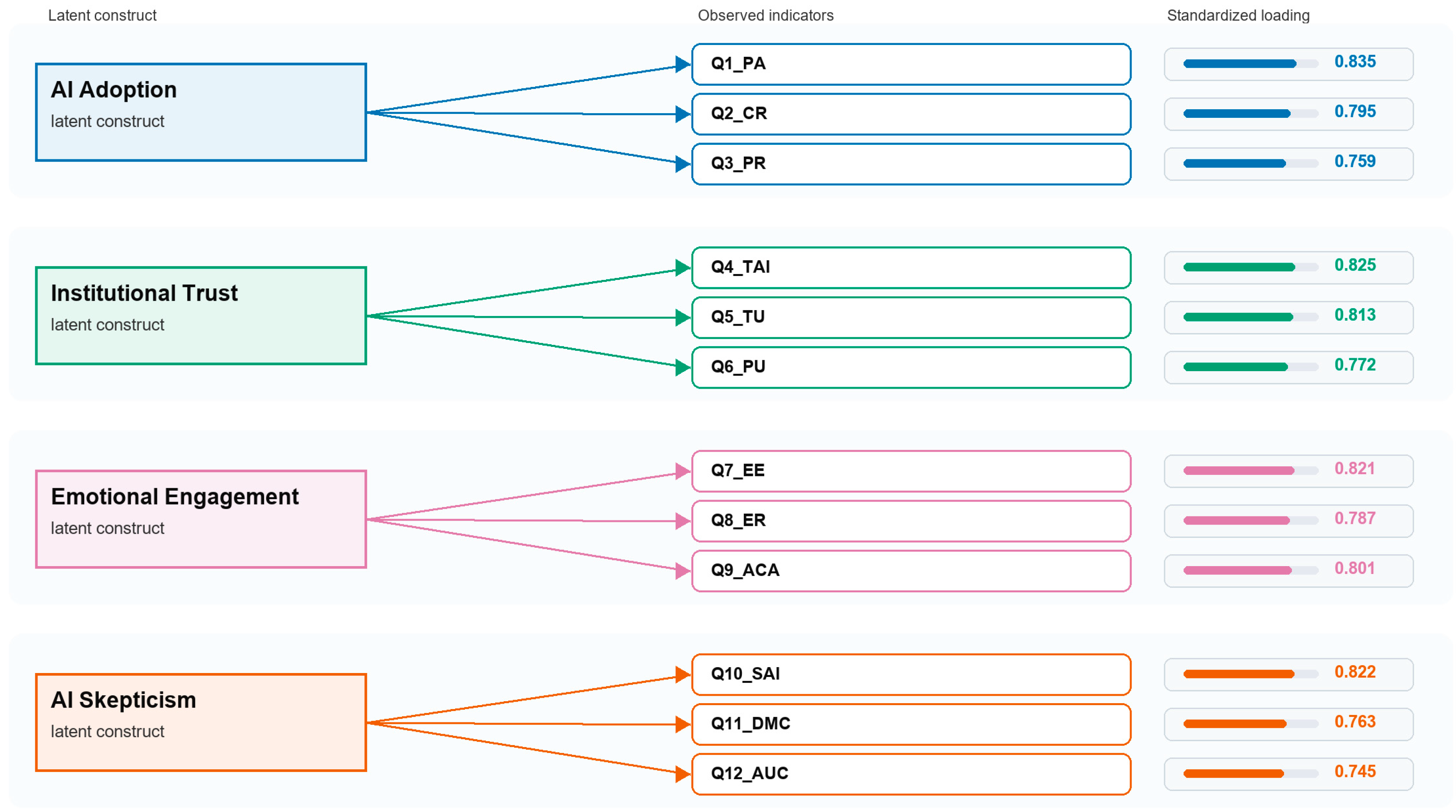
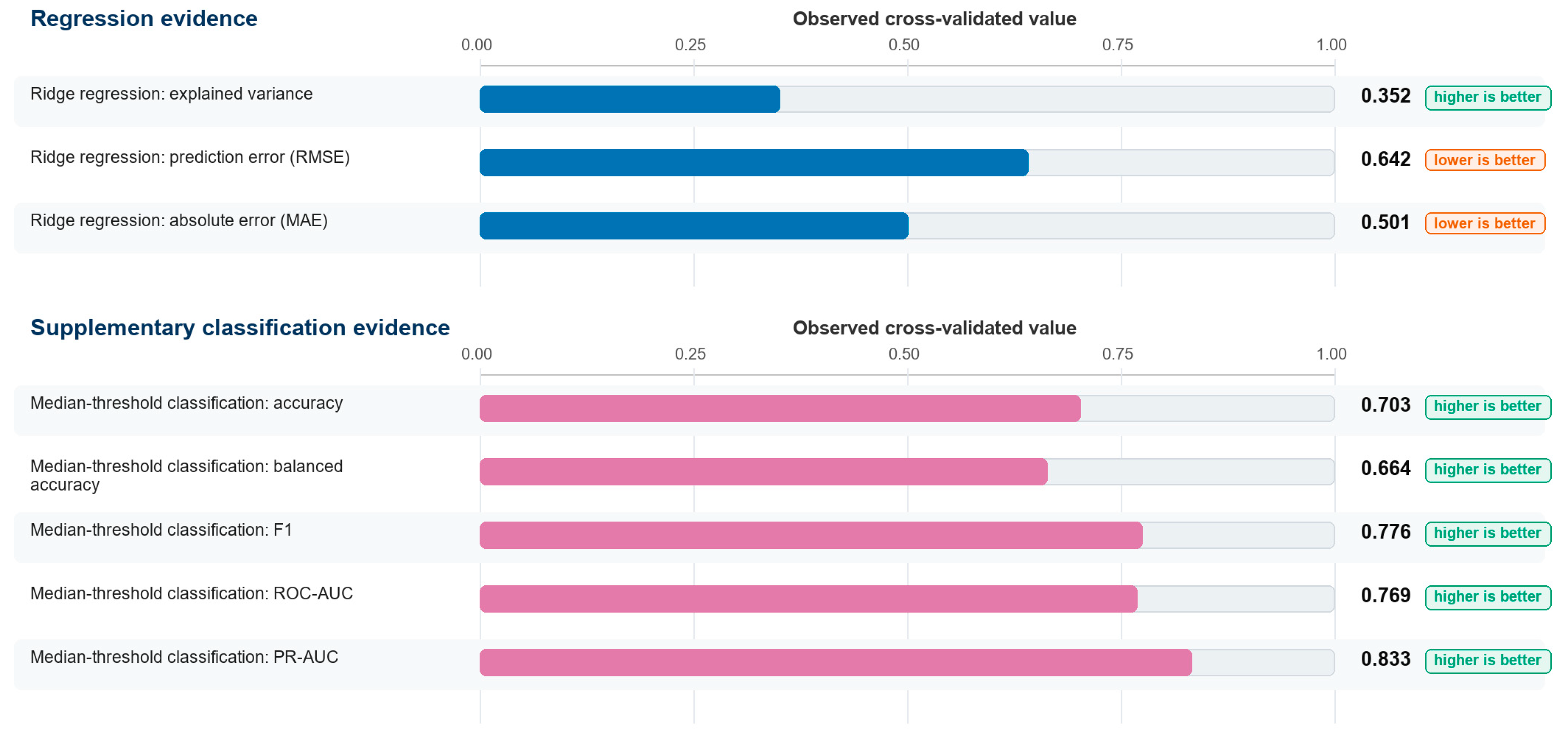
This article develops and tests a Trust-Tech Nexus perspective in which AI Adoption is examined in relation to Institutional Trust, Emotional Engagement, and AI Skepticism. The contribution is not the invention of entirely new constructs, but their context-specific integration for AI-enabled academic marketing in higher education, the transparent 12-item operationalization, and the combination of ordered-indicator CFA with out-of-sample predictive validation. The study addresses three research questions, as follows: RQ1, does the proposed four-construct measurement structure meet accepted reliability and validity standards? RQ2, how are Institutional Trust, Emotional Engagement, and AI Skepticism associated with AI Adoption? RQ3, do these constructs provide meaningful cross-validated predictive evidence for AI Adoption? The machine learning component is used as a predictive and exploratory supplement, not as causal evidence [
27,
28,
29,
30,
31,
32]. Practically, the findings are intended to inform how universities design and govern AI-enabled academic communication including AI chatbots, personalised communication, recommendation systems, and predictive information services so that adoption is reinforced by institutional trust and emotional engagement while skepticism is addressed through transparency rather than treated as mere resistance. Within Informatics, the study is positioned at the intersection of AI-enabled information systems, institutional trust, human– technology interaction, and the social conditions that shape stakeholder adoption in higher education.
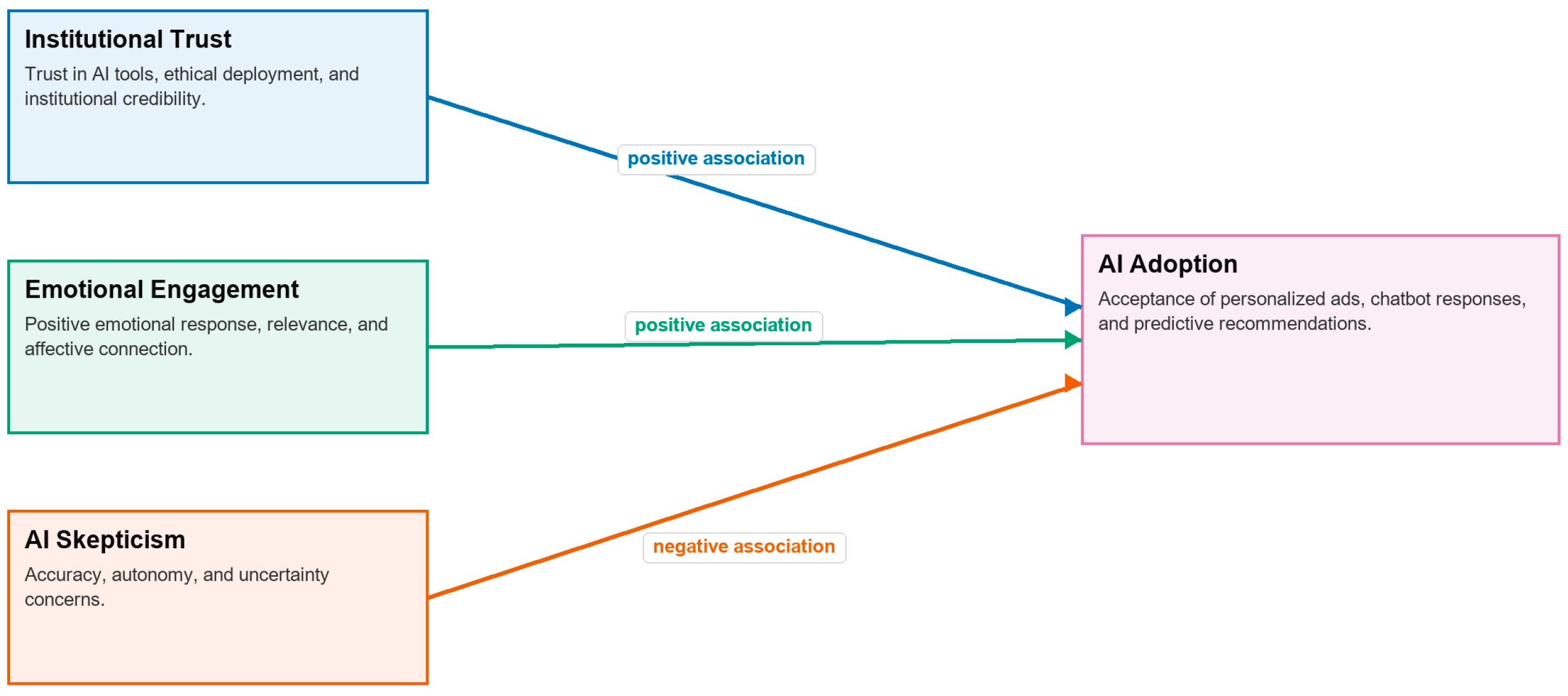
Figure 1 presents the Trust-Tech Nexus conceptual framework used to organize the theoretical relationships among Institutional Trust, Emotional Engagement, AI Skepticism, and AI Adoption.
The framework positions AI Adoption as a stakeholder response shaped by Institutional Trust, Emotional Engagement, and AI Skepticism within an institutionally mediated academic communication and decision-support environment. Institutional Trust and Emotional Engagement are specified as positive correlates because greater perceived institutional credibility and stronger affective engagement are expected to increase stakeholder willingness to use AI-enabled academic communication tools. By contrast, AI Skepticism is specified as a negative correlate because concerns about opacity, inaccuracy, and reduced autonomy are expected to reduce willingness to rely on AI-supported institutional interactions. The model is conceptually bounded to the higher-education context and is not proposed as a universal framework for all forms of AI adoption.
3. Materials and Methods
3.1. Research Design and Dataset
This study used a cross-sectional survey design to examine stakeholder responses to AI-enabled academic communication and service interactions in a higher-education setting. Data were collected between 1 January 2024 and 31 December 2024 at MIT Art, Design and Technology University, Pune, India. The dataset consists of respondent-level survey data and contains 300 valid completed responses with no missing values for the 12 Likert-scale indicators used in the core analysis. Each indicator was measured on a five-point scale ranging from 1 = Strongly Disagree to 5 = Strongly Agree. The design supports psychometric validation and predictive modelling, but it does not support causal inference.
Purposive sampling was used because the target population consisted of stakeholders with awareness of, or exposure to, AI-enabled academic communication tools and services, including chatbots, personalised advertisements, recommendation systems, and AI-supported institutional information services. Inclusion was therefore based on stakeholder relevance to the institution’s academic communication environment rather than random selection from a broader population. Because the survey link was distributed through institutional communication channels and the number of unique invited participants was not archived in a verifiable way, a precise response rate could not be calculated.
The final dataset combined UG students, PG students, faculty, administrative staff, and other institutionally relevant respondents into one pooled stakeholder population. This approach was adopted because the principal aim of the study was institution-level construct validation and predictive testing within a shared AI-supported academic communication environment, rather than subgroup comparison. Although respondents may not all have interacted with an identical interface, they were recruited from the same institutional AI-supported communication environment. The focus of the analysis was therefore on whether the proposed Trust-Tech Nexus constructs and their relationships were empirically defensible across the institutional communication ecosystem as a whole. At the same time, these stakeholder groups may differ in their experiences of, expectations of, and reliance on AI-enabled academic marketing. Accordingly, the pooled analysis should not be interpreted as implying subgroup equivalence, and subgroup-specific analyses remain an important direction for future research.
Initial data screening confirmed 300 usable cases, zero duplicated respondent identifiers, complete responses for all Q1–Q12 items, and valid five-point Likert ranges for every measurement indicator. Demographic variables were retained for sample description and supplementary control models, whereas the primary predictive models used only the construct-level predictors in order to preserve interpretive clarity and avoid unnecessary dimensionality. Sample adequacy was evaluated with reference to both the measurement model and the predictive analysis. For WLSMV CFA,
N = 300 is adequate for a four-factor model with 12 ordered indicators. The predictive models were intentionally low-dimensional and evaluated using deterministic 10-fold cross-validation to reduce overfitting and provide an out-of-sample assessment of predictive utility. Because the study was designed as an exploratory institution-level validation exercise, the pooled analysis is used to characterize the shared higher-education communication environment rather than to imply that every subgroup experienced AI-enabled services in the same way. The respondent profile and study context utilized in the empirical analyses are presented in
Table 1.
Table 1 shows that the study reflects a single-institution higher-education stakeholder sample drawn from MIT Art, Design and Technology University, Pune, India. The respondent pool includes students, faculty, administrative staff, and other institutionally relevant respondents, and should therefore be interpreted as institution-level exploratory evidence rather than as a representative sample of a broader population.
Table 2 reports descriptive statistics for the principal internal stakeholder groups, as follows: students, faculty, and administrative staff. Groupwise descriptive comparisons did not indicate differences of a magnitude that would invalidate pooled institution-level exploratory analysis; therefore, the variables were modelled for the sample as a whole. One-way ANOVA results likewise did not indicate statistically notable between-group mean differences for AI Adoption (F = 0.041,
p = 0.959), Institutional Trust (F = 0.678,
p = 0.509), Emotional Engagement (F = 0.038,
p = 0.963), or AI Skepticism (F = 0.179,
p = 0.836).
Author Contributions
Conceptualization, P.D. and G.W.; methodology, P.D.; validation, P.D., G.W. and R.K.; formal analysis, P.D.; investigation, P.D.; resources, G.W. and R.K.; data curation, P.D.; writing—original draft preparation, P.D.; writing—review and editing, G.W. and R.K.; visualization, P.D.; supervision, G.W. and R.K.; project administration, P.D. All authors have read and agreed to the published version of the manuscript.
Funding
This research received no external funding.
Institutional Review Board Statement
The study was conducted in accordance with the Declaration of Helsinki and was reviewed and approved by the Research Ethics Committee (REC) of MIT Art, Design & Technology University, Pune, India (approval number: MITADTU/REC/007/2023; date of approval: 1 December 2023).
Informed Consent Statement
Informed consent was obtained from all participants involved in the study. Survey participation used anonymised respondent coding, and the dataset used for analysis did not contain personally identifying information.
Data Availability Statement
The dataset and analysis materials are available from the authors on reasonable request, subject to institutional ethics and privacy requirements.
Acknowledgments
The authors acknowledge MIT Art, Design & Technology University, Pune, for institutional support during the study. During preparation of this manuscript, AI-assisted editorial support was used for language refinement and structural checking only; the authors reviewed and edited the output and take full responsibility for the content of the publication.
Conflicts of Interest
The authors declare no conflicts of interest.
References
- Davis, F.D. Perceived usefulness, perceived ease of use, and user acceptance of information technology. MIS Q. 1989, 13, 319–340. [Google Scholar] [CrossRef] [Scilit] [PubMed]
- Venkatesh, V.; Morris, M.G.; Davis, G.B.; Davis, F.D. User acceptance of information technology: Toward a unified view. MIS Q. 2003, 27, 425–478. [Google Scholar] [CrossRef] [Scilit]
- Venkatesh, V.; Thong, J.Y.L.; Xu, X. Consumer acceptance and use of information technology: Extending the unified theory of acceptance and use of technology. MIS Q. 2012, 36, 157–178. [Google Scholar] [CrossRef] [Scilit]
- Morgan, R.M.; Hunt, S.D. The commitment-trust theory of relationship marketing. J. Mark. 1994, 58, 20–38. [Google Scholar] [CrossRef] [Scilit]
- Mayer, R.C.; Davis, J.H.; Schoorman, F.D. An integrative model of organizational trust. Acad. Manag. Rev. 1995, 20, 709–734. [Google Scholar] [CrossRef] [Scilit]
- Pavlou, P.A. Consumer acceptance of electronic commerce: Integrating trust and risk with the Technology Acceptance Model. Int. J. Electron. Commer. 2003, 7, 101–134. [Google Scholar] [CrossRef] [Scilit]
- Gefen, D.; Karahanna, E.; Straub, D.W. Trust and TAM in online shopping: An integrated model. MIS Q. 2003, 27, 51–90. [Google Scholar] [CrossRef] [Scilit]
- Zawacki-Richter, O.; Marín, V.I.; Bond, M.; Gouverneur, F. Systematic review of research on artificial intelligence applications in higher education: Where are the educators? Int. J. Educ. Technol. High. Educ. 2019, 16, 39. [Google Scholar] [CrossRef] [Scilit]
- Popenici, S.A.D.; Kerr, S. Exploring the impact of artificial intelligence on teaching and learning in higher education. Res. Pract. Technol. Enhanc. Learn. 2017, 12, 22. [Google Scholar] [CrossRef] [Scilit] [PubMed]
- Khosravi, H.; Shum, S.B.; Chen, G.; Conati, C.; Tsai, Y.-S.; Kay, J.; Knight, S.; Martinez-Maldonado, R.; Sadiq, S.; Gašević, D. Explainable artificial intelligence in education. Comput. Educ. Artif. Intell. 2022, 3, 100074. [Google Scholar] [CrossRef] [Scilit]
- Ouyang, F.; Jiao, P. Artificial intelligence in education: The three paradigms. Comput. Educ. Artif. Intell. 2021, 2, 100020. [Google Scholar] [CrossRef] [Scilit]
- Kasneci, E.; Sessler, K.; Küchemann, S.; Bannert, M.; Dementieva, D.; Fischer, F.; Gasser, U.; Groh, G.; Günnemann, S.; Hüllermeier, E.; et al. ChatGPT for good? On opportunities and challenges of large language models for education. Learn. Individ. Differ. 2023, 103, 102274. [Google Scholar] [CrossRef] [Scilit]
- Labadze, L.; Grigolia, M.; Machaidze, L. Role of AI chatbots in education: Systematic literature review. Int. J. Educ. Technol. High. Educ. 2023, 20, 56. [Google Scholar] [CrossRef] [Scilit]
- Shahzad, M.F.; Xu, S.; Javed, I. ChatGPT awareness, acceptance, and adoption in higher education: The role of trust as a cornerstone. Int. J. Educ. Technol. High Educ. 2024, 21, 46. [Google Scholar] [CrossRef] [Scilit]
- Castillo-Martínez, I.M.; Flores-Bueno, D.; Gómez-Puente, S.M.; Vite-León, V.O. AI in higher education: A systematic literature review. Front. Educ. 2024, 9, 1391485. [Google Scholar] [CrossRef] [Scilit]
- McGrath, C.; Farazouli, A.; Cerratto-Pargman, T. Generative AI chatbots in higher education: A review of an emerging research area. High Educ. 2025, 89, 1533–1549. [Google Scholar] [CrossRef] [Scilit]
- Jensen, L.X.; Buhl, A.; Sharma, A.; Bearman, M. Generative AI and higher education: A review of claims from the first months of ChatGPT. High. Educ. 2025, 89, 1145–1161. [Google Scholar] [CrossRef] [Scilit]
- Mustafa, M.Y.; Tlili, A.; Lampropoulos, G. A systematic review of literature reviews on artificial intelligence in education (AIED): A roadmap to a future research agenda. Smart Learn. Environ. 2024, 11, 59. [Google Scholar] [CrossRef] [Scilit]
- Lambebo, E.A.; Chen, H.L. Chatbots in higher education: A systematic review. Interact. Learn. Environ. 2024, 33, 2781–2807. [Google Scholar] [CrossRef] [Scilit]
- Almasri, F. Exploring the impact of artificial intelligence in teaching and learning of science: A systematic review of empirical research. Res. Sci. Educ. 2024, 54, 977–997. [Google Scholar] [CrossRef] [Scilit]
- Farrow, R. The possibilities and limits of explicable artificial intelligence (XAI) in education: A socio-technical perspective. Learn. Media Technol. 2023, 48, 266–279. [Google Scholar] [CrossRef] [Scilit]
- Zhu, H.; Sun, Y.; Yang, J. Towards responsible artificial intelligence in education: A systematic review on identifying and mitigating ethical risks. Humanit. Soc. Sci. Commun. 2025, 12, 1111. [Google Scholar] [CrossRef] [Scilit]
- Qian, Y. Pedagogical applications of generative AI in higher education: A systematic review of the field. TechTrends 2025, 69, 1105–1120. [Google Scholar] [CrossRef] [Scilit]
- Ma, M.; Ng, D.T.K.; Liu, Z.; Wong, G.K.W. Fostering responsible AI literacy: A systematic review of K-12 AI ethics education. Comput. Educ. Artif. Intell. 2025, 8, 100422. [Google Scholar] [CrossRef] [Scilit]
- Sova, R.; Tudor, C.; Tartavulea, C.V.; Dieaconescu, R.I. Artificial intelligence tool adoption in higher education: A structural equation modeling approach to understanding impact factors among economics students. Electronics 2024, 13, 3632. [Google Scholar] [CrossRef] [Scilit]
- Xue, L.; Mahat, J.; Ghazali, N. Technology Acceptance Model in artificial intelligence in education: A meta-analysis. SAGE Open 2026, 16, 21582440251409441. [Google Scholar] [CrossRef] [Scilit]
- Breiman, L. Random forests. Mach. Learn. 2001, 45, 5–32. [Google Scholar] [CrossRef] [Scilit]
- Friedman, J.H. Greedy function approximation: A gradient boosting machine. Ann. Stat. 2001, 29, 1189–1232. [Google Scholar] [CrossRef] [Scilit]
- Cortes, C.; Vapnik, V. Support-vector networks. Mach. Learn. 1995, 20, 273–297. [Google Scholar] [CrossRef] [Scilit]
- Tibshirani, R. Regression shrinkage and selection via the lasso. J. R. Stat. Soc. Ser. B Stat. Methodol. 1996, 58, 267–288. [Google Scholar] [CrossRef] [Scilit]
- Shmueli, G. To explain or to predict? Stat. Sci. 2010, 25, 289–310. [Google Scholar] [CrossRef] [Scilit]
- ForouzeshNejad, A.A.; Arabikhan, F.; Gegov, A.; Jafari, R.; Ichtev, A. Data-Driven Predictive Modelling of Agile Projects Using Explainable Artificial Intelligence. Electronics 2025, 14, 2609. [Google Scholar] [CrossRef] [Scilit]
- Schwarz, N.; Clore, G.L. Mood, misattribution, and judgments of well-being: Informative and directive functions of affective states. J. Pers. Soc. Psychol. 1983, 45, 513–523. [Google Scholar] [CrossRef]
- Lerner, J.S.; Li, Y.; Valdesolo, P.; Kassam, K.S. Emotion and decision making. Annu. Rev. Psychol. 2015, 66, 799–823. [Google Scholar] [CrossRef] [Scilit] [PubMed]
- Mick, D.G.; Fournier, S. Paradoxes of technology: Consumer cognizance, emotions, and coping strategies. J. Consum. Res. 1998, 25, 123–143. [Google Scholar] [CrossRef] [Scilit]
- Parasuraman, A. Technology Readiness Index (TRI): A multiple-item scale to measure readiness to embrace new technologies. J. Serv. Res. 2000, 2, 307–320. [Google Scholar] [CrossRef] [Scilit]
- Glikson, E.; Woolley, A.W. Human trust in artificial intelligence: Review of empirical research. Acad. Manag. Ann. 2020, 14, 627–660. [Google Scholar] [CrossRef] [Scilit]
- Kizilcec, R.F. How much information? Effects of transparency on trust in an algorithmic interface. In Proceedings of the 2016 CHI Conference on Human Factors in Computing Systems, San Jose, CA, USA, 7–12 May 2016; ACM: New York, NY, USA, 2016; pp. 2390–2395. [Google Scholar] [CrossRef] [Scilit]
- Fornell, C.; Larcker, D.F. Evaluating structural equation models with unobservable variables and measurement error. J. Mark. Res. 1981, 18, 39–50. [Google Scholar] [CrossRef] [Scilit]
- Henseler, J.; Ringle, C.M.; Sarstedt, M. A new criterion for assessing discriminant validity in variance-based structural equation modeling. J. Acad. Mark. Sci. 2015, 43, 115–135. [Google Scholar] [CrossRef] [Scilit]
- Podsakoff, P.M.; MacKenzie, S.B.; Lee, J.Y.; Podsakoff, N.P. Common method biases in behavioral research: A critical review of the literature and recommended remedies. J. Appl. Psychol. 2003, 88, 879–903. [Google Scholar] [CrossRef] [Scilit] [PubMed]
- Flora, D.B.; Curran, P.J. An empirical evaluation of alternative methods of estimation for confirmatory factor analysis with ordinal data. Psychol. Methods 2004, 9, 466–491. [Google Scholar] [CrossRef] [Scilit] [PubMed]
- Rosseel, Y. lavaan: An R package for structural equation modeling. J. Stat. Softw. 2012, 48, 1–36. [Google Scholar] [CrossRef] [Scilit]
- Hu, L.; Bentler, P.M. Cutoff criteria for fit indexes in covariance structure analysis: Conventional criteria versus new alternatives. Struct. Equ. Model. 1999, 6, 1–55. [Google Scholar] [CrossRef] [Scilit]
- Đerić, E.; Frank, D.; Milković, M. Trust in generative AI tools: A comparative study of higher education students, teachers, and researchers. Information 2025, 16, 622. [Google Scholar] [CrossRef] [Scilit]
- Bamasoud, D.M.; Mohammad, R.; Bilal, S. Adopting generative AI in higher education: A dual-perspective study of students and lecturers in Saudi universities. Big Data Cogn. Comput. 2025, 9, 264. [Google Scholar] [CrossRef] [Scilit]
- Aljumah, A.I.; Nuseir, M.; El Refae, G. Employee behavior in sustainable digital marketing: The role of AI technologies in the UAE. Adm. Sci. 2025, 15, 491. [Google Scholar] [CrossRef] [Scilit]
- Keng, C.-J.; Bao, H.-P.; Lin, C.-H. The persuasive power of AI avatars through trust transfer and the elaboration likelihood model. J. Theor. Appl. Electron. Commer. Res. 2025, 20, 342. [Google Scholar] [CrossRef] [Scilit]
- Alshammari, M.M.; Al-Mamary, Y.H. Building trust and cybersecurity awareness in Saudi Arabia: Key drivers of AI-powered smart home device adoption. Systems 2025, 13, 863. [Google Scholar] [CrossRef] [Scilit]
| Disclaimer/Publisher’s Note: The statements, opinions and data contained in all publications are solely those of the individual author(s) and contributor(s) and not of MDPI and/or the editor(s). MDPI and/or the editor(s) disclaim responsibility for any injury to people or property resulting from any ideas, methods, instructions or products referred to in the content. |


_Bryant.png)