

Systematic Fine-Tuning of Transformer Models for Domain-Specific Misinformation Detection in Spanish Social Media Text

 ,
,  , , and
Abstract
1. Introduction
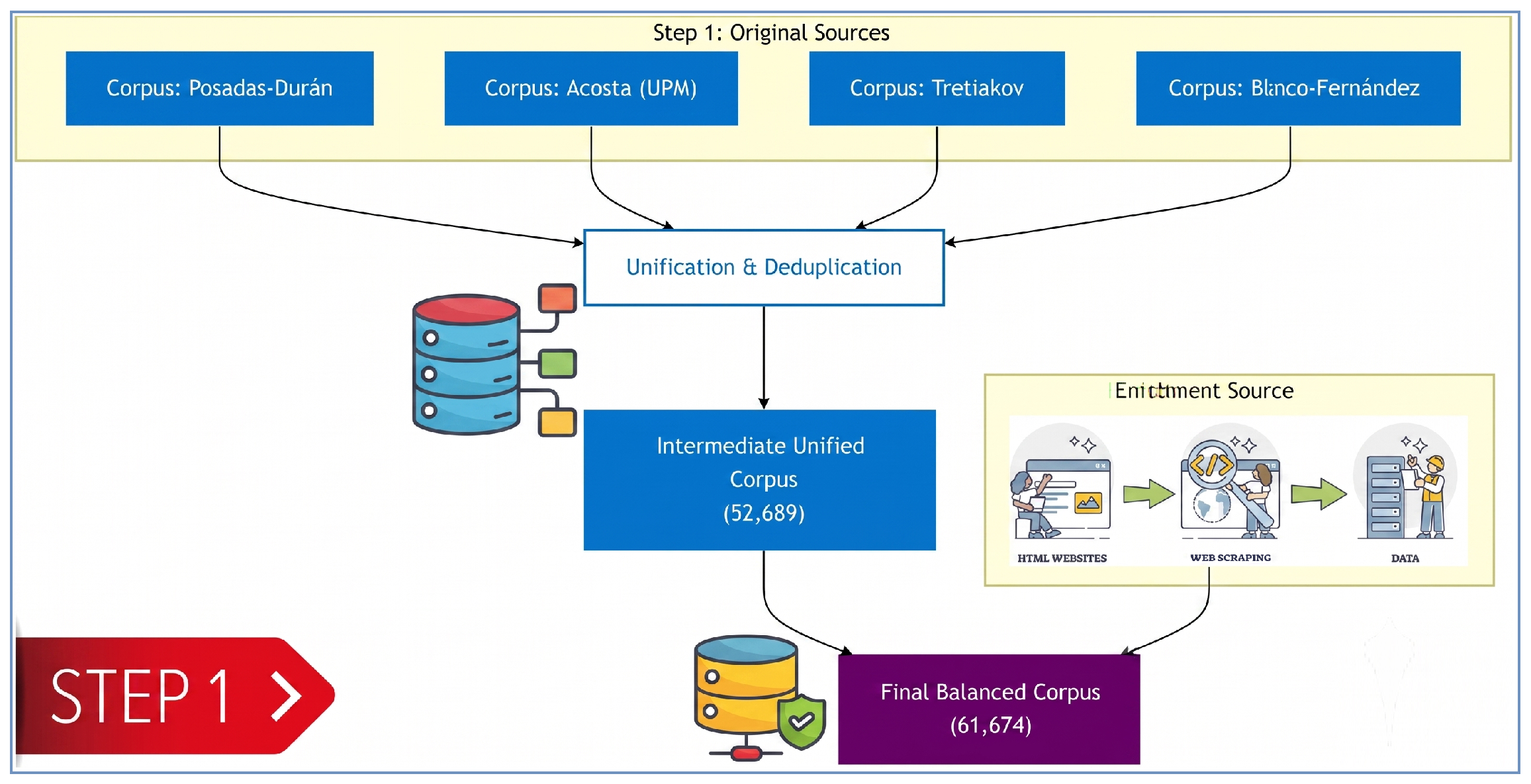
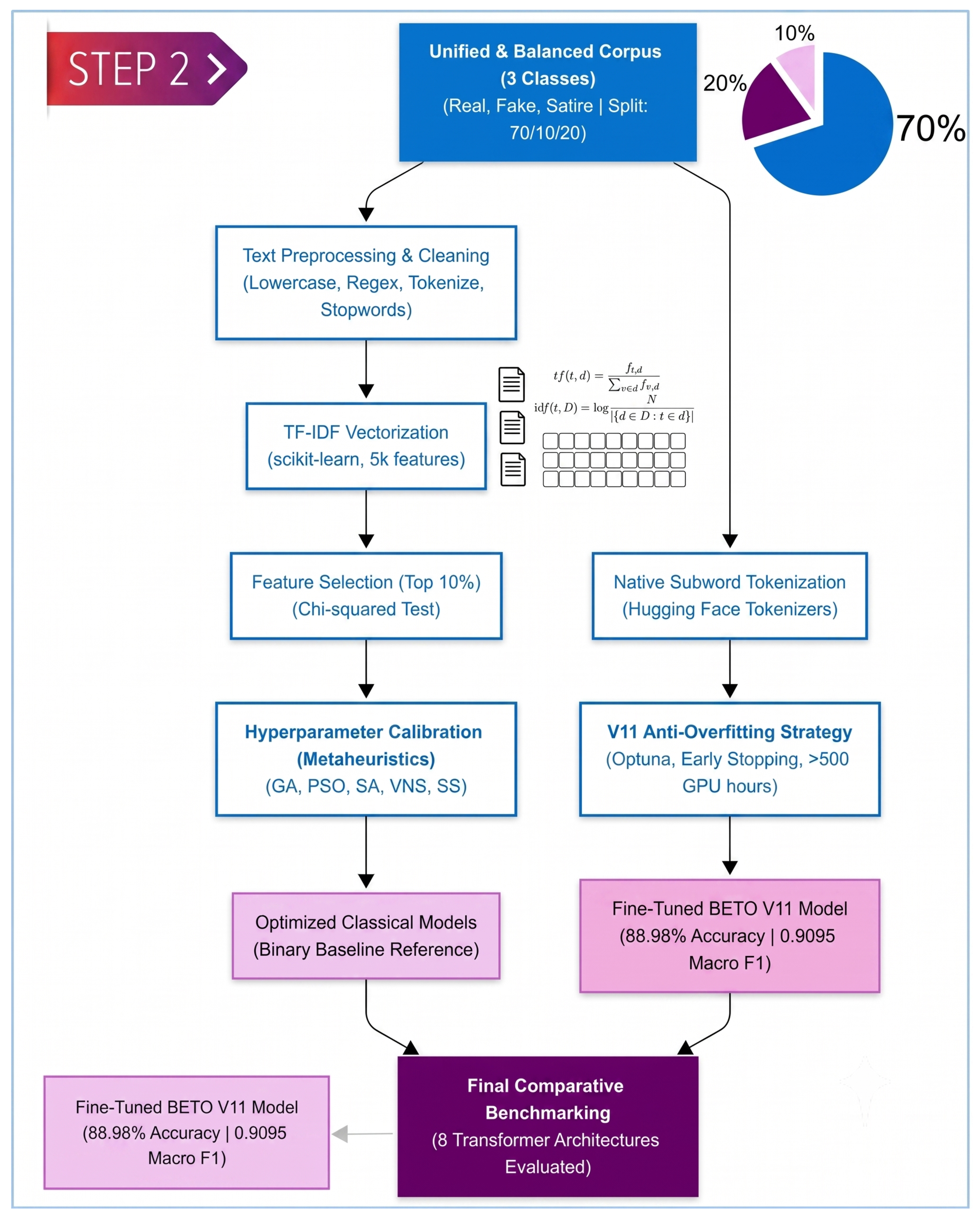
- A Transferable Fine-Tuning Framework: A systematic three-stage pipeline (corpus unification, strong regularization, containerized deployment) is proposed for adapting pretrained transformer models to domain-specific deceptive content detection. The framework is explicitly designed to be transferable across languages, content domains, and social media platforms.
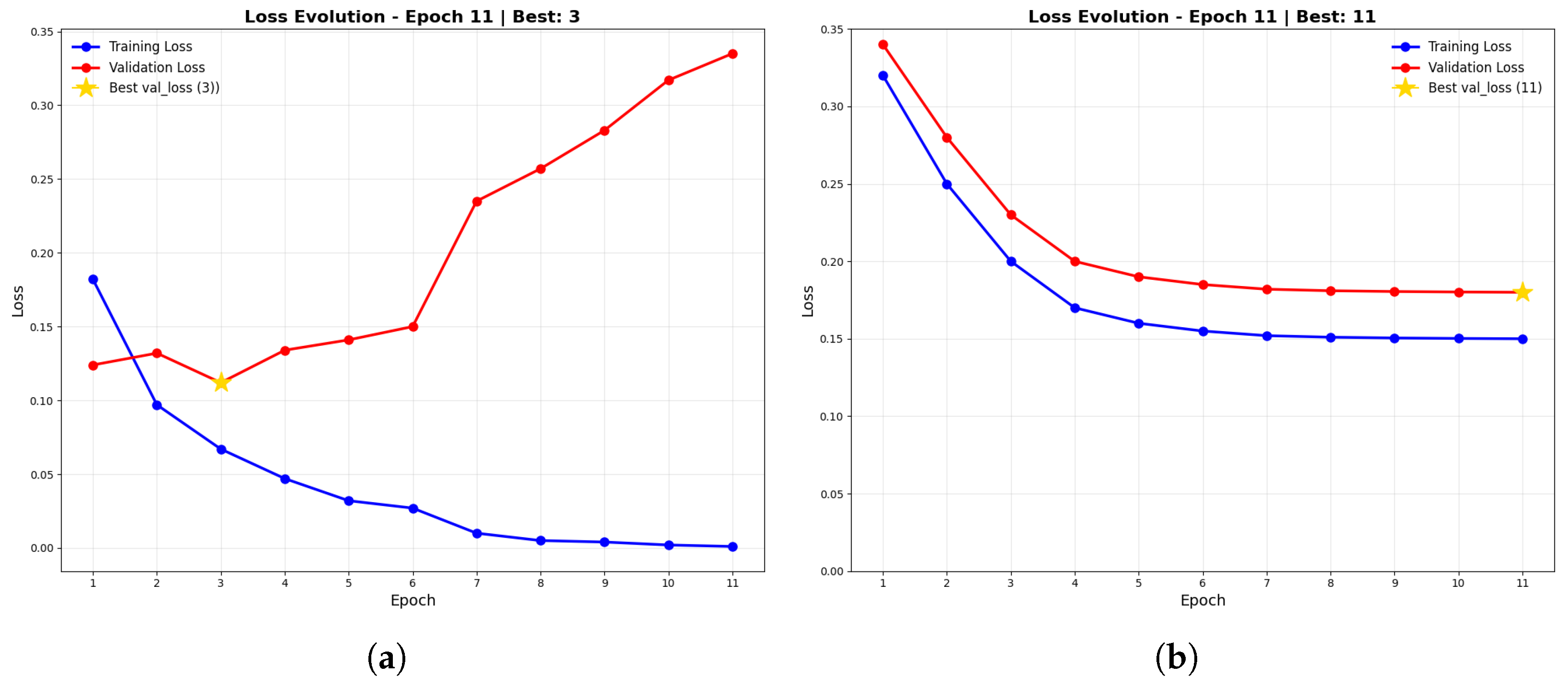
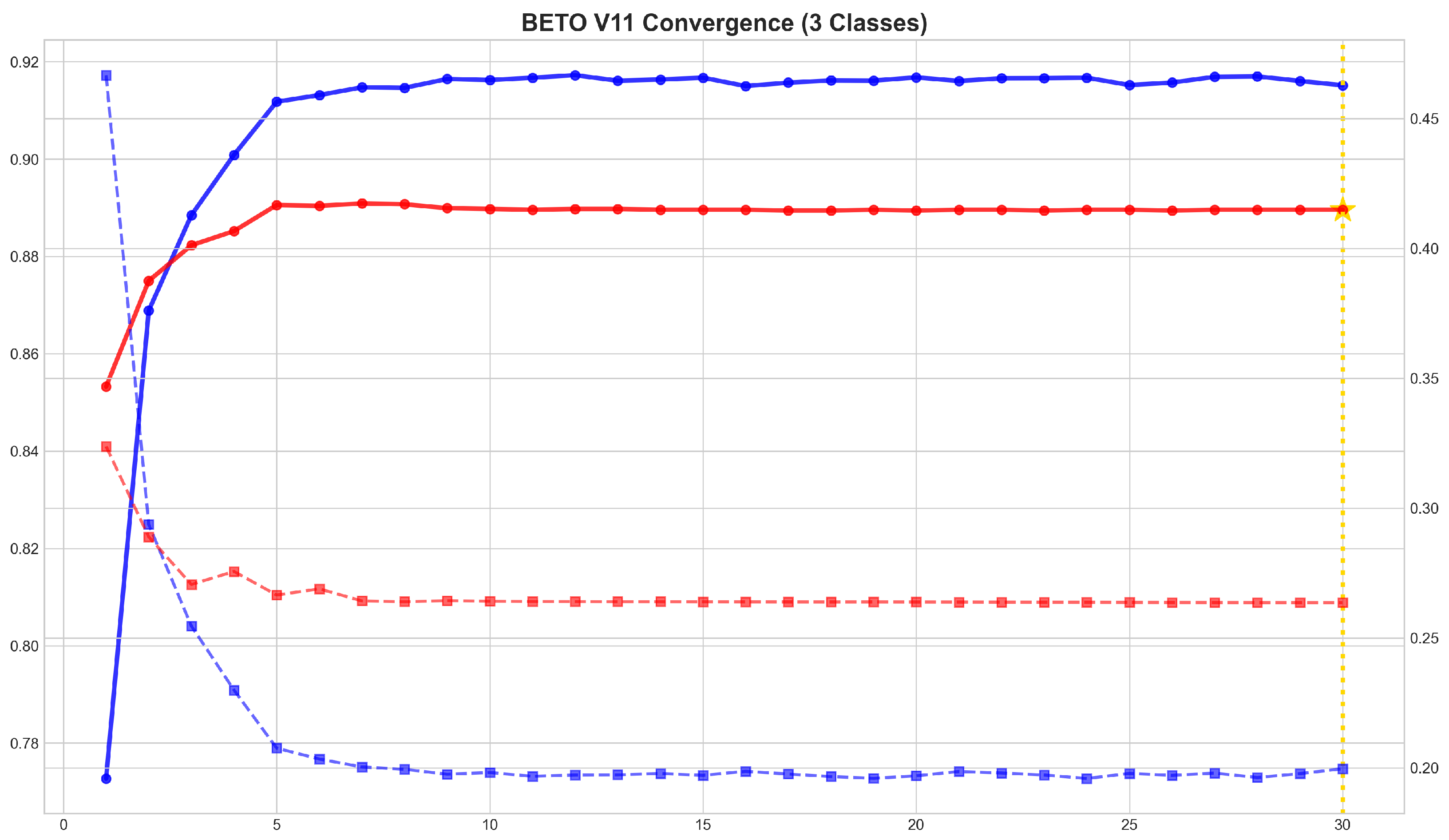
- A Systematic Regularization and Early Stopping Methodology: Through extensive experimentation across multiple architectures, we document a strong regularization strategy for fine-tuning the monolingual BETO encoder. The methodology achieved 89.18% overall accuracy and a 0.9095 Macro F1-Score on a challenging 3-class paradigm, with results reproduced across two independent deep learning frameworks. The training trajectories demonstrate how a dynamic early stopping mechanism, combined with this regularization regime, keeps the validation loss on a stable plateau and prevents the catastrophic overfitting commonly observed in high-capacity transformers, providing a reproducible recipe for practitioners facing similar optimization challenges.
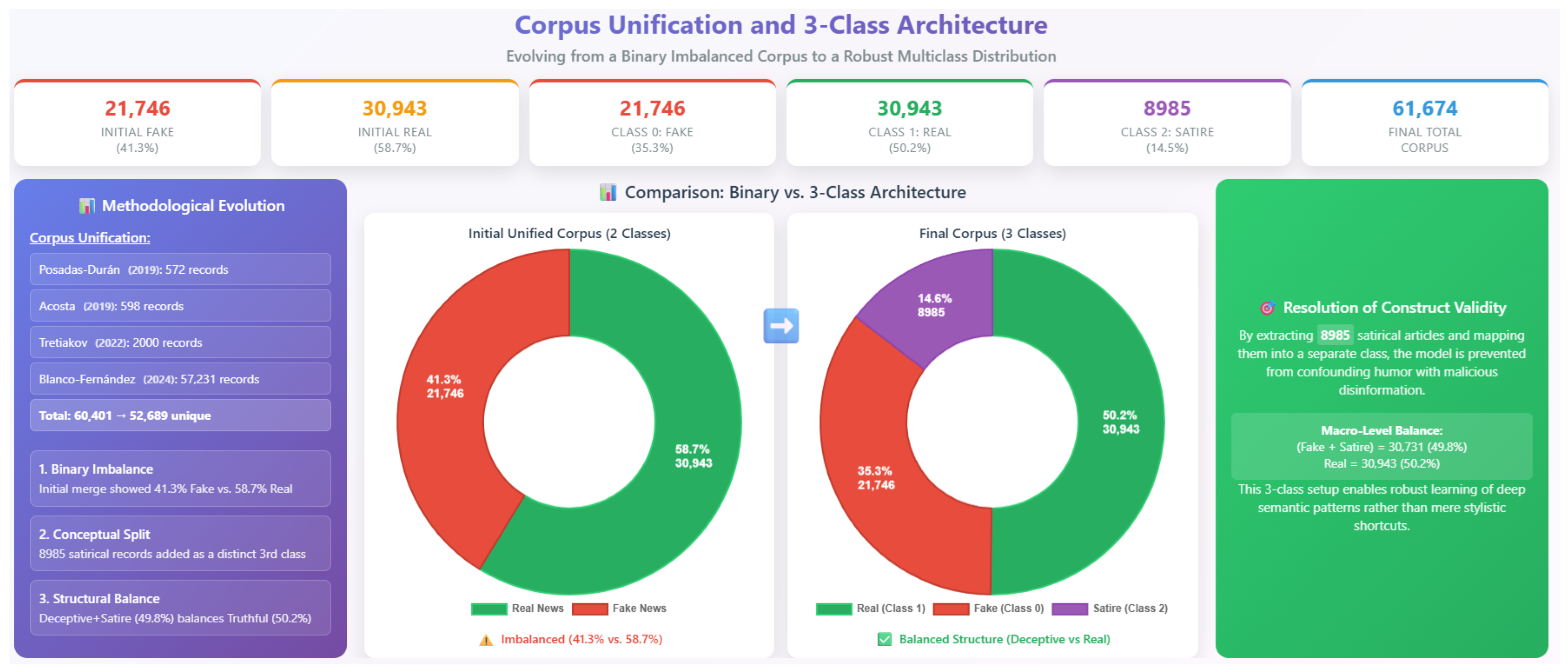
- A Unified Spanish Corpus: A standardized corpus of 61,674 Spanish news articles was constructed from four academic datasets [27,29,30,31] enhanced with web-scraped satirical content, achieving a three-class distribution (35.3% fake, 50.2% real, 14.5% satire)—one of the largest resources for this task.
- A Containerized Prototype Web Application: The optimized model was deployed as a Docker-containerized web application capable of real-time URL analysis, demonstrating that the framework extends beyond academic benchmarks toward a practical tool for public misinformation verification [19]. We describe it as a prototype, since the source-held-out evaluation indicates limitations (notably for satire) that should be addressed before production use.
2. Related Work: Detection Paradigms and Methodological Gaps
2.1. Language Resources and the “Deployment Gap”
2.2. Systematic Fine-Tuning and State-of-the-Art Transformers
3. Materials and Methods
3.1. Stage 1: Corpus Unification and Processing
3.2. Stage 2: Systematic Model Optimization
Data Partitioning and Generalization Strategy
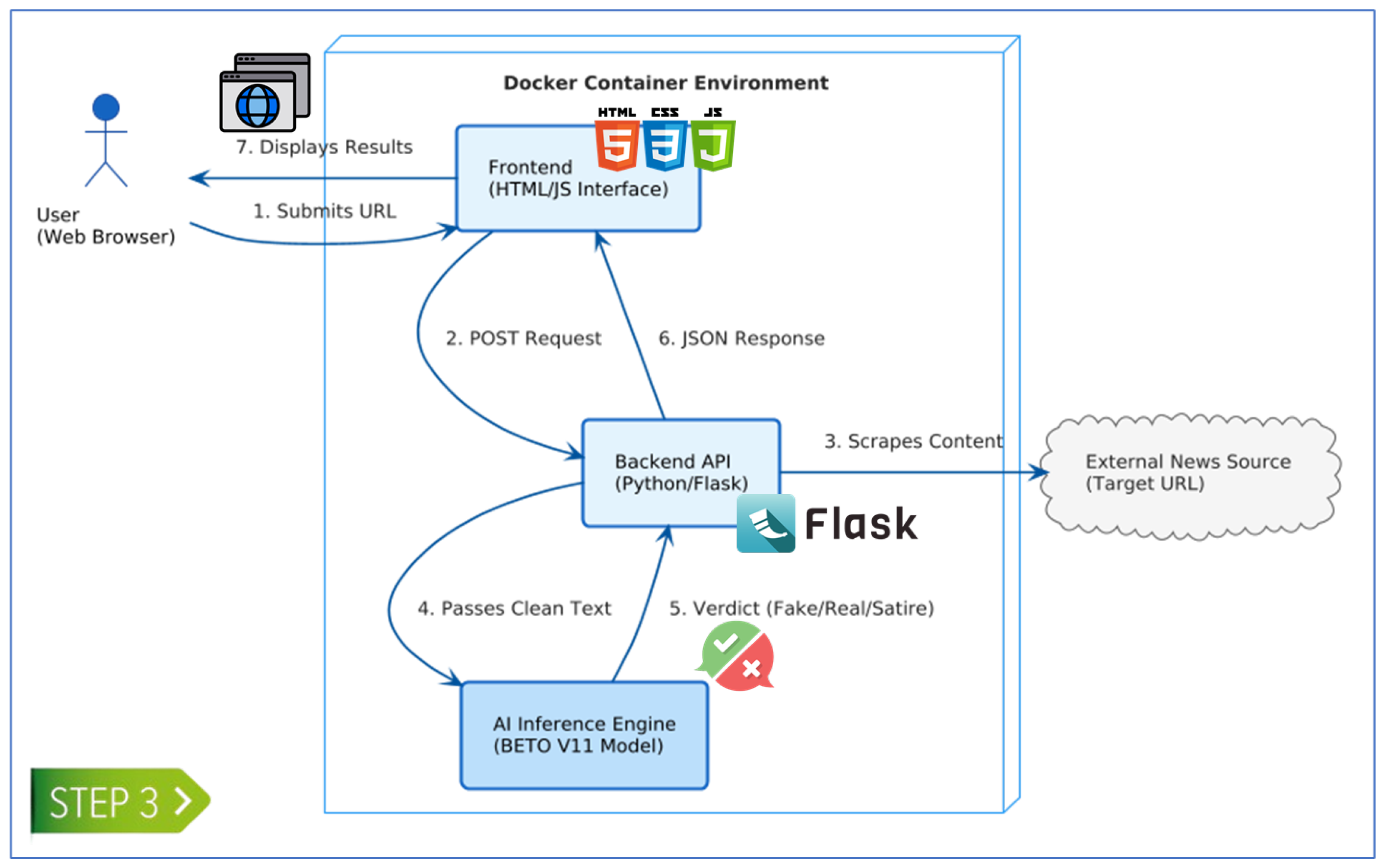
3.3. Stage 3: Production Deployment
- User Interface: A responsive static web frontend built with HTML, CSS, and JavaScript where users submit URLs for analysis. The interface provides real-time visual feedback during the analysis process—including loading indicators and color-coded results (green for real, red for fake)—to ensure an intuitive user experience for non- technical users.
- API Backend: A Flask-based RESTful service exposing an /analyze endpoint that receives POST requests containing the target URL. The backend implements error handling for common failure scenarios such as unreachable URLs, non-textual content, and pages with insufficient text for meaningful classification.
- Inference Engine: The core analytical component loads the trained BETO model and tokenizer at startup to minimize per-request latency. Upon receiving a URL, it scrapes the page content by extracting <h1> and <p> tags via BeautifulSoup, applies text cleaning (removing HTML artifacts, normalizing whitespace), tokenizes the combined title and body with a [SEP] separator token, and computes probability scores through a softmax function. The engine truncates inputs exceeding 512 tokens—BETO’s maximum sequence length—ensuring graceful handling of long-form articles.
- Docker Deployment: The entire runtime environment—including Python 3.10 dependencies, PyTorch, the Hugging Face Transformers library, and the serialized model artifacts—is encapsulated in a Docker image built from a minimal base to ensure reproducibility, portability, and ease of deployment across platforms.
3.4. Evaluation Metrics
- Accuracy: The overall proportion of correctly classified instances across all three classes. While a useful global indicator, it can be misleading under class imbalance, which is why macro-averaged metrics are emphasized.where N is the total number of test instances.
- Macro Precision: The unweighted mean, across classes, of the per-class precision (the proportion of instances predicted as class c that truly belong to c).
- Macro Recall: The unweighted mean of the per-class recall (the proportion of instances truly belonging to class c that are correctly identified).
- Macro F1-Score: The unweighted mean of the per-class F1-scores, where each per-class F1 is the harmonic mean of that class’s precision and recall. This is the primary metric for model selection, as it is robust to the class imbalance of the corpus.
- Macro Specificity: The unweighted mean of the per-class specificity, defined in the one-vs-rest setting as the proportion of instances not belonging to class c that the model correctly excludes from c. It quantifies the model’s ability to avoid spuriously assigning instances to a given class.
4. Results: Framework Validation on Spanish Fake News Detection
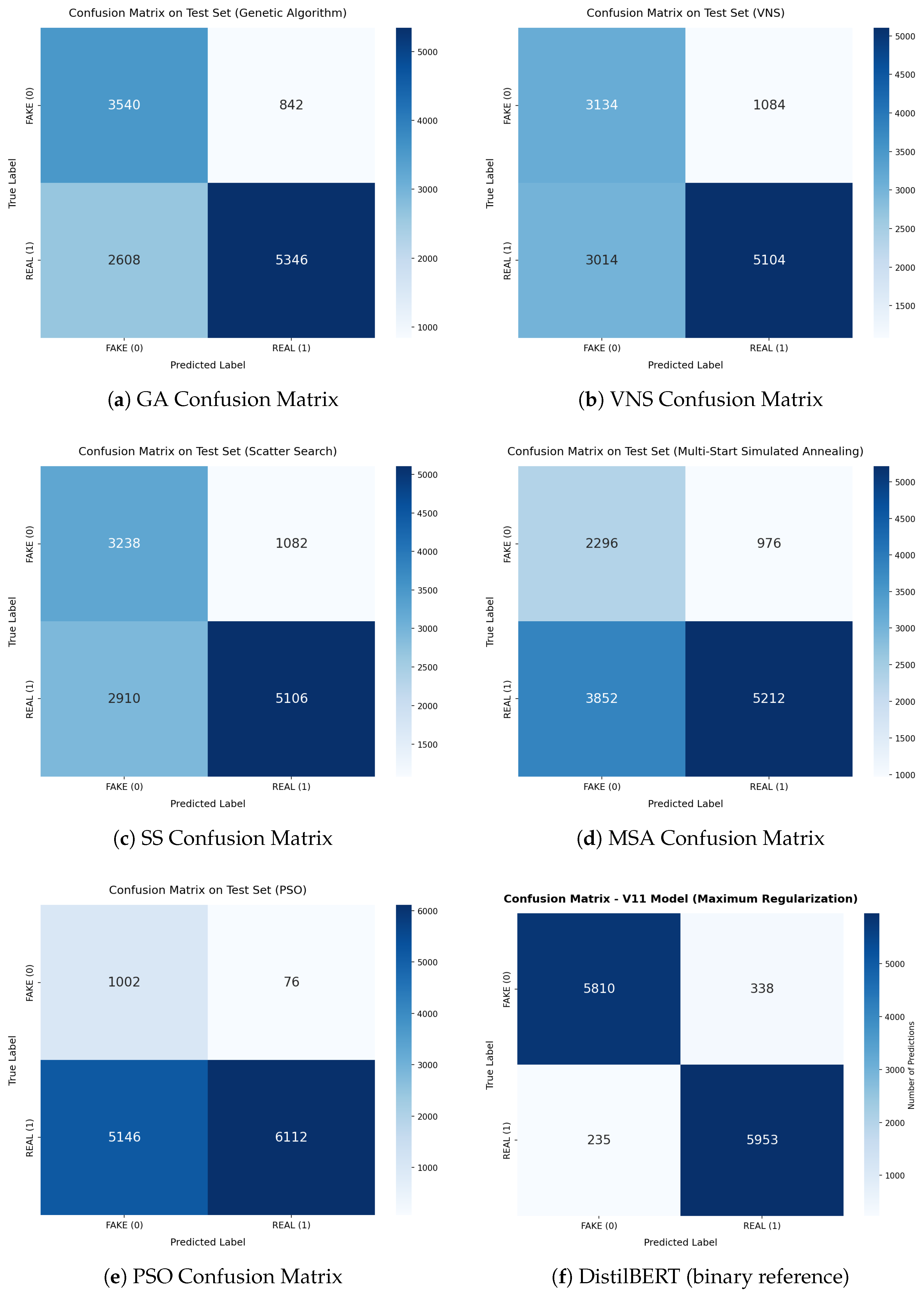
4.1. Performance of the Metaheuristic Baseline (Stage 2a)

| Algorithm | Accuracy (%) | F1-Score (Macro) | Precision (Macro) | Recall (Macro) | Specificity (%) | Ranking |
|---|---|---|---|---|---|---|
| Transformer Reference (binary task) | ||||||
| DistilBERT (binary reference) | 95.36 | 0.954 | 0.954 | 0.954 | 94.5 | 1st |
| Metaheuristic-Optimized Classical Approaches | ||||||
| Genetic Algorithm (GA) | 72.03 | 0.714 | 0.740 | 0.720 | 57.6 | 2nd |
| Scatter Search (SS) | 67.64 | 0.669 | 0.693 | 0.676 | 52.7 | 3rd |
| VNS | 66.78 | 0.659 | 0.686 | 0.667 | 51.0 | 4th |
| Simulated Annealing (MSA) | 60.86 | 0.586 | 0.638 | 0.608 | 37.4 | 5th |
| Particle Swarm Opt. (PSO) | 57.67 | 0.489 | 0.736 | 0.575 | 16.3 | 6th |
| Model Architecture | Accuracy | Macro F1 | Macro Precision | Macro Recall | Macro Specificity |
|---|---|---|---|---|---|
| BETO (V11 Final) | 0.8898 | 0.9095 | 0.9129 | 0.9070 | 0.9331 |
| XLM-RoBERTa-Large | 0.8843 | 0.9061 | 0.9069 | 0.9053 | 0.9311 |
| RoBERTa-Large-BNE | 0.8837 | 0.9038 | 0.9081 | 0.9006 | 0.9293 |
| XLM-RoBERTa-Base | 0.8825 | 0.9025 | 0.9095 | 0.8984 | 0.9274 |
| DistilBERT Multilingual | 0.8795 | 0.9012 | 0.9027 | 0.9000 | 0.9280 |
| mBERT | 0.8730 | 0.8962 | 0.8973 | 0.8953 | 0.9242 |
| DistilBETO | 0.8586 | 0.8819 | 0.8889 | 0.8763 | 0.9141 |
| RoBERTa-Base-BNE | 0.6402 | 0.5791 | 0.6581 | 0.6651 | 0.7667 |
4.2. Preliminary Analysis: Classical Baselines vs. a Transformer Reference (Binary Task)
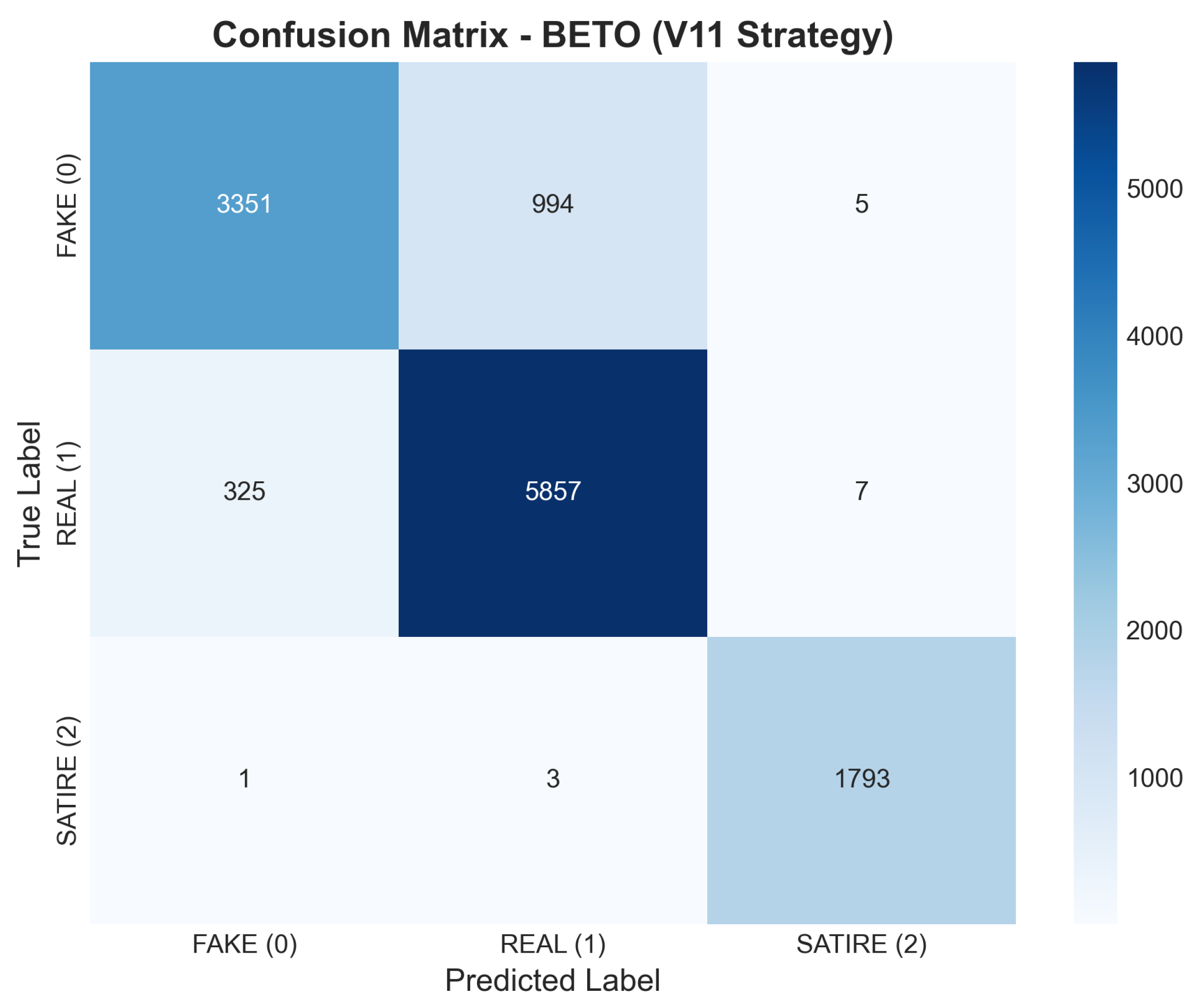
4.3. Performance of the Systematically Fine-Tuned Transformer (Stage 2b)
4.4. Adversarial Robustness and Source Leakage Mitigation
- 1.
- Named Entity Recognition (NER) Masking: Utilizing the es_core_news_sm SpaCy pipeline, all identified Persons (PER), Organizations (ORG), and Locations (LOC) were dynamically replaced with generic masking tags (e.g., [ORG]).
- 2.
- Typographical Noise Injection: To simulate real-world social media degradation, random character swaps and deletions were injected with a 5% probability per word.
4.5. Cross-Source Generalization of the Satire Class
4.6. Overfitting Control Analysis
4.7. Cross-Framework Reproducibility and Optimal Model (BETO) Analysis
4.8. Deployment Validation (Stage 3)
5. Discussion
5.1. Strengths of the Proposed Framework
5.2. Validation Against the State-of-the-Art
5.3. Comparative Analysis: Specialized Encoders vs. Generative LLMs
5.4. Transferability to Other Social Media Deception Domains
- Investment Scam Detection: Social media platforms, particularly Facebook and Instagram, are inundated with fraudulent pages promoting fake investment opportunities (e.g., petroleum investments, cryptocurrency schemes). These pages use persuasive language patterns that share rhetorical features with fake news—urgency, emotional manipulation, and fabricated testimonials. A concrete example is a page impersonating PEMEX (Mexico’s state oil company) that claims citizens can “earn 100,000 pesos” by joining a fictitious “social project” [6]—a classic social engineering tactic combining authority impersonation with unrealistic financial promises. A corpus of labeled scam pages could be constructed using the Stage 1 unification methodology, and the Stage 2 regularization recipe applied directly to fine-tune a detection model.
- Fraudulent E-Commerce Detection: Fake retail pages impersonating legitimate brands or promoting non-existent products represent a growing threat that disproportionately affects elderly and digitally illiterate populations. Real-world examples include pages selling fraudulent “anti-aging cosmetics” using fabricated before-and-after photos, fake WhatsApp testimonials, and artificial urgency tactics (e.g., countdown timers and “order now” buttons) [7], as well as pages advertising implausible products such as “smart radiation-proof reading glasses” claiming to sell over 100,000 units per day [8]. The textual patterns of these pages—exaggerated claims, pressure tactics, and suspicious product descriptions—are amenable to the same transformer-based classification approach.
- Phishing Content Detection: Phishing campaigns disseminated through social media messaging share linguistic features with misinformation: impersonation of authority, urgency, and deceptive intent. The framework’s containerized deployment stage (Stage 3) is particularly valuable here, as it enables real-time URL analysis that could be extended to phishing detection with minimal architectural changes.
5.5. Limitations
5.6. Future Work
6. Conclusions
Author Contributions
Funding
Institutional Review Board Statement
Informed Consent Statement
Data Availability Statement
Acknowledgments
Conflicts of Interest
References
- Bondielli, A.; Marcelloni, F. A survey on fake news and rumour detection techniques. Inf. Sci. 2019, 497, 38–55. [Google Scholar] [CrossRef]
- Higdon, N.; Huff, M. Let’s Agree to Disagree: A Critical Thinking Guide to Communication, Conflict Management, and Critical Media Literacy, 1st ed.; Routledge: London, UK, 2022. [Google Scholar] [CrossRef]
- Higdon, N. Constructive Conflict and Critical Media Literacy. In The Handbook of Social and Political Conflict; Samoilenko, S.A., Simmons, S., Eds.; Wiley: Hoboken, NJ, USA, 2025. [Google Scholar] [CrossRef]
- Tsfati, Y.; Boomgaarden, H.G.; Strömbäck, J.; Vliegenthart, R.; Damstra, A.; Lindgren, E. Causes and Consequences of Mainstream Media Dissemination of Fake News: Literature Review and Synthesis. Ann. Int. Commun. Assoc. 2020, 44, 157–173. [Google Scholar] [CrossRef]
- Allcott, H.; Gentzkow, M. Social Media and Fake News in the 2016 Election. J. Econ. Perspect. 2017, 31, 211–236. [Google Scholar] [CrossRef]
- PEMEX Investment Scam Landing Page. Available online: https://web.archive.org/web/20250720083802/https://artcanvas.digital/v1vBtq9ye (accessed on 29 May 2026).
- Fraudulent Anti-Aging Cosmetics Scam Page. Available online: https://web.archive.org/web/20250720090808/http://web.archive.org/screenshot/https://beauty-plus365.com/ox-mx-ext/ (accessed on 29 May 2026).
- Fraudulent Smart Glasses E-Commerce Scam Page. Available online: https://web.archive.org/web/20250722220434/https://aabbkl.com/detail/5nuf776U53YKCdjArvdT (accessed on 29 May 2026).
- Fraudulent Bodega Aurrera Liquidation Sale Impersonation Page (Variant 1). Available online: https://web.archive.org/web/20260218001617/https://mgluckly-mx.shop/collections/%C2%A1gran-liquidaci%C3%B3n-en-bodega-aurrera!-solo-72-horas (accessed on 29 May 2026).
- Fraudulent Bodega Aurrera Liquidation Sale Impersonation Page (Variant 2). Available online: https://web.archive.org/web/20260218002025/https://mexico-promocion.shop/collections/bodega-aurrera-venta-de-liquidaci%C3%B3n (accessed on 25 May 2026).
- Fraudulent Bodega Aurrera Liquidation Sale Impersonation Page (Variant 3). Available online: https://web.archive.org/web/20260218013806/https://bodgaavrrera.shop/collections/ (accessed on 29 May 2026).
- Fraudulent Electronics Liquidation E-Commerce Scam Page. Available online: https://web.archive.org/web/20260218002729/https://mercadocelulares.store/ (accessed on 29 May 2026).
- Celebrity Health Misinformation Clickbait Page Promoting Fraudulent Medical Products. Available online: https://web.archive.org/web/20250720091118/https://k-m-kalash.space/ (accessed on 29 May 2026).
- Kaliyar, R.K.; Goswami, A.; Narang, P. FakeBERT: Fake news detection in social media with a BERT-based deep learning approach. Multimed. Tools Appl. 2021, 80, 11765–11788. [Google Scholar] [CrossRef] [PubMed]
- Singh, M.K.; Ahmed, J.; Alam, M.A.; Raghuvanshi, K.K.; Kumar, S. A comprehensive review on automatic detection of fake news on social media. Multimed. Tools Appl. 2024, 83, 47319–47352. [Google Scholar] [CrossRef]
- Rout, J.; Mishra, M.; Saikia, M.J. Towards Reliable Fake News Detection: Enhanced Attention-Based Transformer Model. J. Cybersecur. Priv. 2025, 5, 43. [Google Scholar] [CrossRef]
- Alghamdi, J.; Luo, S.; Lin, Y. A comprehensive survey on machine learning approaches for fake news detection. Multimed. Tools Appl. 2024, 83, 51009–51067. [Google Scholar] [CrossRef]
- Shu, K.; Sliva, A.; Wang, S.; Tang, J.; Liu, H. Fake News Detection on Social Media: A Data Mining Perspective. SIGKDD Explor. Newsl. 2017, 19, 22–36. [Google Scholar] [CrossRef]
- Ali, I.; Ayub, M.N.B.; Shivakumara, P.; Noor, N.F.B.M. Fake News Detection Techniques on Social Media: A Survey. Wirel. Commun. Mob. Comput. 2022, 2022, 6072084. [Google Scholar] [CrossRef]
- Pérez-Rosas, V.; Kleinberg, B.; Lefevre, A.; Mihalcea, R. Automatic Detection of Fake News. In Proceedings of the 27th International Conference on Computational Linguistics (COLING 2018); Association for Computational Linguistics: Santa Fe, NM, USA, 2018; pp. 3391–3401. Available online: https://aclanthology.org/C18-1287 (accessed on 29 May 2026).
- Nasir, J.A.; Khan, O.S.; Varlamis, I. Fake news detection: A hybrid CNN-RNN based deep learning approach. Int. J. Inf. Manag. Data Insights 2021, 1, 100007. [Google Scholar] [CrossRef]
- Zhou, X.; Zafarani, R. A Survey of Fake News: Fundamental Theories, Detection Methods, and Opportunities. ACM Comput. Surv. 2020, 53, 109. [Google Scholar] [CrossRef]
- Devlin, J.; Chang, M.-W.; Lee, K.; Toutanova, K. BERT: Pre-training of Deep Bidirectional Transformers for Language Understanding. arXiv 2018, arXiv:1810.04805. [Google Scholar] [CrossRef]
- Vaswani, A.; Shazeer, N.; Parmar, N.; Uszkoreit, J.; Jones, L.; Gomez, A.N.; Kaiser, L.; Polosukhin, I. Attention is All You Need. arXiv 2017, arXiv:1706.03762. [Google Scholar] [CrossRef]
- Wang, W.Y. “Liar, Liar Pants on Fire”: A New Benchmark Dataset for Fake News Detection and Verification. In Proceedings of the 55th Annual Meeting of the Association for Computational Linguistics (Volume 2: Short Papers); Association for Computational Linguistics: Vancouver, BC, Canada, 2017; pp. 422–426. [Google Scholar] [CrossRef]
- Choudhry, I.; Khatri, M.; Tayal, D.K.; Vishwakarma, D.K. An Emotion-Aware Multitask Approach to Fake News and Rumor Detection Using Transfer Learning. IEEE Trans. Comput. Soc. Syst. 2024, 11, 588–599. [Google Scholar] [CrossRef]
- Blanco-Fernández, Y.; Otero-Vizoso, J.; Gil-Solla, A.; García-Duque, J. Enhancing Misinformation Detection in Spanish Language with Deep Learning: BERT and RoBERTa Transformer Models. Appl. Sci. 2024, 14, 9729. [Google Scholar] [CrossRef]
- Martínez-Gallego, K.; Álvarez-Ortiz, A.M.; Arias-Londoño, J.D. Fake news detection in Spanish using deep learning techniques. arXiv 2021, arXiv:2110.06461. [Google Scholar] [CrossRef]
- Posadas-Durán, J.P.; Gómez-Adorno, H.; Sidorov, G.; Escobar, J.J.M. Detection of fake news in a new corpus for the Spanish language. J. Intell. Fuzzy Syst. 2019, 36, 4869–4876. [Google Scholar] [CrossRef]
- Acosta, F.A.Z. Construction of a News Dataset for the Training and Evaluation of Automated Classifiers. Master’s Thesis, Polytechnic University of Madrid, Madrid, Spain, 2019. [Google Scholar] [CrossRef]
- Tretiakov, A.; Martín García, A.; Camacho, D. Detection of false information in Spanish using machine learning techniques. In Intelligent Data Engineering and Automated Learning—IDEAL 2022; Yin, H., Camacho, D., Tino, P., Eds.; Lecture Notes in Computer Science; Springer International Publishing: Cham, Switzerland, 2022; Volume 13756, pp. 42–53. [Google Scholar] [CrossRef]
- Thota, A.; Tilak, P.; Ahluwalia, S.; Lohia, N. Fake news detection: A deep learning approach. SMU Data Sci. Rev. 2018, 1, 10. Available online: https://scholar.smu.edu/datasciencereview/vol1/iss3/10/ (accessed on 29 May 2026).
- Zhen, Z.; Li, Y. C-STEER: A Dynamic Sentiment-Aware Framework for Fake News Detection with Lifecycle Emotional Evolution. Informatics 2026, 13, 4. [Google Scholar] [CrossRef]
- Shang, W.; Yang, J.; Zhang, L.; Yi, T.; Liu, P. ETICD-Net: A Multimodal Fake News Detection Network via Emotion-Topic Injection and Consistency Modeling. Informatics 2025, 12, 129. [Google Scholar] [CrossRef]
- Conneau, A.; Khandelwal, K.; Goyal, N.; Chaudhary, V.; Wenzek, G.; Guzmán, F.; Grave, E.; Ott, M.; Zettlemoyer, L.; Stoyanov, V. Unsupervised Cross-lingual Representation Learning at Scale. arXiv 2019, arXiv:1911.02116. [Google Scholar] [CrossRef]
- Cañete, J.; Chaperon, G.; Fuentes, R.; Ho, J.H.; Kang, H.; Pérez, J. Spanish Pre-Trained BERT Model and Evaluation Data. In Proceedings of the Practical ML for Developing Countries Workshop at ICLR 2020; ICLR: Addis Ababa, Ethiopia, 2020; Available online: https://users.dcc.uchile.cl/jperez/papers/pml4dc2020.pdf (accessed on 29 May 2026).
- Gutiérrez-Fandiño, A.; Armengol-Estapé, J.; Pàmies, A.; Llorca, V.; Silveira-Ocampo, J.; Carrino, C.P.; Armentano-Oller, C.; Rodriguez-Penagos, C.; Gonzalez-Agirre, A.; Villegas, M. MarIA: Spanish Language Models. Proces. Leng. Nat. 2022, 68, 39–60. Available online: http://journal.sepln.org/sepln/ojs/ojs/index.php/pln/article/view/6405 (accessed on 29 May 2026).
- Padilla Cuevas, J.; Reyes-Ortiz, J.A.; Cuevas-Rasgado, A.D.; Mora-Gutiérrez, R.A.; Bravo, M. MédicoBERT: A Medical Language Model for Spanish Natural Language Processing Tasks with a Question-Answering Application Using Hyperparameter Optimization. Appl. Sci. 2024, 14, 7031. [Google Scholar] [CrossRef]
- Yildirim, G. A novel hybrid multi-thread metaheuristic approach for fake news detection in social media. Appl. Intell. 2023, 53, 11182–11202. [Google Scholar] [CrossRef]
- Gravanis, G.; Vakali, A.; Diamantaras, K.; Karadais, P. Behind the Cues: A Benchmarking Study for Fake News Detection. Expert Syst. Appl. 2019, 128, 201–213. [Google Scholar] [CrossRef]
- Sanh, V.; Debut, L.; Chaumond, J.; Wolf, T. DistilBERT, a distilled version of BERT: Smaller, faster, cheaper and lighter. arXiv 2019, arXiv:1910.01108. [Google Scholar] [CrossRef]



| Paradigm | Core Principle | Key Studies | Strengths | Limitations |
|---|---|---|---|---|
| Media Literacy
& Societal Impact | Address root causes through critical thinking education | Higdon [2], Higdon [3], Tsfati et al. [4] | Addresses cultural and cognitive factors | Does not provide automated detection |
| Classical Machine Learning | Statistical features from text (TF-IDF, BoW) | Shu et al. [18], Ali et al. [19], Thota et al. [32] | Computationally efficient, interpretable | Limited semantic understanding |
| Deep Learning (CNN/RNN) | Automatic feature extraction via neural networks | Nasir et al. [21], Zhou & Zafarani [22] | Better feature learning, reduced manual engineering | Limited handling of long-range dependencies |
| Transformers (BERT-based) | Bidirectional context via self-attention mechanisms | Singh et al. [15], Alghamdi et al. [17], Kaliyar et al. [14], Rout et al. [16] | State-of-the-art performance, captures semantic nuances | Computationally expensive, requires large datasets |
| Multimodal & Emotion-Aware | Integrates text, images, and emotional features | Choudhry et al. [26], Zhen & Li [33], Shang et al. [34] | Holistic analysis, improved accuracy | Complex architectures, limited Spanish resources |
| Author(s) [Ref.] | Contribution | Key Finding/Performance | Limitation Addressed by This Work |
|---|---|---|---|
| Posadas-Durán et al. [29] | Created a pioneering Spanish corpus (971 articles) with a stylometric focus. | Established baseline stylometric markers for Spanish fake news. | Corpus is too small for modern transformer fine-tuning. |
| Kaliyar et al. [14] | Proposed FakeBERT, a deep learning model combining BERT with CNN layers. | Achieved 98.9% accuracy on English datasets. | Focused exclusively on English-language content. |
| Blanco-Fernández et al. [27] | Applied BERT/RoBERTa to a large, politically-focused dataset (57k articles). | High accuracy, but limited by domain specificity. | Lacked systematic regularization for out-of-domain transfer. |
| Martínez-Gallego et al. [28] | Explored different BERT variants (including BETO) for Spanish fake news detection. | BETO outperformed multilingual variants in preliminary tests. | No production-ready deployment or adversarial testing. |
| Rout et al. [16] | Proposed an enhanced attention-based transformer model for reliable fake news detection. | Improved reliability and attention focus. | Focused on English, without multi-class satire separation. |
| Author(s) [Ref.] | Contribution | Key Finding/Performance | Limitation Addressed by This Work |
|---|---|---|---|
| Yildirim [39] | Hybrid multi-thread metaheuristic approach for fake news detection. | Improved optimization speed and feature selection. | Classical models lack deep contextual semantic understanding. |
| Thota et al. [32] | Early deep learning approach using traditional neural networks for fake news detection. | Demonstrated NN superiority over classic ML classifiers. | Pre-transformer era; lacks bidirectional attention. |
| Gravanis et al. [40] | Systematic benchmarking of classical ML classifiers and feature representations. | Linguistic cues provide strong baseline signals. | Did not evaluate transferability to modern digital fraud domains. |
| Comparative Aspect | Posadas-Durán | Acosta | Tretiakov | Blanco-Fernández | El Deforma |
|---|---|---|---|---|---|
| Initial Corpus Size | 572 articles | 598 articles | 2000 articles | 57,231 articles | 8985 articles |
| Creation Year | 2019–2021 | 2019 | 2022 | 2024 | 2025 (extraction) |
| Methodological Focus | Stylometric | NLP Baselines | Traditional ML | Transformers | Satirical Content |
| Thematic Domain | General | General | General | Political | Satirical/General |
| Class Distribution | Balanced | Balanced | Balanced | Balanced | Satire Only |
| Contribution (Pre-Dedup) | 0.95% | 0.99% | 3.31% | 94.75% | 14.6% (added later) |
| Class | Train (70%) | Validation (10%) | Test (20%) | Total |
|---|---|---|---|---|
| FAKE | 15,221 | 2175 | 4350 | 21,746 |
| REAL | 21,660 | 3094 | 6189 | 30,943 |
| SATIRE | 6290 | 898 | 1797 | 8985 |
| Total | 43,171 | 6167 | 12,336 | 61,674 |
| Model | Parameters | Layers | Hidden Dim. | Language Scope | Reference |
|---|---|---|---|---|---|
| mBERT (base-multilingual) | 110M | 12 | 768 | Multilingual (104) | Devlin et al. [23] |
| XLM-RoBERTa-Base | 270M | 12 | 768 | Multilingual (100) | Conneau et al. [35] |
| XLM-RoBERTa-Large | 550M | 24 | 1024 | Multilingual (100) | Conneau et al. [35] |
| RoBERTa-base-bne | 125M | 12 | 768 | Spanish (BNE) | Gutiérrez-Fandiño et al. [37] |
| RoBERTa-large-bne | 355M | 24 | 1024 | Spanish (BNE) | Gutiérrez-Fandiño et al. [37] |
| BETO (Spanish BERT) | 110M | 12 | 768 | Spanish | Cañete et al. [36] |
| DistilBETO | 67M | 6 | 768 | Spanish | Cañete et al. [36] |
| DistilBERT-multilingual | 66M | 6 | 768 | Multilingual (104) | Sanh et al. [41] |
| Version | Learning Rate | Dropout | L2 Reg. | Batch Size | Val Loss Gap | Accuracy (%) |
|---|---|---|---|---|---|---|
| V1 (Baseline) | 0.4 | 0.001 | 8 | N/A | 94.7 | |
| V2 | 0.4 | 0.01 | 4 | 0.018 | 94.3 | |
| V3 | 0.4 | 0.01 | 4 | 0.051 | 94.8 | |
| V4 | 0.3 | 0.01 | 8 | 0.037 | 95.8 | |
| V5 | 0.4 | 0.1 | 8 | 0.037 | 95.8 | |
| V6 | 0.5 | 0.5 | 8 | 0.051 | 94.8 | |
| V11 (binary milestone) | 0.7 | 0.5 | 4 | 0.058 | 95.36 |
| Class | Precision | Recall | F1-Score | Support |
|---|---|---|---|---|
| FAKE | 0.91 | 0.77 | 0.83 | 4350 |
| REAL | 0.85 | 0.95 | 0.90 | 6189 |
| SATIRE | 0.99 | 1.00 | 1.00 | 1797 |
| Macro avg | 0.92 | 0.90 | 0.91 | 12,336 |
| Weighted avg | 0.89 | 0.89 | 0.89 | 12,336 |
| Evaluation Set | Source | N | SATIRE Recall |
|---|---|---|---|
| In-source test partition | El Deforma (MX) | 1797 | 1.00 |
| Out-of-source (held-out) | El Mundo Today (ES) | 1000 | 0.08 |
Disclaimer/Publisher’s Note: The statements, opinions and data contained in all publications are solely those of the individual author(s) and contributor(s) and not of MDPI and/or the editor(s). MDPI and/or the editor(s) disclaim responsibility for any injury to people or property resulting from any ideas, methods, instructions or products referred to in the content. |
© 2026 by the authors. Licensee MDPI, Basel, Switzerland. This article is an open access article distributed under the terms and conditions of the Creative Commons Attribution (CC BY) license.
Share and Cite
Avilés, G.H.; Reyes-Ortiz, J.A.; Mora-Gutiérrez, R.A.; Cuevas, J.P.; Alcántara, Ó.H. Systematic Fine-Tuning of Transformer Models for Domain-Specific Misinformation Detection in Spanish Social Media Text. Informatics 2026, 13, 83. https://doi.org/10.3390/informatics13060083
Avilés GH, Reyes-Ortiz JA, Mora-Gutiérrez RA, Cuevas JP, Alcántara ÓH. Systematic Fine-Tuning of Transformer Models for Domain-Specific Misinformation Detection in Spanish Social Media Text. Informatics. 2026; 13(6):83. https://doi.org/10.3390/informatics13060083
Chicago/Turabian StyleAvilés, Gabriel Hurtado, José A. Reyes-Ortiz, Román A. Mora-Gutiérrez, Josué Padilla Cuevas, and Óscar Herrera Alcántara. 2026. "Systematic Fine-Tuning of Transformer Models for Domain-Specific Misinformation Detection in Spanish Social Media Text" Informatics 13, no. 6: 83. https://doi.org/10.3390/informatics13060083
APA StyleAvilés, G. H., Reyes-Ortiz, J. A., Mora-Gutiérrez, R. A., Cuevas, J. P., & Alcántara, Ó. H. (2026). Systematic Fine-Tuning of Transformer Models for Domain-Specific Misinformation Detection in Spanish Social Media Text. Informatics, 13(6), 83. https://doi.org/10.3390/informatics13060083