1. Introduction
Digital transformation in public administration has fundamentally altered how governments provide services and how citizens fulfil their civic responsibilities. Among the most consequential of these shifts is the move towards obligatory digital tax systems, in which compliance is not merely encouraged but enforced by law through built-in government platforms. Indonesia’s shift to Coretax represents one of the most comprehensive mandatory tax digitisation reforms in the developing world. It parallels—and in scope surpasses—the mandatory electronic reporting frameworks that European Union (EU) member states have progressively implemented over two decades, including e-filing mandates, e-invoicing requirements, and Standard Audit File for Tax (SAF-T) reporting obligations [
1,
2]. Where European implementations have typically proceeded incrementally across distinct tax functions and administrative jurisdictions, Coretax consolidates all Indonesian tax obligations into a single unified platform in a single operational transition—a design and implementation ambition that is distinctive even by international standards. Launched on 31 December 2024 and fully operational from January 2025, under Ministry of Finance Regulation No. 81 of 2024, Coretax replaced dozens of fragmented legacy systems with a unified platform covering taxpayer registration, return filing, payment processing, and account management [
3]. With Coretax serving as the permanent infrastructure for all Indonesian tax administration and early evaluations indicating that taxpayer perceptions of system quality during the initial rollout carry significant practical consequences, the question of how taxpayers engage with the platform beyond the legal minimum is both timely and practically urgent [
3,
4].
Coretax represents a fundamental architectural departure from the fragmented legacy infrastructure it replaced, which comprised more than two dozen separate platforms—each handling distinct functions such as income tax filing, Value-Added Tax (VAT) reporting, and payment processing through disconnected interfaces—now unified under one login and one data architecture [
3,
4]. Key design features include real-time data validation at the point of submission, automated pre-population of return fields from third-party data sources, and direct integration with the Indonesian banking system for seamless payment processing—capabilities absent from the legacy e-filing system. The anticipated advantages are substantial: reduced compliance costs for taxpayers, improved audit trail integrity for the Directorate General of Taxes (DJP), and a projected 1.5% increase in Indonesia’s tax-to-Gross Domestic Product (GDP) ratio as informal transactions become harder to conceal within an integrated data environment [
3]. These advantages, however, have not been uniformly realised in the platform’s first year. Early operational reports documented significant system instability during peak filing periods, with taxpayers and tax professionals reporting slow response times, login failures, and inconsistent output validation [
4]. These shortcomings are not incidental: they establish precisely why understanding the determinants of taxpayer satisfaction and continuous engagement with Coretax is both practically urgent and theoretically non-trivial. A system whose technical performance is uneven at launch, and whose users have no legally permissible alternative, creates a natural testing ground for the quality-adoption dynamics this study examines.
Academic interest in digital tax system adoption has accumulated over two decades, with TAM [
5,
6] establishing perceived usefulness and perceived ease of use as the dominant predictors of adoption across institutional settings, a finding extended to digital tax and e-government services by [
7,
8,
9]. In the Indonesian context, ref. Saptono et al. [
10]’s findings indicate that service quality and reduced compliance costs are the main factors that foster user satisfaction with e-filing, which, in turn, mediates tax compliance intention. Most recently, ref. Saptono et al. [
4] provided an early evaluation of Coretax itself, finding that tax professionals report negative perceptions of system quality in the initial rollout—a signal that understanding sustained engagement with this platform is both timely and practically urgent. Similarly, ref. Ariyanto et al. [
11], using ref. DeLone & McLean [
12]’s IS success model on MSMEs in Indonesia, confirmed that the key antecedents of taxpayer compliance behaviour are system quality and user satisfaction. Ref. Abu-Silake et al. [
13], examining digital tax platform usage in Jordan, found consistent cross-national support for TAM’s core constructs in tax compliance settings. Mandatory digital tax administration is increasingly a global phenomenon: EU member states have implemented e-invoicing mandates, SAF-T reporting requirements, and real-time transaction reporting systems that share the compulsory engagement logic of Coretax, though the institutional, regulatory, and technological contexts differ substantially from the Indonesian setting [
1,
2]. Understanding how taxpayer adoption dynamics operate under legal compulsion—and whether the institutional acceptance mechanism identified here generalises beyond Indonesia—represents a research agenda of direct relevance to tax authorities worldwide.
The existing literature on digital tax Information-System (IS) adoption has established TAM’s core constructs as reliable predictors across voluntary and semi-voluntary settings, confirmed system quality as the foundational upstream driver of ease of use and usefulness, and identified user satisfaction as the proximal antecedent of continuous usage intention [
5,
6,
9,
10,
14]. What remains unexamined is whether these relationships hold—and whether they operate through the same mechanisms—when adoption is not a choice but a legal requirement.
Yet, despite this body of work, three important gaps exist. First, the existing literature is almost exclusively based on voluntary or semi-voluntary adoption scenarios—situations in which users have some real choice about how deeply they engage. Coretax is categorically different. Use is legally mandated, non-compliance carries statutory penalties, and the government has committed to the platform as the permanent infrastructure for all Indonesian tax administration. The psychological dynamics of legally compelled IS use—where perceived compulsion operates independently of any cognitive assessment of the system itself—introduce a construct that standard TAM frameworks simply do not account for [
15,
16,
17]. No published study has examined this in the Coretax context. Beyond the construct-level gap, the existing literature has not examined how the organisational challenges inherent in large-scale government IS rollouts—implementation instability, uneven technical readiness, and the absence of exit options—shape the quality-adoption relationship in mandatory settings. This gap is addressed directly through the Coretax deployment context [
2,
18].
Second, prior research has predominantly treated initial adoption or behavioural intention to use as the primary dependent variable. In a mandatory deployment where first use is legally guaranteed, this outcome carries limited analytical weight. The more relevant issue is whether taxpayers engage with the system genuinely and continuously, or merely comply at the minimum level of compulsion required. Continuous usage intention—distinguished from legally enforced behaviour—is the theoretically appropriate and practically meaningful outcome to examine here.
Third, while tax literacy has been identified as an important individual-level characteristic in tax compliance research, no study has tested whether it moderates the relationship between perceived usefulness and continuous usage intention within a mandatory IS setting. This is a gap with direct implications for how tax authorities should design support and training programmes.
The novelty of this study sits at the intersection of these three gaps. To the best of the authors’ knowledge, this study is among the first empirical attempts to apply a TAM-based framework, extended with perceived compulsion as an exogenous mandatory-context construct, to Indonesia’s Coretax platform. It also contributes to the emerging global literature on nationally mandated IS deployment by examining how legal coercion interacts with cognitive system evaluations and user satisfaction in shaping continuous usage intention. Prior mandatory IS studies have largely examined compulsion as a constraint on voluntary adoption decisions rather than as an independent construct operating within a post-adoption continuous usage framework, a distinction that matters because sustained engagement under legal obligation may involve different psychological dynamics from initial adoption resistance [
15,
16]. By introducing perceived compulsion into a post-adoption TAM, this study provides a rare empirical test as to whether institutional acceptance modifies the coercion-resistance prediction derived from the Self-Determination Theory (SDT) when continuous usage intention, rather than initial adoption, is the outcome of interest. The study also examines tax literacy as a potential moderator of the perceived usefulness–continuous usage intention relationship, a pathway that remains underexplored in mandatory IS and digital tax research.
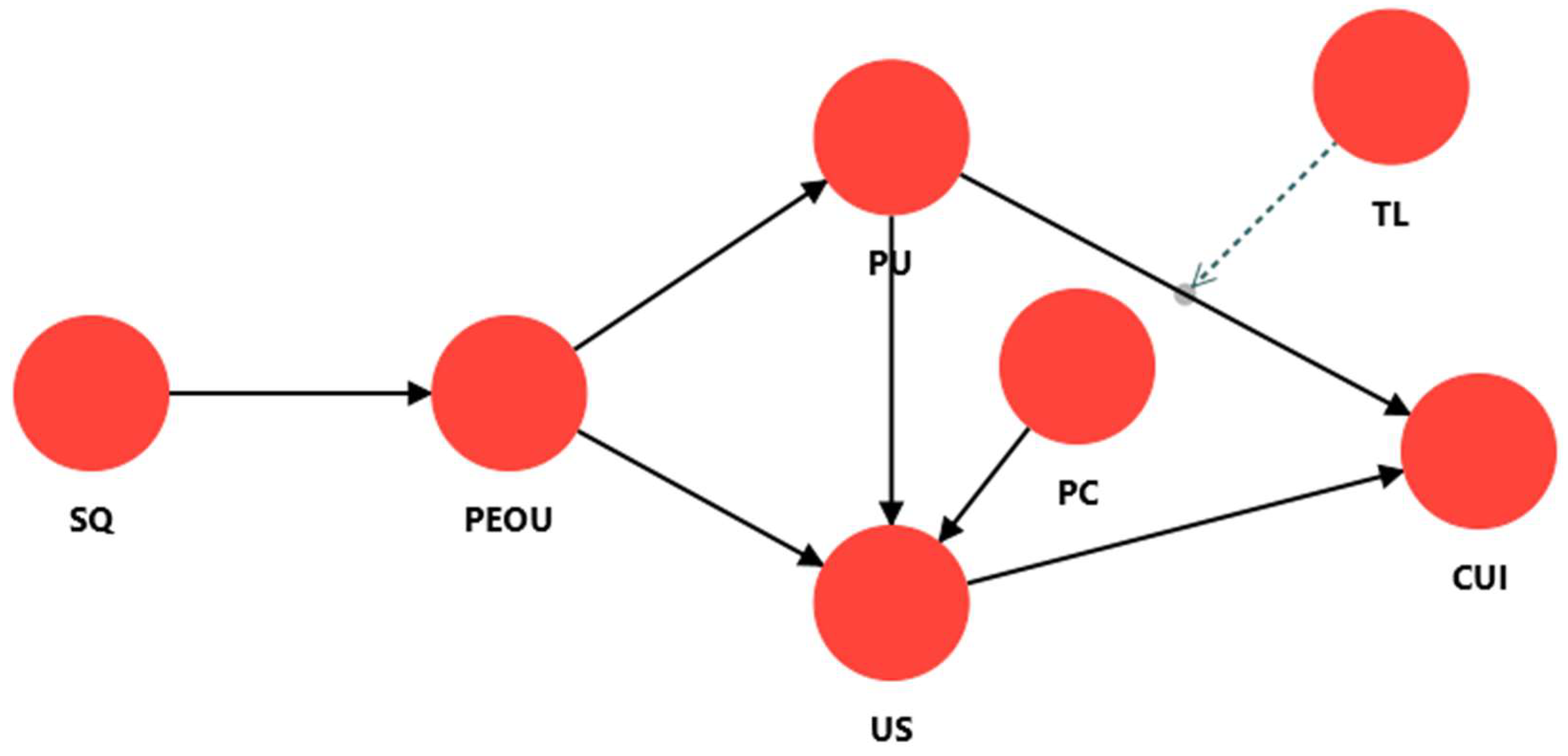
Three research objectives guide this study: to examine how system quality, perceived ease of use, and perceived usefulness shape user satisfaction and continuous usage intention; to assess whether perceived compulsion affects user satisfaction independently of cognitive system evaluations; and to test whether tax literacy moderates the perceived usefulness–continuous usage intention relationship.
These are operationalised through three research questions:
- RQ1.
How do system quality, perceived ease of use, and perceived usefulness influence user satisfaction and continuous usage intention toward Coretax?
- RQ2.
Does perceived compulsion exert a significant effect on user satisfaction, independently of cognitive system evaluations?
- RQ3.
Does tax literacy moderate the relationship between perceived usefulness and continuous usage intention in a mandatory IS context?
5. Discussion
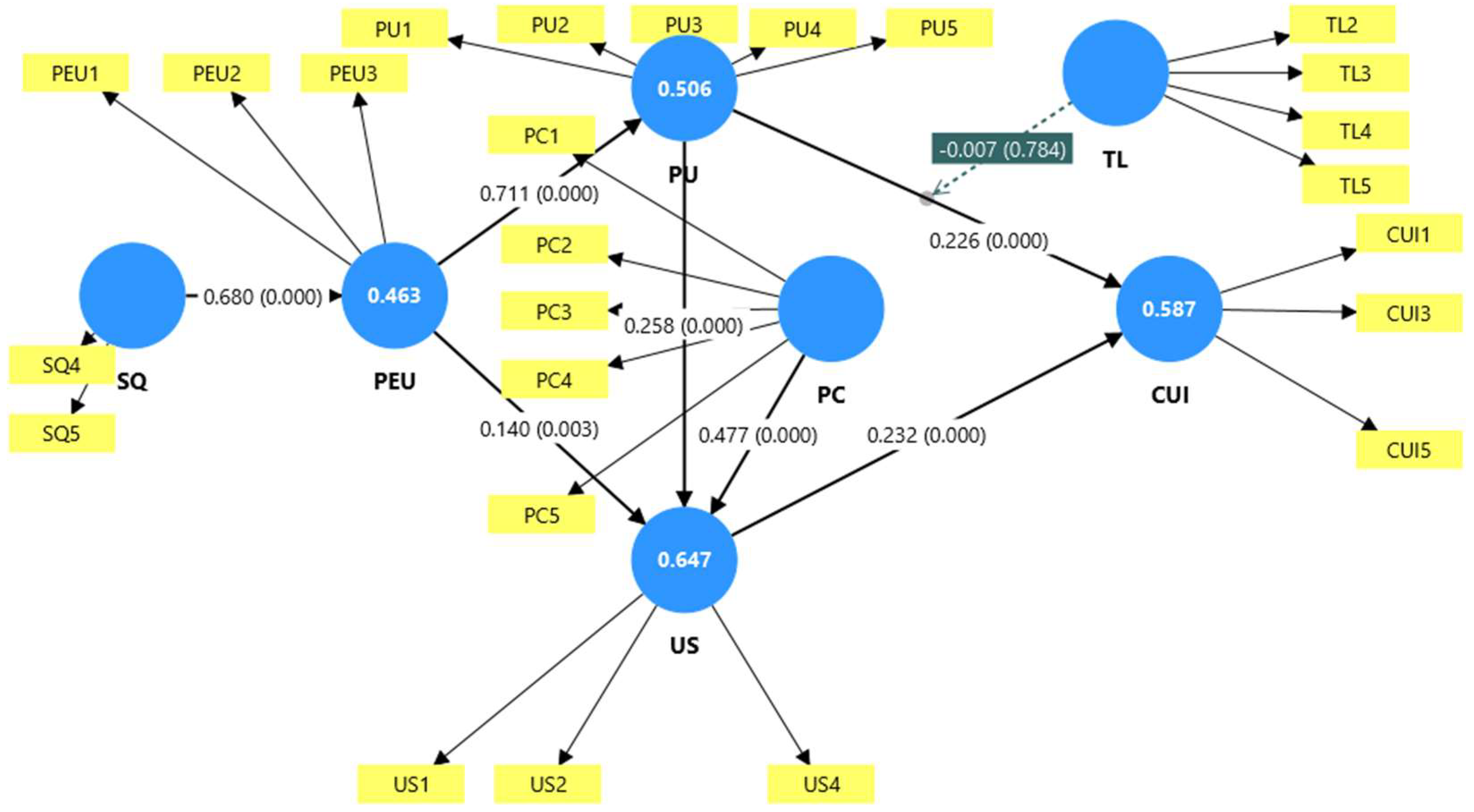
This study examined how system quality, perceived ease of use, perceived usefulness, perceived compulsion, user satisfaction, and tax literacy jointly shape continuous usage intention toward Coretax among Indonesian taxpayers. Six of eight hypotheses were supported. The two exceptions—H5 (opposite direction) and H8 (non-significant moderation)—are analytically as important as the supported results and are addressed in turn.
H1 is the strongest path in the model (β = 0.680, f
2 = 0.861). System quality, captured through taxpayers’ perceptions of Coretax’s technical reliability and overall functional performance, is a powerful upstream driver of perceived ease of use. This is consistent with [
14,
20], who established that system-level technical characteristics are the primary antecedents of ease-of-use perceptions. In the Coretax context—where taxpayers have no legally permissible alternative—technical friction cannot be offset by switching channels, making ease-of-use perceptions acutely sensitive to system quality. H2 further confirms that ease of use strongly predicts perceived usefulness (β = 0.711, f
2 = 1.024), the largest effect in the model. When interaction is cognitively effortless, taxpayers have the cognitive capacity to notice what the system actually delivers—faster filing, improved accuracy, and reduced reporting errors. Refs. Davis, Venkatesh & Davis [
5,
19] anticipated precisely this mechanism, and ref. Al-Hattami & Almaqtari [
28] confirmed it is especially pronounced when user discretion is constrained, which applies directly here. For Coretax specifically, this dynamic carries heightened significance: the platform was launched under active public scrutiny following well-documented early instability, meaning taxpayers’ initial ease-of-use impressions were formed amid technical stress. That the quality-ease-usefulness chain nonetheless held strongly in this sample—within the platform’s first operational year—suggests the chain is robust even when the system is still maturing, and that improvements to Coretax’s reliability would produce upstream gains in perceived usefulness that compound across the entire model. This finding is consistent with recent empirical evidence from digital government IS deployments, where system quality has been confirmed as the dominant upstream predictor of ease-of-use perceptions even during platform transition periods characterised by technical instability [
18].
H3 and H4 together show that both ease of use (β = 0.140) and perceived usefulness (β = 0.258) positively influence user satisfaction, with usefulness carrying the larger weight. This ordering makes theoretical sense: in a compliance-driven IS, satisfaction is less about interaction comfort and more about whether the system delivers on its functional promise—meeting expectations, performing consistently, and supporting obligation fulfilment [
14,
30]. Ref. Akrong et al. [
24], evaluating a tax administration ERP through the DeLone–McLean framework, reported a structurally equivalent pattern. H6 and H7 complete the supported chain, with perceived usefulness (β = 0.226) and user satisfaction (β = 0.232) both independently predicting continuous usage intention at near-equal weights. This dual-pathway result aligns with [
9], who found that sustained e-filing engagement requires that cognitive utility assessments and affective satisfaction be met simultaneously—a finding replicated here with a general taxpayer population. Ref. Abu-Silake et al. [
13] confirmed this dual-pathway structure among digital tax platform users in Jordan, finding that usefulness and satisfaction operate as co-predictors of continued engagement, with comparable effect magnitudes. In the Coretax context, this dual-pathway result carries a specific operational reading. Taxpayers in this sample file monthly VAT returns, submit annual income tax declarations, and manage withholding obligations—a recurring compliance calendar that accumulates satisfaction and usefulness evaluations across multiple use cycles rather than a single interaction. The fact that both usefulness and satisfaction independently predict continuance at near-equal weights suggests that neither functional performance nor affective experience alone is sufficient to sustain engagement; Coretax must deliver on both simultaneously across each successive filing cycle to retain genuine rather than merely compelled usage.
H5 is the study’s most analytically important finding. Perceived compulsion was hypothesised to negatively affect user satisfaction based on SDT [
31] and [
15]’s evidence that coercion generates resistance in mandatory IS settings. The path is significant but positive (β = 0.477), directly contradicting the hypothesised direction. Ref. Brown et al. [
16] offer the most plausible theoretical explanation: when users accept the legitimacy of a mandate, compulsion shifts from a psychological threat to a contextual frame, redirecting evaluative attention to whether the system works rather than to the imposition itself. Ref. Vansteenkiste & Ryan [
47] describe this as identified regulation—externally required behaviour becomes congruent with personal or professional values—which is credible among educated, professionally employed taxpayers who regard compliance as part of their occupational identity. Empirically, ref. Ariyanto [
11] similarly found that compliance-oriented Indonesian taxpayers evaluate mandatory digital systems through a norm-congruent rather than coercion-resistant lens.
This interpretation is reinforced by the sample’s occupational composition: civil servants (37.01%) and private sector workers (39.44%) together comprise over three-quarters of respondents—individuals whose professional identities are bound up with regulatory adherence and for whom the Coretax mandate aligns with pre-existing occupational norms. It is important to acknowledge, however, that this profile may itself partly explain the positive direction. Less-educated taxpayers, informal-sector workers, and small entrepreneurs—underrepresented here but substantial in Indonesia’s broader taxpayer population—may experience compulsion very differently, potentially producing the negative satisfaction effect that SDT originally predicts. The compulsion-satisfaction finding should therefore be interpreted as specific to this occupational and educational profile rather than as a general property of Indonesian taxpayer behaviour. The practical implication is clear: system performance and functional adequacy are the more actionable levers for satisfaction; mandate legitimacy, while present, should not be assumed to be permanent.
H8 is not supported (β = −0.007, n.s., f
2 = 0.000). Tax literacy—reflecting taxpayers’ self-assessed understanding of filing procedures, tax liabilities, and legal consequences of non-compliance—does not moderate the perceived usefulness–continuous usage intention relationship. In a mandatory deployment where usage is legally non-negotiable, the room for individual judgement through which literacy might differentiate users collapses [
15]. The non-significant moderation does not mean tax literacy is irrelevant; however, its medium direct effect on continuous usage intention (f
2 = 0.246) suggests it independently elevates engagement intentions across the sample. This distinction matters for policy: Ref. Saptono et al. [
10] recommends pairing digital tax reforms with taxpayer education, and the direct effect found here supports that as a strategy for raising the overall baseline of Coretax engagement, even if literacy does not amplify the usefulness–continuance pathway at the individual level. In the Coretax context, this direct effect is particularly relevant given Indonesia’s known variability in tax literacy across taxpayer segments. The platform serves a population ranging from sophisticated corporate taxpayers to small entrepreneurs with limited formal tax education. The finding that higher cognitive literacy independently lifts continuous usage intentions suggests that taxpayer education programmes have a direct engagement payoff—not merely a compliance payoff—that justifies investment independent of any moderating function. It is important to note, however, that the null moderation may partly reflect measurement limitations rather than a true absence of effect. The tax literacy scale operationalises the cognitive dimension only—declarative procedural and regulatory knowledge—and the sample skews toward relatively educated, professionally employed respondents among whom high procedural knowledge may be common. Range restriction in a moderator attenuates interaction terms in PLS-SEM, producing near-zero coefficients even when the underlying relationship exists [
38,
39]. Furthermore, self-assessed tax literacy captures perceived rather than objective competence, introducing socially desirable responding as a potential source of variance compression. This interpretation would be tested more definitively by using objective tax knowledge measures or a two-dimensional tax literacy scale that captures both cognitive and motivational dimensions.
Addressing the research questions and the gaps that motivated them, the findings provide three main answers. First, RQ1, which corresponds to Gap 1, is answered affirmatively. The quality, ease-of-use, and usefulness chain operates robustly in a mandatory post-adoption context, confirming that TAM’s explanatory logic remains relevant even when initial adoption is legally guaranteed and continuous usage intention becomes the theoretically meaningful outcome. Second, RQ2, also linked to Gap 1, is answered affirmatively but not in the hypothesised direction. Perceived compulsion significantly affects user satisfaction, but the effect is positive rather than negative. This finding suggests that institutional acceptance, rather than coercion-based resistance, is the operative mechanism in this context and shows that the coercion-resistance prediction derived from SDT was not supported. Third, RQ3, which corresponds to Gap 3, is answered negatively. Tax literacy does not moderate the perceived usefulness-continuous usage intention relationship, suggesting that the mandatory deployment context may suppress individual-level moderation. However, its direct effect on continuous usage intention confirms its additive value as an engagement lever independent of the usefulness pathway.
7. Conclusions
Under a TAM-based framework extended with perceived compulsion and tax literacy, this study provides one of the first empirical examinations of continuous usage intention toward Coretax among Indonesian taxpayers, with six of eight hypotheses supported. System quality emerged as the critical upstream lever, producing the strongest path in the model (β = 0.680) and initiating the cognitive adoption chain: ease of use strongly amplified perceived usefulness (β = 0.711), which, alongside user satisfaction, independently predicted continuous usage intention at near-equal weights (β = 0.226 and β = 0.232, respectively). Both ease of use (β = 0.140) and perceived usefulness (β = 0.258) positively influenced user satisfaction, with usefulness carrying the greater weight—an ordering consistent with compliance-driven IS contexts where functional delivery matters more than interaction comfort. Collectively, these six supported paths confirm that even within a legally mandated deployment where initial adoption is guaranteed, the cognitive quality chain theorised by TAM operates robustly, and system performance remains the dominant determinant of taxpayer engagement beyond the compliance minimum.
The two unsupported results are among the study’s most theoretically significant contributions. The positive effect of perceived compulsion on user satisfaction (β = 0.477) contradicts the SDT-derived prediction in this context, where externally imposed IS use was expected to generate resistance. Instead, the finding points to institutional acceptance as the operative mechanism. When users internalise compliance as an occupational norm, legal coercion may redirect evaluative attention toward system performance rather than being experienced primarily as personal imposition. This suggests that, in high-legitimacy mandatory deployments, governments should not rely only on legitimacy communication. Greater policy attention and budget should be directed toward system quality and functional performance, since these factors are more likely to sustain satisfaction under mandatory use.
This finding nonetheless carries a warning. Coercion-driven satisfaction is not the same as genuine engagement—users satisfied because they have internalised a mandate represent a fragile form of adoption that could reverse rapidly if legitimacy erodes or system quality deteriorates. Optimising compliance systems for satisfaction metrics without preserving user agency—the ability to provide feedback, influence system development, and engage meaningfully with the platform—risks building adoption on an institutionally contingent foundation rather than a functionally earned one. Tax literacy’s null moderation (β = −0.007, f2 = 0.000) reinforces this concern: the mandatory frame suppresses the individual-level judgement through which users would ordinarily evaluate a system on its merits. Its significant direct effect on continuous usage (f2 = 0.246), however, offers a constructive counterpoint—building tax literacy raises the baseline of genuine engagement, giving users the cognitive resources to find the system personally meaningful rather than merely obligatory. These findings collectively argue that mandatory IS design must account for user autonomy, not just compliance metrics, as both an ethical commitment and a practical safeguard against the fragility of adoption that coercion-driven satisfaction alone cannot sustain.
More broadly, future research should situate mandatory IS adoption within the public administration literature on tax morale and institutional trust, examining whether platform quality and the compulsion-satisfaction dynamics observed here have downstream consequences for taxpayers’ civic attitudes toward the tax process itself—a dimension that positions Coretax not merely as a compliance tool but as an institutional interface between citizens and the state.
Limitations and Future Research
First, this study was conducted within the first year of Coretax’s operation, meaning taxpayer perceptions reflect an early adaptation period involving a platform still under active development. Ease-of-use and usefulness evaluations formed at this stage may not represent the settled experience of a technically mature system. More importantly, the unexpected positive direction of the compulsion-satisfaction path may partly reflect the novelty of the mandate rather than a stable attitudinal orientation. Longitudinal research tracking the same taxpayer cohorts across multiple Coretax usage cycles would reveal whether the quality-ease-usefulness chain strengthens as familiarity accumulates, and whether the compulsion-satisfaction relationship weakens as the mandate transitions from a new imposition to an internalised routine, a dynamic account that cross-sectional designs cannot provide. Future research should also directly measure perceived legitimacy and institutional trust to formally test whether they moderate the compulsion-satisfaction relationship, as proposed in the boundary-condition argument in
Section 6.1.
In addition, this study measures taxpayer perceptions and behavioural intentions rather than actual compliance behaviour or fiscal outcomes. Future research linking platform adoption quality to measurable changes in tax revenue, compliance rates, or administrative efficiency would provide a valuable complementary account of Coretax’s real-world impact that the present perceptual design cannot deliver. The study is also bounded by a single national context. Although the mandatory IS adoption dynamics examined here are relevant to tax authorities worldwide, including EU member states implementing SAF-T, real-time e-invoicing, and unified digital tax platforms, cross-national comparative research is needed to establish whether the institutional acceptance mechanism and quality-adoption chain generalise across different regulatory cultures, levels of institutional trust, and stages of digital infrastructure maturity.
Second, this study measured tax literacy as declarative knowledge only, capturing the cognitive dimension while leaving open whether the motivational dimension—compliance as a personal or professional value rather than mere rule awareness—would exhibit stronger moderating potential. Future research should develop a two-dimensional measure that tests both dimensions simultaneously to resolve the null moderation finding more definitively. Caution is also warranted on measurement grounds. The sample’s educational profile—over 83% holding at least a bachelor’s degree—raises the possibility of range restriction in the moderator, which attenuates product-indicator interaction terms in PLS-SEM regardless of the true effect size. Objective tax knowledge measures would provide a cleaner test than self-assessed literacy ratings.
Third, this study tested tax literacy as the sole individual-level moderator of the usefulness–continuance pathway. Perceived risk and digital competence represent two plausible alternatives—high-risk users may convert usefulness into continuance more strongly when the system visibly reduces compliance errors [
5,
6], while stronger digital proficiency reduces cognitive barriers to exploiting system features. Future research incorporating both constructs alongside a two-dimensional tax literacy measure would provide a more complete account of individual-level moderation in mandatory IS contexts.
Fourth, the sample’s demographic composition limits the generalisability of the H5 finding. Over 83% of respondents held at least a bachelor’s degree, and civil servants and private sector employees comprised over three-quarters of the sample—a profile systematically different from Indonesia’s broader taxpayer population, which includes large informal-sector segments and lower-education taxpayers for whom legal coercion may carry very different psychological weight. Future research should sample across education, income, and employment formality strata to test whether the institutional acceptance mechanism generalises beyond compliance-oriented, professionally employed segments.
Fifth, the present operationalisation of system quality does not capture data security and privacy protection as distinct dimensions. In centralised mandatory platforms like Coretax—where all taxpayers’ financial data is consolidated under a single architecture—security concerns represent a theoretically distinct quality dimension, as evidenced by privacy barriers documented in European mandatory e-invoicing deployments [
31,
43]. Future research should explicitly incorporate security and privacy perceptions into the system quality antecedent chain.




 ,
,