Exploring Shifts in User Behavior Through Longitudinal Data from a Digital Platform for Art and Culture


Abstract
1. Introduction
2. Methodology
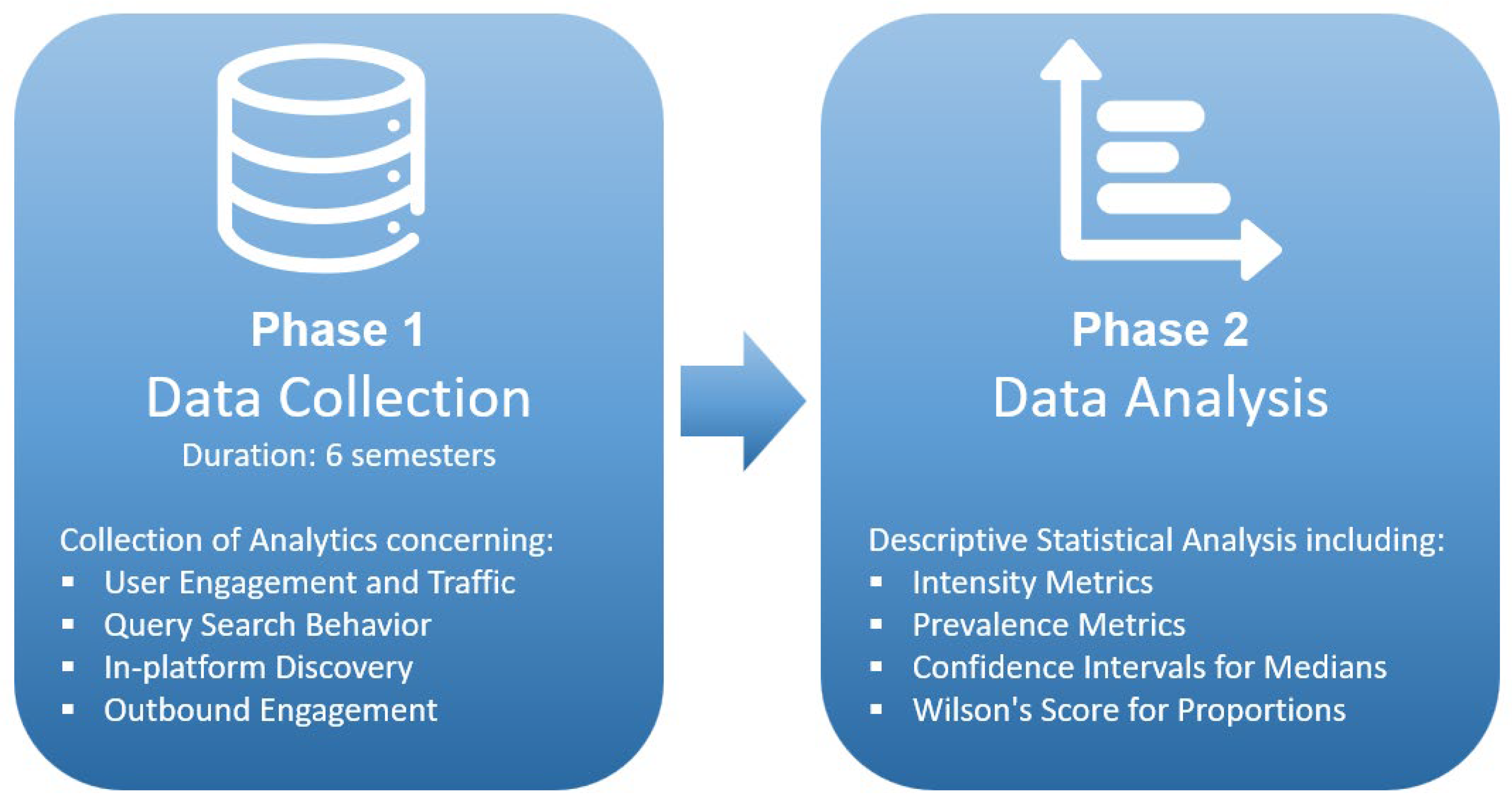
2.1. Research Design
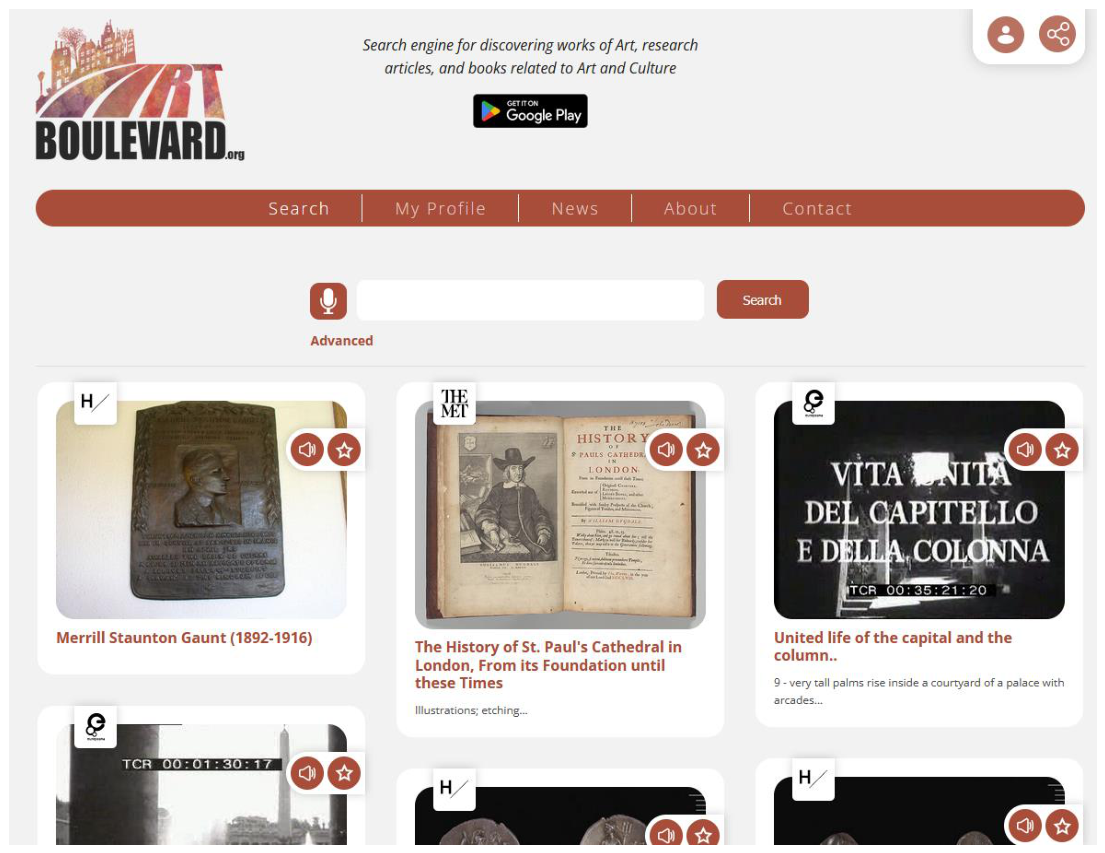
2.2. The ArtBoulevard Platform
- The Europeana Collections;
- The Harvard Art Museums;
- The Metropolitan Museum of Art;
- The Danish National Gallery of Art (SMK);
- The Artsy Online Art Marketplace;
- The CrossRef Scholarly Texts Archive;
- The Open Library of Books.
2.3. Data Collection
2.4. Statistical Analysis
3. Results
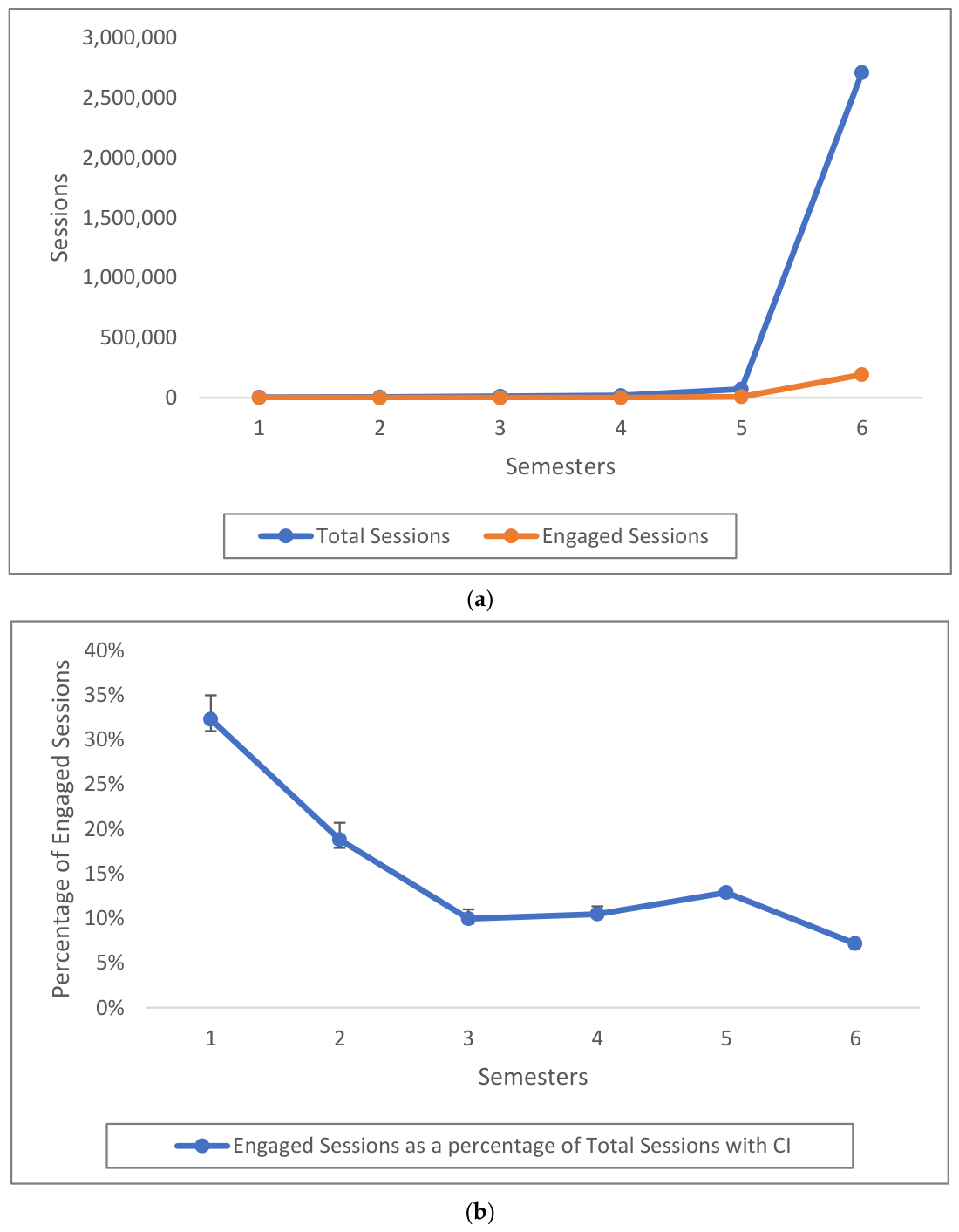
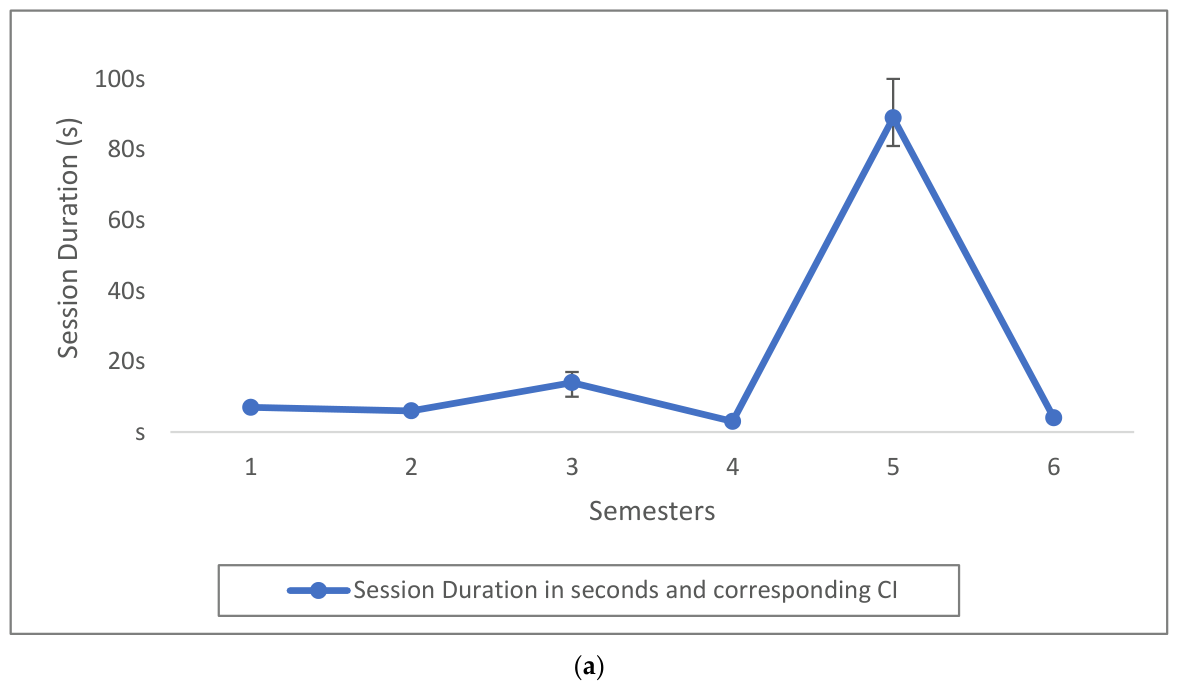
3.1. Traffic and Engagement
3.2. Querying Behavior
3.3. In-Platform Engagement
3.4. Outbound Engagement
4. Discussion
4.1. RQ1: How Did User Engagement Evolve over the Three-Year Period?
4.2. RQ2: To What Extent Did General Query Search Behavior Change over Time?
4.3. RQ3: How Did In-Platform Result Engagement and Outbound Engagement Shift over Time?
5. Conclusions
Funding
Institutional Review Board Statement
Informed Consent Statement
Data Availability Statement
Acknowledgments
Conflicts of Interest
Abbreviations
| UX | User Experience |
| LLM | Large Language Model |
| UI | User Interface |
| HCI | Human–Computer Interaction |
| API | Application Programming Interface |
| CI | Confidence Interval |
| AI | Artificial Intelligence |
| GenAI | Generative Artificial Intelligence |
References
- France, F.G. Managing Digital Image Repositories as Key Tools in the Preservation of Cultural Objects. In Archiving Conference; Society of Imaging Science and Technology: Springfield, VA, USA, 2007; Volume 4, pp. 117–121. [Google Scholar]
- Bekele, M.K.; Pierdicca, R.; Frontoni, E.; Malinverni, E.S.; Gain, J. A survey of augmented, virtual, and mixed reality for cultural heritage. J. Comput. Cult. Herit. JOCCH 2018, 11, 1–36. [Google Scholar] [CrossRef]
- Voinea, G.D.; Girbacia, F.; Postelnicu, C.C.; Marto, A. Exploring cultural heritage using augmented reality through Google’s Project Tango and ARCore. In International Conference on VR Technologies in Cultural Heritage; Springer International Publishing: Cham, Switzerland, 2018; pp. 93–106. [Google Scholar]
- Horakova, J. Shaping the New Era of Digital Art Historical Research with Digital Humanities and AI Art. In Proceedings of the Conference on Animation and Interactive Art, Linz, Austria, 3–7 September 2025; pp. 24–31. [Google Scholar]
- Huang, Y.; He, X.; Lian, Z.; Yang, Z. Mapping the landscape of digital cultural heritage research: A quantitative and visual bibliometric study. Libr. Hi Tech 2025, 43, 1157–1187. [Google Scholar] [CrossRef]
- Gibson, R.C.; Chowdhury, S.; Chowdhury, G. Accessing digital cultural heritage information: Users vs institutional perspectives of metadata and searching. In International Conference on Asian Digital Libraries; Springer International Publishing: Cham, Switzerland, 2022; pp. 207–221. [Google Scholar]
- Pergantis, M.; Varlamis, I.; Kanellopoulos, N.G.; Giannakoulopoulos, A. Searching Online for Art and Culture: User Behavior Analysis. Future Internet 2023, 15, 211. [Google Scholar] [CrossRef]
- Pirmoradi, A.; Hoeber, O. Bridging in-task emotional responses with post-task evaluations in digital library search interface user studies. Inf. Process. Manag. 2025, 62, 104069. [Google Scholar] [CrossRef]
- Zavalina, O.L.; Burke, M. User searching in digital repositories. In Discoverability in Digital Repositories; Routledge: Oxfordshire, UK, 2023; pp. 88–114. [Google Scholar]
- Othman, M.K.; Norman Anuar, N.; Barawi, M.H.; Yahya, A.S.A.H.; Abdul Manaf, A.A. A comprehensive user experience analysis of cultural heritage progressive web app using a hybrid ueq-ipa approach. ACM J. Comput. Cult. Herit. 2024, 17, 1–19. [Google Scholar] [CrossRef]
- Ceccarelli, D.; Gordea, S.; Lucchese, C.; Nardini, F.M.; Tolomei, G. Improving europeana search experience using query logs. In International Conference on Theory and Practice of Digital Libraries; Springer: Berlin/Heidelberg, Germany, 2011; pp. 384–395. [Google Scholar]
- Safari, N.; Mirhosseini, Z.; Abazari, Z. Analyzing the Information-Seeking Behavior of Researchers in the Field of Art. Knowl. Retr. Semant. Syst. 2025, 2, 221–246. [Google Scholar]
- Barifah, M.; Landoni, M.; Eddakrouri, A. Evaluating the user experience in a digital library. Proc. Assoc. Inf. Sci. Technol. 2020, 57, e280. [Google Scholar] [CrossRef]
- Dobreva, M.; Chowdhury, S. A user-centric evaluation of the Europeana digital library. In International Conference on Asian Digital Libraries; Springer: Berlin/Heidelberg, Germany, 2010; pp. 148–157. [Google Scholar]
- Bates, M.J. The design of browsing and berrypicking techniques for the online search interface. Online Rev. 1989, 13, 407–424. [Google Scholar] [CrossRef]
- Jones, S.; Cunningham, S.J.; McNab, R.; Boddie, S. A transaction log analysis of a digital library. Int. J. Digit. Libr. 2000, 3, 152–169. [Google Scholar] [CrossRef]
- Jansen, B.J.; Aldous, K.K.; Salminen, J.; Almerekhi, H.; Jung, S.G. Search Analytics. In Understanding Audiences, Customers, and Users via Analytics: An Introduction to the Employment of Web, Social, and Other Types of Digital People Data; Springer International Publishing: Cham, Switzerland, 2023; pp. 95–103. [Google Scholar]
- McKay, D.; Buchanan, G. Capturing Information Behaviour in the Wild: A Tutorial. In Proceedings of the 2022 Conference on Human Information Interaction and Retrieval, Regensburg, Germany, 14–18 March 2022; pp. 363–364. [Google Scholar]
- Orduña-Malea, E.; Font-Julián, C.I.; Serrano-Cobos, J. Open access publications drive few visits from Google Search results to institutional repositories. Scientometrics 2024, 129, 7131–7152. [Google Scholar] [CrossRef]
- COAR. Mitigating the Impact of AI Bots. COAR: Confederatoon of Open Access Repositories. 2026. Available online: https://coar-repositories.org/news-updates/mitigating-the-impact-of-ai-bots/ (accessed on 1 May 2026).
- Weinberg, M. Are AI Bots Knocking Cultural Heritage Offline. The GLAM-E Lab. 2025. Available online: https://www.glamelab.org/products/are-ai-bots-knocking-cultural-heritage-offline (accessed on 1 May 2026).
- Amer, E.; Elboghdadly, T. The end of the search engine era and the rise of generative AI: A paradigm shift in information retrieval. In 2024 International Mobile, Intelligent, and Ubiquitous Computing Conference (MIUCC); IEEE: New York, NY, USA, 2024; pp. 374–379. [Google Scholar]
- Wlusek, M. Designing Human-Centered Generative AI Conversational Agents for Digital Cultural Heritage: A Case Study on Europeana. Master’s Thesis, Linnaeus University, Växjö, Sweden, 2026. [Google Scholar]
- Sullivan, P. Usability in the computer industry: What contribution can longitudinal field studies make? In International Professional Communication Conference ‘Communicating to the World’; IEEE: New York, NY, USA, 1989; pp. 12–16. [Google Scholar]
- Kalinauskaitė, R. Key concerns in longitudinal study design. In Handbook of Research Methods in Corporate Social Responsibility; Edward Elgar Publishing: Gloucestershire, UK, 2017; pp. 125–138. [Google Scholar]
- Liu, J.; Sun, H.L.; Kuang, L.; Zheng, J. A longitudinal study of user continuance intention to use public digital cultural services. Libr. Inf. Sci. Res. 2025, 47, 101343. [Google Scholar] [CrossRef]
- Zerhoudi, S.; Granitzer, M. Comparative analysis: User interactions in public and private digital libraries datasets. In International Conference on Theory and Practice of Digital Libraries; Springer Nature: Cham, Switzerland, 2024; pp. 162–172. [Google Scholar]
- Dumais, S.; Jeffries, R.; Russell, D.M.; Tang, D.; Teevan, J. Understanding user behavior through log data and analysis. In Ways of Knowing in HCI; Springer: New York, NY, USA, 2014; pp. 349–372. [Google Scholar]
- Malik, U.S.; Micoli, L.L.; Caruso, G.; Guidi, G. Integrating quantitative and qualitative analysis to evaluate digital applications in museums. J. Cult. Herit. 2023, 62, 304–313. [Google Scholar] [CrossRef]
- Mohmedmhdi, H.; Swathi, P.; Praveenraj, D.D.W.; Thayumanavan, K.; Kannan, A.S.; Sachdeva, L. Gamification Analytics for Enhancing Engagement in Digital Repositories. Indian J. Inf. Sources Serv. 2025, 15, 248–256. [Google Scholar] [CrossRef]
- De Barba, P.G.; Malekian, D.; Oliveira, E.A.; Bailey, J.; Ryan, T.; Kennedy, G. The importance and meaning of session behaviour in a MOOC. Comput. Educ. 2020, 146, 103772. [Google Scholar] [CrossRef]
- Greidanus, M.A.; de Rijk, A.E.; Frings-Dresen, M.H.W.; Tiedtke, C.M.; Brouwers, S.; de Boer, A.G.E.M.; Tamminga, S.J. The use and perceived usefulness of an online toolbox targeted at employers (MiLES intervention) for enhancing successful return to work of cancer survivors. J. Occup. Rehabil. 2021, 31, 393–404. [Google Scholar] [CrossRef]
- Young, L.E.; Soliz, S.; Xu, J.J.; Young, S.D. A review of social media analytic tools and their applications to evaluate activity and engagement in online sexual health interventions. Prev. Med. Rep. 2020, 19, 101158. [Google Scholar] [CrossRef]
- Hyndman, R.J.; Fan, Y. Sample quantiles in statistical packages. Am. Stat. 1996, 50, 361–365. [Google Scholar] [CrossRef]
- Gardner, M.J.; Altman, D.G. Confidence intervals rather than P values: Estimation rather than hypothesis testing. Br. Med. J. 1986, 292, 746–750. [Google Scholar] [CrossRef]
- Agresti, A.; Coull, B.A. Approximate is better than “exact” for interval estimation of binomial proportions. Am. Stat. 1998, 52, 119–126. [Google Scholar]
- Makkar, A. SecureEngine: Spammer classification in cyber defence for leveraging green computing in Sustainable city. Sustain. Cities Soc. 2022, 79, 103658. [Google Scholar] [CrossRef]
- Efron, B.; Tibshirani, R. Bootstrap methods for standard errors, confidence intervals, and other measures of statistical accuracy. Stat. Sci. 1986, 1, 54–75. [Google Scholar] [CrossRef]
- McHugh, M.L. The chi-square test of independence. Biochem. Medica 2013, 23, 143–149. [Google Scholar] [CrossRef]
- Aswani, R.; Ghrera, S.P.; Chandra, S.; Kar, A.K. A hybrid evolutionary approach for identifying spam websites for search engine marketing. Evol. Intell. 2021, 14, 1803–1815. [Google Scholar] [CrossRef]
- Bonel, E.; Capestro, M.; Di Maria, E. How COVID-19 impacted cultural consumption: An explorative analysis of Gen Z’s digital museum experiences. Ital. J. Mark. 2023, 2023, 135–160. [Google Scholar] [CrossRef]
- Green, A.U.S. Institutional Repositories Respond to AI: Perspectives on Policy and Technical Measures, Labor Impact, and Engagement Metrics. J. Libr. Adm. 2025, 65, 891–921. [Google Scholar] [CrossRef]
- Campo, E. Attention and Its Crisis in Digital Society; Routledge: Oxfordshire, UK, 2022. [Google Scholar] [CrossRef]
- Gibson, R.C.; Chowdhury, S.; Chowdhury, G. User versus institutional perspectives of metadata and searching: An investigation of online access to cultural heritage content during the COVID-19 pandemic. Int. J. Digit. Libr. 2024, 25, 105–121. [Google Scholar] [CrossRef]
- Xavier, H.S. The Web unpacked: A quantitative analysis of global Web usage. arXiv 2024, arXiv:2404.17095. [Google Scholar] [CrossRef]
- Karpinski, O.F.; Mcfetridge, L.N.; Ta, M.C.; Ashriem, F.N.; Singh, A. Evaluating AI-Assisted Search vs. Traditional Keyword Search: A Comparative Study of ChatGPT and Google. In 2025 IEEE World AI IoT Congress, (AIIoT); IEEE: New York, NY, USA, 2025; pp. 0982–0987. [Google Scholar]
- Wang, R.; Fan, K.; Liu, Z.; Wang, J. A study on user querying behavior in generative artificial intelligence environment. Data Anal. Knowl. Discov. 2024, 8, 20–30. [Google Scholar] [CrossRef]
- Wazzan, A.; MacNeil, S.; Souvenir, R. Comparing traditional and LLM-based search for image geolocation. In Proceedings of the 2024 Conference on Human Information Interaction and Retrieval, Sheffield, UK, 10–14 March 2024; pp. 291–302. [Google Scholar]
- Kim, N.; Ji, Y.G. Exploratory Search with Generative AI: An Empirical Study on the Impact of Interaction Design Strategies on Information Exploration and Cognitive Load. Int. J. Hum. Comput. Stud. 2026, 210, 103771. [Google Scholar] [CrossRef]
- Al Lawati, S.F.D. I Am Not a Caveman: An Eye-tracking Study of How Users are Influenced to Search in the Era of GenAI. In Proceedings of the Companion Proceedings of the ACM on Web Conference, Sydney, Australia, 28 April–2 May 2025; pp. 681–684. [Google Scholar]
- Liu, N.F.; Zhang, T.; Liang, P. Evaluating verifiability in generative search engines. In Findings of the Association for Computational Linguistics: EMNLP 2023; Association for Computational Linguistics: Singapore, 2023; pp. 7001–7025. [Google Scholar]



| Metric | Description | Type |
|---|---|---|
| words | The average number of keywords for all of the queries in a session where a query was performed | Numerical |
| duration | The duration of a session in seconds | Numerical |
| total_actions | The total number of interactions recorded in the timeline * | Numerical |
| queries | The number of queries in sessions where at least one query was performed | Numerical |
| results | The number of result details viewed in sessions where at least one result was viewed | Numerical |
| engaged_session | True for sessions that lasted at least 3 s or displayed captured mouse or scroll movement | Boolean |
| query_session | True for sessions where at least one query was performed | Boolean |
| result_session | True for sessions where at least one result was viewed | Boolean |
| source_session | True for sessions where at least one external link to an original source repository was clicked | Boolean |
| mobile_session | True for sessions where the user’s device was identified as a mobile phone | Boolean |
| Metric | Description | Used for |
|---|---|---|
| Q1 | Value for which 25% of data points are below | Intensity Metrics |
| median | Value for which 50% of data points are below | Intensity Metrics |
| Q3 | Value for which 75% of data points are below | Intensity Metrics |
| IQR | Differences between Q3 and Q1, representing 50% of the data | Intensity Metrics |
| Median 95% CI Low | Lower bound of the 95% bootstrap percentile confidence interval for the median | Intensity Metrics |
| Median 95% CI High | Higher bound of the 95% bootstrap percentile confidence interval for the median | Intensity Metrics |
| N | Total number of sessions that hold true for the specific per-session metric | Prevalence Metrics |
| p% | Percentage of sessions that hold true for the specific per-session metric out of all engaged sessions | Prevalence Metrics |
| p% Wilson CI Low | Lower bound of the 95% Wilson score confidence interval | Prevalence Metrics |
| p% Wilson CI High | Higher bound of the 95% Wilson score confidence interval | Prevalence Metrics |
| Semester | Total Sessions N | Engaged Sessions N | Engaged Sessions p% | Engaged Sessions CI Low | Engaged Sessions CI High |
|---|---|---|---|---|---|
| 1 | 4672 | 1507 | 32.26% | 30.93% | 33.61% |
| 2 | 6587 | 1238 | 18.79% | 17.87% | 19.76% |
| 3 | 12,558 | 1249 | 9.95% | 9.43% | 10.48% |
| 4 | 19,300 | 2020 | 10.47% | 10.04% | 10.91% |
| 5 | 72,877 | 9386 | 12.88% | 12.64% | 13.12% |
| 6 | 2,709,409 | 194,056 | 7.16% | 7.13% | 7.19% |
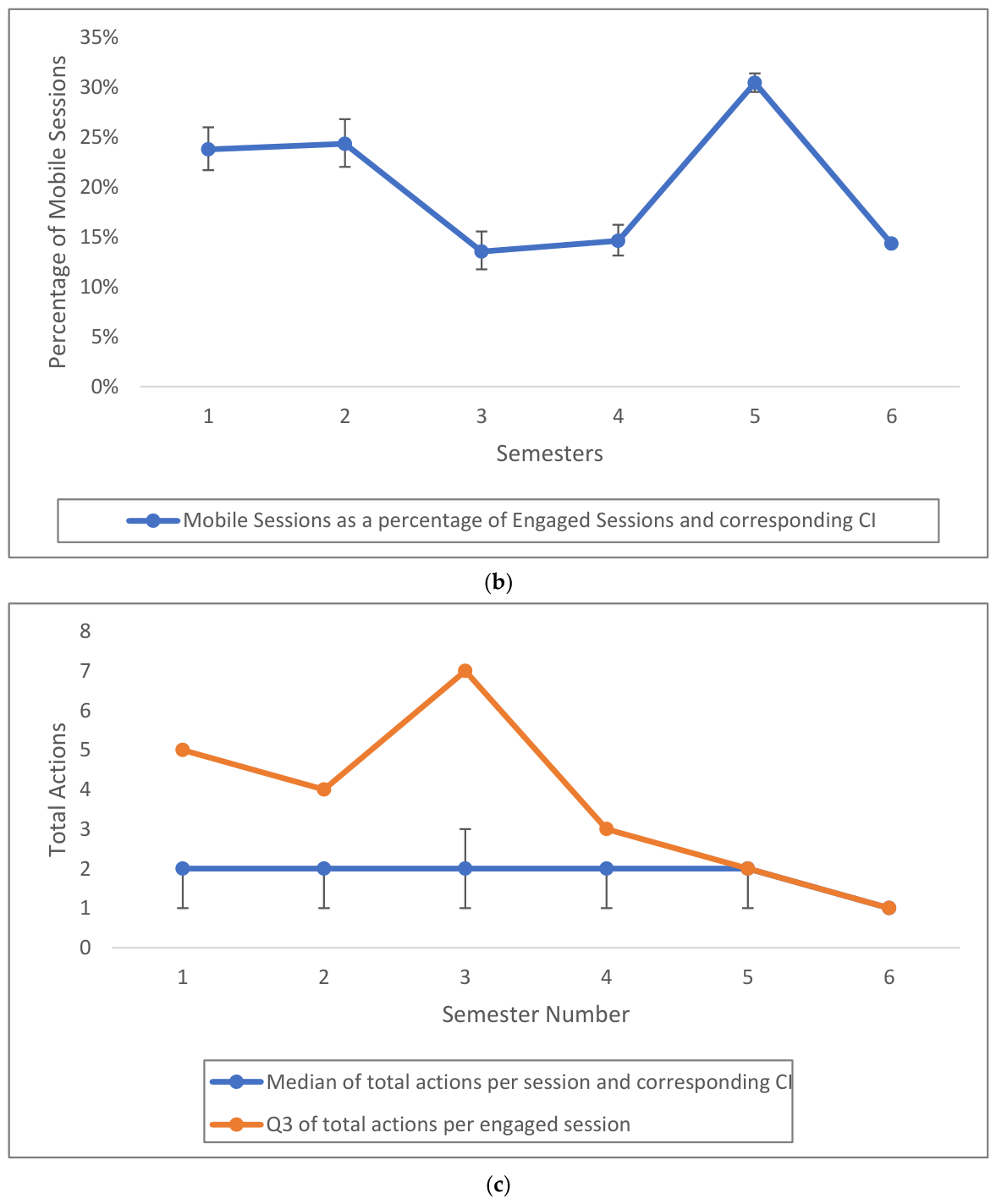
| Semester | Duration Median (Seconds) | Duration IQR (Seconds) | Mobile p% | Total Actions Median | Total Actions IQR | Total Actions Q3 |
|---|---|---|---|---|---|---|
| 1 | 7 | 41 | 23.76% | 2 | 4 | 5 |
| 2 | 6 | 26 | 24.31% | 2 | 3 | 4 |
| 3 | 14 | 197 | 13.53% | 2 | 6 | 7 |
| 4 | 3 | 17 | 14.60% | 2 | 2 | 3 |
| 5 | 89 | 775.75 | 30.43% | 2 | 1 | 2 |
| 6 | 4 | 5 | 14.32% | 1 | 0 | 1 |
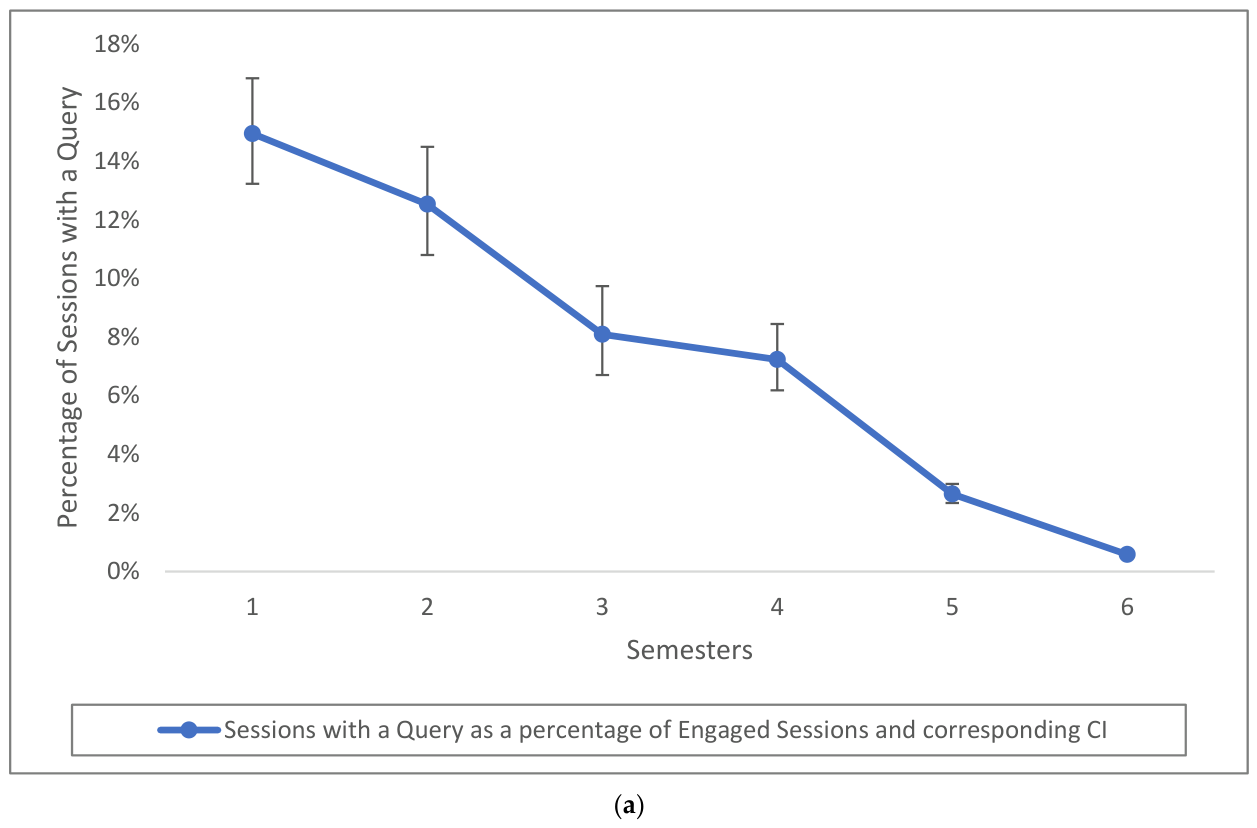
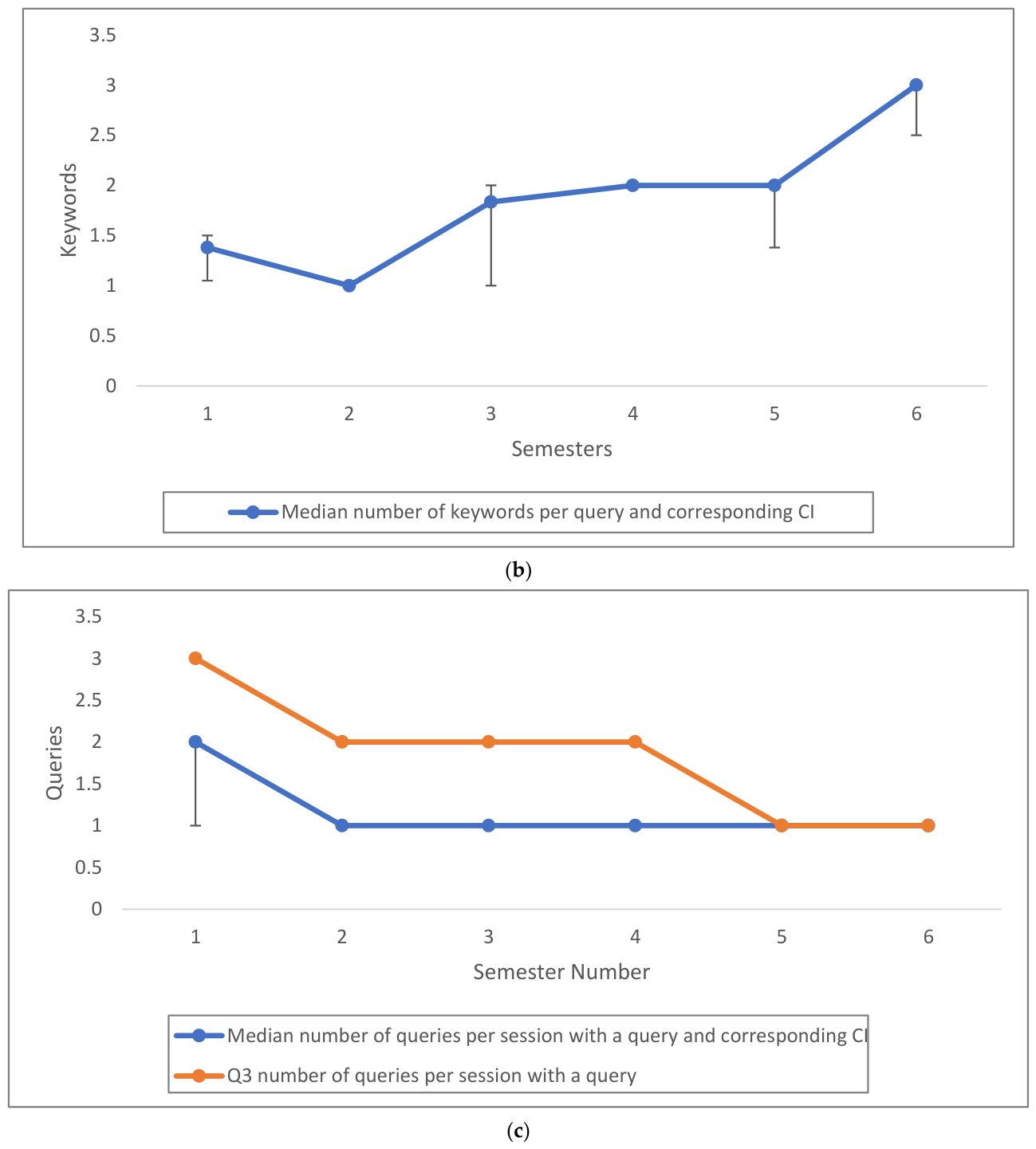
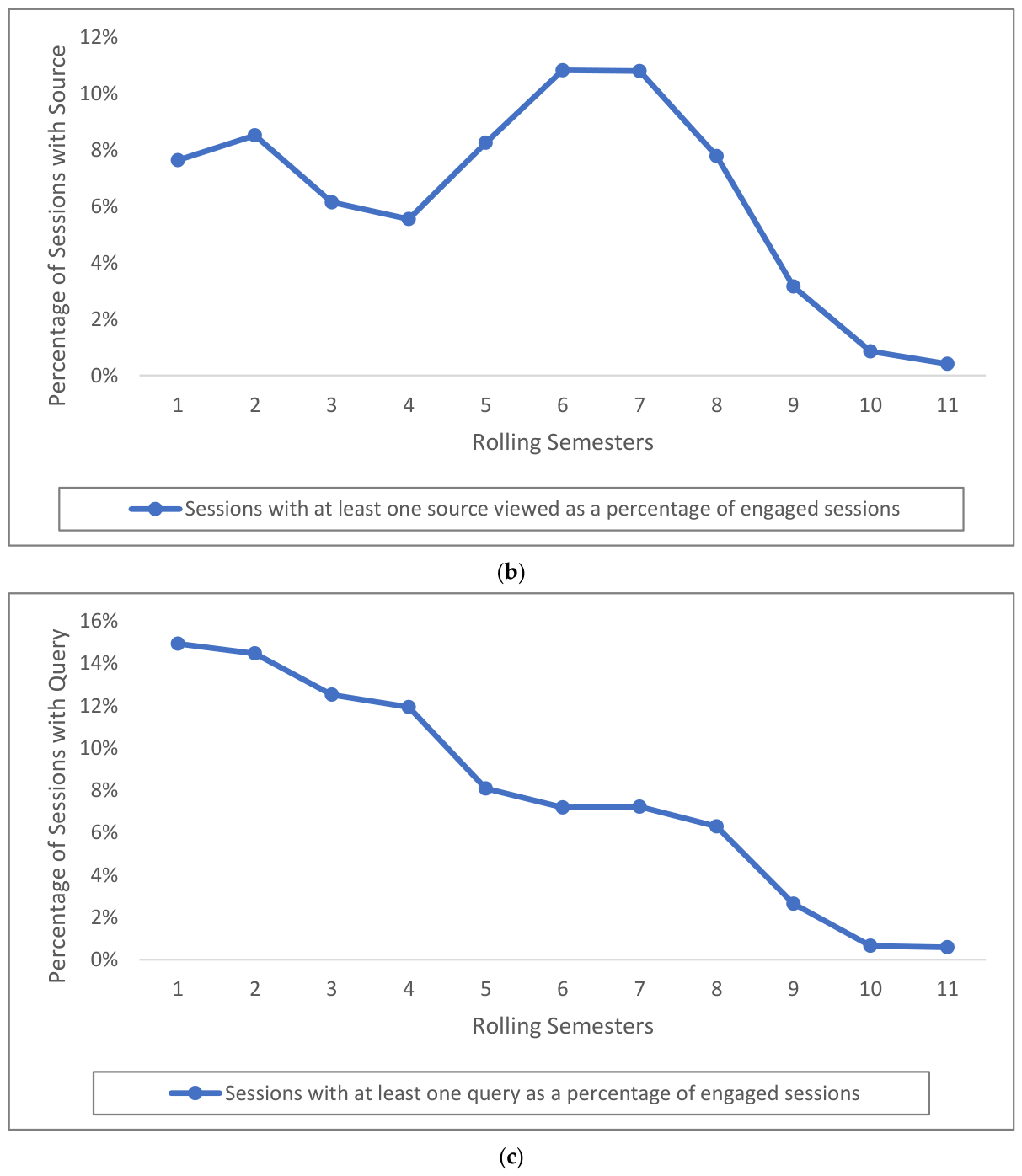
| Semester | Query Sessions N | Query Sessions p% | Keywords Median | Keywords IQR | Queries Median | Queries Q3 | Queries IQR |
|---|---|---|---|---|---|---|---|
| 1 | 225 | 14.93% | 1.38 | 1 | 2 | 3 | 2 |
| 2 | 155 | 12.52% | 1 | 1 | 1 | 2 | 1 |
| 3 | 101 | 8.09% | 1.835 | 2 | 1 | 2 | 1 |
| 4 | 146 | 7.23% | 2 | 2 | 1 | 2 | 1 |
| 5 | 248 | 2.64% | 2 | 2 | 1 | 1 | 0 |
| 6 | 1127 | 0.58% | 3 | 2 | 1 | 1 | 0 |
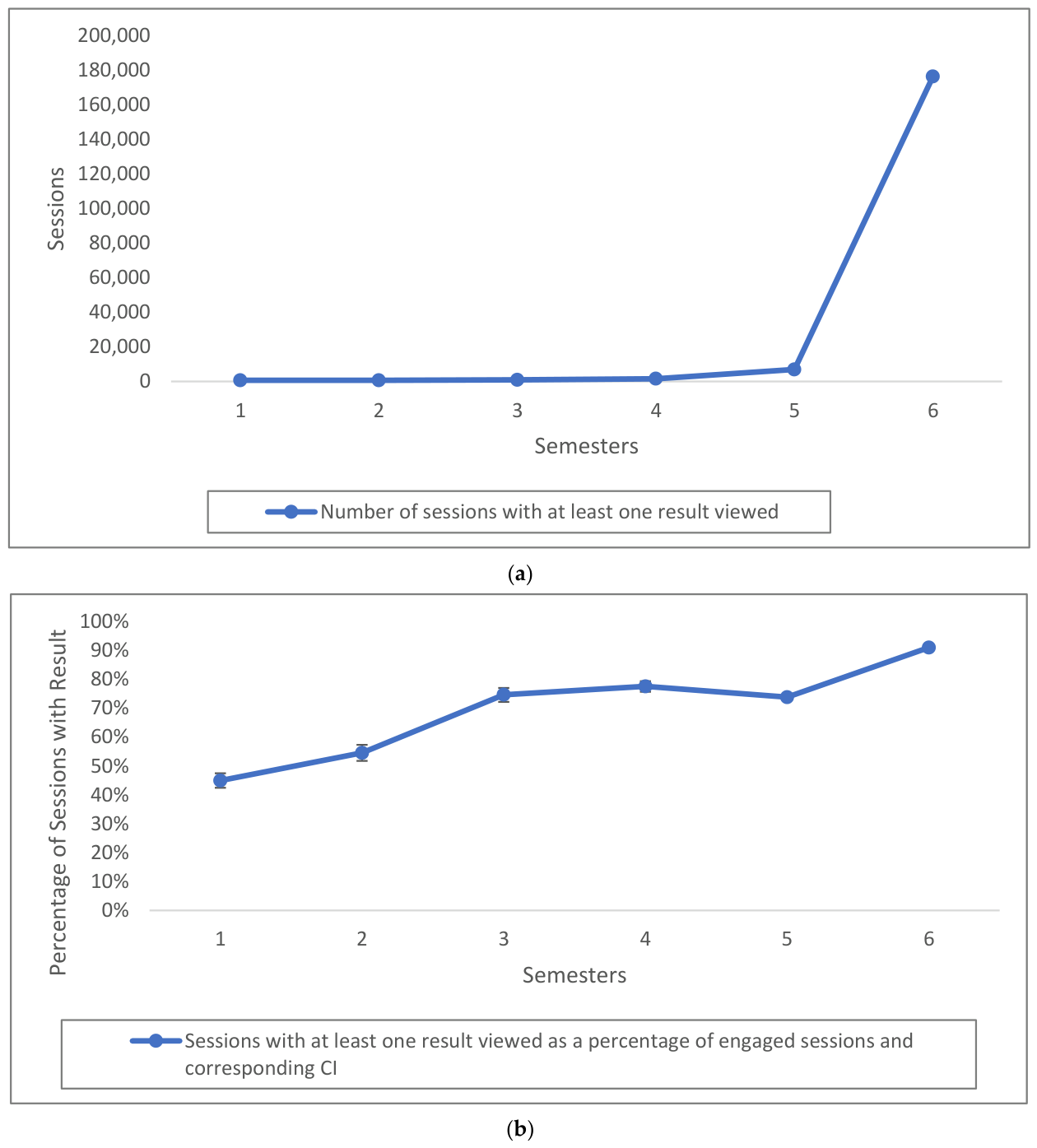
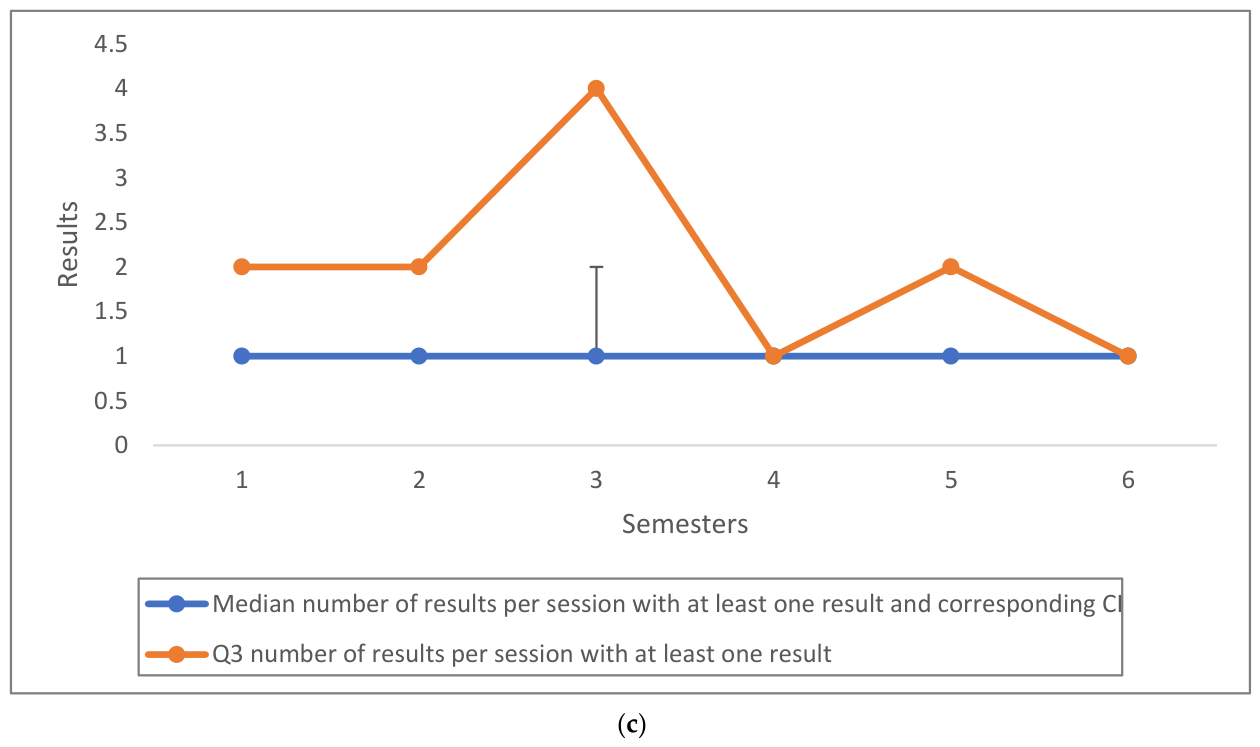
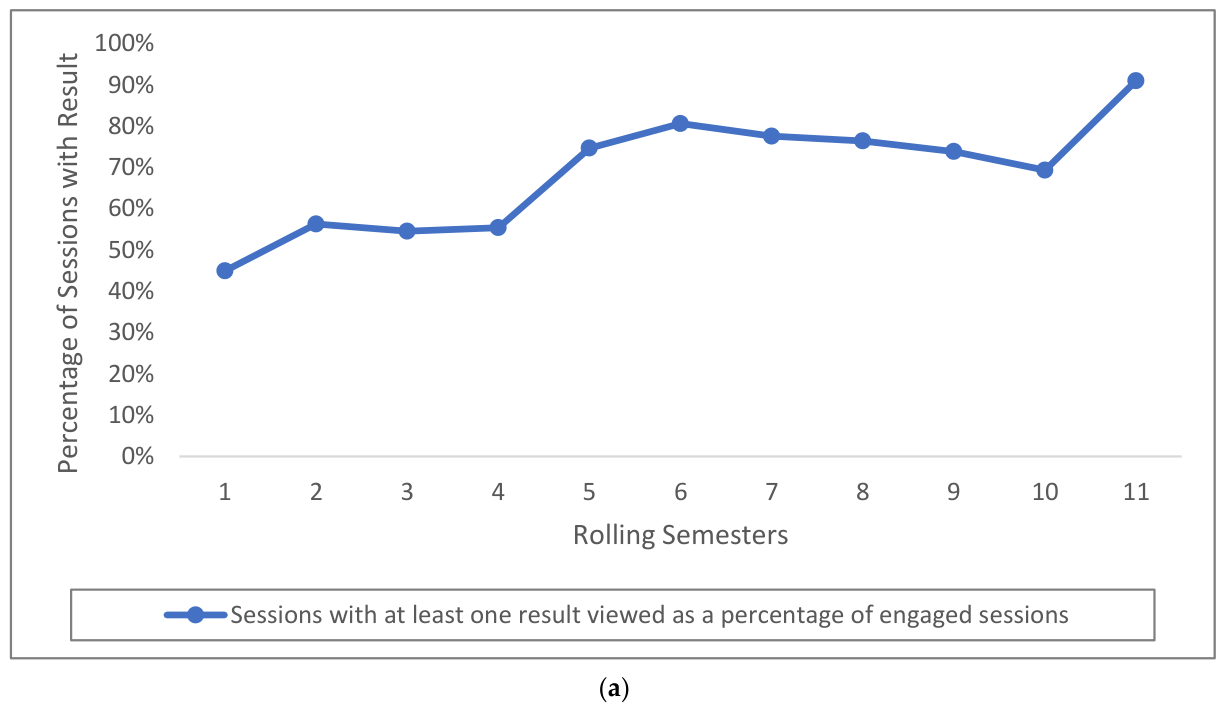
| Semester | Result Sessions N | Result Sessions p% | Results Median | Results Q3 | Results IQR |
|---|---|---|---|---|---|
| 1 | 677 | 44.92% | 1 | 2 | 1 |
| 2 | 675 | 54.52% | 1 | 2 | 1 |
| 3 | 932 | 74.62% | 1 | 4 | 3 |
| 4 | 1566 | 77.52% | 1 | 1 | 0 |
| 5 | 6926 | 73.79% | 1 | 2 | 1 |
| 6 | 176,476 | 90.94% | 1 | 1 | 0 |
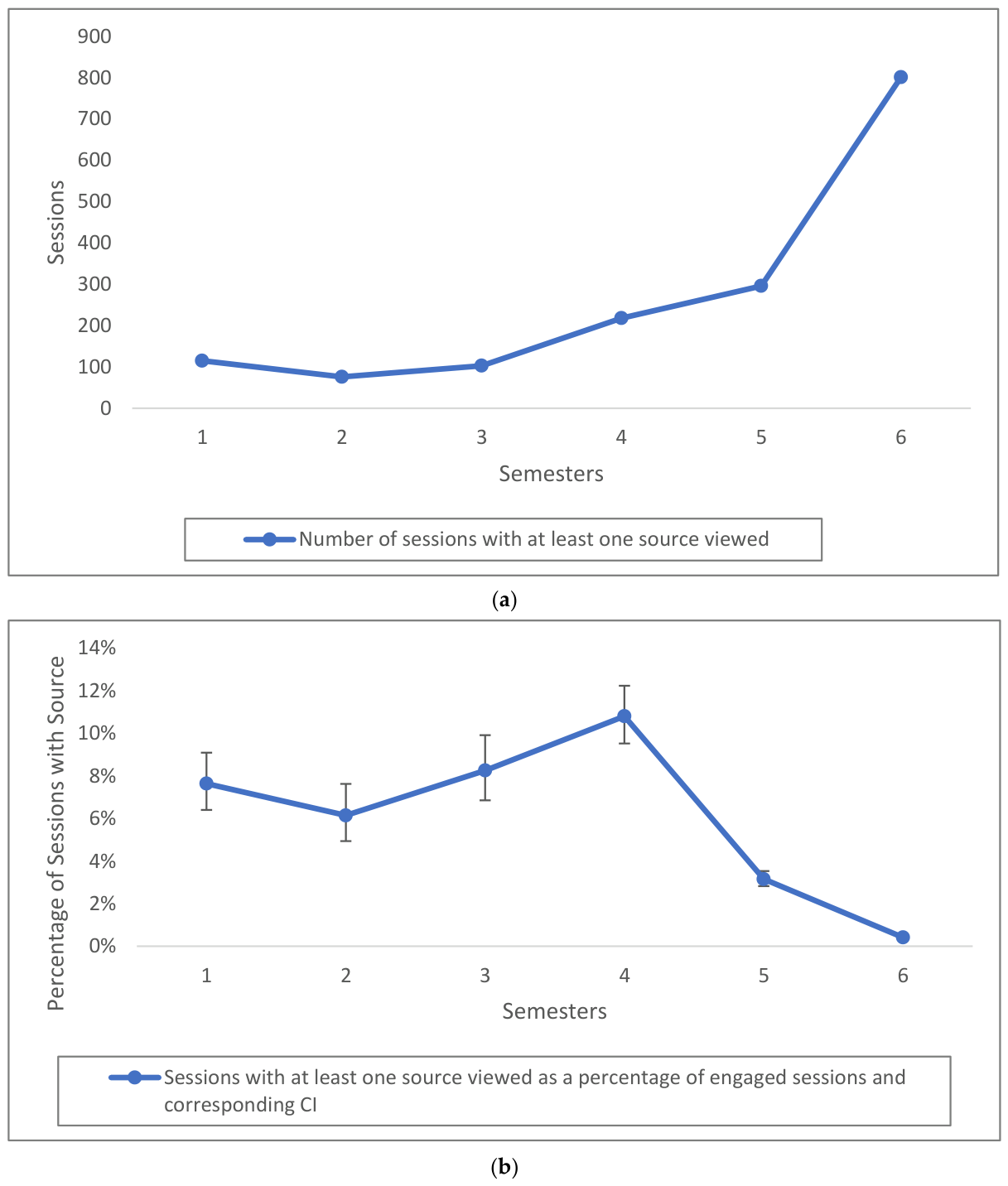
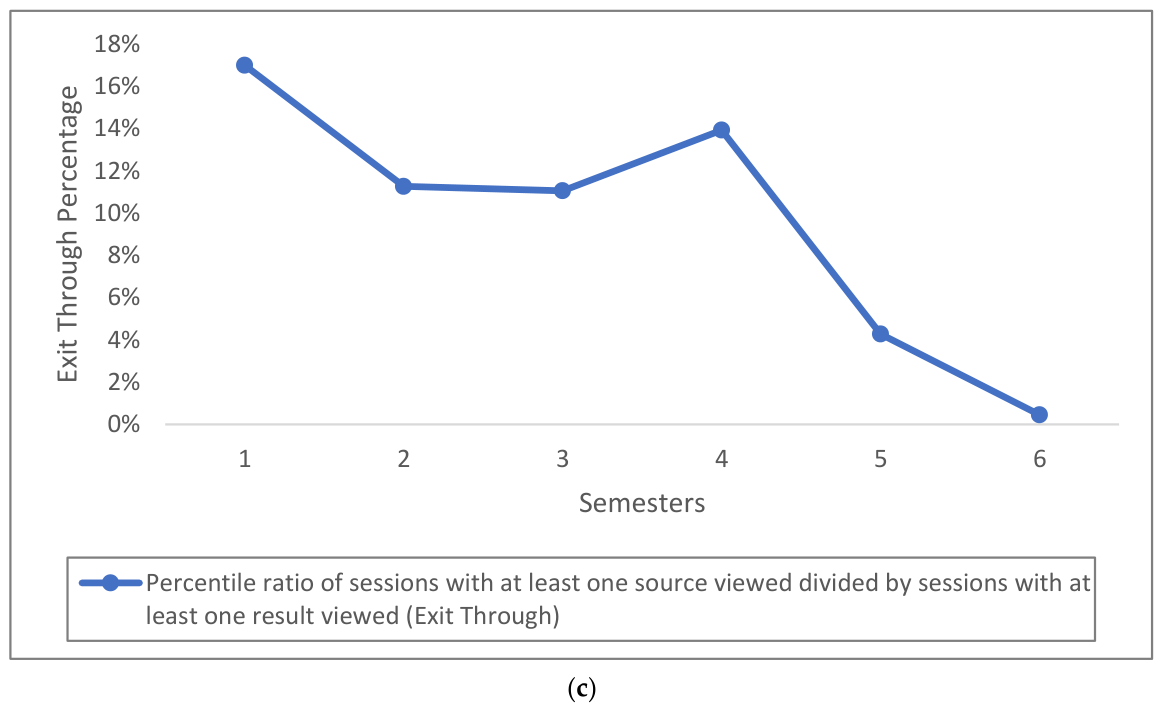
| Semester | Source Sessions N | Source Sessions p% | Source Sessions CI Low | Source Sessions CI High | Exit Through |
|---|---|---|---|---|---|
| 1 | 115 | 7.63% | 6.40% | 9.08% | 16.99% |
| 2 | 76 | 6.14% | 4.93% | 7.62% | 11.26% |
| 3 | 103 | 8.25% | 6.85% | 9.90% | 11.05% |
| 4 | 218 | 10.79% | 9.51% | 12.22% | 13.92% |
| 5 | 296 | 3.15% | 2.82% | 3.53% | 4.27% |
| 6 | 801 | 0.41% | 0.39% | 0.44% | 0.45% |
| Metric | Semester 1 Proportion | Semester 5 Proportion | Semester 6 Proportion | Chi-Square from 1 to 5 | Chi-Square from 1 to 6 |
|---|---|---|---|---|---|
| Query Sessions | 14.93% | 2.64% | 0.58% | 469.09 | 4464.04 |
| Result Sessions | 44.92% | 73.79% | 90.94% | 511.92 | 3707.93 |
| Source Sessions | 7.63% | 3.15% | 0.41% | 70.47 | 1655.84 |
Disclaimer/Publisher’s Note: The statements, opinions and data contained in all publications are solely those of the individual author(s) and contributor(s) and not of MDPI and/or the editor(s). MDPI and/or the editor(s) disclaim responsibility for any injury to people or property resulting from any ideas, methods, instructions or products referred to in the content. |
© 2026 by the author. Licensee MDPI, Basel, Switzerland. This article is an open access article distributed under the terms and conditions of the Creative Commons Attribution (CC BY) license.
Share and Cite
Pergantis, M. Exploring Shifts in User Behavior Through Longitudinal Data from a Digital Platform for Art and Culture. Informatics 2026, 13, 74. https://doi.org/10.3390/informatics13050074
Pergantis M. Exploring Shifts in User Behavior Through Longitudinal Data from a Digital Platform for Art and Culture. Informatics. 2026; 13(5):74. https://doi.org/10.3390/informatics13050074
Chicago/Turabian StylePergantis, Minas. 2026. "Exploring Shifts in User Behavior Through Longitudinal Data from a Digital Platform for Art and Culture" Informatics 13, no. 5: 74. https://doi.org/10.3390/informatics13050074
APA StylePergantis, M. (2026). Exploring Shifts in User Behavior Through Longitudinal Data from a Digital Platform for Art and Culture. Informatics, 13(5), 74. https://doi.org/10.3390/informatics13050074