
Cybersecurity Challenges in Hospitals: International Incident Reports Analysis and Expert Validation



Abstract
1. Introduction
2. Materials and Methods
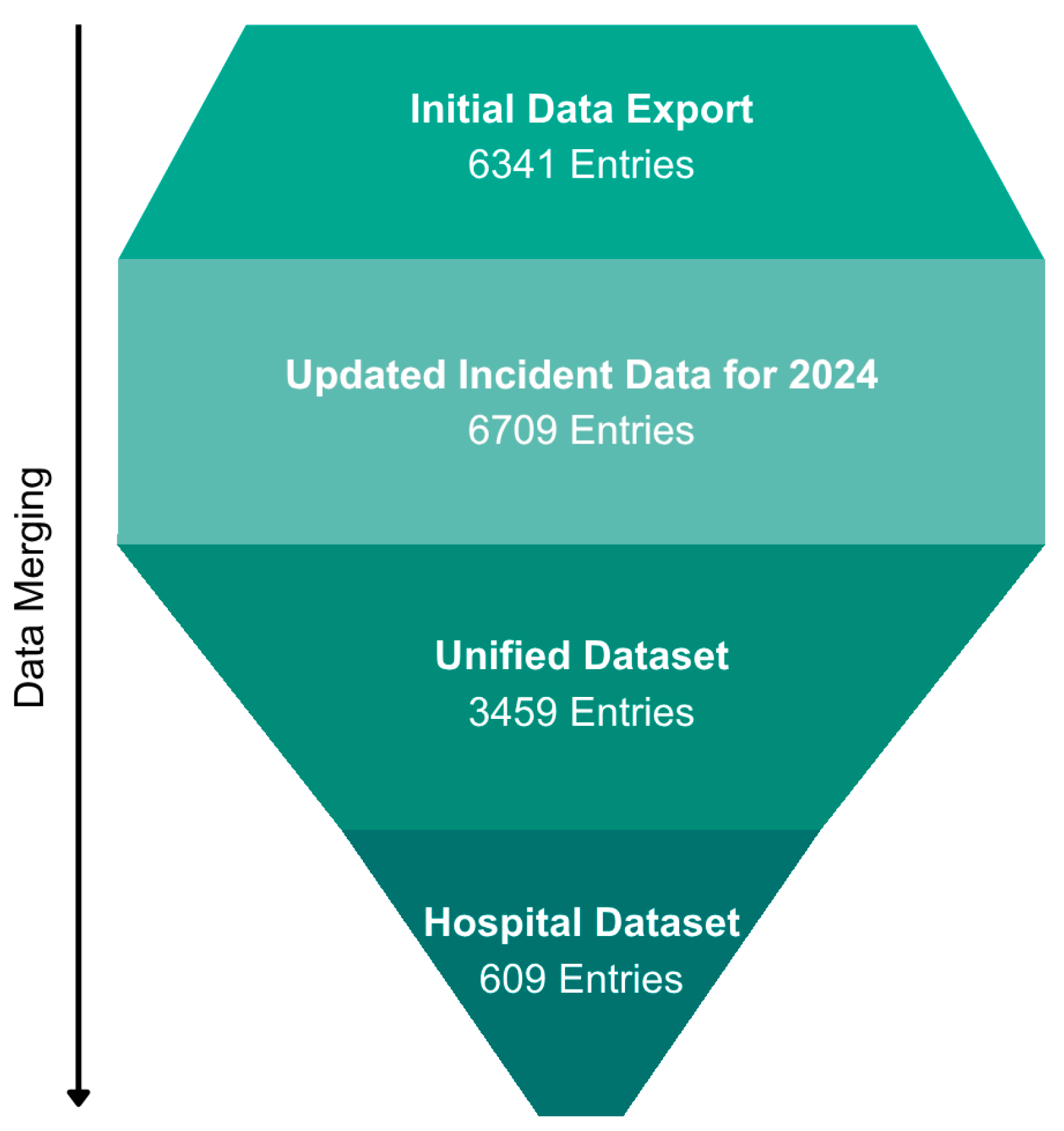
2.1. Synthesis of Cybersecurity Datasets
- Breach Portal of the Department of Health and Human Services (HHS);
- The Incident Hub by TI Safe (TIS);
- Database by European Repository of Cyber Incidents (EuRepoC);
- Cyber Events Database University of Maryland (CED);
- Privacy Rights Clearinghouse (PRC).
2.2. Expert Focus Groups
3. Results
3.1. General Characteristics of the Datasets
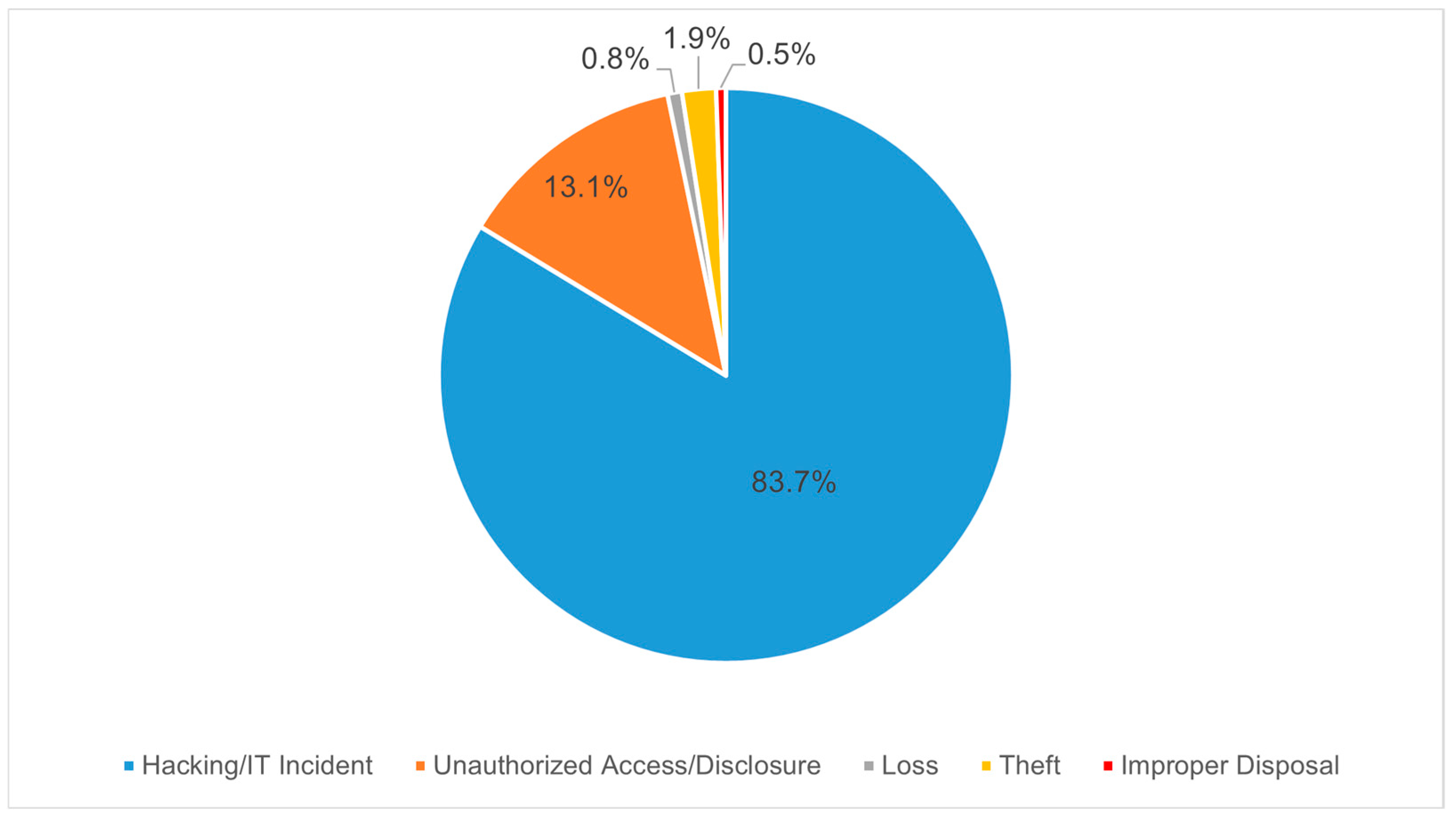
3.1.1. Analysis of the Categories of the Unified Dataset
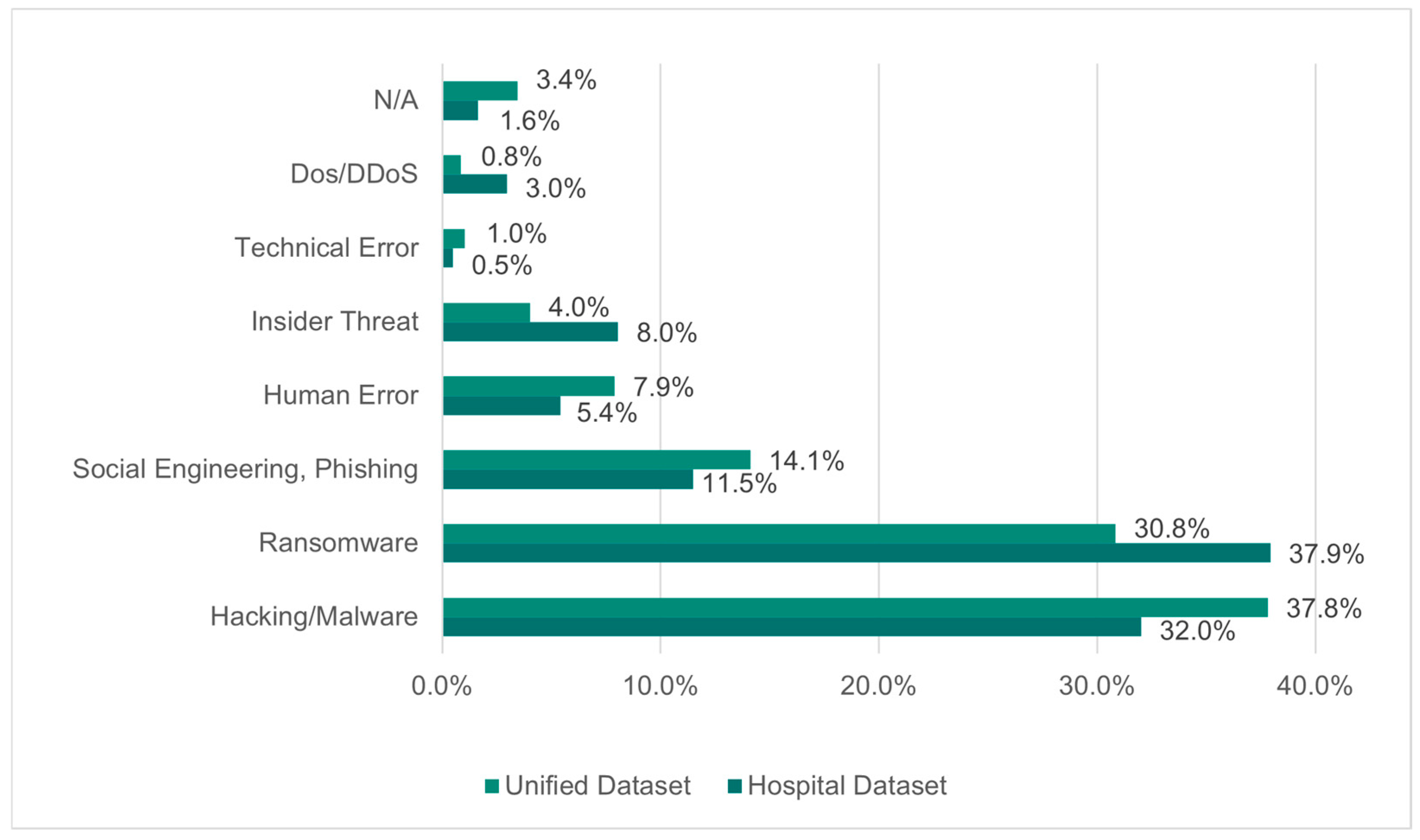
3.1.2. Analysis of the Categories of the Hospital Dataset
3.2. Focus Groups
3.2.1. Technological Factors on Hospital IT Security Risks
“Yes, this is a new threat and a new weapon of defense. So, the means change, but the threat itself does not change.”(Expert A, IT Leader)
“If manufacturers were held liable for every cybersecurity incident they caused [..], including financial liability, many problems would solve themselves, because they would simply put more quality into their products.”(Expert B, ISO)
“Give users things that just work […], things you don’t have to explain much, where you can simply say: here you go, this is your tool for the job. […] Connecting the technical interaction with the organizational side and with the human side, bringing this triangle into balance is the real art, I think.”(Expert C, ISO)
3.2.2. Organizational Factors on Hospital IT Security Risks
“In some cases, detailed reports from the US BSI [cybersecurity agency] become available only two or three days after an incident, which I continue to find impressive. We mainly use these reports to examine whether our own systems might have been vulnerable in a similar way. Alarmingly, it must be said that in many cases we indeed would have been. In those instances, we were simply fortunate.”(Expert D, ISO)
“Supplier and supply-chain attacks, that’s a major issue. That’s why we have a relatively strict supplier evaluation process and follow up on what suppliers are doing. But at the end of the day, it becomes disconnected when procurement or the project team says, ‘We’re buying this now.’ Or when we get free devices from some manufacturers, and then the thing is sitting there, and of course the user says, ‘Well, we have it now, so it has to work.’ And then information security is in a bad position to say, ‘We can’t allow that.’ The device is already there, possibly already being used, and then you somehow have to figure out how to work things out.”(Expert E, ISO)
“Ransomware is, of course, a very good business model. I mean, they’re all just business people. […] The days when someone had to sit down and find a security vulnerability are long gone. Now, you just have to say, ‘I have a few customers, I need a few tools for that,’ similar to what we do in IT, where I purchase a service.”(Expert F, IT Leader)
“Attempts are made to find vulnerabilities via the human factor, but also via technical scans, vulnerability scans, and port scans with a wide variety of countries of origin, at least in terms of IP address assignment. Of course, since the Ukraine crisis began two years ago, we have noticed that the number of attacks or attempted attacks has increased.”(Expert G, ISO)
3.2.3. Human Factors on Hospital IT Security Risks
“I think there is a different way of thinking than 10 or 15 years ago. […] Lots of people come here with their private issues and ask, ‘How can I improve in this area, or can I still set up two-factor authentication, or whatever.’—I think awareness has changed in this regard.”(Expert H, IT Leader)
“In general, during our awareness trainings, we always aim to engage employees on a personal level as well, because we know how closely the private and professional spheres are intertwined. Therefore, it is important to us that employees also have a secure IT environment at home.”(Expert D, ISO)
“I think you have to try very hard to generate understanding first, so that people know why certain restrictions are in place. ‘Why do we have to change our password after x days’, or ‘why don’t we have to change it’, depending on the guidelines that are in place.”(Expert I, IT Leader)
4. Discussion
5. Conclusions
Author Contributions
Funding
Institutional Review Board Statement
Informed Consent Statement
Data Availability Statement
Acknowledgments
Conflicts of Interest
Abbreviations
| AI | Artificial Intelligence |
| CED | Cyber Events Database University of Maryland |
| CISA | Cybersecurity and Infrastructure Security Agency |
| DDoS | Distributed Denial of Service |
| DoS | Denial of Service |
| EMR | Electronic Medical Records |
| EuRepoC | European Repository of Cyber Incidents |
| HHS | Health and Human Services |
| ISO | Information Security Officer |
| IT | Information Technology |
| MDPI | Multidisciplinary Digital Publishing Institute |
| PHI | Protected Health Information |
| PRC | Privacy Rights Clearinghouse |
| SIEM | Security Information and Event Management |
Appendix A
Appendix A.1. Dataset Categories

| Main Category Name | Main Category Description |
|---|---|
| Hacking/IT Incident | Hacking/IT Incident applies, if systems were impermissibly accessed through technical intrusions (including by malware or directed hacking) including systems, servers, desktops, laptops, mobile devices and medical devices. |
| Loss | Loss applies if equipment (servers, desktops, laptops, back-up tapes, thumb-drives, mobile devices, copiers, or other hardware) or if paper records were lost. For example, if a workforce member left a laptop or paper records in a public place. |
| Theft | Theft applies if equipment housing electronic protected health information (servers, desktops, laptops, back-up tapes, thumb-drives, mobile devices, copiers, or other hardware) or if Paper records with patient data were stolen. If electronic protected health information was stolen as a result of a technical intrusion, Hacking/IT Incident is selected. |
| Improper Disposal | Improper Disposal applies if the electronic media (servers, desktops, laptops, back-up tapes, thumb drives, mobile devices, copiers, or other hardware) was not appropriately cleared, purged, or destroyed, or if Paper records were not appropriately shredded or otherwise destroyed prior to disposal. |
| Unauthorized Access/Disclosure | Unauthorized Access/Disclosure applies if no other category fits. For example, when patient data was breached due to misdirected mailing or other communication. |
| Subcategory Name | Mapping Guideline |
|---|---|
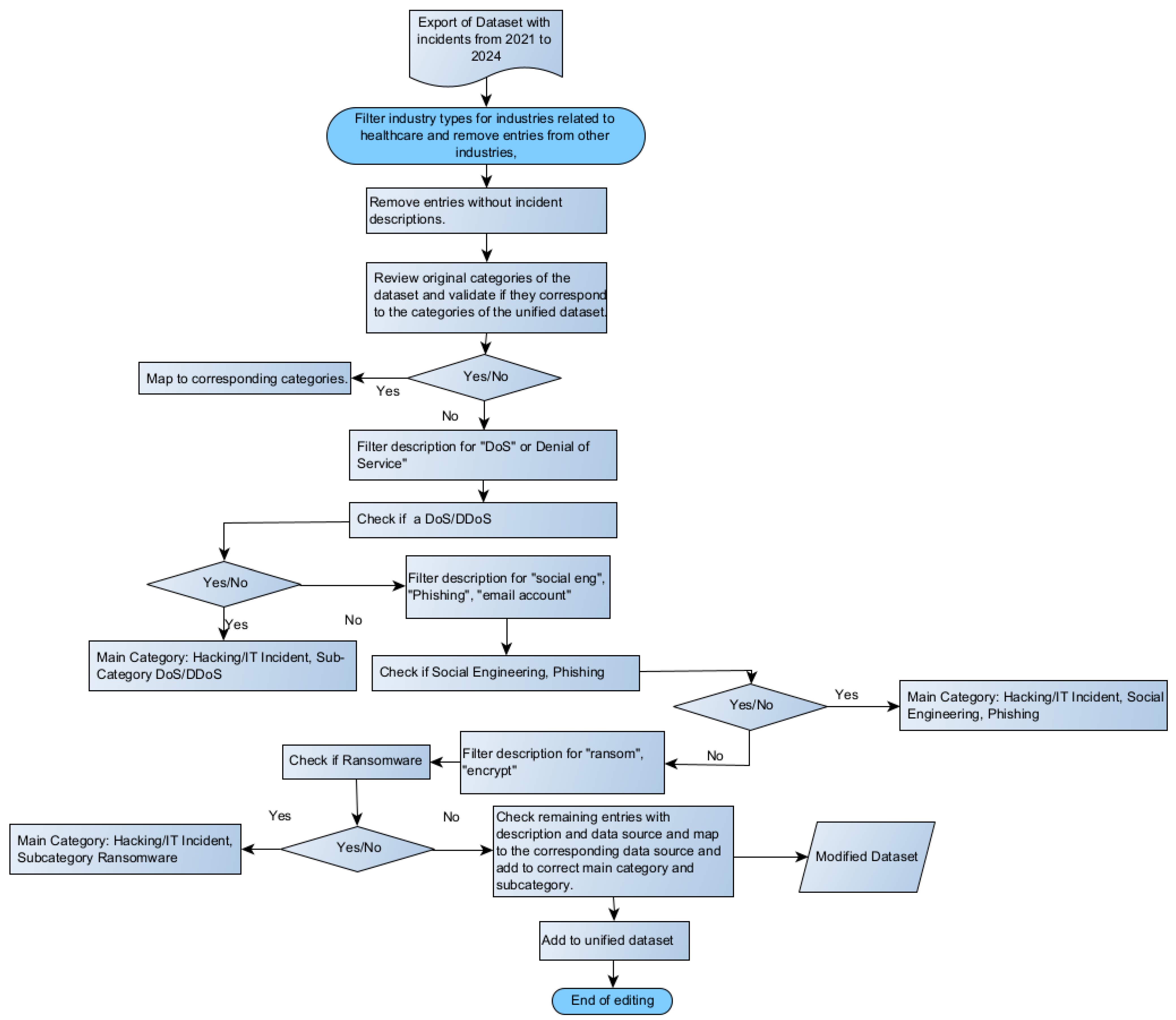
| DoS/DDoS | Reviewed database either has a category which is called DoS/DDoS, or DoS/DDoS is mentioned in the incident description, or it is mentioned that systems were not accessible due to overwhelming traffic. |
| Ransomware | Reviewed database either has a category which is called ransomware, ransomware is mentioned in the incident description, or encryption of systems is mentioned. |
| Social Engineering, Phishing | The reviewed database either has a category with the name phishing or social engineering, or these types of incidents are described in the incident description. |
| Hacking/Malware | A cyberattack is mentioned but it is not stated how it was conducted. |
| Subcategory Name | Mapping Guideline |
|---|---|
| Human Error | An unintentional act by an employee. For example, unintentionally sending an email with patient data to the wrong recipient. |
| Insider Threat | An intentional act by an employee. For example, downloading patient data from the network and then selling it to a third party, purposefully accessing files without permission, or uploading files to the internet. |
| Technical Error | Technical errors leading to unintended exposure, access, or transmission of information. This includes misconfigurations and system malfunctions. |
| N/A | No digital intrusion by a third party, no technical errors, and no unintentional/intentional acts by employees could be identified with the provided data. |
Appendix A.2. Editing of Source Datasets

Appendix A.3. Semi-Structured Questionnaire
| Guiding Questions | Additional Questions |
|---|---|
|
|
|
|
|
|
|
|
|
|
|
|
|
|
|
|
Appendix B
| Unified Dataset | Hospital Dataset | |||||||
|---|---|---|---|---|---|---|---|---|
| Month | 2021 | 2022 | 2023 | 2024 | 2021 | 2022 | 2023 | 2024 |
| Jan | 65 | 65 | 76 | 83 | 9 | 13 | 18 | 12 |
| Feb | 81 | 51 | 66 | 102 | 24 | 11 | 13 | 17 |
| Mar | 92 | 56 | 97 | 96 | 12 | 7 | 20 | 41 |
| Apr | 96 | 66 | 68 | 66 | 10 | 9 | 5 | 11 |
| May | 84 | 85 | 115 | 68 | 22 | 12 | 16 | 12 |
| Jun | 79 | 85 | 85 | 56 | 12 | 12 | 10 | 7 |
| Jul | 73 | 68 | 51 | 65 | 17 | 10 | 10 | 16 |
| Aug | 63 | 54 | 79 | 53 | 8 | 11 | 9 | 4 |
| Sep | 61 | 29 | 93 | 53 | 8 | 3 | 25 | 11 |
| Oct | 68 | 76 | 81 | 63 | 9 | 18 | 11 | 7 |
| Nov | 74 | 56 | 85 | 59 | 13 | 8 | 22 | 7 |
| Dec | 73 | 60 | 83 | 56 | 13 | 11 | 12 | 11 |
| Total | 909 | 751 | 979 | 820 | 157 | 125 | 171 | 156 |
| Main Category | 2021 | 2022 | 2023 | 2024 | Total |
|---|---|---|---|---|---|
| Hacking/IT Incident | 739 (81.3%) | 631 (84%) | 837 (85.5%) | 687 (83.8%) | 2894 (83.7%) |
| Unauthorized Access/Disclosure | 126 (13.9%) | 95 (12.6%) | 121 (12.4%) | 110 (13.4%) | 452 (13.1%) |
| Loss | 12 (1.3%) | 6 (0.8%) | 4 (0.4%) | 6 (0.7%) | 28 (0.8%) |
| Theft | 26 (2.9%) | 15 (2%) | 12 (1.2%) | 13 (1.6%) | 66 (1.9%) |
| Improper Disposal | 6 (0.7%) | 4 (0.5%) | 5 (0.5%) | 4 (0.5%) | 19 (0.5%) |
| Total | 909 (26.3%) | 751 (21.7%) | 979 (28.3%) | 820 (23.7%) | 3459 (100%) |
| Subcategory | 2021 | 2022 | 2023 | 2024 | Total |
|---|---|---|---|---|---|
| Hacking/Malware | 265 (29.2%) | 254 (33.8%) | 450 (46%) | 339 (41.3%) | 1308 (37.8%) |
| Ransomware | 305 (33.6%) | 237 (31.6%) | 295 (30.1%) | 230 (28%) | 1067 (30.8%) |
| Social Engineering, Phishing | 167 (18.4%) | 130 (17.3%) | 80 (8.2%) | 111 (13.5%) | 488 (14.1%) |
| Human Error | 80 (8.8%) | 58 (7.7%) | 80 (8.2%) | 55 (6.7%) | 273 (7.9%) |
| Insider Threat | 48 (5.3%) | 36 (4.8%) | 28 (2.9%) | 27 (3.3%) | 139 (4%) |
| Technical Error | 8 (0.9%) | 7 (0.9%) | 14 (1.4%) | 7 (0.9%) | 36 (1%) |
| Dos/DDoS | 2 (0.2%) | 10 (1.3%) | 12 (1.2%) | 5 (0.6%) | 29 (0.8%) |
| N/A | 34 (3.7%) | 19 (2.5%) | 20 (2%) | 46 (5.6%) | 119 (3.4%) |
| Total | 909 (26.3%) | 751 (21.71%) | 979 (28.3%) | 820 (23.7%) | 3459 (100%) |
| Main Category | 2021 | 2022 | 2023 | 2024 | Total |
|---|---|---|---|---|---|
| Hacking/IT Incident | 124 (79%) | 102 (81.6%) | 151 (88.3%) | 138 (88.5%) | 515 (84.6%) |
| Unauthorized Access/Disclosure | 31 (19.7%) | 16 (12.8%) | 19 (11.1%) | 14 (9%) | 80 (13.1%) |
| Loss | 1 (0.6%) | 3 (2.4%) | 1 (0.6%) | 1 (0.6%) | 6 (1%) |
| Theft | 1 (0.6%) | 2 (1.6%) | 0 (0%) | 2 (1.3%) | 5 (0.8%) |
| Improper Disposal | 0 (0%) | 2 (1.6%) | 0 (0%) | 1 (0.6%) | 3 (0.5%) |
| Total | 157 (25.8%) | 125 (20.5%) | 171 (28.1%) | 156 (25.6%) | 609 (100%) |
| Subcategory | 2021 | 2022 | 2023 | 2024 | Total |
|---|---|---|---|---|---|
| Hacking/Malware | 45 (28.7%) | 40 (32%) | 71 (41.5%) | 39 (25%) | 195 (32%) |
| Ransomware | 54 (34.4%) | 37 (29.6%) | 65 (38%) | 75 (48.1%) | 231 (37.9%) |
| Social Engineering, Phishing | 24 (15.3%) | 19 (15.2%) | 7 (4.1%) | 20 (12.8%) | 70 (11.5%) |
| Human Error | 12 (7.6%) | 8 (6.4%) | 10 (5.8%) | 3 (1.9%) | 33 (5.4%) |
| Insider Threat | 19 (12.1%) | 11 (8.8%) | 8 (4.7%) | 11 (7.1%) | 49 (8%) |
| Technical Error | 0 (0%) | 1 (0.8%) | 2 (1.2%) | 0 (0%) | 3 (0.5%) |
| Dos/DDoS | 1 (0.6%) | 6 (4.8%) | 8 (4.7%) | 3 (1.9%) | 18 (3%) |
| N/A | 2 (1.3%) | 3 (2.4%) | 0 (0%) | 5 (3.2%) | 10 (1.6%) |
| Total | 157 (25.8%) | 125 (20.5%) | 171 (28.1%) | 156 (25.6%) | 609 (100%) |
| No. | Year | Incident Date | Location (Country) | Entity Name | Incident Description | Main- Category | Sub- Category | Source URL | Originated Dataset |
|---|---|---|---|---|---|---|---|---|---|
| 72 | 2021 | 3 February 2021 | Belgium | Sacred Heart Hospital | The Sacred Heart Hospital in Mol is hit by a cyberattack. | Hacking/IT Incident | Hacking/Malware | https://www.databreaches.net/__trashed-12/ (accessed on 15 May 2025) | Cyber Events Data Base |
| 94 | 2021 | 15 February 2021 | United States of America | Capital Medical Center | Capital Medical Center is hit with an Avaddon ransomware attack. | Hacking/IT Incident | Ransomware | https://www.databreaches.net/cancer-patients-in-the-state-of-washington-had-their-sensitive-records-hacked-and-dumped-have-they-been-notified/ (accessed on 14 May 2025) | Cyber Events Data Base |
| 1470 | 2022 | 5 October 2022 | United States of America | Miller Miller Gerber LLP | The Montana Department of Justice reported a data breach involving Miller Miller Gerber LLP on 31 January 2023. The breach occurred on 5 October 2022, affecting 1 individual. The specific types of information compromised are unknown, and further details about the method of breach are not provided. The breach is classified as INSD (Insider Threat) based on the explicit description in the notification letter from University Hospital, as reported by the Montana Department of Justice. The letter states that a now-former employee with authorized access exceeded the authorized use of that access by providing patient information to unauthorized individuals. This clearly indicates deliberate misuse of access by an insider, satisfying the criteria for the INSD classification. | Unauthorized Access/Disclosure | Insider Threat | https://dojmt.gov/office-of-consumer-protection/reported-data-breaches/ (accessed on 11 June 2025) | PRC |
| 1482 | 2022 | 14 October 2022 | United States of America | Advocate Aurora Health | The covered entity (CE), Advocate Aurora Health, reported that web tracking technology transferred the protected health information (PHI) of 3,000,000 individuals to unauthorized recipients. OCR has consolidated this breach report into an existing compliance review of the CE. | Unauthorized Access/Disclosure | Technical Error | Not provided | HHS |
| 1720 | 2023 | 28 January 2023 | Netherlands | University Medical Center of Groningen (UMCG | The pro-Russian hacktivist group Killnet is suspected to be responsible for disrupting the information page of the University Medical Center of Groningen (UMCG) in the Netherlands, with DDoS attacks during 28–30 January 2023 according to Z-Cert, an expertise center for cybersecurity in healthcare. In addition, the websites of other European hospitals were also affected by DDoS attacks. | Hacking/IT Incident | DoS/DDoS | https://blog.cloudflare.com/uptick-in-healthcare-organizations-experiencing-targeted-ddos-attacks/ (accessed on 6 March 2025) | Eurepoc |
| 2709 | 2024 | 8 February 2024 | France | Viamedis and Almerys | Service providers Viamedis and Almerys have suffered phishing attacks that compromised user data. Bank, medical, and contact details were not exposed. However, information such as marital status, date of birth, and Social Security number was compromised. | Hacking/IT Incident | Social Engineering, Phishing | https://www.euronews.com/next/2024/02/08/data-of-33-million-people-in-france-stolen-in-its-largest-ever-cyberattack-this-is-what-we (accessed on 21 February 2025) | TI Safe Incident Hub |
| 3034 | 2024 | 24 October 2024 | United States of America | Stanislaus County Behavioral Health and Recovery Services | The covered entity (CE), Stanislaus County Behavioral Health and Recovery Services, reported that it mailed letters containing the protected health information (PHI) of 767 individuals to the wrong recipients. The PHI involved included names, addresses, and treatment information. The CE notified HHS, affected individuals, and the media. In its mitigation efforts, the CE implemented additional administrative and technical safeguards to better protect its PHI. | Unauthorized Access/Disclosure | Human Error | Not provided | HHS |
| 3241 | 2024 | 29 March 2024 | United States of America | Olive View-UCLA Medical Center | The covered entity (CE), County of Los Angeles Department of Health Services—Olive View–Medical Center, reported that paper documents containing the protected health information (PHI) of 3716 individuals were stolen during a burglary. The PHI involved included names, addresses, and financial and health insurance information. The CE notified HHS, the affected individuals, the media, and provided substitute notice. In response to the breach, the CE provided complimentary credit monitoring services and implemented additional administrative, technical, and security safeguards. | Theft | N/A | Not provided | HHS |
References
- Yeung, A.W.K.; Torkamani, A.; Butte, A.J.; Glicksberg, B.S.; Schuller, B.; Rodriguez, B.; Ting, D.S.W.; Bates, D.; Schaden, E.; Peng, H.; et al. The promise of digital healthcare technologies. Front. Public Health 2023, 11, 1196596. [Google Scholar] [CrossRef]
- Giansanti, D.; Monoscalco, L. The cyber-risk in cardiology: Towards an investigation on the self-perception among the cardiologists. Mhealth 2021, 7, 28. [Google Scholar] [CrossRef]
- Singh, J. Challenges with Medical Devices Connected to Hospital Network. Int. J. Res. Appl. Sci. Eng. Technol. 2024, 12, 735–749. [Google Scholar] [CrossRef]
- Luna, R.; Rhine, E.; Myhra, M.; Sullivan, R.; Kruse, C.S. Cyber threats to health information systems: A systematic review. Technol. Health Care 2016, 24, 1–9. [Google Scholar] [CrossRef]
- Tin, D.; Hata, R.; Granholm, F.; Ciottone, R.G.; Staynings, R.; Ciottone, G.R. Cyberthreats: A primer for healthcare professionals. Am. J. Emerg. Med. 2023, 68, 179–185. [Google Scholar] [CrossRef]
- Kruse, C.S.; Frederick, B.; Jacobson, T.; Monticone, D.K. Cybersecurity in healthcare: A systematic review of modern threats and trends. Technol. Health Care 2017, 25, 1–10. [Google Scholar] [CrossRef] [PubMed]
- Odedina, E.A. The impact of cyberattacks on patient safety and healthcare infrastructure: A risk management perspective. Int. J. Eng. Technol. Res. Manag. 2021, 5, 385–398. [Google Scholar]
- Aldosari, B. Cybersecurity in Healthcare: New Threat to Patient Safety. Cureus 2025, 17, e83614. [Google Scholar] [CrossRef]
- Wasserman, L.; Wasserman, Y. Hospital cybersecurity risks and gaps: Review (for the non-cyber professional). Front. Digit. Health 2022, 4, 862221. [Google Scholar] [CrossRef] [PubMed]
- Ewoh, P.; Vartiainen, T. Vulnerability to Cyberattacks and Sociotechnical Solutions for Health Care Systems: Systematic Review. J. Med. Internet Res. 2024, 26, e46904. [Google Scholar] [CrossRef]
- Jalali, M.S.; Kaiser, J.P. Cybersecurity in Hospitals: A Systematic, Organizational Perspective. J. Med. Internet Res. 2018, 20, e10059. [Google Scholar] [CrossRef]
- Choi, S.J.; Chen, M.; Tan, X. Assessing the impact of health information exchange on hospital data breach risk. Int. J. Med. Inform. 2023, 177, 105149. [Google Scholar] [CrossRef]
- Pilares, I.C.A.; Azam, S.; Akbulut, S.; Jonkman, M.; Shanmugam, B. Addressing the Challenges of Electronic Health Records Using Blockchain and IPFS. Sensors 2022, 22, 4032. [Google Scholar] [CrossRef]
- George, A.S.; Baskar, T.; Srikaanth, P.B. Cyber Threats to Critical Infrastructure: Assessing Vulnerabilities Across Key Sectors. Partn. Univers. Int. Innov. J. 2024, 2, 51–75. [Google Scholar]
- Theocharidou, M.; Lella, I. Enisa Threat Landscape: Health Sector: (January 2021 to March 2023). Available online: https://www.enisa.europa.eu/sites/default/files/publications/Health%20Threat%20Landscape.pdf (accessed on 13 November 2025).
- van Boven, L.S.; Kusters, R.W.J.; Tin, D.; van Osch, F.H.M.; de Cauwer, H.; Ketelings, L.; Rao, M.; Dameff, C.; Barten, D.G. Hacking Acute Care: A Qualitative Study on the Health Care Impacts of Ransomware Attacks Against Hospitals. Ann. Emerg. Med. 2024, 83, 46–56. [Google Scholar] [CrossRef]
- Basil, N.N.; Ambe, S.; Ekhator, C.; Fonkem, E. Health Records Database and Inherent Security Concerns: A Review of the Literature. Cureus 2022, 14, e30168. [Google Scholar] [CrossRef] [PubMed]
- Dolezel, D.; Beauvais, B.; Stigler Granados, P.; Fulton, L.; Kruse, C.S. Effects of Internal and External Factors on Hospital Data Breaches: Quantitative Study. J. Med. Internet Res. 2023, 25, e51471. [Google Scholar] [CrossRef] [PubMed]
- Hines, E.; Trivedi, S.; Hoang-Tran, C.; Mocharnuk, J.; Pfaff, M.J. Perspectives on Cybersecurity and Plastic Surgery: A Survey of Plastic Surgeons and Scoping Review of the Literature. Aesthet. Surg. J. 2023, 43, 1376–1383. [Google Scholar] [CrossRef] [PubMed]
- Cartwright, A.J. The elephant in the room: Cybersecurity in healthcare. J. Clin. Monit. Comput. 2023, 37, 1123–1132. [Google Scholar] [CrossRef]
- Suleski, T.; Ahmed, M. A Data Taxonomy for Adaptive Multifactor Authentication in the Internet of Health Care Things. J. Med. Internet Res. 2023, 25, e44114. [Google Scholar] [CrossRef]
- Harvanek, M.; Bolcek, J.; Kufa, J.; Polak, L.; Simka, M.; Marsalek, R. Survey on 5G Physical Layer Security Threats and Countermeasures. Sensors 2024, 24, 5523. [Google Scholar] [CrossRef]
- Cains, M.G.; Flora, L.; Taber, D.; King, Z.; Henshel, D.S. Defining Cyber Security and Cyber Security Risk with-in a Multidisciplinary Context using Expert Elicitation. Risk Anal. 2022, 42, 1643–1669. [Google Scholar] [CrossRef] [PubMed]
- Morgan, P.L.; Asquith, P.M.; Bishop, L.M.; Raywood-Burke, G.; Wedgbury, A.; Jones, K. A New Hope: Human-Centric Cybersecurity Research Embedded Within Organizations. In HCI for Cybersecurity, Privacy and Trust; Moallem, A., Ed.; Springer International Publishing: Cham, Switzerland, 2020; pp. 206–216. ISBN 978-3-030-50308-6. [Google Scholar]
- Xu, J.; Lu, W. Developing a human-organization-technology fit model for information technology adoption in organizations. Technol. Soc. 2022, 70, 102010. [Google Scholar] [CrossRef]
- Yusof, M.M.; Kuljis, J.; Papazafeiropoulou, A.; Stergioulas, L.K. An evaluation framework for Health Information Systems: Human, organization and technology-fit factors (HOT-fit). Int. J. Med. Inform. 2008, 77, 386–398. [Google Scholar] [CrossRef]
- Kosasi, S.; Vedyanto, V.; Ayu Eka Yuliani, I.D. Appropriate Sets of Criteria for Innovation Adoption of IS Security in Organizations. In Proceedings of the 2018 5th International Conference on Electrical Engineering, Computer Science and Informatics (EECSI), Malang, Indonesia, 16–18 October 2018; IEEE: New York, NY, USA, 2018; pp. 608–613. ISBN 978-1-5386-8402-3. [Google Scholar]
- Amyra, N.; Mohd, S.M. Adoption of Digital Forensic Practice: A Framework Development for Malaysian Organizations. J. Electr. Syst. 2024, 20, 5764–5773. [Google Scholar]
- Kumar, S.; Biswas, B.; Bhatia, M.S.; Dora, M. Antecedents for enhanced level of cyber-security in organisations. J. Enterp. Inf. Manag. 2021, 34, 1597–1629. [Google Scholar] [CrossRef]
- Alhammad, A.; Yusof, M.M.; Jambari, D.I. Evaluating applied security controls for safeguarding medical device-integrated electronic medical records. J. Eval. Clin. Pract. 2025, 31, e14140. [Google Scholar] [CrossRef] [PubMed]
- Dwivedi, Y.K.; Wade, M.R.; Schneberger, S.L. Information Systems Theory; Springer: New York, NY, USA, 2012; ISBN 978-1-4419-9706-7. [Google Scholar]
- Sahu, A.; Mao, Z.; Wlazlo, P.; Huang, H.; Davis, K.; Goulart, A.; Zonouz, S. Multi-Source Multi-Domain Data Fusion for Cyberattack Detection in Power Systems. IEEE Access 2021, 9, 119118–119138. [Google Scholar] [CrossRef]
- Alsolami, T.; Alsharif, B.; Ilyas, M. Enhancing Cybersecurity in Healthcare: Evaluating Ensemble Learning Models for Intrusion Detection in the Internet of Medical Things. Sensors 2024, 24, 5937. [Google Scholar] [CrossRef]
- Dolezel, D.; McLeod, A. Cyber-Analytics: Identifying Discriminants of Data Breaches. Perspect. Health Inf. Manag. 2019, 16, 1a. [Google Scholar]
- Ignatovski, M. For-profit versus non-profit cybersecurity posture: Breach types and locations in healthcare organisations. Health Inf. Manag. 2024, 53, 198–205. [Google Scholar] [CrossRef]
- Yaraghi, N.; Gopal, R.D. The Role of HIPAA Omnibus Rules in Reducing the Frequency of Medical Data Breaches: Insights from an Empirical Study. Milbank Q. 2018, 96, 144–166. [Google Scholar] [CrossRef]
- Abbiati, G.; Ranise, S.; Schizzerotto, A.; Siena, A. Merging Datasets of CyberSecurity Incidents for Fun and Insight. Front. Big Data 2020, 3, 521132. [Google Scholar] [CrossRef]
- Thomas, O.; Munir, M.B.; Tine, J.-M.; Rahman, M.; Cai, Y.; Akbar, K.A.; Uddin, M.N.; Khan, L.; Hockstad, T.; Chowdhury, M. Transportation Cyber Incident Awareness through Generative AI-Based Incident Analysis and Retrieval-Augmented Question-Answering Systems. arXiv 2025, arXiv:2508.02523. [Google Scholar]
- Simon, M.; Looten, V. Description of Data Breaches Notifications in France and Lessons Learned for the Healthcare Stakeholders. Stud. Health Technol. Inform. 2020, 275, 192–196. [Google Scholar] [PubMed]
- Ronquillo, J.G.; Erik Winterholler, J.; Cwikla, K.; Szymanski, R.; Levy, C. Health IT, hacking, and cybersecurity: National trends in data breaches of protected health information. JAMIA Open 2018, 1, 15–19. [Google Scholar] [CrossRef] [PubMed]
- Zängerle, D.; Schiereck, D. Modelling and predicting enterprise-level cyber risks in the context of sparse data availability. Geneva Pap. Risk Insur. Issues Pract. 2023, 48, 434–462. [Google Scholar] [CrossRef]
- Cremer, F.; Sheehan, B.; Fortmann, M.; Kia, A.N.; Mullins, M.; Murphy, F.; Materne, S. Cyber risk and cybersecurity: A systematic review of data availability. Geneva Pap. Risk Insur. Issues Pract. 2022, 47, 698–736. [Google Scholar] [CrossRef]
- Portalatin, M.; Keskin, O.; Malneedi, S.; Raza, O.; Tatar, U. Data Analytics for Cyber Risk Analysis Utilizing Cyber Incident Datasets. In Proceedings of the 2021 Systems and Information Engineering Design Symposium (SIEDS), Charlottesville, VA, USA, 29–30 April 2021; IEEE: New York, NY, USA, 2021; pp. 1–6. ISBN 978-1-6654-1250-6. [Google Scholar]
- Waedlich, R.; Baumann, T. Digitalisierung und innovatives Cyber- und IT-Risikomanagement. In Handbuch Klinisches Risikomanagement; Euteneier, A., Ed.; Springer: Berlin/Heidelberg, Germany, 2024; pp. 631–652. ISBN 978-3-662-67564-9. [Google Scholar]
- U.S. Department of Health and Human Services Office for Civial Rights. Breach Notification. Available online: https://www.hhs.gov/hipaa/for-professionals/breach-notification/breach-reporting/index.html (accessed on 16 May 2025).
- Center for International Security Studies at Maryland. Cyber Events Database. Available online: https://cissm.umd.edu/research-impact/publications/cyber-events-database-home (accessed on 27 November 2025).
- European Repository of Cyber Incidents. EuRepoC Database. Available online: https://eurepoc.eu/database/ (accessed on 27 November 2025).
- Privacy Rights Clearinghouse. Data Breach Chronology. Available online: https://cdn.shopify.com/s/files/1/0571/5489/5955/files/README.pdf?v=1739201304 (accessed on 27 November 2025).
- TI Safe. Incident Hub. Available online: https://hub.tisafe.com/ (accessed on 27 November 2025).
- U.S. Department of Health and Human Services. Breach Portal: Notice to the Secretary of HHS Breach of Unsecured Protected Health Information. Available online: https://ocrportal.hhs.gov/ocr/breach/breach_report.jsf (accessed on 14 October 2025).
- Burke, W.; Stranieri, A.; Oseni, T.; Gondal, I. The need for cybersecurity self-evaluation in healthcare. BMC Med. Inform. Decis. Mak. 2024, 24, 133. [Google Scholar] [CrossRef]
- Kallio, H.; Pietilä, A.-M.; Johnson, M.; Kangasniemi, M. Systematic methodological review: Developing a framework for a qualitative semi-structured interview guide. J. Adv. Nurs. 2016, 72, 2954–2965. [Google Scholar] [CrossRef]
- Haberl, A.; Fleiß, J.; Kowald, D.; Thalmann, S. Take the aTrain. Introducing an interface for the Accessible Transcription of Interviews. J. Behav. Exp. Financ. 2024, 41, 100891. [Google Scholar] [CrossRef]
- Braun, V.; Clarke, V. Using thematic analysis in psychology. Qual. Res. Psychol. 2006, 3, 77–101. [Google Scholar] [CrossRef]
- Quader, F.; Janeja, V.P. Insights into Organizational Security Readiness: Lessons Learned from Cyber-Attack Case Studies. J. Cybersecur. Priv. 2021, 1, 638–659. [Google Scholar] [CrossRef]
- Klauber, J.; Geraedts, M.; Friedrich, J.; Wasem, J. (Eds.) Krankenhaus-Report 2019; Springer: Berlin/Heidelberg, Germany, 2019; ISBN 978-3-662-58224-4. [Google Scholar]
- Ridic, G.; Gleason, S.; Ridic, O. Comparisons of health care systems in the United States, Germany and Canada. Mater. Sociomed. 2012, 24, 112–120. [Google Scholar] [CrossRef]
- Goldschmidt, A.J.W.; Marquardt, K.; Groneberg, D.; von Eiff, W. Aufbruch oder verspielte Zukunft der Krankenhausdigitalisierung in Deutschland. Zbl Arbeitsmed 2023, 73, 170–181. [Google Scholar] [CrossRef]
- Dobrovolska, O.; Ortmanns, W.; Dotsenko, T.; Lustenko, V.; Savchenko, D. Health Security and Cybersecurity: Analysis of Interdependencies. Health Econ. Manag. Rev. 2024, 5, 84–103. [Google Scholar] [CrossRef]
- Qureshi, R.; Koo, I. A Comprehensive Survey of Cybersecurity Threats and Data Privacy Issues in Healthcare Systems. Appl. Sci. 2026, 16, 1511. [Google Scholar] [CrossRef]
- Busetti, S.; Scanni, F.M. Evaluating incident reporting in cybersecurity. From threat detection to policy learning. Gov. Inf. Q. 2025, 42, 102000. [Google Scholar] [CrossRef]
- Directive (EU) 2022/2555 of the European Parliament and of the Council of 14 December 2022 on Measures for a High Common Level of Cybersecurity Across the Union, Amending Regulation (EU) No 910/2014 and Directive (EU) 2018/1972, and Repealing Directive (EU) 2016/1148: NIS 2 Directive. 2022. Available online: https://eur-lex.europa.eu/eli/dir/2022/2555/oj/eng (accessed on 14 December 2025).
- Gabriel, M.H.; Noblin, A.; Rutherford, A.; Walden, A.; Cortelyou-Ward, K. Data breach locations, types, and associated characteristics among US hospitals. Am. J. Manag. Care 2018, 24, 78–84. [Google Scholar]
- Liu, V.; Musen, M.A.; Chou, T. Data breaches of protected health information in the United States. JAMA 2015, 313, 1471–1473. [Google Scholar] [CrossRef]
- U.S. Department of Health and Human Services. Covered Entities and Business Associates. Available online: https://www.hhs.gov/hipaa/for-professionals/covered-entities/index.html (accessed on 4 December 2025).
- Alder, S. Healthcare Data Breach Statistics. Available online: https://www.hipaajournal.com/healthcare-data-breach-statistics/ (accessed on 17 January 2025).
- Munoz-Cornejo, G.; Sakowski, J.; Lee, J.; Parks, A. Analyzing the urban–rural divide: The role of location, time, and breach characteristics in U.S. hospital security incidents, 2012–2021. Discov. Health Syst. 2024, 3, 38. [Google Scholar] [CrossRef]
- Choi, S.J.; Johnson, M.E.; Lehmann, C.U. Data breach remediation efforts and their implications for hospital quality. Health Serv. Res. 2019, 54, 971–980. [Google Scholar] [CrossRef]
- Salim, M.M.; Rathore, S.; Park, J.H. Distributed denial of service attacks and its defenses in IoT: A survey. J. Supercomput. 2020, 76, 5320–5363. [Google Scholar] [CrossRef]
- Madanian, S.; Chinbat, T.; Subasinghage, M.; Airehrour, D.; Hassandoust, F.; Yongchareon, S. Health IoT Threats: Survey of Risks and Vulnerabilities. Future Internet 2024, 16, 389. [Google Scholar] [CrossRef]
- Boutemeur, J.; Lella, I.; Bakatsus, I.; Chatzichristos, G.; Foley, K.; Leskinen, J.; Otcenasek, J.; Ziolek, D. Enisa Threat Landcape. 2025. Available online: https://www.enisa.europa.eu/sites/default/files/2026-01/ENISA%20Threat%20Landscape%202025_v1.2.pdf (accessed on 13 November 2025).
- Munoz Cornejo, G.; Lee, J.; Russell, B.A. A thematic analysis of ransomware incidents among United States hospitals, 2016–2022. Health Technol. 2024, 14, 1059–1070. [Google Scholar] [CrossRef]
- Adam, S. The State of Ransomware 2025: Findings from an Independent Survey of 3400 IT and Cybersecurity Leaders Across 17 Countries Whose Organizations Were Hit by Ransomware in the Last Year. Available online: https://news.sophos.com/en-us/2025/06/24/the-state-of-ransomware-2025/ (accessed on 24 July 2025).
- Tikanmäki, I.; Ruoslahti, H. Human Factors Make or Break Cybersecurity! Inf. Secur. Int. J. 2024, 55, 245–259. [Google Scholar] [CrossRef]
- Giansanti, D.; Gulino, R.A. The Cybersecurity and the Care Robots: A Viewpoint on the Open Problems and the Perspectives. Healthcare 2021, 9, 1653. [Google Scholar] [CrossRef] [PubMed]
- Waddell, M. Human factors in cybersecurity: Designing an effective cybersecurity education program for healthcare staff. Healthc. Manag. Forum 2024, 37, 13–16. [Google Scholar] [CrossRef]


| No. | Year | Incident Date | Location (country) | Entity name | Incident Description | Main category | Subcategory | Source URL | Originated Dataset |
| Number of Participants | 14 |
| Role of Participants | |
| IT Leader | 7 |
| Information Security Officer | 7 |
| Hospital Characteristics | |
| Small (less than 400 beds) | 4 |
| Medium (between 400 and 799 beds) | 3 |
| Large (800 or more beds) | 7 |
| Originated Dataset | Entries in the Unified Dataset | Entries in the Hospital Dataset |
|---|---|---|
| PRC | 762 (22%) | 82 (13.5%) |
| HHS | 1762 (50.9%) | 268 (44%) |
| Cyber Events Database | 722 (20.9%) | 170 (27.9%) |
| EuRepoC | 182 (5.3%) | 77 (12.6%) |
| TI Safe Incident Hub | 31 (0.9%) | 12 (2%) |
| Themes and Sub-Themes | Underlying Topics |
|---|---|
| Technological Factors on Hospital IT Security Risks | |
| Evolving Forms of Hacking |
|
| Balancing Usability and Security |
|
| Technical Weaknesses Lead to Cyber Incidents |
|
| Integrating New Devices or Software Increases Security Risks |
|
| Technical Measures for Increasing Security |
|
| Organizational Factors on Hospital IT Security Risks | |
| Lack of Sufficient Data for Risk Management and Organizational Learning |
|
| Security Challenges in Supplier Management |
|
| Lack of Expertise and Capacity |
|
| Institutionalization of Hacking |
|
| Organizational Measures for increasing Security |
|
| Human Factors on Hospital IT Security Risks | |
| Rise in Risk Awareness |
|
| Personal Security Habits Carry Over into Work |
|
| Main Target of Cybercriminals |
|
| Employee Heterogeneity |
|
Disclaimer/Publisher’s Note: The statements, opinions and data contained in all publications are solely those of the individual author(s) and contributor(s) and not of MDPI and/or the editor(s). MDPI and/or the editor(s) disclaim responsibility for any injury to people or property resulting from any ideas, methods, instructions or products referred to in the content. |
© 2026 by the authors. Licensee MDPI, Basel, Switzerland. This article is an open access article distributed under the terms and conditions of the Creative Commons Attribution (CC BY) license.
Share and Cite
Rogge, G.; Bohnet-Joschko, S. Cybersecurity Challenges in Hospitals: International Incident Reports Analysis and Expert Validation. Informatics 2026, 13, 54. https://doi.org/10.3390/informatics13040054
Rogge G, Bohnet-Joschko S. Cybersecurity Challenges in Hospitals: International Incident Reports Analysis and Expert Validation. Informatics. 2026; 13(4):54. https://doi.org/10.3390/informatics13040054
Chicago/Turabian StyleRogge, Grigori, and Sabine Bohnet-Joschko. 2026. "Cybersecurity Challenges in Hospitals: International Incident Reports Analysis and Expert Validation" Informatics 13, no. 4: 54. https://doi.org/10.3390/informatics13040054
APA StyleRogge, G., & Bohnet-Joschko, S. (2026). Cybersecurity Challenges in Hospitals: International Incident Reports Analysis and Expert Validation. Informatics, 13(4), 54. https://doi.org/10.3390/informatics13040054