Author Contributions
Conceptualization, Y.G.; methodology, Y.G.; formal analysis, Y.G.; investigation, Y.G.; writing—original draft preparation, Y.G.; writing—review and editing, Y.G., T.N., K.H. and S.S.; visualization, Y.G.; supervision, T.N., K.H. and S.S.; project administration, Y.G.; funding acquisition, Y.G. All authors have read and agreed to the published version of the manuscript.
Funding
This research received no external funding.
Institutional Review Board Statement
The study was conducted in accordance with the Declaration of Helsinki and approved by the Institutional Review Board of the University of Electro-Communications (H25019).
Informed Consent Statement
Informed consent was obtained from all subjects involved in the study. A written informed consent form was distributed to all participants in accordance with the approved ethics protocol, and each participant provided signed consent prior to participation.
Data Availability Statement
Anonymized quantitative data and analysis scripts supporting the findings of this study are available from the authors upon reasonable request. Summary files of the structured qualitative interviews are provided as
Supplementary Materials. The original Japanese questionnaire items and full qualitative interview responses are available from the corresponding author upon reasonable request due to ethical and privacy considerations.
Acknowledgments
We thank colleagues and student participants at the University of Electro-Communications for their support with pilot testing and study logistics. All individuals acknowledged here provided their consent.
Conflicts of Interest
The authors declare no conflicts of interest.
References
- Yee, N.; Bailenson, J.N. The Proteus Effect: The Effect of Transformed Self-Representation on Behavior. Hum. Commun. Res. 2007, 33, 271–290. [Google Scholar] [CrossRef]
- Walther, J.B. Computer-Mediated Communication: Impersonal, Interpersonal, and Hyperpersonal. Commun. Res. 1996, 23, 3–43. [Google Scholar] [CrossRef]
- Lim, C.; Ratan, R.A.; Foxman, M.; Meshi, D.; Liu, H.; Hales, G.E.; Lei, Y.S. An Avatar’s Worth in the Metaverse Workplace: Assessing Predictors of Avatar Customization Valuation. Comput. Hum. Behav. 2024, 158, 108309. [Google Scholar] [CrossRef]
- Zhang, J.; Juvrud, J. Gender Expression and Gender Identity in Virtual Reality: Avatars, Role-Adoption, and Social Interaction in VRChat. Front. Virtual Real. 2024, 5, 1305758. [Google Scholar] [CrossRef]
- Asch, S.E. Forming impressions of personality. J. Abnorm. Soc. Psychol. 1946, 41, 258–290. [Google Scholar] [CrossRef] [PubMed]
- Cui, Y.; Wan, Z.; Xia, Q.; Feng, Y.; Gu, W.; Yang, L.; Zhou, Z. Fairy Tale Situation Test for Implicit Theories of Personality. Am. J. Appl. Psychol. 2021, 9, 172–181. [Google Scholar] [CrossRef]
- Elliot, A.; Maier, M.; Moller, A.; Friedman, R.; Meinhardt, J. Color and Psychological Functioning: The Effect of Red on Performance Attainment. J. Exp. Psychol. Gen. 2007, 136, 154–168. [Google Scholar] [CrossRef] [PubMed]
- Nowak, K.L.; Rauh, C. The Influence of the Avatar on Online Perceptions of Anthropomorphism, Androgyny, Credibility, Homophily, and Attraction. J. Comput.-Mediat. Commun. 2005, 11, 153–178. [Google Scholar] [CrossRef]
- Kang, H.; Kim, H.K. My avatar and the affirmed self: Psychological and persuasive implications of avatar customization. Comput. Hum. Behav. 2020, 112, 106446. [Google Scholar] [CrossRef]
- Aseeri, S.; Interrante, V. The influence of avatar representation on interpersonal communication in virtual social environments. IEEE Trans. Vis. Comput. Graph. 2021, 27, 2608–2617. [Google Scholar]
- Fabri, M.; Moore, D.J.; Hobbs, D.J. Designing avatars for social interactions. In Animating Expressive Characters for Social Interaction; John Benjamins Publishing Company: Amsterdam, The Netherlands, 2008; pp. 195–211. [Google Scholar]
- Koda, T.; Ishida, T.; Rehm, M.; André, E. Avatar culture: Cross-cultural evaluations of avatar facial expressions. AI Soc. 2009, 24, 237–250. [Google Scholar] [CrossRef]
- Hall, J.A.; Horgan, T.G.; Murphy, N.A. Nonverbal Communication. Annu. Rev. Psychol. 2019, 70, 271–294. [Google Scholar] [CrossRef] [PubMed]
- Hepperle, D.; Purps, C.; Deuchler, J.; Bruder, G. Aspects of visual avatar appearance: Self-representation, display type, and uncanny valley. Vis. Comput. 2022, 38, 1227–1244. [Google Scholar] [CrossRef] [PubMed]
- Ekdahl, D.; Osler, L. Expressive Avatars: Vitality in Virtual Worlds. Philos. Technol. 2023, 36, 24. [Google Scholar] [CrossRef] [PubMed]
- Hancock, J.T.; Dunham, P.J. Impression formation in computer-mediated communication revisited: An analysis of the breadth and intensity of impressions. Commun. Res. 2001, 28, 325–347. [Google Scholar] [CrossRef]
- Shaikh, A.D.; Chaparro, B.S.; Fox, D. Perception of Fonts: Perceived Personality Traits and Uses. In Proceedings of the Human Factors and Ergonomics Society Annual Meeting, San Francisco, CA, USA, 16–20 October 2006; Volume 50, pp. 1277–1281. [Google Scholar] [CrossRef]
- Slater, M. Place Illusion and Plausibility Can Lead to Realistic Behaviour in Immersive Virtual Environments. Philos. Trans. R. Soc. B 2009, 364, 3549–3557. [Google Scholar] [CrossRef] [PubMed]
- Biocca, F. The Cyborg’s Dilemma: Progressive Embodiment in Virtual Environments. J. Comput.-Mediat. Commun. 1997, 3, JCMC324. [Google Scholar] [CrossRef]
- Meta. Meta Platforms Inc.: Oculus Release Notes. 2021. Available online: https://developer.oculus.com/ (accessed on 4 January 2026).
- Tshivhase, M. On the possibility of authentic self-expression. Communicatio 2015, 41, 374–387. [Google Scholar] [CrossRef]
- Wertheimer, M. Untersuchungen zur Lehre von der Gestalt II. Psychol. Forsch. 1923, 4, 301–350. [Google Scholar] [CrossRef]
Figure 1.
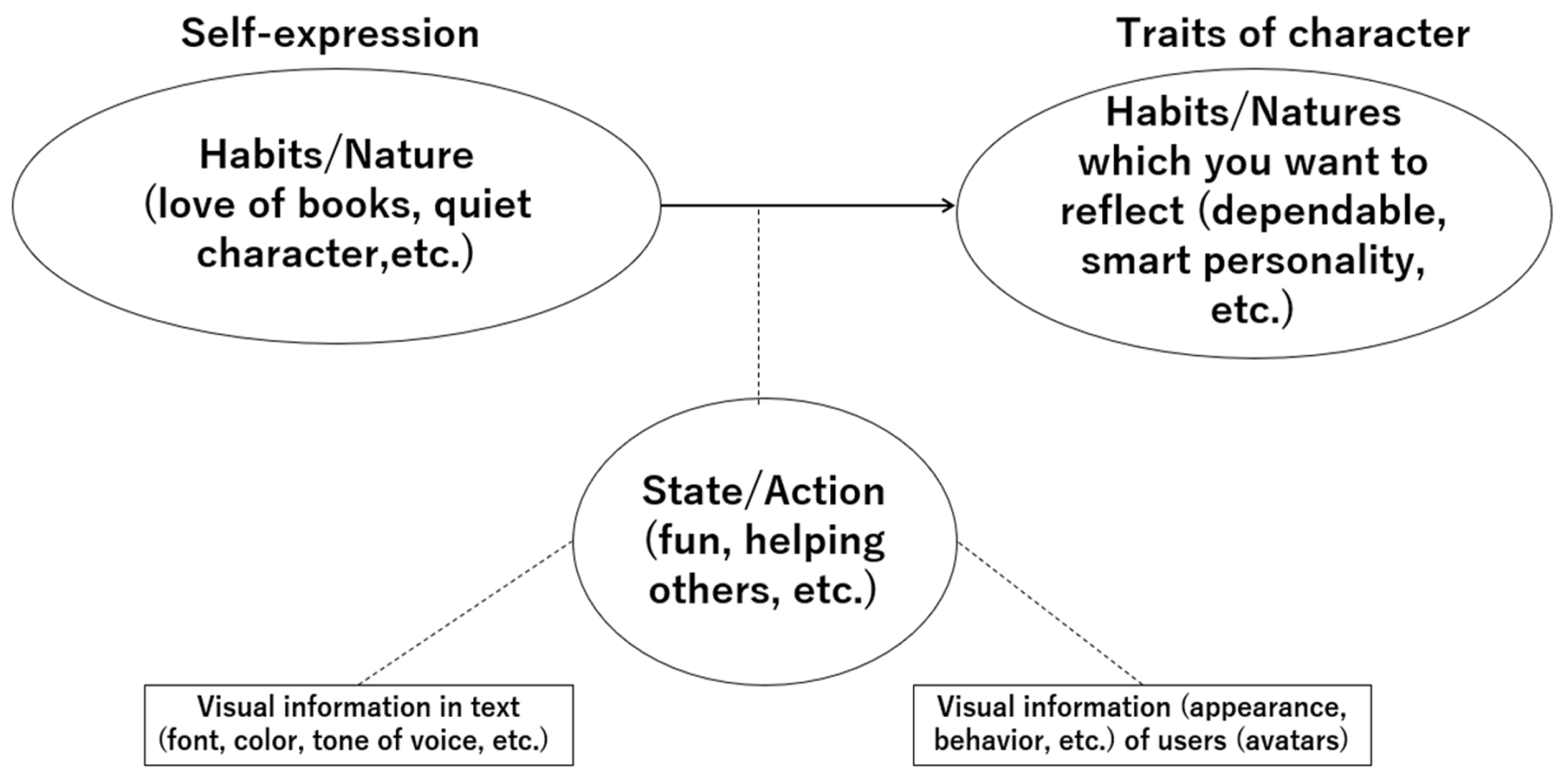
Conceptual model illustrating causal and moderating relations among variables. Solid arrows denote hypothesized causal paths (Harmony → Self-expression fit → Interpersonal affinity). Dashed lines denote moderation by immersion (2D → VR → Social VR); they do not indicate causal direction and therefore have no arrowheads.
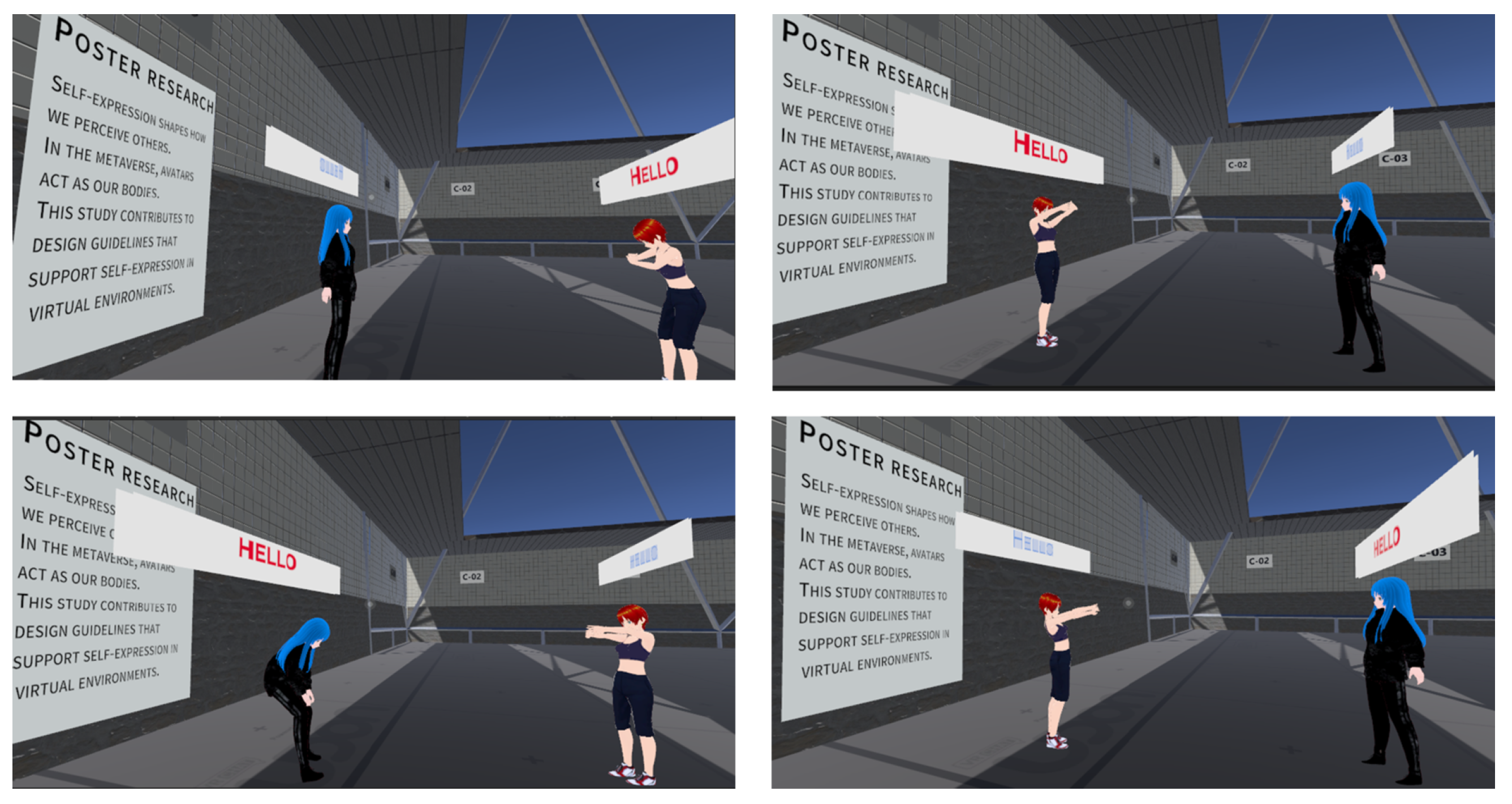
Figure 2.
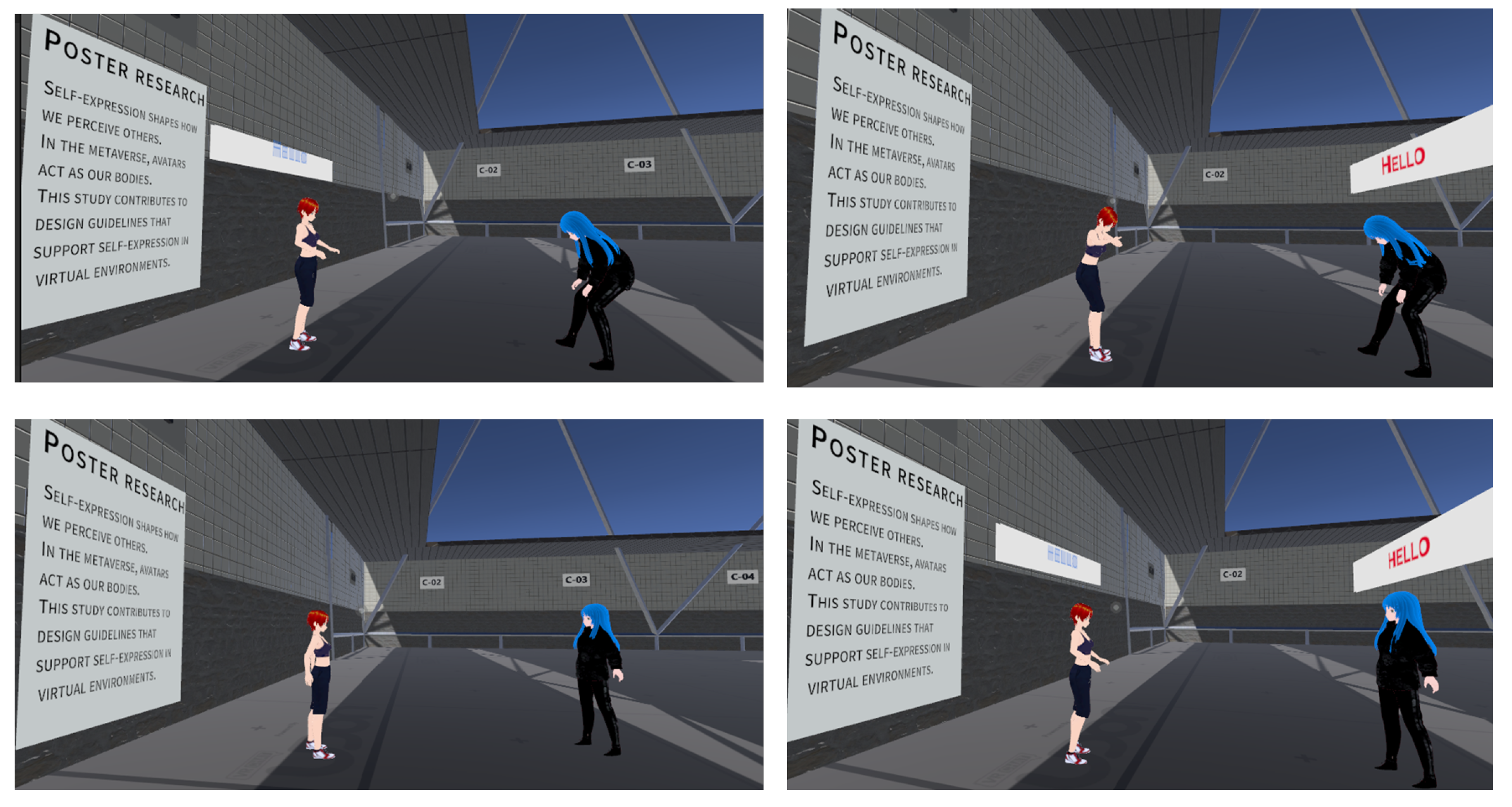
Experimental conditions in the metaverse study (Harmony group). Top-left: congruent warm avatar with warm text; Top-right: congruent cool avatar with cool text; Bottom-left: mismatched cool avatar with warm text; Bottom-right: mismatched warm avatar with cool text. (The in-world text is displayed in Japanese for ecological validity; the conceptual contrasts are warm vs. cool. In each screenshot, the presenter-side target avatar is the one standing in front of the poster; the other avatar, if present, is contextual. These screenshots are illustrative examples of the experimental conditions; minor overlaps or partial occlusions of avatars and UI elements do not affect the operational definition of the conditions or the interpretation of the experimental results).
Figure 3.
Avatar-focused control conditions used in the experiment. These screens illustrate the appearance-only baseline in which no experimental speech-balloon text manipulation was introduced. Any constant platform UI elements visible in the scene were not evaluated. These screenshots are illustrative examples of the experimental conditions; minor overlaps or partial occlusions of avatars and UI elements do not affect the operational definition of the conditions or the interpretation of the experimental results.
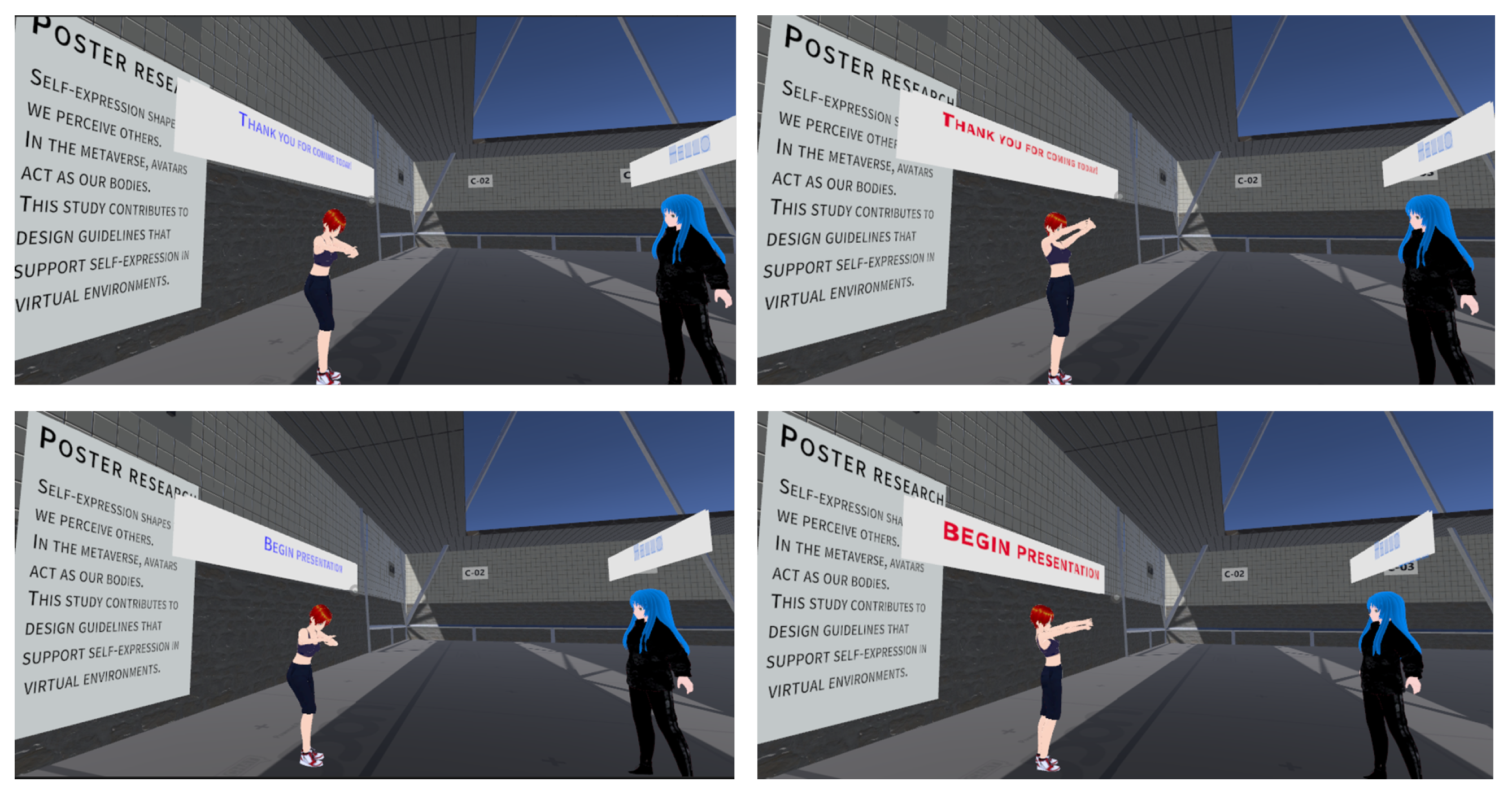
Figure 4.
Text-focused stimuli for evaluating text design (tone × style). The scene retains metaverse context for consistent presentation, but participants evaluated only the text stimulus as instructed. These screenshots are illustrative examples of the experimental conditions; minor overlaps or partial occlusions of avatars and UI elements do not affect the operational definition of the conditions or the interpretation of the experimental results.
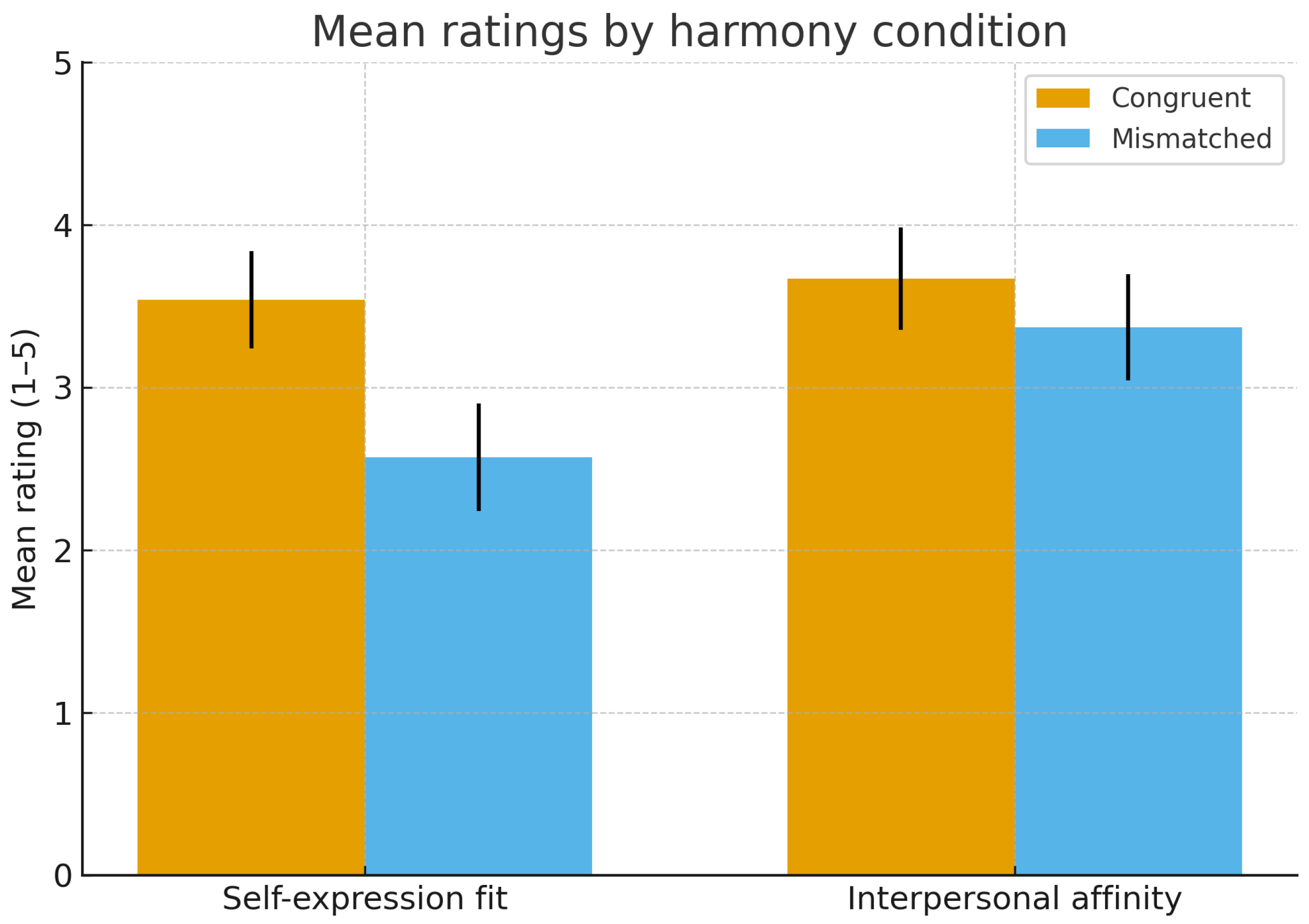
Figure 5.
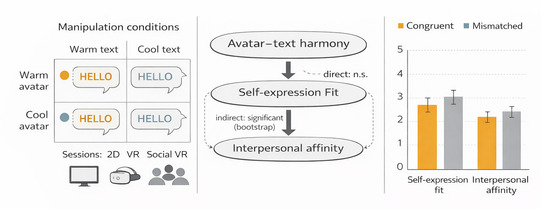
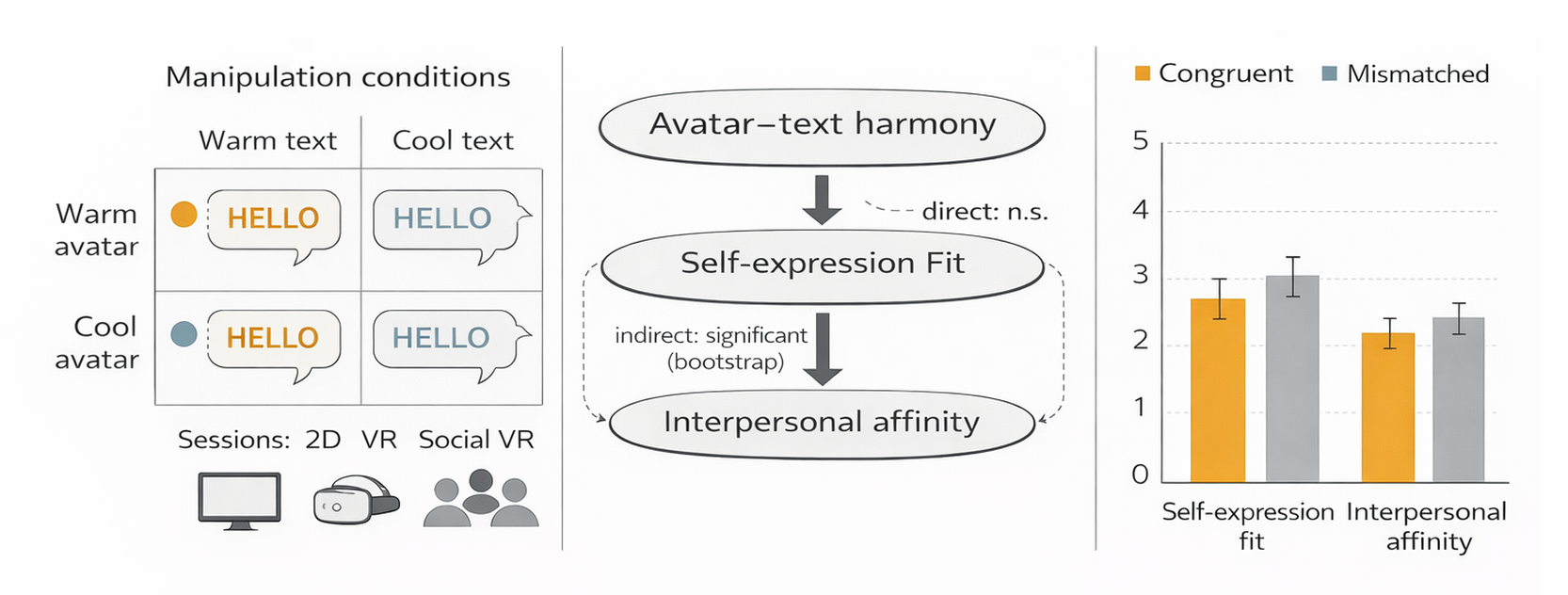
Mean ratings of self-expression fit and interpersonal affinity by harmony condition. Error bars represent 95% confidence intervals. Congruent conditions yielded significantly higher scores than mismatched conditions, supporting H1.
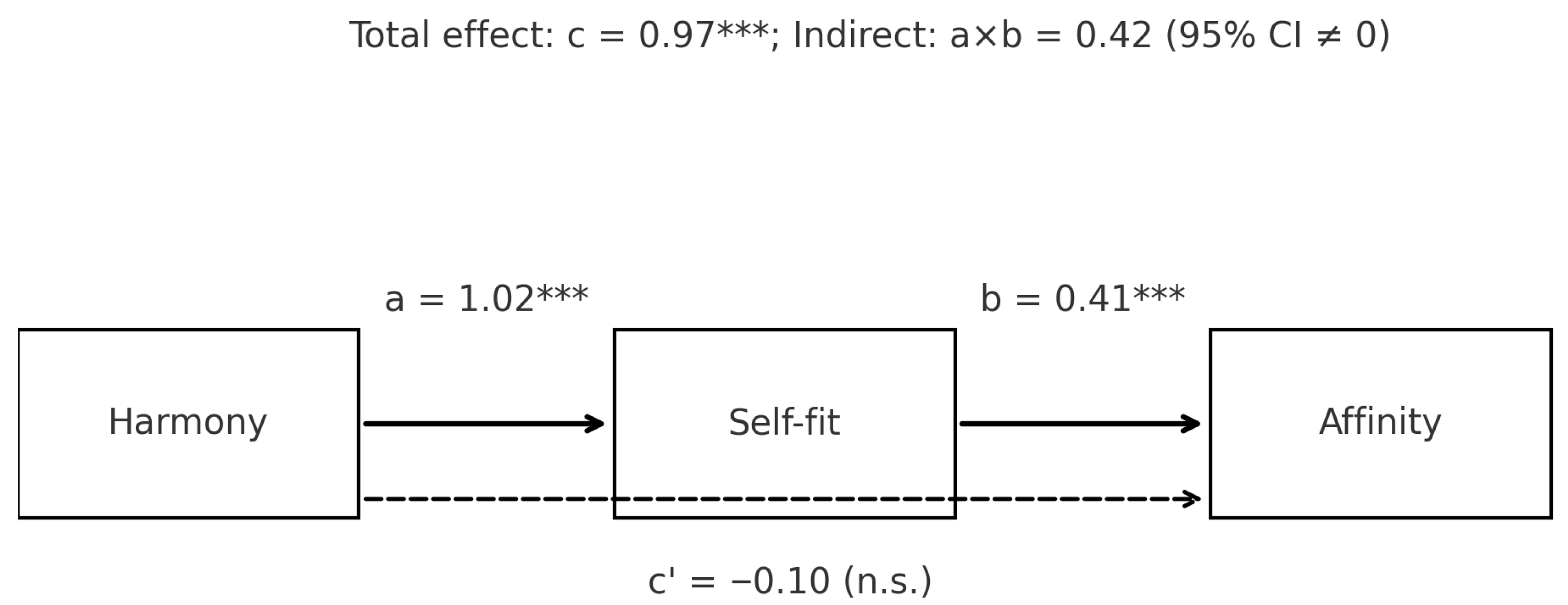
Figure 6.
Mediation model depicting the relationship between harmony, self-expression fit, and interpersonal affinity. Solid arrows indicate significant standardized paths (, , *** ), whereas the dashed arrow indicates a non-significant direct path (, n.s.). The total effect was , and the indirect effect was significant (bootstrap 95% CI excluded zero), confirming H2.
Table 1.
Stimulus font and justification (Warm; added).
| Field | Detail |
|---|
| Font family | Rounded M+ 1c |
| Mapping | Warm |
| License/source | SIL Open Font License/M+ Fonts |
| Stimulus control | Size, letter-spacing, line-height, placement, and contrast were held constant across conditions. |
| Rationale | Rounded curvature is linked to warmth/approachability and lower “hardness/rigidity” impressions in typography studies [13,14,15,17]. |
Table 2.
Stimulus font and justification (Cool; added).
| Field | Detail |
|---|
| Font family | Roboto Condensed |
| Mapping | Cool |
| License/source | Apache 2.0/Google Fonts |
| Stimulus control | Same controls as Table 1 (size, tracking, line-height, placement, and contrast fixed). |
| Rationale | Angular/condensed forms are associated with competence/professionalism and cooler impressions in prior work [13,14,15,17]. |
Table 3.
Twelve experimental conditions structured as 4 × 3 groups.
| Group | Condition | Description |
|---|
| Harmony (4) | HC-warm | Congruent warm avatar + warm text (red/orange hair; warm-colored rounded font, cheerful wording) |
| | HC-cool | Congruent cool avatar + cool text (blue hair; cool-colored angular font, neutral wording) |
| | HM-warm | Mismatched warm avatar + cool text (red/orange hair; cool-colored angular font, neutral wording) |
| | HM-cool | Mismatched cool avatar + warm text (blue hair; warm-colored rounded font, cheerful wording) |
| Presence (4) | P1 | Warm avatar baseline (no experimental speech-balloon text manipulation) |
| | P2 | Cool avatar baseline (no experimental speech-balloon text manipulation) |
| | P3 | Two-avatar context baseline (no experimental speech-balloon text manipulation) |
| | P4 | Two-avatar context baseline (no experimental speech-balloon text manipulation) |
| Text-content (4) | T1 | Cheerful tone × Warm style (cheerful wording, warm-colored rounded font) |
| | T2 | Cheerful tone × Cool style (cheerful wording, cool-colored angular font) |
| | T3 | Neutral tone × Warm style (neutral wording, warm-colored rounded font) |
| | T4 | Neutral tone × Cool style (neutral wording, cool-colored angular font) |
Table 4.
Survey items for each construct (English translation).
| Construct | Items |
|---|
| Perceived congruence | “The text matches the avatar.” (1 item) |
| Self-expression fit | (1) “This avatar-text pair feels like my self-representation.” |
| | (interpreted as perceived representational adequacy from an |
| | observer perspective) |
| | (2) “This avatar-text pair supports my personality expression.” |
| Interpersonal affinity | (1) “I would be willing to talk with this person.” |
| | (2) “This person feels friendly.” |
| | (3) “This person feels trustworthy.” |
| | (4) “This person gives a positive impression.” |
| | (5) “This person feels warm.” |
| | (6) “I am satisfied with the interaction.” |
Table 5.
Descriptive statistics for key outcomes by Harmony condition (collapsed across sessions). Means, standard deviations, and 95% CIs are reported.
| Outcome | Condition | Mean | SD | 95% CI |
|---|
| Self-expression fit | Congruent | 3.54 | 0.68 | [3.24, 3.84] |
| Self-expression fit | Mismatched | 2.57 | 0.75 | [2.24, 2.90] |
| Interpersonal affinity | Congruent | 3.67 | 0.70 | [3.36, 3.99] |
| Interpersonal affinity | Mismatched | 3.37 | 0.73 | [3.05, 3.70] |
Table 6.
Repeated-measures ANOVA summaries. Greenhouse–Geisser corrections applied where required.
| Effect (DV) | df | F | p | Partial |
|---|
| Harmony (Self-fit) | 1, 20 | 50.31 | <0.001 | 0.72 |
| Session (Self-fit) | 2, 40 | 4.10 | 0.025 | 0.17 |
| Harmony × Session (Self-fit) | 2, 40 | 2.45 | 0.099 | 0.11 |
| Harmony (Affinity) | 1, 20 | 15.84 | <0.001 | 0.44 |
| Session (Affinity) | 2, 40 | 2.18 | 0.126 | 0.10 |
| Harmony × Session (Affinity) | 2, 40 | 1.95 | 0.156 | 0.09 |
Table 7.
Mediation summary with standardized coefficients. The indirect effect (a × b) was significant by bootstrap CI.
| Path | Estimate | p |
|---|
| Total effect (Harmony → Affinity), c | 0.97 | <0.001 |
| Harmony → Self-fit, a | 1.02 | <0.001 |
| Self-fit → Affinity (controlling Harmony), b | 0.41 | <0.001 |
| Direct effect (Harmony → Affinity), | −0.10 | 0.37 |
| Indirect effect, | 0.42 | 95% CI excludes 0 |
| Disclaimer/Publisher’s Note: The statements, opinions and data contained in all publications are solely those of the individual author(s) and contributor(s) and not of MDPI and/or the editor(s). MDPI and/or the editor(s) disclaim responsibility for any injury to people or property resulting from any ideas, methods, instructions or products referred to in the content. |