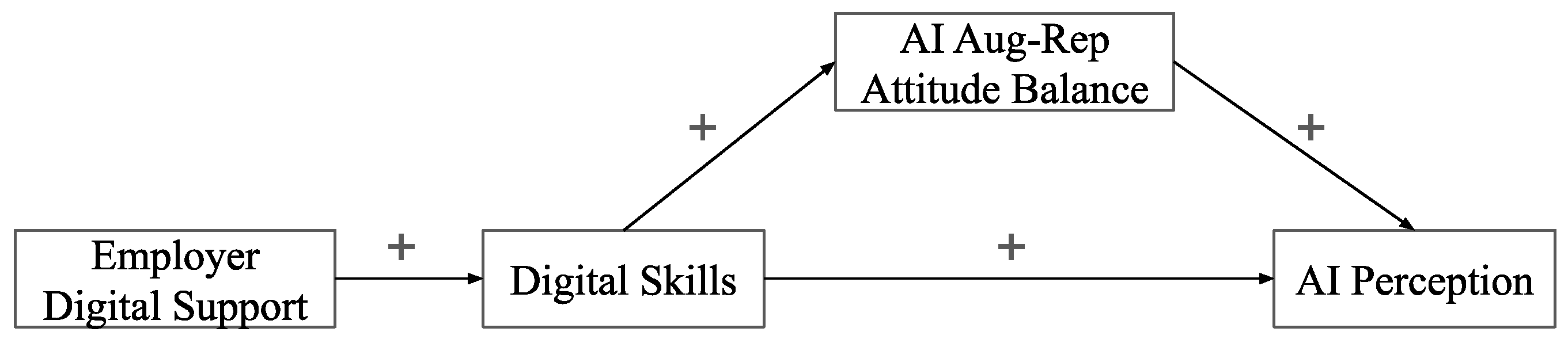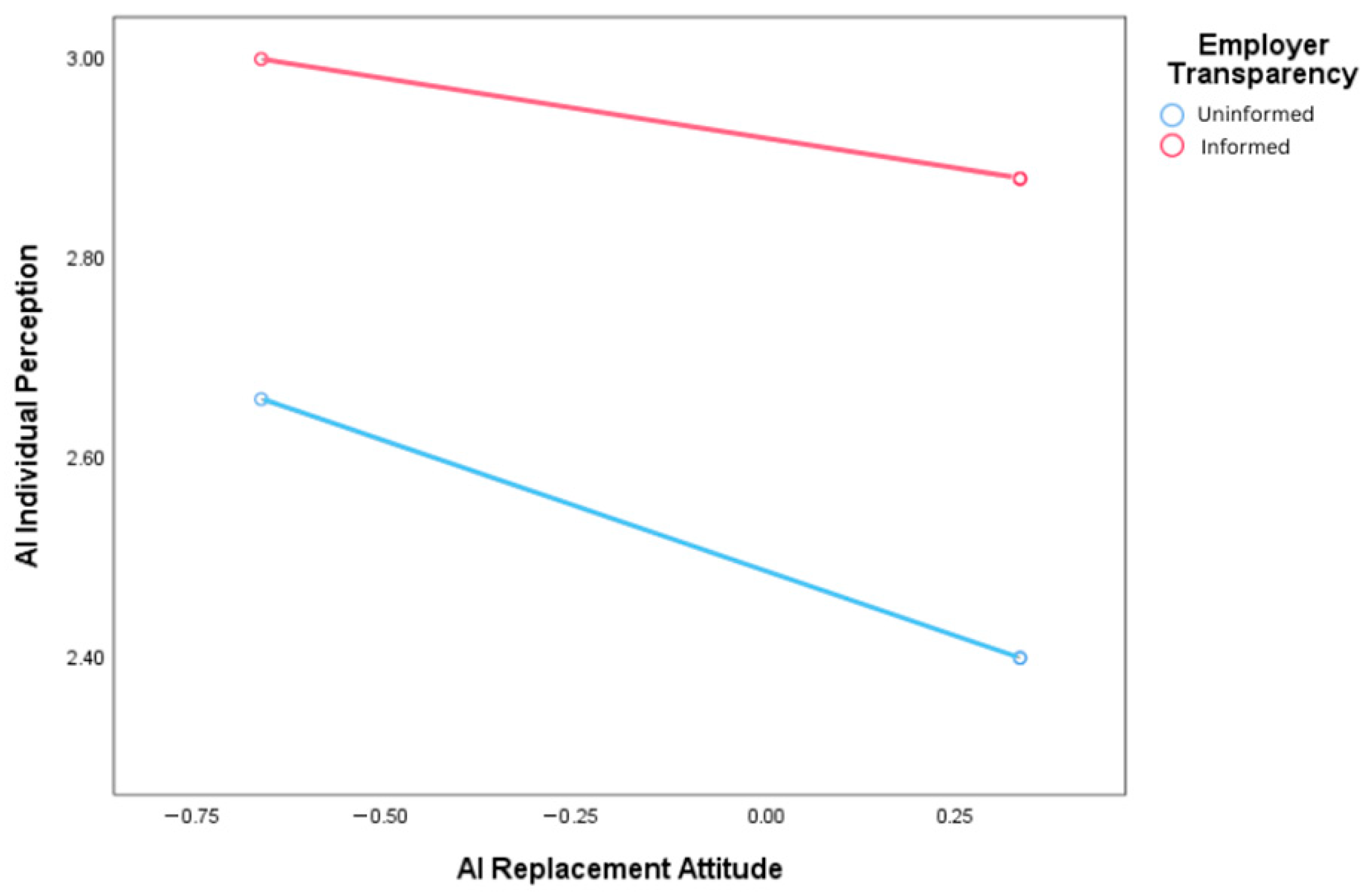
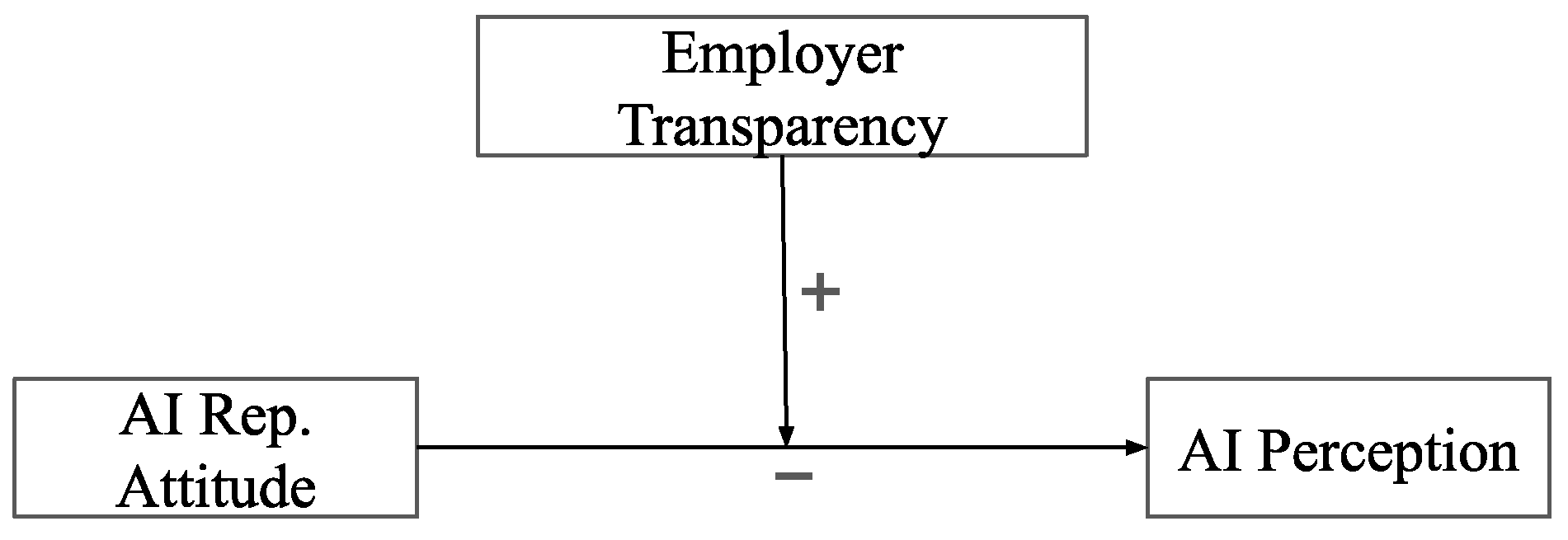
_Bryant.png)
Digital Skills and Employer Transparency: Two Key Drivers Reinforcing Positive AI Attitudes and Perception Among Europeans




Abstract
1. Introduction
1.1. Digital Skills
1.2. Employer Digital Support
1.3. Attitudes Toward AI
1.4. AI Individual Perception
1.5. Employer Transparency
2. Materials and Methods
2.1. Data and Participants
2.2. Measures
2.3. Data Analysis
3. Results
3.1. Reliability and Validity
3.2. Descriptives and Preliminary Analysis
3.3. Assumption Checks
3.4. Regression Model Testing
3.4.1. Research Model 1
3.4.2. Research Model 2
4. Discussion
4.1. Implications and Recommendations
4.2. Limitations and Future Research
5. Conclusions
Author Contributions
Funding
Institutional Review Board Statement
Informed Consent Statement
Data Availability Statement
Acknowledgments
Conflicts of Interest
Appendix A. Psychometric Properties and Statistical Analysis
Appendix A.1. Assumption Testing
Appendix A.1.1. Data Preparation and Screening
Appendix A.1.2. Normality Assessment
Univariate and Multivariate Normality
- Visual Inspection: Normal P-P plots of regression standardized residuals showed points closely following the diagonal line, indicating approximately normal distribution of residuals across all models.
- Histogram Analysis: Histograms of standardized residuals displayed bell-shaped distributions with acceptable symmetry.
- Residual Distribution: Standardized residuals were generally well-distributed around zero with no severe departures from normality.
Appendix A.1.3. Residual Analysis and Regression Diagnostics
Linear Regression: Employer Digital Support with Digital Skills

- Normal P-P Plot of Regression Standardized Residuals: Points closely follow the diagonal line, indicating approximately normal distribution of residuals.
- Histogram of Standardized Residuals: Bell-shaped distribution with acceptable symmetry.
- Scatterplot of Standardized Residuals vs. Standardized Predicted Values: Random scatter around zero with no clear pattern, indicating homoscedasticity and linearity.
Mediation Analysis: Digital Skills→AI Augmentation–Replacement Balance→AI Individual Perception
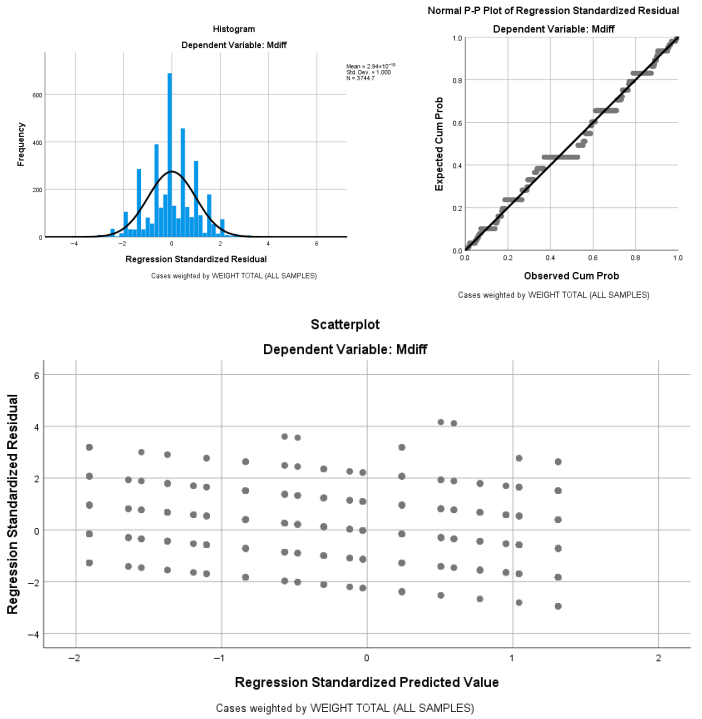
- Normal P-P Plot: Residuals approximate a normal distribution with minor deviations at the extremes, which is typical and acceptable.
- Scatterplot Analysis: Standardized residuals show random distribution around the zero line.
- Pattern Assessment: No evidence of systematic heteroscedasticity or non-linearity detected.


| Source | Sum of Squares | df | Mean Square | F | Sig. |
|---|---|---|---|---|---|
| Regression | 26.459 | 2 | 13.229 | 33.615 | <0.001 |
| Residual | 1420.573 | 3610 | 0.394 | ||
| Total | 1447.032 | 3612 |
Moderation Analysis: AI Replacement × Employer Informed→AI Perception

- Standardized Residuals vs. Standardized Predicted Values: Generally random distribution with acceptable scatter pattern.
- Normal P-P Plot: Acceptable approximation to normality with minor deviations at tails, which is common in large samples.
- Homoscedasticity Assessment: Visual inspection suggests relatively constant variance across fitted values.
Appendix A.1.4. Multicollinearity Diagnostics
| Model | Predictor | VIF | Tolerance |
|---|---|---|---|
| Mediation Model | |||
| Digital Skills | 1.288 | 0.776 | |
| Augmentation–Replacement Balance | 1.002 | 0.998 | |
| Moderation Model | |||
| AI Replacement Attitude | 2.735 | 0.421 | |
| Employer-Informed Status | 3.069 | 0.326 | |
| Interaction Term (Replacement × Info) | 4.027 | 0.248 |
- VIF < 5.0: All values meet this criterion, indicating acceptable levels of multicollinearity.
- Tolerance > 0.2: All predictors exceed this threshold, confirming adequate independence.
- Mean-Centering Effect: Successfully reduced potential multicollinearity in interaction terms.
- Highest VIF: The interaction term (4.027) represents the highest VIF but remains within acceptable limits.
Appendix A.1.5. Independence of Observations
Appendix A.1.6. Outlier Detection and Influence Diagnostics
- Standardized residual plots were examined for extreme values.
- Cook’s distance was calculated to identify potentially influential observations.
- Cases with extreme residuals were retained as they appeared to represent legitimate response patterns rather than data entry errors.
Appendix A.2. Exploratory Factor Analysis (EFA)
Appendix A.2.1. Methodology
Appendix A.2.2. Sample Adequacy Tests
Appendix A.2.3. EFA Results
| Item | Factor 1 (Digital Skills) | Factor 2 (AI Augmentation Attitude) | Factor 3 (AI Replacement Attitude) |
|---|---|---|---|
| Digital skill in daily life (qb2_1) | 0.83 | — | — |
| Digital skill for job tasks (qb2_2) | 0.83 | — | — |
| Digital skill for future work (qb2_3) | 0.82 | — | — |
| Benefit from digital learning (qb2_4) | 0.82 | — | — |
| AI increases task pace (qb6_2) | — | 0.59 | — |
| AI makes accurate decisions (qb6_4) | — | 0.72 | — |
| AI does boring/repetitive jobs (qb6_6) | — | 0.68 | — |
| AI helps people at work/home (qb6_8) | — | 0.57 | — |
| AI steals jobs (qb6_1) | — | — | 0.82 |
| More jobs disappear than are created (qb6_5) | — | — | 0.72 |
Appendix A.3. Confirmatory Factor Analysis (CFA)
Appendix A.3.1. Model Specification
Appendix A.3.2. Standardized Factor Loadings
| Factor and Item | Standardized Loading |
|---|---|
| Factor 1: Digital Skills | |
| Digital skill in daily life (qb2_1) | 0.86 |
| Digital skill for job tasks (qb2_2) | 0.84 |
| Digital skill for future work (qb2_3) | 0.84 |
| Benefit from digital learning (qb2_4) | 0.88 |
| Factor 2: AI Augmentation Attitude | |
| AI increases task pace (qb6_2) | 0.81 |
| AI makes accurate decisions (qb6_4) | 0.76 |
| AI does boring/repetitive jobs (qb6_6) | 0.71 |
| AI helps people at work/home (qb6_8) | 0.67 |
| Factor 3: AI Replacement Attitude | |
| AI steals jobs (qb6_1) | 0.82 * |
| More jobs disappear than are created (qb6_5) | 0.82 * |
Appendix A.4. Inter-Construct Correlations
Appendix A.4.1. Factor Correlation Matrix
| Digital Skills | AI Augmentation Attitude | AI Replacement Attitude | |
|---|---|---|---|
| Digital Skills | — | 0.57 ** | −0.01 |
| AI Augmentation Attitude | 0.57 ** | — | 0.10 * |
| AI Replacement Attitude | −0.01 | 0.10 * | — |
Appendix A.4.2. Interpretation
- A moderate positive correlation (r = 0.57) between Digital Skills and AI Augmentation Attitude suggests that individuals with higher digital skills tend to have more positive attitudes toward AI augmentation.
- A negligible correlation (r = −0.01) between Digital Skills and AI Replacement Attitude indicates that digital skill levels do not significantly relate to attitudes about AI job replacement.
- A weak positive correlation (r = 0.10) between AI Augmentation Attitude and AI Replacement Attitude suggests a slight tendency for those who have positive attitudes toward AI augmentation to also acknowledge potential replacement concerns.
Appendix A.5. Reliability and Validity Assessment
Appendix A.5.1. Internal Consistency and Convergent Validity
| Factor | Number of Items | Composite Reliability (CR) | Average Variance Extracted (AVE) |
|---|---|---|---|
| Digital Skills | 4 | 0.92 | 0.73 |
| AI Augmentation Attitude | 4 | 0.83 | 0.55 |
| AI Replacement Attitude | 2 | 0.80 | 0.67 |
Appendix A.5.2. Reliability and Validity Criteria
Appendix A.5.3. Mathematical Formulations
- λ = standardized factor loading
- k = number of items per construct
Appendix A.6. Conclusions
Appendix A.6.1. Summary of Assumption Testing
- Normality: Visual inspection of residual plots (P-P plots and histograms) indicated acceptable approximation to normal distribution across all models.
- Homoscedasticity: Homoscedasticity was generally satisfied across models, with heteroscedasticity detected in one model and addressed through robust standard errors.
- Linearity: Linearity was confirmed through residual plot analysis, showing random distribution around zero with no systematic pattern.
- Independence: Independence was supported by visual inspection of residual patterns with no evidence of systematic dependence.
- Multicollinearity: All VIF values remained within acceptable limits (< 5.0), with mean-centering successfully addressing interaction term concerns.
Appendix A.6.2. Model Appropriateness
Appendix A.6.3. Methodological Transparency
Appendix B. Variable Construction and Definitions
Appendix B.1. Overview
Appendix B.2. Primary Variables
Appendix B.2.1. Employer Digital Support
- QB3: “To what extent do you agree or disagree that your employer provides you with the necessary tools or training to work effectively with the most recent digital technologies, including Artificial Intelligence?”
- 1 = “Totally agree”
- 2 = “Tend to agree”
- 3 = “Tend to disagree”
- 4 = “Totally disagree”
- 5 = “Not applicable”
- 6 = “Do not know”
- Original 1→Recoded 4 (Totally agree)
- Original 2→Recoded 3 (Tend to agree)
- Original 3→Recoded 2 (Tend to disagree)
- Original 4→Recoded 1 (Totally disagree)
Appendix B.2.2. Digital Skills
- QB2.1: “You consider yourself to be sufficiently skilled in the use of digital technologies… in your daily life.”
- QB2.2: “You consider yourself to be sufficiently skilled in the use of digital technologies… to do your job.”
- QB2.3: “You consider yourself to be sufficiently skilled in the use of digital technologies… to do a future job if you were to find a job or to change jobs within the next twelve months.”
- QB2.4: “You consider yourself to be sufficiently skilled in the use of digital technologies… to be able to benefit from digital and online learning opportunities.”
- qb2_1→qb2_1r
- qb2_2→qb2_2r
- qb2_3→qb2_3r
- qb2_4→qb2_4r
- DigSkill_Index = MEAN (qb2_1r, qb2_2r, qb2_3r, qb2_4r)
Appendix B.2.3. AI Attitudes
AI Augmentation Attitude
- QB6.2: “Robots and Artificial Intelligence are a good thing for society, because they help people do their jobs or carry out daily tasks at home.”
- QB6.4: “Artificial Intelligence is necessary as it can do jobs that are seen as boring or repetitive.”
- QB6.6: “Robots and Artificial Intelligence increase the pace at which workers complete tasks.”
- QB6.8: “Robots and Artificial Intelligence can be used to make accurate decisions in the workplace.”
AI Replacement Attitude
- QB6.1: “Due to the use of robots and Artificial Intelligence, more jobs will disappear than new jobs will be created.”
- QB6.5: “Robots and Artificial Intelligence steal people’s jobs.”
- AI Augmentation Attitude = MEAN (qb6_2r, qb6_4r, qb6_6r, qb6_8r)
- AI Replacement Attitude = MEAN (qb6_1r, qb6_5r)
Appendix B.2.4. AI Individual Perception
- QB5: “How positively or negatively do you perceive the use of robots and Artificial Intelligence in the workplace?”
- 1 = “Very positively”
- 2 = “Fairly positively”
- 3 = “Fairly negatively”
- 4 = “Very negatively”
- 5 = “Not applicable”
- 6 = “Do not know”
Appendix B.2.5. Employer Transparency
- qb9_1: “Employer informed you about AI without further details” (1 = Yes; 0 = No)
- qb9_2: “Employer gave detailed explanation” (1 = Yes; 0 = No)
- qb9_3: “Employer gave access to personal data” (1 = Yes; 0 = No)
- qb9_4: “Employer gave results from automated analysis” (1 = Yes; 0 = No)
- qb9_5: “Employer did not inform at all” (1 = Yes; 0 = No)
- qb9_6: “Not applicable” (student/retired, etc.)
- qb9_7: “Do not know”
- Informed (1): If any of qb9_1 through qb9_4 = 1 (informed in any way)
- Not Informed (0): If qb9_5 = 1 (“Not informed”)
- System Missing: If qb9_6 (“Not applicable”) or qb9_7 (“Do not know”)
Appendix B.3. Control Variables
Appendix B.3.1. Age
- 1 = 15–24 years
- 2 = 25–39 years
- 3 = 40–54 years
- 4 = 55–98 years
Appendix B.3.2. Gender
- 1 = Man
- 2 = Woman
- 3 = “None of the above/Nonbinary/Prefer not to say”
Appendix B.3.3. Education (Highest Level Attained)
- 1 = Pre-primary (no education)
- 2 = Primary
- 3 = Lower secondary
- 4 = Upper secondary
- 5 = Post-secondary non-tertiary (vocational)
- 6 = Short-cycle tertiary
- 7 = Bachelor’s or equivalent
- 8 = Master’s or equivalent
- 9 = Doctoral or equivalent
Appendix B.4. Data Quality and Missing Values
Appendix B.4.1. Missing Data Treatment
- “Not applicable” responses→System missing
- “Do not know” responses→System missing
- Only substantive responses (agreement/disagreement) retained for analysis
Appendix B.4.2. Scale Construction Reliability
- Robustness to minor missing data within scales
- Intuitive interpretation (same metric as original items)
- Appropriate handling of partial responses
Appendix B.5. Variable Summary
| Variable | Type | Scale | Range | Construction Method |
|---|---|---|---|---|
| Employer Digital Support | Continuous | 1–4 | Single item, reverse-coded | Direct recoding |
| Digital Skills | Continuous | 1–4 | Mean of 4 items | Mean composite |
| AI Augmentation Attitude | Continuous | 1–4 | Mean of 4 items | Mean composite |
| AI Replacement Attitude | Continuous | 1–4 | Mean of 2 items | Mean composite |
| AI Individual Perception | Continuous | 1–4 | Single item, reverse-coded | Direct recoding |
| Employer Transparency | Binary | 0–1 | Multiple items combined | Logical recoding |
| Age | Categorical | 1–4 | 4 age groups | Categorical recoding |
| Gender | Categorical | 1–3 | 3 categories | Original coding |
| Education | Categorical | 1–9 | 9 education levels | Categorical recoding |
Appendix B.6. Methodological Notes
Appendix B.6.1. Scale Direction
- Higher Digital Skills = Greater self-assessed competence
- Higher AI Augmentation Attitude = More positive view of AI benefits
- Higher AI Replacement Attitude = Greater concern about job displacement
- Higher AI Individual Perception = More positive workplace AI perception
- Higher Employer Digital Support = Greater perceived employer support
Appendix B.6.2. Analytical Considerations
Appendix C. Supplementary Analyses
Appendix C.1. Overview
Appendix C.2. Supplementary Mediation Analyses
Appendix C.2.1. Mediation Analysis 1: Digital Skills→Augmentation Attitude→AI Individual Perception
- Independent Variable (X): Digital Skills
- Mediator (M): AI Augmentation Attitude
- Dependent Variable (Y): AI Individual Perception
- Sample Size: 7943
Results
- R = 0.4669, R2 = 0.2180, F(1, 7941) = 2213.2002, p < 0.001
- Coefficient = 0.4029, SE = 0.0086, t = 47.0447, p < 0.001, 95% CI [0.3862, 0.4197]
- Coefficient = 0.5822, SE = 0.0102, t = 57.1072, p < 0.001, 95% CI [0.5622, 0.6022]
- Effect = 0.4182, SE = 0.0092, t = 45.2534, p < 0.001, 95% CI [0.4001, 0.4363]
- Effect = 0.1836, SE = 0.0088, t = 20.8681, p < 0.001, 95% CI [0.1664, 0.2009]
- Effect = 0.2346, Bootstrap SE = 0.0076, 95% Bootstrap CI [0.2195, 0.2494]
Interpretation
Appendix C.2.2. Mediation Analysis 2: Digital Skills→Replacement Attitude→AI Individual Perception
- Independent Variable (X): Digital Skills
- Mediator (M): AI Replacement Attitude
- Dependent Variable (Y): AI Individual Perception
- Sample Size: 11,344
Results
- R = 0.0488, R2 = 0.0024, F(1, 11342) = 27.0289, p < 0.001
- Coefficient = −0.0298, SE = 0.0057, t = −5.1989, p < 0.001, 95% CI [−0.0411, −0.0186]
- Coefficient = −0.2445, SE = 0.0133, t = −18.3600, p < 0.001, 95% CI [−0.2706, −0.2184]
- Effect = 0.4032, SE = 0.0081, t = 49.6965, p < 0.001, 95% CI [0.3873, 0.4191]
- Effect = 0.3959, SE = 0.0081, t = 48.9683, p < 0.001, 95% CI [0.3829, 0.4148]
- Effect = 0.0073, Bootstrap SE = 0.0014, 95% Bootstrap CI [0.0045, 0.0101]
Interpretation
Appendix C.3. Cross-Tabulation Analysis
Appendix C.3.1. Augmentation–Replacement Balance and AI Replacement Attitude
- Row Variable: Augmentation–Replacement Balance (Mdiff variable)
- Column Variable: AI Replacement Attitude (Dichotomized: Agree vs. Disagree)
Results
| Augmentation–Replacement Balance | AI Replacement Attitude | ||
|---|---|---|---|
| Disagree | Agree | Total | |
| Low-Augmentation-Dominant (0.88) | 32 (3.7%) | 822 (96.3%) | 854 (100.0%) |
| Medium-Augmentation-Dominant (1.88) | 97 (34.4%) | 185 (65.6%) | 282 (100.0%) |
Interpretation
- Low-Augmentation-Dominant Group (0.88): The group shows overwhelming agreement with AI replacement concerns (96.3% agree vs. 3.7% disagree).
- Medium-Augmentation-Dominant Group (1.88): The group shows moderate but substantial agreement with replacement concerns (65.6% agree vs. 34.4% disagree).
- 6.
- Cautious Optimism Pattern: Even individuals with augmentation-dominant attitudes maintain moderate to high levels of replacement concerns, reflecting sophisticated, nuanced thinking about AI’s workplace implications.
- 7.
- Persistent Concerns: Replacement concerns remain substantial across both groups, suggesting that positive and negative AI attitudes coexist rather than oppose each other.
- 8.
- Gradient of Concern: Higher augmentation-dominance is associated with reduced replacement concerns, but concerns remain prevalent even in the most optimistic group.
Appendix C.4. Summary of Supplementary Findings
Appendix C.4.1. Key Insights
- 9.
- Dramatic Mediation Difference: Augmentation attitude (56.1%) vastly outweighs replacement attitude (1.8%) in mediating the digital skills→perception relationship, representing a 54.3 percentage point difference in explanatory power.
- 10.
- Strong Correlation Contrast: The path coefficients reveal a substantial difference in how digital skills relate to each attitude type:
- Digital Skills→Augmentation Attitude: β = 0.4029 (strong positive)
- Digital Skills→Replacement Attitude: β = −0.0298 (weak negative)
- Correlation difference: Δr ≈ 0.47
- 11.
- Separate Attitude Dimensions: The analyses demonstrate that augmentation and replacement attitudes operate as distinct, largely independent dimensions rather than opposing ends of a single continuum.
- 12.
- Cautious Optimism: The cross-tabulation reveals that even augmentation-dominant individuals maintain substantial replacement concerns, supporting a model of cautious optimism rather than uncritical enthusiasm for AI.
Appendix C.4.2. Integration with Main Results
- Clarifying Mediation Pathways: Demonstrating that positive AI perception development occurs primarily through augmented attitudes rather than reduced replacement concerns.
- Supporting Policy Implications: Providing evidence that fostering augmentation attitudes and digital skills development may be more effective for positive AI adoption than simply addressing replacement fears.
- Revealing Attitude Complexity: Showing that individuals can simultaneously hold positive augmentation views while maintaining responsible caution about replacement risks.
Appendix D. Reproducibility Information
Appendix D.1. Overview
Appendix D.2. Dataset Information
- Total sample size varies by analysis due to missing data handling
- Cross-sectional survey data
- The survey employed a multi-stage, random probability sampling design stratified by region and density of 27 EU member states between April 2024 and May 2024.
Appendix D.3. Software and Statistical Environment
- Hayes PROCESS macro for SPSS v4.2
Appendix D.4. Variable Construction
- Employer Digital Support
- Digital Skills (composite scale)
- AI Individual Perception
- Augmentation–Replacement Attitude Balance (composite scale)
- AI Replacement Attitude (composite scale)
- AI Augmentation Attitude (composite scale)
- Employer Transparency (binary)
- Control variables: Age (categorical), Gender, Education (categorical)
Appendix D.5. Analytical Procedures
Appendix D.5.1. Analysis 1: Linear Regression (Employer Digital Support and Digital Skills)
- Analyze→Regression→Linear
- Method: Enter (Block-wise)
- Dependent Variable: Employer Digital Support
- Block 1 (Controls): Age, Gender, Education
- Block 2 (Predictor): Digital Skills
- Entry method: Enter
- Block-wise entry with controls entered first
- Default confidence intervals (95%)
- Standard residual diagnostics enabled
Appendix D.5.2. Analysis 2: Mediation Analysis (Main Hypothesis Testing)
- Hayes PROCESS macro, Model 4 (Simple Mediation)
- Independent Variable (X): Digital Skills
- Mediator (M): Augmentation–Replacement Attitude Balance
- Dependent Variable (Y): AI Individual Perception
- Covariates: Age, Gender, Education
- Bootstrap samples: 5000
- Confidence level: 95%
- Heteroscedasticity-Consistent Standard Errors: HC3 (due to detected heteroscedasticity in assumption testing)
- Total Effect Option: Enabled (to report total, direct, and indirect effects)
- Missing data: Listwise deletion
Appendix D.5.3. Analysis 3: Moderation Analysis
- Hayes PROCESS macro, Model 1 (Simple Moderation)
- Independent Variable (X): AI Replacement Attitude
- Moderator (W): Employer Transparency
- Dependent Variable (Y): AI Individual Perception
- Covariates: Age, Gender, Education
- Bootstrap samples: 5000
- Confidence level: 95%
- Mean-centering: Continuous
- Missing data: Listwise deletion
Appendix D.5.4. Supplementary Analysis 1: Augmentation Attitude Mediation
- Hayes PROCESS macro, Model 4 (Simple Mediation)
- Independent Variable (X): Digital Skills
- Mediator (M): AI Augmentation Attitude
- Dependent Variable (Y): AI Individual Perception
- Covariates: None
- Bootstrap samples: 5000
- Confidence level: 95%
- Missing data: Listwise deletion
Appendix D.5.5. Supplementary Analysis 2: Replacement Attitude Mediation
- Hayes PROCESS macro, Model 4 (Simple Mediation)
- Independent Variable (X): Digital Skills
- Mediator (M): AI Replacement Attitude
- Dependent Variable (Y): AI Individual Perception
- Covariates: None
- Bootstrap samples: 5000
- Confidence level: 95%
- Missing data: Listwise deletion
Appendix D.5.6. Supplementary Analysis 3: Cross-Tabulation
- Analyze→Descriptive Statistics→Crosstabs
- Row Variable: Augmentation–Replacement Balance
- Column Variable: AI Replacement Attitude (Dichotomized)
- Cell percentages: Row percentages
- Statistics: Chi-square test
- Expected counts displayed
Appendix D.6. Missing Data Handling
- Consistent with variable construction approach (see Appendix B)
- Maintains interpretability across analyses
- Sample sizes remain adequate for all analyses
- Main linear regression: N = 11,410
- Main mediation analysis: N = 3635
- Main moderation analysis: N = 11,338
- Supplementary mediation 1: N = 7543
- Supplementary mediation 2: N = 11,344
- Cross-tabulation: N = 1136 (selected categories)
Appendix D.7. Assumption Testing Procedures
- Heteroscedasticity: HC3 robust standard errors were implemented in the main mediation analysis.
- Normality: Visual diagnostic approaches were supplemented by bootstrap procedures.
- Multicollinearity: VIF diagnostics were conducted; mean-centering was applied in the moderation analysis.
- Outliers: Outliers were retained with robust estimation techniques.
Appendix D.8. Reproducibility Checklist
- Main mediation: Indirect effect = 0.20 with 95% CI [0.186, 0.224]
- Main linear regression: Coefficient = 0.42; p < 0.001
- Main moderation: Interaction effect = 0.14; p < 0.001
- Supplementary mediation 1: Indirect effect = 0.2346 (56.1% mediation)
- Supplementary mediation 2: Indirect effect = 0.0073 (1.8% mediation)
- Cross-tabulation: 96.3% vs. 65.6% agreement pattern
References
- European Commission Eurostat. Use of Artificial Intelligence in Enterprises. Digital Economy and Society; European Commission: Brussels, Belgium, 2025. Available online: https://ec.europa.eu/eurostat/statistics-explained/index.php?title=Use_of_artificial_intelligence_in_enterprises (accessed on 2 December 2025).
- Mayer, H.; Yee, L.; Chui, M.; Roberts, R. Superagency in the Workplace: Empowering People to Unlock AI’s Full Potential at Work; McKinsey Digital, 2025. Available online: https://www.mckinsey.com/~/media/mckinsey/business%20functions/quantumblack/our%20insights/superagency%20in%20the%20workplace%20empowering%20people%20to%20unlock%20ais%20full%20potential%20at%20work/superagency-in-the-workplace-empowering-people-to-unlock-ais-full-potential-v4.pdf (accessed on 20 July 2025).
- European Commission. On Artificial Intelligence: A European Approach to Excellence and Trust (COM/2020/0065). 2020. Available online: https://eur-lex.europa.eu/legal-content/EN/ALL/?uri=CELEX%3A52020DC0065 (accessed on 13 July 2025).
- The White House. Removing Barriers to American Leadership in Artificial Intelligence (Executive Order No. 14179, 90 Fed. Reg. 8741); Federal Register, 2025. Available online: https://www.federalregister.gov/documents/2025/01/31/2025-02172/removing-barriers-to-american-leadership-in-artificial-intelligence (accessed on 10 January 2026).
- The White House. Accelerating Federal Permitting of Data Center Infrastructure (Executive Order No. 14318, 90 Fed. Reg. 35385); Federal Register, 2025. Available online: https://www.federalregister.gov/documents/2025/07/28/2025-14212/accelerating-federal-permitting-of-data-center-infrastructure (accessed on 10 January 2026).
- Migliorini, S. China’s Interim Measures on generative AI: Origin, content and significance. Comput. Law Secur. Rev. 2024, 53, 105985. [Google Scholar] [CrossRef]
- European Commission. Annex Digital Europe: Work Programme 2025–2027 of the Digital Europe Programme. 2025. Available online: https://ec.europa.eu/newsroom/dae/redirection/document/114219 (accessed on 19 July 2025).
- European Commission. Eurobarometer 101.4 (2024) (ZA8844; Version 1.0.0); GESIS: Cologne, Germany, 2025. [CrossRef]
- Organisation for Economic Co-Operation Development. OECD AI Principles Overview; OECD.AI, 2025. Available online: https://oecd.ai/en/ai-principles (accessed on 15 June 2025).
- Wendehorst, C.; Nessler, B. Guidelines on the Application of the Definition of an AI System in the AI Act: ELI Proposal for a Three Factor Approach; European Law Institute, 2024. Available online: https://www.europeanlawinstitute.eu/fileadmin/user_upload/p_eli/Publications/ELI_Response_on_the_definition_of_an_AI_System.pdf (accessed on 12 July 2025).
- European Parliament; Council of the European Union. Regulation (EU) 2024/1689 Laying Down Harmonised Rules on Artificial Intelligence and Amending other Union Acts (Artificial Intelligence Act) (Regulation (EU) 2024/1689). 2024. Available online: https://eur-lex.europa.eu/legal-content/EN/TXT/?uri=CELEX:32024R1689 (accessed on 9 January 2026).
- Pozzi, F.; Valetto, P.; Kuiper, E. AI’s Impact on Europe’s Job Market: A Call for a Social Compact; Social Europe, 2025. Available online: https://www.socialeurope.eu/ais-impact-on-europes-job-market-a-call-for-a-social-compact (accessed on 15 August 2025).
- Chan, C.K.Y.; Hu, W. Students’ voices on generative AI: Perceptions, benefits, and challenges in higher education. Int. J. Educ. Technol. High. Educ. 2023, 20, 43. [Google Scholar] [CrossRef]
- Johnson, B.T.; Martinez-Berman, L.; Curley, C.M. Formation of Attitudes: How People (Wittingly or Unwittingly) Develop Their Viewpoints. Oxford Research Encyclopedia of Psychology. 2022. Available online: https://oxfordre.com/psychology/view/10.1093/acrefore/9780190236557.001.0001/acrefore-9780190236557-e-812 (accessed on 14 July 2025).
- Fazio, R.H.; Olson, M.A. The Mode Model. Dual-Process Theories of the Social Mind. 2014. Available online: https://www.asc.ohio-state.edu/psychology/fazio/documents/FazioOlson_DualProcessVolume__Feb062013.pdf (accessed on 4 July 2025).
- Robbins, S.P.; Judge, T.A. Organizational Behavior, 19th ed.; Pearson: London, UK, 2024; Available online: https://www.pearson.com/en-us/subject-catalog/p/organizational-behavior/P200000007044/9780137687206?srsltid=AfmBOoq3lfnuZge_rVVm_LuZjG210qeDdA9mPL_wdO930R24-b40mHdG (accessed on 20 June 2025).
- Curtarelli, M.; Gualtieri, V.; Jannati, M.S.; Donlevy, V. ICT for Work: Digital Skills in the Workplace; European Commission: Brussels, Belgium, 2016. Available online: https://digital-strategy.ec.europa.eu/en/library/ict-work-digital-skills-workplace (accessed on 15 July 2025).
- Nikou, S.; De Reuver, M.; Mahboob Kanafi, M. Workplace literacy skills—How information and digital literacy affect adoption of digital technology. J. Doc. 2022, 78, 371–391. [Google Scholar] [CrossRef]
- Shakina, E.; Parshakov, P.; Alsufiev, A. Rethinking the corporate digital divide: The complementarity of technologies and the demand for digital skills. Technol. Forecast. Soc. Change 2021, 162, 120405. [Google Scholar] [CrossRef]
- Glikson, E.; Woolley, A.W. Human trust in artificial intelligence: Review of empirical research. Acad. Manag. Ann. 2020, 14, 627–660. [Google Scholar] [CrossRef]
- Davis, F.D. A Technology Acceptance Model for Empirically Testing New End-User Information Systems: Theory and Results. Ph.D. Thesis, Massachusetts Institute of Technology, Cambridge, MA, USA, 1985. Available online: https://dspace.mit.edu/bitstream/handle/1721.1/15192/14927137-MIT.pdf (accessed on 30 June 2025).
- Venkatesh, V.; Morris, M.G.; Davis, G.B.; Davis, F.D. User acceptance of information technology: Toward a unified view. MIS Q. 2003, 27, 425–478. [Google Scholar] [CrossRef]
- Bandura, A. Self-efficacy: Toward a unifying theory of behavioral change. Psychol. Rev. 1977, 84, 191–215. Available online: https://psycnet.apa.org/doi/10.1037/0033-295X.84.2.191 (accessed on 30 June 2025). [CrossRef]
- Bilmes, J. Charles R. Berger and James J. Bradac, Language and social knowledge: Uncertainty in interpersonal relations. London: Edward Arnold, 1982. Pp. viii + 151. Lang. Soc. 1984, 13, 87–90. [Google Scholar] [CrossRef]
- Ellis, A. Reason and Emotion in Psychotherapy; Lyle Stuart, 1962. Available online: https://psycnet.apa.org/record/1963-01437-000 (accessed on 28 June 2025).
- Nickerson, R.S. Confirmation bias: A ubiquitous phenomenon in many guises. Rev. Gen. Psychol. 1998, 2, 175–220. [Google Scholar] [CrossRef]
- Dwivedi, Y.K.; Kshetri, N.; Hughes, L.; Slade, E.L.; Jeyaraj, A.; Kar, A.K.; Baabdullah, A.M.; Koohang, A.; Raghavan, V.; Ahuja, M.; et al. “So what if ChatGPT wrote it?” Multidisciplinary perspectives on opportunities, challenges and implications of generative conversational AI for research, practice and policy. Int. J. Inf. Manag. 2023, 71, 102642. [Google Scholar] [CrossRef]
- Pham, L.; O’Sullivan, B.; Scantamburlo, T.; Mai, T. Addressing digital and AI skills gaps in European living areas: A comparative analysis of small and large communities. Proc. AAAI Conf. Artif. Intell. 2024, 38, 23119–23127. [Google Scholar] [CrossRef]
- Santana, M.; Díaz-Fernández, M. Competencies for the artificial intelligence age: Visualisation of the state of the art and future perspectives. Rev. Manag. Sci. 2023, 17, 1971–2004. [Google Scholar] [CrossRef]
- Vitezić, V.; Perić, M. The role of digital skills in the acceptance of artificial intelligence. J. Bus. Ind. Mark. 2024, 39, 1546–1566. [Google Scholar] [CrossRef]
- Audrin, B.; Audrin, C.; Salamin, X. Digital skills at work–Conceptual development and empirical validation of a measurement scale. Technol. Forecast. Soc. Change 2024, 202, 123279. [Google Scholar] [CrossRef]
- Borgonovi, F.; Calvino, F.; Criscuolo, C.; Samek, L.; Seitz, H.; Nania, J.; Nitschke, J.; O’Kane, L. Emerging Trends in AI Skill Demand Across 14 OECD Countries; OECD Artificial Intelligence Papers, No. 2; OECD: Paris, France, 2023. [Google Scholar] [CrossRef]
- Law, N.; Woo, D.; de la Torre, J.; Wong, G. A Global Framework of Reference on Digital Literacy Skills for Indicator 4.4.2; UNESCO Institute for Statistics, 2018. Available online: https://uis.unesco.org/sites/default/files/documents/ip51-global-framework-reference-digital-literacy-skills-2018-en.pdf (accessed on 19 July 2025).
- Miyamoto, K.; Bashir, S. Digital Skills (No. 35080); The World Bank Group, 2020. Available online: https://documents1.worldbank.org/curated/en/099080723145042066/pdf/BOSIB039fceed5094083460f475698a212d.pdf (accessed on 27 June 2025).
- Sanz, L.F. Digital Skills: A Deep Dive. Digital Skills & Jobs Platform; EU, 2023. Available online: https://digital-skills-jobs.europa.eu/en/latest/briefs/digital-skills-deep-dive (accessed on 27 July 2025).
- Vuorikari, R.; Kluzer, S.; Punie, Y. DigComp 2.2: The Digital Competence Framework for Citizens; Publications Office of the EU: Luxemburg, 2022; EUR 31006 EN. [CrossRef]
- van Deursen, A.J.A.M.; van Dijk, J.A.G.M. Improving digital skills for the use of online public information and services. Gov. Inf. Q. 2009, 26, 333–340. [Google Scholar] [CrossRef]
- van Deursen, A.J.A.M.; van Dijk, J.A.G.M. Toward a multifaceted model of Internet access for understanding digital inequalities. Inf. Soc. 2015, 31, 379–391. [Google Scholar] [CrossRef]
- Coleman Parkes Research; SAS Institute Inc. GenAI in the Enterprise 2024: A Global Survey of Organizational Readiness and Adoption; SAS Institute: Lane Cove, NSW, Australia, 2024; Available online: https://www.sas.com/en_us/news/press-releases/2024/july/genai-research-study-global.html (accessed on 7 July 2025).
- Fattorini, L.; Maslej, N.; Perrault, R.; Parli, V.; Etchemendy, J.; Shoham, Y.; Ligett, K. The Global AI Vibrancy Tool. arXiv 2024, arXiv:2412.04486. [Google Scholar] [CrossRef]
- Bakker, A.B.; Demerouti, E. Job demands–resources theory: Taking stock and looking forward. J. Occup. Health Psychol. 2017, 22, 273. [Google Scholar] [CrossRef]
- Kaushik, D.; Mukherjee, U. High-performance work system: A systematic review of literature. Int. J. Organ. Anal. 2022, 30, 1624–1643. [Google Scholar] [CrossRef]
- Ali, M.; Shah, W.M.; Shah, A.U.M. Effect of high involvement work system on perceived employees development. RADS J. Bus. Manag. 2021, 3, 1–17. Available online: https://jbm.juw.edu.pk/index.php/jbm/article/view/50/37 (accessed on 3 July 2025). [CrossRef]
- Zahoor, S.; Chaudhry, I.S.; Yang, S.; Ren, X. Artificial intelligence application and high-performance work systems in the manufacturing sector: A moderated-mediating model. Artif. Intell. Rev. 2024, 58, 11. [Google Scholar] [CrossRef]
- Morandini, S.; Fraboni, F.; De Angelis, M.; Puzzo, G.; Giusino, D.; Pietrantoni, L. The impact of artificial intelligence on workers’ skills: Upskilling and reskilling in organisations. Informing Sci. 2023, 26, 39–68. [Google Scholar] [CrossRef] [PubMed]
- Nguyen, T.; Elbanna, A. Understanding Human-AI Augmentation in the Workplace: A Review and a Future Research Agenda. Inf. Syst. Front. 2025, 1–21. [Google Scholar] [CrossRef]
- Brynjolfsson, E.; Li, D.; Raymond, L. Generative AI at work. Q. J. Econ. 2025, 140, 889–942. [Google Scholar] [CrossRef]
- Huang, M.-H.; Rust, R.; Maksimovic, V. The feeling economy: Managing in the next generation of artificial intelligence (AI). Calif. Manag. Rev. 2019, 61, 43–65. [Google Scholar] [CrossRef]
- Lebovitz, S.; Lifshitz-Assaf, H.; Levina, N. To engage or not to engage with AI for critical judgments: How professionals deal with opacity when using AI for medical diagnosis. Organ. Sci. 2022, 33, 126–148. [Google Scholar] [CrossRef]
- Spring, M.; Faulconbridge, J.; Sarwar, A. How information technology automates and augments processes: Insights from Artificial-Intelligence-based systems in professional service operations. J. Oper. Manag. 2022, 68, 592–618. [Google Scholar] [CrossRef]
- Chen, C.; Cai, R. Are robots stealing our jobs? Examining robot-phobia as a job stressor in the hospitality workplace. Int. J. Contemp. Hosp. Manag. 2024, 37, 94–112. [Google Scholar] [CrossRef]
- Dong, M.; Conway, J.R.; Bonnefon, J.-F.; Shariff, A.; Rahwan, I. Fears about artificial intelligence across 20 countries and six domains of application. Am. Psychol. 2024. Advance online publication. [Google Scholar] [CrossRef]
- Gull, A.; Ashfaq, J.; Aslam, M. AI in the workplace: Uncovering its impact on employee well-being and the role of cognitive job insecurity. Int. J. Bus. Econ. Aff. 2023, 8, 79–91. [Google Scholar] [CrossRef]
- Vorobeva, D.; El Fassi, Y.; Costa Pinto, D.; Hildebrand, D.; Herter, M.M.; Mattila, A.S. Thinking skills don’t protect service workers from replacement by artificial intelligence. J. Serv. Res. 2022, 25, 601–613. [Google Scholar] [CrossRef]
- Gnambs, T.; Stein, J.P.; Appel, M.; Griese, F.; Zinn, S. An economical measure of attitudes towards artificial intelligence in work, healthcare, and education (ATTARI-WHE). Comput. Hum. Behav. Artif. Hum. 2025, 3, 100106. [Google Scholar] [CrossRef]
- La Torre, D.; Colapinto, C.; Durosini, I.; Triberti, S. Team formation for human-artificial intelligence collaboration in the workplace: A goal programming model to foster organizational change. IEEE Trans. Eng. Manag. 2021, 70, 1966–1976. [Google Scholar] [CrossRef]
- Park, J.; Woo, S.E.; Kim, J. Attitudes towards artificial intelligence at work: Scale development and validation. J. Occup. Organ. Psychol. 2024, 97, 920–951. [Google Scholar] [CrossRef]
- Abou Hashish, E.A.; Alnajjar, H. Digital proficiency: Assessing knowledge, attitudes, and skills in digital transformation, health literacy, and artificial intelligence among university nursing students. BMC Med. Educ. 2024, 24, 508. [Google Scholar] [CrossRef]
- Galindo-Domínguez, H.; Delgado, N.; Campo, L.; Losada, D. Relationship between teachers’ digital competence and attitudes towards artificial intelligence in education. Int. J. Educ. Res. 2024, 126, 102381. [Google Scholar] [CrossRef]
- Sergeeva, O.V.; Masalimova, A.R.; Zheltukhina, M.R.; Chikileva, L.S.; Lutskovskai, L.Y.; Luzin, A. Impact of digital media literacy on attitude toward generative AI acceptance in higher education. Front. Educ. 2025, 10, 1563148. [Google Scholar] [CrossRef]
- Ayduğ, D.; Altınpulluk, H. Are Turkish pre-service teachers worried about AI? A study on AI anxiety and digital literacy. AI Soc. 2025, 40, 5823–5834. [Google Scholar] [CrossRef]
- Zhao, H.; Wu, P. AI Job substitution risks, digital self-efficacy and mental health among employees. J. Occup. Environ. Med. 2023, 67, 10–1097. [Google Scholar] [CrossRef]
- Olson, M.A.; Kendrick, R.V. Origins of Attitudes. In Attitudes and Attitude Change; Crano, W.D., Prislin, R., Eds.; Psychology Press: Hove, UK, 2008; pp. 111–130. Available online: https://psycnet.apa.org/record/2008-09973-006 (accessed on 5 June 2025).
- Lord, C.G.; Ross, L.; Lepper, M.R. Biased assimilation and attitude polarization: The effects of prior theories on subsequently considered evidence. J. Personal. Soc. Psychol. 1979, 37, 2098–2109. [Google Scholar] [CrossRef]
- Trenerry, B.; Chng, S.; Wang, Y.; Suhaila, Z.S.; Lim, S.S.; Lu, H.Y.; Oh, P.H. Preparing workplaces for digital transformation: An integrative review and framework of multi-level factors. Front. Psychol. 2021, 12, 620766. [Google Scholar] [CrossRef]
- Chiu, Y.T.; Zhu, Y.Q.; Corbett, J. In the hearts and minds of employees: A model of pre-adoptive appraisal toward artificial intelligence in organizations. Int. J. Inf. Manag. 2021, 60, 102379. [Google Scholar] [CrossRef]
- Liehner, G.L.; Biermann, H.; Hick, A.; Brauner, P.; Ziefle, M. Perceptions, attitudes and trust towards artificial intelligence—An assessment of the public opinion. Artif. Intell. Soc. Comput. 2023, 72, 32–41. [Google Scholar] [CrossRef]
- Kumar, V.R.; Raman, R. Student Perceptions on Artificial Intelligence (AI) in higher education. In Proceedings of the 2022 IEEE Integrated STEM Education Conference (ISEC), Online, 26 March 2022; pp. 450–454. [Google Scholar] [CrossRef]
- Naamati-Schneider, L.; Alt, D. Beyond digital literacy: The era of AI-powered assistants and evolving user skills. Educ. Inf. Technol. 2024, 29, 21263–21293. [Google Scholar] [CrossRef]
- Engström, A.; Pittino, D.; Mohlin, A.; Johansson, A.; Edh Mirzaei, N. Artificial intelligence and work transformations: Integrating sensemaking and workplace learning perspectives. Inf. Technol. People 2024, 37, 2441–2461. [Google Scholar] [CrossRef]
- Hosseini, Z.; Nyholm, S.; Le Blanc, P.M.; Preenen, P.T.; Demerouti, E. Assessing the artificially intelligent workplace: An ethical framework for evaluating experimental technologies in workplace settings. AI Ethics 2023, 4, 285–297. [Google Scholar] [CrossRef]
- Van de Poel, I. An ethical framework for evaluating experimental technology. Sci. Eng. Ethics 2016, 22, 667–686. [Google Scholar] [CrossRef]
- Braganza, A.; Chen, W.; Canhoto, A.; Sap, S. Productive employment and decent work: The impact of AI adoption on psychological contracts, job engagement and employee trust. J. Bus. Res. 2021, 131, 485–494. [Google Scholar] [CrossRef]
- Orellana, O. Exploration of Employee Attitudes in AI Adoption. Master’s Thesis, School of Management, University of Vaasa, Vaasa, Finland, 2025. Available online: https://urn.fi/URN:NBN:fi-fe202501318514 (accessed on 4 July 2025).
- Kelley, S. Employee perceptions of the effective adoption of AI principles. J. Bus. Ethics 2022, 178, 871–893. [Google Scholar] [CrossRef]
- Scarpello, V.; Campbell, J.P. Job satisfaction: Are all the parts there? Pers. Psychol. 1983, 36, 577–600. [Google Scholar] [CrossRef]
- Wanous, J.P.; Reichers, A.E.; Hudy, M.J. Overall job satisfaction: How good are single-item measures? J. Appl. Psychol. 1997, 82, 247–252. Available online: https://psycnet.apa.org/doi/10.1037/0021-9010.82.2.247 (accessed on 30 June 2025). [CrossRef]
- Campbell, D.T.; Fiske, D.W. Convergent and discriminant validation by the multitrait-multimethod matrix. Psychol. Bull. 1959, 56, 81–105. [Google Scholar] [CrossRef] [PubMed]
- Cremaschi, A.; Lee, D.J.; Leonelli, M. Understanding support for AI regulation: A Bayesian network perspective. Int. J. Eng. Bus. Manag. 2025, 17, 18479790251383310. [Google Scholar] [CrossRef]
- McClure, P.K. “You’re fired,” says the robot: The rise of automation in the workplace, technophobes, and fears of unemployment. J. Comput.-Mediat. Commun. 2018, 23, 145–162. [Google Scholar] [CrossRef]
- Roll, L.C. Employees’ Perceived Fear of Automation: Which Age Groups are Most Affected? European Union’s Horizon 2020 Research and Innovation Program; The Oxford Institute of Population Ageing, 2022. Available online: https://www.ageing.ox.ac.uk/blog/Employees-Perceived-Fear-of-Automation (accessed on 3 July 2025).
- Strzelecki, A.; ElArabawy, S. Investigation of the moderation effect of gender and study level on the acceptance and use of generative AI by higher education students: Comparative evidence from Poland and Egypt. Br. J. Educ. Technol. 2024, 55, 1209–1230. [Google Scholar] [CrossRef]
- Al-khresheh, M.H. Bridging technology and pedagogy from a global lens: Teachers’ perspectives on integrating ChatGPT in English language teaching. Comput. Educ. Artif. Intell. 2024, 6, 100218. [Google Scholar] [CrossRef]
- Vu, H.T.; Lim, J. Effects of country and individual factors on public acceptance of artificial intelligence and robotics technologies: A multilevel SEM analysis of 28-country survey data. Behav. Inf. Technol. 2022, 41, 1515–1528. [Google Scholar] [CrossRef]


| Variable | M | SD | 1 | 2 | 3 | 4 | 5 | 6 |
|---|---|---|---|---|---|---|---|---|
| 1. Digital Skills | 2.81 | 0.86 | — | — | — | — | — | — |
| 2. AI Augmentation Attitude (AI Aug.) | 2.75 | 0.73 | 0.50 ** | — | — | — | — | — |
| 3. AI Replacement Attitude (AI Rep.) | 3.65 | 0.60 | −0.03 * | −0.02 | — | — | — | — |
| 4. AI Perception (AI Per.) | 2.70 | 0.80 | 0.44 ** | 0.65 ** | −0.16 ** | — | — | — |
| 5. AI Perception Management | 2.05 | 0.82 | 0.42 ** | 0.62 ** | −0.03 | 0.57 ** | — | — |
| 6. Employer Transparency | — | — | 0.23 ** | 0.20 ** | −0.08 ** | 0.25 ** | 0.39 ** | — |
| 7. Employer Digital Support | 2.85 | 0.87 | 0.52 ** | 0.40 ** | −0.02 | 0.40 ** | 0.36 ** | 0.32 ** |
| Effect | Path | Predictor | Outcome | β | SE | t (df) | p | 95% CI |
|---|---|---|---|---|---|---|---|---|
| H1 | — | Employer Digital Support | Digital Skills | 0.42 | 0.00 | 60.58 (11410) | <0.001 | [0.40, 0.43] |
| H2–H5: Mediation | a | Digital Skills | Attitude Balance | 0.43 | 0.02 | 24.30 (3630) | <0.001 | [0.40, 0.47] |
| b | Attitude Balance | AI Per. | 0.47 | 0.01 | 38.18 (3629) | <0.001 | [0.45, 0.50] | |
| c′ | Digital Skills | AI Per. | 0.22 | 0.01 | 15.35 (3629) | <0.001 | [0.20, 0.25] | |
| c | Digital Skills | AI Per. | 0.42 | 0.01 | 26.99 (3630) | <0.001 | [0.39, 0.45] | |
| indirect | Digital Skills→ Attitude Balance→ AI Per. | — | 0.20 | 0.009 | — (bootstrapped) | [0.19, 0.22] |
| Augmentation–Replacement Balance | AI Replacement Attitude | |
|---|---|---|
| Disagree | Agree | |
| Low-Augmentation-Dominant (0.88) | 3.7% | 96.3% |
| Medium-Augmentation-Dominant (1.88) | 34.4% | 65.6% |
| Effect | Path | Predictor | Outcome | β | SE | t (df) | p | 95% CI |
|---|---|---|---|---|---|---|---|---|
| AI Aug. Mediation | c | Digital Skills | AI Per. | 0.42 | 0.00 | 45.25 (7940) | <0.001 | [0.40, 0.44] |
| ind | Digital→AI Aug.→AI Per. | — | 0.23 | 0.007 | — (bootstrapped) | [0.22, 0.25] | ||
| AI Rep. Mediation | c | Digital Skills | AI Per. | 0.40 | 0.00 | 49.69 (11342) | <0.001 | [0.39, 0.42] |
| ind | Digital→AI Rep.→AI Per. | — | 0.007 | 0.001 | — (bootstrapped) | [0.00, 0.01] |
Disclaimer/Publisher’s Note: The statements, opinions and data contained in all publications are solely those of the individual author(s) and contributor(s) and not of MDPI and/or the editor(s). MDPI and/or the editor(s) disclaim responsibility for any injury to people or property resulting from any ideas, methods, instructions or products referred to in the content. |
© 2026 by the authors. Licensee MDPI, Basel, Switzerland. This article is an open access article distributed under the terms and conditions of the Creative Commons Attribution (CC BY) license.
Share and Cite
Bharti, D.; Balducci, C.; Zappalà, S. Digital Skills and Employer Transparency: Two Key Drivers Reinforcing Positive AI Attitudes and Perception Among Europeans. Informatics 2026, 13, 17. https://doi.org/10.3390/informatics13010017
Bharti D, Balducci C, Zappalà S. Digital Skills and Employer Transparency: Two Key Drivers Reinforcing Positive AI Attitudes and Perception Among Europeans. Informatics. 2026; 13(1):17. https://doi.org/10.3390/informatics13010017
Chicago/Turabian StyleBharti, Dharan, Cristian Balducci, and Salvatore Zappalà. 2026. "Digital Skills and Employer Transparency: Two Key Drivers Reinforcing Positive AI Attitudes and Perception Among Europeans" Informatics 13, no. 1: 17. https://doi.org/10.3390/informatics13010017
APA StyleBharti, D., Balducci, C., & Zappalà, S. (2026). Digital Skills and Employer Transparency: Two Key Drivers Reinforcing Positive AI Attitudes and Perception Among Europeans. Informatics, 13(1), 17. https://doi.org/10.3390/informatics13010017