Article

Combining Fuzzy Cognitive Maps and Metaheuristic Algorithms to Predict Preeclampsia and Intrauterine Growth Restriction


1
Grupo de Investigación ISI, Universidad Cooperativa de Colombia, Montería 230002, Colombia
2
Departamento de Epidemiología, Fundación Universitaria del Área Andina, Bogotá 110211, Colombia
3
Departamento de Ingeniería de Sistemas, Universidad del Sinú, Montería 230002, Colombia
4
Departamento de Ingeniería de Sistemas, Universidad de Córdoba, Montería 230002, Colombia
*
Author to whom correspondence should be addressed.
Informatics 2025, 12(4), 141; https://doi.org/10.3390/informatics12040141

Submission received: 19 September 2025 / Revised: 11 December 2025 / Accepted: 11 December 2025 / Published: 15 December 2025

Abstract

Preeclampsia (PE) and intrauterine growth restriction (IUGR) are obstetric complications associated with placental dysfunction, which represent a public health problem due to high maternal and fetal morbidity and mortality. Early detection is crucial for timely interventions. Therefore, this study proposes the development of models based on fuzzy cognitive maps (FCM) optimized with metaheuristic algorithms (particle swarm optimization (PSO) and genetic algorithms (GA)) for the prediction of PE and IUGR. The results showed that FCM-PSO applied to the PE dataset achieved excellent performance (accuracy, precision, recall, and F1-Score = 1.0). The FCM-GA model excelled in predicting IUGR with an accuracy and F1-Score of 0.97. Our proposed models outperformed those reported in the literature to predict PE and IUGR. Analysis of the relationships between nodes allowed for the identification of influential variables such as sFlt-1, sFlt-1/PlGF, and uterine Doppler parameters, in accordance with the pathophysiology of placental disorders. FCM optimized with PSO and GA offer a viable clinical alternative as a medical decision support system due to their ability to explore nonlinear relationships and interpretability of variables. In addition, they are suitable for scenarios where low computational resource consumption is required.

1. Introduction

Placental dysfunction is the pathophysiological basis for multiple pregnancy complications, such as preeclampsia (PE) and intrauterine growth restriction (IUGR) [1,2]. Both pathologies share uteroplacental alterations, characterized by defective invasion of extravillous trophoblast cells, deficient remodeling of the maternal spiral artery, and inadequate placental perfusion [2,3,4]. This contributes to the development of placental hypoxia, resulting in vascular damage with oxidative stress, inflammation, and endothelial dysfunction, affecting maternal-fetal homeostasis [2,5]. Although each condition can occur independently, they usually coexist or evolve in parallel, especially when they manifest in the early stages of pregnancy. Clinically, PE is characterized by the sudden onset of hypertension after 20 weeks of gestation and can cause complications such as placental abruption, eclampsia, HELLP syndrome (hemolysis, elevated liver enzymes, and low platelets), maternal organ dysfunction, and IUGR [6]. IUGR, on the other hand, is defined as a fetal weight below the third percentile due to the inability to reach its growth potential [1], leading to an increased risk of fetal death, premature delivery, and long-term effects on the development of metabolic and cardiac diseases [7,8,9]. These complications affect ten million women worldwide each year, causing around 76,000 maternal deaths and 500,000 fetal deaths [7,10], representing a serious public health problem and posing significant challenges to health systems [11]. Despite the clinical impact, early diagnosis remains a challenge, PE lacks a safe and effective treatment, as well as a reliable method of diagnosis or prediction [12]. It is estimated that 50% of IUGR cases are not diagnosed until delivery [13]. Over the last decade, different methodologies have been proposed to improve early detection, including the use of risk factors, biochemical markers, angiogenic biomarkers such as PlGF (placental growth factor), sFlt-1 (soluble fms-like tyrosine kinase 1), and Doppler ultrasound. However, these approaches have proven to be unspecific and insensitive as individual markers for predicting or diagnosing PE and IUGR [13,14]. Given these limitations, artificial intelligence (AI) models have emerged as a promising alternative for the early prediction of these pathologies. The most effective machine learning (ML) models identified in multiple studies include Random Forest (RF), Support Vector Machines (SVM), Logistic Regression (LR), Decision Trees (DT), Naïve Bayes (NV), and Extreme Gradient Boosting (XGBoost) [15]. Most ML models have significant limitations. One of these is that they are considered “closed boxes” due to their complexity, which makes them difficult to interpret and reduces confidence in clinical contexts [16]. This has prompted the search for explainable models that allow for understanding the relationships between variables, such as Fuzzy Cognitive Maps (FCM), which are an alternative for modeling complex relationships and facilitating their interpretation [17]. However, their application in the obstetric field, and in the combined prediction of PE/IUGR, has been scarcely explored.
Early detection of obstetric events remains a challenge in maternal-fetal medicine. Technological and clinical advances remain insufficient for the early detection of PE and IUGR. The coexistence of these diseases makes conventional diagnosis difficult because of the limited capacity of available biomarkers. Thus, there is an urgent need to detect pregnancy complications such as PE and IUGR to reduce morbidity and mortality rates. The development of predictive models that allow for early identification of women at high risk of developing PE or IUGR would have the potential to improve pregnancy care by providing more accurate diagnoses, reducing hospital care costs, and improving interpretation among specialists. Early detection of the disease could reduce maternal and perinatal morbidity rates, significantly improving the understanding and management of these conditions, which would benefit both healthcare professionals and affected patients. Therefore, the present study aims to develop and evaluate prediction models that combine maternal and fetal clinical data with FCM optimized by metaheuristic algorithms for the prediction of PE and IUGR. In this way, we exploit the advantages of FCM in terms of interpretability, dynamism and ability to represent complex relationships.
The rest of the article is organized as follows: Section 2 presents the main related works. Section 3 describes the datasets and the methodology implemented for the construction of the models. Section 4 shows and discusses the results obtained in the experiments performed. Finally, Section 5 concludes the paper.

2. Related Work

Numerous studies in the literature have published ML models for predicting PE and IUGR, ranging from traditional risk factor-based approaches, which may employ clinical, ultrasound, and biochemical variables, to the development of predictive models based on deep learning (DL), capable of integrating large volumes of data and exploring complex relationships to improve diagnostic accuracy [18,19]. However, these reviews warn that many ML and classical regression models present methodological risks of bias, sometimes insufficient sample sizes, frequent absence of calibration reports, and lack of external validation, which favors overfitting and generates unstable predictions [18].
The guidelines of the National Institute for Health and Care Excellence (NICE) [20] and the American College of Obstetricians and Gynecologists (ACOG) [21] recommend assessing the risk of PE based on maternal risk factors. Although these methods are universally applicable and do not require additional tests, their predictive capacity is limited because they lack a comprehensive assessment of pregnant women [22]. In addition, the NICE guidelines acknowledge that several of their recommendations are based on limited evidence in key areas of treatment, place of care, and the postnatal period, which reduces the scope and applicability of their clinical guidance [20]. Feng and Luo [22] points out that the ability of current predictive models to comprehensively capture the risk of PE remains insufficient, highlighting the need for more robust and comprehensive approaches.

2.1. ML Models for Predicting PE

Recent systematic reviews [19,23,24] showed that conventional ML algorithms, such as RF, SVM, XGBoost, and artificial neural networks (ANN), have shown superior performance in predicting PE with AUC (area under the curve) values ranging from 0.76 to 0.97 [23]. However, these reviews caution that the available evidence comes mainly from a limited number of countries with relatively robust health systems, relies heavily on electronic health records with potential missing data, and shows considerable heterogeneity among the datasets analyzed. In addition, many models lack external validation, and poor reporting of aspirin use may introduce significant biases in the estimation of PE risk.
Ansbacher et al. [25] trained an ANN to predict the risk of PE based on demographic characteristics and medical history, which was then combined with biochemical marker values to improve disease prediction. Mean arterial pressure, uterine artery pulsatility index, and placental growth factor values are crucial for achieving excellent prediction, while pregnancy-associated plasma protein A has a limited contribution. The results showed an accuracy of 53.3%, with an AUC of 0.816. When biomarkers were incorporated, these figures increased to 75.3% and 0.909, respectively. The authors acknowledge that the algorithm has not yet been tested in other populations and that the strong influence of the race variable introduces a bias toward the most prevalent ethnicity, so adaptations to the model will be required before extrapolating its results to other contexts.
Jhee et al. [26] developed ML models for PE detection using maternal characteristics and laboratory tests. In their results, they found that systolic blood pressure, serum urea, creatinine, and platelet count were the most important variables. The RL model achieved an accuracy of 86%, a sensitivity of 70%, and a specificity of 87%. Li et al. [27] trained five classification models—RL, Extra Trees Classifier, Voting Classifier, Gaussian Process Classifier, and Stacking Classifier—based on maternal characteristics and biophysical and biochemical markers at 11–13 weeks of gestation. The AUC and detection rate (DR) at 10% FPR (false positive rate) of the Voting Classifier algorithm showed better performance in predicting premature preeclampsia (AUC = 0.884, DR at 10% FPR = 0.625). However, the number of PE events was relatively small compared to women without the disease, and the intervals between antenatal assessments varied according to each participant’s clinical situation, circumstances that may have influenced the observed performance of the proposed models.

2.2. ML Models for Predicting IUGR

In a systematic review of the literature [28], data from 20 studies that used ML models to predict IUGR were analyzed. The results of the analysis indicated that these techniques demonstrated favorable overall diagnostic performance. Specifically, the average sensitivity of the models was found to be 84% (95% CI: 80.0–88.0), the average specificity was 87% (95% CI: 83.0–90.0), an average positive predictive value was 78% (95% CI: 68.0–86.0), and an average negative predictive value was 91% (95% CI: 86%–94.0%). In addition, the researchers demonstrated that the combination of RF and SVM produced the highest level of accuracy (97%) in predicting IUGR. The review combines different algorithms applied to heterogeneous diagnostic techniques and is based exclusively on observational studies without clinical implementation. It does not have large-scale validations that directly compare AI/ML models with conventional diagnosis, so its conclusions on the overall performance of these tools should be interpreted with caution.

2.3. FCM-Based Models for Predicting PE and IUGR

Despite these advances, conventional ML algorithms rely heavily on other tools to explain and understand the connections between variables that contribute to disease prediction [29]. They often lack the ability to generate explicit and interpretable representations of clinical knowledge. These challenges underscore the need for balanced approaches that maintain both predictive utility and clarity in medical decision-making. Although ML approaches to PE prediction have received much attention, the specific application of FCM to these obstetric pathologies remains largely unexplored. Most applications of FCM in obstetrics focus on decision support rather than predictive modeling [30]. For example, Sarmiento et al. [31] used FCM to identify actionable factors for maternal health from the perspective of traditional midwives in indigenous communities. The results showed that the maps described a complex network of cultural interpretations of disease, the abandonment of traditional self-care practices, women’s mental health, and gender-based violence as influential risk factors. Campero-Jurado et al. [32] compared fuzzy logic approaches (Takagi-Sugeno and C-Means algorithms) with other machine learning methods to predict hypertensive disorders in pregnancy, achieving an AUC of 90% with their fuzzy approach compared to 80% for RF, 70% for SVM, and 66.25% for DT.
Nazate-Chuga et al. [33] used FCM to model the risk factors for PE in late pregnancies, improving the understanding of the complexity of the disease and facilitating early identification of women at risk. The model was constructed based on structured interviews to understand the relationships between risk factors. The authors identified and classified risk factors on a scale according to their level of influence but did not apply metrics or use datasets to evaluate predictive ability. This limits its predictive and generalization capabilities in local environments.
Recently, Hoyos et al. [34] published a study proposing an FCM trained with the particle swarm optimization (PSO) algorithm for the prediction of PE and IUGR. The methodology consisted of training the FCM by adjusting the connection weights in three stages, taking into account the biological evolution of the disease. The model achieved an accuracy of 82%, outperforming traditional training methods for FCM. However, they point out that their multistage approach was evaluated only on two datasets with limited sample sizes and little information available for external validation, so caution should be exercised when extrapolating their findings to other clinical settings.
These types of models offer interpretation advantages, allowing physicians to understand the reasoning behind the predictions [17,28]. Therefore, FCM are established as a tool for managing the uncertainty and imprecision inherent in medical decision-making [35], providing explainability in disease prediction. Despite these advantages, it has been pointed out that FCM rely heavily on expert knowledge to define the model structure and connection weights, can be very sensitive to the initial states of the nodes and even diverge into chaotic behavior, and present scalability and standardization issues when applied to large and complex systems.

3. Materials and Methods

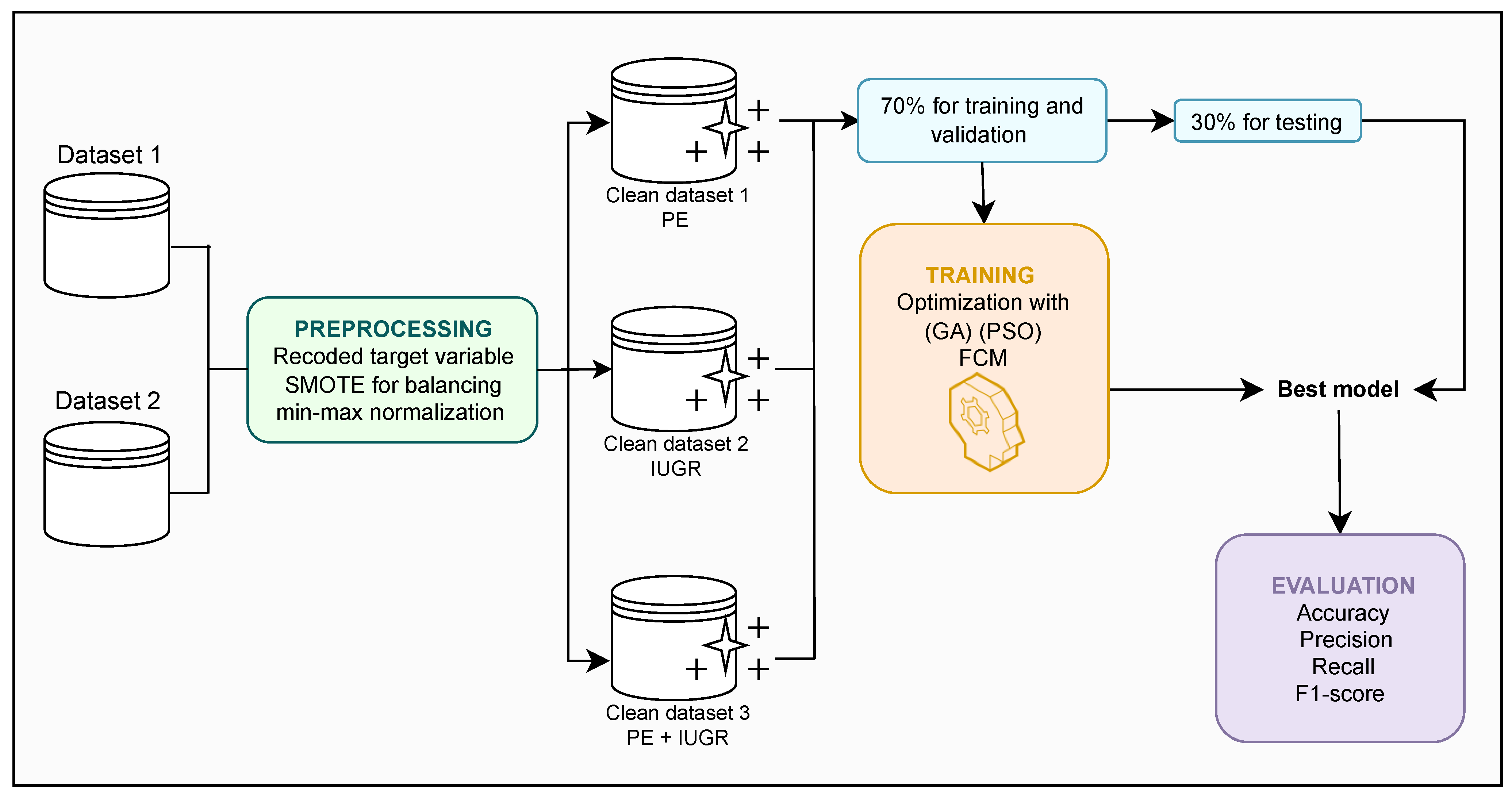
In this section, we describe the methodology used to implement FCM optimized with metaheuristic algorithms (see Figure 1). First, we describe the data sets and their preprocessing. Next, we present the modeling techniques and their experimental configuration. Finally, we describe the metrics used to evaluate the performance of the models.

3.1. Datasets

Three clinical datasets from public data were used to evaluate and construct FCM models optimized with metaheuristic algorithms to independently address the prediction of PE, IUGR, and PE + IUGR. The characteristics of each of these datasets are described below.

3.1.1. Description of Dataset 1

This dataset included pregnant women diagnosed with PE and control pregnant women from a prospective cohort study conducted at the University Medical Center Ljubljana, Slovenia [36]. The dataset included 51 women, of whom 22 had preeclampsia (PE) and 29 were in the control group.The output variable was C21 (see Table 1), corresponding to the binary diagnosis between normal status (0) and PE cases (1), to which class balancing was applied using the Synthetic Minority Over-Sampling Technique (SMOTE). Table 1 describes the variables used to construct the models, which include information on maternal and fetal characteristics, Doppler measurements of the uterine arteries, and biochemical marker results.

3.1.2. Description of Dataset 2

This dataset included pregnant women diagnosed with IUGR and control pregnant women from a retrospective study conducted at the Anhui Maternal and Child Health Care Hospital [37]. It included 72 women diagnosed with preeclampsia, of whom 77.8% developed IUGR. Pregnant women with pre-existing hypertension, previous diabetes mellitus, pre-gestational renal or hepatic disorders, thrombophilia, congenital anomalies, and rheumatic immune disease were excluded. The data were classified into maternal clinical parameters, demographic outcomes, and maternal and neonatal outcomes. The variable Antihypertensive treatment in hospital was eliminated because it had a constant value in all records. The output variable was C31, called “Fetal weight,” which represents the binary diagnosis between cases with normal fetal weight (0) and cases of IUGR (1). Class balancing was applied using SMOTE. Table 2 describes each of the variables used.

3.1.3. Description of the Dataset 3

This dataset included pregnant women with both clinical conditions (PE + IUGR) and healthy pregnant women from a prospective cohort study conducted at the University Medical Center Ljubljana, Slovenia [36]. The dataset included a total of 61 women, of whom 32 had PE + IUGR and 29 were in the control group. The output variable was C21, called diagnostic, which distinguishes between normal status (0) and combined cases of IUGR with PE (1). Table 1 shows the features included in this dataset to build the models.

3.2. Data Preprocessing

Before builiding the FCM models, we preprocessed the datasets to improve their quality. Initially, target variables such as PE and IUGR were recoded to binary variables (0 = control, 1 = presence of disease). Variables with constant values were removed from the dataset because they do not contribute to variability. In addition, variables not used for PE and IUGR analysis were removed from the dataset. Some variables with missing values were imputed using the arithmetic mean. Because the variables had different scales and to reduce model training times, we used min-max normalization to scale them between 0 and 1. Min-max normalization is expressed as follows:
X n = X i X min X max X min
where X n is the normalized value, X i is each value of variable X in the dataset, and X m a x and X m i n are the maximum and minimum values for variable X. Due to the relatively small size of the datasets and the imbalance between classes, we used the Synthetic Minority Oversampling Technique (SMOTE) to generate synthetic data with the same distribution as the original data using nearest neighbor interpolation to reduce the risk of overfitting and improve the representation of the minority class. This technique has proven useful in preventing classifiers from being biased toward the majority class and underestimating the minority class [38]. Additionally, the correct identification of women at higher risk for disease is clinically more relevant. The preprocessed datasets were divided into 70% for training and 30% for testing the FCM. To find the best model and avoid overfitting, we used 5-fold cross-validation.

3.3. Model Construction

In this section, we briefly show the basics of computational intelligence techniques used to build models to predict PE and IUGR.

3.3.1. Fuzzy Sets

Fuzzy sets are collections of data in which observations are not assigned to categories in a binary or crisp manner, but instead are represented through degrees of membership ranging between 0 and 1. This formalization allows us to model intermediate levels of membership and capture the imprecision of many linguistic descriptions and human mental representations [39].
Formally, a fuzzy set A defined over a universe X is characterized by a membership function f A : X [ 0 , 1 ] that assigns to each element x X a sense of belonging f A ( x ) ; the closer to 1 its f A ( x ) , the greater the degree to which x belongs to set A [40]. The clinical variables used in this study correspond to binary data (0/1). However, these values act solely as initial conditions. During the iterative dynamics of the FCM model, the values are transformed into fuzzy activation levels within the interval [0, 1] using the activation function. And the learned relationships between concepts are represented by continuous weights in the range [ 1 ,   1 ] , thus operating within the fuzzy domain.

3.3.2. FCM

FCM are a mathematical tool used to describe how causes and effects are related in complex systems [41]. They are composed of concepts or nodes, which represent the key elements of the system, and edges, which quantify the magnitude and direction of the influence between nodes. Each relationship can take on a value between [−1, 1]. A value of 0 indicates the absence of a relationship, positive values represent a direct or activating influence, and relationships with negative numbers reflect an inhibitory or opposite effect [42]. FCM are usually represented as a graph composed of nodes and weights, expressed as G = C , W , where C = C 1 , C 2 , , C n , is the list of concepts that make up the system, and W R n × n is a weight matrix that collects the intensity and type of relationship that exists between these concepts. To determine the value of a concept over time, the following is used:
C i t + 1 = f C i t + j i C j t · W j i
where W j i indicates how much the concept C j influences C i and f is an activation function that normalizes the concept values in a defined range. Through this structure, the FCM converts the initial binary values into fuzzy activations and allows the relative contribution of each concept to be identified in relation to the other concepts in the FCM.

3.3.3. FCM-PSO

PSO is a population optimization technique that simulates the collective behavior of gregarious organisms. Its objective is to find solutions by iteratively optimizing a set of particles adjusted according to their historical and global experience [43].
Algorithm 1 describe the process that performs automatic training of weights in FCM using PSO for prediction [44]. This combination has been effective in healthcare, since an FCM-based model allows optimization with real patient data [45]. In this way, FCM are shown as a matrix of weights W, where PSO, through iterative optimization, finds the matrix W that maximizes the performance of the system, generally measured by a fitness function, such as classification accuracy around a real clinical set [46]. As shown in Algorithm 1, the process begins by defining the model’s hyperparameters: the number of concepts n, population size N, number of iterations T, cognitive coefficient c 1 and the social coefficient c 2 . Based on the above, n x n matrices W i (one for each particle) are randomly initialized, along with their velocities v i . Each particle is evaluated using the fitness function, which for this medical application includes accuracy metrics. The particles update their velocity using the traditional PSO formula:
v i v i + c 1 · rand ( ) · W i b e s t W i + c 2 · rand ( ) · W W i
Algorithm 1: FCM-PSO
 
Require: Clinical dataset D, number of concepts n, population size N, maximum iterations T
 
Ensure: Optimized FCM weight matrix w∗∗
 1:
d i m n × n
 2:
Initialize particle positions P = { w 1 , w 2 , , w N } with random matrices of shape ( n × n )
 3:
Initialize velocities V = { v 1 , v 2 , , v N } with random values
 4:
for each particle i do
 5:
   Set personal best w i b e s t w i
 6:
   Evaluate fitness of w i using F C M ( D )
 7:
end for
 8:
Set global best w arg max i f i t n e s s ( w i )
 9:
for   t 1 to T do
10:
   for each particle i P  do
11:
     Update velocity:
v i ω · v i + c 1 · r a n d ( ) · ( w i b e s t w i ) + c 2 · r a n d ( ) · ( w w i )
12:
     Update position:
w i w i + v i
13:
     Evaluate fitness of w i using F C M ( D )
14:
     if  f i t n e s s ( w i ) > f i t n e s s ( w i b e s t )  then
15:
         w i b e s t w i
16:
     end if
17:
     if  f i t n e s s ( w i ) > f i t n e s s ( w )  then
18:
         w w i
19:
     end if
20:
   end for
21:
end for
22:
return  w
    This formula establishes the balance between exploring the search space, represented by the particle’s inertia component, and exploiting the knowledge stored in each particle’s personal memory and in the global best solution. Convergence is improved through this mechanism, which is more dynamic towards optimal solutions. Each particle then updates its location using W i W i + v i , reevaluating its performance and selecting the best values. The cycle begins in the input block where the key parameters are defined. From there, an arrow leads to the initialization block, where the weight and random velocity matrices are generated for each of the particles. Subsequently, the best global result is calculated, giving way to the iterative cycle represented in the optimization block, which contains the sub-blocks that express the internal steps of the algorithm, where the following are found: speed and position updates and evaluation of personal and global improvements. The arrows indicate the internal logic of the sequential steps of PSO. At the end of the number of iterations, the algorithm leads to the output block, which delivers the optimized weight matrix, and finally to the result block, indicating that the FCM has reached its best solution. The hyperparameters were evaluated for the three data sets PE, IUGR, and PE + IUGR. The configuration used to construct the models can be seen in Table 3. To find the best model and avoid overfitting, we used 5-fold cross-validation.

3.4. FCM-GA

Genetic algorithms (GA) are metaheuristic optimization techniques whose objective is to find potential random solutions through selection, crossover, and mutation mechanisms [47]. These algorithms operate through cyclical processes that simulate the biological evolution of a population, called an individual or chromosome [48]. The application of GA to train an FCM is highly advantageous because it allows high-dimensional search spaces to present experimental results that demonstrate good performance, reducing the risk of converging on local optimal solutions [49]. The chromosomal representation in FCM-GA can be formulated in a simplified form as:
W 11 , W 12 , W 13 , W 21 , W 22 , W 23 , W 31 , W 32 , W 33 , , W n n
This encoding allows GA to work directly on the FCM weight matrix, considering that w j i { 1 , 1 } corresponds to the weight of a connection between two concepts on the map and is organized in the form of a linear vector, in order to optimize its processing during the evolutionary process.
Algorithm 2 describes the process of optimizing FCM weights using GA. First, the initial population W = W 1 , W 2 , , W n is defined as a set of weight matrices whose values are randomly generated in the interval [−1, 1]. In each iteration, the fitness of the individual is calculated using a fitness function. Individuals with the highest fitness value are selected probabilistically to apply genetic functions: crossover (p-c) and mutation (p-m), which allow the search space to be explored. The population is updated by replacing the lowest-performing population with the new offspring. The iterative process stops when the maximum number of generations is reached or when the fitness value exceeds the established threshold.The algorithm returns the optimal weight matrix W, which represents the final weight configuration of the FCM. In our case, the fitness function is accuracy represented as follows:
F i t n e s s = A c c u r a c y ( W ; D )
Algorithm 2: FCM-GA
 1:
Input: Population size N, maximum generations G m a x , crossover probability P c , mutation probability P m , training data, test data
 2:
Output: Best weight matrix W
 3:
Initialize population P = { W 1 , W 2 , , W N } with random weight matrices
 4:
g 0
 5:
while stopping criterion not met do
 6:
   for each individual W i in P  do
 7:
     Evaluate fitness: f ( W i ) = Accuracy ( W i , test data )
 8:
   end for
 9:
   Select parents using tournament selection
10:
    P new
11:
   while  | P new | < N  do
12:
     Select two parents W p 1 , W p 2
13:
     if random() < P c  then
14:
        Apply Simulated Binary Crossover (SBX) to W p 1 , W p 2 to produce offspring W c 1 , W c 2
15:
     else
16:
         W c 1 W p 1 , W c 2 W p 2
17:
     end if
18:
     for each offspring W c j  do
19:
        for each gene w in W c j  do
20:
          if random() < P m  then
21:
             Apply Polynomial Mutation to w
22:
          end if
23:
        end for
24:
        Add W c j to P new
25:
     end for
26:
   end while
27:
    P P new
28:
    g g + 1
29:
   if  | Accuracy ( g ) Accuracy ( g 1 ) | < 0.001  then
30:
     break
31:
   end if
32:
end while
33:
W arg max W i P f ( W i )
Then, the best-performing individuals are selected and combined in the crossover stage to generate new offspring. Mutation is performed after crossover, and its main function is to introduce random variations in the genes (FCM weights). Based on the results obtained, the previous population is replaced, and the process is repeated iteratively until the optimal solution of the model is reached [50]. The configuration of the hyperparameters for the construction of this model can be seen in Table 4. To find the best model and avoid overfitting, we used 5-fold cross-validation.

3.5. Evaluation Metrics

The predictive performance of the models was evaluated using the following metrics: accuracy, precision, recall, and F1-score.

3.5.1. Accuracy

The proportion of cases that the model classified correctly compared to the total number of cases evaluated. It is expressed as a percentage or as a value between 0 and 1.
Accuracy = T P + T N T P + T N + F P + F N
where T P are true positives, T N are true negatives, F N are false negatives, and F P are false positives.

3.5.2. Precision

Proportion of true positives among the total number of predictions that the model has classified as positive.
Precision = T P T P + F P

3.5.3. Recall

Proportion of true positives correctly classified among the total number of cases that are actually positive.
Recall = T P T P + F N

3.5.4. F1-Score

A measure of a model’s accuracy, combining the values resulting from Precision and Recall.
F 1 = 2 · Precision · Recall Precision + Recall

4. Results and Discussion

4.1. Predictive Performance of the Developed Models

In this subsection, we describe the results of the models based on FCM optimized with PSO and GA. Table 5 shows the predictive performance results of the best models developed for predicting PE, IUGR, and PE + IUGR. Below, we show and discuss the results for each entity.

4.1.1. Predictive Performance of the Models for PE

The models evaluated in the dataset for PE prediction (dataset 1) achieved excellent performance (100%), demonstrating the ability to correctly classify positive and negative cases. Both the FCM-PSO and FCM-GA models achieved equal values in the metrics, but the differences lie in the analysis of their computational efficiency. The FCM-PSO model achieved convergence with a smaller population (54 individuals) and fewer iterations (64), whereas FCM-GA required a population of 83 and 120 iterations.
This reflects the ability of PSO to efficiently explore the search space, avoiding overfitting and achieving global solutions with less computational overhead. This is consistent with the findings of Papazoglou and Biskas [51], who compared PSO and GA, demonstrating that although GA offers a slight advantage in performance, PSO involves less computational overhead. Another study [52] that compared both algorithms concluded that PSO is superior in terms of complexity, accuracy, iteration, and simplicity in finding the optimal solution. Therefore, the FCM-PSO model represents a viable alternative in clinical scenarios where resource efficiency is a key factor in medical decision-making.

4.1.2. Predictive Performance of Models for IUGR

The models evaluated in the prediction of IUGR (dataset 2) showed high performance, although it was slightly lower than that observed in PE. The FCM-PSO model achieved an accuracy of 96%, a precision of 95%, a recall of 97%, and an F1-score of 96%, while the FCM-GA model obtained results of 97% in all metrics. Taking into account the selection criteria, initially evaluating the metrics and subsequently the computational cost, FCM-GA is considered the most robust for IUGR prediction.
These results can be explained by the nature of GA, which explore search spaces through selection, crossover, and mutation mechanisms [53], allowing them to identify complex relationships, but they are accompanied by a greater demand for computational resources. The improvement in the performance of this model was obtained with a greater number of iterations (120). In contrast, PSO generates a balance guided by the exchange of information between particles [43], which favors earlier convergence, achieving a faster solution with 74 iterations and 196 individuals, although with a slight loss of accuracy and precision.
In addition, the dataset for IUGR prediction is more complex, including a total of 31 nodes, which increases the magnitude of the problem and requires greater computational effort to adjust the weights and capture the relationships between nodes. From a clinical point of view, predicting IUGR becomes a challenge due to its multifactorial pathophysiology [21], which may require additional iterations to capture the relationships between each of the variables. Finally, although both models are competitive, FCM-GA stands out for its better overall performance.

4.1.3. Predictive Performance of Models for PE + IUGR

In the last dataset, which combines the clinical conditions PE + IUGR (dataset 3), both models achieved metrics with 100% performance. However, the best model is FCM-PSO, because its configuration required 24 iterations and a population of 36 individuals, unlike FCM-GA, which required 120 iterations and a smaller population (24 individuals). Therefore, FCM-PSO stands out for achieving the same results as GA but with less computational load, making it the right choice for clinical scenarios that require rapid diagnosis. This demonstrates once again that PSO is capable of obtaining the same results as GA, but with lower computational costs [51]. These results demonstrate the ability of FCM to capture the complex relationships in the two pathologies, which is clinically relevant because early and accurate identification of cases in which PE and IUGR coexist is critical for guiding rapid therapeutic decisions.

4.2. Analysis of the Relationships of the Best FCM Model in Each Dataset

4.2.1. FCM-PSO Relationships in the Prediction of PE

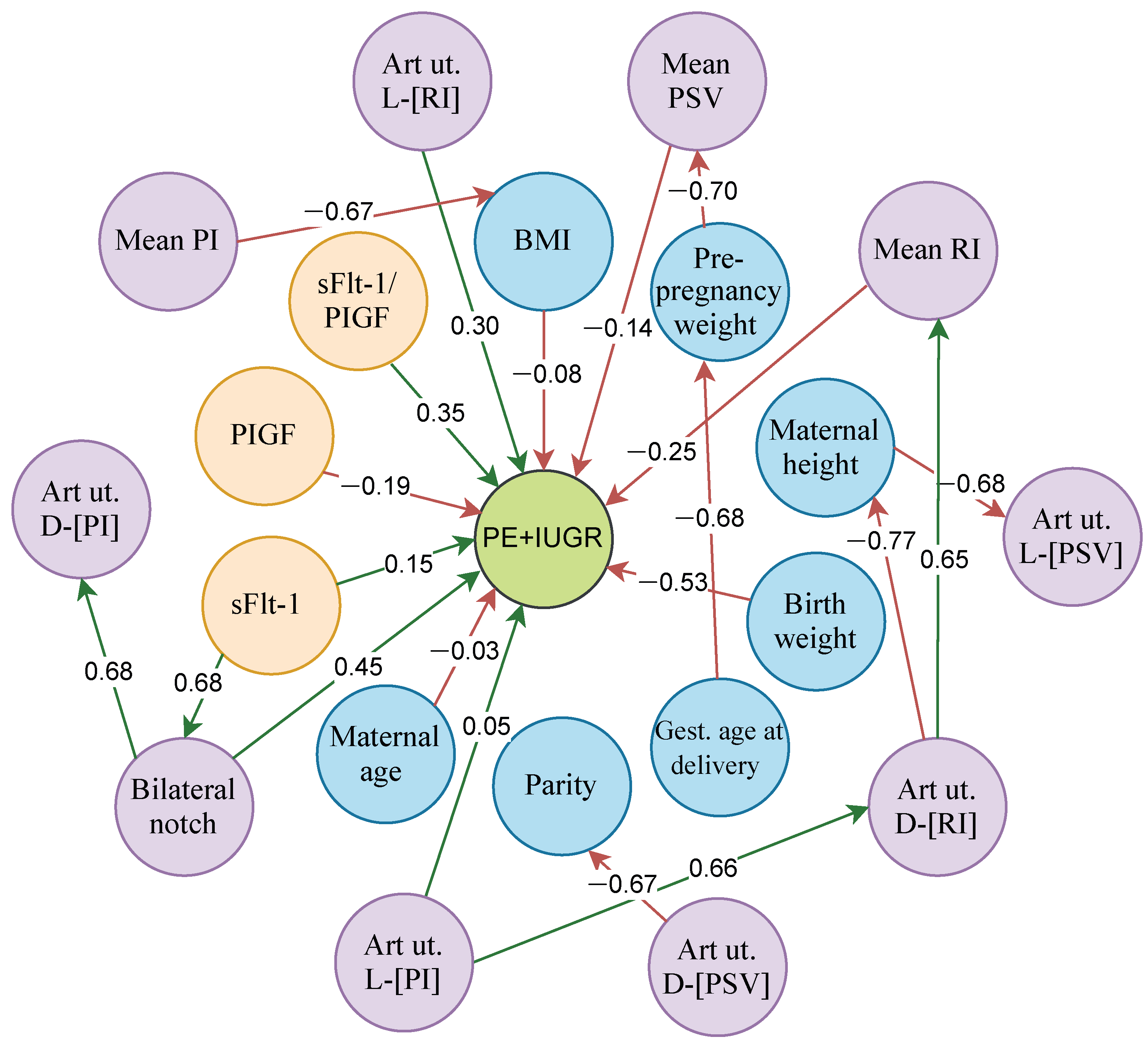
The FCM results show a network of interactions between variables, where the weight indicates the strength of the relationships and the signs determine the activating or inhibiting nature within the system. In order to better understand the relationships between the variables and the development of clinical conditions, a simplified visual graph was designed to facilitate the interpretation of the predominant causal concepts. To this end, all direct relationships to PE were selected, and for the rest of the variables, a weight threshold of ≥0.70 was established, including positive and negative values. This value was defined to highlight the strongest and most clinically relevant connections, minimizing relationships with lower magnitude that could have a significantly lower impact on PE activation.
Figure 2 shows the design of the FCM optimized with PSO, which prioritizes interactions with higher weights representing predictive causal links, where blue circles indicate maternal and fetal characteristics, orange circles are biochemical markers, and purple circles are characteristics of uterine Doppler ultrasound. In addition, the green lines represent relationships with activating influence and the red lines represent inhibitory relationships. Overall, the FCM-PSO model allows the functionality of the system to be described by representing the concepts and their relationships, making visible how the process towards PE prediction is organized. When analyzing the relationships, it was identified that the sFlt-1/PlGF node (−0.70) acted as the factor with the greatest inhibitory influence, followed by BMI (−0.68) and maternal height (−0.64). On the other hand, the sFlt-1 marker (0.65) showed an activating influence. This behavior could be explained by considering that PlGF, produced by the syncytiotrophoblast, promotes angiogenesis and vascular homeostasis, while sFlt-1 is a protein that antagonizes PlGF and vascular endothelial growth factor in circulation, leading to endothelial dysfunction. sFlt-1 is released from the trophoblast in response to various triggers, such as hypoxia and oxidative stress [54,55]. In placental dysfunction, lower levels of PlGF and higher levels of sFlt-1 are observed, and their increase has been associated with hypertensive disorders, as well as with their severity [56].
This phenomenon coincides with the positive weight found in this study, indicating its direct association with an increased risk of PE. However, the negative weight in the sFlt-1/PlGF ratio could be related to a pathophysiological pattern, where interactions with other variables modulate its effect on prediction. Both BMI and maternal height, contrary to what is reported in the literature, which indicates that they are strong influencers in the development of the disease [57,58], resulted in negative weights, acting as inhibitors, which could be related to the characteristics of the population, where other types of variables were more important in the activation of PE. Some variables had no direct influence on the development of the disease, obtaining a weight equal to 0, such as Art ut. D-resistance index [RI], Art ut. L-pulsatility index [PI], Mean PSV, Bilateral notch, gestational age at delivery, birth weight, and PIGF. This indicates that within the model, these variables did not make a significant contribution to the prediction of the outcome. Studies have reported that the role of uterine artery Doppler ultrasound in predicting PE is still unclear. For example, in a meta-analysis [59], it was shown that the RI had a sensitivity of 73% and a specificity of 90%, while the PI had a sensitivity of 65% and a specificity of 88%. However, they conclude that there is high variability in the predictive performance of the indices, which could be influenced by the fact that the quality of the measurement depends on the experience of the operator and the standardization of the equipment.
Obican et al. [60] reported that the predictive value of Doppler indices for adverse pregnancy and neonatal outcomes was moderate. A review of the literature [61] concluded that uterine artery Doppler as a single predictor detects less than 50% of PE cases and no more than 40% of pregnancies with IUGR. As for the bilateral notch result, its performance is comparable to that reported in the previous meta-analysis, which indicated that this variable has relatively low sensitivity [59].

4.2.2. Relationships of FCM-GA in the Prediction of IUGR

The results of the FCM-GA model allowed us to identify various relationships that influence the prediction of the disease. Because the dataset consisted of 30 predictor variables and one class (IUGR), the visual graph was not simplified, as the complexity inherent in the number of nodes made the graphical representation dense. However, the analysis identified the most relevant connections for understanding the behavior of the model. Among the factors related to IUGR, Mode of delivery (0.97) stood out as a highly influential node, which could be interpreted as an indirect marker, because severe cases of IUGR often result in premature births or emergency cesarean sections. Wilk et al. [62] reported a higher risk of cesarean section in pregnancies complicated by IUGR compared to uncomplicated pregnancies (33.2% vs. 21.7%, respectively). Other studies describe increased frequencies of cesarean sections in pregnant women with IUGR, with figures of up to 38.4% [63]. In women with late IUGR (30%), a higher percentage of cesarean sections was observed than in women with appropriate weight for gestational age (p < 0.05) [64]. Creatinine (0.75) and 24-h proteinuria (−0.73) reflected the relevance of renal involvement associated with hypertensive disorders of pregnancy, in which endothelial dysfunction and glomerular damage alter filtration and protein balance, phenomena described in the pathophysiology of PE and IUGR [6]. High levels of protein in 24-h urine (proteinuria), especially when combined with <300 mg/day of protein or a high protein/creatinine ratio, may indicate preeclampsia and a risk of complications such as IUGR [65]. Another relevant relationship is the negative influence of gestational age until the onset of initial symptoms (−0.69), which could suggest that early manifestation of clinical signs increases the likelihood of an adverse outcome. This is consistent with research indicating that early presentation of hypertension, proteinuria, or edema is closely linked to more severe forms of IUGR, reflecting more profound and persistent placental dysfunction [66,67]. Unlike datasets 1 and 3, in this dataset, strong relationships developed between nodes, for example, between antihypertensive therapy and the interval from the onset of hypertension to delivery (−0.99), which could reflect the ability of pharmacological intervention to modify the course of the disease. On the other hand, the relationship between elevated diastolic pressure and BNP (B-type natriuretic peptide) (−0.99), similar to that reported in the literature, shows that severe hemodynamic compromise can alter the secretion of natriuretic peptides, markers of cardiac overload and vascular stress [68]. From the logic of FCM, the relationships do not represent strict causality, but rather an influence on the activation of IUGR. Therefore, when the diastolic pressure node increases, the BNP node decreases in its activation within the model, which could reflect that these variables do not act in parallel but in different pathophysiological trajectories. Finally, highly significant positive relationships, such as elevated systolic pressure with gestational age at the onset of proteinuria (0.98) and history of delivery with elevated systolic pressure (0.98), highlight pathophysiological interactions between hemodynamic factors and obstetric characteristics, indicating that the presence of hypertension can lead to renal alterations and the development of IUGR.

4.2.3. Relationships of FCM-PSO in the Prediction of PE + IUGR

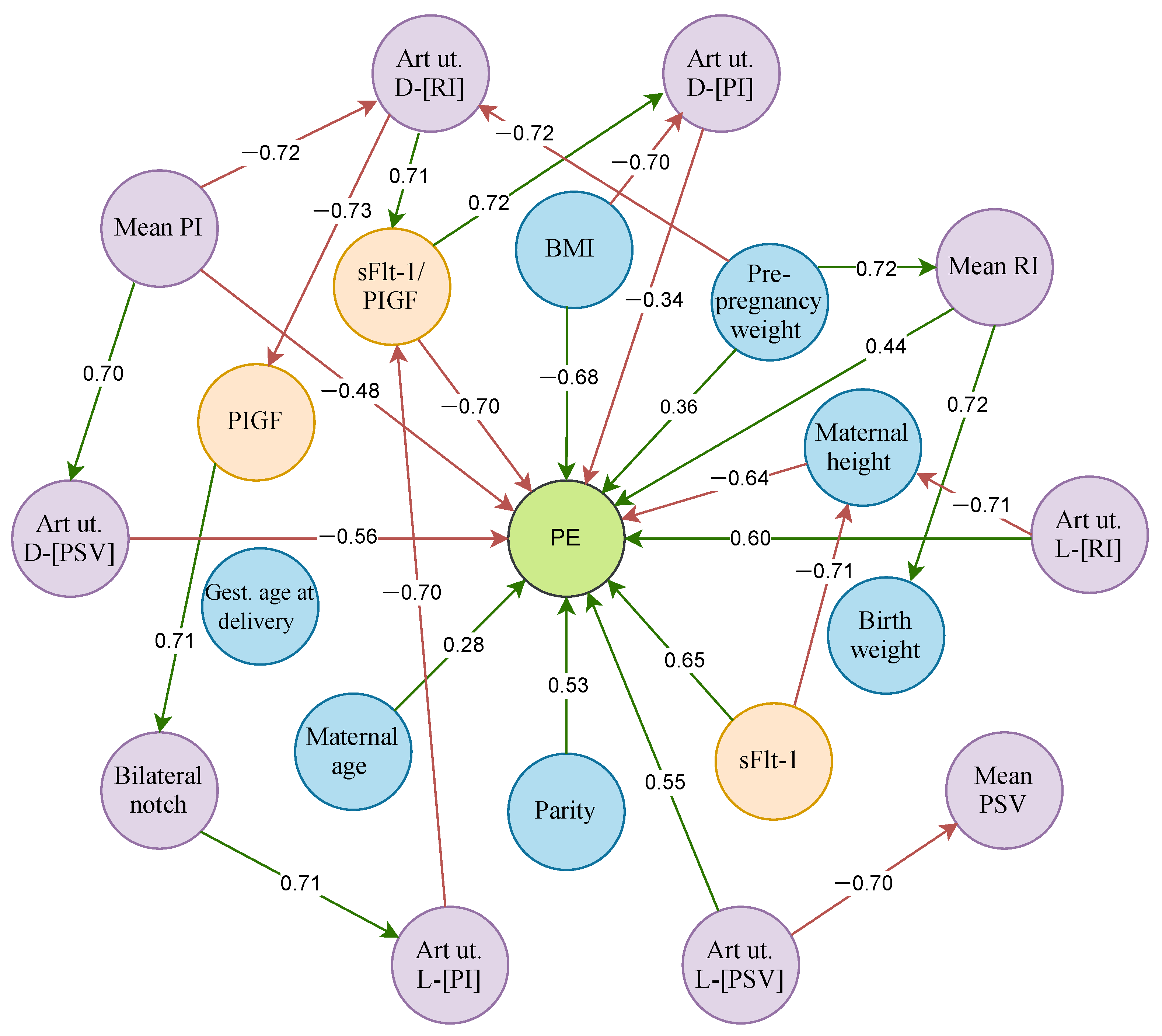
Figure 3 shows the main relationships in the FCM optimized with PSO to predict PE + IUGR. In the analysis of the most influential relationships in the prediction of PE + IUGR, the values of sFlt-1/PlGF (0.35), Bilateral notch (0.45), and Birth weight (−0.53) were found. The presence of a positive weight in the sFlt-1/PlGF ratio reflects its activating role in predicting placental complications, consistent with its value as an angiogenic biomarker in complicated pregnancies [56]. Bilateral notch was the most influential positive relationship on the PE + IUGR node, unlike the PE model where it did not play a relevant role, obtaining a weight of 0. In isolated preeclampsia, angiogenic factors predominated in the prediction, while, when IUGR was included, the hemodynamic alterations captured by Doppler became more relevant because they reflect the uteroplacental vascular resistance associated with compromised fetal growth [69]. Therefore, bilateral notch acts as a complementary ultrasound marker, although limited as a single predictor of PE [59], it becomes more important in scenarios where phenomena of decreased placental perfusion coexist.
A complementary situation occurs with the peripheral relationships of the FCM-PSO, which correspond to the characteristics of uterine Doppler, where the strong interconnection between these variables (both positive and negative) is consistent with the physiological nature of the phenomenon, given that the resistance and pulsatility indices of the uterine arteries are highly correlated with each other and capture different facets of the same hemodynamic alteration [69]. Finally, the presence of multiple variables with zero weight toward the central node, such as Mean PI, Uterine Artery D-(PI), Parity, Uterine Artery D-(PSV), Gestational Age at Delivery, Uterine Artery D-(RI), Maternal Height, Uterine Artery L-(PSV), and Pre-Pregnancy Weight. suggests that, in this model, these variables do not contribute direct predictive value for PE + IUGR, which may be due to redundancy of information between Doppler markers or their low discriminatory power in this dataset. However, their permanence within the graph ensures that they continue to contribute indirectly to the organization of information in the model.

4.3. Comparison with Other ML Models

The development of models for predicting PE and IUGR has been challenging due to the complexity of the pathogenesis of these diseases, which involve various factors and whose origin is sometimes unknown. Classic screening programs, based on clinical practice guidelines and using only maternal risk factors, have shown limitations in predictive performance, yet they are still used in areas with limited financial resources [70]. The parameters traditionally associated with an increased risk of developing PE are a history of preeclampsia, chronic kidney disease, hypertension, diabetes, autoimmune disorders such as systemic lupus erythematosus and antiphospholipid syndrome, advanced maternal age, and a body mass index greater than 35 kg/m2 [21]. New factors of interest have been added to these classic predictors, including Doppler parameters and biochemical markers, which have been shown to be significantly associated with the development of PE [25].
Table 6 shows the comparison between our results and the works reported in the literature. Different explainable artificial intelligence (XAI) and ML strategies have shown variable performance in predicting PE. Salinas et al. [71] developed a fuzzy logic-based model (SK-MOEES) that achieved 91% accuracy using GA for fuzzy rule reduction. Despite its performance, the model had the limitation of not generating predictions in some cases due to the absence of active rules for input combinations, which limits its applicability in broader clinical contexts. This reflects a poorly explored search space, in contrast to the proposed model, which ensures a more comprehensive exploration thanks to the behavior of the particle swarm. PSO has been recognized for its efficient convergence capacity and lower risk of getting stuck in local optima. This dynamic allows for finding weight configurations that enhance the relationship between nodes and increase predictive performance [45]. The study by [46] demonstrated that the FCM-PSO combination is an alternative to manual parameter adjustment, as it integrates the causal structure of FCM with the optimization capacity of the particle swarm. This approach improves predictive performance and, over T iterations, allows for a process of progressive convergence towards more stable solutions.
Pham et al. [76] constructed a model based on fuzzy knowledge graphs (FKG), which includes 19 variables, classified into clinical characteristics and routine laboratory tests for the diagnosis of PE signs. The model works as an application where the results of pregnant women are entered and, finally, a result is obtained that shows the diagnosis and recommendations. Although the model achieved an accuracy of 89.74%, its implementation could be costly for the physician, as it requires the manual entry of the 19 parameters and increases the risk of errors. It is proposed as a medical decision support system, but it does not allow for analysis of how the results are obtained or the variables that most influence the prediction.
Liu et al. [72] used five ML algorithms such as deep neural networks (DNN), LR, SVM, DT, and RF, including 18 variables of maternal characteristics, medical history, laboratory results, and ultrasounds. The best model was RF; however, it does not mention the variables that impact the classification of PE. These algorithms tend to behave like black boxes, and the authors did not use model explainability strategies, thus limiting their clinical utility because they do not allow us to understand how the variables are articulated in the prediction of the disease.
Vasilache et al. [73] developed four ML algorithms for predicting PE, IUGR, and their association (DT, NB, SVM, and RF) using clinical and paraclinical data. All algorithms performed modestly in predicting the PE + IUGR association, with NB and RF achieving the best accuracies (95.1%). For PE prediction, RF obtained the best results with an accuracy of 96.3%. Despite the good performance, the results do not explicitly demonstrate the modeling of causal relationships.
It is evident that the methodological strategy and data preprocessing influence the performance of the models. Gómez-Jemes et al. [74] implemented a multi-label classification approach using decision trees to predict four categories: PE, IUGR, both disorders, or no disease. The model achieved 78% accuracy and determined that the absence of a notch on Doppler was the most important characteristic, followed by S-Flt1 and the sFlt-1/PlGF ratio.
Sufriyana et al. [75] developed ML models for predicting PE and IUGR. The best approach was classification using regression (CVR), achieving an accuracy of 90.6%. The most influential characteristics were maternal weight, BMI, UtA pulsatility index, sFlt-1, and PlGF. However, a relevant methodological limitation was the inability to distinguish between PE and IUGR as independent entities, which compromises its clinical applicability by not differentiating conditions that, despite having a common pathophysiology, have different prognostic trajectories.
Hoyos et al. [34] developed an optimized FCM with PSO, using a multi-stage training methodology to reflect the biological progression of the disease. They used two data sets to predict PE and IUGR, obtaining accuracies of 82% and 98%, respectively. With regard to PE, the variables that had the greatest influence were Left RI-UtA, sFlt-1, Bilateral notch, Weight before pregnancy, and Mean RI-UtA, which reinforces the ability of FCM models to capture complex interactions with different clinical parameters. While regression models and decision trees offer competitive metrics, FCM models in both Hoyos et al. [34] and our study model feedback and nonlinearities characteristic of placental pathophysiology.
From a practical perspective, the use of FCM in clinical settings would provide a significant advantage, since the visual representation of interactions between variables allows healthcare professionals to understand how each factor contributes to disease risk. For example, caring for a pregnant woman initially classified as low risk but with a possibility of prediction given by the model’s interpretations would improve PE risk classification. These FCM can support actions such as modifying the frequency of prenatal checkups, closely monitoring fetal growth, or establishing priority criteria for hospital care, which would allow for more intensive monitoring of pregnant women. Therefore, combining the experience of health professionals with computational support would help improve risk stratification and support decision-making, reinforcing its applicability, especially in areas with limited computational resources. In addition, by allowing health personnel to understand the relationship between concepts and risk, it generates greater confidence and clinical integration of the models. This positions optimized FCM as a robust, interpretable, and adaptive alternative, especially in contexts where model transparency is essential, such as in the field of maternal health. By guiding parameter selection through visual and performance-based analysis, it facilitates the development of decision support tools that conform to clinical reasoning standards.
Finally, this study has some limitations, mainly due to the sample size. Although the amount of data generated in the field of health is large, access to information can be complicated due to access and approval by health institutions, which face challenges in terms of integrity, ethics, and privacy, and the availability of public datasets is still limited. In addition, external validation is necessary in order to extrapolate and generalize the results, using data from more diverse populations. Furthermore, its important to note that the clinical interpretation of the weights and influences generated by the models should be carried out with caution. Due to the small sample sizes and the use of techniques such as SMOTE, some values may reflect patterns inherent to the training process. Therefore, the weights obtained should not be assumed to be evidence of causality or direct representations of clinical dynamics, but rather mathematical approximations that require further validation with larger and more diverse populations. Future work should employ a greater number of sociodemographic variables, including the participation of experts in the field, and move toward implementation in healthcare institutions where models can be integrated in real time with the creation of medical records and allow professionals to be part of the process, in order to establish concrete relationships between human knowledge and the development of models to support clinical decisions.

5. Conclusions

In this work, we developed FCM-based models optimized with PSO and GA to predict PE and IUGR. The developed models showed excellent performance, reaching values of 1.0 in the prediction of PE and PE + IUGR, and 0.97 in the prediction of IUGR, which evidences their robustness and clinical potential. The performance of our models was superior to those reported in the literature. The results of this study highlight the need to continue evaluating the performance of the models in larger populations, at different stages of pregnancy, and in interaction with other risk factors. The approach based on optimized FCM offers a power of discrimination comparable to that of other methods, while providing native transparency and avoiding dependence on interpretation techniques. Additionally, FCM provides a valuable visual and analytical tool for studying the underlying causal mechanisms of preeclampsia and fetal growth restriction. The ability to identify key nodes and significant relationships through this approach represents a breakthrough in the integration of computational intelligence with clinical knowledge, providing a promising avenue for improving risk stratification and decision-making in maternal health. The models obtained demonstrate competitive performance in the classification of PE and IUGR cases, prioritizing interpretability and clinical relevance, which supports their implementation in clinical settings, where the identification of true cases is a priority.

Author Contributions

Conceptualization, M.P.G., J.D.D.-M. and W.H.; methodology, M.P.G., J.D.D.-M. and W.H.; software, M.P.G. and J.D.D.-M.; validation, M.P.G., J.D.D.-M., K.H., B.P. and W.H.; formal analysis, M.P.G., J.D.D.-M., K.H., B.P. and W.H.; investigation, M.P.G., J.D.D.-M., K.H., B.P., R.G. and W.H.; resources, M.P.G., J.D.D.-M., K.H., B.P., R.G. and W.H.; data curation, M.P.G., J.D.D.-M., K.H., B.P. and W.H.; writing—original draft preparation, M.P.G., J.D.D.-M., K.H., B.P.; writing—review and editing, M.P.G., J.D.D.-M., K.H., B.P., R.G. and W.H.; visualization, M.P.G., J.D.D.-M., K.H., and B.P.; supervision, R.G. and W.H.; project administration, R.G. and W.H.; funding acquisition, R.G. All authors have read and agreed to the published version of the manuscript.

Funding

This research received no external funding.

Institutional Review Board Statement

Not applicable.

Informed Consent Statement

Not applicable.

Data Availability Statement

The datasets used in this study have different levels of availability. The datasets 1 and 3 are publicly accessible and available at https://doi.org/10.17632/zsjhvy9ytx.1. (Accessed on 23 July 2024). The dataset 2 is not available in open repositories, so it was obtained by direct request to the corresponding author due to privacy, legal, or ethical reasons.

Acknowledgments

The authors would like to thank Universidad Cooperativa de Colombia (Grants INV3517-INV3569) and Universidad del Sinú for their support during the research.

Conflicts of Interest

The authors declare no conflict of interest.

References

  1. Umapathy, A.; Chamley, L.W.; James, J.L. Reconciling the distinct roles of angiogenic/anti-angiogenic factors in the placenta and maternal circulation of normal and pathological pregnancies. Angiogenesis 2020, 23, 105–117. [Google Scholar] [CrossRef] [PubMed]
  2. Herraiz, I.; Llurba, E.; Verlohren, S.; Galindo, A.; on behalf of the Spanish Group for the Study of Angiogenic Markers in Preeclampsia. Update on the Diagnosis and Prognosis of Preeclampsia with the Aid of the sFlt-1/PlGF Ratio in Singleton Pregnancies. Fetal Diagn. Ther. 2018, 43, 81–89. [Google Scholar] [CrossRef]
  3. Ramirez Zegarra, R.; Ghi, T.; Lees, C. Does the use of angiogenic biomarkers for the management of preeclampsia and fetal growth restriction improve outcomes?: Challenging the current status quo. Eur. J. Obstet. Gynecol. Reprod. Biol. 2024, 300, 268–277. [Google Scholar] [CrossRef]
  4. Anderson, U.; Olsson, M.; Kristensen, K.; Åkerström, B.; Hansson, S. Review: Biochemical markers to predict preeclampsia. Placenta 2012, 33, S42–S47. [Google Scholar] [CrossRef]
  5. Schoots, M.H.; Bourgonje, M.F.; Bourgonje, A.R.; Prins, J.R.; Van Hoorn, E.G.; Abdulle, A.E.; Muller Kobold, A.C.; Van Der Heide, M.; Hillebrands, J.L.; Van Goor, H.; et al. Oxidative stress biomarkers in fetal growth restriction with and without preeclampsia. Placenta 2021, 115, 87–96. [Google Scholar] [CrossRef]
  6. Tomimatsu, T.; Mimura, K.; Matsuzaki, S.; Endo, M.; Kumasawa, K.; Kimura, T. Preeclampsia: Maternal Systemic Vascular Disorder Caused by Generalized Endothelial Dysfunction Due to Placental Antiangiogenic Factors. Int. J. Mol. Sci. 2019, 20, 4246. [Google Scholar] [CrossRef]
  7. Brouwers, L.; De Gier, S.; Vogelvang, T.E.; Veerbeek, J.H.; Franx, A.; Van Rijn, B.B.; Nikkels, P.G. Prevalence of placental bed spiral artery pathology in preeclampsia and fetal growth restriction: A prospective cohort study. Placenta 2024, 156, 1–9. [Google Scholar] [CrossRef] [PubMed]
  8. ACOG. Fetal Growth Restriction: ACOG Practice Bulletin, Number 227. Obstet. Gynecol. 2021, 137, e16–e28. [Google Scholar] [CrossRef]
  9. Braga, A.; Neves, E.; Guimarães, J.; Braga, J.; Vasconcelos, C. Th17 / Treg ratio: A prospective study in a group of pregnant women with preeclampsia and fetal growth restriction. J. Reprod. Immunol. 2023, 159, 104122. [Google Scholar] [CrossRef]
  10. Mathew, R.; Devanesan, B.P.; Srijana; Sreedevi, N. Prevalence of hypertensive disorders of pregnancy, associated factors and pregnancy complications in a primigravida population. Gynecol. Obstet. Clin. Med. 2023, 3, 119–123. [Google Scholar] [CrossRef]
  11. Gerovasili, E.; Sarantaki, A.; Bothou, A.; Deltsidou, A.; Dimitrakopoulou, A.; Diamanti, A. The role of vitamin D deficiency in placental dysfunction: A systematic review. Metab. Open 2025, 25, 100350. [Google Scholar] [CrossRef]
  12. Qi, J.; Wu, B.; Chen, X.; Wei, W.; Yao, X. Diagnostic biomolecules and combination therapy for pre-eclampsia. Reprod. Biol. Endocrinol. 2022, 20, 136. [Google Scholar] [CrossRef]
  13. Figueras, F.; Caradeux, J.; Crispi, F.; Eixarch, E.; Peguero, A.; Gratacos, E. Diagnosis and surveillance of late-onset fetal growth restriction. Am. J. Obstet. Gynecol. 2018, 218, S790–S802.e1. [Google Scholar] [CrossRef]
  14. Tomkiewicz, J.; Darmochwał-Kolarz, D.A. Biomarkers for Early Prediction and Management of Preeclampsia: A Comprehensive Review. Med. Sci. Monit. 2024, 30. [Google Scholar] [CrossRef]
  15. Özcan, M.; Peker, S. Preeclampsia prediction via machine learning: A systematic literature review. Health Syst. 2024, 14, 208–222. [Google Scholar] [CrossRef]
  16. Aljameel, S.S.; Alzahrani, M.; Almusharraf, R.; Altukhais, M.; Alshaia, S.; Sahlouli, H.; Aslam, N.; Khan, I.U.; Alabbad, D.A.; Alsumayt, A. Prediction of Preeclampsia Using Machine Learning and Deep Learning Models: A Review. Big Data Cogn. Comput. 2023, 7, 32. [Google Scholar] [CrossRef]
  17. Apostolopoulos, I.D.; Papandrianos, N.I.; Papathanasiou, N.D.; Papageorgiou, E.I. Fuzzy Cognitive Map Applications in Medicine over the Last Two Decades: A Review Study. Bioengineering 2024, 11, 139. [Google Scholar] [CrossRef] [PubMed]
  18. Tiruneh, S.A.; Vu, T.T.T.; Rolnik, D.L.; Teede, H.J.; Enticott, J. Machine Learning Algorithms Versus Classical Regression Models in Pre-Eclampsia Prediction: A Systematic Review. Curr. Hypertens. Rep. 2024, 26, 309–323. [Google Scholar] [CrossRef] [PubMed]
  19. Ranjbar, A.; Montazeri, F.; Ghamsari, S.R.; Mehrnoush, V.; Roozbeh, N.; Darsareh, F. Machine learning models for predicting preeclampsia: A systematic review. BMC Pregnancy Childbirth 2024, 24, 6. [Google Scholar] [CrossRef] [PubMed]
  20. NICE. Hypertension in pregnancy: Diagnosis and management. Hypertension in Pregnancy. 2019. Available online: https://www.nice.org.uk/guidance/ng133 (accessed on 23 July 2024).
  21. ACOG. Gestational Hypertension and Preeclampsia: ACOG Practice Bulletin, Number 222. Obstet. Gynecol. 2020, 135, e237–e260. [Google Scholar] [CrossRef]
  22. Feng, W.; Luo, Y. Preeclampsia and its prediction: Traditional versus contemporary predictive methods. J.-Matern.-Fetal Neonatal Med. 2024, 37, 2388171. [Google Scholar] [CrossRef]
  23. Malik, V.; Agrawal, N.; Prasad, S.; Talwar, S.; Khatuja, R.; Jain, S.; Sehgal, N.P.; Malik, N.; Khatuja, J.; Madan, N. Prediction of Preeclampsia Using Machine Learning: A Systematic Review. Cureus 2024, 16. [Google Scholar] [CrossRef]
  24. Tiruneh, S.A.; Rolnik, D.L.; Teede, H.J.; Enticott, J. Prediction of pre-eclampsia with machine learning approaches: Leveraging important information from routinely collected data. Int. J. Med. Inform. 2024, 192, 105645. [Google Scholar] [CrossRef]
  25. Ansbacher-Feldman, Z.; Syngelaki, A.; Meiri, H.; Cirkin, R.; Nicolaides, K.H.; Louzoun, Y. Machine-learning-based prediction of pre-eclampsia using first-trimester maternal characteristics and biomarkers. Ultrasound Obstet. Gynecol. 2022, 60, 739–745. [Google Scholar] [CrossRef]
  26. Jhee, J.H.; Lee, S.; Park, Y.; Lee, S.E.; Kim, Y.A.; Kang, S.W.; Kwon, J.Y.; Park, J.T. Prediction model development of late-onset preeclampsia using machine learning-based methods. PLoS ONE 2019, 14, e0221202. [Google Scholar] [CrossRef]
  27. Li, T.; Xu, M.; Wang, Y.; Wang, Y.; Tang, H.; Duan, H.; Zhao, G.; Zheng, M.; Hu, Y. Prediction model of preeclampsia using machine learning based methods: A population based cohort study in China. Front. Endocrinol. 2024, 15, 1345573. [Google Scholar] [CrossRef]
  28. Rescinito, R.; Ratti, M.; Payedimarri, A.B.; Panella, M. Prediction Models for Intrauterine Growth Restriction Using Artificial Intelligence and Machine Learning: A Systematic Review and Meta-Analysis. Healthcare 2023, 11, 1617. [Google Scholar] [CrossRef] [PubMed]
  29. Song, Z.; Lin, H.; Shao, M.; Wang, X.; Chen, X.; Zhou, Y.; Zhang, D. Integrating SHAP analysis with machine learning to predict postpartum hemorrhage in vaginal births. BMC Pregnancy Childbirth 2025, 25, 529. [Google Scholar] [CrossRef]
  30. Bourgani, E.; Stylios, C.D.; Manis, G.; Georgopoulos, V.C. Timed Fuzzy Cognitive Maps for Supporting Obstetricians’ Decisions. In Proceedings of the 6th European Conference of the International Federation for Medical and Biological Engineering; Dubrovnik, Croatia, 7–11 September 2014; Lacković, I., Vasic, D., Eds.; Springer International Publishing: Berlin/Heidelberg, Germany; Volume 45, pp. 753–756. [Google Scholar] [CrossRef]
  31. Sarmiento, I.; Paredes-Solís, S.; Loutfi, D.; Dion, A.; Cockcroft, A.; Andersson, N. Fuzzy cognitive mapping and soft models of indigenous knowledge on maternal health in Guerrero, Mexico. BMC Med. Res. Methodol. 2020, 20, 125. [Google Scholar] [CrossRef]
  32. Campero-Jurado, I.; Robles-Camarillo, D.; Ruiz-Vanoye, J.A.; Xicoténcatl-Pérez, J.M.; Díaz-Parra, O.; Salgado-Ramírez, J.C.; Marroquín-Gutiérrez, F.; Ramos-Fernández, J.C. Fuzzy Logic Prediction of Hypertensive Disorders in Pregnancy Using the Takagi–Sugeno and C-Means Algorithms. Mathematics 2024, 12, 2417. [Google Scholar] [CrossRef]
  33. Nazate Chuga, Z.R.; Chamorro Nazate, J.V.; Guerrero Morán, P.E. Modeling risk factors in preeclampsia for late pregnancies using fuzzy cognitive maps. Salud Cienc. Tecnol.-Ser. Conf. 2024, 3, 777. [Google Scholar] [CrossRef]
  34. Hoyos, W.; García, R.; Aguilar, J. Multistage Training of Fuzzy Cognitive Maps to Predict Preeclampsia and Fetal Growth Restriction. IEEE Access 2025, 13, 136779–136792. [Google Scholar] [CrossRef]
  35. Habib, S.; Akram, M. Medical decision support systems based on Fuzzy Cognitive Maps. Int. J. Biomath. 2019, 12, 1950069. [Google Scholar] [CrossRef]
  36. Fabjan-Vodusek, V.; Kumer, K.; Osredkar, J.; Verdenik, I.; Gersak, K.; Premru-Srsen, T. Correlation between uterine artery Doppler and the sFlt-1/PlGF ratio in different phenotypes of placental dysfunction. Hypertens. Pregnancy 2019, 38, 32–40. [Google Scholar] [CrossRef]
  37. Yi, J.; Chen, L.; Meng, X.; Chen, Y. Risk factors and foetal growth restriction associated with expectant treatment of early-onset preeclampsia. Ann. Med. 2022, 54, 3249–3256. [Google Scholar] [CrossRef]
  38. Chawla, N.V.; Bowyer, K.W.; Hall, L.O.; Kegelmeyer, W.P. SMOTE: Synthetic minority over-sampling technique. J. Artif. Intell. Res. 2002, 16, 321–357. [Google Scholar] [CrossRef]
  39. Kahraman, C.; Öztayşi, B.; Onar, S.Ç. A Comprehensive Literature Review of 50 Years of Fuzzy Set Theory. Int. J. Comput. Intell. Syst. 2016, 9, 3–24. [Google Scholar] [CrossRef]
  40. Zadeh, L.A. Fuzzy sets. Inf. Control 1965, 8, 338–353. [Google Scholar] [CrossRef]
  41. Poczeta, K.; Papageorgiou, E.I.; Gerogiannis, V.C. Fuzzy Cognitive Maps Optimization for Decision Making and Prediction. Mathematics 2020, 8, 2059. [Google Scholar] [CrossRef]
  42. Kosko, B. Fuzzy cognitive maps. Int. J.-Man-Mach. Stud. 1986, 24, 65–75. [Google Scholar] [CrossRef]
  43. Kennedy, J.; Eberhart, R. Particle Swarm Optimization. In Proceedings of the ICNN’95—International Conference on Neural Networks, Perth, WA, Australia, 27 November–1 December 1995. [Google Scholar]
  44. Raja, J.B.; Pandian, S.C. PSO-FCM based data mining model to predict diabetic disease. Comput. Methods Programs Biomed. 2020, 196, 105659. [Google Scholar] [CrossRef]
  45. Obbu, B.S.; Jabeen, Z. Integrated Fuzzy Cognitive Map and Chaotic Particle Swarm Optimization for Risk Assessment of Ischemic Stroke. Int. J. Comput. Exp. Sci. Eng. 2024, 10. [Google Scholar] [CrossRef]
  46. Salmeron, J.L.; Rahimi, S.A.; Navali, A.M.; Sadeghpour, A. Medical diagnosis of Rheumatoid Arthritis using data driven PSO–FCM with scarce datasets. Neurocomputing 2017, 232, 104–112. [Google Scholar] [CrossRef]
  47. Schmitt, L.M. Theory of genetic algorithms. Theor. Comput. Sci. 2001, 259, 1–61. [Google Scholar] [CrossRef]
  48. Alhijawi, B.; Awajan, A. Genetic algorithms: Theory, genetic operators, solutions, and applications. Evol. Intell. 2024, 17, 1245–1256. [Google Scholar] [CrossRef]
  49. Yang, Z.; Liu, J. Learning of fuzzy cognitive maps using a niching-based multi-modal multi-agent genetic algorithm. Appl. Soft Comput. 2019, 74, 356–367. [Google Scholar] [CrossRef]
  50. Stach, W.; Kurgan, L.; Pedrycz, W.; Reformat, M. Genetic learning of fuzzy cognitive maps. Fuzzy Sets Syst. 2005, 153, 371–401. [Google Scholar] [CrossRef]
  51. Papazoglou, G.; Biskas, P. Review and Comparison of Genetic Algorithm and Particle Swarm Optimization in the Optimal Power Flow Problem. Energies 2023, 16, 1152. [Google Scholar] [CrossRef]
  52. Wihartiko, F.D.; Wijayanti, H.; Virgantari, F. Performance comparison of genetic algorithms and particle swarm optimization for model integer programming bus timetabling problem. In IOP Conference Series: Materials Science and Engineering; IOP Publishing: Bristol, UK, 2018; Volume 332, p. 012020. [Google Scholar] [CrossRef]
  53. Isa, F.M.; Ariffin, W.N.M.; Jusoh, M.S.; Putri, E.P. A Review of Genetic Algorithm: Operations and Applications. J. Adv. Res. Appl. Sci. Eng. Technol. 2024, 40, 1–34. [Google Scholar] [CrossRef]
  54. Agrawal, S.; Shinar, S.; Cerdeira, A.S.; Redman, C.; Vatish, M. Predictive Performance of PlGF (Placental Growth Factor) for Screening Preeclampsia in Asymptomatic Women: A Systematic Review and Meta-Analysis. Hypertension 2019, 74, 1124–1135. [Google Scholar] [CrossRef] [PubMed]
  55. Creswell, L.; O’Gorman, N.; Palmer, K.R.; Da Silva Costa, F.; Rolnik, D.L. Perspectives on the Use of Placental Growth Factor (PlGF) in the Prediction and Diagnosis of Pre-Eclampsia: Recent Insights and Future Steps. Int. J. Women’s Health 2023, 15, 255–271. [Google Scholar] [CrossRef]
  56. Giardini, V.; Santagati, A.A.; Marelli, E.; Casati, M.; Vergani, P.; Cantarutti, A.; Locatelli, A. Decoding placental dysfunction with a new angiogenic classification of PlGF and sFlt-1. Eur. J. Obstet. Gynecol. Reprod. Biol. 2025, 312, 114539. [Google Scholar] [CrossRef]
  57. Chen, C.; Lei, Z.; Xiong, Y.; Ni, M.; He, B.; Gao, J.; Zheng, P.; Xie, X.; He, C.; Yang, X.; et al. Gestational weight gain of multiparas and risk of primary preeclampsia: A retrospective cohort study in Shanghai. Clin. Hypertens. 2023, 29, 32. [Google Scholar] [CrossRef]
  58. Gong, X.; Li, J.; Jiang, Y.; Yuan, P.; Chen, L.; Yang, Y.; Li, Y.; Sun, M.; Zhao, Y.; Shi, H.; et al. Risk of preeclampsia by gestational weight gain in women with varied prepregnancy BMI: A retrospective cohort study. Front. Endocrinol. 2022, 13, 967102. [Google Scholar] [CrossRef]
  59. Cao, L.; He, B.; Zhou, Y.; Chen, T.; Gao, Y.; Yao, B. Utility of uterine artery Doppler ultrasound imaging in predicting preeclampsia during pregnancy: A meta-analysis. Med. Ultrason. 2024, 26, 197. [Google Scholar] [CrossRef]
  60. Običan, S.G.; Odibo, L.; Tuuli, M.G.; Rodriguez, A.; Odibo, A.O. Third trimester uterine artery Doppler indices as predictors of preeclampsia and neonatal small for gestational age. J.-Matern.-Fetal Neonatal Med. 2020, 33, 3484–3489. [Google Scholar] [CrossRef]
  61. Pedroso, M.A.; Palmer, K.R.; Hodges, R.J.; Costa, F.D.S.; Rolnik, D.L. Uterine Artery Doppler in Screening for Preeclampsia and Fetal Growth Restriction. Rev. Bras. Ginecol. Obs./RBGO Gynecol. Obstet. 2018, 40, 287–293. [Google Scholar] [CrossRef]
  62. Wilk, C.; Arab, S.; Czuzoj-Shulman, N.; Abenhaim, H.A. Influence of intrauterine growth restriction on caesarean delivery risk among preterm pregnancies undergoing induction of labor for hypertensive disease. J. Obstet. Gynaecol. Res. 2019, 45, 1860–1865. [Google Scholar] [CrossRef] [PubMed]
  63. Pinton, A.; Lemaire Tomzack, C.; Merckelbagh, H.; Goffinet, F. Induction of labour with unfavourable local conditions for suspected fetal growth restriction after 36 weeks of gestation: Factors associated with the risk of caesarean. J. Gynecol. Obstet. Hum. Reprod. 2021, 50, 101996. [Google Scholar] [CrossRef] [PubMed]
  64. Lubrano, C.; Taricco, E.; Coco, C.; Di Domenico, F.; Mandò, C.; Cetin, I. Perinatal and Neonatal Outcomes in Fetal Growth Restriction and Small for Gestational Age. J. Clin. Med. 2022, 11, 2729. [Google Scholar] [CrossRef] [PubMed]
  65. Aynaoğlu Yıldız, G.; Topdağı Yılmaz, E.P. The association between protein levels in 24-hour urine samples and maternal and neonatal outcomes of pregnant women with preeclampsia. J.-Turk.-Ger. Gynecol. Assoc. 2022, 23, 190–198. [Google Scholar] [CrossRef]
  66. Mansour Ghanaei, M.; Amir Afzali, S.; Morady, A.; Mansour Ghanaie, R.; Asghari Ghalebin, S.M.; Rafiei, E.; Kabodmehri, R. Intrauterine Growth Restriction with and without Pre-Eclampsia: Pregnancy Outcome and Placental Findings. J. Obstet. Gynecol. Cancer Res. 2022, 7, 177–185. [Google Scholar] [CrossRef]
  67. Almuhaytib, F.A.; AlKishi, N.A.; Alyousif, Z.M. Early Onset Preeclampsia and Intrauterine Growth Restriction: A Case Report. Cureus 2023, 15. [Google Scholar] [CrossRef]
  68. Hussain, A.; Sun, W.; Deswal, A.; De Lemos, J.A.; McEvoy, J.W.; Hoogeveen, R.C.; Matsushita, K.; Aguilar, D.; Bozkurt, B.; Virani, S.S.; et al. Association of NT-ProBNP, Blood Pressure, and Cardiovascular Events. J. Am. Coll. Cardiol. 2021, 77, 559–571. [Google Scholar] [CrossRef]
  69. Tian, Y.; Yang, X. A Review of Roles of Uterine Artery Doppler in Pregnancy Complications. Front. Med. 2022, 9, 813343. [Google Scholar] [CrossRef] [PubMed]
  70. Tan, M.Y.; Syngelaki, A.; Poon, L.C.; Rolnik, D.L.; O’Gorman, N.; Delgado, J.L.; Akolekar, R.; Konstantinidou, L.; Tsavdaridou, M.; Galeva, S.; et al. Screening for pre-eclampsia by maternal factors and biomarkers at 11–13 weeks’ gestation. Ultrasound Obstet. Gynecol. 2018, 52, 186–195. [Google Scholar] [CrossRef]
  71. Salinas, M.; Velandia, D.; Mayeta-Revilla, L.; Bertini, A.; Querales, M.; Pardo, F.; Salas, R. An Explainable Fuzzy Framework for Assessing Preeclampsia Classification. Biomedicines 2025, 13, 1483. [Google Scholar] [CrossRef] [PubMed]
  72. Liu, M.; Yang, X.; Chen, G.; Ding, Y.; Shi, M.; Sun, L.; Huang, Z.; Liu, J.; Liu, T.; Yan, R.; et al. Development of a prediction model on preeclampsia using machine learning-based method: A retrospective cohort study in China. Front. Physiol. 2022, 13, 896969. [Google Scholar] [CrossRef]
  73. Vasilache, I.A.; Scripcariu, I.S.; Doroftei, B.; Bernad, R.L.; Cărăuleanu, A.; Socolov, D.; Melinte-Popescu, A.S.; Vicoveanu, P.; Harabor, V.; Mihalceanu, E.; et al. Prediction of Intrauterine Growth Restriction and Preeclampsia Using Machine Learning-Based Algorithms: A Prospective Study. Diagnostics 2024, 14, 453. [Google Scholar] [CrossRef]
  74. Gómez-Jemes, L.; Oprescu, A.M.; Chimenea-Toscano, Á; García-Díaz, L.; Romero-Ternero, M.D. Machine Learning to Predict Pre-Eclampsia and Intrauterine Growth Restriction in Pregnant Women. Electronics 2022, 11, 3240. [Google Scholar] [CrossRef]
  75. Sufriyana, H.; Wu, Y.W.; Su, E.C.Y. Prediction of Preeclampsia and Intrauterine Growth Restriction: Development of Machine Learning Models on a Prospective Cohort. JMIR Med. Inform. 2020, 8, e15411. [Google Scholar] [CrossRef] [PubMed]
  76. Pham, H.V.; Long, C.K.; Khanh, P.H.; Trung, H.Q. A Fuzzy Knowledge Graph Pairs-Based Application for Classification in Decision Making: Case Study of Preeclampsia Signs. Information 2023, 14, 104. [Google Scholar] [CrossRef]
Figure 1. Flowchart of the methodology proposed in this study.
Informatics 12 00141 g001
Figure 2. FCM optimized with PSO to predict PE.
Informatics 12 00141 g002
Figure 3. FCM optimized with PSO to predict PE + IUGR.
Informatics 12 00141 g003
Table 1. Features included in datasets 1 and 3.
Type of VariableVariableConceptBrief Description
Maternal and
fetal variables
Maternal age (years)C1Time lived by the mother.
Pre-pregnancy weight (kg)C2Body weight in kg before becoming pregnant.
Maternal height (m)C3Measurement of the mother’s height.
BMI (kg/m2)C4Weight and height ratio for calculating
body mass.
Doppler-related
features
Art ut. D-resistance index [RI]C5Measures resistance to diastolic blood flow
in the right uterine artery.
Art ut. D-pulsatility index [PI]C6Assess resistance to blood flow in the right
uterine artery using mean, diastolic, and
systolic velocity.
Art ut. D-Peak Systolic Velocity [PSV]C7Maximum velocity reached during systole
in the right uterine artery.
Art ut. L-resistance index [RI]C8Measures resistance to diastolic blood flow
in the left uterine artery.
Art ut. L-pulsatility index [PI]C9Assess resistance to blood flow in the left
uterine artery using mean, diastolic, and
systolic velocity.
Art ut. L-Peak Systolic Velocity [PSV]C10Maximum velocity reached during systole
in the left uterine artery.
Mean RIC11Average value of the right and left resistance
index [RI].
Mean PIC12Average value of the right and left pulsatility
index [PI].
Mean PSVC13Average value of the right and left peak
systolic velocity [PSV].
Bilateral notchC14Presence or absence of notch in the flow
waveform of the uterine arteries.
Maternal and
fetal variables
Gestational age at delivery (weeks)C15Weeks between the first day of the
mother’s last menstrual period and the birth
of the newborn.
ParityC16Number of times a woman has
been pregnant.
Birth weightC17Weight of the newborn measured after birth.
Biochemical markerssFlt-1 (µg/L)C18Soluble protein of the Fms-like tyrosine
kinase receptor (FLT1) that acts as an
antiangiogenic receptor.
PIGF (µg/L)C19Protein responsible for normal
placental growth.
sFlt-1/ PIGFC20Ratio for assessing the risk of preeclampsia.
TargetPE and PE + IUGRC21Presence or absence of preeclampsia or
intrauterine growth restriction.
Table 2. Features included in the dataset 2.
Type of VariableVariableConceptBrief Description
Maternal and
fetal variables
Age (years)C1Length of life since birth.
BMI (kg/m2)C2Weight and height ratio for
calculating body mass.
Gestational age
of delivery (weeks)
C3Weeks between the first day
of the mother’s last menstrual
period and the birth of the newborn.
GravidityC4Total number of pregnancies a
woman has had, regardless of
the outcome.
ParityC5Number of pregnancies that have
reached a viable stage (>20 weeks
of gestation).
Signs and
symptoms
Initial onset
symptoms (IOS)
C6Initial or early symptoms in
pregnant women.
Gestational age
of IOS onset
C7Number of weeks elapsed from the
first day of the last menstrual period
to the onset of initial symptoms.
Interval from IOS
onset to delivery
C8Weeks elapsed from the onset of
symptoms to delivery.
Gestational age
of hypertension
onset
C9Number of weeks elapsed from the
first day of the last menstrual period
to the onset of hypertension.
Interval from
hypertension
onset to delivery
C10Weeks elapsed from the onset of
hypertension to delivery.
Gestational age
of edema onset
C11Number of weeks elapsed from
the first day of the last menstrual
period to the onset of edema.
Interval from
edema onset to
delivery
C12Weeks elapsed from the onset
of edema to delivery.
Gestational age
of proteinuria
onset
C13Number of weeks elapsed from the
first day of the last menstrual period
to the onset of proteinuria.
Interval from
proteinuria onset
to delivery
C14Weeks elapsed from the onset of
proteinuria to delivery.
Expectant
treatment
C15Management strategy that
aims to prolong pregnancy.
Anti-hypertensive
therapy before
hospitalization
C16Administration of antihypertensive
treatment prior to hospitalization.
Past historyC17Previous history of hypertension.
Maximum systolic
blood pressure (mm/Hg)
C18Highest blood pressure value
when the heart contracts.
Maximum diastolic
blood pressure (mm/Hg)
C19Highest blood pressure value when
the heart relaxes between beats.
Reasons for deliveryC20Indications for termination
of pregnancy.
Mode of deliveryC21The way in which birth occurs.
Routine
laboratory
tests
Maximum BNP
value (pg/mL)
C22Highest result for B-type
natriuretic peptide.
Maximum creatinine
value (µmol/L)
C23Highest creatinine result.
Maximum uric acid
value (µmol/L)
C24Highest uric acid result.
Maximum proteinuria
value (mg/24 h)
C25Highest result for proteinuria in
24-h urine sample.
Maximum total
protein value (g/L)
C26Highest total proteinuria result.
Maximum albumin
value (g/L)
C27Highest albumin result.
Maximum ALT
value (UI/L)
C28Highest alanine aminotransferase result.
Maximum AST
value (UI/L)
C29Highest aspartate aminotransferase
result.
Maximum platelet
value
C30Highest platelet count.
TargetFetal weightC31Fetal weight at birth.
Table 3. Hyperparameters setting to find the best model for FCM-PSO.
TechniqueHyperparameterConfiguration Options
FCMActivation function
Inference function
Sigmoid, Hyperbolic tangent
Kosko, Modified Kosko, Rescaled
PSOPopulation Size
Iteration Steps
Random values between 15–199
Random values between 16–500
Table 4. Hyperparameters setting to find the best model for FCM-GA.
TechniqueHyperparameterConfiguration Options
FCMActivation function
Inference function
Sigmoid, Hyperbolic tangent
Kosko, Modified Kosko, Rescaled
GAPopulation Size
Random mutation
Flat Crossover
Random values between 11–199
Random values between 0.01–1.0
Table 5. Predictive performance of the best models developed to predict PE, IUGR, and PE + IUGR.
DatasetModelAccuracyPrecisionRecallF1-ScorePopulation SizeIteration Steps
PEFCM- PSO1.01.01.01.05464
FCM- GA1.01.01.01.083120
IUGRFCM- PSO0.960.950.970.9619674
FCM- GA0.970.970.970.97136120
PE+ IUGRFCM- PSO1.01.01.01.03624
FCM- GA1.01.01.01.024120
Table 6. Comparison of the predictive performance of our work with other studies reported in the literature.
StudyPredictionModelAccuracyPrecisionRecallF1-Score
Salinas et al. [71]PEFuzzy Model-GA0.910.600.880.71
Liu et al. [72]PERF0.740.820.420.56
Vasilache et al. [73]PERF0.960.63-0.74
Hoyos et al. [34]PEFCM + PSO0.820.850.760.82
Gómez-Jemes et al. [74]PE + IUGRRF0.780.830.880.85
Sufriyana et al. [75]PE + IUGRCVR0.90---
Our workPEFCM + PSO1.01.01.01.0
Disclaimer/Publisher’s Note: The statements, opinions and data contained in all publications are solely those of the individual author(s) and contributor(s) and not of MDPI and/or the editor(s). MDPI and/or the editor(s) disclaim responsibility for any injury to people or property resulting from any ideas, methods, instructions or products referred to in the content.