Article

Hierarchical Fake News Detection Model Based on Multi-Task Learning and Adversarial Training

1
Manchester Metropolitan Joint Institute, Hubei University, Wuhan 430062, China
2
School of Computer Science, Hubei University, Wuhan 430062, China
3
Hubei Key Laboratory of Big Data Intelligent Analysis and Application, Hubei University, Wuhan 430062, China
*
Author to whom correspondence should be addressed.
Informatics 2025, 12(4), 131; https://doi.org/10.3390/informatics12040131
Submission received: 13 August 2025 / Revised: 15 November 2025 / Accepted: 19 November 2025 / Published: 27 November 2025

Abstract

The harmfulness of online fake news has brought widespread attention to fake news detection by researchers. Most existing methods focus on improving the accuracy and early detection of fake news, while ignoring the frequent cross-topic issues faced by fake news in online environments. A hierarchical fake news detection method (HAMFD) based on multi-task learning and adversarial training is proposed. Through the multi-task learning task at the event level, subjective and objective information is introduced. A subjectivity classifier is used to capture sentiment shift within events, aiming to improve in-domain performance and generalization ability of fake news detection. On this basis, textual features and sentiment shift features are fused to perform event-level fake news detection and enhance detection accuracy. The post-level loss and event-level loss are weighted and summed for backpropagation. Adversarial perturbations are added to the embedding layer of the post-level module to deceive the detector, enabling the model to better resist adversarial attacks and enhance its robustness and topic adaptability. Experiments are conducted on three real-world social media datasets, and the results show that the proposed method improves performance in both in-domain and cross-topic fake news detection. Specifically, the model attains accuracies of 91.3% on Twitter15, 90.4% on Twitter16, and 95.7% on Weibo, surpassing advanced baseline methods by 1.6%, 1.5%, and 1.1%, respectively.

1. Introduction

Fake news is unconfirmed or exaggerated or distorted news based on uncertainty and dissemination. There is a strong relationship between the development of the Internet and fake news. The rise and popularity of online social media networks such as Weibo and Twitter have made the dissemination of information more rapid, extensive and convenient, which has provided new platforms and channels for the generation, dissemination and influence of fake news, and has become a breeding ground for it. Compared with traditional media, online media spread faster, which aggravates the speed and scope of the spread of fake news. The Internet also provides an environment of anonymity and virtuality, which allows people to express their views and disseminate information more freely. This anonymity and virtuality makes the dissemination of fake news more convenient, while also increasing the possibility that the makers of fake news can evade responsibility and traceability.
The massive amount and diversity of information in the network era make people face information overload and screening difficulties. When acquiring information, it is often easy to be misled by fake news, which is likely to have a serious impact on people’s lives. For example, during the COVID-19 pandemic, rumors about a nationwide lockdown in the United States led to panic buying of groceries and toilet paper, which disrupted supply chains, widened the supply-demand gap, and increased food insecurity among socio-economically disadvantaged and other vulnerable populations [1]. Such incidents illustrate how social media platforms like Twitter (now X) and Weibo can accelerate the diffusion of misinformation through rapid reposting and algorithmic amplification. Studies have shown that false news on Twitter spreads “farther, faster, deeper, and more broadly” than true news [2], highlighting the urgent need for automated fake news detection on these platforms. To curb the timely spread of fake news, automatic detection methods have been introduced and have emerged as a critical task in the field of Natural Language Processing (NLP).
Fake news may take different characteristics and forms across different social networking platforms and domains. Many early research works on fake news detection have been devoted to identifying fake news by extracting text features and employing machine learning techniques such as Support Vector Machine (SVM) [3], Random Forest [4] and Decision Tree [5]. These methods can identify fake news to some extent. However, they mainly rely on feature engineering, which is usually data-dependent and cannot handle emerging fake news. As a result, these models often suffer from weak generalization ability and poor robustness.
To this end, a new language detection model is designed to enhance the topic adaptivity and robustness of the automatic fake news detection model. A hierarchical architecture is constructed to divide the training data into a post level and an event level. The post level contains the source message post along with all the replies and retweets, while an event in the event level is defined as a collection of a source message post and its replies and retweets. By training the input data separately on these two hierarchies, in order to improve the cross-topic robustness of the model.
Adversarial training is applied at the post level, where the model is exposed to a variety of adversarial samples during training. Adversarial training enables the model to learn how to recognize and respond to these samples, thus improving its robustness and generalization ability.
References [6,7,8,9] discuss the psychological activities involved when people post fake news and disseminate fake news on online social media. These studies reveal the important role of subjectivity and objectivity of information in identifying fake news. The subjectivity and objectivity of information refers to the presence of words that contain strong personal feelings in the information. On social media platforms, in order to make fake news more misleading, its publishers often adopt an objective tone that mimics authentic information [8], whereas people who do not believe in the fake news or who are aware of the truth tend to refute the fake news with subjective comments in which emotional attitudes are evident [9]. Reference [10] further validates the reliability of the findings of the appeal study by introducing personal emotional information.
Inspired by the researches [6,7,8,9,10], a multi-task learning module is added to the event level of the model. This module helps the model to understand the external knowledge related to the subjectivity and objectivity of the information and enables the HAMFD model to capture the subjectivity and objectivity of the information in the post texts. External knowledge can guide the model to learn in a more logical direction, thereby improving the generalization ability of the model. This helps the model to perform better on new data and not just achieve a state of fit on the training data.
In this study, adversarial training and multi-task learning are applied to the post level and event level of the model, respectively. The post loss and event loss are obtained by setting the auxiliary classifier and the main classifier. The two losses are combined to obtain the adversarial perturbation parameters, which are fed into the post level to enhance the robustness and generalization ability of the model. External knowledge related to the subjectivity and objectivity of information is introduced through multi-task learning to enhance the robustness across topics of the model.
The main contributions of this paper are summarized as follows:
1.
This work introduces a hierarchical approach that applies adversarial training at the post level and multi-task learning at the event level.
2.
The problem of poor robustness and weak topic adaptive ability of the fake news detection model are addressed through the external knowledge related to the subjectivity and objectivity of information introduced by the adversarial training and multi-task learning modules.
3.
It is proved through experiments that the proposed method achieves the effect of enhancing the robustness and topic adaptive ability of the model, and the proposed model outperforms the current state-of-the-art models.

2. Related Work

Early fake news detection on the internet mainly relied on manually defined rules and feature engineering. Castillo et al. [11], Yang et al. [5], Liu et al. [12] designed and extracted features related to fake news, such as textual content, social relationships, and user behaviors based on empirical and domain knowledge, and used these features to construct classification models.
As machine learning technologies advanced, researchers started employing conventional algorithms for detecting fake news on the internet. These approaches enable automatic extraction of features and patterns from data and build classifiers to make judgements. Zhang et al. [13] detected fake news and misinformation using text features and SVM methods. Wu et al. [14] proposed an alternative SVM-based approach that leverages graph kernel techniques, integrating both propagation structure and textual content to detect fake news. Some other researchers have also adopted the idea of combining propagation structures and content features. For example, Castillo et al. [11] utilized the decision tree approach and Kwon et al. [4] used the random forest approach to detect fake news. Vosoughi et al. [15,16] utilized the Hidden Markov Models (HMM) to process the sequential data by modelling fake news data as a time series and combining it with propagation structure and content features. Their study trained two HMMs to distinguish true and fake news and the model with high likelihood will be selected as the result. Zubiaga et al. [17] employed Conditional Random Fields (CRF) method to capture contextual dependencies in breaking news scenarios, thereby enhancing fake news detection performance. However, such approaches heavily depend on manually designed features, making them both time-consuming and resource-intensive.
In recent years, the rise of deep learning technology has significantly promoted the development of fake news detection technology on the internet. Wu et al. [18] proposed a propagation graph neural network algorithm based on Gated Graph Neural Network (GNN), which combines the textual features of fake news and the structural features of fake news propagation. The features are then embedded into a high-level representation by using the information interactions between neighbouring nodes in the propagation structure graph, thereby improving the accuracy of fake news detection. Nguyen et al. [19] used two levels of anomaly scoring: first-order signals and higher-order signals, to detect fake news in time and to provide timely preventive measures to minimise the negative impact of fake news dissemination. Luo et al. [20] constructed a model to deal with vectorised representations computed from post text information and topological networks respectively. This model can achieve semantically enhanced representations of posts in shorter time spans or fewer Early Rumor Detection (ERD) posts. Yang et al. [21] obtained a global representation of posts and comments by means of a two-layer Graph Convolutional Neural Network (GCN), a comment self-attention mechanism, and co-attention, to acquire a global representation of posts and comments for fake news detection. Liu et al. [22] effectively fused the structural patterns of retweet trees with node-level representations to perform fake news detection. Zheng et al. [23] detected fake news on social media by mining highly homogeneous social circles. These models have significantly improved the accuracy of fake news detection but have not addressed the issue of poor cross-topic robustness in fake news detection models.
Existing fake news detection methods can be broadly categorized into traditional machine learning and deep learning approaches. Early studies relied on handcrafted linguistic, user, and propagation features, whereas recent deep learning models such as BiGCN [24], BCBA_GN [25], and BiLSTM_UCL [26] integrate textual and structural signals to improve detection accuracy. However, most methods still face challenges of poor robustness and limited topic-level adaptability. Moreover, few studies explicitly incorporate external knowledge such as subjectivity and objectivity information to enhance generalization. Motivated by these limitations, this study introduces a hierarchical adversarial multi-task learning model (HAMFD) that aims to improve the robustness and topic adaptability of fake news detection models.

3. Methodology

3.1. Problem Definition

False information or messages that are widely disseminated through online platforms such as the Internet, social media, and online forums are defined as online fake news. On social networks, a single source message contains limited semantic information. In order to obtain richer semantic information, events are used as input instances for the fake news detection method, where an event is a set of text that contains a source message and retweeted and commented messages.
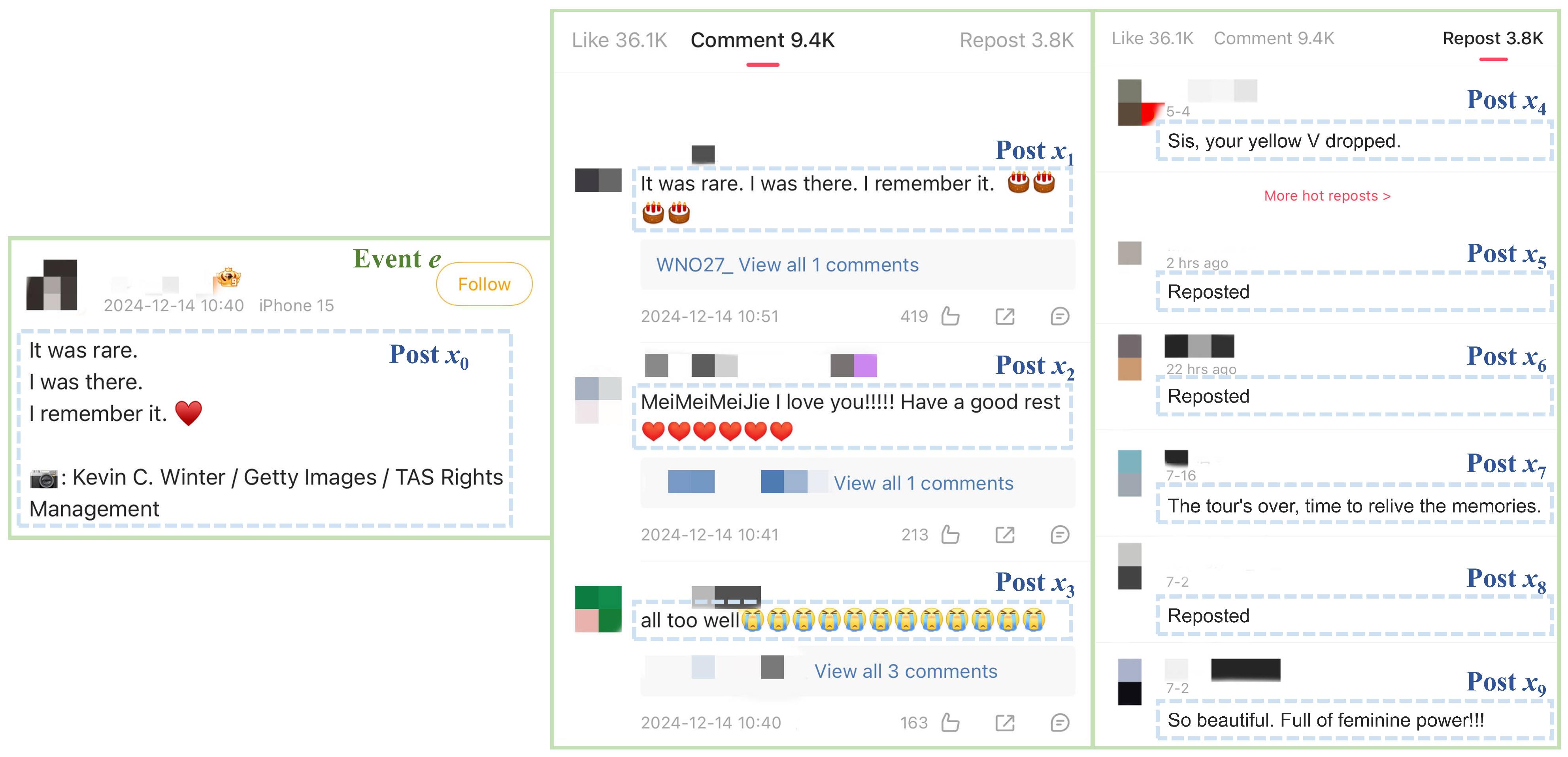
As shown in Figure 1, an event consists of multiple posts and is defined as e k = { x 0 , x 1 , x 2 , , x n } , where x 0 represents the source message, and { x 1 , x 2 , , x n } are the reposts and comments of x 0 . Let D = { e 1 , e 2 , , e s } denote the collection of events contained within the dataset. Each post x j is segmented into a word sequence { ω 1 , ω 2 , , ω m } and fed into the model at the post level.
It is worth noting that the number of words varies across posts, and the number of posts differs across events. Therefore, the fake news detection model must be capable of handling hierarchical sequences with variable lengths at both the post and event levels. The primary classifier is trained using a portion of the labelled event data, represented as e k = { x 0 , x 1 , x 2 , , x n } y k . Since one event contains multiple posts, posts in the same event will share the labels of fake news or non-fake news. Therefore, the auxiliary classifier x j = { ω 1 , ω 2 , , ω m } y j can be built.

3.2. Overall Architecture

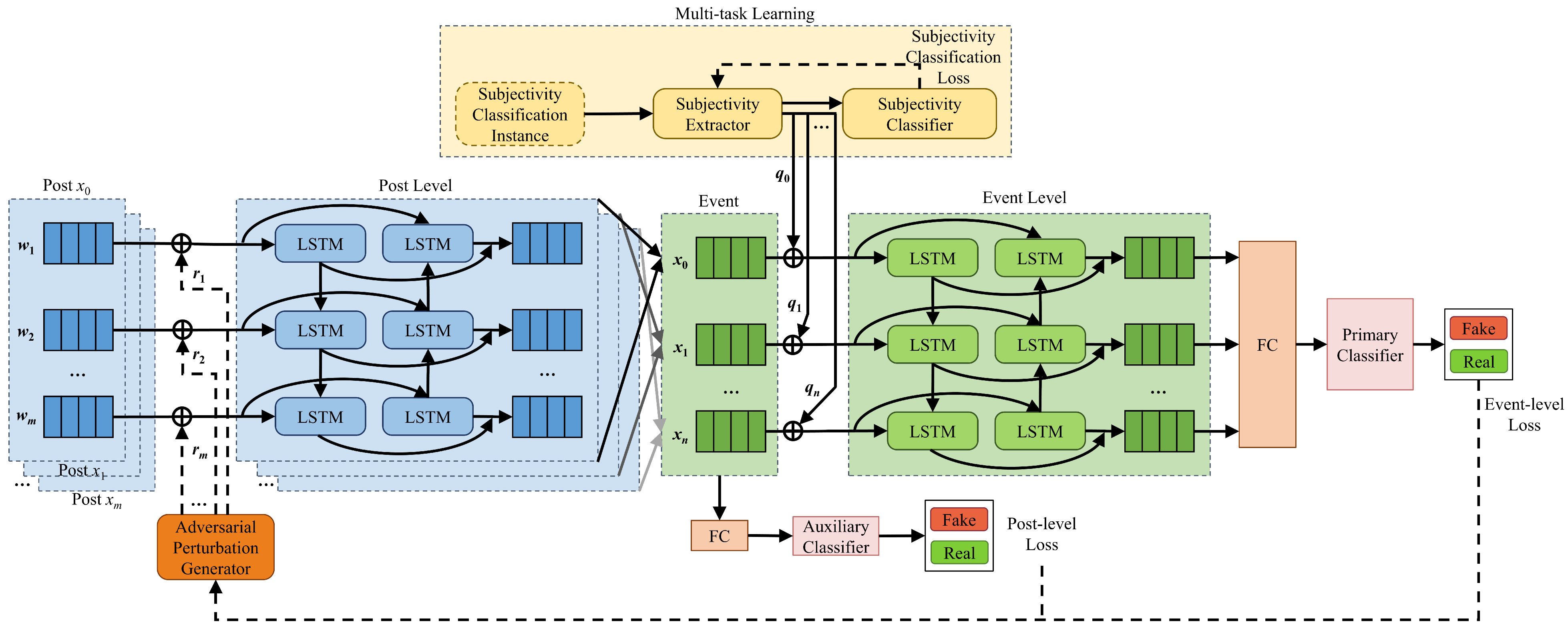
The fake news detection model proposed in this paper, HAMFD, is shown in Figure 2. The model is composed of five main modules: the post-level module, the event-level module, the multi-task learning module, the classification module, and the perturbation generation module. As illustrated in the figure, the model adopts a hierarchical architecture. At the post level, word embeddings of each post are first perturbed by the adversarial perturbation generator and then encoded by BiLSTM to obtain contextualized post representations. These representations are aggregated at the event level, where another BiLSTM captures dependencies among posts within an event. Meanwhile, the multi-task learning module extracts subjectivity–objectivity information through an auxiliary classification branch and fuses it with post representations before event-level encoding. The auxiliary post-level and the primary event-level classifiers jointly optimize a weighted loss, while adversarial perturbations generated from the overall loss further enhance robustness and cross-topic adaptability.

3.3. Post-Level Module

The input to the post-level module includes all posts under an event. Each post x j is tokenized into a sequence of words denoted as { ω 0 , ω 1 , ω 2 , , ω n } . Using GloVe [27], a model for generating word embeddings, the words in the post text are mapped into a continuous vector space, and the word embedding for each token is calculated to construct the input of the post-level BiLSTM. The corresponding formula is given below:
I p = { w 1 , w 2 , L , w m }
where w i is the pre-trained word embedding, and I p is the input to the BiLSTM in the post level. Here, L denotes the omitted intermediate word embeddings in the sequence. All post-based vectors pass through the BiLSTM layer of the post level sequentially in their order in the time dimension. At time step t, the post-based vectors are represented as follows:
P t = BiLSTM p ( w i , P t 1 )
where BiLSTM p denotes the BiLSTM layer at the post level.
Since BiLSTM has a bidirectional structure, it can combine the forward and backward hidden states. By using a concatenation operation, the final hidden state at each time step can be obtained. The unit vector of the top layer LSTM p at the last time step for each post is used as the final representation of that post in the post level encoding.
During the output phase, all posts are aggregated again into a single event, which is represented as a matrix with individual columns indicating the vector representation of each post. The formula is as follows:
O p = [ P 0 , P 1 , P 2 , L , P n ]
where P 0 denotes the representation of the source post, and each reply post is embedded as P i ( i 0 ) , O p represents the output generated by the post-level BiLSTM.

3.4. Event-Level Module

I e serves as the input representation for the BiLSTM layer at the event level, which is computed as follows:
I e = O p = [ P 0 , P 1 , P 2 , L , P n ]
For the event-level module, the encoding process of the event-level BiLSTM is similar to that of the post-level BiLSTM. However, the input units of the two are different. The post-level BiLSTM receives input in the form of word-level embeddings structured by individual posts, whereas the event-level BiLSTM takes as input event-level representations composed of enriched post embeddings. The event-level data vector is represented as follows:
E t = BiLSTM e ( P t , E t 1 )
where P t represents the post embedding P t enhanced with the subjective information captured by the subjectivity extractor, and BiLSTM e denotes the BiLSTM layer of the event level. The state E t of the event-level BiLSTM denotes the end level at the end time step for the aggregated representation of all the posts within an event.

3.5. Multi-Task Learning Module

As indicated in the introduction, it is clear that external knowledge can be used to improve feature representation, enabling the model to be better capture important features in the data, thus enhancing its representation capability. At the same time, it can also guide the model towards a more reasonable direction of learning, thus improving the model’s topic adaptive capability. HAMFD model introduces subjectivity and objectivity knowledge extracted from posts by constructing a multi-task learning module, which assists the model in identifying the subjective and objective tendencies of the post. This helps the model determine whether the content of a post contains the poster’s subjective emotions. According to references [6,7,8,9], publishers of fake news often adopt an ostensibly objective tone to increase the confusability of the fake news [8], while those who do not believe in the fake news or know the truth tend to refute the fake news with subjective comments that clearly express emotional attitudes [9].
The specific architecture of the multi-task learning module is shown in Figure 2. The “subjectivity extractor” within the module is capable of identifying and extracting the subjective or objective attitude in post x j , capturing the subjectivity-related information from x j . The captured subjectivity extractor is represented by a sentence vector, called q z k g ( x j ) , where q z k g denotes the aforementioned subjectivity extractor. In the model, q z k g ( x j ) has the same dimensionality as the original post-level sentence representation vector. The sum of these two vectors is used as the final sentence-level representation in the event-level input layer, in the following form:
P t = P t + q z k g ( x j )
To enable the subjectivity extractor to extract high-quality subjectivity information from the text, a subjectivity sentiment classification task is employed for joint training. In the subjectivity classification task, the objective is to train a model f z k g : x y , which maps an input sentence x to its corresponding label y, where y { subjective , objective } . In HAMFD, f z k g comprises two components: a feature extractor q z k g and a classifier z z k g , collectively referred to in Figure 2 as the “subjectivity extractor” and “subjectivity classifier”, respectively. Given that subjective and objective information is often signaled by the presence of sentiment words, module q z k g adopts model 1-g, which consists of an embedding layer, a fully connected layer, and a max-pooling layer. This architecture is designed to effectively model and extract the subjectivity-related features in the input text. Formally, sentence x in the subjectivity classification task is first segmented into a sequence of words [ ω 0 , ω 1 , ω 2 , , ω n ] , which is then mapped into a sequence of word embeddings [ v 0 , v 1 , v 2 , , v n ] through the embedding layer. Next, the fully connected layer subsequently maps these vectors from the original semantic space into a latent space that captures subjectivity-related information. Finally, the maximum pooling layer selects the most significant local features in this semantic space, thereby aggregating the key information that is most discriminative for subjectivity classification. The computation formula in q z k g is as follows:
q z k g ( x j ) = maxpool { V 2 m v 0 , V 2 m v 1 , L , V 2 m v n } = maxpool { V 2 m E m [ ω 0 ] , V 2 m E m [ ω 1 ] , L , V 2 m E m [ ω n ] }
In this formulation, E m denotes the parameter set of the embedding layer, while V 2 m corresponds to the trainable weight matrix of the fully connected layer. The derived sentence representation is then passed to classifier c z k g to determine whether the input is subjective or objective. The prediction error relative to the ground-truth label y is quantified via the binary cross-entropy loss, expressed as:
( x , y ) = F . binary _ cross _ entropy ( W f l q q z k g ( x j ) + b f l q , y )
In this formulation, W f l q and b f l q denote the learnable parameters of the classifier c z k g . The overall training objective for the subjectivity classification task, presented in Equation (9).
L z k g = 1 k k = 1 k ( x k , y k )
( x k , y k ) represents the risk loss of subjectivity classification defined in Equation (8), and k denotes the total count of training instances in the subjectivity classification task.

3.6. Classification Module

Based on the principle of multi-task learning, which improves the performance and generalization ability of each task by sharing and utilizing information and interrelations between different tasks. It is known that the fake news post level classification and the fake news event level classification are highly correlated, and the post-level encoder’s parameters are utilized by both. Therefore, the hierarchical model consists of an auxiliary classifier in the post-level module and a primary classifier in the event-level module. The auxiliary classifier in the post-level module not only enables shared feature learning to accelerate training and prevent gradient vanishing, but also determines whether the input data is an adversarial sample, thereby improving the model’s robustness against adversarial attacks. Two separate classifiers are employed to generate predictions for both the post level and event level. The formulas are as follows:
y ^ p = softmax ( W p · P t + b p )
y ^ e = softmax ( W e · P t + b e )
where y ^ p and y ^ e denote the classification results of the post level and the event level, separately. W p , W e and b p , b e correspond to the weights and biases of the fully connected layers for the two levels.
The training goal is to reduce the standard deviation between the predicted values and the ground truth, as formalised in Equations (12)–(14).
L p = y log ( y ^ p r ( 1 y p ) log ( 1 y ^ p n ) )
L e = y log ( y ^ e r ( 1 y e ) log ( 1 y ^ e n ) )
L z = γ L p + ( 1 γ ) L e
Here L p and L e represent the losses at the post level and the event level, respectively. γ is the weighting coefficient that controls the contributions of L p and L e . L z is the overall loss of the entire fake news detection model obtained by weighted summation of L p and L e . y represents the ground-truth label. y ^ r and y ^ n correspond to the two predicted labels of the model: fake news and real news.

3.7. Adversarial Perturbation Generation Module

The above describes the forward propagation of the HAMFD model under standard training. To enhance the cross-topic robustness of the model, an adversarial training method is introduced, where adversarial perturbations are generated through backpropagation.
Gradients with respect to the model parameters are obtained by the total loss L z and its subcomponent L e with the following equation:
g p = x L z ( θ , x , ( y p , y e ) )
By computing the L2-norm-constrained linear approximation of x L z ( θ , x , ( y p , y e ) ) , the adversarial perturbation is obtained as follows:
r = ε · x L z ( θ , x , ( y p , y e ) ) x L z ( θ , x , ( y p , y e ) ) 2
where ε is the perturbation coefficient, and the value of the adversarial perturbation r is calculated based on the total loss L z rather than L p , because the added adversarial perturbation r causes both L z and L e to increase.
Adversarial perturbations are added at the post level, i.e., word-level perturbations are added to the word embeddings to obtain the adversarial input to the post level BiLSTM. This operation is formalised in Equation (17).
I p fus = { w 1 + r 1 , w 2 + r 2 , L , w m + r m }
In this formulation r i represents the word-level perturbation vector applied to the word embedding w i . All post-level vectors are passed through the post level BiLSTM layer sequentially according to their temporal order. At time step t, the post level vector is represented as follows:
P t fus = BiLSTM p ( w i + r i , P t 1 fus )
Due to the use of BiLSTM, which has a bidirectional structure that merges the forward and backward hidden states. By using a concatenation operation, the final hidden state at each time step can be obtained. The unit vector P t fus of the top layer L S T M p at the last time step for each post is used as the final representation of that post in the post level encoding.
During the output phase, all posts are aggregated again into a single event, which is represented as a matrix, where each column corresponds to the embedding of a post, as expressed in Equation (19).
O p fus = [ P 0 fus , P 1 fus , P 2 fus , L , P n fus ]
where P 0 fus denotes the embedding of the source post, P i fus corresponds to the embedding of the repost and reply posts, and O p fus represents the adversarial output from the post-level BiLSTM.
I e fus serves as the input to the event-level BiLSTM, as given in Equation (20).
I e fus = O p fus = [ P 0 fus , P 1 fus , P 2 fus , L , P n fus ]
For the event-level module, the event level data vector is represented as follows:
E t fus = BiLSTM e P t fus , E t 1 fus
where P t fus represents P t fus enhanced with the subjective information captured by the subjectivity extractor, and BiLSTM e denotes the event-level BiLSTM layer. E t is replaced by E t fus , and the adversarial losses at the post level and event level, as well as the total loss, can be calculated using Equations (12)–(14).
After forward and backward propagation, the adversarial gradient at the post level is represented by Equation (22):
g p fus = x L z fus θ , x + r , ( y p fus , y e fus )
Finally, gradients derived from adversarial training at the post level are applied to update the model’s parameters. The parameter update process is represented by Equation (23):
θ n = θ n 1 α g p + g p fus
where α is the learning rate.
The parameter optimization process of the model can be expressed as follows:
min θ D max r [ L z θ , x + r , ( y p , y e ) + L e θ , e , y e ]
where max r [ L z θ , x + r , ( y p , y e ) + L e θ , e , y e ] indicates that r is the perturbation of the post-level input x under internal risk maximization.

4. Experimental Results and Analysis

The proposed HAMFD framework is benchmarked against competing methods on real-world social media datasets to examine its performance.

4.1. Experimental Data and Settings

4.1.1. Datasets

The experiments evaluate the model using three publicly available fake news datasets: Twitter15 [28], Twitter16 [28], and Weibo [29]. The Twitter15 and Twitter16 datasets contain four label categories: Non-Rumor (NR), False Rumor (FR), True Rumor (TR), and Unverified Rumor (UR). The Weibo dataset contains two label categories: False Rumor and True Rumor. The statistics of the datasets are presented in Table 1.
To improve the topic adaptability of the model, subjectivity and objectivity information is introduced through the multi-task learning module. For the model training tasks on the Twitter15 and Twitter16 datasets, the subjectivity extractor and classifier in the multi-task learning module are trained using the subjectivity dataset proposed by Pang and Lee [29], which contains 5000 subjective and 5000 objective English sentences. For training on the Weibo dataset, due to the absence of an openly accessible Chinese subjectivity corpus, the English subjectivity dataset is translated into Chinese and manually corrected to construct a Chinese subjectivity dataset, which contains 5000 subjective and 5000 objective Chinese sentences.

4.1.2. Evaluation Metrics and Parameter Settings

To make a fair comparison and verify the effectiveness of the model, evaluation metrics that are consistent with previous research work are adopted. For the Twitter15 and Twitter16 datasets, accuracy (Acc.) and the F1 scores of NR, FR, TR, and UR are used as evaluation metrics for assessing the in-domain performance of the detection model. For the Weibo dataset, accuracy (Acc.) as well as precision (Prec.), recall (Rec.), and F1 scores of FR and TR are used as evaluation metrics for evaluating the in-domain performance of the detection model. For Twitter15 and Twitter16, accuracy and class-wise F1 are reported following the standard four-class evaluation practice. Because F1 is the harmonic mean of precision and recall, listing separate precision and recall for each class would be redundant and is generally uncommon for these benchmarks. In contrast, for the binary Weibo dataset, precision and recall are additionally provided to reflect false-positive and false-negative trade-offs and to facilitate comparison with prior studies on this dataset.
The experimental datasets are split into 80% for training, 10% for validation, and 10% for testing.
The model is optimised via backpropagation based on the loss function, and the parameters are updated using the Adam algorithm [30], with β 1 and β 2 set to 0.9 and 0.999, respectively. The learning rate α is initialized to 1 × 10 4 . The word embedding vectors for the text of the posts are obtained using GloVe [27] with a vector dimensionality of 300. The batch size is set to 64, dropout is set to 0.5, the loss coefficient weight γ is set to 0.2, and the perturbation coefficient ε is set to 1.0.

4.2. Baseline Models

To assess the efficacy of the HAMFD model, this research compares the model with eight state-of-the-art models.
1.
DTC [11]: A method based on supervised learning and feature engineering, which constructs a classifier using the decision tree algorithm to identify fake news in the dataset.
2.
SVM-TS [31]: A linear SVM classifier capturing temporal features is constructed based on the complete period of a given event by exploiting the specificity of the temporal dimension.
3.
SVM-TK [32]: A model that captures the propagation structure of fake news by combining Support Vector Machines with a time series kernel function.
4.
RvNN [33]: A tree-structured model based on recursive neural networks that uses a variational autoencoder to capture semantic information between components for fake news recognition.
5.
PPC_RNN+CNN [34]: A model that combines Recursive Neural Network(RNN) and Convolutional Neural Network(CNN) which performs fake news detection by capturing global user features along the propagation paths of fake news.
6.
BiGCN [24]: A model that combines bidirectional information propagation and Graph Convolutional Networks(GCN) to construct a fake news detection model by improving node embedding and message passing on the graph.
7.
BCBA_GN [25]: A model for detecting fake news based on statistical and textual features, which is constructed through adaptive feature fusion.
8.
BiLSTM_UCL [26]: A model that unites word embeddings and BiLSTM, and combines Multi-Layer Perceptron(MLP) with posterior features.

4.3. Comparative Experiments

The in-domain performance of the nine models on the three datasets is obtained through experiments. Table 2 and Table 3 present the experimental results for the Twitter15 and Twitter16 datasets, respectively. Both Twitter15 and Twitter16 include accuracy (Acc.) and F1 scores under four different labels.
Table 4 presents the experimental results for the Weibo dataset, which includes four evaluation metrics: Acc., Prec., Rec., and F1.
Detailed analysis of the experimental results is as follows:
1.
Comparing the experimental results of all the models in Table 2, Table 3 and Table 4, it can be observed that the deep learning model outperforms the traditional machine learning model in all metrics of the three datasets. This is because in traditional machine learning, feature engineering is a crucial step that requires manual design and selection of features, which often prevents traditional machine learning models from extracting more comprehensive and deeper features. Among the three traditional machine learning comparison models, DTC [11] performs poorly due to the fact that the decision tree model is very sensitive to small changes in the input data. Even slight changes in the input can lead to entirely different decision tree structures, making the model unstable. Moreover, decision tree is also a greedy algorithm which constructs the tree based on local optimal splits. This may cause the model to fall into a local optimal solution instead of a global optimal solution. SVM-TS [31] and SVM-TK [32] perform better in the in-domain performance metrics compared to the DTC model, as SVM generally has a better generalization performance, and both the SVM-TS and SVM-TK models are specifically designed to handle time-series data, enabling them to better capture dynamic relationships and features within the temporal dimension. In contrast, deep learning models such as RvNN [33], PP_RNN+CNN [34] and Bi-GCN [24] can automatically learn features from raw data and capture more valuable high-dimensional features. In addition, deep learning models are able to build more abstract representations by stacking multiple levels of feature representations, which helps improve the performance of fake news detection models.
2.
The experimental results show that among the eight baseline models, the BiLSTM_UCL [26] model achieves the best performance. This is because the BiLSTM_UCL model not only captures the textual and temporal features of posts but also leverages important posterior features from different categories. By combining BiLSTM, MLP, and posterior features, the BiLSTM_UCL model can simultaneously consider both forward and backward information at each time step, thereby capturing contextual information in the sequence more comprehensively. It also increases the number of hidden layers and the number of neurons in each hidden layer to improve the scalability of the model. In comparison, the HAMFD model achieves improvements across all evaluation metrics. Specifically, on the Twitter15 dataset, its accuracy (Acc.) increases by 1.6% compared to BiLSTM_UCL, and the F1 scores improve by 2.2%, 2.1%, 1.4%, and 0.8%, respectively. On the Twitter16 dataset, its accuracy (Acc.) increases by 1.5% over the best result among the baseline models, and the F1 scores improve by 3.4%, 0.6%, 0.7%, and 1.3%, respectively. On the Weibo dataset, its accuracy (Acc.) increases by 1.1% over the best baseline result, and the precision (Prec.), recall (Rec.), and F1 scores for both true and fake news categories also improve to varying degrees. The superior performance of the HAMFD model compared to the BiLSTM_UCL model is attributed to the fact that HAMFD compensates for the BiLSTM_UCL model’s omission of subjectivity and objectivity information in post texts. By introducing external knowledge related to subjectivity and objectivity, HAMFD can improve the accuracy of fake news detection. Additionally, HAMFD incorporates adversarial perturbations at the post level, which enhances the robustness of the fake news detection model.
Overall, compared with existing methods, the proposed HAMFD achieves consistent performance improvements across all datasets. Specifically, it surpasses the strongest baseline, BiLSTM_UCL, by 1.6%, 1.5%, and 1.1% in accuracy on Twitter15, Twitter16, and Weibo, respectively, with corresponding gains in label-wise F1 scores. These results suggest that incorporating subjectivity information and post-level adversarial training enables the model to capture richer textual and emotional representations, thereby improving both detection accuracy and its generalization capability.

4.4. Ablation Study

The effectiveness of each module in the HAMFD model is verified through ablation experiments, which are divided into the following two parts:
1.
w/o M: The multi-task learning module is removed to verify the impact of subjectivity and objectivity information introduced through multi-task learning on the model’s performance.
2.
w/o A: The perturbation generation module is removed to verify the impact of adversarial perturbations generated based on the total loss of the model on its performance.
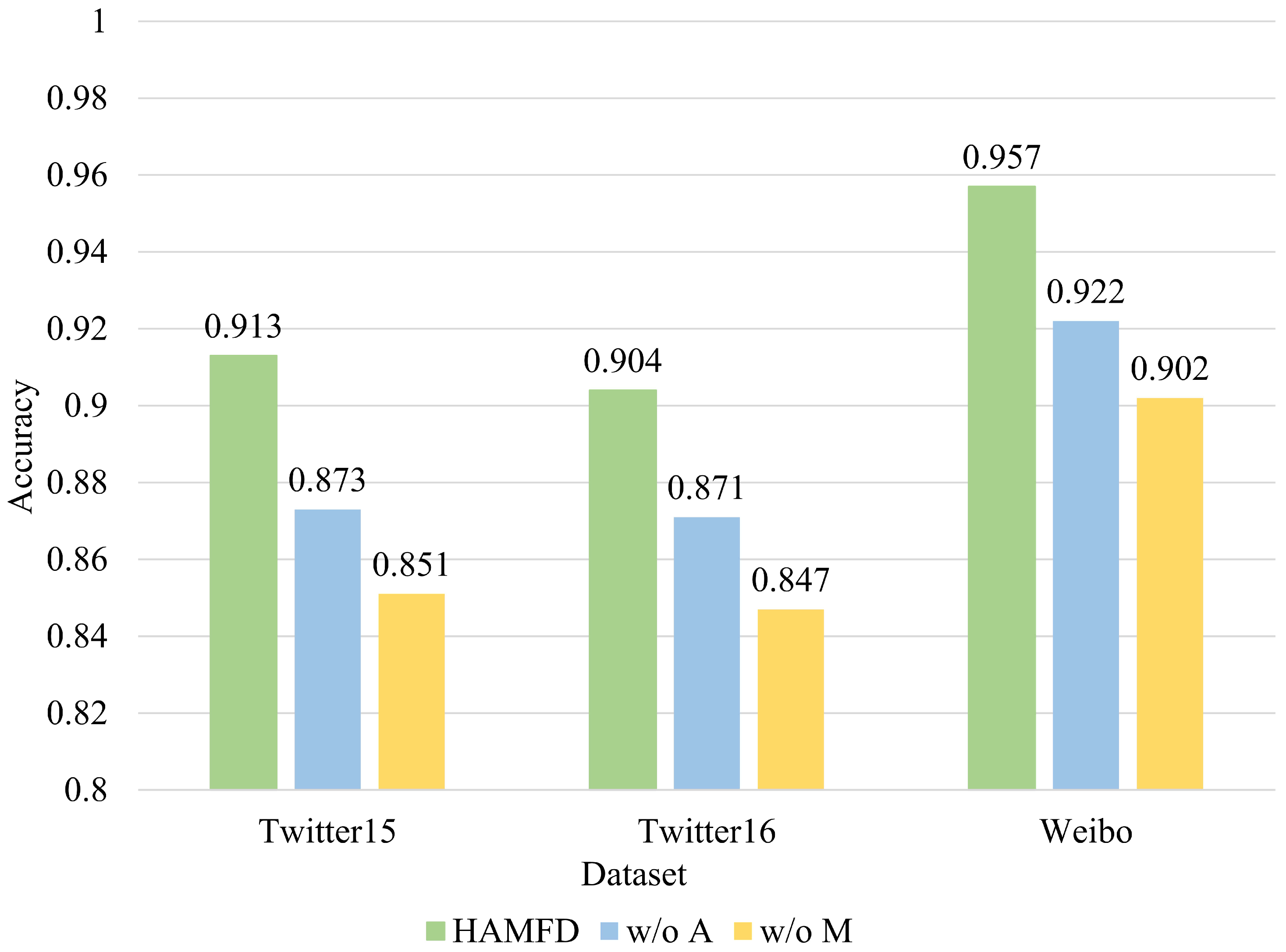
Figure 3 depicts the results obtained from the ablation experiments.
To complement the visualization with exact values, the following tables report accuracy and class-wise F1 scores on all datasets.
Remark. For readability and to avoid redundancy, only the overall accuracy is visualized in Figure 3, which follows the common practice of summarizing ablation effects with a single scalar metric. The accuracy values are reported in Table 5, and the F1 scores reported in Table 6 exhibit the same pattern that removing either component consistently reduces performance across all classes (NR/FR/TR/UR on Twitter15/16 and F/T on Weibo). Consequently, the bar plot provides a concise overview, while Table 5 and Table 6 supply the complementary numerical details.
Based on the experimental results shown in Figure 3, Table 5 and Table 6, the following conclusions can be drawn:
1.
After removing the perturbation generation module, the accuracy of the HAMFD model decreases on all three datasets, with the accuracy decreasing by 4.0%, 3.3%, and 3.5% on the Twitter15, Twitter16, and Weibo datasets, respectively. The experimental results demonstrate the effectiveness of the perturbation generation module. By introducing adversarial perturbations into the training data, the model can better learn to cope with such perturbations, thereby improving the accuracy on adversarial samples.
2.
When the multi-task learning module is excluded, the accuracy of the HAMFD model also decreases on all three datasets, with drops of 6.2%, 5.7%, and 5.5% on the Twitter15, Twitter16, and Weibo datasets, respectively. The experimental findings confirm the contribution of the multi-task learning module and further show that introducing external knowledge related to subjectivity and objectivity enables the model to better capture emotional features in the data, enhances the model’s representation capability, and improves the accuracy of fake news detection.
3.
F1 results are consistent with the accuracy results. Across all datasets, F1 decreases when either component is removed, indicating that the improvements are not restricted to any single label.
In summary, both the adversarial perturbation and multi-task learning modules play complementary roles in enhancing the model’s robustness and representational capacity. The ablation results further demonstrate that each component contributes meaningfully to the overall improvement observed in the comparative experiments, supporting the effectiveness of the proposed hierarchical adversarial multi-task learning design relative to existing approaches.

4.5. Cross-Topic Robustness Experiments

The Weibo dataset [10] is segmented based on event topics to simulate cross-topic scenarios. The number of events for each topic is shown in Table 7.
Events from the topics of Technology, Military, Business, Society, and Education are selected as the training set, while events from the moderately sized topics of Politics, Entertainment, and Health are selected for validation and testing. The deep learning models listed in Table 4 are used as baseline models for comparison, and accuracy is adopted as the evaluation metric to conduct cross-topic robustness experiments. The experimental results on the Weibo dataset are shown in Table 8.
An examination of the accuracy figures reported in Table 4 and Table 8 indicates that existing models show a noticeable decrease in cross-topic performance compared with their in-domain results. As shown in Table 4, most deep learning baselines, except for the RvNN [33] model, record accuracy levels above 90%. However, their cross-topic robust performance has dropped below 80% in some topics. The performance degradation shown in Table 8 reveals the challenge faced in the field of fake news detection—the frequent topic shift of fake news on social media platforms.
To address the problem of frequent topic shifts, the adversarial perturbation module and the multi-task learning module are incorporated into the model. The cross-topic robustness experimental results show that, compared with the baseline models, the HAMFD model suffers smaller accuracy loss after topic shift, demonstrating better cross-topic robustness. It is proved that the multi-task learning module added in the event level of the model can help the model to understand the external knowledge related to the subjectivity and objectivity of the information, enabling the HAMFD model to capture subjectivity information in post texts. Subjectivity information can guide the model to learn in a more reasonable direction and improve its generalization ability. It also confirms that incorporating adversarial perturbations at the post level can enhance the robustness of the model, enabling it to perform better on new data rather than merely fitting the training data.

5. Conclusions and Future Work

To address the frequent topic shift of fake news on social networks, a hierarchical architecture model is proposed, in which adversarial perturbations and subjectivity information are introduced at the post level and event level of the fake news detection model, respectively. The introduction of adversarial perturbations enables the model to better resist adversarial attacks and improve its robustness. By incorporating external knowledge, subjectivity information and integrating it with post features, the model’s representation capability is enhanced, thereby improving accuracy and cross-topic robustness. Experimental results on three real datasets demonstrate that the proposed method achieves higher fake news detection performance than other baseline methods and exhibits good cross-topic robustness.

5.1. Error Analysis

Analysis of misclassified samples indicates that errors mainly occur in posts with ambiguous or mixed sentiments, as well as those using irony or sarcasm to mimic factual statements. In such cases, the subjectivity classifier may fail to capture subtle emotional cues, causing inaccurate predictions at the event level. Additionally, fake news articles adopting objective or neutral tones are sometimes misclassified as real, as its linguistic style closely resembles legitimate news. In cross-topic evaluation, performance degradation is observed when the target topic differs substantially in topic or linguistic style from the training data, suggesting that unseen topic adaptation remains a challenge.

5.2. Limitations

Despite its advantages, the proposed model has several limitations. First, HAMFD relies primarily on textual and subjectivity-based features without incorporating visual cues, propagation structures, or social interaction signals, which may limit its effectiveness in detecting multimodal fake news on modern platforms. In addition, the subjectivity–objectivity knowledge used in the multi-task learning module is derived from a static external corpus, which may not fully reflect evolving linguistic patterns in dynamic social media environments. Second, although three benchmark datasets (Twitter15, Twitter16, and Weibo) were employed, they all originate from microblogging platforms. The absence of datasets from other scenarios such as Facebook, Reddit, or online news portals restricts the generalizability of the findings. Third, while the adversarial training module is designed to enhance robustness, experiments were not conducted under real adversarial attacks or noisy conditions, so its empirical resistance to practical perturbations remains to be validated. Moreover, the perturbation coefficient ε was fixed at 1.0 rather than adaptively optimized, which may constrain robustness across diverse or unseen topics. Furthermore, like most data-driven systems, HAMFD may be affected by potential dataset bias, as the distribution and language style of fake news vary across platforms and cultural contexts.

5.3. Future Work

Future research will extend the model to multimodal settings by combining textual, visual, and structural information. Additional cross-domain and cross-lingual datasets and strategies to mitigate dataset bias will be explored to further evaluate generalization. Moreover, controlled experiments under real-world noisy and adversarial conditions will be conducted to assess robustness, and efforts will focus on developing more interpretable and computationally efficient model variants for real-time fake news detection.

Author Contributions

Conceptualization, Y.S.; methodology, Y.S.; software, Y.S.; validation, Y.S. and D.Y.; formal analysis, Y.S.; investigation, Y.S.; resources, Y.S.; data curation, Y.S.; writing—original draft preparation, Y.S.; writing—review and editing, Y.S. and D.Y.; visualization, Y.S.; supervision, D.Y.; project administration, D.Y.; funding acquisition, D.Y. All authors have read and agreed to the published version of the manuscript.

Funding

This work is partially supported by the National Natural Science Foundation of China (No. 62377009).

Institutional Review Board Statement

Not applicable.

Informed Consent Statement

Not applicable.

Data Availability Statement

Publicly available datasets were analyzed in this study. The Twitter15, Twitter16, and Weibo datasets are available from https://www.dropbox.com/s/46r50ctrfa0ur1o/rumdect.zip?dl=0 (accessed on 18 November 2025). The English subjectivity dataset is available at http://www.cs.cornell.edu/people/pabo/movie-review-data/ (accessed on 18 November 2025). The Chinese subjectivity dataset used in this study was derived by translating and manually refining the English subjectivity dataset; the processed version is available from the corresponding author upon reasonable request.

Acknowledgments

The authors would like to thank the anonymous reviewers for their valuable comments and suggestions, which have greatly improved the quality of this manuscript. The authors also acknowledge the support of colleagues from the research group for their constructive discussions during the course of this work.

Conflicts of Interest

The authors declare no conflicts of interest.

Abbreviations

HAMFDHierarchical Adversarial Multi-task Fake News Detection
NLPNatural Language Processing
SVMSupport Vector Machine
HMMHidden Markov Model
CRFConditional Random Field
GNNGraph Neural Network
ERDEarly Rumor Detection
GCNGraph Convolutional Network
BiLSTMBidirectional Long Short-Term Memory
RNNRecurrent Neural Network
CNNConvolutional Neural Network
MLPMulti-Layer Perceptron
Acc.Accuracy
Prec.Precision
Rec.Recall
F1F1 Score
NRNon-Rumor
FRFalse Rumor
TRTrue Rumor
URUnverified Rumor
COVID-19Coronavirus Disease 2019

References

  1. Tasnim, S.; Hossain, M.M.; Mazumder, H. Impact of Rumors and Misinformation on COVID-19 in Social Media. J. Prev. Med. Public Health 2020, 53, 171–174. [Google Scholar] [CrossRef] [PubMed]
  2. Vosoughi, S.; Roy, D.; Aral, S. The spread of true and false news online. Science 2018, 359, 1146–1151. [Google Scholar] [CrossRef]
  3. Pérez-Rosas, V.; Kleinberg, B.; Lefevre, A.; Mihalcea, R. Automatic Detection of Fake News. arXiv 2017, arXiv:1708.07104. [Google Scholar] [CrossRef]
  4. Kwon, S.; Cha, M.; Jung, K.; Chen, W.; Wang, Y. Prominent Features of Rumor Propagation in Online Social Media. In Proceedings of the 2013 IEEE 13th International Conference on Data Mining, Dallas, TX, USA, 7–10 December 2013; pp. 1103–1108. [Google Scholar] [CrossRef]
  5. Yang, F.; Yu, X.; Liu, Y.; Yang, M. Automatic Detection of Rumor on Sina Weibo. In Proceedings of the MDS ’12: Proceedings of the ACM SIGKDD Workshop on Mining Data Semantics, Beijing, China, 12–16 August 2012; pp. 1–7. [Google Scholar]
  6. Einwiller, S.A.; Kamins, M.A. Rumor Has It: The Moderating Effect of Identification on Rumor Impact and the Effectiveness of Rumor Refutation. J. Appl. Soc. Psychol. 2008, 38, 2248–2272. [Google Scholar] [CrossRef]
  7. DiFonzo, N.; Bourgeois, M.J.; Suls, J.; Homan, C.; Stupak, N.; Brooks, B.P.; Ross, D.S.; Bordia, P. Rumor clustering, consensus, and polarization: Dynamic social impact and self-organization of hearsay. J. Exp. Soc. Psychol. 2013, 49, 378–399. [Google Scholar] [CrossRef]
  8. Zhang, N.; Huang, H.; Su, B.; Zhao, J.; Zhang, B. Dynamic 8-state ICSAR rumor propagation model considering official rumor refutation. Phys. A Stat. Mech. Its Appl. 2014, 415, 333–346. [Google Scholar] [CrossRef]
  9. Rosnow, R.L. Inside rumor: A personal journey. Am. Psychol. 2016, 46, 484–496. [Google Scholar] [CrossRef]
  10. Lu, M.; Huang, Z.; Li, B.; Zhao, Y.; Qin, Z.; Li, D. SIFTER: A Framework for Robust Rumor Detection. IEEE/ACM Trans. Audio Speech Lang. Process. 2022, 30, 429–442. [Google Scholar] [CrossRef]
  11. Castillo, C.; Mendoza, M.; Poblete, B. Information credibility on Twitter. In Proceedings of the WWW ’11: Proceedings of the 20th International Conference on World Wide Web, Hyderabad, India, 28 March–1 April 2011; pp. 675–684. [Google Scholar] [CrossRef]
  12. Liu, X.; Nourbakhsh, A.; Li, Q.; Fang, R.; Shah, S. Real-time rumor debunking on Twitter. In Proceedings of the CIKM ’15: Proceedings of the 24th ACM International Conference on Information and Knowledge Management, Melbourne, Australia, 18–23 October 2015; pp. 1867–1870. [Google Scholar] [CrossRef]
  13. Zhang, H.; Fan, Z.; Zheng, J.; Liu, Q. An improving deception detection method in computer-mediated communication. Networks 2012, 7, 1811–1816. [Google Scholar] [CrossRef]
  14. Wu, K.; Yang, S.; Zhu, K.Q. False rumors detection on Sina Weibo by propagation structures. In Proceedings of the 2015 IEEE 31st International Conference on Data Engineering, Seoul, Republic of Korea, 13–17 April 2015; pp. 651–662. [Google Scholar] [CrossRef]
  15. Vosoughi, S. Automatic Detection and Verification of Rumors on Twitter; Massachusetts Institute of Technology: Cambridge, MA, USA, 2015. [Google Scholar]
  16. Vosoughia, S.; Mohsenvand, M.N.; Roy, D. Rumor Gauge: Predicting the veracity of rumors on Twitter. ACM Trans. Knowl. Discov. Data 2017, 11, 1–36. [Google Scholar] [CrossRef]
  17. Zubiaga, A.; Liakata, M.; Procter, R.; Bontcheva, K.; Tolmie, P. Towards Detecting Rumours in Social Media. arXiv 2015, arXiv:1504.04712. [Google Scholar] [CrossRef]
  18. Wu, Z.; Pi, D.; Chen, J.; Xie, M.; Cao, J. Rumor detection based on propagation graph neural network with attention mechanism. Expert Syst. Appl. 2020, 158, 113595. [Google Scholar] [CrossRef]
  19. Nguyen, T.T.; Nguyen, T.T.; Nguyen, T.T.; Vo, B.; Jo, J.; Nguyen, Q.V.H. JUDO: Just-in-time rumour detection in streaming social platforms. Inf. Sci. 2021, 570, 70–93. [Google Scholar] [CrossRef]
  20. Luo, Y.; Ma, J.; Yeo, C.K. BCMM: A novel post-based augmentation representation for early rumour detection on social media. Pattern Recognit. 2021, 113, 107818. [Google Scholar] [CrossRef]
  21. Yang, Y.; Wang, Y.; Wang, L.; Meng, J. PostCom2DR: Utilizing information from post and comments to detect rumors. Expert Syst. Appl. 2021, 189, 116071. [Google Scholar] [CrossRef]
  22. Liu, B.; Sun, X.; Meng, Q.; Yang, X.; Lee, Y.; Cao, J. Nowhere to Hide: Online Rumor Detection Based on Retweeting Graph Neural Networks. IEEE Trans. Neural Netw. Learn. Syst. 2022, 35, 4887–4898. [Google Scholar] [CrossRef]
  23. Zheng, P.; Dou, Z.H.Y.; Yan, Y. Rumor detection on social media through mining the social circles with high homogeneity. Inf. Sci. 2023, 642, 119083. [Google Scholar] [CrossRef]
  24. Bian, T.; Xiao, X.; Xu, T.; Zhao, P.; Huang, W.; Rong, Y.; Huang, J. Rumor Detection on Social Media with Bi-Directional Graph Convolutional Networks. Proc. Aaai Conf. Artif. Intell. 2020, 34, 549–556. [Google Scholar] [CrossRef]
  25. Shelke, S.; Attar, V. Rumor Detection in Social Network Based on User, Content and Lexical Features. Multimed. Tools Appl. 2022, 81, 17347–17368. [Google Scholar] [CrossRef] [PubMed]
  26. Zhang, Z.; Dan, Z.; Dong, F.; Gao, Z.; Zhang, Y. A Rumor Detection Method Based on Adaptive Fusion of Statistical Features and Textual Features. Information 2022, 13, 388. [Google Scholar] [CrossRef]
  27. Pennington, J.; Socher, R.; Manning, C. GloVe: Global Vectors for Word Representation. In Proceedings of the 2014 Conference on Empirical Methods in Natural Language Processing (EMNLP), Doha, Qatar, 25–29 October 2014; pp. 1534–1543. [Google Scholar] [CrossRef]
  28. Ma, J.; Gao, W.; Mitra, P.; Kwon, S.; Jansen, B.J.; Wong, K.F.; Cha, M. Detecting rumors from microblogs with recurrent neural networks. In Proceedings of the 25th International Joint Conference on Artificial Intelligence (IJCAI), New York, NY, USA, 9–15 July 2016; pp. 3818–3824. Available online: https://dl.acm.org/doi/proceedings/10.5555/3061053 (accessed on 18 November 2025).
  29. Pang, B.; Lee, L. A sentimental education: Sentiment analysis using subjectivity summarization based on minimum cuts. In Proceedings of the ACL ’04: Proceedings of the 42nd Annual Meeting on Association for Computational Linguistics, Barcelona, Spain, 21–26 July 2004; pp. 271–278. [Google Scholar] [CrossRef]
  30. Kingma, D.P.; Ba, J. Adam: A Method for Stochastic Optimization. arXiv 2014, arXiv:1412.6980. [Google Scholar] [CrossRef]
  31. Ma, J.; Gao, W.; Wei, Z.; Lu, Y.; Wong, K.-F. Detect Rumors Using Time Series of Social Context Information on Microblogging Websites. In Proceedings of the CIKM ’15: Proceedings of the 24th ACM International Conference on Information and Knowledge Management, Melbourne, Australia, 18–23 October 2015; pp. 1751–1754. [Google Scholar] [CrossRef]
  32. Ma, J.; Gao, W.; Wong, K.F. Detect Rumors in Microblog Posts Using Propagation Structure via Kernel Learning. In Proceedings of the 55th Annual Meeting of the Association for Computational Linguistics, Vancouver, BC, Canada, 30 July–4 August 2017; pp. 708–717. [Google Scholar] [CrossRef]
  33. Ma, J.; Gao, W.; Wong, K.F. Rumor Detection on Twitter with Tree-structured Recursive Neural Networks. In Proceedings of the 56th Annual Meeting of the Association for Computational Linguistics, Melbourne, Australia, 15–20 July 2018; pp. 1980–1989. [Google Scholar] [CrossRef]
  34. Liu, Y.; Wu, Y.F.B. Early Detection of Fake News on Social Media Through Propagation Path Classification with Recurrent and Convolutional Networks. In Proceedings of the Thirty-Second AAAI Conference on Artificial Intelligence (AAAI-18), New Orleans, LA, USA, 2–7 February 2018; pp. 354–361. Available online: https://dl.acm.org/doi/abs/10.5555/3504035.3504079 (accessed on 18 November 2025).
Figure 1. Event Structure on Social Media Networks.
Informatics 12 00131 g001
Figure 2. Overall framework of the proposed algorithm.
Informatics 12 00131 g002
Figure 3. Ablation Study Results.
Informatics 12 00131 g003
Table 1. Statistics of Experimental Datasets.
Statistical InformationTwitter15Twitter16Weibo
Number of Posts331,612204,82038,056,560
Number of Events14908184664
Number of Non-Rumors (NR)3742052351
Number of False Rumors (FR)3702052313
Number of True Rumors (TR)3742030
Number of Unverified Rumors (UR)3722050
Average Number of Posts per Event233251816
Maximum Number of Posts per Event1768276559,318
Minimum Number of Posts per Event558110
Table 2. Experimental Results on the Twitter15 Dataset.
MethodAcc.NR-F1FR-F1TR-F1UR-F1
DTC0.6250.7160.5190.6420.523
SVM-TS0.5810.3940.5200.4630.549
SVM-TK0.7050.6190.7560.4850.835
RvNN0.7590.7140.7650.8140.714
PPC_RNN+CNN0.8120.8100.8130.7900.785
BiGCN0.8140.7720.8270.8300.786
BCBA_GN0.8640.8430.8390.8720.858
BiLSTM_UCL0.8970.8850.9030.8950.873
HAMFD0.9130.9070.9240.9090.881
Table 3. Experimental Results on the Twitter16 Dataset.
MethodAcc.NR-F1FR-F1TR-F1UR-F1
DTC0.6070.6520.4320.5730.739
SVM-TS0.6450.5460.6380.6540.668
SVM-TK0.7320.8140.7130.7450.801
RvNN0.7220.6280.7120.8330.714
PPC_RNN+CNN0.8550.8110.8710.8370.842
BiGCN0.8600.7790.8590.9250.855
BCBA_GN0.8830.8560.8670.9280.847
BiLSTM_UCL0.8890.8730.8950.9230.884
HAMFD0.9040.9070.9010.9300.897
NR/FR/TR/UR denote non-rumor, false rumor, true rumor, and unverified rumor, respectively.
Table 4. Experimental Results on the Weibo Dataset.
MethodTypeAcc.Prec.Rec.F1
DTCF0.7670.7350.7630.749
T0.6850.7860.732
SVM-TSF0.7560.7320.8040.774
T0.7140.8210.717
SVM-TKF0.7860.9160.8190.864
T0.6130.7530.773
RvNNF0.7940.8330.7830.812
T0.7270.8330.808
PPC_RNN+CNNF0.9130.8840.9320.922
T0.9270.9010.907
Bi-GCNF0.9340.9400.9300.931
T0.9280.9390.929
BCBA_GNF0.9410.9260.9520.941
T0.9350.9240.951
BiLSTM_UCLF0.9460.9460.9510.949
T0.9590.9350.940
HAMFDF0.9570.9470.9610.965
T0.9710.9550.951
F and T denote false rumor and true rumor, respectively.
Table 5. Ablation accuracy of HAMFD and its variants on Twitter15, Twitter16, and Weibo.
ModelTwitter15Twitter16Weibo
HAMFD0.9130.9040.957
w/o A0.8730.8710.922
w/o M0.8510.8470.902
Table 6. F1 scores of HAMFD and its ablations on Twitter15, Twitter16, and Weibo.
Twitter15Twitter16Weibo
ModelNRFRTRURNRFRTRURFT
HAMFD0.9070.9240.9090.8810.9070.9010.9300.8970.9650.951
w/o A0.8850.8970.8830.8600.8830.8780.9040.8690.9420.924
w/o M0.8720.8840.8710.8480.8710.8620.8970.8630.9340.915
NR/FR/TR/UR/F/T denote non-rumor, false rumor, true rumor, unverified rumor, false rumor, and true rumor, respectively.
Table 7. Statistics of Event Topics.
TopicTech.Mil.Biz.Soc.Educ.Pol.Entert.Health
Event6595101290089280805329
Abbrev.: Tech. = Technology, Mil. = Military, Biz. = Business, Soc. = Society, Educ. = Education, Pol. = Politics, Entert. = Entertainment.
Table 8. Cross-topic performance on the Weibo dataset.
MethodPolitics (Acc.)Entertainment (Acc.)Health (Acc.)
RvNN0.6280.6340.663
PPC_RNN+CNN0.7220.7480.714
BiGCN0.7710.7930.807
BCBA_GN0.8270.8750.776
BiLSTM_UCL0.8460.8310.863
HAMFD0.9230.9100.942
Disclaimer/Publisher’s Note: The statements, opinions and data contained in all publications are solely those of the individual author(s) and contributor(s) and not of MDPI and/or the editor(s). MDPI and/or the editor(s) disclaim responsibility for any injury to people or property resulting from any ideas, methods, instructions or products referred to in the content.