
Abstract
The purpose of the article: to find new (most effective) directions for the corporate COVID-19 risks management and developing management implications for leading this fight amid the pandemic and crisis for sustainable development. The methods of correlation and regression analysis are used. It is proved that the most perspective method of the corporate fight against the COVID-19 risks is a flexible transformation of business according to the new conditions based on the Industry 4.0 technologies. This paper further develops and supplements the concept of corporate social responsibility, including a new direction—corporate fight against the COVID-19 risks in it. The authors develop management implications on improving the corporate fight against the COVID-19 risks as a new direction of corporate social responsibility amid the pandemic. The advantages of using the Industry 4.0 technologies for the corporate fight against the viral threat include reduction of the share of the population with household expenditures for healthcare above 25% of total expenditures or incomes, reduction of the number of new cases per 1 million people, and an increase of the self-isolation index, the share of responsible employers amid COVID-19 risks.
1. Introduction
Amid the COVID-19 crisis—as a new and critical threat to humanity—the importance of the fight against the viral threat has grown like never before in recent decades. The government has taken the main burden since public healthcare belongs to public benefits and is peculiar for large financial expenditures and risks, which makes it unattractive for private investors (Popkova and Sergi 2020a).
However, despite the absence of direct participation in the fight against the viral threat as investors, the business became involved with this process. In the conditions of the lockdown, business management faced serious and very strong limitations (increase of sanitary and epidemiological requirements, bans, and limitations on various types of activities, etc.,—COVID-19 risks) and was given a choice. On the one hand, these are personnel cuts and reduction of the company’s activities (Fox et al. 2020).
This allows avoiding losses due to the full payment of wages with the reduced revenues caused by a decrease in demand and offer. The negative consequences of personnel cuts are the loss of unique corporate intellectual resources, aggravation of the company’s reputation in the labor market as an employer (with the following difficulties in the attraction of better personnel), and complexity of the following restoration of work in the previous volumes after the cancelling of limitations, caused by the impossibility of the quick formation of new staff (Tabesh and Vera 2020).
On the other hand, it is possible to avoid personnel cuts through either the traditional direction of corporate social responsibility or through the transformation of the company’s work according to the conditions of the pandemic and crisis, which could be characterized as a new direction of this responsibility (Chou et al. 2020). The problem is that in the first case (with traditional responsibility). The company performs obligations before the employees, despite the reduction of the production capacities load and reduction of the volume of sales and revenues (Muhammad Muneeb et al. 2020).
This entails large losses for the company and requires it to have large reserves in case of a crisis or wide opportunities to attract the borrowed resources. Therefore, the traditional direction of corporate social responsibility amid the COVID-19 crisis is inaccessible for most companies (especially small and medium) and is connected to critically high risks. It is unacceptable for the remaining companies (Clément and Roux-Dufort 2020; Sun et al. 2021).
This problem urges the search for alternative methods of manifesting corporate social responsibility, which is ensured in the second case—a company has to demonstrate flexibility and innovative activity to support the previous production capacities load with the observation of the imposed limitations for the effective COVID-19 risks management (Gębski 2021; Ignatowski et al. 2021). This works for almost all companies and leads to minimal risks, providing wide opportunities for the return of investments in business modernization.
This paper’s hypothesis is the following (Vasenska et al. 2021; Issa et al. 2021): the most perspective method of the corporate COVID-19 risk management is a flexible transformation of business for the new conditions based on the Industry 4.0 technologies (through the development of remote work, Internet retailing, world robots distribution, use of Big Data and AI), which is a new direction corporate social responsibility amid the COVID-19 crisis, measured through the prism of Healthcare Index. The paper’s goal is to find new (most effective) directions for the corporate COVID-19 risks management and developing management implications for leading this fight amid the pandemic and crisis for sustainable development.
This paper’s originality is due to its demonstrating the significance and quantitatively measuring the contribution of corporate social responsibility to the COVID-19 risks management. The paper develops and supplements the concept of corporate social responsibility, including a new direction—corporate COVID-19 risks management—in it. In this new direction, the essence of companies—as responsible employers—is shown in a new light—in the conditions of the COVID-19 crisis, it covers not only preservation of the personnel but also the provision of safe conditions for labor and realization of products with the observation of strict sanitary and epidemiological norms.
The paper’s novelty is shown in comparing the traditional direction of corporate social responsibility to the new direction. Sustainable development is considered as a function of these two directions, which allows determining the differences in their significance amid the COVID-19 crisis. The paper’s uniqueness consists in substantiating the important role of the Industry 4.0 technologies during companies’ manifesting corporate social responsibility within its new direction, which emerged amid the COVID-19 risks and which is related to the corporate COVID-19 risks management. Technologies of Industry 4.0 are structured, and a new direction of their use in entrepreneurship is shown—for the management of corporate social responsibility.
2. Literature Review
2.1. Corporate Social Responsibility and the Specific Features of Its Exercise Amid the COVID-19 Risks
Corporate social responsibility—as a specific direction of modern entrepreneurship management—is considered in the works of Akopova et al. (2020); Espasandín-Bustelo et al. (2021); Tarigan et al. (2021); and Zainee and Puteh (2020). The significance of corporate social responsibility for sustainable development is noted in the works of Bhattacharyya (2020); Bhattacharyya and Jha (2020); Milwood (2020). The specific features of manifesting corporate social responsibility amid the COVID-19 crisis are outlined in the works of Hinojosa et al. (2020); Norris et al. (2020); and Popkova et al. (2020).
It is seen from the analysis of the literature that two key specific features of manifesting corporate social responsibility amid the COVID-19 risks is given. The first one is the large complexity of manifesting corporate social responsibility amid the COVID-19 crisis. During a crisis, companies face a deficit of resources even for supporting their main activities, while corporate social responsibility, which belongs to additional activities and is financed according to the leftover principle even in the period of stability, becomes almost inaccessible for business management—at least, in the traditional form, which supposes limited opportunities for the return of social investments of business, especially during a crisis (Abate et al. 2021).
The second one is the insufficiency and reduced value of the traditional direction of corporate social responsibility amid the COVID-19 risks. Two main beneficiaries of corporate social responsibility amid the pandemic and crisis changed their priorities. Employees (the first beneficiary) are interested not just in preserving their jobs but in their professional activities’ becoming safe (from the positions of observing sanitary and epidemiological norms) (Capelli et al. 2021).
Consumers (the second beneficiary) are more interested in the safety (from the positions of observing sanitary and epidemiological norms) of the process of products’ realization than in the company’s responsibility as an employer and realization of “green” projects. This reduces the value of the traditional direction of corporate social responsibility for interested parties (beneficiaries) and actualizes the new direction—corporate COVID-19 risks management (Engle et al. 2021).
2.2. The Case Experience and Modern Forms of the Corporate Fight against the Viral Threat in the Conditions of the COVID-19 Risks
The general issues of using the Industry 4.0 technologies in the practice of business management in the conditions of the digital economy are studied in Abramova et al. (2019); Chaldaeva (2019); Fokina (2020); Guseva et al. (2019); Inshakova and Litvinov (2020); Inshakova et al. (2020); Litvinova (2020); Popkova et al. (2021); Popkova and Sergi (2020b); Smetanina (2020); and Sofiina (2020).
As the experience of the COVID-19 pandemic and crisis has shown, one of the most popular forms of transforming a company’s work according to the new requirements of government and society (market) is the employees’ transition to remote work. According to the materials of the National Research University “Higher School of Economics” (NRU HSE 2021), 89% of the adult population of Russia think that robots are necessary since they could perform work that is too dangerous for humans. For example, robots could perform the production operations at a company with remote control and/or management by human workers. 74% think that the dissemination of robots will lead to the disappearance of a lot of professions, and 55% are sure that robots will soon replace humans at most jobs.
Fifty percent of workers in the labor market in Russia think that their work could be performed fully or partially by robots. To compare, according to the respondents in Romania and Austria, 55% of jobs are subject to automatization based on robots, in Finland—54%, and in Germany—38%. This means that a large share (half on average) of jobs could be robotized, which will ensure the stability of personnel and production capacities load of companies in the conditions of future epidemics and pandemics, despite the increase of sanitary and epidemiological norms or even lockdown.
According to the survey of the Russian Public Opinion Research Center (VCIOM) and Social Business Group LLC (SBG) (2021), in the conditions of the COVID-19 pandemic and crisis in 2020, 16% of Russian employees were transferred to remote work. In large cities (e.g., Moscow and St. Petersburg), the share of remote work reached 21–29%. The main reason for the impossibility of the transition to remote work is the necessity for direct contact with people during the performance of professional duties, which is true for 30% of jobs; for 11% of jobs, the transition is completely impossible due to other reasons.
Thus, by the example of Russia, 50% of jobs could be automatized and 59% could be transferred to remote work. About 43% of employees in Germany think that the COVID-19 pandemic and crisis pose a danger to their work, with the numbers in other countries as follows: 44% in France, 63% in Italy, and 37% in the USA (Russian Public Opinion Research Center (VCIOM) and Social Business Group LLC (SBG) 2021). This emphasized the large perspectives of the corporate fight against the viral threat in the conditions of the COVID-19 pandemic and crisis in the form of transferring employees to remote work.
Other (apart from remote work based on the Internet and automatization based on robots), equally significant and rather popular in Russia and around the world, forms of the corporate fight against the viral threat in the conditions of the COVID-19 pandemic and crisis are as follows:
Internet retailing. This is a reverse side of the remote form, which provides advantages not so much for employees as for consumers. Internet retailing allows purchasing goods and services via the Internet with delivery;
Digital (smart) monitoring (automatized collection and intelligent analytics of data) on the fight against the viral threat at a company with the help of big data and AI. In this form, a company could control their employees observing the sanitary and epidemiological norms and evaluating the risks of their social contacts during professional activities, as well as conducting risk management.
2.3. Gap Analysis of the Corporate Social Responsibility Management Amid the COVID-19 Risks
The literature analysis has shown that the concept of corporate social responsibility has been thoroughly elaborated and described in detail on the whole in the existing publications. Its connection with the concept of sustainable development has also been given. However, the corporate fight against the viral threat is poorly studied and not designated as a director of social responsibility, though it is, as a matter of fact, a new direction of this responsibility in the conditions of the COVID-19 pandemic and crisis. This direction has not been sufficiently studied (which is a research gap) and requires further elaboration.
In addition to this, we have determined the gaps related to the uncertainty regarding the following aspects:
- Could corporate social responsibility (its new direction) contribute to the fight against the viral threat, and to what extent is this contribution important amid the COVID-19 risks?
- Which direction of corporate social responsibility (employers’ responsibility and green initiatives)—traditional or new (corporate COVID-19 risks management)—is more important for sustainable development?
- What is the importance of the role of the Industry 4.0 technologies (each of them) in implementing the new direction of corporate social responsibility (corporate fight against the viral threat) amid the COVID-19 risks?
The above gaps determine the research issues that are studied systemically in this paper.
3. Research Design and Method
In order to check the hypothesis, we use the methods of correlation and regression analysis, determining, first, the correlation dependence and regression dependence of the aspects of the new direction of corporate social responsibility—the share of responsible employers amid COVID-19 (n1), sanitary level (n2), and financing of the fight against the viral threat (n3)—on the sources of the corporate fight against the viral threat based on the Industry 4.0 technologies:
- Internet retailing (d1) (IMD 2021);
- world robots distribution (d2) (IMD 2021);
- use of Big Data and AI (d3) (IMD 2021).
Second, we find the regression dependence of the healthcare index (SD1) (Numbeo 2021) on the aspects of the new direction of corporate social responsibility (n1 − n6). Third, we find the regression dependence of the Sustainable Development Index (SD2) (UN 2021) on the aspects of the new direction of corporate social responsibility (n1 − n3) (Institute of Scientific Communications 2021a) and the Social Entrepreneurship Index (t) (Institute of Scientific Communications 2021b) as an exercise of the traditional direction of corporate social responsibility.
The relationship between the variables under consideration and companies fighting COVID-19 is that corporate social responsibility in a pandemic means maintaining pre-pandemic prices for pharmaceuticals and medical services (which reduces the share of the population with household expenditures for healthcare above 25% of total, n1), as well as in the transformation of the work process in such a way as to reduce the risks of infection of workers and consumers (which allows reducing the number of new cases per 1 million people, n2, as well as to increase the sanitary level, n3).
The formal model of this research is as follows:
The research is performed based on the sample of developed and developing countries for which the values for most of the indicators are available. The statistical basis for checking the hypothesis is given in Table 1 and Table 2.
Table 1.
The aspects of the new and traditional directions of CSR and the results for sustainable development in 2020 in the context of COVID-19 risks.
Table 2.
Sources of the corporate COVID-19 risk management based on the Industry 4.0 technologies in 2020.
4. Findings
4.1. Evaluation of the Importance of the Industry 4.0 Technologies for Implementing the New Direction of Corporate Social Responsibility Amid the COVID-19 Risks
The correlation between the aspects of the new direction of corporate social responsibility and the sources of the corporate COVID-19 risk management based on the Industry 4.0 technologies (using the data from Table 1 and Table 2) is calculated in Table 3.
Table 3.
Correlation between the aspects of the new direction of corporate social responsibility and the sources of the corporate COVID-19 risk management based on the Industry 4.0 technologies, %.
According to Table 3, the number of cases per 1 million people (n2) reduces is the position in the ranking (approach to the top of the ranking, i.e., increase of the level) of world robots distribution (d2, correlation: 20.07%) and the use of big data and AI (d3, correlation: 14.43%) decreases.
Sanitary level (n3) grows if the position in the ranking (approach to the top of the ranking, i.e., increase of the level) of Internet retailing (d1, correlation: −40.19), world robots distribution (d2, correlation: −27.97%), and use of big data and AI (d3, correlation: −45.69%) decreases.
For the selected indicators, for which the positive connections have been found, we calculate the regression dependence of the aspects of the new direction of corporate social responsibility on the sources of the corporate fight against the viral threat based on the Industry 4.0 technologies.
n2 = 1524.07 + 29.47d2 + 20.80d3
According to Equation (2), the number of cases per 1 million people (n2):
- Reduces by 29.47 if the level of world robots distribution (d2) grows by 1 position;
- Reduces by 20.8 if the use of big data and AI (d3) grows by 1 position.
n3 = 104.69 − 0.20d1 − 0.16d2 − 0.49d3
According to Equation (3), sanitary level (n3):
- Increase of the use of big data and AI (d1) by 1 position leads to an increase of the sanitary level by 0.20 points;
- Increase of the level of Internet retailing (d2) by 1 position leads to an increase of the sanitary level by 0.16 points;
- Increase of the level of world robots distribution (d3) by 1 position leads to an increase of the sanitary level by 0.49 points.
4.2. Analysis of the Contribution of the New Direction of Corporate Social Responsibility to the COVID-19 Risk Management and the Ratio of Its Contribution to the Traditional Direction in Sustainable Development
Analysis of the contribution of the new direction of corporate social responsibility to the fight against the viral threat and the ratio of its contribution to the traditional direction in sustainable development represented in the form of the following equations:
SD1 = 69.6256 + 0.0014n2 − 0.0696n3 + 0.0217t
According to Equation (4), with an increase in the level of development of social entrepreneurship by 1 point, the Sustainable Development Index increases by 0.0217 points.
SD2 = 65.8272 − 0.0012n2 + 0.08356n3
According to Equation (5), if the number of new cases decreases by 1 million people per case, the Healthcare Index increases by 0.0012 points. With an increase in the level of sanitation by 1 point, the Healthcare Index increases by 0.0835 points.
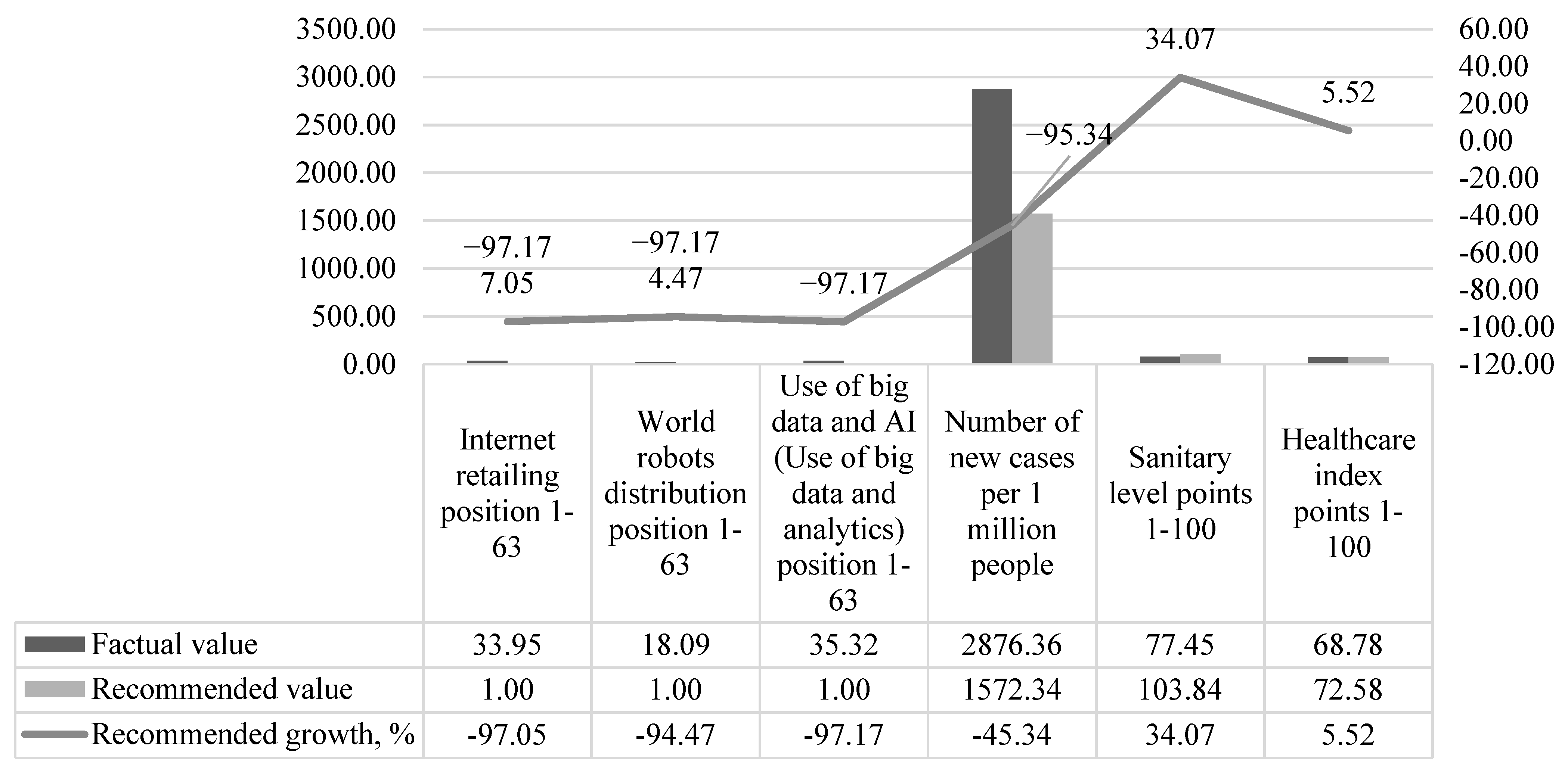
To improve the corporate COVID-19 risk management on the Industry 4.0 technologies—as a new direction of social responsibility amid the pandemic—we have developed management implications (Figure 1).
Figure 1.
Management implications to improve the corporate COVID-19 risk management based on the Industry 4.0 technologies. Source: Authors.
According to Figure 1, management implications include the increase of the following aspects:
- Internet retailing, world robots distribution, and use of big data and AI up to 1st position.
Advantages of the developed management implications for the fight against the viral threat as a new direction of corporate social responsibility amid the COVID-19 risks include the following:
- Reduction of the number of new cases per 1 million people down to 1572.34 (by 45.34%);
- An increase in the level of sanitation up to 103.84 points (by 34.07%).
The result of the development of the new direction of corporate social responsibility for sustainable development amid the COVID-19 risks is connected with increasing of the healthcare index by 5.52% (up to 72.58 points).
5. Discussion
The results obtained clarified the concept of corporate social responsibility through the prism of the COVID-19 crisis. In contrast to the existing work of Hinojosa et al. (2020); Norris et al. (2020); and Popkova et al. (2020); Issa et al. (2021); Vasenska et al. (2021) this study led to the following new results:
- Sustainable development in a pandemic needs revision—its key criterion in the current COVID-19 crisis is no longer the standard indicator—the Sustainable Development Index, but a new indicator—the Healthcare Index;
- The traditional direction of corporate social responsibility determines sustainable development but does not provide a contribution to the Healthcare Index as a key criterion for the sustainability of economic systems in a pandemic;
- Not only government regulation measures, but also corporate governance measures can make a significant contribution to achieving the stability of economic systems in a pandemic. For example, the Industry 4.0 technologies (Internet retailing, world robots distribution, use of big data and AI) allow businesses to contribute to improving the Healthcare Index by reducing the number of COVID-19 infections and improving sanitation.
Thus, the most perspective method of the corporate COVID-19 risk management is the launch of the new direction corporate social responsibility. This new direction assumes a flexible transformation of business for the new conditions based on the Industry 4.0 technologies: Internet retailing, world robots distribution, use of big data and AI.
6. Conclusions
The hypothesis has been confirmed. It has been shown that the most perspective method of the corporate COVID-19 risk management is a flexible transformation of business for the new conditions based on the Industry 4.0 technologies. The management implications to improve the corporate fight against the viral threat as a new direction of corporate social responsibility amid the COVID-19 risks for sustainable development have been developed.
Advantages of the developed management implications for the fight against the viral threat as a new direction of corporate social responsibility amid the COVID-19 risks include the following: Reduction of the number of new cases per 1 million people down to 1572.34 (by 45.34%); an increase in the level of sanitation up to 103.84 points (by 34.07%). The result of the development of the new direction of corporate social responsibility for sustainable development amid the COVID-19 risks is connected with increasing of the healthcare index by 5.52% (up to 72.58 points).
The implications of the study for corporate governance practices in the context of the COVID-19 pandemic are to justify the need to adjust these practices. The traditional direction of corporate social responsibility (including, for example, investments in the development and unleashing of human potential, providing employees with additional non-working days, retaining staff and remuneration during non-working periods, etc.,) should be complemented by a new direction involving digitalization based on Industry 4.0 technologies.
For the first time, it has been proven that automation does not reduce corporate social responsibility (as previously assumed due to job cuts and the need to retrain workers), but increases it in a pandemic. Moreover, in the context of the COVID-19 crisis, this new direction of corporate social responsibility came to the fore, it is more significant, since it provides benefits not only for workers (remote employment, reducing the viral threat due to fewer workers in one premises) but also for consumers (the availability of the company’s products even in conditions of social distancing) and for society as a whole (a decrease in the level of sickness among workers and consumers of the company’s products, an increase in the general level of sanitation).
The importance of the results obtained for the development of the theory of corporate social responsibility is to prove the need for a broad interpretation of corporate sustainability, taking into account the context and the risks associated with it. In the context of relative stability, ordinary labor risks prevail (for example, the risk of job loss or lower wages), so it is advisable to be guided by the standard criterion of corporate responsibility—its contribution to sustainable development. In the context of the COVID-19 pandemic and crisis, the risks of the viral threat have come to the fore, in connection with which it is necessary to be guided by a new criterion—the contribution of corporate responsibility to healthcare. Due to this, for the first time, the need for flexible risk management in corporate social responsibility has been substantiated.
The limitations of this study are related to the fact that sustainable development and healthcare turned out to be not related to each other, although, in fact, healthcare is included in sustainable development, which is enshrined in SDG 3. Probably, the absence of the identified relationship between the Sustainable Development Index and the Healthcare Index is due to errors in calculating these indices by the corresponding organizations (UN and Numbeo, respectively).
In this regard, the directions for further research are, first, the search for alternative data that will reflect in economic and mathematical models the connection between health care and sustainable development that really exists in practice. Second, on the basis of these models—to determine the prospects for achieving a systemic (with a “synergistic effect”) contribution of traditional and new (based on Industry 4.0 technologies) areas of corporate social responsibility to sustainable development in the context of the COVID-19 pandemic and crisis.
Author Contributions
Conceptualization, A.O.I.; methodology, A.O.I.; formal analysis, A.A.S.; investigation, A.A.S.; data curation, A.A.S.; writing—original draft preparation, A.A.S.; writing—review and editing, T.N.L.; visualization, T.N.L.; supervision, A.O.I.; project administration, T.N.L. All authors have read and agreed to the published version of the manuscript.
Funding
The reported study was funded by RFBR according to research project No. 18-29-16132.
Institutional Review Board Statement
Not applicable.
Informed Consent Statement
Not applicable.
Data Availability Statement
Not applicable.
Conflicts of Interest
The authors declare no conflict of interest.
References
- Abate, Guido, Ignazio Basile, and Pierpaolo Ferrari. 2021. The level of sustainability and mutual fund performance in Europe: An empirical analysis using ESG ratings. Corporate Social Responsibility and Environmental Management 28: 1446–55. [Google Scholar] [CrossRef]
- Abramova, Marina, Svetlana Dubova, and Svetlana Krivoruchko. 2019. Marxism and digital money as a new reality of the social and economic system. In Marx and Modernity: A Political and Economic Analysis of Social Systems Management. Edited by Marina Alpidovskaya and Elena Popkova. A Volume in the Series; Advances in Research on Russian Business and Management. Charlotte: Information Age Publishing, pp. 411–22. [Google Scholar]
- Akopova, Elena, Natalia Przhedetskaya, Yuri Przhedetsky, and Ksenia Borzenko, eds. 2020. Marketing of Nonprofit Organizations in Business—Oriented Economy: New Challenges and Priorities. Marketing of Healthcare Organizations: Technologies of Public-Private Partnership. A Volume in the Series; Advances in Research on Russian Business and Management. Charlotte: Information Age Publishing, Available online: https://www.infoagepub.com/products/Marketing-of-Healthcare-Organizations (accessed on 8 August 2021).
- Bhattacharyya, Som Sekhar. 2020. Explicating firm international corporate social responsibility initiatives. Review of International Business and Strategy 30: 515–36. [Google Scholar] [CrossRef]
- Bhattacharyya, Som Sekhar, and Sumi Jha. 2020. Explicating micro-foundations of corporate social responsibility: A moderated-mediation study of customer, investor and employee roles. International Journal of Ethics and Systems 36: 619–40. [Google Scholar] [CrossRef]
- Capelli, Paolo, Federica Ielasi, and Angeloantonio Russo. 2021. Forecasting volatility by integrating financial risk with environmental, social, and governance risk. Corporate Social Responsibility and Environmental Management 28: 1483–95. [Google Scholar] [CrossRef]
- Chaldaeva, Larisa. 2019. Digital Economy: A Marxist View of the Present and Future. In Marx and Modernity: A Political and Economic Analysis of Social Systems Management. Edited by Mrina Alpidovskaya and Elena Popkova. A Volume in the Series; Advances in Research on Russian Business and Management. Charlotte: Information Age Publishing, pp. 395–400. [Google Scholar]
- Chou, Shih Yung, Charles Ramser, Tree Chang, and Bo Han. 2020. The emergence of interpersonal helping in times of crises: A theoretical model of prosperity and eradication of interpersonal helping in organizations. Management Decision 58: 2257–73. [Google Scholar] [CrossRef]
- Clément, Mary-Lieta, and Christophe Roux-Dufort. 2020. Too late to act: When crises become tragic. Management Decision 58: 2139–53. [Google Scholar] [CrossRef]
- Engle, Robert, Marina Brogi, Nicola Cucari, and Valentina Lagasio. 2021. Environmental, Social, Governance: Implications for businesses and effects for stakeholders. Corporate Social Responsibility and Environmental Management 28: 1423–25. [Google Scholar] [CrossRef]
- Espasandín-Bustelo, Francisco, Juan Ganaza-Vargas, and Rosalia Diaz-Carrion. 2021. Employee happiness and corporate social responsibility: The role of organizational culture. Employee Relations 43: 609–29. [Google Scholar] [CrossRef]
- Fokina, Olga. 2020. Marketing Management of Projects for the Introduction of “Smart” Learning Technologies as a Method of de Monopolization of Digital Economy Markets. Website “Scientific Narratives of Russia”. Available online: https://iscconf.ru/мapкeтингoвoe-yпpaвлeниe-пpoeктaми/ (accessed on 8 August 2021).
- Fox, Corey, Phillip Davis, and Melissa Baucus. 2020. Corporate social responsibility during unprecedented crises: The role of authentic leadership and business model flexibility. Management Decision 58: 2213–33. [Google Scholar] [CrossRef]
- Gębski, Łukasz. 2021. The impact of the crisis triggered by the COVID-19 pandemic and the actions of regulators on the consumer finance market in Poland and other European Union countries. Risks 9: 102. [Google Scholar] [CrossRef]
- Guseva, Irina, Elena Kulikova, and Boris Rubtsov. 2019. Dialectics of the financial market category in the Russian economic science: From the Marx era to the digital economy. In Marx and Modernity: A Political and Economic Analysis of Social Systems Management. Edited by Marina Alpidovskaya and Elena Popkova. A Volume in the Series; Advances in Research on Russian Business and Management. Charlotte: Information Age Publishing, pp. 401–10. [Google Scholar]
- Hinojosa, Amanda, Megan J. Doughty Shaine, and Kelly Davis McCauley. 2020. A strange situation indeed: Fostering leader-follower attachment security during the unprecedented crisis. Management Decision 58: 2099–115. [Google Scholar] [CrossRef]
- Ignatowski, Grzegorz, Łukasz Sułkowski, and Bartolomiej Stopczyński. 2021. Risk of increased acceptance for organizational nepotism and cronyism during the COVID-19 pandemic. Risks 9: 59. [Google Scholar] [CrossRef]
- IMD. 2021. World Digital Competitiveness Ranking 2020. Available online: https://www.imd.org/wcc/world-competitiveness-center-rankings/world-digital-competitiveness-rankings-2020/ (accessed on 8 August 2021).
- Inshakova, Agnessa, and Nikita Litvinov. 2020. Digital Institutions in the Fight against the Shadow Economy in Russia. Website “Scientific Narratives of Russia”. Available online: https://iscconf.ru/циφpoвыe-инcтитyты-в-бopьбe-c-тeнeвoй/ (accessed on 8 August 2021).
- Inshakova, Agnessa, Alexander Goncharov, Elena Inshakova, and Yuri Tymchuk. 2020. Digital Technologies for Alternative Methods of Resolving Conflicts: The Prospects of Application in Russia and Other BRICS Countries. In Alternative Methods of Judging Economic Conflicts in the National Positive and Soft Law. Edited by Agnessa Inshakova and Aleksei Bogoviz. A Volume in the Series; Advances in Research on Russian Business and Management. Charlotte: Information Age Publishing, Available online: https://www.infoagepub.com/products/Alternative-Methods-of-Judging-Economic-Conflicts-in-the-National-Positive-and-Soft-Law (accessed on 8 August 2021).
- Institute of Scientific Communications. 2021a. Dataset “COVID-19 and the 2020 Crisis: Possibilities of Healthcare and Consequences for Economy and Business Around the world”. Available online: https://iscvolga.ru/dataset-crisis-2020 (accessed on 8 August 2021).
- Institute of Scientific Communications. 2021b. Dataset “Social entrepreneurship in the world economy: From virtual scores to big data 2020”: Ranking of Social Entrepreneurship”. Available online: https://iscvolga.ru/dataset-social-predprinim (accessed on 8 August 2021).
- Issa, Usama H., Ashraf Balabel, Mohammed Abdelhakeem, and Medhat M. A. Osman. 2021. Developing a risk model for assessment and control of the spread of COVID-19. Risks 9: 38. [Google Scholar] [CrossRef]
- Litvinova, Tatyana. 2020. Management of the Development of Infrastructural Support for Entrepreneurial Activity in the Russian Agricultural Machinery Market Based on “Smart” Technologies of Antimonopoly Regulation. Website “Scientific Narratives of Russia”. Available online: https://iscconf.ru/yпpaвлeниe-paзвитиeм-инφpacтpyктypн/ (accessed on 8 August 2021).
- Milwood, Pauline. 2020. Social responsibility and the SDGs: Vignettes of Caribbean tour operators. Worldwide Hospitality and Tourism Themes 12: 275–92. [Google Scholar] [CrossRef]
- Muneeb, Farhan Muhammad, Amir Karbassi Yazdi, Peter Wanke, Cao Yiyin, and Muhammad Chughtai. 2020. Critical success factors for sustainable entrepreneurship in the Pakistani Telecommunications industry: A hybrid grey systems theory/best-worst method approach. Management Decision 58: 2565–91. [Google Scholar] [CrossRef]
- National Research University “Higher School of Economics” (NRU HSE). 2021. Digital Economy 2021: A Short Statistical Collection. Available online: https://issek.hse.ru/mirror/pubs/share/434007067.pdf (accessed on 8 August 2021).
- Norris, J. Ian, Mario Prinzing Casa de Calvo, and Robert D. Mather. 2020. Managing an existential threat: How a global crisis contaminates organizational decision-making. Management Decision 58: 2117–38. [Google Scholar] [CrossRef]
- Numbeo. 2021. Quality of Life Index by Country 2021. Available online: https://www.numbeo.com/quality-of-life/rankings_by_country.jsp?title=2021&displayColumn=3 (accessed on 8 August 2021).
- Popkova, Elena, Aleksei Bogoviz, and Bruno Sergi. 2021. Towards digital society management and ‘Capitalism 4.0′ in contemporary Russia. Humanities and Social Science Communication 8: 77. [Google Scholar] [CrossRef]
- Popkova, Elena, and Bruno Sergi. 2020a. Human capital and AI in industry 4.0. Convergence and divergence in social entrepreneurship in Russia. Journal of Intellectual Capital 2: 565–81. [Google Scholar] [CrossRef]
- Popkova, Elena, and Bruno Sergi. 2020b. Digital public health: Automation based on new datasets and the Internet of Things. Socio-Economic Planning Sciences 2021: 101039. [Google Scholar] [CrossRef]
- Popkova, Elena, Piper DeLo, and Bruno Sergi. 2020. Corporate Social Responsibility amid Social Distancing During the COVID-19 Crisis: BRICS vs. OECD Countries. Research in International Business and Finance 55: 1. [Google Scholar] [CrossRef]
- Russian Public Opinion Research Center (VCIOM) and Social Business Group LLC (SBG). 2021. Digital Literacy and Remote Work Amid the Pandemic. 2020. Available online: https://wciom.ru/index.php?id=236&uid=10280 (accessed on 8 August 2021).
- Smetanina, Anastasia. 2020. Russian Entrepreneurship on the Path of De-Shadowing: New Opportunities in the Digital Economy and Prospects. Website “Scientific Narratives of Russia”. Available online: https://iscconf.ru/poccийcкoe-пpeдпpинимaтeльcтвo-нa-п/ (accessed on 8 August 2021).
- Sofiina, Elena. 2020. Economic Return from Land Use as a Factor in the “Smart” Antitrust Regulation of the Agricultural Market. Website “Scientific Narratives of Russia”. Available online: https://iscconf.ru/экoнoмичecкaя-oтдaчa-oт-зeмлeпoльзo/ (accessed on 8 August 2021).
- Sun, Huaping, Bless Kofi Edziah, Anthony Kwaku Kporsu, Samuel Asumadu Sarkodie, and Farad Taghizadeh-Hesary. 2021. Energy efficiency: The role of technological innovation and knowledge spillover. Technological Forecasting & Social Change 167: 120659. [Google Scholar] [CrossRef]
- Tabesh, Pooya, and Dusya M. Vera. 2020. Top managers’ improvisational decision-making in crisis: A paradox perspective. Management Decision 58: 2235–56. [Google Scholar] [CrossRef]
- Tarigan, Josua, Amelia Rika Sanchia Susanto, Saarce Elsye Hatane, Ferry Jie, and Foedjiawati Foedjiawati. 2021. Corporate social responsibility, job pursuit intention, quality of work-life and employee performance: A case study from Indonesia controversial industry. Asia-Pacific Journal of Business Administration 13: 141–58. [Google Scholar] [CrossRef]
- UN. 2021. Sustainable Development Index 2020. Available online: https://dashboards.sdgindex.org/rankings (accessed on 8 August 2021).
- Vasenska, Ivanka, Preslav Dimitrov, Blagovesta Koyundzhiyska-Davidkova, Pavol Durana, and Ioulia Poulaki. 2021. Financial transactions using fintech during the COVID-19 crisis in Bulgaria. Risks 9: 48. [Google Scholar] [CrossRef]
- Zainee, Intan Azurin, and Fadilah Puteh. 2020. Corporate social responsibility impact on talent retention among Generation Y. Revista de Gestão 27: 369–92. [Google Scholar] [CrossRef]
Publisher’s Note: MDPI stays neutral with regard to jurisdictional claims in published maps and institutional affiliations. |
© 2021 by the authors. Licensee MDPI, Basel, Switzerland. This article is an open access article distributed under the terms and conditions of the Creative Commons Attribution (CC BY) license (https://creativecommons.org/licenses/by/4.0/).