1. Introduction
The role of dividend as it pertains to firm valuation, investor behavior and asset pricing emphasizes its importance in policy in corporate finance. In emerging markets such as South Africa, the relationship between dividend decisions and market performance is shaped by not only by macroeconomic conditions but also by firm-level fundamentals and investor preferences. While much of the traditional literature around dividends focuses on examining dividend effects at the firm level, this study seeks to extend this analysis to a market aggregate level as a means of recognizing that dividend payout behavior reflects industry-specific attributes such as firm maturity (firm life cycle), cash-flow volatility and regulatory environments.
Moreover, market indices reflect the aggregated valuation of listed firms and therefore the use of aggregated dividends provides a more holistic understanding of payout behavior that individual dividend payouts and announcements may not fully reflect, thus allowing for an assessment of how the overall dividend behavior influences index-level price dynamics in South Africa. Investigating how aggregate market-level dividend payments influence market indices can provide insight into market behavior in economies where payout policies may signal stability and long-term value under volatile conditions.
The extensive body of research around dividend behavior lies at the firm level while relatively few studies investigate aggregate or index-level dividend dynamics. Particularly, the emerging market contexts remain relatively unexplored. Existing theories provide important perspectives on dividend dynamics in the form of dividend irrelevance (
Miller and Modigliani 1961) and dividend relevancy in the form of signaling, agency costs and the firm life cycle theory. However, less is known about how the aggregate dividends contribute to the movements in index prices over time. This gap is especially relevant for emerging economies such as South Africa, where investors create a payout environment that differs from those in developed economies.
This study therefore aims to determine the effect of dividend policy on the South African market, and given this aim, the following research question is proposed: Do aggregate dividend payments affect the market index price performance in the Johannesburg Stock Exchange (JSE)? The objectives of this study are as follows: objective one is to determine if a long-run relationship exists between dividends and the market index price; objective two is to determine if dividends have a statistically significant effect on market index price; finally objective three is to determine if dividends have a statistically significant effect on market index price in the short run. These objectives will be achieved by constructing a market-capitalization-weighted dividend index over the period 2000–2020 and estimating an Autoregressive Distributed Lag (ARDL) and error correction model.
The contributions of this study is threefold: one, it offers evidence on aggregate dividend index dynamics in the context of an emerging market as a complement to the evidence from traditional firm-level dividend research; two, it highlights the effects on index prices on short- and long-run adjustments to dividend information; finally, it provides practical insights for the corporate managers, policymakers and institutional investors seeking to understand how payout policies affect market conditions.
The remainder of the paper is structured as follows.
Section 2 contains a literature review on the theories related to dividend policy as well as empirical studies on the relationships between firm value and dividend policy.
Section 3 will discuss the research data and methodology that will be applied to derive empirical results.
Section 4 will discuss empirical results and, finally,
Section 5 will conclude the study with a summary and recommendations.
2. Literature Review
2.1. Theoretical Framework
Dividend policy remains an extensively debated topics in corporate finance literature debates of which have led to the development of classical theoretical perspectives most relevant of which include the dividend irrelevance theory (
Miller and Modigliani 1961), signaling theory (
Bhattacharya 1979), agency cost theory (
Jensen and Meckling 1976), the life cycle theory (
Mueller 1972) and the clientele effect theory (
Ben-David 2010). As a collective, these frameworks explain why firms pay dividends, how managers use dividends as a tool to communicate information and how investors with different preferences respond to payout decisions. The body of knowledge consists of several empirical studies that test these theories across various institutional and market structures.
2.2. Empirical Evidence on Dividend Policy in Emerging Markets
A substantial body of empirical research has examined the relationship between dividend policy, firm value and share price performance across emerging markets. Many studies report dividends having a positive and significant effect on firm value and share prices. This is evidenced in early studies such as
Iturriaga and Crisóstomo (
2010) who found that dividends enhanced the value of firms with limited growth opportunities and were insignificant in the case of firms with more growth opportunities, consistent with the life cycle theory. Similar results were found in
Khan et al. (
2011) in Pakistan,
Priya and Nimalathasan (
2013),
Sudiani and Wiksuana (
2018) for Indonesian manufacturing firms, and
Raza et al. (
2018), all of whom showed a correlation between dividend payments or yields and higher share prices, supporting the signaling theory.
More recent studies further reinforce this positive relationship. Using firm-level data,
Abdiaziz et al. (
2025) found that higher dividend payouts significantly improved firm value in the Nairobi Stock Exchange (NSE). Similarly,
Njoku and Lee (
2024) report evidence of dividends having a significant relationship with market valuations in South Korea; however, the strength and direction of the effect are dependent on the ownership structures, i.e., Chaebol, where a positive effect was found, and non-Chaebol firms, which demonstrated negative effects. This points to the role of the institutional environment in determining dividend value dynamics.
El-Deeb and Allam (
2024) provide evidence within the Egyptian context, showing that dividend policy directly enhanced firm value and provided evidence of a complementary relationship between corporate risk disclosure and dividend policy.
Other studies, however, have reported insignificant or negative effects. For instance, earlier studies such as
Rehman (
2016) showed that dividend payout ratio had an insignificant effect on firm value in Pakistan, suggesting that dividends may play a limited informational role. Similarly,
Paminto et al. (
2016) found that while dividend policy does improve profitability it does not significantly enhance firm value, in line with the dividends irrelevance theory. Results from both
Rehman (
2016) and
Paminto et al. (
2016) align with the dividends irrelevance theory, implying that dividends might be irrelevant in certain contexts. Furthermore, a negative relationship was observed in
Bezawada and Tati (
2017) for Indian electrical equipment manufacturers between dividend yield and firm value contrasting with earlier studies by
Iturriaga and Crisóstomo (
2010) and
Khan et al. (
2011).
More recent studies such as
Uwuigbe et al. (
2025) found that dividend payments had a negative insignificant effect on equity valuation while earnings was found to be the main driver of valuation in the Nigerian context. These findings challenge the assumption that dividends universally improve firm value in the emerging market context but instead suggest that earnings may be seen as more reliable during periods of uncertainty. Consistent with
Njoku and Lee (
2024), these findings suggest that the institutional environment plays a role in dividend value dynamics. Macroeconomic uncertainty may cause investors to prefer increased earnings over time rather than dividend payouts; this is evident in
Kumar and Sinha (
2024) who provided a comprehensive analysis of dividend dynamics in India and highlighted that dividend behavior is cyclical and sensitive to macroeconomic shocks and influenced by firm maturity (life cycle theory) and market conditions.
In the South African context,
Nyere and Wesson (
2019) and
Tembo and Chipeta (
2024) similarly emphasize the importance of the broader institutional environment in shaping dividend policy. Their findings argue that institutional characteristics such as financial development and regulatory structures play a pivotal role in determining dividend behavior and investor responses in South Africa.
2.3. Sectoral and Industry-Specific Evidence
More industry-specific studies show diversity in the effects of dividends across sectors and markets. For instance, a sectoral analysis conducted by
Al-Hasan et al. (
2013) in the Bangladesh market and
Liviani and Rachman (
2021) in Indonesia shows that the effect of dividends on firm value may vary across industries. Their findings suggest that more mature industries tend to demonstrate a stronger relationship between dividend payout and firm valuation.
Recent evidence by
Pristiana and Murtadho (
2025) further demonstrates that industry characteristics significantly shape dividend payout’s relationship to firm value. The paper included various sectors across the Indonesian market with energy and consumer sectors showing stronger reactions to dividend payouts while the basic materials, industrials or real estate show weaker or insignificant relationships.
Similarly,
Rashid and Rahman (
2008) show that dividend policy affects stock price volatility only in certain industries such as engineering and pharmaceuticals, suggesting that sectoral fundamentals shape investor responses.
Charteris and Chipunza (
2020) provide further insights into this heterogeneity in South Africa specifically, showing that while dividends generally influence JSE share prices, the strength of this relationship differs across firms which suggests that this diversity can be reflected on an industry level as well.
2.4. Empirical Literature from South Africa
In the South African context, on the other hand, research on dividend policy is limited and available research offers mixed results.
Vermeulen and Smit (
2011) found that dividend payout had a significant positive effect on future earnings, concluding that South African companies with higher dividend payments tend to perform better in the long run.
Erasmus (
2013) found that dividend decision represented by dividend yield does have a significant influence on share returns. The paper goes on to suggest that investors may be sensitive to increases and decreases in dividend payments, thereby suggesting that changes in dividend levels would influence share returns.
De Wet and Mpinda (
2013) found that in the long run, dividend yield has a positive significant impact on market price, and finally,
Mamaro and Tjano (
2019) found a significant positive relationship between dividend payout and financial performance, though a major limitation of this study was the small sample size employed. Concerning dividend policy and stock volatility in South Africa,
Pelcher (
2019) investigated the role of dividend policy on the stock price volatility of companies listed on the JSE using a panel data analysis. The study found a positive and significant relationship between dividend yield and stock price volatility, but an insignificant relationship between dividend payout and stock price volatility.
Overall, the relationship between dividends and volatility remains debated as seen in studies such as
Khalaf et al. (
2023) that explored the impact of dividend policy on price volatility and found that dividend policy has no impact on share price volatility. In contrast,
Ali et al. (
2023) investigated the impact of dividend policy on share price volatility in Pakistan and found that dividends are positively correlated with share price volatility.
2.5. Summary of Empirical Literature
Across markets and industries, findings are mixed, which reflects the heterogeneity in investor preferences, growth opportunities, industry structures and market maturity. Studies that found positive effects on firm value could be explained through the signaling or life cycle theories. Insignificant or negative effects are supported by the dividend irrelevance theory and highlight the need to understand and establish market or industry context. Industry-level studies similarly point to sectoral heterogeneity and again suggest the need to establish and understand context, as dividend policy does not perform homogenously across industries and markets.
2.6. Research Gap
The literature also highlights the narrow scope of literature surrounding dividend policy in South Africa and the focus of current literature on the topic remaining at a firm level rather than a market level. Although previous work provides extensive evidence on dividend policy on the firm level, few studies examine the influence of aggregate dividend behavior on market outcomes, particularly within the South African context. Sectoral heterogeneity seen in multiple studies suggests that aggregation at market levels may reveal information not reflected at the firm level, yet no published work has constructed an aggregate dividend index for the JSE to investigate its dynamic relationship with the overall market index. In conclusion, dividend behavior is shaped at the firm and industry level and this study will investigate the effects at the aggregate market level.
2.7. Research Hypotheses
Building on the theoretical framework and empirical evidence reviewed, the following hypotheses have been formulated regarding the dynamic relationship between aggregate dividends and the JSE market index:
H1. There is a long-term cointegrating relationship between aggregate dividends and the JSE market index. This follows the signaling theory and evidence from emerging markets showing that continuous dividend payments communicate firm stability and thus enhance long-run valuation.
H2. Aggregate dividends exert a negative short-run effect on the JSE market index. Short-Run effects are expected to be weak or negative due to market inefficiencies or macroeconomic uncertainty that may be present in emerging markets, consistent with findings in Uwuigbe et al. (2025) and Njoku and Lee (2024). H3. Lagged aggregate dividends have a positive short-run effect on the JSE market index, reflecting the gradual investor adjustment to dividend information.
H4. Macroeconomic variables significantly influence the JSE market index price after controlling for aggregate dividends.
3. Methodology
3.1. Research Method
The aim of this study is to determine the role of dividend policy on value in the South African market. The objectives are as follows: firstly, to determine if a long-run relationship exists between dividends and the market index price; secondly, to determine if dividends have a statistically significant effect on the market index price; and, thirdly, to determine if dividends have a statistically significant effect on the market index price in the short run.
The sample consists of both financial and non-financial firms listed on the JSE from 2000 to 2020, because the objective is to measure the market-level dividend dynamics, the inclusion of multiple sectors is methodologically appropriate. The use of market capitalization weighting mitigates the risk that individual firm influence would materially affect the results.
Companies were included in the sample if they met the following criteria:
Companies included in the study must have been listed on the JSE from 2000;
Companies included in the study must consistently have been listed on the stock exchange, i.e., companies that delisted and relisted were excluded from the study;
Companies must have issued dividends consistently, at least 80% of the time they were listed, i.e., 17 out of the 21 years being observed.
The 80% dividend history threshold was selected to ensure sufficient time series continuity for constructing the aggregate index and for satisfying the ARDL model’s requirement for stable long-horizon data. Using this threshold also decreases the potential for noise while still maintaining a sufficient and diverse sample. Although this introduces a form of survivorship bias, it is appropriate within the context of the study as the objective is to capture how sustained dividend-paying behavior influences market-level dynamics.
The companies and industries that have met the inclusion criteria and will be included in the study are tabled in
Table 1.
The selected firms collectively account for a substantial share of the JSE’s total market capitalization and represent the dominant dividend-paying industries in South Africa. Their inclusion ensures that the constructed dividend index accurately reflects the aggregate market dividend behavior rather than the behavior of a narrow subset of firms. Despite financial and non-financial firms differing in their institutional dynamics, this diversity is appropriate because the objective of the study is to capture dividend effects at the index level. Moreover, the use of market capitalization weighting prevents sectoral dominance or bias; excluding major sectors such as telecommunications and financials would misrepresent the true structure of the JSE.
To achieve objectives outlined in the earlier sections of this section, the study will employ the use of a cointegrating regression analysis known as ARDL developed by
Pesaran and Shin (
1995), which is a multivariate technique. According to
Saunders et al. (
2019), ARDL is a multivariate technique used to calculate the effect of multiple independent variables on one dependent variable by assessing both the short- and long-run dynamics. The main advantages of this method are: firstly, the method allows for the stationarity at both I(0) and I(1), to differentiate the non-stationary variables; secondly, dropping the requirement to difference the non-stationary variables will therefore allow for results for both the long and short run; and lastly, the presence of cointegration eliminates the problem of a spurious regression and meaningless results.
Aside from the general advantages discussed above, the ARDL approach is appropriate for this study for the following reasons:
- i.
The study relies on annual data over a relatively short sample period (2000–2020), and therefore the use of the ARDL is more suitable because it performs better with these parameters compared to cointegration methods such as Johansen.
- ii.
It provides flexibility regarding the order of integration of the variables, as it can accommodate a mix of level and first-differenced variables.
- iii.
The study’s objectives require an estimation of the long and short run which the ARDL naturally provides through the error correction model.
- iv.
Bounds testing allows for the estimation of existing long-run equilibrium relationships without imposing restrictive assumptions, making it suitable for modeling complex interactions between variables.
3.2. Data
This section describes the data sources used in the empirical analysis. All data are annual and publicly available on standard financial databases ensuring full transparency and replicability of the study. This study employs secondary annual data sourced from a combination of databases which include Thomson Reuters and Equity RT. The sample period selected is a 21-year period, from 2000 to 2020; the period was selected with the consideration of data availability across sectors.
Although higher frequency data may capture short-term market adjustments, the use of annual data is to ensure consistency with the frequency of final dividend declarations which occur on an annual basis for most JSE-listed firms. The use of annual dividend data is also consistent with prior emerging market studies namely
Bezawada and Tati (
2017) and
Pelcher (
2019). The empirical analysis is conducted strictly on a market level and therefore the use of firm-level data is used to construct the market-level dividend series.
All variables are expressed in nominal terms, consistent with the use of nominal index prices and dividend payments, ensuring coherence between the dependent variable and the constructed aggregate dividend measure. A summary of the data used and their sources is contained in
Table 2 below:
3.3. Construction of Aggregate Dividend Index
The gross dividend for each company was directly extracted from each company’s financial statements. Where gross dividend figures were unavailable, the dividend per share and the number of shares outstanding were available and therefore gross dividend was determined by multiplying the former by the latter. If dividends were not paid in a certain year for one reason or the other, the dividend that year was recorded as zero to maintain consistency in the time series.
Dividend values were then converted into an aggregate index using market capitalization weights. Weighting dividends by market capitalization ensures that larger firms with the propensity to have greater influence on overall market movements contribute proportionately to the index. This approach is consistent with index construction methods used in major equity markets and avoids distortion caused by firm size differences (
Fabozzi 2025). The index is dynamically weighted, allowing year-to-year changes in market capitalization to automatically adjust each firm’s contribution to the index.
The market capitalization of each company for a particular year was summed up to obtain total market capitalization for the year, and this was done for all years. The market capitalization for a company in a particular year was then divided by the total market capitalization for the year, and this was done for each year and across all the companies. A market-level dividend index was constructed in this study.
These weights are then multiplied by the respective dividends of each company for each year and the year 2015 will be used as a base year. The base year was set to 2015, as it represents:
- i.
a midpoint within the sample window.
- ii.
a period with no extreme shocks compared to the 2009 crisis or the 2020 pandemic period.
- iii.
A stable structural period in JSE market dynamics.
The use of a neutral year enhances interpretability and avoids index distortion that may occur if extreme years are used as reference points.
The equation used to determine the indexed dividend value is expressed as follows:
In all model specifications, DIV refers to the aggregate indexed dividend variable derived from Equation (1).
3.4. Variables
The JSE index price at the end of each year acts as the dependent variable to achieve objectives one and two and three. These figures will be extracted from the Equity RT database which specializes in financial market research; this acts as a proxy for index and firm value.
Dividend payout is the primary independent variable in this study. It represents how much of a company’s earnings is paid out to the shareholders through dividends. The dividend per share was extracted from the financial statements of selected companies and will serve as a proxy for dividend policy, similar to
Vermeulen and Smit (
2011),
Pelcher (
2019) and
Krishnan and Chen (
2020).
Macroeconomic variables are one of the significant external determinants of firm value and performance and therefore act as control variables in the study. They also act as proxies for the broader institutional environment, which shapes investor expectations and dividend value dynamics, as highlighted in
Njoku and Lee (
2024) and
Kumar and Sinha (
2024). The most prominent of these macroeconomic determinants, according to
Sirucek (
2012),
Banda et al. (
2019) and
Ndlovu et al. (
2018), include the interest rate represented here by the South African repo rate and the exchange rate represented here by the USD-to-ZAR rate.
The inclusion of the USD/ZAR exchange rate is based on the high degree of trade exposure among JSE-listed firms as movements in the exchange rate affect export revenues, imported costs and ultimately profitability and valuation. Other macroeconomic variables such as GDP growth, inflation and market volatility were excluded due to:
- i.
lack of consistency with annual frequency data with dividends data
- ii.
high collinearity with interest rates and exchange rates which could distort estimates
All variables were kept nominal in levels. No missing values were present for any of the control variables; however, where firm-level dividend data were unavailable, the dividend payout for that year was treated as zero assuming that no dividend was paid that year.
3.5. Model
The generic form of the ARDL is as follows:
where:
= Vector
= I(0) or I(1) variables
γ0 = Short-run reaction of after a change in
Et = Error term
The ECM is a recalibration or “reparametrizing” of the ARDL model, according to
Asteriou and Hall (
2007). This makes all variables in the ECM stationary and solves the issues associated with a spurious regression. The ECM can therefore be used to estimate the short-run dynamics between variables and how long it takes for deviations from equilibrium to return to a long-run equilibrium relationship when variables are cointegrated.
According to
Asteriou and Hall (
2007), from the equation above the reparametrized equation for the ECM model is as follows:
The ECM model for this study is therefore:
where:
INDX = Index price
b0 = Coefficient of the variables
DIV = Dividend payout
INT = Interest rate
EXC = Exchange rate
= Error term
p = Number of lags for the dependent variable
q1, q2, q3 = Lag lengths for DIV, INT, EXC
j, k, m = Summation indices
The ARDL model requires stationarity and therefore stationarity will be tested using the augmented Dickey–Fuller and Phillips–Peron (PP) unit root tests. This is carried out to ensure the appropriate use of the ARDL I(1) but never I(2) (
Shrestha and Bhatta 2018). A cointegration test will be incorporated in the model. This is known as the bounds test developed by
Pesaran et al. (
2001); the aim is to determine if there is a long-term relationship between variables in the model. An ECM model will also be carried out to determine the short-term relationship between variables. The selection of the optimal lag length is important to ensure that the error terms do not suffer from non-normality, autocorrelation, heteroskedasticity, etc. This will ensure that the model is appropriate for the long-run equation. For this study, the Akaike Information Criterion (AIC) will be used to determine the optimal lag as it performs well with small to moderate sample sizes and avoids excessively restrictive lag structures (
Lütkepohl 2005). The model will also be tested for normality, autocorrelation, heteroskedasticity and stability; the results of these are contained in
Section 4 of this study.
4. Results
4.1. Aggregate Market Dividends (ZAR)
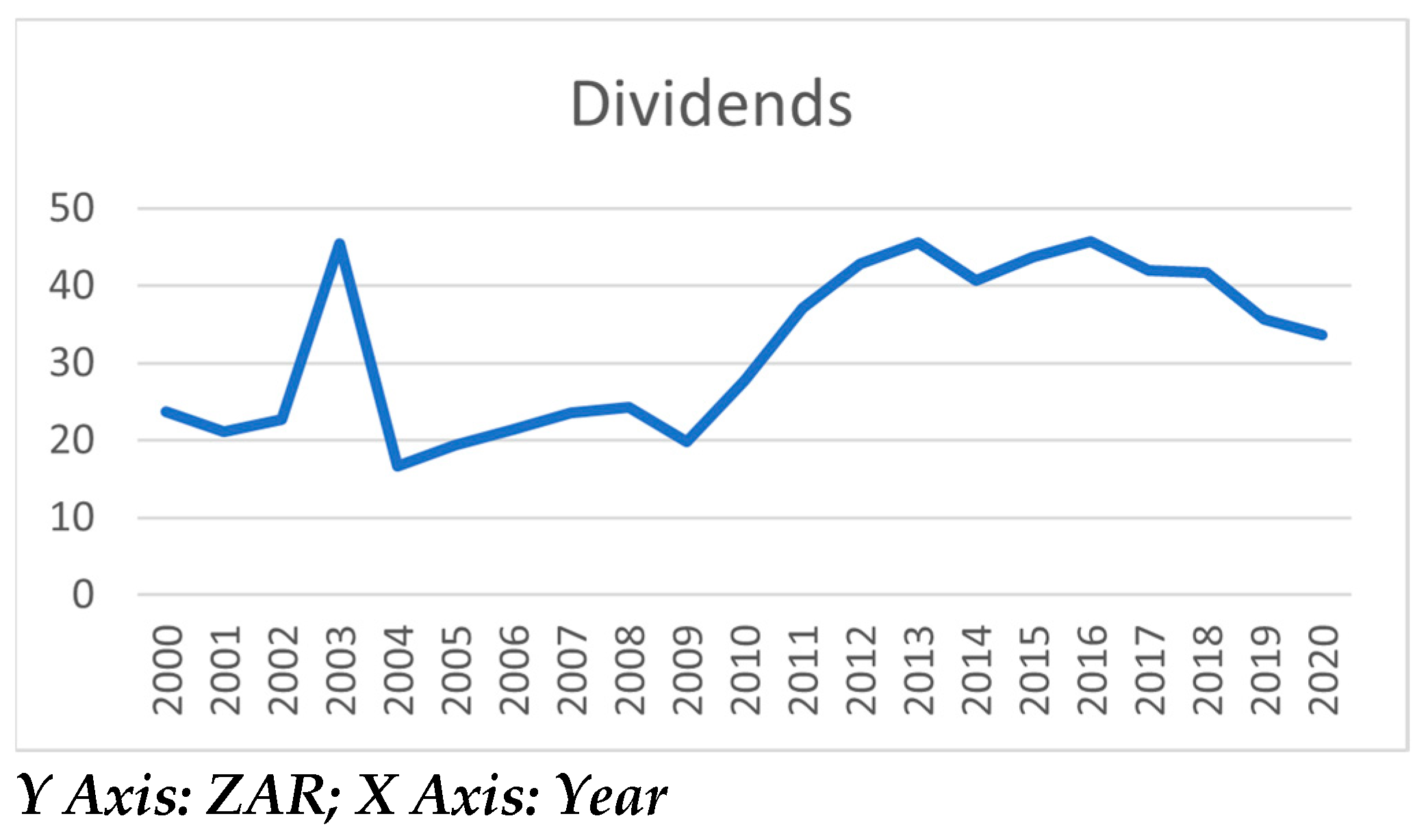
The aggregate market dividend depicted in
Figure 1 starts at R24 and remains in this range till 2002, then it doubles in 2003. It then falls significantly to R17, the lowest dividend per share in the sample period and it remains in this range till 2006 when it reaches R24 again and remains in this range till it increases in 2011 to R37 and continues to increase, reaching a high of R46 in 2013 and 2016. After this it decreases to R36 in 2019 and then R34 in 2020.
4.2. Stationarity Testing
Table 3 depicts the results from the unit root test carried out to ensure the appropriate use of the ARDL I(1) but never I(2) (
Shrestha and Bhatta 2018). The ADF test is the main test applied and the PP test is used as confirmation for the ADF. Results show that dividends, index price, total exchange rate and interest rate are stationary at first difference (I(1)).
As seen in
Table 3, variables were found to be stationary at I(1) and can therefore be used in the context of an ARDL model; these variables will be tested for the presence of cointegration using the bounds test. The presence of cointegration means that the ARDL model can be used, and the results will be discussed in the following section.
4.3. Bounds Test for Cointegration
The bounds test is contained in
Table 4, which shows that there is a long-run relationship between variables in the model because the F-statistic value is greater than all upper bound critical values and therefore the null hypothesis of no cointegration can be rejected. This means that variables have a long-run relationship; despite them potentially diverging from equilibrium in the short run, they tend to return to this equilibrium in the long run.
A long-run relationship between dividends and market index price can be explained by the signaling theory; dividends being a way of communicating the financial health of companies means that the continuous payment of dividends will signal either the success or failure of companies in the market.
The financial health of companies is something that links dividends and share prices; if dividends are an indication of the financial health of companies and if the financial health of companies determines their share prices, then the financial success or failure of these companies is reflected in the increase or decrease in the market index price.
4.4. Diagnostics Testing
Table 5 below shows that the optimal lag selection was done by EViews 12, using the AIC, which delivered an optimal model of (3, 2, 0, 2). In this model, market index price is the dependent variable, and the model was run with an unrestricted constant and trend, with dividends, exchange rate and interest rate serving as dynamic regressors.
Dividends were found to have a significant negative effect on index price, meaning a 1 unit increase in dividends would result in an approximate R216 decrease in index price, and in the first period after payment this effect is reversed, meaning a 1 unit increase in dividends would result in a R230 increase in dividends.
The adjusted R-squared is 99.69%, meaning that 99.69% of the explanatory variables explain the dependent variable and therefore the model has a good fit. Finally, the Durbin–Watson Stat is greater than the R-Squared, meaning that the regression is likely not spurious, and the F-statistic p-value is 0.0000, which means that there are no errors in the model. The initial estimation of the ARDL model will be followed by a series of diagnostic tests to ensure that there are no violations of the assumptions associated with a regressive model. The following tests are related to the market price index model: the autocorrelation test, the heteroscedasticity test, and finally, the normality test, which will be discussed in turn below.
4.4.1. Autocorrelation
Autocorrelation can be detected using the serial correlation test in EViews 12. The chi-square is used as the p-value and tested against the following criterion: if the p-value is greater than 0.05, the null hypothesis that there is no autocorrelation will be accepted. However, if the p-value is less than 0.05, the null hypothesis will be rejected and the alternative hypothesis that there is autocorrelation will be accepted.
Autocorrelation was tested for the index price model for up to 4 lags which are depicted in
Table 6. The model delivered a chi-square
p-value of 0.001 which is below 0.05 and therefore autocorrelation may be present, and the Newey–West covariance method will be applied as a remedy for the presence of autocorrelation.
4.4.2. Heteroscedasticity
Heteroscedasticity can be measured using numerous tests, one of them being the Harvey test, which will be applied in this study. The chi-square is used as a measure for the p-value and tested against the following criteria: when the p-value is greater than 0.05, the null hypothesis that there is no heteroscedasticity will be accepted; when the p-value is less than 0.05 then the null hypothesis will be rejected and the alternative hypothesis that there is heteroscedasticity will be accepted.
The Harvey test was conducted for both the index price models depicted in
Table 7. The model delivered a chi-square
p-value of 0.631 which is greater than 0.05 and therefore the null hypothesis of no heteroscedasticity can be accepted.
4.4.3. Normality Testing
Concerning normality, the null hypothesis is that normality is present if the p-value of the Jarque–Bera is greater than 0.05, while the alternative hypothesis is that there is no normality should the
p-value be less than 0.05. In
Table 8, normality was found to be present for the index price model as the Jarque–Bera had a
p-value of 0.6662, which is greater than 0.05 and therefore normality can be assumed to be present in the residuals.
4.4.4. Stability Tests
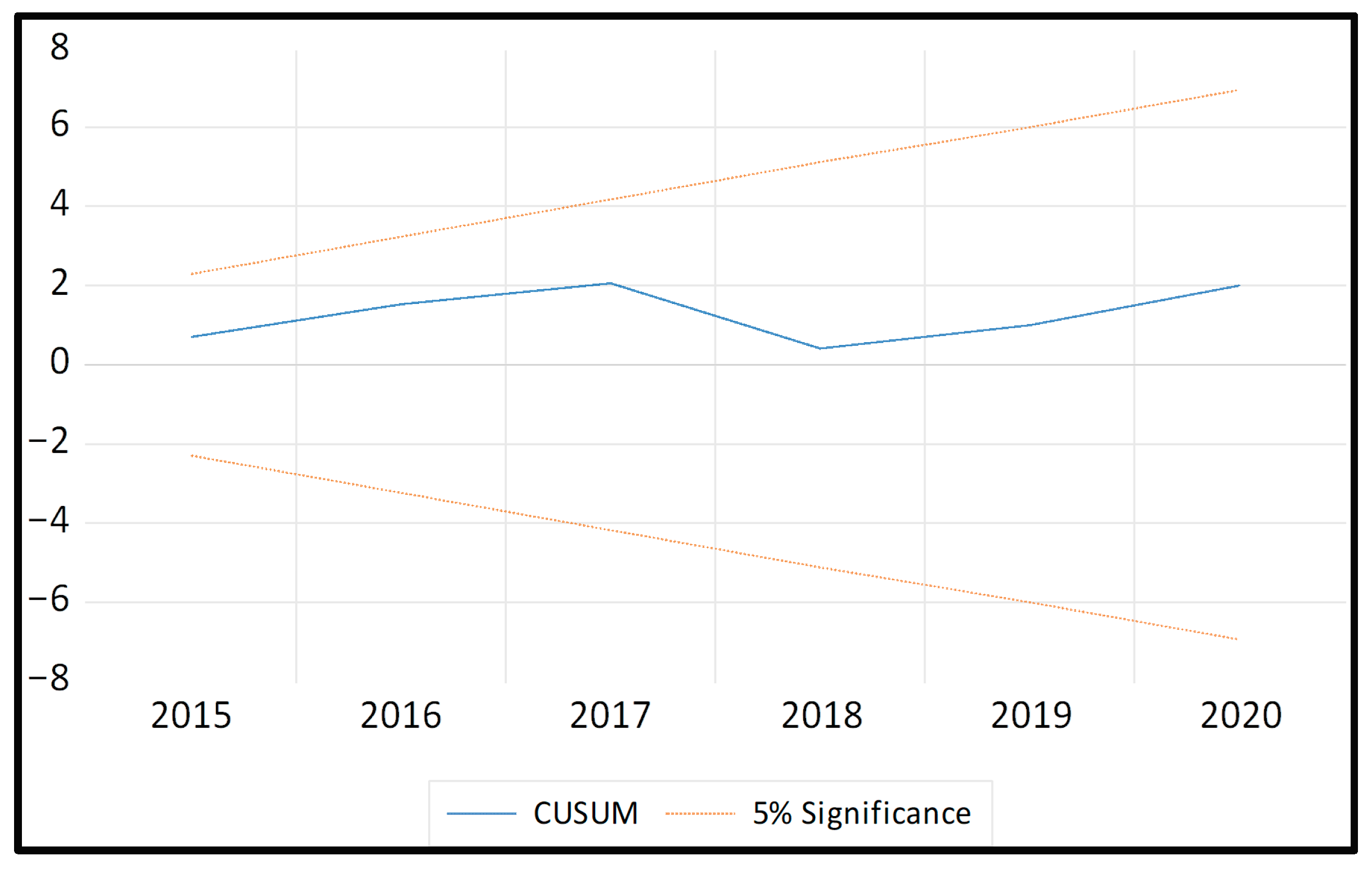
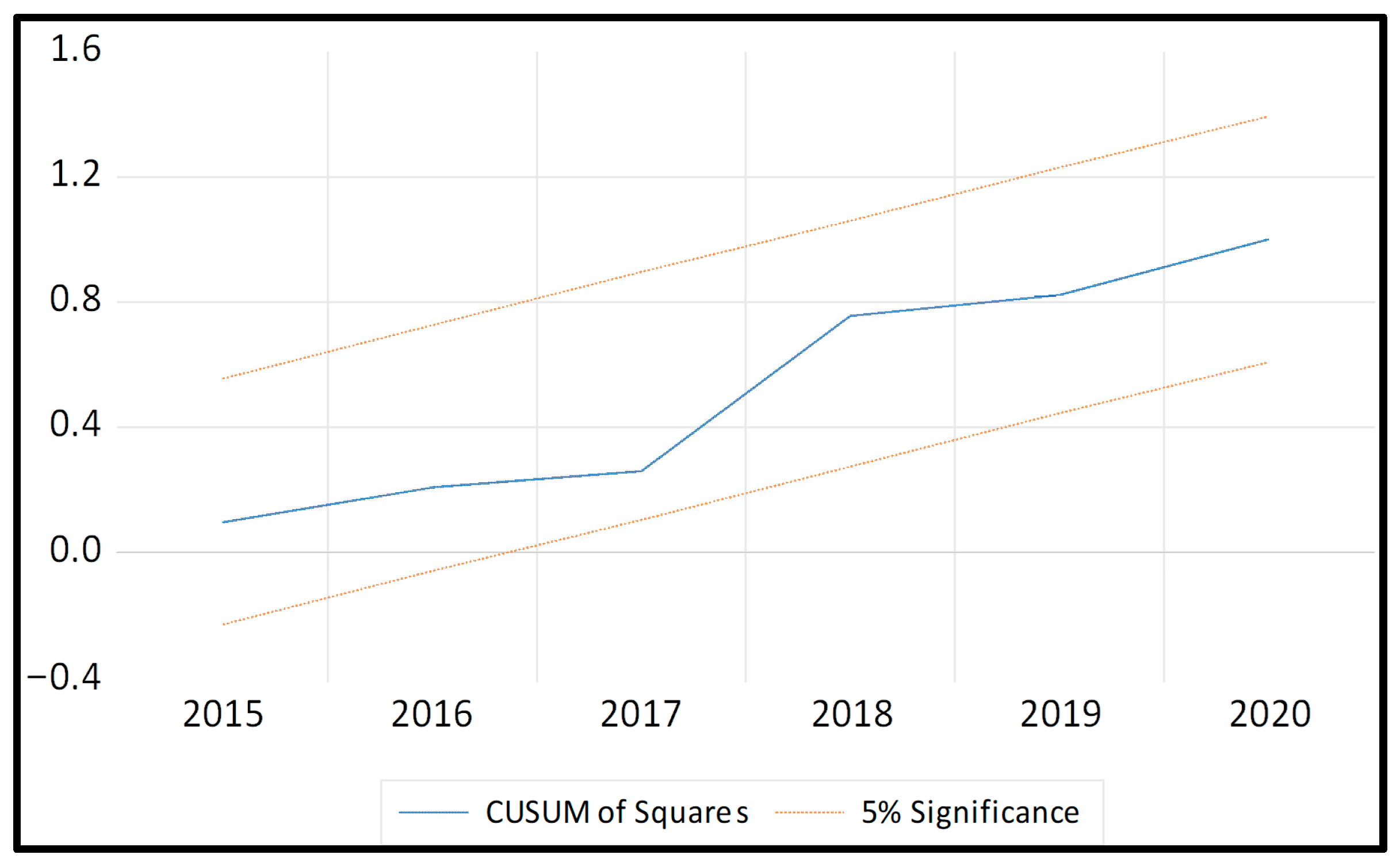
Stability tests were conducted for both the index price using the Cumulative Sum (CUSUM) and the Cumulative Sum of Squares (CUSUMSQ). The null hypothesis is that the coefficient vector in the error correction model remains the same in all periods; in other words it is stable, i.e., the CUSUM and CUSUMSQ statistics stay within the bound of 5% significance for the null hypothesis of stability to be accepted (
Bahmani-Oskooee and Ng 2002).
Figure 2 and
Figure 3 below depict the results of the stability test for the CUSUM and CUSUMSQ of the index price model and show that residuals were within the 5% significance boundary and that therefore the null hypothesis of stability can be accepted. While formal structural break tests were not conducted, the CUSUM and CUSUMSQ stability tests indicate stable coefficients throughout the sample period decreasing albeit not eliminating concerns about structural change.
4.5. Market Price Index Model After Diagnostics Testing
The optimal lag selection was done automatically by EViews using the AIC which delivered an optimal model of (3, 2, 0, 2). The model also applied the Newey–West covariance method to account for the presence of autocorrelation. Results of the final model are depicted in
Table 9; in this model, market index price is the dependent variable, and the model was run with an unrestricted constant and trend with dividends, exchange rate and interest rate serving as dynamic regressors.
Dividends were found to have a negative significant effect at a 1% significance level on index price initially paid and then have a positive significant effect in the first period after payment is made, also at a 1% significance level, and in contrast to the initial model, in the second period after payment is made becomes negative and significant at a 5% significance level.
The contemporaneous dividend coefficient being significant and negative suggests that when dividends are announced or paid, the immediate initial market reaction is a decrease in the index level and while this is counter to the previous literature, this result points to a clientele preference for capital gains in the South African market. Payment of dividend could signal and be interpreted as a diversion of funds away from profitable reinvestment opportunities or even a lack thereof; this interpretation is especially likely in a market where institutional investors who prefer capital appreciation dominate.
On the other hand, the lagged dividend coefficient being significant and positive suggests a delayed reaction to dividend-related information; once the market has time to process the impact, which turns favorable. This delayed adjustment is consistent with seminal work on behavioral finance from
Bernard and Thomas (
1989) and
Hong and Stein (
1999) which suggests that information is processed by investors progressively and therefore time was needed to fully absorb dividend-related news and provide a more accurate measure of the effect of dividends on market value.
Interest rate has a strong negative effect on index price, which is consistent with expectations because an increase in interest rate would result in a decrease in firm profits. A decrease in profitability will likely result in a decrease in share prices across companies listed on the JSE, all things remaining equal. An increase in interest rates could also cause investors to shift their preference to fixed-income securities. Thereby, causing a decrease in demand for shares, which causes prices to decrease. The optimal model determined by the AIC did not identify any lags relating to interest rates and therefore the effect of an increase in interest rates in other periods will not be accounted for.
The exchange rate represented in this model is the USD-to-ZAR rate. The effect of the USD-to-ZAR exchange rate is mixed. The relationship between exchange rates and index prices is informed by the level of imports and exports conducted by the firms on the JSE. An increase in exchange rates causing an increase in index prices is likely attributed to companies’ export levels; it is likely that listed companies’ export prices are increased by the increase in exchange rates, meaning an increase in revenue, which is likely to result in an increase in profits, all things remaining constant. When an increase in exchange rates causes a decrease in index price, this is likely because of import levels across listed firms, meaning that an increase in exchange rates increases company costs, which therefore decreases their profits across companies and in turn decreases index price, all things remaining constant.
4.6. Short-Run Error Correction Model Results
The error correction term (ECT), denoted by the term CointEq(−1), indicates how long it takes a variable to adjust to equilibrium in the dynamic model, i.e., the speed of adjustment. It is expected to be negative and statistically significant, which would indicate the presence of a stable long-run relationship.
Table 10 delivers a negative, highly significant ECT, indicating the presence of a stable long-run relationship for both models at 1% levels of significance. The coefficient indicates a relatively quick adjustment speed to equilibrium in the market price index model. The results also show that dividends have a significant negative relationship with market index price in the short run at a 1% significance level.
The short-run model shows a negative contemporaneous response to changes in dividends but a positive lagged response which mirrors the long-run results. These results again could be interpreted as investors’ initial reaction to dividends as a diversion away from growth opportunities that later turn favorable over time. The combined ARDL and ECM results now allow for a formal evaluation of the study’s hypotheses which is presented in the following subsection.
4.7. Hypothesis Evaluation
The empirical results provide support for all four hypotheses, and these will be discussed in turn:
- i.
H1 can be accepted, as the bounds test confirms a statistically significant long-run cointegrating relationship between aggregate dividends and the JSE market index.
- ii.
H2 can be accepted as the ARDL and ECM results show a negative contemporaneous effect of dividends on the index in the short run.
- iii.
H3 can be accepted as lagged dividend coefficients are positive and significant which indicates that the market adjusts to dividend information over time in line with the seminal literature on gradual information assimilation such as
Bernard and Thomas (
1989).
- iv.
Overall, these findings confirm that dividends have a significant effect on the South African market which is both time-dependent and shaped by the broader macroeconomic environment as seen in
Uwuigbe et al. (
2025).
4.8. Limitations of the Study
This study is not without limitations which will be discussed in turn:
- i.
The use of annual data smooths short-term market reactions and may obscure adjustment dynamics.
- ii.
While the index approach captures aggregate behavior and it does not model firm-level heterogeneity or sector-specific responses.
- iii.
The study focuses on the South African market and results from other emerging markets with different institutional environments.
- iv.
The study period events such as the global financial crisis may have introduced structural breaks not explicitly modeled in the ARDL specification.
5. Conclusions
This study examined the dynamic relationship between aggregate dividend policy and market value on the JSE by constructing a market-capitalization-weighted dividend index and estimating an ARDL and ECM model over the period 2000 to 2020. The results show a clear long-run cointegrating relationship between dividends and the JSE market index, confirming that dividend behavior and market valuation move together over time. In the short run, dividends exert a negative contemporaneous effect on the index, but this effect becomes positive once lagged, suggesting investor adjustment over time. Macroeconomic variables, interest rate in particular, play an important role in shaping index dynamics and highlight the importance of the broader economic environment in determining value.
These findings therefore provide evidence that the impact on dividend policy in the South African market is both time and context dependent. The initial negative reaction suggests that investors may perceive dividends negatively due to a preference for capital growth, but the positive lagged response shows that once investors have time to process dividend information and implications, the market perception of dividends becomes favorable. These results align with explanations of delayed price adjustment and contradict interpretations of dividend irrelevance.
The main stakeholders that would benefit from the results of this study are investors and managers as they are the direct benefactors of information relating to dividends; recommendations for these stakeholders along with recommendations for future research will be discussed in turn:
5.1. Recommendations to Investors
The perception of dividends by South African investors seems to be as a method of wealth accumulation, therefore causing any deviation from this to be viewed negatively, which ultimately affects the development of wealth. It would be beneficial to investors to understand that a payment of dividends should not necessarily be perceived as a lack of growth opportunities for investment. It would also be beneficial to understand that consistent payment of dividends does not always equate to good financial performance in a company and vice versa. With that said, it is important that investors who currently prefer dividends understand that managers in future might choose to decrease current dividend payments or switch to a zero-dividend policy.
5.2. Recommendations to Managers
Dividends could be used as a means of signaling the financial state of the company to investors; however, it seems that investors in South Africa are more interested in capital gains. It is possible that South African investors view the payment of dividends as an opportunity cost to investing in growth opportunities. It is also possible that dividend payments are seen as a payment made because the company no longer has any viable growth opportunities in which to invest. Boards should therefore adopt dividend policies that carefully balance the short-run reaction with the long-term value signaling, particularly in sectors that rely heavily on investor perceptions.
5.3. Recommendations for Future Research
The results of this study are not exhaustive and there are still several angles from which a study regarding dividend policy in South Africa can be approached. Future research should consider extending the study to industry-specific indices or employing alternative econometric methods such as non-linear ARDL or structural break models. Comparative studies would also help contextualize the delayed market response, identifying whether it is a uniquely South African phenomenon or part of a broader behavioral pattern. Alternative weighting methods could generate marginally different patterns and therefore could be applied to another study.
In conclusion, this study provides evidence that dividend policy meaningfully affects market value in South Africa, with effects that vary across time and economic conditions. Both immediate and delayed market reactions offer new insights for investors, managers and academics seeking to understand the impact of dividends at the market level.
Author Contributions
Conceptualization, M.C.D.W. and O.C.A.; methodology, M.C.D.W.; software, O.C.A.; validation, O.C.A.; formal analysis, O.C.A.; investigation, O.C.A.; resources, O.C.A.; data curation O.C.A.; writing—original draft preparation, O.C.A.; writing—review and editing, M.C.D.W.; visualization, O.C.A.; supervision M.C.D.W.; project administration, O.C.A. All authors have read and agreed to the published version of the manuscript.
Funding
This research received no external funding.
Data Availability Statement
The data supporting findings of this study are publicly available through commercial databases, specifically Thomson Reuters Datastream and EquityRT. All variables, transformations and sample selection procedures are detailed in the methodology to allow replication by researchers with access to these databases.
Conflicts of Interest
The authors declare no conflict of interest.
References
- Abdiaziz, Mohamed Abdi, Moses Kithinji, and Doren Mutegi. 2025. Effect of dividend payout on the value of firms listed at Nairobi Securities Exchange in Kenya. The Strategic Journal of Business & Change Management 12: 949–63. [Google Scholar]
- Al-Hasan, Abdullah, Md Asaduzzaman, and Rashal Al Karim. 2013. The effect of dividend policy on share price: An evaluative study. IOSR Journal of Economics and Finance 1: 6–11. [Google Scholar] [CrossRef]
- Ali, Masoor, Muzamil Saeed, and Muhammad Adeel Khalid. 2023. The Role of Dividend Policy on Stock Price Volatility: An analysis and Evidence from Pakistan. Research Journal for Societal Issues 5: 157–70. [Google Scholar] [CrossRef]
- Asteriou, Dimitrios, and Stephen G. Hall. 2007. Applied Econometrics: A Modern Approach. London: Palgrave McMillian. [Google Scholar]
- Bahmani-Oskooee, Moshen, and Raymond Chi Wing Ng. 2002. Long-run demand for money in Hong Kong: An application of the ARDL model. International Journal of Business and Economics 1: 147. [Google Scholar]
- Banda, Kamoto, John Henry Hall, and Rudra P. Pradhan. 2019. The impact of macroeconomic variables on industrial shares listed on the Johannesburg Stock Exchange. Macroeconomics and Finance in Emerging Market Economies 12: 270–92. [Google Scholar] [CrossRef]
- Ben-David, Itzhak. 2010. Dividend policy decisions. In Behavioral Finance. New York: John Wiley & Sons, pp. 435–51. [Google Scholar]
- Bernard, Victor L., and Jeffry S. Thomas. 1989. Post-Earnings-Announcement Drift: Delayed Price Response or Risk Premium? Journal of Accounting Research 27: 1–36. [Google Scholar] [CrossRef]
- Bezawada, Brahmaiah, and Ravi Kumar Tati. 2017. Dividend policy and firm valuation—A study of Indian electrical equipment manufacturing industry. Theoretical Economics Letters 7: 1233–43. [Google Scholar] [CrossRef][Green Version]
- Bhattacharya, Sudipto. 1979. Imperfect Information, Dividend Policy, and “The Bird in the Hand” Fallacy. The Bell Journal of Economics 10: 259–70. [Google Scholar] [CrossRef]
- Bwowa, Culverwell, Mouton Marise, and Milan C. de Wet. 2024. Effects of credit rating changes on corporate capital structure in South Africa. Journal of Economic and Financial Sciences 17: a866. [Google Scholar] [CrossRef]
- Charteris, Ailie, and Kudakwashe J. Chipunza. 2020. Stock prices and dividends: A South African perspective. Investment Analysts Journal 49: 1–15. [Google Scholar] [CrossRef]
- De Wet, Johannes, and Mvita Mpinda. 2013. The impact of dividend payments on shareholders’ wealth: Evidence from the Vector Error Correction Model. International Business & Economics Research Journal 12: 1451–65. [Google Scholar]
- De Wet, Milan Christian, and Milan Heckroodt van Wyk. 2025. The connectivity between content elements and SDGs in the South African banking industry. Sustainability 17: 2572. [Google Scholar] [CrossRef]
- El-Deeb, Mohamed Samy, and Mohamed Fathy Allam. 2024. The moderating effect of dividend policy on the relationship between the corporate risk disclosure and firm value: Evidence from Egypt. Future Business Journal 10: 25. [Google Scholar] [CrossRef]
- Erasmus, Pierre. 2013. The influence of dividend yield and dividend stability on share returns: Implications for dividend policy formulation. Journal of Economic and Financial Sciences 6: 13–31. [Google Scholar] [CrossRef][Green Version]
- Fabozzi, Frank J. 2025. Capital Markets: Institutions, Instruments, and Risk Management. Cambridge: MIT Press. [Google Scholar]
- Hong, Harrison, and Jeremy C. Stein. 1999. A unified theory of underreaction, momentum trading, and overreaction in asset markets. The Journal of finance 54: 2143–84. [Google Scholar] [CrossRef]
- Iturriaga, Felix J. Lopez, and Vincete Lima Crisóstomo. 2010. Do leverage, dividend payout, and ownership concentration influence firms’ value creation? An analysis of Brazilian firms. Emerging Markets Finance and Trade 46: 80–94. [Google Scholar] [CrossRef]
- Jensen, Michael C, and William H. Meckling. 1976. Theory of the firm: Managerial behavior, agency costs and ownership structure. Journal of Financial Economics 3: 305–60. [Google Scholar] [CrossRef]
- Khalaf, Bashar Abu, Antoine B. Awad, and Saman Sarfraz Ahmed. 2023. The Impact of Dividend Policy on Share Price Volatility: Evidence from Listed Companies in Gulf Cooperation Council Countries. Corporate And Business Strategy Review 4: 289–95. [Google Scholar] [CrossRef]
- Khan, Khalid Ijaz I., Muhammad Aamir, Abdul Qayyum, Asad Nasir, and Muhammad Imran Khan. 2011. Can dividend decisions affect the stock prices: A case of dividend paying companies of KSE. International Research Journal of Finance and Economics 76: 69–74. [Google Scholar]
- Krishnan, CNV, and Yifei Chen. 2020. The relationship between dividend payout and price to earnings. Journal of Accounting and Finance 20: 111–30. [Google Scholar] [CrossRef]
- Kumar, Amit, and Pankaj Sinha. 2024. Changing dividend payout behavior and predicting dividend policy in emerging markets: Evidence from India. Investment Management and Financial Innovations 21: 259–74. [Google Scholar] [CrossRef]
- Liviani, Ratu, and Yoga Tantular Rachman. 2021. The influence of leverage, sales growth, and dividend policy on company value. International Journal of Financial, Accounting, and Management 3: 165–78. [Google Scholar] [CrossRef]
- Lütkepohl, Helmut. 2005. New Introduction to Multiple Time Series Analysis. Berlin/Heidelberg: Springer. [Google Scholar] [CrossRef]
- Mamaro, Lenny P, and Robert N. Tjano. 2019. The relationship between dividend payout and financial performance: Evidence from Top 40 JSE firms. The Journal of Accounting and Management 9: 5–19. [Google Scholar]
- Miller, Merton H, and Franco Modigliani. 1961. Dividend policy, growth, and the valuation of shares. The Journal of Business 34: 411–33. [Google Scholar] [CrossRef]
- Mueller, Dennis C. 1972. A life cycle theory of the firm. The Journal of Industrial Economics 20: 199–219. [Google Scholar] [CrossRef]
- Ndlovu, Boldwin, Faisal Faisal, Nil Gunsel Resatoglu, and Turgut Türsoy. 2018. The impact of macroeconomic variables on stock returns: A case of the Johannesburg Stock Exchange. Romanian Statistical Review 66: 87–104. [Google Scholar]
- Njoku, Okechukwu Enyeribe, and Younghwan Lee. 2024. Revisiting the effect of dividend policy on firm performance and value: Empirical evidence from the Korean market. International Journal of Financial Studies 12: 22. [Google Scholar] [CrossRef]
- Nyere, Lovemore, and Nicolene Wesson. 2019. Factors influencing dividend payout decisions: Evidence from South Africa. South African Journal of Business Management 50: 1–16. [Google Scholar] [CrossRef]
- Paminto, Ardi, Djoko Sinaga, and Jhonny Setyadi. 2016. The effect of capital structure, firm growth and dividend policy on profitability and firm value of the oil palm plantation companies in Indonesia. European Journal of Business and Management 8: 123–124. [Google Scholar]
- Pelcher, Lydia. 2019. The role of dividend policy in share price volatility. Journal of Economic and Financial Sciences 12: 1–10. [Google Scholar] [CrossRef]
- Pesaran, Mohammad Hashem, and Yongcheol Shin. 1995. An Autoregressive Distributed Lag Modelling Approach to Cointegration Analysis. Cambridge: Department of Applied Economics, University of Cambridge, vol. 9514. [Google Scholar]
- Pesaran, Mohammad Hashem, Yongcheol Shin, and Richard J. Smith. 2001. Bounds testing approaches to the analysis of level relationships. Journal of Applied Econometrics 16: 289–326. [Google Scholar] [CrossRef]
- Pristiana, Ulfi, and Muis Murtadho. 2025. Improving Firm Value to Dividend Policy Evidence of Indonesia Public Company in Emerging Market. Jurnal Ilmiah Manajemen Kesatuan 13: 2521–32. [Google Scholar] [CrossRef]
- Priya, K, and Balasundaram Nimalathasan. 2013. Dividend policy ratios and firm performance: A case study of selected hotels & restaurants in Sri Lanka. Global Journal of Commerce & Management Perspective 2: 16–22. [Google Scholar]
- Rashid, Afzalur, and AZM Anisur Rahman. 2008. Dividend policy and stock price volatility: Evidence from Bangladesh. The Journal of Applied Business and Economics 8: 71. [Google Scholar]
- Raza, Hamad, Suresh Ramakrishnan, Syed Muhammad Ahmad Hassan Gillani, and Humara Ahmad. 2018. The effect of dividend policy on share price: A conceptual review. International Journal of Engineering & Technology 7: 34–39. [Google Scholar] [CrossRef]
- Rehman, Obaid Ur. 2016. Impact of capital structure and dividend policy on firm value. Journal of Poverty, Investment and Development 21: 40–57. [Google Scholar]
- Saunders, Mark, Phillip Lewis, and Thornhill Adrian. 2019. Research Methods for Business Students, 8th ed. London: Pearson Education Limited. [Google Scholar]
- Shrestha, Min B., and Guna R. Bhatta. 2018. Selecting appropriate methodological framework for time series data analysis. The Journal of Finance and Data Science 4: 71–89. [Google Scholar] [CrossRef]
- Sirucek, Martin. 2012. Macroeconomic Variables and Stock Market: US Review. MPRA Paper 39094. Munich: University LMU. [Google Scholar]
- Sudiani, Ni Kadek Ayu, and I Gusti Bagus Wiksuana. 2018. Capital structure, investment opportunity set, dividend policy and profitability as firm value determinants. Russian Journal of Agricultural and Socio-Economic Sciences 81: 259–67. [Google Scholar] [CrossRef]
- Tembo, Margret, and Chimwemwe Chipeta. 2024. Institutional determinants of dividend policy of African listed firms. Investment Analysts Journal 53: 286–303. [Google Scholar] [CrossRef]
- Uwuigbe, Uwalomwa, Uwuigbe Olubukunola, Damilola Eluyela, Osman Issah, Alex Adegboye, and Saidu Musa. 2025. The impact of dividends, cash flow, and earnings on equity valuation of listed firms in Nigeria. Investment Management and Financial Innovations 22: 318–34. [Google Scholar] [CrossRef]
- Vermeulen, Marise, and Eon Smit. 2011. Dividend payout and future earnings growth: A South African study. South African Journal of Business Management 42: 33–46. [Google Scholar] [CrossRef]
| Disclaimer/Publisher’s Note: The statements, opinions and data contained in all publications are solely those of the individual author(s) and contributor(s) and not of MDPI and/or the editor(s). MDPI and/or the editor(s) disclaim responsibility for any injury to people or property resulting from any ideas, methods, instructions or products referred to in the content. |