Article

Collusion Between Retailers and Customers: The Case of Insurance Fraud in Taiwan

1
Department of Economics, CREST-Ecole Polytechnique, 91128 Palaiseau, France
2
Department of Risk Management and Insurance, National Chenghi University, Taipei 11605, Taiwan
3
Department of Insurance, Tamkang University, New Taipei 25137, Taiwan
*
Author to whom correspondence should be addressed.
Risks 2026, 14(3), 60; https://doi.org/10.3390/risks14030060
Submission received: 29 December 2025 / Revised: 21 February 2026 / Accepted: 25 February 2026 / Published: 9 March 2026

Abstract

This study analyzes how the insurance distribution channel can affect insurance fraud. It uses econometric models that confirm the existence of claim manipulation as a form of insurance fraud, whereby policyholders circumvent the bonus–malus system and reduce the actual burden of insurance deductibles. The econometric approach is based on joint regression models for the probability that a claim is manipulated on one hand, and the probability that the policyholder has strong incentives to do so, on the other hand. The estimation shows that there is a significantly positive residual correlation between these regressions, which establishes the likelihood of fraudulent claim manipulation. The econometric modelling of claim cost allows us to disentangle the manipulation of claims that correspond to true losses and small false claims filed at the end of the policy year, and also to highlight the role of the insurance distribution channel in these fraud mechanisms. Using data from two Taiwanese car insurers with very different distribution channels in 2010, we compare an insurer that relies heavily on dealer-owned agents (DOAs) with another insurer that does not rely on DOAs at all. We find strong evidence of severe claim manipulation when insurance is sold through DOAs. Moreover, as the first insurer significantly reduced its reliance on the DOA channel over time, we perform a before–after comparison using data from 2010 and 2018. The results show that the claim manipulation fraud previously observed in the DOA channel decreases as the market share of this distribution channel is reduced. All these results highlight the role of automobile insurance agencies in facilitating this fraud process. The theoretical underpinnings of our analysis are provided by a claim fraud model considering collusion and audit.

1. Introduction

Vertical relationships often involve outsourcing services from upstream companies to downstream retailers. Due to the way the latter operate, this can be the source of agency costs and may involve collusion between retailers and customers, who exploit loopholes in contracts between producers and customers. Discount fraud and warranty fraud are examples of such inappropriate customer behaviors that involve collusion with retailers or front-line employees. Discount fraud exploits special discounts that companies may offer in particular circumstances, for instance, when discounted products are used for a specific purpose, such as educational purposes for software. Warranty fraud occurs mainly when a service provider—such as an automobile repairer—replaces a defective part with a new spare part and triggers the manufacturer’s warranty, although the defective part was not original and therefore not protected by the warranty.
This study investigates another form of customer misbehavior facilitated by service providers acting on behalf of distributors: insurance fraud. We focus our attention on the Taiwanese car insurance market and on the role of car dealer-owned insurance agents (DOAs). In these cases, car dealers both sell automobile insurance to their customers and own an automobile repair shop. Understandably, this multi-faceted activity and the long-term connection with car owners favor collusion between policyholders and DOAs when the settlement of a claim gives rise to a negotiation with the insurer. With respect to insurance fraud itself, we will focus our attention on two cases of misconduct that have been observed in Taiwan, with both taking the form of a concentration of claims during the last months of the policy year. First of all, policyholders may file small false claims (i.e., claims that do not correspond to any loss) before the end of the policy year if they have not received compensation previously, a behavior highlighted by Li et al. (2013). Recouping part of the insurance premium paid to allegedly unfair insurers can be the psychological motivation behind this behavior. Secondly, per-claim deductibles and the bonus–malus mechanism can incentivize policyholders to manipulate claims that correspond to actual losses. This involves postponing these claims to the last month of the policy year and inflating them, either by bundling several losses in a single claim or by building up cost reports. Disentangling these two types of fraud (called premium recouping and claim manipulation, respectively) and assessing the role of DOAs in both of them are the main challenges addressed in the present study.
Our analysis is built on a database obtained from two major Taiwanese insurance companies. Company 1 provided information about the policyholders who filed an automobile claim in 2010 or 2018 and company 2 in 2010 only. Company 1 relied heavily on DOAs to sell policies, although the market share of this distribution channel decreased significantly from 2010 to 2018, while company 2 never used DOAs.
Starting with the year 2010, our results confirm that there was more manipulation of claims when insurance policies were sold through DOAs than other distribution channels and also that deductibles promoted fraud.1 As observed by Li et al. (2013), the logic of the claim manipulation mechanism can be found in the Taiwanese bonus–malus system, as well as in the incentives inherent in the design of deductible contracts. We will provide evidence on this mechanism indirectly, by showing that in 2010, the intertemporal pattern of claims was consistent with the manipulation of claims favored by DOAs, after controlling for other explanations, including moral hazard and premium recouping behavior.2 Things changed dramatically between 2010 and 2018: DOAs were less frequently used by insurers, with presumably lower bargaining power at the claims settlement stage. In other words, in 2018, it was more difficult for DOAs to collude with their clients at the expense of the insurer. As we will show, the role of DOAs as facilitators of insurance fraud through claim manipulation disappeared in 2018, in line with the decrease in their bargaining power.
The theoretical foundations of this analysis are provided by an insurance market model presented in the appendix that focuses on the strategic interaction between, on one hand, policyholders who file fraudulent claims by colluding with car repairers and/or insurance agents and, on the other hand, insurers who audit claims. The audit of claims is all the more costly as collusion is more difficult to detect, which is particularly the case when car repairers are sheltered by DOAs. In addition, if irregularities are detected by the insurer, the bargaining power of DOAs may allow them to dissuade insurers from enforcing penalties. The result is a higher fraud rate when insurance is distributed by DOAs than through other channels. This is reinforced in the case of deductible contracts, as deductibles increase the gain that policyholders obtain from fraud and weaken insurers’ incentives to monitor claims.
This study is organized as follows: In Section 2, we describe the background of our analysis, both from a factual and theoretical point of view. We introduce some factual observations about the timing of automobile insurance claims in Taiwan and describe regular fraud patterns by distinguishing premium recouping from claim manipulation. We also introduce a costly state verification model that provides the theoretical foundations of our approach to insurance fraud, featuring the interaction between a policyholder who may manipulate claims and an insurer who performs audits randomly. The model shows that this interaction leads to an equilibrium level of fraud determined by parameters related to the insurance contract and the insurance agent. We here only provide an intuitive presentation of the model, with more details being given in the appendix. In Section 3, we present the methodology of our empirical analysis, describing our objectives and conjectures, the data, and our econometric approach. In Section 4, we present and discuss our results. They contribute to the econometric analysis of insurance fraud in three ways: firstly, by disentangling premium recouping and claim manipulation in the Taiwanese car insurance market; secondly, by highlighting the role of DOAs in these mechanisms; and thirdly, by showing that this role deeply changed from 2010 to 2018. Conclusions are presented in Section 4. The insurance market model that supports our analysis is presented more completely in Appendix A.

2. Background

2.1. Factual Background

Our investigation will be based on information provided by two major Taiwanese insurers, called companies 1 and 2, about their automobile policyholders and claims in 2010 and 2018. In 2010, company 1 sold approximately 37% of its automobile insurance policies through DOAs, and this share dropped to about 20% in 2018. On the contrary, company 2 never sold insurance through the DOA channel.3
Insurance agents, whether DOAs or standard agents, are responsible for handling claims. These are often negotiations between, on the one hand, the insurer who aims to minimize the cost of claims and, on the other hand, agents, who can favor their clients, especially when they receive commissions based on sales. In this bargaining process, DOAs benefit from the size of their activity and the fact that they own the list of their clients. In particular, an insurer who discovers a claim manipulation by a DOA may be reluctant to take retaliatory actions because of this strategic advantage of the DOAs, who could switch to another insurer.4 In the case of company 1, it is likely that the bargaining power of the DOAs decreased between 2010 and 2018, as this insurer significantly reduced its dependence on DOAs. The specificity of DOAs also has an informational dimension because they work in partnership with car repairers, with both being sheltered by car dealers. This multi-faceted agency relationship creates an informational advantage: establishing that a claim has been falsified is particularly difficult and costly when filed through a DOA.
Some information about insurance contracts is useful for the present investigation. There are three different types of automobile physical damage insurance contracts in Taiwan: types A, B and C. Type A and B contracts cover all types of losses in collision and out-of-collision events, with more exclusions for B than for A,5 while type C contracts only cover the damages incurred in a collision involving two or more vehicles. These contracts also differ in terms of compensation: type A contracts offer low coverage with a deductible, type B contracts can be purchased with or without a deductible, and type C contracts provide full coverage without a deductible. Claims are per accident, with a specific deductible for each claim. The change in premium is ruled by a bonus–malus system when policyholders renew their contracts with the same insurance company, with a no-claim discount and an increase in the premium proportional to the number of claims, without reference to their severity. Policyholders who switch to another insurance company bargain with the latter about the new starting point of their bonus–malus record.
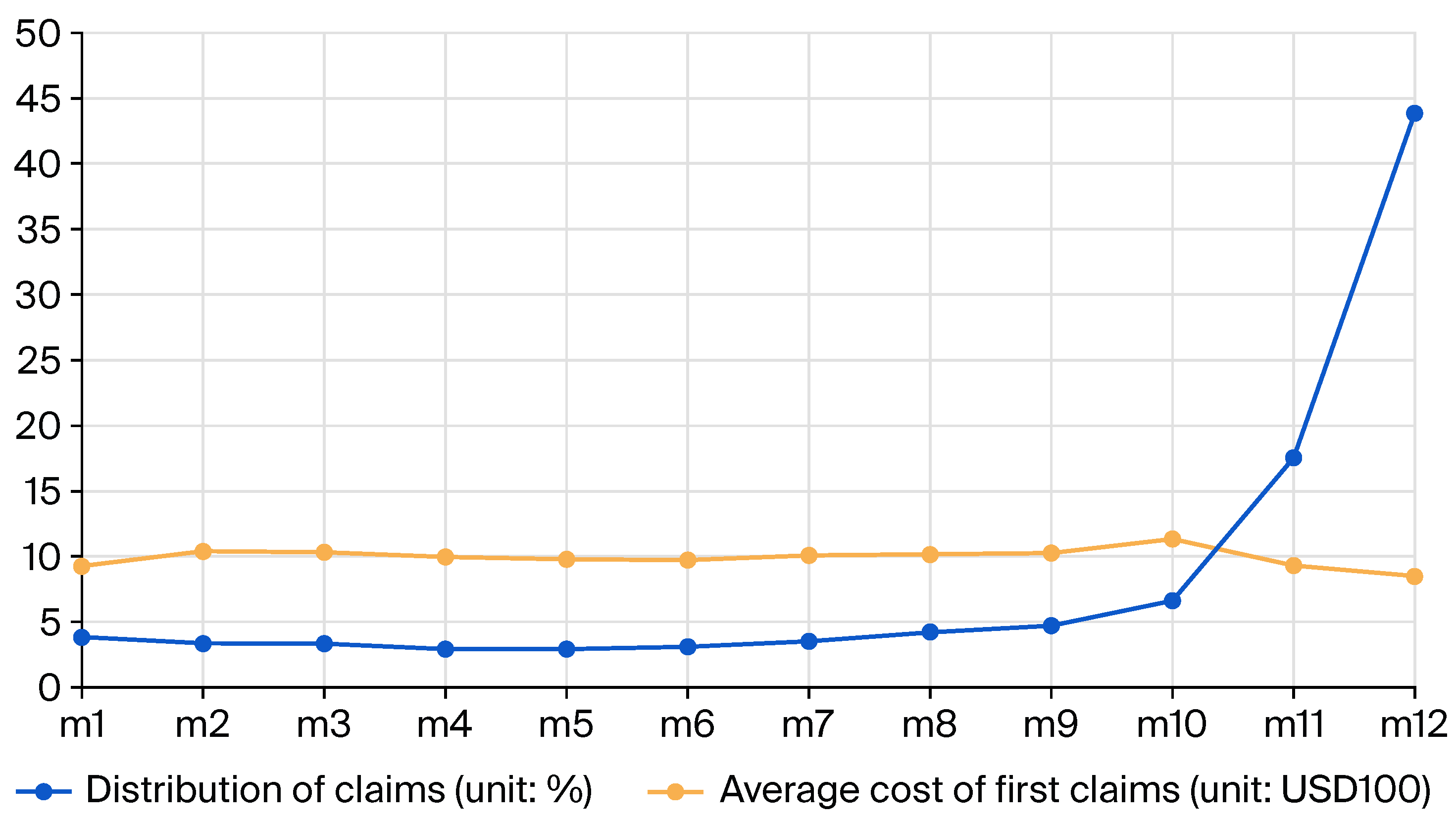
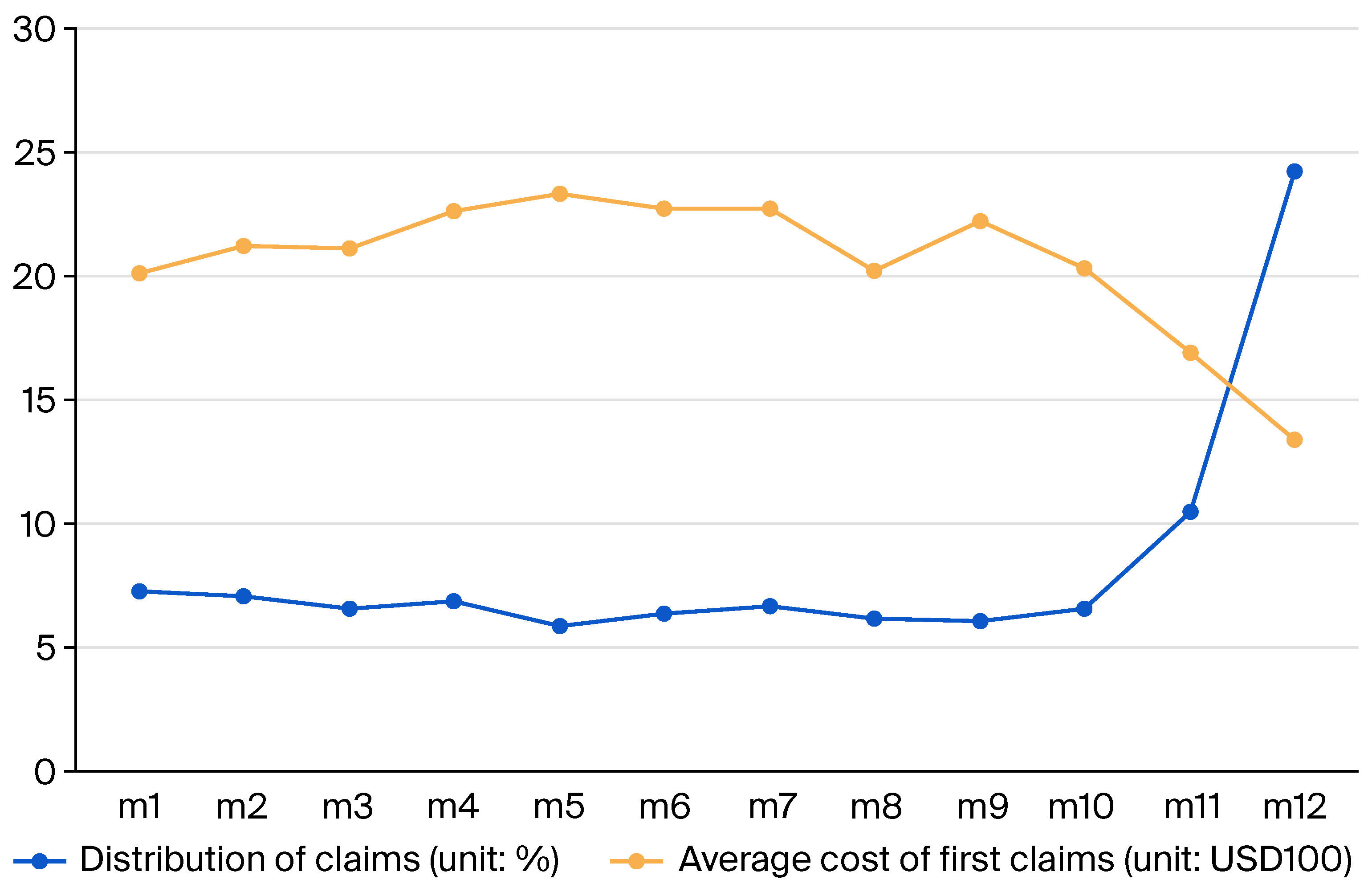
Our study is related to specific forms of automobile insurance fraud in Taiwan. Li et al. (2013) observed that a large proportion of automobile insurance claims are filed during the last months of the policy year (as opposed to the calendar year). This is confirmed by our own database. Figure 1 presents the distribution of claims and their average cost in 2010 over the twelve months of the policy year, with a striking concentration of claims and a slight decrease in claim costs in the last months.6 Li et al. (2013) interpret this phenomenon as a “premium recouping” effect: some policyholders without an accident in the previous months tend to file small false claims during the last month of the policy year, to express the feeling that they were treated unfairly by the insurance company.7 They also observe that deductible contracts and the Taiwanese bonus–malus system can encourage policyholders to postpone true claims until the end of the policy year and to cumulate several losses in a single claim, a behavior that will be called “claim manipulation” in the following.8 Type A and B contracts may be subject to such claim fraud, regardless of their modalities, contrary to type C contracts, where claims are only filed in the case of a collision with another car, with a police report being required, which makes fraud very unlikely.

2.2. Theoretical Background

A costly state verification model provides the theoretical foundations of our approach to insurance fraud. It features the interaction between a policyholder who may file fraudulent claims and an insurer who randomly audits claims. The model shows that this interaction leads to an equilibrium level of fraud determined by parameters related to the insurance contract and the insurance agent. We here only provide an intuitive presentation of the model. More details can be found in the appendix of this article.
In this model, fraud corresponds to the manipulation of claims. It is committed by policyholders who may have one or two accidents that may be small or large during the same policy year. Policyholders may postpone small claims till their last policy month. They will file one single large claim for two minor accidents presented as a severe accident if another minor accident occurs later during the same policy year. Claim manipulation reduces the retained cost of the accidents since the deductible is paid only once. It also provides an additional gain by circumventing the bonus–malus system. The insurance agent (either a DOA or a standard agent) is in charge of claim handling.
Let us denote by α and β the fraud and audit strategy of the policyholder and the insurer, respectively. The policyholder’s strategy ( α ) is the probability that he postpones a first small claim in order to file a large claim later, and the insurer’s strategy ( β ) is the probability of auditing large claims. We assume that an audit allows the insurer to detect with certainty whether the claim has been manipulated or not. If fraud is detected, then the insurer and the insurance agent (defending the interests of the policyholder) negotiate about the payment of the claim.
This defines a non-cooperative game where the policyholder chooses the fraud strategy to maximize his expected utility and the insurer chooses the audit strategy to minimize the cost of claims. At the Nash equilibrium of this game, both strategies are mutual best responses. The audit probability ( β ) makes the policyholder indifferent between manipulation and honesty, and the fraud probability ( α ) makes the insurer indifferent between auditing and non-auditing. The equilibrium strategies of the policyholder and of the insurer may be written as α * ( d , ξ , c ) and β * ( P , d , ξ ), respectively, where d is the deductible of the insurance contract, ξ is the bargaining power of the insurance agent (DOA or standard agent) in case of negotiation with the insurer, c is the audit cost, and P is the insurance premium. Most importantly, the equilibrium fraud rate ( α * ) is increasing with respect to d ,   ξ , and c, because a higher deductible, larger bargaining power of the insurance agent, or a larger audit cost makes auditing less attractive to the insurer. The larger d ,   ξ , or c, the larger the equilibrium fraud rate ( α * ) that incentivizes the insurer to audit claims with positive probability.
This leads us to simple predictions about the effect of the type of contract and distribution channel on claim manipulation. Firstly, using α d * > 0 shows that higher deductibles go along with more manipulation. In other words, for a given distribution channel, fraud is more prevalent when contracts include a deductible. Furthermore, using α ξ * > 0 and α c * > 0 shows that fraud occurs more frequently when insurance has been purchased through DOAs than standard insurance agents, either because it is more costly to audit a claim that goes through a DOA or because DOAs have larger bargaining power than standard insurance agents when they negotiate with the insurer.

3. Methodology

3.1. Objectives and Conjectures

Our overarching objective is to disentangle two distinct forms of automobile insurance fraud observed in Taiwan—premium recouping and claim manipulation—and to assess how these behaviors are shaped by contract design and insurance distribution channels, in particular, the role of dealer-owned agents (DOAs).
Building on the factual patterns documented by Li et al. (2013) and further descriptive evidence from our data, we focus on the concentration of insurance claims toward the end of the policy year. Premium recouping refers to the filing of small false claims near contract expiration by policyholders who have not previously claimed any indemnity, a behavior often interpreted as an expression of resentment or low moral cost of cheating. Claim manipulation, by contrast, involves strategic behavior surrounding real losses: policyholders postpone reporting accidents until the final policy month and inflate the reported cost of claims, either by bundling multiple losses into a single claim or by building up repair costs. Claim manipulation is particularly attractive under bonus–malus rules and per-claim deductibles.9
To operationalize these mechanisms empirically, we classify policyholders into groups based on their renewal behavior and contract characteristics. The recoup group ( R G ) includes policyholders who have not renewed their type A or B contract for more than one year after the current policy year and therefore face limited future consequences of filing a claim.10 Within R G , the suspicious group ( S G ) includes policyholders who have renewed their contract for exactly one additional year, a configuration under which the incentives to manipulate the bonus–malus system are the strongest.11 In 2010, we further distinguished two subgroups in S G : S G 1 corresponds to policyholders with no-deductible contracts, and S G 2 includes those with deductible contracts, reflecting differences in manipulation incentives. In 2018, all type A and B contracts include deductibles, and the distinction collapses accordingly.
In brief, R G policyholders are those with presumably the lowest moral cost of fraud and potentially a propensity for trying to recoup part of their insurance premium by filing small false claims by the end of the policy year. Among them, S G includes those who benefit the most from claim manipulation, by deferring actual claims to the last month of their policy year, and inflating them or bundling several losses within one single claim.
These considerations lead us to formulate testable hypotheses, where the suspicious period corresponds to the last month of the policy year, and the fraud rate is the number of claims per policyholder filed during the suspicious period.12
Hypothesis 1:
The fraud rate tends to be higher in the suspicious group than in the non-suspicious group, and this is particularly the case for individuals covered by deductible contracts.
Hypothesis 1 captures the timing dimension of fraud through claim manipulation or premium recouping. Distinguishing these two fraud patterns requires examining how the claim severity changes across the policy year. Indeed, if a substantial number of claims filed during the last policy month correspond in fact to first claims that have been postponed and inflated, possibly with the cumulated losses from several events, then these claims should be more expensive than the average. In other words, we should expect the ratio between “the average cost of first claims” and “the average cost of all claims” (hereinafter referred to as the first-claim cost ratio) to increase during this month, contrary to the premium recouping interpretation.13 Hence, conjecturing that there is a substantial amount of claim manipulation leads us to the following hypothesis.
Hypothesis 2:
In the suspicious group, the first-claim cost ratio is larger in the suspicious period than during the rest of the policy year.
Finally, our analysis emphasizes the role of DOAs in the fraud mechanism. DOAs combine insurance intermediation with close ties to repair shops and benefit from substantial bargaining power at the claims settlement stage. These features are expected to reduce the effectiveness of audits, facilitating claim manipulation, hence our third hypothesis.14
Hypothesis 3:
The fraud rate in the suspicious group is larger when insurance has been purchased through the DOA channel than through other distribution channels.
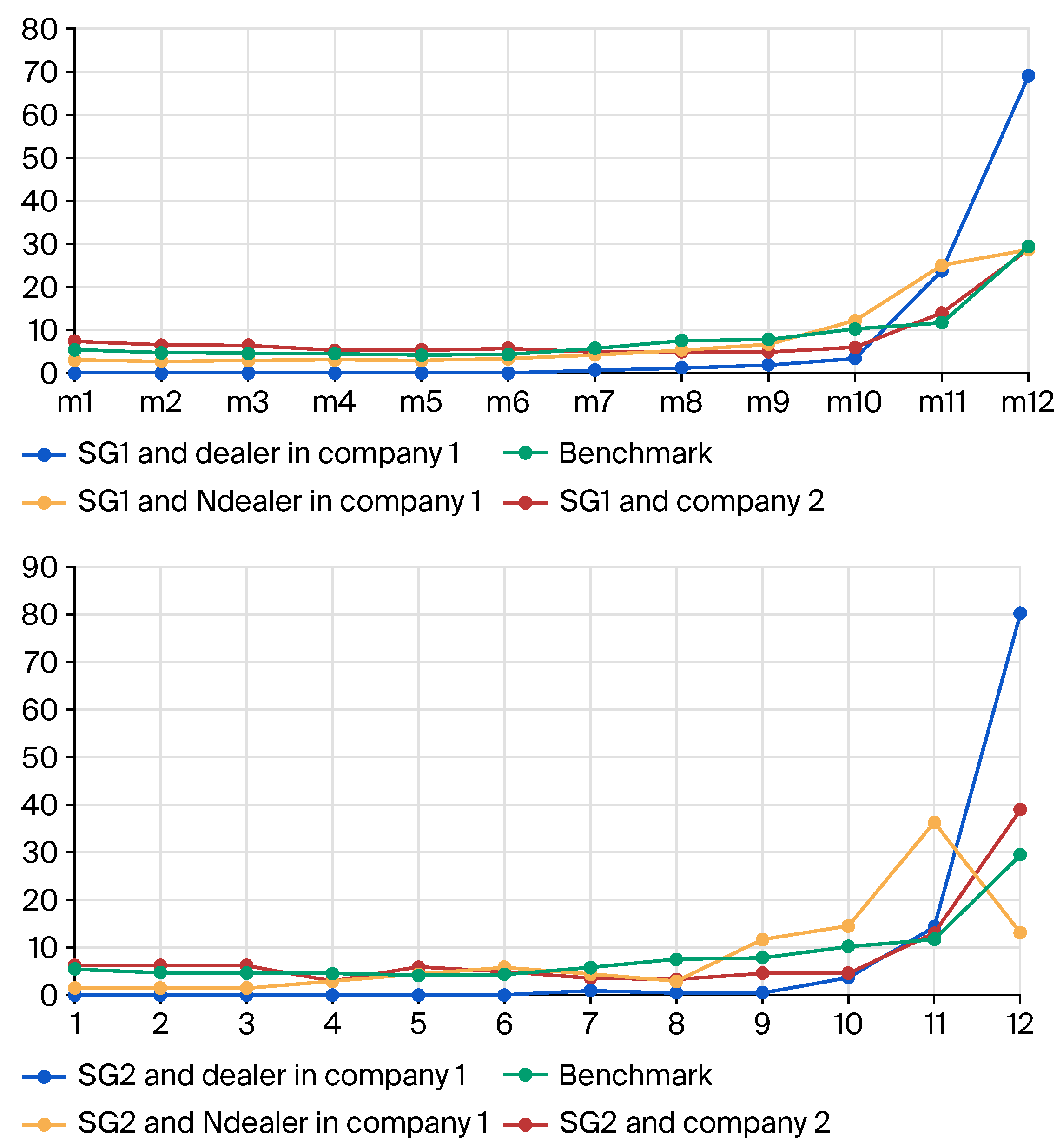
Figure 2. Distribution of claims (%) during the policy year 2010 for SG1 and SG2 according to the distribution channel, with type C contracts as the benchmark. The qualifiers “dealer” and “Ndealer” refer to the cases where the insurance policy has been sold through a DOA and through a standard agent, respectively.
Risks 14 00060 g002
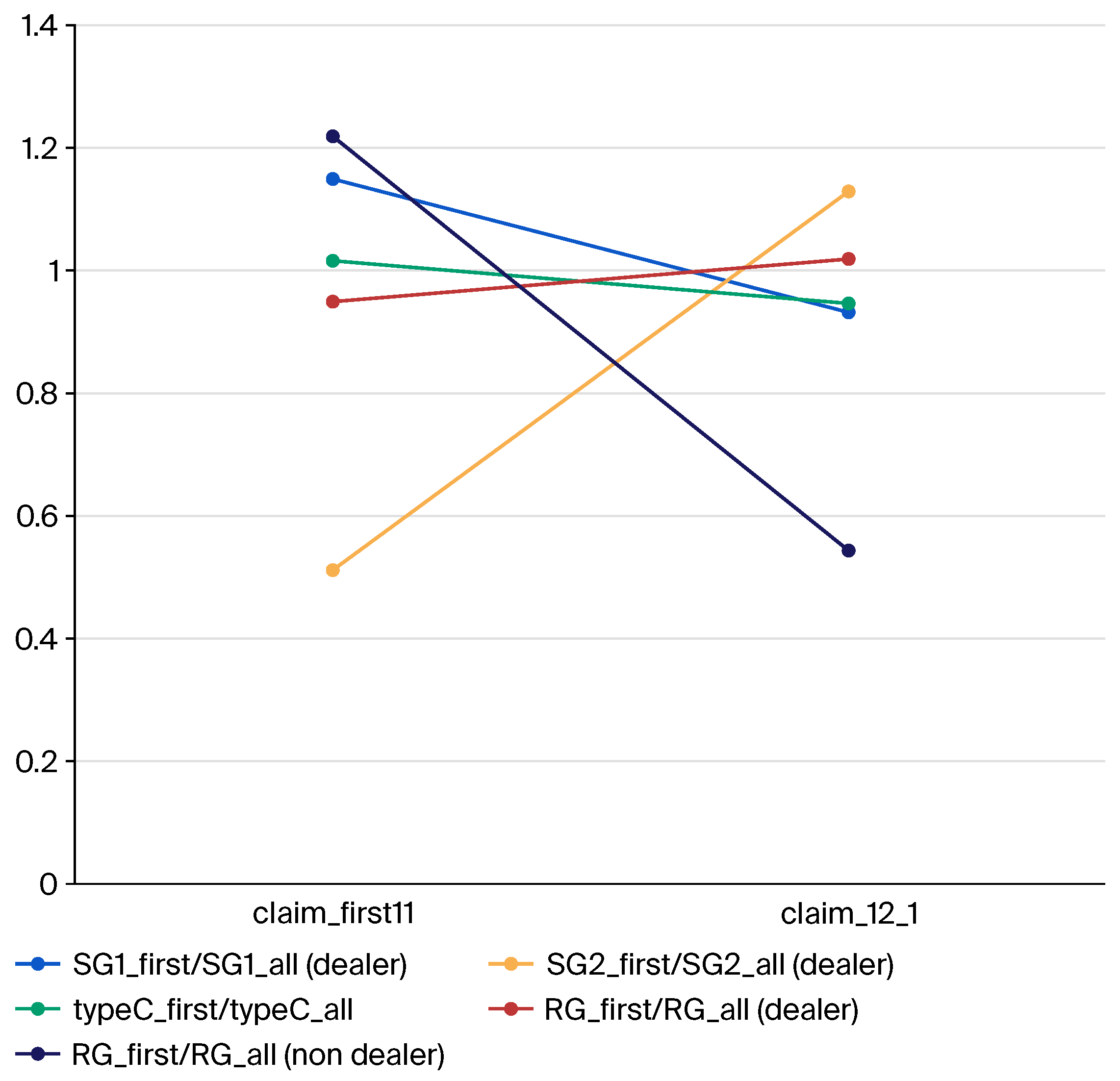
Figure 3. Changes in the first-claim cost ratio from months 1–11 to month 12 of the policy year 2010. SG1_first/SG1_all (dealer) is the first-claim cost ratio of contracts in the SG1 subset purchased through the DOA channel. The other variables have similar interpretations.
Risks 14 00060 g003

3.2. Data

The data of companies 1 and 2 include detailed information about the policyholders, their insurance contracts, and the claims that they filed. The available variables are listed in Table 1. The data were collected over the periods 2010–2012 and 2018–2020, but our analysis of insurance claims will be limited to 2010 and 2018, in order to determine whether policyholders subsequently renewed their contracts for less or more than one year.15 We will start by considering the year 2010 in Section 4.1, Section 4.2, Section 4.3 and Section 4.4. As previously mentioned, company 1 has strongly reduced its dependence on DOAs from 2010 to 2018; therefore, in Section 4.5, comparing the results obtained for the years 2010 and 2018 will allow us to assess the consequence of this structural change.
We target owners of small sedans and small trucks for private use with type A, B, or C insurance contracts for physical car damage. In 2010, there were 141,739 policyholders in the whole sample, and among them, 9205 filed at least one claim, which defines what we call the “research sample”, that is to say, the sub-sample of policyholders who filed one or more claims during their policy year.16 The mean values of the variables in the two samples are displayed in the first two columns of Table 2, with some significant differences. In particular, the percentages of type A or B contracts and particularly those in S G 1 and S G 2 , are much larger in the research sample. It is not surprising to find that, on average, the bonus–malus coefficient and the insurance premium are higher in the research sample than in the whole sample, insofar as more frequent losses are reflected by bonus–malus records and insurance ratings. Also note that there is a higher proportion of cars under three years old in the research sample, which reflects the role of DOAs highlighted in this article. The three other columns of Table 2 separate the research sample into three subgroups, according to the insurance distribution channels (DOAs in company 1 and non-DOAs in companies 1 and 2), with a similar structure in terms of gender, age of the policyholder, size of the vehicle, and use. There is a much larger proportion of new vehicles for the DOA channel, reflecting the fact that, most of the time, a DOA sells an insurance contract when the corresponding dealer sells a new car.The percentage of claims filed in the last month of the policy year (measured by the average value of the S C dummy), the percentage of type A or B contracts, and the share of S G and R G are higher in the DOA channel than in the two other channels.

3.3. Econometric Approach

Our econometric approach combines two complementary strands of the insurance economics literature. We rely on Dionne and Gagné (2002) for the identification of opportunistic fraud patterns, and we adopt the empirical testing framework developed by Chiappori and Salanie (2000) to implement our econometric analysis.
A central insight by Dionne and Gagné (2002) is that opportunistic insurance fraud is not randomly distributed over time but rather tends to concentrate near the end of the insurance contract, when experience-based pricing rules, deductibles, or contract renewal rules reduce the future cost of filing a claim. In such environments, the timing and cost of claims relative to the contract horizon provide informative signals of hidden opportunistic behavior, even when fraud is not directly observed. Following this logic, we leverage systematic patterns in claim timing and claim amounts near the end of the policy year to infer the presence of claim manipulation.
While this insight guides our identification strategy, our empirical implementation relies on the conditional correlation approach proposed by Chiappori and Salanie (2000). They show that under hidden information, unobserved incentives generate statistically testable conditional dependence between relevant outcomes once observable risk characteristics are controlled for. In this study, we adapt this framework to study claim manipulation under hidden information. Rather than testing for asymmetric information between insurers and policyholders in contract choice as performed by Chiappori and Salanie (2000), we examine whether unobserved incentives to manipulate claims are correlated with observable contract features and renewal behavior. Specifically, we leverage the timing of claims within the policy year and policyholders’ renewal decisions to construct groups for which the gains from manipulating the bonus–malus system and deductibles are plausibly higher. We estimate joint models for (i) the probability that a claim is filed during the suspicious period at the end of the policy year and (ii) the probability that a policyholder belongs to a group with strong incentives for intertemporal claim manipulation. A significantly positive residual correlation between these equations indicates the presence of claim manipulation behavior, consistent with the fraud patterns emphasized by Dionne and Gagné (2002). Our empirical identification of claim manipulation relies on several key assumptions that need to be highlighted. First, conditionally on observable underwriting and pricing characteristics (e.g., age, gender, vehicle age, etc.), it is assumed that the timing of actual accidents is not systematically concentrated in the final month of the policy year. Secondly, type C contracts can serve as a benchmark, because police reporting requirements and the lack of a deductible make it very unlikely that claims manipulation will occur in that case. Thirdly, our definition of the suspicious group is based on contract renewal behavior as a proxy for incentives embedded in the bonus–malus system. While renewal decisions may also reflect loyalty or switching costs, these factors alone should not produce a systematic end-of-year claim concentration if there was no intent to manipulate the insurance claims.

4. Results: Presentation and Discussion

4.1. Evidence on Claim Manipulation

Let us first test hypotheses 1 to 3 for the year 2010. Hypothesis 1 amounts to identifying whether there is conditional dependence between belonging to the suspicious group and filing a claim within the suspicious period, associated with the dummies S G (or S G 1 and S G 2 for each subgroup) and S C , respectively. We do so with the following three bivariate probit models, where Φ ( . ) is the cumulative normal distribution function and X is the vector of explanatory variables (with vectors of coefficients β S C , β S G , ), including the premium amount and all the variables used in pricing and underwriting decisions.17 In order to control for the recouping effect, the R G dummy is also included in X.
Model 1
Prob ( S C = 1 ) = Φ ( X β S C + ε )
Prob ( S G = 1 ) = Φ ( X β S G + η )
Model 2
Prob ( S C = 1 ) = Φ ( X β S C + ε )
Prob ( S G 1 = 1 ) = Φ ( X β S G 1 + η )
Model 3
Prob ( S C = 1 ) = Φ ( X β S C + ε )
Prob ( S G 2 = 1 ) = Φ ( X β S G 2 + η )
The results of these regressions are presented in Table 3, with a special interest in the residual correlation coefficient ρ . Hypothesis 1 should lead to a positive conditional correlation between filing a suspicious claim and belonging to a suspicious group. More formally, the estimated residual correlation coefficients of these models, i.e., ρ ^ S C , S G , ρ ^ S C , S G 1 , and ρ ^ S C , S G 2 , should be positive and significantly different from 0, which leads us to test for null hypotheses H 0 : ρ S C , S G 0 , H 0 : ρ S C , S G 1 0 , and H 0 : ρ S C , S G 2 0 in models 1, 2 and 3, respectively.
The three estimated residual correlation coefficients are significantly positive, which allows us to reject the null hypothesis in each model and thus to state that there is a significantly positive conditional correlation between S C and S G ,   S G 1 , or S G 2 in each model. In other words, in accordance with Hypothesis 1, there is conditional dependence between belonging to the suspicious group and filing a claim within the suspicious period, regardless of whether the individual is covered by a deductible contract.18
We have characterized claim manipulation as the misbehavior that consists of postponing and inflating true claims, possibly by bundling several losses in a single claim, unlike the premium recouping misconduct, where false small claims are filed by the end of the policy year. If claim manipulation occurs more frequently than premium recouping, then the suspicious period should be characterized by high values of the first-claim cost ratio. This is expressed in Hypothesis 2, which we test through the regression
c l m a m t = α c S C + α f f i r s t + α f s f i r s t S C + α X X + e ,
on the claims filed by members of S G 1 and S G 2 . This corresponds to 6567 claims filed by 6140 policyholders from SG1 and 633 claims filed by 594 policyholders from SG2. In these regressions, c l m a m t is the value of the claim (in US dollars), while S C and f i r s t are dummies indicating that the claim was suspicious (i.e., it was filed during the last month of the policy year) and that it was the first claim of the policyholder during this policy year, respectively. Regression (7) also includes the interaction variable f i r s t S C . The results are reported in Table 4.
The estimated coefficients of the interaction variable are α ^ f s = 113.3 with a p-value 0.1627 for S G 1 and α ^ f s = 1465.7 with a p-value lower than 0.0001 for S G 2 . This sustains Hypothesis 2 for S G 2 , but not for S G 1 , which confirms the fact that being covered by a deductible contract is a factor that encourages fraud through claim manipulation.
Hypothesis 3 focuses on the role of DOAs in this type of insurance fraud. We test this hypothesis with bivariate probit models 1, 2, and 3 in sub-samples that include policyholders who have purchased insurance through the DOA channel or through other distribution channels. This leads us to estimated residual correlation coefficients ρ ^ S C , S G ,   ρ ^ S C , S G 1 , and ρ ^ S C , S G 2 in each sub-sample.
Detailed results are displayed in Table 5, Table 6 and Table 7, for models 1, 2, and 3, respectively, with conclusions on residual correlation summarized as follows:19
Company   1 Dealer Company   1 Non - dealer Company   2 Model   1       ρ ^ S C , S G 0.5393   *** 0.1344 0.0562 Model   2       ρ ^ S C , S G 1 0.5729   *** 0.0916 0.0610 Model   3       ρ ^ S C , S G 2 0.7492   *** 0.2020 0.2076   ***
Hence, when the regressions are performed in the sub-sample of policyholders who purchased coverage through the DOAs of company 1, there is a significant positive residual correlation between S C and S G ,   S G 1 , or S G 2 at the 1% threshold. This correlation vanishes in the two other sub-samples, except between S C and S G 2 in company 2.
These econometric results highlight two intuitive and central conclusions about the process of claim manipulation. First of all, they reveal the role of facilitators played by DOAs in this process. Whether the manipulation is to defer claims or accumulate them over time, policyholders could hardly display such behavior on their own without the cooperation of car dealers and repair shops. Accordingly, evidence of this behavior is observed exclusively when insurance policies are sold through the DOA channel. Secondly, the results highlight the incentives for manipulation generated by contract design. Policies with deductibles, compared with those without, create stronger incentives for policyholders to avoid incurring claim costs. Therefore, policyholders facing deductibles are more inclined to engage in the manipulation of accumulated claims.

4.2. Categorizing Policyholders

It is worth examining whether categorizing policyholders allows us to better identify fraudulent behaviors. Let us first look at the behavioral differences between men and women. If fraudulent behaviors differ by gender, then the female indicator should be statistically significant with the same sign in both bivariate probit regressions. Among Table 3, Table 5, Table 6 and Table 7, this happens only in Table 6, which corresponds to the dealer channel of company 1; in this table, the female variable is statistically significant and positive simultaneously in the S G 1 equation (the suspicious group with zero-deductible contracts) and in the S C equation. In other words, women are more likely than men to belong to the zero-deductible suspicious group and to concentrate their claims in the final month of the policy year.
However, there remains an open question as to whether, in the dealer channel of company 1, women actually manipulate the timing of claims more intensely than men. In order to better understand this question, we performed model 2 regressions separately for male and female sub-samples, by limiting attention to the dealer channel of company 1. The following table shows the estimated residual correlation coefficients for these regressions.20 Wald tests show that the estimated difference between men and women is not statistically significant; thus, we may conclude that there is no evidence of gender differences in fraudulent behavior.
Residual   correlation   coefficient Men Women ρ 0.1491   * [ 0.0789 ] 0.2749   *** [ 0.0484 ]
Difference   ( Men - Women ) 0.1258 [ 0.0926 ]
We can also examine whether fraudulent behavior differs according to age groups. To do so, we first examine the estimates of the bivariate probit regressions and observe that in most specifications, the age-group variables are not statistically significant in either equation. The only exception is the indicator for the ages of 25–30 (age2530), which shows some explanatory relevance. Since observations under the age of 25 represent only a small part of the sample, we combine individuals under 30 years old into one group. Individuals aged 30 years and over constitute the oldest sub-sample, while those under 30 years form the youngest sub-sample.
We then re-estimate the three bivariate probit models reported in Table 3 separately for these two sub-samples. The table below shows the estimated residual correlations for each sub-sample, and Wald tests were performed to assess whether the residual correlations differ significantly between the younger and older sub-samples. Some evidence of age-related differences in fraudulent behavior emerges only in model 1, with the younger cohort displaying significantly stronger signs of claim manipulation.
Residual   correlation coefficient   for : Model   1 Model   2 Model   3 individuals   younger   than   30 0.8334   *** [ 0.1537 ] 0.2349   *** [ 0.0220 ] 0.0056 [ 0.0281 ] individuals   ( weakly )   older   than   30 0.3259   *** [ 0.0329 ] 0.1893 [ 0.1280 ] 0.1432 [ 0.1430 ] Difference   ( Young - Old ) 0.5075   *** [ 0.1572 ] 0.0456 [ 0.1299 ] 0.1376 [ 0.1457 ]

4.3. Sensitivity Analysis

Our definition of the suspicious period and therefore the identification of suspicious claims reflect the practice of insurers to update the insurance premium by excluding claims occurring during the last policy month. In order to strengthen the credibility of our conclusions, we conducted a sensitivity analysis by redefining the suspicious period as the second-to-last, third-to-last, and fourth-to-last months, successively. This was performed for Table 3, Table 5, Table 6 and Table 7, with results being presented in Table 8 and Table 9. For the sake of brevity, we only present the residual correlation deduced from the bivariate probit regressions.
As shown in Table 8, regardless of whether S C is defined using claims occurring in the second-to-last, third-to-last, or fourth-to-last month, there is no evidence of a statistically significant positive conditional correlation between belonging to the suspicious group and the occurrence of suspicious claims across models 1 to 3. In other words, we do not observe the same claim manipulation pattern when the suspicious period differs from the last policy month.
When the same sensitivity analysis is performed separately for each distribution channel—dealers of company 1, non-dealers of company 1, and company 2—with results reported in Table 9, we still fail to find a statistically significant positive conditional correlation between belonging to the suspicious group and the occurrence of suspicious claims. In other words, even after disaggregating our sample according to the distribution channel, there is no evidence that the members of the suspicious group tend to shift claims toward other policy months than the final month.
Taken together, the results from Table 8 and Table 9 not only support the robustness of our main findings, but they also reveal an additional pattern: as the definition of S C varies across months, the estimated conditional correlations reported in these tables fluctuate substantially, in terms of both statistical significance and sign (positive versus negative). This suggests that, aside from the concentration of claims in the final month driven by manipulation within the suspicious group, claims occurring in the remaining eleven months are essentially random, providing additional evidence inconsistent with systematic manipulation.

4.4. Comments on the Role of Car Dealers in Claim Manipulation

A central conclusion of this study is that car dealers play an important role in facilitating the manipulation of claims by policyholders. To strengthen the credibility of this finding, we first check that for company 1, the evidence of manipulation in the policies sold through the car dealer channel—measured by the significantly positive residual correlation between suspicious groups and suspicious claims—is substantially stronger than that observed for company 1’s non-car dealer channel and company 2, which does not employ car dealers. To do so, we successively consider two null hypotheses H 0 : ρ ^ S C , S G D ρ ^ S C , S G N D and H 0 : ρ ^ S C , S G D ρ ^ S C , S G C 2 in model 1,21 and we proceed in the same way for models 2 and 3, hence with S G 1 and S G 2 instead of S G . The results reported in Table 10 show that both null hypotheses are rejected, regardless of the definition of the suspicious group. In other words, whatever the definition of suspicious group ( S G ,   S G 1 , or S G 2 ), the conditional correlation between filing a suspicious claim and belonging to the suspicious group is significantly greater when contracts are sold through car dealers associated with company 1 than through another distribution channel for company 1 or company 2.
Further evidence on the role of car dealers can be obtained by focusing on the first-claim cost ratio during the suspicious period (as in Hypothesis 2), considering sub-samples defined by the distribution channel and using type C contracts as a benchmark. A higher first-claim cost ratio during the suspicious period for S G 1 or S G 2 than for type C contracts would signal manipulation of claims with claim build-up or claim bundling by members of the suspicious groups. Symmetrically, a lower first-claim cost ratio would be compatible with the premium recouping mechanism highlighted by Li et al. (2013), with small claims being filed at the end of the policy year if no claim has been filed before. This leads us to consider regression (8) below, where the claim amount is the dependent variable, as in regression (7). In (8), f i r s t ,   S C , and X are identical to those in regression (7), and S 1 ,   S 2 , and S 3 are dummies indicating that the policy has been purchased from company 1 through the DOA channel, from company 1 through another distribution channel, and from company 2, respectively. Moreover, C is a dummy indicating that the insurance policy is a type C contract, used as a benchmark without claim manipulation.
c l m a m t = α c S C + α f f i r s t + α f s f i r s t S C + s S G 11 f s S G 1 S 1 f i r s t S C + s S G 21 f s S G 2 S 2 f i r s t S C + s S G 23 f s S G 2 S 3 f i r s t S C + s C f s C f i r s t S C + α X X + e .
The estimation of regression (8) shows that null hypothesis H 0 :   s S G 21 f s s C f s is rejected at a significance level of 1%, in contrast to the results obtained when s S G 11 f s and s S G 23 f s are compared with s C f s .22 This means that the first-claim cost ratio is significantly higher during the last policy month when a deductible contract has been purchased from company 1 through the DOA channel. In total, in 2010, the deductible contracts sold through DOAs created the most favorable condition for insurance fraud through the postponing of claims, with claim build-up or bundling.

4.5. Smaller Bargaining Power for DOAs in 2018

From 2010 to 2018, company 1 reduced by almost half the share of its automobile insurance contracts sold through car dealers. They became less important partners of the insurer, with likely lower bargaining power in the claims settlement process.
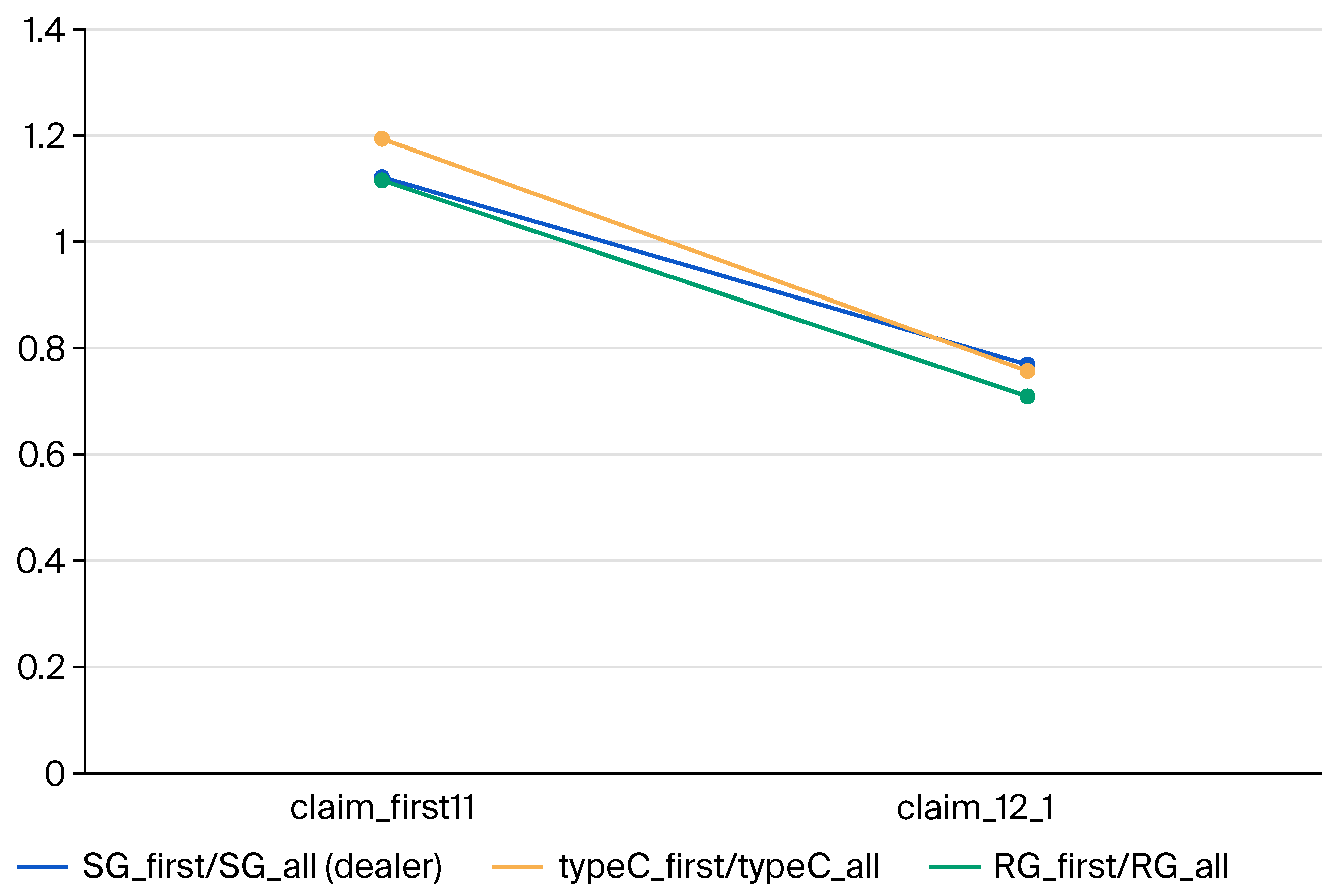
To assess the consequences of this change, we gathered information on 269,475 type A, B, and C automobile insurance contracts sold by company 1 in 2018. The content of these contracts remained essentially the same as in 2010, with the only significant change being that, in 2018, following the liberalization of the Taiwanese insurance market, company 1 only sold type A and B contracts with a deductible. Therefore, the suspicious group ( S G ) should no longer be split into S G 1 and S G 2 , and it coincides with what we called S G 2 for the year 2010. Table 11 provides detailed information about the data. The comparison of Table 1 and Table 11 confirms the decrease in the proportion of contracts sold through DOAs, as well as other significant changes—notably the decrease in policyholders who filed a claim in 2010 and 2018 from 6.49% to 3.71%, respectively.23 Figure 4 also confirms that claim rates are still higher in the last month than in previous months of the policy year, with a significant decrease in the average claim cost during the last policy month, and Figure 5 shows a decrease in the first-claim cost ratio for all types of contracts, including policyholders in S G going through DOAs, unlike what was observed for S G 2 in 2010.
Does this mean that the claim manipulation favored by DOAs had disappeared by 2018? Formal tests were carried out to ascertain this. The results of bivariate probit regressions (similar to model 1 above) are presented in Table 12. The estimated residual correlation between S G and S C is still significantly positive regardless of the distribution channel, but null hypothesis H 0 : ρ D ρ N D is rejected at the 1% significance threshold. In other words, the positive residual correlation between belonging to the suspicious group and filing a claim in the suspicious period is still valid, which confirms claim manipulation, but the role of DOAs in this fraud process has disappeared. For completeness, we verified that the difference ρ D ρ N D significantly decreased between 2010 and 2018, meaning that the higher conditional correlation between S C and S G for the D O A channel, compared with other distribution channels, significantly decreased from 2010 to 2018.24
We performed a robustness check with a two-stage method in order to confirm this change from 2010 to 2018. To do so, we created a new dataset that included S G 2 and type C contracts sold by company 1 in 2010 or 2018, with the y 2018 dummy being used to indicate that the contract was sold in 2018.25 The first stage consists of estimating the probit regression
Pr [ S G = 1 ] = Φ ( X β S G + η ) ,
and the estimated probability of belonging to the suspicious group ( S G ^ ) and the D dummy for the DOA channel are used as explanatory variables in the second-stage regression:
Pr [ S C = 1 ] = Φ ( β e s t S G S G ^ + β S G S G + β D D + β 2018 y 2018 + β S G D S G D + β S G 2018 S G y 2018 + β D 2018 D y 2018 + β S G D 2018 S G D y 2018 + X β S C + ε )
The results are presented in Table 13. The estimated coefficient of the triple interaction term S G D y 2018 is β ^ S G D 2018 = 1.7265 , and it is significantly different from 0 at the 1% significance threshold. In other words, DOAs’ incentivizing of policyholders from the suspicious group ( S G ) to manipulate claims significantly decreased from 2010 to 2018.
Considering that DOAs played a crucial role in the manipulation of claims in 2010, one may wonder whether the decrease in their bargaining power fully canceled the fraud process in 2018, be it under the form of claim manipulation or of the premium recouping behavior. To verify this, we estimated regression (7) for S G and for type C contracts, with data from the year 2018. The results are presented in Table 14. The estimated coefficient α ^ f s is not significantly different from 0 in both subsets of contracts. In other words, in 2018, unlike in 2010, there was no significant change in the cost of first claims filed during the last month of the policy year compared with previous months.

4.6. Summary and Implications of the Results

The results presented in Section 4.1, Section 4.2, Section 4.3, Section 4.4 and Section 4.5 convey a coherent picture of how contractual incentives and distribution structures jointly shape manipulation behavior in automobile insurance. First, the evidence consistently points to intertemporal manipulation of real losses, rather than random concentration of claims or purely psychological premium recouping, as the dominant form of fraud in this market. Second, contract design determines the payoff from manipulation, but it does not by itself make manipulation feasible. Indeed, deductibles and bonus–malus rules create incentives to postpone and bundle claims, yet these incentives translate into economically meaningful fraud only when policyholders can coordinate claim reporting and repair activities. Third, the analysis underscores the central role of distribution channels as enabling institutions. Dealer-owned agents combine insurance intermediation, claim handling, and access to repair services, thereby lowering coordination costs and weakening insurers’ enforcement capacity. Fraud, in this sense, is an outcome mediated by organizational arrangements and bargaining power at the claims settlement stage. Fourth, the comparison between 2010 and 2018 illustrates that fraud is responsive to organizational change. The attenuation of claim manipulation following the reduction in insurers’ reliance on dealer-owned agents shows that fraud can be substantially deterred without altering core contract parameters.
Taken together, the results yield a coherent interpretation of insurance fraud in this market. Fraud primarily takes the form of opportunistic manipulation of real losses rather than small false claims. Contractual incentives such as deductibles and bonus–malus rules create the motive for manipulation, but distribution channels determine whether these incentives can be exploited. When intermediaries have great bargaining power while defending the interests of their customers and control complementary services such as repair shops, as in the DOA channel, then manipulation flourishes. Conversely, organizational changes that reduce intermediary power can substantially deter fraud without altering core contract design.

5. Conclusions

This study has shown that insurance fraud in automobile insurance is shaped not only by the individual incentives embedded in deductibles and bonus–malus rules but also—crucially –by the structure of insurance distribution channels. Using Taiwanese car insurance data, we documented two distinct fraud mechanisms: premium recouping through small false claims and the manipulation of claims through strategic deferral and inflation of real losses. Our econometric analysis has combined the approach of Dionne and Gagné (2002) to the identification of opportunistic fraud patterns on one hand, and the empirical testing framework of Chiappori and Salanie (2000) on the other hand. Our results provide strong evidence that, in 2010, claim manipulation was significantly more prevalent when insurance policies were sold through dealer-owned agents (DOAs), while this channel-specific effect largely disappeared in 2018 after insurers significantly reduced their reliance on DOAs.
The results highlight the importance of vertical relationships in the economics of insurance fraud. DOAs combine insurance intermediation with close links to repair services, which increases the difficulty of detecting manipulation and weakens the ability of insurers to enforce penalties. As a result, distribution channels with greater intermediary bargaining power can significantly amplify incentives for fraud, particularly under contracts with deductibles and experience-based pricing rules. Conversely, the decrease in the DOA effect over time suggests that organizational changes in distribution can significantly reduce fraud, even in the absence of major reforms in contract design or audit technology.
From a managerial and regulatory perspective, the results suggest that anti-fraud strategies should not focus exclusively on policyholder behavior or contractual parameters. Insurers can also reduce exposure to fraud by limiting dependence on powerful intermediaries, redefining agency relationships, or separating sales from claims-related services. More broadly, the distribution structure must be considered an essential element of fraud risk management by insurers.
This study also has limitations that should be acknowledged. Our analysis is based on indirect evidence of fraud inferred from claim timing and cost patterns, rather than identified fraudulent claims. Although this approach is well established in the literature and appropriate given data constraints, it necessarily captures behavioral patterns consistent with fraud rather than verified misconduct.
Future research could extend this framework by incorporating richer information on repair networks, audit outcomes, or intermediary contracts, as well as examining similar mechanisms in other insurance markets or jurisdictions. More generally, the integration of organizational and contractual characteristics in empirical analyses of insurance fraud seems essential to understanding how fraud arises—and how it can be effectively deterred.

Author Contributions

Conceptualization, P.P., J.W. and K.C.W.; Methodology, P.P., J.W. and K.C.W.; Formal analysis, P.P., J.W. and K.C.W.; Investigation, P.P., J.W. and K.C.W.; Writing—original draft, P.P., J.W. and K.C.W.; Writing—review & editing, P.P., J.W. and K.C.W. All authors have read and agreed to the published version of the manuscript.

Funding

We acknowledge financial support from Investissements d’Avenir (ANR-121-IDEX-0003/Labex ECODEC) and from Allianz Chair on the insurability of emerging risks at ENSAE.

Data Availability Statement

The data presented in this study have been obtained from two large corporations through an application to the Taiwan Insurance Institute. They are not publicly available due to privacy restrictions.

Conflicts of Interest

The authors declare no conflicts of interest.

Appendix A. Theoretical Model

The model features the non-cooperative interaction between policyholders and insurers in a costly state verification setting with two types of insurance distribution channels.26 Consider a population of risk-averse drivers, whose type is defined by the couple ( i , h ) with i { D , A } and h { 1 , 2 } . Index i refers to the individuals’ preference for a specific distribution channel through which they purchase insurance: DOAs when i = D or standard insurance agents when i = A . Index h reflects the individual’s degree of absolute risk aversion: h = 1 corresponds to a higher absolute risk aversion than h = 2 . Assume that drivers may have either 0, 1, or 2 accidents during the same policy year, with probability π 1 and π 2 for 1 and 2 accidents, respectively, and π 1 + π 2 < 1 ; further assume that these probabilities are independent of the policyholders’ type. Insurance contracts include a deductible per accident. We denote by d i h and P i h the deductible and the premium, respectively, of the contract chosen by type h individuals who purchase insurance through channel i. Less risk-averse individuals choose a larger deductible; thus, we have d i 2 > d i 1 0 .27
Each accident may be severe or minor, and the corresponding claims small or large, with probability q s or q m = 1 q s , respectively, regardless of the policyholder’s type and of whether it is the first or second accident during the policy year. For the sake of simplicity, it is assumed that a large claim exactly doubles a small claim, with losses and 2. Fraud is committed by policyholders who postpone small claims till their last policy month. They file one single large claim for two minor accidents presented as a severe accident that occurred during the last policy month, if another minor accident occurs later during the same policy year. Otherwise, the claim corresponding to the first minor accident will be denied because it is filed outside the deadline. Fraud reduces the retained cost of the accidents by half since the deductible is paid only once. It also provides an additional gain through the manipulation of the bonus–malus system if the policyholder intends to stay with the same insurer for at least the following year. A policyholder who is caught defrauding must pay a penalty (considered, for simplicity, to be a fine paid to the government), and in this case, the claim is fully denied.
Let us denote by α i h and β i h the fraud and audit mixed strategy of the policyholder and the insurer, respectively, for a population of type ( i , h ) individuals. α i h is the probability that a type ( i , h ) policyholder postpones a first small claim (when the corresponding minor accident occurs before the last policy month), with the intention to file a single large claim for two accidents during the last policy month, should another minor accident occur before the end of the year. Fraud is concentrated among those policyholders who are willing to stay with the same insurer at the end of the policy year because they are the ones who benefit the most through the bonus–malus mechanism.28 β i h is the probability that a large claim (filed by a type ( i , h ) policyholder) is audited by the insurer.29 Such large claims correspond either to true severe accidents or to two minor accidents that have been fraudulently aggregated and postponed to the last month. We assume that auditing allows the insurer to detect with certainty whether the claim has been manipulated or not.
The expected cost of claims per type ( i , h ) policyholder is written as
C i h = L D i h + F C i h + A C i h ,
where L is the expected costs of accidents, D i h is the cost retained by the policyholder (in the absence of claim manipulation), F C i h is the cost of claim manipulation for the insurer, and A C i h is the audit cost.
L and D i h are equal to the expected number of accidents per policyholder, π 1 + 2 π 2 , multiplied by the weighted average loss per accident and by the deductible per accident, respectively. This gives
L = ( π 1 + 2 π 2 ) [ q s + 2 q m ] = ( π 1 + 2 π 2 ) ( 2 q s ) ,
and
D i h = ( π 1 + 2 π 2 ) d i h .
F C i h is proportional to α i h , but, for given α i h , it decreases linearly with β i h , because auditing a larger fraction of large claims reduces the average indemnity payment through the detection of falsified claims. DOAs have some bargaining power with insurers, and they may intercede with the insurer when a claim is denied for fraud. This intervention is successful with some probability; thus, it decreases the financial benefit drawn by the insurer from spotting a defrauding policyholder–car repairer coalition. We may write
F C i h = α i h [ a 1 ( d i h ) a 2 ( d i h , ζ i ) β i h ] ,
where a 1 ( d i h ) and a 2 ( d i h , ζ i ) correspond to the expected cost of fraud (in the absence of audit) and to the expected gain from a claim audit, respectively. We have a 1 > 0 and a 2 d < 0 because the larger the deductible, the larger the financial impact of claims falsification and the smaller the gain to the insurer when a claim is denied after an audit. Furthermore, ζ i is a parameter that measures the bargaining power of distribution channel i in the case of negotiation with the insurer about the payment of a claim, with ζ D > ζ A .30 We have a 2 ζ < 0 because the distribution channel’s bargaining power leads to the insurer’s expected benefit when fraud is detected to be smaller.
DOAs own and control their repair shop. Thus, it is assumed that auditing a claim (i.e., spending resources to discover whether a claim has been manipulated or not) is more costly when insurance has been purchased through a DOA than through a standard insurance agent, because the protection of the DOA makes the detection of the policyholder–repairer collusion more difficult. We denote by c i the audit cost when the insurance distribution channel is i = D or A, with c D > c A .
Since here fraud consists of filing one single large, postponed claim for two accidents, the number of large claims filed by type ( i , h ) policyholders is linearly increasing with α i h , which allows us to write31
A C i h = c i β i h ( a 3 + a 4 α i h ) .
The insurer chooses β i h in [ 0 , 1 ] in order to minimize C i h given by (A1), which implies that
β i h = 0 if α i h < α * ( d i h , ζ i , c i ) , [ 0 , 1 ] if α i h = α * ( d i h , ζ i , c i ) , = 1 if α i h > α * ( d i h , ζ i , c i ) ,
where
α * ( d , ζ , c ) c a 3 a 2 ( d , ζ ) c a 4 .
with α d * > 0 ,   α ζ * > 0 , and α c * > 0 . Let us assume that α * ( d , ζ , c ) < 1 for the relevant values of d ,   ζ ,   c , which means that systematic fraud would trigger the auditing of all the large claims. Type h policyholders are willing to defraud if the probability of being caught is smaller than a threshold β h * ( P i h , d i h , ζ i ) ( 0 , 1 ) . Individuals always defraud when the audit probability is zero, and they never defraud if all large claims are audited; hence, the audit probability ( β h * ( P i h , d i h , ζ i ) ) for which they are indifferent between fraud and honesty is between 0 and 1.32 This audit probability threshold is type-dependent (hence the subscript h in the β h * function) because it is affected by the intrinsic risk aversion of the policyholder, but it also depends on P i h because an increase in premium may affect the policyholder’s risk aversion through a wealth effect,33 and it is increasing with d i h because an increase in the deductible makes fraud more attractive. Furthermore, β h * is increasing with ζ i because a larger bargaining power of the agent corresponds to a larger probability of avoiding the full cancellation of the insurance payout when a fraudulent claim is detected through an audit. Thus, we have
α i h = 0 if β i h > β h * ( P i h , d i h , ζ i ) , [ 0 , 1 ] if β i h = β h * ( P i h , d i h , ζ i ) , = 1 if β i h < β h * ( P i h , d i h , ζ i ) .
A type ( i , h ) policyholder who has a minor accident before the last policy month and his insurer plays a non-cooperative game, with strategies α i h and β i h , respectively. The Nash equilibrium of this game is easily characterized. If α i h = 0 , then (A4) gives β i h = 0 , which implies α i h = 1 from (A6), hence a contradiction. Similarly, if α i h = 1 , then (A4) gives β i h = 1 , which implies α i h = 0 from (A6), hence again a contradiction. Thus, α i h ( 0 , 1 ) and (A4), (A6) give β i h = β h * ( P i h , d i h , ζ i ) ( 0 , 1 ) and α i h = α * ( d i h , ζ i , c i ) ( 0 , 1 ) .
In brief, at equilibrium, the audit probability β i h = β h * ( P i h , d i h , ζ i ) makes the policyholder indifferent between manipulation and honesty, and the manipulation probability α i h = α * ( d i h , ζ i , c i ) makes the insurer indifferent between auditing and non-auditing.
This leads us to simple predictions about the effect of the type of contract and distribution channel on claim manipulation. Firstly, using α d * > 0 shows that higher deductibles go along with more manipulation. Since d 2 > d 1 0 , we have α i 2 > α i 1 for i { D , A } . In other words, for a given distribution channel, fraud is more prevalent among type 2 than type 1 individuals. More simply, if d 1 = 0 , we can say, in brief, that deductibles encourage fraud. Furthermore, using c D > c A ,   ξ D > ξ A , and α ζ * > 0 ,   α c * > 0 yields α D h > α A h for i { 1 , 2 } . Put briefly, for a given type of individual, there is more fraud when insurance has been purchased through DOAs than through standard insurance agents, either because it is more costly to audit a claim that goes through a DOA or because DOAs have larger bargaining power than standard insurance agents.

Notes

1
Other authors have highlighted the effect of deductibles on insurance fraud. Using data from Québec, Dionne and Gagné (2001) show that the amount of the deductible is a significant determinant of the reported loss when no other vehicle is involved in the accident, thus when the presence of witnesses is less likely. Based on an experimental study, Miyazaki (2009) highlights that higher deductibles result in a lower perception that padding claim amounts constitutes unethical behavior, thus leading to a greater propensity for fraud.
2
Although the research by Dionne et al. (2009)is an exception, it is usually very difficult to use direct information on fraudulent claims to analyze insurance fraud, either because the identified fraud is just the tip of the iceberg or due to the reluctance of insurers to share confidential information on any fraud they are victims of. As we do here, the preferred approach is to establish indirect evidence of fraud. For instance, Dionne and Gagné (2002) deduce the existence of fraud in automobile theft insurance from the time pattern of claims across the twelve policy months. Pao et al. (2014) provide evidence of opportunistic theft insurance fraud by analyzing the claim pattern in areas hit by a typhoon.
3
Our data are anonymized. They were obtained from the Taiwan Insurance Institute, a think tank that receives individual policy-level data from all insurance companies operating in Taiwan. Note that our objective is not to analyze particular insurers per se but to identify how distribution channels can affect insurance fraud.
4
On average, Taiwanese DOAs sell more policies than other agents, three times more on average, and much more for the largest DOAs. They are independent agents, and, as emphasized by Mayers and Smith (1981), this status gives them more discretion in claim administration (e.g., they may intercede on behalf of their customers at the claims settlement stage) because they can credibly threaten to switch their business to another insurer. In fact, DOAs provide comparatively less stable customers to company 1 than other insurance agents, with continuation rates (i.e., the fraction of customers who continue to purchase insurance from the same insurer year on year) which are about sixty percent for DOAs and seventy to eighty percent for other insurance agents.
5
Type B contracts cover all the areas of type A contracts, except the non-collision losses caused by intentional damage, vandalism, and any unidentified reasons.
6
The policy year begins with the starting date of the contract, which differs among policyholders and thus does not coincide with the calendar year.
7
It is well known that insurance fraud is often associated with the feeling that the insurance company is unfair; see Fukukawa et al. (2007), Miyazaki (2009), and Tennyson (1997, 2002). The premium recouping phenomenon highlighted by Li et al. (2013) could reflect a kind of resentment against insurers, particularly from policyholders who have not filed a claim during the previous months of the policy year and may consider their insurance premium as an undue payment. This interpretation is sustained by research studies in experimental psychology that show how self-justification emerges as a driver of social misbehavior when individuals display aversion to viewing themselves as dishonest persons; see Mazar et al. (2008), Shalvi et al. (2015), and Cohn et al. (2019).
8
A variant of the claim manipulation strategy consists of postponing a true claim to the end of the policy year and building up the cost report by falsifying the claim, although no other accident occurred.
9
Indeed, the claims filed during the last month of policy year t are not recorded in the bonus–malus statement of year t + 1 (they will be taken into account in year t + 2 ). Therefore, policyholders who are considering renewing their type A or B contract with the same insurer may see an advantage in deferring their claim to the last policy month, in order to delay the increase in the premium. Moreover, as the bonus–malus record depends on the number of claims and not on their severity, policyholders can benefit from bundling several losses in a single claim. This is even more profitable in the case of deductible contracts, since deductibles are per-claim.
10
In Taiwan, filing a claim during the last month of the policy year does not affect the policyholder through the bonus–malus system if he/she does not stay with the same insurer for more than one year. Our definition of the recoup group thus corresponds to policyholders without strong attachments to their current insurer for whom false claims filed toward the end of the policy year have no consequence through the bonus–malus system.
11
The bonus–malus record has a new starting point when policyholders change insurers. Thus, manipulating claims does not provide a bonus–malus advantage to policyholders who change insurers at the end of the current policy year. On the contrary, those who plan to renew their contract only once benefit the most from the manipulation of claims.
12
Of course, this definition of fraud rate does not mean that all claims filed during the suspicious period have been fraudulently manipulated.
13
Increasing marginal falsification costs may explain why false claims (that do not correspond to any actual loss) tend to be smaller than true claims that are manipulated and possibly inflated. See Crocker and Morgan (1997) and Crocker and Tennyson (2002) on the costly state falsification approach to insurance fraud. This reasoning may be misleading if the cost of claims is affected by an intertemporal moral hazard mechanism that makes drivers more cautious after a first accident. To separate the manipulation of claims from moral hazard, we can consider type C contracts as a benchmark, because the manipulation of claims is very unlikely for such contracts.
14
Figure 2 provides a preliminary idea of the role of DOAs by considering how the type of contract and the distribution channel affected the time distribution of claims during the policy year. It is striking that the distribution of claims peaks at the end of the policy year for SG1 and SG2 members who purchased insurance through DOAs. The comparison with type C contracts used as a benchmark without claim manipulation reinforces the intuition that DOAs play an important role in this fraud process. Figure 3 supports the claim manipulation hypothesis for policyholders of SG2 who purchased insurance from a DOA in 2010: their first-claim cost ratio increased sharply in the last month of the policy year, which was not the case for the other groups of policyholders.
15
In what follows, years are policy years; for example, a contract corresponds to year 2010 if it started in 2010.
16
The data include information on 9936 claims, because some policyholders filed several claims during the policy year 2010.
17
This includes all the observable characteristics of the insured (e.g., age, gender, bonus–malus coefficient, and premium), the characteristics of the vehicle (e.g., age, brand, and registered area), and the recoup dummy, R G . Hence, X includes all the variables listed in the first part of Table 1, as well as l o g p r e m and R G in the second part.
18
Table 3 also offers some interesting byproducts that are worth mentioning. Firstly, policyholders from R G tend to file their first claims in the suspicious period, which echoes the conclusions by Li et al. (2013) on premium recouping misbehavior. Secondly, the owners of new cars (carage0 and carage1) tend to file their first claim during the suspicious period more frequently than the other policyholders. This is not independent from the role played by DOAs in the claim manipulation process, insofar as car owners have tighter relationships with car dealers when their vehicles are newer.
19
*** refers to the significance level at the 1% threshold.
20
In all the tables that follow the standard errors are in brackets; ***: p < 0.01 ; **: p < 0.05 ; *: p < 0.1 .
21
D ,   N D , and C 2 refer to insurance purchased from company 1 through car dealers, from company 1 through other distribution channels, and from company 2, respectively.
22
Detailed estimation results are available from the authors upon request.
23
Several factors explain this change, including the difference in the claim-handling strategies of companies 1 and 2 and, more importantly, the fact that contracts without deductibles were not offered by company 1 in 2018.
24
In more precise terms, null hypothesis H 0 : ( ρ D ρ N D ) 2018 ( ρ D ρ N D ) 2010 0 can be rejected at the 1% significance level.
25
S G 2 and S G coincide in 2018 since company 1 had stopped selling type A or B contracts without deductibles by then.
26
The model may be viewed as an extension of that by Picard (1996) to a setting where the audit process depends on the insurance distribution channel. For the sake of brevity, several aspects of insurance market analysis are deliberately overlooked here. This particularly concerns the way individuals choose their contract and their insurance distribution channel, depending on their risk aversion and on their intrinsic preference for a specific channel.
27
For notational simplicity, we assume that the deductible is the same whether it is the first or second claim during the policy year.
28
The policyholders who may benefit the most from defrauding through claim manipulation are those who have a first minor accident before the last month of their policy year and who do not intend to change insurers. If these policyholders are just indifferent between defrauding and not defrauding (as will be the case), then the other policyholders will be deterred from defrauding.
29
The degree of risk aversion is not directly observed by the insurer. However, individuals choose different contracts (i.e., different deductibles) depending on their risk aversion; thus, insurers can condition their audit probability on the level of the deductible and thus indirectly on the policyholder’s type.
30
Claim manipulation, as it is described, may be committed by policyholders who intend to renew their insurance policy and who have two accidents, with the first one being minor and occurring before the last month of the policy year. Thus, a 1 ( d i h ) and a 2 i ( d i h ) depend on the probability that a type ( i , h ) individual is in this situation, which depends on π 1 ,   π 2 and q s but also on the timing of accidents throughout the policy year, which is left undescribed for the sake of brevity.
31
Here also, a 3 and a 4 depend on π 1 ,   π 2 , and q s (but not on d i h ); furthermore, a 4 depends on the timing of accidents throughout the policy year.
32
β h * could be defined in a more explicit way by considering the expected utility of a type h individual who has a minor accident before the last policy month and who has to choose between two strategies: either honestly filing a small claim without delay or postponing their claim to the last policy month in order to file a single large claim if another minor accident occurs. β h * is the audit probability that makes the policyholder indifferent between these two strategies.
33
For instance, under DARA preferences, an increase in the insurance premium makes the policyholder more risk-averse and thus less prone to manipulating claims. In that case, the larger the insurance premium, the lower the audit probability threshold above which fraud is deterred.

References

  1. Chiappori, Pierre-André, and Bernard Salanie. 2000. Testing for asymmetric information in insurance markets. Journal of Political Economy 108: 56–78. [Google Scholar] [CrossRef]
  2. Cohn, Alain, Michel André Maréchal, David Tannenbaum, and Christian Lukas Zünd. 2019. Civic honesty around the globe. Science 365: 70–73. [Google Scholar] [CrossRef] [PubMed]
  3. Crocker, Keith J., and John Morgan. 1997. Is honesty the best policy? Curtailing insurance fraud through optimal incentive contracts. Journal of Political Economy 106: 355–75. [Google Scholar] [CrossRef]
  4. Crocker, Keith J., and Sharon Tennyson. 2002. Insurance fraud and optimal claims settlement strategies. Journal of Law and Economics XLV: 469–507. [Google Scholar] [CrossRef]
  5. Dionne, Georges, and Robert Gagné. 2001. Deductible contracts against fraudulent claims: Evidence from automobile insurance. Review of Economics and Statistics 83: 290–301. [Google Scholar] [CrossRef]
  6. Dionne, Georges, and Robert Gagné. 2002. Replacement cost endorsement and opportunistic fraud in automobile insurance. Journal of Risk and Uncertainty 24: 213–30. [Google Scholar] [CrossRef]
  7. Dionne, Georges, Florence Giuliano, and Pierre Picard. 2009. Optimal auditing with scoring: Theory and application to insurance fraud. Management Science 55: 58–70. [Google Scholar] [CrossRef]
  8. Fukukawa, Kyoko, Christine Ennew, and Steve Diacon. 2007. An eye for an eye: Investigating the impact of consumer perception of corporate unfairness on aberrant consumer behavior. In Insurance Ethics for a More Ethical World (Research in Ethical Issues in Organizations). Edited by Patrick Flanagan, Patrick Primeaux and William Ferguson. Bingley: Emerald Group Publishing Ltd., vol. 7, pp. 187–221. [Google Scholar]
  9. Li, Chu-Shiu, Chwen-Chi Liu, and Sheng-Chang Peng. 2013. Expiration dates in automobile insurance contracts: The curious case of last policy month claims in Taiwan. Geneva Risk and Insurance Review 38: 23–47. [Google Scholar] [CrossRef]
  10. Mayers, David, and Clifford W. Smith, Jr. 1981. Contractual provisions, organizational structure, and conflict control in insurance markets. Journal of Business 54: 407–34. [Google Scholar] [CrossRef]
  11. Mazar, Nina, On Amir, and Dan Ariely. 2008. The dishonesty of honest people: A theory of self-concept maintenance. Journal of Marketing Research 45: 633–44. [Google Scholar] [CrossRef]
  12. Miyazaki, Anthony D. 2009. Perceived ethicality of insurance claim fraud: Do higher deductibles lead to lower ethical standards. Journal of Business Ethics 87: 589–98. [Google Scholar] [CrossRef]
  13. Pao, Tsung-I., Larry Y. Tzeng, and Kili C. Wang. 2014. Typhoons and opportunistic fraud: Claim patterns of automobile theft insurance in Taiwan. Journal of Risk and Insurance 81: 91–112. [Google Scholar] [CrossRef]
  14. Picard, Pierre. 1996. Auditing claims in insurance market with fraud: The credibility issue. Journal of Public Economics 63: 27–56. [Google Scholar] [CrossRef]
  15. Shalvi, Shaul, Francesca Gino, Rachel Barkan, and Shahar Ayal. 2015. Self-serving justifications: Doing wrong and feeling moral. Current Directions in Psychological Science 24: 125–30. [Google Scholar] [CrossRef]
  16. Tennyson, Sharon. 1997. Economic institutions and individual ethics: A study of consumer attitudes toward insurance fraud. Journal of Economics Behavior and Organization 32: 247–65. [Google Scholar] [CrossRef]
  17. Tennyson, Sharon. 2002. Insurance experience and consumers’attitudes toward insurance fraud. Journal of Insurance Regulation 21: 35–55. [Google Scholar]
Figure 1. Distribution of claims (%) and average cost of first claims (USD 100) during the policy year 2010.
Risks 14 00060 g001
Figure 4. Distribution of claims (%) and average cost of first claims (USD 100) during the policy year 2018.
Risks 14 00060 g004
Figure 5. Changes in the first-claim cost ratio from months 1–11 to month 12 of the policy year 2018.
Risks 14 00060 g005
Table 1. Definition of variables.
VariableDefinition
Explained variables
claimDummy variable equal to 1 when the insured has filed at least one claim during the policy year and 0 otherwise.
SCDummy variable equal to 1 when the insured has filed his or her first claim during the suspicious period (in the last policy month) and 0 otherwise.
SGDummy variable equal to 1 when the insured belongs to the “suspicious group”, 1 and 0 otherwise.
SG1Dummy variable equal to 1 when the insured belongs to “suspicious group 1”, 2 and 0 otherwise.
SG2Dummy variable equal to 1 when the insured belongs to “suspicious group 2”, 3 and 0 otherwise.
Explanatory variables
first group (underwriting and pricing variables)
femaleDummy variable equal to 1 if the insured is female and 0 otherwise.
age2025Dummy variable equal to 1 if the insured is in the 20–25 age group and 0 otherwise.
age2530Dummy variable equal to 1 if the insured is in the 25–30 age group and 0 otherwise.
age3060Dummy variable equal to 1 if the insured is in the 30–60 age group and 0 otherwise.
ageabv60Dummy variable equal to 1 if the insured is older than 60 and 0 otherwise.
carage0Dummy variable equal to 1 when the car is less than one year old and 0 otherwise.
carage1Dummy variable equal to 1 when the car is two years old and 0 otherwise.
carage2Dummy variable equal to 1 when the car is three years old and 0 otherwise.
carage3Dummy variable equal to 1 when the car is four years old and 0 otherwise.
carage4Dummy variable equal to 1 when the car is five years old and 0 otherwise.
veh_mDummy variable equal to 1 when the capacity of the insured car is between 1800 and 2000 c.c. and 0 otherwise.
veh_lDummy variable equal to 1 when the capacity of the insured car is larger than 2000 and 0 otherwise.
sedanDummy variable equal to 1 when the car is a sedan and is for non-commercial or for long-term rental purposes and 0 otherwise. 4
bonusBonus–malus coefficient used to calculate the premium in the current contract year. It is a multiplier of the premium. Hence, it is a discount if it is smaller than 1, and it is a penalty if it is larger than 1.
tramak_jDummy variable equal to 1 when the brand of the insured car is j, with j = n, f, h, t, and c, and 0 otherwise. 5
second group (other control variables)
logpremLogarithm of the premium of the contract in the current contract year.
DDummy variable equal to 1 if the insurance contract is sold through the DOA channel of company 1 and 0 otherwise.
company2Dummy variable equal to 1 if the insurance contract is sold by company 2 and 0 otherwise. 6
ABDummy variable equal to 1 if the insured is covered by a type A or type B contract and 0 otherwise. 7
RGDummy variable equal to 1 when the insured belongs to the Recoup Group, 8 and 0 otherwise.
1 The “suspicious group” (SG) includes individuals who renewed their contract with the same insurance company for only one year. The counter group for the SG includes the policyholders who did not renew their contract or renewed it for more than one year with the same insurance company. 2 “Suspicious group 1” (SG1) includes SG policyholders with no-deductible contracts. The counter group for SG1 includes the policyholders with deductible contracts or who are not in SG. 3 “Suspicious group 2” (SG2) includes SG policyholders with deductible contracts. The counter group for SG2 includes the policyholders with no-deductible contracts or who are not in SG. 4 The counter group for sedan includes the insured whose cars are not small sedans, for example, small or large trucks, cargo, etc. 5 The counter group for tramak_j, j = n, f, h, t, and c, includes other brands (i.e., other than Nissan, Ford, Honda, Toyota, and China, respectively). 6 The counter groups for D and company 2 include the insurance contracts sold through other channels than DOAs and by company 1, respectively. 7 The counter group for type A and type B includes type C contracts. 8 The recoup group includes policyholders covered by type A or B contracts who did not renew their contract more than once after the current policy year.
Table 2. Sample structure (2010).
Whole SampleSub-Sample with ClaimDOAs in Company 1No DOAs in Company 1Company 2
claim0.0649
SC0.02940.43860.66280.27230.2954
RG0.19030.23650.31650.21970.1739
AB0.33960.73160.89790.61750.6228
C20.27700.47410.00000.00001.0000
SG0.08900.73160.89790.61750.6228
SG10.07940.66700.83860.55890.5522
SG20.00950.06450.05930.05850.0706
D0.35380.39781.00000.00000.0000
female0.71280.74360.77580.71760.7236
age20250.00230.00220.00220.00250.0021
age25300.03030.03860.03170.03390.0456
age30600.89350.89430.89650.88720.8944
ageabv600.00870.06500.06960.07630.0580
carage00.17610.29830.49260.13830.1785
carage10.15370.24030.23870.22140.2468
carage20.09670.10100.06880.08820.1315
carage30.12050.11170.06990.12720.1425
carage40.10750.07490.04400.09410.0956
veh_m0.29500.25890.22830.28070.2786
veh_l0.25790.26780.27010.30700.2553
sedan0.90900.92470.96120.89740.9015
lnprem8.99099.527710.08949.52799.0563
bonus0.88741.11400.87600.71541.4214
Observations141,7399205366211794364
Table 3. Conditional dependence between SC and SG.
VariablesModel 1Model 2Model 3
SCSGSCSG1SCSG2
RG0.1193 ***
[0.0332]
1.5444 ***
[0.0861]
0.1374 ***
[0.0348]
1.3111 ***
[0.0732]
0.3037 ***
[0.1076]
2.1846 ***
[0.1744]
female−0.0138
[0.0317]
0.1493 ***
[0.0386]
0.0034
[0.0330]
0.3138 ***
[0.0393]
−0.0299
[0.0524]
0.0263
[0.0687]
age20250.0281
[0.2993]
−0.1512
[0.3506]
0.1413
[0.3045]
−0.1264
[0.3507]
0.2296
[0.4003]
−0.8458
[0.6399]
age2530−0.2138 **
[0.0884]
−0.2505 **
[0.1071]
−0.4537 ***
[0.0926]
−0.2802 ***
[0.1083]
−0.2659 *
[0.1464]
−0.7943 ***
[0.2049]
age30600.0409
[0.0551]
0.0152
[0.0680]
−0.0292
[0.0568]
0.0367
[0.0685]
−0.0627
[0.0964]
−0.2297 *
[0.1213]
tramak_n0.1442
[0.1662]
0.3462
[0.2265]
0.1815
[0.1774]
0.4390 *
[0.2277]
0.5884 *
[0.3364]
0.3559
[0.3788]
tramak_f−0.1785 ***
[0.0623]
0.0285
[0.0749]
−0.1999 ***
[0.0656]
0.0592
[0.0769]
−0.0827
[0.0979]
0.0165
[0.1249]
tramak_h−0.1205 **
[0.0566]
−0.2087 ***
[0.0652]
−0.0468
[0.0582]
−0.1026
[0.0664]
−0.1615 *
[0.0897]
−0.3503 ***
[0.1265]
tramak_t0.0409
[0.0317]
0.2473 ***
[0.0392]
0.0697 **
[0.0334]
0.3562 ***
[0.0400]
−0.0694
[0.0563]
−0.2450 ***
[0.0748]
tramak_c−0.4594 ***
[0.0765]
−0.1594 *
[0.0818]
−0.3729 ***
[0.0784]
−0.2453 ***
[0.0829]
−0.2362 **
[0.1086]
−0.6231 ***
[0.1738]
carage00.3822 ***
[0.0506]
0.4696 ***
[0.0600]
0.3307 ***
[0.0536]
0.4260 ***
[0.0611]
0.4480 ***
[0.870]
0.5117 ***
[0.1023]
carage10.1381 ***
[0.0469]
0.0837
[0.0532]
0.1361 ***
[0.0492]
0.1840 ***
[0.0547]
0.0998
[0.0758]
0.3499 ***
[0.0949]
carage20.0573
[0.0553]
−0.0801
[0.0626]
0.0060
[0.0576]
0.0526
[0.0643]
0.1059
[0.0865]
0.1412
[0.1164]
carage30.0956 *
[0.0529]
0.0376
[0.0595]
−0.0547
[0.0551]
0.0272
[0.0609]
0.1182
[0.0793]
−0.1662
[0.1176]
carage4−0.1447 **
[0.0607]
−0.1928 ***
[0.0659]
−0.2558 ***
[0.0637]
−0.1329 *
[0.0681]
−0.2502 ***
[0.0901]
0.0632
[0.1190]
veh_m0.0783 **
[0.3456]
−0.2005 ***
[0.0421]
0.1401 ***
[0.0357]
−0.2903 ***
[0.0430]
0.1156 *
[0.0596]
0.1263
[0.0806]
veh_l0.0636
[0.0403]
−0.0568
[0.0507]
0.0544
[0.0418]
−0.1804 ***
[0.0519]
0.1670 **
[0.0771]
0.3927 ***
[0.0922]
sedan0.0685
[0.0585]
−0.3449 ***
[0.0695]
0.0246
[0.0605]
−0.2958 ***
[0.0700]
−0.0286
0.0951]
0.0040
[0.1277]
lnprem0.1036 ***
[0.0257]
0.4852 ***
[0.0238]
0.1086 ***
[0.0272]
0.4849 ***
[0.0245]
0.0006
[0.0426]
0.3405 ***
[0.0436]
bonus−0.4794 ***
[0.0345]
−0.1689 ***
[0.0400]
−0.5341 ***
[0.0371]
−0.1805 ***
[0.0415]
−0.1382 **
[0.0559]
0.0550
[0.0682]
ρ 0.1395 ***
[0.0319]
0.0873 ***
[0.0337]
0.2608 ***
[0.0514]
Standard errors in brackets; ***: p < 0.01; **: p < 0.05; *: p < 0.1.
Table 4. Testing hypothesis 2 (year 2010).
SG1SG2
Est. Coeff.p-ValueEst. Coeff.p-Value
Intercept−2869.3<0.0001−4642.1<0.0001
SC−198.90.0113−742.10.0183
first46.50.4172−403.00.0630
first*SC−113.30.16271465.7<0.0001
female17.10.4871−145.30.0853
age2025−237.20.3869621.70.5280
age2530−107.30.1077−442.50.0865
age3060−36.90.3693223.10.1660
tramak_n−201.70.0932−620.80.1240
tramak_f−184.50.0002−134.00.3972
tramak_h−117.80.0082−138.60.4594
tramak_t−193.9<0.0001−401.3<0.0001
tramak_c−219.10.0003−836.50.0006
carage0−149.20.0002−108.00.3834
carage1−103.00.0069−192.30.1308
carage2−25.80.5639−159.70.2931
carage312.90.7677−192.70.2024
carage4103.00.0409−30.50.8493
veh_m−14.20.5944−151.10.1689
veh_l214.9<0.0001148.30.1818
sedan269.6<0.0001305.20.0785
logprem371.2<0.0001697.1<0.0001
bonus48.10.0681−536.6<0.0001
Adj R20.11380.4206
Observations6567633
Table 5. Conditional dependence between SC and SG in sub-samples—Model 1 (year 2010).
Company 1
with DOAs
Company 1
Without DOAs
Company 2
SCSGSCSGSCSG
RG0.2087 ***
[0.0490]
1.4486 ***
[0.1864]
−0.0127
[0.1068]
1.2273 ***
[0.1624]
0.1663 ***
[0.0560]
1.0515 ***
[0.0861]
female0.0602
[0.0535]
0.1776 **
[0.0790]
−0.1042
[0.0914]
0.1454
[0.1007]
−0.0456
[0.0463]
0.2719 ***
[0.0507]
age20250.3982
[5405]
−0.3157
[0.6116]
−0.2333
[0.9014]
−0.4811
[0.8294]
0.0419
[0.4649]
−0.3576
[0.4989]
age2530−0.4620 ***
[0.1456]
−0.2670
[0.2155]
0.0615
[0.2624]
−0.6889 **
[0.3040]
−0.3168 **
[0.1310]
−0.5582 ***
[0.1383]
age3060−0.0284
[0.0856]
0.0917
[0.1254]
0.0773
[0.1563]
−0.2390
[0.1686]
−0.0226
[0.0869]
0.0069
[0.0947]
tramak_n−0.0162
[0.3307]
0.0922
[0.4795]
0.5034
[0.4041]
0.4999
[0.5685]
0.3149
[0.2239]
0.2470
[0.2816]
tramak_f−0.0451
[0.1189]
0.1857
[0.1755]
−0.0466
[0.1517]
−0.0111
[0.1682]
−0.0337
[0.0906]
−0.1600
[0.0993]
tramak_h−0.0381
[0.1253]
0.0760
[0.1689]
−0.0707
[0.1447]
−0.0458
[0.1634]
−0.0103
[0.0750]
−0.3598 ***
[0.0805]
tramak_t−0.1260 **
[0.0538]
0.4904 ***
[0.0760]
−0.1435
[0.0935]
0.2018 *
[0.1037]
0.0418
[0.0491]
−0.0453
[0.0539]
tramak_c−0.1936
[0.3462]
0.3031
[0.4113]
0.1873
[0.2121]
−0.3445
[0.2479]
−0.1218
[0.0872]
−0.3294 ***
[0.0937]
carage0−0.0363
[0.0975]
0.4796 ***
[0.1268]
−0.1329
[0.1535]
0.6156 ***
[0.1729]
0.0914
[0.0809]
0.4867 ***
[0.0934]
carage10.0224
[0.0943]
0.1614
[0.1219]
−0.1268
[0.1240]
0.4121 ***
[0.1320]
0.0151
[0.0695]
0.2196 ***
[0.0703]
carage2−0.1635
[0.1126]
−0.1748
[0.1472]
0.2890 *
[0.1509]
0.4076 **
[0.1756]
−0.0292
[0.0754]
0.1062
[0.0790]
carage30.0092
[0.1111]
−0.0060
[0.1433]
−0.0056
[0.1332]
0.1812
[0.1457]
−0.1602 **
[0.0719]
0.1101
[0.0757]
carage4−0.2389 *
[0.1254]
−0.2915 *
[0.1540]
−0.3620 **
[0.1597]
0.2705 *
[0.1561]
−0.1641 **
[0.0810]
0.0986
[0.0848]
veh_m−0.0862
[0.0585]
−0.2110 **
[0.0836]
−0.1666 *
[0.1006]
−0.1394
[0.1110]
0.1415 **
[0.0564]
0.0495
[0.0618]
veh_l−0.1789 ***
[0.0689]
−0.2330 **
[0.0926]
−0.3471 ***
[0.1242]
−0.0786
[0.1263]
0.0888
[0.0828]
0.2930 ***
[0.0909]
sedan−0.1914
[0.1258]
−0.2939
[0.1809]
0.0666
[0.1567]
−0.3395 *
[0.1755]
0.0700
[0.0816]
−0.1867 **
[0.0884]
lnprem0.2229 **
[0.0874]
0.6791 ***
[0.0632]
−0.0554
[0.1058]
0.7074 ***
[0.0752]
−0.0662
[0.0453]
0.5853 ***
[0.5853]
bonus−0.2188
[0.1636]
−1.2374 ***
[0.1890]
0.4098 *
[0.2408]
−1.0545 ***
[0.2304]
−0.1504 *
[0.080]
−0.4616 ***
[0.0955]
Constant−4.9188 *
[0.7791]
−4.9188 ***
[0.5876]
−0.2026
[0.9081]
−5.6378 ***
[0.6592]
0.1742
[0.3822]
−4.6010 ***
[0.3136]
ρ 0.5393 ***
[0.0729]
0.1344
[0.1201]
0.0562
[0.0480]
Standard errors in brackets; ***: p < 0.01; **: p < 0.05; *: p < 0.1.
Table 6. Conditional dependence between SC and SG1 in sub-samples—Model 2 (year 2010).
Company 1
with DOAs
Company 1
Without DOAs
Company 2
SCSG1SCSG1SCSG1
RG0.2010 ***
[0.0501]
1.5341 ***
[0.2253]
−0.0221
[0.1104]
1.1578 ***
[0.1645]
0.0709
[0.0599]
1.2021 ***
[0.0980]
female0.1167 **
[0.0549]
0.2759 ***
[0.0824]
−0.0620
[0.0935]
0.1638
[0.1028]
−0.1032 **
[0.0480]
0.2954 ***
[0.0537]
age20250.4237
[0.5564]
−0.4132
[0.6221]
−0.1955
[0.8616]
−0.1888
[0.8311]
−0.3207
[0.4869]
−0.2477
[0.5016]
age2530−0.4478 ***
[0.1503]
−0.5637 **
[0.2213]
−0.0376
[0.2680]
−0.4613
[0.3076]
−0.2080
[0.1329]
−0.4562 ***
[0.1452]
age3060−0.0198
[0.0884]
0.0052
[0.1334]
0.0910
[0.1599]
−0.2645
[0.1707]
−0.0325
[0.0892]
−0.1003
[0.0987]
tramak_n0.3639
[0.3716]
0.0218
[0.4651]
0.6697 *
[0.4006]
0.3062
[0.5392]
0.3782
[0.2385]
0.1518
[0.2967]
tramak_f−0.1312
[0.1246]
0.1808
[0.1894]
0.0723
[0.1563]
−0.1424
[0.1727]
−0.2251 **
[0.0958]
−0.2843 ***
[0.1054]
tramak_h−0.0022
[0.1272]
0.1606
[0.1764]
0.0368
[0.1485]
−0.2072
[0.1682]
−0.0244
[0.0769]
−0.4242 ***
[0.0844]
tramak_t−0.1027 *
[0.0572]
0.5401 ***
[0.0802]
−0.0549
[0.0972]
−0.0003
[0.1056]
0.0102
[0.0505]
−0.0394
[0.0565]
tramak_c−0.3570
[0.3465]
0.1435
[0.4135]
0.0864
[0.2209]
−0.4660 *
[0.2552]
−0.1067
[0.0892]
−0.4536 ***
[0.0979]
carage0−0.0659
[0.1021]
0.5069 ***
[0.1329]
−0.0428
[0.1574]
0.5662 ***
[0.1766]
0.0966
[0.0888]
0.6870 ***
[0.0882]
carage10.0044
[0.0987]
0.2771 **
[0.1267]
−0.0676
[0.1287]
0.4466 ***
[0.1354]
0.1138
[0.0749]
0.4128 ***
[0.0739]
carage2−0.0842
[0.1171]
0.0655
[0.1550]
0.2540
[0.1568]
0.4376 **
[0.1804]
0.0698
[0.0793]
0.2247 ***
[0.0830]
carage3−0.0432
[0.1142]
0.0676
[0.1472]
0.0953
[0.1352]
0.2778 *
[0.1472]
0.0236
[0.0745]
0.2375 ***
[0.0796]
carage4−0.3611 ***
[0.1289]
−0.1421
[0.1602]
−0.4584 ***
[0.1689]
0.3412 **
[0.1630]
−0.0691
[0.0842]
0.1746 *
[0.0896]
veh_m0.0165
[0.0596]
−0.2147 **
[0.0864]
−0.1595
[0.1011]
−0.3025 ***
[0.1143]
0.1506 ***
[0.0584]
0.0094
[0.0652]
veh_l−0.1736 **
[0.0699]
−0.2738 ***
[0.0971]
−0.3776
[0.1246]
−0.2738 **
[0.1308]
0.1270
[0.0866]
0.2227 **
[0.0968]
sedan−0.1373
[0.1279]
−0.3944 **
[0.1921]
0.0408
[0.1612]
−0.4320 **
[0.1846]
0.0674
[0.0838]
−0.3254 ***
[0.0924]
lnprem0.2181 **
[0.0890]
0.7433 ***
[0.0660]
−0.0377
[0.1169]
0.7134 ***
[0.0781]
−0.0475
[0.0484]
0.6283 ***
[0.0385]
bonus−0.1648
[0.1718]
−1.0223 ***
[0.1953]
0.4459
[0.2571]
−1.0166 ***
[0.2367]
−0.2510 ***
[0.0932]
−0.4993 ***
[0.1022]
Constant−1.5136 *
[0.7873]
−5.7331 ***
[0.6162]
−0.4028
[1.0080]
−5.4420 ***
[0.6751]
0.1944
[0.4086]
−4.8641 ***
[0.3291]
ρ 0.5729 ***
[0.0699]
0.0916
[0.1362]
−0.0610
[0.0534]
Standard errors in brackets; ***: p < 0.01; **: p < 0.05; *: p < 0.1.
Table 7. Conditional dependence between SC and SG2 in sub-samples—Model 3 (year 2010).
Company 1
with DOAs
Company 1
Without DOAs
Company 2
SCSG2SCSG2SCSG2
RG0.2622
[0.2004]
1.6147 ***
[0.2621]
−0.4441
[0.4225]
2.3649 ***
[0.4639]
0.2728 *
[0.1594]
1.7827 ***
[0.2152]
female−0.1535
[0.1249]
−0.0666
[0.1494]
−0.0555
[0.1397]
0.3131
[0.2001]
−0.0175
[0.0669]
−0.0709
[0.0833]
age20250.2937
[0.7007]
−0.4864
[0.8008]
0.2417
[1.1300]
0.4348
[1.0916]
−0.0347
[0.6076]
−0.2253
[0.7808]
age2530−0.6705
[0.3223]
−0.3919
[0.3941]
0.6021
[0.4272]
−0.7861
[0.7589]
−0.3573 *
[0.1828]
−0.4311 *
[0.2376]
age30600.0564
[0.2093]
−0.1246
[2562]
0.4362 *
[0.2572]
−0.1269
[0.3146]
−0.1732
[0.1268]
−0.1471
[0.1547]
tramak_n0.7126
[0.6845]
−0.1096
[0.7266]
−0.3747
[1.7463]
0.0300
[1.7441]
0.2852
[0.4113]
0.2575
[0.4415]
tramak_f−0.1230
[0.2342]
0.3446
[0.2781]
−0.0555
[0.2220]
0.0392
[0.2885]
−0.0269
[0.1283]
−0.0740
[0.1624]
tramak_h−0.0649
[0.2789]
−0.1577
[0.3410]
0.0791
[0.2231]
−0.5671 *
[0.3424]
0.0696
[0.1063]
−0.2862 **
[0.1434]
tramak_t−0.4971 ***
[0.1352]
−0.8100 ***
[0.1601]
−0.1005
[0.1473]
−0.1753
[0.1983]
0.0083
[0.0727]
−0.1858 **
[0.0946]
tramak_c0.0140
[0.5654]
−0.0334
[0.8117]
−0.2963
[0.2935]
−0.2935
[0.4233]
−0.1097
[0.1245]
−0.8299 ***
[0.1970]
carage00.1719
[0.1898]
0.4071 *
[0.2236]
−0.0541
[0.2660]
0.2479
[0.3513]
0.3881 ***
[0.1199]
0.3900 ***
[0.1319]
carage1−0.0991
[0.1911]
0.0391
[0.2321]
−0.0870
[0.1933]
0.4110
[0.2520]
0.0899
[0.0954]
−0.0666
[0.1193]
carage2−0.0875
[0.2321]
−0.0744
[0.2908]
0.2821
[0.2407]
0.3666
[0.3243]
0.0783
[0.1058]
−0.0445
[0.1366]
carage30.3269
[0.2303]
−0.1232
[0.2926]
0.0080
[0.2028]
−0.2482
[0.3401]
0.2198 **
[0.0963]
−0.0513
[0.1284]
carage4−0.2220
[0.2400]
−0.4267
[0.3248]
−0.3660
[0.2303]
0.4180
[0.2698]
0.0271
[0.1083]
−0.0476
[0.1430]
veh_m0.0385
[0.1383]
0.0276
[0.1680]
0.1005
[0.1489]
−0.1990
[0.2141]
0.1787 **
[0.0815]
−0.0262
[0.1075]
veh_l0.1327
[0.1801]
0.2949
[0.1809]
0.1798
[0.1944]
−0.0297
[0.2319]
0.2780 **
[0.1228]
0.3828 ***
[0.1455]
sedan−0.2460
[0.2635]
−0.2723
[0.3166]
0.0885
[0.2384]
−0.6997 **
[0.2843]
0.1115
[0.1199]
−0.3116 **
[0.1471]
lnprem0.1987
[0.1692]
0.6067 ***
[0.1097]
−0.1528
[0.2006]
0.4173 ***
[0.1440]
−0.0067
[0.0713]
0.3557 ***
[0.0688]
bonus−0.0319
[0.3338]
−0.9141 **
[0.3744]
0.2821
[0.4282]
−0.9554 **
[0.4655]
−0.3427 **
[0.1385]
0.0301
[0.1585]
Constant−1.4106
[1.4319]
−5.0827 ***
[1.0026]
0.0842
[1.6199]
−3.8736 ***
[1.2197]
−0.1057
[0.5649]
−3.6732 ***
[0.5400]
ρ 0.7492 ***
[0.1355]
−0.2020
[0.2206]
0.2076 ***
[0.0702]
Standard errors in brackets; ***: p < 0.01; **: p < 0.05; *: p < 0.1.
Table 8. Residual correlation for alternative definitions of the suspicious period.
Suspicious PeriodResidual Correlation Model 1
(SC, SG)
Residual Correlation Model 2
(SC, SG1)
Residual Correlation Model 3
(SC, SG2)
Second-to-last month claims−0.0153
[0.0418]
0.0355
[0.0263]
−0.0269
[0.0328]
Third-to-last month claims−0.3214 ***
[0.0432]
−0.1393 ***
[0.0321]
−0.0654
[0.0451]
Fourth-to-last month claims−0.1824 ***
[0.0466]
−0.1050 ***
[0.0356]
−0.0518
[0.0505]
Table 9. Residual correlation according to the suspicious period and the distribution channel.
SC
Model 1
(SC, SG)
Model 2
(SC, SG1)
Model 3
(SC, SG2)
Panel 1: company 1, with DOAs
Second-to-last month claim−0.3519
[0.9772]
−0.1004 *
[0.0492]
−0.1264 **
[0.0562]
Third-to-last month claim−0.9999 ***
[0.0010]
−0.1379 **
[0.0694]
0.0590
[0.0855]
Fourth-to-last month claim−0.2027 ***
[0.0709]
−0.0976 **
[0.0428]
0.0120
[0.0502]
Panel 2: company 1, without DOAs
Second-to-last month claim−0.9909 ***
[0.0002]
−0.2006 ***
[0.0678]
−0.0910
[0.0927]
Third-to-last month claim0.1461
[5.1641]
−0.0571
[0.0853]
0.0999
[0.1051]
Fourth-to-last month claim−0.1524 *
[0.0800]
−0.0293
[0.0538]
−0.1103
[0.0666]
Panel 3: company 2
Second-to-last month claim−0.9999 ***
[0.0000]
−0.1218
[0.1002]
−0.3810 *
[0.1637]
Third-to-last month claim−0.9999 ***
[0.0000]
−0.2691 ***
[0.0869]
0.1029
[0.1209]
Fourth-to-last month claim0.0880
[0.0820]
0.0660
[0.0572]
−0.0247
[0.0665]
Table 10. Difference in conditional dependence between SC and SG/SG1/SG2 in 2010.
Model 1Model 2Model 3
(SC, SG)(SC, SG1)(SC, SG2)
ρ D ρ N D 0.4049 ***
[4.6650]
0.4814 ***
[5.3121]
0.9513 ***
[5.2735]
ρ D ρ C 2 0.4831 ***
[7.9626]
0.6339 ***
[10.3059]
0.5416 ***
[6.0383]
ρ C 2 ρ N D −0.0782
[−1.1193]
−0.1526
[−1.9339]
0.4096 ***
[3.4480]
Table 11. Sample structure in 2018.
Whole SampleSub-Sample with ClaimDOAsNo DOAs
claim0.0371
SC0.00900.24200.26950.2275
RG0.34000.36140.49120.2931
AB0.35000.37080.50390.3007
SG0.21890.26970.35050.2272
D0.27950.34521.00000.0000
female0.55990.65150.65410.6502
age20250.00870.00570.00610.0055
age25300.03760.04010.03440.0430
age30600.76740.81070.79680.8180
carage00.04390.19700.22460.1825
carage10.05910.17020.17050.1701
carage20.06440.14770.14240.1504
carage30.06080.11320.11060.1146
carage40.06180.09930.10040.0987
veh_m0.28000.33200.33720.3292
veh_l0.16120.18810.19100.1866
sedan0.97190.99510.99620.9945
lnprem8.99939.04079.29928.9045
bonus0.93700.70830.73160.6960
Observations269,47510,01034556555
Table 12. Conditional dependence between SC and SG (year 2018).
DOAsNo DOAs
SCSGSCSG
RG−0.1621 *
[0.0833]
3.9976 ***
[0.1734]
−0.0552
[0.0539]
4.1421 ***
[0.1275]
female0.1163 **
[0.0565]
0.1735
[0.1131]
0.1878 ***
[0.0379]
0.1635 *
[0.0839]
age2025−0.4879
[0.4042]
1.7509 ***
[0.6026]
−0.3606
[0.2516]
−0.2547
[0.7147]
age2530−0.4798 ***
[0.1719]
0.5993 **
[0.3043]
−0.6081 ***
[0.1090]
0.1064
[0.2218]
age3060−0.0701
[0.0716]
0.2061
[0.1511]
−0.0548
[0.0509]
−0.0222
[0.1054]
tramak_n−0.5044
[0.5860]
1.2453 **
[0.5731]
0.4607 **
[0.2073]
−0.2498
[0.5385]
tramak_f0.3979 ***
[0.1484]
0.1127
[0.2855]
0.5452 ***
[0.0839]
0.7828 ***
[0.1915]
tramak_h0.1188
[0.1440]
0.2980
[0.2660]
0.2119 ***
[0.0795]
−0.3979 **
[0.1850]
tramak_t0.5698 ***
[0.0578]
0.1843
[0.1162]
0.3826 ***
[0.0393]
0.3883 ***
[0.0891]
tramak_c0.4150
[0.2818]
−0.4958
[0.6022]
−0.0831
[0.1984]
0.3025
[0.4272]
carage00.2969 ***
[0.0899]
−0.9596 ***
[0.1991]
0.2489 ***
[0.0581]
−0.6280 ***
[0.1419]
carage1−0.1035
[0.0878]
−0.9074 ***
[0.1917]
−0.0309
[0.0576]
−0.3448 **
[0.1366]
carage2−0.2374 ***
[0.0891]
−0.1850
[0.1909]
−0.0843
[0.0579]
−0.3009 **
[0.1320]
carage3−0.2848 ***
[0.0980]
−0.2969
[0.1936]
−0.3812 ***
[0.0658]
−0.5707 ***
[0.1408]
carage4−0.2814 ***
[0.1003]
−0.3862 *
[0.2060]
−0.2758 ***
[0.0684]
−0.9843 ***
[0.1550]
veh_m−0.0768
[0.0593]
−0.0678
[0.1243]
0.1282 ***
[0.0407]
0.2059 **
[0.0956]
veh_l−0.3323 ***
[0.0739]
−0.4531 ***
[0.1601]
−0.1396 ***
[0.0525]
0.3258 ***
[0.1124]
sedan−0.5778
[0.4758]
−1.3503 *
[0.6892]
−0.4488
[0.2802]
−1.1315 **
[0.5508]
lnprem0.1095 **
[0.0453]
−0.0162
[0.0916]
−0.0536 *
[0.0291]
−0.0823
[0.0592]
bonus0.9318 ***
[0.1128]
0.3404
[0.2296]
0.7223 ***
[0.0790]
−1.0135 ***
[0.1906]
ρ 0.5229 **
[0.2575]
0.9277 ***
[0.2172]
Standard errors in brackets; ***: p < 0.01; **: p < 0.05; *: p < 0.1. The difference in conditional dependence between SC and SG: ρ D ρ N D = −0.4048 (t = −1.7524; H 0 : ρ D ρ N D cannot be rejected).
Table 13. Comparative manipulation ability of DOAs (years 2010 and 2018).
First StageSecond Stage
Est. Coeff.p-ValueEst. Coeff.p-Value
Intercept−37.0773<0.0001−0.77930.0027
SG −0.42120.0899
S G ^ −0.15650.5312
dealer 0.006180.9478
y2018 −0.23990.0005
SG*dealer 1.8147<0.0001
SG*y2018 0.74570.0029
dealer*y2018 0.04430.6633
SG*dealer*y2018 −1.7265<0.0001
recoup16.74950.8673−0.13040.5139
female0.37150.01980.06400.0322
age2025−4.36410.9975−0.47860.0182
age25300.06440.9055−0.5400<0.0001
age30600.67480.0241−0.09570.0182
tramak_n−4.97430.99720.10250.575
tramak_f0.68560.00850.05250.4566
tramak_h−0.31430.33050.06180.3446
tramak_t−0.33280.04470.2423<0.0001
tramak_c0.35150.4887−0.28920.0562
carage00.24080.29130.4741<0.0001
carage10.13370.54680.1807<0.0001
carage2−0.28930.28250.1914<0.0001
carage3−0.34360.23250.08230.1051
carage40.31670.19010.03140.5563
veh_m−0.17220.32230.03000.3498
veh_l−0.18070.34110.03330.3941
sedan−1.4823<0.0001−0.12910.3234
logprem3.8113<0.0001−0.02230.3687
bonus−0.83320.00870.5239<0.0001
−2logL12,270.28611,655.898
Table 14. Testing Hypothesis 2 for the year 2018.
SGType C
Est. Coeff.p-ValueEst. Coeff.p-Value
Intercept20.83410.025930.31300.0009
SC−4.83080.0581−9.09290.0006
first−0.80950.5265−3.74170.0036
first*SC−0.76150.77891.82270.5221
female−3.7137<0.0001−0.71400.4280
age2025−10.31780.097011.94030.0314
age2530−3.55320.12163.46550.1534
age3060−2.55200.0254−0.96120.4385
tramak_n−1.72280.7422−7.93120.1331
tramak_f−4.90290.0172−9.3758<0.0001
tramak_h−7.9695<0.0001−11.4974<0.0001
tramak_t−7.0401<0.0001−11.1717<0.0001
tramak_c−8.66080.0585−10.91920.0065
carage02.77240.04473.47850.0142
carage15.1712<0.00014.14780.0029
carage23.77670.00395.8271<0.0001
carage32.52550.06925.54910.0003
carage42.32390.10844.11720.0100
veh_m5.0363<0.00014.5882<0.0001
veh_l9.7725<0.000115.1139<0.0001
sedan6.28420.37107.35190.2293
logprem−0.69290.2462−1.54600.0395
bonus2.13280.2304−0.08870.9615
Adj. R 2 0.07730.0549
Observations31497530
Disclaimer/Publisher’s Note: The statements, opinions and data contained in all publications are solely those of the individual author(s) and contributor(s) and not of MDPI and/or the editor(s). MDPI and/or the editor(s) disclaim responsibility for any injury to people or property resulting from any ideas, methods, instructions or products referred to in the content.