Article

Guaranteed Annuity Option Under Correlated and Regime-Switching Risks

by
Jude Martin B. Grozen
1 and
Rogemar S. Mamon
2,3,4,*
1
Institute of Mathematics, University of the Philippines Diliman, Quezon City 1101, Philippines
2
Department of Statistical & Actuarial Sciences, The University of Western Ontario, London, ON N6A 3K7, Canada
3
Analytics, Computing, and Complex Systems Laboratory, Asian Institute of Management, Makati City 1229, Philippines
4
Division of Physical Sciences and Mathematics, University of the Philippines Visayas, Miag-ao, Iloilo City 5023, Philippines
*
Author to whom correspondence should be addressed.
Risks 2026, 14(2), 42; https://doi.org/10.3390/risks14020042
Submission received: 27 November 2025 / Revised: 2 February 2026 / Accepted: 4 February 2026 / Published: 23 February 2026
(This article belongs to the Special Issue Mathematical Methods Applied in Pricing and Investment Problems)

Abstract

Guaranteed annuity options (GAOs) allow policyholders to convert accumulated funds into life annuities at maturity at a guaranteed minimum rate. Thus, insurers are exposed to both investment and longevity risks. Accurate valuation of these long-term, survival-contingent contracts is essential for solvency assessment and risk management. Many existing approaches assume independence between interest rate and mortality risks. This paper develops a computationally efficient pricing framework for GAOs that jointly models interest and mortality rates as correlated stochastic processes with regime-switching dynamics governed by a finite-state continuous-time Markov chain. Model parameters are estimated using U.S. interest rates and cohort mortality data via quasi-maximum likelihood estimation. A semi-analytic valuation formula is derived based on the joint distribution of the underlying processes. Numerical results show that incorporating correlation and regime-switching materially increases GAO prices relative to conventional one-state models. The proposed semi-analytic approach delivers substantial computational advantages over standard Monte Carlo simulations. Sensitivity analysis further identifies the parameters most relevant for long-horizon pricing and solvency considerations. This highlights the practical relevance of the framework for managing longevity-linked guarantees under economic and demographic uncertainty.

1. Introduction

Population aging and increasing life expectancy are profoundly transforming the landscape of retirement financing and insurance markets worldwide by intensifying the effect of longevity risk, which threatens the provision of retirement income (Coughlan 2014). As individuals live longer and spend a greater portion of their lives in retirement, improvements in longevity have driven demand for lifetime income products to grow substantially, pushing the cost of financing up by up to 30% for a given level of retirement income stream (Cocco and Gomes 2012). Annuities and endowments, which are offered by insurance companies, private pension and annuity providers, and governments, serve as essential instruments for ensuring retirement income security, with many insurers now providing guaranteed living and death benefits through products known as “variable annuities”. These products have helped investors to efficiently manage their pre- and post-retirement plans (Shevchenko and Luo 2016). However, accurately pricing and managing these long-term contracts is challenging because they expose providers to multiple forms of uncertainty, including equity, investment, and longevity, with the latter two being the most consequential (Ballotta and Haberman 2006; Gao et al. 2015). If investment returns (represented by interest rates) fall below the levels assumed at the time of pricing, insurers may face insufficient assets to meet their obligations. Likewise, if policyholders live longer than anticipated due to improvements in mortality, the cost of annuity payments increases significantly, potentially eroding profitability and threatening solvency (National Association of Insurance Commissioners 2019). These risks have both micro-level implications for insurer balance sheets and macro-level consequences for financial stability and public policy.
Longevity risk has gained particular prominence in recent decades as sustained mortality improvements have outpaced many actuarial assumptions. However, until recently, this risk was unacknowledged in the design and funding of defined benefit pension plans (Coughlan 2014). Medical advancements, biotechnology, healthier lifestyles, and improved access to healthcare have increased survival rates across many age groups. At the same time, recent shocks such as epidemics and pandemics have highlighted that mortality dynamics are not only trending but also volatile and regime-dependent. Mortality improvement itself carries uncertainty: although long-term trends are generally downward, the pace of improvement varies over time and across populations. This introduces mortality trend risk, i.e., the risk that future survival rates improve faster (or slower) than expected. For insurers and regulators, this uncertainty complicates pricing, reserving, capital allocation, and risk management. Inadequately capturing mortality dynamics could lead to mispricing, underreserving, or excessive capital charges, all of which have important regulatory and policy consequences.
The significance of these risks is amplified by the structure of products such as the guaranteed annuity option (GAO), which embeds valuable guarantees for policyholders but exposes insurers to downside risk. Following the description of Boyle and Hardy (2003), a GAO guarantees the right to convert accumulated funds into a life annuity at maturity using a minimum conversion rate. If the guaranteed rate is higher than the prevailing market rate, the insurer must make up the difference; otherwise, the policyholder converts at the market rate. GAOs were widely offered in tax-sheltered retirement products in the United States and were particularly prevalent in the United Kingdom in the 1970s and 1980s. However, one of the most notable failures in GAO pricing occurred when Equitable Life significantly underestimated both interest rate and longevity risks, especially the impact of improving mortality. This mispricing contributed to the closure of Equitable Life to new business in 2000, and had major financial, regulatory, and reputational consequences. This episode underscores the high stakes of modelling longevity and interest rate risks correctly and illustrates that mispricing is not merely a theoretical concern but a real-world challenge with systemic implications (Park 2017).
From a modelling perspective, accurately capturing the joint behaviour of interest and mortality rates is essential. Traditional actuarial approaches often assume that interest rates are stochastic whilst mortality rates remain deterministic, implicitly presuming independence between the two risks. However, empirical evidence suggests that interest and mortality may exhibit a correlation due to shared macroeconomic drivers such as inflation, economic growth, and healthcare investment. Park (2017) argued that ignoring this correlation leads to misestimation of liabilities. This implies that the interaction between interest and mortality risks has a material effect on GAO prices. Therefore, both risks should be modelled as stochastic processes, and their correlation should be explicitly incorporated into pricing and risk management frameworks. This is consistent with the broader trend in actuarial and financial modelling toward integrated, multi-risk approaches.
Furthermore, because annuities and similar contracts often extend over long horizons, the economic and demographic environment can change significantly during the life of the contract. Structural shifts in mortality trends (due to medical innovation, epidemics, or lifestyle changes) and economic regimes (such as monetary policy shifts or financial crises) cannot be adequately captured by single-regime models. Regime-switching models provide a flexible and powerful framework for capturing such changes. First introduced by Hamilton (1989), regime-switching models allow the parameters of stochastic processes to vary across distinct states governed by a Markov chain. In the context of interest and mortality modelling, regime-switching could represent high- and low-interest environments, periods of rapid or slow mortality improvement, changes in risk premia, or other structural shifts. Gao et al. (2015) introduced regime-switching volatilities modulated by a finite-state continuous-time Markov chain. However, that framework only allowed the volatilities to switch and did not incorporate regime-switching in other parameters, which may limit its ability to fully capture realistic dynamics. In addition, some existing models rely heavily on advanced measure-theoretic tools (e.g., change of measure, Bayes’ rule for conditional expectation), which, although mathematically elegant, may reduce accessibility for practitioners and complicate implementation.
Despite substantial progress in the literature, several issues remain. First, many models still assume mortality is deterministic, i.e., future survival probabilities are considered as fixed and known in advance without allowing for uncertainty. This, as a consequence, assumes that mortality rates are independent of interest rates (Park 2017). However, in reality, mortality improvements fluctuate over time due to advances in medicine, lifestyle changes, pandemics, unexpected shocks, and other demographic factors. Furthermore, interest and mortality may be correlated through macroeconomic drivers, such as healthcare investment, economic growth, and inflation. Failure to incorporate these factors may lead to mispricing, underestimation of liabilities, and increased solvency risk, particularly for long-term products such as annuities and GAOs. By assuming that mortality is stochastic and correlated with interest rates, one can capture a more realistic representation of risk, which can lead to better pricing and risk management of these products. Second, whilst some studies incorporate regime-switching to account for structural changes in the “state of the economy” or some demographic variables, they often apply it only to interest rates or to a limited subset of parameters, such as volatility (Gao et al. 2015). This simplification fails to capture the full range of economic and demographic uncertainty that occurs over long time horizons, such as periods of medical breakthroughs, pandemics, terrorism, occasional setting of reference rates by central banks, or recessions. Failing to quantify these risks adequately can also result in inaccurate pricing and risk management. By incorporating a regime-switching scheme across multiple parameters in both interest and mortality models, one is able to capture a more flexible and realistic representation of structural changes, which can improve the robustness and accuracy of the long-term projections. Third, there is a lack of pricing frameworks that can jointly handle stochasticity, correlation, and regime-switching in both interest and mortality processes in a tractable manner. Existing papers typically consider only a subset of these features in their framework, e.g., treating mortality as deterministic and/or independent of interest rates, or applying regime-switching to only the interest or volatility parameter, amongst others. As a result, such models are unable to fully capture the joint and regime-dependent evolution of financial and demographic risks that are central to the valuation of long-term products such as guaranteed annuity options. Fourth, most existing analytical solutions rely on measure-theoretic probability techniques, which limit adoption amongst practitioners and complicate numerical implementation. Whilst the utilisation of such machinery is mathematically elegant and often facilitates closed-form solutions, it can obscure the underlying actuarial and economic intuition behind the models, thereby making them difficult to calibrate, validate, communicate, and apply in practice. Finally, there are relatively few empirical applications using real-world data, especially in major markets such as the United States (U.S.), even though these products are widely used and regulated based on market-consistent valuation principles. This scarcity of such empirical studies makes the U.S. a valuable setting for research due to (1) its large and mature life insurance and annuity market and (2) its financial and mortality data being extensively used in research and practice (Hardy 2003). U.S. Treasury yields are commonly used as benchmark risk-free rates in term-structure and asset pricing studies, reflecting their depth and liquidity (Duffie 1996; Fleming 2000; Van Binsbergen et al. 2022). On the other hand, the availability of long-span publicly accessible U.S. mortality data constructed using standardized methodologies enables reliable estimation of stochastic mortality models and facilitates reproducibility through independent replication of results (Human Mortality Database 2017).
The objectives that follow are motivated by the need to address the limitations of existing GAO pricing frameworks in modelling the complex, evolving dynamics of longevity and interest risks over long periods of time. With long-term retirement products being inherently sensitive to these two risks, failure to incorporate the stochastic and correlated behaviour of interest and mortality rates, and the structural changes in economic and demographic variables can lead to substantial mispricing and solvency concerns, possibly repeating the incident that occurred at Equitable Life. Such historical experiences reaffirm that these shortcomings have tangible financial and regulatory consequences rather than merely theoretical implications. This necessitates a pricing framework that jointly incorporates stochasticity, correlation, and regime-switching. Furthermore, for such a framework to be accessible in practice, it must remain tractable and empirically implementable whilst avoiding reliance on advanced measure-theoretic techniques that may impede practitioner adoption and limit its usefulness in pedagogical settings.
The purpose of this study is to develop a comprehensive pricing framework for GAOs that jointly captures the stochastic, correlated, and regime-switching behaviour of interest and mortality risks in a tractable and empirically implementable manner. Specifically, this study aims to (i) specify stochastic models that incorporate correlation and regime-switching in both interest and mortality processes; (ii) estimate model parameters using real U.S. data; (iii) derive a semi-analytic formula for GAO prices using only the joint distribution of the underlying stochastic processes; (iv) perform the valuation of GAOs based on the estimated parameters; and (v) conduct sensitivity analysis to examine the impact of model parameters on GAO prices. By focusing on both theoretical rigour and practical applicability, this framework addresses the needs of researchers, practitioners, and regulators.
This study makes several contributions to the literature. First, it extends the model in Gao et al. (2015) by allowing multiple model parameters—not only volatilities—to follow regime-switching dynamics, resulting in a more realistic and flexible representation of economic and demographic uncertainty. Second, it derives an explicit representation for the pure endowment price, which is a key component in the semi-analytic GAO pricing formula. Unlike previous approaches, our derivation relies solely on the joint distribution of the stochastic processes and avoids the use of measure-theoretic tools such as change of measure or Bayes’ rule for conditional expectation, thereby improving accessibility and tractability. Third, the proposed framework is applied to U.S. interest rate and mortality data, demonstrating its empirical relevance and providing insights into pricing, risk management, and regulatory assessment. The use of real data enhances the practical value of the model and bridges the gap between theory and implementation. Overall, this work contributes not only to methodological innovation but also to the broader goal of developing robust pricing tools that support insurer solvency, fair valuation, and sound policy development in the presence of longevity and interest rate uncertainty.
The remainder of this paper is structured as follows. In Section 2, we present the methodology, which includes the formulation of the stochastic and regime-switching models for interest and mortality rates, the model parameter estimation, and the semi-analytic pricing framework for GAOs under the proposed model. Section 3 discusses the numerical implementation and investigates how changes in model parameters affect GAO prices. Finally, some concluding remarks are provided in Section 4.

2. Methodology

This section will proceed as follows: Section 2.1 discusses the models used to describe the joint dynamics of the interest and mortality-rate processes; Section 2.2 describes the data used and explains the method used in estimating the model parameters from the data; and Section 2.3 introduces GAO and develops the valuation framework used to compute its price.

2.1. Modelling Framework

Let ( Ω , F , { F t } , Q ) be a filtered probability space supporting all stochastic processes relevant to the valuation of GAOs, where Ω denotes the sample space, Q is the risk-neutral probability measure, and { F t } t 0 is the filtration generated jointly by the processes introduced in this section. Since our valuation framework employs a regime-switching structure and requires explicit modelling of at least the interest rate and mortality rate, we first present the models used in the one-state setting before extending them to the multi-state case.

2.1.1. One-State Case

For the interest-rate process, we adopt the Vasiček model (Vasiček 1977), which describes the dynamics of the short rate or force of interest r t through the stochastic differential equation (SDE):
d r t = a ( b r t ) d t + σ d W t ( 1 ) ,
where a > 0 governs the speed of mean reversion toward the long-term level b > 0 , σ > 0 is the instantaneous volatility, and W t ( 1 ) is a standard Wiener process. This model is chosen for its parsimony, its affine structure, the presence of mean reversion, its allowance for negative interest rates, and the availability of closed-form expressions for zero-coupon bond prices, which are essential for discounting future cash flows.
For the mortality rate model, we represent the force of mortality μ t using a simple affine Gaussian diffusion with exponential drift, given by
d μ t = c μ t d t + ξ d Z t ,
where c > 0 and ξ > 0 are the drift and volatility parameters, respectively, and Z t is a standard Wiener process given by Z t = ρ W t ( 1 ) + 1 ρ 2 W t ( 2 ) . Here, ρ is the correlation between r t and μ t , and W t ( 1 ) and W t ( 2 ) are independent standard Brownian motions. This specification is adopted primarily for tractability within an affine framework, since it yields closed-form expressions for survival factors and facilitates semi-analytic valuation. Gaussian mortality diffusions of this type have been used as practical approximations in the actuarial literature, including in Luciano and Vigna (2005).
We note that, as with any Gaussian specification, μ t may become negative with positive probability. In empirical applications, this probability is typically small for parameter values calibrated from observed mortality series over moderate horizons, and practical implementations may incorporate positivity-preserving adjustments such as truncation or flooring if required. The framework proposed in this paper is not restricted to this mortality model, and alternative stochastic mortality specifications that enforce positivity, such as in Lee-Carter (Lee and Carter 1992) and Cains-Blake-Dowd (Cairns et al. 2006) models, may also be considered.

2.1.2. Multi-State Case

Regime-switching models describe stochastic processes whose behaviour is influenced by an unobserved state variable, typically interpreted as an economic or structural regime, which drives changes in the dynamics of the process itself. When applied to economic or financial time series, these states are often viewed as representing different phases of the economy, such as “calm” and “turbulent” periods (Ho et al. 2014). The regime-switching framework was introduced by Hamilton (1989) in the context of autoregressive time-series models and was subsequently developed further by Hamilton and Susmel (1994). Applications now span a range of areas, including lognormal models (e.g., (Gao et al. 2015; Hardy 2001)).
In a regime-switching setting, the parameters of a given model vary across a finite set of regimes, with transitions between regimes governed by a finite-state Markov chain. This allows the model to capture structural changes, shifts in volatility, and nonlinear behaviour that cannot be replicated by single-regime specifications.
We extend the one-state models in Equations (1) and (2) by incorporating a full regime-switching structure. In Gao et al. (2015), only the volatility parameters σ and ξ were allowed to switch across regimes. Here, we broaden the regime dependence to include all parameters except for the mean-reversion speeds a and c. This choice preserves analytical tractability and ensures that Itô’s lemma may still be applied conveniently in the valuation step. The augmented models are therefore given by
d r t = a ( b t r t ) d t + σ t d W t ( 1 ) ,
d μ t = c μ t d t + ξ t d Z t .
Moreover, to incorporate regime-dependent correlation, let W t ( 1 ) and W t ( 2 ) be independent Brownian motions, defined on the same filtered probability space and independent of the Markov chain y t . Define ρ t = ρ , y t , and introduce
Z t : = 0 t ρ s d W s ( 1 ) + 0 t 1 ρ s 2 d W s ( 2 ) .
Then, Z t is a Brownian motion with respect to the joint filtration, and the instantaneous correlation between the innovations in r t and μ t is given by ρ t .
The time subscripts emphasise that the parameters b t , σ t , ξ t , and ρ t are now regime-dependent. Their dynamics are driven by a homogeneous K-state continuous-time Markov chain y t , which takes values in the canonical basis vectors { e 1 , , e K } , where e i has a 1 in its ith coordinate and zeros elsewhere. Under this formulation, each regime corresponds to one such basis vector, and the parameters take the following form:
b t = b , y t , σ t = σ , y t , ξ t = ξ , y t , ρ t = ρ , y t ,
where b = ( b 1 , , b K ) , σ = ( σ 1 , , σ K ) , ξ = ( ξ 1 , , ξ K ) , and ρ = ( ρ 1 , , ρ K ) .
Thus, when y t = e 1 , the model reduces to
d r t = a ( b 1 r t ) d t + σ 1 d W t ( 1 ) , d μ t = c μ t d t + ξ 1 d Z t ,
with Z t = ρ 1 W t ( 1 ) + 1 ρ 1 2 W t ( 2 ) ; analogous expressions hold for all other regimes.
Following Elliott et al. (1995), the regime process has the semimartingale representation:
d y t = Γ y t d t + d n t ,
where Γ is the transition intensity matrix of the homogeneous Markov chain, and { n t } t 0 is a martingale increment under Q. The unconditional distribution of the regime at time t is given by the probability vector:
p t = E Q [ y t ] = p t ( 1 ) , , p t ( K ) ,
which satisfies the Kolmogorov forward equation
d p t = Γ p t d t ,
with initial value p 0 . The columns of Γ sum to zero, ensuring that the probabilities remain well-defined. Throughout, we assume that r t , μ t , and y t are adapted to the filtration { F t } t 0 .

2.2. Model Calibration

2.2.1. The Interest and Mortality Data

The interest-rate data consist of annual U.S. spot rates for 20-year government bonds from 1993 to 2023 (31 observations), obtained from Yahoo! Finance. This sample window is determined by data availability considerations: whilst long historical series of U.S. mortality data are available from the Human Mortality Database (HMD) from as early as 1933, observations for U.S. 20-year Treasury spot rates are only available from 1993 onward. This time frame thus represents the longest overlapping period for which both interest and mortality rate data are simultaneously observable, which is essential for the joint modelling of correlated financial and longevity risks. We choose an annual interest frequency so that it aligns with the period at which mortality rates are realized at the end of each year. This 20-year tenor most closely aligns with the term-to-maturity assumed for the GAO product in Section 3. Although daily observations are available, only the final spot rate recorded near the end of each calendar year is retained to coincide with the mortality data, which are also measured annually, and to facilitate the implementation of the correlated modelling framework. The annual spot rates, denoted i t , are converted to forces of interest using
r t = ln ( 1 + i t ) .
Mortality data are taken from the 1 × 1 U.S. Life Tables produced by the Human Mortality Database (Human Mortality Database 2017), an online repository providing detailed mortality and population records for 41 countries. In this study, we use the mortality experience of a U.S. male cohort aged 10 in 1993, which aligns with the first year of available interest-rate data. By 2023, this cohort reaches age 40 (again yielding 31 observations), corresponding to the issue age and valuation date of the product described in Section 3. The database reports annual mortality rates q x , t for an individual aged x in year t for the pairs ( x , t ) = ( 10 , 1993 ) , ( 11 , 1994 ) , , ( 40 , 2023 ) . These are converted into forces of mortality by assuming a constant force over each interval [ x , x + 1 ] and applying
μ x , t = ln ( 1 q x , t ) .
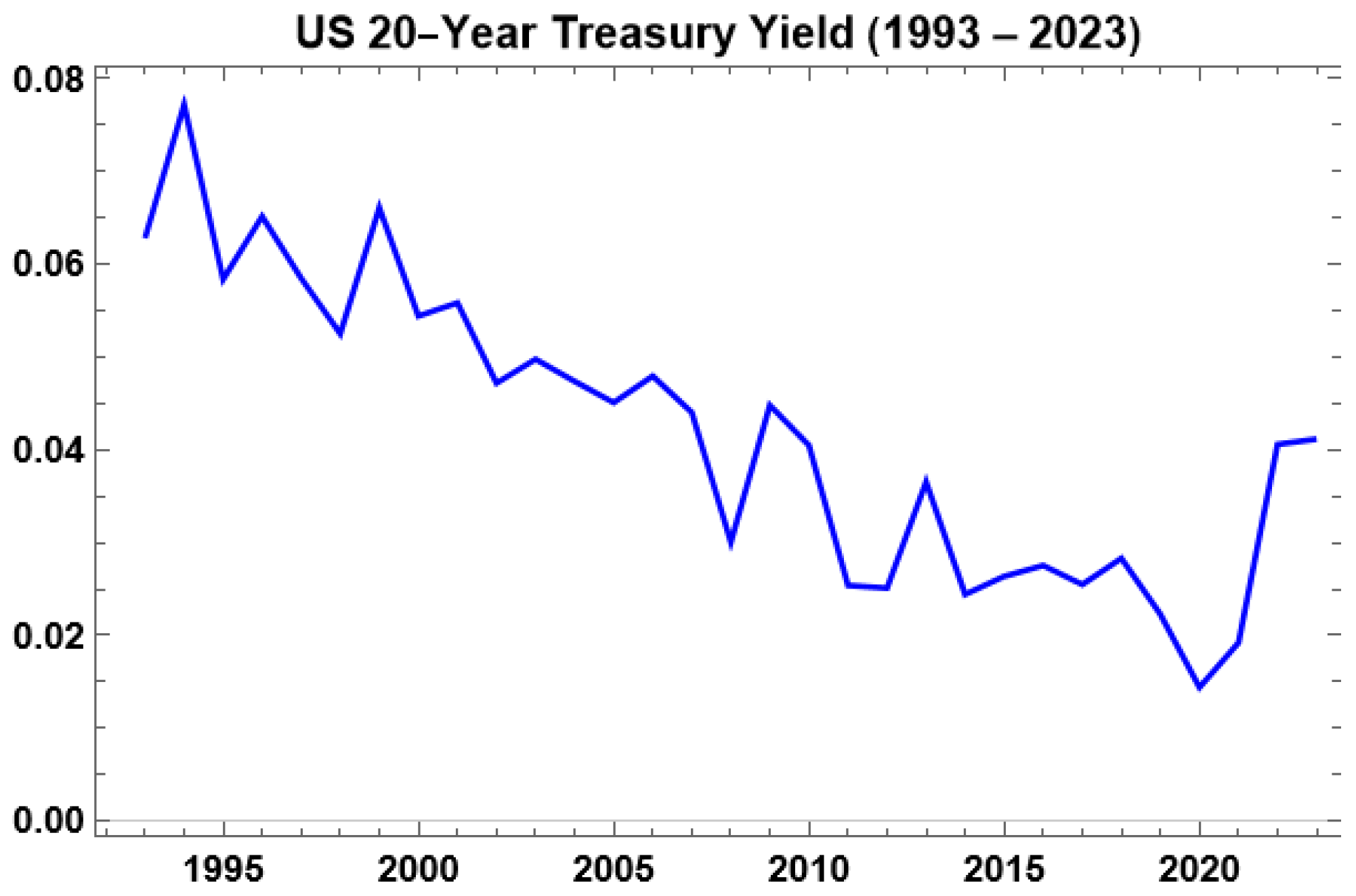
Figure 1 shows a broadly declining pattern in U.S. interest rates over the sample period, with rates reaching notably low levels by 2017. This behaviour supports the use of the Vasiček model for interest-rate dynamics: its affine structure and allowance for negative rates make it well-suited to capturing a low or near-zero interest-rate environment without forcing the process away from the prevailing trend.
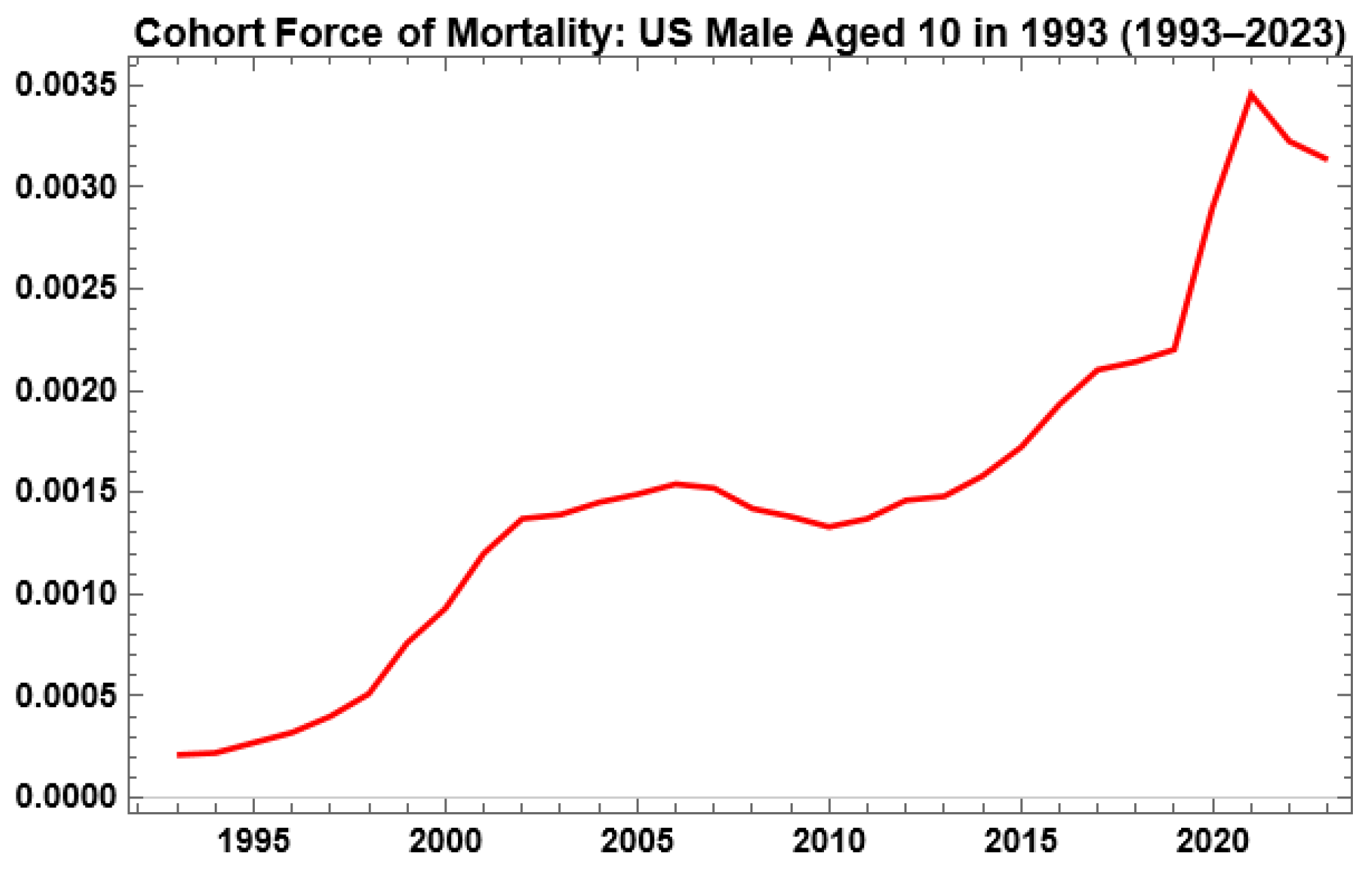
By contrast, Figure 2 illustrates an overall upward trend in the force of mortality for the selected cohort; however, several noticeable deviations occur. These include a slight decline around 2007–2009, after which the upward trajectory resumes. From 2015 onwards, a much steeper increase could be observed, eventually leading to a peak value in 2020, possibly reflecting the impact of the pandemic. This is followed by a modest drop, albeit it remains substantially higher than the values in the earlier decades. Such abrupt shifts are characteristic of changes in volatility or structural behaviour, and may be effectively captured by a regime-switching framework that distinguishes between high- and low-volatility mortality regimes.
Taken together, the downward trajectory of interest rates and the upward trajectory of mortality rates indicate a negative association between the two series. This observation provides empirical justification for the correlated modelling approach introduced in Section 2.

2.2.2. Quasi-Maximum Likelihood Estimation

To estimate the parameters of the regime-switching models, we employ the quasi-maximum likelihood estimation (QMLE) method, following the approach of James and Webber (2000). QMLE applies the principle of maximum likelihood to a quasi-likelihood (or approximate likelihood) function, rather than to the exact likelihood, thereby providing a tractable approximation when the true likelihood is analytically intractable. This methodology has been used effectively in Zhou and Mamon (2012) to approximate likelihood functions arising from stochastic differential equation models for interest rates. We adopt the same approach for both the one-state and multi-state specifications considered in this paper, owing to their relative simplicity and ease of implementation. For alternative estimation techniques that explicitly incorporate serial correlation, see Hardy (2001).
Under the maximum likelihood estimation, we determine the vector of parameter values of a given probabilistic model that maximizes its likelihood of representing the observed samples. Let X 1 , . . . , X n be a random sample (independent and identically distributed random variables) from a distribution with probability density function (pdf) f X ( x ; θ ) , where θ = ( θ 1 , θ 2 , . . . , θ D ) is a vector of parameters and θ Ω θ , where Ω θ R D is the parameter space. The likelihood function L ( θ x 1 , . . . , x n ) is given by
L ( θ x 1 , . . . , x n ) = f X 1 , X 2 , . . . , X n ( x 1 , x 2 , . . . , x n ; θ ) = i = i n f X i ( x i ; θ ) .
The maximum likelihood estimator θ ^ M L E for θ is as follows:
θ ^ M L E = arg max θ Ω θ L ( θ x 1 , . . . , x n ) .
Since ln x is a monotonically increasing one-to-one function this is also equivalent to
θ ^ M L E = arg max θ Ω θ l ( θ ) ,
where l ( θ ) : = ln L ( θ x 1 , . . . , x n ) is the log-likelihood function. After these estimates are obtained, we obtain the standard errors corresponding to these parameter estimates from the Observed Fisher Information Matrix I θ ^ M L E , which is a D × D matrix whose entries are given by
I θ ^ M L E i j = 2 l ( θ ) θ i θ j | θ = θ ^ M L E .
From this, the standard error of the estimate θ ^ i for the parameter θ i is the square-root of ( i , i ) -th entry of the inverse of I θ ^ M L E , i.e., I 1 θ ^ M L E i i . In case the resulting I θ ^ M L E is singular, we instead use its pseudoinverse (specifically, the Moore-Penrose Generalized Inverse) which in this case is I + θ ^ M L E = I θ ^ M L E I θ ^ M L E 1 I θ ^ M L E . Li and Yeh (2012) justified the use of the said pseudoinverse by proving that it is the Cramér–Rao bound of a singular Fisher information matrix corresponding to the minimum variance amongst all choices of minimum constraint functions.
The parameter estimation in this paper is carried out using quasi-maximum likelihood estimation (QMLE), where the likelihood is constructed from an approximate conditional distribution implied by a discretisation of the continuous-time dynamics. In particular, the Euler–Maruyama scheme is used to obtain a Gaussian approximation to the one-step transition of ( r t , μ t ) under the assumed models. This approach is widely used in practice when working with discretely observed data and provides a transparent and computationally tractable estimation strategy.
We note, however, that when observations are available only at low frequency, such as annually, discretisation error may be non-negligible, especially for mean-reverting processes. For the one-state case considered here, both the Vasiček short-rate model and the Ornstein–Uhlenbeck-type mortality model admit exact Gaussian transition densities, which could be employed to reduce discretization bias. Extending the likelihood construction to exact transitions and to higher-frequency datasets where available is, therefore, a natural robustness enhancement.
We acknowledge that, due to the limited availability of observations owing to the very nature of the mortality rate data with annual frequency, the statistical robustness of the estimates may not be particularly strong. To provide further insights into robustness, bootstrap methods could be applied, which allow for the assessment of the variability of parameter estimates under repeated resampling. Aside from this, since Equations (3) and (4) have regime-switching volatilities which are apparently latent in nature, further model diagnostics and robustness checks that are commonly employed in discrete-time implementations of latent stochastic volatility models may be considered (e.g., Zeghdoudi et al. (2014)).
The empirical results reported in this study should be interpreted as an implementation illustration of the proposed modelling framework, with the estimator understood as quasi-likelihood-based rather than exact maximum likelihood.
To derive the quasi-log-likelihood function for the one-state case, we follow James and Webber (2000) and discretise Equations (1) and (2) using the Euler–Maruyama scheme with Δ t = 1 (reflecting annual data):
r t + 1 = r t + a ( b r t ) + σ Δ W t ( 1 ) , μ t + 1 = μ t + c μ t + ξ ρ Δ W t ( 1 ) + 1 ρ 2 Δ W t ( 2 ) ,
where the increments Δ W t ( 1 ) = W t + 1 ( 1 ) W t ( 1 ) and Δ W t ( 2 ) = W t + 1 ( 2 ) W t ( 2 ) are independent standard normal random variables, that is Δ W t ( i ) N ( 0 , 1 ) for i = 1 , 2 . It follows that, conditional on ( r t , μ t ) , the vector ( r t + 1 , μ t + 1 ) has a bivariate normal distribution, namely
r t + 1 μ t + 1 | r t μ t N 2 r t + a ( b r t ) μ t + c μ t , σ 2 ρ σ ξ ρ σ ξ ξ 2 .
This implies that the conditional density of ( r t + 1 , μ t + 1 ) given ( r t , μ t ) is
f r t + 1 , μ t + 1 | r t , μ t ; a , b , c , σ , ξ , ρ = 1 2 π σ ξ 1 ρ 2 exp ( 1 2 ( 1 ρ 2 ) [ r t + 1 r t a ( b r t ) σ 2 2 ρ r t + 1 r t a ( b r t ) μ t + 1 μ t c μ t σ ξ μ t + 1 μ t c μ t ξ 2 ] ) .
Given observations r 0 , r 1 , , r n and μ 0 , μ 1 , , μ n , the quasi-log-likelihood function is
l ( a , b , c , σ , ξ , ρ ) = ln L ( a , b , c , σ , ξ , ρ r 0 , , r n , μ 0 , , μ n ) = ln t = 0 n 1 f r t + 1 , μ t + 1 | r t , μ t ; a , b , c , σ , ξ , ρ = n ln ( 2 π ) n ln σ n ln ξ n 2 ln ( 1 ρ 2 ) 1 2 ( 1 ρ 2 ) t = 0 n 1 [ r t + 1 r t a ( b r t ) σ 2 2 ρ r t + 1 r t a ( b r t ) μ t + 1 μ t c μ t σ ξ + μ t + 1 μ t c μ t ξ 2 ] .

2.2.3. Quasi-Log-Likelihood Function (Multi-State Case)

For the K-state case, we follow the approach of Zhou and Mamon (2012) and adapt it to our modelling framework so that the conditional distribution of ( r t + 1 , μ t + 1 ) given ( r t , μ t ) is expressed as a mixture of K bivariate normal distributions. The mixing weights correspond to the components of the steady-state vector of the discrete-time K-state Markov chain that approximates the continuous-time chain driving the regime dynamics. Accordingly, the conditional density can be written as
f r t + 1 , μ t + 1 r t , μ t ; θ = i = 1 K π i f r t + 1 , μ t + 1 r t , μ t , y t = e i ; a , b i , c , σ i , ξ i , ρ i ,
where each component density is given by
f r t + 1 , μ t + 1 r t , μ t , y t = e i ; a , b i , c , σ i , ξ i , ρ i = 1 2 π σ i ξ i 1 ρ i 2 exp ( 1 2 ( 1 ρ i 2 ) [ r t + 1 r t a ( b i r t ) σ i 2 2 ρ i r t + 1 r t a ( b i r t ) μ t + 1 μ t c μ t σ i ξ i + μ t + 1 μ t c μ t ξ i 2 ] ) ,
for i = 1 , , K . The steady-state vector π = ( π 1 , , π K ) satisfies the matrix equation π P = π , where P is the transition matrix with entries
p i j = Pr y n + 1 = e j y n = e i , n = 0 , 1 , 2 , .
The parameter vector is
θ = a , b 1 , , b K , c , σ 1 , , σ K , ξ 1 , , ξ K , ρ 1 , , ρ K , p 12 , p 13 , , p 1 K , p 21 , p 23 , , p 2 K , ,
with the structure depending on the chosen value of K.
Since the regime-switching process is modelled as a homogeneous continuous-time Markov chain, the transition matrix P is related to the transition intensity matrix Γ through
P = e Γ Γ = ln P ,
where, for any square matrix A , the matrix exponential and logarithm are defined by the power series:
e A = k = 0 A k k ! = I + A + A 2 2 + A 3 3 ! + ,
and
ln ( A ) = k = 1 ( 1 ) k + 1 ( A I ) k k = ( A I ) ( A I ) 2 2 + ( A I ) 3 3 ( A I ) 4 4 + ,
with I denoting the identity matrix. The quasi-log-likelihood function is given by
l ( θ ) = ln L ( θ r 0 , r 1 , , r n , μ 0 , μ 1 , , μ n ) = ln t = 0 n 1 f r t + 1 , μ t + 1 r t , μ t ; θ = t = 0 n 1 ln f r t + 1 , μ t + 1 r t , μ t ; θ .

2.2.4. Parameter Estimation

In this paper, quasi-maximum likelihood estimation (QMLE) is implemented numerically using the FindMaximum function in Mathematica, a technical computing software package. We fit the one-state, two-state, and three-state versions of the model to the data. The corresponding optimisation problems and parameter constraints for the three specifications are summarised in Table 1.
Table 2 reports the parameter estimates together with their standard errors (in parentheses). Overall, Table 2 indicates that the QMLE procedure yields stable and reasonable parameter estimates, as reflected in the magnitude of the associated standard errors. In particular, the volatility parameters ξ i , followed by σ i , are estimated most precisely across the three models, whereas the correlation parameters ρ i exhibit comparatively larger standard errors and hence are estimated with lower precision.
The QMLE approach adopted in this study is based on an approximate Gaussian likelihood implied by the Euler–Maruyama discretisation. Although QMLE is widely used in practice and performs well under mild regularity conditions, it remains an approximation to the true likelihood and may be sensitive to small-sample effects. In particular, uncertainty may be more pronounced for regime-dependent parameters, such as correlation and transition probabilities, especially when a regime is visited relatively infrequently in the observed sample. For this reason, the reported standard errors should be interpreted as measures of estimation precision within the quasi-likelihood framework.
Alternative estimation procedures could be explored in future work to assess robustness and improve inference under regime-switching dynamics. These include maximum likelihood estimation via expectation–maximisation algorithms, Bayesian methods (e.g., Markov chain Monte Carlo), and filtering-based approaches designed for latent regime processes. Nevertheless, QMLE is adopted here because it offers a transparent and computationally tractable estimation strategy, and it produces stable parameter estimates that support practical implementation of the proposed pricing framework.
Knowing that the mortality process μ t admits negative values for any t > 0 , we address this modelling concern by verifying that such probabilities are practically negligible. To this end, we approximate the probability that the mortality rate process takes negative values at future times using a Monte Carlo simulation of 100,000 sample paths. Specifically, Table 3 reports
Pr μ 40 + t < 0 μ 40 = 0.00313491 ) , t = 5 , 10 , , 60
together with their standard errors (in parentheses). Here, age 40 corresponds to the age of the U.S. male cohort in 2023, as shown in Figure 2. The chosen values of t therefore correspond to ages 45, 50, …, 100, which constitute the relevant time horizon for the numerical experiments presented in the succeeding subsections. Across all model specifications, the probabilities are extremely small, with the largest probability being below 0.2%. In particular, for the one-state model, no realisations of the mortality process have attained negative values across all 100,000 sample paths for any t, resulting in estimated probabilities of 0 throughout the entire time horizon. Further reassurance can be obtained by using the closed-form formula derived by Luciano and Vigna (2005) for the one-state case. In this setting, the formula is given by
Pr μ 40 + t < 0 μ 40 = 0.00313491 ) = Φ 0.00313491 e c t ξ e 2 c t 1 2 c
and these probabilities are also displayed in Table 3. Indeed, the exact probabilities are extremely low, ranging from orders of 10 18 up to 10 8 , which are practically negligible in actuarial contexts.
Incorporating regime switching increases the likelihood for the mortality process to attain negative values, reflecting the higher variability induced by transitions between latent states. This effect is modest in the two-state model and more apparent in the three-state model, where the estimated probabilities increase gradually with the time horizon. Nevertheless, even in the three-state case, the probability of observing negative mortality rates remains below 0.2%, indicating that such events are exceedingly rare within the relevant age range.
Although the quantities reported in Table 3 measure the likelihood of negative values at the specified future times, they do not capture when such an event is expected to happen along a sample path of μ t . To complement the above analysis, we therefore look at the expected hitting time of the negative region. Conditional on μ 40 = 0.00313491 , we define the first hitting time as
τ 0 : = inf { t > 0 : μ 40 + t < 0 } .
whilst τ 0 quantifies the time at which the mortality process first exits the admissible (non-negative) state space of the modelling framework, its expectation may be difficult to estimate reliably in practice due to rare-event behaviour and long simulation horizons. Moreover, from an actuarial perspective, our window of interest is typically restricted to ages of up to 100, corresponding to a maximum horizon of 60 years from age 40. To this end, we introduce a right-censored version of τ 0 , defined as
τ 0 60 : = min ( τ 0 , 60 ) .
We then estimate E [ τ 0 60 ] via Monte Carlo simulation using 100,000 sample paths. In this setup, the paths for which the process remains non-negative over the interval t [ 0 , 60 ] are censored at 60. This censored expectation provides a conservative and practical measure for the time scale over which negative values may arise. The resulting estimates are shown in Table 4.
Across all model specifications and consistent with the results in Table 3, the expected hitting times are extremely close to the censoring threshold, indicating that, on average, negative realizations of the mortality rate process occur, if at all, only at the very end of the considered horizon.
In the one-state model, the expected hitting time equals 60 exactly, with zero standard error, reflecting that no paths hit negative values within the 60-year window. This observation is consistent with the closed-form probability of negativity discussed previously, providing additional reassurance that the one-state model remains well within the admissible non-negative region.
Introducing regime switching slightly decreases the expected hitting time, with the two-state model yielding 59.997 and the three-state model 59.945. Consistent with the previous discussion on negative mortality rates, these small deviations reflect the increased variability induced by state transitions, which occasionally allow paths to reach negative values before the censoring point t = 60 . Moreover, even in the three-state model, the expected hitting time also remains near the upper bound of the horizon, and the corresponding standard errors are extremely small.
In summary, the results from Table 3 and Table 4 demonstrate that negative mortality values are exceedingly rare within the actuarially relevant age range of 45–100 and confirm that the models produce practically admissible mortality trajectories over the time horizon of interest.
From Table 2, one observes that the quasi-log-likelihood values of the regime-switching models are higher than those of the one-state model, indicating that the former capture the underlying data dynamics more effectively. Taken in isolation, this would suggest selecting the three-state model. However, it is also necessary to assess whether the improvement in fit implied by the quasi-log-likelihood is sufficient to justify the additional model complexity, in order to avoid overfitting.
To address this, we employ two standard model selection criteria that penalise the log-likelihood for extra parameters: the Akaike Information Criterion (AIC) and the Bayesian Information Criterion (BIC). These are given by
AIC = 2 l θ 2 D , BIC = 2 l θ D ln n ,
where n denotes the number of observations and D the number of parameters. Table 3 reports these values for the models considered, with n = 31 .
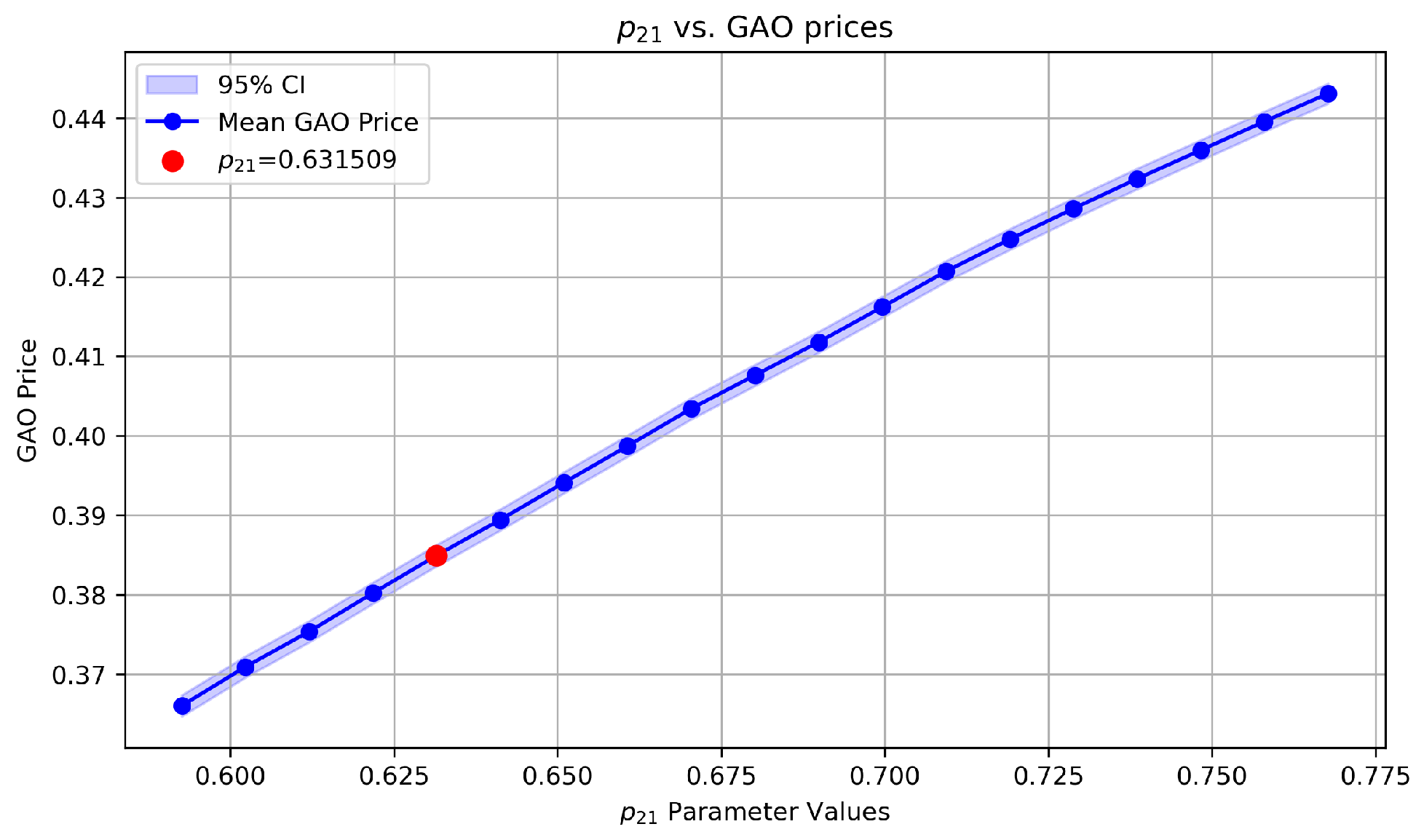
Table 5 indicates that the two-state model attains the highest AIC value, whilst the one-state model has the highest BIC value. Given our datasets and the trade-off between goodness of fit and model complexity, the main choice is therefore between the one-state and two-state frameworks for overall performance in terms of fit, predictive ability, and interpretability. In general, AIC is regarded as more suitable for prediction, whereas BIC is often preferred for explanation or for identifying the true underlying model. The AIC is typically chosen when predictive accuracy is the primary objective and the inclusion of additional parameters is acceptable, whilst the BIC is favoured when the aim is to select the most parsimonious model that still explains the data adequately. In our context, the modelling framework is intended for long-term projection of interest and mortality rates for GAO pricing, which aligns more naturally with the predictive focus of the AIC. Accordingly, the two-state model is adopted for the valuation and sensitivity analyses.
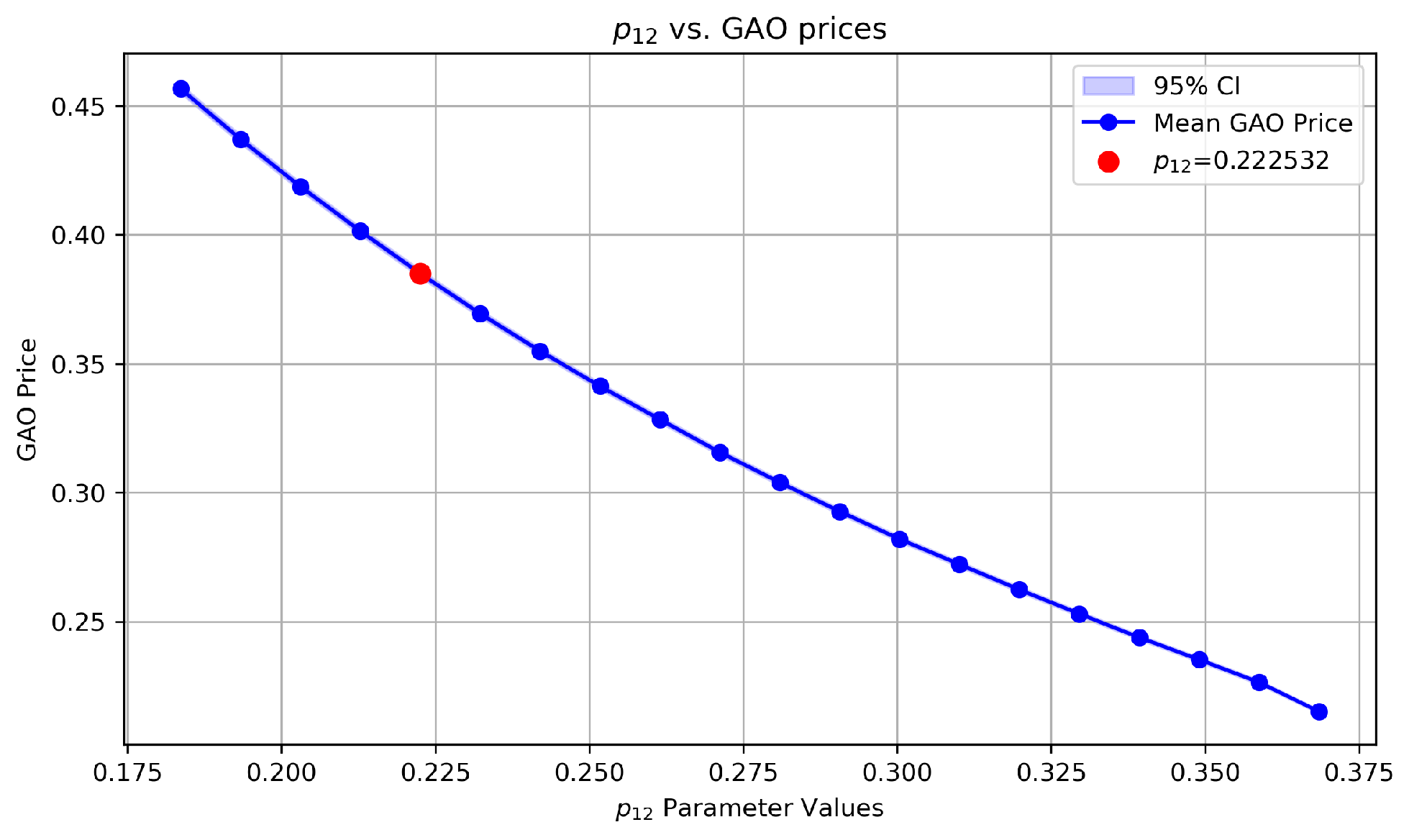
Examining the parameter estimates for the two-state model in Table 2, Regime 1 corresponds to a low-volatility and lower interest-rate environment, as implied by the corresponding parameter values of σ 1 and ξ 1 . This regime is visited most of the time, consistent with the relatively small transition probability p 12 of 22.25%, which implies a low propensity to move from Regime 1 into Regime 2.
By contrast, Regime 2 may be characterised as a high-volatility environment, evidenced by the larger values of σ 2 and ξ 2 , together with a higher long-term mean interest-rate level b. Elevated interest rates often coincide with heightened volatility, reflecting increased uncertainty and a greater likelihood of default when borrowing costs are high. The economy occupies this regime relatively infrequently, as suggested by the transition probability p 21 of 63.15%, which indicates a strong tendency to move out of Regime 2.
Finally, we note that the one-state model contains 6 parameters, the two-state model contains 12, and the three-state model contains 20. By induction, a K-state model may be shown to have ( K + 1 ) ( K + 2 ) parameters.

2.3. The Valuation Problem

A GAO grants the policyholder the right to convert accumulated funds at maturity into a life annuity at a guaranteed minimum rate. Throughout this paper, the valuation of GAOs is carried out under the risk-neutral measure to ensure the absence of arbitrage. A detailed discussion of the relationship between the risk-neutral and physical measures may be found in the remark provided by Gao et al. (2017).
In particular, we follow Hardy (2003) and Gao et al. (2017), where the risk-neutral measure Q is adopted as a conceptual device to express the price of an embedded option, such as GAO, as an expected value under Q. By the Girsanov’s theorem, the measure Q is related to the real-world (objective) measure P via the market price of risk (Elliott and Kopp 2005). Unlike other financial instruments, which are not affected by mortality/longevity risk, GAOs are long-term insurance products and are not actively traded. This means that current market data on GAO are insufficient to reliably calibrate the equivalent risk-neutral mortality parameters, a task that is generally easily feasible for short-term traded financial instruments (Grozen and Mamon 2025). Moreover, implied volatilities or other short-term market-derived estimates may differ substantially from long-term historical values because even small changes in parameter estimates can have a large impact on long-term guaranteed-maturity liabilities. This further highlights that the risk-neutral measure here functions as a pricing device, and care must be taken in interpreting risk-neutral parameter estimates due to the limited market information available for GAOs. For practical purposes in assessing long-term risk dynamics, objective-measure estimates remain as inputs for pricing models established under the risk-neutral setting.
The succeeding subsections are organised as follows. Section 2.3.1 illustrates the mechanics of a GAO through an example. Section 2.3.2 then generalizes this example by deriving an expression for the cost borne by insurers in offering a GAO contract, as well as the price of the GAO itself. Lastly, Section 2.3.3 and Section 2.3.4 derive closed-form formulas for a pure endowment, a basic building block in the GAO valuation formula.

2.3.1. A Motivating Example for GAO

Consider a single-premium policy in which a contribution of £500 is paid into the policyholder’s account at time 0. Suppose that, by the maturity date T, the account value has grown to £1000. Under a GAO contract with a guaranteed minimum conversion rate g = 1 9 , a rate commonly offered to UK males in the 1970s and 1980s, the policyholder is guaranteed a life annuity paying at least £1000 ×   1 9 £111 per year for life, irrespective of future interest and mortality conditions.
If future interest and mortality rates turn out to be favourable (for example, relatively high interest and higher mortality), life annuities become relatively inexpensive, and an account value of £1000 might purchase a life annuity paying, say, £222 per year. In this case, a rational policyholder will prefer the higher market annuity rate of £222 rather than the guaranteed £111; the option will not be exercised, and the insurer incurs no additional liability.
Conversely, if future interest and mortality rates are unfavourable (for example, relatively low interest and lower mortality), life annuities become relatively expensive, and the same £1000 might only purchase a life annuity paying, say, £99 per year. The policyholder will then choose the guaranteed rate of £111 per year, since it is more advantageous. In this scenario, the GAO is exercised, and the insurer must bear the additional cost of providing the higher guaranteed income.

2.3.2. The Cost of GAO

Boyle and Hardy (2003) formulated the cost of providing a GAO as follows. Consider a single-premium equity-linked policy that matures at time T, with an initial premium invested in an account of value S ( 0 ) at time 0, yielding an accumulated value S ( T ) at maturity. Let a x ( T ) denote the market price of a life annuity that pays £1 per annum, commencing at maturity age x, and let g be the guaranteed conversion rate. If the option is exercised at maturity, the policyholder purchases a life annuity paying g S ( T ) per annum at a cost of g S ( T ) a x ( T ) . When this cost exceeds the accumulated account value S ( T ) , the insurer must cover the shortfall g S ( T ) a x ( T ) S ( T ) . If the option is not exercised, the amount S ( T ) is simply annuitized at prevailing market rates, and no additional liability is incurred. Thus, conditional on survival to maturity, the cost of providing the GAO is
S ( T ) max g a x ( T ) 1 , 0 = S ( T ) g a x ( T ) 1 + .
Because this cost is valued at time T, we incorporate the modelling framework introduced in Section 2.1 and discount it to time 0 whilst adjusting for both interest and survival. The discounted cost is therefore given by
e 0 T r s d s e 0 T μ s d s S ( T ) g a x ( T ) 1 + .
Here, e 0 T r s d s is the stochastic discount factor associated with the short rate process. Similarly, e 0 T μ s d s is the survival factor associated with the (possibly stochastic) force of mortality. Conditional on the mortality intensity path { μ s } 0 s T , this factor represents the probability of survival to time T. The unconditional survival probability is therefore given by E Q e 0 T μ s d s , in direct analogy with bond pricing where the conditional expectation of e 0 T r s d s yields the zero-coupon bond price.
For tractability, we assume that the terminal account value S ( T ) is deterministic and, therefore, can be taken outside the expectation operator. Given that r t and μ t evolve as stochastic processes under the specifications introduced in Section 2.1, we aim to obtain an explicit formula for the GAO price per £1 of account value at maturity by evaluating the conditional expectation:
P G A O = E Q e 0 T r s d s e 0 T μ s d s g a x ( T ) 1 + | F 0 ,
where
a x ( T ) = n = 1 E Q e T T + n r s d s e T T + n μ s d s | F T = n = 1 M ( T , T + n ) ,
and
M ( t , T ) : = E Q e t T r s d s e t T μ s d s | F t .
It has to be noted that e t T μ s d s is a random survival factor when μ t is stochastic, and the pure endowment price M ( t , T ) is obtained by taking its conditional expectation jointly with the discount factor. Equation (7) is commonly referred to in actuarial practice as the price of a pure endowment at time t, under stochastic interest and mortality. Formally, it is the present value at time t of a payment of £1 at time T, conditional on the policyholder being alive at that time.
A closed-form expression for P G A O is generally not available. However, we may obtain a semi-analytic formula by deriving a closed-form expression for the pure endowment price terms in Equation (6) and evaluating the remaining components of P G A O numerically via Monte Carlo simulation. The following sections present the derivation of the closed-form expressions for Equation (7) under both the one-state and multi-state modelling frameworks.

2.3.3. Pure Endowment Price for One-State Case

Recall that the price of a pure endowment is the present value at time t of a payment of £1 at time T, conditional on the policyholder being alive at time T. Equivalently, it may be regarded as the time-t price of a zero-coupon bond maturing at T, adjusted for the probability of survival to T. In previous works (e.g., (Gao et al. 2015) and the references therein), a closed-form expression for Equation (7) is available in the one-state case, under the assumption that r t and μ t follow Equations (1) and (2). This expression is given by
M ( t , T , r t , μ t ) = E Q e t T r s d s e t T μ s d s | F t = e A ( t , T ) r t + G ˜ ( t , T ) μ t + D ( t , T ) + H ˜ ( t , T ) ,
where
A ( t , T ) = 1 e a ( T t ) a , G ˜ ( t , T ) = e c ( T t ) 1 c ,
D ( t , T ) = b σ 2 2 a 2 A ( t , T ) ( T t ) σ 2 4 a A ( t , T ) 2 , H ˜ ( t , T ) = ρ σ ξ a c ξ 2 2 c 2 G ˜ ( t , T ) ( T t ) + ρ σ ξ a c A ( t , T ) ϕ ( t , T ) + ξ 2 4 c G ˜ ( t , T ) 2 , ϕ ( t , T ) = 1 e ( a c ) ( T t ) a c .
This closed-form expression depends explicitly on the current values r t and μ t . On this basis, the GAO price could be written as
P G A O = E Q e 0 T r s d s e 0 T μ s d s g a x ( T ) 1 + | F 0 ,
where
a x ( T ) = n = 1 M ( T , T + n , r T , μ T ) = n = 1 e A ( T , T + n ) r T G ˜ ( T , T + n ) μ T + D ( T , T + n ) + H ˜ ( T , T + n ) .

2.3.4. Pure Endowment Price Derivation for Multi-State Case

In Gao et al. (2015), the pure endowment price was established by assuming that only the volatility parameters σ and ξ in Equations (1) and (2) are regime-switching. Their derivation heavily employed the machinery of measure-theoretic probability, i.e., change-of-measure and Bayes’ rule for conditional expectations.
In this paper, we also extend their result by deriving a formula for the pure endowment price under the assumption that the parameters b , σ , ξ , and ρ are time-varying under the dictates of a finite-state continuous-time Markov chain. Furthermore, our derivation will only rely on the properties of the joint distribution of the stochastic processes r t and μ t and their corresponding integrals. This approach was motivated by one of the three ways in deriving the bond price under the Vasiček model, which was highlighted in Mamon (2004).
Our goal is to evaluate
M ( t , T ) = E Q e t T r s d s e t T μ s d s | F t .
By synthesising the technique and principles from Elliott and Mamon (2002) and Mamon (2004), we get
M ( t , T , r t , μ t , y t ) = E Q e t T r s d s e t T μ s d s | F t = e A ( t , T ) r t G ˜ ( t , T ) μ t Ψ t , T y t , 1 ,
where 1 is a vector of 1’s. Here, Ψ t , T is a fundamental matrix solution to the linear matrix differential equation
d Ψ t , s = H ( s , T ) Ψ t , s d s , Ψ t , t = I
where I is the identity matrix, H ( s , T ) = Γ + J ( s , T ) and
J ( v , T ) = d i a g a b 1 A ( v , T ) + 1 2 σ 1 2 A ( v , T ) 2 + 1 2 ξ 1 2 G ˜ ( v , T ) 2 + ρ 1 σ 1 ξ 1 A ( v , T ) G ˜ ( v , T ) a b K A ( v , T ) + 1 2 σ K 2 A ( v , T ) 2 + 1 2 ξ K 2 G ˜ ( v , T ) 2 + ρ K σ K ξ K A ( v , T ) G ˜ ( v , T ) .
Notice that the formula depends on r t , μ t , and the Markov chain y t . The fundamental matrix solution Ψ t , s exists and is unique (see Appendix A for details). When the coefficients are deterministic, the solution is exponential-affine, whilst for general time- or regime-dependent coefficients it may not admit a closed form (Keller-Ressel and Mayerhofer 2015), but it could be computed numerically. See Appendix A for the full derivation of this formula.
If t = 0 , we could calculate the price of pure endowment using
M 0 , T , r 0 , μ 0 : = i = 1 K π i M 0 , T , r 0 , μ 0 , e i ,
where π i ’s are the components of the steady-state vector π = π 1 , π 2 , , π K . In other words, this is the weighted average of M 0 , T , r 0 , μ 0 , y t for y t = e i , i = 1 , 2 , , K .
Substituting this to Equation (6), the GAO price is
P G A O = E Q e 0 T r s d s e 0 T μ s d s g a x ( T ) 1 + | F 0 ,
where
a x ( T ) = n = 1 M ( T , T + n , r T , μ T , y T ) = n = 1 e A ( T , T + n ) r T G ˜ ( T , T + n ) μ T Ψ T , T + n y T , 1
and Ψ T , T + n is a fundamental matrix solution to the linear matrix differential equation
d Ψ T , s = H ( s , T + n ) Ψ T , s d s , Ψ T , T = I .
We emphasise that the multi-state expression for M ( t , T ) does not rely on unconditional joint Gaussianity of t T r s d s and t T μ s d s under regime switching. Conditional on the regime path of the finite-state Markov chain, the model remains affine within each regime, and the corresponding conditional expectation is characterized by a system of coupled linear equations. The regime uncertainty is then aggregated through the fundamental matrix Ψ t , T , yielding the semi-analytic representation stated in the paper (see Appendix A for details).

3. Numerical Implementation

We now present numerical results for the pure endowment price and the GAO price, based on the derived formulae and a set of predetermined baseline product and parameter assumptions. Three numerical experiments are conducted:
  • to verify whether Equation (11) is consistent with the numerical results obtained via Monte Carlo simulation,
  • to verify whether the results from Equation (12) are consistent with those reported in Gao et al. (2015) under their assumptions, and
  • to compute the GAO price using the parameter estimates in Table 2.
The baseline assumptions that follow are chosen to reflect typical features of GAO contracts observed in practice g = 1 9 , in the UK and to maintain comparability with the existing GAO literature. Whilst retirement ages of 62 (early) and 67 are common in the U.S. as per statutory Social Security (Knoll 2011), retirement ages of 60 and 65 were chosen as they are widely used benchmark ages in the actuarial literature for long-term retirement products.
For experiment (i), Table 6 reports the baseline assumptions used in the numerical computation of the pure endowment price. Whilst the b and ρ values across regimes were chosen to be arbitrary, the rest of the values were taken from Gao et al. (2015).
For experiments (ii) and (iii), the following baseline assumptions are adopted for the numerical computation of the GAO price. The assumptions in (ii) are exactly the assumptions used in Gao et al. (2015) for verification purposes, whilst the model parameter assumptions in (iii) were derived from Section 2.2.4, taking into account the policyholder’s age in 2023 (40 years old).
  • Product type:
    -
    The GAO grants the policyholder the right to convert an account value of $1 at the maturity age x = 65 (ii) or x = 60 (iii) into a life annuity with a guaranteed minimum rate g = 1 9 (11.11%), payable at the beginning of each year until the policyholder reaches age 100. The corresponding benefit period is N = 35 = 100 65 for (ii) and N = 40 = 100 60 for (iii), where N denotes the length of the benefit period.
  • Sample policyholder:
    -
    An American male with an issue age of 35 ( T = 15 = 65 35 for (ii)) or 40 ( T = 20 = 60 40 for (iii)) at the end of 2023.
  • Parameter assumptions:
    -
    For the verification against Gao et al. (2015) in experiment (ii), see Table 7.
    -
    For the application to the actual dataset in experiment (iii), see Table 8.
Table 7. Base assumptions for comparison with Gao et al. (2015).
Base Assumption Set for Benchmarking with Gao et al. (2015)
Contract Specification: g = 1 9 , T = 15 , N = 35 , Δ t = 1 / 252
Interest Rate Model: a = 0.15 , b = 0.045 , r 0 = b
Mortality Model: c = 0.10 , μ 0 = 0.006
Correlations: ρ = 0.9 , 0.5 , 0 , 0.5 , 0.9
Regime-switching volatilities ( σ , ξ )
2-state model: σ 1 ξ 1 σ 2 ξ 2 = 0.05 0.0005 0.01 0.0001
3-state model: σ 1 ξ 1 σ 2 ξ 2 σ 3 ξ 3 = 0.05 0.0005 0.03 0.0003 0.01 0.0001
Transition Intensity Matrices
2-state model: Γ = 1 1 1 1 ,    3-state model: Γ = 2 1 1 1 2 1 1 1 2
Table 8. Base assumptions for GAO valuation: actual data.
Base Assumption Set for GAO Valuation (Using Parameter Estimates from Actual Data)
Contract Specification: g = 1 9 , T = 20 , N = 40 , Δ t = 1 252
Interest Rate Model: d r t = a ( b t r t ) d t + σ t d W t ( 1 ) , r 0 = 0.0411419
Mortality Model: d μ t = c μ t d t + ξ t d Z t , μ 0 = 0.00313491
Parameters
1-state model: a c b σ ξ ρ = 0.2044426 0.0508595 0.0398160 0.0088094 0.0001820 0.2200909
2-state model: a c b 1 σ 1 ξ 1 ρ 1 a c b 2 σ 2 ξ 2 ρ 2 = 0.125344 0.029262 0.012502 0.006371 0.000092 0.047698 0.125344 0.029262 0.138125 0.010149 0.000330 0.880354
3-state model: a c b 1 σ 1 ξ 1 ρ 1 a c b 2 σ 2 ξ 2 ρ 2 a c b 3 σ 3 ξ 3 ρ 3 = 0.237874 0.015246 0.077074 0.006953 0.000004 0.941548 0.237874 0.015246 0.087688 0.010977 0.000353 0.861127 0.237874 0.015246 0.021742 0.005242 0.000098 0.056420
Transition Matrices
2-state model: Γ = ln B ,  where  B = 1 0.222532 0.631509 0.222532 1 0.631509
3-state model: Γ = ln C ,   where
C = 1 0.323684 0.378931 0.127667 0.053947 0.323684 1 0.127667 0.415566 0.154111 0.378931 0.415566 1 0.053947 0.154111
These baseline assumptions are summarised in Table 7 and Table 8. By construction, the values reported in Table 7 are based on the assumptions specified in Gao et al. (2015). For this computation, we take ρ to be identical across all states, that is, ρ 1 = ρ 2 = ρ 3 , and evaluate the GAO price for five different values of ρ as listed in Table 7.
For Table 8, the values of r 0 and μ 0 correspond to the terminal observations of r t and μ t at the end of 2017, as depicted in Figure 1 and Figure 2, respectively, whilst the remaining parameter assumptions are taken from Table 2. The transition intensity matrices Γ represent the natural logarithms of the transposed transition probability matrices P , in accordance with Equation (5).

3.1. Monte Carlo Simulation Process

For the pure endowment price, we compare the values obtained from Equation (11) with those produced by the Monte Carlo simulation.
For the GAO price, since Equations (8) and (12) yield semi-analytic expressions, their expectations are approximated via Monte Carlo simulation, whilst the terms inside the conditional expectations involving Equations (9) and (13) are evaluated using the analytic formulae derived in the preceding sections.
In what follows, we describe the Monte Carlo procedures used for both the pure endowment price and the GAO price under the one-state and multi-state models. Unless stated otherwise, all simulations are based on 50,000 sample paths for each model specification.
Monte Carlo simulation for the one-state model
1.
The time horizon is the interval [ 0 , T ] , where T denotes the time to maturity. This interval is divided into m equal subintervals of length Δ t = T / m , with grid points t i = i Δ t for i = 0 , 1 , , m . In this study, we set Δ t = 1 / 252 .
2.
Sample paths for r t and μ t are generated by recursively applying the Euler–Maruyama discretisation to the one-state model:
r t i + 1 = r t i + ( a b a r t i ) Δ t + σ Δ t ϵ t i + 1 ( 1 ) , μ t i + 1 = μ t i + c μ t i Δ t + ξ Δ t Z t i + 1 = μ t i + c μ t i Δ t + ξ Δ t ρ ϵ t i + 1 ( 1 ) + 1 ρ 2 ϵ t i + 1 ( 2 ) ,
where { ϵ t i ( 1 ) } and { ϵ t i ( 2 ) } are independent sequences of standard normal random variables.
3.
(a)
For pure endowment price in experiment (i): Using the simulated paths, approximate 0 T r s d s and 0 T μ s d s via the trapezoidal rule:
0 T r s d s Δ t 2 r 0 + r m + 2 k = 1 m 1 r k , 0 T μ s d s Δ t 2 μ 0 + μ m + 2 k = 1 m 1 μ k .
Substituting these approximations into e 0 T r s d s e 0 T μ s d s yields the simulated pure endowment value.
(b)
For GAO price P G A O in experiments (ii) and (iii):
  • Substitute the terminal values r T and μ T into
    a x ( T ) = n = 1 N e A ( T , T + n ) r T G ˜ ( T , T + n ) μ T + D ( T , T + n ) + H ˜ ( T , T + n ) .
  • Evaluate ( g a x ( T ) 1 ) + .
  • Approximate the integrals of r t and μ t using the trapezoidal rule above.
  • Substitute the results into
    e 0 T r s d s e 0 T μ s d s ( g a x ( T ) 1 ) + .
4.
Repeat Steps 2–3 for 50,000 simulated paths.
5.
The Monte Carlo estimate of the GAO price is the sample average across all simulations. The associated standard error is computed as the sample standard deviation divided by 50 , 000 and measures the precision of the estimator.
Monte Carlo simulation for the multi-state model
1.
As in the one-state case, discretise the interval [ 0 , T ] into m subintervals of length Δ t = T / m , with Δ t = 1 / 252 in this study.
2.
Approximate the continuous-time K-state Markov chain y t i with its discrete-time counterpart { y t i } via P Δ t , whose entries are p i j . Generate i.i.d. uniform random numbers { υ t i } . The initial state y t 1 is selected according to the steady-state probabilities { π i } of P Δ t :
y t 1 = e k if i = 1 k 1 π i υ t 1 < i = 1 k π i .
3.
For i = 2 , , m , given y t i 1 = e k , determine y t i according to the transition probabilities p k j using:
y t i = e l if j = 1 l 1 p k j υ t i < j = 1 l p k j .
4.
Generate sample paths for r t and μ t via Euler–Maruyama:
r t i = r t i 1 + ( a b t i a r t i 1 ) Δ t + σ t i Δ t ϵ t i ( 1 ) , μ t i = μ t i 1 + c μ t i 1 Δ t + ξ t i Δ t Z t i = μ t i 1 + c μ t i 1 Δ t + ξ t i Δ t ρ t i ϵ t i ( 1 ) + 1 ρ t i 2 ϵ t i ( 2 ) ,
where b t i = b , y t i , σ t i = σ , y t i , ξ t i = ξ , y t i , and ρ t i = ρ , y t i .
5.
Pure endowment and GAO price: Proceed as in the one-state model, but note that computing
M ( t , T , r t , μ t , y t ) = e A ( t , T ) r t G ˜ ( t , T ) μ t Ψ t , T y t , 1
or
a x ( T ) = n = 1 N e A ( T , T + n ) r T G ˜ ( T , T + n ) μ T Ψ T , T + n y T , 1
requires evaluating the fundamental matrix Ψ T , T + n , which is obtained numerically using a Runge–Kutta method for matrix differential equations. The trapezoidal rule is then used to approximate 0 T r s d s and 0 T μ s d s , after which e 0 T r s d s e 0 T μ s d s ( g a x ( T ) 1 ) + is computed.
6.
Repeat Steps 2–5 for 50,000 simulated paths.
7.
The Monte Carlo price is the sample average, and the standard error is obtained as the sample standard deviation divided by 50 , 000 .

3.2. Numerical Results

3.2.1. Pure Endowment Prices

The fundamental matrix Ψ 0 , T in Table 9, Table 10, Table 11 and Table 12 was approximated using the Runge–Kutta method with Δ t = 0.01 . The prices generated under both methods (i.e., our proposed method vis-à-vis the Monte Carlo simulation) are close to each other, although Equation (11) computes the prices at a substantially faster rate, indicating that our derived equation is more efficient than the Monte Carlo simulation method. Furthermore, the standard errors under the Monte Carlo simulation method increase as the time to maturity T increases, reflecting the increasing uncertainty in the projection of future interest and mortality rates.

3.2.2. GAO Prices

For each value of ρ in Table 13 and Table 14, the GAO prices obtained from Equation (12), with standard errors reported in parentheses, are consistently lower than those reported in Gao et al. (2015) by approximately 0.002. This discrepancy arises from the differing formulations: Equation (12) is derived under a homogeneous Markov chain, whereas Gao et al. (2015) employ a non-homogeneous Markov chain as a consequence of their change-of-measure approach. Although the resulting prices do not coincide, it is important to emphasise that both sets of values are approximations to the (unobserved) true GAO price.
Having completed this verification step, we then compute the GAO price for the actual data using the parameter estimates in Table 2 and Equation (12); the corresponding figures are reported in Table 15.

3.2.3. GAO Prices Using Actual Data

Table 15 shows that the GAO prices obtained under the two-state and three-state models are approximately 10% and 25% higher, respectively, than the corresponding price under the one-state model. These differences may be attributed to the additional information captured by the regime-switching specifications, which allow the dynamics to vary across multiple volatility regimes. In particular, the three-state model yields a noticeably larger increase in price because, as indicated in Table 2, two of its three regimes have long-term mean interest-rate levels that are very close to zero. In such regimes, there is effectively little or no discounting of future life-contingent cash flows, which naturally leads to higher GAO values. At the same time, the results suggest that there is no simple pattern in the extent of the GAO price increase as one moves from a model with fewer regimes to one with more. The impact of the number of regimes on the price depends critically on the specific regime characterisations implied by the calibration, rather than on the number of states alone.
Table 15 also reports three mean computation times associated with the one-state model. The first corresponds to the use of the semi-analytic pricing expression in Equation (8). The second and third refer to computation times when the fundamental-matrix-based expression in Equation (12) is employed within frameworks that mimic the two- and three-state structures. In these latter cases, for each i, the parameter sets ( b i , σ i , ξ i , ρ i ) are assigned values consistent with a single underlying set of parameters (for example, under the three-state setting, b 1 = b 2 = b 3 = b ), so that the dynamics are homogeneous across regimes but the computational machinery of the multi-state formulation is retained. Therefore, it is not surprising that the implementations based on Equation (12) require more time than the pure one-state semi-analytic approach in Equation (8), reflecting the additional numerical overhead associated with the fundamental matrix calculations.

3.3. Sensitivity Analysis

According to Klugman (2012), the actuarial control cycle is a problem-solving framework in which the professional defines the problem, designs an appropriate solution, and then monitors the results, making adjustments as necessary. In the context of this study, the sensitivity analysis corresponds to the monitoring of the results stage. We focus on the two-state model, which is identified as the best specification amongst the three models considered according to the AIC criteria, and we examine how fluctuations in the model parameters affect the GAO price. To do this, we vary the parameters one at a time and observe the resulting changes in the GAO value.
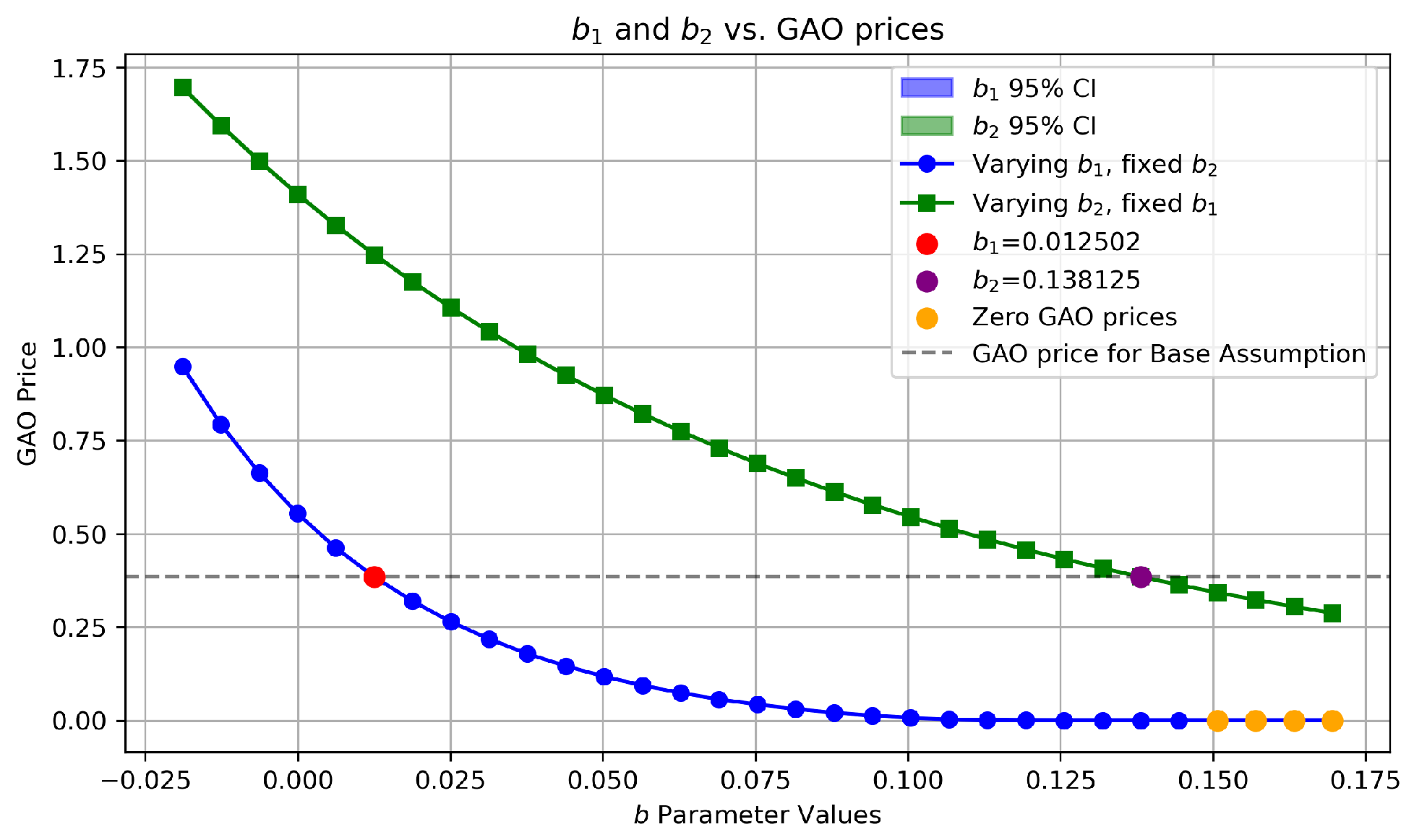
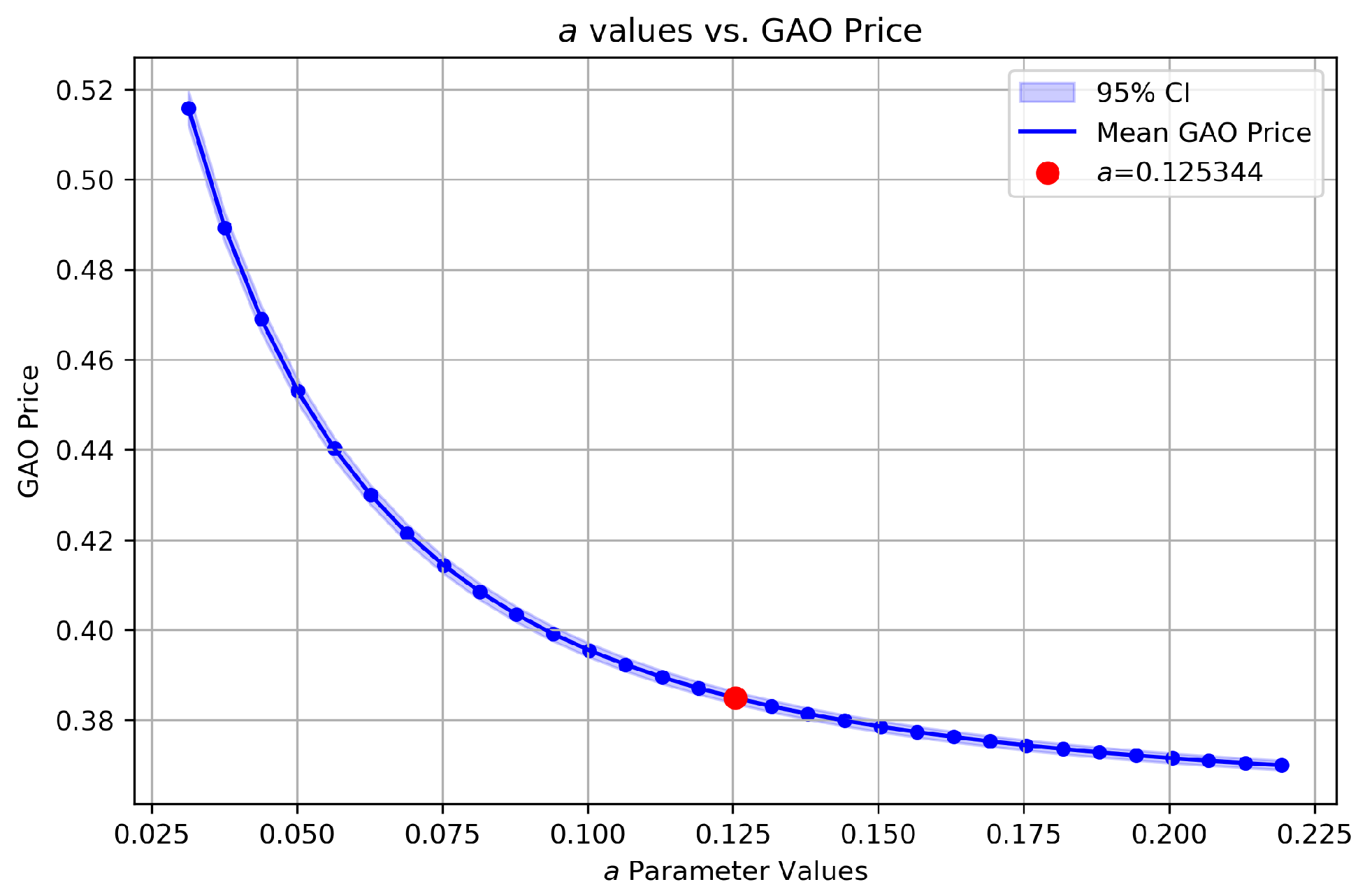
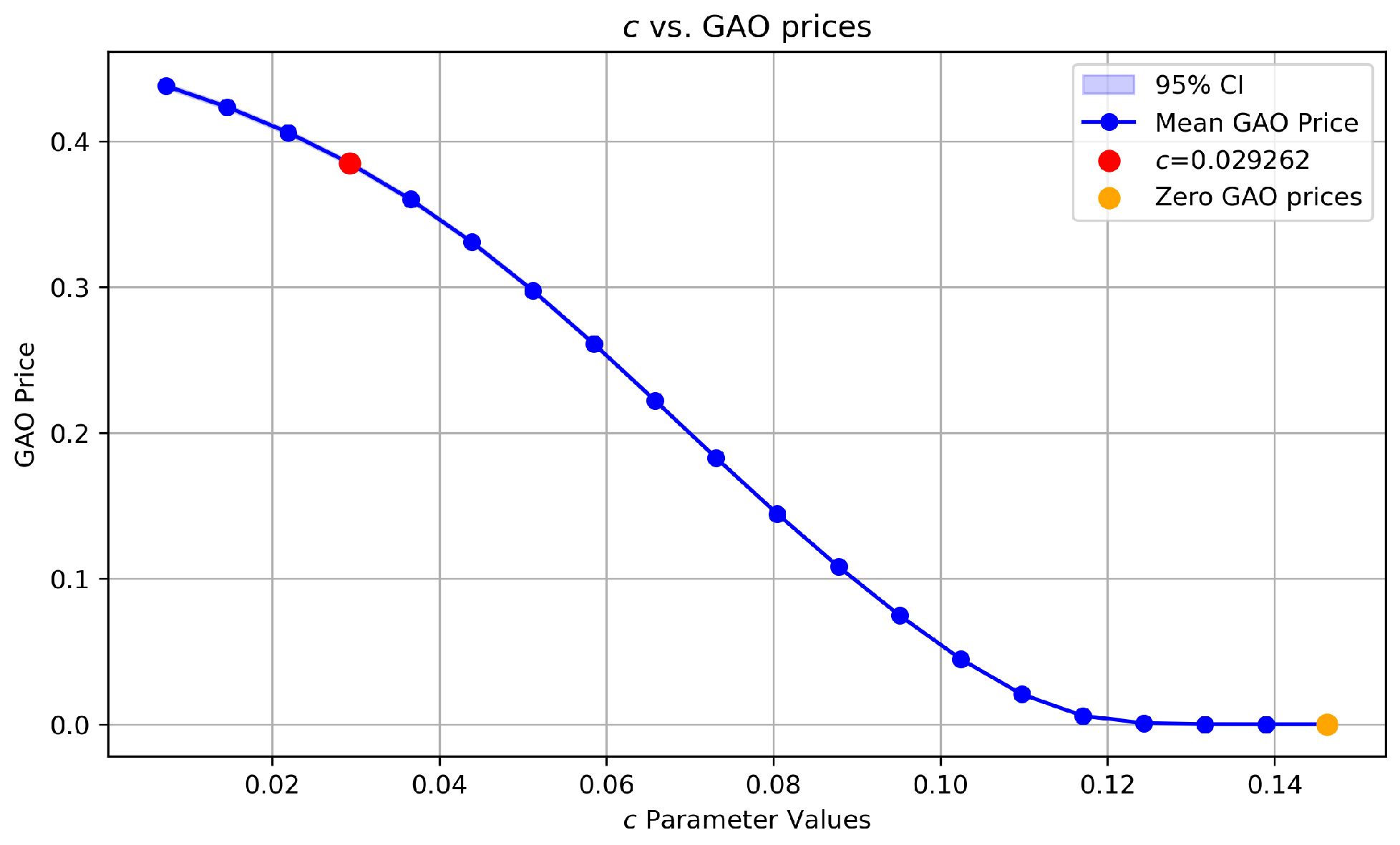
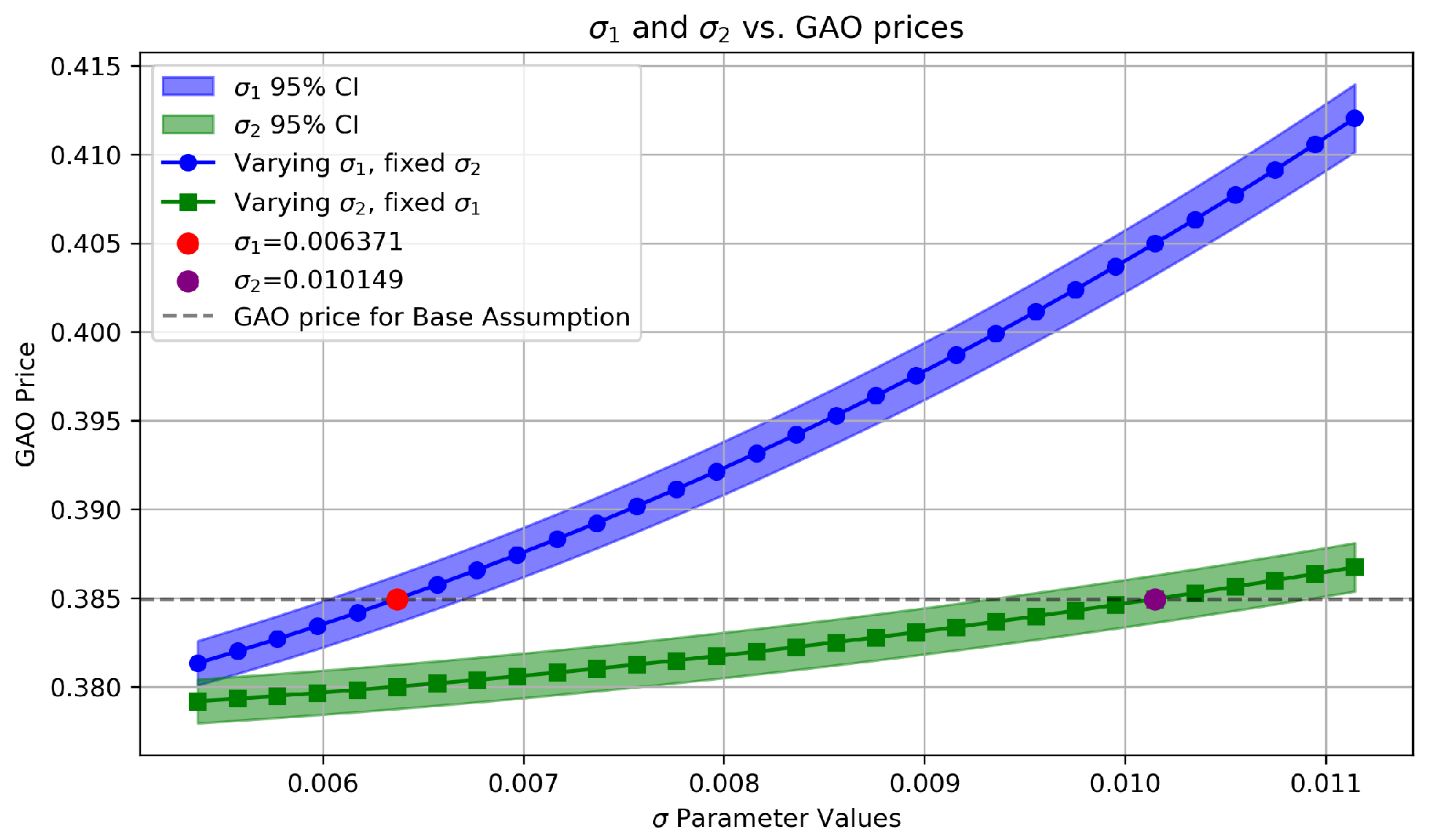
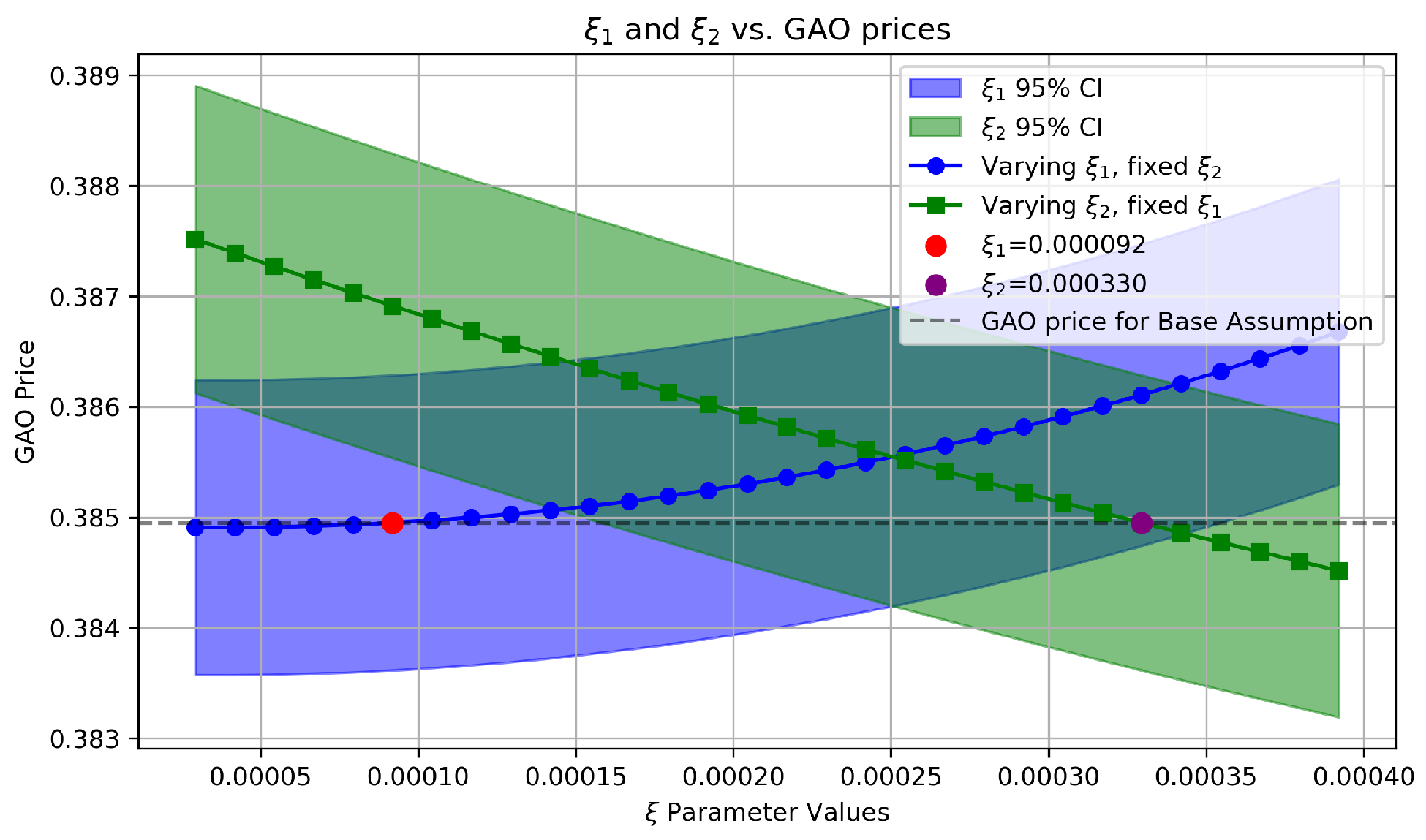
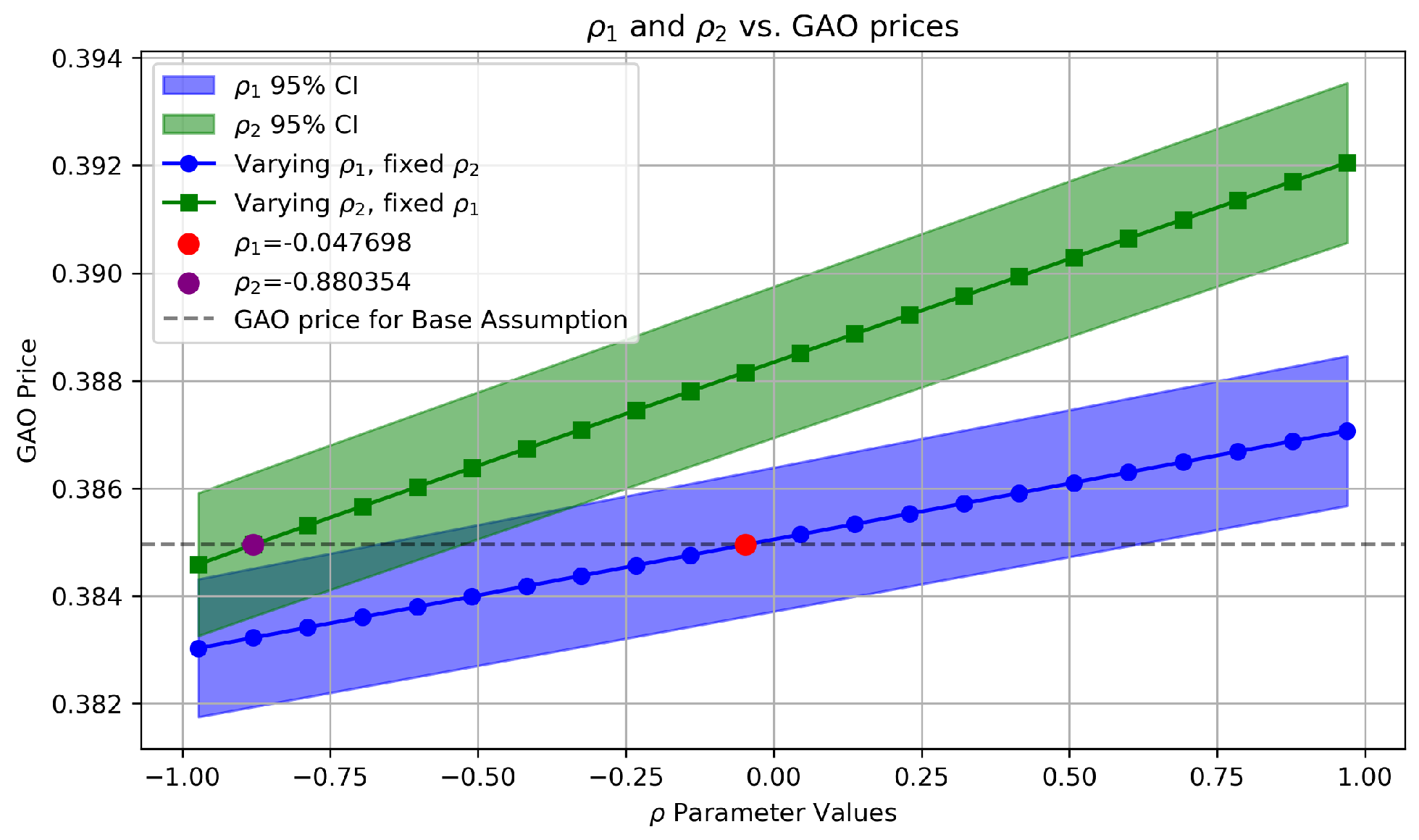
Figure 3, Figure 4, Figure 5, Figure 6, Figure 7, Figure 8, Figure 9 and Figure 10 illustrate the impact of parameter variation on the GAO price. The solid dots indicate the GAO price under the base assumptions given in Table 2 and Table 8. By (i) examining the slopes of the plots and (ii) analysing the percentage change in the GAO price for each percentage change in the parameter value in the neighbourhood of the solid points, it becomes evident that a, b 2 , c, and σ 2 are amongst the parameters that require particularly close monitoring for our dataset, as the GAO price is highly sensitive to changes in these quantities.

3.4. Further Practical Implications

3.4.1. International Accounting Standard (IAS) 19

Under the IAS 19, net interest is recognised by applying the reporting-date discount rate to the opening net defined benefit liability (or asset) for the period. This treatment is deterministic at each reporting date. Still, it remains sensitive to the level of interest rates because the opening liability itself reflects discounting assumptions and long-term cash flow projections. As a result, persistent low-rate environments can materially affect net interest expense over time.
The regime-dependent interest rate dynamics considered in this paper provide a natural framework for interpreting this effect. In a low-rate regime, discounting of long-dated benefit payments is weaker, which increases the present value of liabilities and, therefore, raises the opening net defined benefit obligation used as the base for net interest computation in subsequent periods. This mechanism increases net interest expense even before considering additional effects from longevity improvements or embedded guarantees. Accordingly, whilst IAS 19 balance sheet measurement relies on a single discount rate at each reporting date, regime-dependent modelling remains useful for forward-looking assessment of how sustained low-rate regimes can affect the path of liabilities and the evolution of net interest charges.
Under the IAS 19, the defined benefit obligation is measured using a discount rate fixed at the reporting date, typically derived from high-quality corporate bond yields. This reporting convention can create the appearance of a static valuation input within a given measurement date, even though economic conditions are evolving continuously. In contrast, the modelling framework in this paper treats interest rates and mortality as stochastic risk drivers over time, allowing for correlation and regime-switching behaviour. The stochastic projections, therefore, reflect the economic uncertainty that accumulates over long horizons and that can affect the value of embedded guarantees.
Importantly, the IAS 19 measurement approach does not eliminate economic volatility. Instead, it concentrates its impact into periodic actuarial remeasurements as market yields change from one reporting date to the next and as longevity assumptions are updated. In addition, the presence of embedded options such as annuitisation guarantees can make liabilities more sensitive to adverse states, particularly when low discount rates coincide with improved longevity. Scenario-based stress testing and stochastic valuation tools are therefore useful complements to IAS 19 measurement, as they reveal the distributional and tail-risk effects that are not visible from a purely static discount rate treatment at a single reporting date.
In defined benefit pension arrangements that permit annuitisation at retirement, embedded conversion features can operate in a manner analogous to a GAO. When the plan sponsor effectively provides a minimum annuity conversion rate, the member holds an option that is exercised when market annuity rates are less favourable than the guaranteed terms. This feature increases the projected benefit payments in adverse scenarios and, therefore, raises the best estimate of the defined benefit obligation (DBO) relative to an otherwise identical plan without such an embedded guarantee. Since the IAS 19 net interest charge is computed on the net defined benefit liability, a higher DBO mechanically results in a higher net interest expense, even if the accounting discount rate remains deterministic.
A simple illustration clarifies the mechanism. Suppose a member retires with an accumulated notional account of £1000 and the plan offers a guaranteed conversion rate of g = 1 / 9 , implying a minimum annual pension of approximately £111. If prevailing market conditions imply that £1000 can purchase only £99 per annum, the guaranteed conversion becomes binding, and the plan bears the shortfall. The projected pension payments increase relative to the market annuitisation baseline, and the present value of benefits rises accordingly. In contrast, if market annuity rates are more favourable, the guarantee is out of the money, and the incremental cost is negligible. This asymmetry implies that annuitisation guarantees increase the liability in the states that matter most for solvency and financial reporting, reinforcing the value of GAO-style valuation tools for assessing the effect of embedded options on net DBO and net interest charges.
Even though the IAS 19 requires deterministic discount rates for balance sheet measurement and does not permit stochastic discounting in the reported defined benefit obligation, stochastic models remain valuable for forward-looking risk management. In particular, the proposed framework is well-suited for sensitivity analysis, earnings and funding forecasts, and covenant testing, since it provides a coherent way to quantify how joint shifts in interest rates and longevity conditions affect long-term liabilities and embedded guarantees. This is especially relevant for management reporting and external disclosure, where scenario-based analysis is often communicated through management commentary and MD&A, and where stakeholders require transparency on the potential impact of adverse economic and demographic environments on solvency, liquidity, and financial resilience.

3.4.2. Solvency II Considerations

The proposed framework could complement the Solvency II standard formula. The standard formula provides a consistent and pragmatic approach for capital assessment, but it is necessarily based on simplified risk aggregation and pre-specified shocks. In contrast, the main value of the present framework arises in settings where joint interest rate and longevity risks are material and where correlation and regime persistence could meaningfully affect both valuation and tail risk.
In particular, the regime-switching and correlated multi-risk structure is well aligned with internal model approaches, where insurers aim to capture portfolio-specific risk profiles and non-linear interactions across risk drivers. For GAO-heavy portfolios, the interaction between discounting, annuity factors, and survival uncertainty can be amplified under prolonged low-interest-rate regimes or adverse longevity environments. The proposed modelling framework provides a transparent and tractable tool for analyzing these effects within a market-consistent valuation setting, whilst remaining consistent with the broader solvency objectives of Pillar 1.
In spite of the fact that the numerical experiments in this paper focus on valuation, the proposed regime-switching framework could also support a Solvency II interpretation of one-year risk capital. Specifically, the joint stochastic modelling of interest rates and mortality, together with regime-dependent dynamics and correlation, provides a coherent basis for generating one-year loss distributions under market and longevity shocks. For portfolios with material exposure to GAOs, these loss distributions naturally reflect the interaction between annuity factors, discount rates, and survival dynamics, which is often a key driver of tail risk.
Within an internal model setting, the same simulation and valuation machinery may be used to revalue liabilities over a one-year horizon and to estimate the 99.5% one-year value-at-risk consistent with the solvency capital requirement (SCR). The regime-switching structure is particularly useful for capturing adverse persistence scenarios, such as prolonged low-interest-rate environments coupled with stronger longevity improvements, which may amplify losses at the portfolio level. This illustrates how the framework can support capital assessment and risk aggregation under joint market and demographic uncertainty, without requiring additional methodological development beyond the modelling and valuation components presented in this study.
Recent Solvency II reforms have renewed attention on the valuation and risk management of long-term guarantees, particularly where insurers seek to apply the matching adjustment (MA). In this context, a key supervisory focus is the reliability and predictability of liability cash flows and the extent to which the asset portfolio can be matched to the liability profile under adverse conditions. By jointly modelling interest rate and mortality dynamics, including their correlation and regime dependence, the proposed framework supports more realistic projections of annuity-related cash flows over long horizons. In particular, the model captures prolonged low-interest rate environments and adverse longevity regimes, both of which can materially increase annuity factors and extend the duration of benefit payments.
These features are relevant for MA eligibility and ongoing supervisory review because they enable insurers to assess how stable liability cash flows remain when economic and demographic conditions shift, and to quantify the sensitivity of liabilities to persistent regimes rather than relying solely on single-regime or independence assumptions. As a result, the framework can strengthen evidence on the liability risk profile, support stress testing and model governance requirements, and provide a transparent basis for demonstrating that the matching strategy remains credible under correlated long-term risks, without requiring additional modelling developments beyond those presented in this study.
Moreover, the proposed regime-switching framework is well-suited to own risk and solvency assessment (ORSA) scenario design under Solvency II, particularly when insurers wish to move beyond deterministic shocks prescribed by the standard formula and develop internally consistent stresses. Within our setting, adverse scenarios may be constructed by applying stresses directly to the model parameters that govern interest and mortality dynamics, and then revaluing the GAO under the stressed parameter set.
Several stress dimensions are natural in this framework. First, mortality trend risk can be represented through stresses to the drift parameter driving the force of mortality, which corresponds to faster longevity improvement than expected and increases the value of life-contingent benefits. Second, mortality volatility can be stressed by increasing the regime-dependent mortality volatility parameters, capturing greater uncertainty in survival outcomes and reflecting shocks such as pandemics or structural changes in healthcare conditions. Third, interest rate volatility stresses can be implemented by increasing the regime-dependent volatility parameters of the short-rate process, producing wider interest rate distributions and, therefore, larger valuation uncertainty over long horizons. Fourth, correlation risk can be incorporated by stressing the regime-dependent correlation parameters, allowing for stronger negative dependence between mortality and interest rates. This is particularly relevant for GAOs because the option value may increase when low interest rates coincide with improved longevity, thereby increasing both the annuity factor and the expected duration of payments.
In addition, the regime-switching structure allows stresses to be applied to regime persistence and transition behaviour. For instance, a prolonged low-rate regime may be represented by increasing the persistence of the low-interest state or by reducing the transition intensity out of that regime. Similarly, an adverse mortality environment can be represented by increasing the persistence of a high-mortality-volatility state. These regime-based stresses provide scenarios that are forward-looking, economically interpretable, and consistent with long-term uncertainty.
For solvency assessment, each stressed scenario leads to a corresponding revaluation of the GAO liability distribution and its best estimate value. The resulting changes may then be translated into capital and risk appetite metrics, for example, through changes in reserve levels or through tail risk measures such as value-at-risk and expected shortfall on the GAO loss variable. In this way, the framework provides a practical route for ORSA-style stress testing that links macroeconomic and demographic scenarios directly to liability valuations, without requiring additional methodological development beyond the pricing and sensitivity tools presented in this study.
Despite the paper’s focus on model development and valuation, the proposed framework is compatible with standard model governance practices expected under Solvency II Pillar 2. In implementation, the regime-switching component can be validated by checking whether inferred regime probabilities align with historically plausible macroeconomic episodes and whether the implied regime frequencies and persistence are consistent with observed market conditions. The regime-dependent parameter estimates may also be assessed through plausibility checks, for example, by verifying that volatility and correlation levels remain within economically reasonable ranges and that long-run interest rate behaviour is consistent with the yield curve environment over the calibration period. In addition, stress-testing can be performed by revaluing the GAO under adverse but realistic scenarios, such as prolonged low-interest-rate regimes, sudden volatility shifts, or temporary mortality shocks, to evaluate the stability of valuations and to support capital and risk appetite assessments. These steps provide a practical route for embedding the model within a robust validation and model risk management process, without requiring additional empirical development beyond the scope of the present study.

4. Conclusions

This paper develops a comprehensive and practically implementable pricing framework for GAOs that jointly incorporates stochasticity, correlation, and regime-switching in both interest rate and mortality risks. The central contribution of the study is a tractable semi-analytic valuation approach that combines a regime-switching modelling structure with an explicit pure endowment component, enabling efficient pricing of long-horizon survival-contingent guarantees under realistic economic and demographic uncertainty. In doing so, the framework bridges an important gap between theoretical multi-risk modelling and the operational needs of insurers and regulators.
The originality of the paper lies in two key features. First, we extend existing regime-switching GAO models by allowing multiple parameters, not only volatilities, to vary across regimes, which provides a more flexible representation of structural changes in interest and mortality dynamics. Second, we derive an explicit representation for the pure endowment price using only the joint distribution of the underlying processes, avoiding the change-of-measure and conditional expectation machinery that is often used in related work. This improves transparency, reduces technical overhead, and facilitates wider adoption amongst practitioners.
Our empirical results, based on U.S. interest rates and cohort mortality data, confirm the practical relevance of these modelling choices. In particular, the regime-switching specification identifies economically interpretable regimes of high and low volatility, and the resulting GAO valuations differ materially from those implied by conventional one-state models. The numerical experiments further show that the proposed semi-analytic approach offers substantial computational advantages relative to standard Monte Carlo simulations. Sensitivity analysis also identifies the parameters that require closer monitoring, reinforcing the importance of model governance and calibration updates for long-term products.
From a policy and regulatory perspective, the findings support the case for integrated modelling of investment and longevity risks in market-consistent valuation frameworks. In jurisdictions where capital requirements are sensitive to long-horizon guarantees, such as under Solvency III in Europe and risk-based capital approaches in North America, improved pricing tools contribute directly to better reserving practices and more reliable solvency assessment. More broadly, as population aging accelerates and pension systems shift towards private provision and defined contribution structures, insurers and policymakers will face increasing pressure to design sustainable lifetime income solutions. GAOs and similar embedded guarantees can play a valuable role, but only if they are supported by robust valuation methods, appropriate capital buffers, and access to risk-transfer instruments such as interest rate and longevity swaps. Regulatory convergence through international initiatives, including the IAIS Insurance Core Principles and IFRS 17 (Zhao et al. 2021), strengthens the need for transparent and defensible modelling approaches, particularly when markets remain fragmented in oversight and implementation.
Markets with integrated regulators (e.g., OSFI in Canada, APRA in Australia) are better positioned to manage the dual insurance–investment nature of GAOs, whereas fragmented jurisdictions face coordination challenges across insurance, securities, and pension regulators. As global populations age and governments seek sustainable retirement solutions, GAOs and related lifetime income guarantees may play a larger role in pension reform. However, their successful adoption will require accurate pricing models, such as the framework proposed in this study, alongside deep capital markets, access to risk-transfer instruments (e.g., interest rate and longevity swaps), and coherent regulatory guidance to ensure solvency, innovation, and consumer protection.
This study also has limitations. The modelling framework relies on parsimonious affine specifications for interest and mortality rates, which offer tractability but may not capture all nonlinearities observed in practice. In addition, the maturity account value was assumed to be non-random, which limits direct application to fully equity-linked products unless the fund value process is modelled explicitly. The empirical analysis focuses on one market and one cohort specification, and the estimated regimes may differ across countries, demographic groups, and contract features. Finally, whilst QMLE provides a convenient and robust estimation approach, alternative procedures, including Bayesian or filtering-based methods, could further improve inference in regime-switching environments.
Additionally, we recognise that the empirical calibration relies on annual interest rate and cohort mortality observations over the period 1993–2023. Whilst this dataset is suitable for illustrating long-horizon joint modelling, it limits statistical power for estimating regime-dependent parameters and may lead to larger uncertainty, particularly for correlation and transition behaviour. The regime-switching specifications also increase parameter dimensionality, and multi-state results should therefore be interpreted cautiously in small samples, with model selection favouring parsimony. Moreover, the valuation results are derived under a simplifying assumption that the maturity fund value is deterministic, which isolates the interaction between interest and mortality risks but does not directly capture equity-linked fund dynamics. Finally, the market price of longevity risk is not calibrated from traded longevity instruments, which remain limited in depth and liquidity in many markets. These considerations do not affect the validity of the proposed pricing framework, but they clarify how the empirical results should be interpreted and how the model may be strengthened in future applications.
Several extensions follow naturally from this work. The framework can be combined with alternative interest rate and mortality models, such as those in Cox et al. (1985), Lee and Carter (1992), and Cairns et al. (2006), or related stochastic mortality variants (Blackburn and Sherris 2013). Future research could also incorporate stochastic account values for equity-linked contracts, richer dependence structures (including stochastic correlation), and capital-based pricing applications that evaluate risk measures such as Value-at-Risk and Expected Shortfall, following existing approaches (e.g., Gao et al. (2015)).
In summary, this paper provides a tractable and empirically grounded framework for valuing GAOs under correlated and regime-switching risks, with clear relevance to pricing practice, solvency assessment, and retirement policy. The methodology and findings contribute to more robust management of longevity-linked guarantees and support the development of sustainable lifetime income products in an era of demographic change and persistent macroeconomic uncertainty.

Author Contributions

Conceptualization, J.M.B.G. and R.S.M.; Methodology, J.M.B.G. and R.S.M.; Software, J.M.B.G.; Validation, J.M.B.G. and R.S.M.; Formal analysis, J.M.B.G. and R.S.M.; Investigation, J.M.B.G. and R.S.M.; Resources, R.S.M.; Data curation, J.M.B.G. and R.S.M.; Writing—original draft, J.M.B.G.; Writing—review & editing, R.S.M.; Visualization, J.M.B.G.; Supervision, R.S.M.; Project administration, R.S.M. All authors have read and agreed to the published version of the manuscript.

Funding

The Manulife Graduate Scholarship, which supported the first author, is gratefully acknowledged.

Data Availability Statement

The original data presented in the study are openly available in Yahoo Finance (https://ca.finance.yahoo.com/) (accessed on 31 January 2025) and Human Mortality Database (https://www.mortality.org/) (accessed on 8 May 2025).

Acknowledgments

The authors extend their gratitude to the DOST-NRCP CareeR Mentoring Program for providing mentoring support during the development of this manuscript.

Conflicts of Interest

The authors declare no conflict of interest.

Appendix A. Direct Derivation of the Closed-Form Expression for the Pure Endowment Price Under a Multi-State Setting

As explained in Section 2.3.4, given the state of the Markov chain y t at time t, the price of the pure endowment at time t T with maturity at time T is
M t , T , r t , μ t , y t = E Q e t T r s d s e t T μ s d s | F t .
First, let us assume that the trajectory of the Markov chain y t driving the models’ parameters is known. Following Grozen and Mamon (2025), since t T r s d s and t T μ s d s are Gaussian and Markov when y t is known, the sum t T r s d s t T μ s d s is also Gaussian with
E Q t T r s d s t T μ s d s = r t A ( t , T ) μ t G ˜ ( t , T ) t T a b u A ( u , T ) d u
and
V a r Q t T r s d s t T μ s d s = V a r Q t T r s d s + V a r Q t T μ s d s + 2 C ov Q t T r s d s , t T μ s d s = t T σ u 2 A ( u , T ) 2 d u + t T ξ u 2 G ˜ ( u , T ) 2 d u + 2 t T ρ u σ u ξ u A ( u , T ) G ˜ ( u , T ) d u .
Consequently, exp t T r s d s t T μ s d s is lognormally distributed with expected value:
E Q exp t T r s d s t T μ s d s = exp ( E Q t T r s d s t T μ s d s + 1 2 V a r Q t T r s d s t T μ s d s ) = exp ( r t A ( t , T ) μ t G ˜ ( t , T ) t T a b u A ( u , T ) d u + 1 2 [ t T σ u 2 A ( u , T ) 2 d u + t T ξ u 2 G ˜ ( u , T ) 2 d u + 2 t T ρ u σ u ξ u A ( u , T ) G ˜ ( u , T ) d u ] ) .
Simplifying further, we get
E Q exp t T r s d s t T μ s d s = e r t A ( t , T ) μ t G ˜ ( t , T ) e t T a b u A ( u , T ) + 1 2 σ u 2 A ( u , T ) 2 + 1 2 ξ u 2 G ˜ ( u , T ) 2 + ρ u σ u ξ u A ( u , T ) G ˜ ( u , T ) d u .
We then let
ϕ u : = a b 1 A ( u , T ) + 1 2 σ 1 2 A ( u , T ) 2 + 1 2 ξ 1 2 G ˜ ( u , T ) 2 + ρ 1 σ 1 ξ 1 A ( u , T ) G ˜ ( u , T ) a b K A ( u , T ) + 1 2 σ K 2 A ( u , T ) 2 + 1 2 ξ K 2 G ˜ ( u , T ) 2 + ρ K σ K ξ K A ( u , T ) G ˜ ( u , T )
so that
E Q exp t T r s d s t T μ s d s = e r t A ( t , T ) μ t G ˜ ( t , T ) e t T ϕ u , y u d u .
Under the assumption that the trajectory of y t is known, r t and μ t are conditionally Gaussian based on Equations (3) and (4) and are conditionally Markov processes; see for instance, Karatzas and Shreve (1988), p. 355 or Elliott and Kopp (2005), p. 267. Thus,
E Q e t T r s d s e t T μ s d s | F t = E Q e t T r s d s e t T μ s d s | r t , μ t .
Moreover, from Equations (12) and (13), r s and μ s are functions of r t and μ t for s t , respectively. Consequently,
E Q e t T r s d s e t T μ s d s | F t = E Q e t T r s ( r t ) d s e t T μ s ( μ t ) d s = e r t A ( t , T ) μ t G ˜ ( t , T ) e t T ϕ u , y u d u .
Note again that, so far, we assume that the trajectory of y t is known. When y t is random, we need to take another expectation conditional on { F t } t 0 . Specifically, since e r t A ( t , T ) μ t G ˜ ( t , T ) is deterministic, the quantity
E Q e t T ϕ u , y u d u | F t
remains to be evaluated.
Following Elliott and Mamon (2002), we define a scalar
Λ t , s : = e t s ϕ u , y u d u
so that
d Λ t , s = ϕ s , y s e t s ϕ u , y u d u d s = ϕ s , y s Λ t , s d s .
Hence,
d ( Λ t , s y t , s ) = Λ t , s d y t , s + y t , s d Λ t , s = Λ t , s ( Γ y t , s d s + d n s ) + y t , s ϕ s , y s Λ t , s d s = ( Γ Λ t , s y t , s + ϕ s , y s Λ t , s y t , s ) d s + Λ t , s d n s .
This implies the integral form:
Λ t , s y t , s = Λ t , t y t , t + t s Γ Λ t , v y t , v d v + t s ϕ v , y v Λ t , v y t , v d v + t s Λ t , v d n v = y t + t s Γ Λ t , v y t , v d v + t s ϕ v , y v Λ t , v y t , v d v + t s Λ t , v d n v .
We take conditional expectations of both sides, so that
λ t , s : = E Q Λ t , s y t , s | F t = y t + t s E Q Γ Λ t , v y t , v | F t d v + t s E Q ϕ v , y v Λ t , v y t , v | F t d v
where the martingale term has conditional expectation of 0. Next, we note that ϕ v , y v y t , v = J ( v , T ) y t , v almost surely, and J ( v , T ) is a time-varying diagonal matrix
d i a g a b 1 A ( v , T ) + 1 2 σ 1 2 A ( v , T ) 2 + 1 2 ξ 1 2 G ˜ ( v , T ) 2 + ρ 1 σ 1 ξ 1 A ( v , T ) G ˜ ( v , T ) a b K A ( v , T ) + 1 2 σ K 2 A ( v , T ) 2 + 1 2 ξ K 2 G ˜ ( v , T ) 2 + ρ K σ K ξ K A ( v , T ) G ˜ ( v , T ) .
Since Λ t , v is scalar,
ϕ v , y v Λ t , v y t , v = J ( v , T ) Λ t , v y t , v a . s .
As a result,
λ t , s = y t + t s E Q Γ Λ t , v y t , v | F t d v + t s E Q J ( v , T ) Λ t , v y t , v | F t d v = y t + t s Γ E Q Λ t , v y t , v | F t d v + t s J ( v , T ) E Q Λ t , v y t , v | F t d v = y t + t s Γ λ t , v d v + t s J ( v , T ) λ t , v d v = y t + t s Γ + J ( v , T ) λ t , v d v .
Write
H ( s , T ) : = Γ + J ( s , T )
so that
λ t , s = y t + t s H ( v , T ) λ t , v d v .
Thus, we must solve the equivalent differential equation:
d λ t , s = H ( s , T ) λ t , s d s
with initial condition λ t , t = y t . We then consider a fundamental matrix Ψ t , s that satisfies the linear matrix differential equation:
d Ψ t , s = H ( s , T ) Ψ t , s d s , Ψ t , t = I .
Given this, we have the solution λ t , s = Ψ t , s y t because, by checking, we have the following:
d λ t , s = d Ψ t , s y t = H ( s , T ) Ψ t , s y t d s = H ( s , T ) λ t , s d s .
The existence and uniqueness of the fundamental matrix solution Ψ t , s to the linear matrix differential equation follow from the linearity and continuity of the map y H ( s , T ) y for y R K and are guaranteed by the general results, for example, in Hale (2009). Furthermore, in our particular setting, Keller-Ressel and Mayerhofer (2015) validated the existence of a connection between the affine transform formula and exponential moments by way of the solution of a generalised Riccati differential equation. In particular, the expectation of the exponential of a function of a Markov chain is finite if and only if a (minimal) solution to the extended Riccati system exists up to time T.
For the special case where the coefficient matrix is deterministic, as in Elliott and Mamon (2002), the solution of the linear system is exponential–affine. In the general time-dependent or regime-dependent case considered here, the solution may not admit a closed-form exponential–affine representation (Keller-Ressel and Mayerhofer 2015) and can be computed numerically.
Knowing that y t , T , 1 = y T , 1 = 1 for any values of y T { e 1 , e 2 , , e K } we have
E Q e t T ϕ u , y u d u | F t = E Q e t T ϕ u , y u d u y t , T , 1 | F t = E Q e t T ϕ u , y u d u y t , T | F t , 1 = E Q Λ t , T y t , T | F t , 1 = λ t , T , 1 = Ψ t , T y t , 1 .
This gives the following:
M ( t , T , r t , μ t , y t ) : = E Q e t T r s d s e t T μ s d s | F t = e r t A ( t , T ) μ t G ˜ ( t , T ) E Q e t T ϕ u , y u d u | F t = e r t A ( t , T ) μ t G ˜ ( t , T ) Ψ t , T y t , 1 .

References

  1. Ballotta, Laura, and Steven Haberman. 2006. The fair valuation problem of guaranteed annuity options: The stochastic mortality environment case. Insurance: Mathematics and Economics 38: 195–214. [Google Scholar] [CrossRef]
  2. Blackburn, Craig, and Michael Sherris. 2013. Consistent dynamic affine mortality models for longevity risk applications. Insurance: Mathematics and Economics 53: 64–73. [Google Scholar] [CrossRef]
  3. Boyle, Phelim, and Mary Hardy. 2003. Guaranteed annuity options. ASTIN Bulletin 33: 125–52. [Google Scholar] [CrossRef][Green Version]
  4. Cairns, Andrew J., David Blake, and Kevin Dowd. 2006. Pricing death: Frameworks for the valuation and securitization of mortality risk. ASTIN Bulletin 36: 79–120. [Google Scholar] [CrossRef]
  5. Cocco, João F., and Francisco J. Gomes. 2012. Longevity risk, retirement savings, and financial innovation. Journal of Financial Economics 103: 507–29. [Google Scholar] [CrossRef]
  6. Coughlan, Guy. 2014. Longevity Risk Management, Corporate Finance, and Sustainable Pensions. In Recreating Sustainable Retirement: Resilience, Solvency, and Tail Risk. Oxford: Oxford Academic. [Google Scholar]
  7. Cox, John, Jonathan Ingersoll, and Stephen Ross. 1985. A theory of the term structure of interest rates. Econometrica 53: 385–407. [Google Scholar] [CrossRef]
  8. Duffie, Darrell. 1996. Dynamic Asset Pricing Theory. Princeton: Princeton University Press. [Google Scholar]
  9. Elliott, Robert, and Rogemar Mamon. 2002. An interest rate model with a Markovian mean reverting level. Quantitative Finance 2: 454–58. [Google Scholar] [CrossRef]
  10. Elliott, Robert, Lakhdar Aggoun, and John Moore. 1995. Hidden Markov Models: Estimation and Control. New York: Springer. [Google Scholar]
  11. Elliott, Robert J., and P. Ekkehard Kopp. 2005. Mathematics of Financial Markets. New York: Springer. [Google Scholar]
  12. Fleming, Michael J. 2000. The benchmark US Treasury market: Recent performance and possible alternatives. Economic Policy Review 6: 129–45. [Google Scholar]
  13. Gao, Huan, Rogemar Mamon, and Xiaoming Liu. 2015. Pricing a guaranteed annuity option under correlated and regime-switching risk factors. European Actuarial Journal 5: 309–26. [Google Scholar] [CrossRef]
  14. Gao, Huan, Rogemar Mamon, and Xiaoming Liu. 2017. Risk measurement of a guaranteed annuity option under a stochastic modelling framework. Mathematics and Computers in Simulation 132: 108–20. [Google Scholar] [CrossRef]
  15. Grozen, Jude, and Rogemar Mamon. 2025. A direct approach in the pricing analysis and risk role matching of a guaranteed annuity option under correlated risks. American Journal of Mathematical and Management Sciences 44: 131–53. [Google Scholar] [CrossRef]
  16. Hale, Jack. 2009. Ordinary Differential Equations. Garden City: Dover Publications. [Google Scholar]
  17. Hamilton, James. 1989. A new approach to the economic analysis of nonstationary time series and the business cycle. Econometrica 57: 357–84. [Google Scholar] [CrossRef]
  18. Hamilton, James, and Raul Susmel. 1994. Autoregressive conditional heteroskedasticity and changes in regime. Journal of Econometrics 64: 307–33. [Google Scholar] [CrossRef]
  19. Hardy, Mary. 2001. A regime-switching model of long-term stock returns. North American Actuarial Journal 5: 41–53. [Google Scholar] [CrossRef]
  20. Hardy, Mary. 2003. Investment Guarantees: Modeling and Risk Management for Equity-Linked Life Insurance. Hoboken: John Wiley & Sons. [Google Scholar]
  21. Ho, Kin-Yip, Yanlin Shi, and Zhaoyong Zhang. 2014. A regime-switching analysis of Asian bank stocks. In Handbook of Asian Finance. Volume 1: Financial Markets and Sovereign Wealth Funds. Amsterdam: Elsevier, pp. 105–29. [Google Scholar]
  22. Human Mortality Database. 2017. USA 1 × 1 Life Tables. Berkeley: University of California. Rostock: Max Planck Institute for Demographic Research (Germany). Available online: www.mortality.org (accessed on 8 May 2025).
  23. James, Jessica, and Nick Webber. 2000. Interest Rate Modeling. Chichester: John Wiley & Sons. [Google Scholar]
  24. Karatzas, Ioannis, and Steven E. Shreve. 1988. Brownian Motion and Stochastic Calculus. New York: Springer. [Google Scholar]
  25. Keller-Ressel, Martin, and Eberhard Mayerhofer. 2015. Exponential moments of affine processes. Annals of Applied Probability 25: 714–52. [Google Scholar] [CrossRef]
  26. Klugman, Stuart. 2012. Understanding Actuarial Practice. Schaumburg: Society of Actuaries. [Google Scholar]
  27. Knoll, Melissa A. 2011. Behavioral and psychological aspects of the retirement decision. Social Security Bulletin 71: 15. [Google Scholar]
  28. Lee, Ronald D., and Lawrence R. Carter. 1992. Modeling and forecasting US mortality. Journal of the American Statistical Association 87: 659–71. [Google Scholar]
  29. Li, Yen-Huan, and Ping-Cheng Yeh. 2012. An interpretation of the Moore-Penrose generalized inverse of a singular Fisher Information Matrix. IEEE Transactions on Signal Processing 60: 5532–36. [Google Scholar] [CrossRef]
  30. Luciano, Elisa, and Elena Vigna. 2005. Non Mean Reverting Affine Processes for Stochastic Mortality. Available online: https://papers.ssrn.com/sol3/papers.cfm?abstract_id=724706 (accessed on 1 December 2019).
  31. Mamon, Rogemar S. 2004. Three ways to solve for bond prices in the Vasicek model. Advances in Decision Sciences 8: 1–14. [Google Scholar] [CrossRef]
  32. National Association of Insurance Commissioners. 2019. Longevity Risk. Available online: https://content.naic.org/cipr_topics/topic_longevity_risk.htm (accessed on 1 December 2019).
  33. Park, Soohong. 2017. Annuity Product Valuation and Risk Measurement Under Correlated Financial and Longevity Risks. Master’s Thesis. Electronic Thesis and Dissertation Repository, The University of Western Ontario, London, ON, Canada. Available online: https://ir.lib.uwo.ca/etd/4860/ (accessed on 1 December 2019).
  34. Shevchenko, Pavel V., and Xiaolin Luo. 2016. A unified pricing of variable annuity guarantees under the optimal stochastic control framework. Risks 4: 22. [Google Scholar] [CrossRef]
  35. Van Binsbergen, Jules H., William F. Diamond, and Marco Grotteria. 2022. Risk-free interest rates. Journal of Financial Economics 143: 1–29. [Google Scholar] [CrossRef]
  36. Vasiček, Oldrich. 1977. An equilibrium characterization of the term structure. Journal of Financial Economics 5: 177–88. [Google Scholar] [CrossRef]
  37. Zeghdoudi, Halim, Abdellah Lallouche, and M. Riad Remita. 2014. On volatility swaps for stock market forecast: Application example CAC 40 French index. Journal of Probability and Statistics 2014: 854578. [Google Scholar] [CrossRef]
  38. Zhao, Yixing, Heng Xiong, and Rogemar Mamon. 2021. Claim reserving for insurance contracts in the context of IFRS 17: A new paid-incurred chain approach to risk adjustments. Financial Innovation 7: 71. [Google Scholar] [CrossRef]
  39. Zhou, Nanxin, and Rogemar Mamon. 2012. An accessible implementation of interest rate models with Markov-switching. Expert Systems with Applications 39: 4679–89. [Google Scholar] [CrossRef]
Figure 1. U.S. Interest Rates (Proxy for the Force of Interest, r t ).
Risks 14 00042 g001
Figure 2. Force of mortality for a U.S. male cohort aged 10 in 1993.
Risks 14 00042 g002
Figure 3. GAO prices versus a values.
Risks 14 00042 g003
Figure 4. GAO prices versus b values.
Risks 14 00042 g004
Figure 5. GAO prices versus c values.
Risks 14 00042 g005
Figure 6. GAO Prices versus σ values.
Risks 14 00042 g006
Figure 7. GAO prices versus ξ values.
Risks 14 00042 g007
Figure 8. GAO prices versus ρ values.
Risks 14 00042 g008
Figure 9. GAO prices versus p 12 values.
Risks 14 00042 g009
Figure 10. GAO prices versus p 21 values.
Risks 14 00042 g010
Table 1. Parameter constraints for quasi-maximum likelihood estimation.
Maximise l ( θ ) Subject to:
1-state a , b , c , σ , ξ > 0
1 ρ 1
2-state a , b 1 , b 2 , c , σ 1 , σ 2 , ξ 1 , ξ 2 > 0
1 ρ 1 , ρ 2 1
0 p 12 , p 21 1
3-state a , b 1 , b 2 , b 3 , c , σ 1 , σ 2 , σ 3 , ξ 1 , ξ 2 , ξ 3 > 0
1 ρ 1 , ρ 2 , ρ 3 1
0 p 12 , p 13 , p 21 , p 23 , p 31 , p 32 1
p 12 + p 13 < 1
p 21 + p 23 < 1
p 31 + p 32 < 1
Table 2. Parameter estimates.
Parameters1-State2-State3-State
a0.204443 (0.099067)0.125344 (0.097536)0.237874 (0.091352)
b 1 0.039816 (0.008001)0.012502 (0.027116)0.077074 (0.021947)
b 2 0.138125 (0.081175)0.087688 (0.026165)
b 3 0.021742 (0.010093)
c0.050860 (0.020094)0.029262 (0.012657)0.015246 (0.002157)
σ 1 0.008809 (0.001138)0.006371 (0.001529)0.006953 (0.003310)
σ 2 0.010149 (0.002977)0.010977 (0.003206)
σ 3 0.005242 (0.001034)
ξ 1 0.000182 (0.000023)0.000092 (0.000015)0.000004 (0.000002)
ξ 2 0.000330 (0.000092)0.000353 (0.000097)
ξ 3 0.000098 (0.000017)
ρ 1 −0.220091 (0.175767)−0.047698 (0.241871)0.941548 (0.085747)
ρ 2 −0.880354 (0.104430)−0.861127 (0.132776)
ρ 3 0.056420 (0.271969)
p 12 0.222532 (0.105753)0.323684 (0.014386)
p 13 0.378931 (0.007604)
p 21 0.631509 (0.037265)0.127667 (0.036932)
p 23 0.415566 (0.027853)
p 31 0.053947 (0.052837)
p 32 0.154111 (0.075392)
Quasi-log-likelihood value315.92324.07329.09
Table 3. Probability of μ 40 + t having negative values.
t1-State1-State (Exact)2-State3-State
50.00000 (0.000000) 1.622 × 10 18 0.00000 (0.000000)0.00000 (0.000000)
100.00000 (0.000000) 3.054 × 10 12 0.00000 (0.000000)0.00001 (0.000010)
150.00000 (0.000000) 2.625 × 10 10 0.00000 (0.000000)0.00003 (0.000017)
200.00000 (0.000000) 1.889 × 10 9 0.00001 (0.000010)0.00009 (0.000030)
250.00000 (0.000000) 5.189 × 10 9 0.00002 (0.000014)0.00016 (0.000040)
300.00000 (0.000000) 9.038 × 10 9 0.00001 (0.000010)0.00028 (0.000053)
350.00000 (0.000000) 1.240 × 10 8 0.00003 (0.000017)0.00046 (0.000068)
400.00000 (0.000000) 1.492 × 10 8 0.00004 (0.000020)0.00065 (0.000081)
450.00000 (0.000000) 1.664 × 10 8 0.00005 (0.000022)0.00094 (0.000097)
500.00000 (0.000000) 1.775 × 10 8 0.00005 (0.000022)0.00116 (0.000108)
550.00000 (0.000000) 1.846 × 10 8 0.00006 (0.000024)0.00126 (0.000112)
600.00000 (0.000000) 1.889 × 10 8 0.00006 (0.000024)0.00137 (0.000117)
Table 4. Expected hitting time of μ 40 + t to negative values (censored at t = 60 ).
Model   Hitting Time Estimate   Standard Error
1-state60.00000.00000
2-state59.99730.00091
3-state59.94540.00384
Table 5. Model selection criteria values.
Model   D   Quasi-Log-LikelihoodAICBIC
1-state6315.92619.84611.24
2-state12324.07624.14606.93
3-state20329.09618.18589.50
Table 6. Base assumption set for Equation (11) vs. Monte Carlo simulation.
Base Assumption Set for Equation (11) vs. Monte Carlo Simulation
Term-to-Maturity: t = 0 , T = 5 , 10 , 15 , 20
Initial Values: r 0 = 0.045 , μ 0 = 0.006
Δ t := 0.01
Parameters
1-state model: a c b σ ξ ρ = 0.15 0.10 0.045 0.05 0.0005 0.9
2-state model: a c b 1 σ 1 ξ 1 ρ 1 a c b 2 σ 2 ξ 2 ρ 2 = 0.15 0.10 0.045 0.05 0.0005 0.9 0.15 0.10 0.025 0.01 0.0001 0.5
3-state model: a c b 1 σ 1 ξ 1 ρ 1 a c b 2 σ 2 ξ 2 ρ 2 a c b 3 σ 3 ξ 3 ρ 3 = 0.15 0.10 0.045 0.05 0.0005 0.9 0.15 0.10 0.025 0.03 0.0003 0.5 0.15 0.10 0.005 0.01 0.0001 0
Transition Intensity Matrices
2-state model: Γ = 1 0.5 1 0.5 ,    3-state model: Γ = 2 0.5 0.25 1 1.5 0.75 1 1 1
Table 9. Pure endowment price, T = 5 .
ModelUsing Equation (11)Using Monte Carlo Simulation
PriceMean TimePriceStandard ErrorMean Time
1-state0.791375∼0 s0.7900320.0008745.60 s
2-state0.7918830.15 s0.7914190.00052023.30 s
3-state0.8066770.21 s0.8060670.00048430.90 s
Table 10. Pure endowment price, T = 10 .
ModelUsing Equation (11)Using Monte Carlo Simulation
PriceMean TimePriceStandard ErrorMean Time
1-state0.667858∼0 s0.6653750.00175512.00 s
2-state0.6474700.28 s0.6476430.00100050.60 s
3-state0.6857650.44 s0.6845720.00095264.60 s
Table 11. Pure endowment price, T = 15 .
ModelUsing Equation (11)Using Monte Carlo Simulation
PriceMean TimePriceStandard ErrorMean Time
1-state0.575544∼0 s0.5680540.00243918.50 s
2-state0.5257900.41 s0.5237160.00125581.20 s
3-state0.5845900.67 s0.5824520.001258106.60 s
Table 12. Pure endowment, T = 20 .
ModelUsing Equation (11)Using Monte Carlo Simulation
PriceMean TimePriceStandard ErrorMean Time
1-state0.474383∼0 s0.4699870.00295425.20 s
2-state0.4046820.54 s0.4029740.00130477.00 s
3-state0.4756690.82 s0.4733970.001360141.00 s
Table 13. Comparison of computed GAO prices under the 2-state model.
ρ Price Using Equation (12)Price Under Gao et al. (2015)
0.90.153677 (0.00196470)0.1560967 (0.00089)
0.50.136075 (0.00159855)0.1381359 (0.00079)
00.116242 (0.00127366)0.1177460 (0.00068)
−0.50.098399 (0.00101902)0.0993417 (0.00058)
−0.90.085333 (0.00085013)0.0858406 (0.00051)
Table 14. Comparison of computed GAO prices under the 3-state model.
ρ Price Using Equation (12)Price Under Gao et al. (2015)
0.90.128270 (0.00137569)0.1323896 (0.00074)
0.50.114766 (0.00118549)0.1172892 (0.00066)
00.099109 (0.00098396)0.1012253 (0.00058)
−0.50.084641 (0.00081120)0.0860152 (0.00050)
−0.90.073845 (0.00069017)0.0743525 (0.00044)
Table 15. GAO prices under 3 models using actual data.
ModelGAO PriceStandard ErrorMean Computation Time (Min)
1-state0.3013170.0003204241.24 Equation (8)/9.80 Equation (12), 2-state/11.06 Equation (12), 3-state
2-state0.3414080.00063777610.20
3-state0.3856080.00045400411.60
Disclaimer/Publisher’s Note: The statements, opinions and data contained in all publications are solely those of the individual author(s) and contributor(s) and not of MDPI and/or the editor(s). MDPI and/or the editor(s) disclaim responsibility for any injury to people or property resulting from any ideas, methods, instructions or products referred to in the content.