Article

Healthy Habits and Emotional Balance in Women during the Postpartum Period: Differences between Term and Preterm Delivery

by
Andrea Gila-Díaz
1,2,
Gloria Herranz Carrillo
3,
Silvia M. Arribas
1,2 and
David Ramiro-Cortijo
1,2,*
1
Department of Physiology, Faculty of Medicine, Universidad Autónoma de Madrid, C/Arzobispo Morcillo, 2, 28029 Madrid, Spain
2
Food, Oxidative Stress and Cardiovascular Health (FOSCH) Multidisciplinary Research Team, Universidad Autónoma de Madrid, Ciudad Universitaria de Cantoblanco, 28049 Madrid, Spain
3
Division of Neonatology, Hospital Clínico San Carlos, Instituto de Investigación Sanitaria del Hospital Clínico San Carlos (IdISSC), C/Profesor Martin Lagos s/n, 28040 Madrid, Spain
*
Author to whom correspondence should be addressed.
Children 2021, 8(10), 937; https://doi.org/10.3390/children8100937

Submission received: 21 September 2021 / Revised: 14 October 2021 / Accepted: 16 October 2021 / Published: 18 October 2021

Abstract

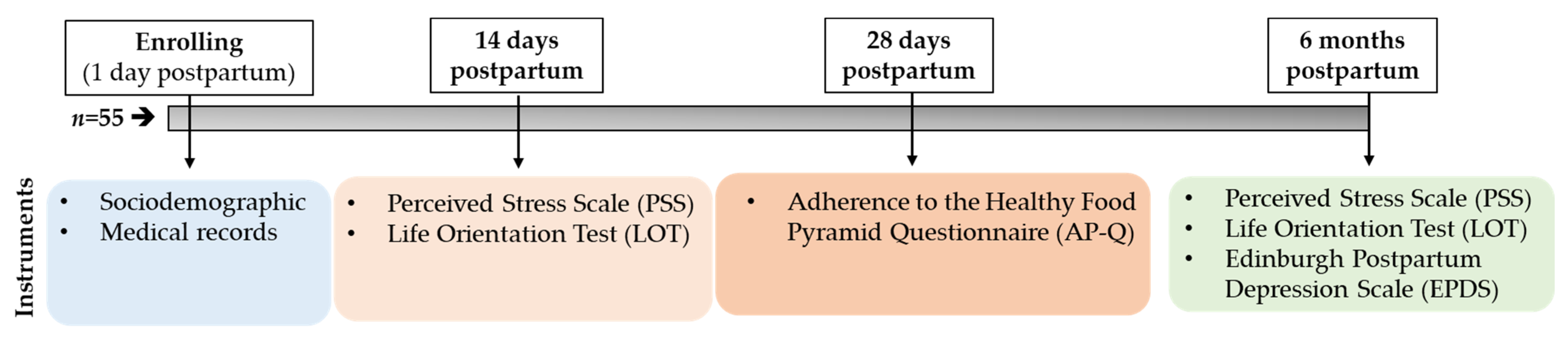
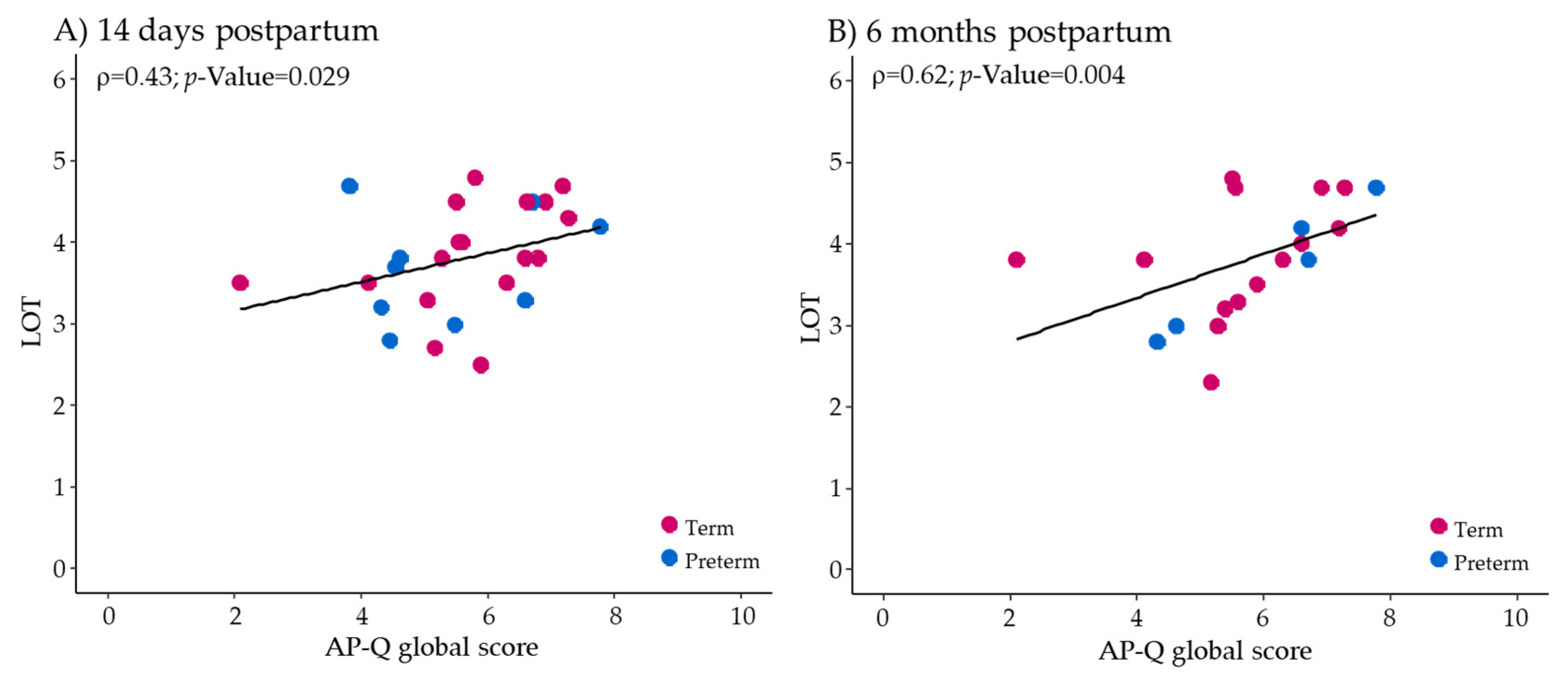
Breastfeeding could be considered as a vulnerable period, rising the risk to shift from optimism to pessimism. Preterm delivery is an event that increases postpartum maternal stress and depression, which can have a negative impact on breastfeeding and maternal–filial wellbeing. The adherence to healthy habits may have a positive influence on this vulnerable population. We aimed to analyze the impact of prematurity on maternal psychological aspects during postpartum and to study if adherence to the Healthy Food Pyramid influences psychological variables. Fifty-five breastfeeding women being attended in the Hospital Clínico San Carlos (Madrid, Spain) were recruited during the first day postpartum. The medical data were collected from the obstetrical records. The women answered an auto-administered questionnaire with several sections: sociodemographic characteristics, Perceived Stress Scale (PSS), and Life Orientation Test (LOT), at 14 days and 6 months postpartum, Adherence to the Healthy Food Pyramid Questionnaire (AP-Q) at 28 days postpartum and the Edinburgh Postpartum Depression Scale (EPDS) at 6 months postpartum. The PSS and LOT scores were not statistically different in mothers with preterm compared to term delivery either at 14 days or at 6 months postpartum. Longitudinally, the PSS did not show significant differences, but the LOT score was lower at 6 months compared to 14 days postpartum (p-Value = 0.046). A higher EPDS score was significantly found in mothers with preterm delivery (9.0 ± 4.7) than those with a term delivery (5.4 ± 4.2; p-value = 0.040). A significant and positive correlation was observed between the AP-Q score and LOT both at 14 days and 6 months postpartum. Conclusively, maternal optimism decreases during the postpartum period, women with preterm delivery being at risk of postpartum depression. Furthermore, there is a relationship between optimism and adherence to healthy habits. Healthcare professional counseling is essential during the entire breastfeeding period, particularly in vulnerable mothers with preterm delivery.
Keywords: breastfeeding; Healthy Food Pyramid; life orientation; Mediterranean diet; optimism; perceived stress; postpartum depression breastfeeding; Healthy Food Pyramid; life orientation; Mediterranean diet; optimism; perceived stress; postpartum depression