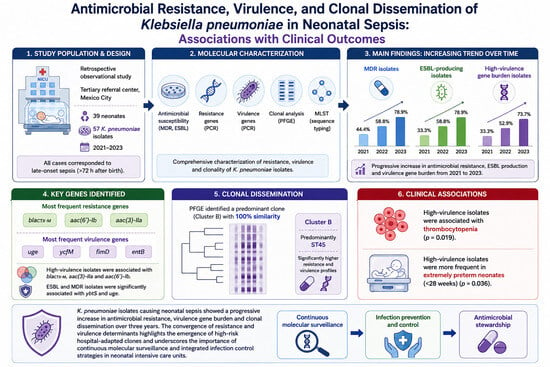
1. Introduction
The Third International Consensus Definition for and Septic Shock (Sepsis-3) defines sepsis as “a life-threatening organ dysfunction caused by a dysregulated host response to infection” [
1]. This condition results from an exaggerated inflammatory response characterized by immune dysregulation, excessive cytokine release, endothelial dysfunction, and tissue injury, ultimately leading to septic shock, multiple organ dysfunction, and death if not promptly recognized and treated. Despite advances in critical care and antimicrobial therapy, sepsis remains one of the leading causes of morbidity and mortality worldwide [
2,
3].
The neonatal period represents one of the most vulnerable stages of life for the development of sepsis due to the immaturity of both the innate and adaptive immune systems. Prematurity, low birth weight, low Apgar scores, prolonged hospitalization, central venous catheterization, parenteral nutrition, mechanical ventilation, and extended stays in neonatal intensive care units (NICUs) are among the most recognized risk factor predisposing newborns to severe bacterial infections. In addition to host-related risk factors, the increasing prevalence of antibiotic-resistant pathogens has further compromised treatment efficacy, making neonatal sepsis a major public health challenge [
4,
5].
Recent global estimates indicate that sepsis accounts for approximately 166 million cases and 21.4 million deaths each year, with children under five years of age representing one of the most affected populations [
6]. Neonatal sepsis alone has an estimated global incidence of 3930 cases per 100,000 live births, disproportionately affecting low- and middle-income countries, where access to timely diagnosis and appropriate antibiotic therapy remains limited [
6]. In Latin America, more than 50% of deaths in children under five occur during the neonatal period, with neonatal sepsis representing one of the leading contributors to neonatal mortality [
7]. However, despite its clinical relevance, the true burden of neonatal sepsis in Latin America and Mexico remains difficult to determine due to heterogeneous surveillance systems, limited microbiological characterization, and the lack of standardized epidemiological reporting.
In Mexico, the reported incidence of neonatal sepsis ranges from 4 to 15.4 cases per 1000 live births, exceeding the 1.1–8.6 cases per 1000 live births reported in other Latin American countries [
8,
9]. This burden is even greater among critically ill neonates requiring intensive care. At the Instituto Nacional de Perinatología (INPer), the incidence of culture-confirmed neonatal sepsis was 4.7 cases per 1000 live births in 2023 [
10], whereas among infants admitted to the neonatal intensive care unit (NICU), the incidence reached 112.4 cases per 1000 admissions, highlighting the substantial burden of sepsis in this high-risk population [
11].
Among the bacterial pathogens causing neonatal sepsis,
Staphylococcus aureus,
Acinetobacter spp.,
Streptococcus agalactiae,
Streptococcus pneumoniae,
Escherichia coli, and
Klebsiella pneumoniae are the most frequently reported. Among these,
K. pneumoniae has emerged as one of the most clinically relevant nosocomial pathogens because of its remarkable capacity to acquire antibiotic resistance and virulence determinants while persisting in the hospital environment. According to the 2024 World Health Organization (WHO) Bacterial Priority Pathogens List, third-generation cephalosporin-resistant and carbapenem-resistant
K. penumoniae are classified as critical-priority pathogens, underscoring the urgent need for effective surveillance and infection control strategies [
12,
13,
14]. Furthermore, the widespread dissemination of multidrug-resistant (MDR) and extended-spectrum beta-lactamases (ESBL)-producing
K. penumoniae has substantially reduced therapeutic options and has been consistently associated with prolonged hospitalization, increased health costs, and higher mortality among neonatal, pediatric, and adult patients with bloodstream infections [
15,
16].
Beyond antibiotic resistance, the pathogenic success of
K. penumoniae is also driven by the acquisition of virulence-associated determinants involved in iron acquisition, adhesion, biofilm formation, immune evasion, and capsule biosynthesis. The increasing convergence between antibiotic resistance and virulence determinants has become a growing concern, as strains harboring both characteristics may exhibit enhanced pathogenicity, improved bacterial fitness, and reduced susceptibility to available therapies [
17]. Although several studies have independently characterized resistance mechanisms or hypervirulent lineages, few have simultaneously investigated antimicrobial resistance, virulence-associated genes, clonal dissemination, and their relationship with neonatal clinical outcomes, particularly in Latin American populations.
Therefore, the aim of this study was to characterize the antibiotic resistance profiles, virulence-associated genes, and clonal relationship of K. pneumoniae isolates recovered from neonatal sepsis cases at INPer between 2021 and 2023 and to evaluate their associations with neonatal clinical outcomes. By integrating molecular epidemiology with clinical characteristics, this study seeks to provide evidence to support improved surveillance strategies, optimized antimicrobial use, and strengthen infection prevention and control measures in neonatal intensive care settings.
2. Materials and Methods
2.1. Study Approval and Data Collection
This study was approved by the Research Ethics Committee of the Instituto Nacional de Perinatología (approval number 212250-3210-11007-04-14). It was designed as a retrospective, cross-sectional, observational study conducted at the Instituto Nacional de Perinatología between January 2021 and December 2023.
The inclusion criteria included neonates with culture-confirmed sepsis caused by Klebsiella pneumoniae isolated from blood and cerebrospinal fluid. Newborns with clinical sepsis in whom microorganisms other than K. pneumoniae were isolated were excluded. Cases initially diagnosed as K. pneumoniae infections but subsequently reclassified as different microorganisms following molecular identification were also excluded from the analysis.
Patient data were collected from electronic clinical records (Expediente Clínico Electrónico), the legally required electronic health record system in Mexico that contains comprehensive patient medical information. All patient information was anonymized before analysis.
The neonatal variables analyzed included fever, hypothermia, tachycardia, bradycardia, tachypnea, bradypnea, apnea, respiratory distress syndrome, leukopenia, leukocytosis, neutrophilia, thrombocytopenia, thrombosis, meningitis, gastroschisis, enterocolitis, intrauterine growth restriction, gestational age, and birth weight. Maternal variables included in this study were cervicovaginitis, urinary tract infection, premature rupture of membranes, chorioamnionitis, diabetes, gestational diabetes, obesity, and preeclampsia.
Gestational age was also classified according to the WHO as follows: extremely preterm (<28 weeks), very preterm (28–32 weeks), preterm (32–37 weeks), and term (>37 weeks) [
18].
2.2. Biological Material
Clinical isolates were cultured in Tryptic Soy Broth (TSB) (Beckton Dickinson and Company, 07417 Franklin Lakes, NJ, USA) and incubated at 37 °C for 24 h. Subsequently, viable isolates were plated on MacConkey agar (Beckton Dickinson and Company, 07417 Franklin Lakes, NJ, USA) and incubated at 37 °C for 24 h. Each isolate was preserved in TSB supplemented with 15% glycerol (Merk KGaA, 64293 Darmstadt, Germany) at −70 °C.
Genomic DNA was extracted using the Quick-gDNA™ MiniPrep kit (Zymo Research Corp, 92614 Irvine, CA, USA) according to the manufacturer’s instructions.
Strain confirmation and antimicrobial susceptibility testing were performed in the Clinical Microbiology Laboratory using the VITEK 2® system (bioMérieux SA, 69280 Marcy L’Étoile, Lyon, France) with AST-N271 and AST-N272 cards.
Molecular identification of K. pneumoniae was performed by real-time PCR targeting the tonB gene. Amplification consisted of an initial denaturation at 95 °C for 5 min, followed by 30 cycles of denaturation at 95 °C for 15 s and annealing at 58 °C for 15 s, using the QuantStudioTM 5 Real-Time System with SYBRTM Green I Master Mix (Thermo Fisher Scientific, 02451 Waltham, MA, USA). Species identification was confirmed by melt curve analysis using a ramp rate of 0.05 °C/s, yielding a characteristic melting temperature (Tm) of 91.6 °C.
2.3. Molecular Detection of Antibiotic Resistance and Virulence
PCR analysis was performed to detect four beta-lactam resistance genes, three aminoglycoside resistance genes (
Table 1), and eight
Klebsiella pneumoniae virulence-associated genes (
Table 2),
For amplification of virulence genes, each reaction contained 100 ng of genomic DNA, 500 nM of each primer, and 0.05 U/μL of Taq polymerase. For resistance genes, reactions contained 100 ng of genomic DNA, 320 nM of each primer, and 0.025 U/μL of Taq polymerase (Thermo Fisher Scientific).
PCR conditions consisted of an initial denaturation at 94 °C for 5 min, followed by 30 cycles for virulence genes and 35 cycles for resistance genes, each including denaturation at 94 °C for 40 s, annealing at gene-specific temperatures shown in
Table 1 and
Table 2, and extension at 72 °C for 1 min, followed by a final extension at 72 °C for 5 min.
Amplified products were separated by agarose gel electrophoresis, stained with SYBRTM Green, and visualized under UV light using a UVP EpiChemi II Darkroom imaging system (Analytik Jena, Jena, Germany).
2.4. Determination of Antimicrobial Resistance Patterns
The antimicrobial susceptibility profiles of K. pneumoniae strains were determined according to the 2025 Clinical and Laboratory Standards Institute (CLSI) using the WHONET 2025 platform for data interpretation. Susceptibility was assessed against the following antimicrobial agents: amikacin, ampicillin/sulbactam, cefoxitin, cefepime, ceftriaxone, ceftazidime, ciprofloxacin, piperacillin/tazobactam, doripenem, ertapenem, gentamicin, imipenem, meropenem, and tigecycline.
2.5. Molecular Typing of Klebsiella pneumoniae by PFGE
Clinical isolates were genotyped by PFGE to evaluate their clonal relatedness. Briefly, isolates were cultured on blood agar (Becton Dickinson, Franklin Lakes, NJ, USA) and incubated at 37 °C for 24 h. Bacterial cells were subsequently resuspended in PIV buffer (2 M Tris-HCl, pH 7.6; 5 M NaCl; Merk KgaA) and washed three times with the same buffer.
A total of 120 µL of the bacterial suspension was mixed with 2%low-melting-point agarose, 10 μL of proteinase K, and 10 μL of lysozyme. After solidification, agarose plugs were transferred to 1.5 mL microcentrifuge tubes containing lysis buffer (2 M Tris-HCl, pH 7.6; 5 M NaCl; 0.5 M EDTA, pH 7.6 [Merk KGaA]; 5% Brij58; 10% deoxycholate [ThermoFisher Scientific]; 20% sarcosyl [Merk KGaA]; 10 mg/mL lysozyme [Thermo Fisher Scientific]) and incubated at 37 °C for 12 h.
The plugs were subsequently incubated in ESP buffer (0.5 M EDTA, pH 9; 20% sarcosyl; 20 mg/mL proteinase K (Thermo Fisher Scientific) at 50 °C for 24 h. Thereafter, plugs were washed three times with ultrapure water and three additional times with 1X TE buffer at 50 °C for 15 min per wash.
For DNA digestion, plugs were equilibrated in 1X XbaI restriction buffer for 30 min at 37 °C and then incubated with 30 U of XbaI (Thermo Fisher Scientific) for 3 h at 37 °C.
PFGE was performed on 1% agarose gels in a CHEF Mapper® XA system (Bio-Rad Laboratories, Hercules, CA, USA) under the following conditions: 6 V/cm, 120° angle, initial pulse time of 2.2 s, final pulse time of 54.2 s, linear ramp, at 14 °C for 24 h.
Restriction patterns were visualized using the EpiChemi II Darkroom imaging system (Analytik Jena, Jena, Germany) and analyzed with BioNumerics
® v7.6 (Applied Maths, BioMérieux, Sint-Martens-Latem, Belgium) using the Dice similarity coefficient and the unweighted pair group with arithmetic mean (UPGMA) with 2% optimization and 4% position tolerance. These parameters enable the accurate assessment of clonal relationships among the isolates [
24].
2.6. Multilocus Sequence Typing Using Sanger Method
Multilocus sequence typing (MLST) was performed according to the protocol described by Diancourt L et al. and available through the Institut Pasteur PubMLST database [
25].
Following PCR amplification, products were purified using the AFTSpin Multifunction DNA purification KIT RK30100 (AB clonal technology 500W Cummings Park, Woburn, MA, USA). Purified amplicons were sequenced using the BigDye Terminator v3.1 Cycle Sequencing Kit (Applied Biosystems, Foster City, CA, USA) according to the manufacturer’s instructions on an ABI PRISM® 3130 Genetic Analyzer (Applied Biosystems, Foster City, CA, USA).
The resulting chromatograms were analyzed using BioEdit v7.2 (Ibis Biosciences, Carlsbad, CA, USA) to ensure sequence quality and alignment accuracy. Allelic profiles were confirmed through comparison with reference sequences using the NCBI BLASTn database v.2.17.0.
2.7. Clonality Assessment and Statistical Analysis
Clonality analysis was interpreted according to the criteria proposed by Tenover et al. for outbreak classification. Isolates with 100% similarity were considered indistinguishable, those with 85–90% similarity were classified as closely related, isolates with 70–80% similarity were considered possibly related, and those showing less than 65% similarity were classified as unrelated [
26].
For the statistical analysis, four independent variables were evaluated to assess association with molecular and clinical characteristics. The first comparison was based on the presence or absence of extended-spectrum beta-lactamases (ESBL); the second compared multidrug-resistant (MDR) and antimicrobial-susceptible isolates; the third classified isolates according to their virulence gene burden as “low virulence gene burden” (1–4 virulence-associated genes) or “high virulence gene burden” (5–8 virulence-associated genes); and the fourth compared the PFGE clusters identified by dendrogram analysis.
The four analytical domains were defined according to the objectives of the study. Individual associations evaluated within these domains were considered exploratory and hypothesis-generating. In particular, comparisons of individual virulence genes between high- and low-virulence gene-burden groups were intended to describe the molecular composition of these groups rather than to establish independent predictive associations.
For inferential comparisons, only the first isolate recovered from each neonate was considered (39). Because PFGE data were unavailable for two of these isolates, cluster-based statistical analyses were performed on 37 independent isolates. All available isolates with PFGE profiles (N = 54) were nevertheless retained for descriptive molecular epidemiological and clonal analyses.
Because none of the isolates fulfilled the currently accepted molecular criteria for hypervirulent
K. pneumoniae (hvKp), isolates were classified according to their cumulative virulence-associated genes rather than being designated as hypervirulent. Isolates harboring five to eight virulence-associated genes were categorized as high virulence gene burden, whereas those carrying one to four virulence-associated genes were classified as low virulence gene burden. This approach was intended solely to compare the cumulative burden of accessory virulence determinants and should not be interpreted as a molecular definition of hvKp. [
27].
Statistical analyses were conducted using IBM SPSS Statistics 27 (IBM, 10504-1722 Armonk, NY, USA). Descriptive statistics included percentages and measures of central tendency. Associations between categorical variables were evaluated using the chi-square test, with statistical significance defined as
p < 0.05. When the expected frequency in any cell of a 2 × 2 contingency table was less than five, Fisher’s exact test (two-tailed) was applied. Odds ratios (ORs) and 95% confidence intervals (95% CI) were calculated to estimate the strength of associations [
9].
Forest plots were generated using the ForestPlotter package version 1.1.1 in the R platform environment V. 4.5.2.
3. Results
From January 2021 to December 2023, 39 neonates were diagnosed with sepsis caused by
Klebsiella pneumoniae. Of these, 9 were term, 9 preterm, 13 very preterm, and 8 extremely preterm. The clinical characteristics of the study cohort are summarized in
Supplementary Table S1. Some neonates presented with 2 and 5
K. pneumoniae isolates at different time points, resulting in a total of 57 strains, which were distributed as follows: 9 in 2021, 29 in 2022, and 19 in 2023.
A temporal variation in the distribution of resistance and virulence genes was observed between 2021 and 2023 (
Table 3). The most prevalent resistance genes among all isolates were
blaCTX-M (45.6%),
aac(6′)-Ib (49.1%), and
aac(3)-IIa (42.1%), all showing a progressive increase over time. Notably,
blaCTX-M rose from 11.1% in 2021 to 78.9% in 2023, while
aac(6′)-Ib, absent in 2021, was detected in more than two-thirds of the isolates by 2023. In contrast,
blaTEM exhibited a decreasing trend during the study period, declining from 55.6% in 2021 to 31.6% in 2023.
Regarding virulence genes, the highest overall frequencies corresponded to
uge (68.4%),
ycfM (66.7%),
fimD (64.9%), and
entB (59.6%). A marked increase was observed for
uge,
ybtS, and
wabG, which reached their highest frequencies in 2023 (94.7%, 94.7%, and 68.4%, respectively). Conversely,
mrkC decreased from 77.8% in 2021 to 57.9% in 2023, and
iucA was only sporadically detected (1.8% of isolates) (
Table 3).
Overall, these findings show a progressive rise in the diversity and frequency of genes associated with antimicrobial resistance and virulence, particularly among the most recent isolates, and during the study period.
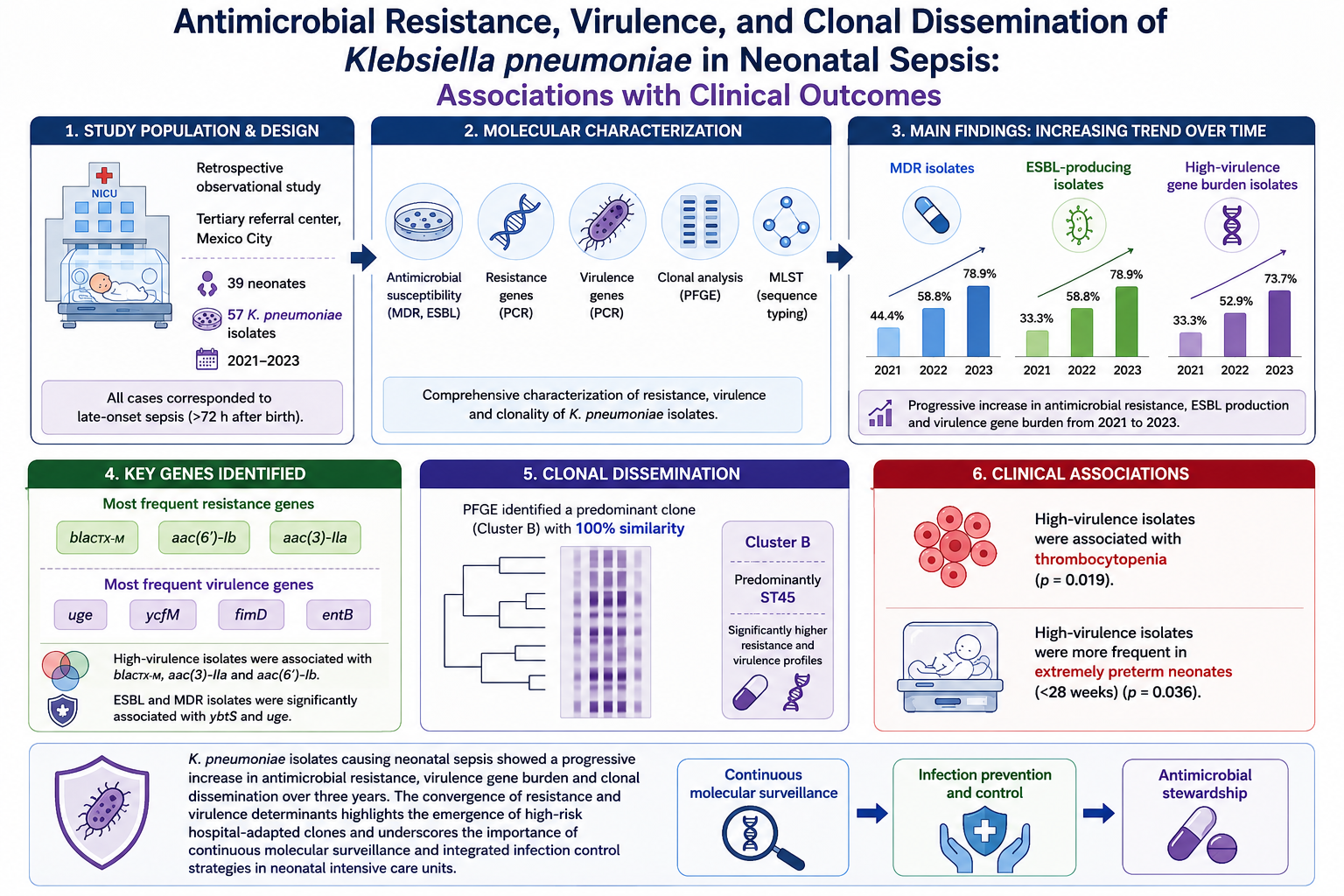
A progressive increase in the MDR phenotype, extended-spectrum beta-lactamase (ESBL) production, and virulence potential was observed among
K. pneumoniae isolates between 2021 and 2023 (
Table 4). The proportion of MDR strains increased from 44.4% in 2021 to 78.9% in 2023, representing 64.9% of all isolates. Similarly, ESBL-producing strains showed a steady rise, from 33.3% in 2021 to 78.9% in 2023.
Regarding virulence grouping, isolates classified as having high virulence-gene burden also exhibited a gradual increase, from 33.3% in 2021 to 73.7% in 2023, accounting for more than half of the total isolates (54.3%).
Isolates were classified according to MDR status, ESBL production, and virulence-gene burden to explore their associations with molecular and clinical characteristics. MDR and ESBL-producing isolates each represented 64.9% of the total isolates (37/57), whereas 54.3% were classified as having a high virulence-gene burden (
Table 4).
Overall, these results show an increment in antimicrobial resistance and virulence-gene burden during the study period, suggesting the increasing circulation of more resistant and potentially pathogenic K. pneumoniae strains.
3.1. Association with ESBL Production
An association analysis based on ESBL status revealed significant relationships with several molecular determinants. The
blaCTX-M-positive isolates were 2.88 times more likely to exhibit the ESBL phenotype than
blaCTX-M-negative isolates (
p < 0.001; RR 2.88, 95% CI 1.70–4.90). Because no
blaCTX-M-positive isolates were detected in the ESBL-negative group, the odds ratio could not be estimated and the relative risk was reported instead. Overall, 59.1% of ESBL-producing isolates carried
blaCTX-M, supporting a strong association between this determinant and the ESBL phenotype in our cohort. Given the exploratory nature of the analysis and the limited sample size, this finding should be confirmed in larger studies (
Figure 1).
Surprisingly, the
aac(6′)-Ib gene (
p 0.003, OR 10.83, 95% CI 1.97–59.46) was present in 59.1% of ESBL-positive isolates; however, its presence is related to resistance to aminoglycosides rather than β-lactams, suggesting that these strains may have a broader resistance profile, increasing the risk of therapeutic failure with aminoglycosides (
Figure 1).
Regarding virulence genes, a significant association with ESBL was observed for
ybtS (
p 0.024, OR 5.60, 95% CI 1.24–25.17), suggesting that ESBL-positive strains may simultaneously harbor virulence factors that enhance their pathogenic potential (
Figure 1).
Neonates infected with non-ESBL-producing strains showed significant associations with leukopenia (
p = 0.004; OR 11.25, 95% CI 1.97–69.95) and neutropenia (
p = 0.017; OR 6.42, 95% CI 1.50–27.44). These findings indicate that both hematological alterations were more frequently observed among neonates infected with non-ESBL-producing strains in this cohort. Given the exploratory nature of the analysis and the wide confidence intervals, these associations should be interpreted cautiously (
Figure 1).
3.2. Association with Multidrug Resistance Profile
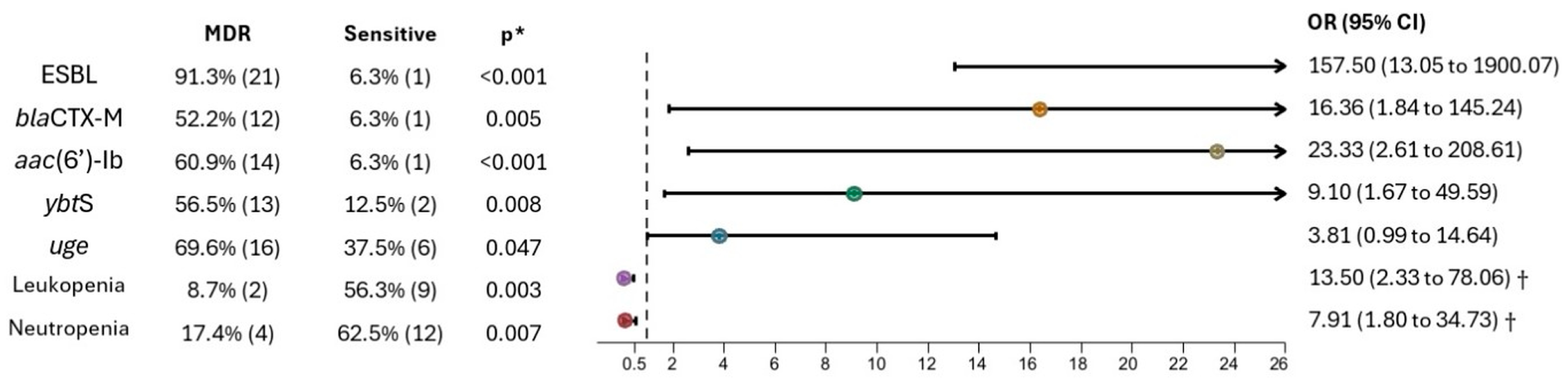
When comparing the multidrug resistance profile with different strain features and clinical outcomes, we observed, as expected, significant associations with the MDR phenotype and resistance-associated genes, specifically for
blaCTX-M (
p 0.005; OR = 16.36; 95% CI 1.84–145.24) and
aac(6′)-Ib (
p < 0.001, OR 23.33, 95% CI 2.61–208.61) (
Figure 2).
Furthermore, the presence of extended-spectrum beta-lactamase (ESBL) was also strongly associated with the MDR phenotype (
p < 0.001, OR 157.50, 95% CI 13.05–1900.07), suggesting that MDR isolates were highly likely to exhibit an ESBL phenotype (
Figure 2).
Regarding virulence genes,
ybtS (
p 0.008, OR 9.10, 95% CI 1.67–49.59) was significantly associated with MDR strains and
uge (
p 0.047, OR 3.81, 95% CI 0.99–14.64) showed a borderline association (
p = 0.047; OR 3.81, 95% CI 0.99–14.64), which should be interpreted cautiously given the wide confidence interval and the inclusion of the null value; nevertheless, these results suggest that these resistant strains may simultaneously harbor virulence factors that enhance their pathogenic potential (
Figure 2).
Regarding neonatal outcomes, a significant association was found between susceptible strains and the occurrence of leukopenia (
p 0.003, OR 13.50, 95% CI 2.33–78.06), as well as neutropenia (
p 0.007, OR 7.91, 95% CI 1.80–34.73). These findings indicate that both hematological alterations were more frequently observed among neonates infected with susceptible strains in this cohort. (
Figure 2).
3.3. Association with Virulence-Gene Burden Profiles
When comparing virulence-gene burden and resistance determinants, only two of the seven resistance genes evaluated were significantly enriched among isolates with a high virulence-gene burden:
blaCTX-M (
p = 0.050) and
aac(6′)-Ib (
p = 0.019). These findings indicate a higher likelihood of detecting
blaCTX-M (81.9%) and
aac(6′)-Ib (86.9%) in
K. pneumoniae strains harboring more than five virulence-associated genes (high virulence-gene burden strains) (
Table 5).
Also, isolates classified as having high virulence-gene burden demonstrated a significantly higher prevalence of key virulence determinants. This group was characterized by cumulative carriage of
fimD (
p 0.015),
mrkC (
p 0.010),
entB (
p < 0.001),
uge (
p < 0.001),
wabG (
p < 0.001),
ybtS (
p 0.019) and
ycfM (
p 0.002), which together might facilitate critical pathogenic processes such as biofilm formation, iron acquisition, and evasion of the neonatal immune system (
Table 5).
Furthermore, regarding clinical outcomes, strains classified as high virulence-gene burden showed an association with thrombocytopenia (
p 0.028, OR 5.68, 95% CI: 1.37–23.48) and were more frequently identified in extremely preterm neonates (7 neonates versus 1 with a low virulence-gene burden strain) (
p 0.05, OR 14.00, 95% CI: 1.13–172.64). Additionally, neonates born after PROM (premature rupture of membranes) and PPROM (preterm premature rupture of membranes) showed a higher frequency of infection with low virulence-gene burden strains, with 55.5% vs. 14.2% in those with high virulence-gene burden strains (
p 0.006, OR 7.50, 95% CI: 1.61–34.83) (
Figure 3).
3.4. Clonal Analysis Profile
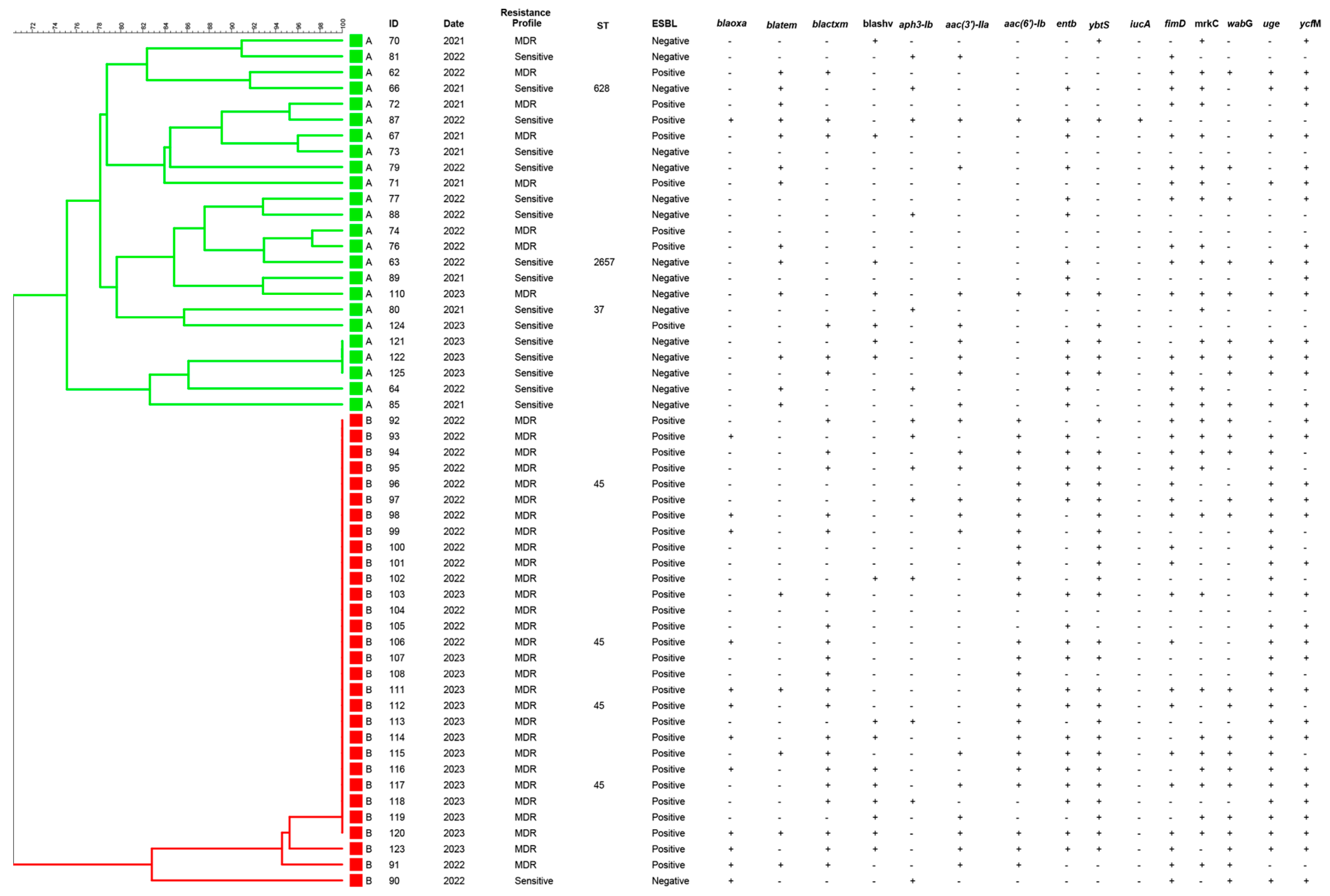
Clonal analysis revealed that 24 strains clustered in cluster A, showing more than 75% similarity. In contrast, in cluster B, 27 of 30 strains exhibited 100% similarity, suggesting the circulation of the same clone in the hospital during the 2022–2023 period (
Figure 4).
In the right panel of
Figure 4, the sequence types (ST) are shown, with four different types identified: ST628, ST2657, ST37, and ST45. Additionally, the presence (+) or absence (-) patterns of the resistance and virulence genes included in this study are displayed, allowing the identification of potential associations between these genes and the analyzed isolates (
Figure 4).
3.5. Relationship Between Clusters and Molecular and Clinical Variables
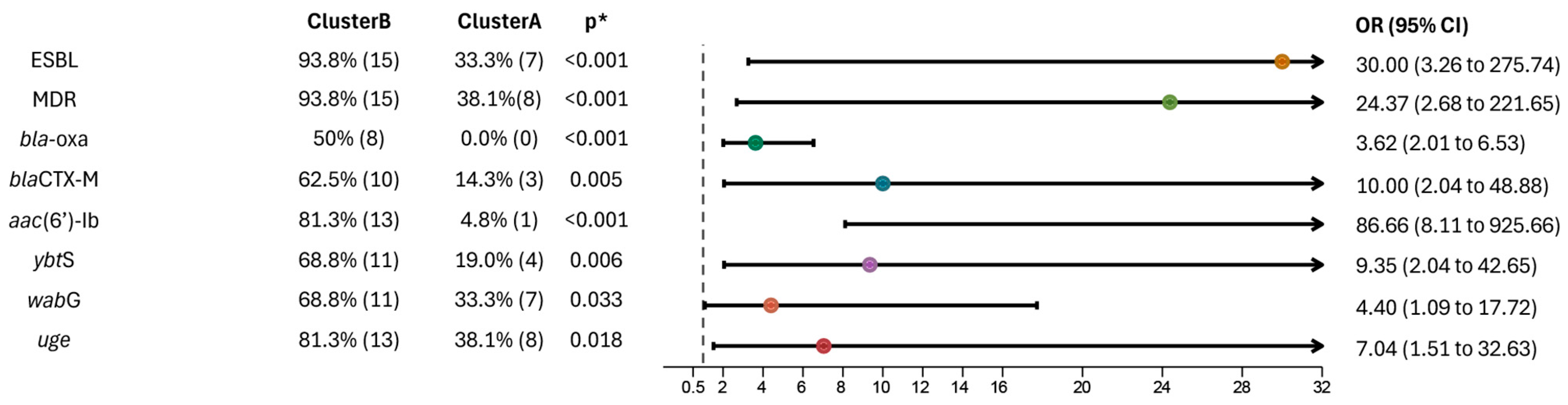
Significant differences were observed between clusters A and B regarding resistance and virulence profiles. In cluster B, 93.8% of the strains were both ESBL-producing (p < 0.001, OR 30.00, 95% CI 3.26–275.74) and multidrug-resistant (MDR) (p < 0.001, OR 24.37, 95% CI 2.68–221.65), indicating that most strains in this cluster exhibit a highly resistant profile.
The frequency of the genes
blaOXA (
p < 0.001, OR 3.62, 95% CI 2.01–6.53),
blaCTX-M (
p 0.005, OR 10.00, 95% CI 2.04–48.88), and
aac(6′)-Ib (
p < 0.001; OR 86.66; 95% CI 8.11–925.66) was also significantly higher in cluster B (
Figure 5).
Regarding virulence genes,
ybtS (
p 0.006; OR = 9.35; 95% CI 2.04–42.65),
wabG (
p 0.033; OR = 4.40; 95% CI 1.09–17.72) and
uge (
p 0.018; OR = 7.04; 95% CI 1.51–32.63) were significantly more frequent in cluster B. These findings indicate that cluster B was characterized by a higher prevalence of virulence-associated determinants, together with the predominantly resistant phenotype described above (
Figure 5). No significant associations were identified between PFGE clusters and clinical outcomes among neonates with sepsis.
4. Discussion
This study provides an up-to-date overview of the molecular and clinical characteristics of K. pneumoniae strains associated with neonatal sepsis between 2021 and 2023, demonstrating a progressive increase in antimicrobial resistance, virulence-associated genes and clonal dissemination at INPer. These findings reflect a concerning pattern during the study period toward increasingly resistant strains with enhanced prevalence of virulence-associated determinants, representing a significant challenge for neonatal care.
Several studies have documented a global increase in antibiotic resistance among
K. pneumoniae isolates in recent years. Özkavaklı et al. reported that
K. pneumoniae was the most frequently isolated Gram-negative pathogen associated with late-onset sepsis between 2015 and 2022, with increasing resistance to cephalosporins and aminoglycosides; however, no resistance to meropenem was detected during the most recent study period (2021–2022) [
28]. In contrast, the multicenter NeoOBS study by Russell et al. demonstrated a high prevalence of carbapenem resistance among neonatal pathogens, raising concerns regarding the effectiveness of WHO-recommended antibiotic regimens for neonatal sepsis [
29]. Similarly, data from South Africa showed a shift from ESBL-producing strains toward increasing carbapenem resistance over a 10-year period [
30]. Other reports from Egypt, India, and additional regions have described rising rates of both ESBL and carbapenem resistance, along with increased resistance to cephalosporines and aminoglycosides, trends that are consistent with our findings [
31,
32,
33].
A similar pattern was observed in our cohort during the study period. By 2023, the frequencies of both MDR and ESBL-producing isolates had reached 78.9% (
Table 4). Genotypic analysis also showed an increased frequency of several resistance determinants, particularly
blaCTX-M and
blaSHV, associated with β-lactam resistance, as well as
aac(3)-IIa and
aac(6′)-Ib, which are associated with aminoglycoside resistance.
Beyond antibiotic resistance, an increased virulence-gene burden has also been reported worldwide. In our cohort, the proportion of isolates classified as high virulence-gene burden increased from 33.3% in 2021 to 73.7% in 2023. A similar global tendency was described by Lam et al., who analyzed over 9000 genomes and demonstrated a progressive increase in virulence score over time. In their study, higher virulence scores were largely associated with siderophore systems such as aerobactin (
iuc) and yersiniabactin (
ybt). In our cohort, although classical hypervirulence markers were not systematically predominant, we observed a marked increase in frequency of genes such as
uge,
ybtS, and
wabG, reaching frequencies of 94.7%, 94.7%, and 68.4% in 2023, respectively [
17].
Importantly, Lam et al. also described the phenomenon of convergence, in which strains exhibit both elevated virulence scores and multidrug resistance, particularly ESBL production or carbapenem resistance. This convergence has been associated with the acquisition of virulence plasmids by MDR clones or, conversely, the acquisition of resistance determinants by hypervirulent lineages [
17]. Although our study did not investigate the genomic context or mechanisms of gene acquisition, the concurrent increase in virulence-gene burden and antimicrobial resistance observed in our cohort may suggest a similar convergence pattern. Plasmid-mediated horizontal gene transfer represents a plausible mechanism that could contribute to this pattern; however, this hypothesis requires confirmation in future genomic studies.
To characterize the virulence-associated genetic profile of the isolates, we evaluated the presence of selected virulence-associated genes previously described in
K. pneumoniae. These genes were chosen because they represent different functional categories involved in bacterial pathogenicity. Adhesion-related genes (
fimD and
mrkC) were included due to their reported role in attachment and biofilm formation. Genes associated with outer membrane structure and host interaction, such as
ycfM, were also assessed. Additionally,
wabG and
uge, which are involved in lipopolysaccharide and capsular polysaccharide biosynthesis, were analyzed given their contribution to structural components linked to immune interaction. Furthermore, iron acquisition systems were represented by the siderophore-associated genes
entB,
ybtS, and
iucA, which have been widely described in clinical isolates of
K. pneumoniae [
19,
20,
21,
22,
23]. The detection of these genes allowed us to construct a virulence-gene burden profile for each isolate, which was subsequently used to categorize strains for comparative analysis.
Isolates were categorized as high- and low-virulence-gene burden groups based on the number of detected virulence-associated genes. Within the high-burden group, we observed an enrichment of virulence determinants including
entB,
fimD,
mrkC,
wabG,
uge, and
ycfM. These genes are implicated in iron acquisition, adhesion, biofilm formation, and capsule-associated functions, all of which contribute to bacterial virulence potential and host interaction. While these determinants are considered accessory rather than defining markers of virulence, their cumulative presence may enhance adaptive and survival capacity. Notably, Mukherjee et al. reported that hypervirulent strains harbored accessory genes such as
wabG,
fimH,
entB,
uge, and
ybtS at higher frequencies compared to classical strains [
34]. Although our isolates were not classified as hypervirulent, the partial overlap in virulence-gene profiles suggests that classical strains may progressively accumulate virulence determinants. While this enrichment does not indicate true hypervirulence, it may reflect an ongoing shift that might enhance pathogenic potential within classical
K. penumoniae populations.
In our study, a higher virulence-gene burden was associated with increased prevalence of
blaCTX-M and
aac (6’)-Ib, suggesting a potential link between enhanced pathogenic potential and antimicrobial resistance. Shrestha et al. similarly reported that an increased number of accessory virulence factors was associated with MDR status, particularly in strains harboring beta-lactamase genes, siderophores, and aminoglycoside resistance determinants [
35]. Furthermore, this convergence of virulence and resistance determinants has been previously described where siderophores, adhesion factors, and beta-lactamases coexist within the same strain, representing an emerging clinical and epidemiological threat in hospital settings [
18].
Antibiotic resistance in
K. pneumoniae represents a major global health concern. In our cohort, a statistically significant association was observed between MDR and ESBL production, with MDR isolates frequently exhibiting an ESBL phenotype. In both groups, the most prevalent resistance determinant was
blaCTX-M, a gene family responsible for resistance to third-generation cephalosporins. A large genomics analysis conducted by Sands et al. investigating neonatal sepsis isolates across multiple low- and middle-income countries reported similar patterns, identifying
K. pneumoniae as one of the leading causes of neonatal sepsis and documenting high levels of MDR worldwide. In that study, approximately 95% of isolates were resistant to ampicillin and 80% to cephalosporines, with
blaCTX-M-15 identified as the most prevalent resistance determinant in nearly 85% of
K. pneumoniae isolates. The authors also reported a high prevalence of carbapenemase genes such as
blaNDM and variants of
blaOXA-48 [
36].
Furthermore, our MDR isolates showed a higher prevalence of aac(6’)-Ib, a gene encoding an aminoglycoside-modifying enzyme, which may further limit therapeutic options. The coexistence of β-lactam and aminoglycoside resistance determinants highlights the increasing complexity of antimicrobial resistance profiles in clinical K pneumoniae isolates.
Additionally, MDR and ESBL-producing isolates in our cohort were significantly associated with the presence of two specific virulence determinants,
ybtS and
uge. The
uge gene, involved in capsular biosynthesis and bacterial virulence, has previously been reported in carbapenem-resistant
K. pneumoniae isolates from adult intensive care unit patients, where its presence was associated with more severe infection profiles [
37]. To our knowledge, similar observations have been less frequently described in neonatal populations, highlighting the need for further investigation in this vulnerable group. In addition, Lam et al. have shown that
ybt represents one of the most prevalent virulence determinants in
K. pneumoniae, being detected in approximately 40% of MDR isolates worldwide. This study also reported a notable convergence between isolates harboring yersiniabactin-associated loci and those exhibiting high levels of antimicrobial resistance, including ESBL and carbapenem resistance [
17].
Given that all infections in out cohort corresponded to late-onset sepsis acquired within the hospital setting, we further explored the genetic relatedness among isolates. Two distinct clusters were identified. Notably, cluster B exhibited 100% similarity, consistent with a shared lineage and suggesting possible intrahospital transmission of a persistent strain.
Cluster B was characterized by a higher resistance and virulence-gene burden compared to cluster A. A large proportion (93.8%) of the isolates within this cluster were MDR and ESBL producers, with increased prevalence of
blaOXA,
blaCTX-M, and
aac(6’)-Ib. In contrast, only one-third of the isolates in cluster A exhibited MDR and ESBL phenotypes. Additionally, four isolates within cluster B belonged to sequence type ST45, a lineage previously described as a high-risk clone associated with antimicrobial resistance and neonatal infection in Europe [
17].
Genomic studies have also highlighted that
K. pneumoniae lineages showing convergence between antimicrobial resistance and virulence-associated determinants may be linked to greater clinical severity and more limited therapeutic options [
17]. Consistent with these observations, cluster B isolates in our study exhibited a higher prevalence of virulence-associated genes, including
ybtS,
wabG, and
uge, indicating an enrichment of virulence-associated determinants within this predominantly resistant cluster. The yersiniabactin locus (
ybt) has been reported as one of the most prevalent virulence determinants among MDR
K. pneumoniae isolates worldwide, being detected in up to 40% of cases [
17]. Moreover, yersiniabactin carriage has been associated with unfavorable clinical outcomes. Sands et al. reported an association between its presence and increased mortality, as well as an earlier onset of sepsis [
36].
In contrast, cluster A was composed of more diverse sequence types, including ST628, ST2657, and ST37. ST37 has been identified as a prevalent lineage in low- and middle-income countries, although it is generally associated with lower resistance profiles [
36]. Consistent with this pattern, cluster A isolates in our cohort showed a lower prevalence of resistance-associated determinants than those belonging to cluster B.
Regarding neonatal clinical outcomes, we observed that patients infected with non-ESBL-producing and antibiotic-susceptible isolates had a higher frequency of leukopenia and neutropenia. Leukopenia has been consistently described as a common hematological finding in neonatal sepsis and has been associated with increased mortality, particularly in cases caused by
K. pneumoniae [
38,
39]. Similarly, Manandhar et al. reported that leukopenia was associated with increased odds of sepsis in neonatal populations, where a high proportion of isolates were MDR [
40].
In contrast, there is limited evidence directly correlating neutropenia with infections caused by non-ESBL or antibiotic-susceptible
K. pneumoniae isolates. Some studies, such as that by Al Benwan et al., have reported increased neutrophil counts in bacteremia cases involving ESBL-producing
K. pneumoniae and
Escherichia coli, suggesting that host response patterns may vary depending on bacterial resistance profiles [
41]. In our cohort, leukopenia and neutropenia were more frequently observed among neonates infected with antibiotic-susceptible strains. These findings may suggest that even antibiotic-susceptible strains can exhibit sufficient virulence to significantly impact neonatal clinical stability; however, these exploratory associations should be interpreted cautiously, as they may reflect differences in host response or other unmeasured clinical factors rather than a direct effect of the bacterial resistance phenotype.
Additionally, our patients infected with isolates categorized as having a high virulence-gene burden showed a higher incidence of thrombocytopenia. Although no studies have directly evaluated the relationship between virulence-gene burden and thrombocytopenia, this hematological finding has been widely described as a marker of neonatal sepsis and is associated with increased mortality [
38,
42]. Platelets play an active role in the inflammatory response, and during sepsis, dysregulated immune activation and increased thrombopoietin levels may contribute to bone marrow exhaustion and reduced platelet production. Consequently, thrombocytopenia is considered a well-established marker associated with disease severity in neonatal sepsis [
42].
Furthermore, patients infected with isolates exhibiting a high virulence-gene burden were more frequently associated with extreme prematurity. Extreme preterm neonates represent a highly vulnerable population with increased susceptibility to late-onset sepsis. Trong et al. reported a higher incidence of late-onset sepsis in extremely preterm infants, with
K. pneumoniae identified as the predominant pathogen and associated with more severe clinical presentations [
43]. However, this association should be interpreted cautiously, as neonatal characteristics such as gestational age and birth weight were not controlled for in multivariable analyses.
In contrast, in our cohort, infections caused by isolates with a lower virulence-gene burden were more frequently associated with maternal factors such as PROM and PPROM. Multiple studies have demonstrated an increased risk of neonatal infection in the presence of PROM, and Kumar et al. reported a higher risk of early-onset sepsis in neonates born to mothers with PROM, with
K. pneumoniae being one of the most common causative agents [
44,
45].
Additionally, Kwon et al. identified PPROM in the context of maternal vaginal colonization as an independent risk factor for early-onset sepsis. However, no studies to date have established a direct relationship between virulence-gene burden in
K. pneumoniae and maternal risk factors such as PROM or PPROM, underscoring the need for further research in this area [
46].
It is important to mention that the observed associations between bacterial characteristics and neonatal outcomes may be influenced by underlying host vulnerability, particularly gestational age and birth weight, and should not be interpreted as independent or causal effects.
This study has several limitations that should be considered when interpreting our findings. First, this was a retrospective, single-center study with a relatively small sample size, which may limit the generalizability of the results; therefore, future multicenter studies including external validation cohorts will be essential to confirm the reproducibility and generalizability of our findings. Owing to the limited sample size, multivariable regression analyses were not statistically appropriate because of the risk of model overfitting. Consequently, all associations were explored using univariate analyses; therefore, isolated statistically significant associations, particularly those with wide confidence intervals or borderline significance, should be interpreted cautiously and considered hypothesis-generating rather than confirmatory. The limited sample size may increase the probability of type I error and reduce the precision of individual effect estimates. Likewise, although an increase in antibiotic resistance and virulence gene burden was observed during the three-year study period, the duration of surveillance does not allow definitive conclusions regarding long-term epidemiological trends. Despite these limitations, this study provides one of the first comprehensive molecular epidemiological characterizations of K. pneumoniae causing neonatal sepsis in Mexico. By integrating antimicrobial susceptibility profiles, resistance, and virulence determinants, PFGE and MLST analyses, clonal dissemination, and neonatal clinical outcomes, our findings provide valuable insights into the emergence of increasingly resistant and potentially more pathogenic hospital-associated clones. These results support the implementation of continuous molecular surveillance and may contribute to improving infection prevention strategies and antibiotic management in neonatal intensive care units.




 ,
,