Publication Bias in Epidemiological Studies of Malocclusions in Mexican Children and Teenagers: A Systematic Review and Meta-Analysis

 ,
,  ,
,
Abstract
1. Introduction
2. Materials and Methods
2.1. Protocol Registry
2.2. Eligibility Criteria and Participant Characteristics of Studies
2.2.1. Population
2.2.2. Outcomes
2.3. Search Strategy and Databases Used
2.4. Study Selection
2.5. Data Collection Process and Data Items
2.6. Risk of Bias in Individual Studies and Quality Assessments
2.7. Meta-Analyses Methodology
3. Results
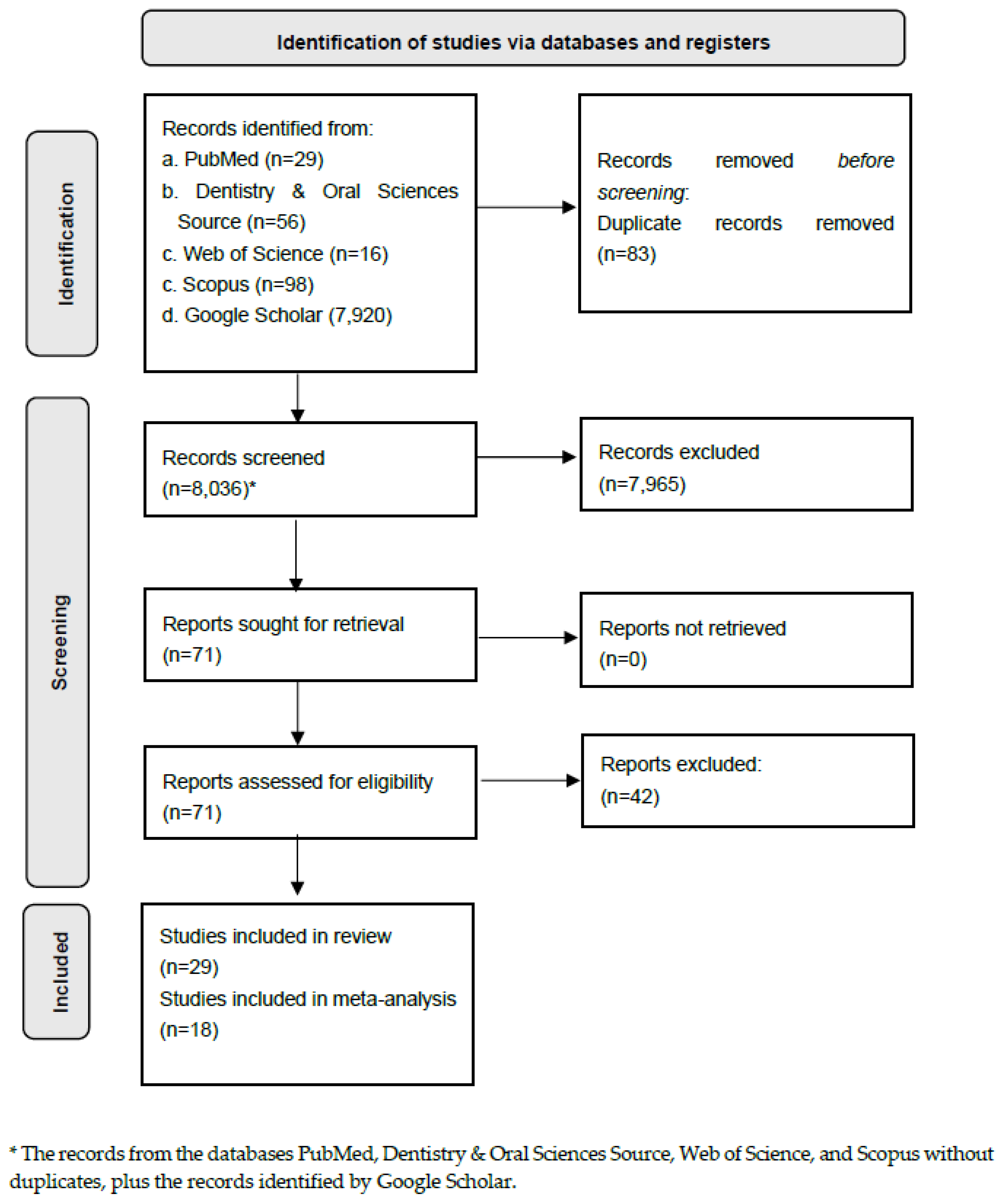
3.1. Selection and Characteristics of the Studies
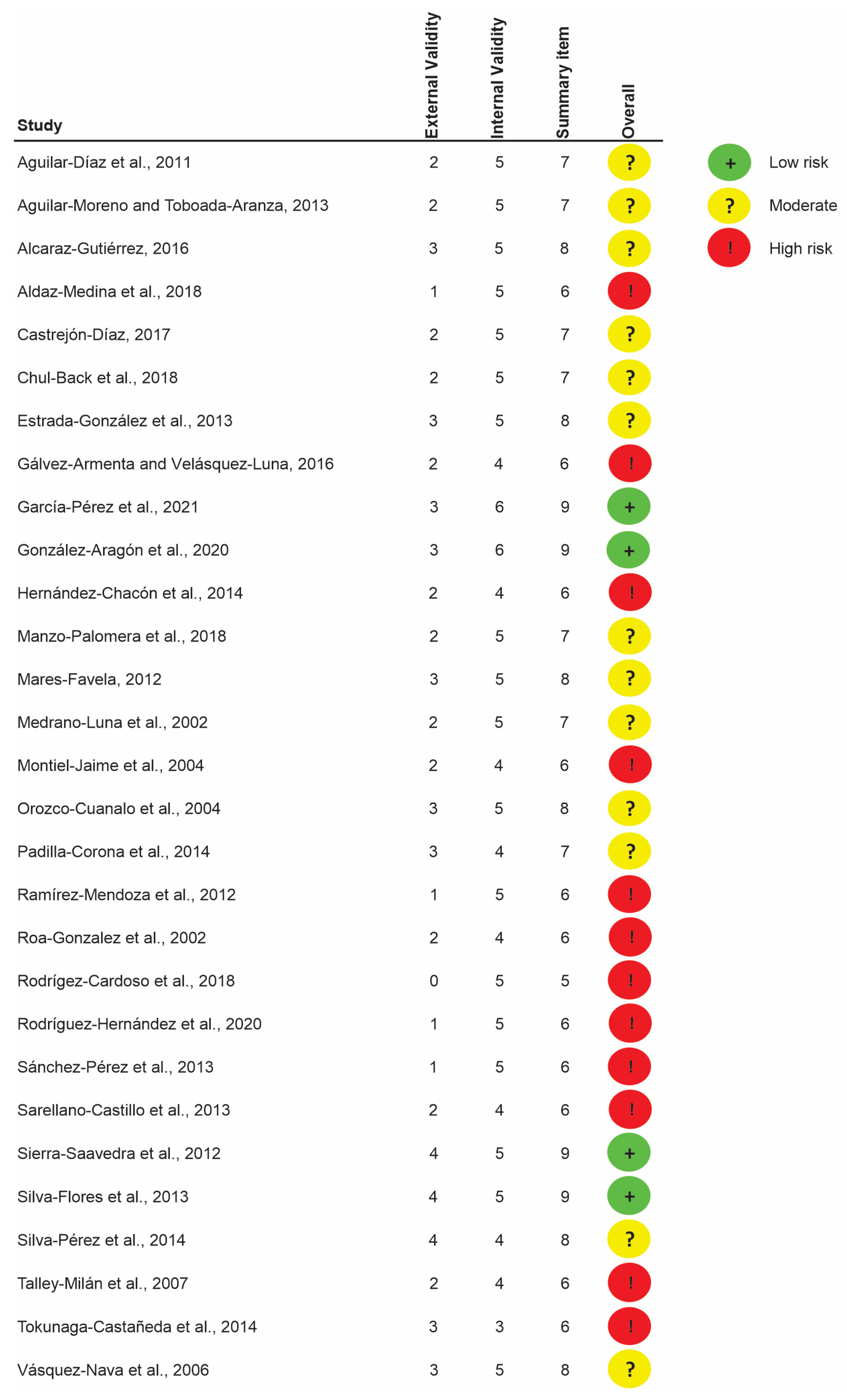
3.2. Risk of Bias and Quality Assessments
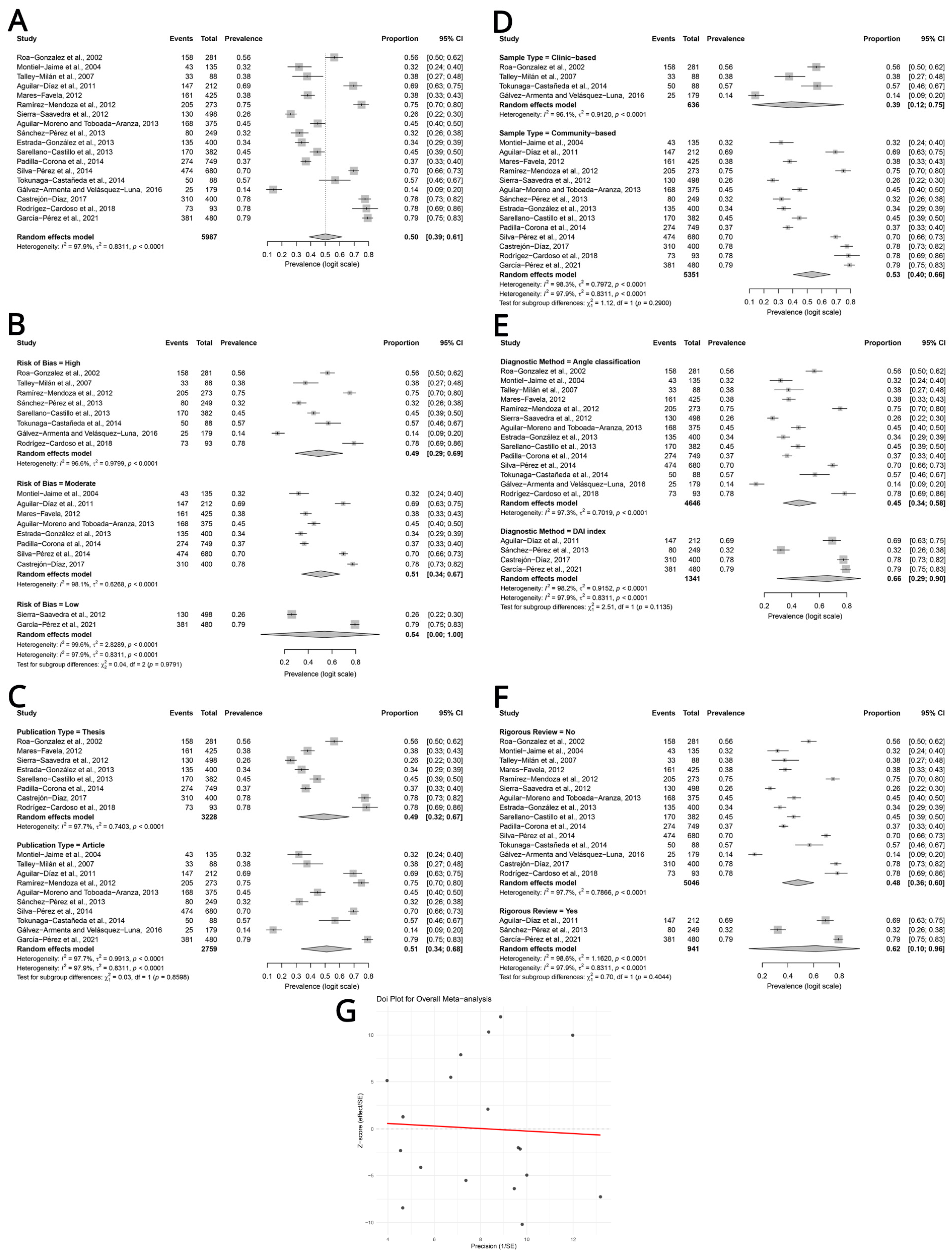
3.3. Meta-Analyses
3.4. Certainty of Evidence According to GRADE
3.5. Malocclusion in Deciduous Dentition
4. Discussion
Strengths and Limitations
5. Conclusions
Author Contributions
Funding
Institutional Review Board Statement
Informed Consent Statement
Data Availability Statement
Acknowledgments
Conflicts of Interest
Appendix A

| 9 | Reason |
|---|---|
Thesis | Participants were not stratified by age |
Article | Diagnosis of posterior crossbite |
Article | Participants were not stratified by age |
Article | Participants were not stratified by age |
Article | Severity analysis in previously diagnosed patients. |
Article | Participants were not stratified by age |
Thesis | Participants were not stratified by age |
Thesis | Participants were not stratified by age |
Article | Diagnosis of anterior open bite |
Article | Participants outside the eligible age range |
Article | Participants outside the eligible age range |
Article | Participants were not stratified by age |
Article | Participants were not stratified by age |
Article | Participants were not stratified by age |
Thesis | Participants were not stratified by age |
Article | Participants were not stratified by age |
Article | Participants were not stratified by age |
Article | Participants were not stratified by age |
Article | Participants were not stratified by age |
Article | Participants were not stratified by age |
Article | Participants were not stratified by age |
Thesis | Participants were not stratified by age |
Thesis | Participants were not stratified by age |
Thesis | Without prevalence information |
Thesis | Participants were not stratified by age |
Article | Participants were not stratified by age |
Article | Participants were not stratified by age |
Article | Participants were not stratified by age |
Article | Patients with cleft lip and palate |
Article | Diagnosis of anterior open bite in asthmatic patients |
Article | Participants were not stratified by age |
Thesis | Participants were not stratified by age |
Thesis | Participants were not stratified by age |
Article | Participants were not stratified by age |
Thesis | Diagnosis of opening limitations |
Article | Participants living in California |
Article | Participants outside the eligible age range |
Article | Participants outside the eligible age range |
Article | Participants outside the eligible age range |
Article | Participants outside the eligible age range |
Thesis | Severity analysis in previously diagnosed patients |
Article | Incomplete data |
| ID | Population | Result |
|---|---|---|
| Roa-Gonzalez, 2002 [88] Thesis | Dental medical records of patients aged 7–12 years (n = 281), Monterrey, Nuevo León state. Age (mean): 8.76 ± 1.33 years Male: 48.4% (n = 136) Female: 51.6% (n = 145) | Molar relationship (Angle classification) Class I: 43.8% (n = 123) Class II 20.6% (n = 58) Class III: 35.6% (n = 100) |
| Montiel-Jaime, 2004 [89] Article | Children aged 6–12 years (n = 135), Netzahualcoyotl city. N/A | Molar relationship (Angle classification) Class I: 68% (n = 92) Class II: 23.88% (n = 31) Class III: 9% (n = 12) Bite abnormalities Anterior open bite: N/A Posterior open bite: N/A Anterior crossbite: N/A Posterior crossbite: N/A Edge-to-edge bite: N/A Overjet: N/A Overbite: N/A |
| Orozco-Cuanalo et al., 2004 [90] Article | Schoolchildren aged 6–13 years (n = 888), Netzahualcoyotl city. Age (mean): 8.5 years Female: 47.2% Male: 52.8% | Molar relationship (Angle classification) Class I: N/A Class II: N/A Class III: N/A Bite abnormalities Total: 75.90% (n = 674). Anterior crossbite: 15.9% Posterior crossbite: 14.3% Deviated dental midline: 35.7% Edge-to-edge bite: 6.3% Tooth crowding: 36.5% Ectopic eruption: 17.5% Gyroversion: 27.8% Anterior open bite and diastema: 8.7% |
| Talley-Millán et al., 2007 [22] Article | Patients aged 8–40 years (n = 428), Postgraduate dental school clinic (DEPeI), National Autonomous University of Mexico (UNAM), Mexico City. Age (mean): 16.86 years | Molar relationship (Angle classification) Class I: 52.8% (n = 226) 8–12 years old: 12.9% (n = 55) * 13–19 years old: 27.8% (n = 119) 20–40 years old: 12.1% (n = 52) Class II: 33.9% (n = 145) 8–12 years old: 6.1% (n = 26) * 13–19 years old: 8% (n = 77) 20–40 years old: 9.8% (n = 42) Class III: 13.3% (n = 57) 8–12 years old: 1.6% (n = 7) * 13–19 years old: 7% (n = 30) 20–40 years old 20 (4.7%) |
| Aguilar Díaz et al., 2011 [91] Article | Male children aged 8–10 years (n = 212) San Luis Potosí state. | Molar relationship (DAI) No anomalies: 30.7% (n = 65) Total abnormalities: 69.3% (n = 147) [Definite malocclusion: 34.4% (n = 73), Severe Malocclusion: 16.5% (n = 35), and Very Severe: 18.4% (n = 39)]. |
| Mares-Favela, 2012 [92] Thesis | Male children aged 6–13 years (n = 425) Monterrey, Nuevo León state. Male: 56.86% (n = 224) Female: 47.29% (n = 201) | Molar relationship (Angle classification) Class I: 62.12% (n = 264) Class II: 31.06% (n = 132) Class III: 6.82% (n = 29) |
| Ramírez-Mendoza et al., 2012 [93] Article | Students from two primary schools aged 6–12 years (n = 273), Villahermosa, Tabasco state. | Molar relationship (Angle classification) No alterations 25% (n = 67) Alterations: 75% (n = 206) |
| Sierra-Saavedra, 2012 [94] Thesis | Male primary school students aged 6–12 years (n = 498), San Nicolás de los Garza, Nuevo León state. | Molar relationship (Angle classification) Class I: (n = 368) Class II: (n = 93) Class III: (n = 37) |
| Aguilar-Moreno and Taboada-Aranza, 2013 [95] Article | Students from elementary schools (n = 375), Nezahualcóyotl and Izcalli cities. Age (mean): 8.8 (±1.7) Male: 50.1% (n = 188) Female: 49.9% (n = 187) | Molar relationship (Angle classification) Class I: 55.2% (n = 207) Class II div.1: 19.2% (n = 72) Class II div. 2: 15.7% (n = 59) Class III: 9.9% (n = 37) |
| Silva-Flores et al., 2013 [96] Article | Schoolchildren aged 7–12 years (n = 402), Tamaulipas. Age (mean): 9.5 years ±1.5 Female: (n = 208) Male: (n = 194) | Molar relationship N/A Bite abnormalities: Horizontal overbite: (n = 27) Vertical overbite: (n = 25) Posterior crossbite: (n = 15) Anterior crossbite: (n = 23) Open anterior bite: (n = 19) Edge-to-edge bite: (n = 18) |
| Sánchez-Pérez et al., 2013 [97] Article | Schoolchildren aged 15 years (n = 249), Mexico City. Male (n = 131) Female (n = 118) | Molar relationship (DAI index) No anomalies: 67.9% (n = 169) Anomalies: 32.1% (n = 80) [Definite malocclusion: 18.5% (n = 46), Severe Malocclusion: 7.6% (n = 19) and Very Severe: 6.0% (n = 15)]. Bite abnormalities Overjet: 61% Open bite: 4.5% |
| Estrada-González, 2013 [98] Thesis | Schoolchildren aged 6–15 years (n = 400), Monterrey, Nuevo León state. Male: 42.5% (n = 170) Female: 57.5% (n = 230) | Molar relationship (Angle classification) Class I: 66.25% (n = 265) Class II: 24.62% (n = 98) Class III: 9.13% (n = 37) |
| Sarellano-Castillo, 2013 [99] Thesis | Schoolchildren aged 8–11 years (n = 382), Nuevo León state. 9 years old: 35% 8–10 years old: 28% 7–11 years old: 5% | Molar relationship (Angle classification) Class I: 55% (n = 212) Class II: 36% (n = 139) Class III: 8% (n = 31) |
| Silva-Pérez et al., 2014 [100] Article | Schoolchildren aged 6–12 years (n = 680), Tabasco. Female: (n = 386) Male: (n = 359) | Molar relationship (Angle classification) Normal occlusion: 30.3%(n = 206) Alterations: 69.7% (n = 474) |
| Padilla-Corona, 2014 [101] Thesis | Schoolchildren aged 6–12 years (n = 749), Tamaulipas state. Age (mean): 8.44 ± 1.77 years N/A | Molar relationship (Angle classification) Class I: 63.41% (n = 475) Class II: 26.81% (n = 201) Class III: 9.74% (n = 73) |
| Tokunaga-Castañeda et al., 2014 [23] Article | Dental medical records of patients aged 8–40 years (n = 428), DEPeI, UNAM. Age (mean): 16.85 years Female: 64.7% (n = 277) Male: 35.3% (n = 151) 8–12 years old: 20.6% (n = 88) * 13–19 years old: 52.8% (n = 226) 20–40 years old: 26.6% (n = 114) | Molar relationship (Angle classification) Class I: 8–12 years old: 8.9% (n = 38) * 13–19 years old: 29% (n = 124) 20–40 years old: 15.4% (n = 66) Class II: 8–12 years old: 9.3% (n = 40) * 13–19 years old: 18.2% (n = 78) 20–40 years old: 9.6% (n = 41) Class III: 8–12 years old: 2.3% (n = 10) * 13–19 years old: 5.6% (n = 24) 20–40 years old: 1.6% (n = 7) |
| Alcaraz-Gutiérrez, 2016 [102] Thesis | Male children aged 9–11 years (n = 543), Tepatitlán de Morelos, Jalisco state. Age (mean): 9.8 years Male: 40.5% (n = 222) Female: 59.5% (n = 323) | Bite abnormalities (Modified WHO index) None: 41.4% (n = 225) Small: 56.7% (n = 308) Moderate or Severe: 1.8% (n = 10) |
| Gálvez-Armenta and Velásquez-Luna, 2016 [103] Article | Dental medical records of patients aged 6–12 years (n = 179), Sinaloa state. Age (mean): 7.9 ± 1.4 Female: (n = 95) Male: (n = 84) | Molar relationship (Angle classification) Class I: 79% (n = 92) Class II: 17% (n = 20) Class III: 4% (n = 5) Bite abnormalities Edge-to-edge bite: 11% Deep overbite: 10% Overjet: 6% Anterior open bite: 5% Anterior crossbite: 4% Posterior crossbite: 2% |
| Castrejón-Díaz, 2017 [104] Thesis | Students aged 12–15 years (n = 400), Culiacan, Sinaloa state. Age (mean): 8.90 ± 1.39 Male: 46.2% (n = 185) Female: 53.8% (n = 215) | Molar relationship (DAI index) No anomalies: 22.5% (n = 90) Anomalies: 77.5% (n = 310) [Definite malocclusion: 20% (n = 80), 12 years old: 21.5% (n = 43), 15 years old: 18.5% (n = 37) Severe malocclusion: 24.3% (n = 97), and Very Severe: 33.2% (n = 133)]. |
| Chul-Back et al., 2018 [105] Article | Male children aged 8–14 years (n = 526), Montemorelos, Nuevo León state. Female: (n = 247) Male: (n = 279) | Molar relationship ND Bite abnormalities Total: 54.4% (n = 286) Overjet: 24% (n = 126) Edge-to-edge bite: 18.1% (n = 95) Anterior crossbite: 3.6% (n = 19) Anterior normal occlusion: 54.4% (n = 286) Overjet: 24% (n = 126) p < 0.05 Edge-to-edge bite: 18.1% (n = 95) Anterior crossbite: 3.6% (n = 19) |
| Rodríguez-Cardoso, 2018 [77] Thesis | Male children aged 6–12 years (n = 93), Puebla city. Male: 61.3% (n = 57) Female: 38.7% (n = 36) | Molar relationship (Angle classification) Class I: 21.5% (n = 20) Class II: 54.83% (n = 51) Class III: 23.65% (n = 22) |
| González-Aragón et al., 2020 [106] Article | Teenagers aged 13–15 years (n = 424), Mexico City. Age (mean): 13.7(±0.44) Female: (n = 225) Male: (n = 199) | Molar relationship N/A Bite abnormalities Open bite: 1.7% (n = 7) Overbite: 11.6% (n = 42) Posterior crossbite: 7.6% (n = 32) Anterior crossbite: 7.8% (n = 33) Overjet: 18.9% (n = 80) |
| García-Pérez et al., 2021 [107] Article | Male child patients aged 8–10 years (n = 480), Dental clinic of School of Higher Studies (FES) Iztacala, UNAM, Tlalnepantla de Baz, State of Mexico. Age (mean): 9.2(±0.75) Male: 50.6% (n = 243) Female: 49.4% (n = 237) | Molar relationship (DAI index) No anomalies: 20.6% (n = 99) Anomalies: 79.4% (n = 381) [Definite malocclusion: 31.3% (n = 150), Severe Malocclusion: 25.6% (n = 123), and Very Severe: 22.5% (n = 108)]. Bite abnormalities Anterior open bite: 4.4% (n = 21) Anterior crossbite: 45.6% (n = 219) |
| ID | Population | Result |
|---|---|---|
| Medrano-Luna et al., 2002 [108] Article | Children aged 3–5 years (n = 193), Iztapalapa, Mexico City. | Terminal plane Flush terminal plane and mesial step: 81.9% (n = 158) Distal step and mesial step with tendency to increase: 18.1% (n = 35) Bite abnormalities ND |
| Vásquez-Nava et al., 2006 [109] Article | Male children aged 4–5 years (n = 1160), Tamaulipas state. Male: 50.2% Female: 49.8% | Terminal plane ND Bite abnormalities Total: 55.2% (n = 640) Anterior open bite: 51.03% Posterior crossbite: 7.5% |
| Hernández-Chacón et al., 2014 [26] Article | Children aged 3–5 years (n = 144), Juárez City, Chihuahua state. Female: 47% (n = 68) Male: 53% (n = 76) | Terminal plane Mesial step: 56% (n = 81) Flush terminal plane and mesial step with tendency to increase: 19% (n = 27) Distal step: 6% (n = 9) Bite abnormalities Total: 95.1% (n = 137) Overbite: 54.16% (n = 78) Crossbite: 27.08% (n = 39) Open bite: 9.72% (n = 14) Edge-to-edge bite: 4.16% (n = 6) |
| Manzo-Palomera et al., 2018 [110] Article | Preschooler aged 3–5 years (n = 522), North Coast Region, Jalisco state. Female: 49.24% Male: 50.76% | Terminal plane N/A Bite abnormalities No malocclusion: 69.16% (n = 361) Mild to severe malocclusion: 30.84% (n = 161) [Mild degree malocclusions: 26.05% (n = 136) and Moderate to severe degree malocclusion: 4.79% (n = 25)]. |
| Aldaz-Medina, 2018 [25] Thesis | Children patients aged 3–5 years (n = 100), Postgraduate dental clinic of Medicine School of the Autonomous University of Querétaro (FMUAQ), Queretaro city. Male: 45% Female: 55% | Terminal plane N/A Bite abnormalities Open bite: (n = 8) Posterior crossbite: (n = 5) Anterior crossbite: (n = 14) |
| Rodríguez-Hernández, 2020 [111] Thesis | Children aged 1–3 years (n = 95), Autonomous University of Baja California (UABC), Campus Tijuana, Tijuana city. Female: 48.4% (n = 46) Male: 51.5% (n = 49) | Terminal plane N/A Bite abnormalities Total: 24.2% (n = 23) Anterior open bite: 8.4% (n = 8) Crossbite posterior: 2.1% (n = 2) Horizontal overbite: 13.7% (n = 13) |
References
- Leavy, K.M.; Cisneros, G.J.; LeBlanc, E.M. Malocclusion and its relationship to speech sound production: Redefining the effect of malocclusal traits on sound production. Am. J. Orthod. Dentofac. Orthop. 2016, 150, 116–123. [Google Scholar] [CrossRef] [PubMed]
- Broutin, A.; Blanchet, I.; Canceill, T.; Noirrit-Esclassan, E. Association between Dentofacial Features and Bullying from Childhood to Adulthood: A Systematic Review. Children 2023, 10, 934. [Google Scholar] [CrossRef] [PubMed]
- Warden, G. Definitions of Bias in Clinical Research. Methods Mol. Biol. 2021, 2249, 35–52. [Google Scholar] [CrossRef] [PubMed]
- Thornton, A.; Lee, P. Publication bias in meta-analysis: Its causes and consequences. J. Clin. Epidemiol. 2000, 53, 207–216. [Google Scholar] [CrossRef]
- Song, F.; Hooper, L.; Loke, Y.K. Publication bias: What is it? How do we measure it? How do we avoid it? Open Access J. Clin. Trials 2013, 5, 71–81. [Google Scholar] [CrossRef]
- Prager, E.M.; Chambers, K.E.; Plotkin, J.L.; McArthur, D.L.; Bandrowski, A.E.; Bansal, N.; Martone, M.E.; Bergstrom, H.C.; Bespalov, A.; Graf, C. Improving transparency and scientific rigor in academic publishing. J. Neurosci. Res. 2019, 97, 377–390. [Google Scholar] [CrossRef]
- Hayashino, Y.; Noguchi, Y.; Fukui, T. Systematic Evaluation and Comparison of Statistical Tests for Publication Bias. J. Epidemiol. 2005, 15, 235–243. [Google Scholar] [CrossRef]
- Freeman, R.; Marmor, T. Making sense of health services politics through cross-national comparison. J. Health Serv. Res. Policy 2003, 8, 180–182. [Google Scholar] [CrossRef]
- Jacques, O.; Noël, A. The politics of public health investments. Social Sci. Med. 2022, 309, 115272. [Google Scholar] [CrossRef]
- Reda, S.F.; Reda, S.M.; Thomson, W.M.; Schwendicke, F. Inequality in Utilization of Dental Services: A Systematic Review and Meta-analysis. Am. J. Public Health 2018, 108, e1–e7. [Google Scholar] [CrossRef]
- de Frutos-Valle, L.; Martin, C.; Alarcon, J.A.; Palma-Fernandez, J.C.; Iglesias-Linares, A. Subclustering in Skeletal Class III Phenotypes of Different Ethnic Origins: A Systematic Review. J. Evid. Based Dent. Pract. 2019, 19, 34–52. [Google Scholar] [CrossRef]
- Gottfredson, L.S. Intelligence: Is it the epidemiologists’ elusive “fundamental cause” of social class inequalities in health? J. Pers. Soc. Psychol. 2004, 86, 174–199. [Google Scholar] [CrossRef] [PubMed]
- Boccia, S.; La Torre, G.; Persiani, R.; D’Ugo, D.; van Duijn, C.M.; Ricciardi, G. A critical appraisal of epidemiological studies comes from basic knowledge: A reader’s guide to assess potential for biases. World J. Emerg. Surg. 2007, 2, 7. [Google Scholar] [CrossRef]
- Page, M.J.; McKenzie, J.E.; Bossuyt, P.M.; Boutron, I.; Hoffmann, T.C.; Mulrow, C.D.; Shamseer, L.; Tetzlaff, J.M.; Akl, E.A.; Brennan, S.E.; et al. The PRISMA 2020 statement: An updated guideline for reporting systematic reviews. Rev. Esp. Cardiol. 2021, 74, 790–799. [Google Scholar] [CrossRef] [PubMed]
- Higgins, J.P.T.; Green, S. Cochrane Handbook for Systematic Reviews of Interventions; John Wiley & Sons: Hoboken, NJ, USA, 2011. [Google Scholar]
- Hoy, D.; Brooks, P.; Woolf, A.; Blyth, F.; March, L.; Bain, C.; Baker, P.; Smith, E.; Buchbinder, R. Assessing risk of bias in prevalence studies: Modification of an existing tool and evidence of interrater agreement. J. Clin. Epidemiol. 2012, 65, 934–939. [Google Scholar] [CrossRef]
- Hoek, A.G.; Dal Canto, E.; Wenker, E.; Bindraban, N.; Handoko, M.L.; Elders, P.J.M.; Beulens, J.W.J. Epidemiology of heart failure in diabetes: A disease in disguise. Diabetologia 2024, 67, 574–601. [Google Scholar] [CrossRef]
- Sidik, K.; Jonkman, J.N. A simple confidence interval for meta-analysis. Stat. Med. 2002, 21, 3153–3159. [Google Scholar] [CrossRef] [PubMed]
- Higgins, J.P.; Thompson, S.G. Quantifying heterogeneity in a meta-analysis. Stat. Med. 2002, 21, 1539–1558. [Google Scholar] [CrossRef]
- Furuya-Kanamori, L.; Barendregt, J.J.; Doi, S.A.R. A new improved graphical and quantitative method for detecting bias in meta-analysis. Int. J. Evid. Based Healthc. 2018, 16, 195–203. [Google Scholar] [CrossRef]
- Shamim, M.A. Real-life implications of prevalence meta-analyses? Doi plots and prediction intervals are the answer. Lancet Microbe 2023, 4, e490. [Google Scholar] [CrossRef]
- Talley Millán, M.; Katagiri Katagiri, M.; Elorza Pérez Tejada, H. Casuística de maloclusiones Clase I, Clase II y Clase III según Angle en el Departamento de Ortodoncia de la UNAM. Rev. Odontológica Mex. 2007, 11, 175–180. [Google Scholar] [CrossRef]
- Tokunaga, C.S.; Katagiri, K.M.; Elorza, P.H. Prevalencia de las maloclusiones en el Departamento de Ortodoncia de la División de Estudios de Postgrado e Investigación de la Facultad de Odontología de la Universidad Nacional Autónoma de México. Rev. Odontológica Mex. 2014, 18, 175–179. [Google Scholar] [CrossRef][Green Version]
- Campbell, M.; McKenzie, J.E.; Sowden, A.; Katikireddi, S.V.; Brennan, S.E.; Ellis, S.; Hartmann-Boyce, J.; Ryan, R.; Shepperd, S.; Thomas, J.; et al. Synthesis without meta-analysis (SWiM) in systematic reviews: Reporting guideline. BMJ 2020, 368, l6890. [Google Scholar] [CrossRef]
- Medina, V.A. Presencia de Maloclusiones en Pacientes Alimentados con Lactancia Materna Exclusiva, Mixta Y Otro Tipo de Alimentación. 2018. Available online: https://ri-ng.uaq.mx/handle/123456789/1303 (accessed on 16 April 2024).
- Georgina, H.C.; Laura, B.D.A.; Tania, H.G. Prevalencia de maloclusiones relacionadas con hábitos deletéreos en un grupo de niños de 3 a 5 años que asisten por primera vez a la clínica del posgrado de Odontopediatría de la Universidad Autónoma de Ciudad Juárez. Oral 2014, 15, 1163–1168. [Google Scholar]
- Singh, S. Evidence in oral health promotion-implications for oral health planning. Am. J. Public Health 2012, 102, e15–e18. [Google Scholar] [CrossRef] [PubMed]
- Bourgeois, D.M.; Phantumvanit, P.; Llodra, J.C.; Horn, V.; Carlile, M.; Eiselé, J.-L. Rationale for the prevention of oral diseases in primary health care: An international collaborative study in oral health education. Int. Dent. J. 2014, 64, 1–11. [Google Scholar] [CrossRef] [PubMed]
- Lombardo, G.; Vena, F.; Negri, P.; Pagano, S.; Barilotti, C.; Paglia, L.; Colombo, S.; Orso, M.; Cianetti, S. Worldwide prevalence of malocclusion in the different stages of dentition: A systematic review and meta-analysis. Eur. J. Paediatr. Dent. 2020, 21, 115–122. [Google Scholar] [CrossRef]
- Chen, H.; Lin, L.; Chen, J.; Huang, F. Prevalence of Malocclusion Traits in Primary Dentition, 2010–2024: A Systematic Review. Healthcare 2024, 12, 1321. [Google Scholar] [CrossRef]
- Murad, M.H.; Chu, H.; Lin, L.; Wang, Z. The effect of publication bias magnitude and direction on the certainty in evidence. BMJ Evid. Based Med. 2018, 23, 84–86. [Google Scholar] [CrossRef]
- De Ridder, L.; Aleksieva, A.; Willems, G.; Declerck, D.; Cadenas de Llano-Pérula, M. Prevalence of Orthodontic Malocclusions in Healthy Children and Adolescents: A Systematic Review. Int. J. Environ. Res. Public Health 2022, 19, 7446. [Google Scholar] [CrossRef]
- Akbari, M.; Lankarani, K.B.; Honarvar, B.; Tabrizi, R.; Mirhadi, H.; Moosazadeh, M. Prevalence of malocclusion among Iranian children: A systematic review and meta-analysis. Dent. Res. J. 2016, 13, 387–395. [Google Scholar] [CrossRef] [PubMed]
- Eslamipour, F.; Afshari, Z.; Najimi, A. Prevalence of Malocclusion in Permanent Dentition of Iranian Population: A Review Article. Iran. J. Public Health 2018, 47, 178–187. [Google Scholar]
- Londono, J.; Ghasemi, S.; Moghaddasi, N.; Baninajarian, H.; Fahimipour, A.; Hashemi, S.; Fathi, A.; Dashti, M. Prevalence of malocclusion in Turkish children and adolescents: A systematic review and meta-analysis. Clin. Exp. Dent. Res. 2023, 9, 689–700. [Google Scholar] [CrossRef]
- Lin, M.; Xie, C.; Yang, H.; Wu, C.; Ren, A. Prevalence of malocclusion in Chinese schoolchildren from 1991 to 2018: A systematic review and meta-analysis. Int. J. Paediatr. Dent. 2020, 30, 144–155. [Google Scholar] [CrossRef]
- Shen, L.; He, F.; Zhang, C.; Jiang, H.; Wang, J. Prevalence of malocclusion in primary dentition in mainland China, 1988–2017: A systematic review and meta-analysis. Sci. Rep. 2018, 8, 4716. [Google Scholar] [CrossRef]
- Mehta, A.; Negi, A.; Verma, A.; Jain, K. Pooled prevalence estimates of malocclusion among Indian children and adolescents: A systematic review and meta-analysis. Int. J. Adolesc. Med. Health 2022, 34, 371–380. [Google Scholar] [CrossRef]
- Balachandran, P.; Janakiram, C. Prevalence of malocclusion among 8-15 years old children, India—A systematic review and meta-analysis. J. Oral Biol. Craniofac Res. 2021, 11, 192–199. [Google Scholar] [CrossRef]
- Devanna, R.; Felemban, N.H.; Althomali, Y.; Battepati, P.M.; Ali Alfawzan, A.; Gupta, P. Prevalence of malocclusion among children of the Kingdom of Saudi Arabia—A systematic review and meta-analysis. Saudi Dent. J. 2021, 33, 826–834. [Google Scholar] [CrossRef] [PubMed]
- Almotairy, N.; Almutairi, F. A Nation-wide Prevalence of Malocclusion Traits in Saudi Arabia: A Systematic Review. J. Int. Soc. Prev. Community Dent. 2022, 12, 1–11. [Google Scholar] [CrossRef]
- Rebelo Vieira, J.M.; Pereira, J.V.; Sponchiado Júnior, E.C.; Corrêa, A.C.C.; Santos, A.; Silva, T.S.D.; Vieira, W.A.; Quadros, L.N.; Rebelo, M.A.B. Prevalence of dental caries, periodontal disease, malocclusion, and tooth wear in indigenous populations in Brazil: A systematic review and meta-analysis. Braz. Oral Res. 2023, 37, e094. [Google Scholar] [CrossRef] [PubMed]
- Lawrence, A. Influence seekers: The production of grey literature for policy and practice. Inf. Serv. Use 2017, 37, 389–403. [Google Scholar] [CrossRef]
- Furuya-Kanamori, L.; Rousou, X.; Kostoulas, P.; Doi, S.A.R. Examining and Interpreting Doi Plot Asymmetry in Meta-Analyses of Randomized Controlled Trials. J. Evid. Based Med. 2025, 18, e70063. [Google Scholar] [CrossRef]
- Varenne, B. Oral health at the core of the global health agenda. J. Am. Dent. Assoc. 2022, 153, 393–394. [Google Scholar] [CrossRef]
- Flores Longoria, M.L. Prevalencia de Maloclusión en Primera Dentición de los Pacientes de 3–6 años que Acuden al Posgrado de Odontología Infantil de la UANL; Universidad Autónoma de Nuevo León: San Nicolás de los Garza, Mexico, 2002. [Google Scholar]
- Beraud Osorio, D.I.; Sánchez Rodríguez, M.A.; Murrieta Pruneda, J.F.; Mendoza Núñez, V.M. Prevalencia y factores de riesgo de mordida cruzada posterior en niños de 4-9 años de edad en ciudad Nezahualcóyotl. Boletín Médico Hosp. Infant. México 2004, 61, 141–148. [Google Scholar]
- Casanova-Rosado, J.F.; Medina-Solis, C.E.; Vallejos-Sánchez, A.A.; Casanova-Rosado, A.J.; Maupomé, G.; Avila-Burgos, L. Lifestyle and psychosocial factors associated with tooth loss in Mexican adolescents and young adults. J. Contemp. Dent. Pract. 2005, 6, 70–77. [Google Scholar] [CrossRef] [PubMed]
- Gutiérrez Juárez, G.; Gutiérrez Venegas, G. Prevalencia de forma de los arcos dentales en adultos con maloclusión y sin tratamiento ortodóncico. Rev. Odontológica Mex. 2006, 10, 109–114. [Google Scholar] [CrossRef]
- Alvarez Neria, C.A. Frecuencia de los componentes de la maloclusión clase II esquelética en dentición mixta. Rev. ADM 2006, 63, 210–214. [Google Scholar]
- Ramírez Velásquez, M.P.; Cashat Cruz, M.; Fragoso Ríos, R. Evaluación de las necesidades de atención dental para pacientes pediátricos VIH positivos con base en indicadores de salud dental. Rev. Odontológica Mex. 2007, 11, 76–80. [Google Scholar] [CrossRef]
- Te, A.L.P. Frecuencia de Hipodoncia, Hipoplasia del Esmalte, Caries, Gingivitis y Maloclusión en Pacientes con Síndrome de Williams-Beuren, del Instituto Nacional de Pediatria; Universidad Nacional Autónoma de México: Mexico City, Mexico, 2007. [Google Scholar]
- Nájera Ávila, J.A. Prevalencia en pacientes con maloclusión clase III esqueletal determinada por hipoplasia maxilar o hiperplasia mandibular por medio del análisis de Ricketts, Steiner, Trujillo y Wits en la Clínica de Ortodoncia de la Universidad Michoacán de San Nicolás de Hidalgo, Morelia, Michoacán 2006–2008. 2008. Available online: http://bibliotecavirtual.dgb.umich.mx:8083/xmlui/handle/DGB_UMICH/4476 (accessed on 14 November 2023).
- López-Pérez, R.; Borges-Yáñez, S.A.; López-Morales, P. Anterior open bite and speech disorders in children with Down syndrome. Angle Orthod. 2008, 78, 221–227. [Google Scholar] [CrossRef]
- Marroquín-Rodríguez, E.A.; García-Moyeda, A.; Luna-Guillermo, J.; Flores-Peña, Y.; Torres-Salazar, A.; Villarreal-Garza, J.A.; Cerda-Flores, R.M. Prevalence of Malocclusion in Mestizo Populat|on in Northeastern México. Rev. Med. Torreón. 2010, 2, 35–41. [Google Scholar]
- Murrieta Pruneda, J.F.; Pérez Silva, L.E.; Allendelagua Bello, R.I.; Linares Vieyra, C.; Júarez López, L.A.; Meléndez Ocampo, A.F.; Meza Sánchez, J.d.C.; González Guevara, M.B.; López Ramírez, T. Prevalencia de chasquido en la ATM y su relación con el tipo de oclusión dental, en un grupo de jóvenes mexicanos. Rev. Adm. 2011, LXVIII, 237–243. [Google Scholar]
- Aranza, O.T.; Zurita, A.T.; Martínez, C.E.C.; Cuanalo, L.O. Prevalencia de maloclusiones y trastornos del habla en una población preescolar del oriente de la Ciudad de México. Boletín Médico Hosp. Infant. México 2011, 68, 425–430. [Google Scholar]
- Mendoza, J.R.; López, R.; León, R.G.; López, J.; Álvarez, H. Características y alteraciones de la oclusión en la dentición primaria en preescolares de 3 a 6 años en Tabasco, México. Odontol. pediatr. 2011, 10, 6. [Google Scholar]
- Díaz, M.P.; Guzmán, L.M.D.; Frías, M.A.E.; Guardado, N.M.H. Factores intrínsecos de maloclusión dental en pacientes con dentición permanente. Rev. Asoc. Dent. Mex. 2013, 70, 61–67. [Google Scholar]
- Peña Mendez, L.S.d.l. Prevalencia de Maloclusiones en la Primera Dentición en Niños del Área Metropolitana de Monterrey, Nuevo León. Master’s Thesis, Universidad Autónoma de Nuevo León, San Nicolás de los Garza, Mexico, 2013. [Google Scholar]
- Guerrero Castellon, M.P.; Aguiar Fuentes, E.G. Frecuencia y caracteristicas de las maloclusiones en el centro de atencion multiple no. 1 de tepic, nayarit. Rev Tamé 2013, 2, 143–147. [Google Scholar]
- Oropeza, L.M.; Ocampo, A.F.M.; Sánchez, R.O.; López, A.F. Prevalencia de las maloclusiones asociada con hábitos bucales nocivos en una muestra de mexicanos. Rev. Mex. Ortod. 2014, 2, 220–227. [Google Scholar] [CrossRef][Green Version]
- Leslie, R.-R.D.; Erika, E.-D.; Antón-Sarabia, J.; Gabriel, M.-Q. Asociación de Maloclusiones Clase I, II y III y su Tratamiento en Población Infantil en la Ciudad de Puebla, México. Rev. Tamé 2014, 2, 175–179. [Google Scholar]
- Ventura, M.A.R.; Olán, L.I. Estado de salud bucodental de niños con capacidades especiales del Centro de Atención Múltiple No. 4. Horiz. Sanit. 2014, 13, 233–237. [Google Scholar] [CrossRef][Green Version]
- Rojas, M.H.M.; Mendieta, P.L.; Ocampo, A.F.M. Perfil clínico epidemiológico del trastorno temporomandibular en mexicanos con maloclusión. Rev. Mex. Ortod. 2015, 3, 79–83. [Google Scholar] [CrossRef][Green Version]
- Aamodt, K.; Reyna-Blanco, O.; Sosa, R.; Hsieh, R.; De la Garza Ramos, M.; Martinez, M.G.; Orellana, M.F. Prevalence of caries and malocclusion in an indigenous population in Chiapas, Mexico. Int. Dent. J. 2015, 65, 249–255. [Google Scholar] [CrossRef]
- Favela Campa, J.A. Prevalencia de Maloclusiones en Dentición Primaria en Relación a la Lactancia Materna en Chiapas. Master Degree, Universidad Autónoma de Nuevo León, San Nicolás de los Garza, Mexico, 2015. [Google Scholar]
- Lozano Longoria, M.J. Prevalencia de Maloclusiones en Dentición Primaria en Relación a la Lactancia Materna en Pacientes Indígenas de la Clínica Esquípulas en Chiapas, México; Universidad Autónoma de Nuevo León: San Nicolás de los Garza, Mexico, 2015. [Google Scholar]
- Garza Ramos, N.S. Maloclusiones Dentales en Niños de 7 a 10 Años y su Relación con el Tipo de Alimentación Recibida Durante su Etapa de Lactante Menor; Universidad Autónoma de Nuevo León: San Nicolás de los Garza, Mexico, 2016. [Google Scholar]
- García, Y.A.; Bravo, M.d.L.O. Prevalencia de Caries Dental, Maloclusiones y Erosión Dental en Niños Preescolares de la Ciudad de Tepatitlán de Morelos, Jalisco-2016. Thesis for the Specialty In Dentistry, Universidad de Guadalajara, Guadalajara, Mexico, 2016. Available online: https://riudg.udg.mx/handle/20.500.12104/83557 (accessed on 16 April 2024).
- Castillo Carmona, I.G.; Feregrino Vejar, L.; Rojas Garcia, A.R.; Gutierrez Rojo, J.F. Frecuencia de maloclusión en pacientes que acuden a atención ortodóncica en la zona centro de Tepic, Nayarit. Rev. Tame 2016, 5, 452–454. [Google Scholar]
- Gutiérrez-Rojo, M.F.; Gutiérrez-Rojo, J.F.; Gutiérrez-Villaseñor, J.; Rojas-García, A.R. Necesidad de tratamiento ortodóntico utilizando el Índice Estética Dental (DAI) en una población de Guadalajara, Jalisco, México. Acta Odontológica Colomb. 2016, 6, 99–106. [Google Scholar]
- Cuanalo, L.O.; González, L.M.C.; García, M.E.B.; de la Fuente, M.V.G. Maloclusiones dentales y su relación con la respiración bucal en una población infantil al oriente de la Ciudad de México. Vertientes. Rev. Espec. Cienc. Salud 2016, 19, 43–47. [Google Scholar]
- García-Garza, C.I.; Ochoa-Cáceres, S.; Martín-Brieke, W.S.; de los Ángeles Salazar-Cruz, M.; Gutiérrez-Brito, M. Prevalencia del grupo de maloclusión de acuerdo al análisis de GOSLON en pacientes con fisura labio alvéolo palatinas de seis a 12 años que asisten al Servicio de Ortodoncia del Hospital para el Niño Poblano. Rev. Oral 2017, 18, 1520. [Google Scholar]
- Ramos-Ríos, J.A.; Ramírez-Hernández, E.; Vázquez-Rodríguez, E.M.; Vázquez-Nava, F. Asthma-associated oral and dental health repercussions in children aged 6 to 12 years. Rev. Alerg. México 2017, 64, 270–276. [Google Scholar] [CrossRef]
- Torres-Capetillo, E.G.; Capetillo-Hernández, G.R.; Ruiz, M.; González-Cabrera, J.C. Prevalencia de maloclusiones dentales relacionada con género y edad en estudiantes universitarios Dental Malocclusion prevalence related with gender and age in University students. Rev. Técnicas 2018, 2, 16–20. [Google Scholar]
- Rodríguez-Morales, L.A.; Limonchi-Palacio, V.L.; Bulnes-López, R.M. Prevalencia de Maloclusión Transversal Pos-Terior y Factores Predisponentes en Pacientes del Posgrado de Ortodoncia. Thesis “Universidad Juárez Autóno-ma de Tabasco”. 2018. Available online: https://ri.ujat.mx/home (accessed on 16 April 2024).
- Garibo-Ruiz, M.A.; Barrera-Brito, D.; Garibo-Ruiz, D. Asociación entre el tiempo de lactancia y el desarrollo de maloclusiones. Salud Pública México 2018, 60, 128. [Google Scholar] [CrossRef]
- Ortíz, R.M.M.; García, J.A.T.; Sánchez, M.D.C.; De la Rosa, K.B.S.; Durón, D.A. Prevalencia de hábitos perniciosos y las consecuencias en la oclusión en dentición temporal y mixta Temprana. Vista Mexicana de Medicina Forense y Ciencias de la Salud. Rev. Mex Med. Forense 2019, 4, 75–77. [Google Scholar]
- Chapa Hernández, A. Manifestaciones Orales y Prevalencia de Enfermedades Bucales en Niños con Epidermólisis Bullosa en México. Master’s Thesis, Universidad Autónoma de Nuevo León, San Nicolás de los Garza, Mexico, 2019. [Google Scholar]
- Silva, R.G.; Kang, D.S. Prevalence of malocclusion among Latino adolescents. Am. J. Orthod. Dentofac. Orthop. 2001, 119, 313–315. [Google Scholar] [CrossRef]
- Murrieta Pruneda, J.F.; Arrieta Ortega, C.L.; Juárez López, L.A.; Linares Vieyra, C.; González Guevara, M.B.; Meléndez OCampo, A. Prevalencia de maloclusiones en un grupo de estudiantes universitarios mexicanos y su posible asociacion con la edad, el sexo y el nivel socioeconomico, 2009. Rev. Fac. Odontol. Univ. Antioq. 2012, 24. Available online: https://revistas.udea.edu.co/index.php/odont/article/view/10768 (accessed on 16 April 2026).
- Gutierrez Rojo, J.F.; Reyes Maldonado, Y.D.S.; Lopez Erenas, C.; Rojas Garcia, A.R. Frecuencia de Maloclusiones dentales en la clínica de la Especialidad de Ortodoncia de la Universidad Autónoma de Nayarit. Conacyt. 2015. Available online: http://aramara.uan.mx:8080/jspui/handle/123456789/235 (accessed on 16 April 2026).
- Amaral, M.G.G.; López, L.V.R. Prevalence, types and etiologic factors of mandibular crowding in orthodontic patients in Tabasco, Mexico, 2015–2016. Rev. Mex. Ortod. 2018, 6, 22–27. [Google Scholar]
- Morteo, L.T.; Astorga, M.D.l.A.H.; Hernández, G.R.C.; Caprtillo, E.G.T.; Leal, M.R.; López, F.S.C.; Martinez, R.E.O.; Aguilar, S.G.F. Maloclusiones en estudiantes de enseñanza media superior en Veracruz. Cienc. Front. 2021. Available online: https://erevistas.uacj.mx/ojs/index.php/cienciafrontera/article/view/3607/3273 (accessed on 16 April 2026).
- Tristán López, J.D. Correlación de maloclusiones con condición y biotipo periodontal en adolescentes de la Ciudad de San Luis Potosí. Repos. Nac. Conacyt 2019. [Google Scholar]
- Marín-Delgado, O.; de León-Chacón, F.; Espinosa-Cristóbal, L.F.; Donohué-Cornejo, A.; Cuevas-González, J.C.; García-Zamarrón, D.J.; Constandse-Cortés, D. Asociación del nivel de maloclusión, alteraciones dentomaxilofaciales y satisfacción del tratamiento ortodóncico en pacientes adolescentes de Ciudad Juárez, Chihuahua. Rev. Mex. Ortod. 2021, 7, 125–138. [Google Scholar] [CrossRef]
- Roa González, S.d.C. Prevalencia de Maloclusión de los Pacientes de 7 a 12 Años que Acudieron a Recibir Tratamiento Odontológico al Posgrado de Odontología Infantil de la UANL el Periodo Comprendido de Enero del 2000 a Diciembre del 2003. Master’s Thesis, Universidad Autónoma de Nuevo León, San Nicolás de los Garza, Mexico, 2002. [Google Scholar]
- Jaime, M.E.M. Frecuencia de maloclusiones y su asociación con hábitos perniciosos en una población de niños mexicanos de 6 a 12 años de edad. Rev. Asoc. Dent. Mex. 2004, 61, 209–214. [Google Scholar]
- Cuanalo, L.O.; Méndez, W.M.; Cruz, O.S.; García, M.E.B.; Herrera, Á.F.Á.; González, C.L.S. Prevalencia de Enfermedades Bucodentales en una Población Escolar. Vertientes Rev. Espec. Cienc. Salud 2013, 7. Available online: https://www.revistas.unam.mx/index.php/vertientes/article/view/32964 (accessed on 16 April 2026).
- Aguilar-Díaz, F.; Irigoyen-Camacho, M.; Borges-Yáñez, S. Oral-health-related quality of life in schoolchildren in an endemic fluorosis area of Mexico. Qual. Life Res. 2011, 20, 1699–1706. [Google Scholar] [CrossRef]
- Mares Favela, M.Á. Prevalencia de Hábitos Bucales y su Relación con las Maloclusiones en la Población Infantil del Área Metropolitana de Monterrey, NL. Master’s Thesis, Universidad Autónoma de Nuevo León, San Nicolás de los Garza, Mexico, 2012. [Google Scholar]
- Mendoza, J.R.; Ventura, M.A.R.; García, M.H.M.; Ramírez, A.G. Prevalencia de Caries Dental y Maloclusiones en Escolares de Tabasco, México. Horiz. Sanit. 2012, 11, 13–23. [Google Scholar] [CrossRef]
- Sierra Saavedra, C. Prevalencia de Enfermedades Bucodentales en Alumnos de Escuelas Primarias Privadas y Públicas en la Ciudad de San Nicolás de los Garza, México. Master’s Thesis, Universidad Autónoma de Nuevo León, San Nicolás de los Garza, Mexico, 2012. [Google Scholar]
- Aguilar Moreno, N.A.; Taboada Aranza, O. Frecuencia de maloclusiones y su asociación con problemas de postura corporal en una población escolar del Estado de México. Boletín Médico Hosp. Infant. México 2013, 70, 364–371. [Google Scholar]
- Flores, X.D.S.; Benavides, R.C.R.; Barrera, J.C.; Rodríguez, J.D.L. Prevalencia de caries, gingivitis y maloclusiones en escolares de Ciudad Victoria, Tamaulipas y su relación con el estado nutricional. Rev. Odontológica Mex. 2013, 17, 221–227. [Google Scholar] [CrossRef][Green Version]
- Sánchez-Pérez, L.; Irigoyen-Camacho, M.E.; Molina-Frechero, N.; Mendoza-Roaf, P.; Medina-Solís, C.; Acosta-Gío, E.; Maupomé, G. Malocclusion and TMJ disorders in teenagers from private and public schools in Mexico City. Med. Oral Patol. Oral Y Cir. Bucal 2013, 18, e312. [Google Scholar] [CrossRef] [PubMed]
- Estrada González, F.M. Prevalencia de Maloclusiones Dentales y Presencia de Dientes Permanentes en Escolares de 6 a 15 años de la Ciudad de Monterrey, NL, México y su Área Metropolitana. Master’s Thesis, Universidad Autónoma de Nuevo León, San Nicolás de los Garza, Mexico, 2013. [Google Scholar]
- Sarellano Castillo, K.L. Presencia de Hábitos Orales Deformantes de la Oclusión y Maloclusión Dental en una Población Escolar de 3°, 4° y 5° año de Primaria en el Área Metropolitana de Monterrey. Master’s Thesis, Universidad Autónoma de Nuevo León, San Nicolás de los Garza, Mexico, 2013. [Google Scholar]
- Silva Pérez, G.A.; Bulnes López, R.M.; Rodríguez López, L.V. Prevalencia de hábito de respiración oral como factor etiológico de maloclusión en escolares del Centro, Tabasco. Rev. ADM 2014, 71, 285–289. [Google Scholar]
- Padilla Corona, J. Diagnóstico de Salud Bucodental en Niños de 6 a 12 años de Edad del Nivel Primaria en la Ciudad de Tampico, Madero y Altamira Tamaulipas, México. Ph.D Thesis, Universidad de Sevilla, Sevilla, Mexico, 2014. Available online: http://hdl.handle.net/11441/57499 (accessed on 16 April 2026).
- Alcaraz Gutiérrez, A.E.; Hernández Rivas, M.I.D.; Guzmán Flores, J.M.C. Prevalencia de Anomalías Dentofaciales y Maloclusiones en Escolares de 9 a 11 años de Edad en Tepatitlán, Jalisco; Centro Universitario de Los Altos, Universidad de Guadalajara: Guadalajara, Mexico, 2016. [Google Scholar]
- Gálvez-Armenta, A.; Velázquez-Luna, J. Frecuencia de maloclusiones en pacientes con dentición mixta de la clínica de la Especialidad en Odontopediatría de la Universidad Autónoma de Sinaloa. Rev. Tame 2016, 5, 482–485. [Google Scholar]
- Castrejón Díaz, M.A. Necesidades de Tratamiento Ortodóntico en Jóvenes de 12 y 15 años de Edad de Culiacán, Sinaloa (México); Universidad de Granada: Granada, Spain, 2017. [Google Scholar]
- Back, S.C.; Hernández, A.; Jiménez, J.; Hernández, H.; Calderón, A. Relación entre tipos de maloclusión en plano horizontal y hábitos orales en niños de 8 a 14 años de Montemorelos. Unaciencia 2018, 11, 44–50. [Google Scholar] [CrossRef]
- González-Aragón Pineda, Á.E.; García Pérez, A.; Rosales-Ibáñez, R.; Stein-Gemora, E. Relationship between the Normative Need for Orthodontic Treatment and Oral Health in Mexican Adolescents Aged 13–15 Years Old. Int. J. Environ. Res. Public Health 2020, 17, 8107. [Google Scholar] [CrossRef] [PubMed]
- García Pérez, A.; González-Aragón Pineda, Á.E.; Gonzalez Olivares, H. Oral health-related quality-of-life scores differ by socioeconomic status, mother’s level of education, dental visits and severity of malocclusion in mixed dentition of eight-to-ten-year-old schoolchildren. PeerJ 2021, 9, e12062. [Google Scholar] [CrossRef]
- Luna, J.E.M.; Galindo, L.S.C.; Pruneda, J.F.M. Prevalencia de factores de riesgo para el desarrollo de la oclusión. Rev. Asoc. Dent. Mex. 2002, 59, 128–133. [Google Scholar]
- Vázquez-Nava, F.; Quezada-Castillo, J.; Oviedo-Treviño, S.; Saldivar-González, A.; Sánchez-Nuncio, H.; Beltrán-Guzmán, F.; Vázquez-Rodríguez, E.; Rodríguez, C.V. Association between allergic rhinitis, bottle feeding, non-nutritive sucking habits, and malocclusion in the primary dentition. Arch. Dis. Child. 2006, 91, 836–840. [Google Scholar] [CrossRef]
- Manzo-Palomera, O.; Sánchez-Michel, A.; Medina-Agilar, A.; Silva-González, G.; Sánchez-Manzo, A.; Martin-Silva, M.; Hernández-Rivas, M.; Ruvalcaba-Muñoz, L. Prevalencia de maloclusiones en preescolares de los altos norte de Jalisco. Rev. Tame 2018, 7, 712–716. [Google Scholar]
- Rodríguez Hernández, D. Relación del tiempo de lactancia materna en maloclusiones, hábitos y caries temprana de la infancia en niños de 1 Mes-3 años y caso clínico. Available online: https://cienciaabierta.uabc.mx/Record/repositorioinstitucional-20.500.12930-7785 (accessed on 16 November 2023).


| PICO Strategy | |
|---|---|
| Population | Mexican children ≤ 15 years old |
| Outcome | Prevalence rates of malocclusions |
| Study design | Observational studies (prospective and retrospective studies) |
| Electronic database | MEDLINE/PubMed, Dentistry & Oral Sciences Source, Scopus, Google Scholar, and Web of Science |
| Focused question | What is the publication bias of evidence about the prevalence of malocclusion in Mexican children? |
| Algorithms and keywords used | |
| PubMed | (malocclusion OR malocclusions) AND (prevalence) AND (Mexico) |
| Dentistry & Oral Sciences Source | (malocclusion OR malocclusions) AND (prevalence) AND (Mexico) |
| Google Scholar | (malocclusion OR malocclusions) AND (prevalence) AND (Mexico) |
| Web of Science | #1TS=(malocclusion OR malocclusions) #2TS=(prevalence) #3TS=(Mexico) |
| Scopus | TITLE-ABS-KEY ((malocclusion OR malocclusions) AND (prevalence) AND (Mexico)) |
| Certainty Assessment | ||||||
|---|---|---|---|---|---|---|
| Malocclusions in Mixed Dentition | ||||||
| № of Participants (Studies) | Risk of Bias | Inconsistency | Indirectness | Imprecision | Publication Bias | Overall Certainty of Evidence |
| 18 | Very serious a | Very serious b | Not serious | Serious c | Publication bias suspected | ⨁⨁◯◯ Low |
Disclaimer/Publisher’s Note: The statements, opinions and data contained in all publications are solely those of the individual author(s) and contributor(s) and not of MDPI and/or the editor(s). MDPI and/or the editor(s) disclaim responsibility for any injury to people or property resulting from any ideas, methods, instructions or products referred to in the content. |
© 2026 by the authors. Licensee MDPI, Basel, Switzerland. This article is an open access article distributed under the terms and conditions of the Creative Commons Attribution (CC BY) license.
Share and Cite
Argueta-Figueroa, L.; Quiroz-Carlín, K.A.; Bautista-Hernández, M.A.; Torres-Rosas, R.; Castro-Gutiérrez, M.E.M.; Pérez-Cervera, Y.; Moreno-Rodríguez, A.; Acevedo-Mascarúa, A.E.; Martínez-Martínez, E.A. Publication Bias in Epidemiological Studies of Malocclusions in Mexican Children and Teenagers: A Systematic Review and Meta-Analysis. Children 2026, 13, 580. https://doi.org/10.3390/children13040580
Argueta-Figueroa L, Quiroz-Carlín KA, Bautista-Hernández MA, Torres-Rosas R, Castro-Gutiérrez MEM, Pérez-Cervera Y, Moreno-Rodríguez A, Acevedo-Mascarúa AE, Martínez-Martínez EA. Publication Bias in Epidemiological Studies of Malocclusions in Mexican Children and Teenagers: A Systematic Review and Meta-Analysis. Children. 2026; 13(4):580. https://doi.org/10.3390/children13040580
Chicago/Turabian StyleArgueta-Figueroa, Liliana, Karina Alejandra Quiroz-Carlín, Mario Alberto Bautista-Hernández, Rafael Torres-Rosas, María Eugenia Marcela Castro-Gutiérrez, Yobana Pérez-Cervera, Adriana Moreno-Rodríguez, Alfonso Enrique Acevedo-Mascarúa, and Enrique Antonio Martínez-Martínez. 2026. "Publication Bias in Epidemiological Studies of Malocclusions in Mexican Children and Teenagers: A Systematic Review and Meta-Analysis" Children 13, no. 4: 580. https://doi.org/10.3390/children13040580
APA StyleArgueta-Figueroa, L., Quiroz-Carlín, K. A., Bautista-Hernández, M. A., Torres-Rosas, R., Castro-Gutiérrez, M. E. M., Pérez-Cervera, Y., Moreno-Rodríguez, A., Acevedo-Mascarúa, A. E., & Martínez-Martínez, E. A. (2026). Publication Bias in Epidemiological Studies of Malocclusions in Mexican Children and Teenagers: A Systematic Review and Meta-Analysis. Children, 13(4), 580. https://doi.org/10.3390/children13040580