Phototherapy Alone or Combined with Adjuvant Drugs for Neonatal Hyperbilirubinemia: A Systematic Review and Network Meta-Analysis


Highlights
- Adjunctive therapies combined with phototherapy were associated with greater bilirubin reduction than phototherapy alone.
- Fibrates and UDCA ranked higher in the analysis for improving bilirubin reduction and facilitating the resolution of jaundice, while probiotics, zinc, and agar showed modest effects, and phenobarbital showed no clear benefit.
- This analysis provides a comparative overview of adjunctive therapies in resolving jaundice. Further well-designed RCTs are required to establish efficacy and safety before clinical use.
Abstract
1. Introduction
2. Materials and Methods
2.1. Search Strategy
2.2. Inclusion and Exclusion Criteria
2.3. Data Extraction
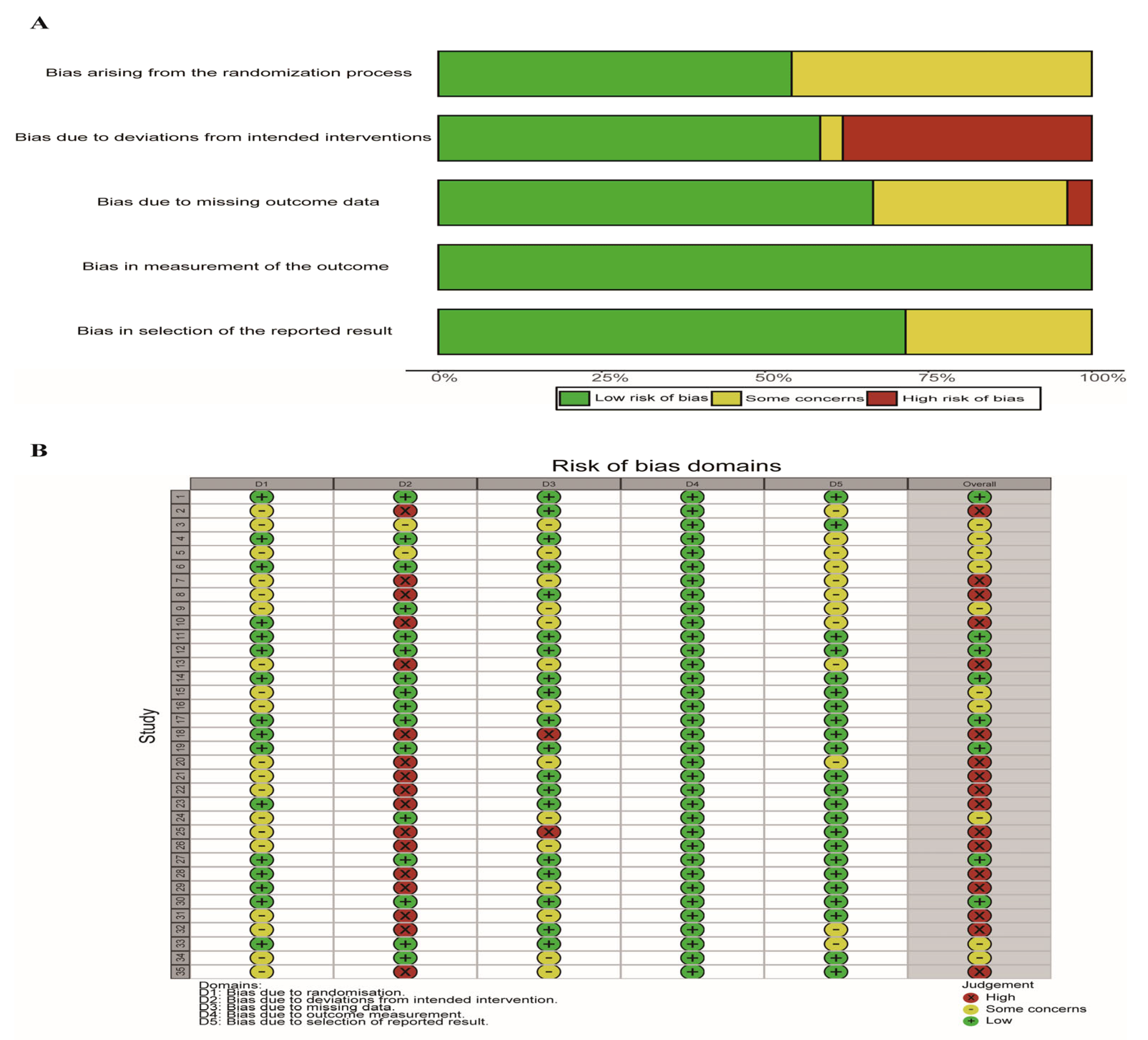
2.4. Quality Evaluation
2.5. Statistical Methods
3. Results
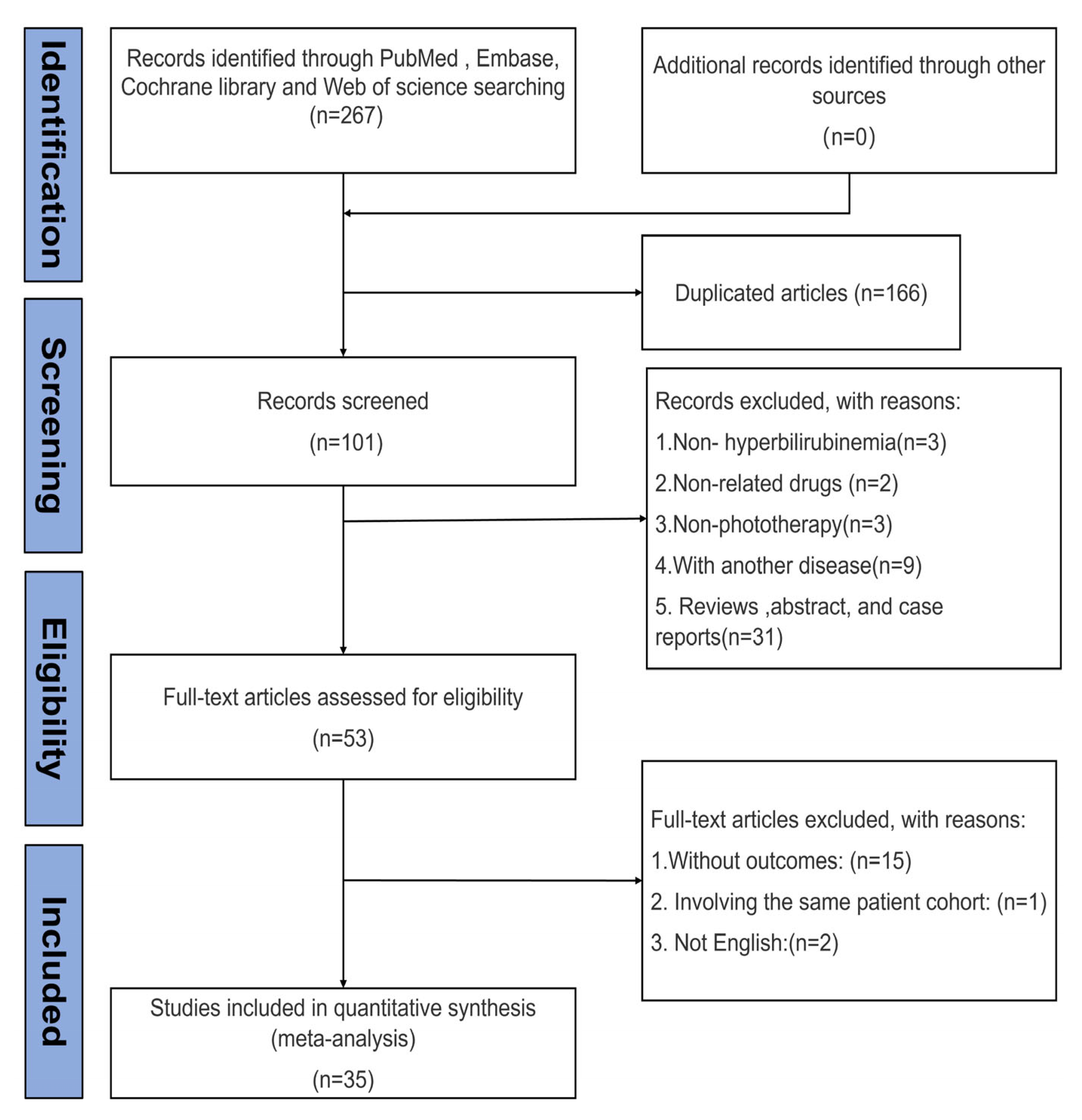
3.1. Selection Process
3.2. Data Characteristics
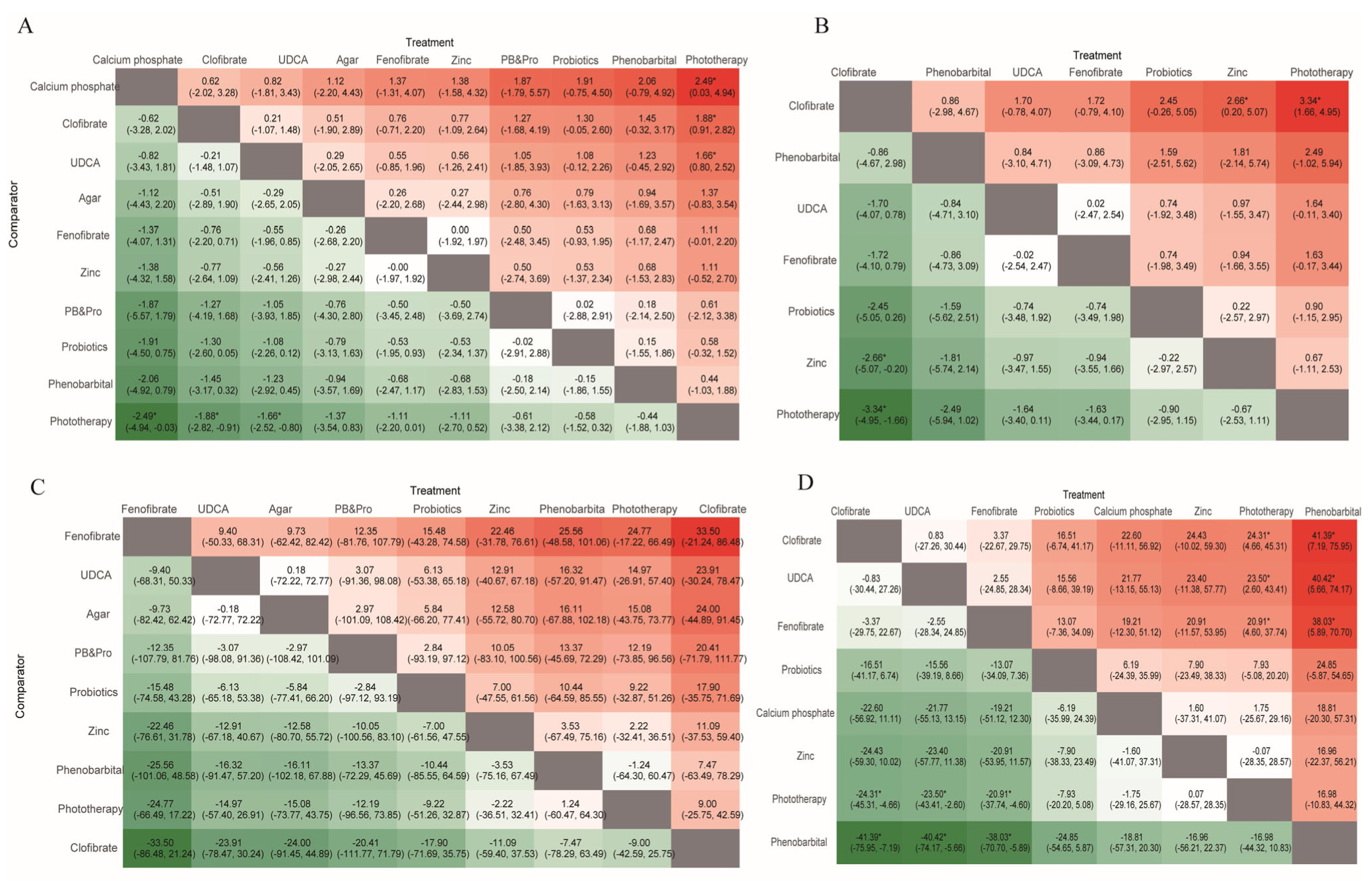
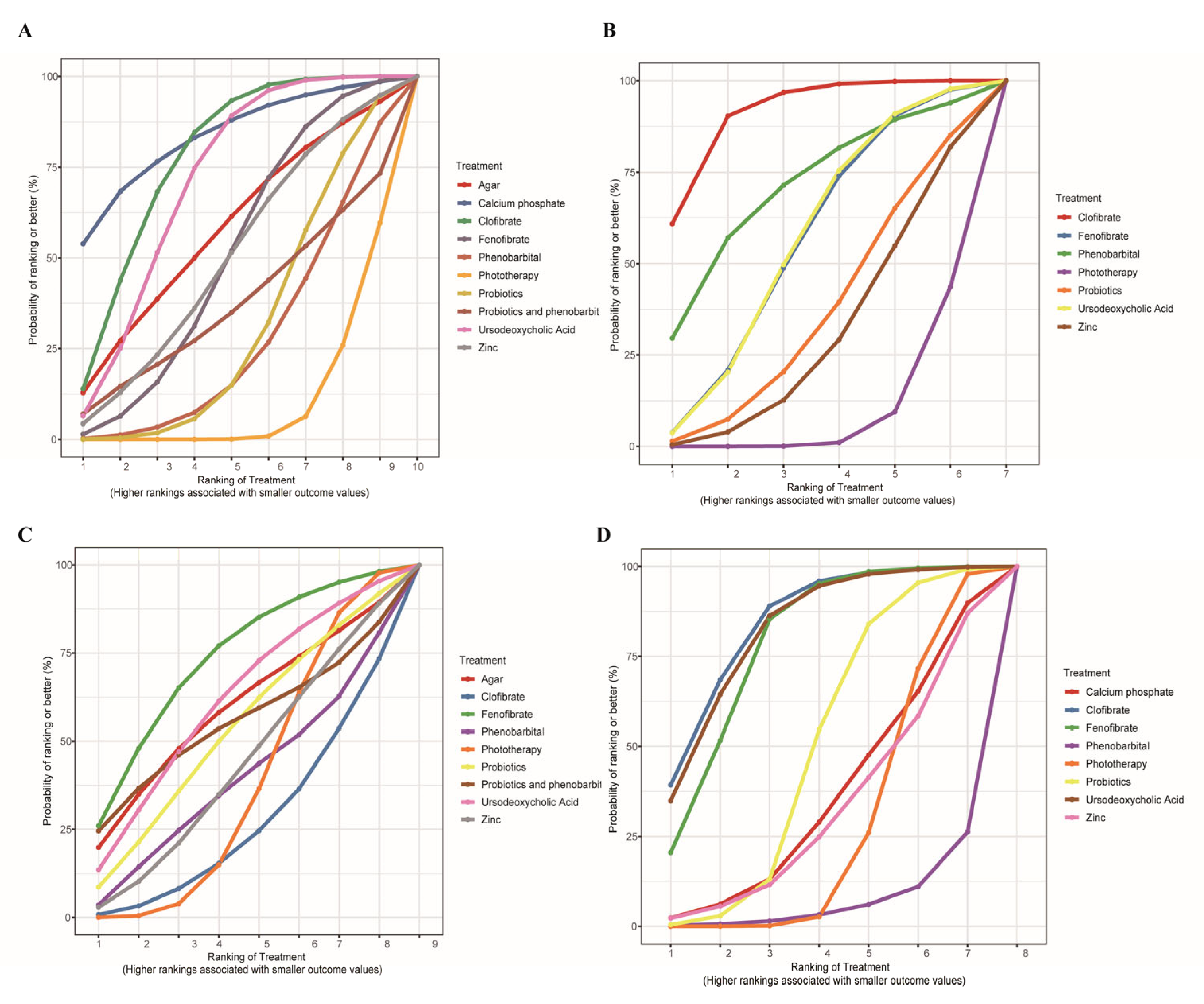
3.3. Bilirubin Levels at 24 H
3.4. Bilirubin Levels at 48 H
3.5. Phototherapy Duration
3.6. Admission Duration
3.7. Adverse Events
4. Discussion
5. Conclusions
Supplementary Materials
Author Contributions
Funding
Institutional Review Board Statement
Informed Consent Statement
Data Availability Statement
Conflicts of Interest
Abbreviations
| UDCA | ursodeoxycholic acid |
| RCTs | randomized controlled trials |
| MD | mean difference |
| SD | standard deviation |
| SUCRA | surface under the cumulative ranking curve |
| PbBT | probability of being the best treatment |
References
- Bhutani, V.K.; Stark, A.R.; Lazzeroni, L.C.; Poland, R.; Gourley, G.R.; Kazmierczak, S.; Meloy, L.; Burgos, A.E.; Hall, J.Y.; Stevenson, D.K. Predischarge screening for severe neonatal hyperbilirubinemia identifies infants who need phototherapy. J. Pediatr. 2013, 162, 477–482.e471. [Google Scholar] [CrossRef]
- Keren, R.; Luan, X.; Friedman, S.; Saddlemire, S.; Cnaan, A.; Bhutani, V.K. A comparison of alternative risk-assessment strategies for predicting significant neonatal hyperbilirubinemia in term and near-term infants. Pediatrics 2008, 121, e170–e179. [Google Scholar] [CrossRef] [PubMed]
- Qattea, I.; Farghaly, M.A.A.; Elgendy, M.; Mohamed, M.A.; Aly, H. Neonatal hyperbilirubinemia and bilirubin neurotoxicity in hospitalized neonates: Analysis of the US Database. Pediatr. Res. 2022, 91, 1662–1668. [Google Scholar] [CrossRef] [PubMed]
- Qian, S.; Kumar, P.; Testai, F.D. Bilirubin Encephalopathy. Curr. Neurol. Neurosci. Rep. 2022, 22, 343–353. [Google Scholar] [CrossRef] [PubMed]
- Novoa, R.H.; Huaman, K.; Caballero, P. Light-Emitting Diode (LED) Phototherapy versus Non-LED Phototherapy Devices for Hyperbilirubinemia in Neonates: A Systematic Review and Meta-analysis. Am. J. Perinatol. 2023, 40, 1618–1628. [Google Scholar] [CrossRef]
- Joel, H.N.; McHaile, D.N.; Philemon, R.N.; Mbwasi, R.M.; Msuya, L. Effectiveness of FIBEROPTIC phototherapy compared to conventional phototherapy in treating HYPERBILIRUBINEMIA amongst term neonates: A randomized controlled trial. BMC Pediatr. 2021, 21, 32. [Google Scholar] [CrossRef]
- Zarkesh, M.; Mahdipour, S.; Aghili, S.; Jafari, A.; Hoseini Nouri, S.A.; Rad, A.H.; Ghalandari, M.; Tabrizi, M. Evaluation of therapeutic effect of oral Ursodeoxycholic Acid on indirect hyperbilirubinemia in term neonates undergoing phototherapy: A randomized controlled clinical trial. PLoS ONE 2023, 18, e0273516. [Google Scholar] [CrossRef]
- Zahedpasha, Y.; Ahmadpour-Kacho, M.; Hajiahmadi, M.; Naderi, S. Effect of clofibrate in jaundiced full-term infants: A randomized clinical trial. Arch. Iran. Med. 2007, 10, 349–353. [Google Scholar]
- Tsai, M.L.; Lin, W.Y.; Chen, Y.T.; Lin, H.Y.; Ho, H.H.; Kuo, Y.W.; Lin, J.H.; Huang, Y.Y.; Wang, H.S.; Chiu, H.Y.; et al. Adjuvant probiotic Bifidobacterium animalis subsp. lactis CP-9 improve phototherapeutic treatment outcomes in neonatal jaundice among full-term newborns: A randomized double-blind clinical study. Medicine 2022, 101, E31030. [Google Scholar] [CrossRef]
- Tsai, M.-L.; Shen, S.-P.; Chen, Y.-T.; Chiu, H.-Y.; Lin, H.-Y.; Cheng, H.-W.; Kuo, Y.-W.; Lin, J.-H.; Wang, H.-S.; Huang, Y.-Y.; et al. Effects of phototherapy combined with Lactobacillus salivarius AP-32 or Bifidobacterium animalis subsp. lactis CP-9 on improving neonatal jaundice and gut microbiome health: A randomized double-blind clinical study. Nutr. J. 2025, 24, 73. [Google Scholar] [CrossRef]
- Sharafi, R.; Mortazavi, Z.; Sharafi, S.; Parashkouh, R.M. The effect of clofibrate on decreasing serum bilirubin in healthy term neonates under home phototherapy. Iran. J. Pediatr. 2010, 20, 48–52. [Google Scholar]
- Shah Farhat, A.; Saeidi, R.; Mohammadzadeh, A.; Lotfi, S.R.; Hajipour, M. Comparison of Phototherapy Effect with and without Phenobarbital on the Newborns with Hyperbilirubinemia. Iran. J. Child Neurol. 2024, 18, 23–29. [Google Scholar] [CrossRef] [PubMed]
- Shabo, S.K.; Gargary, K.H.; Erdeve, O. Indirect Neonatal Hyperbilirubinemia and the Role of Fenofibrate as an Adjuvant to Phototherapy. Children 2023, 10, 1192. [Google Scholar] [CrossRef] [PubMed]
- Serce, O.; Gursoy, T.; Ovali, F.; Karatekin, G. Effects of Saccharomyces boulardii on neonatal hyperbilirubinemia: A randomized controlled trial. Am. J. Perinatol. 2014, 30, 137–142. [Google Scholar] [CrossRef] [PubMed]
- Saadat, S.H.; Goodarzi, R.; Gharaei, B. Oral fenofibrate for hyperbilirubinemia in term neonates: A single-blind randomized controlled trial. J. Clin. Transl. Sci. 2023, 7, e85. [Google Scholar] [CrossRef]
- Rana, N.; Mishra, S.; Bhatnagar, S.; Paul, V.; Deorari, A.K.; Agarwal, R. Efficacy of Zinc in Reducing Hyperbilirubinemia among At-Risk Neonates: A Randomized, Double-Blind, Placebo-Controlled Trial. Indian J. Pediatr. 2011, 78, 1073–1078. [Google Scholar] [CrossRef]
- Nouri, S.A.H.; Mohammadi, M.H.; Moghaddam, Y.N.; Rad, A.H.; Zarkesh, M. Therapeutic effects of synbiotic on neonates with gestational age over 34 weeks admitted for jaundice. J. Neonatal-Perinat. Med. 2022, 15, 327–333. [Google Scholar] [CrossRef]
- Nikouei, M.; Cheraghi, M.; Mansouri, M.; Hemmatpour, S.; Moradi, Y. The effect of oral zinc sulfate supplementation on hospitalized infants with hyperbilirubinemia: A double-blind randomized clinical trial. Eur. J. Pediatr. 2024, 183, 4649–4658. [Google Scholar] [CrossRef]
- Nassif, H.; Alaifan, M.; Tamur, S.; Khadawardi, K.; Bahauddin, A.A.; Ahmed, A.; Ahmad, S.; Singh, R.; Alhussaini, B.H.; Hassan, A. Effectiveness of phototherapy with and without probiotics for the treatment of indirect hyperbilirubinaemia in preterm neonates: A randomised controlled trial. Paediatr. Int. Child Health 2024, 44, 24–29. [Google Scholar] [CrossRef]
- Mosharref, M.; Rehnuma, N.; Jahan, N. Effect of Oral Fenofibrate on Serum Bilirubin Level in Term Neonates with Unconjugated Hyperbilirubinaemia: A Randomized Control Trial. J. Armed Forces Med. Coll. 2021, 16, 35–38. [Google Scholar] [CrossRef]
- Mandlecha, T.H.; Mundada, S.M.; Gire, P.K.; Reddy, N.; Khaire, P.; Joshi, T.; Pawar, S. Effect of Oral Zinc Supplementation on Serum Bilirubin Levels in Term Neonates with Hyperbilirubinemia Undergoing Phototherapy: A Double-blind Randomized Controlled Trial. Indian Pediatr. 2023, 60, 991–995. [Google Scholar] [CrossRef] [PubMed]
- Mahyar, A.; Mehrpisheh, S.; Khajeh, B.; Ayazi, P.; Oveisi, S.; Mahyar, S.; Esmaeili, S. The effect of purgative manna and clofibrate on neonatal unconjugated hyperbilirubinemia. Acta Med. Iran. 2019, 57, 368–373. [Google Scholar] [CrossRef]
- Liu, W.; Liu, H.; Wang, T.; Tang, X. Therapeutic effects of probiotics on neonatal jaundice. Pak. J. Med. Sci. 2015, 31, 1172–1175. [Google Scholar] [CrossRef] [PubMed]
- Kumar, P.; Adhisivam, B.; Bhat, B.V. Clofibrate as an Adjunct to Phototherapy for Unconjugated Hyperbilirubinemia in Term Neonates. Indian J. Pediatr. 2017, 84, 763–767. [Google Scholar] [CrossRef]
- Kumar, A.; Bagri, N.K.; Basu, S.; Asthana, R.K. Zinc supplementation for neonatal hyperbilirubinemia: A randomized controlled trial. Indian Pediatr. 2014, 51, 375–378. [Google Scholar] [CrossRef]
- Khoshnevisasl, P.; Sadeghzadeh, M.; Kamali, K.; Moeinian, M. Effect of Zinc on Hyperbilirubinemia of Newborns, a Randomized Double Blinded Clinical Trial. Curr. Health Sci. J. 2020, 46, 250–254. [Google Scholar] [CrossRef]
- Kaabneh, M.A.; Salama, G.S.; Shakkoury, A.G.; Al-Abdallah, I.M.; Alshamari, A.; Halaseh, R.A. Phenobarbital and Phototherapy Combination Enhances Decline of Total Serum Bilirubin and May Decrease the Need for Blood Exchange Transfusion in Newborns with Isoimmune Hemolytic Disease. Clin. Med. Insights Pediatr. 2015, 9, 67–72. [Google Scholar] [CrossRef]
- Honar, N.; Ghashghaei Saadi, E.; Saki, F.; Pishva, N.; Shakibazad, N.; Hosseini Teshnizi, S. Effect of Ursodeoxycholic Acid on Indirect Hyperbilirubinemia in Neonates Treated with Phototherapy. J. Pediatr. Gastroenterol. Nutr. 2016, 62, 97–100. [Google Scholar] [CrossRef]
- Habibi, M.; Mahyar, A.; Ayazi, P.; Ahmadabadi, F.; Javadi, A. The effect of clofibrate on hyperbilirubinemia of term neonates. Acta Med. Iran. 2012, 50, 21–25. [Google Scholar]
- Ghorui, A.; Chowdhry, B.K.; Manjhi, P.K.; Kumar, P.; Kumar, C.M. Evaluation of efficacy of oral calcium phosphate as an adjunct to standard-of-care regular phototherapy in cases of neonatal jaundice: A hospital-based double-blind, randomised, placebo-controlled trial. BMJ Paediatr. Open 2024, 8, e002902. [Google Scholar] [CrossRef]
- Gharehbaghi, M.M.; Sani, A.M.; Refeey, M. Evaluating the effects of different doses of ursodeoxycholic acid on neonatal jaundice. Turk. J. Pediatr. 2020, 62, 424–430. [Google Scholar] [CrossRef] [PubMed]
- Fallah, R.; Islami, Z.; Lotfi, S.R. Single dose of 50 mg/kg clofibrate in jaundice of healthy term neonates: Randomised clinical trial of efficacy and safety. Indian J. Pediatr. 2012, 79, 194–197. [Google Scholar] [CrossRef] [PubMed]
- Faal, G.; Khatib Masjedi, H.; Sharifzadeh, G.; Kiani, Z. Efficacy of zinc sulfate on indirect hyperbilirubinemia in premature infants admitted to neonatal intensive care unit: A double-blind, randomized clinical trial. BMC Pediatr. 2020, 20, 130. [Google Scholar] [CrossRef] [PubMed]
- Elfarargy, M.S.; Al-Ashmawy, G.M.; Abu-Risha, S.E.; Khattab, H. Zinc Supplementation in Preterm Neonates with Jaundice: Is it Beneficial? Endocr. Metab. Immune Disord.-Drug Targets 2021, 21, 1929–1934. [Google Scholar] [CrossRef]
- Eghbalian, F.; Sabzehei, M.K.; Talesh, S.T.; Raeisi, R.; Jenabi, E. The Effect of Probiotics on Phototherapy for Bilirubin Reduction in Term Neonates: A Randomized Controlled Trial. Curr. Pediatr. Rev. 2024, 21, 85–90. [Google Scholar] [CrossRef]
- Eghbalian, F.; Raeisi, R.; Faradmal, J.; Asgharzadeh, A. The Effect of Clofibrate and Phototherapy on Prolonged Jaundice due to Breast Milk in Full-Term Neonates. Clin. Med. Insights Pediatr. 2023, 17, 11795565231177987. [Google Scholar] [CrossRef]
- Babaie, E.; Hassanpour, K.; Aldaghi, M.; Sahebkar, M. Comparison of the effect of ursodeoxycholic acid and multistrain synbiotic on indirect hyperbilirubinemia among neonates treated with phototherapy: A double-blind, randomized, placebo-controlled clinical trial study. J. Res. Med. Sci. 2023, 28, 40. [Google Scholar] [CrossRef]
- Awad, M.H.; Amer, S.; Hafez, M.; Nour, I.; Shabaan, A.E. Fenofibrate as an adjuvant to phototherapy in pathological unconjugated hyperbilirubinemia in neonates: A randomized control trial. J. Perinatol. 2021, 41, 865–872. [Google Scholar] [CrossRef]
- Akefi, R.; Hashemi, S.M.; Alinejad, S.; Almasi-Hashiani, A. The effect of ursodeoxycholic acid on indirect hyperbilirubinemia in neonates treated with phototherapy: A randomized clinical trial. J. Matern. Fetal Neonatal Med. 2022, 35, 4075–4080. [Google Scholar] [CrossRef]
- Ahmadipour, S.; Baharvand, P.; Rahmani, P.; Hasanvand, A.; Mohsenzadeh, A. Effect of Synbiotic on the Treatment of Jaundice in Full Term Neonates: A Randomized Clinical Trial. Pediatr. Gastroenterol. Hepatol. Nutr. 2019, 22, 453–459. [Google Scholar] [CrossRef]
- Abdel-Aziz Ali, S.M.; Mansour Galal, S.; Sror, S.M.; Hussein, O.; Abd-El-Haseeb Ahmed, A.O.; Hamed, E.A. Efficacy of oral agar in management of indirect hyperbilirubinemia in full-term neonates. J. Matern. Fetal Neonatal Med. 2022, 35, 975–980. [Google Scholar] [CrossRef] [PubMed]
- Kim, E.J.; Go, H.Y.; Sung, H.K. Efficacy of Clostridium butyricum Supplementation Combined with Phototherapy for Neonatal Hyperbilirubinemia: A Systematic Review and Meta-Analysis. Microorganisms 2025, 13, 1441. [Google Scholar] [CrossRef] [PubMed]
- Page, M.J.; McKenzie, J.E.; Bossuyt, P.M.; Boutron, I.; Hoffmann, T.C.; Mulrow, C.D.; Shamseer, L.; Tetzlaff, J.M.; Akl, E.A.; Brennan, S.E.; et al. The PRISMA 2020 statement: An updated guideline for reporting systematic reviews. Bmj 2021, 372, n71. [Google Scholar] [CrossRef] [PubMed]
- Van Der Veere, C.N.; Schoemaker, B.; Bakker, C.; Van Der Meer, R.; Jansen, P.L.; Elferink, R.P. Influence of dietary calcium phosphate on the disposition of bilirubin in rats with unconjugated hyperbilirubinemia. Hepatology 1996, 24, 620–626. [Google Scholar] [CrossRef]
- Lake, J.R.; Renner, E.L.; Scharschmidt, B.F.; Cragoe, E.J., Jr.; Hagey, L.R.; Lambert, K.J.; Gurantz, D.; Hofmann, A.F. Inhibition of Na+/H+ exchange in the rat is associated with decreased ursodeoxycholate hypercholeresis, decreased secretion of unconjugated urodeoxycholate, and increased ursodeoxycholate glucuronidation. Gastroenterology 1988, 95, 454–463. [Google Scholar] [CrossRef]
- Kuitunen, I.; Kiviranta, P.; Sankilampi, U.; Renko, M. Ursodeoxycholic acid as adjuvant treatment to phototherapy for neonatal hyperbilirubinemia: A systematic review and meta-analysis. World J. Pediatr. 2022, 18, 589–597. [Google Scholar] [CrossRef]
- van der Schoor, L.W.E.; Verkade, H.J.; Bertolini, A.; de Wit, S.; Mennillo, E.; Rettenmeier, E.; Weber, A.A.; Havinga, R.; Valášková, P.; Jašprová, J.; et al. Potential of therapeutic bile acids in the treatment of neonatal Hyperbilirubinemia. Sci. Rep. 2021, 11, 11107. [Google Scholar] [CrossRef]
- Chawla, D. Clofibrate in Neonatal Hyperbilirubinemia. Indian J. Pediatr. 2017, 84, 735–736. [Google Scholar] [CrossRef]
- Oliver, M.F. Primary prevention of ischaemic heart disease: WHO coordinated cooperative trial. A summary report. Bull. World Health Organ. 1979, 57, 801–805. [Google Scholar]
- Goldenberg, I.; Benderly, M.; Goldbourt, U. Update on the use of fibrates: Focus on bezafibrate. Vasc. Health Risk Manag. 2008, 4, 131–141. [Google Scholar] [CrossRef]
- Sambati, V.; Laudisio, S.; Motta, M.; Esposito, S. Therapeutic Options for Crigler-Najjar Syndrome: A Scoping Review. Int. J. Mol. Sci. 2024, 25, 1006. [Google Scholar] [CrossRef]
- Ghorani-Azam, A.; Balali-Mood, M.; Riahi-Zanjani, B.; Darchini-Maragheh, E.; Sadeghi, M. Acute Phenobarbital Poisoning for the Management of Seizures in Newborns and Children; A Systematic Literature Review. CNS Neurol. Disord. Drug Targets 2021, 20, 174–180. [Google Scholar] [CrossRef]
- Méndez-Sánchez, N.; Martínez, M.; González, V.; Roldán-Valadez, E.; Flores, M.A.; Uribe, M. Zinc sulfate inhibits the enterohepatic cycling of unconjugated bilirubin in subjects with Gilbert’s syndrome. Ann. Hepatol. 2002, 1, 40–43. [Google Scholar] [CrossRef]
- Blum, D.; Etienne, J. Agar in control of hyperbilirubinemia. J. Pediatr. 1973, 83, 345. [Google Scholar] [CrossRef]
- Eghbalian, F.; Hasanpour-Dehkordi, A.; Raeisi, R. The Effects of Clofibrate on Neonatal Jaundice: A Systematic Review. Int. J. Prev. Med. 2022, 13, 3. [Google Scholar] [CrossRef]





| ID | Study | Country | Sample | Sex (Female/Male) | Gestational Age (Week) | Initial Bilirubin (mg/dL) | Adjuvant Drugs | Group Sample | Outcome Reported |
|---|---|---|---|---|---|---|---|---|---|
| 1 | M. L. Tsai 2022 [9] | China | 83 | 20/23 | 38.0 ± 0.20 | 16.78 ± 0.41 | probiotic | 43 | bilirubin levels at 24 h; phototherapy duration |
| 25/15 | 37.88 ± 0.18 | 16.13 ± 0.41 | phototherapy only | 40 | |||||
| 2 | P. Kumar 2017 [24] | India | 90 | 21/24 | 38.7 ± 1.2 | 18 ± 2.1 | clofibrate | 45 | bilirubin levels at 24, 48 h; phototherapy duration |
| 22/23 | 38.2 ± 1.2 | 18.6 ± 2.0 | phototherapy only | 45 | |||||
| 3 | A. Shah Farhat 2024 [12] | Iran | 80 | NR | 36.4 ± 2.39 | 17.52 ± 1.54 | phenobarbital | 40 | bilirubin levels at 24 h; phototherapy duration; admission duration |
| NR | 36.9 ± 2.16 | 17.84 ± 1.41 | phototherapy only | 40 | |||||
| 4 | E. Babaie 2023 [37] | Iran | 120 | 20/20 | NR | 16.67 ± 2.08 | ursodeoxycholic acid | 40 | bilirubin levels at 24 h |
| 27/13 | NR | 17.34 ± 2.15 | probiotic | 40 | |||||
| 17/23 | NR | 17.28 ± 2.23 | phototherapy only | 40 | |||||
| 5 | Y. Zahedpasha 2007 [8] | Iran | 60 | 14/16 | NR | 18.21 ± 1.85 | clofibrate | 30 | bilirubin levels at 24, 48 h |
| 14/16 | NR | 17.50 ± 2.34 | phototherapy only | 30 | |||||
| 6 | T. H. Mandlecha 2023 [21] | India | 106 | 26/27 | NR | 19.11 ± 2.16 | zinc | 53 | bilirubin levels at 24, 48 h |
| 30/23 | NR | 18.57 ± 2.144 | phototherapy only | 53 | |||||
| 7 | S. Ahmadipour 2019 [40] | Iran | 83 | NR | 39.20 ± 3.90 | NR | probiotic | 40 | admission duration |
| NR | 39.00 ± 4.10 | NR | phototherapy only | 43 | |||||
| 8 | N. Honar 2016 [28] | Iran | 80 | 21/19 | NR | 15.9 ± 1.7 | ursodeoxycholic acid | 40 | bilirubin levels at 24, 48 h; phototherapy duration |
| 22/18 | NR | 16.3 ± 1.5 | phototherapy only | 40 | |||||
| 9 | P. Khoshnevisasl 2020 [26] | Iran | 112 | 27/29 | 38.8 ± 1.03 | NR | zinc | 56 | bilirubin levels at 24, 48 h; admission duration |
| 31/25 | 38.8 ± 0.98 | NR | phototherapy only | 56 | |||||
| 10 | H. Nassif 2024 [19] | Pakistan | 72 | 20/16 | 33.5 ± 1.71 | 16.68 ± 1.69 | probiotic | 36 | admission duration |
| 14/22 | 33.62 ± 1.95 | 16.92 ± 1.63 | phototherapy only | 36 | |||||
| 11 | M.-L. Tsai 2025 [10] | China | 277 | 46/43 | 37.93 ± 0.12 | 15.84 ± 0.25 | Probiotic (AP-32) | 89 | admission duration |
| 41/55 | 37.99 ± 0.12 | 16.08 ± 0.23 | Probiotic (CP-9) | 96 | |||||
| 51/41 | 38.08 ± 0.12 | 15.67 ± 0.23 | phototherapy only | 92 | |||||
| 12 | O. Serce 2014 [14] | Turkey | 119 | 26/12 | 37.7 ± 1.7 | 13.6 ± 2.9 | probiotic | 58 | bilirubin levels at 24, 48 h; admission duration |
| 29/32 | 37.9 ± 2.02 | 13.6 ± 2.4 | phototherapy only | 61 | |||||
| 13 | S. M. Abdel-Aziz Ali 2022 [41] | Egypt | 60 | 13/17 | 38.10 ± 2.11 | 16.70 ± 1.58 | agar | 30 | bilirubin levels at 24 h; phototherapy duration |
| 14/16 | 37.80 ± 1.63 | 17.20 ± 1.27 | phototherapy only | 30 | |||||
| 14 | N. Rana 2011 [16] | India | 286 | NR | NR | NR | zinc | 145 | phototherapy duration |
| NR | NR | NR | phototherapy only | 141 | |||||
| 15 | G. Faal 2020 [33] | Iran | 60 | NR | 33.2 ± 1.27 | 12.2 ± 71.67 | zinc | 30 | bilirubin levels at 24 h; phototherapy duration |
| NR | 32.1 ± 1.77 | 10.2 ± 35.24 | phototherapy only | 30 | |||||
| 16 | M. M. Gharehbaghi 2020 [31] | Iran | 120 | NR | 37.75 ± 4.93 | 19.88 ± 2.33 | ursodeoxycholic acid (5 mg/kg/dose, q12 h) | 40 | bilirubin levels at 24, 48 h |
| NR | 38.1 ± 1.05 | 19.33 ± 2.51 | ursodeoxycholic acid (7.5 mg/kg/dose, q12 h) | 40 | |||||
| NR | 38.55 ± 1.01 | 19.76 ± 2.64 | phototherapy only | 40 | |||||
| 17 | A. Ghorui 2024 [30] | India | 80 | 21/19 | NR | 15 ± 3.19 | calcium phosphate | 40 | bilirubin levels at 24 h; admission duration |
| 16/24 | NR | 16.1 ± 2.64 | phototherapy only | 40 | |||||
| 18 | M. Zarkesh 2023 [7] | Iran | 92 | NR | NR | 17.03 ± 1.81 | ursodeoxycholic acid | 49 | bilirubin levels at 24, 48 h; admission duration |
| NR | NR | 17.49 ± 1.92 | phototherapy only | 43 | |||||
| 19 | M. H. Awad 2021 [38] | Egypt | 120 | 28/32 | NR | 19.4 ± 3.8 | Fenofibrate (10 mg/kg/day for 1 day) | 60 | bilirubin levels at 24, 48 h; phototherapy duration |
| 28/32 | NR | 19.4 ± 4.4 | Fenofibrate (10 mg/kg/day for 2 days) | 60 | |||||
| 36/24 | NR | 18.8 ± 4.1 | phototherapy only | 60 | |||||
| 20 | S. K. Shabo 2023 [13] | Iraq | 100 | 22/28 | 38.58 ± 0.758 | 19.28 ± 0.427 | fenofibrate | 50 | bilirubin levels at 24, 48 h; admission duration |
| 29/21 | 38.52 ± 0.995 | 19.21 ± 0.518 | phototherapy only | 50 | |||||
| 21 | S. H. Saadat 2023 [15] | Iran | 86 | 22/21 | 38.19 ± 0.98 | 17.31 ± 1.56 | fenofibrate | 43 | bilirubin levels at 24, 48 h; phototherapy duration; admission duration |
| 16/27 | 38.21 ± 1.25 | 17.61 ± 1.67 | phototherapy only | 43 | |||||
| 22 | M. A. Kaabneh 2015 [27] | Jordan | 200 | 52/51 | 39 ± 1 | 14.7 ± 1.6 | phenobarbital | 103 | bilirubin levels at 24, 48 h; |
| 50/47 | 39 ± 1 | 14.6 ± 1.5 | phototherapy only | 97 | |||||
| 23 | R. Fallah 2012 [32] | Iran | 60 | NR | 38.23 ± 0.971 | 19.54 ± 3.07 | clofibrate | 30 | bilirubin levels at 24, 48 h; phototherapy duration; admission duration |
| NR | 37.87 ± 1.07 | 19.5 ± 2.21 | phototherapy only | 30 | |||||
| 24 | F. Eghbalian 2023 [36] | Iran | 100 | NR | NR | 19.49 ± 1.17 | clofibrate | 50 | admission duration |
| NR | NR | 18.13 ± 2.5 | phototherapy only | 50 | |||||
| 25 | R. Sharafi 2010 [11] | Iran | 60 | NR | NR | 17.24 ± 1.48 | clofibrate | 30 | bilirubin levels at 24, 48 h; phototherapy duration |
| NR | NR | 17.42 ± 1.44 | phototherapy only | 30 | |||||
| 26 | M. Habibi 2012 [29] | Iran | 52 | 11/15 | NR | 20.788 ± 2.3852 | clofibrate | 26 | bilirubin levels at 24 h; |
| 11/15 | NR | 20.523 ± 2.4458 | phototherapy only | 26 | |||||
| 27 | M. Nikouei 2024 [18] | Iran | 290 | 81/79 | 38.25 ± 1.053 | 16.65 ± 2.90 | ursodeoxycholic acid | 160 | bilirubin levels at 24, 48 h; admission duration |
| 64/66 | 38.27 ± 1.092 | 16.36 ± 2.96 | phototherapy only | 130 | |||||
| 28 | F. Eghbalian 2024 [35] | Iran | 150 | 43/32 | 37.8 ± 0.8 | NR | probiotic | 75 | bilirubin levels at 24, 48 h; phototherapy duration; admission duration |
| 39/36 | 37.6 ± 0.7 | NR | phototherapy only | 75 | |||||
| 29 | A. Mahyar 2019 [22] | Iran | 40 | 9/11 | 38.5 ± 2 | 18 ± 2.4 | clofibrate | 20 | bilirubin levels at 24, 48 h; |
| 12/8 | 17.9 ± 3.1 | 39 ± 1 | phototherapy only | 20 | |||||
| 30 | R. Akefi 2022 [39] | Iran | 220 | 48/62 | NR | 16.8 ± 2.4 | ursodeoxycholic acid | 110 | bilirubin levels at 24 h; phototherapy duration |
| 58/52 | NR | 15.7 ± 2.5 | phototherapy only | 110 | |||||
| 31 | W. Liu 2015 [23] | China | 68 | NR | NR | 20.29 ± 3.04 | phenobarbital and probiotic | 34 | bilirubin levels at 24 h; phototherapy duration |
| NR | NR | 20.53 ± 2.81 | phenobarbital | 34 | |||||
| 32 | S. A. H. Nouri 2022 [17] | Iran | 194 | 51/46 | NR | 16.93 ± 1.43 | probiotic | 97 | bilirubin levels at 24, 48 h; |
| 57/40 | NR | 16.73 ± 1.53 | phototherapy only | 97 | |||||
| 33 | A. Kumar 2014 [25] | India | 80 | 28/12 | 37.6 ± 1.5 | 13.9 ± 2.5 | zinc | 40 | bilirubin levels at 48 h; phototherapy duration |
| 25/15 | 37.7 ± 1.4 | 13.4 ± 1.9 | phototherapy only | 40 | |||||
| 34 | M. S. Elfarargy 2021 [34] | Egypt | 200 | 54/46 | 35.7 ± 0.6 | 17.7 ± 1.1 | zinc | 100 | bilirubin levels at 48 h; |
| 58/42 | 35.8 ± 0.5 | 17.6 ± 1.2 | phototherapy only | 100 | |||||
| 35 | M. Mosharref 2021 [20] | Bangladesh | 60 | 10/20 | 38.1 ± 1.8 | 17.19 ± 1.98 | fenofibrate | 30 | bilirubin levels at 24, 48 h; admission duration |
| 13/17 | 37.8 ± 1.1 | 17.02 ± 2.26 | phototherapy only | 30 |
| Adjuvant Drugs | Bilirubin Levels at 24 h | Bilirubin Levels at 48 h | Phototherapy Duration | Admission Duration | ||||
|---|---|---|---|---|---|---|---|---|
| SUCRA | PbBT | SUCRA | PbBT | SUCRA | PbBT | SUCRA | PbBT | |
| phototherapy only | 0.10 | 0.00% | 0.09 | 0.00% | 0.38 | 0.03% | 0.28 | 0.00% |
| clofibrate | 0.78 | 13.89% | 0.91 | 60.88% | 0.27 | 0.85% | 0.84 | 40.83% |
| ursodeoxycholic acid | 0.71 | 6.43% | 0.56 | 3.77% | 0.62 | 13.36% | 0.82 | 32.72% |
| calcium phosphate | 0.84 | 53.89% | NA | NA | NA | NA | 0.36 | 2.61% |
| probiotics | 0.32 | 0.06% | 0.37 | 1.46% | 0.53 | 8.9% | 0.50 | 0.59% |
| fenofibrate | 0.51 | 1.43% | 0.56 | 3.83% | 0.73 | 25.9% | 0.79 | 20.8% |
| agar | 0.58 | 12.86% | NA | NA | 0.59 | 19.68% | NA | NA |
| phenobarbital | 0.28 | 0.21% | 0.71 | 29.59% | 0.39 | 3.55% | 0.07 | 0.23% |
| zinc sulfate | 0.51 | 4.29% | 0.31 | 0.47% | 0.43 | 3.31% | 0.33 | 2.23% |
| Phenobarbital& probiotics | 0.38 | 6.94% | NA | NA | 0.55 | 24.42% | NA | NA |
| ID | Study | Adjuvant Drugs | Group Sample | Adverse Events | Blood Transfusion | Mortality |
|---|---|---|---|---|---|---|
| 1 | M. L. Tsai 2022 [9] | probiotic | 43 | None | None | None |
| phototherapy only | 40 | None | None | None | ||
| 2 | P. Kumar 2017 [24] | clofibrate | 45 | None | NA | None |
| phototherapy only | 45 | None | 4 | None | ||
| 3 | A. Shah Farhat 2024 [12] | phenobarbital | 40 | NA | NA | NA |
| phototherapy only | 40 | NA | NA | NA | ||
| 4 | E. Babaie 2023 [37] | ursodeoxycholic acid | 40 | None | NA | None |
| probiotic | 40 | 5 mild abdominal pain | NA | None | ||
| phototherapy only | 40 | None | NA | None | ||
| 5 | Y. Zahedpasha 2007 [8] | clofibrate | 30 | None | None | None |
| phototherapy only | 30 | None | None | None | ||
| 6 | T. H. Mandlecha 2023 [21] | zinc | 53 | None | NA | None |
| phototherapy only | 53 | None | NA | None | ||
| 7 | S. Ahmadipour 2019 [40] | probiotic | 40 | None | NA | None |
| phototherapy only | 43 | None | NA | None | ||
| 8 | N. Honar 2016 [28] | ursodeoxycholic acid | 40 | None | NA | None |
| phototherapy only | 40 | None | NA | None | ||
| 9 | P. Khoshnevisasl 2020 [26] | zinc | 56 | None | NA | None |
| phototherapy only | 56 | None | NA | None | ||
| 10 | H. Nassif 2024 [19] | probiotic | 36 | 1 case of rash, 1 case of diarrhea, and 1 case of unstable body temperature | NA | None |
| phototherapy only | 36 | 3 case of rash, 1 case of diarrhea, and 3case of unstable body temperature | NA | None | ||
| 11 | M.-L. Tsai 2025 [10] | Probiotic (AP-32) | 89 | None | NA | None |
| Probiotic (CP-9) | 96 | None | NA | None | ||
| phototherapy only | 92 | None | NA | None | ||
| 12 | O. Serce 2014 [14] | probiotic | 58 | None | NA | None |
| phototherapy only | 61 | None | NA | None | ||
| 13 | S. M. Abdel-Aziz Ali 2022 [41] | agar | 30 | None | NA | None |
| phototherapy only | 30 | None | NA | None | ||
| 14 | N. Rana 2011 [16] | zinc | 145 | 3 cases of diarrhea, 4 cases of vomiting, and 1 case of rash | NA | None |
| phototherapy only | 141 | 1 case of diarrhea, 6 cases of vomiting | NA | None | ||
| 15 | G. Faal 2020 [33] | zinc | 30 | None | NA | None |
| phototherapy only | 30 | None | NA | None | ||
| 16 | M. M. Gharehbaghi 2020 [31] | ursodeoxycholic acid (5 mg/kg/dose, q12h) | 40 | None | NA | None |
| ursodeoxycholic acid (7.5 mg/kg/dose, q12 h) | 40 | None | NA | None | ||
| phototherapy only | 40 | None | NA | None | ||
| 17 | A. Ghorui 2024 [30] | calcium phosphate | 40 | None | NA | None |
| phototherapy only | 40 | None | NA | None | ||
| 18 | M. Zarkesh 2023 [7] | ursodeoxycholic acid | 49 | None | NA | None |
| phototherapy only | 43 | None | NA | None | ||
| 19 | M. H. Awad 2021 [38] | Fenofibrate (10 mg/kg/day for 1 day) | 60 | 1 case of anemia and 1 case of leukopenia; 8 cases of abdominal distension and diarrhea; 4 cases of elevated liver enzymes | 1 | None |
| Fenofibrate (10 mg/kg/day for 2 days) | 60 | 1 case of anemia, 6 cases of abdominal distension and diarrhea, and 3 cases of elevated liver enzymes | 1 | None | ||
| phototherapy only | 60 | 3 cases of anemia; 1 case of leukopenia; 8 cases of abdominal distension and diarrhea; 4 cases of elevated liver enzymes | 3 | None | ||
| 20 | S. K. Shabo 2023 [13] | fenofibrate | 50 | None | NA | None |
| phototherapy only | 50 | None | NA | None | ||
| 21 | S. H. Saadat 2023 [15] | fenofibrate | 43 | None | NA | None |
| phototherapy only | 43 | None | NA | None | ||
| 22 | M. A. Kaabneh 2015 [27] | phenobarbital | 103 | NA | 7 | NA |
| phototherapy only | 97 | NA | 15 | NA | ||
| 23 | R. Fallah 2012 [32] | clofibrate | 30 | 1 case of gastrointestinal reaction | NA | None |
| phototherapy only | 30 | None | NA | None | ||
| 24 | F. Eghbalian 2023 [36] | clofibrate | 50 | None | NA | None |
| phototherapy only | 50 | None | NA | None | ||
| 25 | R. Sharafi 2010 [11] | clofibrate | 30 | None | NA | None |
| phototherapy only | 30 | None | NA | None | ||
| 26 | M. Habibi 2012 [29] | clofibrate | 26 | None | NA | None |
| phototherapy only | 26 | None | NA | None | ||
| 27 | M. Nikouei 2024 [18] | ursodeoxycholic acid | 160 | None | NA | None |
| phototherapy only | 130 | None | NA | None | ||
| 28 | F. Eghbalian 2024 [35] | probiotic | 75 | None | NA | None |
| phototherapy only | 75 | None | NA | None | ||
| 29 | A. Mahyar 2019 [22] | clofibrate | 20 | None | NA | None |
| phototherapy only | 20 | 1 case of rash | NA | None | ||
| 30 | R. Akefi 2022 [39] | ursodeoxycholic acid | 110 | None | NA | None |
| phototherapy only | 110 | None | NA | None | ||
| 31 | W. Liu 2015 [23] | phenobarbital and probiotic | 34 | None | NA | None |
| phenobarbital | 34 | None | NA | None | ||
| 32 | S. A. H. Nouri 2022 [17] | probiotic | 97 | None | NA | None |
| phototherapy only | 97 | None | NA | None | ||
| 33 | A. Kumar 2014 [25] | zinc | 40 | 3 cases of vomiting; 3 cases of rash; 4 cases of diarrhea | None | None |
| phototherapy only | 40 | 2 cases of vomiting; 3 cases of rash; 3 cases of diarrhea | None | None | ||
| 34 | M. S. Elfarargy 2021 [34] | zinc | 100 | None | NA | None |
| phototherapy only | 100 | None | NA | None | ||
| 35 | M. Mosharref 2021 [20] | fenofibrate | 30 | None | NA | None |
| M. L. Tsai 2022 [9] | phototherapy only | 30 | None | NA | None |
Disclaimer/Publisher’s Note: The statements, opinions and data contained in all publications are solely those of the individual author(s) and contributor(s) and not of MDPI and/or the editor(s). MDPI and/or the editor(s) disclaim responsibility for any injury to people or property resulting from any ideas, methods, instructions or products referred to in the content. |
© 2026 by the authors. Licensee MDPI, Basel, Switzerland. This article is an open access article distributed under the terms and conditions of the Creative Commons Attribution (CC BY) license.
Share and Cite
Fei, Q.; Liu, H.; Wang, X.; Yuan, T. Phototherapy Alone or Combined with Adjuvant Drugs for Neonatal Hyperbilirubinemia: A Systematic Review and Network Meta-Analysis. Children 2026, 13, 573. https://doi.org/10.3390/children13040573
Fei Q, Liu H, Wang X, Yuan T. Phototherapy Alone or Combined with Adjuvant Drugs for Neonatal Hyperbilirubinemia: A Systematic Review and Network Meta-Analysis. Children. 2026; 13(4):573. https://doi.org/10.3390/children13040573
Chicago/Turabian StyleFei, Qiang, Huazi Liu, Xinning Wang, and Tianming Yuan. 2026. "Phototherapy Alone or Combined with Adjuvant Drugs for Neonatal Hyperbilirubinemia: A Systematic Review and Network Meta-Analysis" Children 13, no. 4: 573. https://doi.org/10.3390/children13040573
APA StyleFei, Q., Liu, H., Wang, X., & Yuan, T. (2026). Phototherapy Alone or Combined with Adjuvant Drugs for Neonatal Hyperbilirubinemia: A Systematic Review and Network Meta-Analysis. Children, 13(4), 573. https://doi.org/10.3390/children13040573