


Neonatal Intensive Care Admissions and Outcomes in Malta from 2019 to 2022—A Retrospective Observational Study

 , , ,
, , ,
Highlights
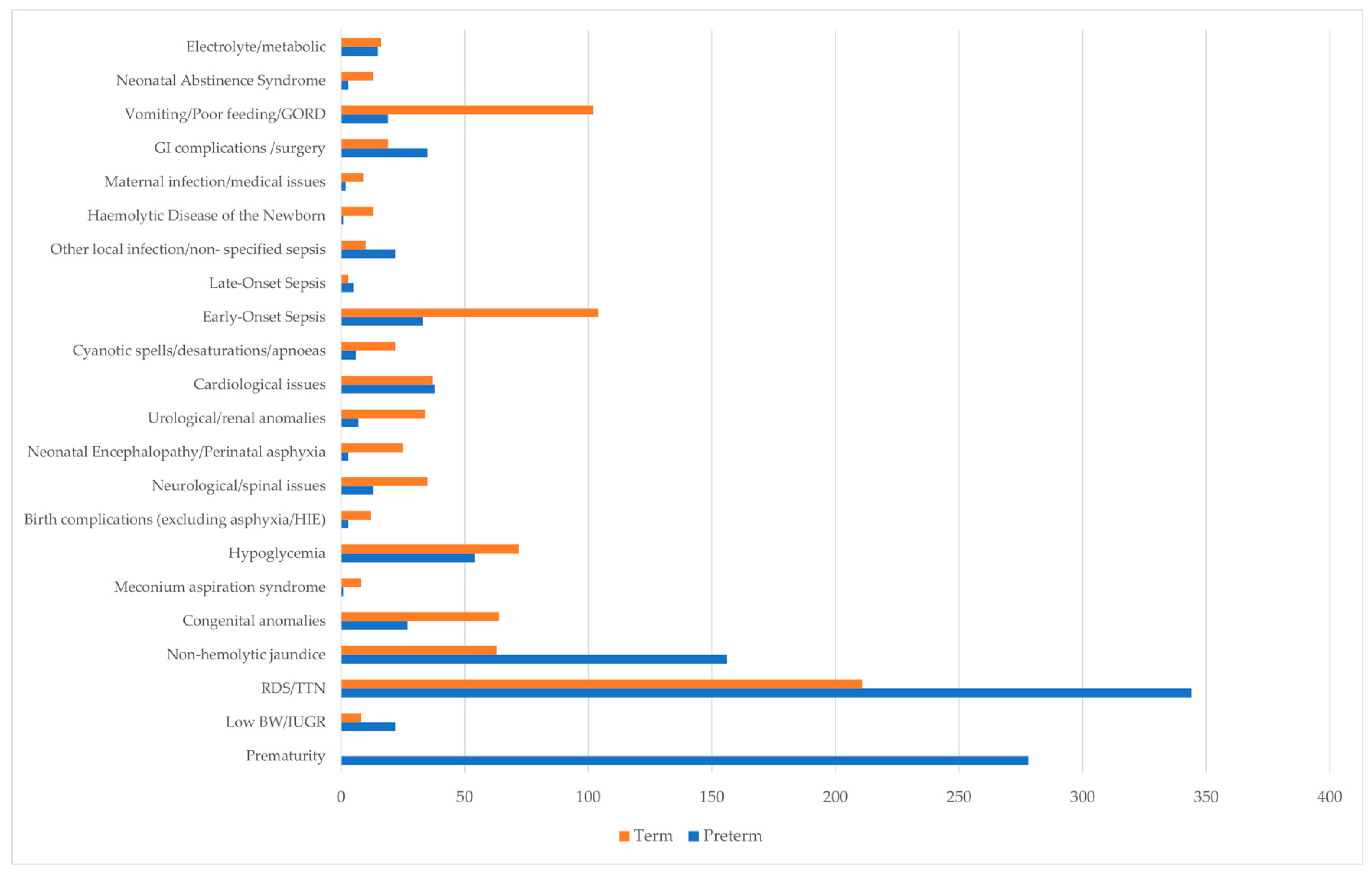
- NICU admission rates remained consistent before and after the COVID-19 pandemic. A significant proportion of admissions involved term infants, underscoring that neonatal intensive care is frequently required for conditions beyond prematurity.
- Respiratory distress syndrome was the predominant indication for NICU admission; however, surfactant administration rates were relatively low.
- Enteral nutrition practice resulted in delayed attainment of full enteral nutrition compared to international standards. The exclusive breastfeeding rate was below the European Union average.
- Sepsis and central line-associated bloodstream infection (CLABSI) rates were low, suggesting robust infection prevention and control measures.
- The Maltese NICU demonstrates overall service stability and effective infection prevention, but opportunities exist to optimize care, especially in respiratory management and nutritional support.
- Targeted quality improvement initiatives, such as adopting standardized feeding protocols and evaluating less-invasive surfactant administration, could help align outcomes with international standards.
- This study highlights the lack of appropriate neonatal data collection in Malta. Establishing a prospective, standardized neonatal database will enable comprehensive data capture, inclusion of high-risk infants, and more robust monitoring of outcomes. Future studies incorporating prospective data collection and including maternal demographics and socioeconomic variables will enhance outcome monitoring to further guide evidence-based improvements in neonatal care.
Abstract
1. Introduction
2. Materials and Methods
2.1. Study Population, Inclusion and Exclusion Criteria
- -
- Neonates admitted to the NICU up to 28 days of age between 1 January 2019 and 31 December 2022.
- -
- Available electronic medical records fulfilling NICU admission criteria as outlined in Table 1 below.
- Neonates admitted to the NICU after 28 days of life were excluded from the study cohort.
- Neonates for whom electronic medical records were unavailable were also excluded from analysis.
2.2. Data Collection and Definitions
- -
- Infant characteristics: Sex, gestational age, classification as appropriate/large/small for gestational age, resuscitation at birth, and Apgar scores.
- -
- Admission details: Primary diagnosis or indication for admission; nutritional support modalities (expressed breast milk, preterm formula, total parenteral nutrition); respiratory support strategies (high-flow nasal cannula, continuous positive airway pressure [CPAP], bilevel positive airway pressure [BiPAP], invasive intubation); administration of surfactant; and implementation of therapeutic hypothermia.
- -
- Clinical outcomes and comorbidities: Congenital heart disease, patent ductus arteriosus management, retinopathy of prematurity, necrotizing enterocolitis (medical vs. surgical), hyperbilirubinemia management (phototherapy/exchange transfusion), cranial imaging findings, hydrocephalus, chronic lung disease, postnatal dexamethasone, congenital anomalies, surgical interventions, microbiology results (blood, urine, CSF cultures), and hearing assessment.
2.3. Statistical Analysis
2.4. Justification and Handling of Missing Data
3. Results
3.1. General Demographics and Admission Trends
3.2. Resuscitation at Birth
3.3. Reasons for NICU Admission
3.4. Nutrition Practices
3.5. Associated Complications for Admitted Neonates
3.6. Respiratory Support
3.7. Cardiac Morbidity
3.8. Sepsis
4. Discussion
4.1. Mortality Rates, Admission Rates and Demographic Characteristics
4.2. Prematurity-Related Morbidity
4.3. Nutritional Practices
4.4. Respiratory Management
4.5. Sepsis
4.6. Additional Outcomes
5. Limitations
6. Conclusions
Author Contributions
Funding
Institutional Review Board Statement
Informed Consent Statement
Data Availability Statement
Acknowledgments
Conflicts of Interest
Abbreviations
| NICU | Neonatal intensive care unit |
| CLABSI | Central line-associated bloodstream infection |
| RDS | Respiratory distress syndrome |
| TTN | Transient tachypnoea of the newborn |
| PVL | Periventricular leukomalacia |
| IVH | Intraventricular hemorrhage |
| VLBW | Very low birth weight |
| LBW | Low birth weight |
| NSAID | Non-Steroidal Anti-Inflammatory Drugs |
| ROP | Retinopathy of prematurity |
| EBM | Expressed breastmilk |
| TPN | Total parenteral nutrition |
| BPD | Bronchopulmonary dysplasia |
| CSF | Cerebrospinal fluid |
| NEC | Necrotizing enterocolitis |
| SGA | Small for gestational age |
| PTF | Preterm formula |
| LISA | Less invasive surfactant administration |
References
- World Health Organization. Children: Reducing Mortality. Available online: https://www.who.int/data/gho/data/themes/topics/topic-details/GHO/child-mortality-and-causes-of-death (accessed on 30 July 2020).
- UNICEF. National and Regional Under-5 Mortality Rate by Economic Status for Low- and Middle-Income Countries. Available online: https://data.unicef.org/resources/u5mr-by-economic-status/ (accessed on 30 July 2020).
- Johnston, K.M.; Gooch, K.; Korol, E.; Vo, P.; Eyawo, O.; Bradt, P.; Levy, A. The economic burden of prematurity in Canada. BMC Pediatr. 2014, 14, 93. [Google Scholar] [CrossRef]
- MacroTrends. Malta Population Growth Rate 1950–2024. Available online: https://www.macrotrends.net/countries/MLT/malta/population-growth-rate (accessed on 11 July 2024).
- Harrison, W.; Goodman, D. Epidemiologic trends in neonatal intensive care, 2007–2012. JAMA Pediatr. 2015, 169, 855–862. [Google Scholar] [CrossRef]
- Basuray, R.G.; Cacioppo, C.; Inuzuka, V.; Cooper, K.; Hardy, C.; Perry, M.F. Increasing exclusive nursery care of late preterm and low birth weight infants. Hosp. Pediatr. 2023, 13, 992–1000. [Google Scholar] [CrossRef] [PubMed]
- Hammer, N.C.; Koch, J.J.; Hopkins, H.C. Neonatal resuscitation: Updated guidelines from the American Heart Association. Am. Fam. Physician 2021, 104, 425–428. [Google Scholar] [PubMed]
- Bliss. Statistics for Babies Admitted to Neonatal Units at Full Term. Available online: https://www.bliss.org.uk/research-campaigns/neonatal-care-statistics/statistics-for-babies-admitted-to-neonatal-units-at-full-term (accessed on 11 July 2024).
- Mahmood, N.; Alameedy, H.; Almaroof, S. Incidence of retinopathy of prematurity at Al Zahraa Teaching Hospital. Diyala J. Med. 2019, 17, 182–188. [Google Scholar] [CrossRef]
- Kashaki, M.; Saboute, M.; Allafi, M.; Norouzi, E. Is maternal hypertension a reducing factor for intraventricular hemorrhage in Iranian preterm newborns? Res. Sq. 2020. [Google Scholar] [CrossRef]
- Alsaied, A.; Islam, N.; Thalib, L. Global incidence of necrotizing enterocolitis: A systematic review and meta-analysis. BMC Pediatr. 2020, 20, 344. [Google Scholar] [CrossRef]
- Patel, A.L.; Trivedi, S.; Bhandari, N.P.; Ruf, A.; Scala, C.M.; Witowitch, G.; Chen, Y.; Renschen, C.; Meier, P.P.; Silvestri, J.M. Reducing necrotizing enterocolitis in very low birth weight infants. J. Perinatol. 2014, 34, 850–857. [Google Scholar] [CrossRef]
- Kim, S.H.; Son, J.; Park, H.K. Surgical necrotizing enterocolitis risk factors in extremely preterm infants. Pediatr. Res. 2025, 97, 1575–1581. [Google Scholar] [CrossRef]
- Mustapha, M.; Wilson, K.; Barr, S. Optimizing nutrition of preterm and term infants in the NICU. Paediatr. Child Health 2021, 31, 38–45. [Google Scholar] [CrossRef]
- Abdul Hamid, H.; Szatkowski, L.; Budge, H.; Cheah, F.C.; Ojha, S. Nutritional practices and growth of preterm infants. BMJ Paediatr. Open 2021, 5, e001153. [Google Scholar] [CrossRef] [PubMed]
- Maastrup, R.; Rom, A.; Walloee, S.; Sandfeld, H.B.; Kronborg, H. Improved exclusive breastfeeding rates in preterm infants after a neonatal nurse training program focusing on six breastfeeding-supportive clinical practices. PLoS ONE 2021, 16, e0245273. [Google Scholar] [CrossRef]
- Bonet, M.; Forcella, E.; Blondel, B.; Draper, E.S.; Agostino, R.; Cuttini, M.; Zeitlin, J. Supporting lactation for very preterm infants in NICU. BMJ Open 2015, 5, e006973. [Google Scholar] [CrossRef]
- Webbe, J.; Battersby, C.; Longford, N.; Oughham, K.; Uthaya, S.; Modi, N.; Gale, C. Parenteral nutrition use in the first postnatal week. BMJ Paediatr. Open 2022, 6, e001543. [Google Scholar] [CrossRef]
- Hackenbruch, S.N.; Cutajar, D.; Farrugia, R.D. Enteral nutrition of preterm infants on the Maltese islands. Eur. J. Clin. Nutr. 2023, 77, 1005–1007. [Google Scholar] [CrossRef]
- Usha, P.; Johnson, K.; McGuire, S.; Haines, K.; Spizzoucco, A.; Lainwala, S. Quality improvement initiative to achieve early enteral feeds in preterm infants at a level IV neonatal intensive care unit. Nutr. Clin. Pract. 2024, 40, 209–216. [Google Scholar] [CrossRef]
- Arafa, N.; El-Sheshtawy, O.; Thabet, A.; Khamis, G. Post-feeding positions and feeding tolerance. Egypt. J. Health Care 2022, 13, 1475–1486. [Google Scholar] [CrossRef]
- Cui, Q.; Li, Y.; Tong, X.; Zheng, H.; Yang, C.; Wei, S.; Ding, Y.; Liu, J.; Meng, Q.; Zhang, A.; et al. Feeding outcomes in preterm twins with birthweight difference. Res. Sq. 2023. [Google Scholar] [CrossRef]
- Benguigui, L.; Varnier, R.; Laborie, S.; Plaisant, F.; Butin, M. Fast enteral feeding in VLBW infants. Acta Paediatr. 2024, 114, 370–377. [Google Scholar] [CrossRef] [PubMed]
- Lagerquist, E.; al-Haddad, B.; Irvine, J.; Muskthel, L.; Rios, A.; Upadhyay, K. Feeding volume advancement in preterm neonates. Nutr. Clin. Pract. 2023, 38, 1175–1180. [Google Scholar] [CrossRef] [PubMed]
- Course, C.; Chakraborty, M. Management of respiratory distress syndrome in Wales. Sci. Rep. 2020, 10, 3536. [Google Scholar] [CrossRef]
- Sweet, D.; Carnielli, V.; Greisen, G.; Hallman, M.; Klebermass-Schrehof, K.; Ozek, E.; Te Pas, A.; Plavka, R.; Roehr, C.C.; Saugstad, O.D.; et al. European consensus guidelines on RDS management. Neonatology 2023, 120, 3–23. [Google Scholar] [CrossRef] [PubMed]
- Kwok, T.C.; Poulter, C.; Algarni, S.; Szatkowski, L.; Sharkey, D. Respiratory management outcomes in high-risk preterms. Thorax 2023, 78, 1215–1222. [Google Scholar] [CrossRef]
- Yilman, O.; Ozdemir, S.A.; Calkavur, S.; Gokmen, T. Usage of Surfactant and Evaluation of Lung Problems in Late Preterm Infants. Gynecol. Obstet. Reprod. Med. 2023, 29, 212–218. [Google Scholar]
- Siffel, C.; Kistler, K.D.; Lewis, J.F.M.; Sarda, S.P. Global incidence of bronchopulmonary dysplasia. J. Matern. Fetal Neonatal Med. 2019, 34, 1721–1731. [Google Scholar] [CrossRef]
- Zysman-Colman, Z.; Tremblay, G.M.; Bandeali, S.; Landry, J.S. Bronchopulmonary dysplasia trends. Paediatr. Child Health 2013, 18, 86–91. [Google Scholar] [CrossRef]
- Lapcharoensap, W.; Gage, S.C.; Kan, P.; Profit, J.; Shaw, G.M.; Gould, J.B.; Stevenson, D.K.; O’Brodovich, H.; Lee, H.C. Risk factors for bronchopulmonary dysplasia. JAMA Pediatr. 2015, 169, e143676. [Google Scholar] [CrossRef]
- Kim, S.J.; Kim, G.E.; Park, J.H.; Lee, S.L.; Kim, C.S. Early-onset sepsis in NICU. Korean J. Pediatr. 2019, 62, 36–41. [Google Scholar] [CrossRef] [PubMed]
- Kahvo, M.; Tharumakunarajah, R. Blood Culture Contamination in a Neonatal Intensive Care Unit. Arch. Dis. Child. 2017, 102, A90. [Google Scholar] [CrossRef]
- Born, S.; Dame, C.; Matthäus-Krämer, C.; Schlapbach, L.J.; Reichert, F.; Schettler, A.; Schwarzkopf, D.; Thomas-Rüddel, D.; Proquitté, H.; Reinhart, K.; et al. Epidemiology of sepsis in children and neonates. Crit. Care Med. 2021, 49, 1049–1057. [Google Scholar] [CrossRef]
- Zambri, H.; Fetriyah, U.; Nito, P. The Relationship between Birth Weight and Neonatal Sepsis Incidence: Literature Review. Int. J. Clin. Invent. Med. Sci. 2021, 3, 93–100. [Google Scholar] [CrossRef]
- Lin, Q.; Zhu, D.; Chen, C.; Feng, Y.; Shen, F.; Wu, Z. Risk factors for neonatal hyperbilirubinemia. Transl. Pediatr. 2022, 11, 1001–1009. [Google Scholar] [CrossRef] [PubMed]
- Pappa, O.; Bogiatzopoulou, A.; Smit, E.; Mishra, A. Infant Journal. Therapeutic hypothermia in neonates: Do we cool outside the entry criteria? Available online: https://www.infantjournal.co.uk/journal_article.html?id=7241 (accessed on 11 July 2024).
- Isayama, T.; Kusuda, S.; Reichman, B.; Lee, S.K.; Lehtonen, L.; Norman, M.; Adams, M.; Bassler, D.; Helenius, K.; Hakansson, S.; et al. Neonatal Intensive Care Unit-Level Patent Ductus Arteriosus Treatment Rates and Outcomes in Infants Born Extremely Preterm. J. Pediatr. 2020, 220, 34–39. [Google Scholar] [CrossRef] [PubMed]
- Norman, M.; Padkaer Petersen, J.; Stensvold, H.J.; Thorkelsson, T.; Helenius, K.; Brix Andersson, C.; Ørum Cueto, H.; Domellöf, M.; Gissler, M.; Heino, A.; et al. Preterm birth in the Nordic countries—Capacity, management and outcome in neonatal care. Acta Paediatr. 2023, 112, 1422–1433. [Google Scholar] [CrossRef] [PubMed]
- National Statistics Office. Regional Statistics Malta 2023; NSO: Valletta, Malta, 2023. Available online: https://nso.gov.mt/wp-content/uploads/Regional-Statistics-Malta-2023-Edition.pdf (accessed on 11 July 2024).
- Buttigieg, S. The Impact of Demographic Changes in Malta on Health and the Health System over the Past Two Decades. 2019. Available online: https://www.academia.edu/86279394/The_impact_of_demographic_changes_in_Malta_on_health_and_the_health_system_over_the_past_two_decades (accessed on 11 July 2024).
- Behboudi-Gandevani, S.; Bidhendi-Yarandi, R.; Panahi, M.H.; Mardani, A.; Prinds, C.; Vaismoradi, M. Perinatal outcomes in immigrants from conflict zones. Front. Public Health 2022, 10, 766943. [Google Scholar] [CrossRef]
- The Journal. Average Age of Childbearing Increased Since 1996. Available online: https://thejournal.mt/average-age-of-childbearing-up-by-3-years-since-1996/ (accessed on 22 July 2024).





| Indication | Details |
|---|---|
| Gestational Age | All infants below or equal to 34+6 weeks of gestation |
| Birth Weight | Neonates with birth weight < 1.9 kg |
| Resuscitation Need | Advanced resuscitation at birth beyond inflation breaths and persistent issues despite ventilation breaths; perinatal asphyxia |
| Respiratory Indications | Distress, need for oxygen support, cyanosis, oxygen saturation instability, meconium aspiration |
| Cardiovascular Instability | Cardiovascular instability |
| Complicated Delivery | Complicated delivery, traumatic birth injury with severe cephalhematoma, infants of mothers with complications |
| Neurological Concerns | Seizures, HIE, altered tone or consciousness, suspected intracranial hemorrhage |
| Hypoglycemia | Three episodes of hypoglycemia 1.2–2.5 mmol/L recorded on HemoCue (Ängelholm, Sweden) venous blood gas despite adequate feeding with need for intravenous dextrose support, any HemoCue (Ängelholm, Sweden) and venous blood gas < 1.2 mmol/L or symptomatic hypoglycemia |
| Persistent Acidosis | pH < 7, BE > −12 mmol/L and lactate > or equal to 7 mmol/L 2 h post-birth |
| Hydronephrosis | Male babies with antenatally diagnosed bilateral hydronephrosis requiring catheterization or suspected postnatal posterior urethral valves |
| Inborn Errors of Metabolism | Suspected inborn errors of metabolism |
| Early-Onset Sepsis | Suspected early-onset sepsis |
| Feeding Intolerance | Feeding intolerance or significant abdominal distension |
| Congenital Anomalies | Congenital anomalies requiring surgery (e.g., gastroschisis, diaphragmatic hernia) |
| Postoperative Monitoring | Need for postoperative monitoring |
| Thermal Support | Inability to maintain body temperature and persistent need for an incubator or thermal support |
| Severe Hyperbilirubinemia | Severe hyperbilirubinemia requiring intensive phototherapy and exchange transfusion |
| Continuous Monitoring | Any newborn requiring continuous monitoring (cardiorespiratory) |
| Variables | n = 1234 | % | |
|---|---|---|---|
| Gestational age (weeks) | 24–27+6 | 31 | 2.5 |
| 28–30+6 | 59 | 4.8 | |
| 31–32+6 | 91 | 7.4 | |
| 33–34+6 | 169 | 13.7 | |
| 35–36+6 | 174 | 14.1 | |
| 37–38+6 | 258 | 20.9 | |
| 39–39+6 | 145 | 11.8 | |
| 40+ | 139 | 11.3 | |
| Not available | 168 | 13.6 | |
| Birth weight (g) | <1500 | 110 | 8.9 |
| 1500–2500 | 368 | 29.8 | |
| >2500 | 701 | 56.8 | |
| Not available | 55 | 4.5 | |
| Gestational age vs. BW | Appropriate | 906 | 73.4 |
| Small | 227 | 18.4 | |
| Large | 64 | 5.2 | |
| Not recorded | 37 | 3 | |
| Resuscitation at birth | Yes | 101 | 8.2 |
| No | 1114 | 90.3 | |
| Not recorded | 19 | 1.5 |
| Variable | Preterm Up to 36+6 Weeks (n = 528) n (%) |
|---|---|
| Retinopathy of prematurity | 24 (4.5) |
| Treated | 4 (0.8) |
| Not treated | 20 (3.8) |
| Intraventricular hemorrhage | |
| None | 509 (96.4) |
| Grade 1 | 11 (2.1) |
| Grade 2 | 5 (0.9) |
| Grade 3 | 1 (0.2) |
| Grade 4 | 2 (0.4) |
| Periventricular leukomalacia | |
| None | 508 (96.2) |
| Unilateral | 7 (1.3) |
| Bilateral | 13 (2.5) |
| Necrotizing enterocolitis | |
| None | 504 (95.5) |
| Medical treatment | 22 (4.2) |
| Surgical treatment | 9 (1.7) |
| Patent ductus arteriosus | |
| No treatment | 29 (5.5) |
| Paracetamol | 7 (1.3) |
| NSAIDs | 6 (1.1) |
| Surgical | 2 (0.4) |
| Positive Cultures | Preterm (n = 528) | Term (n = 547) | p Value | ||
|---|---|---|---|---|---|
| n | % | n | % | 0.222 | |
| Blood (peripheral) | 29 | 5.5 | 13 | 2.4 | |
| Blood (central) | 9 | 1.7 | 1 | 0.2 | |
| Urine | 1 | 0.2 | 1 | 0.2 | |
| CSF | 2 | 0.4 | 3 | 0.5 | |
| Mean age at which the culture first turned positive | 22.88 days | 5.79 days | <0.0001 | ||
Disclaimer/Publisher’s Note: The statements, opinions and data contained in all publications are solely those of the individual author(s) and contributor(s) and not of MDPI and/or the editor(s). MDPI and/or the editor(s) disclaim responsibility for any injury to people or property resulting from any ideas, methods, instructions or products referred to in the content. |
© 2026 by the authors. Licensee MDPI, Basel, Switzerland. This article is an open access article distributed under the terms and conditions of the Creative Commons Attribution (CC BY) license.
Share and Cite
De Battista, N.A.; Attard Littschwager, A.; Sciberras, C.; Shaw, R.; Farrugia, R.; Khashu, M. Neonatal Intensive Care Admissions and Outcomes in Malta from 2019 to 2022—A Retrospective Observational Study. Children 2026, 13, 532. https://doi.org/10.3390/children13040532
De Battista NA, Attard Littschwager A, Sciberras C, Shaw R, Farrugia R, Khashu M. Neonatal Intensive Care Admissions and Outcomes in Malta from 2019 to 2022—A Retrospective Observational Study. Children. 2026; 13(4):532. https://doi.org/10.3390/children13040532
Chicago/Turabian StyleDe Battista, Nadine Anne, Alexander Attard Littschwager, Clarissa Sciberras, Rebecca Shaw, Ryan Farrugia, and Minesh Khashu. 2026. "Neonatal Intensive Care Admissions and Outcomes in Malta from 2019 to 2022—A Retrospective Observational Study" Children 13, no. 4: 532. https://doi.org/10.3390/children13040532
APA StyleDe Battista, N. A., Attard Littschwager, A., Sciberras, C., Shaw, R., Farrugia, R., & Khashu, M. (2026). Neonatal Intensive Care Admissions and Outcomes in Malta from 2019 to 2022—A Retrospective Observational Study. Children, 13(4), 532. https://doi.org/10.3390/children13040532



