1. Introduction
Mechanical ventilation (MV) remains a fundamental component of care for critically ill patients in intensive care units (ICUs) [
1]. However, determining the optimal timing for discontinuation of MV remains a complex clinical challenge. Unnecessary delays had been associated with a range of complications, including diaphragmatic weakness and atrophy, delirium and cognitive dysfunction, ventilator-associated infections, ventilator-induced lung injury (VILI), airway trauma from the endotracheal tube (ETT), and critical illness-related neuropathy or myopathy [
1,
2,
3,
4,
5]. Some of these adverse effects are directly related to invasive respiratory support, while others result from prolonged exposure to sedatives, opioids, neuromuscular blocking agents, and their cumulative dosing [
6,
7]. Conversely, premature extubation carries its own risks, such as respiratory muscle fatigue, impaired gas exchange, loss of airway protection, and increased stress on both the respiratory and cardiovascular systems, often resulting in reintubation and worse clinical outcomes [
8,
9,
10]. Thus, extubation represents a delicate balance between avoiding unnecessary prolongation of support and preventing failure of early liberation.
This balance is particularly challenging in pediatric patients undergoing cardiac surgery, in whom respiratory and cardiovascular systems are closely interdependent. Following cardiopulmonary bypass (CPB), children frequently experience hemodynamic instability and a systemic inflammatory response that can promote fluid overload, pulmonary edema, pleural effusions, and elevated pulmonary vascular resistance [
11,
12,
13]. Postoperative respiratory recovery may be further compromised by generalized muscle weakness and diaphragmatic fatigue, both of which are common in this population [
14,
15]. In addition, cardiac-specific factors—arising across the preoperative, intraoperative, and postoperative periods—can significantly influence extubation outcomes. Although these conditions primarily affect the heart, their downstream cardiopulmonary effects often determine readiness for ventilator liberation. Such factors include residual cardiac lesions, prolonged CPB or aortic cross-clamp times, intraoperative cardiac arrest, arrhythmias, myocardial stunning, and pericardial effusion, among others [
16,
17,
18]. These factors, often acting simultaneously, make the assessment of extubation readiness in pediatric cardiac patients uniquely complex.
Current International clinical practice guidelines for pediatric ventilator liberation advocate the use of standardized extubation readiness testing (ERT), commonly incorporating spontaneous breathing trials (SBTs) [
19,
20]. However, these recommendations are largely derived from studies involving heterogeneous pediatric ICU populations, with limited representation from cardiac intensive care units (CICUs). In practice, adherence to SBTs in pediatric CICUs remains inconsistent; Sher et al. reported that only 43.7% of providers routinely performed SBTs in this setting [
21], and decision-making often relies on a combination of clinical judgment and nonspecific physiologic indicators. As a result, there is a need for simple, objective, and reproducible bedside tools that can complement existing strategies and improve the precision of extubation readiness assessment in this population.
The rapid shallow breathing index (RSBI), defined as the ratio of respiratory rate (RR) to tidal volume (TV) adjusted for body weight (breaths/min/mL/kg), is one of the most widely studied predictors of successful liberation from MV. It reflects the relationship between respiratory demand and ventilatory capacity at the time of assessment. Despite its established role in adult critical care, its utility in pediatric critical care remains uncertain [
22,
23,
24]. Although current guidelines recommend measuring the RSBI during SBTs, no pediatric-specific cutoff value has been established [
19,
20]. Moreover, only a limited number of studies have examined its utility in children post congenital cardiac surgery. Johnston et al. found no association between RSBI and extubation failure [
25], whereas Munshi et al. observed higher RSBI values among children who failed extubation, though they were unable to define a reliable threshold due to small sample size [
26].
Given these limitations, the primary objective of our study was to identify a clinically meaningful RSBI cutoff that could reliably predict safe extubation in pediatric cardiac patients. We hypothesized that incorporating an evidence-based RSBI threshold into SBTs may enhance clinical decision-making and improve the safety and efficiency of ventilator liberation in this high-risk population.
2. Materials and Methods
2.1. Study Design and Data Source
We performed a prospective, single-center observational cohort study involving children younger than 18 years of age who were admitted to the PICU following cardiac surgery at AUBMC between 1 July 2020, and 30 June 2024. The study was approved by the Institutional Review Board under the title “Determination of Rapid Shallow Breathing Index as a Predictor of Extubation Readiness in the Pediatric Intensive Care Unit” (BIO-2019-0335, amendment approved on 4 June 2020). Written informed parental consent was obtained for all participants, and the study was conducted in accordance with the Declaration of Helsinki.
Demographic and clinical data were prospectively collected from the electronic medical record system (EPIC), as well as directly from ventilator parameters, following caregiver consent. All patients were monitored for a minimum of 48 h after extubation. In cases of extubation failure, follow-up continued until at least 48 h after successful re-extubation.
Data collection was organized into three main domains. The first included demographic information such as date of birth, sex, and weight. The second captured clinical characteristics at admission, including primary diagnosis, Risk Adjustment for Congenital Heart Surgery-1 (RACHS-1) score and associated comorbidities. The third focused on PICU course and management, documenting the date and time of PICU admission, intubation, total duration of mechanical ventilation, extubation timing and outcome, and documented causes of extubation failure. Details regarding analgesic, sedative, and neuromuscular blocking agents—including cumulative doses—were recorded. Respiratory parameters, including RR, TV, and calculated RSBI, were measured one minute prior to extubation, along with the type of respiratory support provided following extubation.
2.2. Study Population
The study included intubated pediatric patients following cardiac surgery, younger than 18 years of age who were admitted to the PICU at AUBMC and judged by the attending intensivist to be ready for extubation. Children who experienced extubation failure and required re-intubation within 48 h were followed until they remained successfully extubated for at least 48 h after re-extubation.
Patients were excluded if they met any of the following criteria: age 18 years or older, neonatal age group, non-cardiac patients, presence of an underlying neuromuscular disorder, requirement for tracheostomy after re-intubation following a failed first extubation, or transfer to another healthcare facility either before extubation or within 48 h after extubation.
2.3. Outcome and Predictor Variables
The primary outcome of this study was to determine a clinically useful RSBI cutoff that could help predict extubation readiness in pediatric cardiac patients. The RSBI was calculated as the ratio of RR to TV adjusted for body weight, and is expressed in breaths/min/mL/kg.
2.4. Recruitment Strategy and Sampling Technique
The study was conducted in the PICU at AUBMC, a tertiary referral center in Lebanon. The PICU is a closed, 10-bed unit that admits cardiac patients post operatively. The unit is staffed by three pediatric intensivists who follow a unified and standardized approach to ventilator weaning and extubation.
All intubated pediatric cardiac patients were assessed daily for readiness to wean from MV. Extubation readiness was determined by the attending intensivist based on standardized institutional criteria (detailed in
Supplementary Material S1).
Once deemed ready, patients underwent an SBT using a spontaneous ventilation mode with pressure support ranging from 6 to 12 cmH
2O, adjusted according to the ETT size (detailed in
Supplementary Material S2). PEEP was set between 4 and 5 cmH
2O, and FiO
2 was tailored to the underlying disease. Patients who tolerated the SBT for one hour without clinical or hemodynamic compromise and were afebrile were considered eligible for extubation. At that time, RR (breaths per minute) and TV (mL/kg) were recorded directly from the ventilator one minute prior to extubation. The RSBI was then calculated as the ratio of RR to TV.
The extubation protocol described above represents the standard of care in the unit and was applied to all intubated pediatric patients, irrespective of participation in the study. Additional clinical and demographic data were extracted from EPIC. Following extubation, patients were monitored for 48 h to assess extubation outcomes. In cases where re-intubation was required within this period, follow-up continued until the patient remained successfully extubated for at least 48 h after re-extubation.
2.5. Statistical Analysis
Reported rates of extubation failure vary widely across institutions, reaching as high as 30% in some settings [
27]. Based on our center’s experience over the past five years, we estimated an expected extubation failure rate of 10% and used this value to calculate the required sample size for the study. Assuming a 95% confidence interval and a margin of error of 0.04, the minimum sample size was calculated as 217 patients using Cochran’s formula:
where N represents the required sample size, Z the Z-score corresponding to a 95% confidence level, p the anticipated proportion, and
d the desired margin of error.
To strengthen the statistical power of our analysis, we ultimately enrolled 247 patients over a four-year period. Continuous variables were summarized using medians and interquartile ranges (IQRs), as their distributions were non-normal. Categorical variables were described using frequencies and percentages. Body mass index (BMI) was categorized according to World Health Organization BMI-for-age percentiles into four groups (≤15th percentile, <50th percentile, <85th percentile, and ≥85th percentile) [
28].
Descriptive statistical analyses were conducted to summarize the demographic and clinical characteristics of the intubated pediatric cardiac population. Categorical variables were compared using the chi-square or Fisher’s exact test, as appropriate, while continuous variables were analyzed using the independent samples t-test. Variables with a p-value ≤ 0.20 in univariable analysis were entered into a multivariable regression model to identify independent predictors of extubation failure.
Receiver operating characteristic (ROC) curve analysis was subsequently performed to determine the optimal RSBI cutoff and evaluate its diagnostic performance. Sensitivity, specificity, PPV, and NPV were calculated to assess the predictive accuracy of the RSBI for extubation failure. A p-value of less than 0.05 was considered statistically significant.
3. Results
A total of 247 pediatric patients who underwent cardiac surgery and required postoperative MV were enrolled over the four-year study period (
Table 1). The median age of the cohort was 2.0 years. Overall, 13 patients (5.3%) experienced extubation failure, while 234 (94.7%) remained successfully extubated.
BMI percentile was significantly associated with extubation failure (p = 0.001), with a higher proportion of reintubated patients falling at or below the 15th percentile.
The distribution of underlying cardiac diagnoses differed significantly between patients with successful extubation and those who failed extubation (p < 0.001). Extubation failure occurred more frequently among patients with single-ventricle palliation, including Bidirectional Glenn (BDG) and Fontan procedures, as well as those with atrioventricular canal (AVC) defects and Blalock–Taussig (BT) shunt physiology.
Surgical complexity, as assessed by the RACHS-1 classification, was strongly associated with extubation outcome (p < 0.001). Patients with RACHS-1 category ≥3 accounted for the majority of extubation failures, whereas those with RACHS-1 category 2 were predominantly successfully extubated.
Peri-extubation characteristics were shown in
Table 2. Patients who experienced extubation failure had a significantly higher RSBI measured immediately prior to extubation compared with those who were successfully extubated (median 4.97 vs. 3.76,
p < 0.001). They also required longer durations of MV (median 32 h vs. 17 h,
p = 0.032).
Use of neuromuscular blocking agents was significantly more common in patients who failed extubation (23.1% vs. 2.6%, p = 0.008). Although higher Morphine Milligram Equivalent (MME) doses were observed in the extubation failure group, this difference did not reach statistical significance. Sedation strategy (midazolam alone versus combination therapy) was also not significantly associated with extubation outcome.
All patients who failed extubation required non-invasive positive pressure ventilation (NIPPV) immediately following extubation, compared with approximately half of successfully extubated patients (p = 0.001).
In multivariable regression analysis, the RSBI was the only variable independently associated with extubation failure (p = 0.014).
The most common cause of reintubation was respiratory infection (53.8%), followed by atelectasis (23.1%) (
Table 3).
The diagnostic performance of the RSBI was checked using ROC curve analysis (see
Supplementary Material S3). It showed a strong discriminatory ability of the RSBI for predicting extubation failure, with an AUC of 0.974 (95% CI: 0.947–1.000,
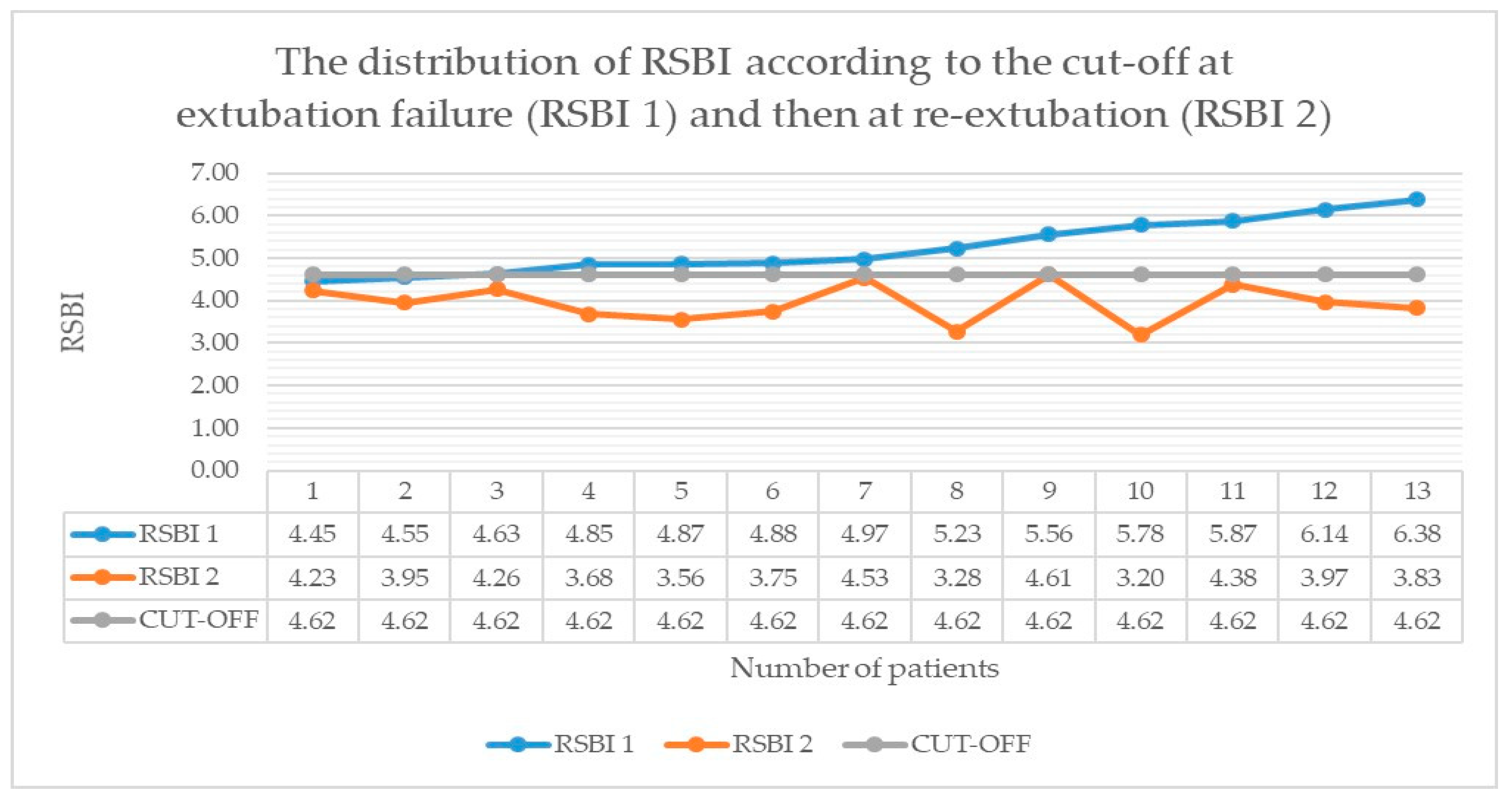
p < 0.001). An RSBI cutoff value of ≥4.62 breaths/min/mL/kg was identified as the optimal threshold, yielding a sensitivity of 84.6%, specificity of 94.0%, NPV of 99.1%, and PPV of 44%.
In patients who experienced extubation failure, the RSBI (RSBI-2) was reassessed at the time of successful re-extubation.
Figure 1 demonstrates that RSBI-2 values in all 13 patients remained below the established cutoff.
4. Discussion
In this prospective cohort of pediatric patients undergoing cardiac surgery, we demonstrated that the RSBI measured immediately prior to extubation is a strong predictor of extubation outcome. To our knowledge, this study represents one of the largest prospective evaluations of the RSBI in pediatric patients following cardiac surgery and is among the first to propose a clinically actionable RSBI cutoff derived from a standardized extubation protocol.
The RSBI is a real-time physiologic marker that captures the combined effects of respiratory muscle strength, lung mechanics, neurologic status, and metabolic demand at the moment of extubation. Its relevance in this population in particular, can be better understood in the context of post-CPB pathophysiology. Following cardiac surgery, systemic inflammation and capillary leak contribute to pulmonary edema and reduced lung compliance, leading to lower TVs [
11,
12,
13]. Concurrently, diaphragmatic dysfunction and respiratory muscle fatigue—well described in patients receiving MV—can impair effective ventilation and promote compensatory increases in RR [
14,
15]. In addition, residual cardiac lesions, shunt physiology, or postoperative myocardial dysfunction may increase metabolic demand and ventilatory requirements, further stressing the balance between respiratory load and capacity [
16,
18]. By integrating RR and TV into a single index, RSBI reflects the net effect of these interacting processes at the time of extubation.
However, the physiologic framework and integrative property mentioned above does not fully explain why the RSBI emerged as the only independent predictor of extubation failure in multivariable regression analysis. Although similar observations have been reported in pediatric and adult studies, where dynamic respiratory indices measured during SBTs outperform baseline or perioperative characteristics in adjusted analyses [
8,
19,
22,
24], this result should be interpreted with caution in our study. The limited number of outcome events raises the possibility of overfitting and restricts the robustness of multivariable modeling.
In adults, an RSBI threshold of approximately 105 breaths/min/L is widely used [
8,
9]. However, this value is not directly applicable to children due to fundamental differences in respiratory physiology, including higher RR and smaller TV. Pediatric studies have reported heterogenous RSBI cutoff values for predicting successful extubation, with thresholds ranging from approximately 6.7 breaths/min/mL/kg [
22,
29], to around 8 breaths/min/mL/kg [
30], and up to 11 breaths/min/mL/kg [
31]. The comparatively lower threshold identified in our study (4.62 breaths/min/mL/kg) may be explained by the relatively homogeneous population of physiologically optimized postoperative cardiac patients, in contrast to prior studies that included heterogeneous PICU populations with diverse underlying conditions. Although the RSBI demonstrated strong discriminative performance (AUC 0.974; 95% CI 0.947–1.000), the small number of events may have introduced optimism bias and led to overestimation of model performance.
While the RSBI measures real-time respiratory load/capacity, BMI reflects baseline reserve. Multiple studies supported the association between lower BMI percentile and extubation failure. Poor growth and low lean body mass have been linked to diaphragm weakness, increased respiratory workload, reduced cough efficacy, delayed weaning and increased morbidity [
17,
23,
24,
32,
33].
In our cohort, all patients who experienced extubation failure received NIPPV immediately after extubation, highlighting that clinicians appropriately identified these patients as high risk and escalated support early. This finding should be interpreted cautiously because non-invasive respiratory support (NRS) use is often influenced by confounding by indication: clinicians preferentially deploy NRS in patients perceived to have marginal reserve, which can make it appear associated with worse outcomes in observational data even when it is beneficial. Recent pediatric evidence supports the role of post-extubation NRS as a preventive strategy in children at risk for extubation failure [
34,
35,
36,
37,
38].
Extubation failure in our cohort occurred more frequently in patients with higher surgical complexity (RACHS-1 ≥ 3), including those undergoing single-ventricle palliation such as BDG and Fontan procedures, as well as AVC repairs. In contrast, extubation failure was rare or absent in several biventricular repairs such as isolated ventricular septal defect (VSD) and tetralogy of Fallot (TOF) repair. This distribution is consistent with the multicenter findings reported by Byrnes et al. [
32], where procedures involving cavopulmonary physiology, AVC repair, and higher RACHS-1 categories exhibited higher rates of both early and late extubation failure, whereas isolated biventricular repairs demonstrated lower failure rates. These similarities reinforce the concept that extubation failure is largely driven by underlying cardiopulmonary physiology and surgical complexity, rather than by center-specific practices alone.
Although the absolute proportions in our single-center subgroups appear higher for some procedures (e.g., Fontan, BDG), interpretation must be cautious due to small sample sizes. Nonetheless, the overall pattern aligns well with large registry data.
Patients who failed extubation in our study required significantly longer durations of MV and were more likely to have received neuromuscular blocking agents. Similar associations have been reported in prior studies, where prolonged ventilation often reflects greater illness severity, diaphragmatic dysfunction, pleural effusions, or postoperative complications rather than failure of weaning assessment alone [
10,
16,
17,
32].
International pediatric ventilator liberation guidelines emphasize neurologic readiness and airway protection as critical components of extubation readiness [
19,
20]. By allowing additional time for sedative washout before attempting extubation, our approach may attenuate the impact of sedation on extubation outcomes. This may partially explain why sedation did not emerge as an independent risk factor in our cohort, despite its known association with prolonged ventilation and delirium in other settings [
2,
6,
7].
The strongest clinical contribution of our study lies in the very high NPV of the RSBI. In a population with a relatively low extubation failure rate, a tool that reliably identifies patients at low risk of failure is particularly valuable. An RSBI below 4.62 breaths/min/mL/kg can provide reassurance to clinicians when other clinical readiness criteria are satisfied, while elevated values should prompt reassessment of reversible factors rather than serve as an absolute contraindication to extubation.
5. Limitations
This study has several limitations. Although it was conducted prospectively in a tertiary care center with access to advanced resources—thereby strengthening its internal validity—it remains a single-center study. As such, the findings may not be fully generalizable to other institutions with different clinical protocols, resource availability, or patient populations, including other hospitals across Lebanon and beyond.
The high discriminatory performance of the RSBI observed in this study should be interpreted with caution. Only 13 extubation failure events occurred, which introduces the possibility of small-event inflation bias and potential overestimation of model performance. In addition, we did not perform internal validation techniques, such as bootstrapping, to assess model stability. Therefore, the proposed RSBI cutoff and its diagnostic performance should be considered preliminary and require validation in larger, multicenter cohorts before broader clinical application.
The interpretation of the multivariable analysis is similarly limited by the small number of outcome events. According to established events-per-variable recommendations, the number of covariates that can be reliably included in regression models is restricted, increasing the risk of overfitting. Consequently, the identification of the RSBI as an independent predictor should be considered exploratory and hypothesis-generating rather than definitive. Larger studies with sufficient event numbers are needed to confirm the stability and independence of this association.
Finally, the RSBI was measured at a single time point immediately prior to extubation, and dynamic changes during the spontaneous breathing trial were not assessed. Although patients were continuously monitored clinically throughout the trial, serial RSBI measurements may provide additional insight into evolving respiratory muscle fatigue and could further refine extubation readiness assessment. This represents an important area for future investigation.
6. Conclusions
The RSBI is a simple, reproducible, and physiologically meaningful tool that can enhance extubation readiness assessments in pediatric patients following cardiac surgery. An RSBI cutoff of ≥4.62 breaths/min/mL/kg identifies patients at increased risk of extubation failure, while values below this threshold provide strong reassurance for safe ventilator liberation. Larger, multicenter studies are needed to validate our results.
Supplementary Materials
The following supporting information can be downloaded at:
https://www.mdpi.com/article/10.3390/children13040503/s1, File S1: Extubation Readiness Criteria; File S2: Pressure Support range according to endotracheal tube size. File S3: ROC Curve of RSBI for Predicting Extubation Failure.
Author Contributions
Conceptualization, J.M.; methodology, J.M.; formal analysis, J.M.; resources, J.M., M.S.E.M. and W.N.; data curation, J.M.; writing—original draft preparation, M.S.E.M. and W.N.; writing—review and editing, J.M. and M.N.M.; visualization, M.S.E.M., W.N. and M.N.M.; supervision, J.M.; project administration, J.M. All authors have read and agreed to the published version of the manuscript.
Funding
This research received no external funding.
Institutional Review Board Statement
The study was conducted in accordance with the Declaration of Helsinki, and approved by the Institutional Review Board of the American University of Beirut Medical Center (AUBMC) (protocol code BIO-2019-0335 and date of approval: 4 June 2020).
Informed Consent Statement
Informed consent was obtained from all subjects involved in the study.
Data Availability Statement
The raw data supporting the conclusions of this article will be made available by the authors on request.
Conflicts of Interest
The authors declare no conflicts of interest.
Abbreviations
The following abbreviations are used in this manuscript:
| ASD | Atrial septal defect |
| AVC | Atrioventricular canal |
| BDG | Bidirectional Glenn |
| BMI | Body mass index |
| BT | Blalock–Taussig |
| CICU | Cardiac Intensive Care Unit |
| CPB | Cardiopulmonary bypass |
| ERT | Extubation readiness testing |
| ETT | Endotracheal tube |
| ICU | Intensive Care Unit |
| IQR | Interquartile range |
| MV | Mechanical ventilation |
| NIPPV | Non-invasive positive pressure ventilation |
| NPV | Negative predictive value |
| NRS | Non-invasive respiratory support |
| PICU | Pediatric Intensive Care Unit |
| PPV | Positive predictive value |
| RACHS-1 | Risk Adjustment for Congenital Heart Surgery-1 |
| ROC | Receiver Operating Characteristic |
| RR | Respiratory rate |
| RSBI | Rapid Shallow Breathing Index |
| RV-PA | Right ventricular to Pulmonary artery |
| SBT | Spontaneous Breathing Trial |
| TAPVR | Total anomalous pulmonary venous return |
| TOF | Tetralogy of Fallot |
| TV | Tidal volume |
| VILI | Ventilator induced lung injury |
| VSD | Ventricular septal defect |
References
- Green, J.; Ross, P.A.; Newth, C.J.; Khemani, R.G. Subglottic post-extubation upper airway obstruction is associated with long-term airway morbidity in children. Pediatr. Crit. Care Med. 2021, 22, e502–e512. [Google Scholar] [CrossRef] [Scilit] [PubMed]
- Tobias, J.D. Tolerance, withdrawal, and physical dependency after long-term sedation and analgesia of children in the pediatric intensive care unit. Crit. Care Med. 2000, 28, 2122–2132. [Google Scholar] [CrossRef] [Scilit] [PubMed]
- Long, D.A.; Fink, E.L. Transitions from short to long-term outcomes in pediatric critical care: Considerations for clinical practice. Transl. Pediatr. 2021, 10, 2858. [Google Scholar] [CrossRef] [Scilit] [PubMed]
- Mourani, P.M.; Sontag, M.K. Ventilator-associated pneumonia in critically ill children: A new paradigm. Pediatr. Clin. 2017, 64, 1039–1056. [Google Scholar] [CrossRef] [Scilit]
- Kneyber, M.C.J.; Zhang, H.; Slutsky, A.S. Ventilator-induced lung injury. Similarity and differences between children and adults. Am. J. Respir. Crit. Care Med. 2014, 190, 258–265. [Google Scholar] [CrossRef] [Scilit]
- Manning, J.C.; Pinto, N.P.; Rennick, J.E.; Colville, G.; Curley, M.A. Conceptualizing post intensive care syndrome in children—The PICS-p framework. Pediatr. Crit. Care Med. 2018, 19, 298–300. [Google Scholar] [CrossRef] [Scilit]
- Principi, T.; Fraser, D.D.; Morrison, G.C.; Al Farsi, S.; Carrelas, J.F.; Maurice, E.A.; Kornecki, A. Complications of mechanical ventilation in the pediatric population. Pediatr. Pulmonol. 2011, 46, 452–457. [Google Scholar] [CrossRef] [Scilit]
- Karthika, M.; Al Enezi, F.A.; Pillai, L.V.; Arabi, Y.M. Rapid shallow breathing index. Ann. Thorac. Med. 2016, 11, 167–176. [Google Scholar] [CrossRef] [Scilit]
- MacIntyre, N.R. Evidence-based ventilator weaning and discontinuation. Respir. Care 2004, 49, 830–836. [Google Scholar] [CrossRef] [Scilit]
- Kurachek, S.C.; Newth, C.J.; Quasney, M.W.; Rice, T.; Sachdeva, R.C.; Patel, N.R.; Takano, J.; Easterling, L.; Scanlon, M.; Musa, N.; et al. Extubation failure in pediatric intensive care: A multiple-center study of risk factors and outcomes. Crit. Care Med. 2003, 31, 2657–2664. [Google Scholar] [CrossRef] [Scilit]
- Apostolakis, E.; Filos, K.S.; Koletsis, E.; Dougenis, D. Lung dysfunction following cardiopulmonary bypass. J. Card. Surg. 2010, 25, 47–55. [Google Scholar] [CrossRef] [Scilit] [PubMed]
- Hirleman, E.; Larson, D. Cardiopulmonary bypass and edema: Physiology and pathophysiology. Perfusion 2008, 23, 311–322. [Google Scholar] [CrossRef] [Scilit] [PubMed]
- von Ungern-Sternberg, B.S.; Petak, F.; Saudan, S.; Pellegrini, M.; Erb, T.O.; Habre, W. Effect of cardiopulmonary bypass and aortic clamping on functional residual capacity and ventilation distribution in children. J. Thorac. Cardiovasc. Surg. 2007, 134, 1193–1198. [Google Scholar] [CrossRef] [Scilit] [PubMed]
- Sassoon, C.S.; Caiozzo, V.J.; Manka, A.; Sieck, G.C. Altered diaphragm contractile properties with controlled mechanical ventilation. J. Appl. Physiol. 2002, 92, 2585–2595. [Google Scholar] [CrossRef] [Scilit]
- Powers, S.K.; Shanely, R.A.; Coombes, J.S.; Koesterer, T.J.; McKenzie, M.; Van Gammeren, D.; Cicale, M.; Dodd, S.L. Mechanical ventilation results in progressive contractile dysfunction in the diaphragm. J. Appl. Physiol. 2002, 92, 1851–1858. [Google Scholar] [CrossRef] [Scilit]
- AlRabeeah, S.M. A review of prolonged mechanical ventilation in pediatric cardiac surgery patients: Risk factors and implications. J. Multidiscip. Health. 2024, 17, 6121–6130. [Google Scholar] [CrossRef] [Scilit]
- Saengsin, K.; Sittiwangkul, R.; Borisuthipandit, T.; Trongtrakul, K.; Tanasombatkul, K.; Phanacharoensawad, T.; Moonsawat, G.; Phinyo, P. Predictive factors of extubation failure in pediatric cardiac intensive care unit: A single-center retrospective study from Thailand. Front. Pediatr. 2023, 11, 1156263. [Google Scholar] [CrossRef] [Scilit]
- Taksande, K. The complex interplay of variables in extubation decision-making following pediatric cardiac surgery: A narrative review. Cureus 2024, 16, e64216. [Google Scholar] [CrossRef] [Scilit]
- Abu-Sultaneh, S.; Iyer, N.P.; Fernández, A.; Gaies, M.; González-Dambrauskas, S.; Hotz, J.C.; Kneyber, M.C.J.; López-Fernández, Y.M.; Rotta, A.T.; Werho, D.K.; et al. Executive Summary: International Clinical Practice Guidelines for Pediatric Ventilator Liberation, A Pediatric Acute Lung Injury and Sepsis Investigators (PALISI) Network Document. Am. J. Respir. Crit. Care Med. 2023, 207, 17–28. [Google Scholar] [CrossRef] [Scilit]
- Loberger, J.M.; Steffen, K.; Khemani, R.G.; Nishisaki, A.; Abu-Sultaneh, S. Implementing the Pediatric Ventilator Liberation Guidelines Using the Most Current Evidence. Respir. Care 2024, 69, 869–880. [Google Scholar] [CrossRef] [Scilit]
- Sher, G.; Moghari, M.H.; Abbas, K.; Mathewson, M.; Garber, N.; Godsey, V.; Udassi, J.P. The Practice of Extubation Readiness Testing in Pediatric Cardiac Intensive Care Units: A Cross-sectional Study Based on an Electronic Survey. CJC Pediatr. Congenit. Heart Dis. 2025, 1–7. [Google Scholar] [CrossRef] [Scilit]
- Dastranji, A.; Bilan, N. The role of rapid shallow breathing index in predicting successful weaning of pediatric patients with respiratory failure. Int. J. Pediatr. 2019, 7, 9003–9012. [Google Scholar]
- Khemani, R.G.; Sekayan, T.; Hotz, J.R.; Flink, R.C.; Rafferty, G.F.; Iyer, N.; Newth, C.J.L.M. Risk Factors for Pediatric Extubation Failure: The Importance of Respiratory Muscle Strength*. Crit. Care Med. 2017, 45, e798. [Google Scholar] [CrossRef] [Scilit] [PubMed]
- Moura, J.C.D.S.; Gianfrancesco, L.; de Souza, T.H.; Hortencio, T.D.R.; Nogueira, R.J.N. Extubation in the pediatric intensive care unit: Predictive methods. An integrative literature review. Rev. Bras. Ter. Intensiv. 2021, 33, 304–311. [Google Scholar] [CrossRef] [Scilit] [PubMed]
- Johnston, C.; Piva, J.P.; de Carvalho, W.B.; Garcia, P.C.; Fonseca, M.C.; Hommerding, P.X. Post cardiac surgery in children: Extubation failure predictor’s. Rev. Bras. Ter. Intensiv. 2008, 20, 57–62. [Google Scholar] [CrossRef] [Scilit]
- Munshi, F.A.; Bukhari, Z.M.; Alshaikh, H.; Aldahar, M.S.; Alsafrani, T.; Elbehery, M. Rapid Shallow Breathing Index as a Predictor of Extubation Outcomes in Pediatric Patients Underwent Cardiac Surgeries at King Faisal Cardiac Center. Cureus 2020, 12, e8754. [Google Scholar] [CrossRef] [Scilit]
- Egbuta, C.; Evans, F. Weaning from ventilation and extubation of children in critical care. BJA Educ. 2022, 22, 104–110. [Google Scholar] [CrossRef] [Scilit]
- Body Mass Index-for-Age (BMI-for-Age). Available online: https://www.who.int/toolkits/child-growth-standards/standards/body-mass-index-for-age-bmi-for-age (accessed on 3 March 2026).
- Arshad, S.; Gul, F.; Khaleeq, T.A.; Iqbal, M.; Ali, Q. Modified rapid shallow breathing index as a predictor of extubating outcomes in critical care pediatric patients. J. Shifa Tameer-e-Millat Univ. 2024, 7, 160–164. [Google Scholar] [CrossRef] [Scilit]
- Thiagarajan, R.R.; Bratton, S.L.; Martin, L.D.; Brogan, T.V.; Taylor, D. Predictors of successful extubation in children. Am. J. Respir. Crit. Care Med. 1999, 160, 1562–1566. [Google Scholar] [CrossRef] [Scilit]
- Baumeister, B.L.; El-Khatib, M.; Smith, P.G.; Blumer, J.L. Evaluation of predictors of weaning from mechanical ventilation in pediatric patients. Pediatr. Pulmonol. 1997, 24, 344–352. [Google Scholar] [CrossRef] [Scilit]
- Byrnes, J.; Bailly, D.D.; Werho, D.K.; Rahman, F.; Esangbedo, I.; Hamzah, M.; Banerjee, M.; Zhang, W.; Maher, K.O.; Schumacher, K.R.; et al. Risk Factors for Extubation Failure After Pediatric Cardiac Surgery and Impact on Outcomes: A Multicenter Analysis. Crit. Care Explor. 2023, 5, e0966. [Google Scholar] [CrossRef] [Scilit] [PubMed]
- Assy, J.; Yaacoub, C.; Khafaja, S.; Arabi, M.T.; El Rassi, I.; Bitar, F.; Yazbeck, N. The Association Between Preoperative Malnutrition and Early Postoperative Outcomes in Children with Congenital Heart Disease: A 2-Year Retrospective Study at a Lebanese Tertiary Medical Center. Children 2025, 12, 705. [Google Scholar] [CrossRef] [Scilit]
- Loberger, J.M.; Moore, M.; Scanlon, M.; Khemani, R.G.; Abu-Sultaneh, S.; Rogerson, C.M. Contemporary Trends in Pediatric Extubation Failure and Noninvasive Respiratory Support Use. Chest 2026, 169, 106–114. [Google Scholar] [CrossRef] [Scilit]
- Iyer, N.P.; Rotta, A.T.; Essouri, S.; Fioretto, J.R.; Craven, H.J.; Whipple, E.C.; Ramnarayan, P.; Abu-Sultaneh, S.; Khemani, R.G. Association of Extubation Failure Rates with High-Flow Nasal Cannula, Continuous Positive Airway Pressure, and Bilevel Positive Airway Pressure vs Conventional Oxygen Therapy in Infants and Young Children: A Systematic Review and Network Meta-Analysis. JAMA Pediatr. 2023, 177, 774. [Google Scholar] [CrossRef] [Scilit]
- Rolim, D.S.; Galas, F.R.B.; Faria, L.S.; Amorim, E.F.; Regenga, M.M.; Troster, E.J. Use of Noninvasive Ventilation in Respiratory Failure After Extubation During Postoperative Care in Pediatrics. Pediatr. Cardiol. 2020, 41, 729–735. [Google Scholar] [CrossRef] [Scilit]
- Das, S.; Desai, M.; Das, D.; Dutta, N.; Gajpal, S.; Sharma, M. Spectrum and outcome of the use of noninvasive ventilation in a pediatric cardiac intensive care unit: A single-center experience. Ann. Pediatr. Cardiol. 2023, 16, 247–253. [Google Scholar] [CrossRef] [Scilit]
- Lafever, S.F.; Toledo, B.; Leiva, M.; Padrón, M.; Balseiro, M.; Carrillo, A.; López-Herce, J. Non-invasive mechanical ventilation after heart surgery in children. BMC Pulm. Med. 2016, 16, 167. [Google Scholar] [CrossRef] [Scilit]
| Disclaimer/Publisher’s Note: The statements, opinions and data contained in all publications are solely those of the individual author(s) and contributor(s) and not of MDPI and/or the editor(s). MDPI and/or the editor(s) disclaim responsibility for any injury to people or property resulting from any ideas, methods, instructions or products referred to in the content. |