Appendix A
Table A1.
Aggregated variables.
Table A1.
Aggregated variables.
| Variables | Categories (Description) | Reason for Aggregating/Recoding |
|---|
| Ethnicity | Asian descent (Chinese, Hindustani, and Javanese) African descent (Creole and Maroon) Other (Indigenous/Amerindian, Mixed, Caucasian, Other)
| The variable from a multiple-choice question. Aggregated for use in statistical analyses. |
| Household size | | Recoded as a categorical variable for use in statistical analyses. Household size, as a continuous variable, lacks a unit of measurement. |
| Level of education (mother) | | Quasi-complete separation, i.e., issues with estimability. The “Higher education (Masters/Bachelor)/other” level had 0 counts in the seronegative level of the outcome “Total IgG anti-S1 Seroprevalence of 2023 (C2)”. The regression model estimates were inflated. The solution was to combine the levels “Technical vocational/secondary” and “Higher education (Masters/Bachelor)/other “. |
| Employment | Employed (employed for wages and self-employed) Unemployed (unemployed—looking for work, unemployed—not looking for work, homemaker, student, retired, unable to work due to disability, other, and mixed)
| The variable from a multiple-choice question. Aggregated for use in statistical analyses. |
| Family protection actions during the COVID-19 pandemic | | The variable originated from a multiple-choice question. Aggregated for use in statistical analyses. |
| Social activities of children during the COVID-19 pandemic | | The variable originated from a multiple-choice question. Aggregated for use in statistical analyses. |
Table A2.
Comparison between models with main effects (no interaction) and models with interactions before binary logistic regression modeling.
Table A2.
Comparison between models with main effects (no interaction) and models with interactions before binary logistic regression modeling.
| Models with Main Effects | Models with Interaction | p-Value a |
|---|
| age_motherc + region_residence | age_motherc * region_residence | 0.677 |
| age_motherc + distancing3 | age_motherc * distancing3 | 0.034 |
| age_motherc + mask4 | age_motherc * mask4 | 0.063 |
| age_motherc + pos_household | age_motherc * pos_household | 0.058 |
| mother_vaccine + age_motherc | mother_vaccine * age_motherc | 0.438 |
| mother_vaccine + age_childc | mother_vaccine * age_childc | 0.208 |
| mother_vaccine + gender_child | mother_vaccine * gender_child | 0.720 |
| mother_vaccine + ethnicity3 | mother_vaccine * ethnicity3 | 0.257 |
| mother_vaccine + region_residence | mother_vaccine * region_residence | 0.664 |
| mother_vaccine + num_house | mother_vaccine * num_house | 0.372 |
| mother_vaccine + education3 | mother_vaccine * education3 | 0.770 |
| mother_vaccine + employment2 | mother_vaccine * employment2 | 0.194 |
| mother_vaccine + childactivities3 | mother_vaccine * childactivities3 | 0.084 |
| mother_vaccine + mask4 | mother_vaccine * mask4 | 0.096 |
| mother_vaccine + distancing3 | mother_vaccine * distancing3 | 0.715 |
| mother_vaccine + COVID_diagnosis | mother_vaccine * COVID_diagnosis | 0.285 |
| mother_vaccine + pos_household | mother_vaccine * pos_household | 0.282 |
| age_motherc + num_house | age_motherc * num_house | 0.054 |
| num_house + pos_household | num_house * pos_household | 0.180 |
Figure A1.
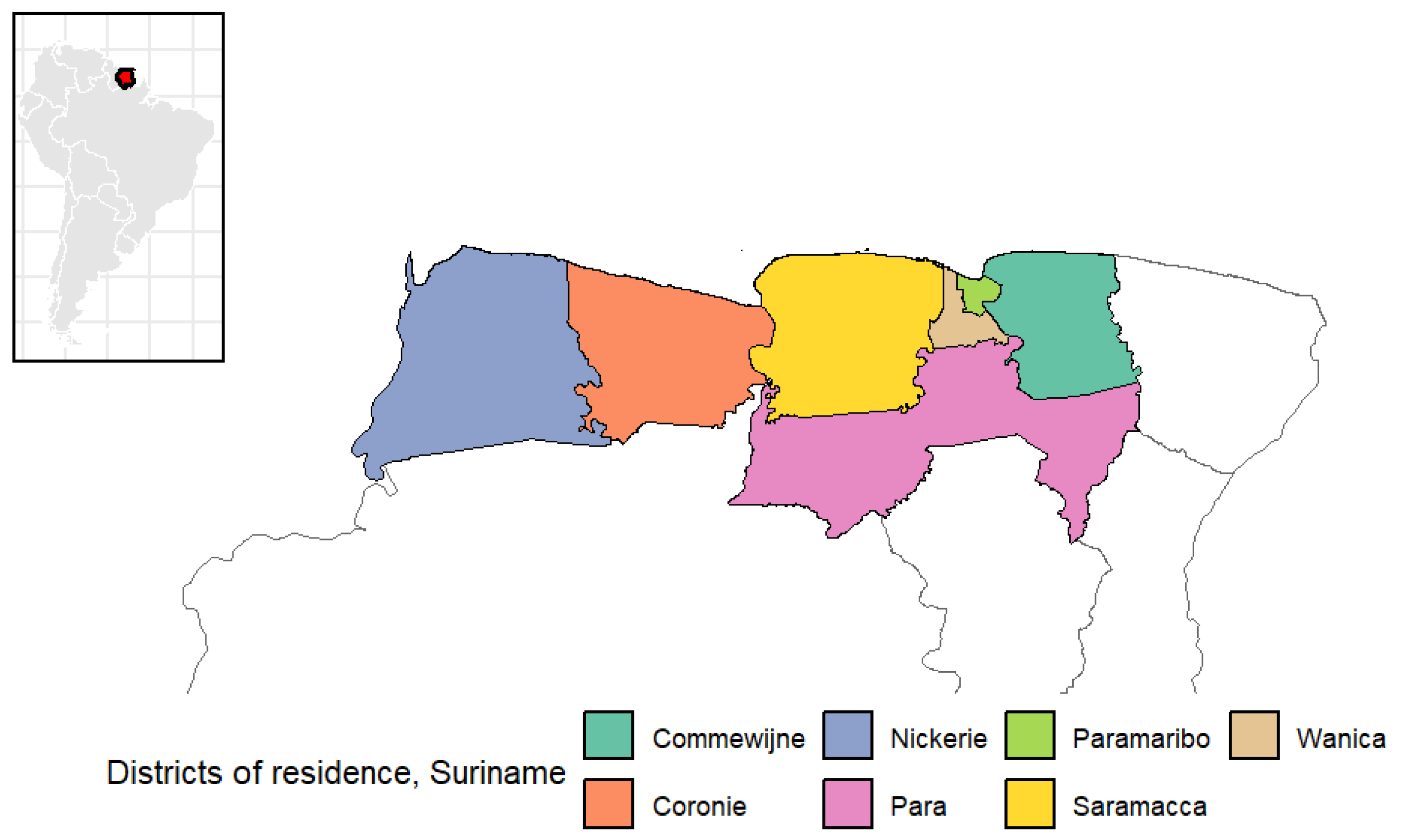
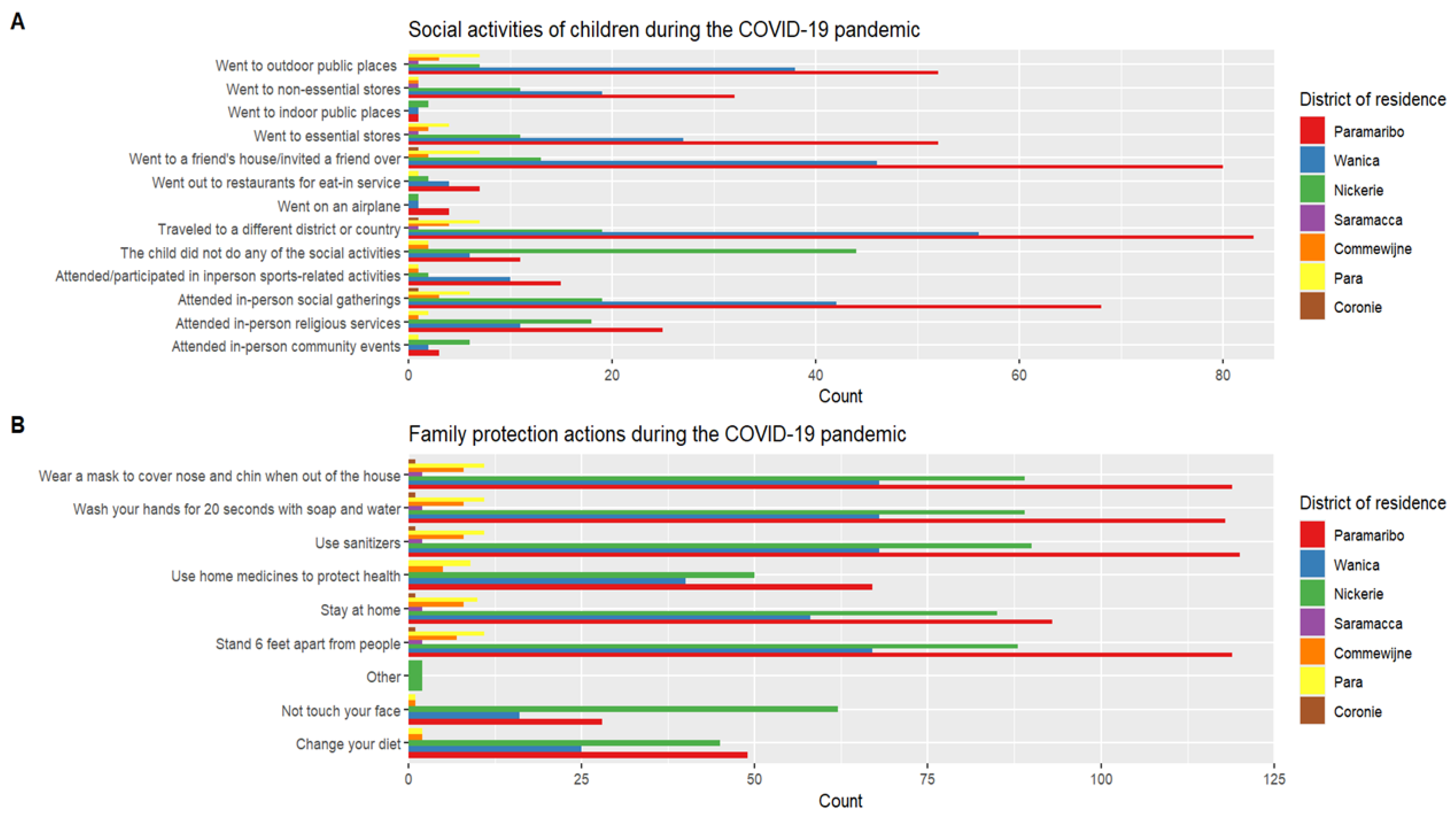
Social activities of children and family protection actions by district of residence (N = 300). (A) Social activities of children during the COVID-19 pandemic by district of residence reported in C2. (B) Family protection actions during the COVID-19 pandemic by district of residence reported in C2. Participants from Paramaribo (N = 120), Para (N = 11), Wanica (N = 68), Commewijne (N = 8), and Saramacca (N = 2), Nickerie (N = 90), and Coronie (N = 1).
Figure A1.
Social activities of children and family protection actions by district of residence (N = 300). (A) Social activities of children during the COVID-19 pandemic by district of residence reported in C2. (B) Family protection actions during the COVID-19 pandemic by district of residence reported in C2. Participants from Paramaribo (N = 120), Para (N = 11), Wanica (N = 68), Commewijne (N = 8), and Saramacca (N = 2), Nickerie (N = 90), and Coronie (N = 1).
Table A3.
Types of nose swab from children tested for COVID-19 at any point in time.
Table A3.
Types of nose swab from children tested for COVID-19 at any point in time.
| Variables | Overall, N (%) | Nose Swab Negative, N (%) | Nose Swab Positive, N (%) |
|---|
| Total | 100 (100.0) | 75 (75.0) | 25 (25.0) |
| Type of nose swab test | | | |
| PCR | 35 (35.0) | 27 (36.0) | 8 (32.0) |
| Antigen | 65 (65.0) | 48 (64.0) | 17 (68.0) |
Figure A2.
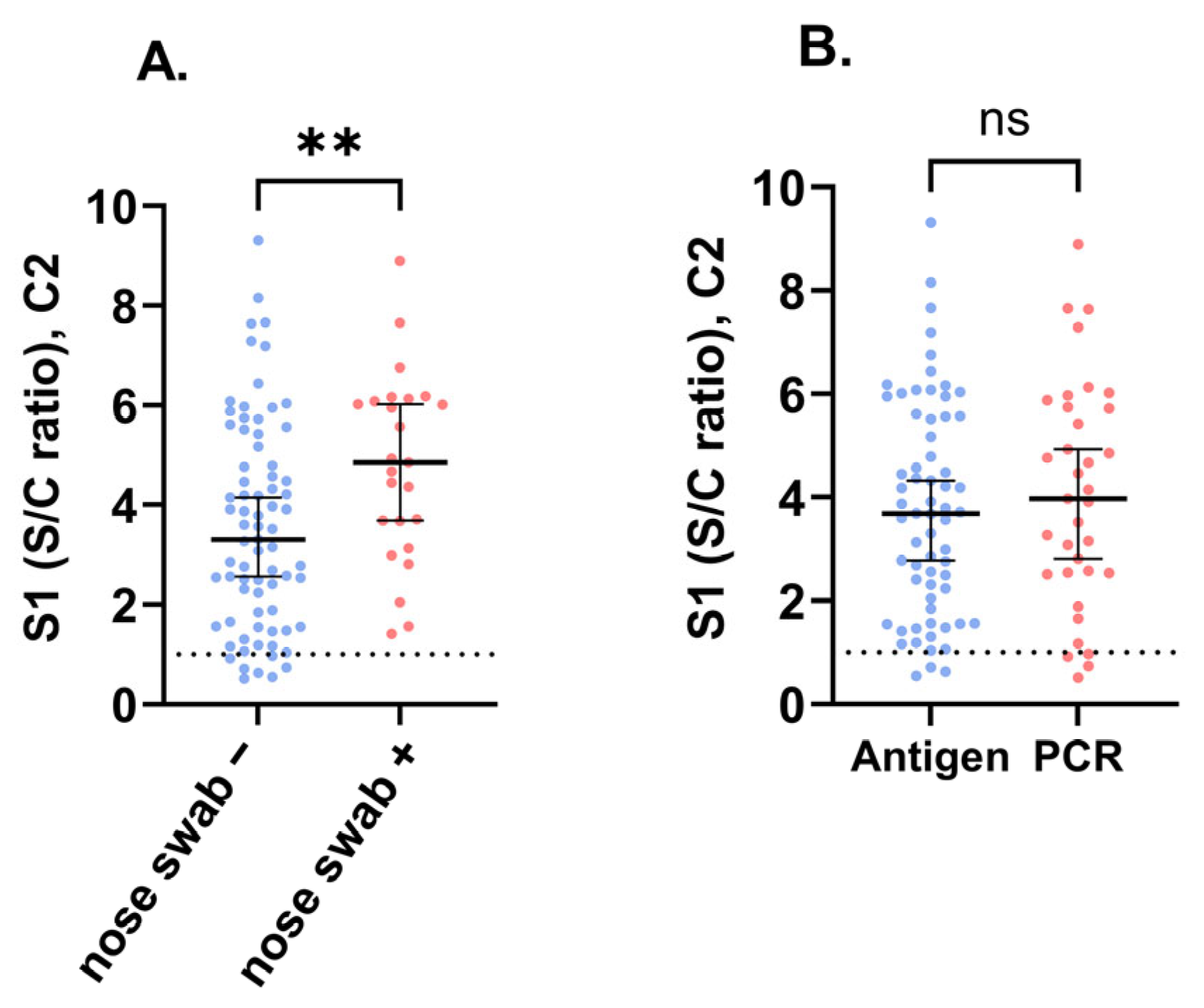
Total IgG SARS-CoV-2 S1 S/C ratios of children who were tested for COVID-19 at any point in time. Children nose swab testing at any point in time was reported by their mothers via questionnaire at C2. (A) Nose swab negative and positive results (blue N = 75 and red N = 25, respectively). (B) Type of nose swab test: antigen and PCR tests (blue N = 65 and red N = 35, respectively). Data analysis is shown as scatter plots with symbols representing individual participants and bars representing the median ±95% CI. Statistical significance was calculated using the two-sided, Mann–Whitney U test. A significant p value (p ** < 0.005) was obtained. C2, collection time point 2 from 21 February 2023 to 22 April 2023; S1, spike domain 1; ns, not significant; S/C, sample to cut-off ratio; PCR, Polymerase chain reaction test; CI, confidence intervals.
Figure A2.
Total IgG SARS-CoV-2 S1 S/C ratios of children who were tested for COVID-19 at any point in time. Children nose swab testing at any point in time was reported by their mothers via questionnaire at C2. (A) Nose swab negative and positive results (blue N = 75 and red N = 25, respectively). (B) Type of nose swab test: antigen and PCR tests (blue N = 65 and red N = 35, respectively). Data analysis is shown as scatter plots with symbols representing individual participants and bars representing the median ±95% CI. Statistical significance was calculated using the two-sided, Mann–Whitney U test. A significant p value (p ** < 0.005) was obtained. C2, collection time point 2 from 21 February 2023 to 22 April 2023; S1, spike domain 1; ns, not significant; S/C, sample to cut-off ratio; PCR, Polymerase chain reaction test; CI, confidence intervals.
Figure A3.
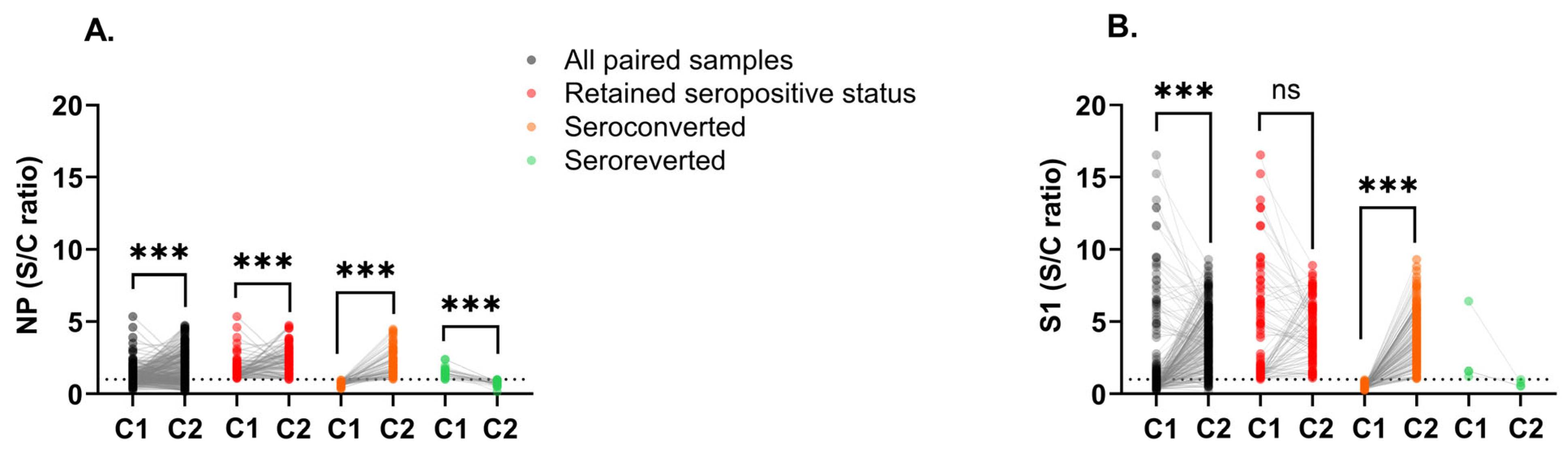
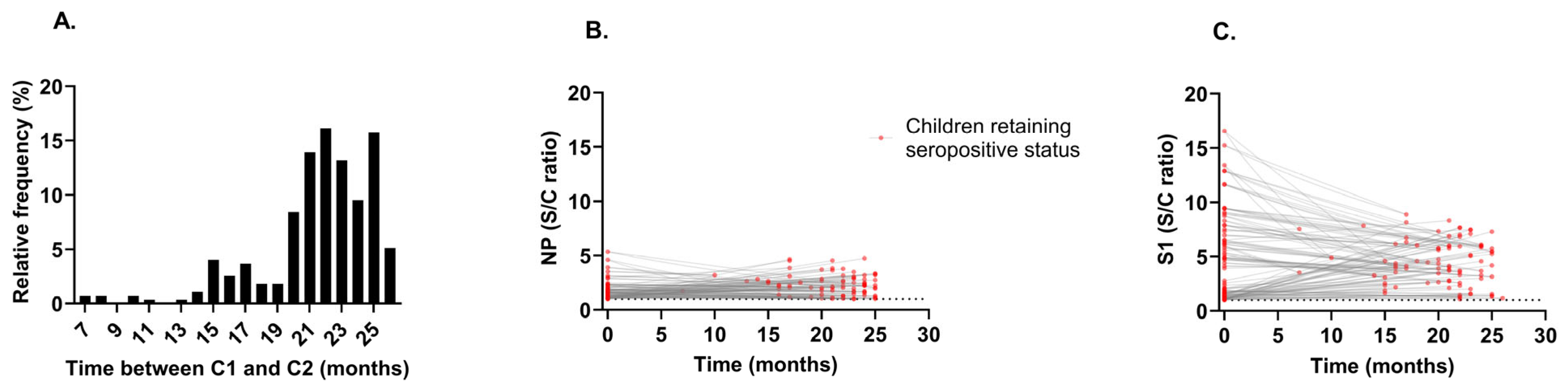
Time (months) between DBS collection C1 and C2. (A) Histogram showing the time in months of DBS collection time points. The mean time between collections of all paired samples was 21.5 months (standard deviation (SD) 3.6, 95% CI 21.1–21.9). IgG anti-NP (B) or anti-S1 (C) S/C ratios of seropositive children in C1 (month 0) that retained seropositive status in C2. Statistical analysis was performed in GraphPad Prism 10.0.3. C1, collection time point 1 from 3 January 2021 to 19 September 2022; C2, collection time point 2 from 21 February 2023 to 22 April 2023; NP, nucleoprotein; S1, spike domain 1; n, sample size; S/C, sample to cut-off ratio; IgG, immunoglobulin G; CI, confidence intervals.
Figure A3.
Time (months) between DBS collection C1 and C2. (A) Histogram showing the time in months of DBS collection time points. The mean time between collections of all paired samples was 21.5 months (standard deviation (SD) 3.6, 95% CI 21.1–21.9). IgG anti-NP (B) or anti-S1 (C) S/C ratios of seropositive children in C1 (month 0) that retained seropositive status in C2. Statistical analysis was performed in GraphPad Prism 10.0.3. C1, collection time point 1 from 3 January 2021 to 19 September 2022; C2, collection time point 2 from 21 February 2023 to 22 April 2023; NP, nucleoprotein; S1, spike domain 1; n, sample size; S/C, sample to cut-off ratio; IgG, immunoglobulin G; CI, confidence intervals.
Figure A4.
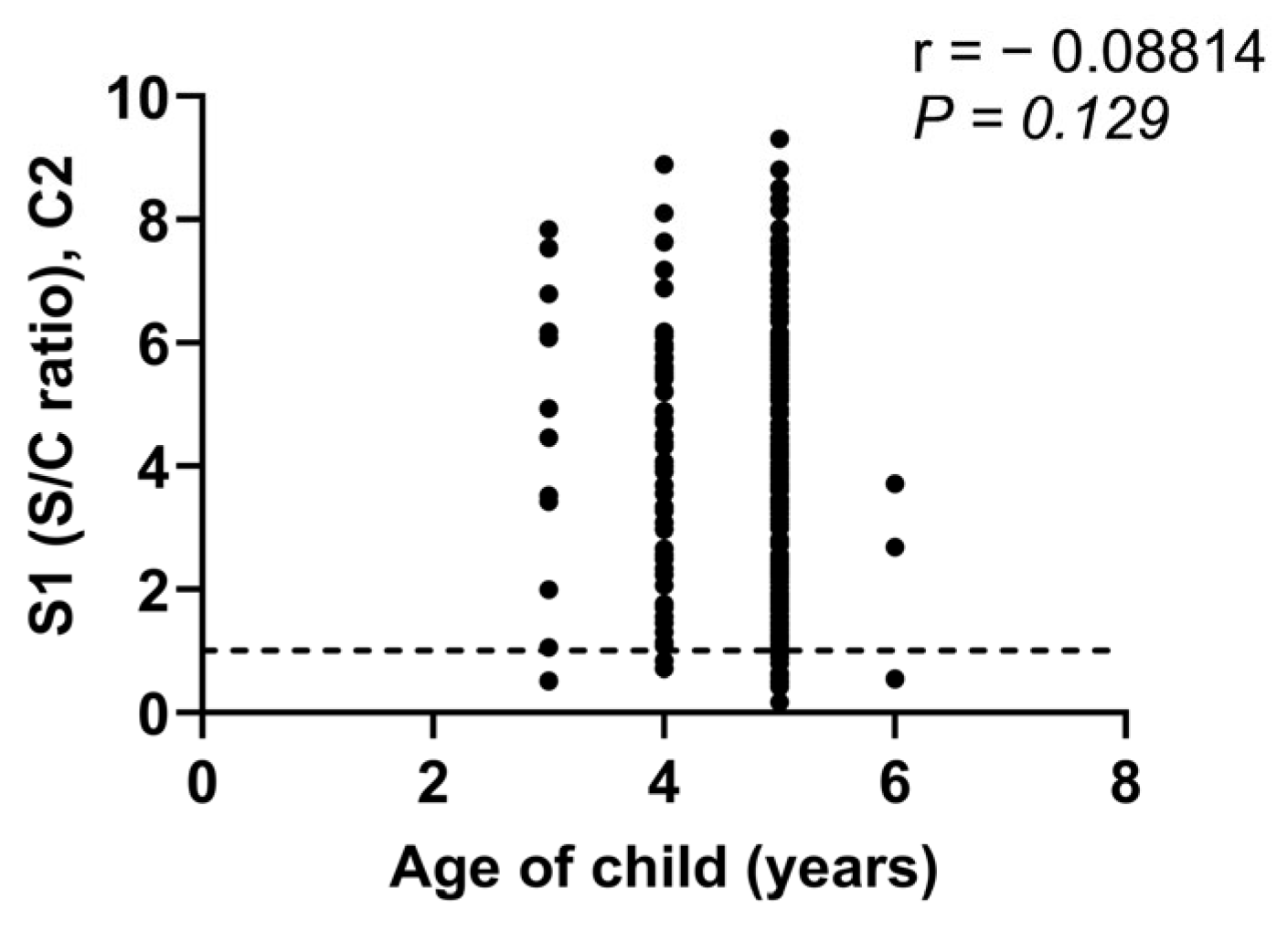
Levels of total IgG anti-S1 by age of children in C2. The S/C ratio was calculated as the sample adjusted OD450 nm/cut-off for the plate. Samples with a ratio >1 were identified as positive and ≤1 as negative. The dashed lines represent the cut-off of 1. A Spearman correlation was performed in GraphPad Prism 10.0.3. r, rho; p, p-value; C2, collection time point 2 from 21 February 2023 to 22 April 2023; S1, spike domain 1; S/C, sample to cut-off ratio.
Figure A4.
Levels of total IgG anti-S1 by age of children in C2. The S/C ratio was calculated as the sample adjusted OD450 nm/cut-off for the plate. Samples with a ratio >1 were identified as positive and ≤1 as negative. The dashed lines represent the cut-off of 1. A Spearman correlation was performed in GraphPad Prism 10.0.3. r, rho; p, p-value; C2, collection time point 2 from 21 February 2023 to 22 April 2023; S1, spike domain 1; S/C, sample to cut-off ratio.
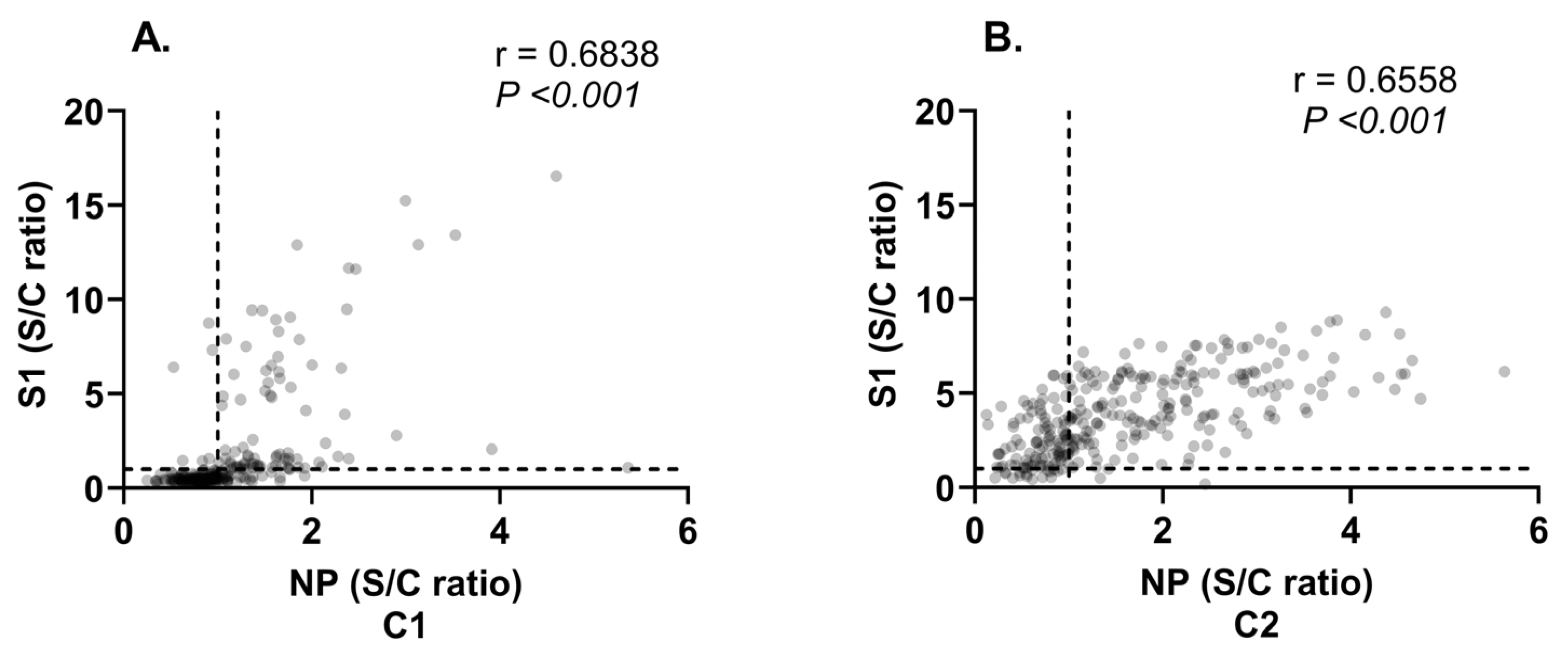
Figure A5.
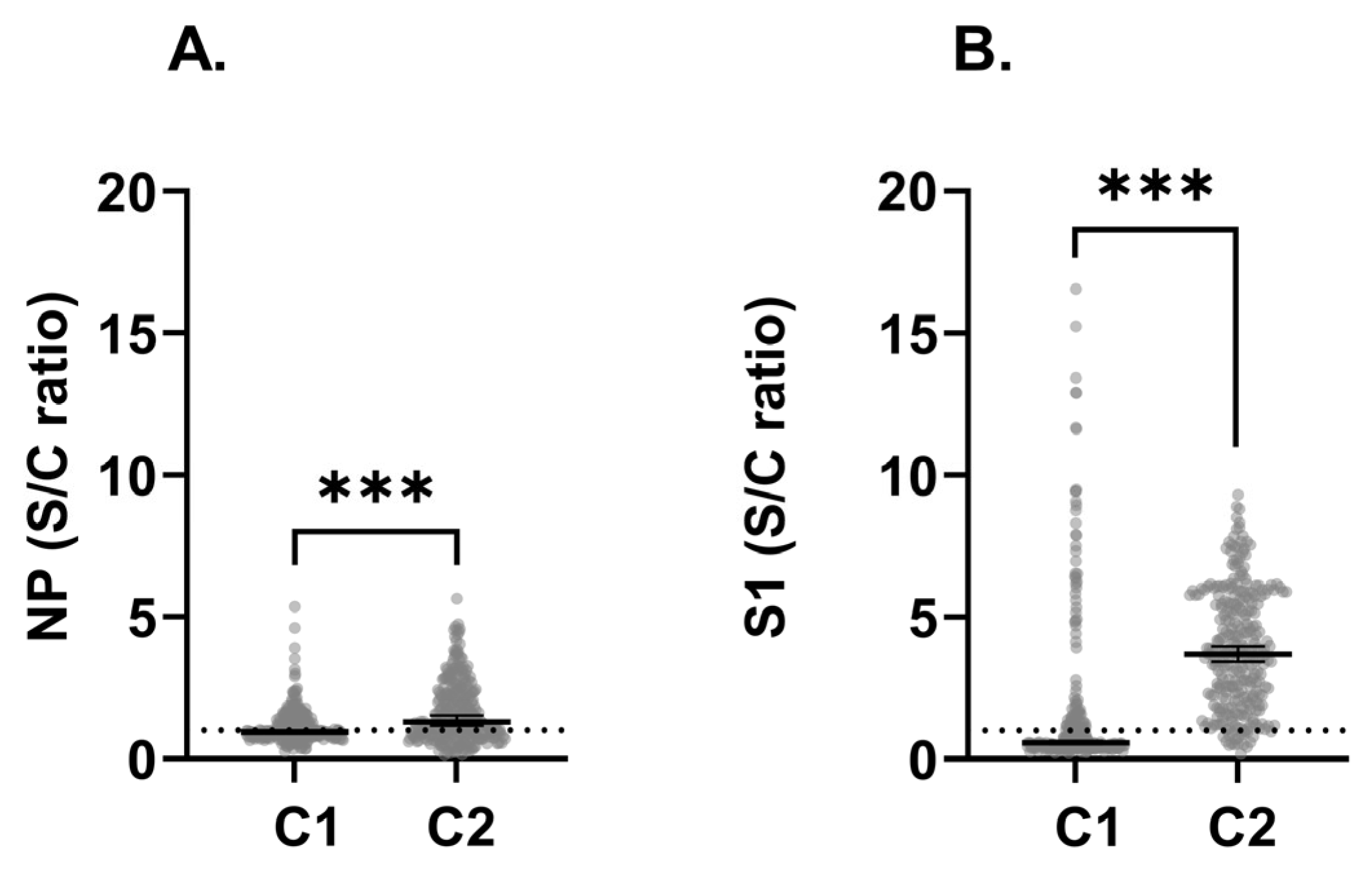
S/C ratios of total IgG anti-NP and S1 from eluted DBS samples of children from two collection time points. Spearman correlation analysis of total IgG anti-SARS-CoV-2 NP and/or S1 [C1: N = 275; C2: N = 298] (A,B). The S/C ratio was calculated as the sample adjusted OD450 nm/cut-off for the plate. Samples with a ratio >1 were identified as positive and ≤1 as negative. The dashed lines represent the cut-off of 1. Statistical analysis performed in GraphPad Prism 10.0.3. r, rho; p, p-value; C1, collection time point 1 from 3 January 2021 to 19 September 2022; C2, collection time point 2 from 21 February 2023 to 22 April 2023; NP, nucleoprotein; S1, spike domain 1; S/C, sample to cut-off ratio.
Figure A5.
S/C ratios of total IgG anti-NP and S1 from eluted DBS samples of children from two collection time points. Spearman correlation analysis of total IgG anti-SARS-CoV-2 NP and/or S1 [C1: N = 275; C2: N = 298] (A,B). The S/C ratio was calculated as the sample adjusted OD450 nm/cut-off for the plate. Samples with a ratio >1 were identified as positive and ≤1 as negative. The dashed lines represent the cut-off of 1. Statistical analysis performed in GraphPad Prism 10.0.3. r, rho; p, p-value; C1, collection time point 1 from 3 January 2021 to 19 September 2022; C2, collection time point 2 from 21 February 2023 to 22 April 2023; NP, nucleoprotein; S1, spike domain 1; S/C, sample to cut-off ratio.
Table A4.
Cross table for Cohen’s kappa inter-reliability test of SARS-CoV-2 antibody seroprevalence in 2021–2022 (C1).
Table A4.
Cross table for Cohen’s kappa inter-reliability test of SARS-CoV-2 antibody seroprevalence in 2021–2022 (C1).
| | | Anti-S1 Seroprevalence |
|---|
| Anti-NP Seroprevalence | Overall, N (%) | Seronegative, N (%) | Seropositive, N (%) |
|---|
| Total | 275 (100.0) | 182 (66.2) | 93 (33.8) |
| Seronegative | 161 (58.6) | 155 (96.3) | 6 (3.7) |
| Seropositive | 114 (41.5) | 27 (23.7) | 87 (76.3) |
Sensitivity refers to the percentage of seropositive children who are correctly identified as seropositive. Where true positives are children correctly diagnosed as seropositive, and false negatives are children incorrectly diagnosed as seronegative.
Specificity refers to the percentage of seronegative children who are correctly identified as seronegative. Where true negatives are children correctly diagnosed as seronegative and false positives are children incorrectly diagnosed as seropositive.
The Cohen’s kappa test is statistically significant (p < 0.001). The kappa value of 0.746 indicates a moderate inter-rater reliability between IgG anti-NP and S1 results of C1. The test was performed in R v4.4.2.
Table A5.
Crosstable for Cohen’s kappa inter-reliability test of SARS-CoV-2 antibody seroprevalence in 2023 (C2).
Table A5.
Crosstable for Cohen’s kappa inter-reliability test of SARS-CoV-2 antibody seroprevalence in 2023 (C2).
| | | Anti-S1 Seroprevalence |
|---|
| Anti-NP Seroprevalence | Overall, N (%) | Seronegative, N (%) | Seropositive, N (%) |
|---|
| Total | 298 (100.0) | 20 (6.7) | 278 (93.3) |
| Seronegative | 109 (36.6) | 17 (15.6) | 92 (84.4) |
| Seropositive | 189 (63.4) | 3 (1.6) | 186 (98.4) |
Sensitivity refers to the percentage of seropositive children who are correctly identified as seropositive. Where true positives are children correctly diagnosed as seropositive, and false negatives are children incorrectly diagnosed as seronegative.
Specificity refers to the percentage of seronegative children who are correctly identified as seronegative. True negatives are children correctly diagnosed as seronegative and false positives are children incorrectly diagnosed as seropositive.
The Cohen’s kappa test is statistically significant (p < 0.001). The kappa value of 0.169 indicates none inter-rater reliability between IgG anti-NP and anti-S1 results of C2. The test was performed in R 4.4.2.
Table A6.
Summary of the data and univariate regression analysis.
Table A6.
Summary of the data and univariate regression analysis.
| Variables | Overall (N = 233) | Seronegative (N = 14) | Seropositive (N = 219) | Univariate Analysis, OR (95% CI) | p-Value a |
|---|
| Age of mother in years, mean (SD) b | 33.8 (6.4) b | 39.4 (6.8) b | 33.4 (6.2) b | 0.86 (0.78–0.94) | 0.001 |
| Age of child in years, mean (SD) b | 4.8 (0.5) b | 4.8 (0.7) b | 4.8 (0.5) b | 0.93 (0.27–2.48) | 0.894 |
| Gender | | | | | |
| Female | 132 (56.7%) | 6 (42.9%) | 126 (57.5%) | Ref. | |
| Male | 101 (43.4%) | 8 (57.1%) | 93 (42.5%) | 0.55 (0.18–1.64) | 0.288 |
| Ethnicity | | | | | |
| Asian descent | 67 (28.8%) | 3 (21.4%) | 64 (29.2%) | Ref. | |
| African descent | 86 (36.9%) | 6 (42.9%) | 80 (36.5%) | 0.63 (0.13–2.47) | 0.518 |
| Other (Indigenous/Amerindian, Mixed, Caucasian, Other) | 80 (34.3%) | 5 (35.7%) | 75 (34.2%) | 0.70 (0.14–2.98) | 0.639 |
| Recruitment region | | | | | |
| Paramaribo region | 187 (80.3%) | 13 (92.9%) | 174 (79.5%) | Ref. | |
| Nickerie region | 46 (19.7%) | 1 (7.1%) | 45 (20.5%) | 3.36 (0.64–61.88) | 0.249 |
| Household size | | | | | |
| 4 or fewer | 103 (44.2%) | 2 (14.3%) | 101 (46.1%) | Ref. | |
| 5 or more | 130 (55.8%) | 12 (85.7%) | 118 (53.9%) | 0.19 (0.03–0.74) | 0.035 |
| Level of education (mother) | | | | | |
| None/primary/lower secondary | 124 (53.2%) | 8 (57.1%) | 130 (59.4%) | Ref. | |
| Technical vocational/secondary/higher education (masters/bachelor)/other | 109 (46.8%) | 6 (42.9%) | 103 (47.0%) | 1.18 (0.40–3.70) | 0.762 |
| Employment | | | | | |
| Employed | 167 (71.7%) | 10 (71.4%) | 157 (71.7%) | Ref. | |
| Unemployed | 66 (28.3%) | 4 (28.6%) | 62 (28.3%) | 0.99 (0.32–3.71) | 0.983 |
| Social activities of children during the COVID-19 pandemic | | | | | |
| 3 or fewer | 117 (50.2%) | 5 (35.7%) | 112 (51.1%) | Ref. | |
| 4 or more | 116 (49.8%) | 9 (64.3%) | 107 (48.9%) | 0.53 (0.16–1.59) | 0.270 |
| Use of mask by child in social activities | | | | | |
| Never/rarely | 35 (15.0%) | 2 (14.3%) | 33 (15.1%) | Ref. | |
| Sometimes | 38 (16.3%) | 3 (21.4%) | 35 (16.0%) | 0.71 (0.09–4.52) | 0.714 |
| Often/always | 160 (68.7%) | 9 (64.3%) | 151 (68.9%) | 1.02 (0.15–4.18) | 0.983 |
| Distancing practice by child in social activities | | | | | |
| Never/rarely | 123 (52.8%) | 6 (42.9%) | 117 (53.4%) | Ref. | |
| Sometimes | 47 (20.2%) | 3 (21.4%) | 44 (20.1%) | 0.75 (0.19–3.68) | 0.696 |
| Often/always | 63 (27.0%) | 5 (35.7%) | 58 (26.5%) | 0.59 (0.17–2.14) | 0.407 |
| COVID-19 diagnosis by healthcare provider | | | | | |
| No | 164 (70.4%) | 11 (78.6%) | 153 (69.9%) | Ref. | |
| Yes | 69 (29.6%) | 3 (21.4%) | 66 (30.1%) | 1.58 (0.48–7.16) | 0.492 |
| COVID-19-positive household contacts | | | | | |
| No positives | 116 (49.8%) | 10 (71.4%) | 106 (48.4%) | Ref. | |
| Positives | 117 (50.2%) | 4 (28.6%) | 113 (51.6%) | 2.67 (0.86–9.95) | 0.106 |
| Mother COVID-19 vaccination | | | | | |
| Vaccinated | 134 (57.5%) | 11 (78.6%) | 123 (56.2%) | Ref. | |
| Not vaccinated | 99 (42.5%) | 3 (21.4%) | 96 (43.8%) | 2.86 (0.87–12.91) | 0.114 |
Appendix A.1. Validation of the Final Model
Appendix A.1.1. Final Model Training and Accuracy
Steps:
Create a vector of predicted outcomes.
Establish a threshold for the probability of a child being seropositive. Here, we propose a default threshold of 50%, i.e., if the probability of a child being seropositive is below 50%, then the child is seronegative.
- 3.
Compare the predicted outcomes made by the model to the observed outcomes.
Table A7.
Observed vs. predicted values from C2.
Table A7.
Observed vs. predicted values from C2.
| | Predicted |
|---|
| Observed | Seropositive, N | Seronegative, N |
|---|
| Seropositive | 217 | 2 |
| Seronegative | 12 | 2 |
Accuracy refers to the percentage of correct predictions (or accuracy). Accuracy was calculated in R 4.4.2.
Appendix A.1.2. Sensitivity and Specificity of the Final Model
Sensitivity and specificity were also calculated in R 4.4.2.
Appendix A.1.3. Area Under the Curve (AUC) and Receiver Operating Characteristic Curve (ROC)
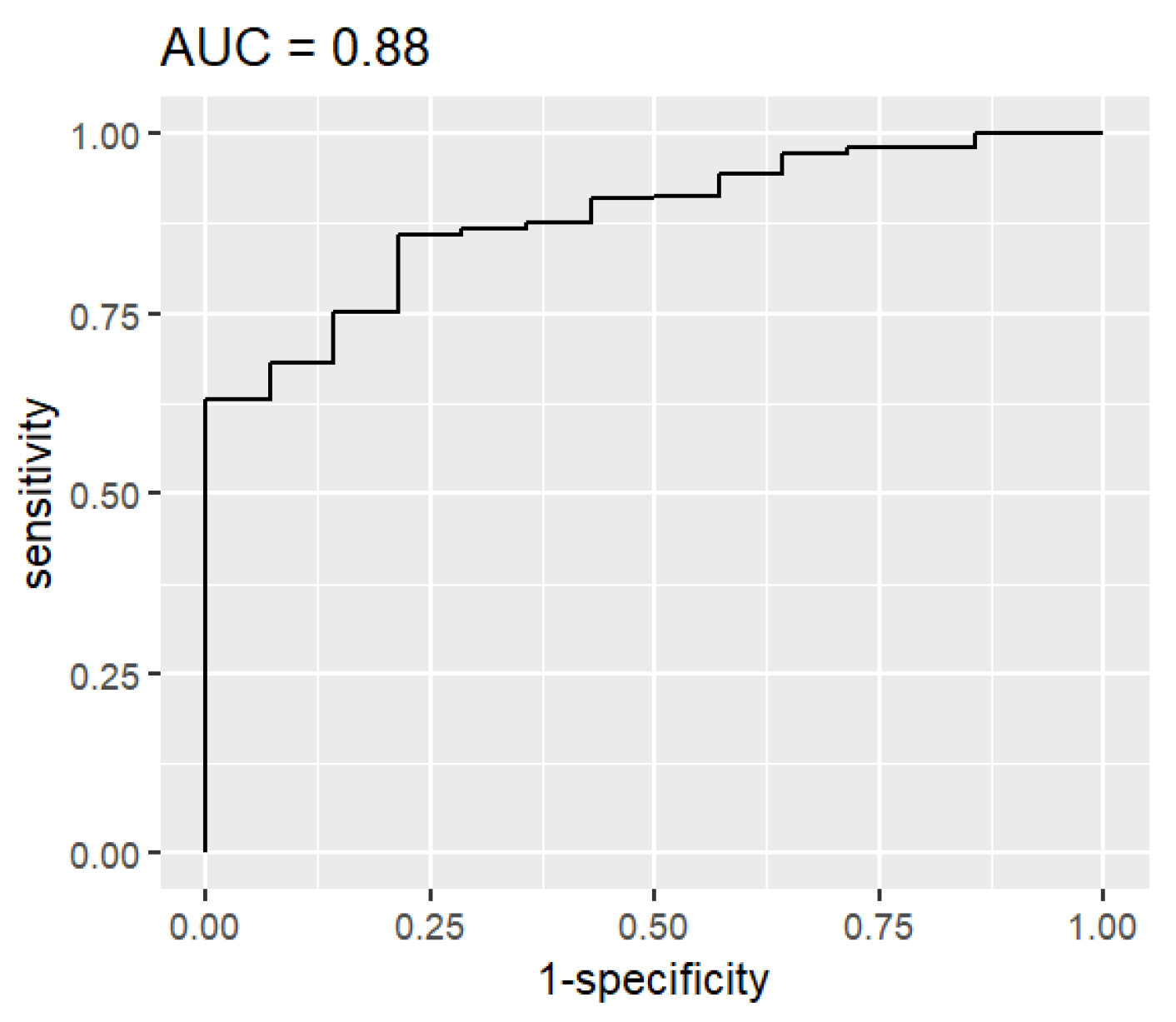
Figure A6.
AUC and ROC analysis for the final model. AUC, Area Under the Curve; ROC, Receiver Operating Characteristic curve.
Figure A6.
AUC and ROC analysis for the final model. AUC, Area Under the Curve; ROC, Receiver Operating Characteristic curve.
From the plot, the closer the ROC curve is to the upper left corner, the better the model.
The closer the AUC is to 1, the better the model.
Based on the ROC curve and the AUC, the final model is good to very good, is appropriate for the data, and is useful to predict whether a child is seropositive.
Appendix A.1.4. Variance Inflation Factors (VIFs) to Assess Multicollinearity
Table A8.
Variance inflation factors (VIFs) of variables in the final model.
Table A8.
Variance inflation factors (VIFs) of variables in the final model.
| Variables | VIF |
|---|
| Age of mother in years (centered) | 1.14 |
| Recruitment region | 1.20 |
| Household size | 1.20 |
| COVID-19-positive household contacts | 1.14 |
| Mother COVID-19 vaccination | 1.56 |
| Social activities of children during the COVID-19 pandemic | 1.73 |
| Use of mask by child in social activities | 1.11 |
| Distancing practice by child in social activities | 1.37 |
| COVID-19 diagnosis by healthcare provider | 1.22 |
Appendix A.1.5. Hosmer and Lemeshow Goodness of Fit Test
H0: there is no lack of fit
HA: there is lack of fit
Chi2 test is not statistically significant (p = 0.87), indicating no evidence of lack of fit.




 ,
,