Prevalence and Recovery of Euthyroid Sick Syndrome in Pediatric Diabetic Ketoacidosis: A Retrospective Cohort Study

 , , , , , , ,
Highlights
- Euthyroid sick syndrome was diagnosed in 61.5% of pediatric patients with diabetic ketoacidosis, with two distinct hormonal phenotypes: isolated low FT3 and combined low FT4 and FT3.
- After 2 weeks, all children had at least one thyroid hormone returned to normal, but only 38.4% showed complete normalization of FT3, and 36.6% reached normal values for all thyroid parameters.
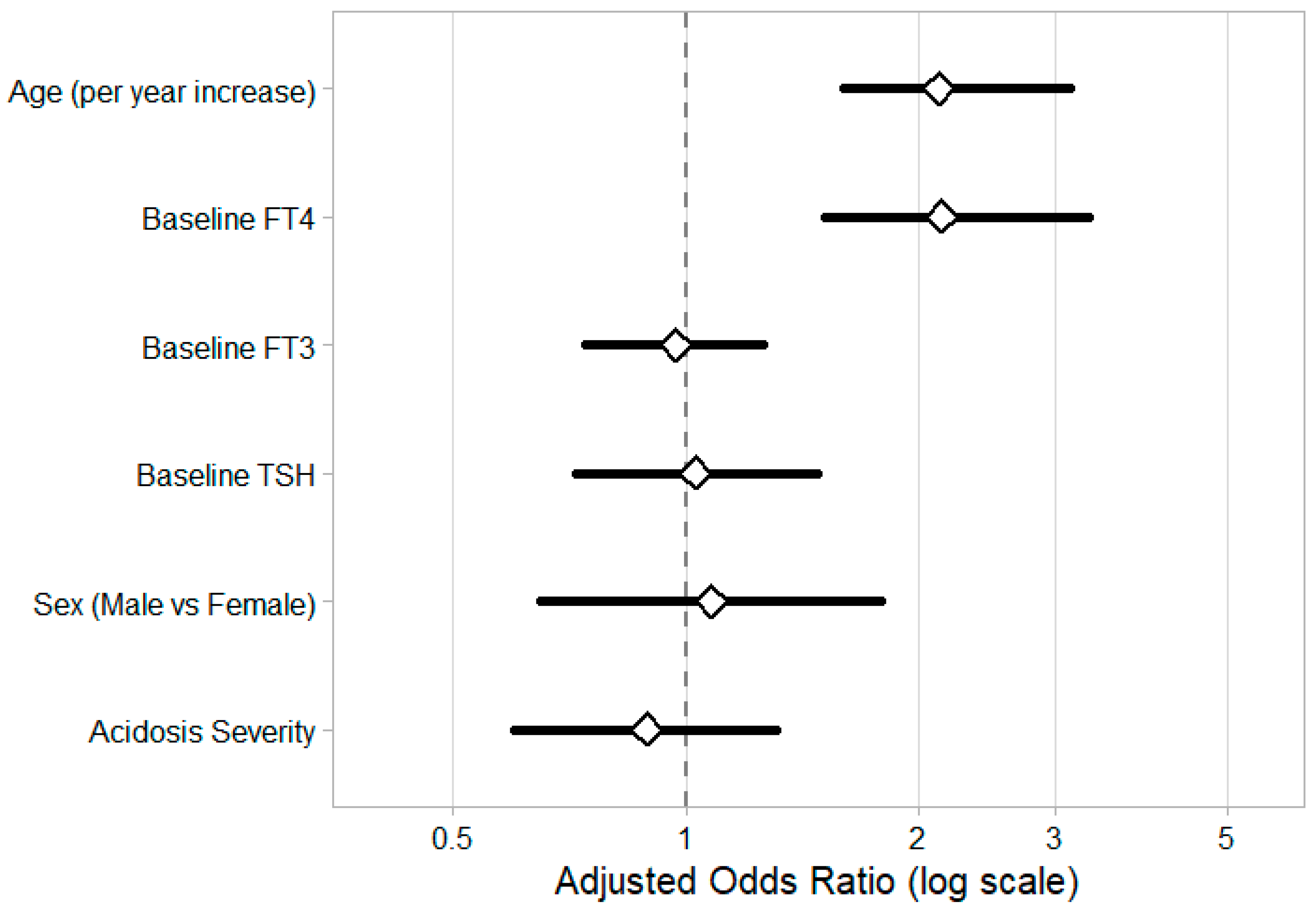
- Older age and higher baseline FT4 levels strongly predict complete thyroid recovery, highlighting key factors for early prognosis in pediatric ESS.
- Thyroid function tests during acute DKA should be interpreted cautiously, and follow-up testing is essential to avoid misdiagnosis or unnecessary hormone replacement.
Abstract
1. Introduction
2. Materials and Methods
2.1. Study Design
2.2. Study Population and Sample Size
2.3. Study Variables
2.4. Study Outcomes
2.5. Data Collection
2.6. Operational Definitions
- <1 year: TSH 0.8–8.2 mIU/L, FT4 11–23 pmol/L, FT3 5.5–10.0 pmol/L.
- 1–6 years: TSH 0.7–6.0 mIU/L, FT4 14–26 pmol/L, FT3 5.7–13.1 pmol/L.
- 7–12 years: TSH 0.6–5.0 mIU/L, FT4 13–23 pmol/L, FT3 4.5–10.0 pmol/L.
- ≥13 years: TSH 0.4–4.2 mIU/L, FT4 12–21 pmol/L, FT3 3.5–9.4 pmol/L.
- Low FT3: Isolated low FT3 with normal FT4
- Low FT3 and FT4: Low FT3 and low FT4
2.7. Ethical Approval
2.8. Statistical Analysis
3. Results
4. Discussion
4.1. Interpretation of the Main Study Findings
4.2. Implication of This Study
4.3. Limitations and Strengths
5. Conclusions
Author Contributions
Funding
Institutional Review Board Statement
Informed Consent Statement
Data Availability Statement
Acknowledgments
Conflicts of Interest
Abbreviations
| aOR | Adjusted Odds Ratio |
| BMI | Body Mass Index |
| CI | Confidence Interval |
| DKA | Diabetic Ketoacidosis |
| ESS | Euthyroid Sick Syndrome |
| FT3 | Free Triiodothyronine |
| FT4 | Free Thyroxine |
| HbA1c | Hemoglobin A1c |
| ICU | Intensive Care Unit |
| IQR | Interquartile Range |
| NTI | Nonthyroidal Illness |
| Q1 | First Quartile |
| Q3 | Third Quartile |
| SD | Standard Deviation |
| T1DM | Type 1 Diabetes Mellitus |
| T3 | Triiodothyronine |
| T4 | Thyroxine |
| TSH | Thyroid-Stimulating Hormone |
References
- Ganesan, K.; Anastasopoulou, C.; Wadud, K. Euthyroid Sick Syndrome. In StatPearls [Internet]; StatPearls: Treasure Island, FL, USA, 2022. Available online: https://www.ncbi.nlm.nih.gov/books/NBK482219/ (accessed on 24 November 2025).
- Evelein, A.M.V.; van der Pol, R.J.; van Wessel, K.; Hoetjer, M.; Dierselhuis, M.P.; van Santen, H.M. Nonthyroidal Illness Syndrome in a Noncritically Ill Child. Pediatrics 2025, 156, e2024069628. [Google Scholar] [CrossRef] [Scilit] [PubMed]
- Akbaş, T.; Şahin, I.E.; Öztürk, A. Alterations in thyroid hormones in brain-dead patients are related to non-thyroidal illness syndrome. Endokrynol. Pol. 2018, 69, 545–549. [Google Scholar] [CrossRef] [Scilit]
- Gutch, M.; Kumar, S.; Gupta, K.K. Prognostic Value of Thyroid Profile in Critical Care Condition. Indian J. Endocrinol. Metab. 2018, 22, 387–391. [Google Scholar] [CrossRef] [Scilit] [PubMed]
- Larissa, L. Advancing Diagnostic Criteria for Euthyroid Sick Syndrome in Critically Ill Patients. J. Thyroid. Disord. Ther. 2024, 13, 350. [Google Scholar]
- Maldonado, L.S.; Murata, G.H.; Hershman, J.M.; Braunstein, G.D. Do Thyroid Function Tests Independently Predict Survival in the Crit-ically Ill? Thyroid 1992, 2, 119–123. [Google Scholar] [CrossRef] [Scilit] [PubMed]
- de Vries, E.M.; Fliers, E.; Boelen, A. The molecular basis of the non-thyroidal illness syndrome. J. Endocrinol. 2015, 225, R67–R81. [Google Scholar] [CrossRef] [Scilit]
- Wang, B.; Liu, S.; Li, L.; Yao, Q.; Song, R.; Shao, X.; Li, Q.; Shi, X.; Zhang, J. Non-Thyroidal Illness Syndrome in Patients with Cardio-vascular Diseases: A Systematic Review and Meta-Analysis. Int. J. Cardiol. 2017, 226, 1–10. [Google Scholar] [CrossRef] [Scilit]
- Kakleas, K.; Soldatou, A.; Karachaliou, F.; Karavanaki, K. Associated Autoimmune Diseases in Children and Adolescents with Type 1 Diabetes Mellitus (T1DM). Autoimmun. Rev. 2015, 14, 781–797. [Google Scholar] [CrossRef] [Scilit]
- Rabbone, I.; Maltoni, G.; Tinti, D.; Zucchini, S.; Cherubini, V.; Bonfanti, R.; Scaramuzza, A. Diabetic ketoacidosis at the onset of disease during a national awareness campaign: A 2-year observational study in children aged 0–18 years. Arch. Dis. Child. 2019, 105, 363–366. [Google Scholar] [CrossRef] [Scilit]
- Katsarou, A.; Gudbjörnsdottir, S.; Rawshani, A.; Dabelea, D.; Bonifacio, E.; Anderson, B.J.; Jacobsen, L.M.; Schatz, D.A.; Lernmark, Å. Type 1 diabetes mellitus. Nat. Rev. Dis. Primers 2017, 3, 17016. [Google Scholar] [CrossRef] [Scilit]
- Blair, J.C.; Joseph, J.; Saroha, V.; Payne, H.; Paul, P.; Didi, M.; Isherwood, D.; Blair, J. Thyroid Function at Diagnosis of Type I Diabetes. Arch. Dis. Child. 2011, 96, 777–779. [Google Scholar] [CrossRef] [Scilit]
- Marzuillo, P.; Iafusco, D.; Guarino, S.; Di Sessa, A.; Zanfardino, A.; Piscopo, A.; Luongo, C.; Capalbo, D.; Verde, M.; Aiello, F.; et al. Euthyroid sick syndrome and its association with complications of type 1 diabetes mellitus onset. Pediatr. Res. 2023, 94, 632–642. [Google Scholar] [CrossRef] [Scilit] [PubMed]
- Hu, Y.-Y.; Li, G.-M.; Wang, W. Euthyroid sick syndrome in children with diabetic ketoacidosis. Saudi Med. J. 2015, 36, 243–247. [Google Scholar] [CrossRef] [Scilit] [PubMed]
- Kadiyala, R.; Peter, R.; Okosieme, O.E. Thyroid dysfunction in patients with diabetes: Clinical implications and screening strategies. Int. J. Clin. Pract. 2010, 64, 1130–1139. [Google Scholar] [CrossRef] [Scilit] [PubMed]
- Shao, P.; Guo, S.; Li, G.; Qin, D.; Li, S.; Luan, Y. Determinants of deranged thyroid function parameters in children admitted for management of diabetic ketoacidosis/diabetic ketosis. BMC Endocr. Disord. 2020, 20, 135. [Google Scholar] [CrossRef] [Scilit]
- Casaer, M.P.; Mesotten, D.; Hermans, G.; Wouters, P.J.; Schetz, M.; Meyfroidt, G.; Van Cromphaut, S.; Ingels, C.; Meersseman, P.; Muller, J.; et al. Early versus late parenteral nutrition in critically ill adults. N. Engl. J. Med. 2011, 365, 506–517. [Google Scholar] [CrossRef] [Scilit]
- Langouche, L.; Perre, S.V.; Marques, M.; Boelen, A.; Wouters, P.J.; Casaer, M.P.; Berghe, G.V.D. Impact of early nutrient restriction during critical illness on the nonthyroidal illness syndrome and its relation with outcome: A randomized, controlled clinical study. J. Clin. Endocrinol. Metab. 2013, 98, 1006–1013. [Google Scholar] [CrossRef] [Scilit]
- Peeters, R. Non thyroidal illness: To treat or not to treat? Ann. Endocrinol. 2007, 68, 224–228. [Google Scholar] [CrossRef] [Scilit]
- Rashidi, H.; Ghaderian, S.B.; Latifi, S.M.; Hoseini, F. Impact of diabetic ketoacidosis on thyroid function tests in type 1 diabetes mellitus patients. Diabetes Metab. Syndr. Clin. Res. Rev. 2017, 11, S57–S59. [Google Scholar] [CrossRef] [Scilit]
- Wolfsdorf, J.; Glaser, N.; Sperling, M.A. Diabetic Ketoacidosis in Infants, Children, and AdolescentsA consensus statement from the American Diabetes Association. Diabetes Care 2006, 29, 1150–1159. [Google Scholar] [CrossRef]
- Üstüntaş, T.; Atabek, M.E.; Eklioğlu, B.S.; Dibeklioğlu, S.E. Transient Thyroid Dysfunction in New-Onset Type 1 Diabetes: Reassessing Test Timing for Accurate Results. Turk. Arch. Pediatr. 2025, 60, 153–158. [Google Scholar] [CrossRef] [Scilit] [PubMed]
- Deng, X.-Y.; Yi, M.; Li, W.-G.; Ye, H.-Y.; Chen, Z.-S.; Zhang, X.-D. The prevalence, hospitalization outcomes and risk factors of euthyroid sick syndrome in patients with diabetic ketosis/ketoacidosis. BMC Endocr. Disord. 2023, 23, 195. [Google Scholar] [CrossRef] [Scilit] [PubMed]
- Clemens, K.; Payne, W.; Van Uum, S.H.M. Central hypothyroidism. Indian J. Endocrinol. Metab. 2011, 15, S99. [Google Scholar] [CrossRef] [Scilit] [PubMed]
- Marik, P.E.; Bellomo, R. Stress Hyperglycemia: An Essential Survival Response! Crit. Care 2013, 17, 305. [Google Scholar] [CrossRef] [Scilit]
- Iwamoto, Y.; Kimura, T.; Tatsumi, F.; Sugisaki, T.; Kubo, M.; Nakao, E.; Dan, K.; Wamata, R.; Iwamoto, H.; Takahashi, K.; et al. Effect of Hyperglycemia-Related Acute Metabolic Disturbance on Thyroid Function Parameters in Adults. Front. Endocrinol. 2022, 13, 869869. [Google Scholar] [CrossRef] [Scilit]
- The Role of Thyroid Dysfunction in the Critically Ill: A Review of the Literature. Available online: https://pubmed.ncbi.nlm.nih.gov/20935602/ (accessed on 29 November 2025).
- Warner, M.H.; Beckett, G.J. Mechanisms behind the Non-Thyroidal Illness Syndrome: An Update. J. Endocrinol. 2010, 205, 1–13. [Google Scholar] [CrossRef] [Scilit]
- El-Ella, S.S.A.; El-Mekkawy, M.S.; El-Dihemey, M.A. Prevalence and Prognostic Value of Non-Thyroidal Illness Syndrome among Criti-cally Ill Children. An. De Pediatría (Engl. Ed.) 2019, 90, 237–243. [Google Scholar] [CrossRef] [Scilit]
- Yang, W.; Sheng, F. Factors Associated with Thyroid Dysfunction in Children with Newly Diagnosed Type 1 Diabetes Mellitus. Minerva Pediatr. 2021, 73, 324–329. [Google Scholar] [CrossRef] [Scilit]
- Xing, Y.; Chen, J.; Song, G.; Zhao, L.; Ma, H. Impact of Diabetic Ketoacidosis on Thyroid Function in Patients with Diabetes Mellitus. Int. J. Endocrinol. 2021, 2021, 2421091. [Google Scholar] [CrossRef] [Scilit]
- Fastiggi, M.; Meneghel, A.; Doblas, J.G.d.R.; Vittadello, F.; Tirelli, F.; Zulian, F.; Martini, G. Prognostic role of euthyroid sick syndrome in MIS-C: Results from a single-center observational study. Front. Pediatr. 2023, 11, 1217151. [Google Scholar] [CrossRef] [Scilit]



| Variable | Level/Statistic | Overall (N = 182) |
|---|---|---|
| Age (years) | Mean ± SD | 11.3 ± 4.3 |
| 4 years or less | 22 (12.1%) | |
| 5–9 years | 28 (15.4%) | |
| 10–14 years | 84 (46.2%) | |
| 15–18 years | 48 (26.4%) | |
| Sex | Female | 84 (46.2%) |
| Male | 98 (53.8%) | |
| BMI (kg/m2) | Mean ± SD | 18.8 ± 3.1 |
| Underweight (<5th percentile) | 16 (8.8%) | |
| Normal weight (5th–84th percentile) | 122 (67.0%) | |
| Overweight (85th–94th percentile) | 28 (15.4%) | |
| Obese (≥95th percentile) | 16 (8.8%) | |
| Blood glucose | Mean ± SD | 482.7 ± 68.5 |
| HbA1C | Mean ± SD | 11.5 ± 1.5 |
| Moderate (HbA1c 7–8.9%), | 4 (3.6%) | |
| Poor (HbA1c ≥ 9%) | 108 (96.4%) | |
| Acidosis severity | Mild/Moderate | 92 (82.1%) |
| Severe | 20 (17.9%) | |
| Euthyroid sick syndrome | 112 (61.5%) | |
| Variable | Isolated Low FT3 (N = 40) | Low FT4 and FT3 (N = 72) | p-Value |
|---|---|---|---|
| Hormonal pattern at presentation | |||
| TSH (normal), n (%) | 40 (100%) | 72 (100%) | — |
| Free T4 (normal), n (%) | 40 (100%) | 0 (0%) | — |
| Free T4 (low), n (%) | 0 (0%) | 72 (100%) | — |
| Free T3 (low), n (%) | 40 (100%) | 72 (100%) | — |
| Demographic characteristics | |||
| Age (years), median [Q1, Q3] | 9.50 [3.50, 11.00] | 12.00 [8.50, 14.00] | 0.004 |
| Female sex, n (%) | 14 (35.0%) | 34 (47.2%) | 0.30 |
| Male sex, n (%) | 26 (65.0%) | 38 (52.8%) | |
| Weight (kg), median [Q1, Q3] | 26.00 [15.00, 35.00] | 33.50 [27.00, 45.50] | 0.001 |
| Glycemic parameters | |||
| HbA1c (%), median [Q1, Q3] | 12.0 [10.4, 12.6] | 11.3 [10.3, 12.4] | 0.20 |
| Baseline glucose (mg/dL), median [Q1, Q3] | 502.0 [444.0, 571.5] | 462.0 [430.0, 518.5] | 0.04 |
| Thyroid function at presentation | |||
| TSH (mIU/L), median [Q1, Q3] | 2.3 [1.6, 3.0] | 1.2 [0.9, 2.4] | <0.001 |
| FT4 (pmol/L), median [Q1, Q3] | 14.6 [14.0, 15.7] | 11.0 [10.4, 12.0] | <0.001 |
| FT3 (pmol/L), median [Q1, Q3] | 2.8 [2.4, 4.0] | 2.3 [1.9, 2.8] | 0.001 |
| Follow-up thyroid parameters (2 weeks) | |||
| Follow-up FT3 (pmol/L), median [Q1, Q3] | 4.80 [4.20, 5.10] | 4.00 [3.10, 4.30] | <0.001 |
| FT3 change (pmol/L), median [Q1, Q3] | 1.30 [0.80, 2.10] | 0.90 [0.55, 2.30] | 0.40 |
| Parameter | Overall (N = 112) | Isolated Low FT3 (N = 40) | Low FT4 and FT3 (N = 72) | Baseline Median [Q1, Q3] | Follow-up Median [Q1, Q3] | Absolute Change Median [Q1, Q3] | % Change Median [Q1, Q3] |
|---|---|---|---|---|---|---|---|
| TSH remained normal, n (%) | 112 (100.0%) | 40 (100.0%) | 72 (100.0%) | 1.75 [1.10, 2.90] | 2.20 [1.55, 3.10] | 0.40 [0.20, 0.75] | 25.23 [6.57, 58.61] |
| FT4 normalized, n (%) | 88 (78.6%) | 40 (100.0%) | 48 (66.7%) | 12.00 [10.65, 14.05] | 13.90 [12.70, 14.90] | 1.35 [0.60, 2.30] | 10.64 [4.26, 21.60] |
| FT3 normalized, n (%) | 43 (38.4%) | 19 (47.5%) | 24 (33.3%) | 2.40 [1.95, 3.40] | 4.10 [3.40, 4.85] | 1.20 [0.60, 2.15] | 46.30 [23.86, 93.66] |
| Any parameter normalized, n (%) | 112 (100.0%) | 40 (100.0%) | 72 (100.0%) | — | — | — | — |
| All parameters normalized, n (%) | 41 (36.6%) | 19 (47.5%) | 22 (30.6%) | — | — | — | — |
| Variable | Mild/Moderate DKA (n = 92) | Severe DKA (n = 20) | p-Value |
|---|---|---|---|
| TSH at diagnosis (mIU/L) | 2.0 [1.1, 2.9] | 1.6 [0.9, 2.4] | 0.3 |
| FT4 at diagnosis (pmol/L) | 12.3 [11.0, 14.1] | 11.2 [9.8, 12.9] | 0.056 |
| FT3 at diagnosis (pmol/L) | 2.4 [2.1, 3.0] | 2.5 [1.9, 3.9] | 0.9 |
| FT4 normalized | 78 (84.8%) | 10 (50.0%) | 0.002 |
| FT3 normalized | 39 (42.4%) | 4 (20.0%) | 0.078 |
| FT4 change (pmol/L) | 1.3 [0.6, 2.1] | 2.3 [0.7, 3.8] | 0.035 |
| FT3 change (pmol/L) | 1.3 [0.8, 2.3] | 0.7 [0.2, 1.2] | 0.039 |
| Age (years) | 10.5 [7.0, 14.0] | 9.5 [5.0, 12.0] | 0.14 |
| HbA1c (%) | 11.4 [10.3, 12.4] | 12.0 [10.8, 12.8] | 0.2 |
| Glucose at Diagnosis (mg/dL) | 456.0 [429.0, 511.0] | 529.0 [517.0, 610.0] | <0.001 |
Disclaimer/Publisher’s Note: The statements, opinions and data contained in all publications are solely those of the individual author(s) and contributor(s) and not of MDPI and/or the editor(s). MDPI and/or the editor(s) disclaim responsibility for any injury to people or property resulting from any ideas, methods, instructions or products referred to in the content. |
© 2026 by the authors. Licensee MDPI, Basel, Switzerland. This article is an open access article distributed under the terms and conditions of the Creative Commons Attribution (CC BY) license.
Share and Cite
Alqahtani, Y.A.; Shati, A.A.; Alshaikh, A.A.; Raffaa, A.S.M.; Alqahtani, A.S.; Abdullah Saeed Alshahrani, F.; Alshahrani, M.F.N.; Al-Sultan, M.A.; Alotaibi, A.S.; Alshahrani, Y.S.; et al. Prevalence and Recovery of Euthyroid Sick Syndrome in Pediatric Diabetic Ketoacidosis: A Retrospective Cohort Study. Children 2026, 13, 296. https://doi.org/10.3390/children13020296
Alqahtani YA, Shati AA, Alshaikh AA, Raffaa ASM, Alqahtani AS, Abdullah Saeed Alshahrani F, Alshahrani MFN, Al-Sultan MA, Alotaibi AS, Alshahrani YS, et al. Prevalence and Recovery of Euthyroid Sick Syndrome in Pediatric Diabetic Ketoacidosis: A Retrospective Cohort Study. Children. 2026; 13(2):296. https://doi.org/10.3390/children13020296
Chicago/Turabian StyleAlqahtani, Youssef A., Ayed A. Shati, Ayoub A. Alshaikh, Abdullah Saeed Mohammed Raffaa, Abdulaziz Saeed Alqahtani, Fahad Abdullah Saeed Alshahrani, Mohammed Fahad Nasser Alshahrani, Mohammed Abdulrahman Al-Sultan, Abdulaziz Saud Alotaibi, Yazeed Sultan Alshahrani, and et al. 2026. "Prevalence and Recovery of Euthyroid Sick Syndrome in Pediatric Diabetic Ketoacidosis: A Retrospective Cohort Study" Children 13, no. 2: 296. https://doi.org/10.3390/children13020296
APA StyleAlqahtani, Y. A., Shati, A. A., Alshaikh, A. A., Raffaa, A. S. M., Alqahtani, A. S., Abdullah Saeed Alshahrani, F., Alshahrani, M. F. N., Al-Sultan, M. A., Alotaibi, A. S., Alshahrani, Y. S., & Ghazy, R. M. (2026). Prevalence and Recovery of Euthyroid Sick Syndrome in Pediatric Diabetic Ketoacidosis: A Retrospective Cohort Study. Children, 13(2), 296. https://doi.org/10.3390/children13020296