Between Steps and Emotions: Folk Dance as a Promoter of Youth Well-Being


Highlights
- School folk dance promotes the emotional well-being of children and adolescents, generating positive emotions, self-esteem, and psychological balance through movement.
- Students perceive folk dance not only as an artistic activity but also as a space for bodily and cultural expression that fosters identity, social cohesion, and self-confidence.
- Systematically incorporating folk dance into physical education can strengthen students’ mental health, motivation, and meaningful learning.
- Folk dance emerges as an integral pedagogical strategy that combines movement, emotion, and culture to promote youth well-being.
Abstract
1. Introduction
1.1. Personal Well-Being
1.2. Coordinative and Physical Abilities
2. Materials and Methods
- “What are the reasons that led you to choose to dance folk dances?”
- “What do you think is the relationship between folk dances and a country’s history?”
- “How important is it to you whether a Chilean folk dance is or is not related to politics?”
- “What do you feel when you dance folk dances?”
- Emotions and sensations experienced while dancing folklore (directly derived from Question 4, the core of the study).
- Personal perception of participation in the activity (related to Question 1).
- Value and meaning attributed to folk dance (articulated through Questions 1, 2, and 3).
- Relevance of folklore in school and everyday life, including cultural and identity aspects (Question 2 and part of Question 3).
- Content review by the research team.
- Discussion of the semantic relevance of each question.
- Direct alignment with the research question.
- Data Saturation.
- Emotional well-being.
- Cultural meaning of dances.
- Subjective experiences.
- Bodily expression.
- Potential interpretive biases.
- Alignment between emerging categories and original data.
- Coherence between the applied questions and the study objectives.
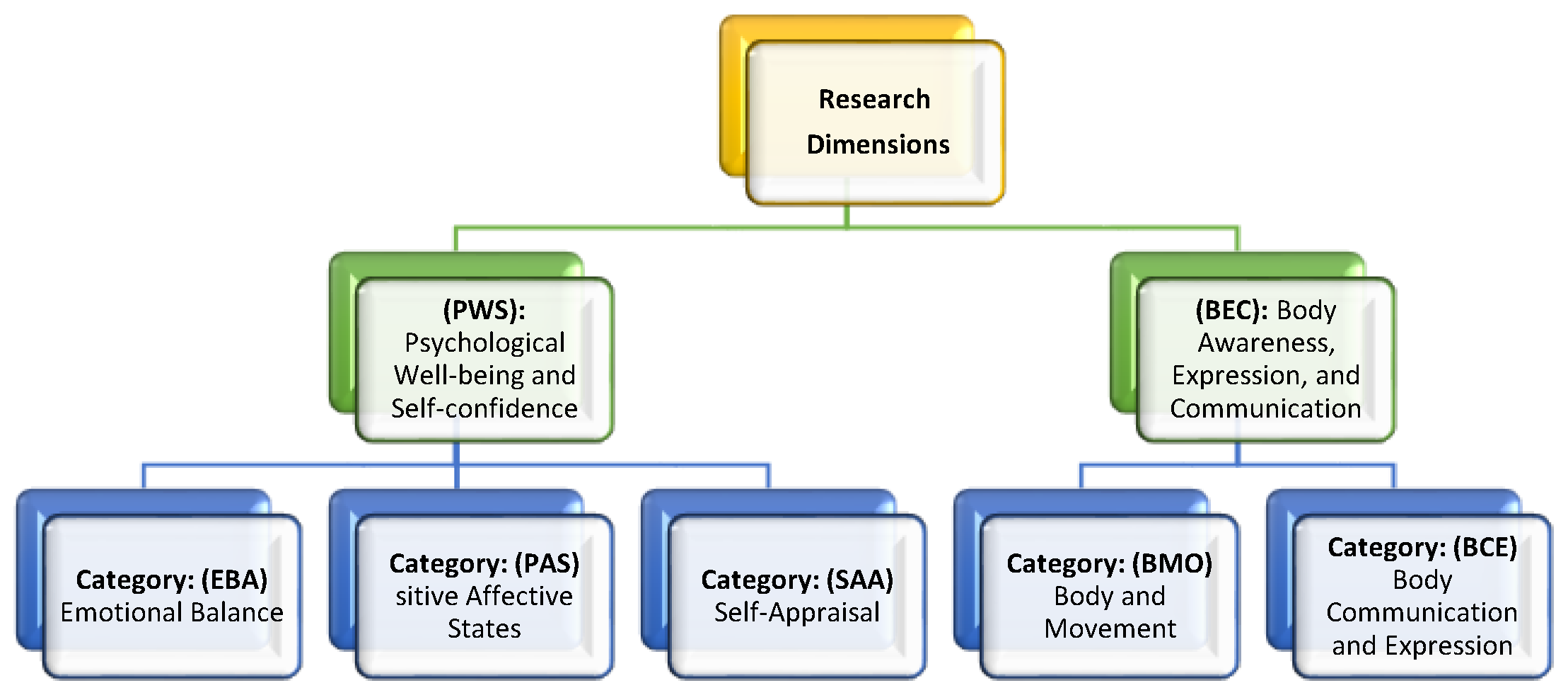
2.1. Presentation of the Dimensions and Categories
2.1.1. Dimension 1: Psychological Well-Being and Self-Confidence (PWS)
Example: “It clears my mind from everything bad that has happened during the week. Dancing clears me from it all.”
Example: “Dancing makes me feel like a spark inside… It fills me. That spark starts to generate warmth, and what it really produces is happiness.”
Example: “I feel really beautiful when I dance folklore.”
2.1.2. Dimension 2: Body Awareness, Expression, and Communication (CEC)
Example: “Because it’s exercise and because I’ve always liked it—for obvious reasons.”
Example: “I believe that dancing expresses much more than words could ever say.”
3. Results
3.1. Dimension: Psychological Well-Being and Self-Confidence (PWS)
3.2. Dimension: Body Awareness, Expression, and Communication (CEC)
4. Discussion
4.1. Dimensions
Example: “Honestly, I feel really happy. I’ve always loved it since I was little, so I always feel happy, and I think I’ll always be happy dancing this.”
Example: “I feel good; it makes me forget about everything—all the problems I go through. It’s like a way to de-stress. And especially with my group, when I feel really down, I come here, and they always make me smile. So, it’s awesome.”
Example: “Emotion, happiness, love too—freedom of expression. Because I feel that through dance, I can express myself maybe not by talking, but by dancing.”
Example: “I feel really good, I’m beautiful, I see something I like, and it makes me happy.”
Example: “Happiness, and maybe a sense of release from the burdens one carries in school life. Peace—it’s like a way to relax.”
Example: “Liberation. I feel like I can free myself and express what I feel through movement and dance in general joy.”
4.2. Categories Corresponding to the “Psychological Well-Being and Self-Confidence (PWS)” Dimension: Positive Affective States (PAS), Emotional Balance (EBA), and Self-Appreciation (SAA)
4.3. Categories Corresponding to the “Body Awareness, Expression, and Communication (BCE)” Dimension: Body and Movement (BMO) and Bodily Communication and Expression (BCE)
Example: “Because of the exercise, and because I’ve always liked it—for obvious reasons.”
5. Conclusions
Author Contributions
Funding
Institutional Review Board Statement
Informed Consent Statement
Data Availability Statement
Conflicts of Interest
Abbreviations
| PWS | Psychological Well-being and Self-confidence |
| EBA | Emotional Balance |
| PAS | Positive Affective States |
| SAA | Self-appreciation |
| CEC | Body Awareness, Expression, and Communication |
| BMO | Body and Movement |
| BCE | Body Communication and Expression |
References
- Egorov, M.; Zakharova, G.; Olesova, S.; Neustroeva, A.; Yakovleva, A. Folk dance as a means of preserving and transmitting the worldview and way of life. In Advances in Social Science, Education and Humanities Research, Proceedings of the International Conference on Man-Power-Law-Governance: Interdisciplinary Approaches (MPLG-IA 2019), Moscow, Russia, 24–25 September 2019; Atlantis Press: Dordrecht, The Netherlands, 2019; Volume 298, pp. 383–386. [Google Scholar] [CrossRef] [Scilit]
- Liu, W.; Xue, H.; Wang, Z.Y. A systematic comparison of intercultural and indigenous cultural dance education from a global perspective (2010–2024). Front. Psychol. 2024, 15, 1-18. [Google Scholar] [CrossRef] [Scilit] [PubMed]
- Daryanti, F.; Mustika, I.W.; Rahayuningtyas, W.; Mustofa, H. The role of traditional dance education in children’s learning: A systematic literature review. J. Curric. Stud. Res. 2025, 7, 140–154. [Google Scholar] [CrossRef] [Scilit]
- Talpă, S. Folk dance in the educational process. Arta 2023, 32, 72–76. [Google Scholar] [CrossRef] [Scilit]
- Chen, H. Analysis of the impact of learning folk dance on college students. J. Educ. Teach. Soc. Stud. 2023, 5, 97–102. [Google Scholar] [CrossRef] [Scilit]
- Urra-López, K.; Farías, M.M.; Riquelme-Uribe, D. Didactic components of digital folklore and their impact on physical education and health classes. EmásF. Rev. Digit. Educ. Fís 2024, 15, 54–67. [Google Scholar]
- Reyes, E.R.M.; Macías, B.A.M. El folklore desde la educación física. Cienciamatria 2024, 10, 8. [Google Scholar] [CrossRef] [Scilit]
- Holquist, S.E. What is student voice anyway? The intersection of student leadership and identity. Educ. Adm. Q. 2023, 59, 703–743. [Google Scholar] [CrossRef] [Scilit]
- Deafenbaugh, L. Folklife education: A warm welcome schools extend to communities. J. Folk. Educ. 2015, 2, 76–83. [Google Scholar]
- Wang, Q.; Xue, M. The implications of expectancy–value theory of motivation in language education. Front. Psychol. 2022, 13, 992372. [Google Scholar] [CrossRef] [Scilit]
- Schoeffel, P.; Ramos, V.F.C.; Cechinel, C.; Wazlawick, R.S. The Expectancy-Value-Cost Light Scale to measure motivation of students in computing courses. Inform. Educ. 2022, 21, 91–111. [Google Scholar] [CrossRef] [Scilit]
- Jochum, E.; Egholm, D.; Oliveira, A.S.; Jacobsen, S.L. The effects of folk dance in schools on physical and mental health for at-risk adolescents: A pilot intervention study. Front. Sports Act. Living 2024, 6, 1434661. [Google Scholar] [CrossRef] [Scilit]
- Lobo, J. Do our folk dances still thrive? Personal Experience and Interest of Students Towards Philippine Traditional Dances as Basis on Strengthening the Love for Culture and the Arts. Am. J. Arts Hum. Sci. 2022, 1, 27–33. [Google Scholar] [CrossRef] [Scilit]
- Rannau-Garrido, J.P.; Contreras-Olivares, M. Sobre la didáctica de las danzas folklóricas en el contexto escolar chileno: Aproximaciones desde una experiencia de Aprendizaje Servicio. Rev. Estud. Exper Educ. 2024, 23, 32–50. [Google Scholar] [CrossRef] [Scilit]
- Urra-López, K.; Tandrón-Negrín, B.; Riquelme-Uribe, D. ¿Y dónde quedaron las danzas folclóricas? Una mirada crítica sobre los Estándares Profesionales para Educación Física y Salud. J. Mov. Health 2023, 20, 1–3. [Google Scholar] [CrossRef] [Scilit]
- Buyrukoğlu, E.; Karademir, M.B.; Yetkin, M. Examination of attitudes of individuals playing folk dances toward folk dances. Mediterr. J. Sport. Sci. 2024, 7, 170–181. [Google Scholar] [CrossRef] [Scilit]
- Matos-Duarte, M.; Smith, E.; Muñoz Moreno, A. Danzas folclóricas: Una forma de aprender y educar desde la perspectiva sociocultural. Retos 2020, 38, 739–744. [Google Scholar] [CrossRef] [Scilit]
- Marcen, C.; Monserrat-Revillo, S.; Martínez-Domínguez, E. Benefits of dance for youth well-being: Comparison with athletes and sedentary. Eur. J. Hum. Mov. 2024, 53, 114–130. [Google Scholar] [CrossRef] [Scilit]
- Soares, R.A.S.; Silva, C.M.; Queiroz, D.P.; Santos, S.R.; Miranda, T.F.L. Danza, psicomotricidad y educación infantil: Revisão de literatura e considerações para uma educação física escolar significativa. Res. Soc. Dev. 2021, 10, 1–13. [Google Scholar] [CrossRef] [Scilit]
- González-Devesa, D.; Blanco-Martínez, N.; Varela, S.; Ayán-Pérez, C. Effects of dance programs on fundamental motor skills in preschool children: A systematic review and meta-analysis. J. Dance Med. Sci 2025. [Google Scholar] [CrossRef] [Scilit]
- Jo, J.H.; Lee, S. Perception of PE teachers on folk dance as expressive activity. J. Humanit. Soc. Sci. 2022, 13, 2179–2193. [Google Scholar] [CrossRef] [Scilit]
- De Souza, A.C.C.; Telles, S.C.C. A percepção de professores de Educação Física sobre uma escrita curricular culturalmente orientada. Res. Soc. Dev. 2021, 10, 1–15. [Google Scholar] [CrossRef] [Scilit]
- Miles, M.B.; Huberman, A.M.; Saldaña, J. Qualitative Data Analysis: A Methods Sourcebook, 3rd ed.; SAGE Publications: Thousand Oaks, CA, USA, 2014. [Google Scholar]
- Hanna, J.L. A nonverbal language for imagining and learning: Dance education in K–12 curriculum. Educ. Res. 2008, 37, 491–506. [Google Scholar] [CrossRef] [Scilit]
- Ravn, S. Embodied learning in physical activity: Developing skills and attunement to interaction. Front. Sports Act. Living 2022, 4, 795733. [Google Scholar] [CrossRef] [Scilit]
- Cuervo-Zapata, J.J.; González-Palacio, E.V. Estado del conocimiento científico sobre la danza en educación física. Pedagog. Saberes 2024, 61, 108–123. [Google Scholar] [CrossRef] [Scilit]
- Kurutz, Y.P.F.; Hülse, L.; Bonin, J.C. Folklore em forma de role-playing game. Extens Foco 2020, 8, 131–151. [Google Scholar] [CrossRef] [Scilit]
- Koch, S.C.; Riege, R.F.; Tisborn, K.; Biondo, J.; Martin, L.; Beelmann, A. Effects of dance movement therapy and dance on health-related psychological outcomes: A meta-analysis update. Front. Psychol. 2019, 10, 1806. [Google Scholar] [CrossRef] [Scilit]
- Roca-Amat, A.; García-Alandete, J. Psychological benefits of dance: A systematic review. Clin. Salud 2024, 35, 1–13. [Google Scholar] [CrossRef] [Scilit]
- Kleppang, A.L.; Steigen, A.M.; Finbråten, H.S. Explaining variance in self-efficacy among adolescents: The association between mastery experiences, social support, and self-efficacy. BMC Public Health 2023, 23, 2-10. [Google Scholar] [CrossRef] [Scilit]
- Harris, M.A.; Orth, U. The Link Between Self-Esteem and Social Relationships: A Meta-Analysis of Longitudinal Studies. J. Pers. Soc. Psychol. 2020, 119, 1459–1477. [Google Scholar] [CrossRef] [Scilit]
- Conesa, E. Las danzas del mundo como herramienta formativa. Trances 2017, 9, 747–780. [Google Scholar]
- Laban, R. El Dominio del Movimiento; Paidós: Barcelona, Spain, 2011. [Google Scholar]
- Torrents, C.; Castañer, M. La expresión corporal en la educación física. Retos 2016, 29, 238–243. [Google Scholar] [CrossRef]
- Urrea-Giraldo, J.E.; Hernández-Carvajal, A.M. Danzas autóctonas del Eje Cafetero. Calle 14 2024, 20, 13–34. [Google Scholar] [CrossRef] [Scilit]
- Gómez-Torres, D.; Ruiz-Montero, P.J.; González-Valero, G. Dance and physical education: Benefits for adolescents’ motor development. Int. J. Environ. Res. Public Health 2023, 20, 1439. [Google Scholar]
- Fredricks, J.A.; Bohnert, A.; Burdick, K. Extracurricular participation and youth development. Child. Dev. Perspect. 2019, 13, 144–150. [Google Scholar] [CrossRef] [Scilit]
- Immordino-Yang, M.H.; Damasio, A. We feel, therefore we learn: The relevance of affective and social neuroscience to education. Mind Brain Educ. 2007, 1, 3–10. [Google Scholar] [CrossRef] [Scilit]
- Goldberg, H.; Ochsner, K.N.; Phelps, E.A. Growing brains, nurturing minds. Front. Educ. 2022, 7, 977514. [Google Scholar] [CrossRef] [Scilit]


| Dimensions | Frequency | Percentage of Occurrence (n = 285) |
|---|---|---|
| Psychological Well-being and Self-confidence (PWS) | 243 | 85.30% |
| Physical Exercise, Expression, and Body Communication (CEC) | 42 | 14.70% |
| Psychological Well-Being and Self-Confidence (PWS) | Frequency | Percentage of Occurrence (n = 243) |
|---|---|---|
| Category: Emotional Balance (EBA) | 25 | 10.3% |
| Category: Positive Affective States (PAS) | 199 | 81.9% |
| Category: Self-Appreciation (SAA) | 19 | 7.9% |
| Body Awareness, Expression, and Communication (CEC) | Frequency | Percentage of Occurrence (n = 42) |
|---|---|---|
| Category: Body and Movement (BMO) | 15 | 35.7% |
| Category: Body Communication and Expression (BCE) | 27 | 64.3% |
Disclaimer/Publisher’s Note: The statements, opinions and data contained in all publications are solely those of the individual author(s) and contributor(s) and not of MDPI and/or the editor(s). MDPI and/or the editor(s) disclaim responsibility for any injury to people or property resulting from any ideas, methods, instructions or products referred to in the content. |
© 2026 by the authors. Licensee MDPI, Basel, Switzerland. This article is an open access article distributed under the terms and conditions of the Creative Commons Attribution (CC BY) license.
Share and Cite
Urra-López, K.; Coronado-Reyno, C.; Reyno-Freundt, A. Between Steps and Emotions: Folk Dance as a Promoter of Youth Well-Being. Children 2026, 13, 211. https://doi.org/10.3390/children13020211
Urra-López K, Coronado-Reyno C, Reyno-Freundt A. Between Steps and Emotions: Folk Dance as a Promoter of Youth Well-Being. Children. 2026; 13(2):211. https://doi.org/10.3390/children13020211
Chicago/Turabian StyleUrra-López, Karen, Catalina Coronado-Reyno, and Alda Reyno-Freundt. 2026. "Between Steps and Emotions: Folk Dance as a Promoter of Youth Well-Being" Children 13, no. 2: 211. https://doi.org/10.3390/children13020211
APA StyleUrra-López, K., Coronado-Reyno, C., & Reyno-Freundt, A. (2026). Between Steps and Emotions: Folk Dance as a Promoter of Youth Well-Being. Children, 13(2), 211. https://doi.org/10.3390/children13020211