Systematic Review

Health Implications of Radon Exposure Among Children: A Systematic Review
Faculty of Health Sciences, Department of Environmental Health, University of Johannesburg, Doornfontein Campus, P.O. Box 524, Johannesburg 2006, South Africa
*
Author to whom correspondence should be addressed.
Children 2026, 13(2), 208; https://doi.org/10.3390/children13020208
Submission received: 10 December 2025 / Revised: 11 January 2026 / Accepted: 15 January 2026 / Published: 31 January 2026
(This article belongs to the Section Pediatric Pulmonary and Sleep Medicine)

Highlights

What are the main findings?
  • Childhood radon exposure is linked to lung cancer, as evidenced by adult dose–response cohorts indicating a projected risk increase of 10–20%.
  • Some measurable inflammatory markers, cytogenetic changes, and epigenetic reprogramming were identified as early indicators of radon-induced biological stress in children.
What are the implication of the main findings?
  • Early exposure functions as a latent trigger within the multistage carcinogenic progression of lung cancer, consistent with radiation epidemiology models where the incidence rate correlates with the early cumulative dose.
  • Biological responses to radon exposure occur significantly prior to the clinical manifestation of malignancy, indicating that alpha-particle radiation induces a continuum of molecular injury that bridges disease onset. This highlights the importance of incorporating molecular biomarkers into radon exposure risk assessment frameworks.

Abstract

Background: Radon exposure has been recognised as a risk factor for developing lung cancer and other health issues. The mutagenic changes associated with long-term radon exposure take 10–30 years to manifest, which may lead to a lower observed incidence of lung cancer in children. Children are more vulnerable to radon exposure and its effects due to their smaller lung capacity and faster breathing rates, resulting in greater radon inhalation. Objective: The aim of the study is to present current evidence on the association between radon exposure and health effects among children. Methodology: We conducted a systematic review of the available literature on radon exposure and its health impacts, focusing on children. A preliminary literature scoping was conducted in CINAHL, PubMed, Google Scholar, and ScienceDirect. Some of the search terms included: “children” OR “health” OR “implications” OR “radon” OR “exposure”. Subsequently, a comprehensive search was conducted, covering quantitative studies in EBSCOhost across all selected databases. The review adhered to the 27-item PRISMA (Preferred Reporting Items for Systematic Reviews and Meta-Analyses) checklist. The quality of the evidence gathered was assessed using the Grading of Recommendations Assessment, Development and Evaluation (GRADE) tool. The study was registered with PROSPERO under the ID: CRD420251269394. The review analysed 26 studies, all published between 1994 and 2025. Results: The incidence of lung cancer was projected to increase with childhood radon exposure, with statistical significance (OR per radon 100 Bq/m3 = 1.16; 1.05–1.31). Certain biological markers were associated with childhood long-term radon exposure: IL-5 (13.4%; 95% CI: 0.4–2.8; p = 0.044). Conclusions: Childhood radon exposure, although rarely enough to cause overt malignancy, contributes cumulatively to lifetime lung cancer risk and causes detectable biological markers.

1. Introduction

Radon is an invisible, odourless, and tasteless radioactive gas, and it is generated through the radioactive decay of parent compounds like radium, thorium, and uranium, present in soil and rocks [1]. The three predominant isotopes of radon are radon (222Rn), thoron (220Rn), and actinon (219Rn), which originate from the decay of uranium isotopes (238U, 236U, and 235U) [2,3], with half-lives of 3.82 days for radon, 55.8 s for thoron, and 3.98 s for actinon [2]. Radon isotopes are not inherently harmful; however, their decay products, such as polonium, bismuth, and lead, pose significant health risks [4]. These decay products are solid radioactive elements that emit alpha (α), beta (β), and gamma (γ) particles, with alpha particles tending to adhere to lung epithelium. The interaction of alpha particles with pulmonary parenchyma has the potential to damage DNA and consequently lead to lung cancer [5]. Among non-smokers, chronic exposure to radon remains the primary cause of lung cancer, and it is classified as the second leading cause among smokers [6]. The onset of lung cancer resulting from prolonged radon exposure may not be immediately apparent in children, except for asthma-related symptoms such as chronic cough, breathlessness, hoarseness, chest pain, and certain respiratory illnesses [7]. Similarly, chronic exposure to radon increases the risk of leukaemia in both children and adults [8,9].
Children are at high risk of exposure, particularly at home, school, and within their proximal environment. However, locations such as residences and educational institutions are intended to serve as safe environments where children can learn, reside, and engage in recreational activities free from hazardous substances. The probability of radon exposure is twice as high in children compared to adults due to their increased respiratory rate [10]. Beyond the residence, schools constitute another setting where children spend a considerable amount of time, thereby amplifying potential radon exposure. Understanding the relationship between increased radon exposure and its health effects is essential to mitigate the respiratory disease burden among the paediatric population. Consequently, the European Union’s environmental legislation recommends a maximum indoor radon concentration of 300 Bq/m3 [11]. Similarly, the South African National Nuclear Regulator (NNR) advocates a maximum indoor radon level of 300 Bq/m3 [11]. Currently, South Africa and other African nations lack statutory requirements for radon testing in educational institutions and residences [12].
The results on health outcomes associated with chronic radon exposure among children are inconsistent, suggesting a varying degree of statistical significance between the effects of radon exposure [13,14,15]. Furthermore, several studies have been conducted to ascertain the relationship between radon exposure and health risks in adult populations [16,17]. To document the evidence regarding the association between radon exposure among children and health effects, a systematic review was performed with a particular focus on both developing and developed countries. The review incorporated 26 studies that were published between 1994 and 2025. The quality of the evidence was evaluated using the Grading of Recommendations Assessment, Development and Evaluation (GRADE) tool. GRADE has proven to be an effective instrument for systematic reviews and healthcare guidelines, offering reliable evidence.

2. Materials and Methods

2.1. Study Design

The study’s design was grounded in the Population, Intervention, Comparison, and Outcome (PICO) framework. The PICO instrument enables a precise, systematic, and rigorous search for findings while delineating the components of quantitative health-related research [18,19]. The focus centred on prolonged radon exposure among children across various regions worldwide, including Low- and Middle-Income Countries (LMICs) and High-Income Countries (HICs), along with the associated health outcomes. A systematic review of scientific studies was conducted to examine the correlation by employing the PECO approach, emphasising the following points:
  • Population (P): Children who are chronically exposed to radon in schools and homes.
  • Exposure (E): chronic indoor radon exposure.
  • Comparison (C): children who are not chronically exposed to indoor radon or exposed to low radon levels.
  • Outcome (O): lung cancer, leukaemia, inflammatory biomarkers, and other health-related outcomes.

2.2. Protocol and Registration

This systematic review was conducted and documented in accordance with the Preferred Reporting Items for Systematic Reviews and Meta-Analyses (PRISMA) guidelines [20,21]. The review adhered to the 27-item PRISMA checklist (Supplementary Materials). The study was registered with the University of Johannesburg Faculty of Health Sciences Research Ethics Committee (REC) under Clearance Number REC-2969-2024, as well as in the PROSPERO database under the identification number CRD420251269394.

2.3. Information Sources and Search Strategy

A preliminary scoping of literature was conducted utilising CINAHL, PubMed, Google Scholar, and ScienceDirect. The search incorporated terms such as: “children,” OR “health,” OR “implications,” OR “radon,” OR “exposure,” OR “low-middle income countries,” OR “outcomes,” OR “asthma,” OR “lung cancer,” OR “leukaemia,” OR “cough.” Subsequently, the researcher independently performed comprehensive searches of electronic databases, concentrating on accessible quantitative studies published between August 1994 and 25 August 2025, within EBSCOhost across all selected databases. This methodology aimed to identify studies on the health impacts of radon exposure among children in diverse regions globally. The search was confined to research articles published in English, and the identified references were uploaded to RAYYAN [22], a cloud-based platform designed for researchers undertaking systematic reviews and meta-analyses.

2.4. Studies’ Selection and Data Extraction Processes

2.4.1. Study Selection and Data Extraction

This review considered eligible studies that employed quantitative methodologies to investigate the relationship between radon exposure in children and associated adverse health effects. Chronic radon exposure was defined as exposure lasting three months or longer, occurring at either home and/or school. The scope of the search was expanded to include studies conducted beyond South Africa, given that this was the first review of its kind within the region. Inclusion criteria encompassed studies that: (a) exclusively focused on chronic radon exposure among children in school and/or home environments and the associated health consequences; (b) directly compared cases, children diagnosed with health conditions such as lung cancer, leukaemia, lymphoma, or exhibiting elevated inflammatory biomarkers, who experienced continuous radon exposure, with controls, children not exposed to radon or exposed to minimal levels; (c) assessed whether children exhibited specific health conditions in conjunction with ongoing radon exposure or demonstrated improvement following reduced exposure; (d) utilised quantitative research designs, including case–control, cohort, cross-sectional, and longitudinal studies. There was no restriction regarding the presentation of results. Accepted metrics included percentages, risk ratios, odds ratios, and hazard ratios. Studies were excluded if they involved participants over 18 years of age, or if they employed qualitative or mixed-methods designs, as these criteria conflicted with the protocols of the research.

2.4.2. Search Results

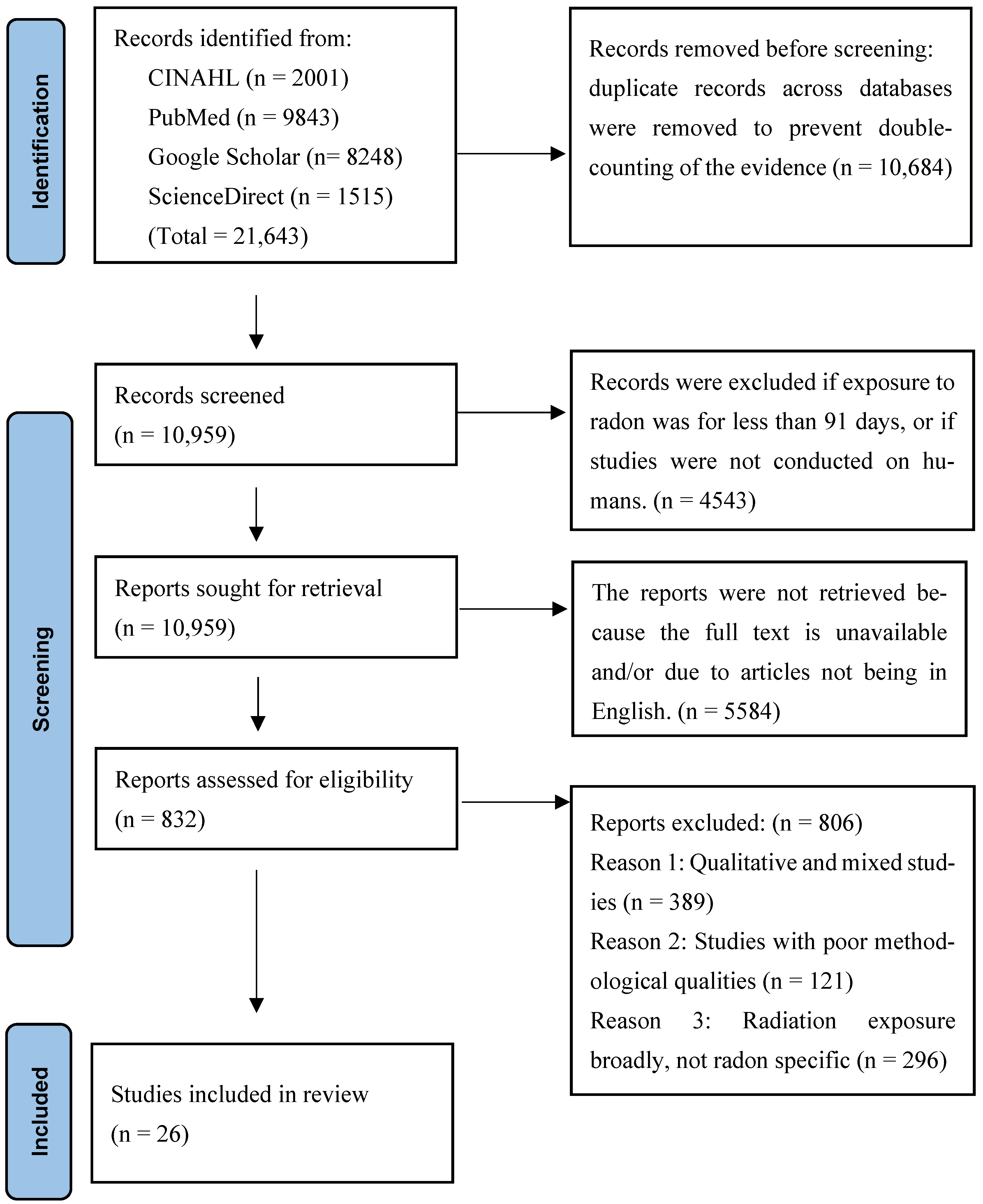
An initial search was undertaken on EBSCOhost to find studies conducted between 1994 and 25 August 2025, using the keyword “children” (representing the sample population). The search yielded 21,643 results with low sensitivity [23]. Subsequently, additional details pertaining to the phenomenon of interest, “radon exposure,” were incorporated, reducing the number of relevant research articles to 10,959. Further refinement was achieved by adding the term “health outcomes, “ which decreased the results to 6416. Limiters such as full-text availability, references, peer-reviewed status, quantitative articles published in English, and studies involving participants with health-related problems were then applied. The search terms: “children,” “radon,” “exposure,” and “health outcomes,” were connected by the Boolean operator ‘OR,’ resulting in a total of 832 articles. These retrieved articles were subsequently examined manually, with a focus on the health impacts of chronic radon exposure among children. The search themes were then combined with the Boolean operator “AND,” following the same systematic approach. The final corpus encompassed 26 articles, as presented in Table 1. In summary, the search process utilising EBSCOhost and other methodologies adhered to the PRISMA Flow Chart on Literature Search outlined in Figure 1.

2.4.3. Rating the Quality of Evidence

The researcher employed the principles of the Grading of Recommendations Assessment, Development and Evaluation (GRADE) to evaluate the quality of evidence pertaining to the health effects of indoor radon exposure among children [44]. The assessment of evidence quality predominantly depends on study design and sample size, with randomised controlled trials (RCTs) regarded as the gold standard. However, RCTS are rarely conducted in environmental health research due to ethical considerations and the vulnerability of the paediatric population [47,48]. Consequently, this review primarily relied on observational studies to synthesise existing literature. This approach necessitated the application of a modified GRADE methodology, incorporating observational study designs such as cohort, case- control, ecological, cross- sectional, and longitudinal studies. To appraise the quality of evidence, the researcher accounted for additional factors including sample size, confounding variables, and potential biases, as detailed in Table 2. The influence of these factors on evidence quality is documented in scholarly literature [49,50]. The association between radon exposure in children and related health outcomes was further examined in the identified observational studies, justified by their credibility in assessing the quality of evidence necessary to establish a link between environmental exposure and disease [51,52,53]. Such studies (cohort, case- control, cross- sectional, and longitudinal) demonstrated results comparable to RCTs, indicating their significance in academic research [52,53]. The reliability of exposure assessment was ascertained by evaluating the quality of the included studies using the Newcastle- Ottawa Scale (NOS) for cohort, case–control, and cross- sectional studies. The aggregate NOS score ranges from 0 to 9 for cohort and case–control studies, and from 0 to 10 for cross- sectional studies. Studies attaining an overall NOS score of at least 6 (or a minimum of 7 for cross- sectional studies) were classified as “high quality”. Those with a score of 4–5 (or 5–6 for cross- sectional studies) were deemed “moderate quality”, while scores below this threshold were categorised as “low quality” [54], as outlined in Table 2.

2.4.4. Risk of Bias Among Selected Studies

In this review, the researcher conducted a critical evaluation of included studies to identify potential biases by examining research methodologies, such as those employed to formulate the research questions, sample sizes, inclusion and exclusion criteria, tools used to measure radon levels, duration of radon measurements, and the methods of data analysis. Studies that failed to account for confounding factors when assessing the health effects of radon exposure were excluded. The search strategy included studies from 1994 to 2025, acknowledging the limited publication of radon research among children, with the aim of minimising bias associated with a restricted literature search period. Furthermore, the fundamental principle of a systematic review is a collaborative academic effort that synthesises qualitative evidence across a substantial sample [55,56]. The selected studies underwent peer review by two senior researchers. Due to the scarcity of evidence from LMICs, the researcher faced limitations owing to the small number of available articles, which impeded the possibility of conducting a meta-analysis. This limitation may introduce potential bias into the evidence synthesis presented in this systematic review. Nevertheless, various statistical techniques, including percentages, risk ratios, odds ratios, hazard ratios, confidence intervals, and p-values, were employed to compile the findings of this review.

3. Results

3.1. Health Implications of Radon Exposure in Children

3.1.1. Lung Cancer

The PRISMA guidelines were adhered to when conducting this systematic literature review. The results identified 24 studies, with data derived from seven publications, which were extrapolated to investigate the relationship between radon exposure and lung cancer in children. Studies examining this association are shown in Table 3.
The BEIR VI team [24] studied miner cohorts, encompassing approximately 68,000 workers and 2700 lung cancer mortality. A dose–response framework was established using the excess relative risk (ERR) model.
ERR = 0.025 y(a) (W1 + ½ W2),
where y(a) indicates age adjustment, and W1 and W2 are the cumulative exposures during previous and earlier time periods.
The pooled ERR was estimated at 0.005 (95% CI: 0.002–0.010), which corresponds to approximately a 16% increase in lung cancer risk for every 100 Bq/m3 of exposure, with an additional 10–20% increase in relative risk anticipated for childhood exposure.
In a comprehensive European case–control study involving 7148 cases and 14,208 controls across 13 different studies [25], a direct linear relationship was identified between indoor radon levels and lung cancer risk. The odds ratio (OR) for each 100 Bq/m3 increase in radon was 1.16, with a 95% confidence interval of 1.05 to 1.31, indicating an approximate 16% increase in lung cancer risk per 100 Bq/m3. Similarly, a pooled analysis conducted in North America [26], which included 3662 cases and 4966 controls, observed an OR of 1.11 (95% CI: 1.00–1.28) per 100 Bq/m3 after adjusting for smoking and other confounding variables. These findings are in close agreement with the European data [25].
Meta-analysis [29], which integrated case–control studies conducted across Europe and North America at exposure levels ranging from 25 to 300 Bq/m3, identified a mean Excess Relative Risk (ERR) of 0.14 (95% Confidence Interval: 0.01–0.29) per 100 Bq/m3. This meta-estimate offered quantitative corroboration of a linear exposure–response relationship and impacted the parameterization of both the BEIR VI and WHO models.
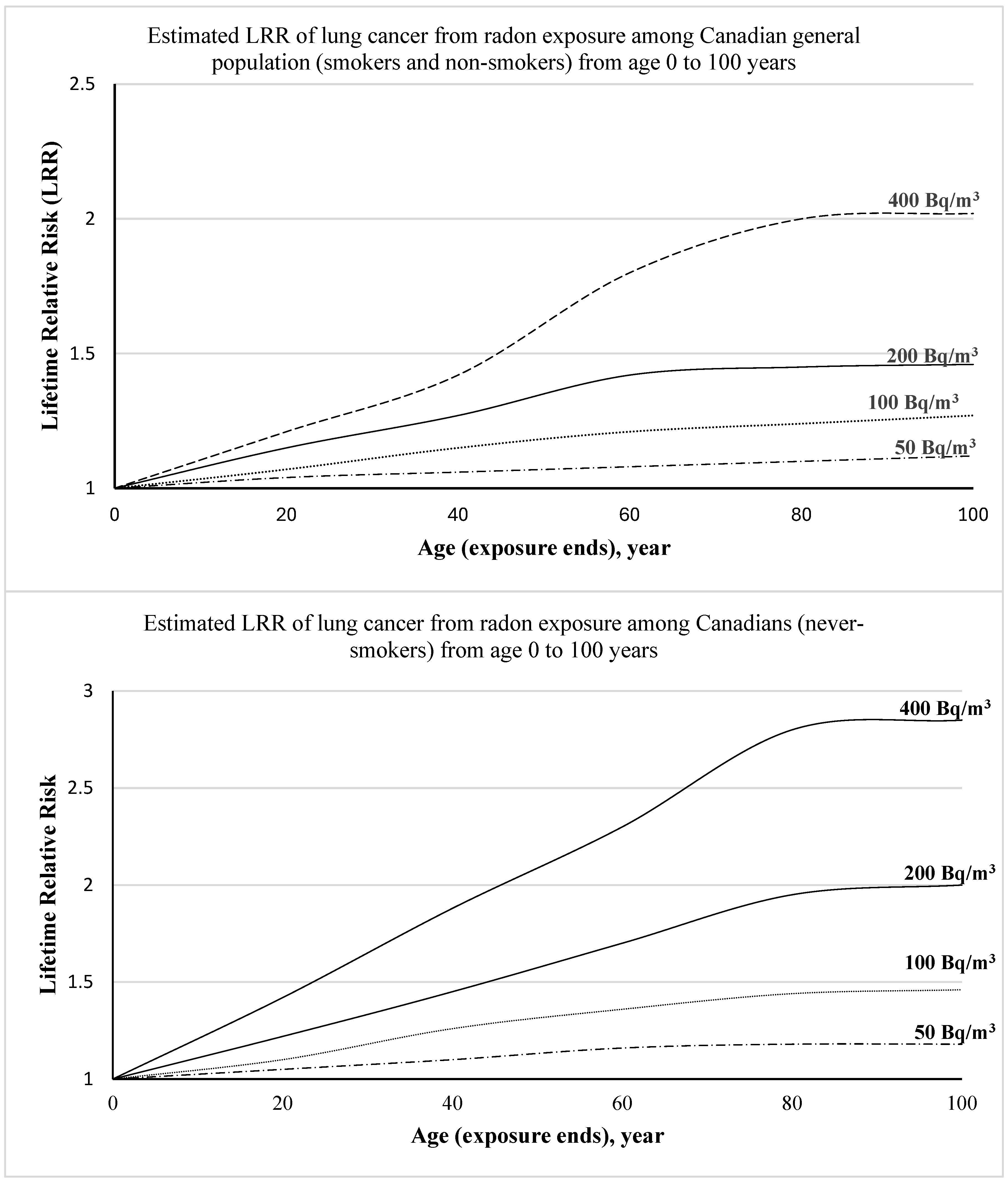
In 2013, Chen [27] used the national residential exposure data to model the lifetime risk of lung cancer within the Canadian population, applying BEIR VI coefficients. At a concentration of 400 Bq/m3, the estimated lifetime relative risk for smokers and non-smokers aged 15 ranged from 1.2 to 1.4, indicating that early-life exposure could potentially increase the lifetime risk of lung cancer by up to 20%, as further demonstrated in Figure 2 (created using the data from ref. [27]). An additional study also examined 18,971 Canadian households [30], with a geometric mean radon level of 108.2 Bq/m3. This research estimated that younger populations receive approximately 1.4 times higher lifetime radon doses compared to individuals born in 1950, taking into account housing characteristics and occupancy patterns.
A systematic review [28] analysed eight Chinese case–control studies involving 8200 lung cancer cases and 18,500 controls. The observed age-dependent excess relative risk (ERR) indicates a 1.2-fold increased risk of lung cancer in individuals exposed to radon during childhood compared to those exposed during adulthood (95% CI: 0.9–1.6), although this finding did not attain statistical significance.

3.1.2. Leukaemia

In accordance with the Preferred Reporting Items for Systematic Reviews and Meta-Analyses (PRISMA) guidelines, a systematic literature search was conducted. This search yielded 34 studies, of which eleven focused explicitly on the connection between paediatric radon exposure and childhood leukaemia. A comprehensive list of identified studies examining the association between radon exposure and childhood leukaemia is presented in Table 4. Eligible studies examined radon exposure among children at home, during school terms, or during hospital stays. Radon exposures were measured using various methods, including short-term measurements, geocoding, prediction models, and alpha-track detectors for long-term assessments.
Independent case–control studies involving more than 900 children (cases and controls), assessed long-term radon exposure using alpha track detectors [31], with radon exposure levels ≥ 148 Bq/m3, yielding a relative risk (RR) of 1.02 (95% CI 0.5–2.0), and [32], with radon exposure > 100 Bq/m3, producing an odds ratio (OR) of 1.1 (95% CI 0.6–2.0). Both studies concluded with similar outcome; there was no association between radon exposure and childhood leukaemia. Similarly, in Norway [37], a longitudinal study spanning 40 years involving over 700,000 children found no significant correlation between radon exposure (≥100 Bq/m3) and leukaemia, with hazard ratios (HR) approximately equal to 1.00 (95% CI 0.87–1.15). It is noteworthy that study [37] acknowledged the crude nature of the exposure assessment, which utilised buffered values for numerous dwellings instead of direct measurements. Furthermore, international health agencies, including the International Agency for Research on Cancer (IARC) and the World Health Organisation (WHO), have indicated that the evidence linking radon exposure to childhood leukaemia remains limited, particularly when contrasted with the well-established association between radon and lung cancer [58,59,60].
In contrast, reference [35] modelled cumulative radon exposure among 2400 cases, finding a positive association with rate ratios of 1.63 for high cumulative exposure. Furthermore, Ref. [57], in Texas, United States, hypothesised a marginal increase in the incidence of lymphoma associated with radon exposure, although with overall inconsistencies. The findings of [35,57] could be interpreted as outliers, again contrary to the harmonised European pooled analyses of case–control datasets, which showed no associations or dose–response signals between radon exposure and childhood leukaemia [34].

3.1.3. Biomarkers

Table 5 outlines studies that explored radon-induced biomarkers. The findings encompassed eleven studies, with data from eight publications extracted to analyse the association between radon exposure and biological markers (biomarkers) in children, as detailed below. Radon exposure in paediatric populations has been correlated with observable alterations in biomarkers, including elevated inflammation markers (CRP, IL-1β, IL-5 in asthmatics) and epigenetic modifications (methylation) [61,62,63].
In a cross-sectional study involving 68 youths aged 6–14 years, Ref. [40] observed that indoor radon concentrations were positively correlated with salivary C-reactive protein (CRP; β = 0.31, p = 0.007) and interleukin-1β (IL-1β; β = 0.33, p = 0.016), thereby indicating systemic inflammation. Similarly, in a cohort of 299 schoolchildren with asthma [7], it was demonstrated that there was a 13.4% (95% CI: 0.4–28.0%; p = 0.044) increase in IL-5 levels associated with each increment in estimated monthly radon exposure, suggesting TH2-mediated immune modulation in response to radon.
Epigenetic effects were evaluated in the longitudinal ALSPAC cohort [41], which included 786–980 children with complete data at three time points (birth, age 7, and 17). The study identified exposure-related DNA methylation at cg16451995 (at birth) and cg01864468 (at age 7), indicating that early-life radon exposure may affect DNA methylation patterns in later childhood.
Cytogenetic and genotoxic findings were also reported in two European studies. In Slovenia, Ref. [42] studied 85 schoolchildren (aged 9–12) exposed to exceptionally high indoor radon levels (≥7000 Bq/m3; annual effective dose 7–11 mSv) and observed increased chromosomal aberrations (4% vs. 2.5% in controls exposed to <400 Bq/m3). In Poland, Ref. [43] examined 94 residents from Kowary City. They found that residential radon levels, measured with CR-39 alpha-track detectors, were associated with increased DNA damage in the comet assay, but this association was not statistically significant when correlated with γH2AX staining due to rapid loss of the γH2AX signal.

4. Discussion

4.1. Childhood Radon Exposure and Lung Cancer

The evidence confirms that residential radon exposure causes cancer in adults, but its impact on children remains less certain. Radon decay products emit alpha particles that can induce DNA double-strand breaks and mutagenic damage in bronchial epithelial cells [64,65]. However, directly linking this mechanism to a measurable risk for childhood lung cancer is challenging due to the rarity of cases, long latency periods, and potential exposure misclassification. Nonetheless, models and estimated risk assessments consistently suggest that early-life radon exposure could result in a slight yet biologically significant increase in lifetime lung cancer risk [24,26].
Despite the biological plausibility, empirical data directly linking childhood radon exposure to lung cancer remain limited. Consequently, epidemiological evidence is predominantly derived from cohorts of adults and occupational miners. In the BEIR VI [24] report, data were modelled from over 68,000 miners, establishing a nearly linear dose–response relationship, with an Excess Relative Risk (ERR) of approximately 0.025 per working-level month. This translates to a 10–16% increase in lung cancer risk per 100 Bq/m3 of radon exposure. The modelling datasets suggest that exposures during early life could augment lifetime risk by an additional 10–20%, primarily attributable to cumulative dose accumulation and extended latency periods, rather than solely increased biological radiosensitivity [25,26].
Epidemiological studies in the general population [25,26], although not explicitly concentrated on the paediatric age group, reveal a linear, no-threshold risk pattern at residential exposure levels. Subsequent simulations [27,30] enhanced projections by incorporating variables such as age, fluctuating radon concentrations, and housing trends, indicating that contemporary children, who spend increased time indoors in well-insulated dwellings, may accrue higher radon doses than previous generations. In the Chen age-specific model [27], the lifetime relative risk (LRR) of paediatric lung cancer was estimated to be between 1.2 and 1.4 for children exposed to radon at 400 Bq/m3 from birth through adolescence. This projection corroborates computational analyses that suggest the significance of extended exposure and the enduring biological effects of early insults [30].
Direct observation of paediatric lung cancer caused by radon is nearly nonexistent, with estimates below 0.3% of all lung cancers [58]. This rarity reflects both the genuine rarity of the disease and the methodological difficulties in measuring lifelong radon exposure. Case–control studies in children lack statistical power due to few cases, and cohort studies would require decades of follow-up to detect the disease [59]. Consequently, the most reliable approach is to use current estimates based on hybrid models combining miner data, adult case–control studies, and age-adjusted dose–response coefficients [24,25,27].
Current models converge on a risk gradient of approximately 10–16% increased lifetime lung cancer risk per 100 Bq/m3 of exposure, with early-life exposure adding an extra 10–20% proportional risk [26,27,30]. Biological mechanisms, such as genotoxic damage, persistent inflammation, and epigenetic modifications, support the validity of these estimates [41,64]. The next step involves addressing the knowledge gap by prioritising longitudinal, biomarker-based studies across various paediatric populations to determine dose–response relationships and validate the existing model assumptions [59,65].

4.2. Childhood Radon Exposure and Leukaemia

Epidemiological evidence examining the association between residential radon exposure and childhood leukaemia remains intricate, diverse, and considerably less conclusive than the well-established relationship between radon and lung cancer. Although alpha-particle emissions from radon progeny can potentially induce DNA double-strand breaks and chromosomal abnormalities in hematopoietic stem cells, translating this mechanistic potential into a detectable population-level effect in children has proven to be methodologically challenging [31,36].
Over more than thirty years of research, encompassing 34 identified studies with 11 explicitly concentrating on paediatric outcomes, findings have varied from no effect to modest positive associations and inconsistent results. Early investigations utilising direct household alpha-track detectors [31,32], which were among the most precise methodologies for measuring exposure, did not demonstrate a significant increase in leukaemia risk, even at concentrations exceeding 148 Bq/m3. These null findings were consistent across comprehensive population-based analyses, including the United Kingdom Childhood Cancer Studies [34,66] and a record-based case–control study [38], which incorporated national radon maps and detailed geocoding. Despite the increased statistical power afforded by tens of thousands of cases and controls, these studies found no dose–response relationship or spatial correlation between radon exposure and leukaemia.
However, certain studies in continental Europe have yielded some suggestive results. The Danish case–control study [35] reported a rate ratio of 1.63 for children in the highest cumulative exposure groups, and [57] similarly reported a slightly increased incidence of lymphoma in Texas, though with regional variations. The harmonised European pooled dataset [60], revealed a statistically significant but small positive association (pooled OR = 1.03 per 100 Bq/m3; 95% CI: 1.01–1.06). Although this association is modest, it aligns with a dose-dependent pattern consistent with effects from low-dose ionising radiation, especially considering long latency periods and cumulative exposures from in utero to early childhood [60].
However, the inconsistencies among studies highlight challenges in radon epidemiological studies. Firstly, exposure misclassification is prevalent; using area-level radon prediction maps, registry or short-term measurements often does not capture significant inside-home temporal fluctuations or different children’s occupancy patterns [38]. Radon levels in homes can vary seasonally and daily by more than tenfold, and such misclassification generally introduces biased results, potentially hiding small but genuine associations [62,67]. Secondly, many studies do not consider residential mobility, which is a crucial factor in paediatric populations, where total exposure largely depends on how long children remain in a particular residence early in life [37].
From a biological perspective, the proposed association between radon and leukaemia relies on whether alpha emissions originating from radon progeny can deliver a biologically relevant dose to the bone marrow microenvironment, where leukemogenic mutations develop [65]. Unlike the bronchial lining, the bone marrow receives a considerably lower absorbed dose from inhaled radon progeny, generally estimated at less than 1% of the dose received by the bronchial tissue [24]. Nevertheless, experimental evidence suggests that even low-dose alpha irradiation can induce clonal hematopoietic changes, oxidative stress, and epigenetic reprogramming associated with leukemogenesis [67]. Consequently, although the dose is minimal, the high linear energy transfer characteristic of alpha particles implies that even infrequent exposures may result in significant biological effects in individuals with genetic vulnerability [62].
Large-scale cohort studies, such as those conducted by [37] in Norway and [38] in Finland, have delivered some of the most statistically robust assessments to date. However, both investigations reported null results, primarily attributable to the indirect methodologies employed for exposure assessment. Reference [37] noted that utilising geospatially buffered exposure estimates, as opposed to direct indoor measurements, diminished the likelihood of detecting associations. Concurrently, newer exposure modelling techniques [38] that integrate geological and structural predictors have improved spatial resolution but continue to encounter challenges in reconstructing historical exposure levels, especially for older structures and diverse ventilation practices.
Within the broader context of radiation epidemiology, the overall evidence suggests that, if a causal effect exists, it is probably small and varies with exposure levels, mainly appearing at higher residential concentrations or in genetically predisposed subgroups [58,59]. These findings suggest that residual confounding, exposure misclassification, and ecological fallacies continue to complicate definitive causal interpretations [60]. From a public health perspective, the impact is subtle. Even a weak, yet genuine, association could have substantial effects at the population level, considering the widespread indoor radon exposure and children’s vulnerability in blood development. Nevertheless, until more high-quality, prospective studies with standardised exposure assessments are conducted, the evidence for a direct causal relationship between residential radon and childhood leukaemia remains limited or inconclusive [58,59,60].

4.3. Childhood Radon Exposure and Biomarkers

Over the past twenty years, there has been a growing interest in understanding how radon exposure might induce molecular and cellular alterations in children. This heightened susceptibility is attributed to their rapidly dividing cells, increased minute ventilation, and extended lifespan expectancy post-exposure, each contributing to an increased sensitivity to the biological impacts of ionising radiation [67,68]. Utilising the PRISMA framework, eight studies gave analysable data linking childhood radon exposure with specific biomarkers related to inflammation, genotoxicity, or epigenetic modifications (see Table 5). Although the evidence remains preliminary, it reliably indicates that even low to moderate levels of radon, those below occupational safety standards, can cause measurable biological responses in children [7,40].
Inflammatory biomarkers serve as highly sensitive indicators of early physiological responses to indoor radon. Exposure to higher radon levels [40] was found to be positively associated with increased salivary C-reactive protein (CRP; β = 0.31, p = 0.007) and interleukin-1β (IL-1β; β = 0.33, p = 0.016) in 68 children aged 6–14 years. These results suggest a systemic pro-inflammatory state, potentially resulting from low-level oxidative stress caused by radon progeny deposits in the airway epithelium. Similarly, a significant increase in interleukin-5 (IL-5; 13.4%, 95% CI: 0.4–28.0%, p = 0.044) was observed among 299 school-aged children with asthma [7]. This indicates that radon exposure may enhance TH2 immune responses and exacerbate inflammatory conditions within the airway. Overall, these findings provide biological evidence that radon may influence cytokine activity in children, particularly in those with pre-existing respiratory conditions.
Beyond inflammatory pathways, increasing evidence associates radon with epigenetic and cytogenetic disruptions. The ALSPAC study [41] provides a detailed dataset tracking over 900 children from birth to adolescence. It found consistent links between estimated residential radon exposure and DNA methylation changes at CpG sites cg16451995 (at birth) and cg01864468 (at age 7), supporting the hypothesis that early-life exposure results in enduring epigenetic reprogramming. These molecular modifications may have long-term implications for gene expression involved in cell cycle regulation, DNA repair, or immune function.
Children residing in environments with elevated radon levels have demonstrated signs of cytogenetic damage and DNA double-strand breaks. In a Slovenian case–control study [42], a 4% increase in chromosomal aberrations was observed in cases compared to 2.5% in controls, at indoor radon concentrations exceeding 7000 Bq/m3 (annual dose 7–11 mSv). This finding supports the hypothesis that high residential radon exposure can induce detectable genomic instability. Further corroborating this hypothesis, researchers [43] reported elevated levels of serum phosphorylated histone γH2AX among children exposed to moderate radon levels in Kowary City regions, Poland. This reinforces the biological plausibility of radon-induced genotoxic stress even among non-mining populations. Conversely, Ref. [45] noted the absence of published paediatric biomarker studies or sufficiently powered epidemiological research from Africa linking radon exposure to health outcomes. Their review advocates for the initiation of such studies and the adoption of standardised measurement methods.
While evidence indicates a spectrum of molecular effects, ranging from inflammation to DNA damage and epigenetic modifications, certain limitations remain. Many investigations were characterised by small sample sizes and indirect exposure assessments, with few establishing definitive causality over time [41,43]. Variability in biomarker results may also stem from co-exposures, indoor environmental factors such as tobacco smoke and particulate matter, as well as individual susceptibility [69,70]. Nevertheless, consistent findings across diverse populations endorse the hypothesis that radon exposure can cause measurable biological responses in children, aligning with models of alpha-particle induced oxidative stress and DNA damage [7,65].
Overall, this emerging body of research highlights the potential of biomarkers as early indicators of radon-induced biological stress in children. Future investigations should prioritise large-scale, longitudinal studies that incorporate multi-household biomarker surveys, including epigenetic, transcriptomic, and proteomic signatures, coupled with personal radon dosimetry. This methodology can assist in revealing the dose–response relationships and in identifying populations at high risk [7,40,43]. Such research would bridge the gap between molecular biomarkers and long-term disease risk, thereby advancing radon risk assessment beyond conventional epidemiological approaches.

5. Strengths and Limitations

The study synthesised evidence from existing literature across epidemiological and modelling fields in various geographical regions [24,44,45,65]. The effort was supported by linking miner cohort data with population-based and paediatric-focused studies, creating a logically coherent narrative that places biological plausibility alongside empirical and theoretical evidence [25,31,64]. This approach enhanced causal inference despite limited data on the association between childhood radon exposure and health effects [65]. The review demonstrated a link between alpha-particles and the modelled lung cancer risks by maintaining dose–response effects among the paediatric population [24]. Additionally, there was alignment between observed biological markers, DNA damage, and interleukins, which underpins the biological plausibility of the review. The study assesses both null and positive findings equally and offers a cautious interpretation of weak or inconsistent associations (leukaemia), consistent with the WHO and UNSCEAR’s cautious conclusions [37,59,65].
The main limitation of this study is its dependence on extrapolated data derived from cohorts of miners and adult case–control studies [26,31]. Although this methodology appears credible due to the infrequency of paediatric lung cancer cases, the study presumes uniform dose–response effects across all age groups, which may result in an overestimation of biological comparability [24]. Certain epidemiological studies referenced employ indirect or modelled radon exposure estimates rather than direct longitudinal indoor measurements, potentially leading to exposure misclassification and non-differential errors [32]. Although the examined literature has a global scope, it is predominantly weighted towards high-income and temperate countries. There is a paucity of research originating from Africa, South Asia, and Latin America- regions where building materials, ventilation practices, and uranium-rich soils may significantly influence exposure profiles and health outcomes [1,45]. This underrepresentation indicates the necessity for additional research in these regions. It is incumbent upon regional researchers to address these gaps to attain a more comprehensive understanding.

6. Conclusions

The review offers a comprehensive overview of childhood radon exposure and its potential health effects. The causal relationship between alpha particles and lung cancer remains predominantly theoretical but biologically credible, supported by dose–response cohorts derived from adult populations [24,65]. Although evidence concerning childhood leukaemia is inconclusive owing to limited population-based studies and uncertainties, the evidence correlating radon exposure with biomarkers appears promising. It demonstrates measurable inflammatory markers, cytogenetic alterations, and epigenetic reprogramming.
Essentially, the collective evidence suggests that radon exposure during childhood, although rarely enough to cause overt malignancy, contributes cumulatively to lifetime lung cancer risk and causes detectable biological markers even at indoor exposure levels below regulatory limits [59,65]. To objectively confirm the link between radon exposure and childhood health effects, large-scale, short-term, and long-term studies with personal dosimetry are needed, while accounting for confounding factors [45,69]. Until then, we must continue to support health promotion efforts to reduce indoor radon exposure, especially in environments occupied by children.

Supplementary Materials

The following supporting information can be downloaded at: https://www.mdpi.com/article/10.3390/children13020208/s1, S1-PRISMA Checklist.

Author Contributions

Conceptualization, R.Y. and P.C.R.; methodology, R.Y. and P.C.R.; validation, R.Y. and P.C.R.; investigation, R.Y. and P.C.R.; writing—original draft preparation, R.Y. and P.C.R.; writing—review and editing, R.Y. and P.C.R. All authors have read and agreed to the published version of the manuscript.

Funding

P.C.R received funding from NRF (Support for Y-rated Researchers Programme (Grant number-CSRP23030380716)) and SAMRC SIR 2024/0088.

Institutional Review Board Statement

The study was conducted in accordance with the Declaration of Helsinki, and approved by the University of Johannesburg Faculty of Health Sciences Research Ethics Committee (REC) under Clearance Number REC-2969-2024 (12 August 2024).

Informed Consent Statement

Not applicable.

Data Availability Statement

No new data were created or analysed in this study.

Acknowledgments

The authors used Grammarly (version 2.0) solely to improve the language clarity and overall structural tone of the manuscript.

Conflicts of Interest

The authors declare no conflicts of interest.

References

  1. Nunes, L.J.R.; Curado, A.; Lopes, S.I. The Relationship Between Radon and Geology: Sources, Transport and Indoor Accumulation. Appl. Sci. 2023, 13, 7460. [Google Scholar] [CrossRef]
  2. Degu Belete, G.; Alemu Anteneh, Y. General Overview of Radon Studies in Health Hazard Perspectives. J. Oncol. 2021, 2021, 6659795. [Google Scholar] [CrossRef] [PubMed]
  3. Voltattorni, N.; Gasparini, A.; Galli, G. The Analysis of 222Rn and 220Rn Natural Radioactivity for Local Hazard Estimation: The Case Study of Cerveteri (Central Italy). Int. J. Environ. Res. Public Health 2023, 20, 6420. [Google Scholar] [CrossRef]
  4. Komorowski, M.A. Radon and Neoplasms. Toxics 2023, 11, 681. [Google Scholar] [CrossRef] [PubMed]
  5. Turner, M.C.; Krewski, D.; Chen, Y.; Pope, C.A., III; Gapstur, S.M.; Thun, M.J. Thun, Radon and Nonrespiratory Mortality in the American Cancer Society Cohort. Am. J. Epidemiol. 2012, 176, 808–814. [Google Scholar] [CrossRef] [PubMed]
  6. Lantz, P.M.; Mendez, D.; Philbert, M.A. Radon, smoking, and lung cancer: The need to refocus radon control policy. Am. J. Public Health 2013, 103, 443–447. [Google Scholar] [CrossRef]
  7. Banzon, T.M.; Greco, K.F.; Li, L.; Mukharesh, L.; Vieira, C.L.Z.; Steiner, M.K.; Hauptman, M.; Ratchataswan, T.; Koutrakis, P.; Phipatanakul, W.; et al. Effect of radon exposure on asthma morbidity in the School Inner-City Asthma study. Pediatr. Pulmonol. 2023, 58, 2042–2049. [Google Scholar] [CrossRef]
  8. Tong, J.; Qin, L.; Cao, Y.; Li, J.; Zhang, J.; Nie, J.; An, Y. Environmental radon exposure and childhood leukemia. J. Toxicol. Environ. Health Part B 2012, 15, 332–347. [Google Scholar] [CrossRef]
  9. Gu, Y.; Wang, J.; Wang, Y.; Xu, C.; Liu, Y.; Du, L.; Wang, Q.; Ji, K.; He, N.; Zhang, M.; et al. Low-dose ionizing radiation exposure and risk of leukemia: Results from 1950-1995 Chinese medical X-ray workers’ cohort study and meta-analysis. J. Natl. Cancer Cent. 2022, 2, 90–97. [Google Scholar] [CrossRef]
  10. University of Kentucky. Radon Policy Research Program. 2024. Available online: https://breathe.uky.edu/sites/default/files/2024-03/radon-and-children.pdf (accessed on 5 December 2025).
  11. Maheso, A.M.; Bezuidenhout, J.; Newman, R.T. Indoor Radon Levels in Homes and Schools in the Western Cape, South Africa-Results from a Schools Science Outreach Initiative and Corresponding Model Predictions. Int. J. Environ. Res. Public Health 2023, 20, 1350. [Google Scholar] [CrossRef]
  12. Nunes, L.J.R.; Curado, A. Indoor radon exposure in Africa: A critical review on the current research stage and knowledge gaps. AIMS Public Health 2025, 12, 329–359. [Google Scholar] [CrossRef]
  13. Kholopo, M.; Rathebe, P.C. Radon Exposure Assessment in Occupational and Environmental Settings: An Overview of Instruments and Methods. Sensors 2024, 24, 2966. [Google Scholar] [CrossRef]
  14. Pulliam, H.R.; Springer, S.D.; Rice, D.L.; Ende, G.C.; Johnson, H.J.; Willett, M.P.; Wilson, T.W.; Taylor, B.K. Neurotoxic effects of home radon exposure on oscillatory dynamics serving attentional orienting in children and adolescents. NeuroImage 2024, 292, 120606. [Google Scholar] [CrossRef] [PubMed]
  15. Hauri, D.; Spycher, B.; Huss, A.; Zimmermann, F.; Grotzer, M.; von der Weid, N.; Weber, D.; Spoerri, A.; Kuehni, C.E.; Röösli, M.; et al. Domestic radon exposure and risk of childhood cancer: A prospective census-based cohort study. Environ. Health Perspect. 2013, 121, 1239–1244. [Google Scholar] [CrossRef]
  16. Dessemon, J.; Perol, O.; Chauvel, C.; Noelle, H.; Coudon, T.; Grassot, L.; Foray, N.; Belladame, E.; Fayette, J.; Fournie, F.; et al. Survival of bronchopulmonary cancers according to radon exposure. Front. Public Health 2024, 11, 1306455. [Google Scholar] [CrossRef] [PubMed]
  17. Richardson, D.B.; Rage, E.; Demers, P.A.; Do, M.T.; Fenske, N.; Deffner, V.; Kreuzer, M.; Samet, J.; Bertke, S.J.; Kelly-Reif, K.; et al. Lung Cancer and Radon: Pooled Analysis of Uranium Miners Hired in 1960 or Later. Environ. Health Perspect. 2022, 130, 57010. [Google Scholar] [CrossRef] [PubMed]
  18. Cumpston, M.S.; McKenzie, J.E.; Thomas, J.; Brennan, S.E. The use of ‘PICO for synthesis’ and methods for synthesis without meta-analysis: Protocol for a survey of current practice in systematic reviews of health interventions. F1000Research 2021, 9, 678. [Google Scholar] [CrossRef]
  19. Waldrop, J.D.; Dunlap, J.J. CE: Beyond PICO—A New Question Simplifies the Search for Evidence. AJN Am. J. Nurs. 2024, 124, 34–37. [Google Scholar] [CrossRef]
  20. Page, M.J.; McKenzie, J.E.; Bossuyt, P.M.; Boutron, I.; Hoffmann, T.C.; Mulrow, C.D.; Shamseer, L.; Tetzlaff, J.M.; Akl, E.A.; Brennan, S.E.; et al. The PRISMA 2020 statement: An updated guideline for reporting systematic reviews. BMJ 2021, 372, n71. [Google Scholar] [CrossRef]
  21. Swartz, M.K. The PRISMA statement: A guideline for systematic reviews and meta-analyses. J. Pediatr. Health Care Off. Publ. Natl. Assoc. Pediatr. Nurse Assoc. Pract. 2011, 25, 1–2. [Google Scholar] [CrossRef]
  22. University of Connecticut. Nursing and Allied Health Subject Guide. What Is Rayyan? 2025. Available online: https://guides.lib.uconn.edu/c.php?g=606651andp=11114135 (accessed on 10 January 2026).
  23. Yusuf, R.A. The lived experiences of individuals aged 18–65 years with diabetes-related amputation in low- and middle-income countries. unpublished. 2022. [Google Scholar]
  24. National Research Council (US) Committee on Health Risks of Exposure to Radon (BEIRVI). Health Effects of Exposure to Radon: BEIR VI; National Academies Press: Washington, DC, USA, 1999. [Google Scholar] [CrossRef]
  25. Darby, S.; Hill, D.; Auvinen, A.; Barros-Dios, J.M.; Baysson, H.; Bochicchio, F.; Deo, H.; Falk, R.; Forastiere, F.; Hakama, M.; et al. Radon in homes and risk of lung cancer: Collaborative analysis of individual data from 13 European case-control studies. BMJ 2004, 330, 223. [Google Scholar] [CrossRef]
  26. Krewski, D.; Lubin, J.H.; Zielinski, J.M.; Alavanja, M.; Catalan, V.S.; Field, R.W.; Klotz, J.B.; Letourneau, E.G.; Lynch, C.F.; Lyon, J.I.; et al. Residential Radon and Risk of Lung Cancer: A Combined Analysis of 7 North American Case Control Studies. Epidemiology 2005, 16, 137–145. [Google Scholar] [CrossRef]
  27. Chen, J. Canadian lung cancer relative risk from radon exposure for short periods in childhood compared to a lifetime. Int. J. Environ. Res. Public Health 2013, 10, 1916–1926. [Google Scholar] [CrossRef]
  28. Su, C.; Pan, M.; Liu, N.; Zhang, Y.; Kan, H.; Zhao, Z.; Deng, F.; Zhao, B.; Qian, H.; Zeng, X.; et al. Lung cancer as adverse health effect by indoor radon exposure in China from 2000 to 2020: A systematic review and meta-analysis. Indoor Air 2022, 32, e13154. [Google Scholar] [CrossRef]
  29. Lubin, J.H.; Boice, J.D., Jr. Lung cancer risk from residential radon: Meta-analysis of eight epidemiologic studies. J. Natl. Cancer Inst. 1997, 89, 49–57. [Google Scholar] [CrossRef] [PubMed]
  30. Simms, J.A.; Pearson, D.D.; Cholowsky, N.L.; Irvine, J.L.; Nielsen, M.E.; Jacques, W.R.; Taron, J.M.; Peters, C.E.; Carlson, L.E.; Goodarzi, A.A. Younger North Americans are exposed to more radon gas due to occupancy biases within the residential built environment. Sci. Rep. 2021, 11, 6724. [Google Scholar] [CrossRef]
  31. Lubin, J.H.; Linet, M.S.; Boice, J.D.; Hatch, E.E.; Kleinerman, R.A.; Tarone, R.E.; Wacholder, S.; Buckley, J.; Conrath, S.M.; Robison, L.L. Case-Control Study of Childhood Acute Lymphoblastic Leukemia and Residential Radon Exposure. JNCI J. Natl. Cancer Inst. 1998, 90, 294–300. [Google Scholar] [CrossRef]
  32. Steinbuch, M.; Weinberg, C.R.; Buckley, J.D.; Robison, L.L.; Sandler, D.P. Indoor residential radon exposure and risk of childhood acute myeloid leukaemia. Br. J. Cancer 1999, 81, 900–906. [Google Scholar] [CrossRef] [PubMed]
  33. Kaletsch, U.; Kaatsch, P.; Meinert, R.; Schüz, J.; Czarwinski, R.; Michaelis, J. Childhood cancer and residential radon exposure—Results of a population-based case-control study in Lower Saxony (Germany). Radiat. Environ. Biophys. 1999, 38, 211–215. [Google Scholar] [CrossRef] [PubMed]
  34. UK Childhood Cancer Study Investigators. The United Kingdom Childhood Cancer Study of exposure to domestic sources of ionising radiation: 1: Radon gas. Br. J. Cancer 2002, 86, 1721–1726. [Google Scholar] [CrossRef]
  35. Raaschou-Nielsen, O.; Andersen, C.E.; Andersen, H.P.; Gravesen, P.; Lind, M.; Schüz, J.; Ulbak, K. Domestic radon and childhood cancer in Denmark. Epidemiology 2008, 19, 536–543. [Google Scholar] [CrossRef] [PubMed]
  36. Kendall, G.M.; Little, M.P.; Wakeford, R.; Bunch, K.J.; Miles, J.C.; Vincent, T.J.; Meara, J.R.; Murphy, M.F. A record-based case–control study of natural background radiation and the incidence of childhood leukaemia and other cancers in Great Britain during 1980–2006. Leukemia 2013, 27, 3–9. [Google Scholar] [CrossRef] [PubMed]
  37. Del Risco Kollerud, R.; Blaasaas, K.G.; Claussen, B. Risk of leukaemia or cancer in the central nervous system among children living in an area with high indoor radon concentrations: Results from a cohort study in Norway. Br. J. Cancer 2014, 111, 1413–1420. [Google Scholar] [CrossRef]
  38. Nikkilä, A.; Arvela, H.; Mehtonen, J.; Raitanen, J.; Heinäniemi, M.; Lohi, O.; Auvinen, A. Predicting residential radon concentrations in Finland: Model development, validation, and application to childhood leukemia. Scand. J. Work. Environ. Health 2020, 46, 278–292. [Google Scholar] [CrossRef] [PubMed]
  39. Yoshinaga, S.; Tokonami, S.; Akiba, S.; Nitta, H.; Kabuto, M. Case-control study of residential radon and childhood leukemia in Japan: Results from preliminary analyses. In International Congress Series; Elsevier: Amsterdam, The Netherlands, 2005; Volume 1276, pp. 233–235. [Google Scholar] [CrossRef]
  40. Taylor, B.K.; Smith, O.V.; Miller, G.E. Chronic Home Radon Exposure Is Associated with Higher Inflammatory Biomarker Concentrations in Children and Adolescents. Int. J. Environ. Res. Public Health 2023, 20, 246. [Google Scholar] [CrossRef]
  41. de Vocht, F.; Suderman, M.; Ruano-Ravina, A.; Thomas, R.; Wakeford, R.; Relton, C.; Tilling, K.; Boyd, A. Residential exposure to radon and DNA methylation across the lifecourse: An exploratory study in the ALSPAC birth cohort. Wellcome Open Res. 2019, 4, 3. [Google Scholar] [CrossRef]
  42. Bilban, M.; Vaupoti, J. Chromosome aberrations study of pupils in high radon level elementary school. Health Phys. 2001, 80, 157–163. [Google Scholar] [CrossRef]
  43. Walczak, K.; Olszewski, J.; Politański, P.; Domeradzka-Gajda, K.; Kowalczyk, K.; Zmyślony, M.; Brodecki, M.; Stępnik, M. Residential exposure to radon and levels of histone γH2AX and DNA damage in peripheral blood lymphocytes of residents of Kowary city regions (Poland). Chemosphere 2020, 247, 125748. [Google Scholar] [CrossRef]
  44. Mphaga, K.V.; Utembe, W.; Rathebe, P.C. Radon exposure risks among residents proximal to gold mine tailings in Gauteng Province, South Africa: A cross-sectional preliminary study protocol. Front. Public Health 2024, 12, 1328955. [Google Scholar] [CrossRef]
  45. Rathebe, P.C.; Khosi, L.; Kholopo, M. Indoor Concentration of Radon in Residential Houses Proximal to Gold Mine Tailings–A Review of Sub-Saharan Africa Studies. Environ. Forensics 2025, 26, 368–379. [Google Scholar] [CrossRef]
  46. Machraoui, S.; Labidi, S.; Azbouche, A. Assessment of radon levels in indoor workplaces in Tunisia and associated radiological risks. Int. J. Environ. Anal. Chem. 2025, 105, 4950–4966. [Google Scholar] [CrossRef]
  47. Nicholls, S.G.; Carroll, K.; Nix, H.P.; Li, F.; Hey, S.P.; Mitchell, S.L.; Weijer, C.; Taljaard, M. Ethical considerations within pragmatic randomized controlled trials in dementia: Results from a literature survey. Alzheimer’s Dement. Transl. Res. Clin. Interv. 2022, 8, e12287. [Google Scholar] [CrossRef] [PubMed]
  48. Resnik, D.B. Randomised controlled trials in environmental health research: Ethical issues. J. Environ. Health 2008, 70, 28–30. [Google Scholar]
  49. Balshem, H.; Helfand, M.; Schünemann, H.J.; Oxman, A.D.; Kunz, R.; Brozek, J.; Vist, G.E.; Falck-Ytter, Y.; Meerpohl, J.; Norris, S.; et al. GRADE guidelines: 3. Rating the quality of evidence. J. Clin. Epidemiol. 2011, 64, 401–406. [Google Scholar] [CrossRef] [PubMed]
  50. Dijkers, M. Introducing GRADE: A systematic approach to rating evidence in systematic reviews and to guideline development. KT Update 2013, 1, 1–9. [Google Scholar]
  51. Mann, C.J. Observational research methods. Research design II: Cohort, cross sectional, and case-control studies. Emerg. Med. J. 2003, 20, 54–60. [Google Scholar] [CrossRef]
  52. ERicotta, E.; Carrillo, F.A.B.; Angelli-Nichols, S.; Barugahare, J.; Benton, A.; Carlson, C.J.; Chang-Rabley, E.; EDean, N.; Duda, S.N.; Federer, L.; et al. Observational research in epidemic settings: A roadmap to reform. BMJ Glob. Health 2025, 10, e017981. [Google Scholar] [CrossRef]
  53. Song, J.W.; Chung, K.C.M. Observational Studies: Cohort and Case-Control Studies. Plast. Reconstr. Surg. 2010, 126, 2234–2242. [Google Scholar] [CrossRef]
  54. Henyoh, A.M.S.; Laurent, O.; Mandin, C.; Clero, E. Radon exposure and potential health effects other than lung cancer: A systematic review and meta-analysis. Front. Public Health 2024, 12, 1439355. [Google Scholar] [CrossRef]
  55. Schmutz, J.B.; Meier, L.L.; Manser, T. How effective is teamwork really? The relationship between teamwork and performance in healthcare teams: A systematic review and meta-analysis. BMJ Open 2019, 9, e028280. [Google Scholar] [CrossRef] [PubMed]
  56. Uttley, L.; Montgomery, P. The influence of the team in conducting a systematic review. Syst. Rev. 2017, 6, 149. [Google Scholar] [CrossRef]
  57. Peckham, E.C.; Scheurer, M.E.; Danysh, H.E.; Lubega, J.; Langlois, P.H.; Lupo, P.J. Residential Radon Exposure and Incidence of Childhood Lymphoma in Texas, 1995–2011. Int. J. Environ. Res. Public Health 2015, 12, 12110–12126. [Google Scholar] [CrossRef] [PubMed]
  58. International Agency for Research on Cancer (IARC). A Review of Human Carcinogens: RADIATION (IARC Monographs on the Evaluation of Carcinogenic Risks to Humans, Vol. 100D); World Health Organisation: Geneva, Switzerland, 2012.
  59. World Health Organisation (WHO). WHO Handbook on Indoor Radon: A Public Health Perspective; World Health Organisation Press: Geneva, Switzerland, 2009.
  60. Moon, J.; Yoo, H. Residential radon exposure and leukemia: A meta-analysis and dose-response meta-analyses for ecological, case-control, and cohort studies. Environ. Res. 2021, 202, 111714. [Google Scholar] [CrossRef] [PubMed]
  61. Druzhinin, V.G.; Sinitsky, M.Y.; Larionov, A.V.; Volobaev, V.P.; Minina, V.I.; Golovina, T.A. Assessing the level of chromosome aberrations in peripheral blood lymphocytes in long-term resident children under conditions of high exposure to radon and its decay products. Mutagenesis 2015, 30, 677–683. [Google Scholar] [CrossRef]
  62. Robertson, A.; Allen, J.; Laney, R.; Curnow, A. The cellular and molecular carcinogenic effects of radon exposure: A review. Int. J. Mol. Sci. 2013, 14, 14024–14063. [Google Scholar] [CrossRef]
  63. Sinitsky, M.Y.; Larionov, A.V.; Asanov, M.A.; Druzhinin, V.G. Associations of DNA-repair gene polymorphisms with a genetic susceptibility to ionizing radiation in residents of areas with high radon (222Rn) concentration. Int. J. Radiat. Biol. 2015, 91, 486–494. [Google Scholar] [CrossRef]
  64. Field, R.W.; Steck, D.J.; Smith, B.J.; Brus, C.P.; Fisher, E.L.; Neuberger, J.S.; Platz, C.E.; Robinson, R.A.; Woolson, R.F.; Lynch, C.F. Residential radon gas exposure and lung cancer: The Iowa Radon Lung Cancer Study. Am. J. Epidemiol. 2000, 151, 1091–1102. [Google Scholar] [CrossRef]
  65. United Nations Scientific Committee on the Effects of Atomic Radiation (UNSCEAR). Sources and Effects of Ionising Radiation: UNSCEAR 2008 Report to the General Assembly, with Scientific Annexes; United Nations: New York, NY, USA, 2009. [Google Scholar]
  66. UK Childhood Cancer Study Investigators. The United Kingdom Childhood Cancer Study of exposure to domestic sources of ionising radiation: 2: Gamma radiation. Br. J. Cancer 2002, 86, 1727–1731. [Google Scholar] [CrossRef]
  67. Sadetzki, S.; Mandelzweig, L. Childhood exposure to external ionising radiation and solid cancer risk. Br. J. Cancer 2009, 100, 1021–1025. [Google Scholar] [CrossRef]
  68. Eisenberg, W. Children Are Very Sensitive to Radiation. Dtsch. Arztebl. Int. 2009, 106, 393. Available online: https://pmc.ncbi.nlm.nih.gov/articles/PMC2712245/ (accessed on 7 December 2025).
  69. Zhang, C.L.; Maccarone, J.R.; Grady, S.T.; Collins, C.M.; Moy, M.L.; Hart, J.E.; Kang, C.M.; Coull, B.A.; Schwartz, J.D.; Koutrakis, P.; et al. Indoor and ambient black carbon and fine particulate matter associations with blood biomarkers in COPD patients. Sci. Total Environ. 2024, 927, 171897. [Google Scholar] [CrossRef]
  70. Ho, G.; Tang, H.; Robbins, J.A.; Tong, E.K. Biomarkers of tobacco smoke exposure and asthma severity in adults. Am. J. Prev. Med. 2013, 45, 703–709. [Google Scholar] [CrossRef] [PubMed]
Figure 1. PRISMA Flow Chart on Literature Search.
Children 13 00208 g001
Figure 2. LRR of lung cancer due to radon exposure from birth to 100 years old [27].
Children 13 00208 g002
Table 1. The 26 studies included in the review identified with the modified GRADE system.
Study, YearStudy DomainStrength of EvidenceMain Outcome
BEIR VI [24]Cohorts of miners modelled for lung cancer riskHighRisk modelled for radon-lung cancer dose–response with no direct paediatric data.
Darby et al. [25]A case–control study modelled for lung cancer riskHighLinear exposure-response risk, adopted in the WHO guidelines
Krewski et al. [26]Case–control study, a projection for lung cancer riskHighAligned with the BEIR VI projection
Chen [27]Quantitative survey for lung cancer risk projectionModerate–highEstimates of lifetime radon-lung cancer risks with varying parameters-age, gender, radon levels
Su et al. [28]Systematic review of adult lung cancer casesHighProjected ERR 1.2 more than adult ERR (95% CI 0.9–1.6)
Lubin et al. [29]Meta-analysis of lung cancer risk projectionHighPooled analysis established a low-risk projection
Simms et al. [30]Modelling of cohorts for lifetime exposure riskModerateA 1.4 times risk for cumulative radon exposure in the paediatric age group
Lubin et al. [31]Case–control for radon exposure vs. risk of leukaemiaModerate–highNo significant association of risk of leukaemia and childhood radon exposure
Steinbuch et al. [32]Case–control exposure risk for paediatric leukaemiaModerate–highNon-significant association in a methodologically underpowered study- cases vs. controls
Kaletsch et al. [33]Case–control exposure risk for paediatric leukaemiaModerate–highNull results with uncertainty
UKCCS Investigators [34]A national case–control study explored childhood exposure to leukaemia riskHighComprehensive data with an overall null effect
Raaschou-Nielsen et al. [35]An extensive participant-based case–control modelled exposure riskHighCumulative childhood exposure with a significant leukaemia risk
Kendall et al. [36]Record-based case–control with a large participantsModerateNull association, possibly a record attrition and misclassification
Del Risco Kollerud et al. [37]Longitudinal study of large paediatric cohorts over 40 yearsHighOverall, not statistically significant (p > 0.05)
Hauri et al. [15]Population-based cohorts of paediatric leukaemia casesLow–moderateExposure not linked with the regional childhood leukaemia trends
Peckham et al. [35]Ecological-based registryLow–moderateLow exposure risk observed
Nikkila et al. [38]Exposure prediction modellingLow–moderateNo significant association, possibly due to methodological heterogeneity
Yoshinaga et al. [39]Preliminary reportLowNo observed association, contributed by sparse data and low magnitude effects
Taylor et al. [40]Cross-sectional review of exposure with associated inflammatory biomarkersModerateSignificant levels of paediatric biomarkers associated with radon exposure
de Vocht et al. [41]DNA methylation correlations with exposure among paediatric cohortsModerateBiological marker linked with radon exposure
Banzon et al. [7]A prospective paediatric biomarker cohort studyModerate–highBiomarker response-dependent dose concentration association
Bilban et al. [42]Biomonitoring of cases and controls in school childrenModerate–highAssay of chromosomal damage linked with radon exposure
Walczak et al. [43]Population-based cohorts, including paediatric cohortsModerate–highDNA damage associated with alpha-particle exposure is consistent with the literature. Exposure level studied objectively with CR39
Mphaga et al. [44]A cross-sectional field studyLow–moderateThe association of biological markers with radon exposure was not primarily explored
Rathebe et al. [45]Systematic review focused on African countriesHighIntegrates African literature and identifies the paucity of biomarker studies within the continent
Tunisia Radon Survey [46]Cross-sectional study of radon exposureLow–moderateFocused mainly on indoor radon concentration levels with no health implication endpoints
Table 2. Factors influencing the quality of evidence review.
Study sample size ≥ 300Study sample size ˂ 300
Consistent findingsConflicting findings
Confounders controlledConfounders not controlled
Cohort, case–control, panel studiesCross-sectional studies
Long duration of indoor radon measurement, ≥90 daysShort indoor radon measurement, ˂90 days or where radon geological data utilised
Table 3. Childhood radon exposure and lung cancer.
Author, YearData CollectionRadon Exposure (Bq/m3)Model CriteriaResult (95% CI)Projected Risks of Lung Cancer
BEIR VI [24]Pooled 11 cohort studies- 68,000 miners and 2700 lung cancer deaths.Estimated radon exposure- 100 to ≥1000 Bq/m3Excess Relative Risk (ERR) = 0.025 y(a) (W1 + ½ W2)y(a) = age-specific adjustment to the RR; W1 = cumulative exposure received 5–15 y before age a; W2 = cumulative
exposure up to age a-15. (95% CI 0.002–0.010)
Projected increase of 16% risk of lung cancer in adults per 100 Bq/m3 radon exposure. An additional 10–20% RR due to childhood exposure.
Darby et al. [25]Analysis of pooled 13 case–control studies from Europe- 7148 cases, 14,208 controls.0–400 Bq/m3Linear ERR model without threshold.OR per 100 Bq/m3 = 1.16 (1.05–1.31)Lung cancer risk increased by approximately 16% per 100 Bq/m3. The basis for lifetime risk is due to early exposure.
Krewski et al. [26]Combined analysis of North American case–control study-3662 cases, 4966 controlsMean exposure- 91 Bq/m3; range, 0–300 Bq/m3.Smoking and other confounders were adjusted for.OR per 100 Bq/m3 = 1.11 (1.00–1.28)Similarly to Darby et al., the basis for Canadian childhood exposure risk modelling.
Lubin et al. [29]Meta-analysis of 8 case–control studies from Europe, and North AmericaLow conc. 25–300 Bq/m3Utilised the weighted ERR model for the 8 studies for precision.Average of 0.14 per 100 Bq/m3 radon exposure; (95% CI 0.01–0.29)Suggests a positive linear trend, with a 14% increased risk; the study contributed to the input for the BEIR VI and WHO models.
Chen [27]A modelling study extrapolated from the Canadian residential data and the BEIR VI model.Ranges from 50 to 400 Bq/m3Lifetime lung cancer risk projection with focus on age, gender, smokers/non-smokers.Lifetime relative risk for cohort population at age 15 years exposed to 400 Bq/m (passive smokers and non-smokers) 1.2–1.4Childhood exposure was associated with up to 20% risk of lung cancer.
Simms et al. [30]Demographic model for 18,971 households.Geometric mean- 108.2 Bq/m3Computational model based on the households and BEIR VI coefficients.Estimates a 1.4 increase in the lifetime dose of the younger population compared to the 1950 birth cohorts.Probably, the younger population is currently accumulating a greater lifetime radon dose due to housing patterns.
Su et al. [28]Systematic review of 8 studies in China, 8200 lung-cancer cases, 18,500 controls.Average exposure 55 Bq/m3, range 15–250 Bq/m3Prediction with meta-regression ERR vs. age of radon exposureProjected ERR 1.2 more than adult ERR (95% CI 0.9–1.6)A marginal increase in age dependence, not statistically significant.
Table 4. Childhood radon exposure and leukaemia.
Author, YearCountryStudy DesignExposure Assessment MethodMain Results
Lubin et al. [31]USACase–control—505 cases vs. 443 controlsAlpha-track radon detectorsNo overall association- RR = 1.02 (95% CI 0.5–2.0)
Steinbuch et al. [32]USACase–control—173 cases vs. 254 controlsAlpha-track detectors in homes for 1 yearNo clear association (Adjusted OR = 1.1 (95% CI 0.6–2.0)
Kaletsch et al. [33]GermanyCase–control—204 leukaemia cases (plus other cancers)/~613 controls, redesigned to 82 cases vs. 209 controlsResidential histories + radon measurements for subsetsNo association; with inconsistent overall effect. Perhaps small sample size
UKCCS Investigators [34]United KingdomLarge case–control—3177 cases vs. 3773 controlsShort-term radon measurements with questionnairesNo evidence of increased risk
Raaschou-Nielsen et al. [35]DenmarkCase–control—2400 cases (leukaemia, CNS, lymphoma) vs. 6697 controlsModelled cumulative radon exposurePositive association- rate ratios of 1.63 for high cumulative exposure
Kendall et al. [36]United KingdomRecord-based case–control—27,447 cases vs. 36,793 controlsPredictive radon map (based on >400,000 measurements12% ERR for ɤ and leukaemia but no significant association with radon exposures
Del Risco Kollerud et al. [37]NorwayCohort—712,674 children followed (1967–2009)Geo-coded & assigned radon exposuresNo association found for childhood leukaemia overall
Hauri et al. [15]SwitzerlandProspective census-based cohort- 997 childhood leukaemia casesLinked national radon-prediction maps to residence at the censusRadon exposure is not associated with childhood leukaemia
Peckham et al. [57]USARegistry-based ecologic—2147 cases (1995–2011)Regional mean radon from the Texas Indoor Radon SurveyA marginal increase was observed, but overall inconsistency persisted; lymphoma compared with leukaemia
Nikkila et al. [38]FinlandExposure-prediction modelling with varying sample sizes by sub-analysesPredicted radon concentrations for buildings with geologic predictorsNon-significant association observed
Yoshinaga et al. [39]JapanCohort—preliminary report of 255 casesResidential radon measurementsPreliminary analyses reported no evidence of association
Table 5. Biomarkers associated with radon exposure.
Study, YearLocationStudy DesignSample SizeMethod of MeasurementIdentified BiomarkersStudy Main Findings
Taylor et al. [40]USAA cross-sectional study review68 youths (aged 6–14 years)Home radon measurement kit and biomarkers in the salivaSalivary CRP, IL-1β, IL-6, IL-8, TNFMultiple regression model- increased radon exposure correlates with higher levels of C-reactive protein (β = 0.31, p = 0.007) and interleukin-1β (β = 0.33, p = 0.016)
de Vocht et al. [41]UKALSPAC cohort of Mothers, children and adolescents (children at birth, age 7, and age 17)786–980 participants with complete information, depending on the sub-samplePotential residential radon exposure estimatesEpigenetic DNA methylation at multiple agesRadon was associated with exposure-dependent DNA methylation of cg16451995 at birth and cg01864468 at age 7
Banzon et al. [7]USASchool-based cohort of children diagnosed with asthma, median age of 8.5299 school children with asthmaRadon exposure (1-month average) by a spatiotemporal modelMainly IL-5 and TH2-cell cytokineIncreased radon exposure (1-month average) associates with a greater increase in IL-5; 13.4%; 95% CI: 0.4–2.8; p = 0.044
Bilban et al. [42]SloveniaCase–control study of school children aged 9–12 years85 cases exposed to radon ≥ 7000 Bq/m3Annual radon doses estimated according to ICRP 65, with an outcome range of 7 to 11 mSvChromosomal aberrations, micronucleus assayIncreased structural chromosomal damage at a maximum of 4% among the cases, compared to 2.5% in the controls
Walczak K et al. [43]Poland (Kowary City)Population-based cohort analyses, including children94 volunteersResidential radon measured with CR39 Alpha track detectorSerum levels of phosphorylated histone gH2AX were used to correlate with DNA damageRadon exposure is associated with increased DNA damage (gH2AX comet assay showed genotoxic effect)
Mphaga et al. [44]South AfricaOngoing cross-sectional study of residents near mine tailings in GautengAnticipated 476 participantsIndoor radon measurement with AlphaE monitorsResults pending, could enable biomarker follow-upBiomarker sampling not the primary goal of the study at protocol stage
Rathebe et al. [45]Africa countries (Cameroon, Ghana, South Africa)Multiple studiesDepending on the studiesUse of short-term vs. long-term device types; SSNTDs vs. electronic monitorsExposure reviewsReviews concluded that there are minimal epidemiologic/biomarker studies in Africa and called for biomonitoring research
Tunisia workplace radon surveys [46]TunisiaCross-sectional studyDepends on the location; 110 locationsSSNTD measurements at workplaces (schools, universities, spas, factories)Exposure assessment across workplacesNo biomarker data reported
Disclaimer/Publisher’s Note: The statements, opinions and data contained in all publications are solely those of the individual author(s) and contributor(s) and not of MDPI and/or the editor(s). MDPI and/or the editor(s) disclaim responsibility for any injury to people or property resulting from any ideas, methods, instructions or products referred to in the content.