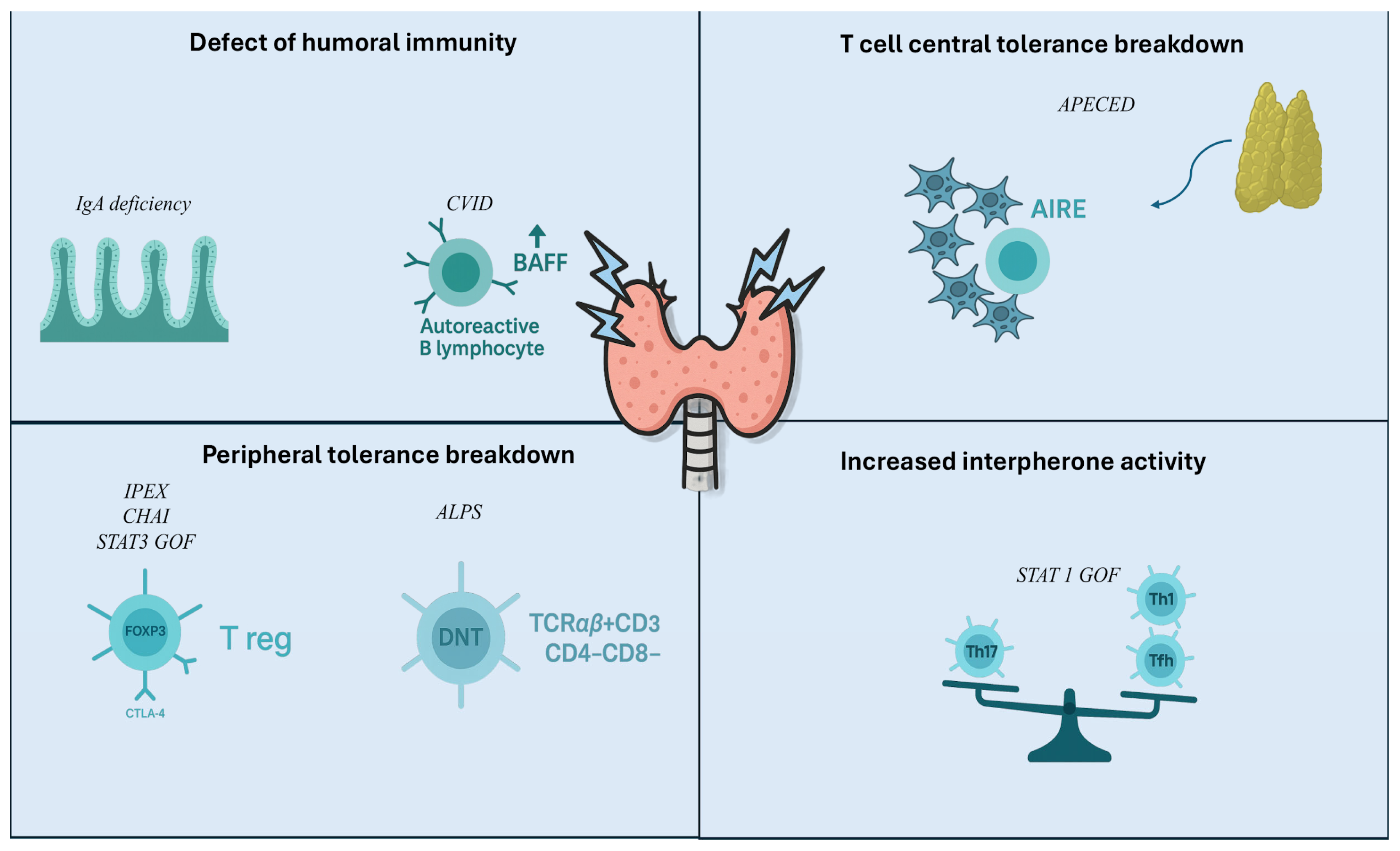
The Cross-Knit Between Immune Cells and Thyroid Function in Autoimmune Thyroid Disorders: What We Can Learn from Inborn Errors of Immunity

 and
and
Highlights
- Autoimmune thyroid diseases (AITDs) share key pathogenetic mechanisms with inborn errors of immunity (IEIs), making IEIs a natural model to study immune tolerance breakdown.
- Genetic and epigenetic perturbations affecting central and peripheral tolerance mechanisms contribute to the development of thyroid autoimmunity.
- Understanding how specific immune defects lead to AITDs enables the identification of precise molecular pathways driving thyroid autoimmunity.
- These insights support the development of targeted, pathway-specific therapies and precision-medicine approaches for AITDs.
Abstract
1. Introduction
2. Autoimmune Thyroid Diseases and Immune Tolerance Breakdown
Thyroid Specific Mechanism of Immune Dysregulation
3. Genetic Susceptibility
4. Epigenetic Factors and ECDs
5. Inborn Errors of Immunity and Thyroiditis
5.1. Defects of Humoral Immunity
5.1.1. Selective IgA Deficiency (SIgAD)
5.1.2. Common Variable Immunodeficiency (CVID)
5.2. IEIs with Disruption of T-Cell Central Tolerance
APECED (Autoimmune Polyendocrine—Candidiasis—Ectodermal—Distrophy)
5.3. IEIs with Altered Peripheral Tolerance Mechanisms
5.3.1. Immune Dysregulation, Polyendocrynopathy, Enteropathy, X-Linked
5.3.2. CTLA-4 Haploinsufficiency
5.3.3. STAT3 Gain of Function
5.3.4. Autoimmune Lymphoproliferative Syndrome (ALPS)
5.3.5. STAT1 Gain of Function
6. Therapeutic Strategies
7. Conclusions
Author Contributions
Funding
Institutional Review Board Statement
Informed Consent Statement
Data Availability Statement
Conflicts of Interest
Abbreviations
| ACE2 | Angiotensin-Converting Enzyme 2 |
| AITD/AITDs | Autoimmune Thyroid Disease(s) |
| ALPS | Autoimmune Lymphoproliferative Syndrome |
| APECED | Autoimmune Polyendocrinopathy-Candidiasis-Ectodermal Dystrophy |
| APS1 | Autoimmune Polyendocrine Syndrome type 1 |
| BAFF | B-cell Activating Factor |
| BCR | B-cell Receptor (implicit in context) |
| CD | Celiac Disease |
| CMC | Chronic Mucocutaneous Candidiasis |
| CTLA-4 | Cytotoxic T-Lymphocyte Antigen 4 |
| CV | Cardiovascular |
| CVID | Common Variable Immunodeficiency |
| DM1/T1DM | Type 1 Diabetes Mellitus |
| DNTs | Double-Negative T cells (TCRαβ+CD3+CD4−CD8−) |
| EDCs | Endocrine-disrupting chemicals |
| GI | Gastrointestinal |
| HT | Hashimoto Thyroiditis |
| HSC | Hematopoietic Stem Cells |
| IEI/IEIs | Inborn Error(s) of Immunity |
| IFN | Interferon |
| IPEX | Immune Dysregulation, Polyendocrinopathy, Enteropathy, X-linked |
| mTEC | Medullary Thymic Epithelial Cells |
| miRNA/miR | MicroRNA |
| PFAS | polyfluoroalkyl substances |
| pSTAT | Phosphorylated STAT |
| PS1 | Polyendocrine Syndrome type 1 (synonym of APS1) |
| SIgAD | Selective IgA Deficiency |
| SNP | Single Nucleotide Polymorphism |
| TACI | Transmembrane Activator and CAML Interactor |
| TG/Tg-Ab | Thyroglobulin/Anti-Thyroglobulin Antibodies |
| THSR/TSHR | Thyroid-Stimulating Hormone Receptor |
| TPO/TPO-Ab | Thyroid Peroxidase/Anti-Thyroid Peroxidase Antibodies |
| TRAb | TSH Receptor Antibodies |
| Treg | Regulatory T cells |
References
- Petranović Ovčariček, P.; Görges, R.; Giovanella, L. Autoimmune Thyroid Diseases. Semin. Nucl. Med. 2024, 54, 219–236. [Google Scholar] [CrossRef] [PubMed]
- Vargas-Uricoechea, H. Molecular Mechanisms in Autoimmune Thyroid Disease. Cells 2023, 12, 918. [Google Scholar] [CrossRef]
- Smith, T.J.; Hegedüs, L. Graves’ Disease. N. Engl. J. Med. 2016, 375, 1552–1565. [Google Scholar] [CrossRef] [PubMed]
- Lane, L.C.; Wood, C.L.; Cheetham, T. Graves’ disease: Moving forwards. Arch. Dis. Child. 2023, 108, 276–281. [Google Scholar] [CrossRef] [PubMed]
- Ralli, M.; Angeletti, D.; Fiore, M.; D’Aguanno, V.; Lambiase, A.; Artico, M.; de Vincentiis, M.; Greco, A. Hashimoto’s thyroiditis: An update on pathogenic mechanisms, diagnostic protocols, therapeutic strategies, and potential malignant transformation. Autoimmun. Rev. 2020, 19, 102649. [Google Scholar] [CrossRef]
- Yıldırım, E.; Esen, I.; Ökdemir, D. Demographic and Clinical Characteristics of Childhood Autoimmune Thyroiditis: Single-Center Study. J. Pediatr. Res. 2025, 12, 90–95. [Google Scholar] [CrossRef]
- Cheetham, T.; Wood, C. Paediatric thyroid disease. Clin. Endocrinol. 2024, 101, 223–233. [Google Scholar] [CrossRef]
- Hanley, P.; Lord, K.; Bauer, A.J. Thyroid Disorders in Children and Adolescents: A Review. JAMA Pediatr. 2016, 170, 1008–1019. [Google Scholar] [CrossRef]
- Vukovic, R.; Zeljkovic, A.; Bufan, B.; Spasojevic-Kalimanovska, V.; Milenkovic, T.; Vekic, J. Hashimoto Thyroiditis and Dyslipidemia in Childhood: A Review. Front. Endocrinol. 2019, 10, 868. [Google Scholar] [CrossRef]
- Wu, G.; Zou, D.; Cai, H.; Liu, Y. Ultrasonography in the diagnosis of Hashimoto’s thyroiditis. Front. Biosci. 2016, 21, 1006–1012. [Google Scholar] [CrossRef]
- Weetman, A.P. An update on the pathogenesis of Hashimoto’s thyroiditis. J. Endocrinol. Investig. 2021, 44, 883–890. [Google Scholar] [CrossRef] [PubMed]
- Viola, N.; Colleo, A.; Casula, M.; Mura, C.; Boi, F.; Lanzolla, G. Graves’ Disease: Is It Time for Targeted Therapy? A Narrative Review. Medicina 2025, 61, 500. [Google Scholar] [CrossRef] [PubMed]
- Léger, J.; Carel, J.C. Diagnosis and management of hyperthyroidism from prenatal life to adolescence. Best Pract. Res. Clin. Endocrinol. Metab. 2018, 32, 373–386. [Google Scholar] [CrossRef] [PubMed]
- Hu, Y.; Zhang, L.; Chen, H.; Liu, X.; Zheng, X.; Shi, H.; Jiang, L.; Cui, D. Analysis of Regulatory T Cell Subsets and Their Expression of Helios and PD-1 in Patients with Hashimoto Thyroiditis. Int. J. Endocrinol. 2019, 2019, 5368473. [Google Scholar] [CrossRef]
- Álvarez-Sierra, D.; Marín-Sánchez, A.; Ruiz-Blázquez, P.; de Jesús Gil, C.; Iglesias-Felip, C.; González, Ó.; Casteras, A.; Costa, R.F.; Nuciforo, P.; Colobran, R.; et al. Analysis of the PD-1/PD-L1 axis in human autoimmune thyroid disease: Insights into pathogenesis and clues to immunotherapy associated thyroid autoimmunity. J. Autoimmun. 2019, 103, 102285. [Google Scholar] [CrossRef]
- Ragusa, F.; Fallahi, P.; Elia, G.; Gonnella, D.; Paparo, S.R.; Giusti, C.; Churilov, L.P.; Ferrari, S.M.; Antonelli, A. Hashimotos’ thyroiditis: Epidemiology, pathogenesis, clinic and therapy. Best Pract. Res. Clin. Endocrinol. Metab. 2019, 33, 101367. [Google Scholar] [CrossRef]
- Antonelli, A.; Ferrari, S.M.; Corrado, A.; Di Domenicantonio, A.; Fallahi, P. Autoimmune thyroid disorders. Autoimmun. Rev. 2015, 14, 174–180. [Google Scholar] [CrossRef]
- Tomer, Y. Mechanisms of autoimmune thyroid diseases: From genetics to epigenetics. Annu. Rev. Pathol. 2014, 9, 147–156. [Google Scholar] [CrossRef]
- Giardino, G.; Romano, R.; Lougaris, V.; Castagnoli, R.; Cillo, F.; Leonardi, L.; La Torre, F.; Soresina, A.; Federici, S.; Cancrini, C.; et al. Immune tolerance breakdown in inborn errors of immunity: Paving the way to novel therapeutic approaches. Clin. Immunol. 2023, 251, 109302. [Google Scholar] [CrossRef]
- Smatti, M.K.; Cyprian, F.S.; Nasrallah, G.K.; Al Thani, A.A.; Almishal, R.O.; Yassine, H.M. Viruses and Autoimmunity: A Review on the Potential Interaction and Molecular Mechanisms. Viruses 2019, 11, 762. [Google Scholar] [CrossRef]
- Pahari, S.; Chatterjee, D.; Negi, S.; Kaur, J.; Singh, B.; Agrewala, J.N. Morbid Sequences Suggest Molecular Mimicry between Microbial Peptides and Self-Antigens: A Possibility of Inciting Autoimmunity. Front. Microbiol. 2017, 8, 1938. [Google Scholar] [CrossRef] [PubMed]
- Pacheco, Y.; Acosta-Ampudia, Y.; Monsalve, D.M.; Chang, C.; Gershwin, M.E.; Anaya, J.M. Bystander activation and autoimmunity. J. Autoimmun. 2019, 103, 102301. [Google Scholar] [CrossRef] [PubMed]
- Vanderlugt, C.L.; Miller, S.D. Epitope spreading in immune-mediated diseases: Implications for immunotherapy. Nat. Rev. Immunol. 2002, 2, 85–95. [Google Scholar] [CrossRef] [PubMed]
- Köhling, H.L.; Plummer, S.F.; Marchesi, J.R.; Davidge, K.S.; Ludgate, M. The microbiota and autoimmunity: Their role in thyroid autoimmune diseases. Clin. Immunol. 2017, 183, 63–74. [Google Scholar] [CrossRef]
- Tomer, Y.; Davies, T.F. Infection, thyroid disease, and autoimmunity. Endocr. Rev. 1993, 14, 107–120. [Google Scholar]
- Desailloud, R.; Hober, D. Viruses and thyroiditis: An update. Virol. J. 2009, 6, 5. [Google Scholar] [CrossRef]
- Brancatella, A.; Viola, N.; Santini, F.; Latrofa, F. COVID-induced thyroid autoimmunity. Best Pract. Res. Clin. Endocrinol. Metab. 2023, 37, 101742. [Google Scholar] [CrossRef]
- Murugan, A.K.; Alzahrani, A.S. SARS-CoV-2: Emerging Role in the Pathogenesis of Various Thyroid Diseases. J. Inflamm. Res. 2021, 14, 6191–6221. [Google Scholar] [CrossRef]
- Bilimoria, K.Y.; Pescovitz, O.H.; DiMeglio, L.A. Autoimmune thyroid dysfunction in children with type 1 diabetes mellitus: Screening guidelines based on a retrospective analysis. J. Pediatr. Endocrinol. Metab. 2003, 16, 1111–1117. [Google Scholar] [CrossRef]
- Kochummen, E.; Marwa, A.; Umpaichitra, V.; Perez-Colon, S.; Chin, V.L. Screening for autoimmune thyroiditis and celiac disease in minority children with type 1 diabetes. J. Pediatr. Endocrinol. Metab. 2018, 31, 879–885. [Google Scholar] [CrossRef]
- Piątkowska, E.; Szalecki, M. Autoimmune thyroiditis in children and adolescents with type 1 diabetes. Pediatr. Endocrinol. Diabetes Metab. 2011, 17, 173–177. [Google Scholar]
- Umpierrez, G.E.; Latif, K.A.; Murphy, M.B.; Lambeth, H.C.; Stentz, F.; Bush, A.; Kitabchi, A.E. Thyroid dysfunction in patients with type 1 diabetes: A longitudinal study. Diabetes Care 2003, 26, 1181–1185. [Google Scholar] [CrossRef] [PubMed]
- Mantovani, R.M.; Mantovani, L.M.; Dias, V.M. Thyroid autoimmunity in children and adolescents with type 1 diabetes mellitus: Prevalence and risk factors. J. Pediatr. Endocrinol. Metab. 2007, 20, 669–675. [Google Scholar] [CrossRef] [PubMed]
- Spadaccino, A.C.; Basso, D.; Chiarelli, S.; Albergoni, M.P.; D’Odorico, A.; Plebani, M.; Pedini, B.; Lazzarotto, F.; Betterle, C. Celiac disease in North Italian patients with autoimmune thyroid diseases. Autoimmunity 2008, 41, 116–121. [Google Scholar] [CrossRef] [PubMed]
- Meloni, A.; Mandas, C.; Jores, R.D.; Congia, M. Prevalence of autoimmune thyroiditis in children with celiac disease and effect of gluten withdrawal. J. Pediatr. 2009, 155, 51–55, 55.e51. [Google Scholar] [CrossRef]
- Fasano, A. Systemic autoimmune disorders in celiac disease. Curr. Opin. Gastroenterol. 2006, 22, 674–679. [Google Scholar] [CrossRef]
- Ansaldi, N.; Palmas, T.; Corrias, A.; Barbato, M.; D’Altiglia, M.R.; Campanozzi, A.; Baldassarre, M.; Rea, F.; Pluvio, R.; Bonamico, M.; et al. Autoimmune thyroid disease and celiac disease in children. J. Pediatr. Gastroenterol. Nutr. 2003, 37, 63–66. [Google Scholar]
- Tywanek, E.; Michalak, A.; Świrska, J.; Zwolak, A. Autoimmunity, New Potential Biomarkers and the Thyroid Gland-The Perspective of Hashimoto’s Thyroiditis and Its Treatment. Int. J. Mol. Sci. 2024, 25, 4703. [Google Scholar] [CrossRef]
- Villanueva, R.; Greenberg, D.A.; Davies, T.F.; Tomer, Y. Sibling recurrence risk in autoimmune thyroid disease. Thyroid 2003, 13, 761–764. [Google Scholar] [CrossRef]
- Brix, T.H.; Hegedüs, L. Twin studies as a model for exploring the aetiology of autoimmune thyroid disease. Clin. Endocrinol. 2012, 76, 457–464. [Google Scholar] [CrossRef]
- Ban, Y.; Greenberg, D.A.; Concepcion, E.; Skrabanek, L.; Villanueva, R.; Tomer, Y. Amino acid substitutions in the thyroglobulin gene are associated with susceptibility to human and murine autoimmune thyroid disease. Proc. Natl. Acad. Sci. USA 2003, 100, 15119–15124. [Google Scholar] [CrossRef] [PubMed]
- Stefan, M.; Jacobson, E.M.; Huber, A.K.; Greenberg, D.A.; Li, C.W.; Skrabanek, L.; Conception, E.; Fadlalla, M.; Ho, K.; Tomer, Y. Novel variant of thyroglobulin promoter triggers thyroid autoimmunity through an epigenetic interferon alpha-modulated mechanism. J. Biol. Chem. 2011, 286, 31168–31179. [Google Scholar] [CrossRef] [PubMed]
- Jacobson, E.M.; Huber, A.; Tomer, Y. The HLA gene complex in thyroid autoimmunity: From epidemiology to etiology. J. Autoimmun. 2008, 30, 58–62. [Google Scholar] [CrossRef] [PubMed]
- Ban, Y.; Davies, T.F.; Greenberg, D.A.; Concepcion, E.S.; Osman, R.; Oashi, T.; Tomer, Y. Arginine at position 74 of the HLA-DR beta1 chain is associated with Graves’ disease. Genes. Immun. 2004, 5, 203–208. [Google Scholar] [CrossRef]
- Menconi, F.; Monti, M.C.; Greenberg, D.A.; Oashi, T.; Osman, R.; Davies, T.F.; Ban, Y.; Jacobson, E.M.; Concepcion, E.S.; Li, C.W.; et al. Molecular amino acid signatures in the MHC class II peptide-binding pocket predispose to autoimmune thyroiditis in humans and in mice. Proc. Natl. Acad. Sci. USA 2008, 105, 14034–14039. [Google Scholar] [CrossRef]
- Chand Dakal, T.; Dhabhai, B.; Agarwal, D.; Gupta, R.; Nagda, G.; Meena, A.R.; Dhakar, R.; Menon, A.; Mathur, R.; Mona; et al. Mechanistic basis of co-stimulatory CD40-CD40L ligation mediated regulation of immune responses in cancer and autoimmune disorders. Immunobiology 2020, 225, 151899. [Google Scholar] [CrossRef]
- Jacobson, E.M.; Tomer, Y. The CD40, CTLA-4, thyroglobulin, TSH receptor, and PTPN22 gene quintet and its contribution to thyroid autoimmunity: Back to the future. J. Autoimmun. 2007, 28, 85–98. [Google Scholar] [CrossRef]
- Jacobson, E.M.; Concepcion, E.; Oashi, T.; Tomer, Y. A Graves’ disease-associated Kozak sequence single-nucleotide polymorphism enhances the efficiency of CD40 gene translation: A case for translational pathophysiology. Endocrinology 2005, 146, 2684–2691. [Google Scholar] [CrossRef]
- Metcalfe, R.A.; McIntosh, R.S.; Marelli-Berg, F.; Lombardi, G.; Lechler, R.; Weetman, A.P. Detection of CD40 on human thyroid follicular cells: Analysis of expression and function. J. Clin. Endocrinol. Metab. 1998, 83, 1268–1274. [Google Scholar] [CrossRef]
- Smith, T.J.; Sciaky, D.; Phipps, R.P.; Jennings, T.A. CD40 expression in human thyroid tissue: Evidence for involvement of multiple cell types in autoimmune and neoplastic diseases. Thyroid 1999, 9, 749–755. [Google Scholar] [CrossRef]
- Lee, H.J.; Li, C.W.; Hammerstad, S.S.; Stefan, M.; Tomer, Y. Immunogenetics of autoimmune thyroid diseases: A comprehensive review. J. Autoimmun. 2015, 64, 82–90. [Google Scholar] [CrossRef] [PubMed]
- Kavvoura, F.K.; Akamizu, T.; Awata, T.; Ban, Y.; Chistiakov, D.A.; Frydecka, I.; Ghaderi, A.; Gough, S.C.; Hiromatsu, Y.; Ploski, R.; et al. Cytotoxic T-lymphocyte associated antigen 4 gene polymorphisms and autoimmune thyroid disease: A meta-analysis. J. Clin. Endocrinol. Metab. 2007, 92, 3162–3170. [Google Scholar] [CrossRef] [PubMed]
- Tomer, Y. Unraveling the genetic susceptibility to autoimmune thyroid diseases: CTLA-4 takes the stage. Thyroid 2001, 11, 167–169. [Google Scholar] [CrossRef] [PubMed]
- Park, Y.J.; Chung, H.K.; Park, D.J.; Kim, W.B.; Kim, S.W.; Koh, J.J.; Cho, B.Y. Polymorphism in the promoter and exon 1 of the cytotoxic T lymphocyte antigen-4 gene associated with autoimmune thyroid disease in Koreans. Thyroid 2000, 10, 453–459. [Google Scholar] [CrossRef]
- Heward, J.M.; Allahabadia, A.; Armitage, M.; Hattersley, A.; Dodson, P.M.; Macleod, K.; Carr-Smith, J.; Daykin, J.; Daly, A.; Sheppard, M.C.; et al. The development of Graves’ disease and the CTLA-4 gene on chromosome 2q33. J. Clin. Endocrinol. Metab. 1999, 84, 2398–2401. [Google Scholar] [CrossRef]
- Lafontaine, N.; Wilson, S.G.; Walsh, J.P. DNA Methylation in Autoimmune Thyroid Disease. J. Clin. Endocrinol. Metab. 2022, 108, 604–613. [Google Scholar] [CrossRef]
- Lafontaine, N.; Shore, C.J.; Campbell, P.J.; Mullin, B.H.; Brown, S.J.; Panicker, V.; Dudbridge, F.; Brix, T.H.; Hegedüs, L.; Wilson, S.G.; et al. Epigenome-wide Association Study Shows Differential DNA Methylation of MDC1, KLF9, and CUTA in Autoimmune Thyroid Disease. J. Clin. Endocrinol. Metab. 2024, 109, 992–999. [Google Scholar] [CrossRef]
- Zadeh-Vakili, A.; Faam, B.; Afgar, A.; Razmpoosh, E.; zarkesh, M.; Amouzegar, A. A systematic review of dysregulated microRNAs in Hashimoto’s thyroiditis. Endocrine 2024, 84, 800–811. [Google Scholar] [CrossRef]
- Martínez-Hernández, R.; Sampedro-Núñez, M.; Serrano-Somavilla, A.; Ramos-Leví, A.M.; de la Fuente, H.; Triviño, J.C.; Sanz-García, A.; Sánchez-Madrid, F.; Marazuela, M. A MicroRNA Signature for Evaluation of Risk and Severity of Autoimmune Thyroid Diseases. J. Clin. Endocrinol. Metab. 2018, 103, 1139–1150. [Google Scholar] [CrossRef]
- Martínez-Hernández, R.; Marazuela, M. MicroRNAs in autoimmune thyroid diseases and their role as biomarkers. Best Pract. Res. Clin. Endocrinol. Metab. 2023, 37, 101741. [Google Scholar] [CrossRef]
- Gorini, F.; Tonacci, A.; Sanmartin, C.; Venturi, F. Phthalates and Non-Phthalate Plasticizers and Thyroid Dysfunction: Current Evidence and Novel Strategies to Reduce Their Spread in Food Industry and Environment. Toxics 2025, 13, 222. [Google Scholar] [CrossRef]
- Li, Z.; Deng, L.; Zhang, Y. Environmental pollutants as emerging disruptors of thyroid function: Mechanisms and early-life risks. Ecotoxicol. Environ. Saf. 2026, 309, 119581. [Google Scholar] [CrossRef]
- Xu, Y.; Xu, J.; Li, S.; Sun, H.; Wang, C.; Pan, K.; Yu, J. Association between environmental endocrine disruptors and autoimmune diseases: A systematic review and meta-analysis. iScience 2025, 28, 113822. [Google Scholar] [CrossRef] [PubMed]
- Du, X.; Wu, Y.; Tao, G.; Xu, J.; Du, Z.; Wu, M.; Gu, T.; Xiong, J.; Xiao, S.; Wei, X.; et al. Association between PFAS exposure and thyroid health: A systematic review and meta-analysis for adolescents, pregnant women, adults and toxicological evidence. Sci. Total Environ. 2024, 953, 175958. [Google Scholar] [CrossRef]
- Fischer, A.; Provot, J.; Jais, J.P.; Alcais, A.; Mahlaoui, N. Autoimmune and inflammatory manifestations occur frequently in patients with primary immunodeficiencies. J. Allergy Clin. Immunol. 2017, 140, 1388–1393.e1388. [Google Scholar] [CrossRef]
- Walter, J.E.; Ayala, I.A.; Milojevic, D. Autoimmunity as a continuum in primary immunodeficiency. Curr. Opin. Pediatr. 2019, 31, 851–862. [Google Scholar] [CrossRef]
- Bussone, G.; Mouthon, L. Autoimmune manifestations in primary immune deficiencies. Autoimmun. Rev. 2009, 8, 332–336. [Google Scholar] [CrossRef]
- Notarangelo, L.D.; Gambineri, E.; Badolato, R. Immunodeficiencies with autoimmune consequences. Adv. Immunol. 2006, 89, 321–370. [Google Scholar]
- Delmonte, O.M.; Castagnoli, R.; Calzoni, E.; Notarangelo, L.D. Inborn Errors of Immunity With Immune Dysregulation: From Bench to Bedside. Front. Pediatr. 2019, 7, 353. [Google Scholar] [CrossRef]
- Yel, L. Selective IgA deficiency. J. Clin. Immunol. 2010, 30, 10–16. [Google Scholar] [CrossRef]
- Ocampo, C.J.; Peters, A.T. Antibody deficiency in chronic rhinosinusitis: Epidemiology and burden of illness. Am. J. Rhinol. Allergy 2013, 27, 34–38. [Google Scholar] [CrossRef]
- Agarwal, S.; Cunningham-Rundles, C. Autoimmunity in common variable immunodeficiency. Curr. Allergy Asthma Rep. 2009, 9, 347–352. [Google Scholar] [CrossRef] [PubMed]
- Albuquerque, A. Nodular lymphoid hyperplasia in the gastrointestinal tract in adult patients: A review. World J. Gastrointest. Endosc. 2014, 6, 534–540. [Google Scholar] [CrossRef] [PubMed]
- Swain, S.; Selmi, C.; Gershwin, M.E.; Teuber, S.S. The clinical implications of selective IgA deficiency. J. Transl. Autoimmun. 2019, 2, 100025. [Google Scholar] [CrossRef] [PubMed]
- Price, P.; Witt, C.; Allcock, R.; Sayer, D.; Garlepp, M.; Kok, C.C.; French, M.; Mallal, S.; Christiansen, F. The genetic basis for the association of the 8.1 ancestral haplotype (A1, B8, DR3) with multiple immunopathological diseases. Immunol. Rev. 1999, 167, 257–274. [Google Scholar] [CrossRef]
- Wang, N.; Shen, N.; Vyse, T.J.; Anand, V.; Gunnarson, I.; Sturfelt, G.; Rantapää-Dahlqvist, S.; Elvin, K.; Truedsson, L.; Andersson, B.A.; et al. Selective IgA deficiency in autoimmune diseases. Mol. Med. 2011, 17, 1383–1396. [Google Scholar] [CrossRef]
- Ben Mkaddem, S.; Rossato, E.; Heming, N.; Monteiro, R.C. Anti-inflammatory role of the IgA Fc receptor (CD89): From autoimmunity to therapeutic perspectives. Autoimmun. Rev. 2013, 12, 666–669. [Google Scholar] [CrossRef]
- Jacob, C.M.; Pastorino, A.C.; Fahl, K.; Carneiro-Sampaio, M.; Monteiro, R.C. Autoimmunity in IgA deficiency: Revisiting the role of IgA as a silent housekeeper. J. Clin. Immunol. 2008, 28, S56–S61. [Google Scholar] [CrossRef]
- Pecoraro, A.; Crescenzi, L.; Galdiero, M.R.; Marone, G.; Rivellese, F.; Rossi, F.W.; de Paulis, A.; Genovese, A.; Spadaro, G. Immunosuppressive therapy with rituximab in common variable immunodeficiency. Clin. Mol. Allergy 2019, 17, 9. [Google Scholar] [CrossRef]
- Patuzzo, G.; Barbieri, A.; Tinazzi, E.; Veneri, D.; Argentino, G.; Moretta, F.; Puccetti, A.; Lunardi, C. Autoimmunity and infection in common variable immunodeficiency (CVID). Autoimmun. Rev. 2016, 15, 877–882. [Google Scholar] [CrossRef]
- Odnoletkova, I.; Kindle, G.; Quinti, I.; Grimbacher, B.; Knerr, V.; Gathmann, B.; Ehl, S.; Mahlaoui, N.; Van Wilder, P.; Bogaerts, K.; et al. The burden of common variable immunodeficiency disorders: A retrospective analysis of the European Society for Immunodeficiency (ESID) registry data. Orphanet J. Rare Dis. 2018, 13, 201. [Google Scholar] [CrossRef] [PubMed]
- Gereige, J.D.; Maglione, P.J. Current Understanding and Recent Developments in Common Variable Immunodeficiency Associated Autoimmunity. Front. Immunol. 2019, 10, 2753. [Google Scholar] [CrossRef] [PubMed]
- Martinez-Gallo, M.; Radigan, L.; Almejún, M.B.; Martínez-Pomar, N.; Matamoros, N.; Cunningham-Rundles, C. TACI mutations and impaired B-cell function in subjects with CVID and healthy heterozygotes. J. Allergy Clin. Immunol. 2013, 131, 468–476. [Google Scholar] [CrossRef] [PubMed]
- Zhang, Y.; Li, J.; Zhang, Y.M.; Zhang, X.M.; Tao, J. Effect of TACI signaling on humoral immunity and autoimmune diseases. J. Immunol. Res. 2015, 2015, 247426. [Google Scholar] [CrossRef]
- Halonen, M.; Eskelin, P.; Myhre, A.G.; Perheentupa, J.; Husebye, E.S.; Kämpe, O.; Rorsman, F.; Peltonen, L.; Ulmanen, I.; Partanen, J. AIRE mutations and human leukocyte antigen genotypes as determinants of the autoimmune polyendocrinopathy-candidiasis-ectodermal dystrophy phenotype. J. Clin. Endocrinol. Metab. 2002, 87, 2568–2574. [Google Scholar] [CrossRef]
- Capalbo, D.; Fusco, A.; Aloj, G.; Improda, N.; Vitiello, L.; Dianzani, U.; Betterle, C.; Salerno, M.; Pignata, C. High intrafamilial variability in autoimmune polyendocrinopathy-candidiasis-ectodermal dystrophy: A case study. J. Endocrinol. Investig. 2012, 35, 77–81. [Google Scholar]
- De Martino, L.; Capalbo, D.; Improda, N.; Lorello, P.; Ungaro, C.; Di Mase, R.; Cirillo, E.; Pignata, C.; Salerno, M. Novel Findings into AIRE Genetics and Functioning: Clinical Implications. Front. Pediatr. 2016, 4, 86. [Google Scholar] [CrossRef]
- Improda, N.; Capalbo, D.; Cirillo, E.; Cerbone, M.; Esposito, A.; Pignata, C.; Salerno, M. Cutaneous vasculitis in patients with autoimmune polyendocrine syndrome type 1: Report of a case and brief review of the literature. BMC Pediatr. 2014, 14, 272. [Google Scholar] [CrossRef]
- Gylling, M.; Kääriäinen, E.; Väisänen, R.; Kerosuo, L.; Solin, M.L.; Halme, L.; Saari, S.; Halonen, M.; Kämpe, O.; Perheentupa, J.; et al. The hypoparathyroidism of autoimmune polyendocrinopathy-candidiasis-ectodermal dystrophy protective effect of male sex. J. Clin. Endocrinol. Metab. 2003, 88, 4602–4608. [Google Scholar] [CrossRef]
- Nagamine, K.; Peterson, P.; Scott, H.S.; Kudoh, J.; Minoshima, S.; Heino, M.; Krohn, K.J.; Lalioti, M.D.; Mullis, P.E.; Antonarakis, S.E.; et al. Positional cloning of the APECED gene. Nat. Genet. 1997, 17, 393–398. [Google Scholar] [CrossRef]
- Bruserud, Ø.; Oftedal, B.E.; Wolff, A.B.; Husebye, E.S. AIRE-mutations and autoimmune disease. Curr. Opin. Immunol. 2016, 43, 8–15. [Google Scholar] [CrossRef] [PubMed]
- Fierabracci, A. Recent insights into the role and molecular mechanisms of the autoimmune regulator (AIRE) gene in autoimmunity. Autoimmun. Rev. 2011, 10, 137–143. [Google Scholar] [CrossRef] [PubMed]
- Husebye, E.S.; Anderson, M.S.; Kämpe, O. Autoimmune Polyendocrine Syndromes. N. Engl. J. Med. 2018, 378, 1132–1141. [Google Scholar] [CrossRef] [PubMed]
- Meyer, S.; Woodward, M.; Hertel, C.; Vlaicu, P.; Haque, Y.; Kärner, J.; Macagno, A.; Onuoha, S.C.; Fishman, D.; Peterson, H.; et al. AIRE-Deficient Patients Harbor Unique High-Affinity Disease-Ameliorating Autoantibodies. Cell 2016, 166, 582–595. [Google Scholar] [CrossRef]
- Betterle, C.; Dal Pra, C.; Mantero, F.; Zanchetta, R. Autoimmune adrenal insufficiency and autoimmune polyendocrine syndromes: Autoantibodies, autoantigens, and their applicability in diagnosis and disease prediction. Endocr. Rev. 2002, 23, 327–364. [Google Scholar] [CrossRef]
- Weiler, F.G.; Peterson, P.; Costa-Carvalho, B.T.; de Barros Dorna, M.; Correia-Deur, J.E.; Sader, S.L.; Espíndola-Antunes, D.; Guerra-Junior, G.; Dias-da-Silva, M.R.; Lazaretti-Castro, M. The heterogeneity of autoimmune polyendocrine syndrome type 1: Clinical features, new mutations and cytokine autoantibodies in a Brazilian cohort from tertiary care centers. Clin. Immunol. 2018, 197, 231–238. [Google Scholar] [CrossRef]
- Garelli, S.; Dalla Costa, M.; Sabbadin, C.; Barollo, S.; Rubin, B.; Scarpa, R.; Masiero, S.; Fierabracci, A.; Bizzarri, C.; Crinò, A.; et al. Autoimmune polyendocrine syndrome type 1: An Italian survey on 158 patients. J. Endocrinol. Investig. 2021, 44, 2493–2510. [Google Scholar] [CrossRef]
- Humbert, L.; Cornu, M.; Proust-Lemoine, E.; Bayry, J.; Wemeau, J.L.; Vantyghem, M.C.; Sendid, B. Chronic Mucocutaneous Candidiasis in Autoimmune Polyendocrine Syndrome Type 1. Front. Immunol. 2018, 9, 2570. [Google Scholar] [CrossRef]
- van der Vliet, H.J.; Nieuwenhuis, E.E. IPEX as a result of mutations in FOXP3. Clin. Dev. Immunol. 2007, 2007, 89017. [Google Scholar] [CrossRef]
- Ochs, H.D.; Gambineri, E.; Torgerson, T.R. IPEX, FOXP3 and regulatory T-cells: A model for autoimmunity. Immunol. Res. 2007, 38, 112–121. [Google Scholar] [CrossRef]
- Loser, K.; Hansen, W.; Apelt, J.; Balkow, S.; Buer, J.; Beissert, S. In vitro-generated regulatory T cells induced by Foxp3-retrovirus infection control murine contact allergy and systemic autoimmunity. Gene Ther. 2005, 12, 1294–1304. [Google Scholar] [CrossRef]
- Passerini, L.; Olek, S.; Di Nunzio, S.; Barzaghi, F.; Hambleton, S.; Abinun, M.; Tommasini, A.; Vignola, S.; Cipolli, M.; Amendola, M.; et al. Forkhead box protein 3 (FOXP3) mutations lead to increased TH17 cell numbers and regulatory T-cell instability. J. Allergy Clin. Immunol. 2011, 128, 1376–1379.e1371. [Google Scholar] [CrossRef]
- Gambineri, E.; Perroni, L.; Passerini, L.; Bianchi, L.; Doglioni, C.; Meschi, F.; Bonfanti, R.; Sznajer, Y.; Tommasini, A.; Lawitschka, A.; et al. Clinical and molecular profile of a new series of patients with immune dysregulation, polyendocrinopathy, enteropathy, X-linked syndrome: Inconsistent correlation between forkhead box protein 3 expression and disease severity. J. Allergy Clin. Immunol. 2008, 122, 1105–1112.e1101. [Google Scholar] [CrossRef] [PubMed]
- Barzaghi, F.; Passerini, L.; Bacchetta, R. Immune dysregulation, polyendocrinopathy, enteropathy, x-linked syndrome: A paradigm of immunodeficiency with autoimmunity. Front. Immunol. 2012, 3, 211. [Google Scholar] [CrossRef] [PubMed]
- Verbsky, J.W.; Chatila, T.A. Immune dysregulation, polyendocrinopathy, enteropathy, X-linked (IPEX) and IPEX-related disorders: An evolving web of heritable autoimmune diseases. Curr. Opin. Pediatr. 2013, 25, 708–714. [Google Scholar] [CrossRef] [PubMed]
- Ronco, P.; Debiec, H. Pathophysiological lessons from rare associations of immunological disorders. Pediatr. Nephrol. 2009, 24, 3–8. [Google Scholar] [CrossRef]
- Schubert, D.; Bode, C.; Kenefeck, R.; Hou, T.Z.; Wing, J.B.; Kennedy, A.; Bulashevska, A.; Petersen, B.S.; Schäffer, A.A.; Grüning, B.A.; et al. Autosomal dominant immune dysregulation syndrome in humans with CTLA4 mutations. Nat. Med. 2014, 20, 1410–1416. [Google Scholar] [CrossRef]
- Kuehn, H.S.; Ouyang, W.; Lo, B.; Deenick, E.K.; Niemela, J.E.; Avery, D.T.; Schickel, J.N.; Tran, D.Q.; Stoddard, J.; Zhang, Y.; et al. Immune dysregulation in human subjects with heterozygous germline mutations in CTLA4. Science 2014, 345, 1623–1627. [Google Scholar] [CrossRef]
- Schwab, C.; Gabrysch, A.; Olbrich, P.; Patiño, V.; Warnatz, K.; Wolff, D.; Hoshino, A.; Kobayashi, M.; Imai, K.; Takagi, M.; et al. Phenotype, penetrance, and treatment of 133 cytotoxic T-lymphocyte antigen 4-insufficient subjects. J. Allergy Clin. Immunol. 2018, 142, 1932–1946. [Google Scholar] [CrossRef]
- Lorenzini, T.; Dotta, L.; Giacomelli, M.; Vairo, D.; Badolato, R. STAT mutations as program switchers: Turning primary immunodeficiencies into autoimmune diseases. J. Leukoc. Biol. 2017, 101, 29–38. [Google Scholar] [CrossRef]
- Flanagan, S.E.; Haapaniemi, E.; Russell, M.A.; Caswell, R.; Allen, H.L.; De Franco, E.; McDonald, T.J.; Rajala, H.; Ramelius, A.; Barton, J.; et al. Activating germline mutations in STAT3 cause early-onset multi-organ autoimmune disease. Nat. Genet. 2014, 46, 812–814. [Google Scholar] [CrossRef]
- Fabre, A.; Marchal, S.; Barlogis, V.; Mari, B.; Barbry, P.; Rohrlich, P.S.; Forbes, L.R.; Vogel, T.P.; Giovannini-Chami, L. Clinical Aspects of STAT3 Gain-of-Function Germline Mutations: A Systematic Review. J. Allergy Clin. Immunol. Pract. 2019, 7, 1958–1969.e1959. [Google Scholar] [CrossRef] [PubMed]
- Hillmer, E.J.; Zhang, H.; Li, H.S.; Watowich, S.S. STAT3 signaling in immunity. Cytokine Growth Factor Rev. 2016, 31, 1–15. [Google Scholar] [CrossRef] [PubMed]
- Lambert, M.P. Presentation and diagnosis of autoimmune lymphoproliferative syndrome (ALPS). Expert. Rev. Clin. Immunol. 2021, 17, 1163–1173. [Google Scholar] [CrossRef] [PubMed]
- Bride, K.; Teachey, D. Autoimmune lymphoproliferative syndrome: More than a FAScinating disease. F1000Research 2017, 6, 1928. [Google Scholar] [CrossRef]
- Consonni, F.; Gambineri, E.; Favre, C. ALPS, FAS, and beyond: From inborn errors of immunity to acquired immunodeficiencies. Ann. Hematol. 2022, 101, 469–484. [Google Scholar] [CrossRef]
- Yan, H.; Hong, Y.; Cai, Y. Association between FAS gene -670 A/G and -1377 G/A polymorphisms and the risk of autoimmune diseases: A meta-analysis. Biosci. Rep. 2020, 40, BSR20191197. [Google Scholar] [CrossRef]
- Kiu, H.; Nicholson, S.E. Biology and significance of the JAK/STAT signalling pathways. Growth Factors 2012, 30, 88–106. [Google Scholar] [CrossRef]
- van de Veerdonk, F.L.; Plantinga, T.S.; Hoischen, A.; Smeekens, S.P.; Joosten, L.A.; Gilissen, C.; Arts, P.; Rosentul, D.C.; Carmichael, A.J.; Smits-van der Graaf, C.A.; et al. STAT1 mutations in autosomal dominant chronic mucocutaneous candidiasis. N. Engl. J. Med. 2011, 365, 54–61. [Google Scholar] [CrossRef]
- Deyà-Martínez, A.; Rivière, J.G.; Roxo-Junior, P.; Ramakers, J.; Bloomfield, M.; Guisado Hernandez, P.; Blanco Lobo, P.; Abu Jamra, S.R.; Esteve-Sole, A.; Kanderova, V.; et al. Impact of JAK Inhibitors in Pediatric Patients with STAT1 Gain of Function (GOF) Mutations-10 Children and Review of the Literature. J. Clin. Immunol. 2022, 42, 1071–1082. [Google Scholar] [CrossRef]
- Chaimowitz, N.S.; Ebenezer, S.J.; Hanson, I.C.; Anderson, M.; Forbes, L.R. STAT1 Gain of Function, Type 1 Diabetes, and Reversal with JAK Inhibition. N. Engl. J. Med. 2020, 383, 1494–1496. [Google Scholar] [CrossRef] [PubMed]
- Toubiana, J.; Okada, S.; Hiller, J.; Oleastro, M.; Lagos Gomez, M.; Aldave Becerra, J.C.; Ouachée-Chardin, M.; Fouyssac, F.; Girisha, K.M.; Etzioni, A.; et al. Heterozygous STAT1 gain-of-function mutations underlie an unexpectedly broad clinical phenotype. Blood 2016, 127, 3154–3164. [Google Scholar] [CrossRef] [PubMed]
- Seidel, M.G.; Hauck, F. Multilayer concept of autoimmune mechanisms and manifestations in inborn errors of immunity: Relevance for precision therapy. J. Allergy Clin. Immunol. 2024, 153, 615–628.e614. [Google Scholar] [CrossRef] [PubMed]
- Pinto, M.V.; Neves, J.F. Precision medicine: The use of tailored therapy in primary immunodeficiencies. Front. Immunol. 2022, 13, 1029560. [Google Scholar] [CrossRef]
- Abubakar, S.D.; Ihim, S.A.; Farshchi, A.; Maleknia, S.; Abdullahi, H.; Sasaki, T.; Azizi, G. The role of TNF-α and anti-TNF-α agents in the immunopathogenesis and management of immune dysregulation in primary immunodeficiency diseases. Immunopharmacol. Immunotoxicol. 2022, 44, 147–156. [Google Scholar] [CrossRef]
- Both, T.; Dalm, V.; Richardson, S.A.; van Schie, N.; van den Broek, L.M.; de Vries, A.C.; van Hagen, P.M.; Rombach, S.M. Inflammatory bowel disease in primary immunodeficiency disorders is a heterogeneous clinical entity requiring an individualized treatment strategy: A systematic review. Autoimmun. Rev. 2021, 20, 102872. [Google Scholar] [CrossRef]
- Hu, X.; Li, J.; Fu, M.; Zhao, X.; Wang, W. The JAK/STAT signaling pathway: From bench to clinic. Signal Transduct. Target. Ther. 2021, 6, 402. [Google Scholar] [CrossRef]
- Forbes, L.R.; Vogel, T.P.; Cooper, M.A.; Castro-Wagner, J.; Schussler, E.; Weinacht, K.G.; Plant, A.S.; Su, H.C.; Allenspach, E.J.; Slatter, M.; et al. Jakinibs for the treatment of immune dysregulation in patients with gain-of-function signal transducer and activator of transcription 1 (STAT1) or STAT3 mutations. J. Allergy Clin. Immunol. 2018, 142, 1665–1669. [Google Scholar] [CrossRef]
- Weinacht, K.G.; Charbonnier, L.M.; Alroqi, F.; Plant, A.; Qiao, Q.; Wu, H.; Ma, C.; Torgerson, T.R.; Rosenzweig, S.D.; Fleisher, T.A.; et al. Ruxolitinib reverses dysregulated T helper cell responses and controls autoimmunity caused by a novel signal transducer and activator of transcription 1 (STAT1) gain-of-function mutation. J. Allergy Clin. Immunol. 2017, 139, 1629–1640.e1622. [Google Scholar] [CrossRef]
- Lee, S.; Moon, J.S.; Lee, C.R.; Kim, H.E.; Baek, S.M.; Hwang, S.; Kang, G.H.; Seo, J.K.; Shin, C.H.; Kang, H.J.; et al. Abatacept alleviates severe autoimmune symptoms in a patient carrying a de novo variant in CTLA-4. J. Allergy Clin. Immunol. 2016, 137, 327–330. [Google Scholar] [CrossRef]
- Compagno, N.; Malipiero, G.; Cinetto, F.; Agostini, C. Immunoglobulin replacement therapy in secondary hypogammaglobulinemia. Front. Immunol. 2014, 5, 626. [Google Scholar] [CrossRef]
- Fischer, M.; Olbrich, P.; Hadjadj, J.; Aumann, V.; Bakhtiar, S.; Barlogis, V.; von Bismarck, P.; Bloomfield, M.; Booth, C.; Buddingh, E.P.; et al. JAK inhibitor treatment for inborn errors of JAK/STAT signaling: An ESID/EBMT-IEWP retrospective study. J. Allergy Clin. Immunol. 2024, 153, 275–286.e218. [Google Scholar] [CrossRef]
- Oikonomou, V.; Smith, G.; Constantine, G.M.; Schmitt, M.M.; Ferré, E.M.N.; Alejo, J.C.; Riley, D.; Kumar, D.; Dias, L.D.S.; Pechacek, J.; et al. The Role of Interferon-γ in Autoimmune Polyendocrine Syndrome Type 1. N. Engl. J. Med. 2024, 390, 1873–1884. [Google Scholar] [CrossRef]
- Su, M.A. JAK Inhibition Immunotherapy for APS-1. N. Engl. J. Med. 2024, 390, 1918–1921. [Google Scholar]
- Wlassits, R.; Müller, M.; Fenzl, K.H.; Lamprecht, T.; Erlacher, L. JAK-Inhibitors-A Story of Success and Adverse Events. Open Access Rheumatol. 2024, 16, 43–53. [Google Scholar] [CrossRef]
- Costagliola, G.; Peroni, D.G.; Consolini, R. Beyond Infections: New Warning Signs for Inborn Errors of Immunity in Children. Front. Pediatr. 2022, 10, 855445. [Google Scholar] [CrossRef]


| Disease | Gene | Main Clinical Features |
|---|---|---|
| Selective IgA deficiency | — | Recurrent infections, allergic diseases, autoimmune manifestations including AITDs |
| CVID | Multiple (e.g., TNFRSF13B, NFKB1) | Hypogammaglobulinemia, recurrent infections, autoimmunity |
| APECED | AIRE | Chronic mucocutaneous candidiasis, poliendocrinopathy, hypoparathyroidism, adrenal insufficiency ectodermal distrophy; |
| IPEX | FOXP3 | Enteropathy, type 1 diabetes, eczema, autoimmune endocrinopathies |
| CTLA4 haploinsufficiency | CTLA4 | Hypogammaglobulinemia, lymphoproliferation, malignancies, autoimmunity |
| STAT3 GOF | STAT3 | Early-onset autoimmunity, growth failure, interstitial lung disease |
| STAT1 GOF | STAT1 | Chronic mucocutaneous candidiasis, autoimmunity, susceptibility to fungal and viral infections |
| Disease | Immune Checkpoint | Drug |
|---|---|---|
| CVID | B-cell tolerance | Rituximab |
| APECED | Central tolerance | Rituximab Ruxolitinib |
| IPEX | Regulatory compartment | |
| CHAI | Regulatory compartment | Abatacept |
| STAT3 GOF | Regulatory compartment/ JAK-STAT pathway | Tocilizumab Ruxolitinib |
| STAT1 GOF | Increased IFNI signature/ JAK-STAT pathway | Ruxolitinib Tofacitinib |
Disclaimer/Publisher’s Note: The statements, opinions and data contained in all publications are solely those of the individual author(s) and contributor(s) and not of MDPI and/or the editor(s). MDPI and/or the editor(s) disclaim responsibility for any injury to people or property resulting from any ideas, methods, instructions or products referred to in the content. |
© 2026 by the authors. Licensee MDPI, Basel, Switzerland. This article is an open access article distributed under the terms and conditions of the Creative Commons Attribution (CC BY) license.
Share and Cite
Grilli, L.; Cillo, F.; Romano, R.; Giardino, G.; Rotondo, F.R.; Vasaturo, S.; Salerno, M.; Capalbo, D. The Cross-Knit Between Immune Cells and Thyroid Function in Autoimmune Thyroid Disorders: What We Can Learn from Inborn Errors of Immunity. Children 2026, 13, 169. https://doi.org/10.3390/children13020169
Grilli L, Cillo F, Romano R, Giardino G, Rotondo FR, Vasaturo S, Salerno M, Capalbo D. The Cross-Knit Between Immune Cells and Thyroid Function in Autoimmune Thyroid Disorders: What We Can Learn from Inborn Errors of Immunity. Children. 2026; 13(2):169. https://doi.org/10.3390/children13020169
Chicago/Turabian StyleGrilli, Laura, Francesca Cillo, Roberta Romano, Giuliana Giardino, Francesca Romana Rotondo, Sara Vasaturo, Mariacarolina Salerno, and Donatella Capalbo. 2026. "The Cross-Knit Between Immune Cells and Thyroid Function in Autoimmune Thyroid Disorders: What We Can Learn from Inborn Errors of Immunity" Children 13, no. 2: 169. https://doi.org/10.3390/children13020169
APA StyleGrilli, L., Cillo, F., Romano, R., Giardino, G., Rotondo, F. R., Vasaturo, S., Salerno, M., & Capalbo, D. (2026). The Cross-Knit Between Immune Cells and Thyroid Function in Autoimmune Thyroid Disorders: What We Can Learn from Inborn Errors of Immunity. Children, 13(2), 169. https://doi.org/10.3390/children13020169