Article

Reliability of the Korean Version of the Eating and Drinking Ability Classification System in Children with Cerebral Palsy


1
Department of Physical Medicine and Rehabilitation, Eulji University Hospital, Daejeon, 95 Dunsanseo-ro, Seo-gu, Daejeon 35233, Republic of Korea
2
Department of Speech and Language Therapy, Eulji University Hospital, Daejeon, 95 Dunsanseo-ro, Seo-gu, Daejeon 35233, Republic of Korea
3
Department of Rehabilitation Medicine, Severance Hospital, Research Institute of Rehabilitation Medicine, Yonsei University College of Medicine, 50 Yonsei-ro, Seodaemun-gu, Seoul 03722, Republic of Korea
*
Author to whom correspondence should be addressed.
These authors contributed equally to this work.
Children 2025, 12(6), 673; https://doi.org/10.3390/children12060673

Submission received: 20 April 2025 / Revised: 17 May 2025 / Accepted: 21 May 2025 / Published: 23 May 2025
(This article belongs to the Section Pediatric Neurology & Neurodevelopmental Disorders)

Abstract

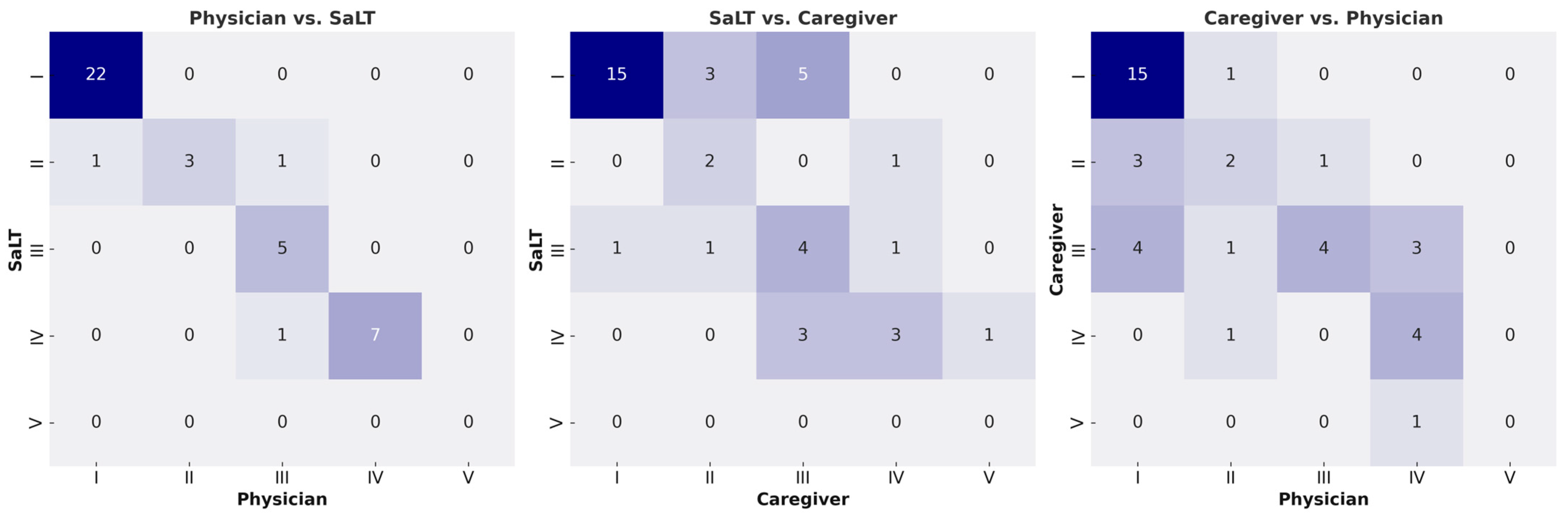
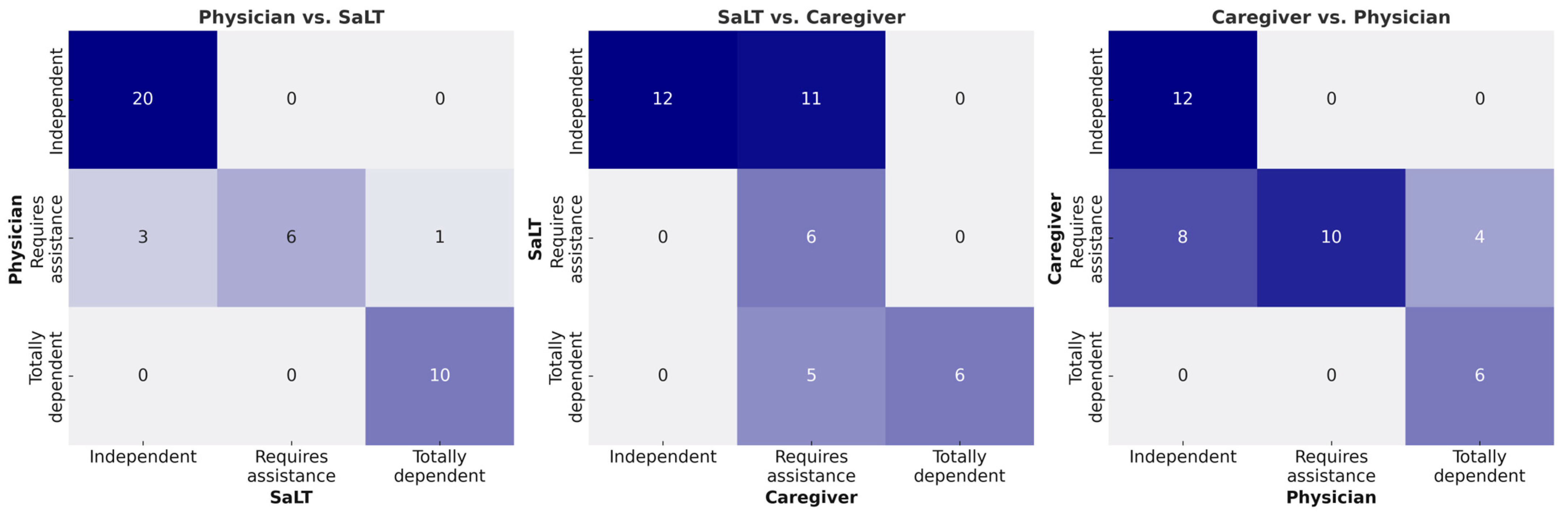
Background/Objectives: This study aimed to assess the reliability and validity of the Korean version of the Eating and Drinking Ability Classification System (EDACS) for children with cerebral palsy (CP). Methods: This was a prospective cross-sectional study conducted to psychometrically assess 40 children with CP. Reliability was evaluated by a physician in pediatric rehabilitation, a speech–language therapist (SaLT), and caregivers. Results: In the evaluation of each level and level of assistance in the EDACS, the agreement observed between the physician and speech therapist was almost perfect (κW = 0.940, 0.919). The agreement between the physician and the caregiver was substantial (κW = 0.618, 0.592), whereas it was moderate between the therapist and caregiver (κW = 0.557, 0.556). Intra-rater reliability remained almost perfect, with the physician (κW = 0.979), the SaLT (κW = 0.980), and caregivers (κW = 0.980). The EDACS showed moderate to high correlation with the Functional Oral Intake Scale, Gross Motor Function Classification System, Manual Ability Classification System, and Communication Function Classification System (Kτ = −0.863, 0.656, 0.720, 0.616). Conclusions: These findings support the Korean EDACS as a reliable tool for classifying eating and drinking abilities in children with CP, thereby enhancing its clinical utility and communication among non-professionals and professionals.
Keywords: cerebral palsy; pediatrics; eating behavior; drinking behavior; efficiency; reproducibility of results cerebral palsy; pediatrics; eating behavior; drinking behavior; efficiency; reproducibility of results