


Abstract
Background: Given the rapid global increase in asthma cases, understanding the impact of climate change on respiratory health is necessary for evidence-based policymaking, particularly in low- and middle-income countries (LMICs). Objectives: To estimate the short-term associations between temperature (mean and diurnal range), particulate matter (PM2.5 and PM10), nitrogen dioxide (NO2), ozone (O3), and childhood asthma exacerbations in Cape Town, South Africa. Methods: We analysed daily hospital records (n = 7753; 2009, 2014, 2019) alongside citywide air quality and meteorological data using negative binomial mixed-effects models and distributed lag non-linear models to capture delayed effects. Results: NO2 and PM10 were consistently associated with a higher exacerbation risk, with additional delayed effects observed for PM2.5, PM10, and NO2. Mean temperature and diurnal temperature range were also linked to an increased risk at short (lag 0–1) and medium (lag 4–5) delays. Conclusions: Temperature variability and traffic-related air pollution contribute to childhood asthma exacerbations in urban LMIC settings. The findings support child-centred early warning systems and stricter air quality controls aligned with WHO guidance.
1. Introduction
Climate change and air pollution are converging threats to child health, altering the exposures that trigger and exacerbate asthma in urban settings [1,2]. Asthma continues to be one of the most common chronic respiratory diseases affecting children globally, with its occurrence steadily increasing. Children are uniquely susceptible to environmental health hazards because of their developing lungs, higher ventilation rates per body weight, and the greater time they spend outdoors. These vulnerabilities make asthma outcomes particularly sensitive to changes in climate and air quality, leading to more severe and prolonged effects in children [1].
Among environmental risk factors, air pollution is consistently associated with the onset and worsening of asthma in children. Exposure to traffic-related pollutants, such as nitrogen dioxide (NO2) and particulate matter (PM2.5), has been estimated to contribute substantially to the burden of childhood asthma [3,4]. Exposure to NO2 is associated with about 1.85 million new paediatric asthma cases annually, and PM2.5 increases the risk of developing childhood asthma by 5%, with disproportionate burdens in dense, lower-income cities [3,4]. Additionally, pollutants such as particulate matter (PM10) and ozone (O3) are well-known respiratory tract irritants that can cause airway inflammation and increase the risk of asthma-related hospitalisation [4,5].
In South Africa, the prevalence of childhood asthma has increased drastically over recent decades, with nearly 20% of children aged 13–14 years affected [6]. This rapid rise cannot be explained solely by genetic factors or known environmental hazards, such as pollen, seasonality, and air pollution [7]. Recent studies suggest that climate variability may be an important additional driver, but it remains understudied in LMICs [8].
Extreme temperatures, whether hot or cold, along with diurnal temperatures, have been associated with worsening conditions through mechanisms such as airway inflammation, increased vulnerability to viruses, and changes in aeroallergen behaviour [8,9]. This suggests that climate-related temperature changes may interact with air pollution exposure to increase the risk in children.
Analyses specific to LMICs that jointly evaluate temperature and multiple pollutants for childhood asthma are scarce [7]. In South Africa, there is limited evidence on how temperature extremes and air pollution interact to influence asthma exacerbations in children [10,11]. Most studies have focused on air pollution and respiratory diseases in adults compared to children [12,13,14,15]. Olaniyan et al. (2020) studied air pollution and pollen exposure in children with asthma in the Western Cape, South Africa. The study also included weather variables but only used one year of data and focused on PM2.5 and NO2 [16].
Therefore, the present study examined the role of multiple air pollutants (NO2, PM10, PM2.5, and O3) and ambient temperature in influencing childhood asthma exacerbations in Cape Town, South Africa. The rapidly urbanising context and diverse pollutant sources make Cape Town a policy-relevant setting for studying these interlinkages. We analysed childhood hospital presentation data from 2009, 2014, and 2019, which corresponded to key milestones in the implementation of the South African National Ambient Air Quality Standards. We applied negative binomial mixed-effects and distributed lag non-linear models to quantify the immediate and delayed associations with asthma exacerbations. This study provides LMIC-specific evidence that complements the global paediatric literature and directly informs child-centred air quality alerts and climate adaptation planning in South Africa. The work bridges global paediatric evidence with LMIC policymaking by quantifying the temperature–pollution–asthma interlinkages in a major African city and highlighting actionable levers for child health protection.
2. Materials and Methods
2.1. Study Design
We used a time-series regression design to assess the effects of daily air pollution and temperature on childhood asthma exacerbations at the Red Cross War Memorial Children’s Hospital (RXH) in Cape Town, South Africa. Hospital records were linked to meteorological and air quality data from the South African Weather Services and the City of Cape Town.
2.2. Childhood Asthma Data
Child asthma data were collected from RXH, a tertiary referral hospital serving Klipfontein and Mitchells Plain, Rosebank, Mowbray, Rondebosch, and Salt River suburbs. Cape Town was the only South African location in Phase 1 of the International Study of Asthma and Allergies in Childhood (ISAAC), making it a suitable site for this study [17]. RXH is one of only two dedicated tertiary care children’s hospitals in the country [18]. We included inpatient and outpatient children who received asthma treatment at RXH in 2009, 2014, and 2019. Using a multiple cross-sectional design, we analysed health data at three distinct time points, with 2014 as the midpoint, providing a ten-year snapshot of data collected five years before and after.
We defined inpatients as children admitted for asthma treatment and outpatients as children treated for asthma without hospital admission. Asthma diagnoses were classified using the International Classification of Diseases, 10th Revision (ICD-10 Code), with codes J45.0 to J45.998. Data was extracted from CliniComTM, a Patient Master Index system used in the Western Cape province. The variables collected included patient names, ages, addresses, ethnicity, gender, treatment date, ICD-10 Codes, and diagnosis. We reviewed the data of 15,811 patients during the study period. Our inclusion criteria were patients aged six–13 years who resided within the CCT at the time of treatment. As a result, 7753 patient visits to RXH (49.0%) met the study criteria, thus excluding 8058 patient treatments (51.0%) due to age or non-CCT residency status. Among the included patients, most were outpatients, with only 409 (5.3%) treated for asthma as inpatients.
2.3. Air Quality and Temperature Data
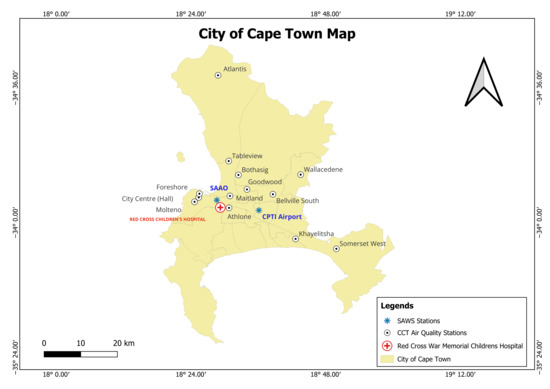
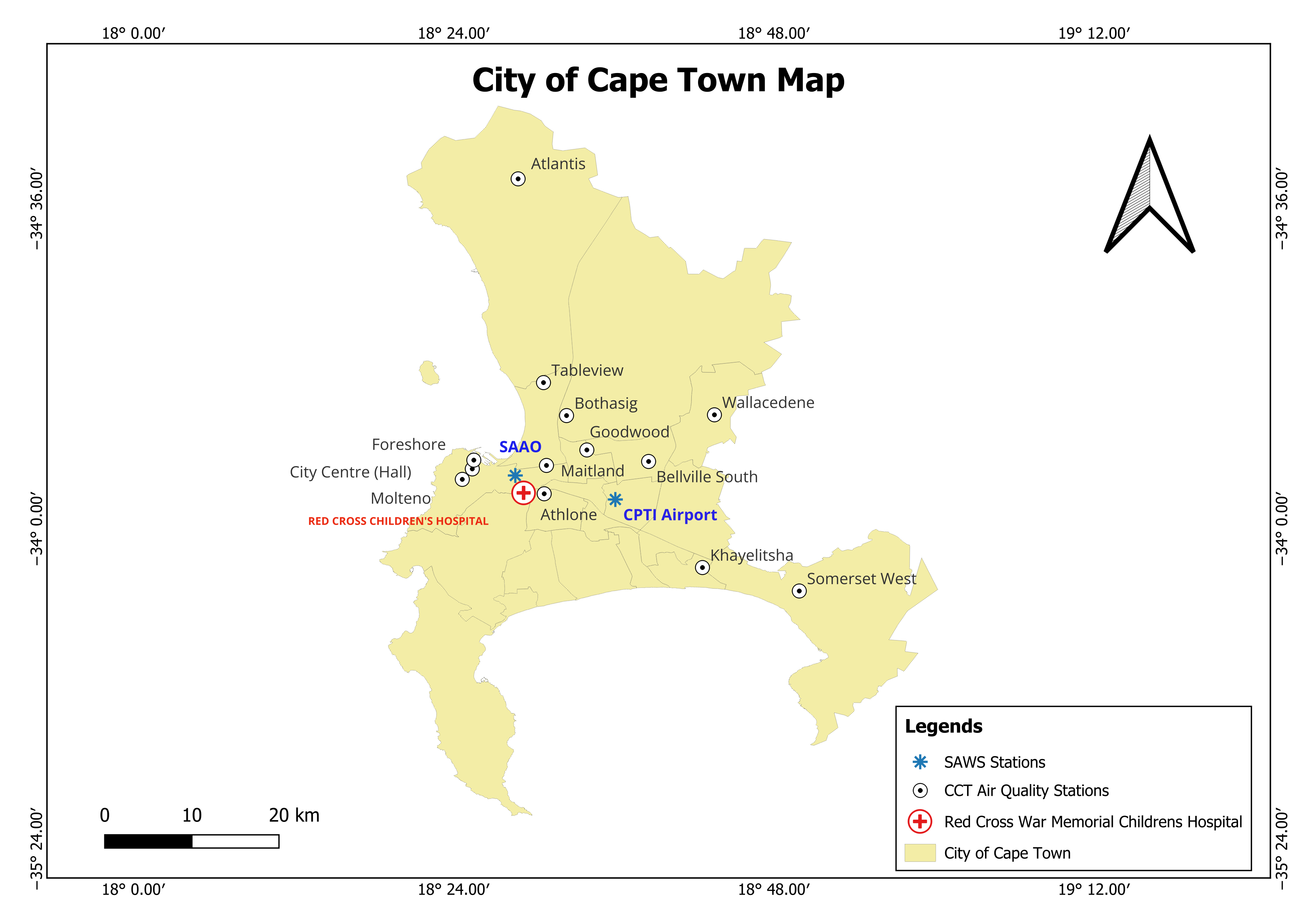
We collected air quality data for PM2.5, PM10, NO2, and O3 and temperature data (i.e., daily maximum and minimum) for our time series analysis. We used three cross-sectional analyses for the study years 2009, 2014, and 2019, covering two equal five-year intervals. These years corresponded to key national air quality and health policy milestones [19,20,21]. In 2009, South African National Ambient Air Quality Standards (NAAQS) were established. By 2014, the transition to a more stringent NAAQS, particularly for PM10, had occurred. 2014 was also a midpoint between 2009 and 2019, enabling an evenly spaced interval for trend analysis. Additionally, in 2019, the CCT began monitoring ambient PM2.5 in September 2017 [15,22,23,24]. We collected daily air quality data from 14 CCT air quality monitoring stations (Figure 1). Four air pollutants, ozone (O3 µg/m3), nitrogen dioxide (NO2 µg/m3), and particulate matter ≤10 (PM10 µg/m3) and ≤2.5 (PM2.5 µg/m3), were selected based on their effects on asthma [25,26]. Before calculating the daily averages for the pollutants, we collected hourly pollutant concentration values from the 11 monitoring stations during the study period (Table S1). Due to variability in data completeness across monitoring stations and days, we computed a citywide hourly average for each pollutant by averaging the available concentration values across all stations for each hour. This approach not only helped fill data gaps by leveraging measurements from other monitoring stations for the same date and time but also provided an estimate of citywide exposure.
Figure 1.
City of Cape Town Air Quality Monitoring Stations.
By averaging the hourly pollutant concentrations across various stations, we assumed that residents of the city were exposed to similar air quality. A similar approach has been used in air pollution and health time series studies conducted in Cape Town [12,14,15,27,28]. We then calculated daily 24 h average concentrations for PM2.5, PM10, NO2, and O3 from these citywide hourly averages, requiring at least 18 1 h valid measurement values per day according to the ISO 17025 guidelines [29]. Similar calculations were used in Cape Town [12,14,15,27,28]. We did not perform data imputation for the days when no station recorded data; these were left as missing.
Daily temperature data for 2009, 2014, and 2019 were obtained from the SAWS for the city. We collected data for a full calendar year (January to December) from two monitoring sites within the city: Cape Town International Airport and the South African Astronomical Observatory (SAAO) (Figure 1). The dataset included both the minimum and maximum daily temperatures. The consolidated daily maximum temperature was calculated by averaging the daily maximum temperatures recorded at both the sites. Similarly, the consolidated daily minimum temperature was calculated by averaging the daily minimum temperatures at both locations. The daily average temperature was calculated by averaging the maximum and minimum temperatures of the day. Diurnal temperature was defined as the variation between the daily maximum and minimum temperatures of the day. It was calculated as the difference between the consolidated daily maximum and minimum temperatures for each day during the study period.
Air quality and temperature datasets were used to explore their relationship with childhood asthma treatment cases at the hospital using time-series regression analysis within a multi-cross-sectional design.
2.4. Statistical Analysis
A descriptive statistical analysis was conducted to summarise the demographic characteristics of the study participants and environmental exposure levels for each study year (2009, 2014, and 2019). We calculated frequencies and percentages for categorical variables, including type of admission, sex, age group, area of residence, type of asthma, and season. We compared the distributions across years using the chi-square test. For continuous environmental variables (average temperature, DTR, PM2.5, PM10, NO2, and O3), the mean and standard deviation were calculated, and differences between years were assessed using a one-way analysis of variance (ANOVA). Where data were only available for two years, an independent sample t-test was performed, except for PM2.5, which had only one year of data. The statistical significance was set at p < 0.05. We employed a snapshot approach focusing on three distinct years (2009, 2014, and 2019) as these years were linked with important milestones in South Africa and the CCT air quality policy [26]. This approach enabled us to explore the relationship between daily environmental exposures (temperature and air pollutants) and childhood asthma exacerbations without aggregating data over extended periods.
A monotonic relationship was explored among asthma exacerbation cases, daily temperature, and air quality variables using Spearman’s rank correlation coefficients. A non-parametric method suitable for assessing pairwise associations that may not be linear was used. This helped to detect potential collinearity among environmental exposures, which are significant risk factors for asthma exacerbation.
A negative binomial mixed-effects regression model was used to model asthma exacerbations. This was an appropriate model for the over dispersed count data of daily hospital asthma treatment visits. Monitoring stations were treated as random effects to account for spatial variability in exposure, and the year was added as a second random effect in the multi-year models.
Bivariate and multivariable analyses were conducted on the exposure variables of temperature (average and DTR) and air pollution (PM2.5, PM10, NO2, and O3). These variables were considered fixed effects, and monitoring stations were treated as random effects. We analysed these models separately for 2009, 2014, and 2019, depending on data availability. A pooled model was used for all three years of the study. This included exposure variables with consistently available data on PM10 and the temperature. We also conducted another pooled model for NO2 and O3 across the two years (2014 and 2019). For these models, we used monitoring stations and years as the random effects.
In the multivariable model for each year, we adjusted for season and included interaction terms between average temperature and season, with the average temperature centred to improve interpretability. However, diurnal temperature was excluded from the final models because of nonsignificant results and poor model fit, as indicated by the Akaike Information Criterion (AIC) and Bayesian Information Criterion (BIC) values.
In the final model for 2019, where complete data were available, including PM2.5, we applied a distributed lag non-linear model (DLNM) with lags 0–7 days to assess the immediate and delayed short-term effects of air pollutants and temperature on asthma exacerbations. This lag structure is commonly used in time-series studies on asthma, air pollution, and temperature [12,30,31,32,33].
These models provided estimates of the Incident Rate Ratios (IRRs) with 95% confidence intervals (CI), representing the relative change in asthma cases associated with each unit change in exposure concentration values [34]. We assessed the model fit using the AIC and BIC to determine the best model and avoid overfitting the data. For the lagged negative binomial mixed effects models, we examined the residual diagnostic plots, which included QQ plots and residuals versus the predicted values. We also tested for overdispersion and zero inflation across all lags (0–7). However, no evidence of overdispersion was found, as p-values ranged from 0.18 to 0.33, and no evidence of zero-inflation was found, with p-values between 0.79 and 0.88. Overall, across all lags, the models had an appropriate fit for analysing the association between air pollution, temperature, and childhood asthma hospital treatment visits. We did not perform data imputation for missing variables to minimise the researchers’ influence on the dataset. All the statistical analyses were conducted in R (version 4.3.1). The fitted models are expressed as follows:
Main Model: Negative binomial mixed-effects multivariable model (lagged)
In general, for these models,
represents the number of daily observed asthma treatment hospital visits,
is the intercept coefficient for the model (constant),
and is the regression coefficient representing our fixed effects, including air pollutants, temperature, seasons, and the interaction between temperature and seasons, as indicated in the models. For the lagged model,
represents the days before the current day in the model. The
represents our random effects single-year models, and in the multi-year models, we included
as random effects.
3. Results
3.1. Demographic and Health Characteristics of Study Participants
Table 1 outlines the sociodemographic and clinical characteristics of children treated for asthma at the RXH in 2009, 2014, and 2019. Across the three study years, a total of 7753 asthma treatment visits were recorded as follows: 2009 (N = 1953), 2014 (N = 2701), and 2019 (N = 3099). We observed a 10% increase in asthma treatment visits between 2009 and 2014 and a further 5% increase between 2014 and 2019. Most asthma cases were outpatients (>94%), predominantly male (56–58%), and aged 6–9 years (62–64%). The distribution of area of residence and asthma type differed significantly between the years (p < 0.000001), with higher increases in Athlone (50–64.5%) and allergic asthma (36–61%). The seasonal distribution of asthma cases has remained consistent over the years. In winter, the number of cases was consistently the highest compared to other seasons, closely followed by that in summer.
Table 1.
Demographic characteristics of children with asthma treated at RXH in 2009, 2014, and 2019 (N = 7753).
3.2. Temperature Variables and Air Pollutants
Table 2 outlines the summary statistics for the environmental variables across the three study years. There was a consistent decrease in the concentration of PM10 from 36.19 µg/m3 (SD 17.10) in 2009 to 21.08 µg/m3 (SD 8.96) in 2019. O3 concentrations increased from 20.77 µg/m3 (SD 16.57) in 2014 to 41.16 µg/m3 (SD 11.47). NO2 showed a decreased concentration from 19.62 µg/m3 (SD 6.21) in 2014 to 12.86 µg/m3 (SD 7.36) in 2019. For PM2.5, we had data only for 2019. For 2009, we had missing data for O3, NO2, and PM2.5. Both temperature variables (average and DTR) remained constant throughout the three-year study period. These environmental variables (temperature and air pollution) differed significantly between years, except for PM2.5, which was excluded from the test.
Table 2.
Summary statistics for temperature and air pollutants in 2009, 2014, and 2019.
3.3. Association Between Childhood Asthma, Air Pollution, and Temperature Variables
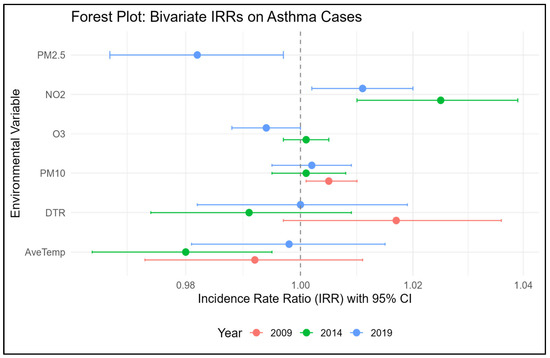
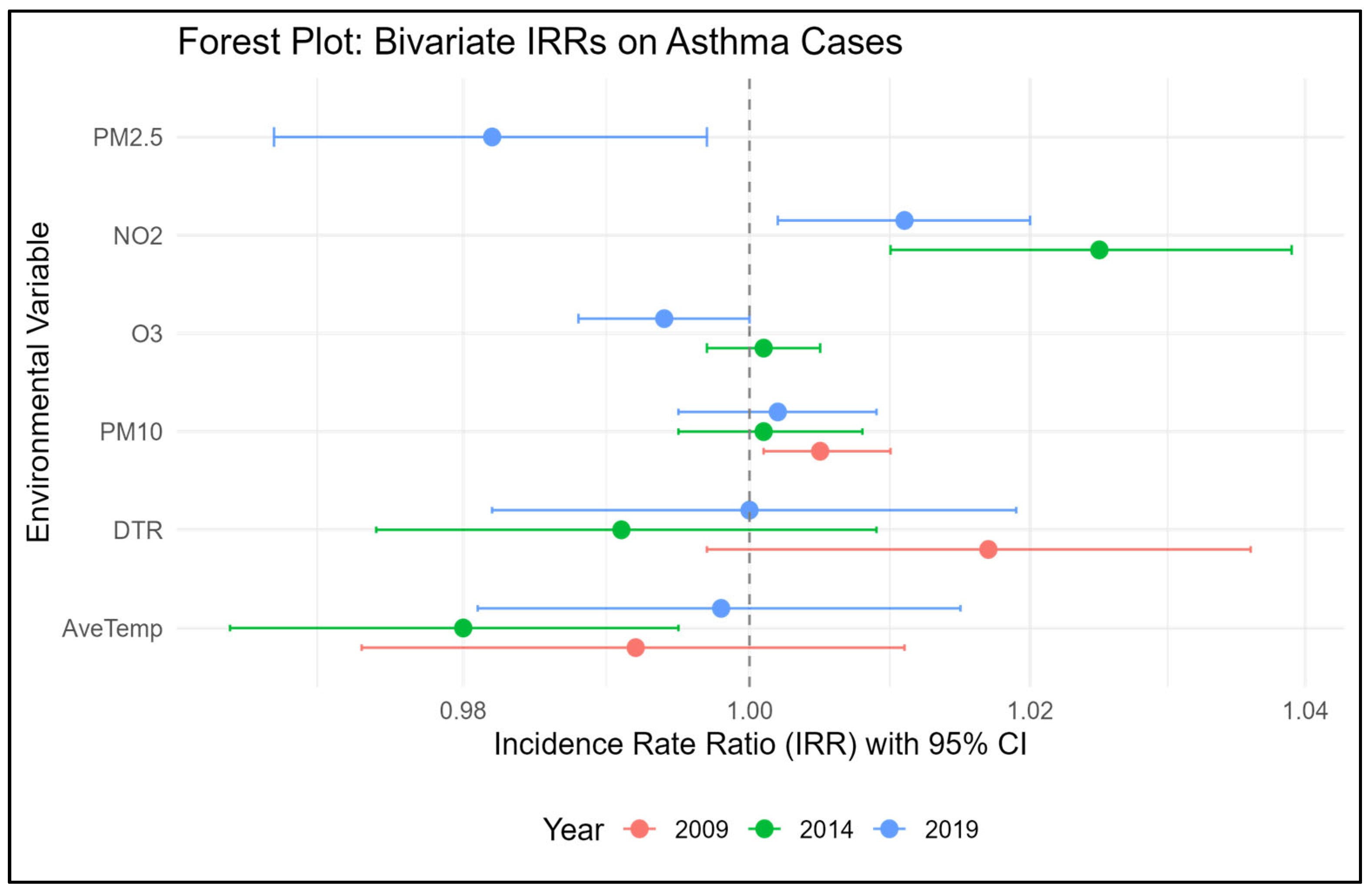
Figure 2 presents a forest plot of the estimates of the bivariate regression analysis that explored the relationship between childhood asthma and environmental exposure (temperature and air pollution). We found that NO2 exposure was consistently associated with an increased risk of childhood asthma in 2014 and 2019. In 2014, NO2 had a significant positive association with asthma (IRR 1.025, 95% CI: 1.011–1.039), indicating a 2.5% increase in daily asthma cases per unit increase in NO2. However, in 2019, NO2 had a significant positive association with asthma (IRR 1.011, 95% CI: 1.002–1.020), indicating a 1.1% increase in daily asthma cases per unit increase in NO2.
Figure 2.
Forest Plot of Bivariate analysis: asthma exacerbation risk associated with environmental variables stratified by year.
For PM10, the pollutant was positively associated with asthma but was only significant for 2009 (IRR 1.005, 95% CI: 1.001–1.009), indicating a 0.5% increase in asthma cases per unit increase in PM10 concentration. O3 and PM2.5 had a significant negative association with asthma cases in 2019; however, in 2014, O3 had a positive nonsignificant association. Over the three years, the average temperature had a negative association with asthma cases, with only 2014 being statistically significant. (Figure S1) shows the correlations between asthma and environmental variables in 2009, 2014, and 2019. The most significant correlations between asthma and environmental variables were PM10 in 2009 (r = 0.04, p < 0.01) and NO2 in 2014 (r = 0.09, p < 0.001) and 2019 (r = 0.04, p < 0.01). We observed similar significant positive associations for PM10 and NO2 with asthma exacerbations in our multi-year analysis (Figure S2).
3.4. Multivariable Delayed Association Between Childhood Asthma, Air Pollution, and Temperature Variables
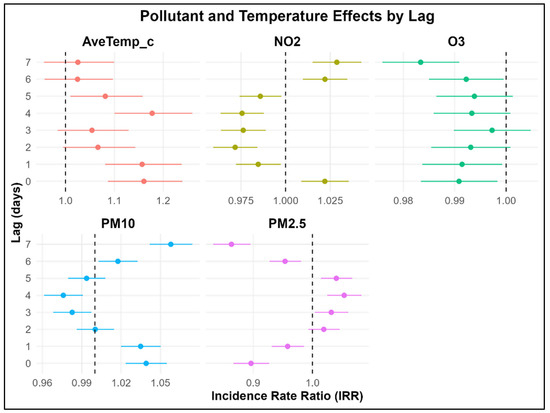
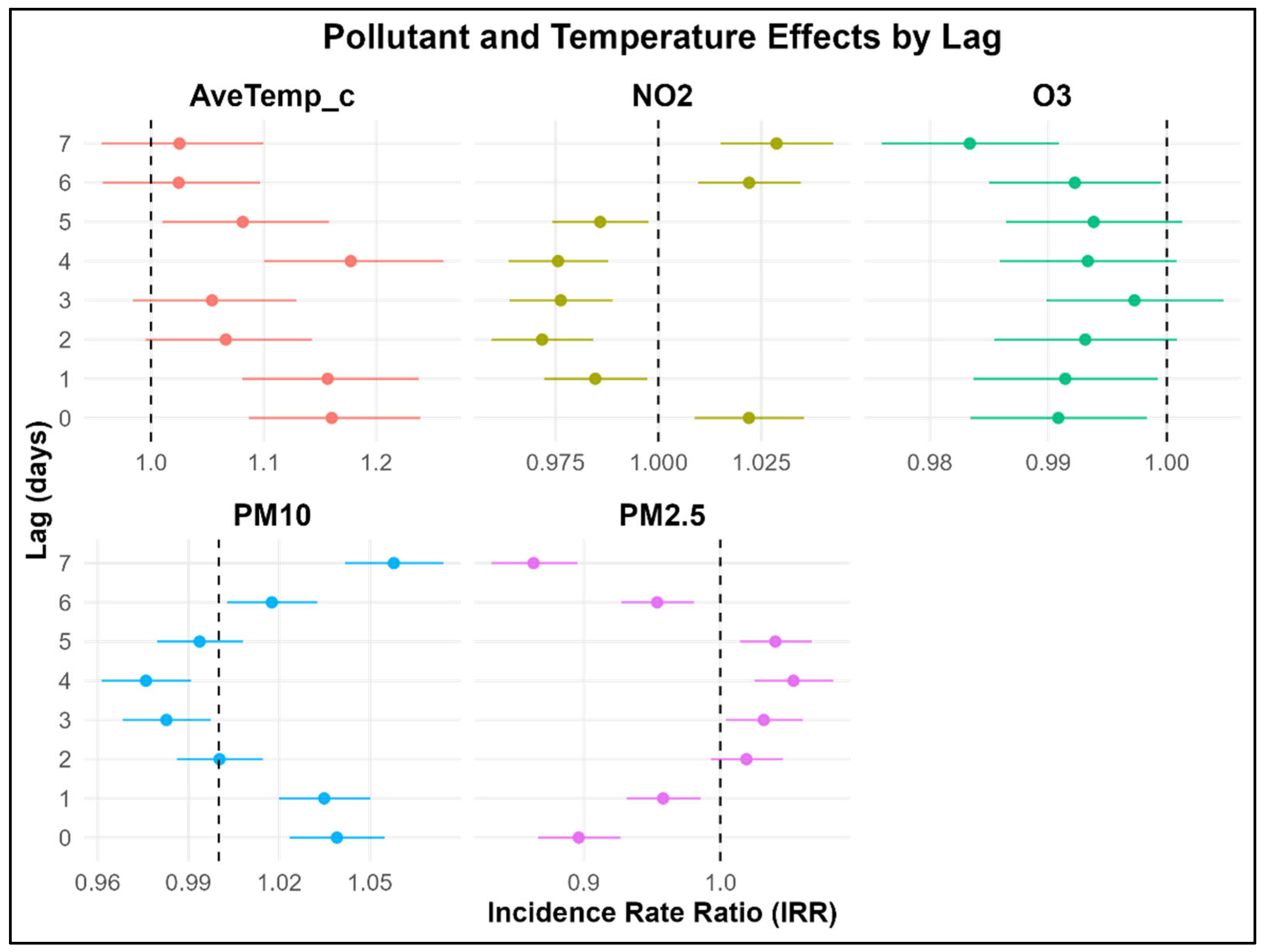
Figure 3 shows the relationship between air pollutants, temperature, and asthma exacerbations in 2019. NO2, PM10, PM2.5, and mean average temperatures were all significant predictors of asthma exacerbations across different lags while controlling for seasons. Distributed lag analysis showed time-varying associations between exposure and asthma exacerbation. For PM2.5, significant decreases in risk were observed at lag 0 (IRR 0.90, 95% CI: 0.87–0.93), lag 1 (IRR 0.96, 95% CI: 0.93–0.99), lag 6 (IRR 0.95, 95% CI: 0.93–0.98), and lag 7 (IRR 0.86, 95% CI: 0.83–0.90), while there was an observed significant increased asthma risk at lag 3–5 with the peak at lag 4 (IRR 1.05, 95% CI: 1.03–1.08). This indicates a delayed response of a 5% increase in asthma exacerbations for lag 4 for each unit increase in PM2.5.
Figure 3.
Association between temperature, air pollutants, and childhood asthma: multivariable multi-pollution lagged model for 2019.
PM10 showed increased asthma risk at lag 0 (IRR 1.04, 95% CI: 1.02–1.06), lag 1 (IRR 1.04, 95% CI: 1.02–1.05), lag 6 (IRR 1.01, 95% CI: 1.003–1.03), and lag 7 (IRR 1.05, 95% CI: 1.04–1.07), while a reduced asthma risk was observed at lag 3–4. These results indicate that for every unit increase in PM10 at lags 0, 1, 6, and 7, asthma exacerbations increased by 1–5%. For NO2, a mixed effect was observed with increased risks in lag 0 (IRR 1.02, 95% CI: 1.008–1.03, p < 0.001), lag 6 (IRR 1.02, 95% CI: 1.009–1.03, p < 0.001), and lag 7 (IRR = 1.02, 95% CI: 1.01–1.04) and a reduced risk at lag 1–5. These results indicate that for each unit increase in NO2 at lags 0, 6, and 7, the incidence of asthma exacerbation increased by 2%. For O3, consistent with our earlier analysis, there was a significant negative relationship in the earlier lags, but an overall negative relationship throughout the lags. Overall, O3 had a slight inverse effect on childhood asthma.
Temperature showed a strong significant positive association at lag 0 (IRR 1.16, 95% CI: 1.08–1.23), lag 1 (IRR 1.15, 95% CI: 1.08–1.23), and lag 4 (IRR 1.17, 95% CI: 1.10–1.25). (Figure S3) shows the effects of (a) seasonality and (b) its interaction with temperature on the incidence of childhood hospitalisation. Except for summer across all years, Autumn, Winter and Spring amplified the risk of asthma exacerbations for lag 0–5 (IRR > 1.5) with a reduced temperature effect. However, for the interaction between temperature and seasonality, in summer, a unit increase higher than the average daily temperature increased the risk of childhood asthma exacerbations, whereas the effect was reduced in other seasons.
4. Discussion
This is the first South African study to show that ambient temperature and air pollution increase the risk of childhood asthma hospitalisation. Our study showed that higher than average daily temperatures and one unit increase in air pollutants (PM10 and NO2) levels were strongly associated with same-day childhood asthma-related hospitalisations. Our lagged analysis showed delayed associations between temperature and air pollutants (PM2.5, PM10, NO2) with asthma exacerbations in children aged six–13 years, suggesting that multiple biological pathways may be involved. In contrast, we observed a significant inverse association with O3. Seasonality also emerged as an independent predictor of childhood asthma, separate from the effects of temperature and air pollution. Compared to summer, all other seasons were strongly associated with an increased risk of childhood asthma. However, in summer, higher-than-average temperatures were associated with an increased risk of childhood asthma compared to other seasons.
Overall, this study highlights the increased risk of asthma exacerbations in children from LMICs due to the combined effects of temperature and air pollution. These findings align with those of several global studies, indicating that air pollution and temperature significantly affect childhood asthma exacerbations [35,36,37,38,39,40].
Since 2009, the number of childhood asthma cases treated at RXH has increased, consistent with the current literature on the global rise in childhood asthma, particularly in LMICs [7,41]. However, this study could not provide population-based rates because it focused solely on cases treated at RXH rather than the broader population. Among the children treated for asthma at RXH, 56.9% were male. Although the number of females treated was lower, their admission rate was higher (54.5%). Similar sex-based patterns have been reported in other studies [42,43,44]. Boys generally have smaller airway diameters, increased allergic inflammation, and higher serum Immunoglobulin E (IgE) levels, which may contribute to the higher prevalence of asthma in childhood compared to girls [44,45]. While some studies reported no sex differences in hospitalisation for asthma exacerbations, [46], others found that boys are twice as likely as girls to be hospitalised with no sex disparity in childhood asthma hospitalisation due to exacerbations [45]. It is worth noting that the higher incidence of asthma in males tends to switch to females during puberty [45]. These findings suggest that sex is a significant risk factor for childhood asthma exacerbations, with effects that vary by age. Additionally, the interaction between climate change, age, and sex adds further complexity. Studies have reported that younger boys are more susceptible to heat-related asthma, whereas older boys are more sensitive to cold temperatures than girls [9,47].
Recent studies showed seasonal influences on asthma exacerbations [32,48]. This study found that childhood asthma in Cape Town occurred more often in autumn, winter, and spring than in the summer. These seasonal trends may be due to pollen exposure, indoor and ambient air pollution due to combustion-related sources, including traffic emissions and residential wood burning, as well as dust exposure. In Cape Town, tree pollen peaks in spring, while grass pollen is from spring through summer, with higher concentrations in coastal areas [49]. Fungal spores peak in autumn and spring, contributing to asthma exacerbations [49,50]. Cape Town’s wet winters is associated with increased viral respiratory infections, which may worsen asthma [51,52]. Children spend more time indoors during winter, increasing exposure to household allergens and pollution [11,53]. Similar seasonal trends in Taiwan showed a higher asthma prevalence in winter than in summer [53]. While temperature extremes, particularly heat, are important predictors of exacerbations, this study found that heat outside the summer season had a lesser effect on exacerbation. The findings highlight how the environment and childhood behaviour impact seasonal asthma risk in Cape Town.
Furthermore, our analysis showed temperature may modify the effect of air pollution on childhood asthma hospitalisation with immediate effects (lag 0) and delayed inflammatory response at lag 4, both consistent with biological plausibility of public health relevance [54]. This study’s correlation analyses showed significant covariation between temperature and air pollutant levels, highlighting a challenge in isolating their effects on health. Global research on temperature as an effect modifier of air pollutants is growing, including in South Africa and Cape Town [55] where studies reported stronger effect of PM10 and NO2 on cardiovascular and respiratory admissions during warm days [15,31,56]. In this study, higher-than-average temperatures were associated with increased risk of childhood asthma hospitalisation by about 15–17% for multiple lags (lag 0–4), with a narrow CI, indicative of significant public and clinical health relevance. Furthermore, higher temperature was correlated with increased childhood asthma and showed positive associations with PM10, PM2.5, and NO2. Similar findings were reported in Australia, where DTR was correlated with PM10, O3, NO2,and childhood asthma exacerbations [33]. These patterns suggest that hotter days and greater temperature fluctuations coincided with higher pollutant levels in Cape Town.
DNLM analysis identified PM2.5 as a significant predictor of childhood asthma in Cape Town. Its small size allows for deep lung penetration and oxidative stress, triggering airway inflammation [36]. In winter and spring, PM2.5 levels in the city exceeded the WHO air quality guideline primarily due of traffic and biomass burning [21]. While PM10 and NO2 from traffic, industrial, residential, and harbour-related activities unique to Cape Town were consistently associated with childhood asthma [57]. Highest pollutant levels in winter and the lowest in summer, consistent with increased winter emissions and summer wind dispersal (the “Cape Doctor”) [21,57]. Children living near highways, traffic-congested areas, harbours, or densely populated areas are particularly vulnerable because of frequent outdoor exposure to high concentrations [16,57].
The distinct lag patterns for each pollutant provide insights into the mechanisms. PM10 immediate and late (lag 7) suggests both instant irritation and a delayed inflammatory response. PM2.5 at lag 4, suggest deep lung penetration and a systemic inflammatory response [36], while the complex lag pattern for NO2 showed both harmful and inverse associations, reflecting its role as a marker for traffic-related pollution mixtures and confounding by co-emitted pollutants [58,59].
Interestingly, O3 showed a negative association with childhood asthma exacerbations, contrary to the current research [60,61]. This relationship is unlikely to represent the true protective effect. Our analysis of mean O3 concentrations were increased from 2014 (20.8 ± 16.6 µg/m3) to 2019 (41.2 ± 11.5 µg/m3), whereas NO2 concentrations decreased from 2014 (19.6 ± 6.2 µg/m3) to 2019 (12.9 ± 7.4 µg/m3). Our correlation of NO2 and O3 shifted from positive in 2014 to negative in 2019, consistent with the expected NOx titration effect in urban areas. This process may create an apparent inverse association between O3 and asthma exacerbations, which may mask the direct impact of NOx on childhood asthma exacerbations [62,63].
Limitations and Strengths of the Study
Understanding the impact of air quality on child health requires reliable data on air pollution type, source, and concentration [64,65]. Our analysing the CCT’s monitoring and archiving systems showed limited good-quality data from a few stations suitable for analysis (Table S1). Previous reports have highlighted data inadequacy in the Western Cape, this is despite CCT following the United States Environmental Protection Agency (USEPA) and ISO/IEC 17025:2017standards with SANAS TR07-03 quality controls [22,23,66].
Due to limited data, we assumed all participants experienced similar pollution exposure across the city. In line with other time series studies in Cape Town, we used the citywide averaging to capture temporal fluctuations in pollution rather than spatial differences [15,16,17,18,31]. To reduce the potential bias, we allocated children to stations near their homes and used a mixed-effects analysis with a random intercept for stations to account for the differences across the city without regard for mobility. Our lack of buffer radius may have avoided excluding cases but potentially increased the risk of exposure misclassification [67]. Additionally, PM2.5 monitoring in Cape Town started in late 2017, thus limiting the analysis to 2019 exposures. Future studies with continuous PM2.5 measurements would better assess long-term links to childhood asthma.
Furthermore, missing data on humidity, viral infections, socioeconomic status, and second-hand smoke exposure may have introduced potential bias [68]. Overall, this study’s use of mixed-effects model helped account for the temporal and spatial variability in exposures and outcomes. This provided a robust framework for examining short-term temporal associations at the population level.
This study used routinely collected real-world air pollution, temperature, and health data. Although some air quality datasets were incomplete across periods and pollutants, the data provide valuable insights into relationships between temperature, air pollution, and childhood asthma exacerbations in Cape Town.
While our study highlights an association between temperature, air pollution, and childhood asthma, poor quality data in Africa remains a significant barrier. Future research should integrate personal monitoring devices, time-series models, and spatial analyses to better capture exposure dynamics [69]. Improved air quality monitoring and data accessibility are crucial for protecting vulnerable populations, particularly children, from the interlinked threats of air pollution and climate change.
5. Conclusions
This initial time-series ecological design in Cape Town, South Africa (2009–2019) found associations between childhood asthma exacerbations and temperature, PM2.5, PM10, and NO2. Although the confidence intervals were narrow, indicating more precise estimates, causal interpretations were limited. Thus, the results warrant future research with more complete exposure data. Seasonality showed significant association with childhood asthma, and temperature predicted PM2.5, PM10, and NO2 concentrations. This supports previous research linking temperature, air pollution, and asthma exacerbation in children. The Department of Health (DoH) and Department of Forestry, Fisheries, and Environment (DFFE) should address temperature risks through climate-change adaptation strategies. The DoH should ensure that municipalities and stakeholders, such as the Provincial DoH, SAWS, and other departments, implement the National Heat-Health Action Guidelines. The DFFE should enforce stricter compliance with the NAAQS, aligning with WHO air quality guidelines, and enhance public access to SAAQIS through environmental health literacy. The SAWS should improve temperature monitoring and collaborate with the Department of Education to establish early warning systems in schools to protect the students. Provinces must implement climate change adaptation plans that address children’s respiratory health.
More accurate data are needed to study children’s exposure to temperature and air pollutants. Long-term air pollutant data must be collected and made available in South Africa. Policymakers must improve the air quality in urban areas. This study emphasises the need to fulfil the Paris Agreement to avoid further temperature increases and protect the health of future generations.
Supplementary Materials
The following supporting information can be downloaded at: https://www.mdpi.com/article/10.3390/children12121634/s1, Figure S1. Spearman’s correlation coefficients between daily air pollutants and temperature variables in the City of Cape Town for three study years 2009, 2014, and 2019. Figure S2. Forest Plot of Bivariate analysis: asthma exacerbation risk associated with environmental variables for multiple years. Figure S3. Seasonal and Temperature effect on childhood asthma cases at RXH. Table S1. Air quality data usability received from the City of Cape Town Air quality monitoring station.
Author Contributions
T.K.P. was responsible for the study design, writing, data collection and analysis, preparation and manuscript submission. H.-A.R. and E.W. contributed to the overall study design and write-up. All authors have read and agreed to the published version of the manuscript.
Funding
This research received no external funding.
Institutional Review Board Statement
This study was conducted in accordance with the principles of the Declaration of Helsinki. Ethical approval was obtained from the University of Cape Town’s Faculty of Health Sciences Human Research Ethics Committee (approval number 677/2020 on 3 November 2020).
Informed Consent Statement
This study involved a secondary data analysis; therefore, informed consent was not required from the participants.
Data Availability Statement
The data presented in this study are available upon request from the corresponding author of this paper. However, owing to legal and privacy issues, these data are not publicly available.
Conflicts of Interest
The authors declare no conflicts of interest.
Abbreviations
The following abbreviations are used in this manuscript:
| DLNM | Distributed Lag Non-Linear Model |
| DTR | Diurnal Temperature Ranges |
| IgE | Immunoglobulin E |
| CCT | City of Cape Town |
| GHGs | Greenhouse Gases |
| ICD-10 Code | International Classification of Diseases Codes |
| IQR | Interquartile Range |
| IRR | Incidence Rate Ratio |
| LMICs | Low- and middle-income countries |
| NAAQS | South African National Ambient Air Quality Standards |
| NO2 μg/m3 | Nitrogen Dioxide |
| O3 μg/m3 | Ozone |
| PM10 μg/m3 | Particulate Matter with a diameter smaller than 10 micrograms |
| PM2.5 μg/m3 | Particulate Matter 2.5 |
| RXH | Red Cross War Memorial Children’s Hospital |
| SANAS | South African National Accreditation System |
| SD | Standard Deviations |
References
- Helldén, D.; Andersson, C.; Nilsson, M.; Ebi, K.L.; Friberg, P.; Alfvén, T. Climate Change and Child Health: A Scoping Review and an Expanded Conceptual Framework. Lancet Planet. Health 2021, 5, e164–e175. [Google Scholar] [CrossRef] [Scilit] [PubMed]
- Annan, H.; Baran, I.; Litwin, S. Five I’s of Climate Change and Child Health: A Framework for Pediatric Planetary Health Education. Pediatrics 2024, 154, e2024066064. [Google Scholar] [CrossRef] [Scilit]
- Achakulwisut, P.; Brauer, M.; Hystad, P.; Anenberg, S.C. Global, National, and Urban Burdens of Paediatric Asthma Incidence Attributable to Ambient NO2 Pollution: Estimates from Global Datasets. Lancet Planet. Health 2019, 3, e166–e178. [Google Scholar] [CrossRef] [Scilit]
- Keleb, A.; Abeje, E.T.; Daba, C.; Endawkie, A.; Tsega, Y.; Abere, G.; Mamaye, Y.; Bezie, A.E. The Odds of Developing Asthma and Wheeze among Children and Adolescents Exposed to Particulate Matter: A Systematic Review and Meta-Analysis. BMC Public Health 2025, 25, 1225. [Google Scholar] [CrossRef] [Scilit]
- Altman, M.C.; Kattan, M.; O’Connor, G.T.; Murphy, R.C.; Whalen, E.; LeBeau, P.; Calatroni, A.; Gill, M.A.; Gruchalla, R.S.; Liu, A.H.; et al. Associations between Outdoor Air Pollutants and Non-Viral Asthma Exacerbations and Airway Inflammatory Responses in Children and Adolescents Living in Urban Areas in the USA: A Retrospective Secondary Analysis. Lancet Planet. Health 2023, 7, e33–e44. [Google Scholar] [CrossRef] [Scilit]
- Mphahlele, R.E.M.; Masekela, R. A Historical Overview of Childhood Asthma in Southern Africa: Are We There Yet? Afr. J. Thorac. Crit. Care Med. 2021, 27, 163–167. [Google Scholar] [CrossRef] [Scilit]
- Soto-Martínez, M.E.; Soto-Quiros, M.E.; Custovic, A. Childhood Asthma: Low and Middle-Income Countries Perspective. Acta Medica Acad. 2020, 49, 181–190. [Google Scholar] [CrossRef] [Scilit]
- Le Souëf, P.N.; Adachi, Y.; Anastasiou, E.; Ansotegui, I.J.; Badellino, H.A.; Banzon, T.; Beltrán, C.P.; D’Amato, G.; El-Sayed, Z.A.; Gómez, R.M.; et al. Global Change, Climate Change, and Asthma in Children: Direct and Indirect Effects—A WAO Pediatric Asthma Committee Report. World Allergy Organ. J. 2024, 17, 100988. [Google Scholar] [CrossRef] [Scilit]
- Makrufardi, F.; Manullang, A.; Rusmawatiningtyas, D.; Chung, K.F.; Lin, S.C.; Chuang, H.C. Extreme Weather and Asthma: A Systematic Review and Meta-Analysis. Eur. Respir. Rev. 2023, 32, 230019. [Google Scholar] [CrossRef] [Scilit] [PubMed]
- Upton, C.M.; Peter, J. Climate Change and Its Impact on Asthma in South Africa. Curr. Allergy Clin. Immunol. 2025, 38, 138–143. [Google Scholar]
- Olaniyan, T.; Dalvie, M.A.; Röösli, M.; Naidoo, R.; Künzli, N.; de Hoogh, K.; Parker, B.; Leaner, J.; Jeebhay, M. Asthma-related Outcomes Associated with Indoor Air Pollutants among Schoolchildren from Four Informal Settlements in Two Municipalities in the Western Cape Province of South Africa. Indoor Air 2019, 29, 89–100. [Google Scholar] [CrossRef] [Scilit]
- Adebayo-Ojo, T.C.; Wichmann, J.; Arowosegbe, O.O.; Probst-Hensch, N.; Schindler, C.; Künzli, N. Short-Term Effects of PM10, NO2, SO2 and O3 on Cardio-Respiratory Mortality in Cape Town, South Africa, 2006–2015. Int. J. Environ. Res. Public Health 2022, 19, 8078. [Google Scholar] [CrossRef] [Scilit] [PubMed]
- Thabethe, N.D.L.; Voyi, K.; Wichmann, J. Association between Ambient Air Pollution and Cause-Specific Mortality in Cape Town, Durban, and Johannesburg, South Africa: Any Susceptible Groups? Environ. Sci. Pollut. Res. 2021, 28, 42868–42876. [Google Scholar] [CrossRef] [Scilit] [PubMed]
- Wichmann, J.; Voyi, K. Ambient Air Pollution Exposure and Respiratory, Cardiovascular and Cerebrovascular Mortality in Cape Town, South Africa: 2001–2006. Int. J. Environ. Res. Public Health 2012, 9, 3978–4016. [Google Scholar] [CrossRef] [Scilit]
- Lokotola, C.L.; Wright, C.Y.; Wichmann, J. Temperature as a Modifier of the Effects of Air Pollution on Cardiovascular Disease Hospital Admissions in Cape Town, South Africa. Environ. Sci. Pollut. Res. 2020, 27, 16677–16685. [Google Scholar] [CrossRef] [Scilit]
- Olaniyan, T.; Jeebhay, M.; Röösli, M.; Naidoo, R.N.; Künzli, N.; de Hoogh, K.; Saucy, A.; Badpa, M.; Baatjies, R.; Parker, B. The Association between Ambient NO2 and PM2.5 with the Respiratory Health of School Children Residing in Informal Settlements: A Prospective Cohort Study. Environ. Res. 2020, 186, 109606. [Google Scholar] [CrossRef] [Scilit]
- Asher, M.I.; Rutter, C.E.; Bissell, K.; Chiang, C.Y.; El Sony, A.; Ellwood, E.; Ellwood, P.; García-Marcos, L.; Marks, G.B.; Morales, E.; et al. Worldwide Trends in the Burden of Asthma Symptoms in School-Aged Children: Global Asthma Network Phase I Cross-Sectional Study. Lancet 2021, 398, 1569–1580. [Google Scholar] [CrossRef] [Scilit] [PubMed]
- Pettifor, J.M. The New Nelson Mandela Children’s Hospital—A White Elephant or an Essential Development for Paediatric Care in Johannesburg? S. Afr. J. Child Health 2017, 11, 4. [Google Scholar] [CrossRef] [Scilit]
- Naiker, Y.; Diab, R.D.; Zunckel, M.; Hayes, E.T. Introduction of Local Air Quality Management in South Africa: Overview and Challenges. Environ. Sci. Policy 2012, 17, 62–71. [Google Scholar] [CrossRef] [Scilit]
- Liebenberg-Enslin, H. Air Quality Evolution in South Africa over the Past 20 Years: A Journey from a Consultant’s Viewpoint. Clean Air J. 2024, 34, 1–3. [Google Scholar] [CrossRef] [Scilit]
- Williams, J.; Petrik, L.; Wichmann, J. PM2.5 Chemical Composition and Geographical Origin of Air Masses in Cape Town, South Africa. Air Qual. Atmos. Health 2021, 14, 431–442. [Google Scholar] [CrossRef] [Scilit] [PubMed]
- Davidson, A.; Naidoo, D. State of Environment Outlook Report for the Western Cape Province: Air Quality; Western Cape Government, Environmental Affairs and Development Planning: Cape Town, South Africa, 2018. [Google Scholar]
- Khumalo, T.N. 2019 State of the Air Report and National Air Quality Indicator. 2020. Available online: https://saaqis.environment.gov.za/Pagesfiles/State%20of%20Air%20Report%20-%202020.pdf (accessed on 30 November 2021).
- Alfeus, A.; Molnar, P.; Boman, J.; Shirinde, J.; Wichmann, J. Inhalation Health Risk Assessment of Ambient PM2.5 and Associated Trace Elements in Cape Town, South Africa. Hum. Ecol. Risk Assess. Int. J. 2022, 28, 917–929. [Google Scholar] [CrossRef] [Scilit]
- World Health Organization. Air Pollution and Child Health: Prescribing Clean Air: Summary; World Health Organization: Geneva, Switzerland, 2018. [Google Scholar]
- Department of Forestry, Fisheries and the Environment. The Environment National Environmental Management: Air Quality Act, 2004 (Act No. 39 of 2004); Department of Forestry, Fisheries and the Environment: Cape Town, South Africa, 2009.
- Morakinyo, O.M.; Mukhola, M.S.; Mokgobu, M.I. Ambient Gaseous Pollutants in an Urban Area in South Africa: Levels and Potential Human Health Risk. Atmosphere 2020, 11, 751. [Google Scholar] [CrossRef] [Scilit]
- Shirinde, J.; and Wichmann, J. Temperature Modifies the Association between Air Pollution and Respiratory Disease Mortality in Cape Town, South Africa. Int. J. Environ. Health Res. 2023, 33, 1122–1131. [Google Scholar] [CrossRef] [Scilit]
- ISO/IEC 17025:2017; General Requirements for the Competence of Testing and Calibration Laboratories. International Organization for Standardization: Geneva, Switzerland, 2017.
- Zhou, X.; Guo, M.; Li, Z.; Yu, X.; Huang, G.; Li, Z.; Zhang, X.; Liu, L. Associations between Air Pollutant and Pneumonia and Asthma Requiring Hospitalization among Children Aged under 5 Years in Ningbo, 2015–2017. Front. Public Health 2023, 10, 1017105. [Google Scholar] [CrossRef] [Scilit]
- Olutola, B.G.; Mwase, N.S.; Shirinde, J.; Wichmann, J. Apparent Temperature Modifies the Effects of Air Pollution on Cardiovascular Disease Mortality in Cape Town, South Africa. Climate 2023, 11, 30. [Google Scholar] [CrossRef] [Scilit]
- Guo, Y.; Jiang, F.; Peng, L.; Zhang, J.; Geng, F.; Xu, J.; Zhen, C.; Shen, X.; Tong, S. The Association between Cold Spells and Pediatric Outpatient Visits for Asthma in Shanghai, China. PLoS ONE 2012, 7, e42232. [Google Scholar] [CrossRef] [Scilit]
- Xu, Z.; Huang, C.; Su, H.; Turner, L.R.; Qiao, Z.; Tong, S. Diurnal Temperature Range and Childhood Asthma: A Time-Series Study. Environ. Health 2013, 12, 12. [Google Scholar] [CrossRef] [Scilit]
- Bhaskaran, K.; Gasparrini, A.; Hajat, S.; Smeeth, L.; Armstrong, B. Time Series Regression Studies in Environmental Epidemiology. Int. J. Epidemiol. 2013, 42, 1187–1195. [Google Scholar] [CrossRef] [Scilit]
- Burbank, A.J.; Peden, D.B. Assessing the Impact of Air Pollution on Childhood Asthma Morbidity: How, When and What to Do. Curr. Opin. Allergy Clin. Immunol. 2018, 18, 124. [Google Scholar] [CrossRef] [Scilit]
- Fan, J.; Li, S.; Fan, C.; Bai, Z.; Yang, K. The Impact of PM2.5 on Asthma Emergency Department Visits: A Systematic Review and Meta-Analysis. Environ. Sci. Pollut. Res. 2016, 23, 843–850. [Google Scholar] [CrossRef] [Scilit]
- Kanellopoulos, N.; Pantazopoulos, I.; Mermiri, M.; Mavrovounis, G.; Kalantzis, G.; Saharidis, G.; Gourgoulianis, K. Effect of PM2.5 Levels on Respiratory Pediatric ED Visits in a Semi-Urban Greek Peninsula. Int. J. Environ. Res. Public. Health 2021, 18, 6384. [Google Scholar] [CrossRef] [Scilit]
- Kim, J.; Lim, Y.; Kim, H. Outdoor Temperature Changes and Emergency Department Visits for Asthma in Seoul, Korea: A Time-Series Study. Environ. Res. 2014, 135, 15–20. [Google Scholar] [CrossRef] [Scilit]
- Li, S.; Batterman, S.; Wasilevich, E.; Wahl, R.; Wirth, J.; Su, F.C.; Mukherjee, B. Association of Daily Asthma Emergency Department Visits and Hospital Admissions with Ambient Air Pollutants among the Pediatric Medicaid Population in Detroit: Time-Series and Time-Stratified Case-Crossover Analyses with Threshold Effects. Environ. Res. 2011, 111, 1137–1147. [Google Scholar] [CrossRef] [Scilit]
- Xu, Z.; Crooks, J.L.; Davies, J.M.; Khan, A.F.; Hu, W.; Tong, S. The Association between Ambient Temperature and Childhood Asthma: A Systematic Review. Int. J. Biometeorol. 2018, 62, 471–481. [Google Scholar] [CrossRef] [Scilit]
- Fischer, G.B.; Sarria, E.E.; Camargos, P.; Mocelin, H.T.; Soto-Quiroz, M.; Cruz, A.A.; Bousquet, J.; Zar, H.J. Childhood Asthma in Low and Middle-Income Countries: Where Are We Now? Paediatr. Respir. Rev. 2019, 31, 52–57. [Google Scholar] [CrossRef] [Scilit]
- Carey, M.A.; Card, J.W.; Voltz, J.W.; Arbes Jr, S.J.; Germolec, D.R.; Korach, K.S.; Zeldin, D.C. It’s All about Sex: Male-Female Differences in Lung Development and Disease. Trends Endocrinol. Metab. TEM 2007, 18, 308. [Google Scholar] [CrossRef] [Scilit]
- Chowdhury, N.U.; Guntur, V.P.; Newcomb, D.C.; Wechsler, M.E. Sex and Gender in Asthma. Eur. Respir. Rev. 2021, 30, 210067. [Google Scholar] [CrossRef] [Scilit] [PubMed]
- Naeem, A.; Silveyra, P. Sex Differences in Paediatric and Adult Asthma. Eur. Med. J. Chelmsf. Engl. 2019, 4, 27–35. [Google Scholar] [CrossRef] [Scilit]
- Fuseini, H.; Newcomb, D.C. Mechanisms Driving Gender Differences in Asthma. Curr. Allergy Asthma Rep. 2017, 17, 19. [Google Scholar] [CrossRef] [Scilit] [PubMed]
- Denlinger, L.C.; Heymann, P.; Lutter, R.; Gern, J.E. Exacerbation-prone asthma. The Journal of Allergy and Clinical Immunology: In Practice 2020, 8, 474-482. [Google Scholar] [CrossRef] [Scilit]
- Di Cicco, M.E.; Ferrante, G.; Amato, D.; Capizzi, A.; De Pieri, C.; Ferraro, V.A.; Furno, M.; Tranchino, V.; La Grutta, S. Climate Change and Childhood Respiratory Health: A Call to Action for Paediatricians. Int. J. Environ. Res. Public Health 2020, 17, 5344. [Google Scholar] [CrossRef] [Scilit]
- Wisniewski, J.A.; McLaughlin, A.P.; Stenger, P.J.; Patrie, J.; Brown, M.A.; El-Dahr, J.M.; Platts-Mills, T.A.; Byrd, N.J.; Heymann, P.W. A Comparison of Seasonal Trends in Asthma Exacerbations among Children from Geographic Regions with Different Climates; OceanSide Publications: Providence, RI, USA, 2016; Volume 37, p. 475. [Google Scholar]
- Berman, D. Pollen Monitoring in South Africa: Review Article. Curr. Allergy Clin. Immunol. 2007, 20, 184–187. [Google Scholar]
- Berman, D.M. Variations in Pollen and Fungal Spore Air Spora: An Analysis of 30 Years of Monitoring for the Clinical Assessment of Patients in the Western Cape; University of Cape Town: Cape Town, South Africa, 2018. [Google Scholar]
- Motlogeloa, O.; Fitchett, J.M.; Sweijd, N. Defining the South African Acute Respiratory Infectious Disease Season. Int. J. Environ. Res. Public Health 2023, 20, 1074. [Google Scholar] [CrossRef] [Scilit]
- Ghani, A.S.A.; Morrow, B.M.; Hardie, D.R.; Argent, A.C. An Investigation into the Prevalence and Outcome of Patients Admitted to a Pediatric Intensive Care Unit with Viral Respiratory Tract Infections in Cape Town, South Africa. Pediatr. Crit. Care Med. 2012, 13, e275. [Google Scholar] [CrossRef] [Scilit] [PubMed]
- Han, Y.Y.; Lee, Y.L.; Guo, Y.L. Indoor Environmental Risk Factors and Seasonal Variation of Childhood Asthma. Pediatr. Allergy Immunol. 2009, 20, 748–756. [Google Scholar] [CrossRef] [Scilit] [PubMed]
- de Bont, J.; Rajiva, A.; Mandal, S.; Stafoggia, M.; Banerjee, T.; Dholakia, H.; Garg, A.; Ingole, V.; Jaganathan, S.; Kloog, I.; et al. Synergistic Associations of Ambient Air Pollution and Heat on Daily Mortality in India. Environ. Int. 2025, 199, 109426. [Google Scholar] [CrossRef] [Scilit] [PubMed]
- Areal, A.T.; Zhao, Q.; Wigmann, C.; Schneider, A.; Schikowski, T. The Effect of Air Pollution When Modified by Temperature on Respiratory Health Outcomes: A Systematic Review and Meta-Analysis. Sci. Total Environ. 2022, 811, 152336. [Google Scholar] [CrossRef] [Scilit]
- Lu, C.; Zhang, Y.; Li, B.; Zhao, Z.; Huang, C.; Zhang, X.; Qian, H.; Wang, J.; Liu, W.; Sun, Y.; et al. Interaction Effect of Prenatal and Postnatal Exposure to Ambient Air Pollution and Temperature on Childhood Asthma. Environ. Int. 2022, 167, 107456. [Google Scholar] [CrossRef] [Scilit]
- Ndletyana, O.; Madonsela, B.S. Spatial Distribution of PM10 and NO2 in Ambient Air Quality in Cape Town CBD, South Africa. Nat. Environ. Pollut. Technol. 2023, 22, 1–13. [Google Scholar] [CrossRef] [Scilit]
- Bronte-Moreno, O.; González-Barcala, F.J.; Muñoz-Gall, X.; Pueyo-Bastida, A.; Ramos-González, J.; Urrutia-Landa, I. Impact of Air Pollution on Asthma: A Scoping Review. Open Respir. Arch. 2023, 5, 100229. [Google Scholar] [CrossRef] [Scilit]
- Zheng, X.; Ding, H.; Jiang, L.; Chen, S.; Zheng, J.; Qiu, M.; Zhou, Y.; Chen, Q.; Guan, W. Association between Air Pollutants and Asthma Emergency Room Visits and Hospital Admissions in Time Series Studies: A Systematic Review and Meta-Analysis. PLoS ONE 2015, 10, e0138146. [Google Scholar] [CrossRef] [Scilit] [PubMed]
- Amialchuk, A.; Sapci, O. The Effect of Long-Term Exposure to O3 and PM2.5 on Allergies and Asthma in Adolescents and Young Adults. Int. J. Environ. Res. Public. Health 2025, 22, 1262. [Google Scholar] [CrossRef] [Scilit] [PubMed]
- Huang, W.; Wu, J.; Lin, X. Ozone Exposure and Asthma Attack in Children. Front. Pediatr. 2022, 10, 830897. [Google Scholar] [CrossRef] [Scilit]
- Laban, T.L.; Beukes, J.P.; Zyl, P.G. van Measurement of Surface Ozone in South Africa with Reference to Impacts on Human Health. Clean Air J. 2015, 25, 9–12. [Google Scholar]
- Amâncio, C.T.; Nascimento, L.F.C. Asthma and Ambient Pollutants: A Time Series Study. Rev. Assoc. Medica Bras (1992). 2012, 58, 302–307. [Google Scholar]
- Western Cape Department of Envaironmental Affairs and Planning. Air Quality Management Plan for the Western Cape Province; Western Cape Department of Envaironmental Affairs and Planning: Cape Town, South Africa, 2010. Available online: https://saaqis.environment.gov.za/documents/AQPlanning/Air%20Quality%20Management%20Plan%20for%20the%20Western%20Cape%20Province.pdf (accessed on 30 November 2021).
- Wright, C.; Oosthuizen, R. Air Quality Monitoring and Evaluation Tools for Human Health Risk Reduction in South Africa; National Association for Clean Air Conference (NACA 2009): Chicago, IL, USA, 2009. [Google Scholar]
- Department of Environmental Affairs and Development Planning (Dea&Dp). Air Quality Management Plan 2016. In Generation Western Cape Air Quality Management Plan, 2nd ed.; Department of Environmental Affairs and Development Planning: Cape Town, South Africa, 2016. [Google Scholar]
- Peng, R.D.; Bell, M.L. Spatial Misalignment in Time Series Studies of Air Pollution and Health Data. Biostat. Oxf. Engl. 2010, 11, 720–740. [Google Scholar] [CrossRef] [Scilit]
- Vanker, A.; Gie, R.P.; Zar, H.J. The Association between Environmental Tobacco Smoke Exposure and Childhood Respiratory Disease: A Review. Expert Rev. Respir. Med. 2017, 11, 661–673. [Google Scholar] [CrossRef] [Scilit]
- Trikamjee, T.; Comberiati, P.; Peter, J. Pediatric Asthma in Developing Countries: Challenges and Future Directions. Curr. Opin. Allergy Clin. Immunol. 2022, 22, 80–85. [Google Scholar] [CrossRef] [Scilit]

Disclaimer/Publisher’s Note: The statements, opinions and data contained in all publications are solely those of the individual author(s) and contributor(s) and not of MDPI and/or the editor(s). MDPI and/or the editor(s) disclaim responsibility for any injury to people or property resulting from any ideas, methods, instructions or products referred to in the content. |
© 2025 by the authors. Licensee MDPI, Basel, Switzerland. This article is an open access article distributed under the terms and conditions of the Creative Commons Attribution (CC BY) license (https://creativecommons.org/licenses/by/4.0/).