Spontaneous Second Molar Migration After MIH-Affected First Molars Extraction: A Radiographic-Based Method Evaluation

 , , ,
, , ,  and
and 
Abstract
1. Introduction
2. Materials and Methods
- •
- Growing patients aged between 6 and 14 years at the time of first permanent molar (FPM) extraction.
- •
- Extraction of FPM due to severe molar incisor hypomineralization (MIH) with or without advanced carious lesions.
- •
- Patients with systemic diseases or craniofacial anomalies that could affect dento-skeletal growth.
- •
- Use of orthodontic appliances influencing the natural movement of teeth.
- •
- Failure to attend follow-up visits despite repeated contact attempts.
- -
- Pre-extraction: assessment of the initial inclination and eruption stage of the SPM.
- -
- Post-extraction follow-up: evaluation of the degree of mesialization and inclination of the SPM.
- -
- Demographic information (sex, age);
- -
- Medical history;
- -
- Date of initial OPT (T0) and subsequent OPTs (T1, T2, etc.);
- -
- Date of tooth extraction.
- -
- Identification of anatomical landmarks (mesial and distal equators of the SPM and Second Permanent Premolar (SPP), and inter-radicular points of the central upper incisors).
- -
- Construction of reference lines (lines drawn between landmarks and divided into segments to determine the molar position).
- -
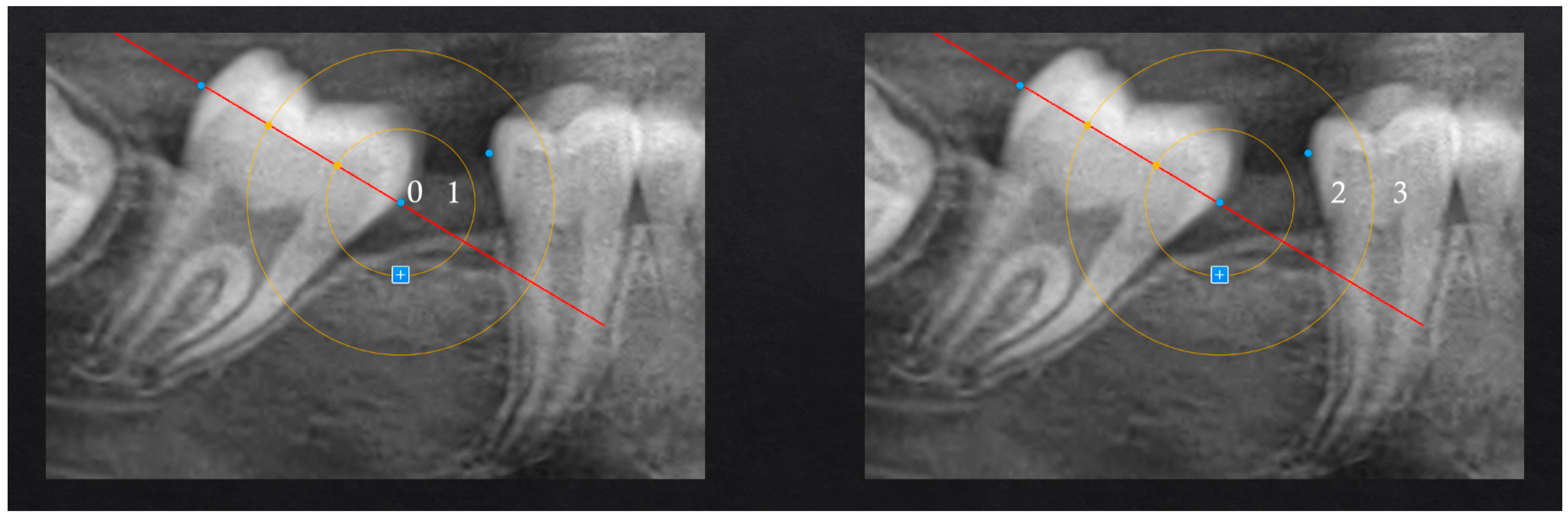
- Construction of the geometric target (as illustrated in Figure 1), using concentric circles centered on the mesial equator of the SPM to define the four-level target scale.
- •
- First circle: radius extending to the first third of the line.
- •
- Second circle: radius extending to two-thirds of the line.
- •
- Score 0: complete closure;
- •
- Score 1: near-complete closure;
- •
- Score 2: partial closure;
- •
- Score 3: minimal or absent closure.
- -
- -
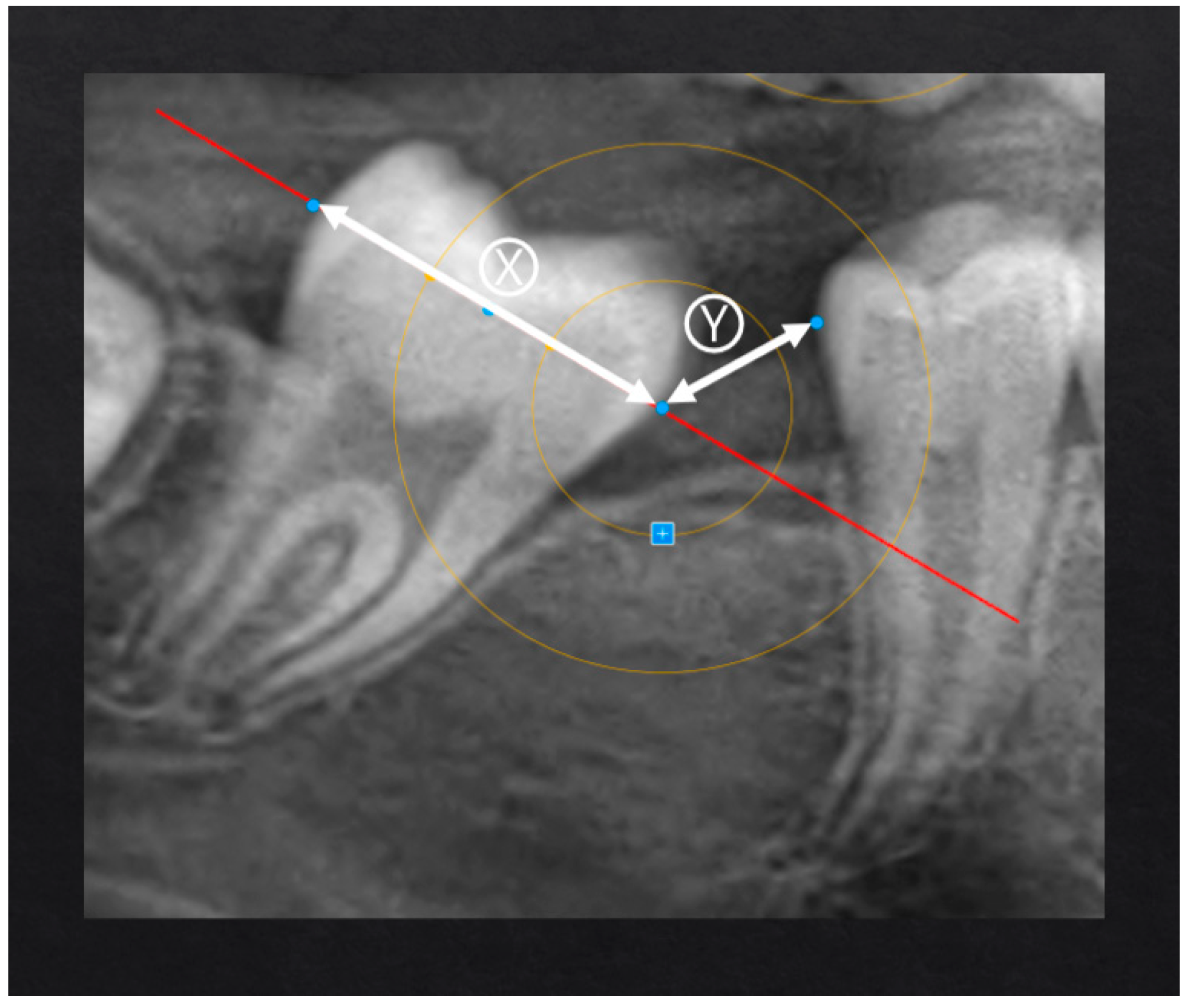
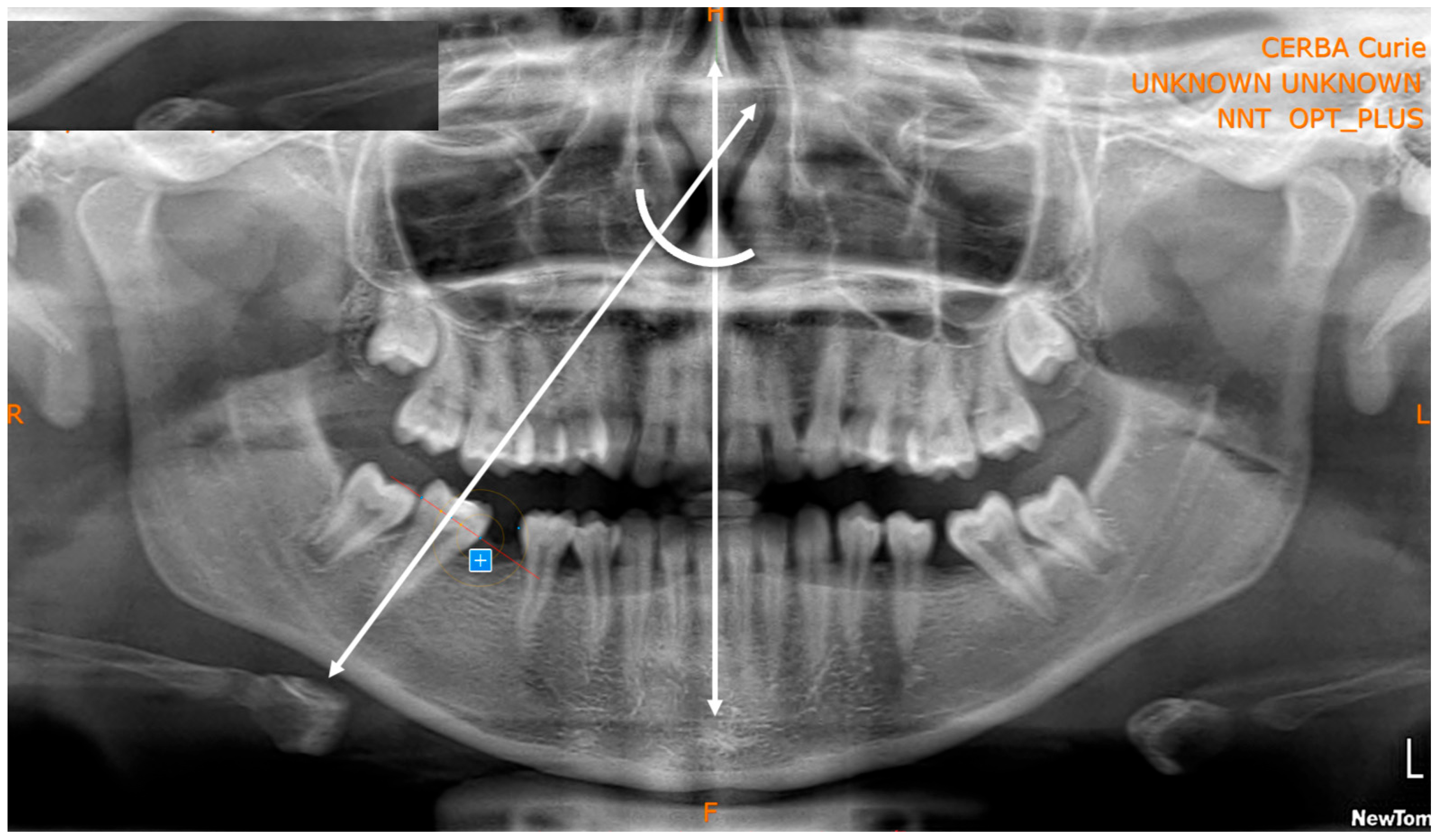
- Measurement of distances and angles to assess the SPM inclination (measurements were taken using the protractor directly on the iPad screen to ensure precision and replicability) from a qualitative point of view (Figure 3).
- •
- Target score 0: The ratio must be equal to or very close to 0.
- •
- Target score 1: The ratio value must not exceed 33.33%.
- •
- Target score 2: The ratio value must not exceed 66.66%.
- •
- Target score 3: The ratio value is greater than or equal to 66.67%.
- •
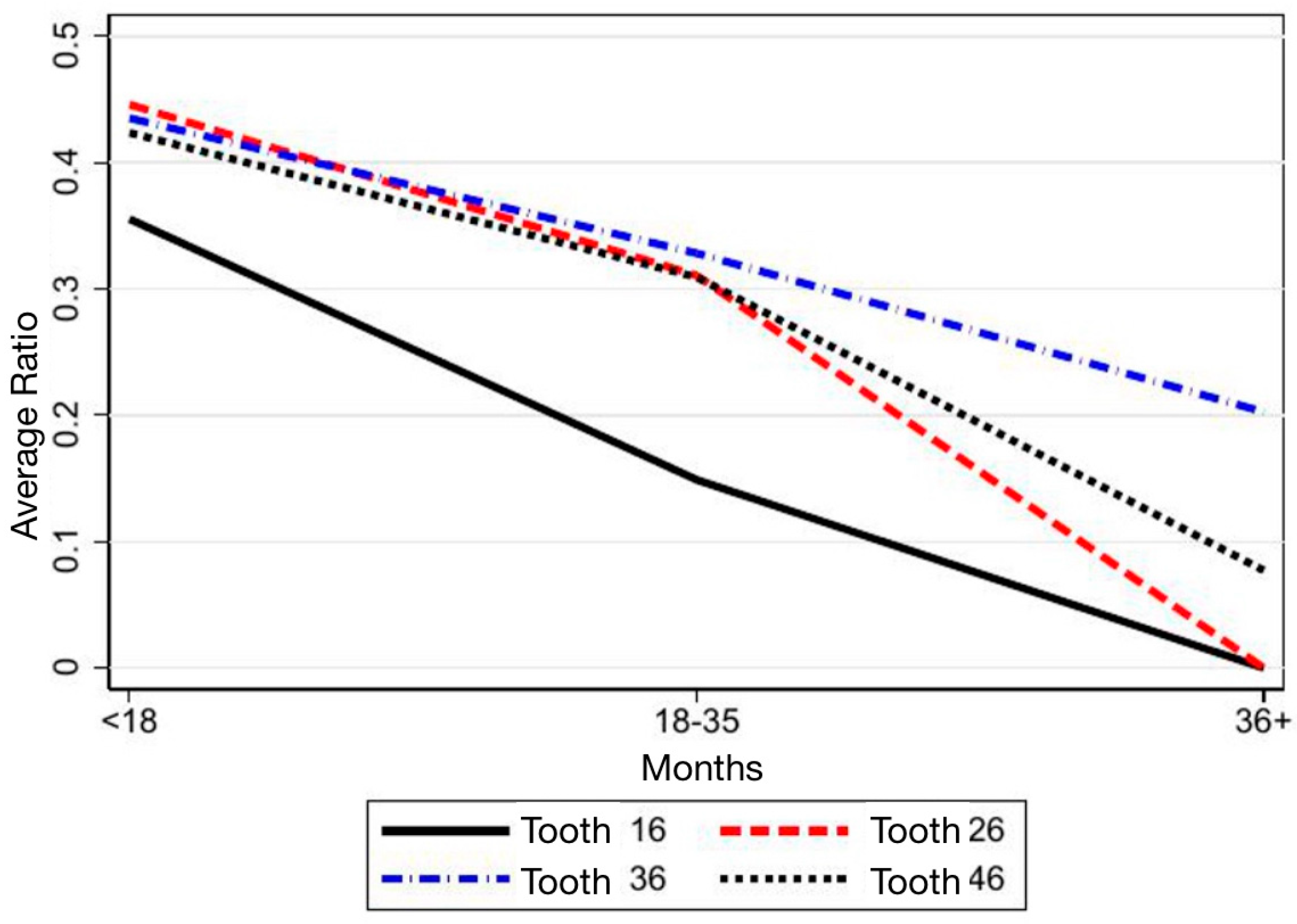
- T1: <18 months;
- •
- T2: 19–35 months;
- •
- T3: ≥36 months.
- -
- T1: Follow-up OPT < 18 months;
- -
- T2: Follow-up OPT from 18 to 35 months;
- -
- T3: Follow-up OPT > 36 months.
- -
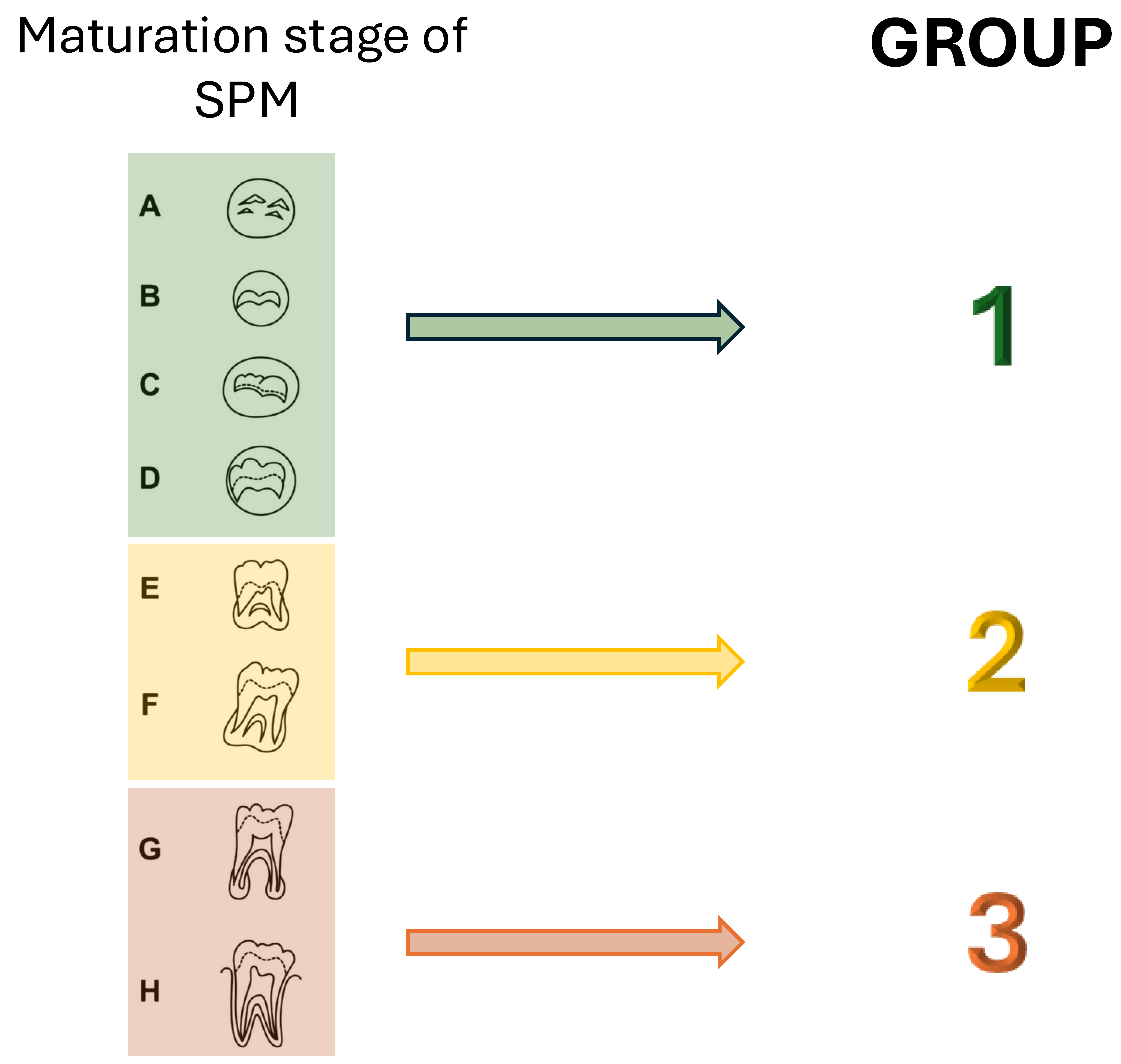
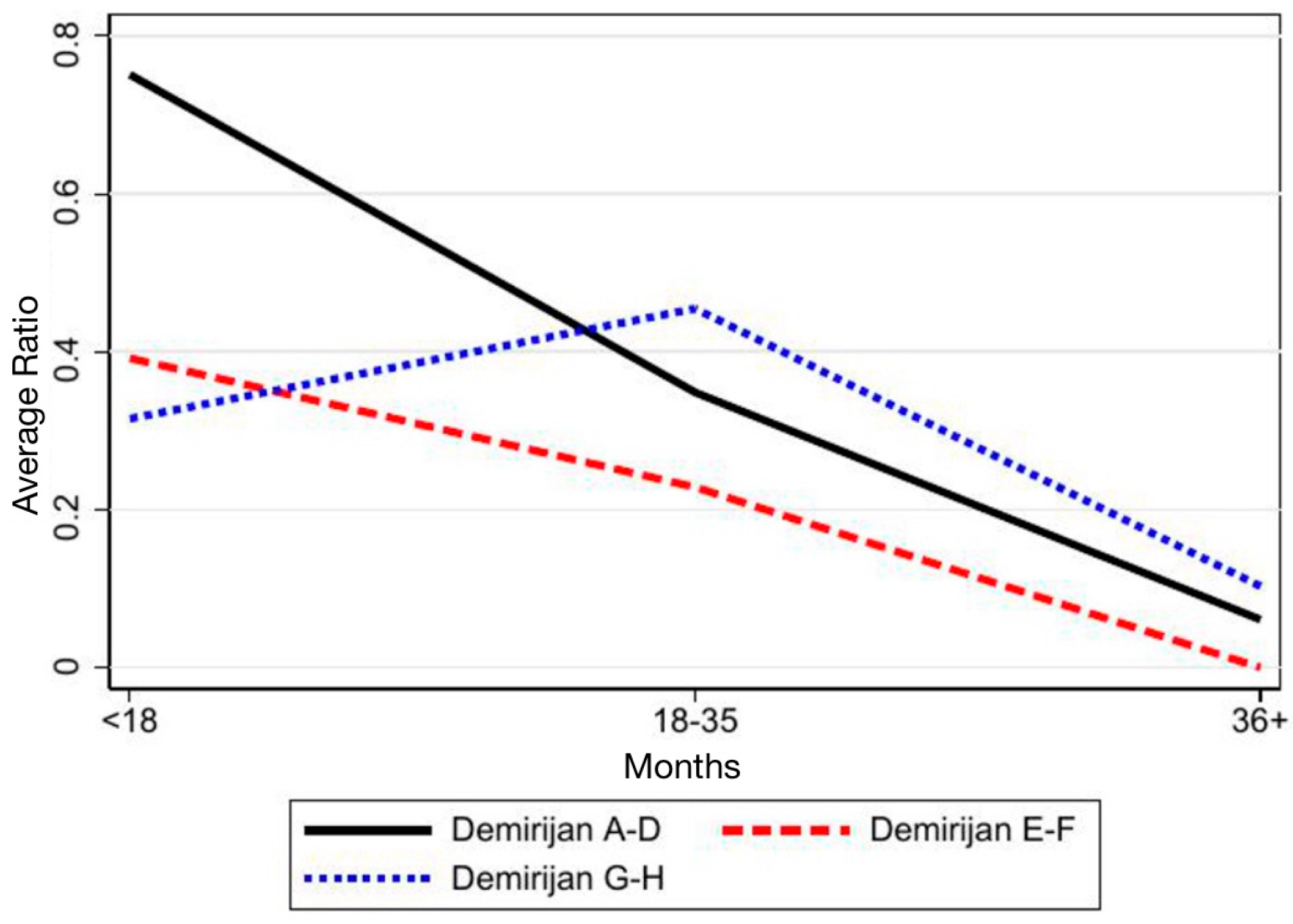
- Group 1: Stages A, B, C, D;
- -
- Group 2: Stages E, F;
- -
- Group 3: Stages G, H.
3. Results
- •
- 11 lacked final radiographic documentation.
- •
- 1 had undergone fixed orthodontic treatment for aesthetic reasons.
- •
- 1 did not consent to extraction.
- •
- 3 became unreachable.
- •
- 8 upper right FPMs;
- •
- 9 upper left FPMs;
- •
- 9 lower left FPMs;
- •
- 10 lower right FPMs.
- •
- 10 patients with 1 extracted molar;
- •
- 5 patients with 2 extracted molars;
- •
- 4 patients with 4 extracted molars.
4. Discussion
5. Conclusions
Author Contributions
Funding
Institutional Review Board Statement
Informed Consent Statement
Data Availability Statement
Conflicts of Interest
Abbreviations
| MIH | Molar-Incisor Hypomineralization. |
| FPM | First Permanent Molar |
| SPM | Second Permanent Molar |
| OPT | Oprtopantomography |
| CBCT | Cone-Beam Computed Tomography. |
| SPP | Second Premolar |
| ID | Identifier |
References
- Peres, M.A.; Macpherson, L.M.D.; Weyant, R.J.; Daly, B.; Venturelli, R.; Mathur, M.R.; Listl, S.; Celeste, R.K.; Guarnizo-Herreño, C.C.; Kearns, C.; et al. Oral Diseases: A Global Public Health Challenge. Lancet 2019, 394, 249–260. [Google Scholar] [CrossRef]
- Garot, E.; Vieira, A.R.; Manton, D.J. Molar Incisor Hypomineralisation as a Dental Caries Risk Factor—Is It True? Monogr. Oral. Sci. 2024, 32, 166–172. [Google Scholar] [CrossRef]
- Petersen, P.E.; Bourgeois, D.; Ogawa, H.; Estupinan-Day, S.; Ndiaye, C. The Global Burden of Oral Diseases and Risks to Oral Health. Bull. World Health Organ. 2005, 83, 661–669. [Google Scholar]
- Somani, C.; Taylor, G.D.; Garot, E.; Rouas, P.; Lygidakis, N.A.; Wong, F.S.L. An Update of Treatment Modalities in Children and Adolescents with Teeth Affected by Molar Incisor Hypomineralisation (MIH): A Systematic Review. Eur. Arch. Paediatr. Dent. 2022, 23, 39–64. [Google Scholar] [CrossRef] [PubMed]
- Elhennawy, K.; Schwendicke, F. Managing Molar-Incisor Hypomineralization: A Systematic Review. J. Dent. 2016, 55, 16–24. [Google Scholar] [CrossRef]
- Alzahrani, A.Y.; Alamoudi, N.M.H.; El Meligy, O.A.E.S. Contemporary Understanding of the Etiology and Management of Molar Incisor Hypomineralization: A Literature Review. Dent. J. 2023, 11, 157. [Google Scholar] [CrossRef] [PubMed]
- Inchingolo, A.M.; Inchingolo, A.D.; Viapiano, F.; Ciocia, A.M.; Ferrara, I.; Netti, A.; Dipalma, G.; Palermo, A.; Inchingolo, F. Treatment Approaches to Molar Incisor Hypomineralization: A Systematic Review. J. Clin. Med. 2023, 12, 7194. [Google Scholar] [CrossRef] [PubMed]
- Zhao, D.; Dong, B.; Yu, D.; Ren, Q.; Sun, Y. The Prevalence of Molar Incisor Hypomineralization: Evidence from 70 Studies. Int. J. Paediatr. Dent. 2018, 28, 170–179. [Google Scholar] [CrossRef]
- Schwendicke, F.; Elhennawy, K.; Reda, S.; Bekes, K.; Manton, D.J.; Krois, J. Global Burden of Molar Incisor Hypomineralization. J. Dent. 2018, 68, 10–18. [Google Scholar] [CrossRef]
- Salerno, C.; Campus, G.; Camoni, N.; Cirio, S.; Caprioglio, A.; Cagetti, M.G. Is Italian Dentists’ Knowledge of Enamel Development Defects Adequate? A Nationwide Survey. Int. Dent. J. 2024, 74, 1447–1455. [Google Scholar] [CrossRef]
- Cobourne, M.T.; Williams, A.; Harrison, M. National Clinical Guidelines for the Extraction of First Permanent Molars in Children. Br. Dent. J. 2014, 217, 643–648. [Google Scholar] [CrossRef] [PubMed]
- Brusevold, I.J.; Kleivene, K.; Grimsøen, B.; Skaare, A.B. Extraction of First Permanent Molars Severely Affected by Molar Incisor Hypomineralisation: A Retrospective Audit. Eur. Arch. Paediatr. Dent. 2022, 23, 89–95. [Google Scholar] [CrossRef]
- Teo, T.K.Y.; Ashley, P.F.; Parekh, S.; Noar, J. The Evaluation of Spontaneous Space Closure after the Extraction of First Permanent Molars. Eur. Arch. Paediatr. Dent. 2013, 14, 207–212. [Google Scholar] [CrossRef]
- Jälevik, B.; Möller, M. Evaluation of Spontaneous Space Closure and Development of Permanent Dentition after Extraction of Hypomineralized Permanent First Molars. Int. J. Paediatr. Dent. 2007, 17, 328–335. [Google Scholar] [CrossRef]
- Stramotas, S.; Geenty, J.P.; Petocz, P.; Darendeliler, M.A. Accuracy of Linear and Angular Measurements on Panoramic Radiographs Taken at Various Positions in Vitro. Eur. J. Orthod. 2002, 24, 43–52. [Google Scholar] [CrossRef]
- Hajdarević, A.; Stervik, C.; Sabel, N.; Jälevik, B.; Robertson, A.; Hansen, K.; Čirgić, E. GuREx-MIH: Radiographic Assessment of Eruption Patterns of Second Permanent Molars and Premolars in 11-Year-Olds after Early Extraction of the First Permanent Molar—A Split-Mouth Trial. Eur. J. Orthod. 2025, 47, cjaf055. [Google Scholar] [CrossRef]
- Farronato, G.; Giannini, L.; Galbiati, G.; Consonni, D.; Maspero, C. Spontaneous Eruption of Impacted Second Molars. Prog. Orthod. 2011, 12, 119–125. [Google Scholar] [CrossRef]
- Crescini, A.; Nieri, M.; Buti, J.; Baccetti, T.; Prato, G.P.P. Orthodontic and Periodontal Outcomes of Treated Impacted Maxillary Canines. Angle Orthod. 2007, 77, 571–577. [Google Scholar] [CrossRef] [PubMed]
- Ericson, S.; Kurol, J. Radiographic Examination of Ectopically Erupting Maxillary Canines. Am. J. Orthod. Dentofac. Orthop. 1987, 91, 483–492. [Google Scholar] [CrossRef]
- Demirjian, A.; Goldstein, H.; Tanner, J.M. A New System of Dental Age Assessment. Hum. Biol. 1973, 45, 211–227. [Google Scholar] [PubMed]
- Aldahool, Y.; Sonesson, M.; Dimberg, L. Spontaneous Space Closure in Patients Treated with Early Extraction of the First Permanent Molar: A Retrospective Cohort Study Using Radiographs. Angle Orthod. 2024, 94, 180–186. [Google Scholar] [CrossRef] [PubMed]
- Patel, S.; Ashley, P.; Noar, J. Radiographic Prognostic Factors Determining Spontaneous Space Closure after Loss of the Permanent First Molar. Am. J. Orthod. Dentofac. Orthop. 2017, 151, 718–726. [Google Scholar] [CrossRef] [PubMed]
- Nordeen, K.A.; Kharouf, J.G.; Mabry, T.R.; Dahlke, W.O.; Beiraghi, S.; Tasca, A.W. Radiographic Evaluation of Permanent Second Molar Substitution After Extraction of Permanent First Molar: Identifying Predictors for Spontaneous Space Closure. Pediatr. Dent. 2022, 44, 123–130. [Google Scholar]
- Ciftci, V.; Guney, A.; Deveci, C.; Sanri, I.; Salimow, F.; Tuncer, A. Spontaneous Space Closure Following the Extraction of the First Permanent Mandibular Molar. Niger. J. Clin. Pract. 2021, 24, 1450–1456. [Google Scholar] [CrossRef]
- Teo, T.K.Y.; Ashley, P.F.; Derrick, D. Lower First Permanent Molars: Developing Better Predictors of Spontaneous Space Closure. Eur. J. Orthod. 2016, 38, 90–95. [Google Scholar] [CrossRef]
- Hamza, B.; Papageorgiou, S.N.; Patcas, R.; Schätzle, M. Spontaneous Space Closure after Extraction of Permanent First Molars in Children and Adolescents: A Systematic Review and Meta-Analysis. Eur. J. Orthod. 2024, 46, cjae054. [Google Scholar] [CrossRef]
- Cenzato, N.; Crispino, R.; Galbiati, G.; Giannini, L.; Bolognesi, L.; Lanteri, V.; Maspero, C. Premature Loss of Primary Molars in Children: Space Recovery through Molar Distalisation. A Literature Review. Eur. J. Paediatr. Dent. 2024, 25, 72–76. [Google Scholar] [CrossRef] [PubMed]



| ICC | ||||
|---|---|---|---|---|
| Intra-Operator | Inter-Operator | |||
| ICC | 95CI | ICC | 95CI | |
| INTER-EQUATORIAL DISTANCE OF THE SPM | 0.98 | 0.96; 0.99 | 0.97 | 0.94; 0.99 |
| INTERDENTAL DISTANCE—SPP | 0.99 | 0.99; 1.00 | 0.98 | 0.97; 1.00 |
| RATIO | 0.99 | 0.99; 1.00 | 0.99 | 0.98; 1.00 |
| SPM INCLINATION | 0.97 | 0.96; 0.99 | 0.95 | 0.92; 0.99 |
| T | ||||||
|---|---|---|---|---|---|---|
| EXTRACTED SPM | T0 | T1 | T2 | T3 | Coefficient | 95%CI |
| 16 | ||||||
| N | 8 | 5 | 3 | 5 | ||
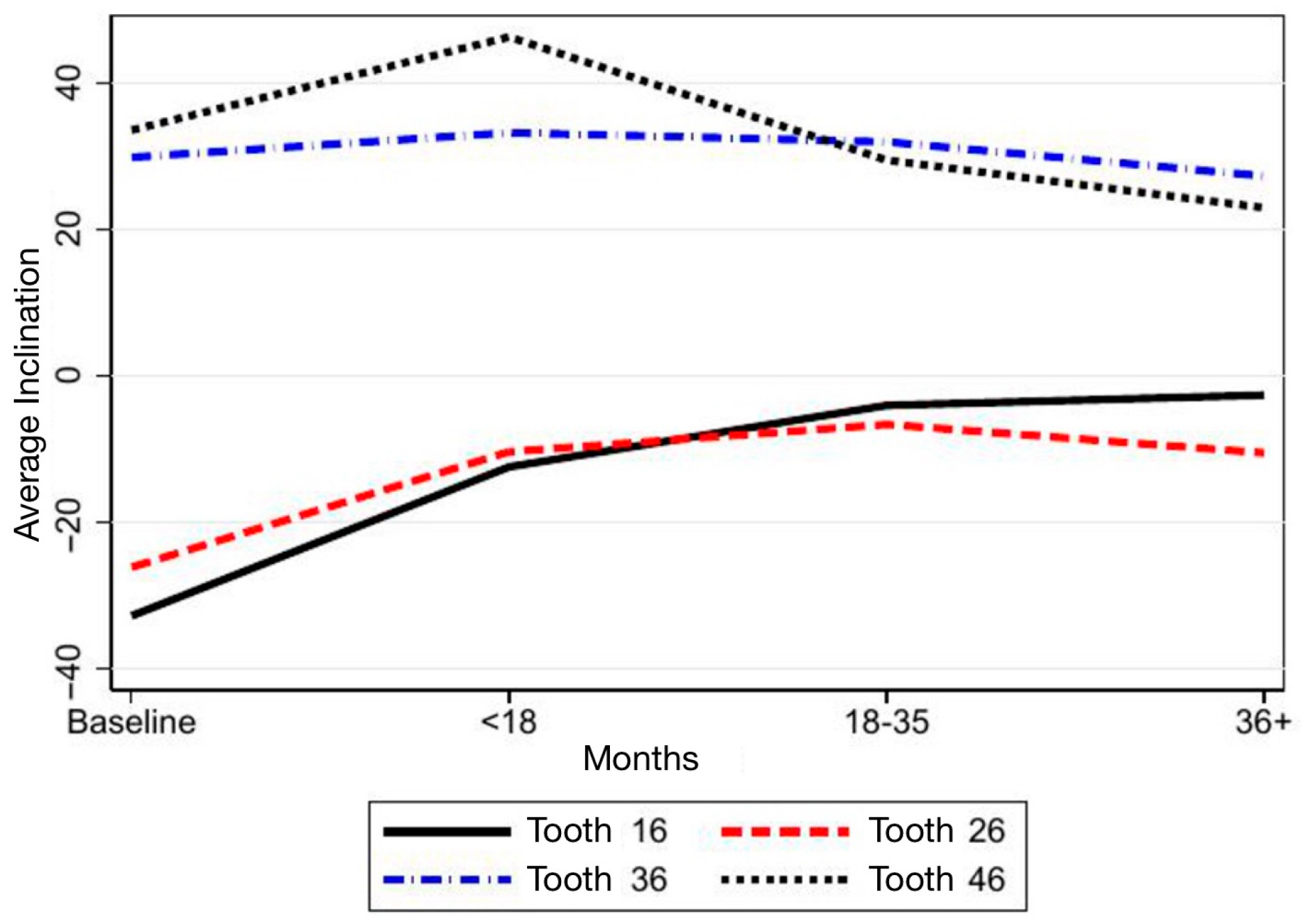
| INCLINATION | −32.75 | −12.40 | −4.00 | −2.60 | 11.40 | [7.87; 14.93] |
| 26 | ||||||
| N | 9 | 6 | 5 | 2 | ||
| INCLINATION | −26.11 | −10.33 | −6.60 | −10.50 | 12.11 | [8.73; 15.49] |
| 36 | ||||||
| N | 9 | 4 | 7 | 3 | ||
| INCLINATION | 29.89 | 33.25 | 32.00 | 27.33 | −0.58 | [−4.66; 3.49] |
| 46 | ||||||
| N | 10 | 3 | 8 | 4 | ||
| INCLINATION | 33.60 | 46.33 | 29.50 | 23.00 | −3.43 | [−6.61; 0.24] |
| T | ||||||
|---|---|---|---|---|---|---|
| D EMIRJIAN | T0 | T1 | T2 | T3 | Coefficient | 95%CI |
| GROUP 1 | ||||||
| N | 7 | 2 | 7 | 10 | ||
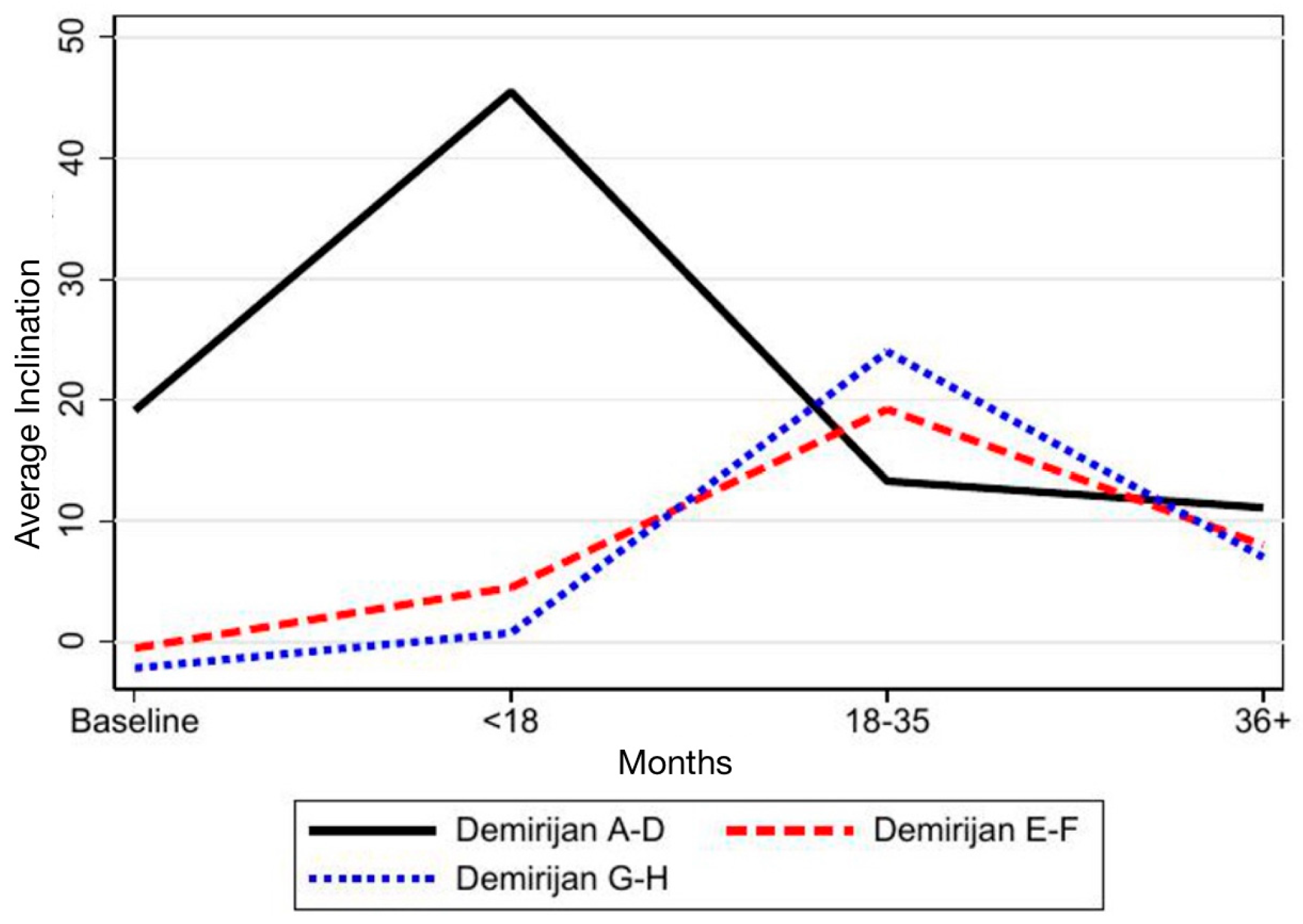
| TARGET | 19.14 | 45.50 | 13.29 | 11.10 | −1.78 | [−10.55; 6.99] |
| GROUP 2 | ||||||
| N | 22 | 12 | 13 | 1 | ||
| TARGET | −0.50 | 4.50 | 19.23 | 8.00 | 7.88 | [−0.69; 16.46] |
| GROUP 3 | ||||||
| N | 7 | 4 | 3 | 3 | ||
| TARGET | −2.14 | 0.75 | 24.00 | 7.00 | 7.00 | [3.26; 10.75] |
| T | |||||
|---|---|---|---|---|---|
| DE MIRJIAN | T1 | T2 | T3 | Coefficient | 95%CI |
| 16 | |||||
| N | 5 | 3 | 5 | ||
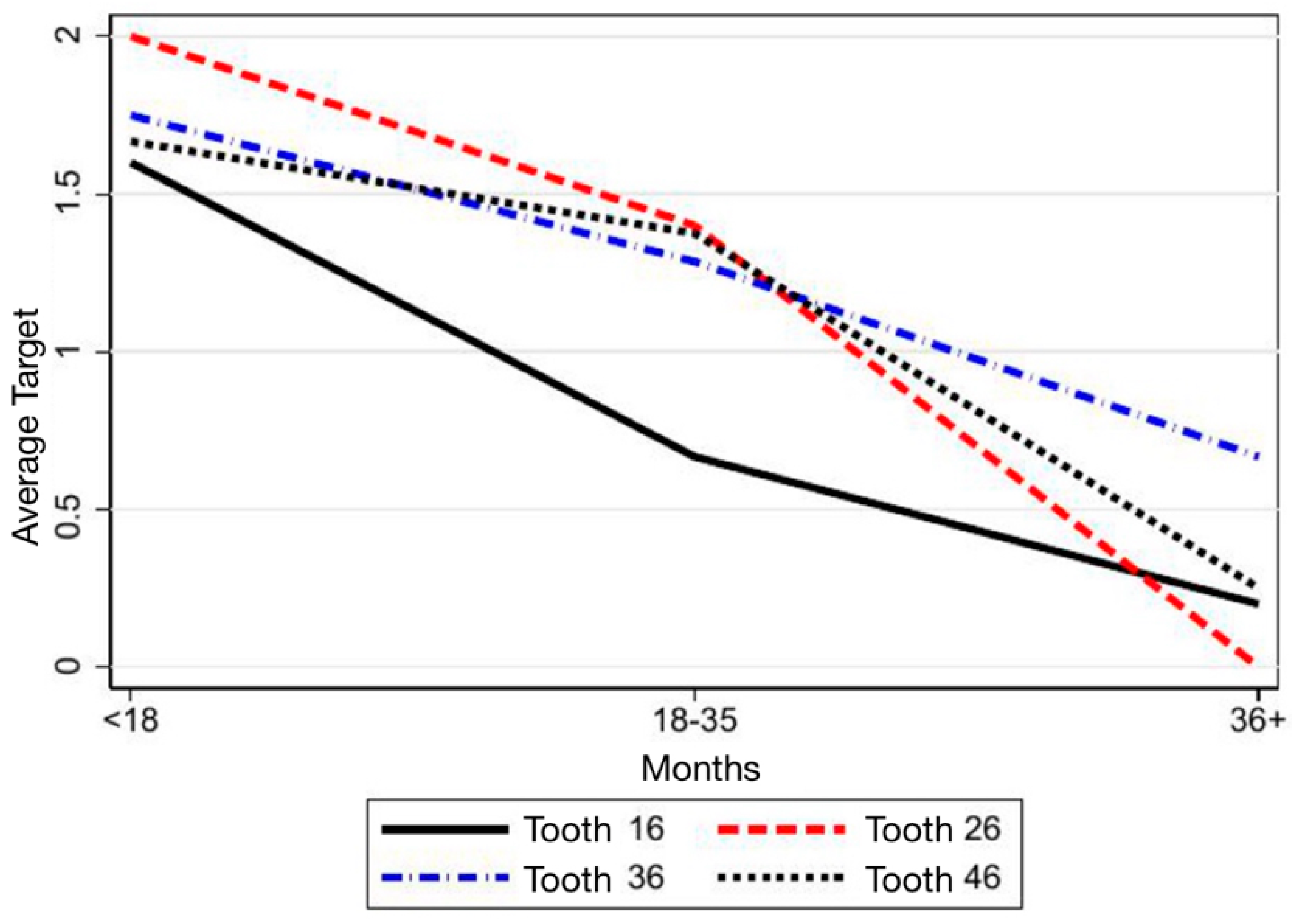
| INCLINATION | 1.60 | 0.67 | 0.20 | −0.68 | [−0.95; −0.38] |
| 26 | |||||
| N | 6 | 5 | 2 | ||
| INCLINATION | 2.00 | 1.40 | 0.00 | −0.91 | [−1.49; −0.33] |
| 36 | |||||
| N | 4 | 7 | 3 | ||
| INCLINATION | 1.75 | 1.29 | 0.67 | −0.54 | [−1.19; 0.12] |
| 46 | |||||
| N | 3 | 8 | 4 | ||
| INCLINATION | 1.67 | 1.38 | 0.25 | −0.74 | [−1.40; −0.76] |
| T | |||||
|---|---|---|---|---|---|
| D EMIRJIAN | T1 | T2 | T3 | Coefficient | 95%CI |
| GROUP 1 | |||||
| N | 2 | 7 | 10 | ||
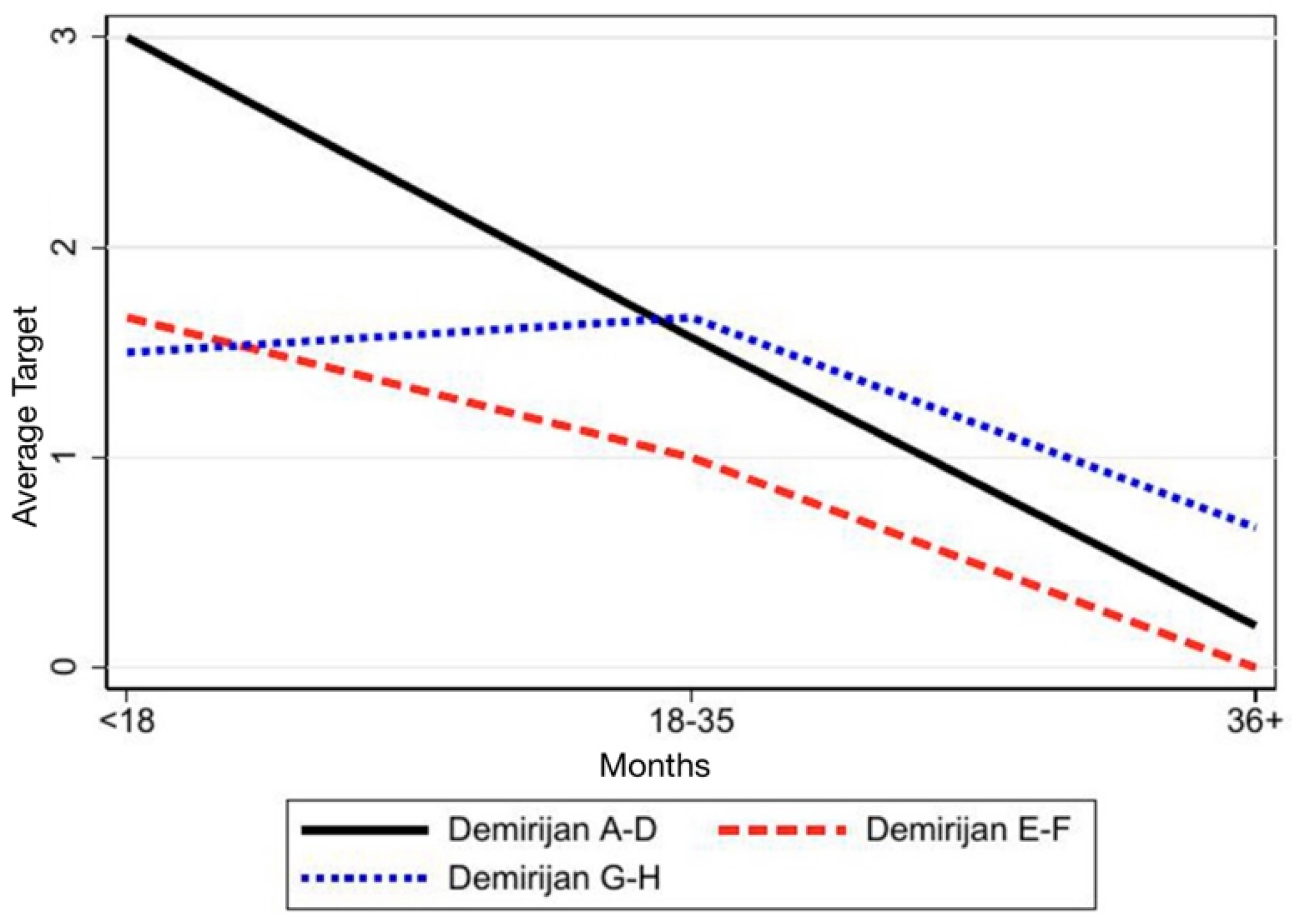
| TARGET | 3.00 | 1.57 | 0.20 | −1.58 | [−2.09;−1.06] |
| GROUP 2 | |||||
| N | 12 | 13 | 1 | ||
| TARGET | 1.67 | 1.00 | 0.00 | −1.02 | [−1.68;−0.36] |
| GROUP 3 | |||||
| N | 4 | 3 | 3 | ||
| TARGET | 1.50 | 1.67 | 0.67 | −0.41 | [−0.77;−0.43] |
Disclaimer/Publisher’s Note: The statements, opinions and data contained in all publications are solely those of the individual author(s) and contributor(s) and not of MDPI and/or the editor(s). MDPI and/or the editor(s) disclaim responsibility for any injury to people or property resulting from any ideas, methods, instructions or products referred to in the content. |
© 2025 by the authors. Licensee MDPI, Basel, Switzerland. This article is an open access article distributed under the terms and conditions of the Creative Commons Attribution (CC BY) license (https://creativecommons.org/licenses/by/4.0/).
Share and Cite
Stabilini, S.A.; Giannini, L.; Cenzato, N.; Olivi Mocenigo, F.; Salerno, C.; Maspero, C.; Cagetti, M.G. Spontaneous Second Molar Migration After MIH-Affected First Molars Extraction: A Radiographic-Based Method Evaluation. Children 2025, 12, 1589. https://doi.org/10.3390/children12121589
Stabilini SA, Giannini L, Cenzato N, Olivi Mocenigo F, Salerno C, Maspero C, Cagetti MG. Spontaneous Second Molar Migration After MIH-Affected First Molars Extraction: A Radiographic-Based Method Evaluation. Children. 2025; 12(12):1589. https://doi.org/10.3390/children12121589
Chicago/Turabian StyleStabilini, Santo Andrea, Lucia Giannini, Niccolò Cenzato, Francesca Olivi Mocenigo, Claudia Salerno, Cinzia Maspero, and Maria Grazia Cagetti. 2025. "Spontaneous Second Molar Migration After MIH-Affected First Molars Extraction: A Radiographic-Based Method Evaluation" Children 12, no. 12: 1589. https://doi.org/10.3390/children12121589
APA StyleStabilini, S. A., Giannini, L., Cenzato, N., Olivi Mocenigo, F., Salerno, C., Maspero, C., & Cagetti, M. G. (2025). Spontaneous Second Molar Migration After MIH-Affected First Molars Extraction: A Radiographic-Based Method Evaluation. Children, 12(12), 1589. https://doi.org/10.3390/children12121589