


The Validity and Reliability of the Short Form of the Adolescent Stress Questionnaire (ASQ-14) Among Greek Adolescents Aged 15–18
 ,
,  ,
,  , and
, and 
Highlights
- The Greek ASQ-14 demonstrated acceptable reliability. Greek adolescents with high perceived socio-economic status had significantly greater scores in external stress factors and significantly lower scores in internal ones.
- Female adolescents had significantly greater scores in ASQ.
- The Greek ASQ-14 responds to the necessity of more viable, concise, and user-friendly stress-assessing instruments for Greek adolescents.
Abstract
1. Introduction
1.1. Stress in Adolescence
1.2. Assessment of Stress in Adolescence
- (a)
- (b)
- The Adolescent Stress Questionnaire (ASQ) [17]: Originally developed to assess stress-inducing situations in Australian adolescents, the ASQ has been translated and validated in multiple languages, including Spanish, Dutch, Norwegian, Turkish, and Hungarian [16]. Its long version was also validated in a study in 1240 adolescents from Germany, Hungary, Spain, Greece, and Denmark [18]. Greek versions of the long form, with 58 items [19], and of the 27-item short form [20] of the tool are available.
- (c)
- The Perceived Stressors Global Scale for Adolescents (PSGS-A) [21]: This more recent tool evaluates six categories of stressful events—social pressure, academic stressors, family concerns, social exhibition, daily hassles, and critical incidents. Currently, it has only been validated in a Mexican adolescent population [21].
- (a)
- The Perceived Stress Scale (PSS) [22]: This instrument measures how individuals, both adults and adolescents, perceive stress over the preceding four weeks. According to Cohen’s Laboratory for the Study of Stress, Immunity, and Disease, the PSS is suitable for population samples of at least a junior high school education [16]. It has been translated into 25 languages, including Greek, and validated for use in Greek adolescents [23,24,25].
- (b)
- The Stress Appraisal Measure for Adolescents (SAMA), a 14-item questionnaire that measures primary and secondary cognitive appraisal of stress in youth of 14–18 years old, by the use of a 5-point Likert scale [26].
- (c)
- The Impact of Event Scale for adolescents (IES) [27], which is a self-report instrument that assesses current subjective distress and identifies post-traumatic stress disorder (PTSD) symptoms.
1.3. The Purpose of the Present Study
2. Materials and Methods
2.1. Study Design, Setting, and Participants
2.2. Measures
2.3. Statistical Analysis
3. Results
3.1. Demographic Characteristics of the Sample
3.2. ASQ-14 Items
3.3. Factor Analyses
3.4. Internal Consistency and Intercorrelations
3.5. Discriminant Validity
4. Discussion
5. Study Limitations and Recommendations for Future Studies
6. Conclusions
Author Contributions
Funding
Institutional Review Board Statement
Informed Consent Statement
Data Availability Statement
Acknowledgments
Conflicts of Interest
Abbreviations
| ASQ | Adolescent Stress Questionnaire |
| EFA | Exploratory Factor Analysis |
| CFA | Confirmatory Factor Analysis |
| CFI | Confirmatory Fit Index |
| TLI | Tucker–Lewis Index |
| SRMR | Standardized Root Mean Squared Error |
| RMSEA | Root Mean Square Error of Approximation |
| PAF | Principal Axis Factoring |
| KMO | Kaiser-Meyer-Olkin |
References
- Caltabiano, M.; Byrne, D.G.; Sarafino, E.P. Health Psychology: Biopsychosocial Interactions, 2nd ed.; John Wiley & Sons: Hoboken, NJ, USA, 2008; p. 128. [Google Scholar]
- Chrousos, G.P. Stress and disorders of the stress system. Nat. Rev. Endocrinol. 2009, 5, 374–381. [Google Scholar] [CrossRef]
- Casey, B.J.; Jones, R.M.; Levita, L.; Libby, V.; Pattwell, S.S.; Ruberry, E.J.; Soliman, F.; Somerville, L.H. The storm and stress of adolescence: Insights from human imaging and mouse genetics. Dev. Psychobiol. J. Int. Soc. Dev. Psychobiol. 2010, 52, 225–235. [Google Scholar] [CrossRef]
- Seiffge-Krenke, I. Coping with relationship stressors: A decade review. J. Res. Adolesc. 2011, 21, 196–210. [Google Scholar] [CrossRef]
- Tasoula, E.; Gregoriou, S.; Chalikias, J.; Lazarou, D.; Danopoulou, I.; Katsambas, A.; Rigopoulos, D. The impact of acne vulgaris on quality of life and psychic health in young adolescents in Greece: Results of a population survey. An. Bras. Dermatol. 2012, 87, 862–869. [Google Scholar] [CrossRef]
- Núñez-Regueiro, F.; Núñez-Regueiro, S. Identifying salient stressors of adolescence: A systematic review and content analysis. J. Youth Adolesc. 2021, 50, 2533–2556. [Google Scholar] [CrossRef]
- Pascoe, M.C.; Hetrick, S.E.; Parker, A.G. The impact of stress on students in secondary school and higher education. Int. J. Adolesc. Youth 2020, 25, 104–112. [Google Scholar] [CrossRef]
- Grant, K.E.; McMahon, S.D.; Carter, J.S.; Carleton, R.A.; Adam, E.K.; Chen, E. The influence of stressors on the development of psychopathology. In Handbook of Developmental Psychopathology; Springer: Boston, MA, USA, 2014; pp. 205–223. [Google Scholar]
- Phillips, S.P.; Reipas, K.; Zelek, B. Stresses, strengths and resilience in adolescents: A qualitative study. J. Prim. Prev. 2019, 40, 631–642. [Google Scholar] [CrossRef] [PubMed]
- Moksnes, U.K.; Byrne, D.G.; Mazanov, J.; Espnes, G.A. Adolescent stress: Evaluation of the factor structure of the adolescent stress questionnaire (ASQ-N). Scand. J. Psychol. 2010, 51, 203–209. [Google Scholar] [CrossRef] [PubMed]
- Reiss, F.; Meyrose, A.K.; Otto, C.; Lampert, T.; Klasen, F.; Ravens-Sieberer, U. Socioeconomic status, stressful life situations and mental health problems in children and adolescents: Results of the German BELLA cohort-study. PLoS ONE 2019, 14, e0213700. [Google Scholar] [CrossRef]
- Romeo, R.D. Adolescence: A central event in shaping stress reactivity. Dev. Psychobiol. J. Int. Soc. Dev. Psychobiol. 2010, 52, 244–253. [Google Scholar] [CrossRef]
- Eiland, L.; Romeo, R.D. Stress and the developing adolescent brain. Neuroscience 2013, 249, 162–171. [Google Scholar] [CrossRef]
- Compas, B.E.; Davis, G.E.; Forsythe, C.J.; Wagner, B.M. Assessment of major and daily stressful events during adolescence: The Adolescent Perceived Events Scale. J. Consult. Clin. Psychol. 1987, 55, 534. [Google Scholar] [CrossRef] [PubMed]
- Kokka, I.; Chrousos, G.P.; Darviri, C.; Bacopoulou, F. Measuring adolescent chronic stress: A review of established biomarkers and psychometric instruments. Horm. Res. Paediatr. 2023, 96, 74–82. [Google Scholar] [CrossRef] [PubMed]
- Kopp, M.S.; Thege, B.K.; Balog, P.; Stauder, A.; Salavecz, G.; Rózsa, S.; Purebl, G.; Ádám, S. Measures of stress in epidemiological research. J. Psychosom. Res. 2010, 69, 211–225. [Google Scholar] [CrossRef] [PubMed]
- Byrne, D.G.; Davenport, S.C.; Mazanov, J. Profiles of adolescent stress: The development of the adolescent stress questionnaire (ASQ). J. Adolesc. 2007, 30, 393–416. [Google Scholar] [CrossRef]
- De Vriendt, T.; Clays, E.; Moreno, L.A.; Bergman, P.; Vicente-Rodriguez, G.; Nagy, E.; Dietrich, S.; Manios, Y.; De Henauw, S.; HELENA Study Group. Reliability and validity of the adolescent stress questionnaire in a sample of European adolescents-the HELENA study. BMC Public Health 2011, 11, 717. [Google Scholar] [CrossRef]
- Darviri, C.; Legaki, P.E.; Chatzioannidou, P.; Gnardellis, C.; Kraniotou, C.; Tigani, X.; Alexopoulos, E.C. Adolescent Stress Questionnaire: Reliability and validity of the Greek version and its description in a sample of high school (lyceum) students. J. Adolesc. 2014, 37, 1373–1377. [Google Scholar] [CrossRef]
- Ertanir, B.; Rietz, C.; Graf, U.; Kassis, W. A cross-national validation of the shortened version of the Adolescent Stress Questionnaire (ASQ-S) among adolescents from Switzerland, Germany, and Greece. Front. Psychol. 2021, 12, 619493. [Google Scholar] [CrossRef]
- Barcelata-Eguiarte, B.E.; Gutiérrez-Arenas, V.; Ruvalcaba-Romero, N.A. Construction, validity and reliability of a global scale of perceived stressful events for adolescents. Psychologia. Av. La Discip. 2020, 14, 13–28. [Google Scholar] [CrossRef]
- Cohen, S.; Kamarck, T.; Mermelstein, R. A global measure of perceived stress. J. Health Soc. Behav. 1983, 24, 385–396. [Google Scholar] [CrossRef]
- Andreou, E.; Alexopoulos, E.C.; Lionis, C.; Varvogli, L.; Gnardellis, C.; Chrousos, G.P.; Darviri, C. Perceived stress scale: Reliability and validity study in Greece. Int. J. Environ. Res. Public Health 2011, 8, 3287–3298. [Google Scholar] [CrossRef]
- Katsarou, A.; Panagiotakos, D.; Zafeiropoulou, A.; Vryonis, M.; Skoularigis, I.; Tryposkiadis, F.; Papageorgiou, C. Validation of a Greek version of PSS-14; a global measure of perceived stress. Cent. Eur. J. Public Health 2012, 20, 104–109. [Google Scholar] [CrossRef]
- Kourmousi, N.; Kounenou, K.; Pezirkianidis, C.; Kalamatianos, A.; Chrousos, G.P. Validation of Perceived Stress Scale-10 Among Greek Middle Adolescents: Associations Between Stressful Life Events and Perceived Stress. Soc. Sci. 2025, 14, 344. [Google Scholar] [CrossRef]
- Rowley, A.A.; Roesch, S.C.; Jurica, B.J.; Vaughn, A.A. Developing and validating a stress appraisal measure for minority adolescents. J. Adolesc. 2005, 28, 547–557. [Google Scholar] [CrossRef]
- Horowitz, M.; Wilner, N.; Alvarez, W. Impact of Event Scale: A measure of subjective stress. Psychosom. Med. 1979, 41, 209–218. [Google Scholar] [CrossRef]
- Sotardi, V.A.; Watson, P.W. A sample validation of the Adolescent Stress Questionnaire (ASQ) in New Zealand. Stress Health 2018, 35, 3–14. [Google Scholar] [CrossRef]
- Lima, J.F.; Alarcón, R.; Escobar, M.; Fernández-Baena, F.J.; Muñoz, A.M.; Blanca, M.J. Psychometric properties of the Spanish version of the Adolescent Stress Questionnaire (ASQ-S). Psychol. Assess. 2017, 29, e1–e12. [Google Scholar] [CrossRef] [PubMed]
- Moksnes, U.K.; Espnes, G.A. Evaluation of the Norwegian version of the Adolescent Stress Questionnaire (ASQ-N): Factorial validity across samples. Scand. J. Psychol. 2011, 52, 601–608. [Google Scholar] [CrossRef] [PubMed]
- McKay, M.T.; Percy, A.; Byrne, D.G. Support for the multidimensional adolescent stress questionnaire in a sample of adolescents in the United Kingdom. Stress Health 2016, 32, 12–19. [Google Scholar] [CrossRef] [PubMed]
- Andretta, J.R.; McKay, M.T.; Byrne, D.G. Psychometric properties of the adolescent stress questionnaire-short form scores and association with self-efficacy. J. Psychiatry Behav. Sci. 2018, 2, 1–6. [Google Scholar] [CrossRef]
- Blanca-Mena, M.J.; Escobar-Espejo, M.; Lima-Ramos, J.F.; Byrne, D.; Alarcón-Postigo, R. Psychometric properties of a short form of the Adolescent Stress Questionnaire (ASQ-14). Psicothema 2020, 32, 261–267. [Google Scholar] [CrossRef]
- Mueller, R. Basic Principles of Structural Equation Modeling; Springer: New York, NY, USA, 2000. [Google Scholar]
- Bentler, P. On the fit of models to covariances and methodology to the Bulletin. Psychol. Bull. 1992, 112, 400–404. [Google Scholar] [CrossRef] [PubMed]
- Greenspoon, P.J.; Saklofske, D.H. Connfirmatory factor analysis of the multidimensional Student’s Life Satisfaction Scale. Personal. Individ. Differ. 1998, 25, 965–971. [Google Scholar] [CrossRef]
- Hu, L.T.; Bentler, P.M. Cutoff criteria for fit indexes in covariance structure analysis: Conventional criteria versus new alternatives. Struct. Equ. Model. 1999, 6, 1–55. [Google Scholar] [CrossRef]
- Raubenheimer, J. An Item Selection Procedure to Maximise Scale Reliability and Validity. S. Afr. J. Ind. Psychology. 2004, 30, 59–64. [Google Scholar] [CrossRef]
- Watode, B.; Kishore, J. Stress management in adolescents. Health Popul. Perspect. Issues 2011, 34, 37–47. [Google Scholar]
- Alsentali, A.M.; Anshel, M.H. Relationship between internal and external acute stressors and coping style. J. Sport Behav. 2015, 38, 357. [Google Scholar]
- Soffer-Dudek, N.; Shahar, G. Evidence from two longitudinal studies concerning internal distress, external stress, and dissociative trajectories. Imagin. Cogn. Personal. 2014, 34, 3–24. [Google Scholar] [CrossRef]
- Moustaka, E.; Bacopoulou, F.; Manousou, K.; Kanaka-Gantenbein, C.; Chrousos, G.P.; Darviri, C. Educational stress among Greek adolescents: Associations between individual, study and school-related factors. Int. J. Environ. Res. Public Health 2023, 20, 4692. [Google Scholar] [CrossRef]
- Giannopoulou, I.; Efstathiou, V.; Korkoliakou, P.; Triantafyllou, G.; Smyrnis, N.; Douzenis, A. Mental health of adolescents amidst preparation for university entrance exams during the second pandemic-related lockdown in Greece. J. Affect. Disord. Rep. 2022, 8, 100339. [Google Scholar] [CrossRef]
- Arnett, J.J.; Žukauskienė, R.; Sugimura, K. The new life stage of emerging adulthood at ages 18–29 years: Implications for mental health. Lancet Psychiatry 2014, 1, 569–576. [Google Scholar] [CrossRef]
- MacDonald, R.; King, H.; Murphy, E.; Gill, W. The COVID-19 pandemic and youth in recent, historical perspective: More pressure, more precarity. J. Youth Stud. 2024, 27, 723–740. [Google Scholar] [CrossRef]
- Ursache, A.; Noble, K.G.; Blair, C. Socioeconomic status, subjective social status, and perceived stress: Associations with stress physiology and executive functioning. Behav. Med. 2015, 41, 145–154. [Google Scholar] [CrossRef]
- Quon, E.C.; McGrath, J.J. Subjective socioeconomic status and adolescent health: A meta-analysis. Health Psychol. 2014, 33, 433. [Google Scholar] [CrossRef]
- Hamza, E.A.; Tindle, R.; Pawlak, S.; Bedewy, D.; Moustafa, A.A. The impact of poverty and socioeconomic status on brain, behaviour, and development: A unified framework. Rev. Neurosci. 2024, 35, 597–617. [Google Scholar] [CrossRef] [PubMed]
- Noble, K.G.; Houston, S.M.; Kan, E.; Sowell, E.R. Neural correlates of socioeconomic status in the developing human brain. Dev. Sci. 2012, 15, 516–527. [Google Scholar] [CrossRef] [PubMed]
- Assari, S. Race, ethnicity, family socioeconomic status, and children’s hippocampus volume. Res. Health Sci. 2020, 5, 25. [Google Scholar] [CrossRef]
- Assari, S.; Boyce, S.; Bazargan, M. Subjective socioeconomic status and children’s amygdala volume: Minorities’ diminish returns. NeuroSci 2020, 1, 59–74. [Google Scholar] [CrossRef] [PubMed]
- Ioakimidis, M.; Papakonstantinou, G. Socioeconomic status and its effects on higher education opportunity: The case of Greece. Theor. Econ. Lett. 2017, 7, 1761–1769. [Google Scholar] [CrossRef]
- Tikkanen, J. Concern or confidence? Adolescents’ identity capital and future worry in different school contexts. J. Adolesc. 2016, 46, 14–24. [Google Scholar] [CrossRef]
- Peeters, T. Understanding Adolescent Future Expectations: Socioeconomic Status and the Mediating Role of Just World Beliefs. Master’s Thesis, Youth Development and Social change, Ymke de Bruijn, Utrecht, The Netherlands, 2024. [Google Scholar]
- Moksnes, U.K.; Moljord, I.E.; Espnes, G.A.; Byrne, D.G. The association between stress and emotional states in adolescents. The role of gender and self-esteem. Personal. Individ. Differ. 2010, 49, 430–435. [Google Scholar] [CrossRef]
- Rose, A.J.; Rudolph, K.D. A review of sex differences in peer relationship processes: Potential trade-offs for the emo-tional and behavioral development of girls and boys. Psychol. Bull. 2006, 132, 98–131. [Google Scholar] [CrossRef] [PubMed]
- Bao, C.; Han, L. Gender difference in anxiety and related factors among adolescents. Front. Public Health 2025, 12, 1410086. [Google Scholar] [CrossRef]
- García-Moya, I.; Paniagua, C.; Jiménez-Iglesias, A. Gender differences in adolescent school stress: A mixed-method study. J. Res. Adolesc. 2025, 35, e13057. [Google Scholar] [CrossRef]
- Feiss, R.; Dolinger, S.B.; Merritt, M.; Reiche, E.; Martin, K.; Yanes, J.A.; Thomas, C.; Pangelinan, M. A systematic review and meta-analysis of school-based stress, anxiety, and depression prevention programs for adolescents. J. Youth Adolesc. 2019, 48, 1668–1685. [Google Scholar] [CrossRef] [PubMed]

| n = 176 | n (%) | |
|---|---|---|
| Gender | ||
| Girls | 131 (74.4) | |
| Boys | 45 (25.6) | |
| Grade | ||
| 1st upper high school (Lyceum) | 17 (9.7) | |
| 2nd upper high school (Lyceum) | 58 (33.0) | |
| 3rd upper high school (Lyceum) | 101 (57.4) | |
| Type of upper high school (Lyceum) | ||
| General | 164 (94.8) | |
| Vocational | 7 (4.0) | |
| Experimental | 1 (0.6) | |
| Pilot | 1 (0.6) | |
| Learning difficulty | 16 (9.1) | |
| Siblings | 154 (90.6) | |
| Living with both parents | 150 (86.2) | |
| Perceived family socioeconomic status | ||
| Low | 11 (6.3) | |
| Middle | 133 (75.6) | |
| High | 32 (18.2) | |
| Follow systematically a program in everyday life | 156 (88.6) | |
| Involvement with a sport or type of sport for at least 2 h a week | 74 (42.0) | |
| Other activities or hobbies | 90 (51.1) | |
| Region | ||
| Eastern Macedonia and Thrace | 8 (4.7) | |
| Attica | 35 (20.7) | |
| North Aegean | 1 (0.6) | |
| Western Greece | 10 (5.9) | |
| Western Macedonia | 5 (3) | |
| Epirus | 1 (0.6) | |
| Thessaly | 15 (8.9) | |
| Central Macedonia | 55 (32.5) | |
| Crete | 10 (5.9) | |
| South Aegean | 2 (1.2) | |
| Peloponnese | 21 (12.4) | |
| Central Greece | 6 (3.6) | |
| Paternal educational level | ||
| Primary school | 8 (4.5) | |
| Lower high school | 25 (14.2) | |
| Upper high school (Lyceum) | 67 (38.1) | |
| Technical university | 24 (13.6) | |
| University | 24 (13.6) | |
| MSc | 19 (10.8) | |
| PhD | 9 (5.1) | |
| Maternal educational level | ||
| Primary school | 8 (4.5) | |
| Lower high school | 9 (5.1) | |
| Upper high school (Lyceum) | 51 (29.0) | |
| Technical university | 46 (26.1) | |
| University | 40 (22.7) | |
| MSc | 15 (8.5) | |
| PhD | 7 (4.0) | |
| Mean (SD) | ||
| Age (years) | 17.1 (0.8) | |
| Diploma grade | 18.1 (1.4) | |
| Not at All Stressful | A Little Stressful | Moderately Stressful | Quite Stressful | Very Stressful | Mean (SD) | Skewness | Kurtosis | |
|---|---|---|---|---|---|---|---|---|
| n (%) | n (%) | n (%) | n (%) | n (%) | ||||
| 1. Having arguments at home | 49 (27.8) | 35 (19.9) | 37 (21) | 19 (10.8) | 36 (20.5) | 2.76 (1.48) | 0.28 | −1.29 |
| 2. Feeling a lack of understanding by your parents | 19 (10.8) | 25 (14.2) | 26 (14.8) | 40 (22.7) | 66 (37.5) | 3.62 (1.39) | −0.60 | −0.97 |
| 3. Being under pressure of study | 20 (11.4) | 16 (9.1) | 44 (25) | 48 (27.3) | 48 (27.3) | 3.5 (1.29) | −0.55 | −0.69 |
| 4. Having difficulty with some subjects | 6 (3.4) | 21 (11.9) | 62 (35.2) | 38 (21.6) | 49 (27.8) | 3.59 (1.12) | −0.24 | −0.76 |
| 5. Being subject to compulsory school attendance | 36 (20.5) | 36 (20.5) | 44 (25) | 30 (17) | 30 (17) | 2.9 (1.37) | 0.11 | −1.17 |
| 6. Not having enough time for your boy/girlfriend | 86 (48.9) | 27 (15.3) | 24 (13.6) | 22 (12.5) | 17 (9.7) | 2.19 (1.4) | 0.79 | −0.79 |
| 7. Being dissatisfied with how you look | 33 (18.8) | 35 (19.9) | 42 (23.9) | 21 (11.9) | 45 (25.6) | 3.06 (1.45) | 0.04 | −1.32 |
| 8. Having disagreements between you and your peers | 15 (8.5) | 31 (17.6) | 48 (27.3) | 34 (19.3) | 48 (27.3) | 3.39 (1.29) | −0.23 | −1.04 |
| 9. Not being listened to by teachers | 70 (39.8) | 36 (20.5) | 28 (15.9) | 31 (17.6) | 11 (6.3) | 2.3 (1.32) | 0.56 | −1.01 |
| 10. Having disagreements between you and your teachers | 79 (44.9) | 34 (19.3) | 37 (21) | 17 (9.7) | 9 (5.1) | 2.11 (1.23) | 0.79 | −0.46 |
| 11. Having a concern about your future | 16 (9.1) | 11 (6.3) | 22 (12.5) | 39 (22.2) | 88 (50) | 3.98 (1.3) | −1.13 | 0.09 |
| 12. Having a lack of freedom | 36 (20.5) | 50 (28.4) | 28 (15.9) | 18 (10.2) | 44 (25) | 2.91 (1.49) | 0.24 | −1.38 |
| 13. Not having enough money to buy the things you want | 48 (27.3) | 39 (22.2) | 23 (13.1) | 27 (15.3) | 39 (22.2) | 2.83 (1.53) | 0.20 | −1.46 |
| 14. Having to take on new family responsibilities as you get older | 27 (15.3) | 40 (22.7) | 42 (23.9) | 39 (22.2) | 28 (15.9) | 3.01 (1.31) | 0.00 | −1.11 |
| Factor | ||
|---|---|---|
| External Pressures and Constraints | Internal Stress and Uncertainty | |
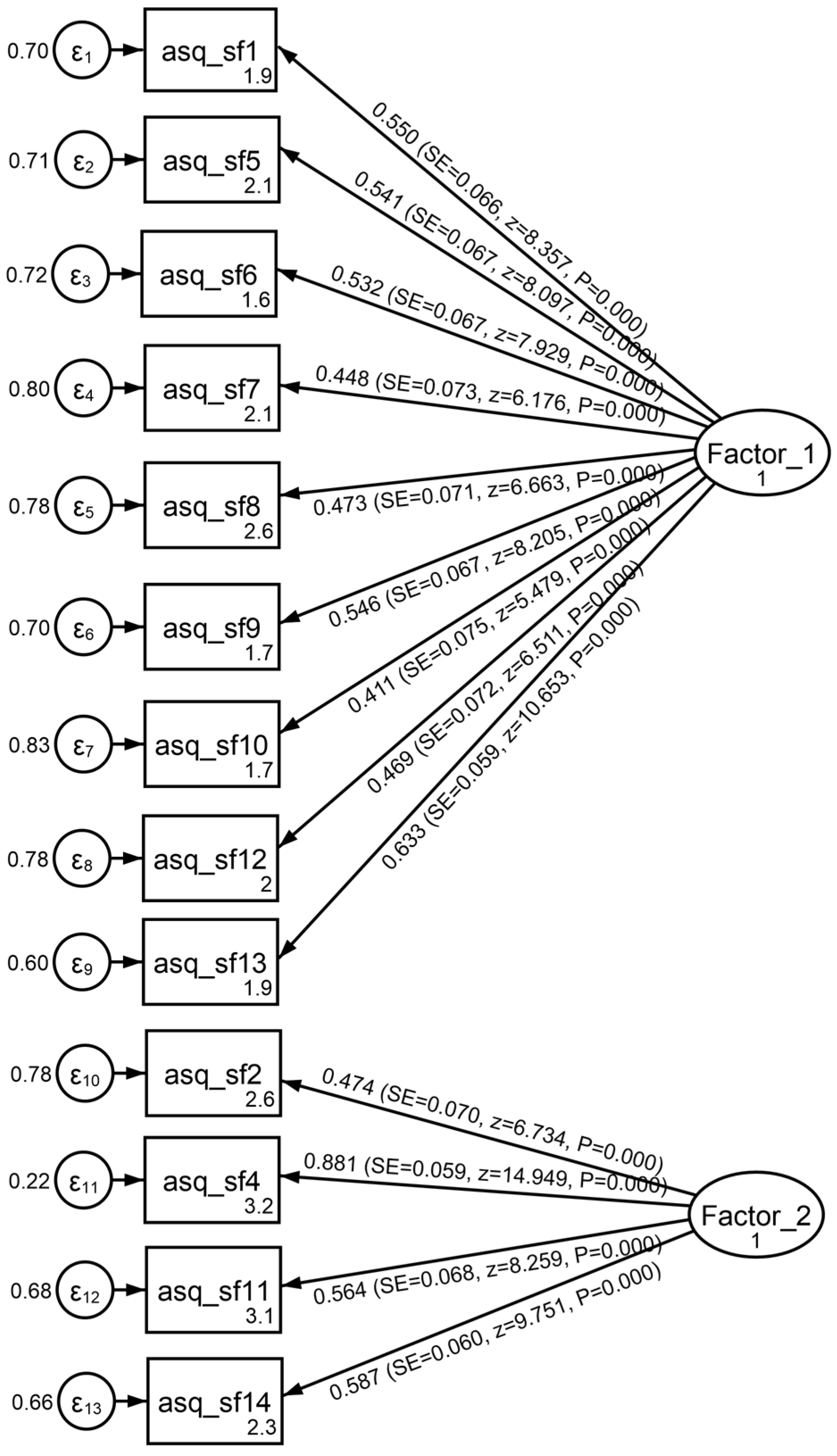
| 1. Having arguments at home | 0.53 | |
| 2. Feeling a lack of understanding by your parents | 0.49 | |
| 3. Being under pressure of study 4. Having difficulty with some subjects | 0.84 | |
| 5. Being subject to compulsory school attendance | 0.53 | |
| 6. Not having enough time for your boy/girlfriend | 0.49 | |
| 7. Being dissatisfied with how you look | 0.43 | |
| 8. Having disagreements between you and your peers | 0.40 | |
| 9. Not being listened to by teachers | 0.57 | |
| 10. Having disagreements between you and your teachers | 0.48 | |
| 11. Having a concern about your future | 0.63 | |
| 12. Having a lack of freedom | 0.46 | |
| 13. Not having enough money to buy the things you want | 0.59 | |
| 14. Having to take on new family responsibilities as you get older | 0.51 | |
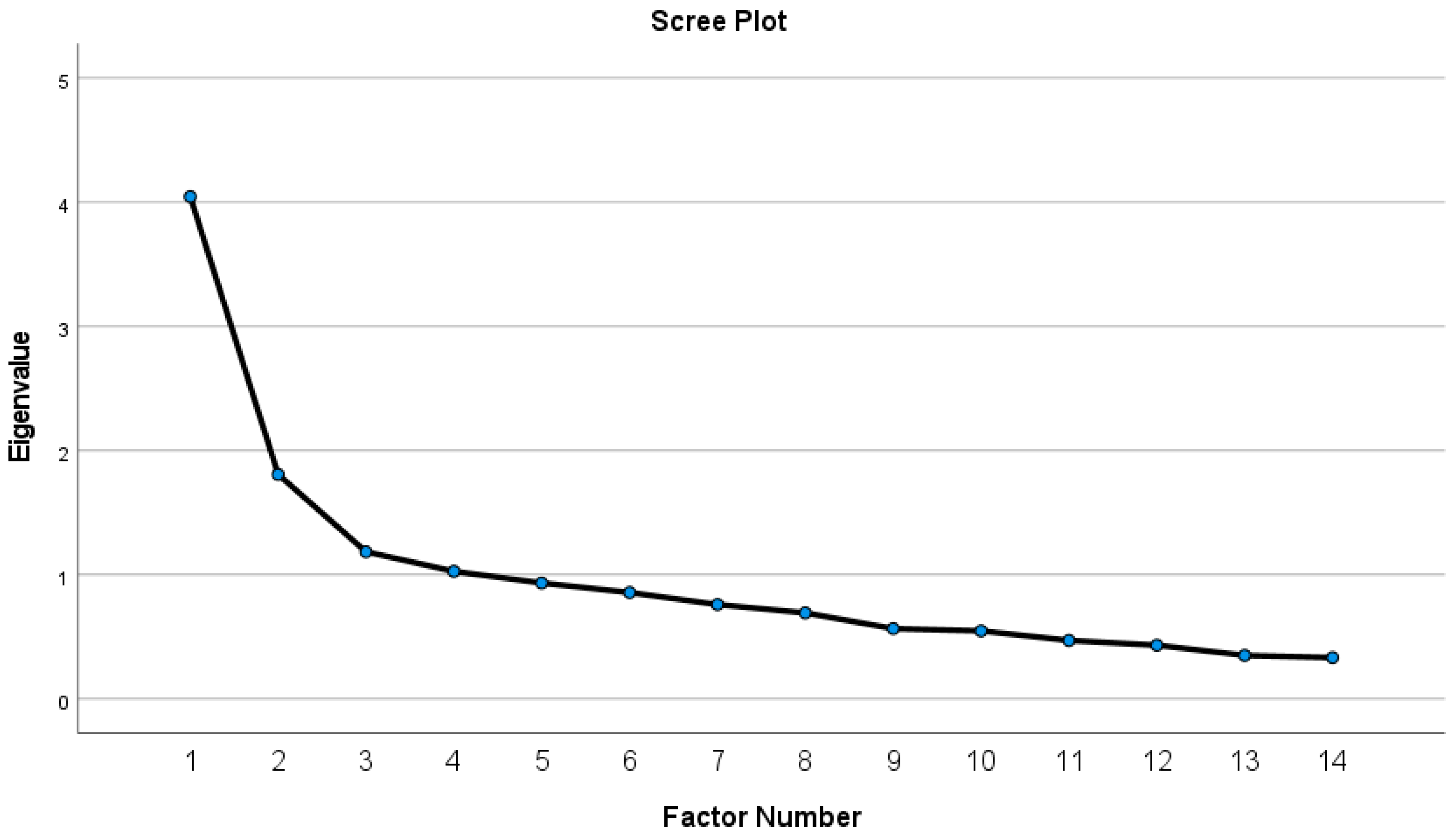
| Eigenvalue | 2.59 | 2.04 |
| % variance explained | 18.5 | 14.5 |
| Corrected Item-Total Correlation | Cronbach’s Alpha if Item Deleted | Cronbach’s Alpha | ||
|---|---|---|---|---|
| External Pressures and Constraints | 1. Having arguments at home | 0.48 | 0.73 | 0.76 |
| 5. Being subject to compulsory school attendance | 0.47 | 0.74 | ||
| 6. Not having enough time for your boy/girlfriend | 0.45 | 0.74 | ||
| 7. Being dissatisfied with how you look | 0.39 | 0.75 | ||
| 8. Having disagreements between you and your peers | 0.41 | 0.74 | ||
| 9. Not being listened to by teachers | 0.47 | 0.74 | ||
| 10. Having disagreements between you and your teachers | 0.35 | 0.75 | ||
| 12. Having a lack of freedom | 0.41 | 0.75 | ||
| 13. Not having enough money to buy the things you want | 0.53 | 0.72 | ||
| Internal Stress and Uncertainty | 2. Feeling a lack of understanding by your parents | 0.41 | 0.70 | 0.71 |
| 4. Having difficulty with some subjects | 0.65 | 0.56 | ||
| 11. Having a concern about your future | 0.51 | 0.63 | ||
| 14. Having to take on new family responsibilities as you get older | 0.43 | 0.68 |
| Mean (SD) | Pearson’s Correlation Coefficients | ||||
|---|---|---|---|---|---|
| 1. | 2. | 3. | |||
| 1. | External Pressures and Constraints | 24.44 (7.38) | 1.00 | 0.38 *** | 0.92 *** |
| 2. | Internal Stress and Uncertainty | 14.19 (3.74) | 1.00 | 0.67 *** | |
| 3. | Total ASQ-SF score | 42.13 (10.09) | |||
| Perceived Family Socioeconomic Status | P Student’s t-Test | ||||
|---|---|---|---|---|---|
| Low/Middle | High | ||||
| Mean | SD | Mean | SD | ||
| External Pressures and Constraints | 23.67 | 6.56 | 27.91 | 9.68 | 0.003 |
| Internal Stress and Uncertainty | 14.47 | 3.78 | 12.94 | 3.32 | 0.036 |
| Total ASQ-SF score | 41.65 | 9.79 | 44.28 | 11.25 | 0.183 |
| Gender | P Student’s t-Test | ||||
|---|---|---|---|---|---|
| Girls | Boys | ||||
| Mean | SD | Mean | SD | ||
| External Pressures and Constraints | 25.21 | 7.68 | 22.22 | 5.96 | 0.019 |
| Internal Stress and Uncertainty | 14.66 | 3.72 | 12.82 | 3.51 | 0.004 |
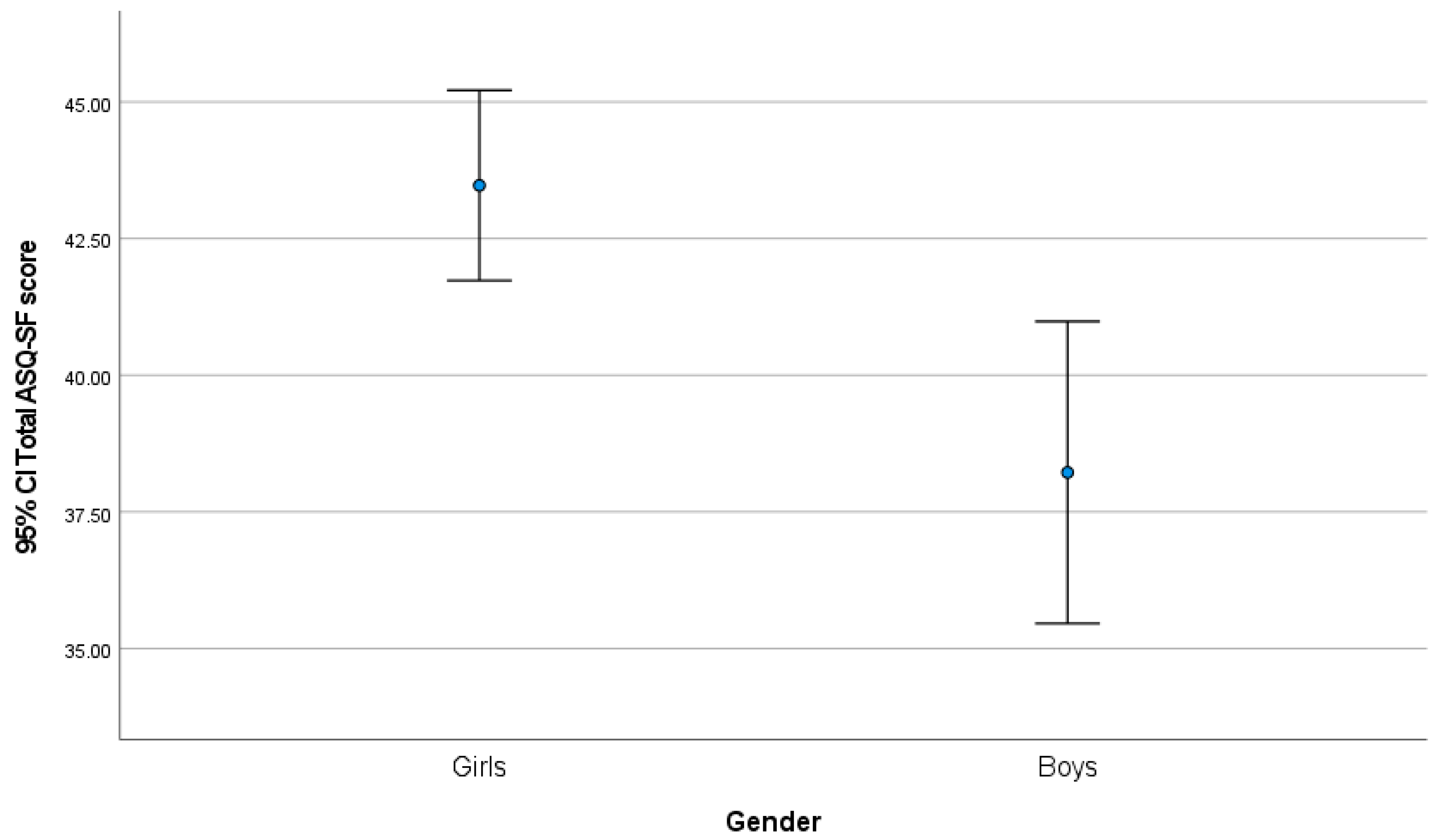
| Total ASQ-SF score | 43.47 | 10.07 | 38.22 | 9.19 | 0.002 |
Disclaimer/Publisher’s Note: The statements, opinions and data contained in all publications are solely those of the individual author(s) and contributor(s) and not of MDPI and/or the editor(s). MDPI and/or the editor(s) disclaim responsibility for any injury to people or property resulting from any ideas, methods, instructions or products referred to in the content. |
© 2025 by the authors. Licensee MDPI, Basel, Switzerland. This article is an open access article distributed under the terms and conditions of the Creative Commons Attribution (CC BY) license (https://creativecommons.org/licenses/by/4.0/).
Share and Cite
Kourmousi, N.; Kounenou, K.; Pezirkianidis, C.; Kalamatianos, A.; Chrousos, G.P. The Validity and Reliability of the Short Form of the Adolescent Stress Questionnaire (ASQ-14) Among Greek Adolescents Aged 15–18. Children 2025, 12, 1537. https://doi.org/10.3390/children12111537
Kourmousi N, Kounenou K, Pezirkianidis C, Kalamatianos A, Chrousos GP. The Validity and Reliability of the Short Form of the Adolescent Stress Questionnaire (ASQ-14) Among Greek Adolescents Aged 15–18. Children. 2025; 12(11):1537. https://doi.org/10.3390/children12111537
Chicago/Turabian StyleKourmousi, Ntina, Kalliopi Kounenou, Christos Pezirkianidis, Antonios Kalamatianos, and George P. Chrousos. 2025. "The Validity and Reliability of the Short Form of the Adolescent Stress Questionnaire (ASQ-14) Among Greek Adolescents Aged 15–18" Children 12, no. 11: 1537. https://doi.org/10.3390/children12111537
APA StyleKourmousi, N., Kounenou, K., Pezirkianidis, C., Kalamatianos, A., & Chrousos, G. P. (2025). The Validity and Reliability of the Short Form of the Adolescent Stress Questionnaire (ASQ-14) Among Greek Adolescents Aged 15–18. Children, 12(11), 1537. https://doi.org/10.3390/children12111537

