Article

Associations Between Neuropathy, Nephropathy and Hearing Loss in Individuals with Type 2 Diabetes

by
Joutiar Razay
1,*,
Jesper H. Schmidt
2,3,
Mette K. Andersen
4,
Jens S. Nielsen
1,
Michael Hecht Olsen
5,6 and
Thomas B. Olesen
1,3
1
Steno Diabetes Center Odense, Odense University Hospital, 5000 Odense, Denmark
2
Research Unit for ORL—Head & Neck Surgery and Audiology, Odense University Hospital, 5000 Odense, Denmark
3
Department of Clinical Research, Faculty of Health Sciences, University of Southern Denmark, 5000 Odense, Denmark
4
Novo Nordisk Foundation Center for Basic Metabolic Research, University of Copenhagen, 2200 Copenhagen, Denmark
5
Department of Internal Medicine and Steno Diabetes Center Zealand, Holbæk Hospital, 4300 Holbæk, Denmark
6
Department of Clinical Medicine, University of Copenhagen, 2200 Copenhagen, Denmark
*
Author to whom correspondence should be addressed.
Biomedicines 2026, 14(5), 1153; https://doi.org/10.3390/biomedicines14051153
Submission received: 9 February 2026 / Revised: 14 May 2026 / Accepted: 15 May 2026 / Published: 20 May 2026

Abstract

Aims: The aim of this study was to investigate the associations between symptomatic hearing loss (HL), neuropathy, and nephropathy in subjects with Type 2 diabetes mellitus (T2DM). Furthermore, the study evaluated whether HL was associated with chronic low-grade inflammation, assessed based on plasma levels of tumour necrosis factor-alpha (TNF-α), interleukin-6 (IL-6), and high-sensitivity C-reactive protein (hsCRP), and explored potential sex-specific differences. Materials and Methods: We included 4245 subjects with T2DM from The Danish Centre for Strategic Research in Type 2 Diabetes cohort. Symptomatic HL was defined using ICD-10 codes. In 2016, a questionnaire was sent out to evaluate neuropathy using the Michigan Neuropathy Screening Instrument (MNSI ≥ 4). Nephropathy was defined as urinary albumin-to-creatinine ratio (UACR) >30 mg/g. Plasma levels of TNF-α, IL-6, and hsCRP were measured at enrolment from 2010 to 2016. Multivariable logistic regression was used, adjusting for covariates. Results: Neuropathy was significantly associated with HL (OR = 1.83, 95%CI [1.42, 2.35], p < 0.001), and the association was stronger in women (OR = 2.74 [1.81, 4.14], p < 0.001) compared to men (OR = 1.44 [1.04, 1.99], p < 0.05) (P-interaction = 0.020). No significant association was found between nephropathy and HL. Among inflammatory markers, only the highest tertile of TNF-α levels was significantly associated with HL compared to the lowest tertile (OR = 1.40 [1.07, 1.82], p < 0.05) without any sex interaction. Conclusions: In subjects with T2DM, neuropathy was associated with symptomatic HL, and the association seemed to be stronger in females. Among chronic low-grade inflammation markers, only TNF-α was significantly associated with symptomatic HL. Additionally, no significant association was found between nephropathy and HL.

1. Introduction

According to the World Health Organisation, 6% of the global population suffers from disabling hearing loss (HL), making it the third leading cause of disability worldwide [1,2]. This prevalence is expected to rise further both due to the rapidly ageing population and due to the increasing prevalence of individuals with type 2 diabetes mellitus (T2DM) [3], who have up to twice the risk of developing HL compared to those without diabetes [4,5,6]. One third of individuals living with T2DM have some degree of HL upon audiometric screening [7]. HL in individuals with T2DM has garnered significant interest, as evidence points to a potential link between angiopathy and/or neuropathy and HL [8]. However, findings across studies have been inconsistent, underscoring the complex interplay of pathophysiological mechanisms. Some researchers propose that HL may be classified as a microvascular complication of T2DM similar to diabetic retinopathy [9,10,11], nephropathy [11,12], and neuropathy [13,14]. The precise aetiology of HL in T2DM remains unclear, raising key questions about whether it is primarily driven by microvascular damage to the small arteries of cochlea or by diabetes-related neuropathy affecting the auditory nerve. If microangiopathy is the primary mechanism, HL may co-occur with nephropathy. Conversely, if neuropathy plays a larger role, HL may align more closely with diabetic neuropathy and manifest in patients with peripheral nervous system damage.
The difference in sex plays a significant role in the prevalence and progression of HL. Males are shown to face earlier HL compared to females, potentially due to noise exposure and hormonal influences [15,16]. Conditions such as diabetes mellitus and CVD also contribute to HL, possibly through chronic low-grade inflammation and perhaps with sex-specific differences. Patients living with T2DM often exhibit chronic low-grade inflammation characterised by elevated levels of inflammatory markers such as interleukin-6 (IL-6), high-sensitivity C-reactive protein (hsCRP) [17], and/or tumour necrosis factor-alpha (TNF-α) [18,19]. These markers are implicated in metabolic dysregulation and vascular dysfunction and may directly affect the delicate microstructures of the ear, including its vascularisation and auditory function. Emerging evidence suggests that chronic low-grade inflammation could play a crucial role in HL by impacting both vascular and neural pathways [20].
This study aims to investigate the association between the presence of microvascular complications such as diabetic polyneuropathy (DPN) (assessed using the Michigan Neuropathy Screening Instrument (MNSI) questionnaire) or nephropathy (assessed using the urinary albumin-to-creatinine ratio (UACR)) and the prevalence of HL, defined as having a clinical diagnosis of HL. Furthermore, the study seeks to evaluate whether low-grade chronic inflammation, assessed as plasma levels of TNF-α, IL-6, and hsCRP, is independently associated with HL, and to explore potential sex-specific differences.

2. Materials and Methods

Setting: The Danish Centre for Strategic Research in Type 2 Diabetes (DD2) cohort is a nationwide cohort of subjects with recently diagnosed T2DM enrolled from either hospital specialist outpatient clinics or general practitioners’ offices across Denmark since November 2010. At enrolment, each patient underwent an interview, clinical examination, and blood and urine sampling for the DD2 biobank. The unique civil registration number assigned to all Danish citizens allows linkage to Danish health registries, including the Danish National Patient Registry (hospital contacts), the Danish National Health Service Prescription Database (prescriptions), the Danish Civil Registration System (vital status and migration data), and the Danish Diabetes Database for Adults (DDDA) [21]. A detailed overview of registries and study variables is provided in Supplementary Table S1.
Study Population: On June 2016 (hereafter referred to as the “index date”), a neuropathy and pain questionnaire was sent to all 6726 (100%) living DD2 participants enrolled from November 2010 to February 2016, with a median of 2.8 years (interquartile range (IQR) 1.8–3.7) post-enrolment. The questionnaire included MNSI along with questions on anthropometric data and lifestyle factors [22]. A total of 5259 participants returned a valid questionnaire (78.2%). Among these, 4406 had a UACR measurement available (65.5%), and 4245 additionally had inflammatory biomarker data from blood samples collected at enrolment. The present study therefore included 4245 participants (63.1%) with self-reported polyneuropathy data, UACR measured within one year of the questionnaire, and available inflammatory biomarker measurements. The timing of the measurements of UACR, inflammatory biomarkers, and HL diagnoses relative to the MNSI are visualised in Supplementary Figure S1 and specified numerically in Supplementary Figure S2.
Exposures: The study’s primary exposures were as follows:
  • Diabetic polyneuropathy (DPN): DPN was assessed using the MNSI and defined as a score ≥4 (sensitivity 40%, specificity 92%) [23].
  • Nephropathy: Nephropathy was assessed based on a single UACR measurement from the Danish laboratory database and DDDA and defined as microalbuminuria (30–300 mg/g) or macroalbuminuria (>300 mg/g).
  • Chronic low-grade inflammation: Inflammatory markers were measured from blood samples collected at DD2 enrolment (median 2.8 years before the index date). Plasma levels of TNF-α and IL-6 (pg/mL) were quantified using Meso Scale Discovery V-plex immunoassays (Meso Scale Diagnostics, Rockville, MD, USA), with intra- and interplate coefficients of variation of 5% and 14.4% for TNF-α, and 6.1% and 12.3% for IL-6, respectively. Serum hsCRP (mg/L) was measured using an enzyme-linked immunosorbent assay with a time-resolved immuno-fluorometric technique, achieving intra- and inter-assay variation of <5% and <6%, respectively. For the analyses, biomarker levels were categorised into the following tertiles: low, intermediate, and high [24].
Outcome: The primary outcome was a composite endpoint of HL, identified based on ICD-10 codes recorded up to the date of neuropathy questionnaire administration (index date). The codes included noise-induced HL (DH833, DH833A), diseases of the inner ear (DH838, DH839), conductive and sensorineural HL (DH90, DH900), ear disorders associated with diseases classified elsewhere (DH94, DH948), sensorineural HL (DH903, DH904, DH905, DH905A, DH905B, DH905C, DH905D, DH905E, DH906, DH907, DH908), and other diagnoses of HL (DH91, DH911, DH912, DH912A, DH913, DH918, DH918A, DH919, DH919A, DH919B). The different event numbers are shown in Supplementary Table S2.
Covariates: Potential confounders and mediators were extracted from the DD2 cohort questionnaire, neuropathy questionnaire (BMI and smoking status), and health registries:
  • Confounders: age, sex, BMI, smoking status, alcohol consumption and polygenic risk score (PRS) for HL.
  • Mediators: low-density lipoprotein cholesterol (LDL-C), HbA1c, medication use (glucose-, lipid-, or blood pressure-lowering medication) within 1 year of the index date and previous cardiovascular disease (CVD).
Genotyping was performed with the Global Screening Array-24 v2.0 or v3.0 chip (Illumina, San Diego, CA, USA), and genotypes were called using the GenCall algorithm in GenomeStudio software (version 2.0, Illumina, San Diego, CA, USA). We performed standard quality control and imputation, with the Haplotype Reference Consortium data as a reference panel. A PRS for HL summarising genetic risk by combining the small effects of many common genetic variants into a single score was calculated and included to adjust for inherited susceptibility to HL [25].
Missing Data: Missing covariate data were handled using multiple imputation with chained equations. Missingness was highest for LDL cholesterol (n = 1608; 37.9%), followed by the PRS for HL (n = 320; 7.0%), BMI (n = 75; 1.8%), and HbA1c (n = 25; 0.6%). The imputation model included all covariates and exposures, and the outcome. Twenty imputed datasets were generated and combined using Rubin’s rules. The distributions of observed and imputed values were visually compared, including inspection of the first and twentieth imputed datasets, and showed good agreement (Supplementary Figure S3).
Statistical Analyses: Descriptive statistics are presented as medians with interquartile ranges (IQR) for continuous variables and proportions (n [%]) for categorical variables, stratified by the presence or absence of an HL diagnosis on the index date. Comparisons between groups were made using the Mann–Whitney U test for continuous variables and Pearson’s chi-square test for categorical variables. Missing covariate data were treated using multiple imputation with chained equations to maximise precision and reduce selection bias, as previously described [26].
Logistic regression models examining association of the diagnosis of HL with MNSI, nephropathy (UACR), and markers of low-grade chronic inflammation (TNF-α, hsCRP, IL-6), presented as odds ratios (OR), 95% confidence intervals (CI) in brackets, and p-values, for the following three hierarchical models:
  • Model 1: Adjusted for age and sex.
  • Model 2: Further adjusted for HbA1c; LDL-C; BMI; smoking status; previous cardiovascular disease; and glucose-, lipid-, and blood pressure-lowering treatment.
  • Model 3: Further adjusted for PRS for HL and for inflammatory markers (TNF-α, IL-6, and hsCRP) in analyses of neuropathy or adjusted for neuropathy and nephropathy in analyses of chronic low-grade inflammation.
To explore whether the association between exposures and prevalent HL was modified by age or sex, interaction terms for age and sex were included in the logistic regression models.
All statistical tests were two-sided, and a p-value below 0.05 was considered statistically significant. Analyses were conducted using Stata version 18 (StataCorp LLC, College Station, TX, USA).
Research Ethics and Informed Consent: The DD2 study received approval from the Danish National Committee on Health Research Ethics (S-20100082) and the Danish Data Protection Agency (2008-58-0035). All participants provided written informed consent.

3. Results

3.1. Baseline Characteristics

Table 1 shows the differences in baseline characteristics between participants with and without diagnosed HL. Participants with symptomatic HL were significantly older (71.0 years vs. 64.7 years, p < 0.001) and more frequently male (71.2% vs. 57.3%, p < 0.001). Participants with HL had a higher prevalence of previous cardiovascular disease (39.8% vs. 26.4%, p < 0.001) and neuropathy (24.5% vs. 16.8%, p < 0.001), lower eGFR (82.2 vs. 91.5 mL min−1 (1.73 m2)−1, p < 0.001), more albuminuria (26.3% vs. 18.9%, p < 0.01), and slightly higher levels of TNF-α (1.04 vs. 0.95 pg/mL, p < 0.001) and of IL-6 (1.25 vs. 1.17 pg/mL, p < 0.01) compared to those without. Among the 445 participants with a registered HL diagnosis, 144 (32.4%) had the HL diagnosis recorded more than 10 years before DD2 enrolment, 210 (47.2%) had the diagnosis recorded within the 10 years preceding DD2 enrolment, and 91 (20.4%) were diagnosed between DD2 enrolment (measurements of biomarkers) and the index date (shown in Supplementary Figure S2).

3.2. Regression Results

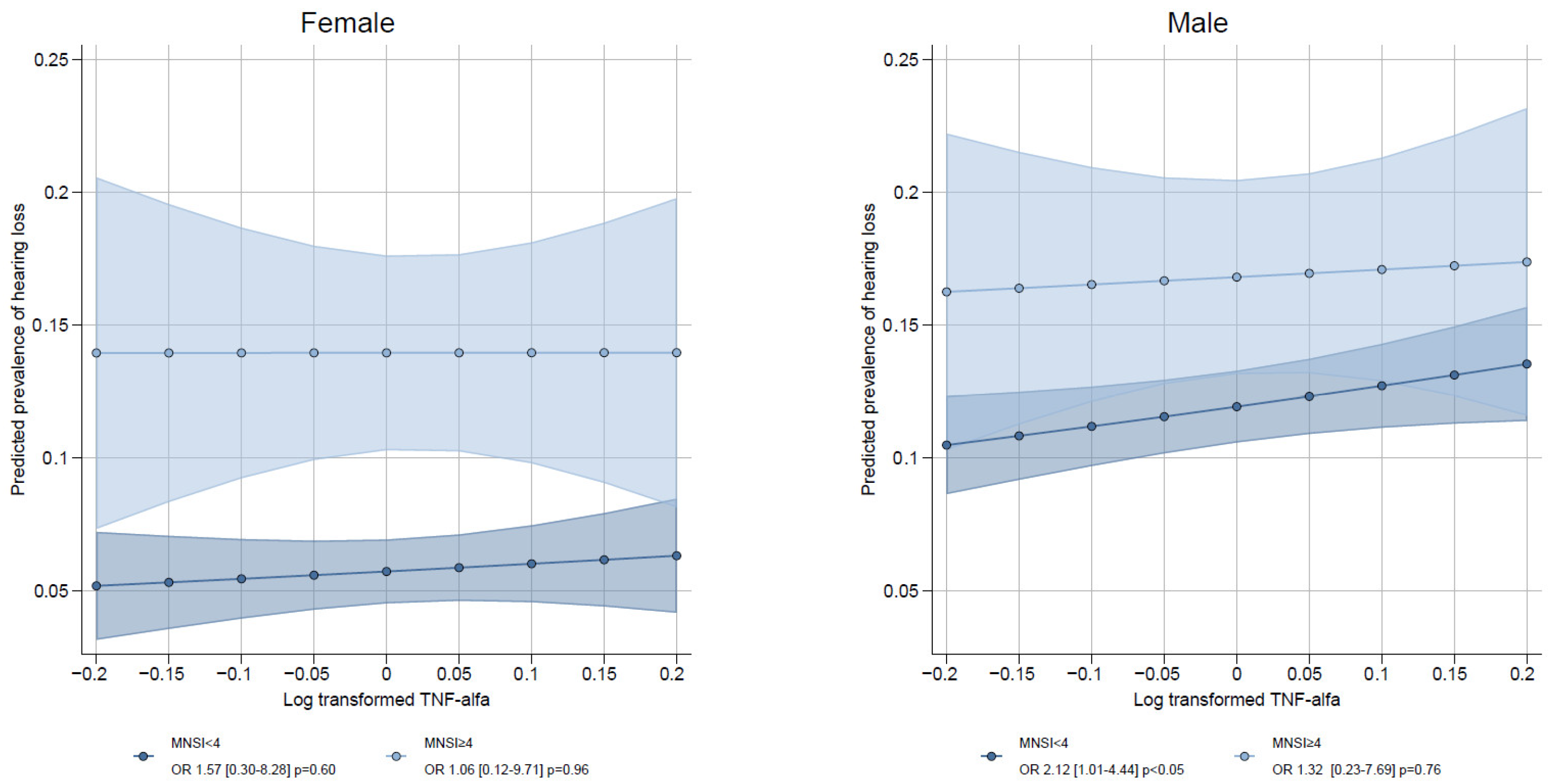
Table 2 and Table 3 show the results of logistic regression models, exploring associations between chronic low-grade inflammation, neuropathy (assessed by questionnaire), and nephropathy (assessed by UACR) and HL. A significant association between neuropathy and symptomatic HL was found in all three models, and in model 3 (OR = 1.83, 95%CI [1.42, 2.35], p < 0.001). In the sex-specific analyses, the associations were still significant for both sexes, but with a significantly stronger association in females (OR = 2.74 [1.81, 4.14], p < 0.001) compared to males (OR 1.44 [1.04, 1.99], p < 0.05) (P-interaction = 0.020) (Table 2). Predicted prevalences according to sex and neuropathy status were as follows: among women, the predicted prevalence of HL was 5.8% (95% CI 4.6–6.9) in those without neuropathy and 13.9% (95% CI 10.3–17.6) in those with neuropathy. Among men, the corresponding prevalences were 11.9% (95% CI 10.6–13.3) without neuropathy and 16.9% (95% CI 13.2–20.5) with neuropathy (Supplementary Table S3). Among inflammatory markers, only the highest tertile of TNF-α levels was significantly associated with symptomatic HL compared to the lowest tertile (OR = 1.40 [1.07, 1.82], p < 0.05) without any sex interaction across all three models (Table 3). Estimated prevalence of HL was evaluated in sex-stratified analyses with TNF-α included as a continuous log-transformed variable (Figure 1). In men without neuropathy, higher TNF-α levels were associated with a higher prevalence of HL (OR 2.12 [1.01–4.44]; p < 0.05), but not in men with neuropathy (OR 1.32 [0.23–7.69]; p = 0.76), without significant interaction (p = 0.57). Among women, TNF-α was not associated with HL regardless of neuropathy status. (Figure 1). Symptomatic HL was not significantly associated with micro- nor macroalbuminuria in any of the models. We did not find any significant sex interaction for the associations between UACR and HL or between inflammatory markers and HL.

4. Discussion

Our study had three primary findings: (1) Neuropathy was significantly associated with symptomatic HL, possibly with a stronger association observed in females compared to males. (2) Nephropathy was not significantly associated with symptomatic HL. Among the inflammatory markers examined, only participants in the highest tertile of TNF-α had higher odds of symptomatic HL, whereas no consistent associations were observed for hsCRP or IL-6.
Regarding neuropathy, our findings were consistent with prior studies highlighting neuropathy as a potential risk factor for symptomatic HL in patients living with T2DM. Previous cross-sectional studies have shown that diabetic neuropathy, also assessed using MNSI, was independently associated with high-frequency HL and that a dose–response relationship existed between neuropathy severity and HL, with the highest prevalence among those with moderate-to-severe neuropathy [13,14]. These findings align with our observation of an association between neuropathy and symptomatic HL across all levels of adjustment. A cross-sectional study explored the relationship between neuropathy and HL in subjects with and without diabetes, identifying neuropathy as a factor for impairments in vision and hearing [27]. Their findings suggest that neuropathy-related HL may transcend diabetes-specific mechanisms, a hypothesis supported by the persistence of our findings after adjustment for metabolic and inflammatory markers. In the present study, the association between neuropathy and symptomatic HL appeared stronger in women than in men. The reasons for this difference are unclear. Although some studies have suggested that men may have a higher lifetime exposure to occupational or recreational noise, which could contribute to HL independent of neuropathy [28,29], we did not have detailed information on noise exposure in the present study. Consequently, the observed sex difference should be interpreted cautiously, as several subgroup and interaction analyses were performed without adjustment for multiple testing, and may thus reflect a combination of biological differences, differences in risk factor profiles, chance findings, or residual confounding.
In our large cohort with subjects living with T2DM, we did not demonstrate a substantial association between symptomatic HL and nephropathy after adjusting for potential confounders. This contrasts with prior studies demonstrating that elevated UACR and declining renal function were associated with HL [11,12,30]. However, these studies used audiometric testing, typically PTA ≥ 25 dB, to detect HL, whereas our study relied on ICD-10 codes for HL, which only capture symptomatic and therefore more severe cases of HL. This difference in HL definition may explain the discrepancy, as milder and probably earlier HL, potentially linked to nephropathy, might not have been identified in our study. These findings underscore the importance of distinguishing between subclinical and clinical (symptomatic) HL in future research. Incorporating audiometric data may help clarify the role of nephropathy and microvascular changes in the mechanisms underlying HL. Our findings of an independent association between symptomatic HL and TNF-α align with prior studies that highlight the potential harmful effects of TNF-α on auditory function [18]. An experimental animal study demonstrated that acute TNF-α exposure induces damage to the cochlear synapse, reducing auditory nerve activity without affecting hearing thresholds or hair cell integrity [31]. These results may suggest a possible neurotoxic effect of TNF-α on auditory synapses, which may mirror the mechanisms underlying HL observed in our study. However, the present findings should be interpreted cautiously. The association was modest in magnitude, limited to the highest TNF-α tertile, and was in contrast to previous studies [17,19,32] not accompanied by similar associations for hsCRP or IL-6. Moreover, although the overall association with TNF-α remained after multivariable adjustment, it was not consistently observed across sex-stratified analyses. Thus, our data do not support a broad or consistent association between systemic chronic low-grade inflammation and symptomatic HL in individuals with T2DM. Again, a key difference between our study and the current literature lies in definition and measurement of HL. Prior studies have often used audiometry, detecting milder and even asymptomatic cases of HL, whereas we used ICD-10 codes to define HL, detecting only symptomatic cases. The fact that we only detected symptomatic and often later HL may explain the missing associations between HL and early inflammatory markers such as hsCRP and IL-6 that are often associated with early microvascular changes such as elevated UACR [33,34,35]. Previous studies have shown that PRS for HL is associated with increased self-reported HL and slightly elevated pure-tone audiometric thresholds [25,36]. In the present study, the associations between both neuropathy and circulating TNF-α and symptomatic HL remained statistically significant after adjustment for the PRS for HL, indicating that these associations are largely independent of inherited genetic susceptibility. The lack of association between IL-6, hsCRP and HL does not support a major role of low-grade inflammation for the presence of symptomatic HL among individuals with T2DM. However, the modest association observed with the highest tertile of TNF-α, known to be produced by macrophages but also by microglia and neurons, may suggest a role for neuroinflammation in development of HL in T2DM [37,38].

Strengths and Limitations

This observational, cross-sectional study cannot establish causality, and residual confounding cannot be fully excluded despite consistent associations across multiple adjusted models. Neuropathy was assessed using the self-reported MNSI questionnaire, which has a reported sensitivity of 40% and specificity of 92%. This may introduce recall bias or subjective reporting, and the lack of a clinical examination to complement the MNSI is a limitation, as it may have resulted in some misclassification, particularly among individuals with mild or asymptomatic neuropathy. However, any misclassification would likely have weakened the observed associations, meaning the true relationship between symptomatic HL and neuropathy may be even stronger than reported.
As our study defined HL through ICD-10 codes rather than audiometric testing, the findings are not directly comparable to PTA-based studies, which capture a wider range of hearing impairment severity, including subclinical cases. Only individuals with symptoms of HL have sought medical attention and thereafter received a confirmative diagnosis, potentially underrepresenting mild or asymptomatic cases of HL. However, our findings remain clinically relevant, as they focus on individuals with more advanced cases of HL. Additionally, patients with more diabetes-related complications, specifically symptomatic neuropathy, tend to visit healthcare services more frequently, which may increase their likelihood of receiving an HL diagnosis and thereby introduce detection bias. Nephropathy, which is asymptomatic, may not lead to the same degree of detection bias. To address potential detection bias, we examined the timing of HL diagnoses relative to DD2 enrolment. When we grouped participants by timing of HL diagnosis, the association with neuropathy was similar across all three groups (Supplementary Table S4). This suggested that the association was unlikely to be explained by the fact that patients with neuropathy may have more healthcare contacts (detection bias). This was further supported by Supplementary Table S5, demonstrating that the incidence rate for the 91 HL diagnosis given after enrolment in DD2 remained relatively stable across follow-up intervals rather than clustering close to the index date.
The study population consisted of subjects living with T2DM in Denmark, which may limit generalisability to other populations. Our study lacked access to occupational history and noise exposure data, which are recognised risk factors for HL. Because occupational noise exposure is typically lower among women, residual confounding by noise may be less pronounced in this group, which could contribute to the larger observed effect estimates [28].
HL diagnoses often preceded the assessment of neuropathy, nephropathy, and inflammatory biomarkers by several years. This temporal separation may have resulted in exposure misclassification, which would primarily be expected to attenuate true associations rather than generate spurious findings. Consequently, null associations (particularly for nephropathy and inflammatory markers) should be interpreted with caution. However, both diabetic neuropathy and chronic low-grade inflammation are well-established slowly progressive conditions that are likely to have been present for a considerable period prior to clinical detection. Prospective studies with repeated measurements are needed to fully establish the temporal relationships between these conditions.
Finally, several prespecified subgroup and interaction analyses were performed. Multiple comparisons increase the possibility that some findings occurred by chance; the observed sex interaction for neuropathy should therefore be interpreted cautiously and considered hypothesis-generating.
Despite these limitations, this study benefits from a large, well-characterised cohort with linkage to national health registries. The use of validated tools for neuropathy assessment, combined with comprehensive biomarker analysis and sex-stratified analysis, strengthens the validity and clinical relevance of our findings.

5. Conclusions

In conclusion, our study demonstrated a significant and independent association between neuropathy and symptomatic HL in subjects with T2DM. Exploratory analyses suggested possible sex differences in this association. Although TNF-α was associated with symptomatic HL, the lack of consistent associations across inflammatory markers does not support a broad association between markers of systemic low-grade inflammation and symptomatic HL.

Supplementary Materials

The following supporting information can be downloaded at: https://www.mdpi.com/article/10.3390/biomedicines14051153/s1, Supplementary Table S1: DD2 inclusion criteria, definitions, and codes. Supplementary Table S2: DD2 inclusion criteria, definitions, and codes. Supplementary Table S3: Age- and sex-adjusted association between neuropathy and hearing loss (HL) stratified by timing of HL diagnosis relative to DD2 enrolment. Supplementary Table S4: Incidence of hearing loss diagnoses after DD2 enrolment according to time between enrolment and index date. Supplementary Table S5: Predicted prevalence of hearing loss by sex, age and neuropathy. Supplementary Figure S1: Timing of exposure measurements and hearing loss diagnoses relative to the index date. Supplementary Figure S2: Distribution of observed and imputed values for covariates with missing data. Supplementary Figure S3: Timing of hearing loss diagnoses in relation to DD2 enrolment and index date.

Author Contributions

Conceptualization, T.B.O. and M.H.O.; methodology, T.B.O. and M.H.O.; formal analysis, J.R. and T.B.O.; writing—original draft preparation, J.R.; writing—review and editing, T.B.O., M.H.O., J.H.S., M.K.A. and J.S.N.; supervision, T.B.O. and M.H.O. All authors have read and agreed to the published version of the manuscript.

Funding

The DD2 study received funding from the Danish Agency for Science (grant numbers 09-067009 and 09-075724) as well as the Danish Health and Medicines Authority, the Danish Diabetes Association, the Region of Southern Denmark, and the Novo Nordisk Foundation (grant numbers NNF17SA0030962-2, NNF20O0063292, NNF17SA0030364, NNF18CC0034900, and NNF23SA0084103). Information on project partners is available at www.DD2.dk. The funding bodies had no role in the study design, data collection, data analysis or interpretation, manuscript preparation, or the decision to publish the manuscript, and imposed no restrictions on publication.

Institutional Review Board Statement

This study was approved by the Danish Data Protection Agency (record number 2008-58-0035, approval date 1 October 2010) and the Regional Committees on Health Research Ethics for Southern Denmark (record number S-20100082, approval date 1 October 2010).

Informed Consent Statement

All participants provided written informed consent to participate in the DD2 study.

Data Availability Statement

Danish data protection regulations prohibit the public sharing of individual-level patient data. Access to the national health registry data used in this study can, however, be granted to researchers affiliated with authorised institutions upon application to the Danish Health Data Authority (forskerservice@sundhedsdata.dk). Data from the DD2 cohort are available following a separate application process via the DD2 website (https://dd2.dk/forskning/ansoeg-om-data, accessed on 9 February 2026).

Acknowledgments

During the preparation of this manuscript, the authors used ChatGPT (OpenAI, Version GPT-4.0, GPT 4.5 and GPT-5, a language model for text editing) for language editing and clarity. The authors reviewed and edited the output and take full responsibility for the content of this publication.

Conflicts of Interest

T.B.O. reports receiving personal fees from AstraZeneca for advisory board participation, outside the submitted work. M.H.O. has, in relation to presentations, received honorariums from Novo Nordisk A/S, Astra Zeneca A/S, Boehringer Ingelheim, Teva A/S, and Johnson and Johnson A/S. J.S.N. is currently employed by Sanofi Danmark A/S. However, Sanofi Danmark A/S had no role in the design, preparation, writing, or decision to publish this article. J.R. and J.H.S. declare that they have no conflicts of interest related to this work.

Abbreviations

The following abbreviations are used in this manuscript:
HLHearing loss
T2DMType 2 diabetes mellitus
TNF-αTumour necrosis factor-alpha
IL-6Interleukin-6
hsCRPHigh-sensitivity C-reactive protein
MNSIMichigan Neuropathy Screening Instrument
DPNDiabetic polyneuropathy
UACRUrine albumin-to-creatinine ratio
DD2The Danish Centre for Strategic Research in Type 2 Diabetes
DDDADanish Diabetes Database for Adults
ICD-10International Classification of Diseases, 10th revision
BMIBody Mass Index
HbA1cHaemoglobin A1c
LDL-CLow-density lipoprotein cholesterol
HDL-CHigh-density lipoprotein cholesterol
TGTriglycerides
eGFREstimated glomerular filtration rate
CVDCardiovascular disease
PRSPolygenic risk score
IQRInterquartile range
OROdds ratio
CIConfidence interval
PTAPure-tone audiometry

References

  1. GBD 2017 Disease and Injury Incidence and Prevalence Collaborators. Global, regional, and national incidence, prevalence, and years lived with disability for 354 diseases and injuries for 195 countries and territories, 1990–2017: A systematic analysis for the Global Burden of Disease Study 2017. Lancet 2018, 392, 1789–1858. [Google Scholar] [CrossRef] [PubMed]
  2. GBD 2019 Hearing Loss Collaborators. Hearing loss prevalence and years lived with disability, 1990–2019: Findings from the Global Burden of Disease Study 2019. Lancet 2021, 397, 996–1009. [Google Scholar] [CrossRef]
  3. Saeedi, P.; Petersohn, I.; Salpea, P.; Malanda, B.; Karuranga, S.; Unwin, N.; Colagiuri, S.; Guariguata, L.; Motala, A.A.; Ogurtsova, K.; et al. Global and regional diabetes prevalence estimates for 2019 and projections for 2030 and 2045: Results from the International Diabetes Federation Diabetes Atlas, 9th edition. Diabetes Res. Clin. Pract. 2019, 157, 107843. [Google Scholar] [CrossRef] [PubMed]
  4. Nwosu, J.N.; Chime, E.N. Hearing thresholds in adult Nigerians with diabetes mellitus: A case-control study. Diabetes Metab. Syndr. Obes. 2017, 10, 155–160. [Google Scholar] [CrossRef]
  5. Bainbridge, K.E.; Hoffman, H.J.; Cowie, C.C. Diabetes and hearing impairment in the United States: Audiometric evidence from the National Health and Nutrition Examination Survey, 1999 to 2004. Ann. Intern. Med. 2008, 149, 1–10. [Google Scholar] [CrossRef]
  6. Oh, I.H.; Lee, J.H.; Park, D.C.; Kim, M.; Chung, J.H.; Kim, S.H.; Yeo, S.G. Hearing loss as a function of aging and diabetes mellitus: A cross sectional study. PLoS ONE 2014, 9, e116161. [Google Scholar] [CrossRef] [PubMed]
  7. Shafiepour, M.; Bamdad, Z.; Radman, M. Prevalence of hearing loss among patients with type 2 diabetes. J. Med. Life 2022, 15, 772–777. [Google Scholar] [CrossRef]
  8. Srinivas, C.V.; Shyamala, V.; Kumar, B.R.S. Clinical Study to Evaluate the Association Between Sensorineural Hearing Loss and Diabetes Mellitus in Poorly Controlled Patients Whose HbA1c >8. Indian J. Otolaryngol. Head Neck Surg. 2016, 68, 191–195. [Google Scholar] [CrossRef]
  9. Alizadeh, Y.; Jalali, M.M.; Sehati, A. Association of different severity of diabetic retinopathy and hearing loss in type 2 diabetes mellitus. Am. J. Otolaryngol. 2022, 43, 103383. [Google Scholar] [CrossRef]
  10. Al-Abed, S.A.; Hakooz, M.M.; Teimat, M.H.; A Aldurgham, G.; Alhusban, W.K.; A Hjazeen, A. A Correlational Study of Hearing Loss and Severity of Diabetic Retinopathy Among Jordanian Patients. Cureus 2023, 15, e43800. [Google Scholar] [CrossRef]
  11. Ashkezari, S.J.; Namiranian, N.; Rahmanian, M.; Atighechi, S.; Mohajeri-Tehrani, M.-R.; Gholami, S. Is hearing impairment in diabetic patients correlated to other complications? J. Diabetes Metab. Disord. 2018, 17, 173–179. [Google Scholar] [CrossRef]
  12. Ren, J.; Ma, F.; Zhou, Y.; Xu, A.; Zhang, J.; Ma, R.; Xiao, X. Hearing impairment in type 2 diabetics and patients with early diabetic nephropathy. J. Diabetes Complicat. 2018, 32, 575–579. [Google Scholar] [CrossRef] [PubMed]
  13. Ren, H.; Wang, Z.; Mao, Z.; Zhang, P.; Wang, C.; Liu, A.; Yuan, G. Hearing Loss in Type 2 Diabetes in Association with Diabetic Neuropathy. Arch. Med. Res. 2017, 48, 631–637. [Google Scholar] [CrossRef]
  14. Abraham, A.M.; Jacob, J.J.; Varghese, A. Prevalence of Hearing Loss in Type 2 Diabetes Mellitus and Its Association with Severity of Diabetic Neuropathy and Glycemic Control. J. Assoc. Physicians India 2023, 71, 11–12. [Google Scholar] [CrossRef]
  15. Gong, R.; Hu, X.; Gong, C.; Long, M.; Han, R.; Zhou, L.; Wang, F.; Zheng, X. Hearing loss prevalence and risk factors among older adults in China. Int. J. Audiol. 2018, 57, 354–359. [Google Scholar] [CrossRef] [PubMed]
  16. Villavisanis, D.F.; Berson, E.R.; Lauer, A.M.; Cosetti, M.K.; Schrode, K.M. Sex-based Differences in Hearing Loss: Perspectives From Non-clinical Research to Clinical Outcomess. Otol. Neurotol. 2020, 41, 290–298. [Google Scholar] [CrossRef]
  17. Nash, S.D.; Cruickshanks, K.J.; Zhan, W.; Tsai, M.Y.; Klein, R.; Chappell, R.; Nieto, F.J.; Klein, B.E.K.; Schubert, C.R.; Dalton, D.S.; et al. Long-term assessment of systemic inflammation and the cumulative incidence of age-related hearing impairment in the epidemiology of hearing loss study. J. Gerontol. Ser. A 2014, 69A, 207–214. [Google Scholar] [CrossRef]
  18. Yoon, S.H.; Kim, M.E.; Kim, H.Y.; Lee, J.S.; Jang, C.H. Inflammatory cytokines and mononuclear cells in sudden sensorineural hearing loss. J. Laryngol. Otol. 2019, 133, 95–101. [Google Scholar] [CrossRef]
  19. Verschuur, C.A.; Dowell, A.; Syddall, H.E.; Ntani, G.; Simmonds, S.J.; Baylis, D.; Gale, C.R.; Walsh, B.; Cooper, C.; Lord, J.M.; et al. Markers of inflammatory status are associated with hearing threshold in older people: Findings from the Hertfordshire Ageing Study. Age Ageing 2012, 41, 92–97. [Google Scholar] [CrossRef]
  20. Watson, N.; Ding, B.; Zhu, X.; Frisina, R.D. Chronic inflammation—Inflammaging—In the ageing cochlea: A novel target for future presbycusis therapy. Ageing Res. Rev. 2017, 40, 142–148. [Google Scholar] [CrossRef] [PubMed]
  21. Christensen, D.H.; Nicolaisen, S.K.; Berencsi, K.; Beck-Nielsen, H.; Rungby, J.; Friborg, S.; Brandslund, I.; Christiansen, J.S.; Vaag, A.; Sørensen, H.T.; et al. Danish Centre for Strategic Research in Type 2 Diabetes (DD2) project cohort of newly diagnosed patients with type 2 diabetes: A cohort profile. BMJ Open 2018, 8, e017273. [Google Scholar] [CrossRef]
  22. Christensen, D.H.; Knudsen, S.T.; Gylfadottir, S.S.; Christensen, L.B.; Nielsen, J.S.; Beck-Nielsen, H.; Sørensen, H.T.; Andersen, H.; Callaghan, B.C.; Feldman, E.L.; et al. Metabolic Factors, Lifestyle Habits, and Possible Polyneuropathy in Early Type 2 Diabetes: A Nationwide Study of 5,249 Patients in the Danish Centre for Strategic Research in Type 2 Diabetes (DD2) Cohort. Diabetes Care 2020, 43, 1266–1275. [Google Scholar] [CrossRef]
  23. Benavidez, G.A.; Ylitalo, K.R.; Lanning, B.; Asare, M.; Meyer, A.; Griggs, J.O. Peripheral neuropathy and depressive symptoms: Examining the association in a primary health care setting among persons with and without diabetes mellitus. Qual. Life Res. 2020, 29, 3297–3304. [Google Scholar] [CrossRef] [PubMed]
  24. Domazet, S.L.; Olesen, T.B.; Stidsen, J.V.; Svensson, C.K.; Nielsen, J.S.; Thomsen, R.W.; Jessen, N.; Vestergaard, P.; Andersen, M.K.; Hansen, T.; et al. Low-grade inflammation in persons with recently diagnosed type 2 diabetes: The role of abdominal adiposity and putative mediators. Diabetes Obes. Metab. 2024, 26, 2092–2101. [Google Scholar] [CrossRef] [PubMed]
  25. Cherny, S.S.; Livshits, G.; Wells, H.R.R.; Freidin, M.B.; Malkin, I.; Dawson, S.J.; Williams, F.M.K. Self-reported hearing loss questions provide a good measure for genetic studies: A polygenic risk score analysis from UK Biobank. Eur. J. Hum. Genet. 2020, 28, 1056–1065, Correction in Eur. J. Hum. Genet. 2022, 30, 1195. [Google Scholar] [CrossRef] [PubMed]
  26. Gedebjerg, A.; Bjerre, M.; Kjaergaard, A.D.; Nielsen, J.S.; Rungby, J.; Brandslund, I.; Maeng, M.; Beck-Nielsen, H.; Vaag, A.; Sørensen, H.T.; et al. CRP, C-Peptide, and Risk of First-Time Cardiovascular Events and Mortality in Early Type 2 Diabetes: A Danish Cohort Study. Diabetes Care 2023, 46, 1037–1045. [Google Scholar] [CrossRef]
  27. Hicks, C.W.; Wang, D.; Lin, F.R.; Reed, N.; Windham, B.G.; Selvin, E. Peripheral Neuropathy and Vision and Hearing Impairment in US Adults with and Without Diabetes. Am. J. Epidemiol. 2023, 192, 237–245. [Google Scholar] [CrossRef]
  28. Eng, A.; ‘t Mannetje, A.; McLean, D.; Ellison-Loschmann, L.; Cheng, S.; Pearce, N. Gender differences in occupational exposure patterns. Occup. Environ. Med. 2011, 68, 888–894. [Google Scholar] [CrossRef]
  29. Nolan, L.S. Age-related hearing loss: Why we need to think about sex as a biological variable. J. Neurosci. Res. 2020, 98, 1705–1720. [Google Scholar] [CrossRef]
  30. Cho, Y.; Kim, D.H.; Choi, J.; Lee, J.K.; Roh, Y.K.; Nam, H.Y.; Nam, G.E.; Kim, D.W.; Lee, S.H.; Lee, C.W.; et al. Glomerular Filtration Rate and Urine Albumin to Creatinine Ratio Associated with Hearing Impairment Among Korean Adults with Diabetes: A Nationwide Population-Based Study. Medicine 2016, 95, e3423. [Google Scholar] [CrossRef]
  31. Katsumi, S.; Sahin, M.I.; Lewis, R.M.; Iyer, J.S.; Landegger, L.D.; Stankovic, K.M. Intracochlear Perfusion of Tumor Necrosis Factor-Alpha Induces Sensorineural Hearing Loss and Synaptic Degeneration in Guinea Pigs. Front. Neurol. 2019, 10, 1353. [Google Scholar] [CrossRef]
  32. Frosolini, A.; Franz, L.; Daloiso, A.; Lovato, A.; de Filippis, C.; Marioni, G. Digging into the Role of Inflammatory Biomarkers in Sudden Sensorineural Hearing Loss Diagnosis and Prognosis: A Systematic Review and Meta-Analysis. Medicina 2022, 58, 963. [Google Scholar] [CrossRef]
  33. Hayashino, Y.; Mashitani, T.; Tsujii, S.; Ishii, H.; Diabetes Distress and Care Registry at Tenri Study Group. Serum high-sensitivity C-reactive protein levels are associated with high risk of development, not progression, of diabetic nephropathy among Japanese type 2 diabetic patients: A prospective cohort study (Diabetes Distress and Care Registry at Tenri [DDCRT7]). Diabetes Care 2014, 37, 2947–2952. [Google Scholar] [PubMed]
  34. Mojahedi, M.J.; Bonakdaran, S.; Hami, M.; Sheikhian, M.R.; Shakeri, M.T.; Aiatollahi, H. Elevated serum C-reactive protein level and microalbuminuria in patients with type 2 diabetes mellitus. Iran. J. Kidney Dis. 2009, 3, 12–16. [Google Scholar]
  35. Liu, G.W.; Zeng, J.E.; Li, L.F. Correlation analysis of serum IGF-1 and IL-6 and urinary albumin/creatinine ratio in patients with type 2 diabetic kidney disease. Front. Endocrinol. 2022, 13, 1082492. [Google Scholar] [CrossRef]
  36. Wang, J.; Lange, K.; Sung, V.; Morgan, A.; Saffery, R.; Wake, M. Association of Polygenic Risk Scores for Hearing Difficulty in Older Adults with Hearing Loss in Mid-Childhood and Midlife: A Population-Based Cross-sectional Study Within the Longitudinal Study of Australian Children. JAMA Otolaryngol. Head. Neck Surg. 2023, 149, 204–211. [Google Scholar] [CrossRef] [PubMed]
  37. Gonzalez Caldito, N. Role of tumor necrosis factor-alpha in the central nervous system: A focus on autoimmune disorders. Front. Immunol. 2023, 14, 1213448. [Google Scholar] [CrossRef]
  38. Torres-Acosta, N.; O’KEefe, J.H.; O’KEefe, E.L.; Isaacson, R.; Small, G. Therapeutic Potential of TNF-alpha Inhibition for Alzheimer’s Disease Prevention. J. Alzheimers Dis. 2020, 78, 619–626. [Google Scholar] [CrossRef] [PubMed]
Figure 1. Predicted prevalence of symptomatic hearing loss according to log-transformed TNF-α, stratified by sex and neuropathy status (MNSI < 4 vs. ≥ 4). The interaction between TNF- α and neuropathy was not significant.
Biomedicines 14 01153 g001
Table 1. Baseline characteristics—patients with symptomatic hearing loss compared to patients without.
Columns by CategoryWithout Symptomatic Hearing LossWith Symptomatic Hearing LossTotalp-Value
N, n (%) 3800 (89.5)445 (10.5)4245 (100)
Age, median (IQR) 64.7 (56.0–70.9)71.0 (66.5–77.0)65.6 (56.7–71.6)<0.001
Sex, n (%)Female1622 (42.7)128 (28.8)1750 (41.2)<0.001
BMI, median (IQR) 29.7 (26.4–33.5)29.4 (26.2–32.8)29.6 (26.4–33.5)0.27
Smoking, n (%)
Never1351 (35.6)138 (31.0)1489 (35.1)<0.001
Previous smoker1676 (44.1)241 (54.2)1917 (45.2)
Current smoker763 (20.1)65 (14.6)828 (19.5)
HbA1c mmol/L, median (IQR) 49.0 (44.0–55.0)48.0 (44.0–52.8)49.0 (44.0–55.0)<0.001
Total cholesterol mmol/L, median (IQR) 4.1 (3.6–4.7)4.0 (3.4–4.7)4.1 (3.6–4.7)0.085
LDL-C mmol/L, median (IQR) 1.9 (1.5–2.5)1.9 (1.4–2.5)1.9 (1.5–2.5)0.47
HDL-C mmol/L, median (IQR) 1.2 (1.0–1.5)1.2 (1.0–1.5)1.2 (1.0–1.5)0.83
TG mmol/L, median (IQR) 1.7 (1.2–2.5)1.7 (1.1–2.4)1.7 (1.2–2.4)0.24
Previous CVD, n (%)Yes1002 (26.4)177 (39.8)1179 (27.8)<0.001
Antihypertensive medication, n (%)
1–21765 (46.4)208 (46.7)1973 (46.5)
≥3750 (19.7)119 (26.7)869 (20.5)<0.001
Loop diuretic use, n (%)≥1377 (9.9)75 (16.9)452 (10.6)<0.001
Aspirin use, n (%)≥1985 (25.9)157 (35.3)1142 (26.9)<0.001
DM medication 1 year prior to study, n (%)
None444 (11.7)77 (17.3)521 (12.3)<0.01
Non-insulin treatment2977 (78.3)330 (74.2)3307 (77.9)
Insulin with or without non-insulin treatment379 (10.0)38 (8.5)417 (9.8)
Lipid-lowering medication, n (%)≥13009 (79.2)357 (80.2)3366 (79.3)0.61
UACR, n (%)
<303080 (81.1)328 (73.7)3408 (80.3)<0.01
30–300634 (16.7)102 (22.9)736 (17.3)
>30086 (2.3)15 (3.4)101 (2.4)
eGFR, median (IQR) 91.5 (76.5–100.8)82.2 (66.2–93.2)90.5 (75.1–100.0)<0.001
MNSI, n (%)≥4639 (16.8)109 (24.5)748 (17.6)<0.001
hsCRP mg/mL, median (IQR) 1.86 (0.81–4.09)1.80 (0.74–3.71)1.85 (0.81–4.03)0.083
TNF-α pg/mL, median (IQR) 0.95 (0.78–1.15)1.04 (0.84–1.25)0.95 (0.79–1.17)<0.001
IL-6 pg/mL, median (IQR) 1.17 (0.80–1.79)1.25 (0.87–1.87)1.18 (0.81–1.80)<0.01
PRS for HL, median (IQR) 0.28 (−0.14–0.71)0.27 (−0.1–0.75)0.28 (−0.13–0.72)0.21
Table 2. Associations between neuropathy and nephropathy (assessed as MNSI and UACR) and symptomatic hearing loss.
Overall, N = 4245
Model 1Model 2Model 3
OR95% CIp-ValueOR95% CIp-ValueOR95% CIp-Value
Neuropathy
MNSI ≥ 41.90[1.49, 2.43]<0.0011.86[1.44, 2.39]<0.0011.83[1.42, 2.35]<0.001
Nephropathy
UACR 30–300 mg/g1.22[0.95, 1.57]0.121.24[0.96, 1.60]0.101.20[0.92, 1.55]0.17
UACR > 300 mg/g1.26[0.70, 2.26]0.441.22[0.67, 2.21]0.521.12[0.61, 2.05]0.71
Male, N = 2495
Model 1Model 2Model 3
OR95% CIp-ValueOR95% CIp-valueOR95% CIp-Value
Neuropathy
MNSI ≥ 41.54[1.12, 2.10]<0.011.46[1.05, 2.01]<0.051.44[1.04, 1.99]<0.05
Nephropathy
UACR 30–300 mg/g1.25[0.93, 1.66]0.141.26[0.94, 1.70]0.131.21[0.89, 1.64]0.22
UACR > 300 mg/g1.44[0.77, 2.68]0.251.36[0.72, 2.57]0.351.23[0.64, 2.35]0.54
Female, N = 1750
Model 1Model 2Model 3
OR95% CIp-ValueOR95% CIp-ValueOR95% CIp-Value
Neuropathy
MNSI ≥ 42.77[1.87, 4.12]<0.0012.77[1.83, 4.17]<0.0012.74[1.81, 4.14]<0.001
Nephropathy
UACR 30–300 mg/g1.15[0.70, 1.89]0.571.20[0.72, 1.99]0.481.17[0.71, 1.95]0.54
UACR > 300 mg/g0.49[0.064, 3.78]0.490.51[0.064, 3.97]0.520.50[0.063, 3.99]0.52
OR, Odds Ratio; CI, Confidence Interval; MNSI, Michigan Neuropathy Screening Instrument; UACR, Urine Albumin-to-Creatinine Ratio. Model 1: Adjusted for age and sex. Model 2: Further adjusted for HbA1c; LDL-C; BMI; smoking status; previous cardiovascular disease; and glucose-, lipid-, and blood pressure-lowering treatment. Model 3: Further adjusted for PRS for HL and inflammatory markers (TNF-α, IL-6, and hsCRP).
Table 3. Associations between chronic low-grade inflammation (assessed as serum levels of hsCRP, IL-6 and TNF-α) and symptomatic hearing loss.
Overall, N = 4245
Model 1Model 2Model 3
OR95% CIp-ValueOR95% CIp-ValueOR95% CIp-Value
3 tertiles of hsCRP
21.09[0.86, 1.39]0.481.08[0.84, 1.39]0.531.03[0.80, 1.33]0.82
31.06[0.82, 1.37]0.651.01[0.77, 1.32]0.940.93[0.69, 1.25]0.65
3 tertiles of IL-6
21.21[0.94, 1.56]0.151.19[0.92, 1.55]0.191.11[0.85, 1.46]0.43
31.16[0.90, 1.50]0.251.10[0.84, 1.44]0.471.01[0.75, 1.37]0.95
3 tertiles of TNF-α
21.11[0.85, 1.45]0.461.09[0.83, 1.43]0.531.07[0.82, 1.41]0.62
31.48[1.15, 1.91]<0.011.45[1.12, 1.88]<0.0051.40[1.07, 1.82]<0.05
Male, N = 2495
Model 1Model 2Model 3
OR95% CIp-ValueOR95% CIp-ValueOR95% CIp-Value
3 tertiles of hsCRP
21.15[0.87, 1.53]0.331.14[0.85, 1.53]0.381.05[0.78, 1.42]0.74
31.04[0.77, 1.42]0.790.98[0.71, 1.36]0.900.82[0.57, 1.17]0.27
3 tertiles of IL-6
21.26[0.93, 1.72]0.141.22[0.89, 1.68]0.211.21[0.83, 1.61]0.39
31.32[0.98, 1.80]0.071.25[0.91, 1.73]0.171.23[0.83, 1.73]0.32
3 tertiles of TNF-α
21.02[0.74, 1.40]0.891.02[0.73, 1.40]0.920.99[0.71, 1.37]0.94
31.49[1.10, 2.01]<0.051.48[1.09, 2.02]<0.051.40[1.01, 1.94]<0.05
Female, N = 1750
Model 1Model 2Model 3
OR95% CIp-ValueOR95% CIp-ValueOR95% CIp-Value
3 tertiles of hsCRP
20.95[0.59, 1.51]0.820.97[0.60, 1.56]0.890.96[0.58, 1.50]0.86
31.07[0.68, 1.67]0.781.04[0.64, 1.70]0.861.19[0.58, 1.54]0.51
3 tertiles of IL-6
21.09[0.69, 1.70]0.721.09[0.69, 1.73]0.711.01[0.65, 1.66]0.98
30.85[0.53, 1.36]0.500.78[0.48, 1.29]0.340.64[0.43, 1.17]0.11
3 tertiles of TNF-α
21.35[0.82, 2.23]0.241.32[0.79, 2.20]0.291.34[0.80, 2.25]0.27
31.49[0.92, 2.41]0.101.45[0.88, 2.37]0.141.54[0.92, 2.57]0.10
OR, Odds Ratio; CI, Confidence Interval; hsCRP, High-Sensitivity C-Reactive Protein; IL-6, Interleukin-6; TNF-α, Tumour Necrosis Factor Alpha. Tertile ranges: TNF-α (T1: <0.84, T2: 0.84–1.08, T3: >1.08); IL-6 (T1: <0.93, T2: 0.93–1.53, T3: >1.53); hsCRP (T1: <1.08, T2: 1.08–3.07, T3: >3.07). Model 1: Adjusted for age and sex. Model 2: Further adjusted for HbA1c; LDL-C; BMI; smoking status; previous cardiovascular disease; and glucose-, lipid-, and blood pressure-lowering treatment. Model 3: Further adjusted for PRS for HL, neuropathy and nephropathy.
Disclaimer/Publisher’s Note: The statements, opinions and data contained in all publications are solely those of the individual author(s) and contributor(s) and not of MDPI and/or the editor(s). MDPI and/or the editor(s) disclaim responsibility for any injury to people or property resulting from any ideas, methods, instructions or products referred to in the content.