Current Studies on the Hypoxic Tumor Microenvironment in Thyroid Cancer: From Molecular Mechanisms to Clinical Therapeutic Perspectives

Abstract
1. Introduction
2. Hypoxia in the Tumor Microenvironment: General Concepts
3. Hypoxia in Thyroid Cancer
3.1. Expression of HIF-1α and HIF-2α in Thyroid Cancer
3.2. HIF-1α Facilitates EMT and Metastasis
3.3. Hypoxia-Driven Angiogenesis in Thyroid Cancer
3.4. Hypoxia-Induced Metabolic Reprogramming in Thyroid Cancer
3.5. Hypoxia and HIF Signaling Maintain Cancer Stem Cell Features in Thyroid Cancer
3.6. HIF-1α Promotes the Dedifferentiation of Thyroid Cancer
3.7. Hypoxia-Induced Radioiodine (RAI) Resistance and Broader Therapeutic Resistance in Thyroid Cancer
3.8. HIF-1α, Lymph Node Metastasis, and Prognosis in Thyroid Cancer
3.9. Influence of the BRAFV600E on the Regulation of HIF-1α Expression
3.10. Hypoxia-Associated Extracellular Matrix Remodeling and Stiffness in Thyroid Cancer
3.11. Heat Shock Response and Unfolded Protein Response Under Hypoxia
3.12. Additional Molecular Mechanisms by Which Hypoxia Regulates Thyroid Cancer Behavior
4. HIF Inhibition as a Potential Therapeutic Strategy in Thyroid Cancer
5. Implications for Diagnosis, Prognosis, and Therapy
6. Conclusions
Author Contributions
Funding
Data Availability Statement
Conflicts of Interest
References
- Deng, Y.; Li, H.; Wang, M.; Li, N.; Tian, T.; Wu, Y.; Xu, P.; Yang, S.; Zhai, Z.; Zhou, L.; et al. Global Burden of Thyroid Cancer From 1990 to 2017. JAMA Netw. Open 2020, 3, e208759. [Google Scholar] [CrossRef]
- Miranda-Filho, A.; Lortet-Tieulent, J.; Bray, F.; Cao, B.; Franceschi, S.; Vaccarella, S.; Dal Maso, L. Thyroid Cancer Incidence Trends by Histology in 25 Countries: A Population-Based Study. Lancet Diabetes Endocrinol. 2021, 9, 225–234. [Google Scholar] [CrossRef]
- Huang, J.; Ngai, C.H.; Deng, Y.; Pun, C.N.; Lok, V.; Zhang, L.; Xu, Q.; Lucero-Prisno, D.E.; Xu, W.; Zheng, Z.-J.; et al. Incidence and Mortality of Thyroid Cancer in 50 Countries: A Joinpoint Regression Analysis of Global Trends. Endocrine 2023, 80, 355–365. [Google Scholar] [CrossRef] [PubMed]
- Hu, S.; Wu, X.; Jiang, H. Trends and Projections of the Global Burden of Thyroid Cancer from 1990 to 2030. J. Glob. Health 2024, 14, 4084. [Google Scholar] [CrossRef] [PubMed]
- Porter, A.; Wong, D.J. Perspectives on the Treatment of Advanced Thyroid Cancer: Approved Therapies, Resistance Mechanisms, and Future Directions. Front. Oncol. 2021, 10, 592202. [Google Scholar] [CrossRef]
- Oza, H.H.; Gilkes, D.M. Multiplex Immunofluorescence Staining Protocol for the Dual Imaging of Hypoxia-Inducible Factors 1 and 2 on Formalin-Fixed Paraffin-Embedded Samples. In Hypoxia: Methods and Protocols; Gilkes, D.M., Ed.; Methods in Molecular Biology; Springer: New York, NY, USA, 2024; pp. 167–178. ISBN 978-1-0716-3633-6. [Google Scholar]
- Ye, Y.; Hu, Q.; Chen, H.; Liang, K.; Yuan, Y.; Xiang, Y.; Ruan, H.; Zhang, Z.; Song, A.; Zhang, H.; et al. Characterization of Hypoxia-Associated Molecular Features to Aid Hypoxia-Targeted Therapy. Nat. Metab. 2019, 1, 431–444. [Google Scholar] [CrossRef]
- Heikkilä, M.; Pasanen, A.; Kivirikko, K.I.; Myllyharju, J. Roles of the Human Hypoxia-Inducible Factor (HIF)-3α Variants in the Hypoxia Response. Cell. Mol. Life Sci. 2011, 68, 3885–3901. [Google Scholar] [CrossRef]
- Kim, S.H.; Hwang, D.; Park, H.; Yang, E.G.; Chung, H.S.; Kim, S.Y. The Action of HIF-3α Variants on HIF-2α–HIF-1β Heterodimer Formation Is Directly Probed in Live Cells. Exp. Cell Res. 2015, 336, 329–337. [Google Scholar] [CrossRef]
- Rankin, E.B.; Giaccia, A.J. Hypoxic Control of Metastasis. Science 2016, 352, 175–180. [Google Scholar] [CrossRef]
- Déry, M.-A.C.; Michaud, M.D.; Richard, D.E. Hypoxia-Inducible Factor 1: Regulation by Hypoxic and Non-Hypoxic Activators. Int. J. Biochem. Cell Biol. 2005, 37, 535–540. [Google Scholar] [CrossRef] [PubMed]
- Nagao, A.; Kobayashi, M.; Koyasu, S.; Chow, C.C.T.; Harada, H. HIF-1-Dependent Reprogramming of Glucose Metabolic Pathway of Cancer Cells and Its Therapeutic Significance. Int. J. Mol. Sci. 2019, 20, 238. [Google Scholar] [CrossRef]
- Coelho, R.G.; Fortunato, R.S.; Carvalho, D.P. Metabolic Reprogramming in Thyroid Carcinoma. Front. Oncol. 2018, 8, 82. [Google Scholar] [CrossRef]
- Lee, C.; Kim, M.-J.; Kumar, A.; Lee, H.-W.; Yang, Y.; Kim, Y. Vascular Endothelial Growth Factor Signaling in Health and Disease: From Molecular Mechanisms to Therapeutic Perspectives. Signal Transduct. Target. Ther. 2025, 10, 170. [Google Scholar] [CrossRef]
- Acuña-Pilarte, K.; Koh, M.Y. The HIF axes in cancer: Angiogenesis, metabolism, and immune-modulation. Trends Biochem. Sci. 2025, 50, 677–694. [Google Scholar] [CrossRef]
- Chen, Z.; Han, F.; Du, Y.; Shi, H.; Zhou, W. Hypoxic Microenvironment in Cancer: Molecular Mechanisms and Therapeutic Interventions. Signal Transduct. Target. Ther. 2023, 8, 70. [Google Scholar] [CrossRef] [PubMed]
- Chu, X.; Tian, W.; Ning, J.; Xiao, G.; Zhou, Y.; Wang, Z.; Zhai, Z.; Tanzhu, G.; Yang, J.; Zhou, R. Cancer Stem Cells: Advances in Knowledge and Implications for Cancer Therapy. Signal Transduct. Target. Ther. 2024, 9, 170. [Google Scholar] [CrossRef] [PubMed]
- Cui, J.-W.; Li, Y.; Yang, Y.; Yang, H.-K.; Dong, J.-M.; Xiao, Z.-H.; He, X.; Guo, J.-H.; Wang, R.-Q.; Dai, B.; et al. Tumor Immunotherapy Resistance: Revealing the Mechanism of PD-1/PD-L1-Mediated Tumor Immune Escape. Biomed. Pharmacother. 2024, 171, 116203. [Google Scholar] [CrossRef] [PubMed]
- Bigos, K.J.; Quiles, C.G.; Lunj, S.; Smith, D.J.; Krause, M.; Troost, E.G.; West, C.M.; Hoskin, P.; Choudhury, A. Tumour response to hypoxia: Understanding the hypoxic tumour microenvironment to improve treatment outcome in solid tumours. Front. Oncol. 2024, 14, 1331355. [Google Scholar] [CrossRef]
- Yan, Y.; He, M.; Zhao, L.; Wu, H.; Zhao, Y.; Han, L.; Wei, B.; Ye, D.; Lv, X.; Wang, Y.; et al. A novel HIF-2α targeted inhibitor suppresses hypoxia-induced breast cancer stemness via SOD2-mtROS-PDI/GPR78-UPRER axis. Cell Death Differ. 2022, 29, 1769–1789. [Google Scholar] [CrossRef]
- Yang, Y.; Tang, H.; Zheng, J.; Yang, K. The PER1/HIF-1alpha Negative Feedback Loop Promotes Ferroptosis and Inhibits Tumor Progression in Oral Squamous Cell Carcinoma. Transl. Oncol. 2022, 18, 101360. [Google Scholar] [CrossRef]
- Abudoukerimu, A.; Hasimu, A.; Abudoukerimu, A.; Tuerxuntuoheti, G.; Huang, Y.; Wei, J.; Yu, T.; Ma, H.; Yimiti, D. HIF-1α Regulates the Progression of Cervical Cancer by Targeting YAP/TAZ. J. Oncol. 2022, 2022, 3814809. [Google Scholar] [CrossRef]
- Lin, Z.; Song, J.; Gao, Y.; Huang, S.; Dou, R.; Zhong, P.; Huang, G.; Han, L.; Zheng, J.; Zhang, X.; et al. Hypoxia-Induced HIF-1α/lncRNA-PMAN Inhibits Ferroptosis by Promoting the Cytoplasmic Translocation of ELAVL1 in Peritoneal Dissemination from Gastric Cancer. Redox Biol. 2022, 52, 102312, Correction in Redox Biol. 2022, 55, 102402. https://doi.org/10.1016/j.redox.2022.102402. [Google Scholar] [CrossRef]
- Parveen, S.M.A.; Natani, S.; Sruthi, K.K.; Khilar, P.; Ummanni, R. HIF-1α and Nrf2 Regulates Hypoxia Induced Overexpression of DDAH1 through Promoter Activation in Prostate Cancer. Int. J. Biochem. Cell Biol. 2022, 147, 106232. [Google Scholar] [CrossRef]
- Yao, C.; Wang, F. Inhibition of Hypoxia-Induced HIF-1α-Mediated Autophagy Enhances the in Vitro Antitumor Activity of Rhein in Pancreatic Cancer Cells. J. Appl. Toxicol. 2022, 42, 1937–1947. [Google Scholar] [CrossRef]
- Luo, F.; Lu, F.-T.; Cao, J.-X.; Ma, W.-J.; Xia, Z.-F.; Zhan, J.-H.; Zeng, K.-M.; Huang, Y.; Zhao, H.-Y.; Zhang, L. HIF-1α Inhibition Promotes the Efficacy of Immune Checkpoint Blockade in the Treatment of Non-Small Cell Lung Cancer. Cancer Lett. 2022, 531, 39–56. [Google Scholar] [CrossRef]
- Zhang, A.; Huang, Z.; Tao, W.; Zhai, K.; Wu, Q.; Rich, J.N.; Zhou, W.; Bao, S. USP33 Deubiquitinates and Stabilizes HIF-2alpha to Promote Hypoxia Response in Glioma Stem Cells. EMBO J. 2022, 41, e109187. [Google Scholar] [CrossRef] [PubMed]
- Lin, X.; Su, H.; Huo, J.; Zhang, F. The Association of Hypoxia-Inducible Factor-1α and Hypoxia-Inducible Factor-2α Protein Expression with Clinicopathological Characteristics in Papillary Thyroid Carcinoma: A Meta-Analysis. Medicine 2023, 102, e34045. [Google Scholar] [CrossRef] [PubMed]
- Zhang, H.; Li, X.; Li, Y.; Li, S.; Yan, G.; Chang, W. Expression and clinical significance of AUF1 and HIF-1α in papillary thyroid carcinoma. World J. Surg. Oncol. 2025, 23, 252. [Google Scholar] [CrossRef] [PubMed]
- Zhang, L.; Shi, B.; Hu, M.; Qian, L. HIF-1α and Caspase-3 Expression in Aggressive Papillary Thyroid Carcinoma. World J. Surg. Oncol. 2022, 20, 353. [Google Scholar] [CrossRef]
- Kim, M.-H.; Lee, T.H.; Lee, J.S.; Lim, D.-J.; Lee, P.C.-W. Hif-1α Inhibitors Could Successfully Inhibit the Progression of Differentiated Thyroid Cancer in Vitro. Pharmaceuticals 2020, 13, 208. [Google Scholar] [CrossRef]
- Klaus, A.; Fathi, O.; Tatjana, T.-W.; Bruno, N.; Oskar, K. Expression of Hypoxia-Associated Protein HIF-1α in Follicular Thyroid Cancer Is Associated with Distant Metastasis. Pathol. Oncol. Res. 2018, 24, 289–296. [Google Scholar] [CrossRef]
- Lodewijk, L.; Van Diest, P.; Van Der Groep, P.; Ter Hoeve, N.; Schepers, A.; Morreau, J.; Bonenkamp, J.; Van Engen-Van Grunsven, A.; Kruijff, S.; Van Hemel, B.; et al. Expression of HIF-1α in Medullary Thyroid Cancer Identifies a Subgroup with Poor Prognosis. Oncotarget 2017, 8, 28650–28659. [Google Scholar] [CrossRef] [PubMed]
- Burrows, N.; Resch, J.; Cowen, R.L.; Von Wasielewski, R.; Hoang-Vu, C.; West, C.M.; Williams, K.J.; Brabant, G. Expression of Hypoxia-Inducible Factor 1α in Thyroid Carcinomas. Endocr.-Relat. Cancer 2010, 17, 61–72. [Google Scholar] [CrossRef] [PubMed]
- Yang, Y.J.; Na, H.J.; Suh, M.J.; Ban, M.J.; Byeon, H.K.; Kim, W.S.; Kim, J.W.; Choi, E.C.; Kwon, H.J.; Chang, J.W.; et al. Hypoxia Induces Epithelial-Mesenchymal Transition in Follicular Thyroid Cancer: Involvement of Regulation of Twist by Hypoxia Inducible Factor-1α. Yonsei Med. J. 2015, 56, 1503–1514. [Google Scholar] [CrossRef] [PubMed]
- Zhong, Z.; Hu, Z.; Jiang, Y.; Sun, R.; Chen, X.; Chu, H.; Zeng, M.; Sun, C. Interleukin-11 Promotes Epithelial-Mesenchymal Transition in Anaplastic Thyroid Carcinoma Cells through PI3K/Akt/GSK3β Signaling Pathway Activation. Oncotarget 2016, 7, 59652–59663. [Google Scholar] [CrossRef]
- Yang, Z.; Yu, W.; Huang, R.; Ye, M.; Min, Z. SIRT6/HIF-1α Axis Promotes Papillary Thyroid Cancer Progression by Inducing Epithelial–Mesenchymal Transition. Cancer Cell Int. 2019, 19, 17, Correction in Cancer Cell Int. 2023, 23, 175. https://doi.org/10.1186/s12935-023-03015-4. [Google Scholar] [CrossRef]
- Li, Y.; Zhao, L.; Li, X.-F. Hypoxia and the Tumor Microenvironment. Technol. Cancer Res. Treat. 2021, 20, 153303382110363. [Google Scholar] [CrossRef]
- Tamura, R.; Tanaka, T.; Akasaki, Y.; Murayama, Y.; Yoshida, K.; Sasaki, H. The Role of Vascular Endothelial Growth Factor in the Hypoxic and Immunosuppressive Tumor Microenvironment: Perspectives for Therapeutic Implications. Med. Oncol. 2020, 37, 2. [Google Scholar] [CrossRef]
- Rajabi, S.; Dehghan, M.H.; Dastmalchi, R.; Jalali Mashayekhi, F.; Salami, S.; Hedayati, M. The Roles and Role-Players in Thyroid Cancer Angiogenesis. Endocr. J. 2019, 66, 277–293. [Google Scholar] [CrossRef]
- Ding, Z.-Y.; Huang, Y.-J.; Tang, J.-D.; Li, G.; Jiang, P.-Q.; Wu, H.-T. Silencing of Hypoxia-Inducible Factor-1α Promotes Thyroid Cancer Cell Apoptosis and Inhibits Invasion by Downregulating WWP2, WWP9, VEGF and VEGFR2. Exp. Ther. Med. 2016, 12, 3735–3741. [Google Scholar] [CrossRef]
- Lu, J.; Liu, X.; Cen, A.; Hong, Y.; Wang, Y. HYPOXIA Induces lncRNA HOTAIR for Recruiting RELA in Papillary Thyroid Cancer Cells to Upregulate miR-181a and Promote Angiogenesis. J. Endocrinol. Investig. 2024, 47, 2873–2884. [Google Scholar] [CrossRef] [PubMed]
- Gyamfi, J.; Kim, J.; Choi, J. Cancer as a Metabolic Disorder. Int. J. Mol. Sci. 2022, 23, 1155. [Google Scholar] [CrossRef] [PubMed]
- Lunt, S.Y.; Vander Heiden, M.G. Aerobic Glycolysis: Meeting the Metabolic Requirements of Cell Proliferation. Annu. Rev. Cell Dev. Biol. 2011, 27, 441–464. [Google Scholar] [CrossRef]
- Stubbs, M.; Griffiths, J.R. The Altered Metabolism of Tumors: HIF-1 and Its Role in the Warburg Effect. Adv. Enzyme Regul. 2010, 50, 44–55. [Google Scholar] [CrossRef]
- Emami Nejad, A.; Najafgholian, S.; Rostami, A.; Sistani, A.; Shojaeifar, S.; Esparvarinha, M.; Nedaeinia, R.; Haghjooy Javanmard, S.; Taherian, M.; Ahmadlou, M.; et al. The Role of Hypoxia in the Tumor Microenvironment and Development of Cancer Stem Cell: A Novel Approach to Developing Treatment. Cancer Cell Int. 2021, 21, 62. [Google Scholar] [CrossRef]
- Shin, E.; Koo, J.S. Glucose Metabolism and Glucose Transporters in Breast Cancer. Front. Cell Dev. Biol. 2021, 9, 728759. [Google Scholar] [CrossRef]
- Dong, S.; Li, W.; Li, X.; Wang, Z.; Chen, Z.; Shi, H.; He, R.; Chen, C.; Zhou, W. Glucose Metabolism and Tumour Microenvironment in Pancreatic Cancer: A Key Link in Cancer Progression. Front. Immunol. 2022, 13, 1038650. [Google Scholar] [CrossRef] [PubMed]
- Yuan, L.-W.; Yamashita, H.; Seto, Y. Glucose Metabolism in Gastric Cancer: The Cutting-Edge. World J. Gastroenterol. 2016, 22, 2046–2059. [Google Scholar] [CrossRef]
- Liu, Y.; Jiang, C.; Liu, Q.; Huang, R.; Wang, M.; Guo, X. CircRNAs: Emerging Factors for Regulating Glucose Metabolism in Colorectal Cancer. Clin. Transl. Oncol. 2023, 25, 2321–2331. [Google Scholar] [CrossRef]
- Heydarzadeh, S.; Moshtaghie, A.A.; Daneshpoor, M.; Hedayati, M. Regulators of Glucose Uptake in Thyroid Cancer Cell Lines. Cell Commun. Signal. 2020, 18, 83. [Google Scholar] [CrossRef]
- Suh, H.Y.; Choi, H.; Paeng, J.C.; Cheon, G.J.; Chung, J.-K.; Kang, K.W. Comprehensive Gene Expression Analysis for Exploring the Association between Glucose Metabolism and Differentiation of Thyroid Cancer. BMC Cancer 2019, 19, 1260. [Google Scholar] [CrossRef]
- Nahm, J.H.; Kim, H.M.; Koo, J.S. Glycolysis-Related Protein Expression in Thyroid Cancer. Tumor Biol. 2017, 39, 1–10. [Google Scholar] [CrossRef]
- Coelho, R.G.; De Menezes Cazarin, J.; De Albuquerque, J.P.A.C.; De Andrade, B.M.; Carvalho, D.P. Differential Glycolytic Profile and Warburg Effect in Papillary Thyroid Carcinoma Cell Lines. Oncol. Rep. 2016, 36, 3673–3681. [Google Scholar] [CrossRef]
- Azoitei, N.; Becher, A.; Steinestel, K.; Rouhi, A.; Diepold, K.; Genze, F.; Simmet, T.; Seufferlein, T. PKM2 Promotes Tumor Angiogenesis by Regulating HIF-1α through NF-κB Activation. Mol. Cancer 2016, 15, 3. [Google Scholar] [CrossRef]
- Sfakianaki, M.; Papadaki, C.; Tzardi, M.; Trypaki, M.; Manolakou, S.; Messaritakis, I.; Saridaki, Z.; Athanasakis, E.; Mavroudis, D.; Tsiaoussis, J.; et al. PKM2 Expression as Biomarker for Resistance to Oxaliplatin-Based Chemotherapy in Colorectal Cancer. Cancers 2020, 12, 2058. [Google Scholar] [CrossRef]
- Zhu, K.; Li, Y.; Deng, C.; Wang, Y.; Piao, J.; Lin, Z.; Chen, L. Significant Association of PKM2 and NQO1 Proteins with Poor Prognosis in Breast Cancer. Pathol.-Res. Pract. 2020, 216, 153173. [Google Scholar] [CrossRef]
- Zhu, S.; Guo, Y.; Zhang, X.; Liu, H.; Yin, M.; Chen, X.; Peng, C. Pyruvate Kinase M2 (PKM2) in Cancer and Cancer Therapeutics. Cancer Lett. 2021, 503, 240–248. [Google Scholar] [CrossRef]
- Hsu, M.-C.; Hung, W.-C. Pyruvate Kinase M2 Fuels Multiple Aspects of Cancer Cells: From Cellular Metabolism, Transcriptional Regulation to Extracellular Signaling. Mol. Cancer 2018, 17, 35. [Google Scholar] [CrossRef]
- Kachel, P.; Trojanowicz, B.; Sekulla, C.; Prenzel, H.; Dralle, H.; Hoang-Vu, C. Phosphorylation of Pyruvate Kinase M2 and Lactate Dehydrogenase A by Fibroblast Growth Factor Receptor 1 in Benign and Malignant Thyroid Tissue. BMC Cancer 2015, 15, 140. [Google Scholar] [CrossRef]
- Feng, C.; Gao, Y.; Wang, C.; Yu, X.; Zhang, W.; Guan, H.; Shan, Z.; Teng, W. Aberrant Overexpression of Pyruvate Kinase M2 Is Associated with Aggressive Tumor Features and the BRAF Mutation in Papillary Thyroid Cancer. J. Clin. Endocrinol. Metab. 2013, 98, E1524–E1533. [Google Scholar] [CrossRef]
- Wang, D.; Liu, X.; Li, M.; Ning, J. HIF-1α Regulates the Cell Viability in Radioiodine-Resistant Papillary Thyroid Carcinoma Cells Induced by Hypoxia through PKM2/NF-κB Signaling Pathway. Mol. Carcinog. 2024, 63, 238–252. [Google Scholar] [CrossRef]
- Muzza, M.; Pogliaghi, G.; Persani, L.; Fugazzola, L.; Colombo, C. Combined Mutational and Clonality Analyses Support the Existence of Intra-Tumor Heterogeneity in Papillary Thyroid Cancer. J. Clin. Med. 2021, 10, 2645. [Google Scholar] [CrossRef]
- Chmielik, E.; Rusinek, D.; Oczko-Wojciechowska, M.; Jarzab, M.; Krajewska, J.; Czarniecka, A.; Jarzab, B. Heterogeneity of Thyroid Cancer. Pathobiology 2018, 85, 117–129. [Google Scholar] [CrossRef]
- Zhu, X.; Zhao, L.; Doolittle, W.K.L.; Cheng, S. Reactivated thyroid hormone receptor β attenuates anaplastic thyroid cancer (ATC) stem cell activity. Endocr.-Relat. Cancer 2023, 30, e220306. [Google Scholar] [CrossRef]
- Doolittle, W.K.L.; Zhao, L.; Cheng, S.-Y. Blocking CDK7-Mediated NOTCH1-cMYC Signaling Attenuates Cancer Stem Cell Activity in Anaplastic Thyroid Cancer. Thyroid 2022, 32, 937–948. [Google Scholar] [CrossRef]
- Ni, Y.-L.; Chien, P.-J.; Hsieh, H.-C.; Shen, H.-T.; Lee, H.-T.; Chen, S.-M.; Chang, W.-W. Disulfiram/Copper Suppresses Cancer Stem Cell Activity in Differentiated Thyroid Cancer Cells by Inhibiting BMI1 Expression. Int. J. Mol. Sci. 2022, 23, 13276. [Google Scholar] [CrossRef]
- Kimura, T.; Doolittle, W.K.L.; Kruhlak, M.; Zhao, L.; Hwang, E.; Zhu, X.; Tang, B.; Wolcott, K.M.; Cheng, S. Inhibition of MEK Signaling Attenuates Cancer Stem Cell Activity in Anaplastic Thyroid Cancer. Thyroid 2024, 34, 484–495. [Google Scholar] [CrossRef]
- Mimeault, M.; Batra, S.K. Hypoxia-Inducing Factors as Master Regulators of Stemness Properties and Altered Metabolism of Cancer- and Metastasis-Initiating Cells. J. Cell. Mol. Med. 2013, 17, 30–54. [Google Scholar] [CrossRef]
- Grassi, E.S.; Ghiandai, V.; Persani, L. Thyroid Cancer Stem-Like Cells: From Microenvironmental Niches to Therapeutic Strategies. J. Clin. Med. 2021, 10, 1455. [Google Scholar] [CrossRef]
- Mahkamova, K.; Latar, N.; Aspinall, S.; Meeson, A. Hypoxia Increases Thyroid Cancer Stem Cell-Enriched Side Population. World J. Surg. 2018, 42, 350–357. [Google Scholar] [CrossRef]
- Lan, L.; Luo, Y.; Cui, D.; Shi, B.-Y.; Deng, W.; Huo, L.-L.; Chen, H.-L.; Zhang, G.-Y.; Deng, L.-L. Epithelial-Mesenchymal Transition Triggers Cancer Stem Cell Generation in Human Thyroid Cancer Cells. Int. J. Oncol. 2013, 43, 113–120. [Google Scholar] [CrossRef]
- Bible, K.C.; Kebebew, E.; Brierley, J.; Brito, J.P.; Cabanillas, M.E.; Clark, T.J.; Di Cristofano, A.; Foote, R.; Giordano, T.; Kasperbauer, J.; et al. 2021 American Thyroid Association Guidelines for Management of Patients with Anaplastic Thyroid Cancer. Thyroid 2021, 31, 337–386. [Google Scholar] [CrossRef]
- Zeng, P.Y.F.; Prokopec, S.D.; Lai, S.Y.; Pinto, N.; Chan-Seng-Yue, M.A.; Clifton-Bligh, R.; Williams, M.D.; Howlett, C.J.; Plantinga, P.; Cecchini, M.J.; et al. The Genomic and Evolutionary Landscapes of Anaplastic Thyroid Carcinoma. Cell Rep. 2024, 43, 113826. [Google Scholar] [CrossRef]
- Oishi, N.; Kondo, T.; Ebina, A.; Sato, Y.; Akaishi, J.; Hino, R.; Yamamoto, N.; Mochizuki, K.; Nakazawa, T.; Yokomichi, H.; et al. Molecular Alterations of Coexisting Thyroid Papillary Carcinoma and Anaplastic Carcinoma: Identification of TERT Mutation as an Independent Risk Factor for Transformation. Mod. Pathol. 2017, 30, 1527–1537. [Google Scholar] [CrossRef]
- Landa, I.; Ibrahimpasic, T.; Boucai, L.; Sinha, R.; Knauf, J.A.; Shah, R.H.; Dogan, S.; Ricarte-Filho, J.C.; Krishnamoorthy, G.P.; Xu, B.; et al. Genomic and Transcriptomic Hallmarks of Poorly Differentiated and Anaplastic Thyroid Cancers. J. Clin. Investig. 2016, 126, 1052–1066. [Google Scholar] [CrossRef]
- Cleere, E.F.; Prunty, S.; O’Neill, J.P. Anaplastic Thyroid Cancer:Improved Understanding of What Remains a Deadly Disease. Surgeon 2024, 22, e48–e53. [Google Scholar] [CrossRef]
- Xu, B.; Fuchs, T.; Dogan, S.; Landa, I.; Katabi, N.; Fagin, J.A.; Tuttle, R.M.; Sherman, E.; Gill, A.J.; Ghossein, R. Dissecting Anaplastic Thyroid Carcinoma: A Comprehensive Clinical, Histologic, Immunophenotypic, and Molecular Study of 360 Cases. Thyroid 2020, 30, 1505–1517. [Google Scholar] [CrossRef]
- Nagaiah, G.; Hossain, A.; Mooney, C.J.; Parmentier, J.; Remick, S.C. Anaplastic Thyroid Cancer: A Review of Epidemiology, Pathogenesis, and Treatment. J. Oncol. 2011, 2011, 542358. [Google Scholar] [CrossRef]
- Powell, B.H.; Turchinovich, A.; Wang, Y.; Gololobova, O.; Buschmann, D.; Zeiger, M.A.; Umbricht, C.B.; Witwer, K.W. miR-210 Expression Is Strongly Hypoxia-Induced in Anaplastic Thyroid Cancer Cell Lines and Is Associated with Extracellular Vesicles and Argonaute-2. Int. J. Mol. Sci. 2023, 24, 4507. [Google Scholar] [CrossRef]
- Yong, L.; Tang, S.; Yu, H.; Zhang, H.; Zhang, Y.; Wan, Y.; Cai, F. The Role of Hypoxia-Inducible Factor-1 Alpha in Multidrug-Resistant Breast Cancer. Front. Oncol. 2022, 12, 964934. [Google Scholar] [CrossRef]
- Beckers, C.; Pruschy, M.; Vetrugno, I. Tumor Hypoxia and Radiotherapy: A Major Driver of Resistance Even for Novel Radiotherapy Modalities. Semin. Cancer Biol. 2024, 98, 19–30. [Google Scholar] [CrossRef]
- Kao, T.-W.; Bai, G.-H.; Wang, T.-L.; Shih, I.-M.; Chuang, C.-M.; Lo, C.-L.; Tsai, M.-C.; Chiu, L.-Y.; Lin, C.-C.; Shen, Y.-A. Novel Cancer Treatment Paradigm Targeting Hypoxia-Induced Factor in Conjunction with Current Therapies to Overcome Resistance. J. Exp. Clin. Canc. Res. 2023, 42, 171. [Google Scholar] [CrossRef]
- Nakajo, M.; Jinguji, M.; Tani, A.; Kajiya, Y.; Nandate, T.; Kitazano, I.; Yoshiura, T. [18F]-FDG-PET/CT and [18F]-FAZA-PET/CT Hypoxia Imaging of Metastatic Thyroid Cancer: Association with Short-Term Progression after Radioiodine Therapy. Mol. Imaging Biol. 2020, 22, 1609–1620, Correction in Mol. Imaging Biol. 2020, 22, 1621. https://doi.org/10.1007/s11307-020-01525-5. [Google Scholar] [CrossRef]
- Castillo-Rivera, F.; Ondo-Méndez, A.; Guglielmi, J.; Guigonis, J.-M.; Jing, L.; Lindenthal, S.; Gonzalez, A.; López, D.; Cambien, B.; Pourcher, T. Tumor microenvironment affects exogenous sodium/iodide symporter expression. Transl. Oncol. 2021, 14, 100937. [Google Scholar] [CrossRef]
- Gou, R.; Chen, S.; Lei, Y.; Wu, P.; Chen, X.; Zhang, Q. Hypoxia Inhibitor Improves Iodine Uptake Disorder in Thyroid Cancer through the Hsa_circ_0023990/miR-448/DNMT1/NIS Axis. Cancer Sci. 2025, 116, 2113–2124. [Google Scholar] [CrossRef]
- Lan, L.; Basourakos, S.; Cui, D.; Zuo, X.; Deng, W.; Huo, L.; Chen, L.; Zhang, G.; Deng, L.; Shi, B.; et al. Inhibiting β-Catenin Expression Promotes Efficiency of Radioiodine Treatment in Aggressive Follicular Thyroid Cancer Cells Probably through Mediating NIS Localization. Oncol. Rep. 2017, 37, 426–434. [Google Scholar] [CrossRef]
- Song, H.; Qiu, Z.; Wang, Y.; Xi, C.; Zhang, G.; Sun, Z.; Luo, Q.; Shen, C. HIF-1α/YAP Signaling Rewrites Glucose/Iodine Metabolism Program to Promote Papillary Thyroid Cancer Progression. Int. J. Biol. Sci. 2023, 19, 225–241. [Google Scholar] [CrossRef]
- Mao, J.; Zhang, Q.; Zhang, H.; Zheng, K.; Wang, R.; Wang, G. Risk Factors for Lymph Node Metastasis in Papillary Thyroid Carcinoma: A Systematic Review and Meta-Analysis. Front. Endocrinol. 2020, 11, 265. [Google Scholar] [CrossRef]
- Zhao, Y.; Yang, Z.; Ma, L.; Wang, F.; Wang, Y.; Xiang, C. HIF1A Overexpression Predicts the High Lymph Node Metastasis Risk and Indicates a Poor Prognosis in Papillary Thyroid Cancer. Heliyon 2023, 9, e14714. [Google Scholar] [CrossRef]
- Burrows, N.; Babur, M.; Resch, J.; Ridsdale, S.; Mejin, M.; Rowling, E.J.; Brabant, G.; Williams, K.J. GDC-0941 Inhibits Metastatic Characteristics of Thyroid Carcinomas by Targeting Both the Phosphoinositide-3 Kinase (PI3K) and Hypoxia-Inducible Factor-1α (HIF-1α) Pathways. J. Clin. Endocrinol. Metab. 2011, 96, E1934–E1943. [Google Scholar] [CrossRef]
- Zerilli, M.; Zito, G.; Martorana, A.; Pitrone, M.; Cabibi, D.; Cappello, F.; Giordano, C.; Rodolico, V. BRAFV600E Mutation Influences Hypoxia-Inducible Factor-1α Expression Levels in Papillary Thyroid Cancer. Mod. Pathol. 2010, 23, 1052–1060. [Google Scholar] [CrossRef]
- Ilie, M.I.; Lassalle, S.; Long-Mira, E.; Hofman, V.; Zangari, J.; Bénaim, G.; Bozec, A.; Guevara, N.; Haudebourg, J.; Birtwisle-Peyrottes, I.; et al. In papillary thyroid carcinoma, TIMP-1 expression correlates with BRAFV600E mutation status and together with hypoxia-related proteins predicts aggressive behavior. Virchows Arch. 2013, 463, 437–444. [Google Scholar] [CrossRef]
- Liu, S.; Zhang, G.; Guo, J.; Chen, X.; Lei, J.; Ze, K.; Dong, L.; Dai, X.; Gao, Y.; Song, D.; et al. Loss of Phd2 Cooperates with BRAFV600E to Drive Melanomagenesis. Nat. Commun. 2018, 9, 5426, Correction in Nat. Commun. 2019, 10, 1211. https://doi.org/10.1038/s41467-019-09195-w. [Google Scholar] [CrossRef]
- Kumar, S.M.; Yu, H.; Edwards, R.; Chen, L.; Kazianis, S.; Brafford, P.; Acs, G.; Herlyn, M.; Xu, X. Mutant V600E BRAF increases hypoxia inducible factor-1α expression in melanoma. Cancer Res. 2007, 67, 3177–3184. [Google Scholar] [CrossRef] [PubMed]
- Deng, B.; Zhao, Z.; Kong, W.; Han, C.; Shen, X.; Zhou, C. Biological role of matrix stiffness in tumor growth and treatment. J. Transl. Med. 2022, 20, 540. [Google Scholar] [CrossRef] [PubMed]
- Mai, Z.; Lin, Y.; Lin, P.; Zhao, X.; Cui, L. Modulating Extracellular Matrix Stiffness: A Strategic Approach to Boost Cancer Immunotherapy. Cell Death Dis. 2024, 15, 307. [Google Scholar] [CrossRef] [PubMed]
- Hu, L.; Ye, L.; Pei, C.; Sun, C.; Zhang, C.; Jiang, F.; He, N.; Lv, W. Enhanced Stiffness in Peri-Cancerous Tissue: A Marker of Poor Prognosis in Papillary Thyroid Carcinoma with Lymph Node Metastasis. Oncologist 2024, 29, e1132–e1148. [Google Scholar] [CrossRef]
- Xia, J.; Shi, Y.; Chen, X. New Insights into the Mechanisms of the Extracellular Matrix and Its Therapeutic Potential in Anaplastic Thyroid Carcinoma. Sci. Rep. 2024, 14, 20977. [Google Scholar] [CrossRef]
- Jolly, L.A.; Novitskiy, S.; Owens, P.; Massoll, N.; Cheng, N.; Fang, W.; Moses, H.L.; Franco, A.T. Fibroblast-Mediated Collagen Remodeling within the Tumor Microenvironment Facilitates Progression of Thyroid Cancers Driven by BrafV600E and Pten Loss. Cancer Res. 2016, 76, 1804–1813. [Google Scholar] [CrossRef]
- Pakos-Zebrucka, K.; Koryga, I.; Mnich, K.; Ljujic, M.; Samali, A.; Gorman, A.M. The Integrated Stress Response. EMBO Rep. 2016, 17, 1374–1395. [Google Scholar] [CrossRef]
- Dewhirst, M.W.; Cao, Y.; Moeller, B. Cycling Hypoxia and Free Radicals Regulate Angiogenesis and Radiotherapy Response. Nat. Rev. Cancer 2008, 8, 425–437, Erratum in Nat. Rev. Cancer 2008, 8, 654. https://doi.org/10.1038/nrc2438. [Google Scholar] [CrossRef]
- Zuo, W.-F.; Pang, Q.; Zhu, X.; Yang, Q.-Q.; Zhao, Q.; He, G.; Han, B.; Huang, W. Heat Shock Proteins as Hallmarks of Cancer: Insights from Molecular Mechanisms to Therapeutic Strategies. J. Hematol. Oncol. 2024, 17, 81. [Google Scholar] [CrossRef] [PubMed]
- Hu, B.; Liu, G.; Zhao, K.; Zhang, G. Diversity of Extracellular HSP70 in Cancer: Advancing from a Molecular Biomarker to a Novel Therapeutic Target. Front. Oncol. 2024, 14, 1388999. [Google Scholar] [CrossRef] [PubMed]
- Albakova, Z. HSP90 multi-functionality in cancer. Front. Immunol. 2024, 15, 1436973. [Google Scholar] [CrossRef]
- Kabakov, A.E.; Yakimova, A.O. Hypoxia-Induced Cancer Cell Responses Driving Radioresistance of Hypoxic Tumors: Approaches to Targeting and Radiosensitizing. Cancers 2021, 13, 1102. [Google Scholar] [CrossRef]
- Telarovic, I.; Wenger, R.H.; Pruschy, M. Interfering with Tumor Hypoxia for Radiotherapy Optimization. J. Exp. Clin. Cancer Res. 2021, 40, 197. [Google Scholar] [CrossRef] [PubMed]
- Soudry, E.; Stern Shavit, S.; Hardy, B.; Morgenstern, S.; Hadar, T.; Feinmesser, R. Heat Shock Proteins HSP90, HSP70 and GRP78 Expression in Medullary Thyroid Carcinoma. Ann. Diagn. Pathol. 2017, 26, 52–56. [Google Scholar] [CrossRef]
- Wang, H.-Q.; Du, Z.-X.; Zhang, H.-Y.; Gao, D.-X. Different Induction of GRP78 and CHOP as a Predictor of Sensitivity to Proteasome Inhibitors in Thyroid Cancer Cells. Endocrinology 2007, 148, 3258–3270. [Google Scholar] [CrossRef]
- Mardente, S.; Aventaggiato, M.; Splendiani, E.; Mari, E.; Zicari, A.; Catanzaro, G.; Po, A.; Coppola, L.; Tafani, M. Extra-Cellular Vesicles Derived from Thyroid Cancer Cells Promote the Epithelial to Mesenchymal Transition (EMT) and the Transfer of Malignant Phenotypes through Immune Mediated Mechanisms. Int. J. Mol. Sci. 2023, 24, 2754. [Google Scholar] [CrossRef]
- miR-181a, Delivered by Hypoxic PTC-Secreted Exosomes, Inhibits DACT2 by Downregulating MLL3, Leading to YAP-VEGF-Mediated Angiogenesis. Mol. Ther. Nucleic Acids 2021, 24, 610–621. [CrossRef]
- Chen, B.; Feng, M.; Yao, Z.; Zhang, Z.; Zhang, K.; Zhou, L. Hypoxia Promotes Thyroid Cancer Progression through HIF1α/FGF11 Feedback Loop. Exp. Cell Res. 2022, 416, 113159. [Google Scholar] [CrossRef]
- Song, H.; Chen, X.; Jiao, Q.; Qiu, Z.; Shen, C.; Zhang, G.; Sun, Z.; Zhang, H.; Luo, Q.-Y. HIF-1α-Mediated Telomerase Reverse Transcriptase Activation Inducing Autophagy Through Mammalian Target of Rapamycin Promotes Papillary Thyroid Carcinoma Progression During Hypoxia Stress. Thyroid 2021, 31, 233–246. [Google Scholar] [CrossRef] [PubMed]
- Yeung, K.T.; Cohen, E.E.W. Lenvatinib in advanced, radioactive iodine–refractory, differentiated thyroid carcinoma. Clin. Cancer Res. 2015, 21, 5420–5426. [Google Scholar] [CrossRef] [PubMed]
- Jonasch, E.; Donskov, F.; Iliopoulos, O.; Rathmell, W.K.; Narayan, V.K.; Maughan, B.L.; Oudard, S.; Else, T.; Maranchie, J.K.; Welsh, S.J.; et al. Belzutifan for Renal Cell Carcinoma in von Hippel–Lindau Disease. N. Engl. J. Med. 2021, 385, 2036–2046. [Google Scholar] [CrossRef] [PubMed]
- Ho, A.L.; Grewal, R.K.; Leboeuf, R.; Sherman, E.J.; Pfister, D.G.; Deandreis, D.; Pentlow, K.S.; Zanzonico, P.B.; Haque, S.; Gavane, S.; et al. Selumetinib-enhanced radioiodine uptake in advanced thyroid cancer. N. Engl. J. Med. 2013, 368, 623–632. [Google Scholar] [CrossRef]
- Li, J.; Yu, K.; Chen, D.; Luo, G.; Jia, J. Predictive Value of Serum HIF-1α/HIF-2α and YKL-40 Levels for Vascular Invasion and Prognosis of Follicular Thyroid Cancer. Clinics 2024, 79, 100486. [Google Scholar] [CrossRef]
- Ma, B.; Wen, S.; Luo, Y.; Zhang, T.; Yang, Y.; Shen, C.; Zhang, Y.; Ji, Q.; Qu, N.; Wang, Y. Targeting tumor hypoxia inhibits aggressive phenotype of dedifferentiated thyroid cancer. J. Clin. Endocrinol. Metab. 2023, 108, 368–384. [Google Scholar] [CrossRef]
- Wray, R.; Mauguen, A.; Michaud, L.; Leithner, D.; Yeh, R.; Riaz, N.; Mirtcheva, R.; Sherman, E.; Wong, R.; Humm, J.; et al. Development of 18F-Fluoromisonidazole Hypoxia PET/CT Diagnostic Interpretation Criteria and Validation of Interreader Reliability, Reproducibility, and Performance. J. Nucl. Med. 2024, 65, 1526–1532. [Google Scholar] [CrossRef]
- Sanduleanu, S.; van der Wiel, A.M.A.; Lieverse, R.I.Y.; Marcus, D.; Ibrahim, A.; Primakov, S.; Wu, G.; Theys, J.; Yaromina, A.; Dubois, L.J.; et al. Hypoxia PET Imaging with [18F]-HX4—A Promising Next-Generation Tracer. Cancers 2020, 12, 1322. [Google Scholar] [CrossRef]


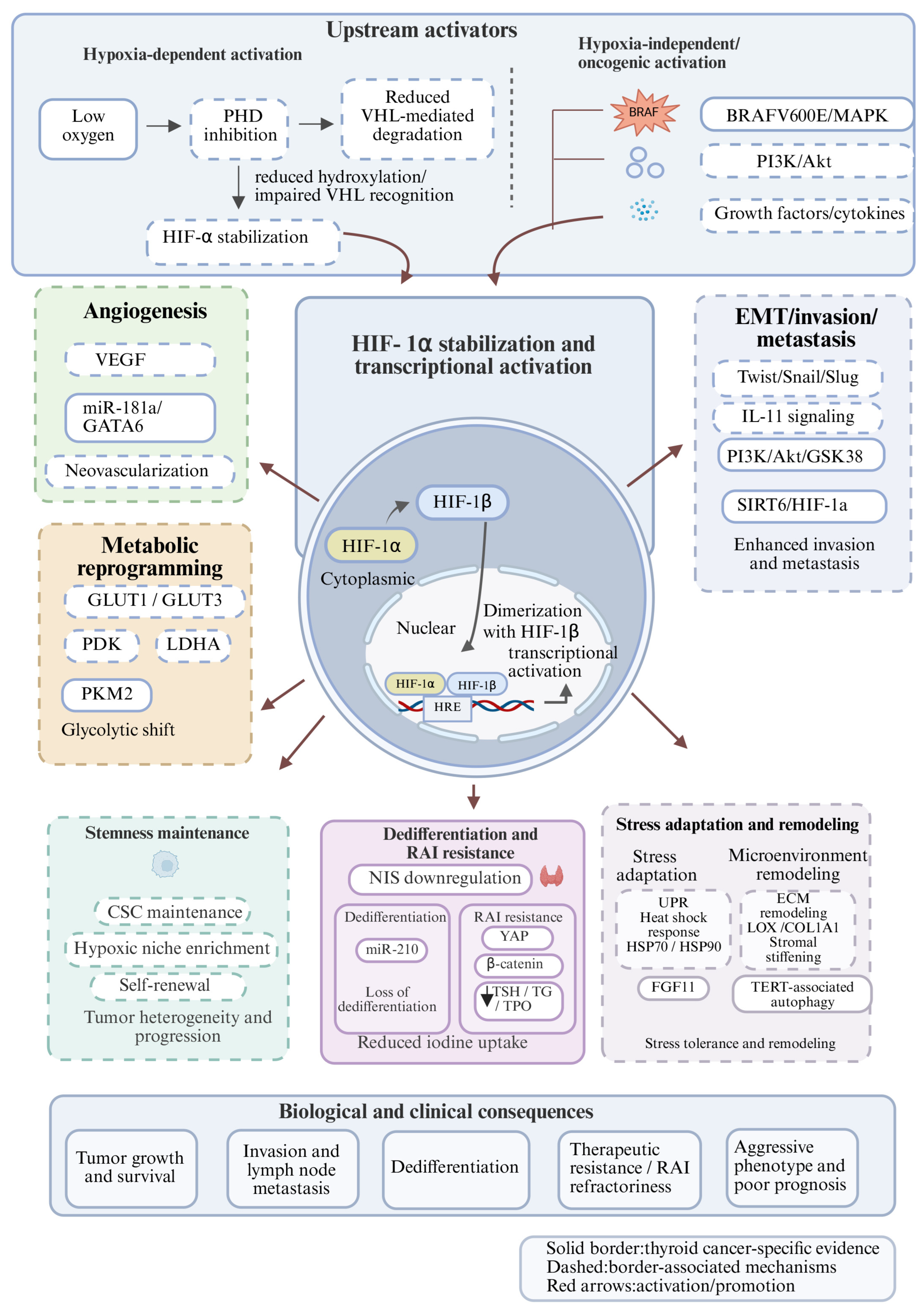
| Functional Category | Molecule/Signaling Pathway | Mechanism of Action | Impact |
|---|---|---|---|
| Angiogenesis | VEGF | Promotes tumor angiogenesis | Enhances tumor growth, invasion, and metastasis [34,40] |
| EMT/metastasis | PI3K/Akt/GSK3β SIRT6/HIF-1α | EMT | Facilitates tumor metastasis [36,37] |
| Stemness maintenance | HIF signaling/CSC maintenance | Maintains stem-like phenotypes and aggressive behavior | Promotes tumor progression and metastatic potential [72] |
| Dedifferentiation | miRNA-210 | Promotes tumor dedifferentiation | Enhances tumor growth, invasion, and metastasis [80] |
| Therapeutic resistance/RAI resistance | HIF-1α/YAP HIF-1α/β-catenin PKM2/NF-κB | Upregulates GLUT expression, downregulates NIS | RAI resistance [62,87,88] |
| downregulates NIS | |||
| Promotes resistance-related inflammatory and metabolic signaling | |||
| Additional hypoxia-responsive pathways | HIF-1α/FGF11 HIF-1α/TERT | Upregulates FGF11 Induces autophagy | Enhances tumor growth, invasion, and metastasis [112,113] |
| ECM remodeling/biomechanical adaptation | ECM remodeling/matrix stiffness | Promotes stromal remodeling, collagen cross-linking, and altered tumor–stroma interactions | Facilitates tumor invasion, therapeutic resistance, and altered radiation response [19,96,97] |
| Stress adaptation/therapeutic resistance | UPR/heat shock response | Maintains proteostasis and reduces apoptosis under hypoxic stress | Enhances tumor cell survival and may contribute to radioresistance/drug resistance [106,107] |
| Strategy/Agent | Target or Rationale | Study Level/Evidence Type | Relevance to Thyroid Cancer | Current Clinical/Translational Status |
|---|---|---|---|---|
| IDF-11774 | HIF-1α-targeting small molecule that suppresses HIF-1α-dependent transcription and glycolytic adaptation | In vitro thyroid cancer evidence (Preclinical) | Directly relevant to thyroid cancer cell models | No thyroid cancer-specific clinical trial identified |
| PX-478 | Direct HIF-1α inhibitor | Phase I clinical evidence in advanced solid tumors | Mechanistically relevant to aggressive thyroid cancer, but no thyroid-specific cohort has been reported | Evaluated in a completed phase I solid-tumor study; thyroid cancer-specific clinical evidence remains lacking |
| Belzutifan | Direct HIF-2α inhibitor | Clinical evidence in non-thyroid solid tumors | Mechanistically relevant to hypoxia biology, but not yet established in thyroid cancer | Current clinical development is concentrated mainly outside thyroid cancer |
| Hypoxia PET imaging (e.g., 18F-FAZA PET/CT) | Noninvasive assessment of tumor hypoxia for risk stratification and treatment guidance | Exploratory translational evidence in thyroid cancer | Directly studied in metastatic thyroid cancer | Exploratory evidence suggests tumor hypoxia may be associated with short-term progression after radioiodine therapy |
| Redifferentiation/RAI-restoration strategies (e.g., selumetinib + I-131) | Clinically relevant to hypoxia-associated dedifferentiation and radioiodine resistance, although not a direct HIF inhibitor | Phase II thyroid cancer evidence | High relevance to refractory thyroid cancer | Thyroid-cancer-specific clinical evaluation is available |
Disclaimer/Publisher’s Note: The statements, opinions and data contained in all publications are solely those of the individual author(s) and contributor(s) and not of MDPI and/or the editor(s). MDPI and/or the editor(s) disclaim responsibility for any injury to people or property resulting from any ideas, methods, instructions or products referred to in the content. |
© 2026 by the authors. Licensee MDPI, Basel, Switzerland. This article is an open access article distributed under the terms and conditions of the Creative Commons Attribution (CC BY) license.
Share and Cite
Peng, X.; Ma, L.; Chang, W. Current Studies on the Hypoxic Tumor Microenvironment in Thyroid Cancer: From Molecular Mechanisms to Clinical Therapeutic Perspectives. Biomedicines 2026, 14, 1126. https://doi.org/10.3390/biomedicines14051126
Peng X, Ma L, Chang W. Current Studies on the Hypoxic Tumor Microenvironment in Thyroid Cancer: From Molecular Mechanisms to Clinical Therapeutic Perspectives. Biomedicines. 2026; 14(5):1126. https://doi.org/10.3390/biomedicines14051126
Chicago/Turabian StylePeng, Xuejiao, Li Ma, and Weiqin Chang. 2026. "Current Studies on the Hypoxic Tumor Microenvironment in Thyroid Cancer: From Molecular Mechanisms to Clinical Therapeutic Perspectives" Biomedicines 14, no. 5: 1126. https://doi.org/10.3390/biomedicines14051126
APA StylePeng, X., Ma, L., & Chang, W. (2026). Current Studies on the Hypoxic Tumor Microenvironment in Thyroid Cancer: From Molecular Mechanisms to Clinical Therapeutic Perspectives. Biomedicines, 14(5), 1126. https://doi.org/10.3390/biomedicines14051126