Embryonic Lead Acetate Exposure Induces Seizure-like Activity in Zebrafish Larvae

 , , ,
, , , 
Abstract
1. Introduction
2. Materials and Methods
2.1. Zebrafish Husbandry
2.2. Breeding and Egg Production
2.3. Lead Acetate Preparation and Exposure of Embryos
2.4. Teratogenic Effects Assessment
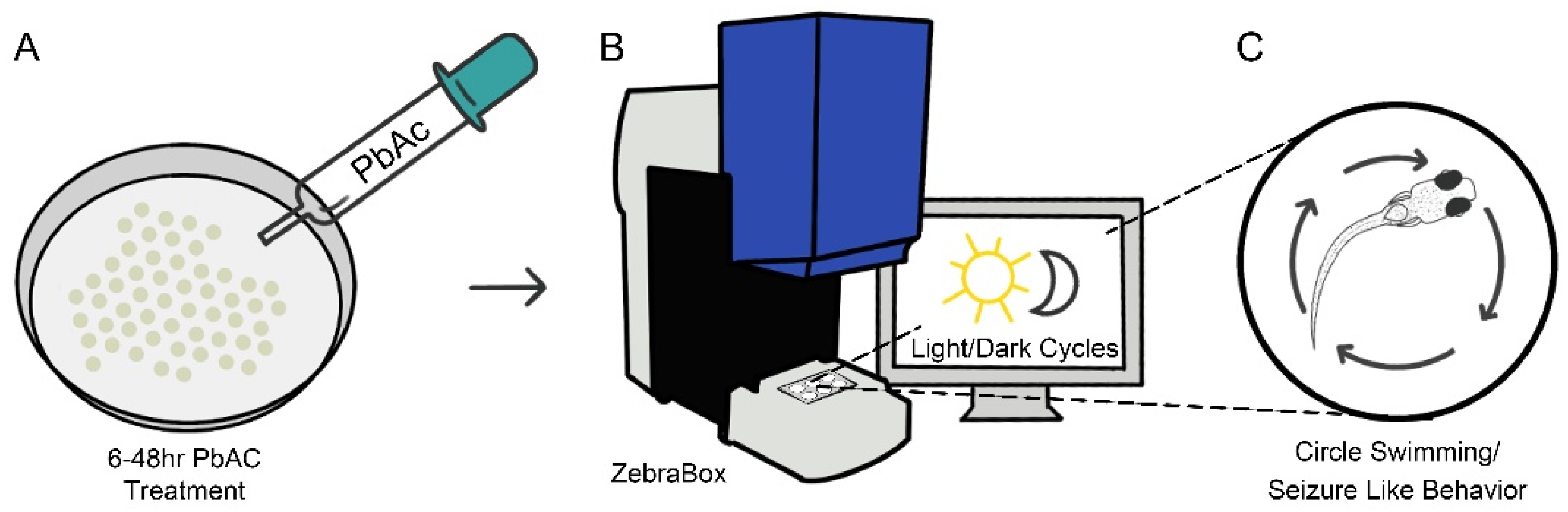
2.5. Circle Swimming Assay
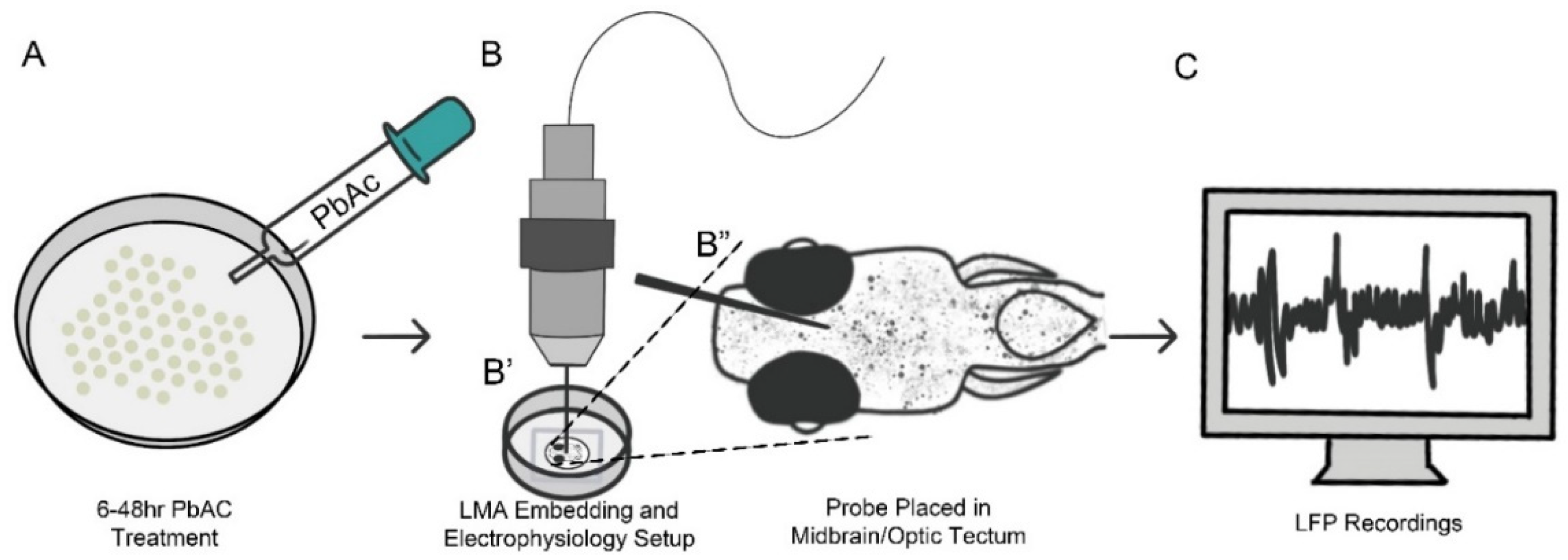
2.6. In Vivo Electrophysiological Recordings in the Optic Tectum of 3 dpf Zebrafish Larvae
2.7. Statistical Analysis
3. Results
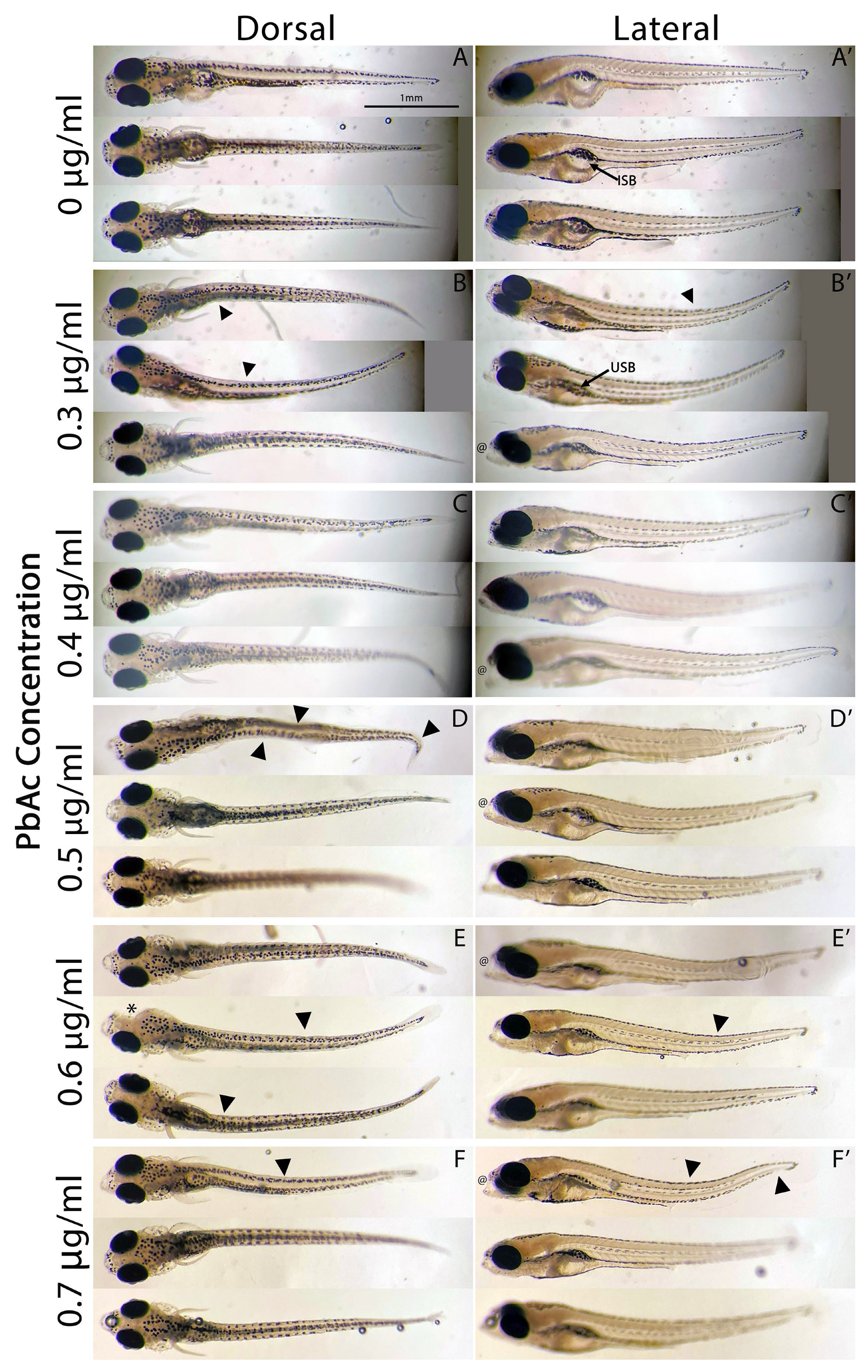
3.1. Lead-Induced Morphological Alterations in 7 dpf Zebrafish Larvae
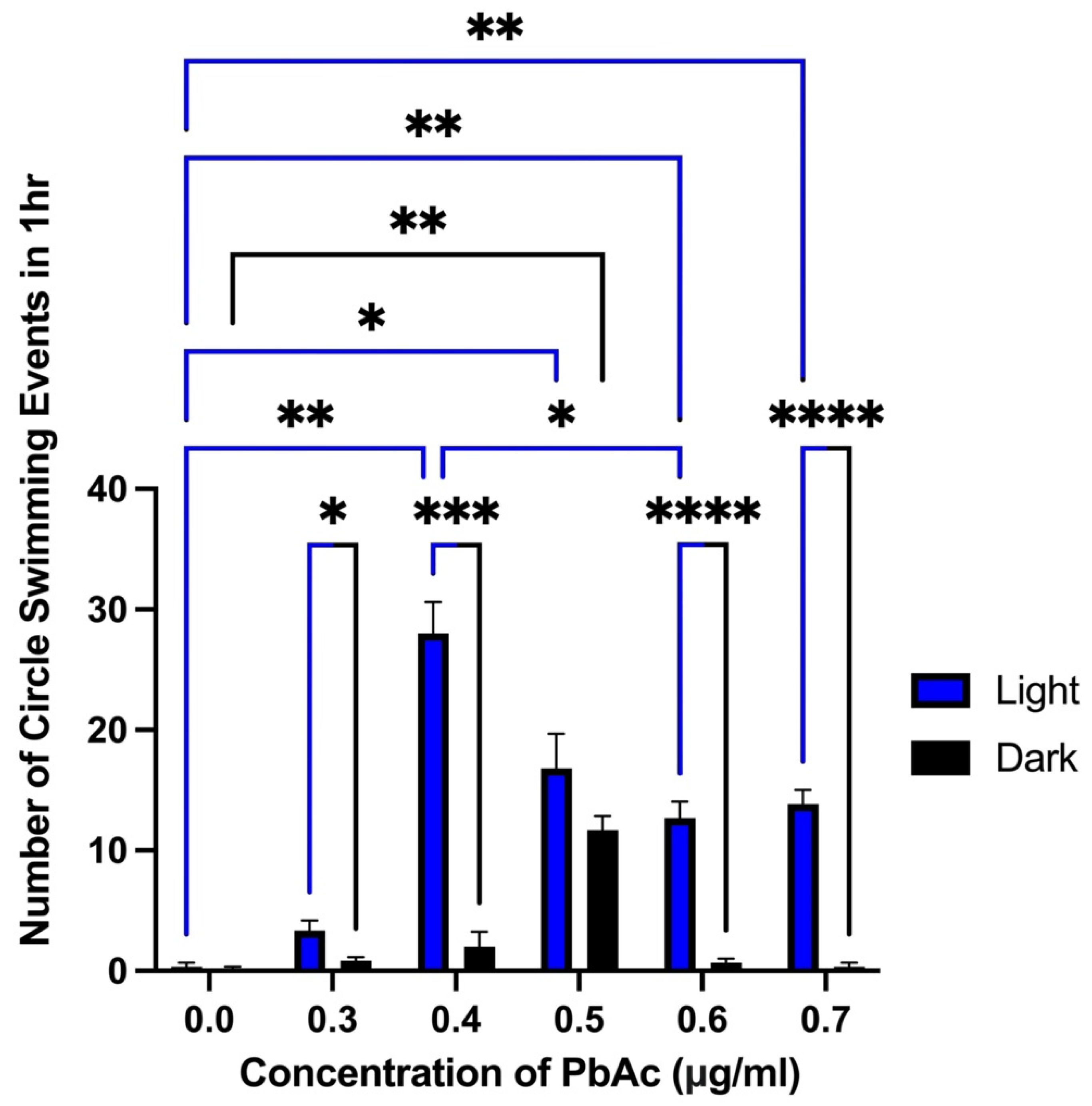
3.2. Lead-Induced Spontaneous Circle Swimming/Seizure-like Behavior
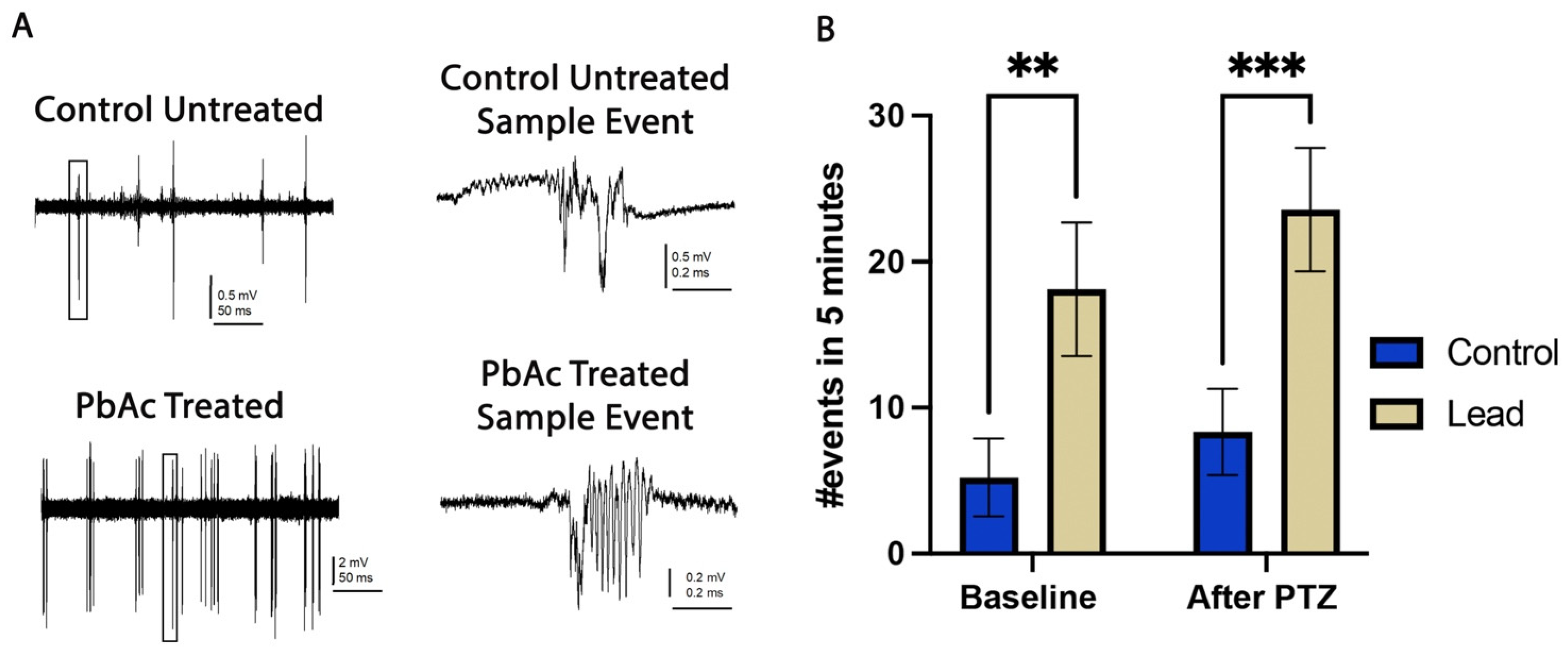
3.3. In Vivo LFP Recordings from the Optic Tectum of 3 dpf Zebrafish Larvae
4. Discussion
5. Conclusions
Supplementary Materials
Author Contributions
Funding
Institutional Review Board Statement
Data Availability Statement
Acknowledgments
Conflicts of Interest
References
- Collin, M.S.; Venkatraman, S.K.; Vijayakumar, N.; Kanimozhi, V.; Arbaaz, S.M.; Stacey, R.G.S.; Anusha, J.; Choudhary, R.; Lvov, V.; Tovar, G.I.; et al. Bioaccumulation of lead (Pb) and its effects on human: A review. J. Hazard. Mater. Adv. 2022, 7, 100094. [Google Scholar] [CrossRef] [Scilit]
- Raj, K.; Das, A.P. Lead pollution: Impact on environment and human health and approach for a sustainable solution. Environ. Chem. Ecotoxicol. 2023, 5, 79–85. [Google Scholar] [CrossRef] [Scilit]
- Renner, R. Exposure on tap: Drinking water as an overlooked source of lead. Environ. Health Perspect. 2010, 118, A68–A72. [Google Scholar] [CrossRef] [Scilit] [PubMed]
- Mishra, P.; Ali, S.; Kumar, R.; Shekhar, S. Global lead contamination in soils, sediments, and aqueous environments: Exposure, toxicity, and remediation. J. Trace Elem. Miner. 2025, 14, 100259. [Google Scholar] [CrossRef] [Scilit]
- Mishra, S.; Bharagava, R.N.; More, N.; Yadav, A.; Zainith, S.; Mani, S.; Chowdhary, P. Heavy Metal Contamination: An Alarming Threat to Environment and Human Health. In Environmental Biotechnology: For Sustainable Future; Sobti, R.C., Arora, N.K., Kothari, R., Eds.; Springer: Singapore, 2019; pp. 103–125. [Google Scholar]
- CDC. CDC Updates Blood Lead Reference Value. Available online: https://www.cdc.gov/lead-prevention/php/news-features/updates-blood-lead-reference-value.html (accessed on 11 November 2025).
- Hauptman, M.; Bruccoleri, R.; Woolf, A.D. An Update on Childhood Lead Poisoning. Clin. Pediatr. Emerg. Med. 2017, 18, 181–192. [Google Scholar] [CrossRef] [Scilit]
- Ramirez Ortega, D.; Gonzalez Esquivel, D.F.; Blanco Ayala, T.; Pineda, B.; Gomez Manzo, S.; Marcial Quino, J.; Carrillo Mora, P.; Perez de la Cruz, V. Cognitive Impairment Induced by Lead Exposure during Lifespan: Mechanisms of Lead Neurotoxicity. Toxics 2021, 9, 23. [Google Scholar] [CrossRef] [Scilit]
- Schroder, A.; Tilleman, J.; DeSimone, E. Lead Toxicity and Chelation Therapy. US Pharm. 2015, 40, 40–44. [Google Scholar]
- Bellinger, D.C. Teratogen update: Lead and pregnancy. Birth Defects Res. A Clin. Mol. Teratol. 2005, 73, 409–420. [Google Scholar] [CrossRef] [Scilit]
- Wani, A.L.; Ara, A.; Usmani, J.A. Lead toxicity: A review. Interdiscip. Toxicol. 2015, 8, 55–64. [Google Scholar] [CrossRef] [Scilit]
- Roy, N.M.; DeWolf, S.; Schutt, A.; Wright, A.; Steele, L. Neural alterations from lead exposure in zebrafish. Neurotoxicol. Teratol. 2014, 46, 40–48. [Google Scholar] [CrossRef] [Scilit]
- Sanders, T.; Liu, Y.; Buchner, V.; Tchounwou, P.B. Neurotoxic effects and biomarkers of lead exposure: A review. Rev. Environ. Health 2009, 24, 15–45. [Google Scholar] [CrossRef] [Scilit] [PubMed]
- Assi, M.A.; Hezmee, M.N.; Haron, A.W.; Sabri, M.Y.; Rajion, M.A. The detrimental effects of lead on human and animal health. Vet. World 2016, 9, 660–671. [Google Scholar] [CrossRef] [Scilit]
- Komoike, Y.; Matsuoka, M. Developmental adverse effects of trace amounts of lead: Evaluation using zebrafish model. Front. Pharmacol. 2022, 13, 1014912. [Google Scholar] [CrossRef] [Scilit]
- Guo, S.; Zhang, X.; Zhang, Y.; Chen, X.; Zhang, Y.; Cao, B.; Xia, D. Development of a rapid zebrafish model for lead poisoning research and drugs screening. Chemosphere 2023, 345, 140561. [Google Scholar] [CrossRef] [Scilit] [PubMed]
- Cozzolino, O.; Sicca, F.; Paoli, E.; Trovato, F.; Santorelli, F.M.; Ratto, G.M.; Marchese, M. Evolution of Epileptiform Activity in Zebrafish by Statistical-Based Integration of Electrophysiology and 2-Photon Ca2+ Imaging. Cells 2020, 9, 769. [Google Scholar] [CrossRef] [Scilit] [PubMed]
- Kalueff, A.V.; Gebhardt, M.; Stewart, A.M.; Cachat, J.M.; Brimmer, M.; Chawla, J.S.; Craddock, C.; Kyzar, E.J.; Roth, A.; Landsman, S.; et al. Towards a comprehensive catalog of zebrafish behavior 1.0 and beyond. Zebrafish 2013, 10, 70–86. [Google Scholar] [CrossRef] [Scilit]
- Baraban, S.C. A zebrafish-centric approach to antiepileptic drug development. Dis. Model Mech. 2021, 14, dmm049080. [Google Scholar] [CrossRef] [Scilit]
- Gyamfi, A.; Manikandan, P.; Cisneros, W.A.; Cummins, T.R.; Marrs, J.A. Voltage-Gated Sodium Channel Dysfunction in Epilepsy: Zebrafish Models for Therapeutics. Biomedicines 2025, 13, 2078. [Google Scholar] [CrossRef] [Scilit]
- Ali, S.; Champagne, D.L.; Spaink, H.P.; Richardson, M.K. Zebrafish embryos and larvae: A new generation of disease models and drug screens. Birth Defects Res. C Embryo Today 2011, 93, 115–133. [Google Scholar] [CrossRef] [Scilit]
- Bauer, B.; Mally, A.; Liedtke, D. Zebrafish Embryos and Larvae as Alternative Animal Models for Toxicity Testing. Int. J. Mol. Sci. 2021, 22, 13417. [Google Scholar] [CrossRef] [Scilit]
- Tierney, K.B. Behavioural assessments of neurotoxic effects and neurodegeneration in zebrafish. Biochim. Biophys. Acta 2011, 1812, 381–389. [Google Scholar] [CrossRef] [Scilit]
- Loring, M.D.; Thomson, E.E.; Naumann, E.A. Whole-brain interactions underlying zebrafish behavior. Curr. Opin. Neurobiol. 2020, 65, 88–99. [Google Scholar] [CrossRef] [Scilit]
- Sakamoto, M.; Yokoyama, T. Probing neuronal activity with genetically encoded calcium and voltage fluorescent indicators. Neurosci. Res. 2025, 215, 56–63. [Google Scholar] [CrossRef] [Scilit]
- Zhang, Y.; Rozsa, M.; Liang, Y.; Bushey, D.; Wei, Z.; Zheng, J.; Reep, D.; Broussard, G.J.; Tsang, A.; Tsegaye, G.; et al. Fast and sensitive GCaMP calcium indicators for imaging neural populations. Nature 2023, 615, 884–891. [Google Scholar] [CrossRef] [Scilit] [PubMed]
- Kursula, P.; Majava, V. A structural insight into lead neurotoxicity and calmodulin activation by heavy metals. Acta Crystallogr. Sect. F Struct. Biol. Cryst. Commun. 2007, 63, 653–656. [Google Scholar] [CrossRef] [Scilit] [PubMed]
- Marino, V.; Dal Cortivo, G.; Dell’Orco, D. Ionic displacement of Ca2+ by Pb2+ in calmodulin is affected by arrhythmia-associated mutations. Biochim. Biophys. Acta Mol. Cell Res. 2023, 1870, 119490. [Google Scholar] [CrossRef] [Scilit]
- Liu, J.; Baraban, S.C. Network Properties Revealed during Multi-Scale Calcium Imaging of Seizure Activity in Zebrafish. eNeuro 2019, 6, ENEURO.0041. [Google Scholar] [CrossRef] [Scilit]
- Mayans, L. Lead Poisoning in Children. Am. Fam. Physician 2019, 100, 24–30. [Google Scholar] [PubMed]
- Reuben, A.; Caspi, A.; Belsky, D.W.; Broadbent, J.; Harrington, H.; Sugden, K.; Houts, R.M.; Ramrakha, S.; Poulton, R.; Moffitt, T.E. Association of Childhood Blood Lead Levels with Cognitive Function and Socioeconomic Status at Age 38 Years and with IQ Change and Socioeconomic Mobility Between Childhood and Adulthood. JAMA 2017, 317, 1244–1251. [Google Scholar] [CrossRef] [Scilit]
- Warniment, C.; Tsang, K.; Galazka, S.S. Lead poisoning in children. Am. Fam. Physician 2010, 81, 751–757. [Google Scholar]
- Peterson, S.M.; Zhang, J.; Weber, G.; Freeman, J.L. Global gene expression analysis reveals dynamic and developmental stage-dependent enrichment of lead-induced neurological gene alterations. Environ. Health Perspect. 2011, 119, 615–621. [Google Scholar] [CrossRef] [Scilit]
- NRDC. New Map Shows Areas with Lead Violations and High Lead Levels in Tap Water. Available online: https://www.nrdc.org/resources/new-map-shows-areas-high-lead-tap-water-levels-lead-violations (accessed on 10 November 2025).
- Westerfield, M. The Zebrafish Book: A Guide for the Laboratory Use of Zebrafish (Danio rerio); University of Oregon Press: Eugene, OR, USA, 2000. [Google Scholar]
- Kimmel, C.B.; Ballard, W.W.; Kimmel, S.R.; Ullmann, B.; Schilling, T.F. Stages of embryonic development of the zebrafish. Dev. Dyn. 1995, 203, 253–310. [Google Scholar] [CrossRef] [Scilit]
- Fisher, R.S.; Acharya, J.N.; Baumer, F.M.; French, J.A.; Parisi, P.; Solodar, J.H.; Szaflarski, J.P.; Thio, L.L.; Tolchin, B.; Wilkins, A.J.; et al. Visually sensitive seizures: An updated review by the Epilepsy Foundation. Epilepsia 2022, 63, 739–768. [Google Scholar] [CrossRef] [Scilit]
- Kamal, I.J.; Cerbini, T.; Clouser, A.; Hernandez, A.; Calello, D.P. Lead encephalopathy presenting as status epilepticus: A case report. BMC Pediatr. 2024, 24, 687. [Google Scholar] [CrossRef] [Scilit]
- Shah Farhat, A.; Khademi, G. Blood lead level and seizure: A narrative review. Rev. Clin. Med. 2015, 2, 84–87. [Google Scholar] [CrossRef] [Scilit]
- Silbergeld, E.K.; Miller, L.P.; Kennedy, S.; Eng, N. Lead, GABA, and seizures: Effects of subencephalopathic lead exposure on seizure sensitivity and GABAergic function. Environ. Res. 1979, 19, 371–382. [Google Scholar] [CrossRef] [Scilit] [PubMed]
- Fleming, A.; Diekmann, H.; Goldsmith, P. Functional characterisation of the maturation of the blood-brain barrier in larval zebrafish. PLoS ONE 2013, 8, e77548. [Google Scholar] [CrossRef] [Scilit] [PubMed]
- O’Brown, N.M.; Megason, S.G.; Gu, C. Suppression of transcytosis regulates zebrafish blood-brain barrier function. eLife 2019, 8, e47326. [Google Scholar] [CrossRef] [Scilit] [PubMed]
- Xie, J.; Farage, E.; Sugimoto, M.; Anand-Apte, B. A novel transgenic zebrafish model for blood-brain and blood-retinal barrier development. BMC Dev. Biol. 2010, 10, 76. [Google Scholar] [CrossRef] [Scilit]
- Bressler, J.P.; Goldstein, G.W. Mechanisms of lead neurotoxicity. Biochem. Pharmacol. 1991, 41, 479–484. [Google Scholar] [CrossRef] [Scilit]
- Song, H.; Zheng, G.; Shen, X.F.; Liu, X.Q.; Luo, W.J.; Chen, J.Y. Reduction of brain barrier tight junctional proteins by lead exposure: Role of activation of nonreceptor tyrosine kinase Src via chaperon GRP78. Toxicol. Sci. 2014, 138, 393–402. [Google Scholar] [CrossRef] [Scilit] [PubMed]
- Struzynska, L.; Walski, M.; Gadamski, R.; Dabrowska-Bouta, B.; Rafalowska, U. Lead-induced abnormalities in blood-brain barrier permeability in experimental chronic toxicity. Mol. Chem. Neuropathol. 1997, 31, 207–224. [Google Scholar] [CrossRef] [Scilit]
- Tobwala, S.; Wang, H.-J.; Carey, J.W.; Banks, W.A.; Ercal, N. Effects of Lead and Cadmium on Brain Endothelial Cell Survival, Monolayer Permeability, and Crucial Oxidative Stress Markers in an in Vitro Model of the Blood-Brain Barrier. Toxics 2014, 2, 258–275. [Google Scholar] [CrossRef] [Scilit]
- Zhang, X.; Liu, Z.; Li, Y.; He, J.; Yang, L.; Yan, Y.; Tong, S.; Wang, Y.; Zhang, T. Lead acetate (PbAc) impairs blood-brain barrier in zebrafish via MMP-9/13-induced pericyte developmental defects. Ecotoxicol. Environ. Saf. 2025, 305, 119250. [Google Scholar] [CrossRef] [Scilit] [PubMed]
- Li, J.; Hu, M.; Liu, Y.; Lu, R.; Feng, W. Lead exposure leads to premature neural differentiation via inhibiting Wnt signaling. Environ. Pollut. 2024, 363, 125232. [Google Scholar] [CrossRef] [Scilit]
- Shemesh, O.A.; Linghu, C.; Piatkevich, K.D.; Goodwin, D.; Celiker, O.T.; Gritton, H.J.; Romano, M.F.; Gao, R.; Yu, C.J.; Tseng, H.A.; et al. Precision Calcium Imaging of Dense Neural Populations via a Cell-Body-Targeted Calcium Indicator. Neuron 2020, 107, 470–486.e11. [Google Scholar] [CrossRef] [Scilit]
- Pinion, J.; Walsh, C.; Goodfellow, M.; Randall, A.D.; Tyler, C.R.; Winter, M.J. Differential Electrographic Signatures Generated by Mechanistically-Diverse Seizurogenic Compounds in the Larval Zebrafish Brain. eNeuro 2022, 9, ENEURO-0337. [Google Scholar] [CrossRef] [Scilit]
- Bollmann, J.H. The Zebrafish Visual System: From Circuits to Behavior. Annu. Rev. Vis. Sci. 2019, 5, 269–293. [Google Scholar] [CrossRef] [Scilit]
- Fitzgerald, J.A.; Konemann, S.; Krumpelmann, L.; Zupanic, A.; Vom Berg, C. Approaches to Test the Neurotoxicity of Environmental Contaminants in the Zebrafish Model: From Behavior to Molecular Mechanisms. Environ. Toxicol. Chem. 2021, 40, 989–1006. [Google Scholar] [CrossRef] [Scilit]
- Yan, D.; Wang, L.; Ma, F.L.; Deng, H.; Liu, J.; Li, C.; Wang, H.; Chen, J.; Tang, J.L.; Ruan, D.Y. Developmental exposure to lead causes inherent changes on voltage-gated sodium channels in rat hippocampal CA1 neurons. Neuroscience 2008, 153, 436–445. [Google Scholar] [CrossRef] [Scilit]
- Choi, J.; Kim, Y.S.; Kim, M.H.; Kim, H.J.; Yoon, B.E. Maternal lead exposure induces sex-dependent cerebellar glial alterations and repetitive behaviors. Front. Cell. Neurosci. 2022, 16, 954807. [Google Scholar] [CrossRef] [Scilit]
- Neal, A.P.; Worley, P.F.; Guilarte, T.R. Lead exposure during synaptogenesis alters NMDA receptor targeting via NMDA receptor inhibition. Neurotoxicology 2011, 32, 281–289. [Google Scholar] [CrossRef] [Scilit]
- Nebet, E.R.; Aprea, C.; Zoodsma, J.D.; Raab, W.J.; Sirotkin, H.I.; Wollmuth, L.P. Conservation of human NMDA receptor subunits and disease variants in zebrafish. BMC Genom. 2025, 26, 1042. [Google Scholar] [CrossRef] [Scilit]
- Gavazzo, P.; Gazzoli, A.; Mazzolini, M.; Marchetti, C. Lead inhibition of NMDA channels in native and recombinant receptors. Neuroreport 2001, 12, 3121–3125. [Google Scholar] [CrossRef] [Scilit] [PubMed]
- Neal, A.P.; Stansfield, K.H.; Worley, P.F.; Thompson, R.E.; Guilarte, T.R. Lead exposure during synaptogenesis alters vesicular proteins and impairs vesicular release: Potential role of NMDA receptor-dependent BDNF signaling. Toxicol. Sci. 2010, 116, 249–263. [Google Scholar] [CrossRef] [Scilit] [PubMed]
- Stansfield, K.H.; Pilsner, J.R.; Lu, Q.; Wright, R.O.; Guilarte, T.R. Dysregulation of BDNF-TrkB signaling in developing hippocampal neurons by Pb2+: Implications for an environmental basis of neurodevelopmental disorders. Toxicol. Sci. 2012, 127, 277–295. [Google Scholar] [CrossRef] [Scilit]
- Zhao, J.; Zhang, Q.; Zhang, B.; Xu, T.; Yin, D.; Gu, W.; Bai, J. Developmental exposure to lead at environmentally relevant concentrations impaired neurobehavior and NMDAR-dependent BDNF signaling in zebrafish larvae. Environ. Pollut. 2020, 257, 113627. [Google Scholar] [CrossRef] [Scilit] [PubMed]


Disclaimer/Publisher’s Note: The statements, opinions and data contained in all publications are solely those of the individual author(s) and contributor(s) and not of MDPI and/or the editor(s). MDPI and/or the editor(s) disclaim responsibility for any injury to people or property resulting from any ideas, methods, instructions or products referred to in the content. |
© 2026 by the authors. Licensee MDPI, Basel, Switzerland. This article is an open access article distributed under the terms and conditions of the Creative Commons Attribution (CC BY) license.
Share and Cite
Gyamfi, A.; Cisneros, W.A.; Manikandan, P.; Subi-Kasozi, C.A.; Cummins, T.R.; Marrs, J.A. Embryonic Lead Acetate Exposure Induces Seizure-like Activity in Zebrafish Larvae. Biomedicines 2026, 14, 897. https://doi.org/10.3390/biomedicines14040897
Gyamfi A, Cisneros WA, Manikandan P, Subi-Kasozi CA, Cummins TR, Marrs JA. Embryonic Lead Acetate Exposure Induces Seizure-like Activity in Zebrafish Larvae. Biomedicines. 2026; 14(4):897. https://doi.org/10.3390/biomedicines14040897
Chicago/Turabian StyleGyamfi, Angela, William A. Cisneros, Priyadharshini Manikandan, Christopher A. Subi-Kasozi, Theodore R. Cummins, and James A. Marrs. 2026. "Embryonic Lead Acetate Exposure Induces Seizure-like Activity in Zebrafish Larvae" Biomedicines 14, no. 4: 897. https://doi.org/10.3390/biomedicines14040897
APA StyleGyamfi, A., Cisneros, W. A., Manikandan, P., Subi-Kasozi, C. A., Cummins, T. R., & Marrs, J. A. (2026). Embryonic Lead Acetate Exposure Induces Seizure-like Activity in Zebrafish Larvae. Biomedicines, 14(4), 897. https://doi.org/10.3390/biomedicines14040897