Presepsin as a Novel Biomarker in Abdominal Sepsis: Diagnostic Accuracy and Prognostic Implications

 , ,
, ,  ,
,  ,
,  , , ,
, , , 
Abstract
1. Introduction
2. Materials and Methods
3. Results
3.1. Diagnostic Performance
3.2. Prognostic Associations
3.3. Longitudinal Monitoring
4. Discussion

| Characteristic | Presepsin | PCT | CRP References |
|---|---|---|---|
| Biomarker Type | sCD14-ST | Prohormone of calcitonin | Acute phase protein [59]. |
| Sensitivity for Sepsis | 82–84% | 0.75–0.78 (75–78%) | Lower than presepsin/PCT [59]. |
| Specificity for Sepsis | 76–78% | 0.75–0.77 (75–77%) | Lower than presepsin/PCT [37]. |
| AUROC for Sepsis Diagnosis | 0.87–0.88 | 0.84–0.86 | 0.85 [38]. |
| AUROC for Bacteremia | 0.79 | 0.86–0.88 | 0.55–0.60 [38]. |
| Diagnostic Odds Ratio | 16 (95% CI: 10–25) | Similar to presepsin | Inferior to presepsin/PCT [61]. |
| Positive Likelihood Ratio | 3.4 (95% CI: 2.5–4.6) | Similar to presepsin | Lower than presepsin/PCT [61]. |
| Negative Likelihood Ratio | 0.22 (95% CI: 0.17–0.27) | Similar to presepsin | Higher than presepsin/PCT [61]. |
| Prognostic Value (Mortality) | Superior (AUROC 0.72, OR 3.31) | Moderate (AUROC 0.59, OR 1.62) | Inferior to presepsin/PCT [59]. |
| ICU Setting Sensitivity | 0.88 (95% CI: 0.82–0.92) | 0.75 (95% CI: 0.68–0.81) | Not well-studied [59]. |
| ICU Setting Specificity | 0.58 (95% CI: 0.42–0.73) | 0.75 (95% CI: 0.65–0.83) | Not well-studied [61]. |
| Combined Use Benefit | Synergistic with PCT (AUROC 0.88) | Synergistic with presepsin | Limited added value [61]. |
| Pathogen Identification | Associated with specific pathogens (E. coli, Klebsiella, Acinetobacter) | Associated with specific pathogens (E. coli, Klebsiella, Enterobacteriaceae) | Poor pathogen discrimination [59]. |
| Statistical Significance vs. PCT | No significant difference (p = 0.169 sensitivity, p = 0.792 specificity) | Reference standard | Significantly inferior [37,59]. |
| Clinical Utility | Better for prognosis and risk stratification | Better for bacteremia detection | Limited diagnostic value [37,61]. |
5. Conclusions
Author Contributions
Funding
Institutional Review Board Statement
Informed Consent Statement
Data Availability Statement
Conflicts of Interest
Abbreviations
| ALBIOS | Albumin Italian Outcome Sepsis trial |
| APACHE II | Acute Physiology and Chronic Health Evaluation II |
| AUC | Area under the curve |
| cIAIs | Complicated intra-abdominal infections |
| CRP | C-reactive protein |
| ECF | Enterocutaneous fistula |
| ED | Emergency department |
| GFR | Glomerular filtration rate |
| IAI | Intra-abdominal infection |
| ICU | Intensive care unit |
| IL-6 | Interleukin-6 |
| IL-8 | Interleukin-8 |
| INR | International normalized ratio |
| LPS | Lipopolysaccharide |
| MAP | Mean arterial pressure |
| NPV | Negative predictive value |
| OD | Organ dysfunction |
| PAMPs | Pathogen-associated molecular patterns |
| PCT | Procalcitonin |
| PIC | Postoperative infectious complications |
| PLT | Platelet count |
| PPV | Positive predictive value |
| PSP | Presepsin |
| ROC | Receiver operating characteristic |
| SAP | Severe acute pancreatitis |
| SBP | Spontaneous bacterial peritonitis |
| SIRS | Systemic inflammatory response syndrome |
| SOFA | Sequential Organ Failure Assessment |
| sCD14-ST | Soluble CD14 subtype |
| sTREM-1 | Soluble triggering receptor expressed on myeloid cells-1 |
| TLRs | Toll-like receptors |
| uPAR | Urokinase-type plasminogen activator receptor |
| WBC | White blood cell count |
| WSES | World Society of Emergency Surgery |
References
- De Backer, D.; Deutschman, C.S.; Hellman, J.; Myatra, S.N.; Ostermann, M.; Prescott, H.C.; Talmor, D.; Antonelli, M.; Azevedo, L.C.P.; Bauer, S.R.; et al. Surviving Sepsis Campaign Research Priorities 2023. Crit. Care Med. 2024, 52, 268–296. [Google Scholar] [CrossRef] [Scilit] [PubMed]
- Lambden, S.; Laterre, P.F.; Levy, M.M.; Francois, B. The SOFA score—Development, utility and challenges of accurate assessment in clinical trials. Crit. Care 2019, 23, 374. [Google Scholar] [CrossRef] [Scilit] [PubMed]
- Singer, M.; Deutschman, C.S.; Seymour, C.W.; Shankar-Hari, M.; Annane, D.; Bauer, M.; Bellomo, R.; Bernard, G.R.; Chiche, J.-D.; Coopersmith, C.M.; et al. The Third International Consensus Definitions for Sepsis and Septic Shock (Sepsis-3). JAMA 2016, 315, 801. [Google Scholar] [CrossRef] [Scilit] [PubMed]
- Font, M.D.; Thyagarajan, B.; Khanna, A.K. Sepsis and Septic Shock—Basics of diagnosis, pathophysiology and clinical decision making. Med. Clin. N. Am. 2020, 104, 573–585. [Google Scholar] [CrossRef] [Scilit]
- Sartelli, M.; Abu-Zidan, F.M.; Catena, F.; Griffiths, E.A.; Di Saverio, S.; Coimbra, R.; Ordoñez, C.A.; Leppaniemi, A.; Fraga, G.P.; Coccolini, F.; et al. Global validation of the WSES Sepsis Severity Score for patients with complicated intra-abdominal infections: A prospective multicentre study (WISS Study). World J. Emerg. Surg. 2015, 10, 61. [Google Scholar] [CrossRef] [Scilit]
- Rogić, D.; Juroš, G.F.; Petrik, J.; Vrančić, A.L. Advances and Pitfalls in Using Laboratory Biomarkers for the Diagnosis and Management of Sepsis. EJIFCC 2017, 28, 114–121. [Google Scholar]
- Póvoa, P.; Coelho, L.; Dal-Pizzol, F.; Ferrer, R.; Huttner, A.; Morris, A.C.; Nobre, V.; Ramirez, P.; Rouze, A.; Salluh, J.; et al. How to use biomarkers of infection or sepsis at the bedside: Guide to clinicians. Intensive Care Med. 2023, 49, 142–153. [Google Scholar] [CrossRef] [Scilit]
- Medzhitov, R.; Janeway, C.A., Jr. Decoding the Patterns of Self and Nonself by the Innate Immune System. Science 2002, 296, 298–300. [Google Scholar] [CrossRef] [Scilit]
- Liu, S.; Khemlani, L.S.; Shapiro, R.A.; Johnson, M.L.; Liu, K.; Geller, D.A.; Watkins, S.C.; Goyert, S.M.; Billiar, T.R. Expression of CD14 by Hepatocytes: Upregulation by Cytokines during Endotoxemia. Infect. Immun. 1998, 66, 5089–5098. [Google Scholar] [CrossRef] [Scilit]
- Shozushima, T.; Takahashi, G.; Matsumoto, N.; Kojika, M.; Endo, S.; Okamura, Y. Usefulness of presepsin (sCD14-ST) measurements as a marker for the diagnosis and severity of sepsis that satisfied diagnostic criteria of systemic inflammatory response syndrome. J. Infect. Chemother. 2011, 17, 764–769. [Google Scholar] [CrossRef] [Scilit]
- Velissaris, D.; Zareifopoulos, N.; Karamouzos, V.; Karanikolas, E.; Pierrakos, C.; Koniari, I.; Karanikolas, M. Presepsin as a Diagnostic and Prognostic Biomarker in Sepsis. Cureus 2021, 13, e15019. [Google Scholar] [CrossRef] [Scilit] [PubMed]
- Claessens, Y.-E.; Trabattoni, E.; Grabar, S.; Quinquis, L.; Der Sahakian, G.; Anselmo, M.; Schmidt, J.; de la Coussaye, J.-E.; Plaisance, P.; Casalino, E.; et al. Plasmatic presepsin (sCD14-ST) concentrations in acute pyelonephritis in adult patients. Clin. Chim. Acta 2017, 464, 182–188. [Google Scholar] [CrossRef] [Scilit] [PubMed]
- Uzun, N.; Keskin, A.; Aci, R.; Bilgin, M.; Akgun, S. Presepsin is a biomarker that can predict mortality in sepsis patients. Rev. Assoc. Med. Bras. 2025, 71, e20241262. [Google Scholar] [CrossRef] [Scilit]
- Henriquez-Camacho, C.; Losa, J. Biomarkers for Sepsis. BioMed Res. Int. 2014, 2014, 547818. [Google Scholar] [CrossRef] [Scilit] [PubMed]
- Vodnik, T.; Kaljevic, G.; Tadic, T.; Majkic-Singh, N. Presepsin (sCD14-ST) in preoperative diagnosis of abdominal sepsis. Clin. Chem. Lab. Med. 2013, 51, 2053–2062. [Google Scholar] [CrossRef] [Scilit]
- Jeong, Y.K.; Kim, E.Y. Predictive Role of Changes in Presepsin and Early Sepsis in ICU Patients After Abdominal Surgery. J. Surg. Res. 2022, 278, 207–215. [Google Scholar] [CrossRef] [Scilit]
- Paraskevas, T.; Chourpiliadi, C.; Demiri, S.; Michailides, C.; Karanikolas, E.; Lagadinou, M.; Velissaris, D. Presepsin in the diagnosis of sepsis. Clin. Chim. Acta 2023, 550, 117588. [Google Scholar] [CrossRef] [Scilit]
- Bösch, F.; Schallhorn, S.; Miksch, R.C.; Chaudry, I.H.; Faist, E.; Werner, J.; Angele, M.K.; Pratschke, S. The Prognostic Value of Presepsin for Sepsis in Abdominal Surgery: A Prospective Study. Shock 2020, 54, 56–61. [Google Scholar] [CrossRef] [Scilit]
- Lu, C.-Y.; Kao, C.-L.; Hung, K.-C.; Wu, J.-Y.; Hsu, H.-C.; Yu, C.-H.; Chang, W.-T.; Feng, P.-H.; Chen, I.-W. Diagnostic efficacy of serum presepsin for postoperative infectious complications: A meta-analysis. Front. Immunol. 2023, 14, 1320683. [Google Scholar] [CrossRef] [Scilit]
- Drăgoescu, A.N.; Pădureanu, V.; Stănculescu, A.D.; Chiuțu, L.C.; Florescu, D.N.; Gheonea, I.A.; Pădureanu, R.; Stepan, A.; Streba, C.T.; Drocaș, A.I.; et al. Presepsin as a Potential Prognostic Marker for Sepsis According to Actual Practice Guidelines. J. Pers. Med. 2020, 11, 2. [Google Scholar] [CrossRef] [Scilit]
- Masson, S.; Caironi, P.; Fanizza, C.; Thomae, R.; Bernasconi, R.; Noto, A.; Oggioni, R.; Pasetti, G.S.; Romero, M.; Tognoni, G.; et al. Circulating presepsin (soluble CD14 subtype) as a marker of host response in patients with severe sepsis or septic shock: Data from the multicenter, randomized ALBIOS trial. Intensive Care Med. 2015, 41, 12–20, Erratum in Intensive Care Med. 2015, 41, 1736. [Google Scholar] [CrossRef] [Scilit]
- Amanai, E.; Nakai, K.; Saito, J.; Hashiba, E.; Miura, T.; Morohashi, H.; Sakamoto, Y.; Mikami, A.; Hakamada, K.; Hirota, K. Usefulness of presepsin for the early detection of infectious complications after elective colorectal surgery, compared with C-reactive protein and procalcitonin. Sci. Rep. 2022, 12, 3960. [Google Scholar] [CrossRef] [Scilit]
- Ozdal, E.; Tortum, F.; Laloglu, E.; Egilmez, E.; Kasali, K. Usability of presepsin, calprotectin, and interleukin 6 in the diagnosis of acute appendicitis. Biomarkers 2024, 29, 479–484. [Google Scholar] [CrossRef] [Scilit]
- Sater, M.S.; Almansour, N.; Malalla, Z.H.A.; Fredericks, S.; Ali, M.E.; Giha, H.A. Potentials of Presepsin as a Novel Sepsis Biomarker in Critically Ill Adults: Correlation Analysis with the Current Diagnostic Markers. Diagnostics 2025, 15, 217. [Google Scholar] [CrossRef] [Scilit] [PubMed]
- Shakeyev, K.; Turgunov, Y.; Ogizbayeva, A.; Avdiyenko, O.; Mugazov, M.; Grigolashvili, S.; Azizov, I. Presepsin (soluble CD14 subtype) as a risk factor for the development of infectious and inflammatory complications in operated colorectal cancer patients. Ann. Coloproctol. 2022, 38, 442–448. [Google Scholar] [CrossRef] [Scilit] [PubMed]
- Song, X.; Song, Y.; Yuan, Y.; Zhang, P.; Zhang, X. Prognostic value of presepsin for outcomes and complications in enterocutaneous fistula complicated by abdominal sepsis. Int. J. Surg. 2016, 33, 96–101. [Google Scholar] [CrossRef] [Scilit] [PubMed]
- Takeuchi, M.; Yokose, T.; Kawakubo, H.; Matsuda, S.; Mayanagi, S.; Irino, T.; Fukuda, K.; Nakamura, R.; Wada, N.; Obara, H.; et al. The perioperative presepsin as an accurate diagnostic marker of postoperative infectious complications after esophagectomy: A prospective cohort study. Esophagus 2020, 17, 399–407. [Google Scholar] [CrossRef] [Scilit]
- Wang, S.; Ruan, W.-Q.; Yu, Z.; Zhao, X.; Chen, Z.-X.; Li, Q. Validity of presepsin for the diagnosis and prognosis of sepsis in elderly patients admitted to the Intensive Care Unit. Minerva Anestesiol. 2020, 86, 1170–1179. [Google Scholar] [CrossRef] [Scilit]
- Wejnaruemarn, S.; Susantitaphong, P.; Komolmit, P.; Treeprasertsuk, S.; Thanapirom, K. Procalcitonin and presepsin for detecting bacterial infection and spontaneous bacterial peritonitis in cirrhosis: A systematic review and meta-analysis. World J. Gastroenterol. 2025, 31, 99506. [Google Scholar] [CrossRef] [Scilit]
- Zong, X.; Liu, Y.; Gu, L.; Chen, X.; Yang, C. Early diagnostic value of Presepsin in sepsis: A prospective study on a population with suspected sepsis in fever clinics. Zhonghua Wei Zhong Bing Ji Jiu Yi Xue 2024, 36, 340–344. [Google Scholar] [CrossRef]
- Aliu-Bejta, A.; Kurshumliu, M.; Namani, S.; Dreshaj, S.; Baršić, B. Ability of presepsin concentrations to predict mortality in adult patients with sepsis. J. Clin. Transl. Sci. 2023, 7, e121. [Google Scholar] [CrossRef] [Scilit]
- Chen, M.; Zhu, Y. Utility of sTREM-1 and Presepsin (sCD14-ST) as Diagnostic and Prognostic Markers of Sepsis. Clin. Lab. 2020, 66, 495–501. [Google Scholar] [CrossRef] [Scilit] [PubMed]
- Narendra, S.; Wyawahare, M.; Adole, P.S. Presepsin vs. Procalcitonin as Predictors of Sepsis Outcome. J. Assoc. Physicians India 2022, 70, 38–40. [Google Scholar] [CrossRef] [Scilit] [PubMed]
- Pluta, M.P.; Czempik, P.F.; Kwiatkowska, M.; Marczyk-Bełbot, K.; Maślanka, S.; Mika, J.; Krzych, Ł.J. Presepsin Does Not Predict Risk of Death in Sepsis Patients Admitted to the Intensive Care Unit: A Prospective Single-Center Study. Biomedicines 2024, 12, 2313. [Google Scholar] [CrossRef] [Scilit] [PubMed]
- Ren, E.; Xiao, H.; Wang, G.; Zhao, Y.; Yu, H.; Li, C. Value of procalcitonin and presepsin in the diagnosis and severity stratification of sepsis and septic shock. World J. Emerg. Med. 2024, 15, 135. [Google Scholar] [CrossRef] [Scilit]
- Contenti, J.; Occelli, C.; Lemoel, F.; Ferrari, P.; Levraut, J. Presepsin versus other biomarkers to predict sepsis and septic shock in patients with infection defined by Sepsis-3 criteria: The PREDI study of diagnostic accuracy. Emergencias 2019, 31, 311–317. [Google Scholar]
- Xiao, H.; Zhang, H.; Wang, G.; Wang, Y.; Tan, Z.; Sun, X.; Zhou, J.; Duan, M.; Zhi, D.; Hang, C.; et al. Comparison Among Presepsin, Procalcitonin, and C-Reactive Protein in Predicting Blood Culture Positivity and Pathogen in Sepsis Patients. Shock 2024, 61, 387–394. [Google Scholar] [CrossRef] [Scilit]
- Wu, J.; Zhan, X.; Wang, S.; Liao, X.; Li, L.; Luo, J. The value of plasma presepsin as a diagnostic and prognostic biomarker for sepsis in Southern China. Inflamm. Res. 2023, 72, 1829–1837. [Google Scholar] [CrossRef] [Scilit]
- Tsuchida, T.; Ie, K.; Okuse, C.; Hirose, M.; Nishisako, H.; Torikai, K.; Tanaka, T.; Kunishima, H.; Matsuda, T. Determining the factors affecting serum presepsin level and its diagnostic utility: A cross-sectional study. J. Infect. Chemother. 2021, 27, 585–591. [Google Scholar] [CrossRef] [Scilit]
- Kyriazopoulou, E.; Leventogiannis, K.; Tavoulareas, G.; Mainas, E.; Toutouzas, K.; Mathas, C.; Prekates, A.; Sakka, V.; Panagopoulos, P.; Syrigos, K.; et al. Presepsin as a diagnostic and prognostic biomarker of severe bacterial infections and COVID-19. Sci. Rep. 2023, 13, 3814. [Google Scholar] [CrossRef] [Scilit]
- Imai, Y.; Tanaka, R.; Honda, K.; Matsuo, K.; Taniguchi, K.; Asakuma, M.; Lee, S.-W. The usefulness of presepsin in the diagnosis of postoperative infectious complications after gastrectomy for gastric cancer: A prospective cohort study. Sci. Rep. 2022, 12, 21289. [Google Scholar] [CrossRef] [Scilit] [PubMed]
- Ruangsomboon, O.; Panjaikaew, P.; Monsomboon, A.; Chakorn, T.; Permpikul, C.; Limsuwat, C. Diagnostic and prognostic utility of presepsin for sepsis in very elderly patients in the emergency department. Clin. Chim. Acta 2020, 510, 723–732. [Google Scholar] [CrossRef] [Scilit] [PubMed]
- Nagata, T.; Yasuda, Y.; Ando, M.; Abe, T.; Katsuno, T.; Kato, S.; Tsuboi, N.; Matsuo, S.; Maruyama, S. Clinical Impact of Kidney Function on Presepsin Levels. PLoS ONE 2015, 10, e0129159. [Google Scholar] [CrossRef] [Scilit] [PubMed]
- Nakamura, Y.; Ishikura, H.; Nishida, T.; Kawano, Y.; Yuge, R.; Ichiki, R.; Murai, A. Usefulness of presepsin in the diagnosis of sepsis in patients with or without acute kidney injury. BMC Anesthesiol. 2014, 14, 88. [Google Scholar] [CrossRef] [Scilit]
- Miyoshi, M.; Inoue, Y.; Nishioka, M.; Ikegame, A.; Nakao, T.; Kishi, S.; Doi, T.; Nagai, K. Clinical evaluation of presepsin considering renal function. PLoS ONE 2019, 14, e0215791. [Google Scholar] [CrossRef] [Scilit]
- Dragoş, D.; Ghenu, M.I.; Timofte, D.; Balcangiu-Stroescu, A.-E.; Ionescu, D.; Manea, M.M. The cutoff value of presepsin for diagnosing sepsis increases with kidney dysfunction, a cross-sectional observational study. Medicine 2023, 102, e32620. [Google Scholar] [CrossRef] [Scilit]
- Arakawa, K.; Saeki, A.; Ide, R.; Matsushita, Y. Presepsin cut-off value for diagnosis of sepsis in patients with renal dysfunction. PLoS ONE 2022, 17, e0273930. [Google Scholar] [CrossRef] [Scilit]
- Xiao, H.; Wang, G.; Wang, Y.; Tan, Z.; Sun, X.; Zhou, J.; Duan, M.; Zhi, D.; Tang, Z.; Hang, C.; et al. Potential Value of Presepsin Guidance in Shortening Antibiotic Therapy in Septic Patients: A Multicenter, Prospective Cohort Trial. Shock 2022, 57, 63–71. [Google Scholar] [CrossRef] [Scilit]
- Chaudhuri, D.M.; Nei, A.M.P.; Rochwerg, B.M.; Balk, R.A.M.; Asehnoune, K.; Cadena, R.M.; Carcillo, J.A.; Correa, R.; Drover, K.B.; Esper, A.M.M.; et al. 2024 Focused Update: Guidelines on Use of Corticosteroids in Sepsis, Acute Respiratory Distress Syndrome, and Community-Acquired Pneumonia. Crit. Care Med. 2024, 52, e219–e233. [Google Scholar] [CrossRef] [Scilit]
- Annane, D.; Briegel, J.; Granton, D.; Bellissant, E.; Bollaerta, P.E.; Keh, D.; Kupfer, Y.; Pirracchio, R.; Rochwerg, B. Corticosteroids for treating sepsis in children and adults. Cochrane Database Syst. Rev. 2025, 2025, CD002243. [Google Scholar] [CrossRef] [Scilit]
- Jeannet, R.; Daix, T.; Chollet, S.; Vaidie, J.; Galinat, T.; Vignon, P.; Feuillard, J.; François, B. CD16dimCD64+ granulocytes are of interest in the diagnosis of ventilator associated pneumonia in neurological intensive care unit patients. J. Transl. Crit. Care Med. 2025, 7, e24-00035. [Google Scholar] [CrossRef] [Scilit]
- Premer, C.; Hare, J.M.; Yuan, S.Y.; Wilson, J.W. Mesenchymal stem/stromal cells as a therapeutic for sepsis: A review on where do we stand? Stem Cell Res. Ther. 2025, 16, 245. [Google Scholar] [CrossRef] [Scilit] [PubMed]
- Laroye, C.; Gibot, S.; Reppel, L.; Bensoussan, D. Concise Review: Mesenchymal Stromal/Stem Cells: A New Treatment for Sepsis and Septic Shock? Stem Cells 2017, 35, 2331–2339. [Google Scholar] [CrossRef] [Scilit] [PubMed]
- Li, Y.; Zhang, H.; Chen, C.; Qiao, K.; Li, Z.; Han, J.; Han, X.; Li, K.; Lai, K.; Liu, N.; et al. Biomimetic Immunosuppressive Exosomes that Inhibit Cytokine Storms Contribute to the Alleviation of Sepsis. Adv. Mater. 2022, 34, e2108476. [Google Scholar] [CrossRef] [Scilit] [PubMed]
- Zhu, Q.; Liao, Y.; Liao, Z.; Ye, G.; Shan, C.; Huang, H. Compact bone mesenchymal stem cells-derived paracrine mediators for cell-free therapy in sepsis. Biochem. Biophys. Res. Commun. 2024, 727, 150313. [Google Scholar] [CrossRef] [Scilit]
- Sharma, N.; Das, S.; Nirmal, K.; Sachan, R.; Singh, P.K.; Jawed, A.; Dar, S.A. Diagnostic and Prognostic Evaluation of Presepsin Levels in Neonatal Septicemia: A Hospital-Based Study. J. Paediatr. Child Health 2026, 62, 261–266. [Google Scholar] [CrossRef] [Scilit]
- Stoma, I.; Karpov, I.; Uss, A.; Krivenko, S.; Iskrov, I.; Milanovich, N.; Vlasenkova, S.; Lendina, I.; Belyavskaya, K.; Cherniak, V. Combination of sepsis biomarkers may indicate an invasive fungal infection in haematological patients. Biomarkers 2019, 24, 401–406. [Google Scholar] [CrossRef] [Scilit]
- Endo, S.; Suzuki, Y.; Takahashi, G.; Shozushima, T.; Ishikura, H.; Murai, A.; Nishida, T.; Irie, Y.; Miura, M.; Iguchi, H.; et al. Usefulness of presepsin in the diagnosis of sepsis in a multicenter prospective study. J. Infect. Chemother. 2012, 18, 891–897. [Google Scholar] [CrossRef] [Scilit]
- Chairaj, T.; Mongkhon, P.; Leewongsakorn, P.; Saensongkwae, K.; Nangola, S.; Saoin, S.; Prompunt, E.; Chantharit, P.; Kloypan, C. Diagnostic performance of procalcitonin and presepsin in sepsis: A systematic review and meta-analysis. BMC Emerg. Med. 2025, 26, 9. [Google Scholar] [CrossRef] [Scilit]
- Sartelli, M.; Tascini, C.; Coccolini, F.; Dellai, F.; Ansaloni, L.; Antonelli, M.; Bartoletti, M.; Bassetti, M.; Boncagni, F.; Carlini, M.; et al. Management of intra-abdominal infections: Recommendations by the Italian council for the optimization of antimicrobial use. World J. Emerg. Surg. 2024, 19, 23. [Google Scholar] [CrossRef] [Scilit]
- Wu, C.-C.; Lan, H.-M.; Han, S.-T.; Chaou, C.-H.; Yeh, C.-F.; Liu, S.-H.; Li, C.-H.; Blaney, G.N.; Liu, Z.-Y.; Chen, K.-F. Comparison of diagnostic accuracy in sepsis between presepsin, procalcitonin, and C-reactive protein: A systematic review and meta-analysis. Ann. Intensive Care 2017, 7, 91. [Google Scholar] [CrossRef] [Scilit]

| Author (Ref.) | Year | Study Design | N | Sampling Time Points | Main Findings |
|---|---|---|---|---|---|
| Jeong et al. [16] | 2022 | Observational | 298 | T0, 24 h, 48 h, 72 h | Demonstrated diagnostic accuracy for sepsis and septic shock in the acute postoperative phase. |
| Paraskevas et al. [17] | 2023 | Systematic review | — | — | Identified as a promising biomarker for triage and early sepsis diagnosis. |
| Bösch et al. [18] | 2020 | Prospective | 31 | T0 | Highest AUC, sensitivity, and specificity among evaluated markers; strong association with mortality. |
| Lu et al. [19] | 2023 | Meta-analysis | 984 | — | Pooled sensitivity 76% and specificity 83% for postoperative infectious complications. |
| Drăgonescu et al. [20] | 2020 | Prospective observational | 114 | T0 | Higher levels in sepsis and septic shock; significant correlation with SOFA score. |
| Masson et al. [21] | 2015 | Multicenter randomized (ALBIOS) | 997 | T0, 24 h, 48 h, 7 d | Baseline concentrations increased with disease severity; early rise associated with worse outcomes and 90-day mortality. |
| Amanai et al. [22] | 2022 | Prospective observational | 114 | T0, 24 h, 48 h, 72 h, 4 d, 6 d | Postoperative increases at days 4–6 predicted infectious complications. |
| Ozdal et al. [23] | 2024 | Prospective | 90 | — | Elevated in appendicitis compared with controls; not discriminatory for complicated cases. |
| Sater et al. [24] | 2025 | Cross-sectional | 129 | T0 | Strong correlation with septic shock parameters compared with other biomarkers. |
| Shakeyev et al. [25] | 2022 | Pilot study | 36 | T0, 72 h | Higher baseline levels associated with postoperative complications and organ dysfunction. |
| Song et al. [26] | 2016 | Prospective cohort | 71 | T0 | Values > 726 pg/mL associated with greater disease severity. |
| Takeuchi et al. [27] | 2020 | Prospective cohort | 30 | T0, 24 h, 48 h, 72 h, 5 d, 7 d | Measurements at postoperative days 5–7 outperformed WBC, CRP, and PCT for infectious complications. |
| Wang et al. [28] | 2020 | Prospective | 142 | 24 h, 72 h, 7 d | Elevated levels in septic elderly ICU patients; associated with 30-day mortality. |
| Wejnaruemarn et al. [29] | 2025 | Systematic review/meta-analysis | 1789 | — | Pooled sensitivity 75% and specificity 80% for bacterial infections. |
| Zong et al. [30] | 2024 | Prospective cohort | 149 | T0 | Sensitivity 89.5% and PPV 64.6% for early sepsis detection. |
| Aliu-Bejta et al. [31] | 2023 | Observational | 100 | 0–72 h | Higher baseline levels observed in non-survivors. |
| Chen et al. [32] | 2020 | Observational | 60 | 0 h, 24 h, 4 d, 7 d | Persistent elevation associated with poorer prognosis. |
| Narendra et al. [33] | 2022 | Prospective cohort | 92 | T0, 24 h, 48 h, 72 h | Cut-off > 1.47 ng/mL predictive of mortality in septic shock. |
| Pluta et al. [34] | 2024 | Prospective | 86 | — | Correlated with positive blood cultures; not independently predictive of mortality. |
| Ren et al. [35] | 2024 | Retrospective | 2225 | T0, 24 h | Higher concentrations in SOFA > 5 and septic shock; high specificity (92.2%). |
| Author (Ref.) | Clinical Setting | Sensitivity (%) | Specificity (%) | PPV (%) | NPV (%) | Comparator(s) |
|---|---|---|---|---|---|---|
| Jeong et al. [16] | Postoperative abdominal surgery | Sepsis: 69.8 (T0), 76.9 (24 h); Septic shock: 83.8 (T0) | Up to 89.8 (48 h) | — | — | PCT |
| Bösch et al. [18] | Emergency abdominal surgery | 70 | 90 | 90 | 30 | PCT, IL-6, WBC |
| Lu et al. [19] | Postoperative infectious complications (meta-analysis) | 76 | 83 | — | — | PCT, CRP |
| Drăgonescu et al. [20] | ICU patients | 79 | 63 | — | — | — |
| Amanai et al. [22] | Colorectal surgery | Up to 87.9 (72 h) | 43.1–87.8 (time-dependent) | — | — | PCT, CRP, WBC |
| Wang et al. [28] | Elderly ICU patients | 82.05–83.33 (24–72 h) | 66.67–89.74 | — | — | PCT, CRP, IL-6 |
| Wejnaruemarn et al. [29] | Cirrhotic patients (meta-analysis) | 75 | 80 | — | — | PCT |
| Zong et al. [30] | Febrile patients | 89.5 | — | 64.6 | — | WBC, CRP, PCT |
| Chen et al. [32] | Sepsis monitoring | 83 | 85 | — | — | sTREM-1 |
| Pluta et al. [34] | ICU sepsis | 93 | 51 | — | — | IL-6, PCT, CRP |
| Ren et al. [35] | Sepsis and septic shock | 39.6 | 92.2 | — | — | PCT, CRP |
| Clinical Role | Key Evidence (Refs.) | Main Findings | Clinical Implication |
|---|---|---|---|
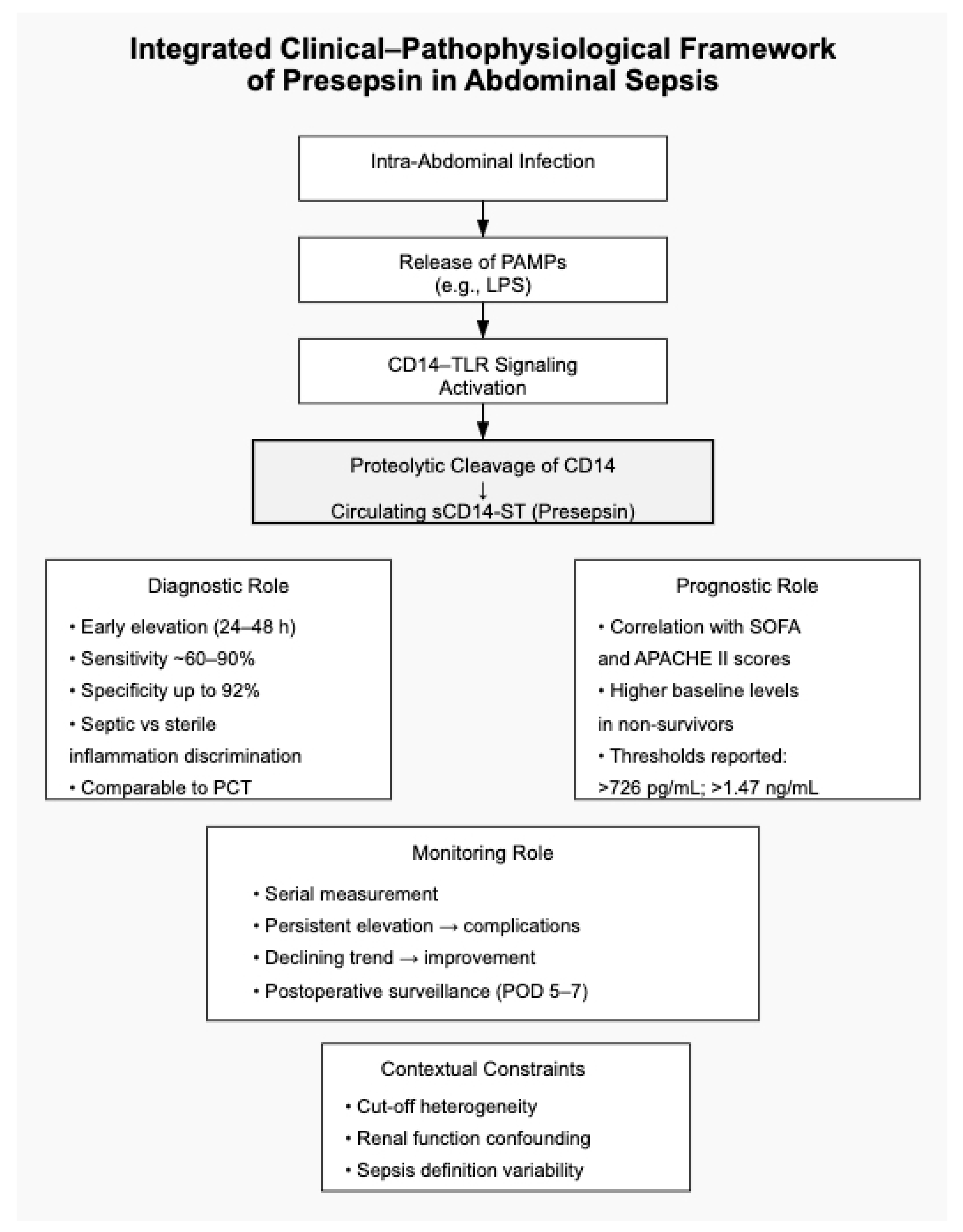
| Diagnostic | [16,18,19,20,22,27,28,29,30,35] | Sensitivity generally ranges from 60 to 90%; specificity up to 92.2% in septic shock; pooled sensitivity 76% and specificity 83% for postoperative infectious complications; pooled sensitivity 75% and specificity 80% in cirrhotic infections. | May provide adjunctive diagnostic information in selected clinical settings, particularly when interpreted alongside established biomarkers and clinical assessment. |
| Prognostic | [21,26,31,33,35] | Baseline concentrations correlate with SOFA score and disease severity; early increases associated with worse outcomes; cut-off > 1.47 ng/mL predictive of mortality; values > 726 pg/mL associated with greater clinical severity. | May contribute to risk stratification; however, prognostic performance appears context-dependent and requires validation in standardized prospective cohorts. |
| Monitoring | [22,25,27,32] | Persistent postoperative elevation associated with infectious complications and organ dysfunction; measurements at postoperative days 5–7 improved detection of complications; decreasing trends associated with clinical improvement. | Serial measurements may support clinical monitoring in postoperative and critical care contexts, although optimal timing and thresholds remain to be standardized. |
Disclaimer/Publisher’s Note: The statements, opinions and data contained in all publications are solely those of the individual author(s) and contributor(s) and not of MDPI and/or the editor(s). MDPI and/or the editor(s) disclaim responsibility for any injury to people or property resulting from any ideas, methods, instructions or products referred to in the content. |
© 2026 by the authors. Licensee MDPI, Basel, Switzerland. This article is an open access article distributed under the terms and conditions of the Creative Commons Attribution (CC BY) license.
Share and Cite
Fiore, M.; Cosenza, G.; Romano, F.M.; Pota, V.; Sansone, P.; Coppolino, F.; Selvaggi, L.; Selvaggi, F.; Pace, M.C. Presepsin as a Novel Biomarker in Abdominal Sepsis: Diagnostic Accuracy and Prognostic Implications. Biomedicines 2026, 14, 822. https://doi.org/10.3390/biomedicines14040822
Fiore M, Cosenza G, Romano FM, Pota V, Sansone P, Coppolino F, Selvaggi L, Selvaggi F, Pace MC. Presepsin as a Novel Biomarker in Abdominal Sepsis: Diagnostic Accuracy and Prognostic Implications. Biomedicines. 2026; 14(4):822. https://doi.org/10.3390/biomedicines14040822
Chicago/Turabian StyleFiore, Marco, Gianluigi Cosenza, Francesco Maria Romano, Vincenzo Pota, Pasquale Sansone, Francesco Coppolino, Lucio Selvaggi, Francesco Selvaggi, and Maria Caterina Pace. 2026. "Presepsin as a Novel Biomarker in Abdominal Sepsis: Diagnostic Accuracy and Prognostic Implications" Biomedicines 14, no. 4: 822. https://doi.org/10.3390/biomedicines14040822
APA StyleFiore, M., Cosenza, G., Romano, F. M., Pota, V., Sansone, P., Coppolino, F., Selvaggi, L., Selvaggi, F., & Pace, M. C. (2026). Presepsin as a Novel Biomarker in Abdominal Sepsis: Diagnostic Accuracy and Prognostic Implications. Biomedicines, 14(4), 822. https://doi.org/10.3390/biomedicines14040822