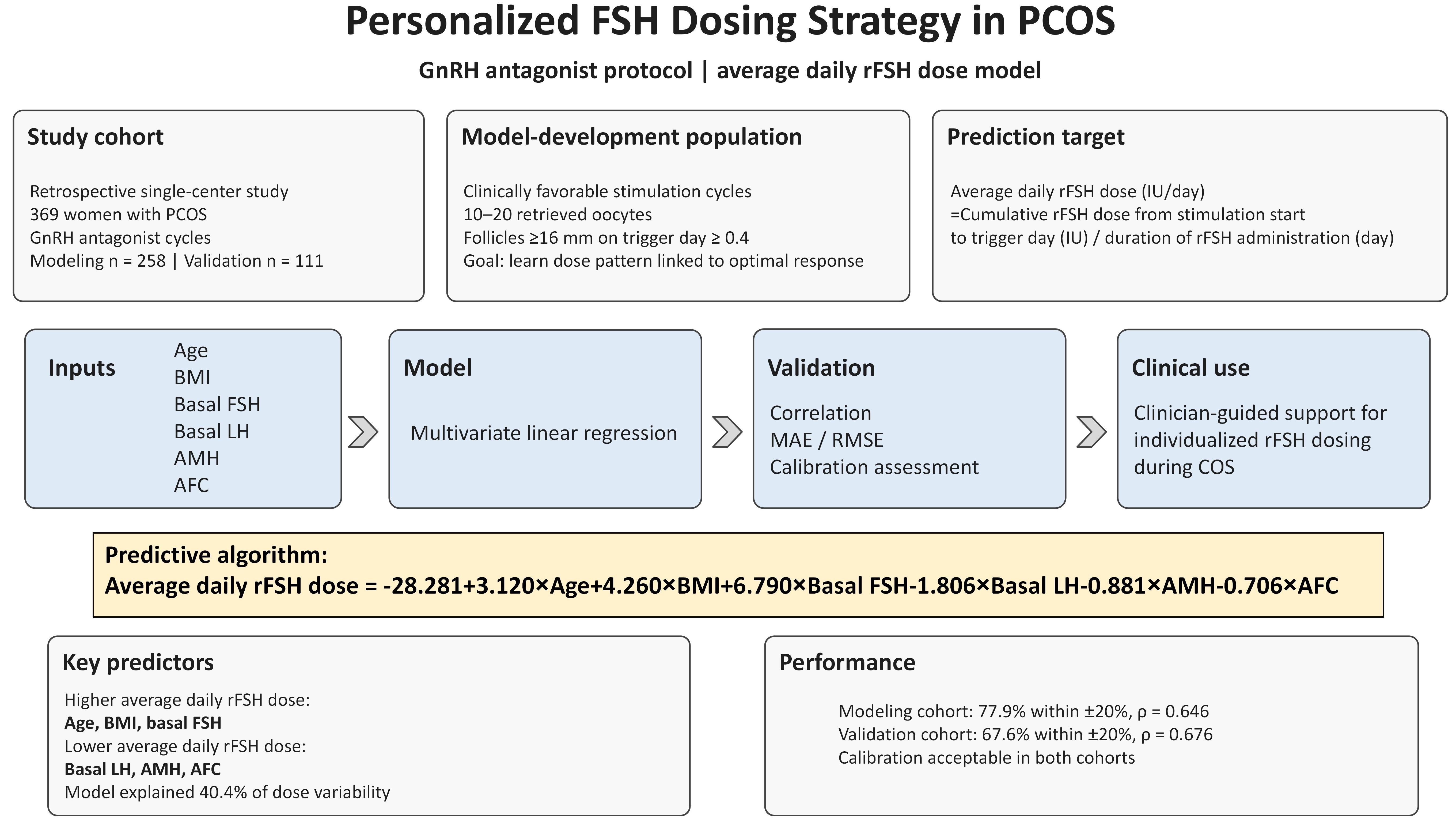
A Personalized FSH Dosing Strategy for Women with Polycystic Ovary Syndrome Undergoing GnRH Antagonist Protocols


Abstract
1. Introduction
2. Material and Methods
2.1. Ethics Statement
2.2. Population
2.3. Fixed Day 5/6 GnRH Antagonist Protocol
2.4. Hormone Assay and AFC Measurement
2.5. Variables Selection
2.6. Outcome Measurement
2.7. Statistical Analysis
2.7.1. Descriptive Analysis
2.7.2. Univariate and Multivariate Linear Regression
2.7.3. Internal Validation of the Predictive Algorithm
3. Results
3.1. Baseline Characteristics and Treatment Characteristics
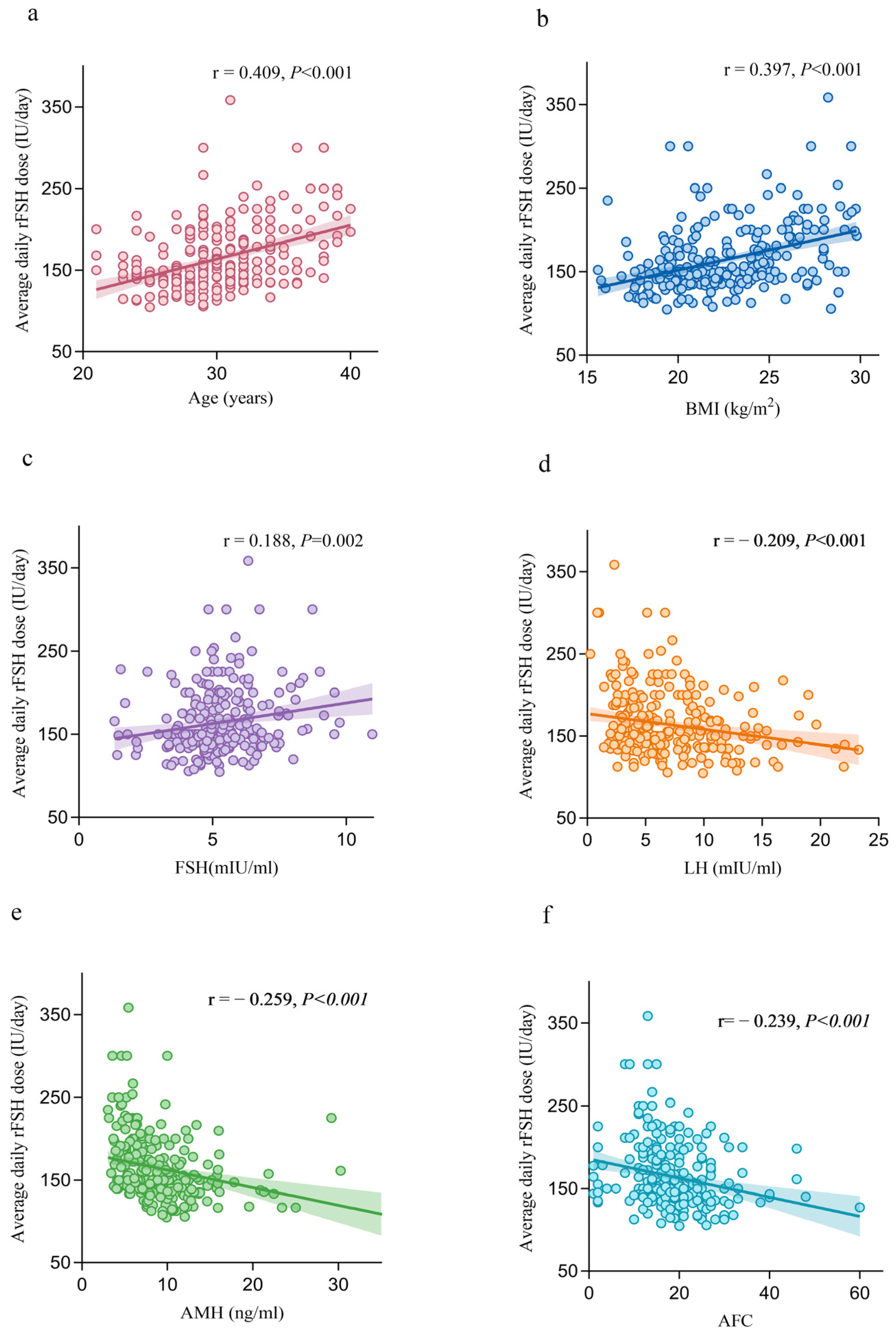
3.2. Factors Associated with Average Daily rFSH Dose
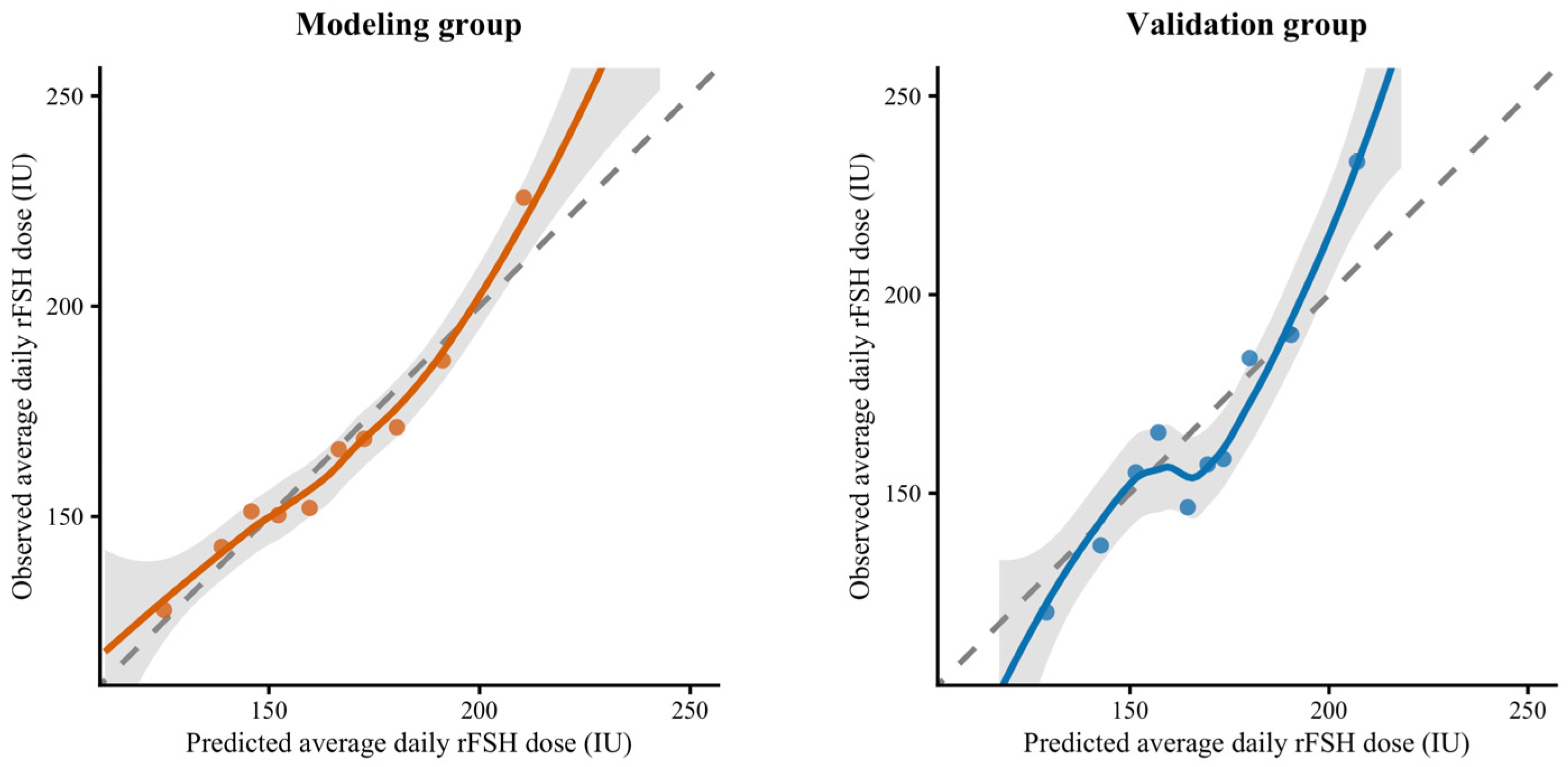
3.3. Calibration and Validation of the Algorithm
4. Discussion
5. Conclusions
Author Contributions
Funding
Institutional Review Board Statement
Informed Consent Statement
Data Availability Statement
Acknowledgments
Conflicts of Interest
References
- Yildiz, B.O.; Bozdag, G.; Yapici, Z.; Esinler, I.; Yarali, H. Prevalence, Phenotype and Cardiometabolic Risk of Polycystic Ovary Syndrome under Different Diagnostic Criteria. Hum. Reprod. 2012, 27, 3067–3073. [Google Scholar] [CrossRef]
- Chen, Y.; Wang, G.; Chen, J.; Wang, C.; Dong, X.; Chang, H.-M.; Yuan, S.; Zhao, Y.; Mu, L. Genetic and Epigenetic Landscape for Drug Development in Polycystic Ovary Syndrome. Endocr. Rev. 2024, 45, 437–459. [Google Scholar] [CrossRef]
- Forslund, M.; Melin, J.; Stener-Victorin, E.; Hirschberg, A.L.; Teede, H.; Vanky, E.; Piltonen, T. International Evidence-based Guideline on Assessment and Management of PCOS—A Nordic Perspective. Acta Obstet. Gynecol. Scand. 2023, 103, 7–12. [Google Scholar] [CrossRef]
- Mourad, S.; Brown, J.; Farquhar, C. Interventions for the Prevention of OHSS in ART Cycles: An Overview of Cochrane Reviews. Cochrane Database Syst. Rev. 2017, 1, CD012103. [Google Scholar] [CrossRef]
- Xu, B.; Zhou, M.; Cheng, M.; Zhang, D.; Wu, X.; Si, C.; Xia, L.; Xu, H.; Li, J.; Chang, H.-M.; et al. Transvaginal Ovarian Drilling Followed by Controlled Ovarian Stimulation from the next Day Improves Ovarian Response for the Poor Responders with Polycystic Ovary Syndrome during IVF Treatment: A Pilot Study. Reprod. Biol. Endocrinol. 2020, 18, 7. [Google Scholar] [CrossRef]
- Popovic-Todorovic, B.; Loft, A.; Lindhard, A.; Bangsbøll, S.; Andersson, A.M.; Andersen, A.N. A Prospective Study of Predictive Factors of Ovarian Response in “standard” IVF/ICSI Patients Treated with Recombinant FSH. A Suggestion for a Recombinant FSH Dosage Normogram. Hum. Reprod. 2003, 18, 781–787. [Google Scholar] [CrossRef] [PubMed]
- Howles, C.M.; Saunders, H.; Alam, V.; Engrand, P.; FSH Treatment Guidelines Clinical Panel. Predictive Factors and a Corresponding Treatment Algorithm for Controlled Ovarian Stimulation in Patients Treated with Recombinant Human Follicle Stimulating Hormone (Follitropin Alfa) during Assisted Reproduction Technology (ART) Procedures. An Analysis of 1378 Patients. Curr. Med. Res. Opin. 2006, 22, 907–918. [Google Scholar] [CrossRef] [PubMed]
- La Marca, A.; Papaleo, E.; Grisendi, V.; Argento, C.; Giulini, S.; Volpe, A. Development of a Nomogram Based on Markers of Ovarian Reserve for the Individualisation of the Follicle-Stimulating Hormone Starting Dose in in Vitro Fertilisation Cycles. BJOG Int. J. Obstet. Gynaecol. 2012, 119, 1171–1179. [Google Scholar] [CrossRef]
- La Marca, A.; Grisendi, V.; Giulini, S.; Argento, C.; Tirelli, A.; Dondi, G.; Papaleo, E.; Volpe, A. Individualization of the FSH Starting Dose in IVF/ICSI Cycles Using the Antral Follicle Count. J. Ovarian Res. 2013, 6, 11. [Google Scholar] [CrossRef] [PubMed]
- Li, Y.; Duan, Y.; Yuan, X.; Cai, B.; Xu, Y.; Yuan, Y. A Novel Nomogram for Individualized Gonadotropin Starting Dose in GnRH Antagonist Protocol. Front. Endocrinol. 2021, 12, 688654. [Google Scholar] [CrossRef]
- Wei, Y.; Luan, T.; Shen, J.; Zhang, J.; Zhang, J.; Su, Y.; Ling, X.; Li, X.; Zhao, C. LH on GnRH-Ant Day to Basal LH Affects the IVF/ICSI Outcome of PCOS Women Undergoing GnRH-Antagonist Protocol. Int. J. Gynecol. Obstet. 2024, 164, 624–632. [Google Scholar] [CrossRef]
- Hu, Z.; Zeng, R.; Gao, R.; Chen, M.; Liu, X.; Zhang, Q.; Qin, L.; Zeng, X. Effects of Different Gonadotropin Preparations in GnRH Antagonist Protocol for Patients with Polycystic Ovary Syndrome during IVF/ICSI: A Retrospective Cohort Study. Front. Endocrinol. 2024, 15, 1309993. [Google Scholar] [CrossRef] [PubMed]
- Akoglu, H. User’s Guide to Correlation Coefficients. Turk. J. Emerg. Med. 2018, 18, 91–93. [Google Scholar] [CrossRef]
- Muharam, R.; Prasetyo, Y.D.; Prabowo, K.A.; Putri, Y.I.; Maidarti, M.; Hestiantoro, A. IVF Outcome with a High Level of AMH: A Focus on PCOS versus Non-PCOS. BMC Womens Health 2022, 22, 172. [Google Scholar] [CrossRef]
- Verberg, M.F.G.; Eijkemans, M.J.C.; Macklon, N.S.; Heijnen, E.M.E.W.; Baart, E.B.; Hohmann, F.P.; Fauser, B.C.J.M.; Broekmans, F.J. The Clinical Significance of the Retrieval of a Low Number of Oocytes Following Mild Ovarian Stimulation for IVF: A Meta-Analysis. Hum. Reprod. Update 2009, 15, 5–12. [Google Scholar] [CrossRef]
- Sunkara, S.K.; Rittenberg, V.; Raine-Fenning, N.; Bhattacharya, S.; Zamora, J.; Coomarasamy, A. Association between the Number of Eggs and Live Birth in IVF Treatment: An Analysis of 400 135 Treatment Cycles. Hum. Reprod. 2011, 26, 1768–1774. [Google Scholar] [CrossRef]
- Magnusson, Å.; Källen, K.; Thurin-Kjellberg, A.; Bergh, C. The Number of Oocytes Retrieved during IVF: A Balance between Efficacy and Safety. Hum. Reprod. 2018, 33, 58–64. [Google Scholar] [CrossRef]
- Srivastava, D.A. To Analyse the Optimal Number of Oocytes Retrieved from Pcos Patients and Normo-Ovulatory Women Undergoing Ivf-Icsi Cycles to Obtain Maximum Clinical Pregnancy Rate. Fertil. Steril. 2024, 122, e430. [Google Scholar] [CrossRef]
- Revelli, A.; Martiny, G.; Delle Piane, L.; Benedetto, C.; Rinaudo, P.; Tur-Kaspa, I. A Critical Review of Bi-Dimensional and Three-Dimensional Ultrasound Techniques to Monitor Follicle Growth: Do They Help Improving IVF Outcome? Reprod. Biol. Endocrinol. 2014, 12, 107. [Google Scholar] [CrossRef]
- Wirleitner, B.; Okhowat, J.; Vištejnová, L.; Králíčková, M.; Karlíková, M.; Vanderzwalmen, P.; Ectors, F.; Hradecký, L.; Schuff, M.; Murtinger, M. Relationship between Follicular Volume and Oocyte Competence, Blastocyst Development and Live-Birth Rate: Optimal Follicle Size for Oocyte Retrieval. Ultrasound Obstet. Gynecol. 2018, 51, 118–125. [Google Scholar] [CrossRef] [PubMed]
- Dubey, A.K.; An Wang, H.; Duffy, P.; Penzias, A.S. The Correlation between Follicular Measurements, Oocyte Morphology, and Fertilization Rates in an in Vitro Fertilization Program. Fertil. Steril. 1995, 64, 787–790. [Google Scholar] [CrossRef] [PubMed]
- Shmorgun, D.; Hughes, E.; Mohide, P.; Roberts, R. Prospective Cohort Study of Three- versus Two-Dimensional Ultrasound for Prediction of Oocyte Maturity. Fertil. Steril. 2010, 93, 1333–1337. [Google Scholar] [CrossRef] [PubMed]
- Yang, J.; Gao, J.; Wang, Y.; Liu, H.; Lian, X. Impact of Follicular Size Categories on Oocyte Quality at Trigger Day in Young and Advanced-Age Patients Undergoing GnRH-Ant Therapy. Front. Endocrinol. 2023, 14, 1167395. [Google Scholar] [CrossRef]
- Peres Fagundes, P.A.; Chapon, R.; Olsen, P.R.; Schuster, A.K.; Mattia, M.M.C.; Cunha-Filho, J.S. Evaluation of Three-Dimensional SonoAVC Ultrasound for Antral Follicle Count in Infertile Women: Its Agreement with Conventional Two-Dimensional Ultrasound and Serum Levels of Anti-Müllerian Hormone. Reprod. Biol. Endocrinol. 2017, 15, 96. [Google Scholar] [CrossRef] [PubMed]



| Variables | Modeling Group (n = 258) | Validation Group (n = 111) | p a |
|---|---|---|---|
| Female age (years) | 30.00 (28.00, 33.00) | 30.00 (28.00, 32.00) | 0.326 |
| Male age (years) | 32.00 (30.00, 35.00) | 32.00 (29.00, 35.00) | 0.492 |
| ART methods, n (%) | 0.486 | ||
| IVF | 159 (61.63) | 64 (57.66) | |
| ICSI | 55 (21.32) | 30 (27.03) | |
| PGT | 44 (17.06) | 17 (15.32) | |
| Duration of infertility (years) | 3.00 (2.00, 5.00) | 4.00 (2.00, 5.00) | 0.069 |
| BMI (kg/m2) | 22.02 (20.10, 24.80) | 22.72 (20.37, 25.12) | 0.466 |
| AFC (n) | 18.00 (14.00, 23.00) | 18.00 (15.00, 23.00) | 0.613 |
| Basal FSH (mIU/mL) | 5.12 (4.47, 6.01) | 5.00 (4.13, 5.92) | 0.263 |
| Basal LH (mIU/mL) | 5.78 (3.50, 9.04) | 4.99 (3.84, 8.05) | 0.431 |
| Basal E2 (pg/mL) | 24.00 (13.47, 38.75) | 21.88 (13.07, 37.84) | 0.604 |
| Basal T(ng/mL) | 0.44 (0.34, 0.56) | 0.42 (0.33, 0.55) | 0.278 |
| AMH (ng/mL) | 8.25 (6.08, 10.65) | 8.17 (5.78, 10.96) | 0.056 |
| Cumulative rFSH dose (IU) | 1350.00 (1125.00, 1725.00) | 1350.00 (1125.00, 1800.00) | 0.945 |
| Initial rFSH dose (IU) | 150.00 (150.00, 187.50) | 150.00 (150.00, 175.00) | 0.328 |
| Duration of stimulation (days) | 9.00 (8.00, 10.00) | 9.00 (8.00, 10.00) | 0.750 |
| Average daily rFSH dose (IU/day) | 150.00 (139.29, 185.16) | 150.00 (137.50, 185.94) | 0.867 |
| Number of oocytes retrieved (n) | 15.00 (13.00, 18.00) | 16.00 (13.00, 18.00) | 0.107 |
| Number of mature oocytes (n) | 13.00 (11.00, 16.00) | 14.00 (11.00, 16.00) | 0.169 |
| Number of 2PN oocytes (n) | 11.00 (9.00, 14.00) | 12.00 (9.50, 14.00) | 0.245 |
| Number of utilizable embryos on Day 3 * (n) | 4.00 (2.00, 6.00) | 4.00 (2.00, 7.00) | 0.366 |
| Variables | Univariate Analysis | Multivariate Analysis | |||
|---|---|---|---|---|---|
| B (95% CIs) | p | B (95% CIs) | p | Adjusted R2 | |
| Female age (years) | 4.162 (3.020~5.304) | <0.001 | 3.120 (2.131~4.110) | <0.001 | 0.404 |
| BMI (kg/m2) | 4.798 (3.431~6.164) | <0.001 | 4.260 (3.078~5.443) | <0.001 | |
| Basal FSH (mIU/mL) | 4.972 (1.772~8.172) | 0.002 | 6.790 (3.939~9.640) | <0.001 | |
| Basal LH (mIU/mL) | −1.892(−2.980~−0.804) | 0.001 | −1.806 (−2.808~−0.805) | <0.001 | |
| AMH (ng/mL) | −2.144 (−3.130~−1.158) | <0.001 | −0.881(−1.756~−0.005) | 0.049 | |
| AFC (n) | −1.155 (−1.733~−0.577) | <0.001 | −0.7006 (−1.210~−0.202) | 0.006 | |
| Group | Paired t-Test p | ρ | MAE (IU) | RMSE (IU) | Deviation ≤ 20% |
|---|---|---|---|---|---|
| Modeling group (n = 258) | 0.986 | 0.646 | 21.82 | 29.75 | 77.91% |
| Validation group (n = 111) | 0.540 | 0.676 | 23.87 | 31.89 | 67.57% |
Disclaimer/Publisher’s Note: The statements, opinions and data contained in all publications are solely those of the individual author(s) and contributor(s) and not of MDPI and/or the editor(s). MDPI and/or the editor(s) disclaim responsibility for any injury to people or property resulting from any ideas, methods, instructions or products referred to in the content. |
© 2026 by the authors. Licensee MDPI, Basel, Switzerland. This article is an open access article distributed under the terms and conditions of the Creative Commons Attribution (CC BY) license.
Share and Cite
Chen, Y.; Yang, T.; Luo, Z.; Luo, L.; Zhang, Z.; Xu, Y.; Chen, M. A Personalized FSH Dosing Strategy for Women with Polycystic Ovary Syndrome Undergoing GnRH Antagonist Protocols. Biomedicines 2026, 14, 769. https://doi.org/10.3390/biomedicines14040769
Chen Y, Yang T, Luo Z, Luo L, Zhang Z, Xu Y, Chen M. A Personalized FSH Dosing Strategy for Women with Polycystic Ovary Syndrome Undergoing GnRH Antagonist Protocols. Biomedicines. 2026; 14(4):769. https://doi.org/10.3390/biomedicines14040769
Chicago/Turabian StyleChen, Yixin, Turui Yang, Zicong Luo, Lu Luo, Ziqing Zhang, Yanwen Xu, and Minghui Chen. 2026. "A Personalized FSH Dosing Strategy for Women with Polycystic Ovary Syndrome Undergoing GnRH Antagonist Protocols" Biomedicines 14, no. 4: 769. https://doi.org/10.3390/biomedicines14040769
APA StyleChen, Y., Yang, T., Luo, Z., Luo, L., Zhang, Z., Xu, Y., & Chen, M. (2026). A Personalized FSH Dosing Strategy for Women with Polycystic Ovary Syndrome Undergoing GnRH Antagonist Protocols. Biomedicines, 14(4), 769. https://doi.org/10.3390/biomedicines14040769