Article

Clinical Characteristics and Predictors of Glycemic Control During the First 24 Months After Diagnosis of Type 1 Diabetes

1
Division of Endocrinology and Diabetology, Department of Internal Medicine, Medical University of Graz, 8036 Graz, Austria
2
Department of Endocrinology, Rheumatology and Acute Geriatrics, Klinik Ottakring, 1160 Vienna, Austria
3
Department of Pediatrics and Adolescent, Medicine Division of General Pediatrics, Medical University of Graz, 8036 Graz, Austria
4
Cardiometabolic Trials Unit, Medical University of Graz, 8036 Graz, Austria
5
Department of Food Chemistry and Toxicology, University of Vienna, 1090 Vienna, Austria
*
Author to whom correspondence should be addressed.
These authors contributed equally to this work.
Biomedicines 2026, 14(3), 690; https://doi.org/10.3390/biomedicines14030690
Submission received: 18 February 2026 / Revised: 13 March 2026 / Accepted: 14 March 2026 / Published: 17 March 2026
(This article belongs to the Special Issue Pathology, Complications and Prognosis of Type 1 Diabetes)

Abstract

Background: Long-term glycemic control in type 1 diabetes (T1D) varies substantially among affected individuals, but the role of baseline characteristics at diagnosis and their association with later glycemic control remain incompletely understood. Identifying early predictors of glycemic control may facilitate timely, individualized therapeutic interventions. Methods: We retrospectively analyzed electronic health records of individuals with newly diagnosed T1D between 2001 and 2022 to assess anthropometric and metabolic parameters at the first presentation of the condition across age groups and determine predictors of glycated hemoglobin (HbA1c) trajectories over 24 months. The multicentric cohort, which comprised people who were diagnosed with T1D in the Austrian federal state of Styria, was classified as children (<10 years), adolescents (10–18 years) or adults (≥18 years). Variables of interest included demographic and anthropometric data, positivity and titers of diabetes-specific autoantibodies, treatment setting (inpatient/outpatient), and presence and severity of diabetic ketoacidosis (DKA). Results: The cohort consisted of 281 individuals (23.1% were children, 41.3% were adolescents, and 35.6% were adults at T1D diagnosis; 46.6% were female). In the unadjusted analyses, younger age (age < 18 years), female sex, and receiving treatment in a general ward were associated with higher HbA1c levels over 24 months. However, after adjustment for important covariates, only younger age remained a significant predictor of inferior glycemic control over 24 months, emphasizing the importance of structured, age-appropriate follow-up care. Conclusions: Younger age at T1D diagnosis independently predicts suboptimal glycemic trajectories over the first two years after T1D onset. Early identification may enable targeted, age-specific interventions to improve long-term outcomes.

1. Introduction

Type 1 diabetes (T1D) is a T cell–mediated autoimmune disease characterized by a dysregulated immune response leading to the destruction of pancreatic β-cells [1]. Globally, T1D is among the most common autoimmune metabolic disorders in children and adolescents, affecting 1 in 250 individuals by the age of 17 years [2]. In Germany, the number of newly diagnosed cases increases by approximately 3200 per year [2]. In Austria, there is an alarming increase in the prevalence of diabetic ketoacidosis (DKA) at T1D onset, especially in children < 2 years [3]. According to projections, the global number of individuals living with T1D is estimated to increase from approximately 8.4 million in 2021 to between 13.5 and 17.4 million by 2040, representing a relative increase of 60% to 107% over this period [4]. The etiology of T1D is believed to involve a combination of genetic predisposition, virus-induced immune responses, and environmental factors [1]. At the time of diagnosis, a significant proportion of β-cells are already destroyed, resulting in diabetic ketoacidosis (DKA) in 25–40% of cases, often requiring intensive care treatment [5,6,7]. Over one-third of affected individuals are diagnosed at an advanced stage, already presenting with severe metabolic disturbances [7]. This highlights the importance of early recognition of T1D and of predictors for future suboptimal glycemic outcomes [8].
Several predictors of insufficient glycemic control are already described in the literature, including DKA at diagnosis, overweight and obesity, comorbidities, first-born status, baseline HbA1c > 9.5%, a higher titer of GAD-A antibodies, low socioeconomic status, family history of diabetes, non-White ethnicity, and poor adherence to treatment or diet [9,10,11].
Suboptimal HbA1c levels, often accompanied by metabolic, social and mental impairments, reduce quality of life and increase morbidity and mortality [12,13]. The knowledge of predictors impacting later glycemic control after T1D diagnosis is important in regard to identifying those with insufficient blood glucose control or complications at an early stage. This enables intensified monitoring and therapeutic strategies from the earliest stages of the disease. If certain factors that influence subsequent blood glucose control are known, treatment can be individually adapted. For example, more individualized insulin therapy or closer monitoring may be appropriate for certain groups of people living with diabetes. Furthermore, affected people might be encouraged for motivation for consistent treatment and beneficial lifestyle changes when predictors of prospective glucose control are individually defined. Understanding predictors might also promote the development of new treatment approaches and improve clinical decision-making.
The aim of this study is, therefore, to investigate predictive factors for suboptimal metabolic control within the first 2 years in people with newly diagnosed T1D in order to identify early indicators of a potentially adverse disease course. Additional objectives include characterizing this population and identifying associations or differences in laboratory values, medical interventions and other parameters across subgroups during diabetes onset and during the further course of the disease.

2. Materials and Methods

This retrospective analysis encompassed data of people with T1D at any age being in care in an outpatient clinic of a secondary and tertiary care center. The study population was identified by a diagnosis-based health record search performed by the Institute for Medical Informatics (Medical University of Graz). People with the diagnosis of T1D within their medical records who visited the outpatient clinic between 1 January 2001 and 31 December 2022 were included and followed up according to HbA1c for 2 further years.
Initially, 1606 individuals were identified. After manual review and exclusion of cases with incomplete data, a final sample of 281 people with sufficiently available follow-up data was included in the analysis.
The time of initial diagnosis was determined through a manual review of electronic records, covering entries from 2001 through 31 December 2022 in order to ensure a 2-year follow-up period. People younger than 18 years at diagnosis who were treated at the department of pediatrics were also included, as were those whose diagnosis or treatment occurred at other facilities within the Styrian Hospital Association (KAGes) indicating a national multicenter setting.
Demographic and medical data were retrospectively extracted from the electronic medical record system. The index visits were physical presentations at medical institutions of the specific hospital association (KAGes), either at outpatient clinics, emergency rooms or intensive care units due to the very first manifestation of hyperglycemia in response to T1D onset. Collected parameters at the index visit were categorized as follows: demographic data (age, sex, body weight, height, BMI), disease-specific data (ketoacidosis yes/no [defined as pH < 7.3], setting of primary care [outpatient, general ward or intensive care unit], pediatric or adult setting), laboratory values (pH, HbA1c, C-peptide, glucose, C-peptide/glucose ratio [CGR], creatinine, glomerular filtration rate [GFR], C-reactive protein [CRP], total cholesterol, low-density lipoprotein cholesterol [LDL-C], triglycerides, proinsulin) as well as diabetes-specific antibodies (islet cell antibodies [IC-A], insulin antibodies [IA-A], tyrosine phosphatase antibodies [IA-2-A], glutamate decarboxylase antibodies [GAD-A] and zinc-transporter antibodies [ZnT8-A]). HbA1c values as well as C-peptide and glucose were retrospectively extracted from the medical records at the time points of 3, 6, 12 and 24 months after the index visit.

2.1. Ethical Considerations

All data were pseudonymized using people’s IDs only for privacy protection. This study was approved by the Ethics Committee of the Medical University of Graz (EK-No. 36-208 ex 23/24).

2.2. Statistical Analysis

Statistical analyses were performed using IBM SPSS Statistics, version 30. Continuous variables are presented as the mean ± standard deviation, while categorical variables are presented as frequencies and percentages. Group comparisons were conducted using independent samples t-tests, chi-squared tests and one-way ANOVA, as appropriate. Pearson’s correlation coefficients were used to assess the relationships between the baseline variables. To evaluate the course of glycemic control, HbA1c levels at 3, 6, 12 and 24 months were analyzed using linear mixed-effects models with repeated measures and random intercepts. Baseline HbA1c at diagnosis was included as a covariate. In the linear mixed-effects models, estimates represent the mean difference in HbA1c between comparison groups or per unit increase in a continuous predictor. Positive estimates indicate higher HbA1c values compared to the respective reference category.
For each predefined clinical and immunological factor (age group, sex, presence of diabetic ketoacidosis, initial treatment setting, C-peptide–glucose ratio tertiles, and number of positive diabetes-specific autoantibodies), separate models were fitted and adjusted for age, sex, and baseline HbA1c. Body mass index (BMI) was not included in the adjusted models due to a high proportion of missing data.
For each factor, both the global association with HbA1c (p-value) and the interaction between time and the factor (p for interaction, pint) were assessed to evaluate whether the effect on HbA1c changed over time. Type III tests with Satterthwaite’s approximation were applied for significance testing, and Bonferroni correction was used for post hoc comparisons. A p-value < 0.05 was considered statistically significant.
Generative AI (ChatGPT, based on the GPT-5.3 model) was used exclusively for language editing and not for content generation or data analysis.

3. Results

A total of 281 people were included in the analysis. Based on age at diagnosis, 65 individuals (23.1%) were classified as children (<10 years), 116 (41.3%) were classified as adolescents (10–18 years), and 100 (35.6%) were classified as adults (≥18 years). The mean age of the total cohort was 18.0 ± 13.0 years (range 1–79), and 46.6% of the included people were female. The mean body mass index (BMI) was 18.6 ± 4.9 kg/m2. Baseline characteristics of the specific age-based populations are indicated in Table 1.

3.1. Baseline Comparisons

3.1.1. Age Groups

All three age groups differed significantly in weight (p < 0.001), height (p < 0.001) and, subsequently, BMI (p < 0.001) as well as creatinine levels (p < 0.001). Furthermore, adults exhibited significantly lower glucose levels at disease onset compared to children and adolescents (children vs. adults: p < 0.001; adolescents vs. adults: p = 0.049). HbA1c and presence of DKA were comparable in all age groups.

3.1.2. HbA1c

In the total population, HbA1c at diagnosis was significantly positively correlated with serum creatinine (p = 0.014), total cholesterol (p < 0.001) and triglycerides (p < 0.001). Negative correlations were observed between HbA1c and BMI (p = 0.009), pH (p < 0.001) and the C-peptide/glucose ratio (CGR p < 0.001).

3.1.3. C-Peptide and C-Peptide to Glucose Ratio (CGR)

The CGR showed a moderate positive correlation with pH (p = 0.004). Negative correlations were found with HbA1c (p < 0.001) and creatinine (p = 0.011).

3.1.4. Sex Aspect

Regarding sex-specific differences, male individuals had higher body weight (p = 0.020), height (p < 0.001), creatinine (p = 0.011) and eGFR (p = 0.047), whereas women had higher C-peptide levels (p = 0.042) and lower pH values (p = 0.035) at T1D diagnosis. No statistically significant differences were found between sexes in terms of type of care at diagnosis, presence of DKA, HbA1c or the number of positive autoantibodies.

3.1.5. Diabetic Ketoacidosis (DKA)

A total of 82 cases of DKA at diabetes onset were observed in this cohort study, with 18 in children, 39 in adolescents and 25 in adults, respectively. The presence of DKA was associated with lower body weight (p = 0.010) and height (p = 0.026) and several metabolic parameters at baseline, including higher HbA1c, CRP, creatinine, LDL-C, total cholesterol, and triglycerides and lower C-peptide, CGR, proinsulin, and eGFR (all p < 0.05). DKA was primarily treated in the intensive care setting (97.3%). Additionally, a significant association was found between DKA and the number of positive autoantibodies (p = 0.027), though no linear trend was observed (p = 0.445).

3.1.6. Type of Care (Outpatient, General Ward, Intensive Care Unit)

Individuals treated in the intensive care unit (ICU) presented with higher levels of HbA1c, creatinine, glucose, and triglycerides and lower levels of C-peptide, CGR, pH, BMI and proinsulin compared to those managed in the outpatient setting (all p < 0.05). Management type also varied significantly with age (p < 0.001), with younger people more likely to receive treatment in the general ward or intensive care and older individuals more frequently managed on an outpatient basis. A linear trend supported this association (p < 0.001). Moreover, the type of care was significantly associated with the presence of DKA (p < 0.001).

3.1.7. Autoantibodies

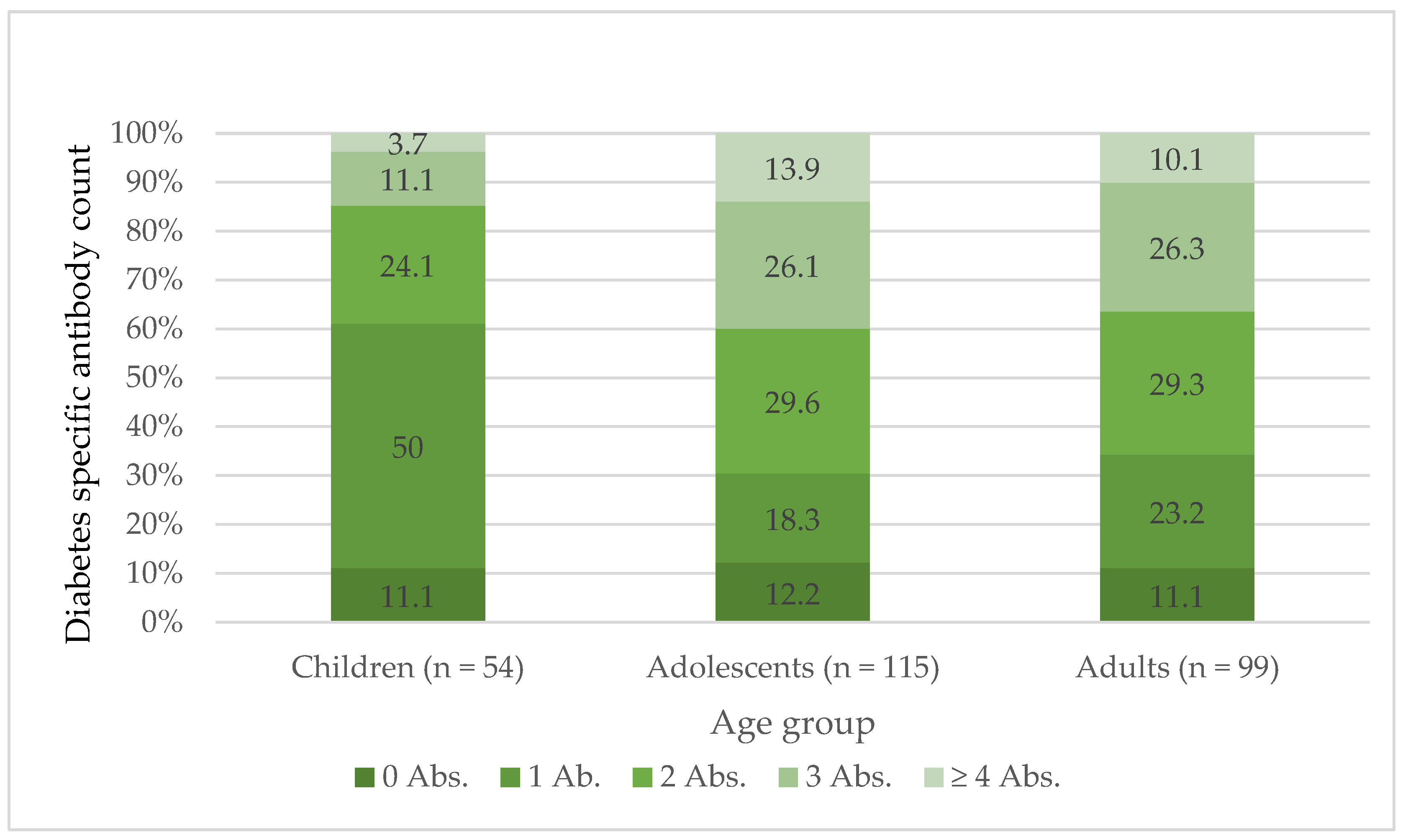
The presence of four or more positive autoantibodies was associated with higher body weight, height, and creatinine and lower levels of C-peptide and triglycerides compared to people with no positive autoantibodies at diagnosis (all p < 0.05). A significant association was observed between age at diagnosis and the number of positive diabetes-specific autoantibodies (p = 0.007). Children most frequently had 0 or 1 positive autoantibody (11.1% and 50%, respectively), while ≥4 autoantibodies were rare (3.7%), as seen in Figure 1. In contrast, adolescents and adults more often presented with multiple autoantibodies, with ≥4 positive markers found in 13.8% and 10.1%, respectively. A test for linear trend confirmed that higher age at onset was associated with a greater number of positive autoantibodies (p = 0.025).

3.2. Predictors of HbA1c Progression over 24 Months with Linear Mixed Model

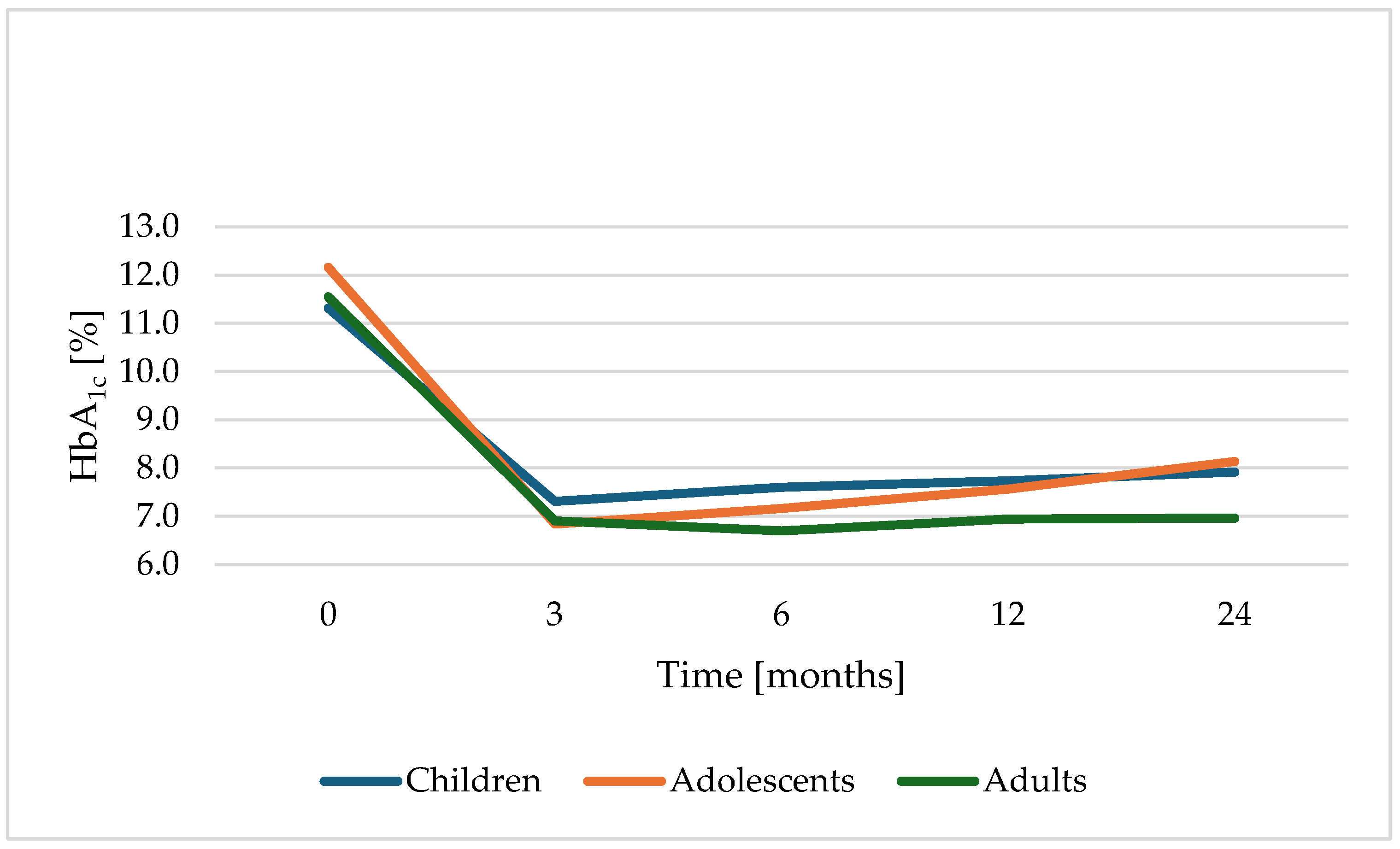
Across all age groups, mean HbA1c decreased significantly in the first six months and stabilized thereafter [HbA1c at index visit: 11.75% [CI: 11.46–12.04], at 3 months: 6.98% [CI: 6.84–7.11], at 6 months 7.12% [CI: 6.97–7.27], at 12 months 7.42% [CI: 7.27–7.56], and at 24 months 7.75% [CI: 7.59–7.91] (p < 0.001)]. Figure 2 shows a descriptive visualization of the HbA1c trajectory over 24 months in three specific age groups.

3.2.1. Unadjusted Analysis of Baseline Variables on HbA1c

  • Management upon initial diagnosis
After adjustment for only baseline HbA1c, during follow-up, outpatient management was associated with significantly lower HbA1c values compared with people admitted to the general ward (p = 0.012); however, there was no significant difference between general ward care and intensive care regarding HbA1c trajectories (p = 1.000). On average, individuals admitted to the general ward at diagnosis showed an HbA1c difference of +0.54% compared to outpatient care (p = 0.009) during the 2 years of follow-up, also shown in Table 2. For people in ICU, this effect was slightly smaller at +0.51% in comparison to outpatient therapy (p = 0.078).
  • Age and sex
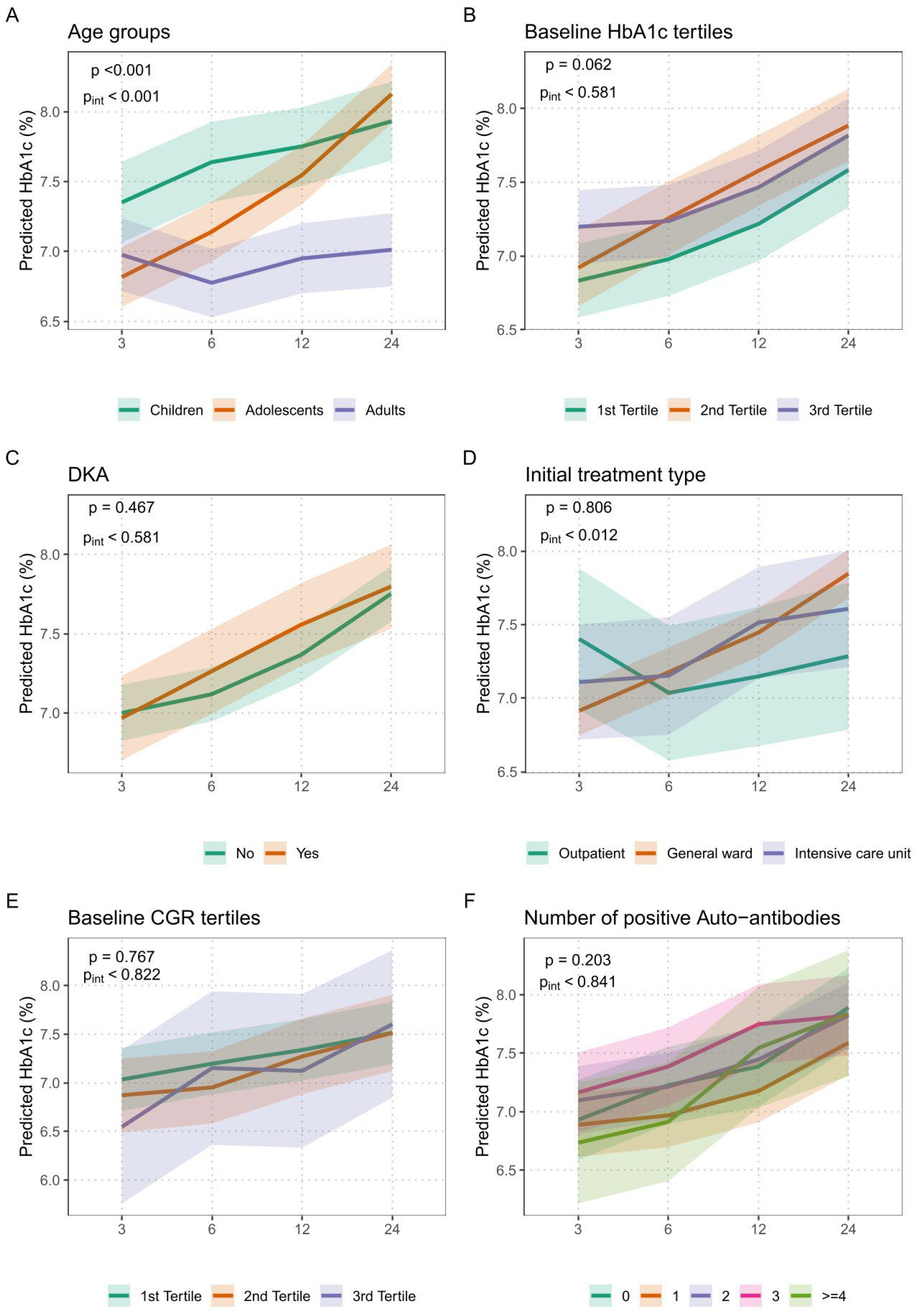
Age at first manifestation and our predefined age groups (children, adolescents and adults) showed a significant association with HbA1c levels over the first 24 months post-T1D diagnosis. Adolescents demonstrated the most unfavorable glycemic trajectory, with the steepest increase in HbA1c, whereas adults maintained the lowest and most stable levels throughout follow-up, as shown in Figure 2 and Figure 3A. Throughout the entire study period, average HbA1c levels of female individuals were 0.22% higher than males at all measurement times (p = 0.034).
  • Antibody count and titer
The number of positive diabetes-specific autoantibodies (GAD-A, IA-2-A, ZnT8-A, IA-A) at diagnosis showed no significant association with average HbA1c levels over the 24-month follow-up period (p = 0.399).
The titer of glutamic acid decarboxylase (GAD-A) antibodies had no significant association with HbA1c progression. People with higher GAD-A Ab levels did not tend to develop suboptimal HbA1c values (p = 0.312) across all age groups. Also, the quantitative value of the other antibodies (ZnT8-A, IA-2-A, IA-A) were not significantly associated with HbA1c trajectories.
  • C-Peptide to Glucose ratio
A lower number of positive diabetes-specific autoantibodies (GAD-A, IA-2-A, ZnT8-A, IA-A) at diagnosis was significantly associated with higher average C-peptide to glucose ratios over the 24-month follow-up period (p = 0.045), indicating better preserved β-cell function.
Tertiles (tertile 1: CGR ≤ 0.47, tertile 2: 0.48–1.22, tertile 3: 1.23–5.00) for CGR were created to evaluate whether higher CGR values were associated with more favorable HbA1c trajectories. However, this analysis revealed no significant effect of CGR group on HbA1c levels across follow-up (p = 0.573). Taken together, these findings indicate that baseline CGR tertile did not significantly predict the further course of HbA1c over 24 months.
  • Diabetic ketoacidosis
In the total cohort, neither the presence of any diabetic ketoacidosis (defined as pH < 7.3) showed a significant association with HbA1c levels over 24 months after initial manifestation (p = 0.331) nor the manifestation with a severe DKA (defined as pH < 7.0) (p = 0.273). All the unadjusted parameters are summarized in Table 2.

3.2.2. Additional Unadjusted Outcomes

Tertiles for baseline HbA1c % (1: 5.45–10.66%; 2: 10.70–12.76%; 3: 12.80–18.80%) were created to assess the association with HbA1c trajectories over time. However, this analysis revealed no significant effect of different baseline HbA1c tertiles on subsequent HbA1c levels (p = 0.542), indicating that baseline HbA1c does not influence later glycemic control.
A CRP > 5 mg/L at the time of T1D diagnosis was not significantly associated with a higher HbA1c in the linear mixed-effects model over 24 months (p = 0.086).
The presence of impaired renal function at baseline (defined as eGFR < 60 mL/min/1.73 m2 in individuals aged ≥ 18 years) was not significantly associated with suboptimal glycemic control over 24 months. Although a trend towards higher HbA1c levels was observed in adult individuals with reduced eGFR (p = 0.088), this did not reach statistical significance.
The baseline LDL-C level was not significantly associated with overall HbA1c levels during the 24-month follow-up period (p = 0.531). Also, the baseline total cholesterol level was not significantly associated with higher overall HbA1c levels during the 24-month follow-up period (p = 0.660). The baseline triglyceride level was not significantly associated with overall HbA1c levels during the 24-month follow-up period (p = 0.390).

3.2.3. Adjusted Analysis of Predictors on HbA1c over 24 Months

In the adjusted linear mixed-effects models, each predefined clinical and immunological variable was analyzed separately, with adjustment for age, sex, and baseline HbA1c. Two p-values were reported: the global p-value (p), assessing the overall association of the factor with HbA1c, and the interaction p-value (pint), evaluating whether the effect of the factor on HbA1c changed over time.
Among all investigated factors, age group showed a highly significant global effect (p < 0.001) and a significant interaction with time (pint < 0.001), as shown in Figure 3A. This indicates that age at diagnosis not only affected mean HbA1c levels but also influenced their trajectory over the 24-month follow-up period. Children and adolescents exhibited higher HbA1c values across all time points, with adolescents showing the steepest deterioration.
Initial treatment setting was also associated with a significant interaction effect (pint = 0.012), though the global effect was not statistically significant (p = 0.806). This suggests that, while the overall HbA1c means did not differ significantly by treatment setting, the HbA1c trajectories over time did: individuals initially managed in outpatient care maintained more stable glycemic control compared to those admitted to general wards or intensive care.
In contrast, baseline HbA1c tertiles showed no significant global association (p = 0.062) and no interaction with time (pint = 0.581), indicating that baseline HbA1c levels were not predictive of glycemic outcomes over 24 months.
Similarly, the presence of diabetic ketoacidosis (DKA) at diagnosis was not significantly associated with HbA1c course, with both the global effect (p = 0.467) and interaction (pint = 0.581) remaining non-significant, as shown in Figure 3C.
The C-peptide to glucose ratio (CGR) at diagnosis did not significantly predict the course of HbA1c either, as evidenced by a p = 0.767 and pint = 0.822, also shown in Figure 3E.
Finally, the number of positive diabetes-specific autoantibodies was not significantly associated with HbA1c outcomes (p = 0.203 and pint = 0.841), suggesting limited prognostic utility of immunological status in the early disease course, as seen in Figure 3F.

4. Discussion

This retrospective multicenter cohort study aimed to identify early predictors of glycemic trajectories during the first 24 months after diagnosis of type 1 diabetes (T1D). The key and clinically most relevant finding is that younger age at diagnosis—particularly onset before 18 years—was the only independent predictor of suboptimal glycemic control in fully adjusted models. All other clinical, metabolic, and immunological factors lost independent significance after adjustment, underscoring age at onset as the dominant determinant of early glycemic outcomes.
Children and adolescents showed consistently higher HbA1c values over the entire follow-up period compared with adults, with adolescents displaying the most unfavorable trajectories. This finding is in strong agreement with large registry and cohort studies demonstrating deterioration of glycemic control during adolescence and young adulthood [13].
First, early-onset T1D is frequently associated with a more aggressive autoimmune process and more rapid β-cell destruction. Younger children tend to have lower residual C-peptide levels, reflecting diminished endogenous insulin secretion and reduced capacity to buffer glycemic excursions. In the Diabetes Control and Complications Trial Research Group (1993), preservation of C-peptide was strongly associated with improved glycemic outcomes and reduced complications [14]. Greenbaum et al. (2012) demonstrated that younger age at diagnosis is linked to lower stimulated C-peptide levels [15]. Similarly, Barker et al. (2014) reported an age-dependent decline in β-cell function in new-onset T1D [16]. Registry analyses from the Type 1 Diabetes Exchange further show that children diagnosed at younger ages have higher mean HbA1c values compared with young adults [17].
Second, developmental physiology complicates glycemic management. Young children exhibit unpredictable food intake, variable activity, and heightened insulin sensitivity, increasing hypoglycemia risk. Fear of hypoglycemia among caregivers has been associated with higher HbA1c [18]. During puberty, increased growth hormone and sex steroids induce insulin resistance, contributing to deterioration in glycemic control [19].
Third, psychosocial factors are critical. Glycemic outcomes in childhood are strongly influenced by family functioning and parental involvement. Greater family conflict is associated with higher HbA1c [20]. Parental stress and depressive symptoms correlate with poorer adherence and metabolic control. Survey analyses indicated that psychiatric stress among patients and their caregivers is directly associated with a younger age at diabetes diagnosis, supporting our observation that earlier onset may be linked to poorer glycemic control [21,22].
Female sex at diagnosis was associated with higher HbA1c levels in unadjusted analyses. Sex-related differences in glycemic control have been reported previously, with women often exhibiting higher HbA1c and complication risk [23]. However, in the present study, sex did not remain an independent predictor after adjustment, suggesting that its effect is largely mediated by age-related and anthropometric factors.
Despite clear associations between diabetic ketoacidosis (DKA) at diagnosis and adverse metabolic parameters at baseline, neither the presence nor the severity of DKA independently predicted HbA1c trajectories. This contrasts with earlier reports linking DKA at onset to worse long-term outcomes [24]. Our findings suggest that, within a healthcare system providing structured acute management and standardized follow-up, the negative prognostic impact of DKA may be largely reversible once metabolic stability is restored.
Neither the number nor titers of diabetes-specific autoantibodies (IC-A, GAD-A, IA-2-A, ZnT8-A, IA-A) were associated with glycemic control over 24 months. While a higher autoantibody burden correlated with lower C-peptide–glucose ratios—indicating reduced residual β-cell function—this did not translate into worse HbA1c outcomes during the first 24 months after diagnosis. Previous studies have reported conflicting results regarding the prognostic role of autoantibodies, with some suggesting more aggressive disease in individuals with multiple antibodies [25,26], whereas others indicate slower progression in GAD-A-positive individuals [27]. Our data support the interpretation that autoantibody profiles are essential for diagnosis and disease classification but have limited value for predicting early glycemic trajectories.
Inflammatory markers, lipid parameters, renal function, and baseline HbA1c tertiles were not independently associated with HbA1c trajectories. Although these variables are relevant for long-term cardiovascular and renal risk, they appear to play a minor role in shaping early glycemic outcomes after T1D onset.
The dominance of age at diagnosis as a predictor of early glycemic control has direct clinical implications. Children and adolescents with newly diagnosed T1D should be considered a high-risk group for early suboptimal glycemic control, independent of disease severity at presentation or immunological markers. Intensified, age-adapted diabetes education, psychosocial support, and close follow-up during the first years after diagnosis are essential to mitigate long-term risks associated with sustained hyperglycemia.
This study is limited by its retrospective design, which is subject to missing data, misclassification, and residual confounding, and does not allow causal inference. The selection of patients in our study was based on the T1D diagnosis as generated by the registry search, which served as the primary source for cohort identification. In clinical practice in Austria, in cases where islet autoantibodies are not detectable, the diagnosis of type 1 diabetes is typically established based on absent or markedly reduced C-peptide levels in combination with the clinical presentation and after exclusion of other forms of diabetes, such as monogenic diabetes.
In addition, we would like to emphasize the temporal context of our cohort. Our analysis includes individuals diagnosed with diabetes starting in 2001, a time when autoantibody panels were more limited than today because fewer islet autoantibodies were known and routinely tested. As a consequence, some individuals classified as antibody-negative at that time might have been positive if broader antibody panels (e.g., including ZnT8) had been available. This may partly explain the slightly higher proportion of individuals without detectable autoantibodies in our cohort.
Another limitation that has to be addressed is that the cohort originates from a single Austrian hospital network with a predominantly White population and universal healthcare access, potentially limiting generalizability. Data on socioeconomic status, diabetes education intensity, insulin delivery modalities, and glucose monitoring technologies were not consistently available. Furthermore, the 24-month follow-up may be insufficient to detect longer-term effects of immunological and metabolic factors on glycemic control. Nevertheless, this study provides robust real-world evidence identifying age at diagnosis as the central determinant of early HbA1c trajectories in T1D.

5. Conclusions

This retrospective multicenter cohort study found that age at diagnosis was the strongest and only factor showing both a significant overall association and a significant time interaction with glycemic control during the first 24 months after T1D onset. Individuals diagnosed before the age of 18 years had consistently higher HbA1c levels throughout the follow-up period, indicating a substantially increased risk of suboptimal long-term glycemic control.
No statistically significant overall associations with HbA1c trajectories were observed for sex, baseline HbA1c tertile, initial treatment setting (outpatient, general ward, or intensive care unit), presence or severity of diabetic ketoacidosis at diagnosis, C-peptide–glucose ratio tertiles, or the number of positive islet autoantibodies. However, the initial treatment setting showed a significant interaction with time, indicating differences in HbA1c trajectories over follow-up despite comparable overall HbA1c levels.
Overall, these findings emphasize the dominant role of younger age at diagnosis as an independent predictor of suboptimal glycemic control in people with newly diagnosed T1D. This highlights the need for age-specific diabetes education, intensified follow-up, and early therapeutic support, particularly for children and adolescents.

Author Contributions

Conceptualization, F.F., S.L., H.S. and F.A. (Felix Aberer); methodology, F.F., S.L., F.A. (Felix Aberer) and D.H.; software, F.F., S.L., D.H. and F.A. (Felix Aberer); validation, D.H., H.K. and F.A. (Faisal Aziz); formal analysis, S.L., F.F., F.A. (Faisal Aziz) and F.A. (Felix Aberer); investigation, S.L., F.F., H.K., F.A. (Faisal Aziz) and E.F.-R.; resources, E.F.-R., T.P. and H.S.; data curation, F.F. and D.H.; writing—original draft preparation, F.F., S.L. and F.A. (Felix Aberer); writing—review and editing, F.F., S.L., F.A. (Felix Aberer), F.A. (Faisal Aziz), D.H., E.F.-R., H.K., T.P. and H.S.; visualization, S.L., F.F., F.A. (Faisal Aziz) and H.K.; supervision, F.A. (Felix Aberer); project administration, F.A. (Felix Aberer), H.S., E.F.-R. and T.P.; supervision, F.A. (Felix Aberer). All authors have read and agreed to the published version of the manuscript.

Funding

This research received no external funding.

Institutional Review Board Statement

This study was conducted in accordance with the Declaration of Helsinki and approved by the Institutional Review Board of Ethics Committee of the Medical University of Graz (EK-No. 36-208 ex 23/24; approval date: 5 April 2025).

Informed Consent Statement

Due to the retrospective nature of this study, informed consent was not obtained. This study is based exclusively on previously collected clinical data that was generated as part of routine medical care. No additional interventions, examinations, or contacts with the patients were required. All data were fully anonymized/pseudonymized prior to analysis, ensuring that individual patients cannot be identified. This study, therefore, poses no additional risk or burden to the participants.

Data Availability Statement

The datasets generated and/or analyzed during the current study are not publicly available due to data protection and patient confidentiality regulations but are available from the corresponding author on reasonable request and with permission of the relevant ethics committee.

Acknowledgments

The authors would like to thank all those who contributed to this study, whether by providing technical assistance, managing the data or offering administrative support.

Conflicts of Interest

F. Aberer received speaker honoraria from Sanofi Aventis, Boehringer Ingelheim, Novo Nordisk, AMGEN and Eli Lilly and was a member of advisory boards of Bayer, Novo Nordisk and Eli Lilly. H. Sourij received honoraria for lectures or consulting activities from Amarin, Amgen, AstraZeneca, Boehringer Ingelheim, Bayer, Daiichi Sankyo, Eli Lilly, Novo Nordisk, Novartis, and Sanofi-Aventis, Sobi. T. Pieber has received research support from Novo Nordisk, AstraZeneca and Sanofi (paid directly to the Medical University of Graz) and personal fees as a consultant from Adocia, Arecor, AstraZeneca, Eli Lilly, Novo Nordisk and Sanofi. T.R.P. is also the Chief Scientific Officer of CBmed (Centre for Biomarker Research in Medicine), a public-funded biomarker research company. The other authors declare that they have no competing interests related to this study. The funders had no role in the design of this study; in the collection, analyses, or interpretation of data; in the writing of the manuscript; or in the decision to publish the results.

Abbreviations

The following abbreviations are used in this manuscript:
Abs.antibodies
ANOVAanalysis of variance
BMIbody mass index
CGRC-peptide to glucose ratio
CIconfidence interval
CRPC-reactive protein
DKAdiabetic ketoacidosis
eGFRestimated glomerular filtration rate
GAD-Aglutamate acid decarboxylase autoantibodies
GFRglomerular filtration rate
HbA1cglycated hemoglobin
IA-2-Atyrosine phosphatase autoantibodies
IA-Ainsulin autoantibodies
IC-Aislet cell antibodies
ICUintensive care unit
KAGesSteiermärkische Krankenanstaltengesellschaft
LDL-Clow-density lipoprotein
SEstandard error
SPSSStatistical Package for the Social Sciences
T1Dtype 1 diabetes mellitus
ZnT8-Azinc-transporter isoform 8 autoantibodies

References

  1. Zajec, A.; Trebušak Podkrajšek, K.; Tesovnik, T.; Šket, R.; Čugalj Kern, B.; Jenko Bizjan, B.; Šmigoc Schweiger, D.; Battelino, T.; Kovač, J. Pathogenesis of Type 1 Diabetes: Established Facts and New Insights. Genes 2022, 13, 706. [Google Scholar] [CrossRef]
  2. Kamrath, C.; Rosenbauer, J.; Eckert, A.J.; Siedler, K.; Bartelt, H.; Klose, D.; Sindichakis, M.; Herrlinger, S.; Lahn, V.; Holl, R.W. Incidence of Type 1 Diabetes in Children and Adolescents During the COVID-19 Pandemic in Germany: Results From the DPV Registry. Diabetes Care 2022, 45, 1762–1771. [Google Scholar] [CrossRef]
  3. Nagl, K.; Waldhör, T.; Hofer, S.E.; Fritsch, M.; Meraner, D.; Prchla, C.; Rami-Merhar, B.; Fröhlich-Reiterer, E. Alarming Increase of Ketoacidosis Prevalence at Type 1 Diabetes-Onset in Austria—Results from a Nationwide Registry. Front. Pediatr. 2022, 10, 820156. [Google Scholar] [CrossRef]
  4. Gregory, G.A.; Robinson, T.I.G.; Linklater, S.E.; Wang, F.; Colagiuri, S.; de Beaufort, C.; Donaghue, K.C.; Magliano, D.J.; Maniam, J.; Orchard, T.J.; et al. Global Incidence, Prevalence, and Mortality of Type 1 Diabetes in 2021 with Projection to 2040: A Modelling Study. Lancet Diabetes Endocrinol. 2022, 10, 741–760. [Google Scholar] [CrossRef] [PubMed]
  5. Calimag, A.P.P.; Chlebek, S.; Lerma, E.V.; Chaiban, J.T. Diabetic Ketoacidosis. Dis.-A-Mon. 2023, 69, 101418. [Google Scholar] [CrossRef]
  6. Dhatariya, K.K.; Glaser, N.S.; Codner, E.; Umpierrez, G.E. Diabetic Ketoacidosis. Nat. Rev. Dis. Primers 2020, 6, 40. [Google Scholar] [CrossRef]
  7. DiMeglio, L.A.; Evans-Molina, C.; Oram, R.A. Type 1 Diabetes. Lancet 2018, 391, 2449–2462. [Google Scholar] [CrossRef]
  8. Kamrath, C.; Mönkemöller, K.; Biester, T.; Rohrer, T.R.; Warncke, K.; Hammersen, J.; Holl, R.W. Ketoacidosis in Children and Adolescents With Newly Diagnosed Type 1 Diabetes During the COVID-19 Pandemic in Germany. JAMA 2020, 324, 801–804. [Google Scholar] [CrossRef]
  9. Adege, H.; Getnet, G.; Ambaye, A.S.; Kassa, M.T.; Endalifer, B.L. Predictors of Glycemic Control among Type 1 Pediatric Diabetes Patients—Northeast Ethiopia. Front. Clin. Diabetes Healthc. 2024, 5, 1449641. [Google Scholar] [CrossRef] [PubMed]
  10. Mazarello Paes, V.; Barrett, J.K.; Dunger, D.B.; Gevers, E.F.; Taylor-Robinson, D.C.; Viner, R.M.; Stephenson, T.J. Factors Predicting Poor Glycemic Control in the First Two Years of Childhood Onset Type 1 Diabetes in a Cohort from East London, UK: Analyses Using Mixed Effects Fractional Polynomial Models. Pediatr. Diabetes 2019, 21, 288–299. [Google Scholar] [CrossRef] [PubMed]
  11. Aeppli, T.R.J.; Mahler, F.L.; Konrad, D. Future Glycemic Control of Children Diagnosed with Type 1 Diabetes Mellitus at Toddler and Preschool/School Age. J. Pediatr. Endocrinol. Metab. 2019, 32, 929–933. [Google Scholar] [CrossRef]
  12. Lachin, J.M.; Bebu, I.; Nathan, D.M. The Beneficial Effects of Earlier versus Later Implementation of Intensive Therapy in Type 1 Diabetes. Diabetes Care 2021, 44, 2225–2230. [Google Scholar] [CrossRef]
  13. Rawshani, A.; Sattar, N.; Franzén, S.; Rawshani, A.; Hattersley, A.T.; Svensson, A.M.; Eliasson, B.; Gudbjörnsdottir, S. Excess Mortality and Cardiovascular Disease in Type 1 Diabetes in Relation to Age at Onset: A Nationwide Study of 27,195 Young Adults with Diabetes. Lancet 2018, 392, 477–486. [Google Scholar] [CrossRef]
  14. Control, T.D.; Complications Trial Research Group. The Effect of Intensive Treatment of Diabetes on the Development and Progression of Long-Term Complications in Insulin-Dependent Diabetes Mellitus. N. Engl. J. Med. 1993, 329, 977–986. [Google Scholar] [CrossRef]
  15. Greenbaum, C.J.; Beam, C.A.; Boulware, D.; Gitelman, S.E.; Gottlieb, P.A.; Herold, K.C.; Lachin, J.M.; McGee, P.; Palmer, J.P.; Pescovitz, M.D.; et al. Fall in C-Peptide during First 2 Years from Diagnosis: Evidence of at Least Two Distinct Phases from Composite Type 1 Diabetes TrialNet Data. Diabetes 2012, 61, 2066–2073. [Google Scholar] [CrossRef]
  16. Barker, J.M.; Goehrig, S.H.; Barriga, K.; Hoffman, M.; Slover, R.; Eisenbarth, G.S.; Norris, J.M.; Klingensmith, G.J.; Rewers, M. Clinical Characteristics of Children Diagnosed with Type 1 Diabetes through Intensive Screening and Follow-Up. Diabetes Care 2004, 27, 1399–1404. [Google Scholar] [CrossRef]
  17. Foster, N.C.; Beck, R.W.; Miller, K.M.; Clements, M.A.; Rickels, M.R.; Dimeglio, L.A.; Maahs, D.M.; Tamborlane, W.V.; Bergenstal, R.; Smith, E.; et al. State of Type 1 Diabetes Management and Outcomes from the T1D Exchange in 2016–2018. Diabetes Technol. Ther. 2019, 21, 66–72. [Google Scholar] [CrossRef]
  18. Haugstvedt, A.; Wentzel-Larsen, T.; Graue, M.; Søvik, O.; Rokne, B. Fear of Hypoglycaemia in Mothers and Fathers of Children with Type 1 Diabetes Is Associated with Poor Glycaemic Control and Parental Emotional Distress: A Population-Based Study. Diabet. Med. 2010, 27, 72–78. [Google Scholar] [CrossRef] [PubMed]
  19. Moran, A.; Jacobs, D.R.; Steinberger, J.; Hong, C.P.; Prineas, R.; Luepker, R.; Sinaiko, A.R. Insulin Resistance during Puberty: Results from Clamp Studies in 357 Children. Diabetes 1999, 48, 2039–2044. [Google Scholar] [CrossRef] [PubMed]
  20. Anderson, B.J.; Vangsness, L.; Connell, A.; Butler, D.; Goebel-Fabbri, A.; Laffel, L.M.B. Family Conflict, Adherence, and Glycaemic Control in Youth with Short Duration Type 1 Diabetes. Diabet. Med. 2002, 19, 635–642. [Google Scholar] [CrossRef]
  21. Hood, K.K.; Peterson, C.M.; Rohan, J.M.; Drotar, D. Association between Adherence and Glycemic Control in Pediatric Type 1 Diabetes: A Meta-Analysis. Pediatrics 2009, 124, e1171–e1179. [Google Scholar] [CrossRef] [PubMed]
  22. Streisand, R.; Swift, E.; Wickmark, T.; Chen, R.; Holmes, C.S. Pediatric Parenting Stress among Parents of Children with Type 1 Diabetes: The Role of Self-Efficacy, Responsibility, and Fear. J. Pediatr. Psychol. 2005, 30, 513–521. [Google Scholar] [CrossRef] [PubMed]
  23. Cosson, E.; Auzanneau, M.; Aguayo, G.A.; Karges, W.; Riveline, J.P.; Augstein, P.; Sablone, L.; Jehle, P.; Fagherazzi, G.; Holl, R.W. Sex Inequalities in Cardiovascular Risk Factors and Their Management in Primary Prevention in Adults Living with Type 1 Diabetes in Germany and France: Findings from DPV and SFDT1. Cardiovasc. Diabetol. 2024, 23, 342. [Google Scholar] [CrossRef] [PubMed]
  24. Wolfsdorf, J.; Craig, M.E.; Daneman, D.; Dunger, D.; Edge, J.; Lee, W.; Rosenbloom, A.; Sperling, M.; Hanas, R. Diabetic Ketoacidosis in Children and Adolescents with Diabetes. Pediatr. Diabetes 2009, 10, 118–133. [Google Scholar] [CrossRef]
  25. Williams, M.D.; Bacher, R.; Perry, D.J.; Grace, C.R.; McGrail, K.M.; Posgai, A.L.; Muir, A.; Chamala, S.; Haller, M.J.; Schatz, D.A.; et al. Genetic Composition and Autoantibody Titers Model the Probability of Detecting C-Peptide Following Type 1 Diabetes Diagnosis. Diabetes 2021, 70, 932–943. [Google Scholar] [CrossRef]
  26. Hamed, M.S.; Samy, M.; Mahmoud, H.; Yehia, N. Study of the Difficult Glycemic Control in Relation to the Presence of Diabetes-Autoantibodies in a Sample of Egyptians with Type 1 Diabetes. Diabetes Res. Clin. Pract. 2019, 152, 53–57. [Google Scholar] [CrossRef]
  27. Ziegler, A.G.; Bonifacio, E. Why Is the Presence of Autoantibodies against GAD Associated with a Relatively Slow Progression to Clinical Diabetes? Diabetologia 2020, 63, 1665–1666. [Google Scholar] [CrossRef]
Figure 1. Total diabetes-specific autoantibody distribution (0–5 antibodies (Abs.) by age group (children, adolescents and adults) in percent [%] at baseline.
Biomedicines 14 00690 g001
Figure 2. Mean HbA1c trajectory during the first 24 months after T1D diagnosis by age group, including baseline HbA1c.
Biomedicines 14 00690 g002
Figure 3. Adjusted predictors of glycemic control (HbA1c trajectory) in interaction with time estimated using linear mixed-effects models over the 24-month follow-up period. All models are adjusted for age, sex, and baseline HbA1c. (A): Association of age group at diagnosis (Children, Adolescents, Adults) with glycemic trajectory. (B): Association of baseline HbA1c tertiles with HbA1c course over 24 months (Tertile 1: 5.45–10.66%, Tertile 2: 10.70–12.76%, Tertile 3: 12.80–18.80%). (C): Association of diabetic ketoacidosis (DKA; Yes vs. No) at baseline with HbA1c progression. (D): Effect of initial treatment setting (Outpatient, General Ward, Intensive Care Unit) on HbA1c course. (E): Association of C-peptide to glucose ratio (CGR) tertiles at diagnosis with HbA1c over time (Tertile 1: ≤0.47, Tertile 2: 0.48–1.22, Tertile 3: 1.23–5.00). (F): Association of the number of positive diabetes-specific autoantibodies (0 to ≥4) with HbA1c trajectory.
Biomedicines 14 00690 g003
Table 1. Baseline characteristics of the specific age-based populations in total numbers (n) and percent (%); BMI, body mass index; CGR, C-peptide–glucose ratio; CRP, C-reactive protein; DKA, diabetic ketoacidosis; HbA1c, glycated hemoglobin; LDL-C, low-density lipoprotein cholesterol.
Children (n = 65)Adolescents (n = 116)Adults
(n = 100)
Total Population (n = 281)
Age in years (n)7 ± 2 (65)13 ± 2 (116)32 ± 13 (100)18.5 ± 13.3 (281)
BMI in kg/m2 (n)15.07 ± 2.67 (51)18.15 ± 4.40 (98)22.89 ± 4.33 (53)18.62 ± 4.91 (202)
HbA1c in % (n)11.32 ± 4.23 (65)12.16 ± 4.63 (116)11.55 ± 4.82 (99)11.75 ± 4.63 (280)
C-peptide in ng/mL (n)1.18 ± 1.42 (26)1.30 ± 1.51 (52)0.81 ± 0.97 (95)1.16 ± 1.23 (179)
Glucose in mg/dL (n)464.46 ± 176.5 (65)411.64 ± 190.64 (116)353.48 ± 168.78 (99)403.34 ± 184.16 (280)
C-peptide–glucose ratio (n)1.11 ± 0.93 (13)1.35 ± 1.47 (55)1.16 ± 1.03 (51)1.24 ± 1.24 (119)
pH value (n)7.34 ± 0.10 (57)7.31 ± 0.14 (107)7.32 ± 0.15 (75)7.32 ± 0.14 (239)
CRP in mg/L (n)3.63 ± 7.69 (65)4.42 ± 9.98 (114)7.03 ± 15.4 (83)5.21 ± 11.54 (262)
Creatinine in mg/dL (n)0.67 ± 0.16 (64)0.85 ± 0.25 (116)1.03 ± 0.33 (98)0.87 ± 0.29 (278)
Total cholesterol in mg/dL (n)177.08 ± 42.27 (65)190.66 ± 50.3 (111)196.53 ± 96 (72)188.8 ± 65.53 (248)
LDL-C in mg/dL (n)87.2 ± 42.76 (65)90.58 ± 34.61 (45)97.5 ± 35.28 (56)94.08 ± 35.18 (160)
Triglycerides in mg/dL (n)285.37 ± 311.65 (65)257.18 ± 203.48 (110)234.08 ± 381.39 (73)257.77 ± 293.61 (248)
Proinsulin in pmol/L (n)9.9 (1)15.6 ± 8.91 (2)12.02 ± 12.14 (65)12.09 ± 11.93 (68)
Sex—female n (%)37 (56.9)50 (43.1)44 (44)131 (46.6)
DKA at diagnosis n (%)18 (27.7)39 (33.6)25 (25)82 (29.2)
Management
outpatient n (%)
0 (0)2 (1.7)31 (31)33 (11.7)
Management
general ward n (%)
58 (89.2)97 (83.6)56 (56)211 (75.1)
Management
intensive care unit n (%)
7 (10.8)17 (14.7)13 (13)37 (13.2)
Positive autoantibodies 0 n (%)6 (11.1)14 (12.2)11 (11.1)31 (11)
Positive autoantibodies 1 n (%)27 (50)21 (18.3)23 (23.2)71 (25.3)
Positive autoantibodies 2 n (%)13 (24.1)34 (29.6)29 (29.3)76 (27)
Positive autoantibodies 3 n (%)6 (11.1)30 (26.1)26 (26.3)62 (22.1)
Positive autoantibodies ≥ 4 n (%)2 (3.7)16 (13.9)10 (10.1)28 (10)
Table 2. Unadjusted predictors of glycemic control (HbA1c trajectory) over 24 months derived from linear mixed-effects models. Estimates represent the mean difference in HbA1c compared with the respective reference category or per unit increase in the predictor. Positive estimates indicate higher HbA1c values, whereas negative estimates indicate lower HbA1c. BMI, body mass index; CGR, C-peptide to glucose ratio; CI, confidence interval; CRP, C-reactive protein; DKA, diabetic ketoacidosis; GAD-A, glutamic acid decarboxylase autoantibodies; eGFR, estimated glomerular filtration rate; IA-2-A, tyrosine phosphatase autoantibodies; IA-A, insulin autoantibodies; IC-A, islet cell antibodies; ICU, intensive care unit; LDL-C, low-density lipoprotein cholesterol; SE, standard error; ZnT8-A, zinc-transporter 8 antibodies.
Unadjusted Predictors of HbA1c Trajectory over 24 Months:EstimateSE:95%-CI:p-Value:
Ketoacidosis (pH < 7.3) yes/no2.956 3.018 [−2.96; 8.76]p = 0.331
Severe ketoacidosis with pH < 71.766 1.410 [−4.53; 1.00]p = 0.273
ICU vs. general ward−0.028 0.161[−5.716; 5.104]p = 1.000
ICU vs. outpatient−0.5102.495[−11.587; 0.429]p = 0.078
General ward vs. outpatient−0.5390.180[−0.972; –0.105]p = 0.009
Total autoantibodies without IC-A (0–4)---p = 0.399
Total autoantibodies with IC-A (0–5)---p = 0.734
Titer IA-A Abs. (U/mL)+0.000050.00018[−0.00037; 0.00046]p = 0.896
Titer ZnT8-A Abs. (U/mL)−0.2370.426[−1.084; 0.610]p = 0.580
Titer IA-2-A Abs. (U/mL)−0.000274 0.000183 [−0.000640; 0.000091]p = 0.180
Titer GAD-A Abs. (U/L)−0.00027 0.00027[−0.00082; 0.00027] p = 0.312
Titer ICA Abs. (0–4)---p = 0.923
Age−0.034 0.0086 [−0.051; −0.017]p < 0.001
Age Groups---p < 0.001
Disclaimer/Publisher’s Note: The statements, opinions and data contained in all publications are solely those of the individual author(s) and contributor(s) and not of MDPI and/or the editor(s). MDPI and/or the editor(s) disclaim responsibility for any injury to people or property resulting from any ideas, methods, instructions or products referred to in the content.