An Improved Method for Determining the Infection Titer of Replication-Competent Adeno-Associated Virus

 , ,
, ,
Abstract
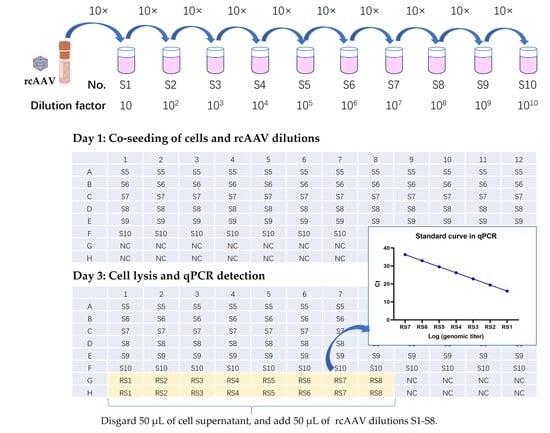
1. Introduction
2. Materials and Methods
2.1. Materials
2.2. Primers and Probes
2.3. Digital PCR for Genomic Titer Determination
2.4. TCID50 Procedure
2.4.1. Sample Preparation
2.4.2. qPCR Detection
2.4.3. Positive Judgment and TCID50 Calculation
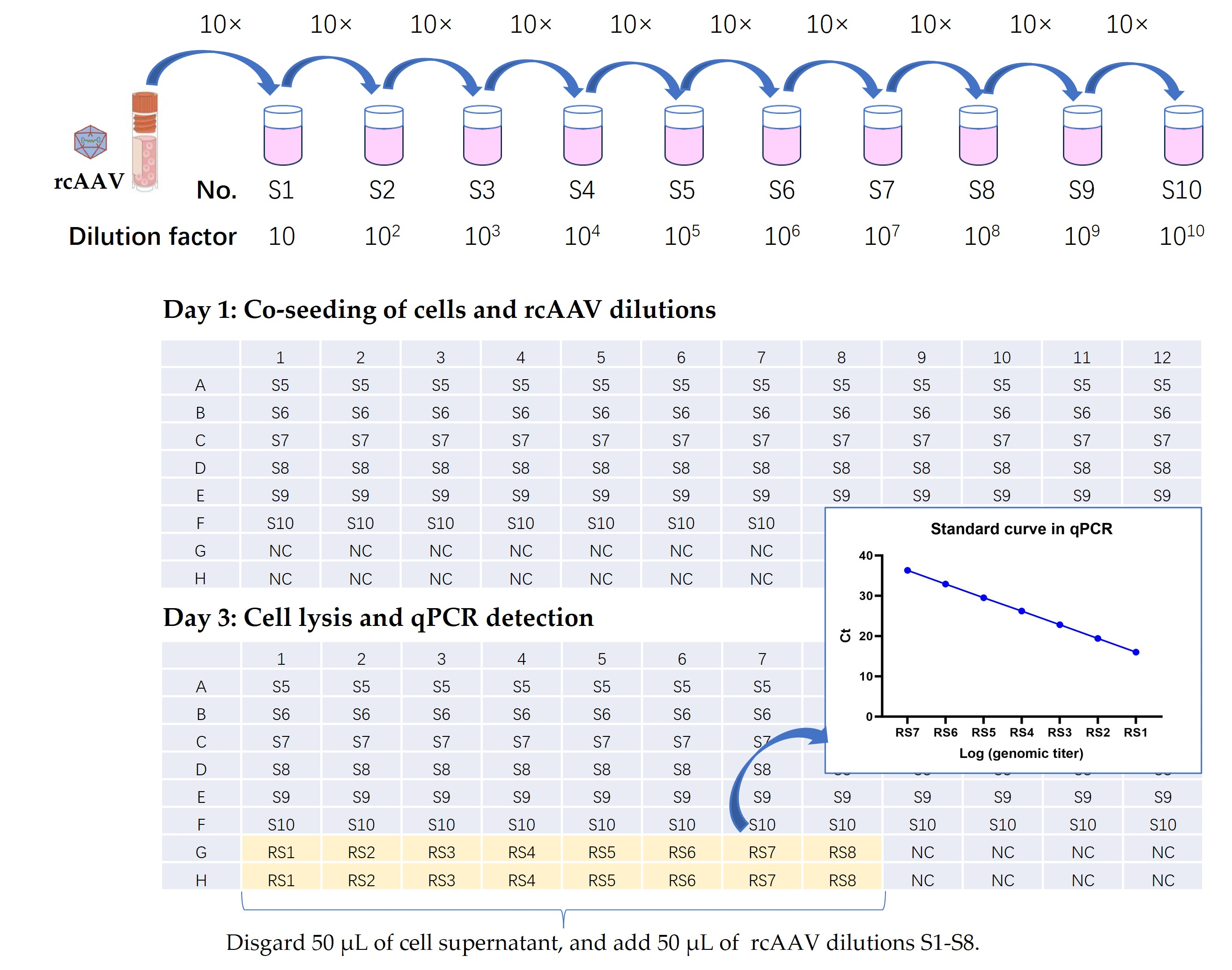
2.5. Generation of Standard Curve Groups
3. Results
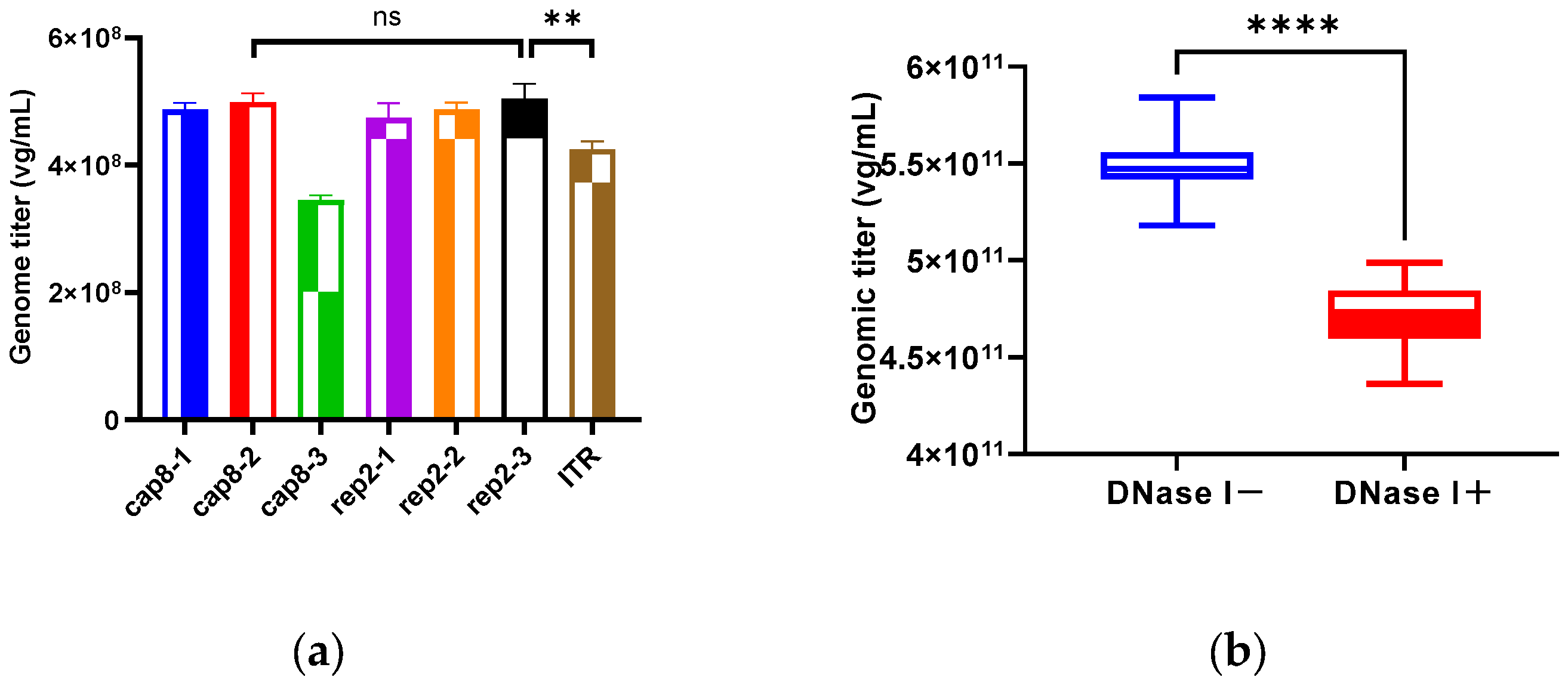
3.1. Determination of Genomic Titer of rcAAV8 Using dPCR
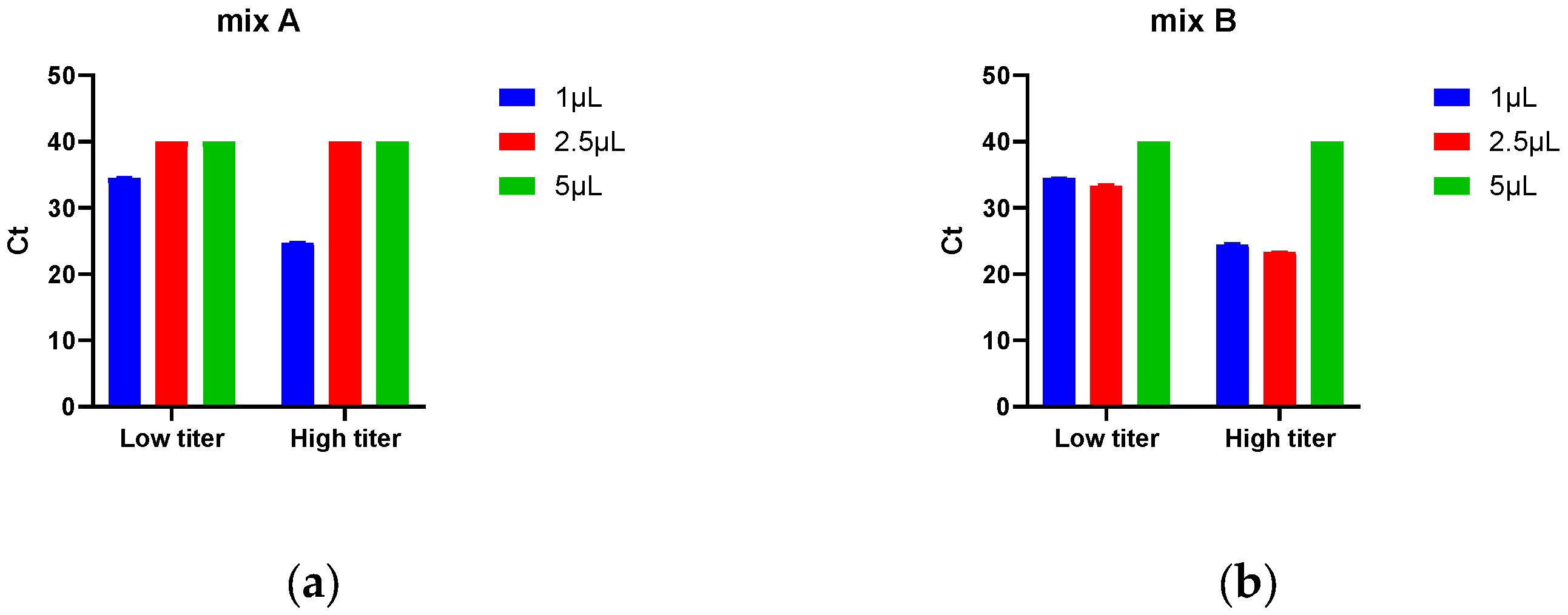
3.2. Establishment of an Endpoint qPCR for rcAAV Genome Detection in TCID50 Assay
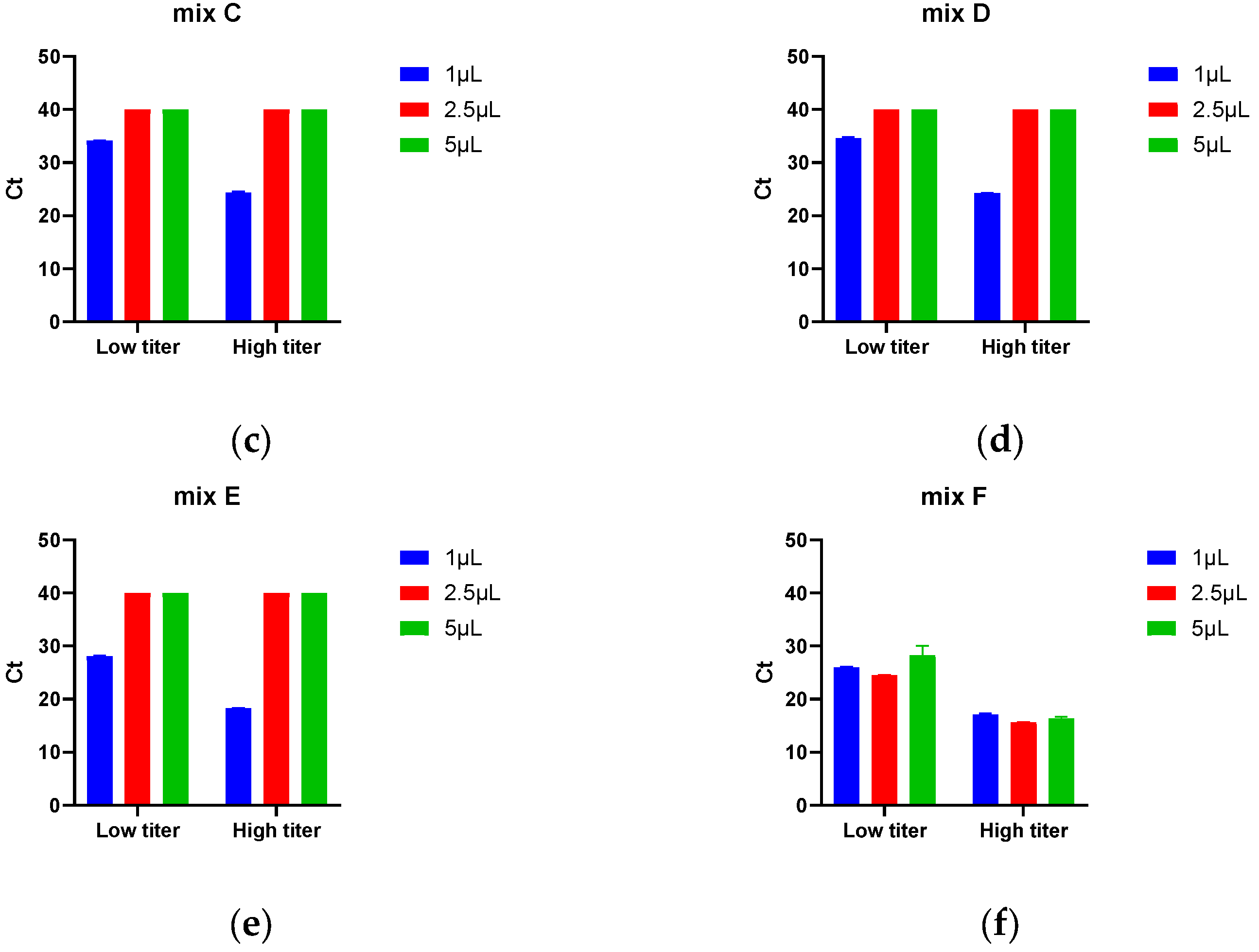
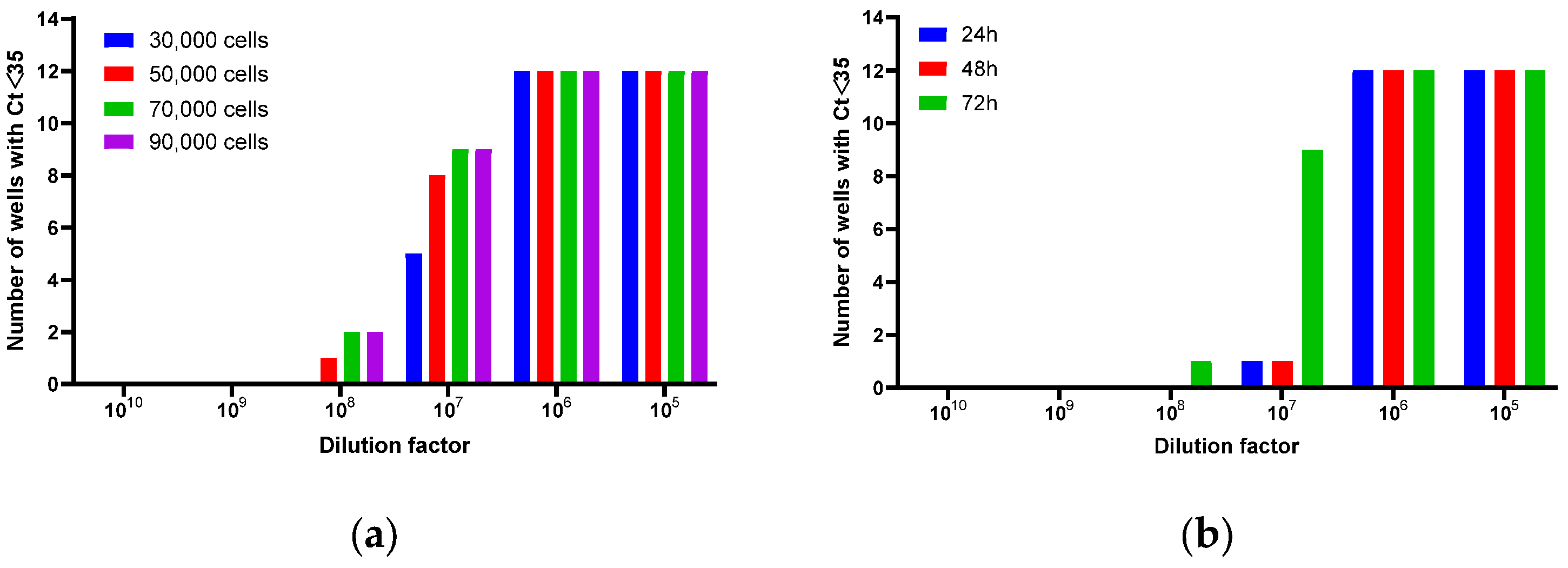
3.3. Optimization of Virus Infection and Replication Process
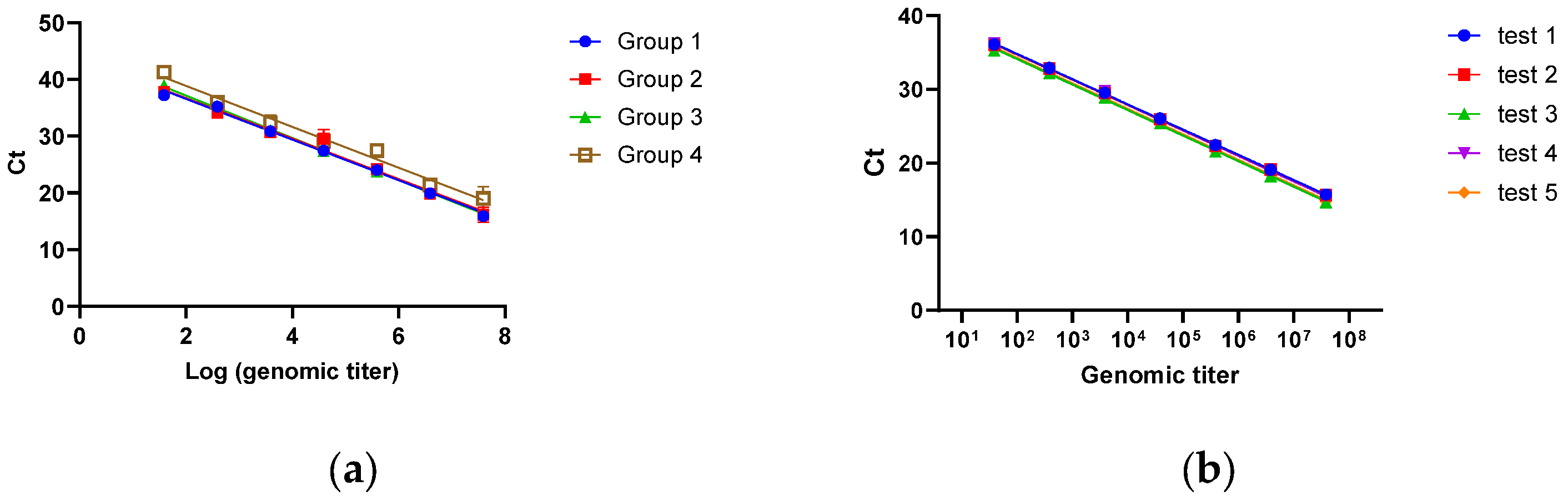
3.4. Establishment and Evaluation of Standard Curves
3.5. Repeatability of the Optimized TCID50 Assay
4. Discussion
5. Conclusions
Author Contributions
Funding
Institutional Review Board Statement
Informed Consent Statement
Data Availability Statement
Conflicts of Interest
Abbreviations
| TCID50 | Tissue culture infection dose 50% |
| AAV | Adeno-associated virus |
| rcAAV | Replication-competent adeno-associated virus |
| LOQ | Limit of quantitation |
References
- Suarez-Amaran, L.; Song, L.; Tretiakova, A.P.; Mikhail, S.A.; Samulski, R.J. AAV Vector Development, Back to the Future. Mol. Ther. 2025, 33, 1903–1936. [Google Scholar] [CrossRef] [PubMed]
- Byrne, B.J.; Flanigan, K.M.; Matesanz, S.E.; Finkel, R.S.; Waldrop, M.A.; D’Ambrosio, E.S.; Johnson, N.E.; Smith, B.K.; Bönnemann, C.; Carrig, S.; et al. Current Clinical Applications of AAV-Mediated Gene Therapy. Mol. Ther. 2025, 33, 2479–2516. [Google Scholar] [CrossRef] [PubMed]
- Naso, M.F.; Tomkowicz, B.; Perry, W.L.; Strohl, W.R. Adeno-Associated Virus (AAV) as a Vector for Gene Therapy. BioDrugs 2017, 31, 317–334. [Google Scholar] [CrossRef] [PubMed]
- Wei, H.; Xiao, W.; Dai, J. China’s First Approved Gene Therapy for Hemophilia B: A New Era for Global AAV-Based Treatments. Mol. Ther. 2025, 33, 2312–2313. [Google Scholar] [CrossRef]
- Zwi-Dantsis, L.; Mohamed, S.; Massaro, G.; Moeendarbary, E. Adeno-Associated Virus Vectors: Principles, Practices, and Prospects in Gene Therapy. Viruses 2025, 17, 239. [Google Scholar] [CrossRef]
- Kontogiannis, T.; Braybrook, J.; McElroy, C.; Foy, C.; Whale, A.S.; Quaglia, M.; Smales, C.M. Characterization of AAV Vectors: A Review of Analytical Techniques and Critical Quality Attributes. Mol. Ther. Methods Clin. Dev. 2024, 32, 101309. [Google Scholar] [CrossRef]
- Tustian, A.D.; Bak, H. Assessment of Quality Attributes for Adeno-Associated Viral Vectors. Biotechnol. Bioeng. 2021, 118, 4186–4203. [Google Scholar] [CrossRef]
- Wright, J.F. Quality Control Testing, Characterization and Critical Quality Attributes of Adeno-Associated Virus Vectors Used for Human Gene Therapy. Biotechnol. J. 2021, 16, e2000022. [Google Scholar] [CrossRef]
- Liu, S.; Li, J.; Peraramelli, S.; Luo, N.; Chen, A.; Dai, M.; Liu, F.; Yu, Y.; Leib, R.D.; Li, Y.; et al. Systematic Comparison of rAAV Vectors Manufactured Using Large-Scale Suspension Cultures of Sf9 and HEK293 Cells. Mol. Ther. 2024, 32, 74–83. [Google Scholar] [CrossRef]
- Joshi, P.R.H.; Venereo-Sanchez, A. Recombinant AAV Production. Methods Mol. Biol. 2024, 2829, 203–214. [Google Scholar] [CrossRef]
- Allen, J.M.; Debelak, D.J.; Reynolds, T.C.; Miller, A.D. Identification and Elimination of Replication-Competent Adeno-Associated Virus (AAV) That Can Arise by Nonhomologous Recombination during AAV Vector Production. J. Virol. 1997, 71, 6816–6822. [Google Scholar] [CrossRef]
- Yip, M.; Chen, J.; Zhi, Y.; Tran, N.T.; Namkung, S.; Pastor, E.; Gao, G.; Tai, P.W.L. Querying Recombination Junctions of Replication-Competent Adeno-Associated Viruses in Gene Therapy Vector Preparations with Single Molecule, Real-Time Sequencing. Viruses 2023, 15, 1228. [Google Scholar] [CrossRef]
- Yang, M.; Shaheen, S.; Yang, K.; Gao, X.; Wu, K.; Zhu, X.; Kang, Q.; Wang, L.; Hemmatzadeh, F.; Zheng, Q.; et al. Reduced rAAV Interference Enhances rcAAV Detection Sensitivity. Mol. Ther. Methods Clin. Dev. 2025, 33, 101584. [Google Scholar] [CrossRef]
- Shevade, A.; Reeves, J.S.; Bak, H.; Tustian, A.D. Development of Cell-Based Assay for Detecting Replication-Competent Adeno-Associated Virus by qPCR. Mol. Ther. Methods Clin. Dev. 2025, 33, 101529. [Google Scholar] [CrossRef] [PubMed]
- Yang, R.; Tran, N.T.; Chen, T.; Cui, M.; Wang, Y.; Sharma, T.; Liu, Y.; Zhang, J.; Yuan, X.; Zhang, D.; et al. AAVone: A Cost-Effective, Single-Plasmid Solution for Efficient AAV Production with Reduced DNA Impurities. Mol. Ther. Nucleic Acids 2025, 36, 102563. [Google Scholar] [CrossRef] [PubMed]
- Dong, B.; Moore, A.R.; Dai, J.; Roberts, S.; Chu, K.; Kapranov, P.; Moss, B.; Xiao, W. A Concept of Eliminating Nonhomologous Recombination for Scalable and Safe AAV Vector Generation for Human Gene Therapy. Nucleic Acids Res. 2013, 41, 6609–6617. [Google Scholar] [CrossRef] [PubMed]
- Issa, S.S.; Shaimardanova, A.A.; Solovyeva, V.V.; Rizvanov, A.A. Various AAV Serotypes and Their Applications in Gene Therapy: An Overview. Cells 2023, 12, 785. [Google Scholar] [CrossRef]
- Lock, M.; Korn, M.; Wilson, J.; Sena-Esteves, M.; Gao, G. Measuring the Infectious Titer of Recombinant Adenovirus Using Tissue Culture Infection Dose 50% (TCID50) End-Point Dilution and Quantitative Polymerase Chain Reaction (qPCR). Cold Spring Harb. Protoc. 2019, 2019, pdb.prot095562. [Google Scholar] [CrossRef]
- Lock, M.; McGorray, S.; Auricchio, A.; Ayuso, E.; Beecham, E.J.; Blouin-Tavel, V.; Bosch, F.; Bose, M.; Byrne, B.J.; Caton, T.; et al. Characterization of a Recombinant Adeno-Associated Virus Type 2 Reference Standard Material. Hum. Gene Ther. 2010, 21, 1273–1285. [Google Scholar] [CrossRef]
- Ayuso, E.; Blouin, V.; Lock, M.; McGorray, S.; Leon, X.; Alvira, M.R.; Auricchio, A.; Bucher, S.; Chtarto, A.; Clark, K.R.; et al. Manufacturing and Characterization of a Recombinant Adeno-Associated Virus Type 8 Reference Standard Material. Hum. Gene Ther. 2014, 25, 977–987. [Google Scholar] [CrossRef]
- Lee, Z.; Lu, M.; Irfanullah, E.; Soukup, M.; Schmidt, D.; Hu, W.-S. Development of an Inducible, Replication-Competent Assay Cell Line for Titration of Infectious Recombinant Adeno-Associated Virus Vectors. Hum. Gene Ther. 2023, 34, 162–170. [Google Scholar] [CrossRef]
- Lock, M.; Wilson, J.; Sena-Esteves, M.; Gao, G. Sensitive Determination of Infectious Titer of Recombinant Adeno-Associated Viruses (rAAVs) Using TCID50 End-Point Dilution and Quantitative Polymerase Chain Reaction (qPCR). Cold Spring Harb. Protoc. 2020, 2020, pdb.prot095653. [Google Scholar] [CrossRef]
- Mohiuddin, I.; Loiler, S.; Zolotukhin, I.; Byrne, B.J.; Flotte, T.R.; Snyder, R.O. Herpesvirus-Based Infectious Titering of Recombinant Adeno-Associated Viral Vectors. Mol. Ther. 2005, 11, 320–326. [Google Scholar] [CrossRef]
- Duong, T.; McAllister, J.; Eldahan, K.; Wang, J.; Onishi, E.; Shen, K.; Schrock, R.; Gu, B.; Wang, P. Improvement of Precision in Recombinant Adeno-Associated Virus Infectious Titer Assay with Droplet Digital PCR as an Endpoint Measurement. Hum. Gene Ther. 2023, 34, 742–757. [Google Scholar] [CrossRef]



| No. | Forward Primer (5′→3′) | Reverse Primer (5′→3′) | Probe (5′→3′) |
|---|---|---|---|
| cap8-1 | 5′-TCAGTTCCAGACCCTCAACC-3′ | 5′-GCCTTCGTTATTGTCTGCCA-3′ | 5′-VIC-CGCCACCGCCTGCAGCCATT-BHQ1-3′ |
| cap8-2 | 5′-CGGACGTGTTCATGATTCCC-3′ | 5′-CCAGGCAGTAGAAGGAGGAG-3′ | 5′-VIC-CGTCCCACGGCCTGACTACCGT-BHQ1-3′ |
| cap8-3 | 5′-GATCCTCCGACCACCTTCAA-3′ | 5′-TTCCTTCTGCAGCTCCCATT-3′ | 5′-VIC-CCACGCTGACCTGTCCGGTGCT-BHQ1-3′ |
| rep2-1 | 5′-GAGAATTTACCGCGGGATCG-3′ | 5′-GTAGCACTCATCCACCACCT-3′ | 5′-FAM-CCCGCCTCCGGCGCCATTT C-BHQ1-3′ |
| rep2-2 | 5′-AACTACCGGGAAGACCAACA-3′ | 5′-GTCGACACAGTCGTTGAAGG-3′ | 5′-FAM-TCGCGGAGGCCATAGCCCACA-BHQ1-3′ |
| rep2-3 | 5′-CACACTGTGCCCTTCTAC-3′ | 5′-ACCAGATCACCATCTTGTC-3′ | 5′-FAM-AACTGGACCAATGAGAACTTTCC-BHQ1-3′ |
| ITR | 5′-GGAACCCTAGTGATGGAGTT-3′ | 5′-CGGCCTCAGTGAGCGA-3′ | 5′-FAM-CGAGCGCGCAGAGAGGGAGTG-BHQ1-3′ |
| Group No. | Day 1 Procedure | Day 3 Procedure |
|---|---|---|
| 1 | Cells+rcAAV+Ad5−: Co-seeded 50 μL of HEK293T cells (in 10% FBS-DMEM) and 50 μL of rcAAV dilutions (in Opti-MEM) into a 96-well plate. | Added 90 μL of lysis buffer → performed stepwise cell lysis → conducted qPCR analysis. |
| 2 | Cells+rcAAV−Ad5−: Co-seeded 50 μL of HEK293T cells (in 10% FBS-DMEM) and 50 μL of Opti-MEM into a 96-well plate. | Removed 50 μL of supernatant → added 50 μL of rcAAV dilutions (in Opti-MEM) → added 90 μL of lysis buffer → performed stepwise cell lysis → conducted qPCR analysis. |
| 3 | Cells+rcAAV−Ad5+: Co-seeded 50 μL of HEK293T cells (in 10% FBS-DMEM) and 50 μL of Ad5 (in Opti-MEM) into a 96-well plate. | Same as Group 2 |
| 4 | Cells−rcAAV−Ad5−: Added 50 μL of 10% FBS-DMEM and 50 μL of Opti-MEM into a 96-well plate. | Same as Group 2 |
| Test No. | Fitting Curve Equation (RS1~RS7) | R2 | Amplification Efficiency (%) | Measured Value of RS6 (vg) | Measured Value of RS7 (vg) |
|---|---|---|---|---|---|
| 1 | y = −3.4212 logx + 41.66 | 0.9998 | 96.0 | 362.3 | 41.4 |
| 2 | y = −3.4144 logx + 41.567 | 0.9998 | 96.3 | 357.4 | 41.7 |
| 3 | y = −3.4652 logx + 41.061 | 0.9993 | 94.3 | 357.5 | 45.8 |
| 4 | y = −3.4582 logx + 41.724 | 0.9992 | 94.6 | 442.1 | 38.3 |
| 5 | y = −3.4592 logx + 41.203 | 0.9987 | 94.6 | 328.8 | 50.1 |
| CV% | / | / | / | 11.5 | 10.6 |
| Test | Test Results (TCID50/mL) | Intra-Assay RSD (%) | |||
|---|---|---|---|---|---|
| Plate 1 | Plate 2 | Plate 3 | Mean | ||
| 1 | 5.22 × 10⁸ | 4.31 × 10⁸ | 6.32 × 10⁸ | 5.28 × 10⁸ | 19.1 |
| 2 | 4.31 × 10⁸ | 4.31 × 10⁸ | 7.66 × 10⁸ | 5.43 × 10⁸ | 35.7 |
| 3 | 4.31 × 10⁸ | 4.31 × 10⁸ | 6.32 × 10⁸ | 4.98 × 10⁸ | 23.4 |
| 4 | 7.66 × 10⁸ | 4.31 × 10⁸ | 4.31 × 10⁸ | 5.43 × 10⁸ | 35.7 |
| 5 | 4.31 × 10⁸ | 3.56 × 10⁸ | 4.31 × 10⁸ | 4.06 × 10⁸ | 10.7 |
| Mean (TCID50/mL) | 5.04 × 10⁸ | / | |||
| Inter-assay RSD (%) | 11.4 | / | |||
Disclaimer/Publisher’s Note: The statements, opinions and data contained in all publications are solely those of the individual author(s) and contributor(s) and not of MDPI and/or the editor(s). MDPI and/or the editor(s) disclaim responsibility for any injury to people or property resulting from any ideas, methods, instructions or products referred to in the content. |
© 2026 by the authors. Licensee MDPI, Basel, Switzerland. This article is an open access article distributed under the terms and conditions of the Creative Commons Attribution (CC BY) license.
Share and Cite
Fu, J.; Yu, L.; Fu, Z.; Wang, G.; Liang, C.; Shi, X.; Zhang, Y. An Improved Method for Determining the Infection Titer of Replication-Competent Adeno-Associated Virus. Biomedicines 2026, 14, 653. https://doi.org/10.3390/biomedicines14030653
Fu J, Yu L, Fu Z, Wang G, Liang C, Shi X, Zhang Y. An Improved Method for Determining the Infection Titer of Replication-Competent Adeno-Associated Virus. Biomedicines. 2026; 14(3):653. https://doi.org/10.3390/biomedicines14030653
Chicago/Turabian StyleFu, Jianning, Lei Yu, Zhihao Fu, Guangyu Wang, Chenggang Liang, Xinchang Shi, and Yixuan Zhang. 2026. "An Improved Method for Determining the Infection Titer of Replication-Competent Adeno-Associated Virus" Biomedicines 14, no. 3: 653. https://doi.org/10.3390/biomedicines14030653
APA StyleFu, J., Yu, L., Fu, Z., Wang, G., Liang, C., Shi, X., & Zhang, Y. (2026). An Improved Method for Determining the Infection Titer of Replication-Competent Adeno-Associated Virus. Biomedicines, 14(3), 653. https://doi.org/10.3390/biomedicines14030653