Non-Invasive Brain Stimulation in Older Inpatients with Depression: A Real-World Comparison of Repetitive Transcranial Magnetic Stimulation (rTMS) and Transcranial Direct Current Stimulation (tDCS) on Depressive Symptoms and Functional Recovery

 , , , and
Abstract
1. Introduction
2. Materials and Methods
2.1. Study Design and Setting
2.2. Participants
2.3. Interventions
2.4. Outcomes
2.5. Statistical Analysis
3. Results
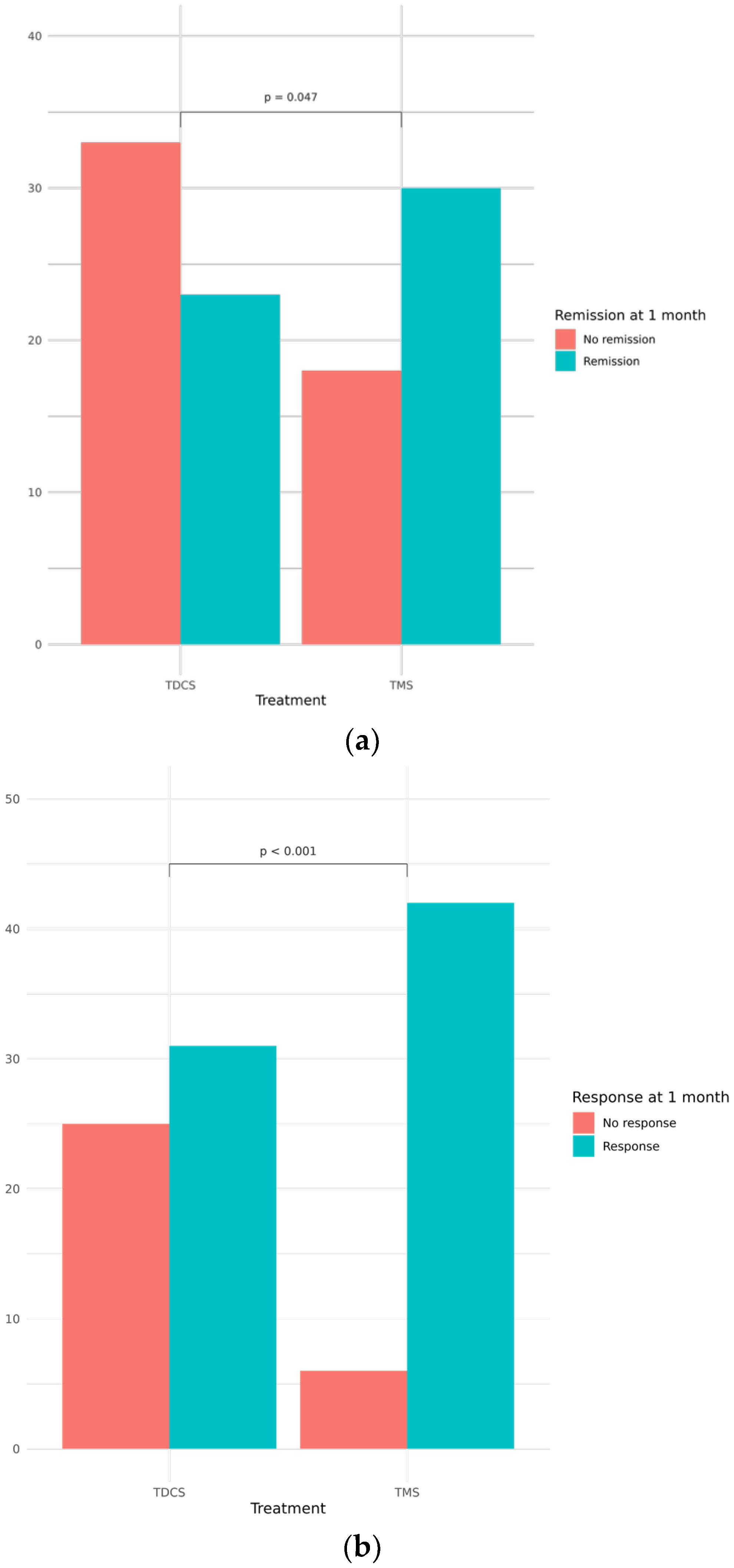
3.1. Primary Outcomes: Response and Remission
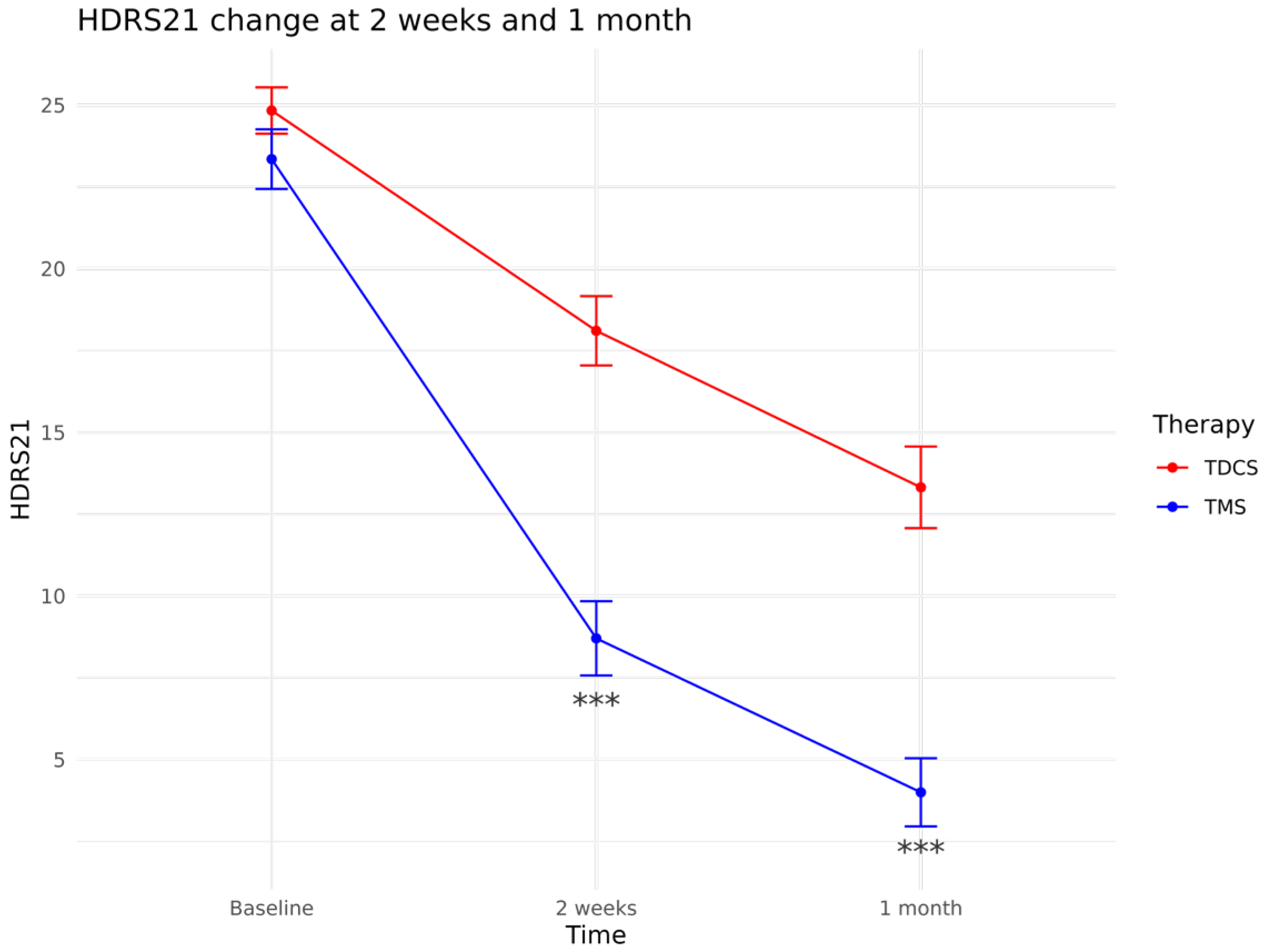
3.2. Continuous Outcomes: Longitudinal HDRS21 Trajectories
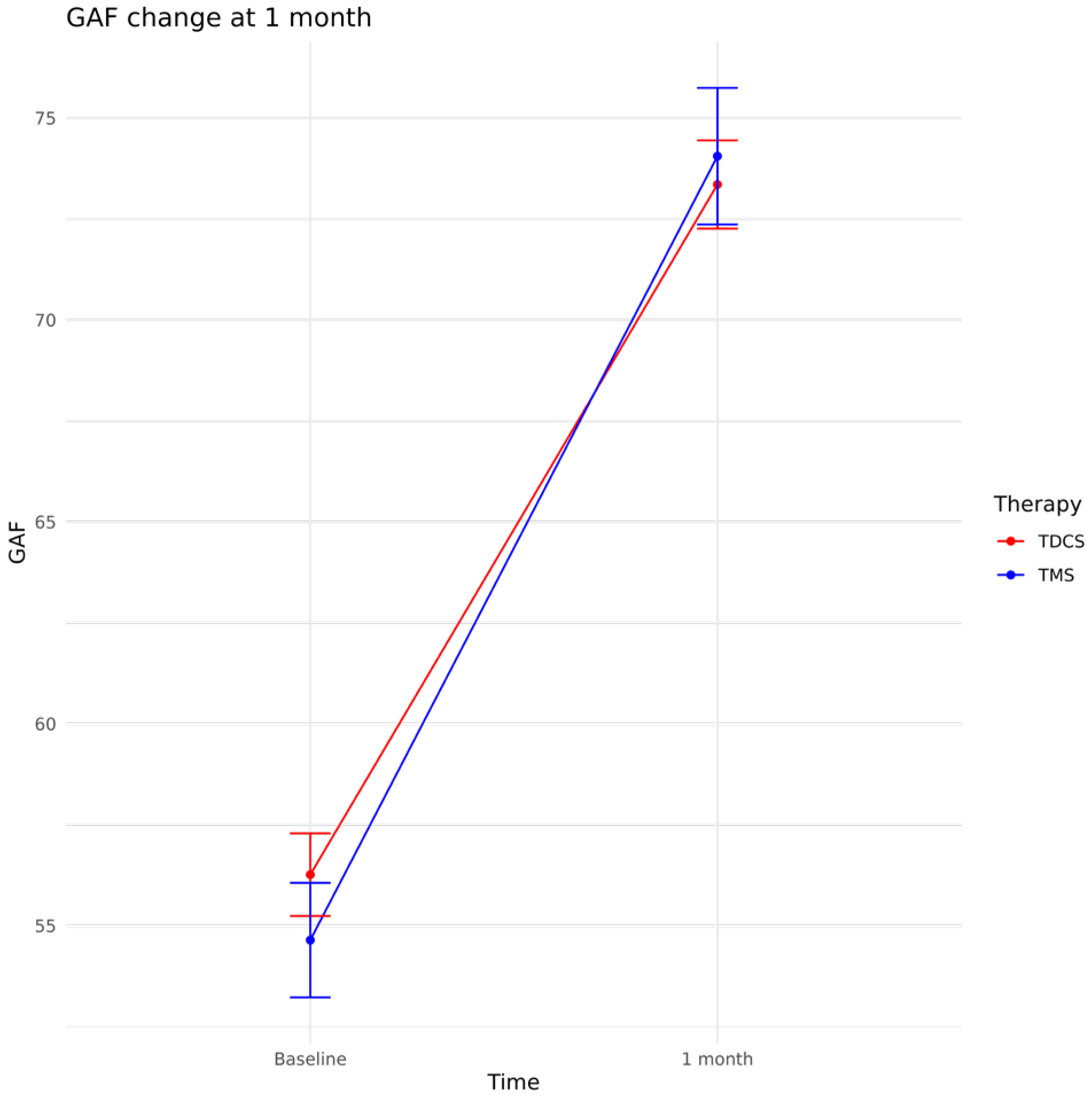
3.3. Functional Outcomes: GAF
4. Discussion
5. Conclusions
Author Contributions
Funding
Institutional Review Board Statement
Informed Consent Statement
Data Availability Statement
Acknowledgments
Conflicts of Interest
Abbreviations
| NIBS | Non-invasive brain stimulation |
| rTMS | repetitive Transcranial Magnetic Stimulation |
| tDCS | transcranial Direct Current Stimulation |
| HDRS21 | 21-item Hamilton Depression Rating Scale |
| GAF | Global Assessment of Functioning |
| LLD | Late-life depression |
| MDD | Major Depressive Disorder |
| MDEs | Major Depressive Episodes |
| BD | Bipolar Disorder |
| DSM-5 | Diagnostic and Statistical Manual of Mental Disorders, 5th edition |
| DLPFC | Left dorsolateral prefrontal cortex |
| SSRIs | Selective Serotonin Reuptake Inhibitors |
| SNRIs | Serotonin-Norepinephrine Reuptake Inhibitors |
| TCAs | Tricyclic Antidepressants |
| SMDs | Standardized mean differences |
References
- Taylor, W.D. Depression in the Elderly. N. Engl. J. Med. 2014, 371, 1228–1236. [Google Scholar] [CrossRef] [Scilit]
- Abdoli, N.; Salari, N.; Darvishi, N.; Jafarpour, S.; Solaymani, M.; Mohammadi, M.; Shohaimi, S. The global prevalence of major depressive disorder (MDD) among the elderly: A systematic review and meta-analysis. Neurosci. Biobehav. Rev. 2022, 132, 1067–1073. [Google Scholar] [CrossRef] [Scilit]
- Best, J.R.; Gan, D.R.Y.; Wister, A.V.; Cosco, T.D. Age and sex trends in depressive symptoms across middle and older adulthood: Comparison of the Canadian Longitudinal Study on Aging to American and European cohorts. J. Affect. Disord. 2021, 295, 1169–1176. [Google Scholar] [CrossRef] [Scilit]
- Li, H.; Liu, X.; Zheng, Q.; Zeng, S.; Luo, X. Gender differences and determinants of late-life depression in China: A cross-sectional study based on CHARLS. J. Affect. Disord. 2022, 309, 178–185. [Google Scholar] [CrossRef] [Scilit]
- Ferri, C.; Yang, K.; Girgus, J.S. Predicting the gender difference in depressive symptoms in older adults. Aging Ment. Health 2023, 27, 1411–1418. [Google Scholar] [CrossRef] [Scilit]
- Kok, R.M.; Reynolds, C.F. Management of Depression in Older Adults. JAMA 2017, 317, 2114. [Google Scholar] [CrossRef] [Scilit]
- Unützer, J. Late-Life Depression. N. Engl. J. Med. 2007, 357, 2269–2276. [Google Scholar] [CrossRef] [Scilit] [PubMed]
- Alexopoulos, G.S. Depression in the elderly. Lancet 2005, 365, 1961–1970. [Google Scholar] [CrossRef] [Scilit] [PubMed]
- Elser, H.; Horváth-Puhó, E.; Gradus, J.L.; Smith, M.L.; Lash, T.L.; Glymour, M.M.; Sørensen, H.T.; Henderson, V.W. Association of Early-, Middle-, and Late-Life Depression with Incident Dementia in a Danish Cohort. JAMA Neurol. 2023, 80, 949. [Google Scholar] [CrossRef] [Scilit] [PubMed]
- Wang, S.-M.; Han, K.; Kim, N.-Y.; Um, Y.H.; Kang, D.-W.; Na, H.-R.; Lee, C.-U.; Lim, H.K. Late-life depression, subjective cognitive decline, and their additive risk in incidence of dementia: A nationwide longitudinal study. PLoS ONE 2021, 16, e0254639. [Google Scholar] [CrossRef] [Scilit]
- Huang, W.; Zhu, W.; Chen, H.; Li, F.; Huang, J.; Zhou, Y.; Sun, X.; Lan, Y. Longitudinal association between depressive symptoms and cognitive decline among middle-aged and elderly population. J. Affect. Disord. 2022, 303, 18–23. [Google Scholar] [CrossRef] [Scilit] [PubMed]
- Brain, J.; Alshahrani, M.; Kafadar, A.H.; Tang, E.Y.H.; Burton, E.; Greene, L.; Turnbull, D.; Myers, B.; Naheed, A.; Siervo, M.; et al. Temporal dynamics in the association between depression and dementia: An umbrella review and meta-analysis. EClinicalMedicine 2025, 84, 103266. [Google Scholar] [CrossRef] [Scilit]
- Sheehan, D.V.; Nakagome, K.; Asami, Y.; Pappadopulos, E.A.; Boucher, M. Restoring function in major depressive disorder: A systematic review. J. Affect. Disord. 2017, 215, 299–313. [Google Scholar] [CrossRef] [Scilit]
- Valiengo, L.; Maia, A.; Cotovio, G.; Gordon, P.C.; Brunoni, A.R.; Forlenza, O.V.; Oliveira-Maia, A.J. Repetitive Transcranial Magnetic Stimulation for Major Depressive Disorder in Older Adults: Systematic Review and Meta-analysis. J. Gerontol. Ser. A 2022, 77, 851–860. [Google Scholar] [CrossRef] [Scilit]
- Zhang, M.; Mo, J.; Zhang, H.; Tang, Y.; Guo, K.; OuYang, X.; Huang, L.; Zhong, X.; Ning, Y. Efficacy and tolerability of repetitive transcranial magnetic stimulation for late-life depression: A systematic review and meta-analysis. J. Affect. Disord. 2023, 323, 219–231. [Google Scholar] [CrossRef] [Scilit]
- Moffa, A.H.; Martin, D.; Alonzo, A.; Bennabi, D.; Blumberger, D.M.; Benseñor, I.M.; Daskalakis, Z.; Fregni, F.; Haffen, E.; Lisanby, S.H.; et al. Efficacy and acceptability of transcranial direct current stimulation (tDCS) for major depressive disorder: An individual patient data meta-analysis. Prog. Neuropsychopharmacol. Biol. Psychiatry 2020, 99, 109836. [Google Scholar] [CrossRef] [Scilit]
- Rimmer, R.M.; Costafreda, S.G.; Mutz, J.; Joseph, K.; Brunoni, A.R.; Loo, C.K.; Padberg, F.; Palm, U.; Fu, C.H. Transcranial direct current stimulation effects in late life depression: A meta-analysis of individual participant data. J. Affect. Disord. Rep. 2022, 10, 100407. [Google Scholar] [CrossRef] [Scilit]
- Zanardi, R.; Poletti, S.; Prestifilippo, D.; Attanasio, F.; Barbini, B.; Colombo, C. Transcranial direct current stimulation: A novel approach in the treatment of vascular depression. Brain Stimul. 2020, 13, 1559–1565. [Google Scholar] [CrossRef] [Scilit] [PubMed]
- Kupfer, D.J.; Frank, E.; Phillips, M.L. Major depressive disorder: New clinical, neurobiological, and treatment perspectives. Lancet 2012, 379, 1045–1055. [Google Scholar] [CrossRef] [Scilit]
- Kaiser, R.H.; Andrews-Hanna, J.R.; Wager, T.D.; Pizzagalli, D.A. Large-Scale Network Dysfunction in Major Depressive Disorder. JAMA Psychiatry 2015, 72, 603. [Google Scholar] [CrossRef] [Scilit] [PubMed]
- Rive, M.M.; van Rooijen, G.; Veltman, D.J.; Phillips, M.L.; Schene, A.H.; Ruhé, H.G. Neural correlates of dysfunctional emotion regulation in major depressive disorder. A systematic review of neuroimaging studies. Neurosci. Biobehav. Rev. 2013, 37, 2529–2553. [Google Scholar] [CrossRef] [Scilit]
- Eshel, N.; Keller, C.J.; Wu, W.; Jiang, J.; Mills-Finnerty, C.; Huemer, J.; Wright, R.; Fonzo, G.A.; Ichikawa, N.; Carreon, D.; et al. Global connectivity and local excitability changes underlie antidepressant effects of repetitive transcranial magnetic stimulation. Neuropsychopharmacology 2020, 45, 1018–1025. [Google Scholar] [CrossRef] [Scilit] [PubMed]
- Liston, C.; Chen, A.C.; Zebley, B.D.; Drysdale, A.T.; Gordon, R.; Leuchter, B.; Voss, H.U.; Casey, B.J.; Etkin, A.; Dubin, M.J. Default Mode Network Mechanisms of Transcranial Magnetic Stimulation in Depression. Biol. Psychiatry 2014, 76, 517–526. [Google Scholar] [CrossRef] [Scilit] [PubMed]
- Noda, Y.; Silverstein, W.K.; Barr, M.S.; Vila-Rodriguez, F.; Downar, J.; Rajji, T.K.; Fitzgerald, P.B.; Mulsant, B.H.; Vigod, S.N.; Daskalakis, Z.J.; et al. Neurobiological mechanisms of repetitive transcranial magnetic stimulation of the dorsolateral prefrontal cortex in depression: A systematic review. Psychol. Med. 2015, 45, 3411–3432. [Google Scholar] [CrossRef] [Scilit]
- Downar, J.; Siddiqi, S.H.; Mitra, A.; Williams, N.; Liston, C. Mechanisms of Action of TMS in the Treatment of Depression. In Emerging Neurobiology of Antidepressant Treatments; Springer: Cham, Switzerland, 2024; pp. 233–277. [Google Scholar] [CrossRef] [Scilit]
- Hejzlar, M.; Novak, T.; Bares, M. Neurostimulation Methods in the Treatment of Depression: A Comparison of rTMS, tDCS, and Venlafaxine Using a Pooled Analysis of Two Studies. Neuropsychiatr. Dis. Treat. 2021, 17, 1713–1722. [Google Scholar] [CrossRef] [Scilit]
- Yang, Y.; Chen, J.; Yu, M.; Xiong, C.; Zhang, R.; Jiang, G. Comparative efficacy of multiple non-invasive brain stimulation to treat major depressive disorder in older patients: A systematic review and network meta-analysis study based on randomized controlled trials. Psychiatry Res. 2025, 344, 116340. [Google Scholar] [CrossRef] [Scilit]
- Mutz, J.; Edgcumbe, D.R.; Brunoni, A.R.; Fu, C.H.Y. Efficacy and acceptability of non-invasive brain stimulation for the treatment of adult unipolar and bipolar depression: A systematic review and meta-analysis of randomised sham-controlled trials. Neurosci. Biobehav. Rev. 2018, 92, 291–303. [Google Scholar] [CrossRef] [Scilit] [PubMed]
- Mutz, J.; Vipulananthan, V.; Carter, B.; Hurlemann, R.; Fu, C.H.Y.; Young, A.H. Comparative efficacy and acceptability of non-surgical brain stimulation for the acute treatment of major depressive episodes in adults: Systematic review and network meta-analysis. BMJ 2019, 364, l1079. [Google Scholar] [CrossRef] [Scilit]
- Furukawa, T.A.; Takeuchi, H.; Hiroe, T.; Mashiko, H.; Kamei, K.; Kitamura, T.; Takahashi, K. Symptomatic recovery and social functioning in major depression. Acta Psychiatr. Scand. 2001, 103, 257–261. [Google Scholar] [CrossRef] [Scilit]
- Piersma, H.L.; Boes, J.L. The GAF and Psychiatric Outcome: A Descriptive Report. Community Ment. Health J. 1997, 33, 35–41. [Google Scholar] [CrossRef] [Scilit]
- Aas, I.M. Guidelines for rating Global Assessment of Functioning (GAF). Ann. Gen. Psychiatry 2011, 10, 2. [Google Scholar] [CrossRef] [Scilit] [PubMed]
- Gold, L.H. DSM-5 and the assessment of functioning: The World Health Organization Disability Assessment Schedule 2.0 (WHODAS 2.0). J Am Acad Psychiatry Law 2014, 42, 173–181. [Google Scholar]
- Pedersen, G.; Karterud, S. The symptom and function dimensions of the Global Assessment of Functioning (GAF) scale. Compr. Psychiatry 2012, 53, 292–298. [Google Scholar] [CrossRef] [Scilit]
- American Psychiatric Association. Diagnostic and Statistical Manual of Mental Disorders; American Psychiatric Association: Washington, DC, USA, 2013. [Google Scholar] [CrossRef] [Scilit]
- Berlim, M.T.; Turecki, G. Definition, Assessment, and Staging of Treatment—Resistant Refractory Major Depression: A Review of Current Concepts and Methods. Can. J. Psychiatry 2007, 52, 46–54. [Google Scholar] [CrossRef] [Scilit]
- Zanardi, R.; Carminati, M.; Attanasio, F.; Fazio, V.; Maccario, M.; Colombo, C. How different definition criteria may predict clinical outcome in treatment resistant depression: Results from a prospective real-world study. Psychiatry Res. 2024, 334, 115818. [Google Scholar] [CrossRef] [Scilit]
- Lefaucheur, J.-P.; Aleman, A.; Baeken, C.; Benninger, D.H.; Brunelin, J.; Di Lazzaro, V.; Filipović, S.R.; Grefkes, C.; Hasan, A.; Hummel, F.C.; et al. Evidence-based guidelines on the therapeutic use of repetitive transcranial magnetic stimulation (rTMS): An update (2014–2018). Clin. Neurophysiol. 2020, 131, 474–528. [Google Scholar] [CrossRef] [Scilit]
- Rossi, S.; Antal, A.; Bestmann, S.; Bikson, M.; Brewer, C.; Brockmöller, J.; Carpenter, L.L.; Cincotta, M.; Chen, R.; Daskalakis, J.D.; et al. Safety and recommendations for TMS use in healthy subjects and patient populations, with updates on training, ethical and regulatory issues: Expert Guidelines. Clin. Neurophysiol. 2021, 132, 269–306. [Google Scholar] [CrossRef] [Scilit]
- Hamilton, M. A rating scale for depression. J. Neurol. Neurosurg. Psychiatry 1960, 23, 56–62. [Google Scholar] [CrossRef] [Scilit]
- Frank, E.; Prien, R.F.; Jarrett, R.B.; Keller, M.B.; Kupfer, D.J.; Lavori, P.W.; Rush, A.J.; Weissman, M.M. Conceptualization and Rationale for Consensus Definitions of Terms in Major Depressive Disorder. Arch. Gen. Psychiatry 1991, 48, 851. [Google Scholar] [CrossRef] [Scilit] [PubMed]
- Zimmerman, M.; Martinez, J.; Attiullah, N.; Friedman, M.; Toba, C.; Boerescu, D.A.; Rahgeb, M. Further evidence that the cutoff to define remission on the 17-item Hamilton Depression Rating Scale should be lowered. Depress. Anxiety 2012, 29, 160–166. [Google Scholar] [CrossRef] [Scilit] [PubMed]
- American Psychiatric Association. DSM-IV-TR; American Psychiatric Association: Arlington, VA, USA, 2000. [Google Scholar] [CrossRef] [Scilit]
- R Core Team. R: A Language and Environment for Statistical Computing; R Foundation for Statistical Computing: Vienna, Austria, 2024. [Google Scholar]
- Blumberger, D.M.; Mulsant, B.H.; Thorpe, K.E.; McClintock, S.M.; Konstantinou, G.N.; Lee, H.H.; Nestor, S.M.; Noda, Y.; Rajji, T.K.; Trevizol, A.P.; et al. Effectiveness of Standard Sequential Bilateral Repetitive Transcranial Magnetic Stimulation vs Bilateral Theta Burst Stimulation in Older Adults with Depression. JAMA Psychiatry 2022, 79, 1065. [Google Scholar] [CrossRef] [Scilit]
- Burke, M.J.; Romanella, S.M.; Mencarelli, L.; Greben, R.; Fox, M.D.; Kaptchuk, T.J.; Pascual-Leone, A.; Santarnecchi, E. Placebo effects and neuromodulation for depression: A meta-analysis and evaluation of shared mechanisms. Mol. Psychiatry 2022, 27, 1658–1666. [Google Scholar] [CrossRef] [Scilit]
- Huneke, N.T.M.; Amin, J.; Baldwin, D.S.; Bellato, A.; Brandt, V.; Chamberlain, S.R.; Correll, C.U.; Eudave, L.; Garner, M.; Gosling, C.J.; et al. Placebo effects in randomized trials of pharmacological and neurostimulation interventions for mental disorders: An umbrella review. Mol. Psychiatry 2024, 29, 3915–3925. [Google Scholar] [CrossRef] [Scilit]
- Chu, C.-S.; Li, C.-T.; Cheng, C.-M.; Jeng, J.-S.; Pan, C.-C.; Chen, G.-W.; Liang, W.-Z.; Chang, C.-H.; Fujii, K.; Kitahata, R.; et al. Predictors of response and remission after transcranial magnetic stimulation for major depressive disorder: An international comparative study between Taiwan and Japan. Asian J. Psychiatr. 2025, 109, 104541. [Google Scholar] [CrossRef] [Scilit] [PubMed]
- Tunvirachaisakul, C.; Gould, R.L.; Coulson, M.C.; Ward, E.V.; Reynolds, G.; Gathercole, R.L.; Grocott, H.; Supasitthumrong, T.; Tunvirachaisakul, A.; Kimona, K.; et al. Predictors of treatment outcome in depression in later life: A systematic review and meta-analysis. J. Affect. Disord. 2018, 227, 164–182. [Google Scholar] [CrossRef] [Scilit] [PubMed]
- Taylor, W.D.; Aizenstein, H.J.; Alexopoulos, G.S. The vascular depression hypothesis: Mechanisms linking vascular disease with depression. Mol. Psychiatry 2013, 18, 963–974. [Google Scholar] [CrossRef] [Scilit]
- Jellinger, K.A. Pathomechanisms of Vascular Depression in Older Adults. Int. J. Mol. Sci. 2021, 23, 308. [Google Scholar] [CrossRef] [Scilit] [PubMed]
- Jellinger, K.A. The enigma of vascular depression in old age: A critical update. J. Neural Transm. 2022, 129, 961–976. [Google Scholar] [CrossRef] [Scilit]
- Grootenboer, E.M.V.; Giltay, E.J.; van der Lem, R.; van Veen, T.; van der Wee, N.J.A.; Zitman, F.G. Reliability and validity of the Global Assessment of Functioning Scale in clinical outpatients with depressive disorders. J. Eval. Clin. Pract. 2012, 18, 502–507. [Google Scholar] [CrossRef] [Scilit]
- Smith, G.N.; Ehmann, T.S.; Flynn, S.W.; MacEwan, G.W.; Tee, K.; Kopala, L.C.; Thornton, A.E.; Schenk, C.H.; Honer, W.G. The Assessment of Symptom Severity and Functional Impairment with DSM-IV Axis V. Psychiatr. Serv. 2011, 62, 411–417. [Google Scholar] [CrossRef]



| rTMS (n = 48) | tDCS (n = 56) | Total (n = 104) | p-Value | SMD | |
|---|---|---|---|---|---|
| Sex (male) | 12; 25.00% | 7; 12.50% | 19; 18.27% | 0.16 b | 0.434 |
| Diagnosis (MDD) | 38; 79.17% | 47; 83.93% | 85; 81.73% | 0.71 b | −0.002 |
| Age (years; mean ± SD) | 65.29 ± 5.21 | 72.39 ± 5.75 | 69.12 ± 6.53 | <0.001 a | −1.311 |
| Age at onset (years; mean ± SD) | 43.30 ± 14.66 | 47.48 ± 15.19 | 45.93 ± 15.05 | 0.21 a | −0.205 |
| Current episode duration (months; mean ± SD) | 6.64 ± 4.22 | 5.31 ± 4.31 | 5.92 ± 4.30 | 0.05 a | 0.379 |
| Antidepressants (SSRIs; SNRIs; TCAs) |
28; 9; 11
58.33%; 18.75%; 22.92% | 29; 14; 13 51.79%; 25.00%; 23.21% |
57; 23; 24
54.81%; 22.12%; 23.08% | 0.34 b | 0.308 |
| Mood stabilizers (yes) | 12; 25.00% | 8; 14.29% | 20; 19.23% | 0.26 b | 0.102 |
| Antipsychotics (yes) | 12; 25.00% | 6; 10.70% | 18; 17.31% | 0.10 b | 0.212 |
| Benzodiazepines (yes) | 37; 77.08% | 45; 80.36% | 82; 78.85% | 0.69 b | −0.020 |
| HDRS21 at baseline | 23.47 ± 4.23 | 24.84 ± 4.59 | 24.34 ± 4.49 | 0.22 a | −0.495 |
| HDRS21 at 2 weeks | 9.00 ± 4.39 | 18.11 ± 6.87 | 14.79 ± 7.49 | <0.001 a | −1.449 |
| HDRS21 at 1 month | 4.84 ± 3.87 | 13.32 ± 8.10 | 10.24 ± 7.98 | <0.001 a | −1.069 |
| GAF at baseline | 55.13 ± 6.42 | 56.27 ± 6.64 | 55.74 ± 6.53 | 0.56 a | −0.163 |
| GAF at 1 month | 72.58 ± 8.49 | 73.36 ± 7.09 | 73.00 ± 7.74 | 0.74 a | −0.020 |
| rTMS (n = 21) | tDCS (n = 21) | Total (n = 42) | p-Value | SMD | |
|---|---|---|---|---|---|
| Sex (male) | 4; 19.05% | 3; 14.29% | 7; 16.67% | 1.00 b | 0.128 |
| Diagnosis (MDD) | 16; 76.19% | 18; 85.71% | 34; 80.95% | 0.69 b | 0.095 |
| Age (years; mean ± SD) | 68.71 (5.32) | 68.57 (5.54) | 68.64 (5.36) | 0.93 a | −0.026 |
| Age at onset (years; mean ± SD) | 45.33 (16.73) | 44.38 (13.44) | 44.86 (14.99) | 0.92 a | −0.063 |
| Current episode duration (months; mean ± SD) | 7.29 (5.71) | 7.05 (4.85) | 7.17 (5.23) | 0.92 a | −0.045 |
| Antidepressants (SSRIs; SNRIs; TCAs) | 11; 3; 7 52.38%; 14.29%; 33.33% | 14; 3; 4 66.67%; 14.29%; 19.05% | 25; 6; 11 59.52%; 14.29%; 26.19% | 0.55 b | 0.145 |
| Mood stabilizers (yes) | 3; 14.29% | 4; 19.05% | 7; 16.67% | 1.00 b | −0.128 |
| Antipsychotics (yes) | 5; 23.81% | 4; 19.05% | 9; 21.43% | 1.00 b | 0.086 |
| Benzodiazepines (yes) | 16; 76.19% | 17; 80.95% | 33; 78.57% | 0.73 b | −0.030 |
| HDRS21 at baseline | 23.95 (4.08) | 23.24 (5.44) | 23.60 (4.76) | 0.69 a | −0.137 |
| HDRS21 at 2 weeks | 9.14 (4.99) | 17.38 (6.84) | 13.26 (7.23) | 0.0001 a | −1.376 |
| HDRS21 at 1 month | 5.81 (4.78) | 13.71 (7.94) | 9.76 (7.61) | 0.001 a | −1.206 |
| GAF at baseline | 55.86 (7.26) | 54.86 (6.76) | 55.36 (6.95) | 0.88 a | −0.143 |
| GAF at 1 month | 73.10 (7.52) | 71.48 (9.86) | 72.29 (8.70) | 0.67 a | −0.185 |
Disclaimer/Publisher’s Note: The statements, opinions and data contained in all publications are solely those of the individual author(s) and contributor(s) and not of MDPI and/or the editor(s). MDPI and/or the editor(s) disclaim responsibility for any injury to people or property resulting from any ideas, methods, instructions or products referred to in the content. |
© 2026 by the authors. Licensee MDPI, Basel, Switzerland. This article is an open access article distributed under the terms and conditions of the Creative Commons Attribution (CC BY) license.
Share and Cite
Prato, M.; Barbini, B.; Frizzi, F.; Carminati, M.; Verri, G.; Cantoni, S.B.; Kafka, T.; Zanardi, R.; Colombo, C. Non-Invasive Brain Stimulation in Older Inpatients with Depression: A Real-World Comparison of Repetitive Transcranial Magnetic Stimulation (rTMS) and Transcranial Direct Current Stimulation (tDCS) on Depressive Symptoms and Functional Recovery. Biomedicines 2026, 14, 650. https://doi.org/10.3390/biomedicines14030650
Prato M, Barbini B, Frizzi F, Carminati M, Verri G, Cantoni SB, Kafka T, Zanardi R, Colombo C. Non-Invasive Brain Stimulation in Older Inpatients with Depression: A Real-World Comparison of Repetitive Transcranial Magnetic Stimulation (rTMS) and Transcranial Direct Current Stimulation (tDCS) on Depressive Symptoms and Functional Recovery. Biomedicines. 2026; 14(3):650. https://doi.org/10.3390/biomedicines14030650
Chicago/Turabian StylePrato, Michele, Barbara Barbini, Filippo Frizzi, Matteo Carminati, Greta Verri, Sebastiano Busseni Cantoni, Thomas Kafka, Raffaella Zanardi, and Cristina Colombo. 2026. "Non-Invasive Brain Stimulation in Older Inpatients with Depression: A Real-World Comparison of Repetitive Transcranial Magnetic Stimulation (rTMS) and Transcranial Direct Current Stimulation (tDCS) on Depressive Symptoms and Functional Recovery" Biomedicines 14, no. 3: 650. https://doi.org/10.3390/biomedicines14030650
APA StylePrato, M., Barbini, B., Frizzi, F., Carminati, M., Verri, G., Cantoni, S. B., Kafka, T., Zanardi, R., & Colombo, C. (2026). Non-Invasive Brain Stimulation in Older Inpatients with Depression: A Real-World Comparison of Repetitive Transcranial Magnetic Stimulation (rTMS) and Transcranial Direct Current Stimulation (tDCS) on Depressive Symptoms and Functional Recovery. Biomedicines, 14(3), 650. https://doi.org/10.3390/biomedicines14030650