Effects of Transcutaneous Spinal Direct Current Stimulation on Cognitive and Psychological Outcomes in Multiple Sclerosis: A Preliminary Case Series

 , ,
, ,  , ,
, ,  , ,
, ,  and
and 
Abstract
1. Introduction
2. Materials and Methods
2.1. Participants
2.2. Experimental Procedure
2.3. Measures
2.4. Statistical Analysis
3. Results
4. Discussion
5. Conclusions
Author Contributions
Funding
Institutional Review Board Statement
Informed Consent Statement
Data Availability Statement
Acknowledgments
Conflicts of Interest
Abbreviations
| MS | Multiple Sclerosis |
| QoL | Quality of Life |
| NIBSS | Non-Invasive Brain and Spinal Stimulation |
| tDCS | transcranial Direct Current Stimulation |
| tsDCS | transcutaneous spinal Direct Current Stimulation |
| MoCA | Montreal Cognitive Assessment |
| PCT | Posner Cueing Task |
| SF-36 | Short-Form Health Survey-36 |
| MSQOL-29 | Multiple Sclerosis Quality of Life Questionnaire-29 |
| BDI-II | Beck Depression Inventory-II |
| SDMT | Symbol Digit Modalities Test |
| LME | Linear Mixed-Effects (model) |
References
- Marrie, R.A.; Fisk, J.D.; Fitzgerald, K.; Kowalec, K.; Maxwell, C.; Rotstein, D.; Salter, A.; Tremlett, H. Etiology, effects and management of comorbidities in multiple sclerosis: Recent advances. Front. Immunol. 2023, 14, 1197195. [Google Scholar] [CrossRef]
- Hauer, L.; Perneczky, J.; Sellner, J. A global view of comorbidity in multiple sclerosis: A systematic review with a focus on regional differences, methodology, and clinical implications. J. Neurol. 2021, 268, 4066–4077. [Google Scholar] [CrossRef]
- Zwibel, H.L. Contribution of impaired mobility and general symptoms to the burden of multiple sclerosis. Adv. Ther. 2009, 26, 1043–1057. [Google Scholar] [CrossRef]
- Kister, I.; Bacon, T.E.; Chamot, E.; Salter, A.R.; Cutter, G.R.; Kalina, J.T.; Herbert, J. Natural History of Multiple Sclerosis Symptoms. Int. J. MS Care 2013, 15, 146–158. [Google Scholar] [CrossRef] [PubMed]
- Uygur-Kucukseymen, E.; Pacheco-Barrios, K.; Yuksel, B.; Gonzalez-Mego, P.; Soysal, A.; Fregni, F. Non-Invasive Brain Stimulation on Clinical Symptoms in Multiple Sclerosis Patients: A Systematic Review and Meta-Analysis. Mult. Scler. Relat. Disord. 2023, 78, 104927. [Google Scholar] [CrossRef] [PubMed]
- Kalmar, J.H.; Gaudino, E.A.; Moore, N.B.; Halper, J.; DeLuca, J. The relationship between cognitive deficits and everyday functional activities in multiple sclerosis. Neuropsychology 2008, 22, 442. [Google Scholar] [CrossRef] [PubMed]
- Chiaravalloti, N.D.; DeLuca, J. Cognitive Impairment in Multiple Sclerosis. Lancet Neurol. 2008, 7, 1139–1151. [Google Scholar] [CrossRef]
- Sumowski, J.F.; Benedict, R.; Enzinger, C.; Filippi, M.; Geurts, J.J.; Hamalainen, P.; Hulst, H.; Inglese, M.; Leavitt, V.M.; Rocca, M.A.; et al. Cognition in multiple sclerosis: State of the field and priorities for the future. Neurology 2018, 90, 278–288. [Google Scholar] [CrossRef]
- Ferreira, M.L.B. Cognitive Deficits in Multiple Sclerosis: A Systematic Review. Arq. Neuro-Psiquiatr. 2010, 68, 632–641. [Google Scholar] [CrossRef] [PubMed]
- Silveira, C.; Guedes, R.; Maia, D.; Curral, R.; Coelho, R. Neuropsychiatric Symptoms of Multiple Sclerosis: State of the Art. Psychiatry Investig. 2019, 16, 877–888. [Google Scholar] [CrossRef]
- Zucchella, C.; Mantovani, E.; De Icco, R.; Tassorelli, C.; Sandrini, G.; Tamburin, S. Non-Invasive Brain and Spinal Stimulation for Pain and Related Symptoms in Multiple Sclerosis: A Systematic Review. Front. Neurosci. 2020, 14, 547069. [Google Scholar] [CrossRef] [PubMed]
- Sprangers, M.A.; de Regt, E.B.; Andries, F.; van Agt, H.M.; Bijl, R.V.; de Boer, J.B.; Foets, M.; Hoeymans, N.; Jacobs, A.E.; Kempen, G.I.; et al. Which Chronic Conditions Are Associated with Better or Poorer Quality of Life? J. Clin. Epidemiol. 2000, 53, 895–907. [Google Scholar] [CrossRef] [PubMed]
- Nejati, V.; Vaziri, Z.; Antal, A.; Antonenko, D.; Behroozmand, R.; Bestmann, S.; Brunelin, J.; Brunoni, A.R.; Carvalho, S.; Davis, N.J.; et al. Report Approval for Transcranial Electrical Stimulation (RATES): Expert recommendation based on a Delphi consensus study. Nat. Protoc. 2025. Online ahead of print. [Google Scholar] [CrossRef]
- Mattioli, F.; Maglianella, V.; D’Antonio, S.; Trimarco, E.; Caligiore, D. Non-Invasive Brain Stimulation for Patients and Healthy Subjects: Current Challenges and Future Perspectives. J. Neurol. Sci. 2024, 456, 122825. [Google Scholar] [CrossRef] [PubMed]
- Ferrucci, R.; Bortolomasi, M.; Brunoni, A.; Vergari, M.; Tadini, L.; Giacopuzzi, M.; Priori, A. Comparative benefits of transcranial direct current stimulation (TDCS) treatment in patients with mild/moderate vs. severe depression. Clin. Neuropsychiatry 2009, 6, 246–251. [Google Scholar]
- Fernández-Pérez, J.J.; Serrano-Muñoz, D.; Beltran-Alacreu, H.; Avendaño-Coy, J.; Gómez-Soriano, J. Trans-Spinal Direct Current Stimulation in Neurological Disorders: A Systematic Review. J. Neurol. Phys. Ther. 2024, 48, 66–74. [Google Scholar] [CrossRef]
- Priori, A.; Ciocca, M.; Parazzini, M.; Vergari, M.; Ferrucci, R. Transcranial Cerebellar Direct Current Stimulation and Transcutaneous Spinal Cord Direct Current Stimulation as Innovative Tools for Neuroscientists. J. Physiol. 2014, 592, 3345–3369. [Google Scholar] [CrossRef]
- Romo-Nava, F.; Awosika, O.O.; Basu, I.; Blom, T.J.; Welge, J.; Datta, A.; Guillen, A.; Guerdjikova, A.I.; Fleck, D.E.; Georgiev, G.; et al. Effect of non-invasive spinal cord stimulation in unmedicated adults with major depressive disorder: A pilot randomized controlled trial and induced current flow pattern. Mol. Psychiatry 2024, 29, 580–589. [Google Scholar] [CrossRef]
- Kan, R.L.D.; Xu, G.X.J.; Shu, K.T.; Lai, F.H.Y.; Kranz, G.; Kranz, G.S. Effects of Non-Invasive Brain Stimulation in Multiple Sclerosis: Systematic Review and Meta-Analysis. Sage Open Chronic Dis. 2022, 13, 20406223211069198. [Google Scholar] [CrossRef]
- Zhang, X.; Huai, Y.; Wei, Z.; Yang, W.; Xie, Q.; Yi, L. Non-Invasive Brain Stimulation Therapy on Neurological Symptoms in Patients with Multiple Sclerosis: A Network Meta Analysis. Front. Neurol. 2022, 13, 1007702. [Google Scholar] [CrossRef]
- Yaseri, A.; Roozbeh, M.; Kazemi, R.; Lotfinia, S. Brain Stimulation for Patients with Multiple Sclerosis: An Umbrella Review of Therapeutic Efficacy. Neurol. Sci. 2024, 45, 2549–2559. [Google Scholar] [CrossRef]
- Hsu, W.-Y.; Cheng, C.-H.; Zanto, T.P.; Gazzaley, A.; Bove, R.M. Effects of Transcranial Direct Current Stimulation on Cognition, Mood, Pain, and Fatigue in Multiple Sclerosis: A Systematic Review and Meta-Analysis. Front. Neurol. 2021, 12, 626113. [Google Scholar] [CrossRef]
- Ferrucci, R.; Vergari, M.; Cogiamanian, F.; Bocci, T.; Ciocca, M.; Tomasini, E.; De Riz, M.; Scarpini, E.; Priori, A. Transcranial Direct Current Stimulation (tDCS) for Fatigue in Multiple Sclerosis. NeuroRehabilitation 2014, 34, 121–127. [Google Scholar] [CrossRef]
- Muñoz-Paredes, I.; Herrero, A.J.; Román-Nieto, N.; Peña-Gomez, A.M.; Seco-Calvo, J. Influence of Transcranial Direct Current Stimulation and Exercise on Fatigue and Quality of Life in Multiple Sclerosis. Healthcare 2023, 11, 84. [Google Scholar] [CrossRef] [PubMed]
- Zakibakhsh, N.; Basharpoor, S.; Ghalyanchi Langroodi, H.; Narimani, M.; Nitsche, M.A.; Salehinejad, M.A. Repeated Prefrontal tDCS for Improving Mental Health and Cognitive Deficits in Multiple Sclerosis: A Randomized, Double-Blind, Parallel-Group Study. J. Transl. Med. 2024, 22, 843. [Google Scholar] [CrossRef]
- Mori, F.; Codecà, C.; Kusayanagi, H.; Monteleone, F.; Buttari, F.; Fiore, S.; Bernardi, G.; Koch, G.; Centonze, D. Effects of Anodal Transcranial Direct Current Stimulation on Chronic Neuropathic Pain in Patients with Multiple Sclerosis. J. Pain 2010, 11, 436–442. [Google Scholar] [CrossRef]
- Mortezanejad, M.; Ehsani, F.; Masoudian, N.; Zoghi, M.; Jaberzadeh, S. Comparing the Effects of Multi-Session Anodal Trans-Cranial Direct Current Stimulation of Primary Motor and Dorsolateral Prefrontal Cortices on Fatigue and Quality of Life in Patients with Multiple Sclerosis: A Double-Blind, Randomized, Sham-Controlled Trial. Clin. Rehabil. 2020, 34, 1103–1111. [Google Scholar] [CrossRef]
- Young, J.; Zoghi, M.; Khan, F.; Galea, M.P. The Effect of Transcranial Direct Current Stimulation on Chronic Neuropathic Pain in Patients with Multiple Sclerosis: Randomized Controlled Trial. Pain Med. 2020, 21, 3451–3457. [Google Scholar] [CrossRef] [PubMed]
- Mohammadkhanbeigi, S.; Tabrizi, Y.M.; Nabavi, S.M.; Minoonejad, H. The Comparable Effect of tDCS and Core Exercises on Balance and Mobility in Patients with Multiple Sclerosis. Iran. Rehabil. J. 2022, 20, 569–578. [Google Scholar] [CrossRef]
- Mori, F.; Nicoletti, C.G.; Kusayanagi, H.; Foti, C.; Restivo, D.A.; Marciani, M.G.; Centonze, D. Transcranial Direct Current Stimulation Ameliorates Tactile Sensory Deficit in Multiple Sclerosis. Brain Stimul. 2013, 6, 654–659. [Google Scholar] [CrossRef] [PubMed]
- Hubli, M.; Dietz, V.; Schrafl-Altermatt, M.; Bolliger, M. Modulation of spinal neuronal excitability by spinal direct currents and locomotion after spinal cord injury. Clin. Neurophysiol. 2013, 124, 1187–1195. [Google Scholar] [CrossRef] [PubMed]
- Desai, R.A.; Davies, A.L.; Tachrount, M.; Kasti, M.; Laulund, F.; Golay, X.; Smith, K.J. Cause and prevention of demyelination in a model multiple sclerosis lesion. Ann. Neurol. 2016, 79, 591–604. [Google Scholar] [CrossRef] [PubMed]
- Lenoir, C.; Jankovski, A.; Mouraux, A. Anodal transcutaneous spinal direct current stimulation (tsDCS) selectively inhibits the synaptic efficacy of nociceptive transmission at spinal cord level. Neuroscience 2018, 393, 150–163. [Google Scholar] [CrossRef]
- Guidetti, M.; Ferrucci, R.; Vergari, M.; Aglieco, G.; Naci, A.; Versace, S.; Pacheco-Barrios, K.; Giannoni-Luza, S.; Barbieri, S.; Priori, A.; et al. Effects of Transcutaneous Spinal Direct Current Stimulation (tsDCS) in Patients with Chronic Pain: A Clinical and Neurophysiological Study. Front. Neurol. 2021, 12, 695910. [Google Scholar] [CrossRef]
- Berra, E.; Bergamaschi, R.; De Icco, R.; Dagna, C.; Perrotta, A.; Rovaris, M.; Grasso, M.G.; Anastasio, M.G.; Pinardi, G.; Martello, F.; et al. The Effects of Transcutaneous Spinal Direct Current Stimulation on Neuropathic Pain in Multiple Sclerosis: Clinical and Neurophysiological Assessment. Front. Hum. Neurosci. 2019, 13, 31. [Google Scholar] [CrossRef]
- Bocci, T.H.; Barloscio, D.; Vergari, M.; Di Rollo, A.; Rossi, S.; Priori, A.; Sartucci, F. Spinal direct current stimulation modulates short intracortical inhibition. Neuromodulation 2015, 18, 686–693. [Google Scholar] [CrossRef]
- Schweizer, L.; Meyer-Frießem, C.H.; Zahn, P.K.; Tegenthoff, M.; Schmidt-Wilcke, T. Transcutaneous spinal direct current stimulation alters resting-state functional connectivity. Brain Connect. 2017, 7, 357–365. [Google Scholar] [CrossRef]
- Wang, L.; Liu, C.; Hou, Y.; Zhan, S.; Zhang, Z.; Wang, J.; Wang, Y. Altered cortical gray matter volume and functional connectivity after transcutaneous spinal cord direct current stimulation in idiopathic restless legs syndrome. Sleep Med. 2020, 74, 254–261. [Google Scholar] [CrossRef]
- Guidetti, M.; Giannoni-Luza, S.; Bocci, T.; Pacheco-Barrios, K.; Bianchi, A.M.; Parazzini, M.; Ionta, S.; Ferrucci, R.; Maiorana, N.V.; Verde, F.; et al. Modeling electric fields in transcutaneous spinal direct current stimulation: A clinical perspective. Biomedicines 2023, 11, 1283. [Google Scholar] [CrossRef]
- Marangolo, P.; Vasta, S.; Manfredini, A.; Caltagirone, C. What else can be done by the spinal cord? A review on the effectiveness of transpinal direct current stimulation (tsDCS) in stroke recovery. Int. J. Mol. Sci. 2023, 24, 10173. [Google Scholar] [CrossRef]
- Cinbaz, G.; Sarı, Z.; Oğuz, S.; Hanoğlu, L.; Fernández-Pérez, J.J.; Gómez-Soriano, J. Effects of Trans-spinal Direct Current Stimulation on Gait Function in People with Multiple Sclerosis. J. Neurol. Phys. Ther. 2025, 50, 70–78. [Google Scholar] [CrossRef]
- Mrakic-Sposta, S.; Ferrucci, R.; Vezzoli, A.; Floro, S.; Vergari, M.; Deriz, M.; Parazzini, M.; Priori, A. Transcutaneous Spinal Cord Stimulation (TSDCS) in Multiple Sclerosis. J. Neurol. Sci. 2021, 429, 118130. [Google Scholar] [CrossRef]
- Mrakic-Sposta, S.; Ferrucci, R.; Marceglia, S.; Vezzoli, A.; Parazzini, M.; Fiocchi, S.; Vergari, M.; Floro, S.; Deriz, M.; Priori, A. Spinal tDCS and Oxy-Inflammation in patients with Multiple Sclerosis: A pilot study. Brain Stimul. 2025, 18, 1131–1133. [Google Scholar] [CrossRef]
- McDonald, W.I.; Compston, A.; Edan, G.; Goodkin, D.; Hartung, H.P.; Lublin, F.D.; McFarland, H.F.; Paty, D.W.; Polman, C.H.; Reingold, S.C.; et al. Recommended Diagnostic Criteria for Multiple Sclerosis: Guidelines from the International Panel on the Diagnosis of Multiple Sclerosis. Ann. Neurol. 2001, 50, 121–127. [Google Scholar] [CrossRef]
- Picelli, A.; Chemello, E.; Castellazzi, P.; Roncari, L.; Waldner, A.; Saltuari, L.; Smania, N. Combined effects of transcranial direct current stimulation (tDCS) and transcutaneous spinal direct current stimulation (tsDCS) on robot-assisted gait training in patients with chronic stroke: A pilot, double blind, randomized controlled trial. Restor. Neurol. Neurosci. 2015, 33, 357–368. [Google Scholar] [CrossRef]
- Nasreddine, Z.S.; Phillips, N.A.; Bédirian, V.; Charbonneau, S.; Whitehead, V.; Collin, I.; Cummings, J.L.; Chertkow, H. The Montreal Cognitive Assessment, MoCA: A Brief Screening Tool for Mild Cognitive Impairment. J. Am. Geriatr. Soc. 2005, 53, 695–699. [Google Scholar] [CrossRef] [PubMed]
- Pirrotta, F.; Timpano, F.; Bonanno, L.; Nunnari, D.; Marino, S.; Bramanti, P.; Lanzafame, P. Italian validation of Montreal Cognitive Assessment. Eur. J. Psychol. Assess. 2015, 31, 131–137. [Google Scholar] [CrossRef]
- Chertkow, H.; Nasreddine, Z.; Johns, E.; Phillips, N.; McHenry, C. P1-143: The Montreal cognitive assessment (MoCA): Validation of alternate forms and new recommendations for education corrections. Alzheimer's Dement. 2011, 7, S157. [Google Scholar] [CrossRef]
- Smith, A. Symbol Digit Modalities Test; Western Psychological Services: Los Angeles, CA, USA, 1973. [Google Scholar]
- Benedict, R.H.; DeLuca, J.; Phillips, G.; LaRocca, N.; Hudson, L.D.; Rudick, R.; Multiple Sclerosis Outcome Assessments Consortium. Validity of the Symbol Digit Modalities Test as a Cognition Performance Outcome Measure for Multiple Sclerosis. Mult. Scler. J. 2017, 23, 721–733. [Google Scholar] [CrossRef]
- Posner, M.I. Orienting of Attention. Q. J. Exp. Psychol. 1980, 32, 3–25. [Google Scholar] [CrossRef]
- Beck, A.T.; Steer, R.A.; Brown, G. Beck Depression Inventory–II; Psychological Assessment; Psychological Corporation: San Antonio, TX, USA, 1996. [Google Scholar] [CrossRef]
- Sica, C.; Ghisi, M. The Italian Versions of the Beck Anxiety Inventory and the Beck Depression Inventory-II: Psychometric Properties and Discriminant Power. In Leading-Edge Psychological Tests and Testing Research; Lange, M.A., Ed.; Nova Science Publishers: Hauppauge, NY, USA, 2007; pp. 27–50. [Google Scholar]
- Ware, J.E. SF-36 Health Survey: Manual and Interpretation Guide; The Health Institute, New England Medical Center: Boston, MA, USA, 1993. [Google Scholar]
- Apolone, G.; Mosconi, P. The Italian SF-36 Health Survey: Translation, Validation and Norming. J. Clin. Epidemiol. 1998, 51, 1025–1036. [Google Scholar] [CrossRef]
- Rosato, R.; Testa, S.; Bertolotto, A.; Confalonieri, P.; Patti, F.; Lugaresi, A.; Grasso, M.G.; Toscano, A.; Giordano, A.; Solari, A. Development of a Short Version of MSQOL-54 Using Factor Analysis and Item Response Theory. PLoS ONE 2016, 11, e0153466. [Google Scholar] [CrossRef] [PubMed]
- Rosato, R.; Testa, S.; Bertolotto, A.; Scavelli, F.; Giovannetti, A.M.; Confalonieri, P.; Patti, F.; Chisari, C.G.; Lugaresi, A.; Pietrolongo, E.; et al. eMSQOL-29: Prospective Validation of the Abbreviated, Electronic Version of MSQOL-54. Mult. Scler. J. 2019, 25, 856–866. [Google Scholar] [CrossRef] [PubMed]
- Benjamini, Y.; Hochberg, Y. Controlling the false discovery rate: A practical and powerful approach to multiple testing. J. R. Stat. Soc. Ser. B Methodol. 1995, 57, 289–300. [Google Scholar] [CrossRef]
- Holm, S. A simple sequentially rejective multiple test procedure. Scand. J. Stat. 1979, 6, 65–70. [Google Scholar]
- R Core Team. R: A Language and Environment for Statistical Computing; R Foundation for Statistical Computing: Vienna, Austria, 2023; Available online: https://www.R-project.org/ (accessed on 1 December 2025).
- Burke, M.J.; Kaptchuk, T.J.; Pascual-Leone, A. Challenges of differential placebo effects in contemporary medicine: The example of brain stimulation. Ann. Neurol. 2019, 85, 12–20. [Google Scholar] [CrossRef]
- Ardolino, G.; Bocci, T.; Nigro, M.; Vergari, M.; Di Fonzo, A.; Bonato, S.; Cogiamanian, F.; Cortese, F.; Cova, I.; Barbieri, S.; et al. Spinal direct current stimulation (tsDCS) in hereditary spastic paraplegias (HSP): A sham-controlled crossover study. J. Spinal Cord Med. 2021, 44, 46–53. [Google Scholar] [CrossRef]
- Wellek, S.; Blettner, M. On the proper use of the crossover design in clinical trials: Part 18 of a series on evaluation of scientific publications. Dtsch. Ärztebl. Int. 2012, 109, 276–281. [Google Scholar]
- Powell, D.J.; Liossi, C.; Schlotz, W.; Moss-Morris, R. Tracking daily fatigue fluctuations in multiple sclerosis: Ecological momentary assessment provides unique insights. J. Behav. Med. 2017, 40, 772–783. [Google Scholar] [CrossRef]
- Nitsche, M.A.; Müller-Dahlhaus, F.; Paulus, W.; Ziemann, U. The pharmacology of neuroplasticity induced by non-invasive brain stimulation: Building models for the clinical use of CNS active drugs. J. Physiol. 2012, 590, 4641–4662. [Google Scholar] [CrossRef]



| Protocol | Variable | T0 | T1 | T2 | T3 |
|---|---|---|---|---|---|
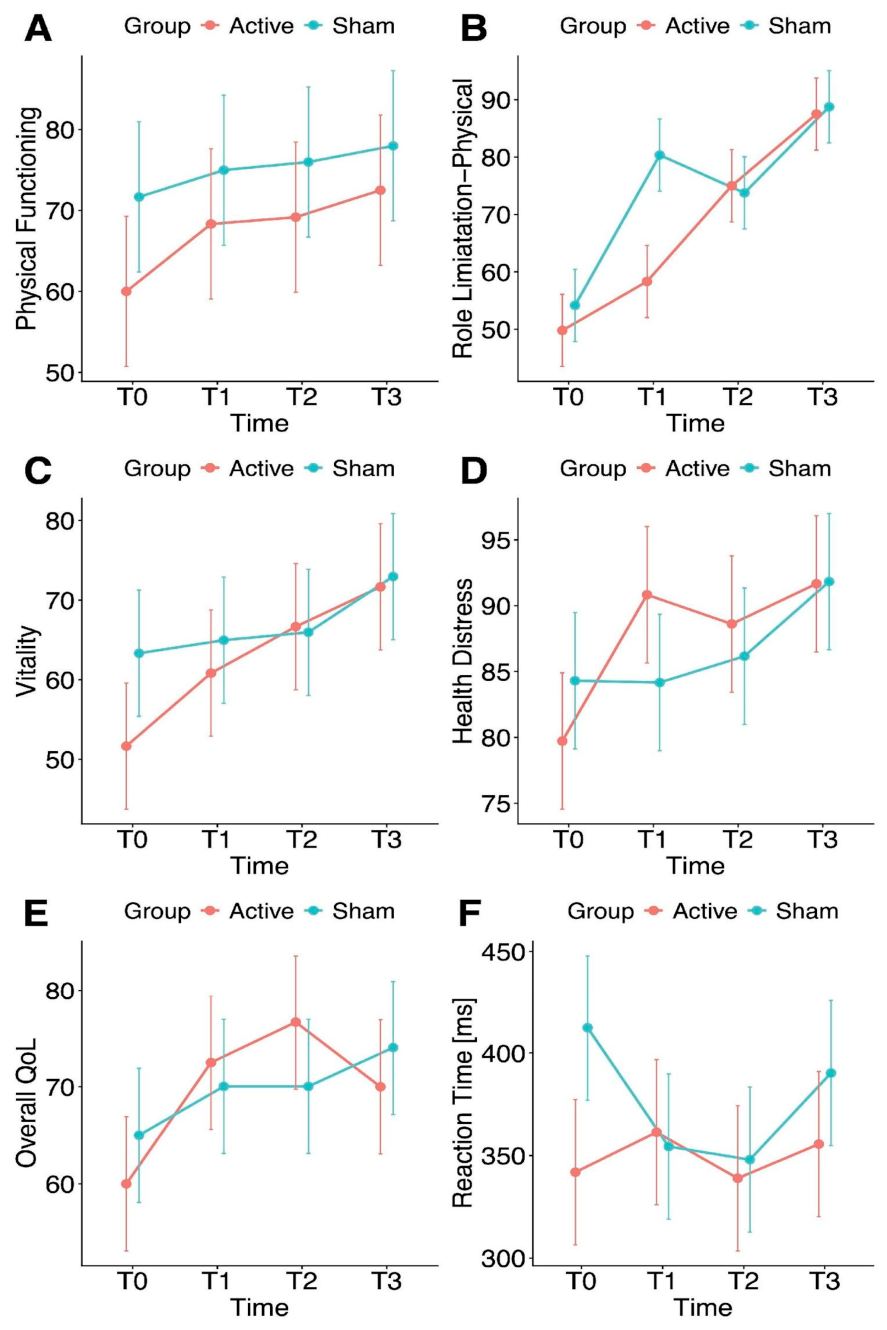
| Active | MoCA | 25.50 ± 2.74 | 25.83 ± 1.94 | 24.67 ± 2.34 | 26.33 ± 1.97 |
| SDMT | 42.67 ± 6.74 | 47.83 ± 8.68 | 46.50 ± 7.89 | 44.50 ± 6.35 | |
| PCT-Valid | 371.42 ± 86.40 | 369.24 ± 120.11 | 352.06 ± 79.69 | 352.83 ± 88.42 | |
| PCT-Invalid | 341.92 ± 63.40 | 361.40 ± 103.01 | 338.94 ± 60.85 | 356.45 ± 78.98 | |
| BDI-II | 4.17 ± 4.36 | 1.83 ± 1.72 | 2.50 ± 3.21 | 2.83 ± 2.71 | |
| SF-36 | |||||
| Physical Functioning | 60.00 ± 25.88 | 68.33 ± 25.03 | 69.17 ± 23.11 | 72.50 ± 24.85 | |
| Social Functioning | 68.67 ± 15.19 | 79.00 ± 16.98 | 87.50 ± 20.92 | 85.17 ± 14.74 | |
| Bodily Pain | 89.67 ± 12.42 | 88.00 ± 13.91 | 88.67 ± 19.66 | 95.67 ± 10.61 | |
| Role Limitations–Emotional | 83.33 ± 40.82 | 88.83 ± 27.35 | 94.33 ± 13.88 | 88.67 ± 17.56 | |
| Role Limitations–Physical | 50.00 ± 39.53 | 58.33 ± 25.82 | 75.00 ± 22.36 | 87.50 ± 13.69 | |
| General Health | 49.50 ± 27.54 | 45.40 ± 23.38 | 52.17 ± 18.29 | 55.17 ± 25.86 | |
| Mental Health | 74.00 ± 15.95 | 77.33 ± 17.47 | 86.00 ± 11.52 | 79.83 ± 13.45 | |
| Vitality | 60.00 ± 25.88 | 60.83 ± 21.78 | 66.67 ± 22.29 | 71.67 ± 23.38 | |
| MSQOL-29 | |||||
| Overall QoL | 60.00 ± 16.73 | 72.50 ± 17.25 | 76.67 ± 20.66 | 70.00 ± 20.98 | |
| Change in Health | 50.00 ± 41.83 | 66.67 ± 30.28 | 75.00 ± 31.62 | 54.17 ± 33.23 | |
| Cognitive Functioning | 72.78 ± 13.65 | 80.56 ± 13.44 | 80.28 ± 10.77 | 86.95 ± 9.27 | |
| Emotional Well-being | 70.00 ± 10.06 | 69.72 ± 24.35 | 75.00 ± 13.58 | 82.22 ± 13.81 | |
| Energy | 56.95 ± 15.29 | 65.28 ± 28.59 | 70.83 ± 22.20 | 69.44 ± 22.77 | |
| Health Perceptions | 38.89 ± 25.09 | 33.33 ± 29.81 | 44.44 ± 40.37 | 50.00 ± 27.89 | |
| Health Distress | 79.72 ± 17.24 | 90.83 ± 12.19 | 88.61 ± 11.37 | 91.67 ± 14.26 | |
| Bodily Pain | 76.95 ± 23.41 | 78.61 ± 21.87 | 82.50 ± 27.36 | 88.61 ± 17.65 | |
| Physical Functioning | 65.28 ± 31.37 | 76.39 ± 22.00 | 70.83 ± 28.26 | 73.61 ± 23.22 | |
| Sexual Functioning | 5.56 ± 8.61 | 5.56 ± 10.09 | 8.33 ± 16.67 | 6.94 ± 13.35 | |
| Social Functioning | 79.17 ± 18.82 | 79.17 ± 18.82 | 87.50 ± 20.92 | 83.33 ± 20.41 | |
| Sham | MoCA | 26.00 ± 2.10 | 25.60 ± 2.88 | 24.80 ± 2.59 | 26.20 ± 2.17 |
| SDMT | 41.83 ± 8.23 | 49.20 ± 6.98 | 47.80 ± 8.56 | 49.60 ± 10.14 | |
| PCT-Valid | 380.97 ± 71.39 | 349.54 ± 51.83 | 355.14 ± 86.48 | 347.65 ± 70.48 | |
| PCT-Invalid | 412.35 ± 152.13 | 355.57 ± 115.82 | 349.18 ± 94.57 | 391.42 ± 146.19 | |
| BDI-II | 4.83 ± 3.82 | 3.20 ± 3.96 | 4.00 ± 5.05 | 3.20 ± 2.59 | |
| SF-36 | |||||
| Physical Functioning | 71.67 ± 27.87 | 77.00 ± 21.97 | 78.00 ± 34.10 | 80.00 ± 23.08 | |
| Social Functioning | 85.33 ± 16.75 | 84.80 ± 16.45 | 85.00 ± 22.36 | 89.80 ± 10.52 | |
| Bodily Pain | 83.67 ± 26.08 | 88.80 ± 16.35 | 100.00 ± 0.00 | 100.00 ± 0.00 | |
| Role Limitations–Emotional | 72.17 ± 44.36 | 66.60 ± 47.20 | 80.00 ± 44.72 | 100.00 ± 0.00 | |
| Role Limitations–Physical | 54.17 ± 36.80 | 81.60 ± 29.25 | 75.00 ± 25.00 | 90.00 ± 13.69 | |
| General Health | 54.00 ± 20.38 | 57.00 ± 29.38 | 56.20 ± 23.41 | 65.00 ± 22.27 | |
| Mental Health | 77.33 ± 17.83 | 78.40 ± 17.34 | 80.00 ± 16.73 | 84.00 ± 17.20 | |
| Vitality | 63.33 ± 17.51 | 64.00 ± 22.75 | 65.00 ± 27.84 | 72.00 ± 31.74 | |
| MSQOL-29 | |||||
| Overall QoL | 65.00 ± 13.78 | 69.00 ± 15.17 | 69.00 ± 21.91 | 73.00 ± 27.75 | |
| Change in Health | 54.17 ± 18.82 | 75.00 ± 25.00 | 60.00 ± 41.83 | 65.00 ± 33.54 | |
| Cognitive Functioning | 75.28 ± 15.14 | 78.00 ± 12.99 | 79.67 ± 14.55 | 76.33 ± 16.52 | |
| Emotional Well-being | 73.61 ± 13.23 | 75.00 ± 17.56 | 76.33 ± 14.50 | 80.67 ± 14.41 | |
| Energy | 59.72 ± 22.62 | 66.67 ± 22.82 | 61.67 ± 29.81 | 71.67 ± 28.63 | |
| Health Perceptions | 33.33 ± 29.81 | 60.00 ± 27.89 | 60.00 ± 43.46 | 53.33 ± 38.01 | |
| Health Distress | 84.30 ± 16.85 | 83.67 ± 14.16 | 85.67 ± 20.33 | 91.33 ± 13.25 | |
| Bodily Pain | 82.78 ± 19.17 | 89.00 ± 20.26 | 89.33 ± 16.77 | 84.00 ± 21.94 | |
| Physical Functioning | 68.06 ± 22.00 | 78.33 ± 22.52 | 68.33 ± 32.49 | 81.67 ± 20.75 | |
| Sexual Functioning | 12.50 ± 13.69 | 10.00 ± 14.91 | 6.67 ± 9.13 | 10.00 ± 14.91 | |
| Social Functioning | 62.50 ± 34.46 | 75.00 ± 25.00 | 75.00 ± 35.36 | 80.00 ± 20.92 |
Disclaimer/Publisher’s Note: The statements, opinions and data contained in all publications are solely those of the individual author(s) and contributor(s) and not of MDPI and/or the editor(s). MDPI and/or the editor(s) disclaim responsibility for any injury to people or property resulting from any ideas, methods, instructions or products referred to in the content. |
© 2026 by the authors. Licensee MDPI, Basel, Switzerland. This article is an open access article distributed under the terms and conditions of the Creative Commons Attribution (CC BY) license.
Share and Cite
Campo, C.; Saccenti, D.; De Sandi, A.; Mellace, D.; Mrakic-Sposta, S.; Marceglia, S.; Vergari, M.; Arighi, A.; Priori, A.; Ferrucci, R. Effects of Transcutaneous Spinal Direct Current Stimulation on Cognitive and Psychological Outcomes in Multiple Sclerosis: A Preliminary Case Series. Biomedicines 2026, 14, 1156. https://doi.org/10.3390/biomedicines14051156
Campo C, Saccenti D, De Sandi A, Mellace D, Mrakic-Sposta S, Marceglia S, Vergari M, Arighi A, Priori A, Ferrucci R. Effects of Transcutaneous Spinal Direct Current Stimulation on Cognitive and Psychological Outcomes in Multiple Sclerosis: A Preliminary Case Series. Biomedicines. 2026; 14(5):1156. https://doi.org/10.3390/biomedicines14051156
Chicago/Turabian StyleCampo, Carmelo, Daniele Saccenti, Angelica De Sandi, Denise Mellace, Simona Mrakic-Sposta, Sara Marceglia, Maurizio Vergari, Andrea Arighi, Alberto Priori, and Roberta Ferrucci. 2026. "Effects of Transcutaneous Spinal Direct Current Stimulation on Cognitive and Psychological Outcomes in Multiple Sclerosis: A Preliminary Case Series" Biomedicines 14, no. 5: 1156. https://doi.org/10.3390/biomedicines14051156
APA StyleCampo, C., Saccenti, D., De Sandi, A., Mellace, D., Mrakic-Sposta, S., Marceglia, S., Vergari, M., Arighi, A., Priori, A., & Ferrucci, R. (2026). Effects of Transcutaneous Spinal Direct Current Stimulation on Cognitive and Psychological Outcomes in Multiple Sclerosis: A Preliminary Case Series. Biomedicines, 14(5), 1156. https://doi.org/10.3390/biomedicines14051156