Can Music Therapy Improve Cognition in Dementia as Measured with Magnetoencephalography: A Hypothesis Study
 , , and
Abstract
1. Introduction
1.1. Executive Functions, Neural Networks, and Dementia
1.2. Improving Working Memory and Executive Functioning Performance in Dementia
1.3. Applying Music Therapy to Improve Working Memory and Executive Functioning in Dementia
1.4. Present Study
2. Materials and Methods
2.1. Behavioural Measures
2.2. Music Therapy Procedure
2.3. N-Back Task
2.4. Magnetoencephalography
2.5. Structural T1 MRI Acquisition
2.6. Magnetoencephalography Analysis
2.6.1. Pre-Processing
2.6.2. Connectivity
2.6.3. Statistics
3. Results
3.1. SMMSE and N-Back Task
3.2. Comparisons of N-Back Scores Between Dementia and Control Groups
3.3. Standard Detection Theory Sensitivity Measure d’
3.4. Reliable Change Statistic: SMMSE and the N-Back Task
3.5. Magnetoencephalography
3.5.1. Theta
3.5.2. Alpha
3.5.3. Beta
3.5.4. Gamma
4. Discussion
4.1. RCI Statistic for the SMMSE
4.2. N-Back Task
4.3. RCI Statistic for the N-Back Task
4.4. Neural Connectivity
4.5. Connectivity Differences Before and After Music Therapy
4.6. Connectivity Differences in Theta, Alpha, Beta, and Gamma Frequency Bands
4.6.1. Theta
4.6.2. Alpha
4.6.3. Beta
4.6.4. Gamma
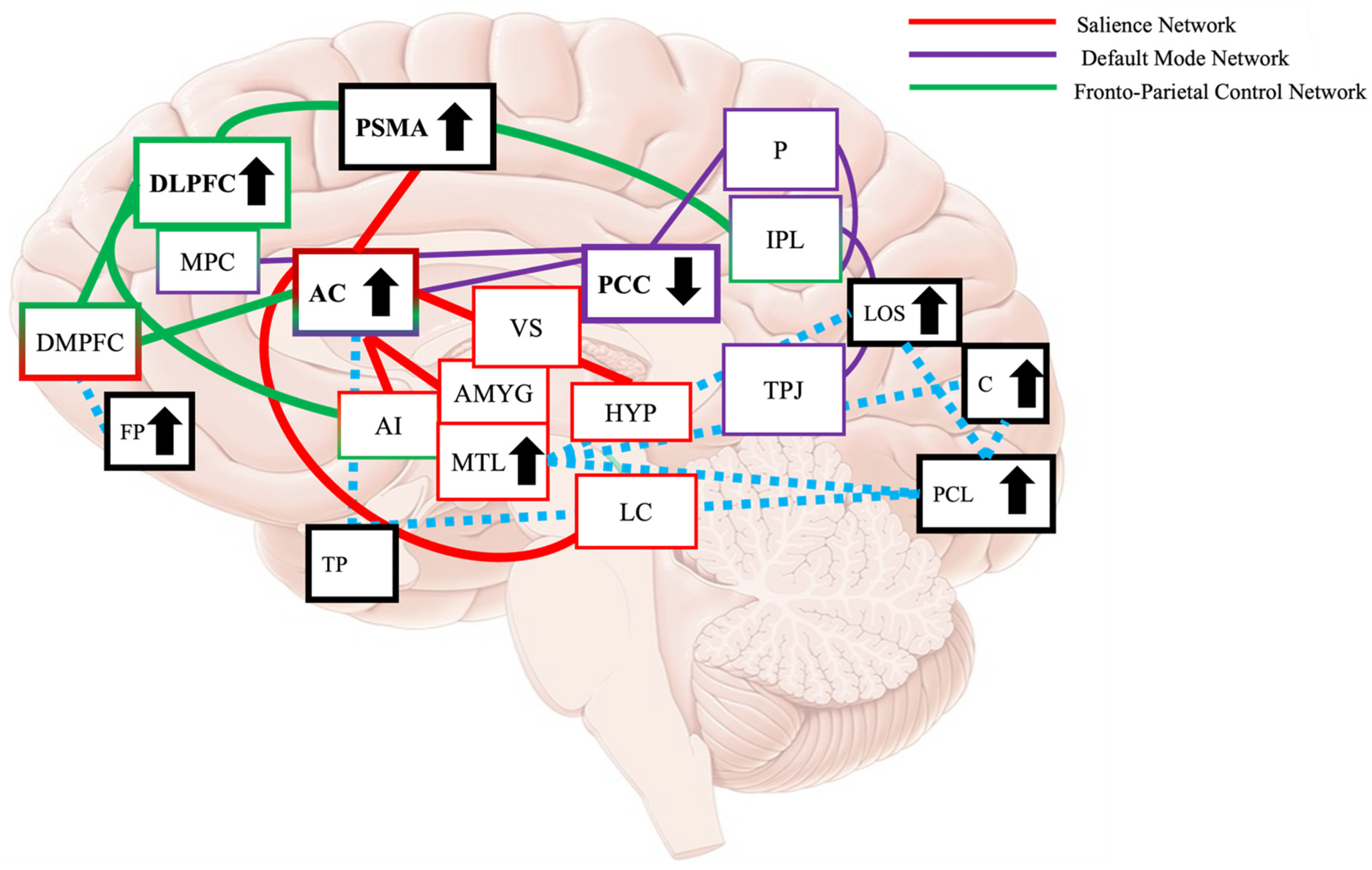
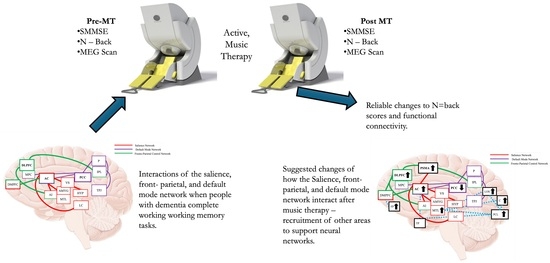
4.7. Proposed Model of How Music Therapy Changes Connectivity
5. Conclusions
Supplementary Materials
Author Contributions
Funding
Institutional Review Board Statement
Informed Consent Statement
Data Availability Statement
Acknowledgments
Conflicts of Interest
References
- Livingston, G.; Huntley, J.; Liu, K.Y.; Costafreda, S.G.; Selbæk, G.; Alladi, S.; Ames, D.; Banerjee, S.; Burns, A.; Brayne, C.; et al. Dementia prevention, intervention, and care: 2024 report of the Lancet standing Commission. Lancet 2024, 404, 572–628. [Google Scholar] [CrossRef] [PubMed]
- Nichols, E.; Steinmetz, J.D.; Vollset, S.E.; Fukutaki, K.; Chalek, J.; Abd-Allah, F.; Abdoli, A.; Abualhasan, A.; Abu-Gharbieh, E.; Akram, T.T.; et al. Estimation of the global prevalence of dementia in 2019 and forecasted prevalence in 2050: An analysis for the Global Burden of Disease Study 2019. Lancet Public Health 2022, 7, e105–e125. [Google Scholar] [CrossRef]
- Cao, Q.; Tan, C.-C.; Xu, W.; Hu, H.; Cao, X.-P.; Dong, Q.; Tan, L.; Yu, J.-T.; Zhu, L.-Q. The Prevalence of Dementia: A Systematic Review and Meta-Analysis. J. Alzheimer’s Dis. 2020, 73, 1157–1166. [Google Scholar] [CrossRef] [PubMed]
- Shin, J.-H. Dementia Epidemiology Fact Sheet 2022. Arm 2022, 46, 53–59. [Google Scholar] [CrossRef]
- Zagórska, A.; Czopek, A.; Fryc, M.; Jaromin, A.; Boyd, B.J. Drug Discovery and Development Targeting Dementia. Pharmaceuticals 2023, 16, 151. [Google Scholar] [CrossRef]
- Green, C.; Handels, R.; Gustavsson, A.; Wimo, A.; Winblad, B.; Sköldunger, A.; Jönsson, L. Assessing cost-effectiveness of early intervention in Alzheimer’s disease: An open-source modeling framework. Alzheimer’s Dement. 2019, 15, 1309–1321. [Google Scholar] [CrossRef]
- Fusar-Poli, L.; Bieleninik, Ł.; Brondino, N.; Chen, X.-J.; Gold, C. The effect of music therapy on cognitive functions in patients with dementia: A systematic review and meta-analysis. Aging Ment. Health 2018, 22, 1097–1106. [Google Scholar] [CrossRef]
- Lam, H.L.; Li, W.T.V.; Laher, I.; Wong, R.G.Y. Effects of Music Therapy on Patients with Dementia—A Systematic Review. Geriatrics 2020, 5, 62. [Google Scholar] [CrossRef]
- Cabeza, R.; Albert, M.; Belleville, S.; Craik, F.I.M.; Duarte, A.; Grady, C.L.; Lindenberger, U.; Nyberg, L.; Park, D.C.; Reuter-Lorenz, P.A.; et al. Maintenance, reserve and compensation: The cognitive neuroscience of healthy ageing. Nat. Rev. Neurosci. 2018, 19, 701–710. [Google Scholar] [CrossRef]
- Watanabe, H.; Bagarinao, E.; Maesawa, S.; Hara, K.; Kawabata, K.; Ogura, A.; Ohdake, R.; Shima, S.; Mizutani, Y.; Ueda, A.; et al. Characteristics of Neural Network Changes in Normal Aging and Early Dementia. Front. Aging Neurosci. 2021, 13, 747359. [Google Scholar] [CrossRef] [PubMed]
- Pusil, S.; López, M.E.; Cuesta, P.; Bruña, R.; Pereda, E.; Maestú, F. Hypersynchronization in mild cognitive impairment: The ‘X’ model. Brain 2019, 142, 3936–3950. [Google Scholar] [CrossRef]
- Teipel, S.; Grothe, M.J.; Zhou, J.; Sepulcre, J.; Dyrba, M.; Sorg, C.; Babiloni, C. Measuring Cortical Connectivity in Alzheimer’s Disease as a Brain Neural Network Pathology: Toward Clinical Applications. J. Int. Neuropsychol. Soc. 2016, 22, 138–163. [Google Scholar] [CrossRef]
- Zhao, Q.; Sang, X.; Metmer, H.; Swati, Z.n.N.K.; Lu, J. Functional segregation of executive control network and frontoparietal network in Alzheimer’s disease. Cortex 2019, 120, 36–48. [Google Scholar] [CrossRef]
- Huntley, J.D.; Hampshire, A.; Bor, D.; Owen, A.; Howard, R.J. Adaptive working memory strategy training in early Alzheimer’s disease: Randomised controlled trial. Br. J. Psychiatry 2017, 210, 61–66. [Google Scholar] [CrossRef] [PubMed]
- Kallio, E.-L.; Öhman, H.; Kautiainen, H.; Hietanen, M.; Pitkälä, K. Cognitive Training Interventions for Patients with Alzheimer’s Disease: A Systematic Review. J. Alzheimer’s Dis. 2017, 56, 1349–1372. [Google Scholar] [CrossRef]
- Chirles, T.J.; Reiter, K.; Weiss, L.R.; Alfini, A.J.; Nielson, K.A.; Smith, J.C. Exercise Training and Functional Connectivity Changes in Mild Cognitive Impairment and Healthy Elders. J. Alzheimer’s Dis. 2017, 57, 845–856. [Google Scholar] [CrossRef]
- Shimizu, N.; Umemura, T.; Matsunaga, M.; Hirai, T. Effects of movement music therapy with a percussion instrument on physical and frontal lobe function in older adults with mild cognitive impairment: A randomized controlled trial. Aging Ment. Health 2018, 22, 1614–1626. [Google Scholar] [CrossRef]
- Cole, M.W.; Reynolds, J.R.; Power, J.D.; Repovs, G.; Anticevic, A.; Braver, T.S. Multi-task connectivity reveals flexible hubs for adaptive task control. Nat. Neurosci. 2013, 16, 1348–1355. [Google Scholar] [CrossRef] [PubMed]
- Sheffield, J.M.; Repovs, G.; Harms, M.P.; Carter, C.S.; Gold, J.M.; MacDonald, A.W., III; Daniel Ragland, J.; Silverstein, S.M.; Godwin, D.; Barch, D.M. Fronto-parietal and cingulo-opercular network integrity and cognition in health and schizophrenia. Neuropsychologia 2015, 73, 82–93. [Google Scholar] [CrossRef] [PubMed]
- Varela-López, B.; Zurrón, M.; Lindín, M.; Díaz, F.; Galdo-Alvarez, S. Compensation versus deterioration across functional networks in amnestic mild cognitive impairment subtypes. GeroScience 2025, 47, 1805–1822. [Google Scholar] [CrossRef]
- Christophel, T.B.; Klink, P.C.; Spitzer, B.; Roelfsema, P.R.; Haynes, J.-D. The Distributed Nature of Working Memory. Trends Cogn. Sci. 2017, 21, 111–124. [Google Scholar] [CrossRef] [PubMed]
- Lee, T.-H.; Kim, S.H.; Katz, B.; Mather, M. The Decline in Intrinsic Connectivity Between the Salience Network and Locus Coeruleus in Older Adults: Implications for Distractibility. Front. Aging Neurosci. 2020, 12, 2. [Google Scholar] [CrossRef] [PubMed]
- Stopford, C.L.; Thompson, J.C.; Neary, D.; Richardson, A.M.T.; Snowden, J.S. Working memory, attention, and executive function in Alzheimer’s disease and frontotemporal dementia. Cortex 2012, 48, 429–446. [Google Scholar] [CrossRef]
- Belleville, S.; Rouleau, N.; Van der Linden, M.; Collette, F. Effect of manipulation and irrelevant noise on working memory capacity of patients with Alzheimer’s dementia. Neuropsychology 2003, 17, 69–81. [Google Scholar] [CrossRef]
- Koshino, H.; Minamoto, T.; Yaoi, K.; Osaka, M.; Osaka, N. Coactivation of the Default Mode Network regions and Working Memory Network regions during task preparation. Sci. Rep. 2014, 4, 5954. [Google Scholar] [CrossRef]
- Persson, J.; Lustig, C.; Nelson, J.K.; Reuter-Lorenz, P.A. Age Differences in Deactivation: A Link to Cognitive Control? J. Cogn. Neurosci. 2007, 19, 1021–1032. [Google Scholar] [CrossRef]
- Weissman, D.H.; Roberts, K.C.; Visscher, K.M.; Woldorff, M.G. The neural bases of momentary lapses in attention. Nat. Neurosci. 2006, 9, 971–978. [Google Scholar] [CrossRef]
- Marek, S.; Dosenbach, N.U.F. The frontoparietal network: Function, electrophysiology, and importance of individual precision mapping. Dialogues Clin. Neurosci. 2018, 20, 133–140. [Google Scholar] [CrossRef]
- Rottschy, C.; Langner, R.; Dogan, I.; Reetz, K.; Laird, A.R.; Schulz, J.B.; Fox, P.T.; Eickhoff, S.B. Modelling neural correlates of working memory: A coordinate-based meta-analysis. Neuroimage 2012, 60, 830–846. [Google Scholar] [CrossRef] [PubMed]
- Agosta, F.; Pievani, M.; Geroldi, C.; Copetti, M.; Frisoni, G.B.; Filippi, M. Resting state fMRI in Alzheimer’s disease: Beyond the default mode network. Neurobiol. Aging 2012, 33, 1564–1578. [Google Scholar] [CrossRef]
- Lim, H.-K.; Juh, R.; Pae, C.-U.; Lee, B.-T.; Yoo, S.-S.; Ryu, S.-H.; Kwak, K.-R.; Lee, C.; Lee, C.-U. Altered Verbal Working Memory Process in Patients with Alzheimer’s Disease. Neuropsychobiology 2008, 57, 181–187. [Google Scholar] [CrossRef]
- Seeley, W.W. Divergent Network Connectivity Changes in Healthy APOE ε4 Carriers: Disinhibition or Compensation? Arch. Neurol. 2011, 68, 1107–1108. [Google Scholar] [CrossRef]
- Menon, V.; Uddin, L.Q. Saliency, switching, attention and control: A network model of insula function. Brain Struct. Funct. 2010, 214, 655–667. [Google Scholar] [CrossRef]
- Seeley, W.W. The Salience Network: A Neural System for Perceiving and Responding to Homeostatic Demands. J. Neurosci. 2019, 39, 9878–9882. [Google Scholar] [CrossRef] [PubMed]
- Unsworth, N.; Robison, M.K. A locus coeruleus-norepinephrine account of individual differences in working memory capacity and attention control. Psychon. Bull. Rev. 2017, 24, 1282–1311. [Google Scholar] [CrossRef]
- Zhou, J.; Greicius, M.D.; Gennatas, E.D.; Growdon, M.E.; Jang, J.Y.; Rabinovici, G.D.; Kramer, J.H.; Weiner, M.; Miller, B.L.; Seeley, W.W. Divergent network connectivity changes in behavioural variant frontotemporal dementia and Alzheimer’s disease. Brain 2010, 133, 1352–1367. [Google Scholar] [CrossRef]
- Menon, V. Large-scale brain networks and psychopathology: A unifying triple network model. Trends Cogn. Sci. 2011, 15, 483–506. [Google Scholar] [CrossRef] [PubMed]
- Stern, Y. What is cognitive reserve? Theory and research application of the reserve concept. J. Int. Neuropsychol. Soc. 2002, 8, 448–460. [Google Scholar] [CrossRef] [PubMed]
- Scarmeas, N.; Stern, Y. fMRI evidence of compensatory mechanisms in older adults at genetic risk for Alzheimer disease. Neurology 2005, 65, 1514–1515. [Google Scholar] [CrossRef]
- Reuter-Lorenz, P.A.; Park, D.C. Cognitive aging and the life course: A new look at the Scaffolding theory. Curr. Opin. Psychol. 2024, 56, 101781. [Google Scholar] [CrossRef]
- Clare, L.; Linden, D.E.J.; Woods, R.T.; Whitaker, R.; Evans, S.J.; Parkinson, C.H.; van Paasschen, J.; Nelis, S.M.; Hoare, Z.; Yuen, K.S.L.; et al. Goal-Oriented Cognitive Rehabilitation for People with Early-Stage Alzheimer Disease: A Single-Blind Randomized Controlled Trial of Clinical Efficacy. Am. J. Geriatr. Psychiatry 2010, 18, 928–939. [Google Scholar] [CrossRef]
- Wang, H.; He, W.; Wu, J.; Zhang, J.; Jin, Z.; Li, L. A coordinate-based meta-analysis of the n-back working memory paradigm using activation likelihood estimation. Brain Cogn. 2019, 132, 1–12. [Google Scholar] [CrossRef]
- Gajewski, P.D.; Hanisch, E.; Falkenstein, M.; Thönes, S.; Wascher, E. What Does the n-Back Task Measure as We Get Older? Relations Between Working-Memory Measures and Other Cognitive Functions Across the Lifespan. Front. Psychol. 2018, 9, 2208. [Google Scholar] [CrossRef] [PubMed]
- Öztekin, I.; McElree, B.; Staresina, B.P.; Davachi, L. Working Memory Retrieval: Contributions of the Left Prefrontal Cortex, the Left Posterior Parietal Cortex, and the Hippocampus. J. Cogn. Neurosci. 2009, 21, 581–593. [Google Scholar] [CrossRef]
- Fraga, F.J.; Mamani, G.Q.; Johns, E.; Tavares, G.; Falk, T.H.; Phillips, N.A. Early diagnosis of mild cognitive impairment and Alzheimer’s with event-related potentials and event-related desynchronization in N-back working memory tasks. Comput. Methods Programs Biomed. 2018, 164, 1–13. [Google Scholar] [CrossRef] [PubMed]
- Goodman, M.S.; Kumar, S.; Zomorrodi, R.; Ghazala, Z.; Cheam, A.S.M.; Barr, M.S.; Daskalakis, Z.J.; Blumberger, D.M.; Fischer, C.; Flint, A.; et al. Theta-Gamma Coupling and Working Memory in Alzheimer’s Dementia and Mild Cognitive Impairment. Front. Aging Neurosci. 2018, 10, 101. [Google Scholar] [CrossRef]
- Redondo, M.T.; Beltrán-Brotóns, J.L.; Reales, J.M.; Ballesteros, S. Executive functions in patients with Alzheimer’s disease, type 2 diabetes mellitus patients and cognitively healthy older adults. Exp. Gerontol. 2016, 83, 47–55. [Google Scholar] [CrossRef] [PubMed]
- Lustig, C.; Snyder, A.Z.; Bhakta, M.; Brien, K.C.; McAvoy, M.; Raichle, M.E.; Morris, J.C.; Buckner, R.L. Functional deactivations: Change with age and dementia of the Alzheimer type. Proc. Natl. Acad. Sci. USA 2003, 100, 14504. [Google Scholar] [CrossRef]
- Rombouts, S.A.; Barkhof, F.; Goekoop, R.; Stam, C.J.; Scheltens, P. Altered resting state networks in mild cognitive impairment and mild Alzheimer’s disease: An fMRI study. Hum. Brain Mapp. 2005, 26, 231–239. [Google Scholar] [CrossRef]
- Won, J.; Nielson, K.A.; Smith, J.C. Large-Scale Network Connectivity and Cognitive Function Changes After Exercise Training in Older Adults with Intact Cognition and Mild Cognitive Impairment. J. Alzheimer’s Dis. Rep. 2023, 7, 399–413. [Google Scholar] [CrossRef]
- Sitzer, D.I.; Twamley, E.W.; Jeste, D.V. Cognitive training in Alzheimer’s disease: A meta-analysis of the literature. Acta Psychiatr. Scand. 2006, 114, 75–90. [Google Scholar] [CrossRef] [PubMed]
- Miendlarzewska, E.; Trost, W. How musical training affects cognitive development: Rhythm, reward and other modulating variables. Front. Neurosci. 2014, 7, 279. [Google Scholar] [CrossRef] [PubMed]
- Bugos, J.A.; Perlstein, W.M.; McCrae, C.S.; Brophy, T.S.; Bedenbaugh, P.H. Individualized Piano Instruction enhances executive functioning and working memory in older adults. Aging Ment. Health 2007, 11, 464–471. [Google Scholar] [CrossRef] [PubMed]
- Bruer, R.A.; Spitznagel, E.; Cloninger, C.R. The temporal limits of cognitive change from music therapy in elderly persons with dementia or dementia-like cognitive impairment: A randomized controlled trial. J. Music Ther. 2007, 44, 308–328. [Google Scholar] [CrossRef]
- Maguire, L.E.; Wanschura, P.B.; Battaglia, M.M.; Howell, S.N.; Flinn, J.M. Participation in Active Singing Leads to Cognitive Improvements in Individuals with Dementia. J. Am. Geriatr. Soc. 2015, 63, 815–816. [Google Scholar] [CrossRef]
- Moussard, A.; Bigand, E.; Belleville, S.; Peretz, I. Music as an Aid to Learn New Verbal Information in Alzheimer’s Disease. Music Percpt. 2012, 29, 521–531. [Google Scholar] [CrossRef]
- Cuddy, L.L.; Duffin, J.M.; Gill, S.S.; Brown, C.L.; Sikka, R.; Vanstone, A.D. Memory for Melodies and Lyrics in Alzheimer’s Disease. Music Percept. 2012, 29, 479–491. [Google Scholar] [CrossRef]
- Simmons-Stern, N.R.; Budson, A.E.; Ally, B.A. Music as a memory enhancer in patients with Alzheimer’s disease. Neuropsychologia 2010, 48, 3164–3167. [Google Scholar] [CrossRef]
- Satoh, M.; Yuba, T.; Tabei, K.; Okubo, Y.; Kida, H.; Sakuma, H.; Tomimoto, H. Music Therapy Using Singing Training Improves Psychomotor Speed in Patients with Alzheimer’s Disease: A Neuropsychological and fMRI Study. Dement. Geriatr. Cogn. Dis. Extra 2015, 5, 296–308. [Google Scholar] [CrossRef]
- Särkämö, T.; Tervaniemi, M.; Huotilainen, M. Music perception and cognition: Development, neural basis, and rehabilitative use of music. Wiley Interdiscip. Rev. Cogn. Sci. 2013, 4, 441–451. [Google Scholar] [CrossRef]
- Jacobsen, J.-H.; Stelzer, J.; Fritz, T.H.; Chételat, G.; Joie, R.L.; Turner, R.; La Joie, R. Why musical memory can be preserved in advanced Alzheimer’s disease. Brain 2015, 138, 2438–2450. [Google Scholar] [CrossRef] [PubMed]
- Chang, Y.-S.; Chu, H.; Yang, C.-Y.; Tsai, J.-C.; Chung, M.-H.; Liao, Y.-M.; Chi, M.-j.; Liu, M.F.; Chou, K.-R. The efficacy of music therapy for people with dementia: A meta-analysis of randomised controlled trials. J. Clin. Nurs. 2015, 24, 3425–3440. [Google Scholar] [CrossRef]
- Zhang, Y.; Cai, J.; An, L.; Hui, F.; Ren, T.; Ma, H.; Zhao, Q. Does music therapy enhance behavioral and cognitive function in elderly dementia patients? A systematic review and meta-analysis. Ageing Res Rev 2017, 35, 1–11. [Google Scholar] [CrossRef]
- Guetin, S.; Portet, F.; Picot, M.C.; Pommie, C.; Messaoudi, M.; Djabelkir, L.; Olsen, A.L.; Cano, M.M.; Lecourt, E.; Touchon, J. Effect of music therapy on anxiety and depression in patients with Alzheimer’s type dementia: Randomised, controlled study. Dement. Geriatr. Cogn. Disord. 2009, 28, 36–46. [Google Scholar] [CrossRef] [PubMed]
- Moreno-Morales, C.; Calero, R.; Moreno-Morales, P.; Pintado, C. Music Therapy in the Treatment of Dementia: A Systematic Review and Meta-Analysis. Front. Med. 2020, 7, 160. [Google Scholar] [CrossRef]
- Greicius, M.D.; Krasnow, B.; Reiss, A.L.; Menon, V. Functional connectivity in the resting brain: A network analysis of the default mode hypothesis. Proc. Natl. Acad. Sci. USA 2003, 100, 253–258. [Google Scholar] [CrossRef]
- Raichle, M.E. The Brain’s Default Mode Network. Annu. Rev. Neurosci. 2015, 38, 433–447. [Google Scholar] [CrossRef]
- Seeley, W.W.; Menon, V.; Schatzberg, A.F.; Keller, J.; Glover, G.H.; Kenna, H.; Reiss, A.L.; Greicius, M.D. Dissociable Intrinsic Connectivity Networks for Salience Processing and Executive Control. J. Neurosci. 2007, 27, 2349. [Google Scholar] [CrossRef]
- Vincent, J.L.; Kahn, I.; Snyder, A.Z.; Raichle, M.E.; Buckner, R.L. Evidence for a Frontoparietal Control System Revealed by Intrinsic Functional Connectivity. J. Neurophysiol. 2008, 100, 3328–3342. [Google Scholar] [CrossRef]
- Slade, B.; Williams, B.; Engelbrecht, R.; Ciorciari, J. Improving executive functioning and reducing the risk of Alzheimer’s disease with music therapy: A narrative review of potential neural mechanisms. J. Alzheimer’s Dis. 2025, 105, 319–330. [Google Scholar] [CrossRef] [PubMed]
- Molloy, D.W.; Standish, T.I.M. A Guide to the Standardized Mini-Mental State Examination. Int. Psychogeriatr. 1997, 9, 87–94. [Google Scholar] [CrossRef] [PubMed]
- Kelly, L.; Ahessy, B. Reminiscence-Focused Music Therapy to Promote Positive Mood and Engagement and Shared Interaction for People Living with Dementia: An Exploratory Study. Voices World Forum Music Ther. 2021, 1–27. [Google Scholar] [CrossRef]
- Kaufmann, E.G.; Engel, S.A. Dementia and well-being: A conceptual framework based on Tom Kitwood’s model of needs. Dementia 2016, 15, 774–788. [Google Scholar] [CrossRef] [PubMed]
- Merrill, R.H. The Doggie in the Window On My Jealous Eyes 1952. Mercury Record Lable. Available online: https://www.discogs.com/release/12410873-Patti-Page-My-Jealous-Eyes-The-Doggie-In-The-Window?srsltid=AfmBOopaeLrmBhadYK8kcMrhZFN1X-WegW6RzoZ6nuWZRk9Lq63MVT6T (accessed on 12 February 2026).
- Peirce, J.W. PsychoPy—Psychophysics software in Python. J. Neurosci. Methods 2007, 162, 8–13. [Google Scholar] [CrossRef] [PubMed]
- Stapleton-Kotloski, J.R.; Kotloski, R.J.; Popli, G.; Godwin, D.W. Magnetoencephalography: Clinical and Research Practices. Brain Sciences 2018, 8, 157. [Google Scholar] [CrossRef]
- Gramfort, A.; Luessi, M.; Larson, E.; Engemann, D.; Strohmeier, D.; Brodbeck, C.; Goj, R.; Jas, M.; Brooks, T.; Parkkonen, L.; et al. MEG and EEG data analysis with MNE-Python. Front. Neurosci. 2013, 7, 267. [Google Scholar] [CrossRef]
- Gramfort, A.; Luessi, M.; Larson, E.; Engemann, D.A.; Strohmeier, D.; Brodbeck, C.; Parkkonen, L.; Hämäläinen, M.S. MNE software for processing MEG and EEG data. Neuroimage 2014, 86, 446–460. [Google Scholar] [CrossRef]
- Neuromag. MaxFilter User’s Guide, 2.2. 2006. Available online: https://ohba-analysis.github.io/osl-docs/downloads/maxfilter_user_guide.pdf (accessed on 1 June 2020).
- Ishii, A.; Tanaka, M.; Shigihara, Y.; Kanai, E.; Funakura, M.; Watanabe, Y. Neural effects of prolonged mental fatigue: A magnetoencephalography study. Brain Res. 2013, 1529, 105–112. [Google Scholar] [CrossRef]
- Urbain, C.; Vogan, V.M.; Ye, A.X.; Pang, E.W.; Doesburg, S.M.; Taylor, M.J. Desynchronization of fronto-temporal networks during working memory processing in autism. Hum. Brain Mapp. 2016, 37, 153–164. [Google Scholar] [CrossRef]
- Yokota, Y.; Naruse, Y. Phase coherence of auditory steady-state response reflects the amount of cognitive workload in a modified N-back task. Neurosci. Res. 2015, 100, 39–45. [Google Scholar] [CrossRef]
- Jas, M.; Larson, E.; Engemann, D.A.; Leppäkangas, J.; Taulu, S.; Hämäläinen, M.; Gramfort, A. A Reproducible MEG/EEG Group Study with the MNE Software: Recommendations, Quality Assessments, and Good Practices. Front. Neurosci. 2018, 12, 530. [Google Scholar] [CrossRef]
- Hyvarinen, A. Fast and robust fixed-point algorithms for independent component analysis. IEEE Trans. Neural Netw. 1999, 10, 626–634. [Google Scholar] [CrossRef]
- Andersen, L.M. Group Analysis in MNE-Python of Evoked Responses from a Tactile Stimulation Paradigm: A Pipeline for Reproducibility at Every Step of Processing, Going from Individual Sensor Space Representations to an across-Group Source Space Representation. Front. Neurosci. 2018, 12, 6. [Google Scholar] [CrossRef]
- Garcés, P.; López-Sanz, D.; Maestú, F.; Pereda, E. Choice of Magnetometers and Gradiometers after Signal Space Separation. Sensors 2017, 17, 2926. [Google Scholar] [CrossRef] [PubMed]
- Vrba, J.; Robinson, S.E. SQUID sensor array configurations for magnetoencephalography applications. Supercond. Sci. Technol. 2002, 15, R51–R89. [Google Scholar] [CrossRef]
- Huang, M.-X.; Nichols, S.; Robb-Swan, A.; Angeles-Quinto, A.; Harrington, D.L.; Drake, A.; Huang, C.W.; Song, T.; Diwakar, M.; Risbrough, V.B.; et al. MEG Working Memory N-Back Task Reveals Functional Deficits in Combat-Related Mild Traumatic Brain Injury. Cereb. Cortex 2018, 29, 1953–1968. [Google Scholar] [CrossRef]
- Dale, A.M.; Liu, A.K.; Fischl, B.R.; Buckner, R.L.; Belliveau, J.W.; Lewine, J.D.; Halgren, E. Dynamic Statistical Parametric Mapping: Combining fMRI and MEG for High-Resolution Imaging of Cortical Activity. Neuron 2000, 26, 55–67. [Google Scholar] [CrossRef] [PubMed]
- Vinck, M.; Oostenveld, R.; van Wingerden, M.; Battaglia, F.; Pennartz, C.M.A. An improved index of phase-synchronization for electrophysiological data in the presence of volume-conduction, noise and sample-size bias. Neuroimage 2011, 55, 1548–1565. [Google Scholar] [CrossRef] [PubMed]
- Benjamini, Y.; Hochberg, Y. Controlling the False Discovery Rate: A Practical and Powerful Approach to Multiple Testing. J. R. Stat. Soc. Ser. B (Methodol.) 1995, 57, 289–300. [Google Scholar] [CrossRef]
- Storey, J.D. A Direct Approach to False Discovery Rates. J. R. Stat. Soc. Ser. B Stat. Methodol. 2002, 64, 479–498. [Google Scholar] [CrossRef]
- Stanislaw, H.; Todorov, N. Calculation of signal detection theory measures. Behav. Res. Methods Instrum. Comput. 1999, 31, 137–149. [Google Scholar] [CrossRef] [PubMed]
- Jacobson, N.S.; Truax, P. Clinical significance: A statistical approach to defining meaningful change in psychotherapy research. In Methodological Issues & Strategies in Clinical Research; American Psychological Association: Washington, DC, USA, 1992; pp. 631–648. [Google Scholar] [CrossRef]
- Jacobson, N.S.; Follette, W.C.; Revenstorf, D. Psychotherapy outcome research: Methods for reporting variability and evaluating clinical significance. Behav. Ther. 1984, 15, 336–352. [Google Scholar] [CrossRef]
- Christensen, L.; Mendoza, J.L. A method of assessing change in a single subject: An alteration of the RC index. Behav. Ther. 1986, 17, 305–308. [Google Scholar] [CrossRef]
- Soveri, A.; Lehtonen, M.; Karlsson, L.C.; Lukasik, K.; Antfolk, J.; Laine, M. Test–retest reliability of five frequently used executive tasks in healthy adults. Appl. Neuropsychol. Adult 2018, 25, 155–165. [Google Scholar] [CrossRef]
- Storey, J.D. The positive false discovery rate: A Bayesian interpretation and the q-value. Ann. Stat. 2003, 31, 2013–2035. [Google Scholar] [CrossRef]
- Reiss, P.T.; Schwartzman, A.; Lu, F.; Huang, L.; Proal, E. Paradoxical results of adaptive false discovery rate procedures in neuroimaging studies. Neuroimage 2012, 63, 1833–1840. [Google Scholar] [CrossRef]
- Choi, A.-N.; Lee, M.S.; Cheong, K.-J.; Lee, J.-S. Effects of Group Music Intervention on Behavioral and Psychological Symptoms in Patients with Dementia: A Pilot-Controlled Trial. Int. J. Neurosci. 2009, 119, 471–481. [Google Scholar] [CrossRef]
- Gallego, M.G.; Garcia, J.G. Music therapy and Alzheimer’s disease: Cognitive, psychological, and behavioural effects. Neurologia 2017, 32, 300–308. [Google Scholar] [CrossRef]
- Clark, P.A.; Tucke, S.S.; Whitlatch, C.J. Consistency of information from persons with dementia:An analysis of differences by question type. Dementia 2008, 7, 341–358. [Google Scholar] [CrossRef]
- Räihä, I.; Isoaho, R.; Ojanlatva, A.; Viramo, P.; Sulkava, R.; Kivelä, S.L. Poor performance in the Mini-Mental State Examination due to causes other than dementia. Scand. J. Prim. Health Care 2001, 19, 34–38. [Google Scholar] [CrossRef]
- Clark, C.M.; Sheppard, L.; Fillenbaum, G.G.; Galasko, D.; Morris, J.C.; Koss, E.; Mohs, R.; Heyman, A.; The CERAD Investigators. Variability in Annual Mini-Mental State Examination Score in Patients with Probable Alzheimer Disease: A Clinical Perspective of Data From the Consortium to Establish a Registry for Alzheimer’s Disease. Arch. Neurol. 1999, 56, 857–862. [Google Scholar] [CrossRef]
- Murali Doraiswamy, P.; Kaiser, L. Variability of the Mini-Mental State Examination in dementia. Neurology 2000, 54, 1538. [Google Scholar] [CrossRef]
- Escandon, A.; Al-Hammadi, N.; Galvin, J.E. Effect of cognitive fluctuation on neuropsychological performance in aging and dementia. Neurology 2010, 74, 210. [Google Scholar] [CrossRef]
- Ashida, S. The Effect of Reminiscence Music Therapy Sessions on Changes in Depressive Symptoms in Elderly Persons with Dementia. J. Music Ther. 2000, 37, 170–182. [Google Scholar] [CrossRef]
- Kydd, P. Using music therapy to help a client with Alzheimer’s disease adapt to long-term care. Am. J. Alzheimer’s Dis. Other Demen. 2001, 16, 103–108. [Google Scholar] [CrossRef]
- Manuel, A.L.; Foxe, D.; Bradshaw, N.; Cordato, N.J.; Hodges, J.R.; Burrell, J.R.; Piguet, O. Sustained attention failures on a 3-min reaction time task is a sensitive marker of dementia. J. Neurol. 2019, 266, 1323–1331. [Google Scholar] [CrossRef] [PubMed]
- Mather, M.; Harley, C.W. The Locus Coeruleus: Essential for Maintaining Cognitive Function and the Aging Brain. Trends Cogn. Sci. 2016, 20, 214–226. [Google Scholar] [CrossRef] [PubMed]
- Waltz, J.A.; Knowlton, B.J.; Holyoak, K.J.; Boone, K.B.; Back-Madruga, C.; McPherson, S.; Masterman, D.; Chow, T.; Cummings, J.L.; Miller, B.L. Relational Integration and Executive Function in Alzheimer’s Disease. Neuropsychology 2004, 18, 296–305. [Google Scholar] [CrossRef]
- Owen, A.M.; McMillan, K.M.; Laird, A.R.; Bullmore, E. N-back working memory paradigm: A meta-analysis of normative functional neuroimaging studies. Hum. Brain Mapp. 2005, 25, 46–59. [Google Scholar] [CrossRef] [PubMed]
- Tsvetanov, K.A.; Gazzina, S.; Jones, P.S.; van Swieten, J.; Borroni, B.; Sanchez-Valle, R.; Moreno, F.; Laforce, R., Jr.; Graff, C.; Synofzik, M.; et al. Brain functional network integrity sustains cognitive function despite atrophy in presymptomatic genetic frontotemporal dementia. Alzheimer’s Dement. 2021, 17, 500–514. [Google Scholar] [CrossRef]
- Merlo, S.; Spampinato, S.F.; Sortino, M.A. Early compensatory responses against neuronal injury: A new therapeutic window of opportunity for Alzheimer’s Disease? CNS Neurosci. Ther. 2019, 25, 5–13. [Google Scholar] [CrossRef] [PubMed]
- Costers, L.; Van Schependom, J.; Laton, J.; Baijot, J.; Sjøgård, M.; Wens, V.; De Tiège, X.; Goldman, S.; D’Haeseleer, M.; D’hooghe, M.B.; et al. Spatiotemporal and spectral dynamics of multi-item working memory as revealed by the n-back task using MEG. Hum. Brain Mapp. 2020, 41, 2431–2446. [Google Scholar] [CrossRef]
- Sauseng, P.; Griesmayr, B.; Freunberger, R.; Klimesch, W. Control mechanisms in working memory: A possible function of EEG theta oscillations. Neurosci. Biobehav. Rev. 2010, 34, 1015–1022. [Google Scholar] [CrossRef]
- Steiger, T.K.; Herweg, N.A.; Menz, M.M.; Bunzeck, N. Working memory performance in the elderly relates to theta-alpha oscillations and is predicted by parahippocampal and striatal integrity. Sci. Rep. 2019, 9, 706. [Google Scholar] [CrossRef]
- Wang, J.-R.; Hsieh, S. Neurofeedback training improves attention and working memory performance. Clin. Neurophysiol. 2013, 124, 2406–2420. [Google Scholar] [CrossRef]
- Asada, H.; Fukuda, Y.; Tsunoda, S.; Yamaguchi, M.; Tonoike, M. Frontal midline theta rhythms reflect alternative activation of prefrontal cortex and anterior cingulate cortex in humans. Neurosci. Lett. 1999, 274, 29–32. [Google Scholar] [CrossRef]
- Greicius, M.D.; Supekar, K.; Menon, V.; Dougherty, R.F. Resting-State Functional Connectivity Reflects Structural Connectivity in the Default Mode Network. Cereb. Cortex 2008, 19, 72–78. [Google Scholar] [CrossRef] [PubMed]
- Ruiz-Rizzo, A.L.; Beissner, F.; Finke, K.; Müller, H.J.; Zimmer, C.; Pasquini, L.; Sorg, C. Human subsystems of medial temporal lobes extend locally to amygdala nuclei and globally to an allostatic-interoceptive system. Neuroimage 2020, 207, 116404. [Google Scholar] [CrossRef] [PubMed]
- Anguera, J.A.; Boccanfuso, J.; Rintoul, J.L.; Al-Hashimi, O.; Faraji, F.; Janowich, J.; Kong, E.; Larraburo, Y.; Rolle, C.; Johnston, E.; et al. Video game training enhances cognitive control in older adults. Nature 2013, 501, 97–101. [Google Scholar] [CrossRef]
- Liu, H.; Qin, W.; Li, W.; Fan, L.; Wang, J.; Jiang, T.; Yu, C. Connectivity-Based Parcellation of the Human Frontal Pole with Diffusion Tensor Imaging. J. Neurosci. 2013, 33, 6782. [Google Scholar] [CrossRef]
- Córcoles-Parada, M.; Ubero-Martínez, M.; Morris, R.G.M.; Insausti, R.; Mishkin, M.; Muñoz-López, M. Frontal and Insular Input to the Dorsolateral Temporal Pole in Primates: Implications for Auditory Memory. Front. Neurosci. 2019, 13, 1099. [Google Scholar] [CrossRef]
- Nilssen, E.S.; Doan, T.P.; Nigro, M.J.; Ohara, S.; Witter, M.P. Neurons and networks in the entorhinal cortex: A reappraisal of the lateral and medial entorhinal subdivisions mediating parallel cortical pathways. Hippocampus 2019, 29, 1238–1254. [Google Scholar] [CrossRef]
- Owens, M.M.; Duda, B.; Sweet, L.H.; MacKillop, J. Distinct functional and structural neural underpinnings of working memory. Neuroimage 2018, 174, 463–471. [Google Scholar] [CrossRef]
- Olivetti Belardinelli, M.; Palmiero, M.; Sestieri, C.; Nardo, D.; Di Matteo, R.; Londei, A.; D’Ausilio, A.; Ferretti, A.; Del Gratta, C.; Romani, G.L. An fMRI investigation on image generation in different sensory modalities: The influence of vividness. Acta Psychol. 2009, 132, 190–200. [Google Scholar] [CrossRef]
- Coullon, G.S.L.; Emir, U.E.; Fine, I.; Watkins, K.E.; Bridge, H. Neurochemical changes in the pericalcarine cortex in congenital blindness attributable to bilateral anophthalmia. J. Neurophysiol. 2015, 114, 1725–1733. [Google Scholar] [CrossRef]
- Bergmann, J.; Genç, E.; Kohler, A.; Singer, W.; Pearson, J. Neural Anatomy of Primary Visual Cortex Limits Visual Working Memory. Cereb. Cortex 2014, 26, 43–50. [Google Scholar] [CrossRef] [PubMed]
- Pavlov, Y.G.; Kotchoubey, B. Oscillatory brain activity and maintenance of verbal and visual working memory: A systematic review. Psychophysiology 2022, 59, e13735. [Google Scholar] [CrossRef] [PubMed]
- Palomäki, J.; Kivikangas, M.; Alafuzoff, A.; Hakala, T.; Krause, C.M. Brain oscillatory 4–35Hz EEG responses during an n-back task with complex visual stimuli. Neurosci. Lett. 2012, 516, 141–145. [Google Scholar] [CrossRef] [PubMed]
- Lejko, N.; Larabi, D.I.; Herrmann, C.S.; Aleman, A.; Ćurčić-Blake, B. Alpha Power and Functional Connectivity in Cognitive Decline: A Systematic Review and Meta-Analysis. J. Alzheimer’s Dis. 2020, 78, 1047–1088. [Google Scholar] [CrossRef]
- Goldman, R.I.; Stern, J.M.; Engel, J., Jr.; Cohen, M.S. Simultaneous EEG and fMRI of the alpha rhythm. Neuroreport 2002, 13, 2487–2492. [Google Scholar] [CrossRef]
- Corbetta, M.; Patel, G.; Shulman, G.L. The Reorienting System of the Human Brain: From Environment to Theory of Mind. Neuron 2008, 58, 306–324. [Google Scholar] [CrossRef]
- Hellyer, P.J.; Shanahan, M.; Scott, G.; Wise, R.J.S.; Sharp, D.J.; Leech, R. The Control of Global Brain Dynamics: Opposing Actions of Frontoparietal Control and Default Mode Networks on Attention. J. Neurosci. 2014, 34, 451. [Google Scholar] [CrossRef] [PubMed]
- Hampshire, A.; Thompson, R.; Duncan, J.; Owen, A.M. Selective tuning of the right inferior frontal gyrus during target detection. Cogn. Affect. Behav. Neurosci. 2009, 9, 103–112. [Google Scholar] [CrossRef]
- Molnar-Szakacs, I.; Iacoboni, M.; Koski, L.; Mazziotta, J.C. Functional Segregation within Pars Opercularis of the Inferior Frontal Gyrus: Evidence from fMRI Studies of Imitation and Action Observation. Cereb. Cortex 2004, 15, 986–994. [Google Scholar] [CrossRef]
- Pijnenburg, Y.A.L.; vd Made, Y.; van Cappellen van Walsum, A.M.; Knol, D.L.; Scheltens, P.; Stam, C.J. EEG synchronization likelihood in mild cognitive impairment and Alzheimer’s disease during a working memory task. Clin. Neurophysiol. 2004, 115, 1332–1339. [Google Scholar] [CrossRef]
- Kim, S.; Park, E.; Cha, H.; Jung, J.-C.; Jung, T.-D.; Chang, Y. Effects of Cognitive Training in Mild Cognitive Impairmentmeasured by Resting State Functional Imaging. Behav. Sci. 2020, 10, 175. [Google Scholar] [CrossRef]
- Faraco, C.C.; Puente, A.N.; Brown, C.; Terry, D.P.; Stephen Miller, L. Lateral temporal hyper-activation as a novel biomarker of mild cognitive impairment. Neuropsychologia 2013, 51, 2281–2293. [Google Scholar] [CrossRef]
- Barense, M.D.; Bussey, T.J.; Lee, A.C.H.; Rogers, T.T.; Davies, R.R.; Saksida, L.M.; Murray, E.A.; Graham, K.S. Functional Specialization in the Human Medial Temporal Lobe. J. Neurosci. 2005, 25, 10239. [Google Scholar] [CrossRef] [PubMed][Green Version]
- Frisoni, G.B.; Laakso, M.P.; Beltramello, A.; Geroldi, C.; Bianchetti, A.; Soininen, H.; Trabucchi, M. Hippocampal and entorhinal cortex atrophy in frontotemporal dementia and Alzheimer’s disease. Neurology 1999, 52, 91. [Google Scholar] [CrossRef]
- Desikan, R.S.; Cabral, H.J.; Fischl, B.; Guttmann, C.R.G.; Blacker, D.; Hyman, B.T.; Albert, M.S.; Killiany, R.J. Temporoparietal MR Imaging Measures of Atrophy in Subjects with Mild Cognitive Impairment That Predict Subsequent Diagnosis of Alzheimer Disease. Am. J. Neuroradiol. 2009, 30, 532. [Google Scholar] [CrossRef] [PubMed]
- Dickerson, B.C.; Salat, D.H.; Bates, J.F.; Atiya, M.; Killiany, R.J.; Greve, D.N.; Dale, A.M.; Stern, C.E.; Blacker, D.; Albert, M.S.; et al. Medial temporal lobe function and structure in mild cognitive impairment. Ann. Neurol. 2004, 56, 27–35. [Google Scholar] [CrossRef] [PubMed]
- Qi, Z.; Wu, X.; Wang, Z.; Zhang, N.; Dong, H.; Yao, L.; Li, K. Impairment and compensation coexist in amnestic MCI default mode network. Neuroimage 2010, 50, 48–55. [Google Scholar] [CrossRef] [PubMed]
- Santangelo, V.; Bordier, C. Large-Scale Brain Networks Underlying Successful and Unsuccessful Encoding, Maintenance, and Retrieval of Everyday Scenes in Visuospatial Working Memory. Front. Psychol. 2019, 10, 233. [Google Scholar] [CrossRef]
- Diana, R.A.; Yonelinas, A.P.; Ranganath, C. Imaging recollection and familiarity in the medial temporal lobe: A three-component model. Trends Cogn. Sci. 2007, 11, 379–386. [Google Scholar] [CrossRef]
- Grady, C.L.; McIntosh, A.R.; Beig, S.; Keightley, M.L.; Burian, H.; Black, S.E. Evidence from Functional Neuroimaging of a Compensatory Prefrontal Network in Alzheimer’s Disease. J. Neurosci. 2003, 23, 986. [Google Scholar] [CrossRef] [PubMed]
- Becker, B.; Androsch, L.; Jahn, R.; Alich, T.; Striepens, N.; Markett, S.; Maier, W.; Hurlemann, R. Inferior frontal gyrus preserves working memory and emotional learning under conditions of impaired noradrenergic signaling. Front. Behav. Neurosci. 2013, 7, 197. [Google Scholar] [CrossRef]
- Kochan, N.A.; Breakspear, M.; Slavin, M.J.; Valenzuela, M.; McCraw, S.; Brodaty, H.; Sachdev, P.S. Functional Alterations in Brain Activation and Deactivation in Mild Cognitive Impairment in Response to a Graded Working Memory Challenge. Dement. Geriatr. Cogn. Disord. 2010, 30, 553–568. [Google Scholar] [CrossRef]
- La Joie, R.; Perrotin, A.; Barré, L.; Hommet, C.; Mézenge, F.; Ibazizene, M.; Camus, V.; Abbas, A.; Landeau, B.; Guilloteau, D.; et al. Region-Specific Hierarchy between Atrophy, Hypometabolism, and β-Amyloid (Aβ) Load in Alzheimer’s Disease Dementia. J. Neurosci. 2012, 32, 16265–16273. [Google Scholar] [CrossRef]
- Howard, M.W.; Rizzuto, D.S.; Caplan, J.B.; Madsen, J.R.; Lisman, J.; Aschenbrenner-Scheibe, R.; Schulze-Bonhage, A.; Kahana, M.J. Gamma Oscillations Correlate with Working Memory Load in Humans. Cereb. Cortex 2003, 13, 1369–1374. [Google Scholar] [CrossRef]
- Roux, F.; Wibral, M.; Mohr, H.M.; Singer, W.; Uhlhaas, P.J. Gamma-Band Activity in Human Prefrontal Cortex Codes for the Number of Relevant Items Maintained in Working Memory. J. Neurosci. 2012, 32, 12411–12420. [Google Scholar] [CrossRef]
- Bajo, R.; Maestú, F.; Nevado, A.; Sancho, M.; Gutiérrez, R.; Campo, P.; Castellanos, N.P.; Gil, P.; Moratti, S.; Pereda, E.; et al. Functional Connectivity in Mild Cognitive Impairment During a Memory Task: Implications for the Disconnection Hypothesis. J. Alzheimer’s Dis. 2010, 22, 183–193. [Google Scholar] [CrossRef]
- van Deursen, J.A.; Vuurman, E.F.P.M.; Verhey, F.R.J.; van Kranen-Mastenbroek, V.H.J.M.; Riedel, W.J. Increased EEG gamma band activity in Alzheimer’s disease and mild cognitive impairment. J. Neural Transm. 2008, 115, 1301–1311. [Google Scholar] [CrossRef]
- König, H.; König, H.H.; Konnopka, A. The excess costs of depression: A systematic review and meta-analysis. Epidemiol. Psychiatr. Sci. 2020, 29, e30. [Google Scholar] [CrossRef]
- Başar, E.; Femir, B.; Emek-Savaş, D.D.; Güntekin, B.; Yener, G.G. Increased long distance event-related gamma band connectivity in Alzheimer’s disease. NeuroImage Clin. 2017, 14, 580–590. [Google Scholar] [CrossRef]
- Palop, J.J.; Mucke, L. Network abnormalities and interneuron dysfunction in Alzheimer disease. Nat. Rev. Neurosci. 2016, 17, 777–792. [Google Scholar] [CrossRef] [PubMed]
- Akimoto, Y.; Nozawa, T.; Kanno, A.; Kambara, T.; Ihara, M.; Ogawa, T.; Goto, T.; Taki, Y.; Yokoyama, R.; Kotozaki, Y.; et al. High-gamma power changes after cognitive intervention: Preliminary results from twenty-one senior adult subjects. Brain Behav. 2016, 6, e00427. [Google Scholar] [CrossRef]
- Klados, M.A.; Styliadis, C.; Frantzidis, C.A.; Paraskevopoulos, E.; Bamidis, P.D. Beta-Band Functional Connectivity is Reorganized in Mild Cognitive Impairment after Combined Computerized Physical and Cognitive Training. Front. Neurosci. 2016, 10, 55. [Google Scholar] [CrossRef]
- Shigihara, Y.; Hoshi, H.; Shinada, K.; Okada, T.; Kamada, H. Non-pharmacological treatment changes brain activity in patients with dementia. Sci. Rep. 2020, 10, 6744. [Google Scholar] [CrossRef] [PubMed]
- Yaple, Z.A.; Stevens, W.D.; Arsalidou, M. Meta-analyses of the n-back working memory task: fMRI evidence of age-related changes in prefrontal cortex involvement across the adult lifespan. Neuroimage 2019, 196, 16–31. [Google Scholar] [CrossRef]
- Greicius, M.D.; Srivastava, G.; Reiss, A.L.; Menon, V. Default-mode network activity distinguishes Alzheimer’s disease from healthy aging: Evidence from functional MRI. Proc. Natl. Acad. Sci. USA 2004, 101, 4637–4642. [Google Scholar] [CrossRef] [PubMed]
- Hirt, J.; Beer, T.; Cavalli, S.; Cereghetti, S.; Pusterla, E.R.G.; Zeller, A. Recruiting Persons With Dementia: A Systematic Review of Facilitators, Barriers, and Strategies. Am. J. Alzheimer’s Dis. Other Dement. 2024, 39, 15333175241276443. [Google Scholar] [CrossRef] [PubMed]
- Afifi, T.D.; Burnham, C.E.; Collins, N.; Gonzales, C.; Ma, A.; Mazur, A.; Naffziger, E.E.; Rand, K.; Rosen, Y.; Salehuddin, A.; et al. Communicative and Methodological Challenges Related to Collecting Data with Older Adults with Dementia in Senior Living Communities During the COVID-19 Pandemic. Int. J. Aging Hum. Dev. 2025, 101, 90–111. [Google Scholar] [CrossRef]
- Goldberg, T.E.; Harvey, P.D.; Wesnes, K.A.; Snyder, P.J.; Schneider, L.S. Practice effects due to serial cognitive assessment: Implications for preclinical Alzheimer’s disease randomized controlled trials. Alzheimer’s Dement. Diagn. Assess. Dis. Monit. 2015, 1, 103–111. [Google Scholar] [CrossRef]
- Erkinjuntti, T. Clinical deficits of Alzheimer’s disease with cerebrovascular disease and probable VaD. Int. J. Clin. Pract. Suppl. 2001, 120, 14–23. [Google Scholar] [PubMed]
- Kalaria, R. Similarities between Alzheimer’s disease and vascular dementia. J. Neurol. Sci. 2002, 203–204, 29–34. [Google Scholar] [CrossRef]
- Ballard, C.; O’Brien, J.; Morris, C.M.; Barber, R.; Swann, A.; Neill, D.; McKeith, I. The progression of cognitive impairment in dementia with Lewy bodies, vascular dementia and Alzheimer’s disease. Int. J. Geriatr. Psychiatry 2001, 16, 499–503. [Google Scholar] [CrossRef]
- Pérez-Sáez, E.; Justo-Henriques, S.I.; Alves Apóstolo, J.L. Multicenter randomized controlled trial of the effects of individual reminiscence therapy on cognition, depression and quality of life: Analysis of a sample of older adults with Alzheimer’s disease and vascular dementia. Clin. Neuropsychol. 2022, 36, 1975–1996. [Google Scholar] [CrossRef] [PubMed]
- Serra, L.; Bruschini, M.; Di Domenico, C.; Mancini, M.; Bechi Gabrielli, G.; Bonarota, S.; Caltagirone, C.; Cercignani, M.; Marra, C.; Bozzali, M. Behavioral psychological symptoms of dementia and functional connectivity changes: A network-based study. Neurobiol. Aging 2020, 94, 196–206. [Google Scholar] [CrossRef]
- Martínez-Moreno, M.; Cerulla, N.; Chico, G.; Quintana, M.; Garolera, M. Comparison of neuropsychological and functional outcomes in Alzheimer’s disease patients with good or bad response to a cognitive stimulation treatment: A retrospective analysis. Int. Psychogeriatr. 2016, 28, 1821–1833. [Google Scholar] [CrossRef]
- Takahashi, T.; Matsushita, H. Long-term effects of music therapy on elderly with moderate/severe dementia. J. Music Ther. 2006, 43, 317–333. [Google Scholar] [CrossRef] [PubMed]
- van der Steen, J.T.; van der Wouden, J.C.; Methley, A.M.; Smaling, H.A.; Vink, A.C.; Bruinsma, M.S. Music-based therapeutic interventions for people with dementia. Cochrane Database Syst. Rev. 2017, 5, CD003477. [Google Scholar] [CrossRef]
- Reschke-Hernández, A.E.; Tranel, D. Strategies to enhance treatment fidelity and music-based intervention reporting in dementia research. Transl. Behav. Med. 2024, 14, 353–358. [Google Scholar] [CrossRef] [PubMed]
- Prinz, A.; Schumacher, A.; Witte, K. Influence of a multidimensional music-based exercise program on selected cognitive and motor skills in dementia patients—A pilot study. Ger. J. Exerc. Sport Res. 2021, 51, 495–505. [Google Scholar] [CrossRef] [PubMed]
- Johnson, L.; Deatrick, E.J.; Oriel, K. The Use of Music to Improve Exercise Participation in People with Dementia: A Pilot Study. Phys. Occup. Ther. Geriatr. 2012, 30, 102–108. [Google Scholar] [CrossRef]



| Gender | M | SD | ||
|---|---|---|---|---|
| M | F | |||
| Dementia Total | 2 | 4 | 86.3 | 6.62 |
| AD | 1 | 1 | ||
| Vascular Dementia | 1 | |||
| Dementia Unknown | 3 | |||
| Completed MEG scans | ||||
| Dementia Total | 2 | 2 | 83.5 | 6.35 |
| AD | 1 | 1 | ||
| Vascular Dementia | 1 | |||
| Dementia Unknown | 1 | |||
| Controls | 2 | 1 | 83 | 5 |
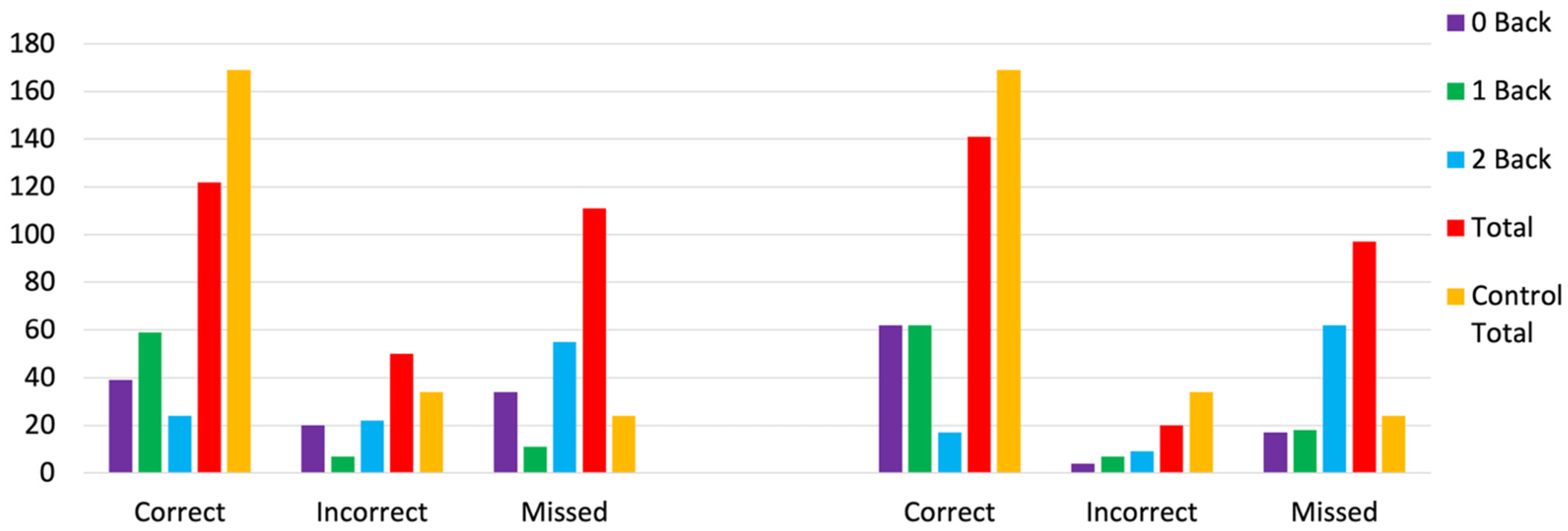
| Dementia | 0 Back | 1 Back | 2 Back | Total M | ||||
|---|---|---|---|---|---|---|---|---|
| M | SD | M | SD | M | SD | M | SD | |
| Before Therapy | ||||||||
| Correct | 39 | 28.1 | 59 | 25.7 | 24 | 16.8 | 122 | 49.9 |
| Incorrect | 20 | 25.2 | 7 | 6.83 | 22 | 24.1 | 50 | 24.4 |
| Missed | 34 | 27.5 | 11 | 10.2 | 55 | 17.1 | 111 | 25.7 |
| After Therapy | ||||||||
| Correct | 62 | 19.2 | 62 | 25.2 | 17 | 21.7 | 141 | 49.4 |
| Incorrect | 4 | 5.66 | 7 | 11.2 | 9 | 10.5 | 20 | 26.7 |
| Missed | 17 | 18.9 | 18 | 25.5 | 62 | 21.7 | 97 | 49.6 |
| Controls | ||||||||
| Correct | 74 | 4.72 | 70 | 8.96 | 25 | 11.84 | 169 | 14.04 |
| Incorrect | 8 | 9.71 | 17 | 23.86 | 9 | 6.81 | 34 | 30.35 |
| Missed | 6 | 4.72 | 9 | 9.24 | 43 | 11.72 | 24 | 6.11 |
| Before Music Therapy | After Music Therapy | t | df | p | W | pW | Z | pZ | Effect Size (d’) | CI | ||
|---|---|---|---|---|---|---|---|---|---|---|---|---|
| Lower | Upper | |||||||||||
| N-Back Task | ||||||||||||
| Overall Correct | - | Overall Correct | −1.375 | 3 | 0.263 | 0.859 | 0.256 | 2 | 0.375 | −0.624 | −1.758 | 0.464 |
| Overall Incorrect | - | Overall Incorrect | 1.701 | 3 | 0.187 | 0.894 | 0.402 | 9 | 0.250 | 0.850 | −0.38 | 1.982 |
| Overall Missed | - | Overall Missed | 0.640 | 3 | 0.566 | 0.851 | 0.228 | 6 | 0.875 | 0.32 | −0.712 | 1.308 |
| Dementia | Controls | |||||||||||
| Before Music Therapy | ||||||||||||
| Overall Correct | - | Overall Correct | −1.409 | 2 | 0.294 | 0.998 | 0.919 | 0.998 | 0.919 | −0.813 | −2.106 | 0.596 |
| Overall Incorrect | - | Overall Incorrect | 0.652 | 2 | 0.596 | 0.928 | 0.481 | 0.982 | 0.745 | 3.396 | 0.233 | 6.683 |
| Overall Missed | - | Overall Missed | 5.882 | 2 | 0.0028 | 0.982 | 0.745 | 0.829 | 0.185 | 0.361 | −0.854 | 1.502 |
| After Music Therapy | ||||||||||||
| Overall Correct | - | Overall Correct | −0.537 | 2 | 0.645 | 0.949 | 0.567 | 0.928 | 0.481 | −0.31 | −1.443 | 0.889 |
| Overall Incorrect | - | Overall Incorrect | −1.519 | 2 | 0.268 | 0.829 | 0.185 | 0.949 | 0.567 | −0.876 | −2.202 | 0.566 |
| Overall Missed | - | Overall Missed | 2.834 | 2 | 0.105 | 1.000 | 1.000 | 1 | 1 | 1.63 | −0.260 | 3.459 |
| 2-Back | 1-Back | 0-Back | ||||||||||
|---|---|---|---|---|---|---|---|---|---|---|---|---|
| Correct (%) | Incorrect (%) | Missed (%) | d′ | Correct (%) | Incorrect (%) | Missed (%) | d′ | Correct (%) | Incorrect (%) | Missed (%) | d′ | |
| Dementia Pre-intervention | ||||||||||||
| 1 | 19 (23.8) | 2 (1.7) | 60 (75.0) | 1.41 | 76 (95.0) | 2 (1.7) | 4 (5.00) | 3.77 | 20 (25.00) | 9 (7.5) | 60 (75.00) | 0.77 |
| 2 | 37 (46.3) | 54 (45.0) | 41 (51.3) | 0.03 | 77 (96.3) | 8 (6.7) | 1 (1.25) | 3.28 | 80 (100) | 8 (6.67) | 0 (0.00) | 3.74 |
| 3 | 2 (2.5) | 5 (4.2) | 77 (96.3) | −0.23 | 60 (75.0) | 0 (0.0) | 20 (25.00) | 3.82 | 21 (26.25) | 13 (10.83) | 58 (72.50) | 0.61 |
| 4 | 37 (46.3) | 27 (2.5) | 42 (52.5) | 0.66 | 22 (27.5) | 16 (13.3) | 56 (70.00) | 0.51 | 36 (45.00) | 6 (5.00) | 43 (53.75) | 1.53 |
| Dementia Post-intervention | ||||||||||||
| 1 | 1 (1.3) | 1 (0.8) | 78 (97.5) | 0.15 | 76 (95.0) | 3 (2.5) | 4 (5.00) | 3.60 | 79 (98.75) | 0 (0.00) | 1 (1.25) | 5.39 |
| 2 | 48 (60.0) | 7 (5.8) | 31 (38.8) | 1.82 | 73 (91.3) | 1 (0.8) | 6 (7.50) | 3.75 | 78 (97.50) | 0 (0.00) | 1 (1.25) | 5.10 |
| 3 | 3 (3.8) | 3 (2.5) | 76 (95.0) | 0.18 | 74 (92.5) | 1 (0.8) | 5 (6.25) | 3.83 | 48 (60.00) | 4 (3.33) | 31 (38.75) | 2.09 |
| 4 | 15 (18.8) | 24 (20.0) | 64 (80.0) | −0.05 | 24 (30.0) | 24 (20.0) | 56 (70.0) | 0.32 | 43 (53.75) | 12 (10.00) | 36 (45.00) | 1.38 |
| Control | ||||||||||||
| 1 | 11 (13.8) | 14 (11.7) | 68 (85.0) | 0.10 | 76 (95.0) | 6 (5.0) | 4 (5.00) | 3.29 | 69 (86.25) | 19 (15.83) | 11 (13.75) | 2.09 |
| 2 | 31 (38.8) | 11 (9.7) | 48 (60.0) | 1.04 | 75 (93.8) | 44 (36.7) | 4 (5.00) | 1.87 | 78 (97.5) | 6 (5.00) | 2 (2.50) | 3.60 |
| 3 | 32 (40.0) | 1 (0.8) | 52 (65.0) | 2.14 | 60 (75.0) | 0 (0.0) | 20 (25.00) | 3.82 | 76 (95.00) | 0 (0.00) | 4 (5.00) | 4.79 |
| Participant | SMMSE | ||||||||||
|---|---|---|---|---|---|---|---|---|---|---|---|
| 1 | −5.64 | ||||||||||
| 2 | 2.41 | ||||||||||
| 3 | −6.44 | ||||||||||
| 4 | 0 | ||||||||||
| 5 | 2.41 | ||||||||||
| 6 | −0.81 | ||||||||||
| N-Back Task | |||||||||||
| Participant | Correct | Incorrect | Missed | ||||||||
| 0 | 1 | 2 | Total | 0 | 1 | 2 | Total | 0 | 1 | 2 | |
| 2 | 4.96 | 2.57 | 0.18 | 7.71 | −9.92 | 0.18 | −0.36 | −10.10 | −4.53 | −2.61 | −0.17 |
| 3 | 1.28 | 0.36 | −4.04 | −1.8 | 1.10 | 1.47 | −0.73 | 1.83 | −2.02 | 6.61 | 4.04 |
| 4 | 10.84 | 0 | −3.31 | 7.53 | −1.65 | −0.18 | −0.18 | −2.01 | −11.76 | 0 | 3.30 |
| 5 | −0.36 | −0.72 | 2.20 | 0.91 | −1.47 | −1.28 | −8.63 | −11.39 | 0.18 | 0.91 | −1.81 |
| Participant | Frequency Band | |||
|---|---|---|---|---|
| Theta | Alpha | Beta | Gamma | |
| 2 | FDR | p-value | FDR | FDR |
| 3 | p-value | p-value | FDR | FDR |
| 4 | FDR | FDR | p-value | FDR |
| 5 | p-value | p-value | p-value | FDR |
Disclaimer/Publisher’s Note: The statements, opinions and data contained in all publications are solely those of the individual author(s) and contributor(s) and not of MDPI and/or the editor(s). MDPI and/or the editor(s) disclaim responsibility for any injury to people or property resulting from any ideas, methods, instructions or products referred to in the content. |
© 2026 by the authors. Licensee MDPI, Basel, Switzerland. This article is an open access article distributed under the terms and conditions of the Creative Commons Attribution (CC BY) license.
Share and Cite
Slade, B.; Williams, B.; Engelbrecht, R.; Woods, W.; Bhar, S.; Ciorciari, J. Can Music Therapy Improve Cognition in Dementia as Measured with Magnetoencephalography: A Hypothesis Study. Biomedicines 2026, 14, 452. https://doi.org/10.3390/biomedicines14020452
Slade B, Williams B, Engelbrecht R, Woods W, Bhar S, Ciorciari J. Can Music Therapy Improve Cognition in Dementia as Measured with Magnetoencephalography: A Hypothesis Study. Biomedicines. 2026; 14(2):452. https://doi.org/10.3390/biomedicines14020452
Chicago/Turabian StyleSlade, Benjamin, Benedict Williams, Romy Engelbrecht, Will Woods, Sunil Bhar, and Joseph Ciorciari. 2026. "Can Music Therapy Improve Cognition in Dementia as Measured with Magnetoencephalography: A Hypothesis Study" Biomedicines 14, no. 2: 452. https://doi.org/10.3390/biomedicines14020452
APA StyleSlade, B., Williams, B., Engelbrecht, R., Woods, W., Bhar, S., & Ciorciari, J. (2026). Can Music Therapy Improve Cognition in Dementia as Measured with Magnetoencephalography: A Hypothesis Study. Biomedicines, 14(2), 452. https://doi.org/10.3390/biomedicines14020452